
All About Forage AI
Forage AI is a fully managed data partner. You tell us the sources, the fields and the refresh you need, and we build the pipeline, check every field, and keep it running as those sources change underneath it.
Everything below is a question a buyer has actually asked us, answered plainly.
What is Forage AI?
An end-to-end managed data pipeline. Forage AI handles discovery, extraction, structuring, quality checks and delivery, built to your own fields and your own systems.
We have been running data pipelines for 12 years, with a team of over 100 data experts across more than 15 industries. To date that work covers 500M+ websites crawled and 10M+ documents parsed.
The shape of the engagement matters more than the technology. You are not buying a tool and learning to operate it. You are handing a data problem to a team that owns the outcome, including the parts that break at 2am.
What does fully managed actually mean?
It means every stage below belongs to us, and none of them becomes your problem later.
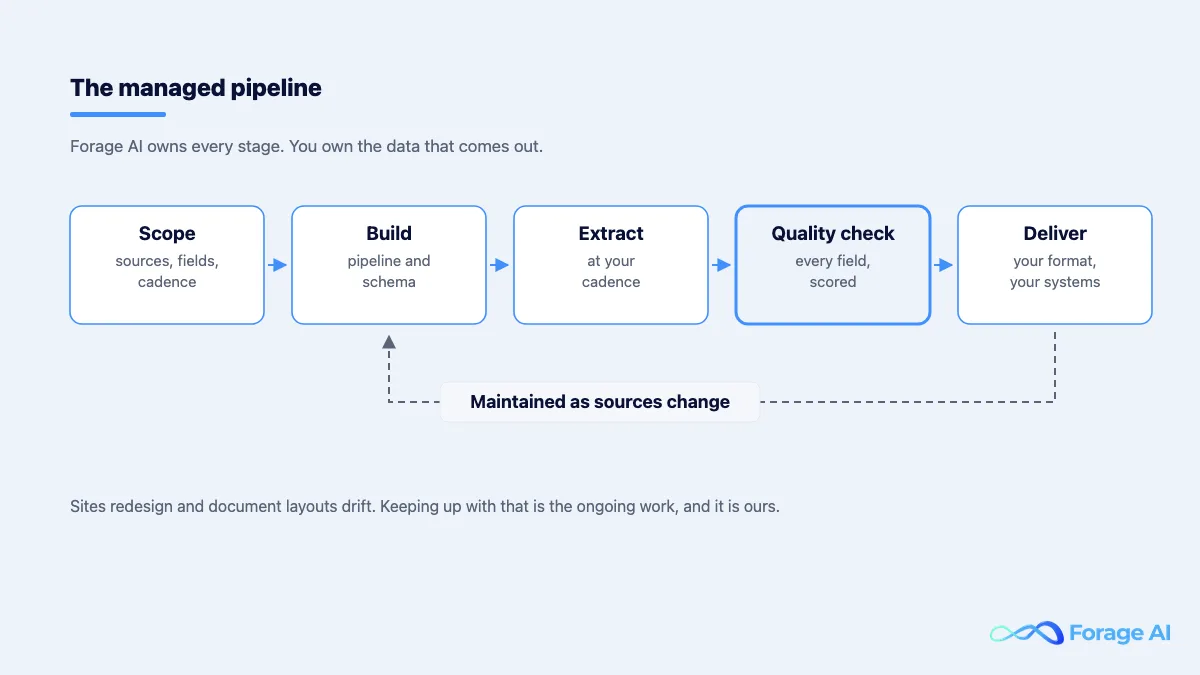
Two consequences are worth stating. There is no console for you to log into and no pipeline for your engineers to babysit. And when a site redesigns or a document issuer changes its layout, the fix is ours to make, and you usually never hear about it.
What is Forage AI not?
We are specific about this, because the category is crowded with things we are not.
- Not a self-serve tool. No sign-up, no free trial, no credits, no plans, no point-and-click builder.
- Not a data marketplace or broker. We do not resell data, and we do not pool one client's data into a product for another.
- Not an off-the-shelf dataset vendor. Every dataset we deliver is built to your spec. We do not sell pre-built catalogues.
- Not a proxy provider, a dashboard, or a BI product.
- Not an annotation or labelling vendor.
If what you want is a dataset you can buy today and download this afternoon, we are the wrong fit, and we will say so on the first call.
How do we hold accuracy and reliability?
This is the part of the work we care most about, so it gets the longest answers.
How accurate is the data?
99.7% field accuracy on delivered records, written into the SLA.
The label matters more than the number. Accuracy claims in this market are usually unqualified, which makes them unfalsifiable. Ours is measured at the field level, on the records we actually hand over, and it is a contractual commitment rather than a marketing figure. The number has been reported back to us by clients on healthcare provider data, which is among the hardest data to keep correct.
During scoping we talk about a different figure, because scoping is a different conversation. We will quote the accuracy bar a given source set can realistically support, and price the cadence against it, so you are not paying to re-crawl pages that have not changed.
How is that accuracy produced?
Not by a single clever model. By a sequence where each stage assumes the previous one can fail.
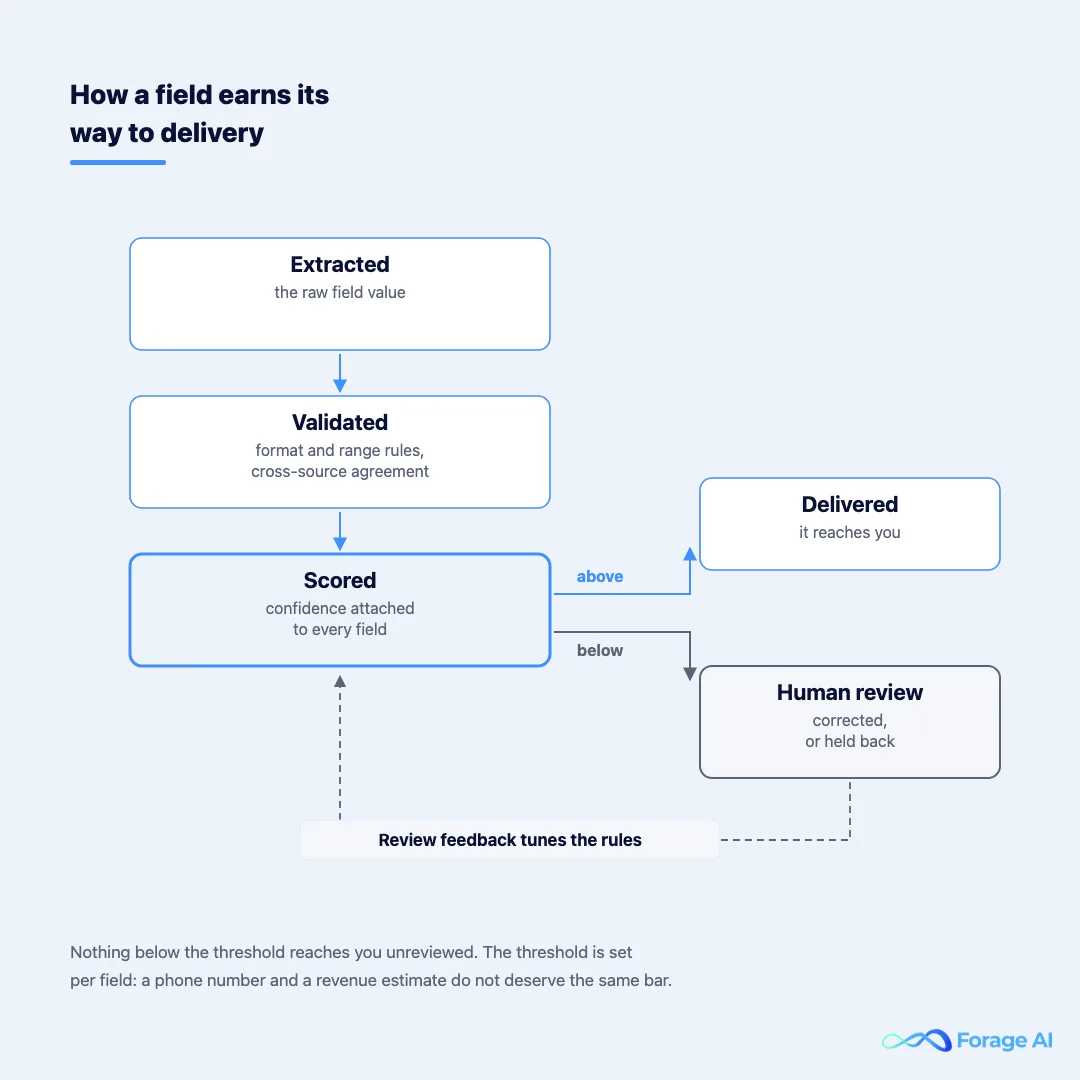
Four things carry most of the weight:
- Per-field confidence scoring. Each field gets a score, and anything below the agreed threshold is routed to review before it reaches you rather than shipped with a caveat.
- A dedicated QA team, three times the industry average in size. This is a staffing choice, and it is the least glamorous reason our numbers hold.
- Cross-source agreement. Where a fact appears in more than one place, disagreement is treated as a signal rather than averaged away.
- Feedback into the rules. What review corrects this month becomes a validation rule next month, so the same class of error does not recur.
What happens when a website changes?
This is the real test of reliability, and it is where most extraction projects quietly degrade. Sites redesign, run A/B variants, move fields and change pagination. A pipeline built against last year's markup returns plausible, wrong data long before it returns an error.
Our monitoring resolves layout edits, A/B variants and full redesigns back to one stable schema, so what lands in your warehouse does not change shape when a source does. Cosmetic edits are filtered out rather than alerted on. Where we monitor for change, a new source gets a 24-hour baseline period so the system learns the page before it starts telling you things have changed.
One client quote we are allowed to share, from a healthcare data team, describes the outcome better than we can.
"Forage AI's pipelines have run reliably for us long enough that we stopped checking on them. They're an extension of our data team, not a vendor we manage."
What does data quality mean beyond accuracy?
A field can be accurate and still useless. Four other properties decide whether data is actually fit to use, and all four are scoped explicitly.
| Property | What it means, and how it is set |
|---|---|
| Completeness | Coverage against the universe you defined, reported per source, including the sources where coverage is partial and why. |
| Freshness | How recently the value was confirmed. Set per field, not per dataset, because a company's headcount and its legal name do not need the same refresh. |
| Consistency | One schema, one set of enumerations, one entity resolved to one canonical ID across every source it appears in. |
| Provenance | Where each value came from and how it was checked, carried on the record itself. |
How do you prove where a field came from?
Records can carry provenance fields alongside the data itself, so any value can be traced without asking us. Those fields are the source URL, collected-at and last-verified timestamps, the verification method used, field-level confidence, change history for the field, and coverage status for the source. Verification method is recorded as automated, human review, or an agentic phone call.
For entity matching the equivalent is a full decision record: the canonical entity ID, a match, no-match or review verdict, a confidence score, decision reason codes, the matched and conflicting attributes, any reviewer decision, and the policy and model version in force at the time.
The principle we hold to is evidence first, matches second. Where evidence is insufficient or conflicting, a record stays unresolved or goes to review rather than being forced into a match.
What if a fact is not on any website?
Then crawling cannot help, and pretending otherwise is how directories rot. Some facts never reach a website, and some that do are wrong.
Our AI Voice Agent verifies those facts by telephone. It crawls and calls the same field, then returns both answers side by side, each timestamped, so you can see where sources drift apart rather than being handed a single value and asked to trust it.
We grade it honestly. Agent calls are scored against recent human calls to the same offices, and if a human caller would have heard a different answer, that counts against us.
Current limit, stated plainly. The voice agent handles direct-dial lines. Phone tree navigation is in development for a later stage, and we will say it is ready when it is, not before.
What Forage AI extracts
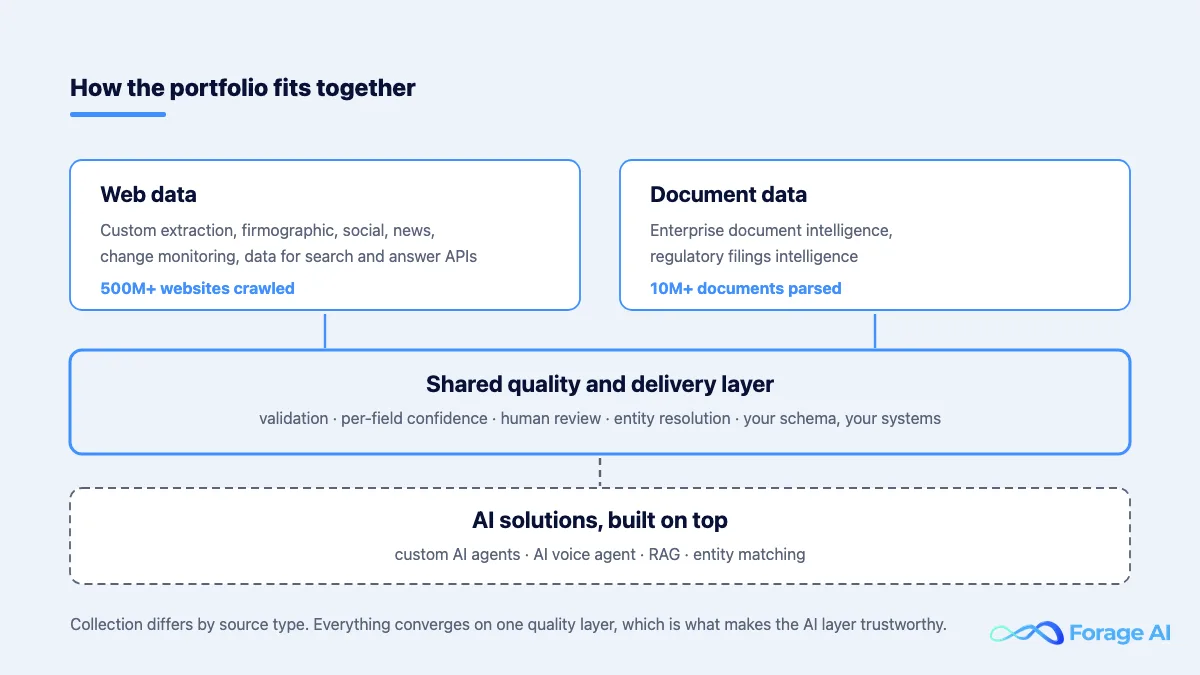
What kinds of web data?
| Line | What it produces |
|---|---|
| Custom extraction | The foundation. You name the websites, the fields and the frequency. Scale runs from hundreds to millions of records with no drop in reliability. |
| Firmographic and company data | Company profile, people and decision makers, size and financials, locations, contact and technology signals, hiring signals. Built for the long tail: private, hard-to-match and newly formed companies that off-the-shelf platforms miss. |
| Social media data | Profiles, posts, engagement, comments and media assets across any platform or forum, with sentiment tuned to your vocabulary rather than a generic model, and cross-platform identity resolution into one confidence-scored profile per person. |
| News data | Articles with outlet metadata, resolved entities including tickers and parent links, story clustering, and event typing such as funding or leadership change. We also clean up purchased news feeds that are not meeting your standard. |
| Website change monitoring | Structured change records with before and after values, change type, priority and a full audit trail. Alerts by webhook, Slack, email, digest, or straight into a warehouse. |
| Data for search and answer APIs | The extraction pipelines behind a web search, answer or web-data product. Deep sources, the long tail, per-source refresh, records in your schema with entities resolved, and provenance on every field. Delivered as a licensed feed, a connector in your partner program, or a private index built for one customer. |
Entity resolution, real-time alerting and change feeds appear across most of these. They are one underlying capability presented per line, not six separate products.
What can Forage AI do with documents?
Enterprise Document Intelligence starts earlier than most document tools. Most of them start after upload. We start at the source.
That means collection is part of the service. Documents are pulled from email, enterprise portals, websites, cloud repositories and business systems, including sources behind a login and MFA. From there they are classified, deduplicated by fingerprinting and hash validation, parsed, normalised, validated and delivered.
On the parsing itself, models trained on document structure identify headers, tables, nested tables, merged cells, multi-line records, footnotes, financial schedules and fields that run across pages, without predefined templates. OCR with image correction handles faded, blurry and archival scans, including handwriting. Table detection runs at 95% across table types, not just clean grids. Reports beyond 2,000 pages and layouts that change between issuers are both in scope.
Document types we work on include regulatory filings, financial statements, Schedules of Investments, contracts, lease agreements, loan applications, insurance claims, KYC and litigation documents, invoices, appraisals, permit applications, medical records, lab reports and provider credentials.
What is Regulatory Filings Intelligence?
Global regulatory filings, organised, standardised and searchable: 400+ filing types, 60+ regulatory authorities, 40+ countries. Filings are classified into a two-level taxonomy, and every filing carries nine standardised fields covering its category and type, jurisdiction, authority, description, purpose, who files it, who uses it, and its regulatory context.
It is aimed at investment firms, financial institutions, data providers and compliance teams who need to know what exists and where, across jurisdictions, before they can do anything else.
Scope note. This is classification and metadata: knowing which filings exist, what they are, and who they apply to. Pulling the values out of the inside of a filing is document intelligence work, which is the previous answer. The two are usually scoped together.
What AI solutions are built on top?
- Custom AI agents. Autonomous agents that navigate the web, parse documents, monitor sources and run multi-step data workflows, built and maintained end to end. Model-agnostic by design. Controls are a first-class feature rather than an afterthought: allowed actions, confidence thresholds, human approval points, escalation rules, and source and action logs.
- AI voice agent. Phone verification, covered above.
- RAG. Retrieval that turns your own data into cited answers, with your permissions preserved from day one and a living index that re-embeds changed content, deployed on your infrastructure. During scoping we assess whether the workflow actually needs RAG, a simpler retrieval layer, an agent, or a combination, because the answer is often not RAG.
- Entity matching. Resolving companies, people, products, brands, sellers, suppliers, locations and assets across databases, CRMs, spreadsheets, APIs, websites, PDFs, filings, registries and news, with the full decision record described earlier.
All four are custom builds, scoped around your sources, your stack and your records. None of them is a product you configure yourself.
What counts as hard-to-get data?
Not volume. Volume is a solved problem. Difficulty comes from the shape of the source, and it tends to fall into five kinds.
- Deep sources. Database-backed portals and registries that only answer a query, with nothing useful to crawl at the surface.
- The long tail. Thousands of small sites, each with its own layout, none of them worth a bespoke build on its own.
- Documents as the only format. Where the value exists solely inside a PDF, a scan, or a filing archive.
- Entities that do not match. Private companies, newly formed entities, and records whose names never agree across sources.
- Facts that are not published anywhere. Where the only authority is a person who answers a phone.
Which sources are genuinely difficult in practice?
JavaScript-rendered pages, document archives, registries, sources behind a login and MFA, pages that change layout between visits, issuers whose document format differs from every other issuer, and the private end of company data where no platform has coverage. On firmographic work specifically, the long-tail, private and hard-to-match companies are the point rather than an edge case.
The reason to hand this class of work to a managed team is that the difficulty is not one-time. A deep source that works today breaks when its query interface changes. Someone has to be watching, and it is cheaper for that to be us.
Custom by default
How custom is a Forage AI pipeline?
Custom is the default state, not an upgrade tier. There is no standard dataset that gets adjusted at the edges. You specify the sources and the fields, and the pipeline is built to those.
Practically, this is what you choose: which sources are in scope, which fields each one yields, what the schema looks like, how often each field refreshes, what the confidence threshold is per field, what happens to a record that falls below it, the format, and the destination.
What formats and destinations?
CSV, JSON, JSONL, XML, SQL, NDJSON and Parquet, or whatever format your systems expect.
Destinations include an API endpoint your systems call, a webhook, a cloud bucket, a direct download, or straight into a database, data warehouse, CRM, ERP or vector database. Where schemas evolve, changes are versioned with a changelog and approved by you before they land.
How often does the data refresh?
You set it, per field and per source, never fixed site-wide. Options run continuous, hourly, daily, weekly, monthly, filing-triggered or event-triggered.
We will push back on over-specifying this, because cadence is the main driver of cost. Scoping it against your actual accuracy bar means you are not paying to re-crawl pages that have not changed.
Which industries do we serve?
More than 15, with five that have their own practices: data for AI, finance and alternative data, e-commerce, healthcare provider data, and real estate. Insurance, banking and lending, legal, supply chain, commercial real estate, and government and public sector come up regularly through document work.
What does Forage AI do in healthcare?
Our healthcare core is external provider data: provider directories, physician and HCP data, practice and hospital records, licence and credential data, and resolving all of it to one canonical provider. Coverage on that work runs to 6,500+ hospitals, 250K+ practices and 2M+ HCPs.
Clinical document work is a real capability on the document side, covering medical records, clinical documents and lab reports. It is not where our depth is, and we will tell you that rather than discover it together halfway through a project.
On regulated health data, the voice agent works on public data only and does not request, collect or store PHI. Any engagement that would touch PHI requires a signed HIPAA Business Associate Agreement before work begins.
What does Forage AI do for AI teams?
We build the training, grounding and evaluation data that model work depends on, and we run the pipelines behind search and answer products. That covers corpus construction from deep and long-tail sources, document corpora at scale, grounding data with provenance attached so an answer can be traced, and refresh so a corpus does not quietly go stale.
We build the data that fine-tuning needs. We do not fine-tune models ourselves.
Working with Forage AI
How does an engagement start?
It starts with a scoping conversation about sources, fields, cadence, accuracy bar and destination. Onboarding typically runs 1 to 2 weeks from brief to live pipeline, and our team handles the data mapping and model tuning rather than handing you a configuration task.
Who owns the data?
You do. Forage AI never resells it, never pools it across clients, never reuses it for another client, and never trains on it. That is written into the contract rather than promised on a website. Extraction queries are not routed through third-party LLMs. Permitted use, retention and any third-party model terms are agreed during scoping and enforced per record.
How do you handle security and deployment?
Deployment is cloud or on-premises. A sovereign deployment puts the pipeline, models, extraction and storage inside your own tenancy, air-gapped where required, while we still build and run it. The data never moves to our side.
On privacy regulation, Forage AI is GDPR compliant and CCPA compliant, our workflows are SOC 2-aligned, and our extraction is designed around public pages, respected site terms and approved sources only. We hold no certifications and we will not imply otherwise. Any certifications, controls or deployment conditions you require are confirmed as part of the engagement.
How is it priced?
Per engagement, scoped to the work. The variables that move the number are source difficulty, field count, volume, cadence and the accuracy bar, with cadence usually the largest. There is no public price list, no per-credit rate and no self-serve tier, because there is no standard unit to price.
How do I start a conversation?
Tell us what you need on our Talk to Us page. The useful things to bring are the sources you need, the fields you want out of them, and how fresh the data has to be. If any of those three are still open, that is a normal place to start, and the scoping call exists to close them.