
Best AI Agent Solutions for Large-Scale Web Data Extraction

Web data extraction stopped being a scripting job a while ago. The moment your target list crosses a few thousand sites, each with its own layout, anti-bot posture, and habit of changing markup on a Tuesday, the brittle scraper you wrote last quarter becomes the thing you maintain instead of the data you wanted. That is the shift every data team we work with runs into, and it is why the conversation has moved from scrapers to agents.
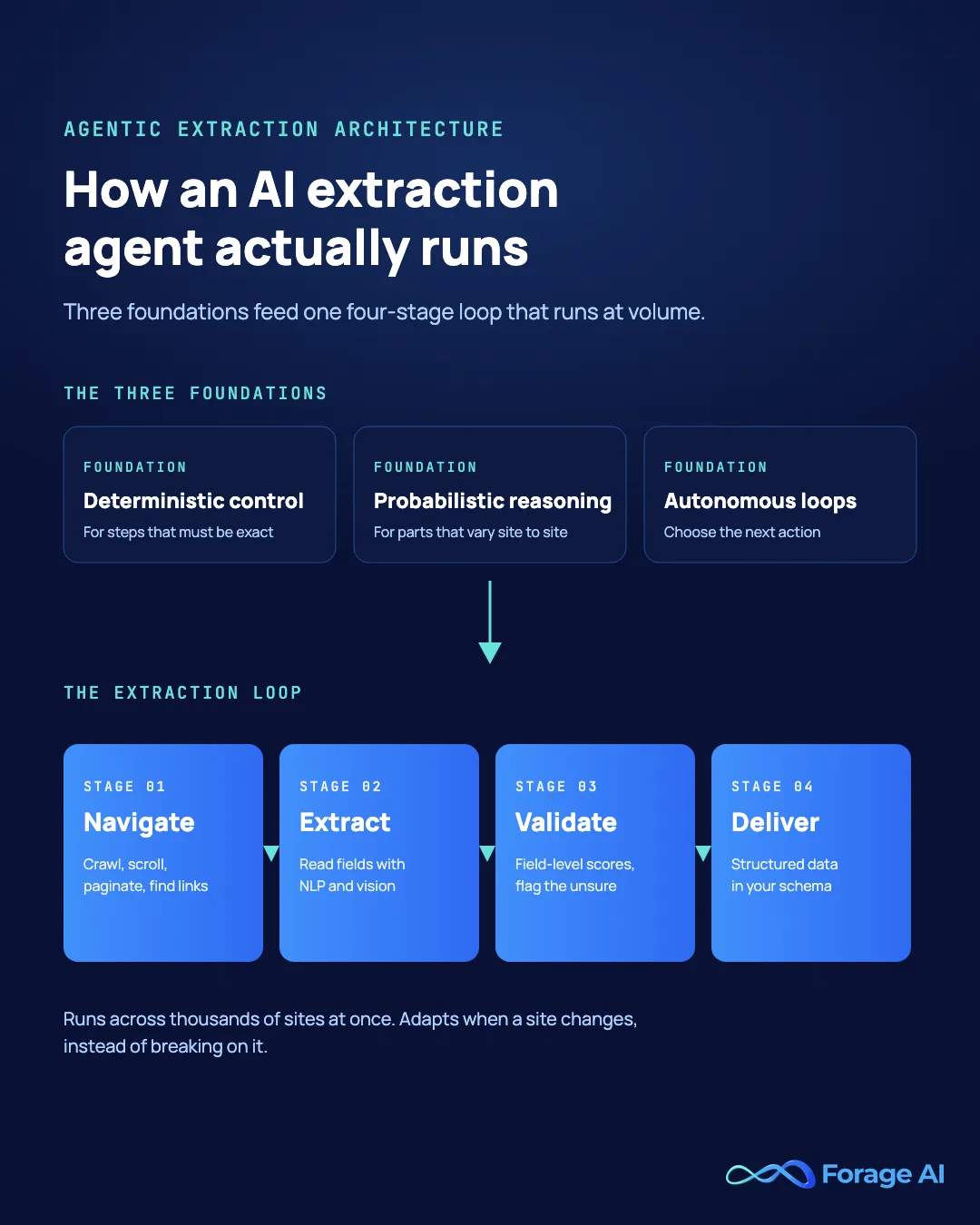
Agentic AI systems operate autonomously and adapt to the site instead of breaking on it. These goal-driven agents navigate complex websites, adjust when the structure changes underneath them, read unstructured content, and keep running at volume. The good ones combine three things: deterministic control for the parts that must be exact, probabilistic reasoning for the parts that vary, and autonomous decision loops that decide what to do next without a human in the path.
The stakes are practical. Teams depend on web data for competitive intelligence, market research, operational insight, risk monitoring, healthcare data surveillance, and regulatory compliance. Pick the wrong agent and you inherit a maintenance bill; pick the right one and the pipeline mostly runs itself. This guide covers how to tell the difference, which agents fit which job, and how to deploy them without the usual stalls.
Quick Digest
- Why agents replaced scrapers: at large scale the cost is maintenance, not code; agentic systems adapt to site changes on their own by pairing deterministic control, probabilistic reasoning, and autonomous decision loops.
- What actually makes an agent reliable at scale: content-aware recognition, auto-scaling infrastructure, real-time processing, and a defensible compliance posture (robots.txt, rate limiting, audit trails).
- The six evaluation criteria: throughput under concurrency, self-healing adaptability, extraction accuracy with field-level validation, compliance posture, integration fit, and total cost of ownership including the human QA you will still pay for.
- The four agent types: a Navigation and Collection Agent for crawling and collection, an Unstructured Document Extraction Agent for documents, an Entity Matching Agent for record linkage, and Custom RAG for natural-language retrieval over your data.
- How the four compare: each fits a distinct job (crawl, document, match, retrieve); the comparison table maps best-for, key capability, scale approach, and the watch-out for each.
Which AI agents handle large-scale web data best?
The best agents for millions of records are the ones that combine several capabilities in one loop instead of bolting them together after the fact. In practice that means natural language processing to read content, computer vision to recognize layout, and adaptive reasoning to decide what matters, all working while the job runs at volume and without dropping accuracy or compliance.
Agents like those from Forage AI bring those pieces together so extraction holds up across thousands of sites at once. That is the whole point of the agentic approach: the intelligence lives inside the run, not in a post-processing cleanup you schedule for later.
There is a build-versus-buy decision underneath this, and we will say the quiet part plainly. If building and maintaining AI agents for data extraction is not your core business, we recommend outsourcing it to experts like Forage AI so you can stay above the nitty-gritties and focus on generating value out of the data. The teams that try to own the extraction stack themselves usually discover the maintenance never ends.
Expert Insights
Enterprises are increasingly buying rather than building. Menlo Ventures' 2025 State of Generative AI in the Enterprise report (December 2025) found that "76% of AI solutions are now purchased vs. built internally." The same logic applies to extraction agents, where the ongoing maintenance is the hidden cost of a build.
Essential features of extraction AI agents
Four capabilities separate an agent that survives at scale from a demo that looked good on ten pages. We all know a scraper can pull a clean table once. The question is whether it still works on the hundred-thousandth page, on a site that redesigned overnight, behind a rate limiter that noticed you.
Which features make AI agents reliable at enterprise scale?
1. Smart content recognition. The agent has to understand context, find the fields that matter, and keep retrieving them after a site changes its markup. The systems that hold up use computer vision and NLP together so they recognize a price or a job title by what it is, not by the CSS selector it happened to sit in last week.
2. Scalable infrastructure. High volume means concurrent requests across many domains at once. Cloud-native frameworks with auto-scaling keep throughput steady when demand swings, so a spike on one source does not stall the rest of the run.
3. Real-time processing. For price tracking or news monitoring, stale data is wrong data. The agent has to move quickly and stay accurate at the same time, which is harder than it sounds once latency and correctness start pulling against each other.
4. Compliance and ethics management. Respect robots.txt, apply sensible rate limiting, and keep audit trails. This is not a legal checkbox you add at the end. It is the difference between a collection program that lasts and one that gets your addresses blocked.
Expert Insights
Robots.txt has a formal standard. The IETF's RFC 9309 (September 2022) says of robots.txt rules: "These rules are not a form of access authorization," and adds that crawlers "SHOULD NOT use the cached version for more than 24 hours, unless the robots.txt file is unreachable." An agent that re-checks robots.txt on that schedule is following the protocol, not just a courtesy.
Which AI-based web scraping services handle massive data projects reliably?
The services that handle high-volume projects put all four capabilities in one place: scalable infrastructure, real-time processing, and content-aware recognition, running across thousands of sites without the throughput sagging as the site count climbs. When any one of those is missing, the cracks show up exactly at the scale you bought the tool to handle.
How should you evaluate AI extraction agents?
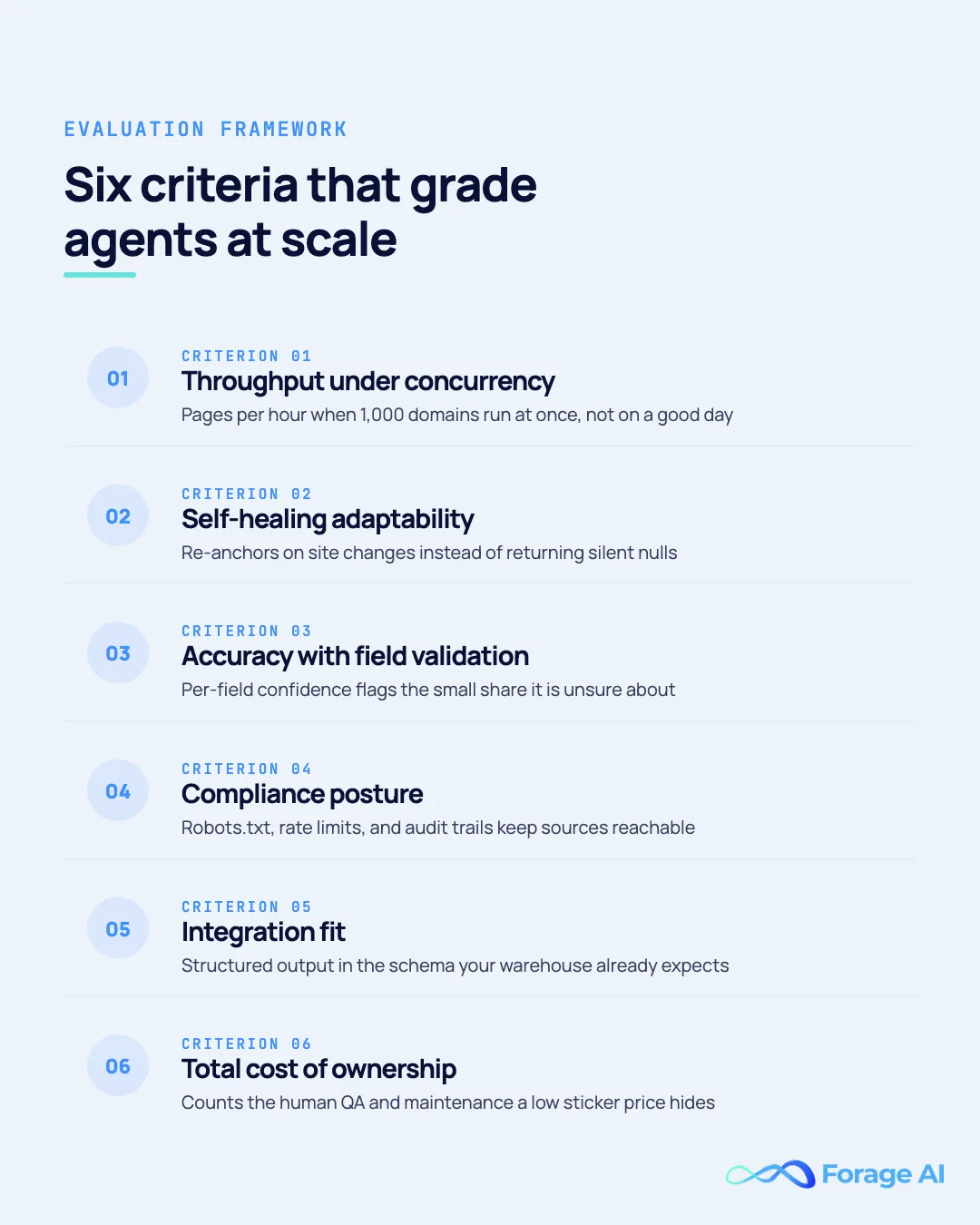
Feature lists sell tools. Evaluation criteria buy the right one. Before you compare vendors, decide what you are grading them on, because a scoring sheet written after the demo tends to reward whatever the demo happened to show. Here are the six criteria we hold agents to when the job is extraction at volume.
The six criteria that separate agents at scale
1. Throughput under concurrency. Not pages per hour on a good day. Pages per hour when a thousand domains are running at once and three of them are slow. Ask what happens to the queue when one source degrades, because that is the failure domain that decides your real throughput.
2. Self-healing adaptability. Sites change. The measure that matters is how the agent behaves when they do: does it detect the drift and re-anchor on its own, or does it fail silently and hand you a column of nulls three days later? Content-aware recognition is what makes the first outcome possible.
3. Extraction accuracy with field-level validation. A single accuracy number is close to meaningless without a validation layer under it. What you want is per-field confidence, so the agent can flag the 2% it is unsure about instead of burying it in the 98% it is confident on. Accuracy you cannot inspect is accuracy you cannot trust.
4. Compliance posture. Robots.txt handling, rate-limit discipline, and audit trails, again, because a source you lose to a block is throughput you no longer have. Grade the agent on whether it can prove what it collected and how.
5. Integration fit. Structured output your systems can read, in the schema your warehouse expects, delivered where your pipeline picks it up. An agent that extracts well but ships a format nobody downstream can use has just moved the bottleneck one step to the right.
6. Total cost of ownership. Count the human QA you will still pay for, the engineering time to maintain custom builds, and the cost of a bad record reaching a decision. Be honest about the headcount or the managed fee; pretending the number is zero is how a low sticker price turns into an expensive year.
Top AI agents for enterprise-level web data extraction
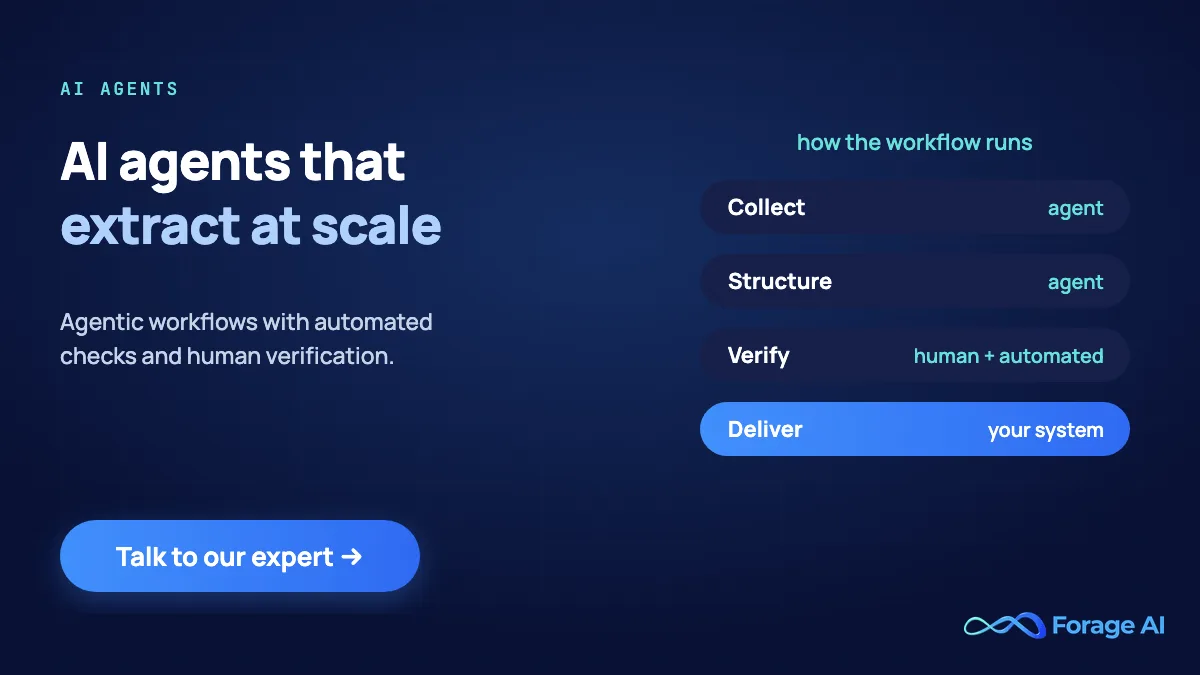
Extraction at scale is not one job. It is four, and the reason single tools disappoint is that they try to be all four at once. Here is how we split the work across specialized agents, each built for a distinct part of the problem. Read the four write-ups, then use the comparison table to match an agent to your requirement.
Navigation and Collection Agent
- Fully managed framework for autonomous web crawling and data extraction, built and run by Forage AI
- Intelligent navigation that handles scrolling, pagination, and element identification
- Configured, deployed and maintained by Forage AI, so your team writes no code
- Cost reduction through minimal human oversight
- Full coverage, so no links get overlooked
Sample use case (e-commerce): track product launches across 10,000+ global retailer websites, each with different formats, structures, anti-bot measures, and dynamic pricing. This is the job that breaks hand-written scrapers first, because every retailer is its own edge case.
Unstructured Document Extraction Agent
- Faster processing than template-based methods
- Field-level validation, with low-confidence fields flagged for human review
- Complex image analysis, including flowcharts and operational diagrams
- Immediate deployment without large training datasets
- Reduces manual review, with a QA team 3x the industry average checking the output
Sample use case (finance): extract and cross-reference data from complex merger and acquisition documents spanning multiple jurisdictions, currencies, and legal frameworks. Process thousands of pages of derivative contracts to identify risk exposures and regulatory compliance gaps, work that a person can do accurately but not at the page counts a deal actually carries.
Entity Matching Agent
- Advanced record linkage across different datasets
- Accurate identification of entities that refer to the same real-world object
- Field-level validation with confidence scores on every match
- Faster delivery than in-house builds
Sample use case (supply chain): match a supplier that appears as “ABC Corp,” “ABC Corporation,” and “ABC Co Ltd” across different procurement systems, recognize the three as one company, and consolidate the vendor relationship. Get this wrong and you are negotiating with yourself in three places.
Custom RAG Solutions
- Intelligent chat systems trained on web and custom data
- Precise retrieval that connects users with accurate answers
- Custom model training for specific industry requirements
Sample use case (healthcare): find medical professionals by specialty, location, and experience with a plain chat query, instead of searching several databases by hand. The retrieval layer turns a collected dataset into something a non-technical user can actually ask questions of.
The four agents compared
| Agent | Best for | Key capability | Scale approach | Watch-out |
|---|---|---|---|---|
| Navigation and Collection Agent | Crawling and collecting from many sites with varied layouts | Managed autonomous navigation: scrolling, pagination, element identification | Concurrent crawling across thousands of domains with full link coverage | Anti-bot and dynamic pricing per site; needs content-aware recognition to survive redesigns |
| Unstructured Document Extraction Agent | Turning documents (contracts, filings, diagrams) into structured fields | Reads complex images and layouts, with field-level validation | Deploys without large training sets; output still checked by a QA team 3x the industry average | High-stakes fields still need field-level validation before they reach a decision |
| Entity Matching Agent | Resolving the same entity across datasets and systems | Record linkage across datasets with confidence-scored matches | Links records across many source systems at once | Match thresholds need tuning; over-merging is as costly as under-merging |
| Custom RAG Solutions | Natural-language retrieval over collected and custom data | Chat retrieval trained on your data, with industry-specific model tuning | Sits on top of the extracted corpus as the query layer | Answer quality is capped by the freshness and accuracy of the underlying data |
What makes Forage AI agents different?
Measurable business impact with Forage AI agents
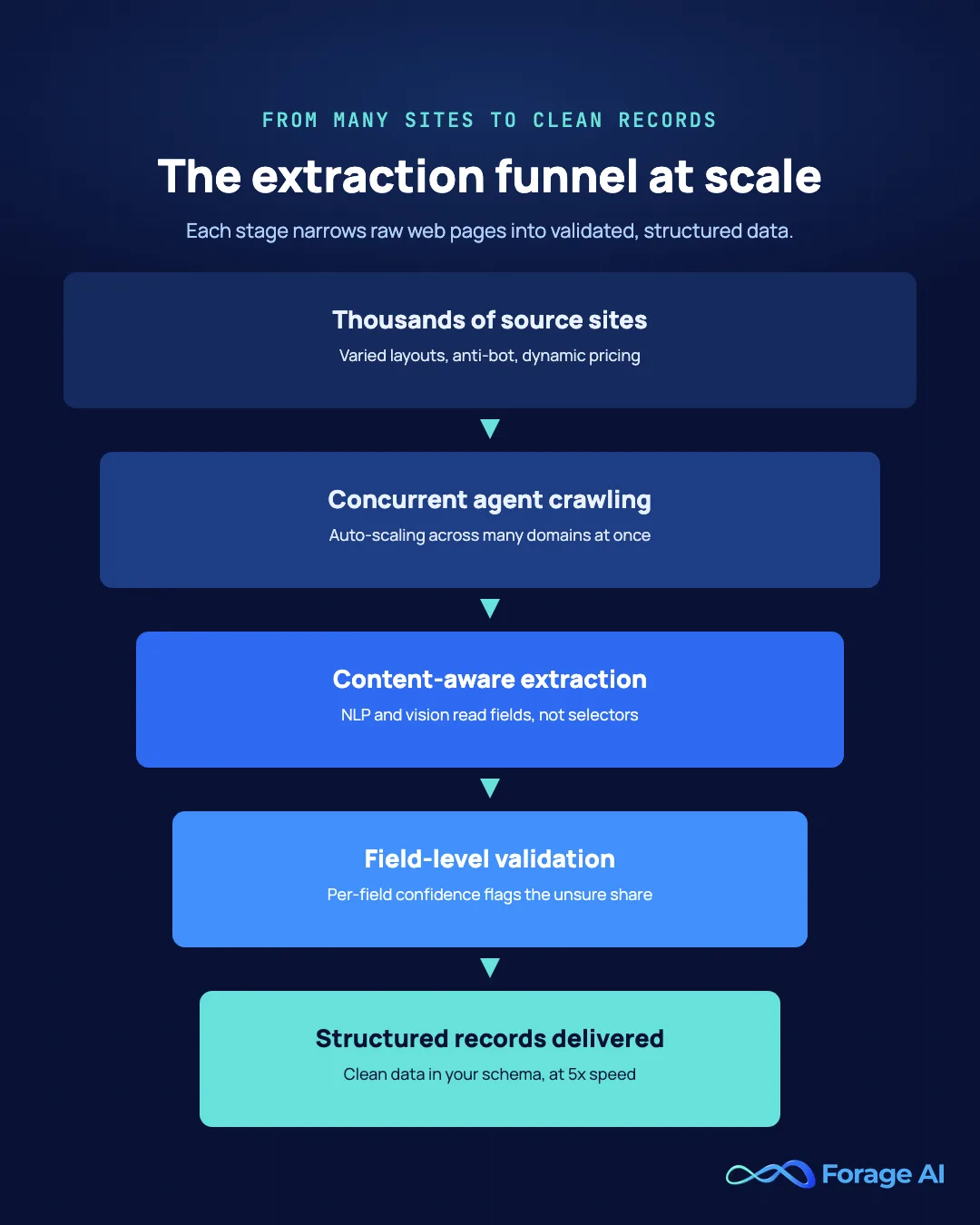
- Faster data delivery than in-house builds
- Field-level validation with human review on low-confidence fields
- Faster extraction than template-based scrapers
- 95% table detection accuracy from our in-house ML model
- Significant reduction in manual oversight
- Fully managed deployment
These outcomes matter because they map to the evaluation criteria above: speed is throughput, accuracy paired with validation is trustworthy extraction, and a fully managed deployment is integration fit that does not eat an engineering quarter.
Key advantages of AI agents for web data extraction
1. Adaptive learning. The agents learn site structures and adjust to changes on their own, which is the self-healing behavior that decides whether a run survives a redesign.
2. Complex navigation. They handle multi-step flows, form submissions, and dynamically loaded content, the parts of a site that stop simple scrapers cold.
3. Content understanding. NLP pulls meaning out of unstructured text and turns raw content into structured fields your systems can read.
4. Scale management. Thousands of websites processed at once, with rate limits and resources handled so throughput stays steady instead of collapsing under its own concurrency.
5. Anti-detection. Careful access patterns keep collection running and sources reachable, which, as noted, is an uptime feature more than a legal one.
How to deploy AI agents at scale
The agent is the easy part. Deployment is where programs stall, usually because a team tries to boil the ocean on day one instead of proving value on one job first. Here is the sequence we have seen work across customer engagements.
AI agent selection criteria for data extraction
Before deployment, confirm the agent clears the practical bar. Treat this as the short checklist version of the six criteria above:
- Proven performance metrics: multi-fold speed gains and 95%+ accuracy
- Fully managed deployment for rapid implementation
- Specialized agents for specific extraction jobs, not one generalist
- Integration that fits your existing systems and schema
- Scalable architecture supporting millions of daily extractions
Deployment strategy for data extraction with AI agents
1. Start with a pilot on measurable benchmarks. Pick a high-impact, low-risk use case that can show clear ROI in 60 to 90 days. Establish baseline metrics from your current process first, then measure the improvement in speed, accuracy, and cost. Skip the baseline and you will win the argument and lose the renewal, because nobody can see what changed.
2. Design the human-AI handoff for complex cases. Let the agents handle routine extraction and escalate judgment calls to domain experts. This hybrid keeps efficiency high while a person stays on the decisions that carry real consequences. Speed and scale from the agent, expertise where it counts from the human.
3. Augment the workflow, do not replace it wholesale. Bring agents in as force multipliers on the existing process. This lowers organizational resistance, speeds adoption, and gets more out of the systems you already paid for. Teams that frame it as replacement spend their first quarter fighting their own people.
4. Set clear escalation protocols for edge cases. Define the thresholds where an agent should hand a scenario to a human: confidence scoring, quality floors, and exception handling. Proactive escalation catches the odd case before it becomes a bad record, while the agent keeps running the routine work unattended.
5. Monitor with concrete metrics. Stand up dashboards for extraction accuracy, processing speed, cost per record, and error rate, with automated alerts on performance drops and data-quality issues. You cannot manage a pipeline you cannot see, and the alert you set today is the incident you avoid next month.
Future trends in AI-powered web data extraction
As of 2026, four shifts are reshaping how agentic extraction gets built and bought. None of them is speculative anymore; they are already showing up in how the better systems are architected.
1. Multi-agent collaborative systems. Teams of agents with distinct skills working together beat any single generalist on complex jobs. One navigates, one extracts documents, one resolves entities, and the coordination between them is where the accuracy gain lives. This is the same split we described in the four-agent breakdown, now formalized into the architecture rather than bolted on.
2. Better reasoning and interpretability. The next generation of agents explains its decisions, which points influenced an extraction and why, so a reviewer can trust the output and target the parts that need a second look. Interpretability is quickly moving from a nice-to-have to an audit requirement.
3. Autonomous self-improvement. Agents that refine their own extraction methods as data patterns shift, without constant manual retraining. This is self-healing adaptability taken one step further, from surviving change to learning from it.
4. Tighter regulatory and ethical frameworks. Stricter oversight is raising the bar on transparency, bias reduction, and accountability. In practice, this rewards the systems that already kept clean audit trails and respected collection limits, and it raises the cost of the ones that did not.
Choosing the best AI agent for large-scale web data extraction comes down to matching technical capability, scalability, and long-term goals against the six criteria we laid out. Plenty of platforms offer basic extraction. Data-driven organizations need agents that pair the AI with reliability and support you can actually call on.
Choosing the right extraction agent
Forage AI runs specialized agents for large-scale web data extraction and measures the result. With 12+ years of automation experience across 15+ industries, the work is grounded in deployments, not slideware.
For teams that need extraction at volume with proven results, Forage AI’s agents deliver:
- Measurable performance: field-level validation and a QA team 3x the industry average on every delivery
- Fully managed deployment, typically 1-2 weeks to first dataset, so implementation does not wait on an engineering quarter
- A full agent portfolio covering crawl, document, match, and retrieve
- Architecture built for scale, with the integration to fit your systems
- An approach grounded in 12+ years of automated data collection
The honest summary: generic scraping tools and general-purpose AI both hit a wall at scale, and the wall is maintenance. Specialized agents, matched to the job and graded on the criteria that matter, are what let a data team spend its time on the data instead of the plumbing. That is the choice worth making.
Frequently asked questions
What is the difference between an AI agent and a traditional web scraper?
A traditional scraper follows fixed rules and breaks when a site changes. An AI agent is goal-driven: it navigates, reads content with NLP and computer vision, and adapts to structural changes on its own. At small scale the scraper is fine. At thousands of sites, the agent’s ability to self-heal is what keeps the pipeline running without constant maintenance.
How do AI agents handle websites that block scraping?
Through disciplined access: respecting robots.txt, applying sensible rate limits, and using careful navigation patterns that avoid tripping anti-bot systems. The goal is not to defeat protections but to collect responsibly so the source stays reachable. In practice, that discipline is what keeps a collection program alive, because a blocked source is lost throughput.
Should we build our own extraction agents or buy them?
If building and maintaining extraction agents is not your core business, buying is usually the better call. The build cost is one engineering sprint; the maintenance cost is every site change afterward, forever. Outsourcing the loop to a specialist lets your team stay focused on generating value from the data rather than babysitting the collection.
What accuracy can AI agents achieve at scale?
Specialized agents reach 95% and higher on extraction, and up to 99% on document data extraction, with a field-level validation layer flagging low-confidence records. The number to watch is not the headline percentage but whether the agent can tell you which fields it is unsure about, so the small share it gets wrong never reaches a decision unchecked.
Which AI agent do I need for my use case?
Match the agent to the job. Crawling many varied sites points to a Navigation and Collection Agent; turning documents into structured data points to the Unstructured Document Extraction Agent; resolving the same entity across systems points to an Entity Matching Agent; and letting users ask questions of the data in plain language points to Custom RAG. Most real programs use more than one, coordinated together.
By punith y