
Best Computer Vision Training Data Providers (2026)
Last updated November 2026
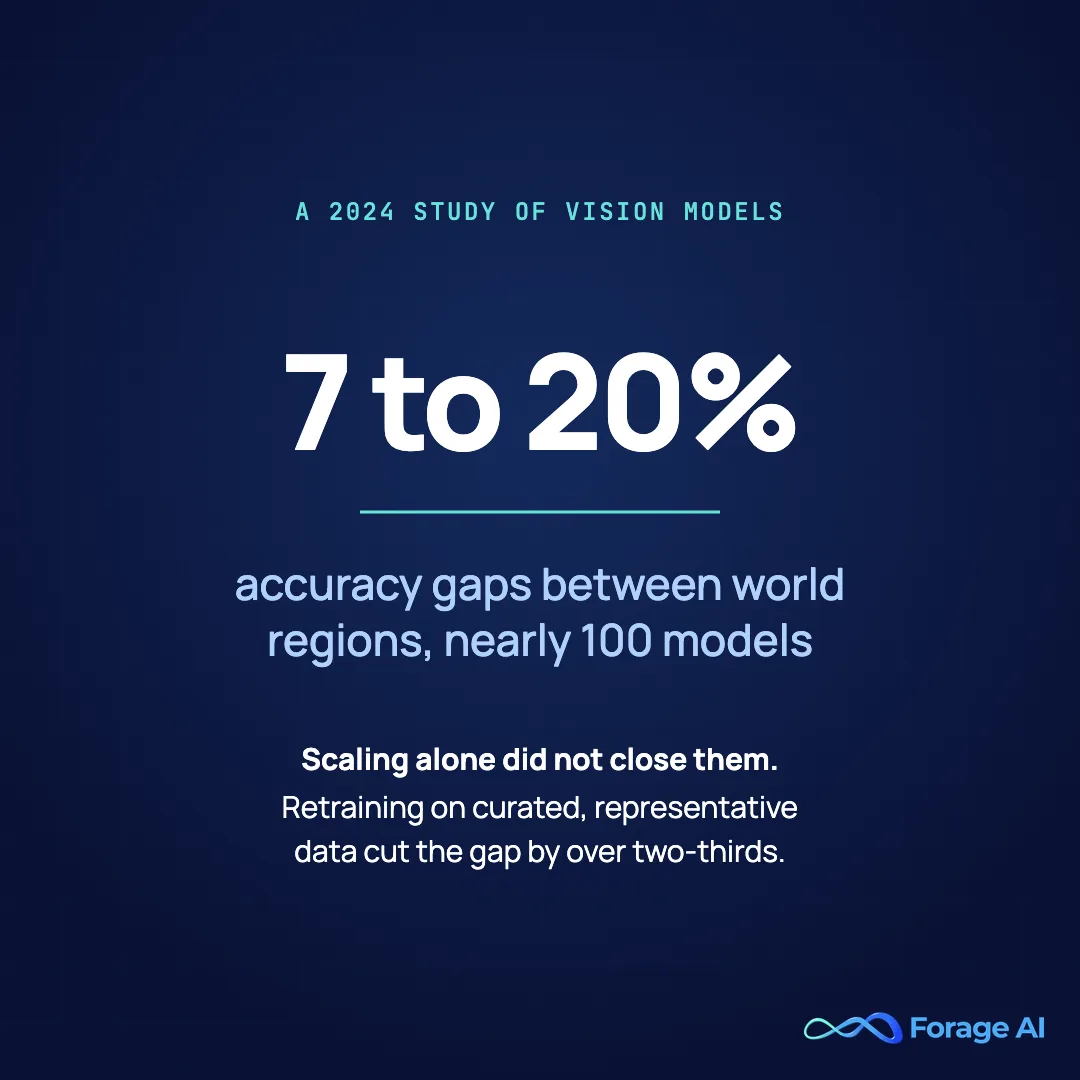
Ship a vision model that scores well on its test set, and the field can tell a different story: it fails on places, people or conditions it never saw in training. A 2024 ICLR study of nearly 100 vision models found accuracy gaps of 7 to 20% between world regions, and found that scaling alone did not close them.
So buy computer vision training data for the gap, not the volume.
If you are looking for the best AI training data solutions provider for computer vision teams, start with what your model is missing. This list groups providers by five gaps and judges each on six questions from its own pages. By the end, you will have a two-to-three provider shortlist for your gap, each training clause read, and three asks to send before you sign.
- Buy for the gap: Regional accuracy gaps of 7 to 20% did not close with scale (ICLR 2024), and flood-image detectors lost more than half their accuracy, on average, across countries (CVPR 2025).
- Dataset licence is not image licence: COCO and Open Images license their annotations; the images inside carry their own terms.
- Stock licences bar training: Getty Images and Shutterstock forbid training under their standard licences and sell it through separate data-licensing agreements.
- Labels are a different purchase: for footage you already hold, compare data labeling companies.
Need imagery collected from sources you nominate? We collect web data for AI training from sources you nominate, to your own schema. Talk to us about scope.
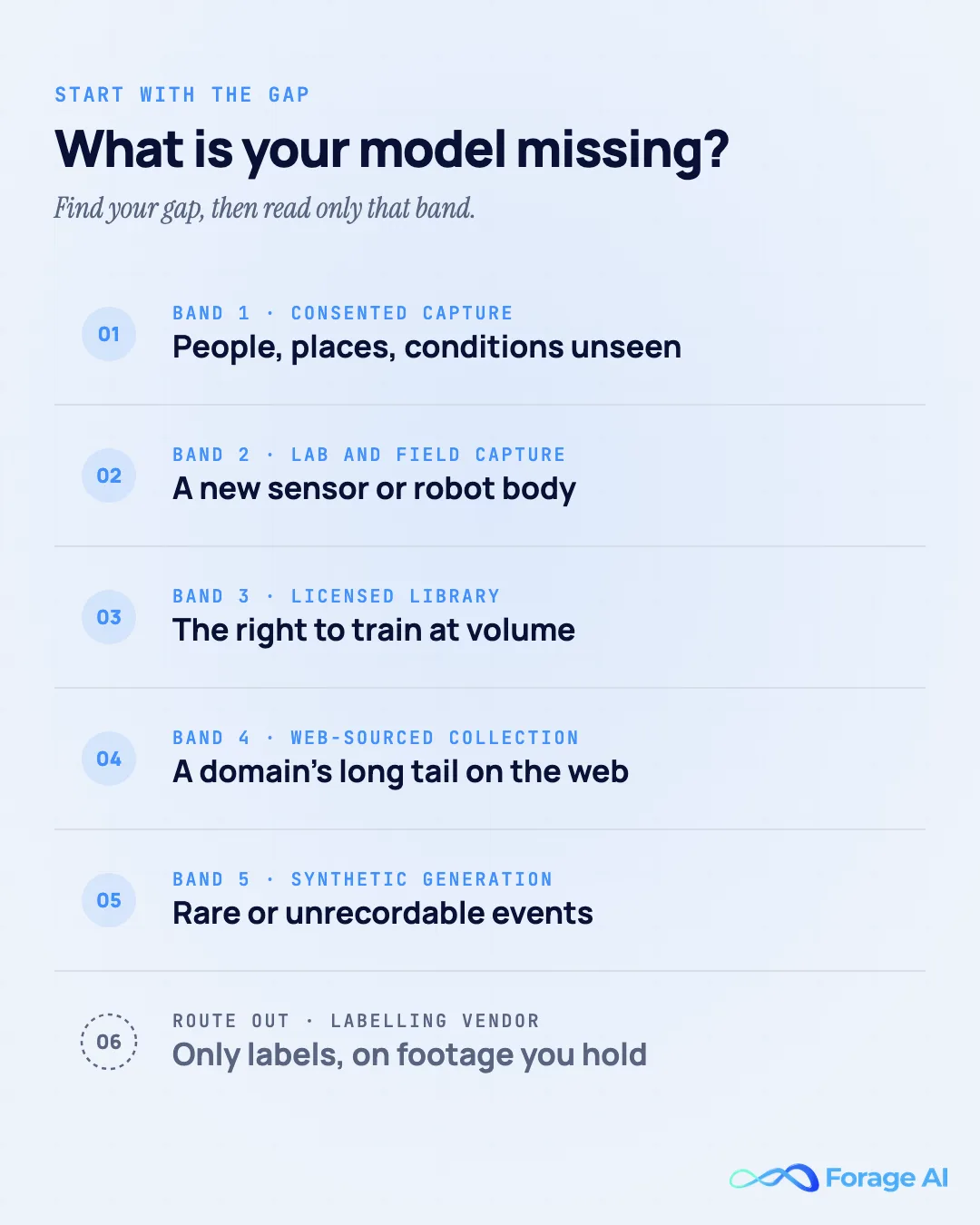
Which provider fits what your model is missing?
The gap decides the supplier type, and the supplier type decides the shortlist. Find your gap, then read only that band.
What is your model missing?
- People, places or conditions it has never seen: band 1
- A new sensor or body: band 2
- The right to train on enough images or video: band 3
- The long tail of a domain on the public web: band 4
- Rare, dangerous or unrecordable events: band 5
- Only labels, for footage you already hold: the route out
Computer vision training data providers at a glance (as of November 2026)
| Provider | Supply route | Best for (the gap) |
|---|---|---|
| Band 1: people, places, conditions | ||
| LXT | Consented custom capture | New regions, lighting and camera angles |
| Shaip | Custom capture and catalogue | Face, driver and landmark sets |
| Band 2: new sensor or body | ||
| iMerit | Lab and field capture | First-person, head-mounted video |
| TELUS Digital | Lab and field capture | Robot and physical-AI data |
| Band 3: right to train at volume | ||
| DataSeeds.AI | Licensed catalogue plus capture | Consented photo volume |
| Getty Images | Library, separate data licence | Stock and editorial imagery |
| Nexdata | Pre-built dataset catalogue | Large pre-built image sets |
| Shutterstock | Library, separate data licence | Multimodal library volume |
| Wavebreak Media | Owned archive plus production | Images with release records |
| Band 4: a domain's long tail on the web | ||
| Grepsr | Web-sourced collection | Images and video from websites |
| Forage AI | Web-sourced collection to your schema | Images or video on sources you name |
| Band 5: rare or unrecordable events | ||
| NVIDIA Omniverse Replicator | Simulation framework you run | Rare scenes you build yourself |
| Parallel Domain | Synthetic generation and simulation | Camera, lidar and radar scenarios |
| Route: labels on footage you hold | Annotation, a different purchase | See the route section |
How we evaluated these providers
We read each provider's own pages and licence terms on 5 November 2026, and name any regional copy we read.
| Question we asked | What the row records | How absence is written |
|---|---|---|
| Best for | The gap it fills | Always filled |
| What it supplies | Volumes, vendor as subject, as of November 2026 | Not stated by vendor |
| Training right | The clause, with document and date | Not stated by vendor |
| People in frame | Consent or release record, as stated | Not stated by vendor |
| Pricing model | As published | Not stated by vendor |
| Watch-out | One honest line | Always filled |
Ratings appear only with review count and date. No vendor paid for placement, and we ran no hands-on test of anyone's data. Quality-process claims are not rows either: test quality with a sample drawn from your gap (the first of the three asks). A compliance badge is not a licence to train, so badges are not rows. Forage AI, which publishes this list, appears last in band 4, unscored. For the four kinds of training-data supplier across all modalities, see our guide to AI training data providers.
Computer vision training data providers by model gap
Numbered for reference. Listed alphabetically inside each band. Nothing here is a ranking.
People, places and conditions your model has never seen
Supply route: consented custom capture
When the gap is a population or a condition (a region, a demographic, night-time lighting), you commission new images, and the consent record is part of the purchase. The GeoDE dataset (NeurIPS 2023) gathered 61,940 images across 40 classes and 6 regions by asking people worldwide for photos, because web-scraped data "typically originates from Europe and North America".
Coverage, not volume, closed the gap in the Richards et al. study (ICLR 2024): retraining the last layer "on more representative, curated data" cut regional disparity "by over two-thirds", on household-object benchmarks (Dollar Street, GeoDE). Detection shows the same pattern: in a CVPR 2025 benchmark, six detectors trained on satellite flood imagery from India or the US lost more than half their accuracy, on average, on imagery from the other country. Image data collection services sell that slice; a contributor count is not coverage of it.
1. LXT
Image and video collection service that captures new data to a brief, country by country.
| Attribute | Detail |
|---|---|
| Best for | New regions, demographics, lighting and camera angles captured to spec |
| What it supplies | LXT states image collection in "150+ countries, 1,000+ language and cultural locales", "Over 10 million contributors and 250,000+ qualified specialists", and video covering "day/night conditions, and different camera perspectives" (as of November 2026) |
| Training right | Not stated by vendor |
| People in frame | States images are "always freshly captured, fully consented"; video is "Consent-based recordings focusing on facial expressions, eye gaze, or full-body motion" |
| Pricing model | Quote-based ("We provide custom quotes based on your specs.") |
| Watch-out | Licence and ownership of delivered images are not on the service pages; get them in the contract |
| Evidence | Detail |
|---|---|
| Reviews | No verified reviews (as of November 2026) |
| Pages read | lxt.ai collection pages, 5 November 2026 |
LXT fits a team whose model fails in a new market or after dark, because a capture brief can name that exact slice; its video data collection covers detectors on video feeds. It is the wrong choice for licensed volume this quarter (band 3).
A consent statement is not a record you can hand to legal. Ask for the form participants signed and check that it names AI training. The blank training right disqualifies LXT only if it will not write licence and ownership into the contract.
- Pro: Lists face-recognition data collection as its own service.
- Pro: Stills and video from one supplier.
- Con: No published price, so even a pilot needs a scoped brief.
2. Shaip
Collection and dataset catalogue service for vision data, including faces, drivers and landmarks.
| Attribute | Detail |
|---|---|
| Best for | Face, driver and surveillance-style sets, off the shelf or custom by geography and demographics |
| What it supplies | Off-the-shelf computer vision datasets or custom builds "to your geography, demographics and annotation requirements"; catalogue examples include "450k images of driver faces ... covering 20,000 unique participants from 10+ ethnicities" and "80k+ images of landmarks from over 40 countries" (as of November 2026) |
| Training right | Not stated by vendor (a "Data Catalogs & Licensing" heading, no clause) |
| People in frame | States face recognition, threat detection, crowd analytics and licence-plate datasets come "with documented consent and ethics review" |
| Pricing model | Quote-based ("Shaip scopes pricing based on the required workflow, pilot results, delivery format, and production scale.") |
| Watch-out | Much of the offer is annotation; confirm you are buying images, not labels |
| Evidence | Detail |
|---|---|
| Reviews | No verified reviews (as of November 2026) |
| Pages read | shaip.com vision services page, 5 November 2026 |
Shaip suits a team that wants a catalogue baseline now and a custom slice later from one supplier. Driver-monitoring and face-analysis teams will find the closest catalogue matches.
Pricing follows pilot results, so pull the pilot sample from the demographics your model misses, not from the catalogue's strongest set. The missing clause matters most for catalogue sets bought as-is.
- Pro: Custom builds specified by geography and demographics, where most coverage gaps sit.
- Con: Annotation-heavy pages make it easy to scope labels you did not need.
Also in this band:
- Appen's off-the-shelf catalogue lists 21 image and video datasets as of November 2026 (selfies, gestures, everyday objects, signage), and Appen states its standard licence is "perpetual and non-exclusive with commercial training rights", with contributor consent documented.
- Defined.ai's image and video datasets sit behind a sign-in; its public Data License Agreement (effective 30 November 2022) permits commercial use of models trained on the data, provided the data is not redistributed and the model does not output recognisable content from contributors.
DataSeeds' managed crowd and Wavebreak Media's custom production also serve this gap; both have entries in band 3.
A new sensor or body
Supply route: lab and field capture
A robot arm or a head-mounted camera needs data recorded on the hardware and in the settings it will meet. A new sensor needs new hardware and labs, not a new population. Several vendor pages read in November 2026 now offer first-person (egocentric) and robot-teleoperation capture: TELUS Digital, iMerit, DataSeeds and Shaip. DataSeeds and Shaip keep their entries in other bands.
3. iMerit
Annotation-led company listed here only for its egocentric video collection offer.
| Attribute | Detail |
|---|---|
| Best for | First-person video recorded on head-mounted hardware |
| What it supplies | Egocentric video collection by "iMerit's global workforce of full-time employees and iMerit Scholars"; its page describes a client engagement "to coordinate 200 hours of in-home task recording using Meta Quest 3 head-mounted cameras worn by participants completing daily activities" (as of November 2026) |
| Training right | Not stated by vendor |
| People in frame | Not stated by vendor |
| Pricing model | Not stated by vendor |
| Watch-out | Primarily an annotation company; this entry covers its collection offer only |
| Evidence | Detail |
|---|---|
| Reviews | No verified reviews (G2 profile with 0 reviews, 5 November 2026) |
| Pages read | imerit.ai video collection page, 5 November 2026 |
iMerit fits a household-robotics team that needs daily tasks filmed from the wearer's point of view, which third-person footage does not show.
The offer rests on one described engagement, so ask whether it is a standing service. Participants appear; consent wording does not. Without a signed form covering AI training, it drops off the list.
- Pro: Recording happens in participants' own homes, the setting a household robot will meet.
- Con: One engagement on one page is thin evidence of a repeatable service.
4. TELUS Digital
Data services company with a physical AI capture line.
| Attribute | Detail |
|---|---|
| Best for | Robot and physical-AI data captured in labs and field settings |
| What it supplies | TELUS Digital states "egocentric videos and teleoperation data spanning remote digital setups, lab scenarios, outdoor field conditions and factory floors" and "We set up labs globally, manage hardware procurement and complex data workflows" (as of November 2026) |
| Training right | Not stated by vendor |
| People in frame | Not stated by vendor |
| Pricing model | Not stated by vendor |
| Watch-out | Collection, labelling and QA are sold as one pipeline; scope which part you are buying |
| Evidence | Detail |
|---|---|
| Reviews | No verified reviews (as of November 2026) |
| Pages read | telusdigital.com physical AI page, 5 November 2026 |
TELUS Digital fits a robotics team whose gap is embodiment: a body and setting the model has not trained on, from factory floors to outdoor fields. A team whose gap is a population belongs in band 1.
Read the sensor list carefully. Its page names lidar, RGB, depth, force-torque and tactile sensors in its labelling description, not its capture description, so ask which sensors it records on. The bundle disqualifies only if your contract cannot separate capture from labelling.
- Pro: Lab setup and hardware procurement are the vendor's job, per its page.
- Pro: Names teleoperation data alongside egocentric video.
- Con: Capture scope for each sensor needs confirming.
The right to train on enough images or video
Supply route: licensed library with a separate AI data-licensing offer
Licensed volume is real, but the standard licence and the training right are different documents, and the training right is the one to read. "Safe for commercial use" is not "licensed for training". A catalogue covers the common case; the slice that differentiates your model usually has to be built, which is why three entries below also offer custom capture or production.
5. DataSeeds.AI
Licensed photo catalogue with its own contributor crowd for custom capture.
| Attribute | Detail |
|---|---|
| Best for | Consented photo volume plus custom capture from a large contributor base |
| What it supplies | DataSeeds states "50M+ rights-cleared images in catalog", "20M+" monthly active contributors and "100+ countries, auditable consent"; three routes: catalogue, managed crowd capture "to your spec", and a production pipeline for egocentric and robotics capture (as of November 2026) |
| Training right | Not stated by vendor at clause level; states its routes "ship rights-cleared and provenance-documented" |
| People in frame | States "Auditable opt-in, commercial-use terms signed before capture" |
| Pricing model | Not stated by vendor |
| Watch-out | "Rights-cleared" is the vendor's term; ask for the buyer-side training clause |
| Evidence | Detail |
|---|---|
| Reviews | No verified reviews (as of November 2026) |
| Pages read | dataseeds.ai home page, 5 November 2026 |
DataSeeds spans bands 1 and 3 and lives here for its catalogue. It fits a team that wants to buy what exists and commission what does not from one contributor base.
Contributors agree to "commercial-use terms"; you need to know whether the licence you receive names training and fine-tuning. Until you hold that clause, "rights-cleared" is a description, not a document.
- Pro: Contributor terms are signed before capture, not gathered afterwards.
- Pro: Catalogue and custom capture share one consent model.
- Con: No training clause or price published.
6. Getty Images
Stock and editorial library that sells training rights under a separate agreement.
| Attribute | Detail |
|---|---|
| Best for | High-production stock and editorial imagery, licensed for training through a separate agreement |
| What it supplies | Getty states its data-licensing offer provides "curated, rights-cleared datasets tailored to your specific use case" and custom datasets shot by its photographer network for exclusive use (as of November 2026) |
| Training right | Standard licence: "Unless explicitly authorised in a Getty Images invoice, sales order confirmation or licence agreement, you may not use content (including any caption information, keywords or other metadata associated with content) for any machine learning and/or artificial intelligence purposes" (Getty Images Content Licence Agreement, last updated April 2026) |
| People in frame | "Getty Images does not represent or warrant that consent has been obtained for such uses with respect to model-released content." |
| Pricing model | Not stated by vendor |
| Watch-out | In Getty's own licence, a model release for stock use is not consent for AI use |
| Evidence | Detail |
|---|---|
| Reviews | No reviews of the data-licensing product (stock profiles rate the stock product) |
| Pages read | Data-licensing page; licence as a regional copy at gettyimages.in/eula, 5 November 2026 (the .com address redirected there) |
Getty fits a buyer who needs recognisable editorial or creative imagery at volume and can negotiate a written authorisation. The clause names captions and keywords, so a vision-language model's training set of image-caption pairs needs the same authorisation as the pixels.
When people are in frame, ask what the data-licensing agreement warrants about consent.
- Pro: Custom shoots for exclusive use can fill a scene the archive lacks.
- Con: No published data-licensing price.
7. Nexdata
Dataset supplier with a large pre-built computer vision catalogue.
| Attribute | Detail |
|---|---|
| Best for | Large pre-built image collections, including face sets |
| What it supplies | Nexdata lists "200 million high-quality images that have undergone professional review" and face-recognition datasets (as of November 2026) |
| Training right | States "commercial-grade usage rights" and "permission for scientific research use"; training use not stated separately; ask for the training clause |
| People in frame | Not stated by vendor |
| Pricing model | Not stated by vendor |
| Watch-out | Face datasets are listed with no consent line on the page; get the consent record before buying any |
| Evidence | Detail |
|---|---|
| Reviews | No verified reviews (as of November 2026) |
| Pages read | nexdata.ai vision datasets page, 5 November 2026 |
Nexdata fits a team that needs a baseline for a common task. It is the wrong start for a specific population or condition: a catalogue is built for the median buyer, not your failing slice.
Its two rights phrases are different grants, and neither names training. Get the training clause in writing.
- Pro: Available now, with no capture cycle to wait for.
- Con: Rights wording mixes commercial and research grants.
- Con: No published price.
8. Shutterstock
Stock library whose standard licence forbids training, with a separate AI data-licensing product.
| Attribute | Detail |
|---|---|
| Best for | Large multimodal libraries (image, video, 3D) licensed for training through its data-licensing team |
| What it supplies | Shutterstock states access to "hundreds of millions of images, videos, audio files, 3D assets" and "3M+ contributors across 150+ countries", specified by "modality, subject matter, metadata, geography, volume, rights profile" (as of November 2026) |
| Training right | Standard licence: you may not "Use any Visual Content as training data for any artificial intelligence, machine learning, or generative AI system, tool, process, or dataset" (Shutterstock Terms of Service and License Agreements, effective 5 October 2026); training is sold separately as "AI data licensing" |
| People in frame | Not stated by vendor on the data-licensing page |
| Pricing model | Not stated by vendor |
| Watch-out | The terms took effect on 5 October 2026; read the version date on whatever you sign |
| Evidence | Detail |
|---|---|
| Reviews | No reviews of the data-licensing product (stock profiles rate the stock product) |
| Pages read | Data-licensing page and licence terms, 5 November 2026 |
Shutterstock fits a team that needs volume across modalities. Geography sits in its specification list, so it can serve a coverage gap, not only a volume gap.
For any face or body model, ask what the AI data licence warrants about contributors and people in frame, and treat silence as disqualifying.
- Pro: The standard-licence prohibition is plain, so the boundary is easy to audit.
- Con: No consent or release terms on the data-licensing page.
9. Wavebreak Media
Production image archive that licenses images for training.
| Attribute | Detail |
|---|---|
| Best for | Owned, professionally produced images with release records in the package |
| What it supplies | Wavebreak states "more than 4 million owned visual assets, including approximately 2.5 million images created through professional media production since 2005", plus custom production (as of November 2026) |
| Training right | "Commercial image licenses specify permitted training, model refinement, testing, deployment and product uses." |
| People in frame | "The review package lists available provenance and model or property release records for the collection." |
| Pricing model | Not stated by vendor |
| Watch-out | "Available" release records: confirm coverage per image before the deal |
| Evidence | Detail |
|---|---|
| Reviews | No reviews of the data-licensing product (as of November 2026) |
| Pages read | wavebreakmedia.com AI datasets page, 5 November 2026 |
Among full entries, only Wavebreak's page names both release records and permitted training uses, which suits a legal review that asks, image by image, who is in frame.
"Model refinement" is named; if you plan to fine-tune a third-party foundation model, confirm the licence covers that case in those words.
- Pro: Custom production for scenes the archive does not hold.
- Con: No published price.
Also in this band: Pixta AI is a marketplace listing face, vehicle and scene datasets; its terms of use (updated 3 March 2025) leave the training licence to an agreement between you and the seller, so the clause differs per dataset. Marketplaces have their own selection questions, covered in our guide to AI dataset marketplaces.
The long tail of a domain already on the web
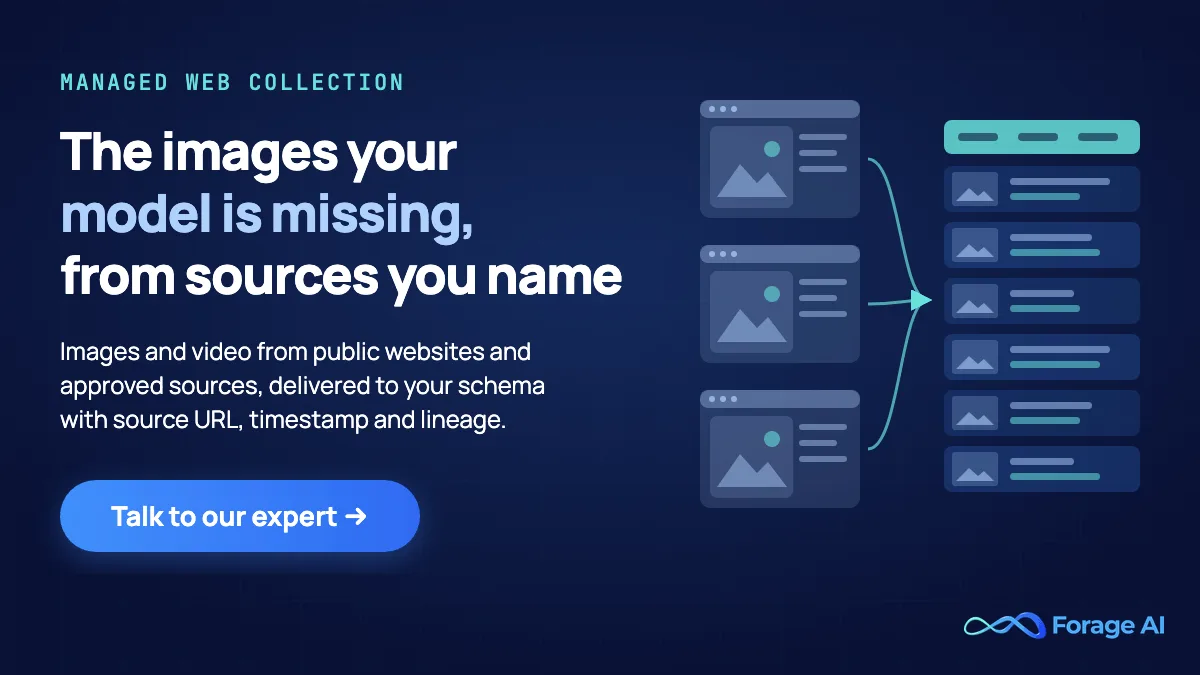
Supply route: web-sourced collection to your schema
For a domain you can name, the images often already sit on public websites. Specify the sources and keep a per-record provenance trail: collection gives you a record, not a right. Four limits apply.
- Collection does not move copyright. Collecting an image does not transfer the right to train on it.
- robots.txt and website terms are a floor, not a licence. France's regulator CNIL states that processing "cannot fall within the reasonable expectations of data subjects if the controller does not exclude from collection websites that explicitly object to scraping through robots.txt or CAPTCHAs".
- The web's skew comes with it. The Europe and North America skew GeoDE found (band 1) stays unless you specify sources by region or domain.
- Wrong route for face, body or biometric data. That gap belongs in band 1; see our guide to legal and ethical issues in web scraping.
Targeting beats filtering. Nguyen et al. (NeurIPS 2022) found that gathering a large amount of web data is not the most effective way to build a pretraining set for generalisation, and in DataComp (2023) a curated 1B set beat OpenAI's CLIP ViT-L/14 by 3.7 points at equal compute. More collectors: web scraping companies for AI data.
10. Grepsr
Managed web data extraction company that markets image and video collection.
| Attribute | Detail |
|---|---|
| Best for | Managed collection of images and video from websites, as URLs or files |
| What it supplies | Grepsr states it delivers "large-scale image and video data to power object detection, facial recognition, image segmentation" through "fully managed web data extraction", and that its crawlers "can scrape images in the form of either URLs or files" (as of November 2026) |
| Training right | Not stated by vendor |
| People in frame | Not stated by vendor |
| Pricing model | Published entry tier: one-time extractions "Starting at $100" for simple standard websites; image files cost extra |
| Watch-out | Its page lists facial recognition as a use; in the EU, building or expanding facial-recognition databases by untargeted scraping of facial images is prohibited (see the licence section). That check is the buyer's |
| Evidence | Detail |
|---|---|
| Reviews | G2: 4.5/5 (n=32, as of 5 November 2026); rates Grepsr's scraping service overall, not image collection |
| Pages read | Grepsr image and video pages, 5 November 2026 |
Grepsr fits a team that wants a priced, one-time pull to test whether web images cover its gap. It is the wrong route for face or body models (limit 4).
Choose files over URLs for a training set: what sits at a URL can change after you train, which breaks reproducibility. Grepsr prices files separately, so get that into the quote.
- Pro: A published starting price allows a small test without a sales cycle.
- Con: The G2 rating covers the scraping service, not image collection.
Bright Data also markets web video data for model training.
11. Forage AI
Managed collection of images and video from the public websites and approved sources you name, delivered as records in your schema.
| Attribute | Detail |
|---|---|
| Best for | The images or video your model is missing exist on public websites or sources you can name |
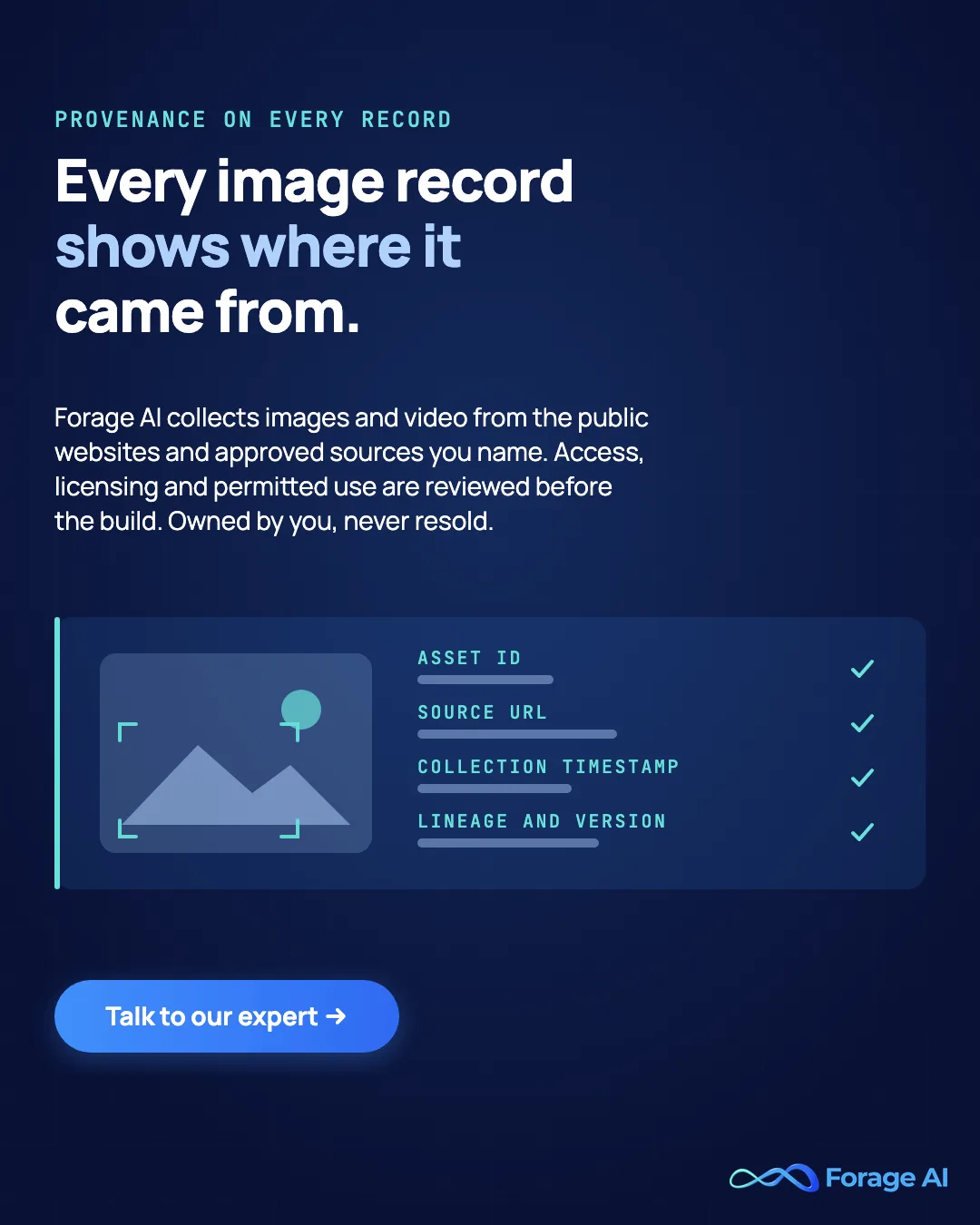
| What it supplies | Forage AI's page states it collects "text, tables, images, charts, audio, and video through one managed engagement". Each multimodal record carries asset ID and modality, the image or video URL, OCR text or transcript, captions as found at source, and duration, dimensions or format, with source URL, collection timestamp, and lineage and version history (as of November 2026) |
| Training right | Set per source in scoping; not conveyed by collection |
| People in frame | Privacy, retention and permitted use are reviewed before the build; for consented imagery of people, see band 1 |
| Pricing model | Not published |
| Watch-out | Collects existing images and video from the sources you name; for new imagery, see bands 1, 2 and 5. Rights per source are agreed in scoping, not conveyed by collection |
| Evidence | Detail |
|---|---|
| Reviews | No verified public reviews |
| Pages read | forage.ai/data-for-ai/, 5 November 2026 |
Forage AI fits a team whose gap is the long tail of a domain it can name. Its page says "Source discovery included. Map known, regional, and long-tail sources before the pipeline is built", which is how the web's regional skew gets corrected by specification. The service is fully managed, never self-serve.
Rights are settled before collection: its page says source access, licensing, permitted use, retention and privacy are reviewed before the pipeline is built, and "The final workflow is limited to approved sources". It is the wrong choice for consented imagery of people (band 1) or ready-licensed volume (band 3).
- Pro: Every record carries its source URL, collection timestamp and lineage.
- Pro: Delivered to your schema and refreshed as sources change.
- Con: Collects existing images and video only; for new imagery, see bands 1, 2 and 5.
- Con: Rights are agreed per source, not supplied with the data.
Rare, dangerous or unrecordable events
Supply route: synthetic generation and simulation
Synthetic data for computer vision fills the cases you cannot record. Rare concepts are expensive to cover with real data: multimodal models "require exponentially more data to achieve linear improvements" on a concept (Udandarao et al., NeurIPS 2024).
Whether synthetic images substitute for real ones depends on the kind and the task. Rendered 3D faces alone matched real data on face landmarks and parsing (Wood et al., Microsoft, ICCV 2021). Text-to-image synthetic images "significantly underperform in scaling when training supervised image classifiers", and helped most when real data was scarce, when test data diverged, or "when synthetic data is used in conjunction with real images" (Fan et al., CVPR 2024). A 2025 preprint, not peer-reviewed, trained detectors only on rendered images and reached 98% mAP50 on an industrial dataset but 67% on a robotics dataset (Araya-Martinez et al.). The verdict is open; test on your own real validation set.
12. NVIDIA Omniverse Replicator
A framework you run to generate synthetic perception data, not a data service.
| Attribute | Detail |
|---|---|
| Best for | Teams that will build and run their own simulation pipeline |
| What it supplies | NVIDIA describes Replicator as "a framework for developing custom synthetic data generation pipelines and services" and states it generates "physically accurate 3D synthetic data" for perception in autonomous vehicles, robotics and video analytics (as of November 2026) |
| Training right | Not stated on the documentation page (ownership of generated data not stated) |
| People in frame | Not applicable unless you add human assets; not stated by vendor |
| Pricing model | Not stated by vendor |
| Watch-out | You supply the 3D assets, scenes and engineering |
| Evidence | Detail |
|---|---|
| Reviews | No verified reviews (as of November 2026) |
| Pages read | Replicator documentation, 5 November 2026 |
Replicator fits a perception team with 3D and simulation skills that wants to generate its own rare scenes. Nothing arrives as a delivered dataset; a team that wants images handed over should look at Parallel Domain.
Output is only as varied as the assets and randomisation you author. Render a small batch of your failing scenario, mix it with real images, and measure on a real slice; the Fan et al. result is the reason to mix rather than replace.
- Pro: You define the scenario list.
- Con: No delivered data; your team builds and runs everything.
13. Parallel Domain
Simulation company for camera, lidar and radar data.
| Attribute | Detail |
|---|---|
| Best for | Camera, lidar and radar simulation for driving, drones and robots |
| What it supplies | "PD Sim: Camera, lidar and radar simulation for developing, training and testing at program scale"; PD Forma turns "Raw capture logs in. Validated, simulation-ready 4D worlds out." Industries listed: agriculture, automotive, defense, drone, robotics, trucking (as of November 2026) |
| Training right | Not stated by vendor |
| People in frame | Not stated by vendor |
| Pricing model | Not stated by vendor (demo request) |
| Watch-out | States "Sensor simulation proven to match reality"; that is the vendor's claim; test transfer on your own real validation set |
| Evidence | Detail |
|---|---|
| Reviews | No verified reviews (as of November 2026) |
| Pages read | paralleldomain.com home page, 5 November 2026 |
Parallel Domain fits an autonomy, drone or robotics team that needs sensor-accurate rare scenarios across camera, lidar and radar, without building the simulator.
PD Forma starts from your own capture logs, which keeps worlds close to the roads and locations you operate in. Any consent questions attached to those logs travel with them; that obligation stays with you.
- Pro: Simulates three sensor modalities together.
- Pro: Builds worlds from your own capture logs.
- Con: No public pricing; every conversation starts with a demo.
Labels on footage you already hold
If your gap is labels, not images, this is the wrong page: a labelling vendor is a different purchase. Label errors exist even in benchmark sets: at least 6% in the ImageNet validation set (Northcutt et al., NeurIPS 2021). Compare vendors in our guide to data labeling companies.
How the shortlisted providers compare
Read down Training right first: "Not stated by vendor" is a question to send, not a verdict. Row order follows the bands, not merit.
| Provider | Gap filled | Vision data supplied (as stated, Nov 2026) | Training right | People in frame | Pricing as published |
|---|---|---|---|---|---|
| LXT | Unseen regions, conditions | Images and video, 150+ countries | Not stated by vendor | Consent stated | Quote-based |
| Shaip | Faces, drivers, landmarks | Catalogue plus custom builds | Not stated by vendor | Consent and ethics review stated | Quote-based |
| iMerit | First-person video | Head-mounted in-home recording | Not stated by vendor | Not stated by vendor | Not stated by vendor |
| TELUS Digital | Robot, physical AI | Egocentric and teleoperation data | Not stated by vendor | Not stated by vendor | Not stated by vendor |
| DataSeeds.AI | Photo volume plus capture | 50M+ catalogue images stated | No clause published | Opt-in terms before capture | Not stated by vendor |
| Getty Images | Stock, editorial volume | Data-licensing datasets | Separate authorisation (entry 6) | No AI consent warranty | Not stated by vendor |
| Nexdata | Pre-built baseline | 200 million images stated | Commercial and research wording | Not stated by vendor | Not stated by vendor |
| Shutterstock | Multimodal volume | Images, video, audio, 3D | Separate AI data licence | Not stated by vendor | Not stated by vendor |
| Wavebreak Media | Images with releases | 4M+ owned assets stated | Permitted training uses named | Release records listed | Not stated by vendor |
| Grepsr | Web images, video | URLs or files | Not stated by vendor | Not stated by vendor | From $100, one-time; files extra |
| Forage AI | Named-domain long tail | Records with provenance | Set per source in scoping | Reviewed before the build | Not published |
| NVIDIA Omniverse Replicator | Rare scenes, self-built | Framework you run | Not stated on documentation | Not applicable without human assets | Not stated by vendor |
| Parallel Domain | Rare sensor scenarios | Camera, lidar, radar simulation | Not stated by vendor | Not stated by vendor | Demo request |
What does a licence to train cover for images?
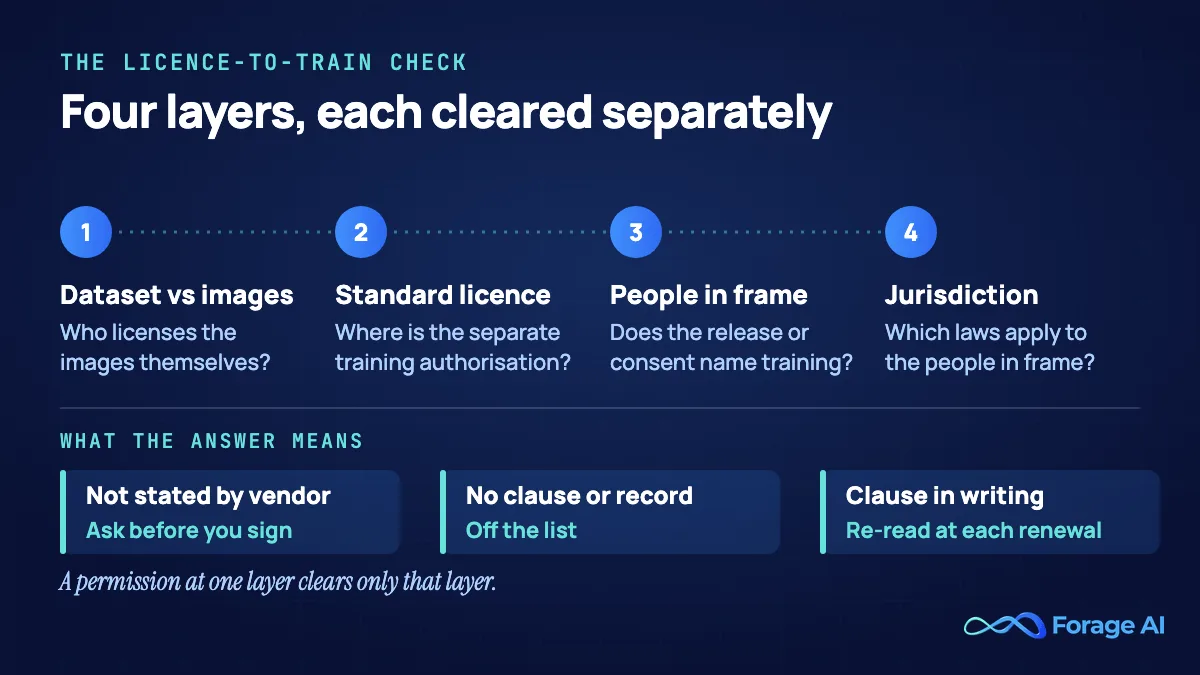
The Training right column raises the next question: what a licence to train covers. It has four layers, each cleared separately; a permission at one layer clears only that layer. Computer vision datasets, libraries and the law each draw their own line.
| Layer | What it covers | Example (with document) | What to ask |
|---|---|---|---|
| 1. Dataset vs images inside | The packaging, not always the pixels | COCO's terms: annotations CC BY 4.0; "The COCO Consortium does not own the copyright of the images", which follow Flickr's terms. Open Images: annotations CC BY 4.0, images "listed as having a CC BY 2.0 license", verify per image. LAION: "lists of URLs to the original images together with the ALT texts" | Who licenses the images themselves? |
| 2. Library standard licence | Ordinary stock use | Getty Images Content Licence Agreement (last updated April 2026) and Shutterstock's terms (effective 5 October 2026), which list using "any Visual Content as training data" among prohibited uses. See entries 6 and 8 | Where is the separate training authorisation? |
| 3. People in frame | Releases and consent | Getty "does not represent or warrant that consent has been obtained for such uses with respect to model-released content" | Does the release or consent name AI training? |
| 4. Jurisdiction | Where the people and the model are | EU AI Act, GDPR, Illinois BIPA (below) | Which laws apply to the people in frame? |
A dataset's licence often covers its annotations, not the images inside it.
LAION's stated legal basis is a research exemption, and a company re-downloading the images from its URLs is not LAION. LAION's datasets were withdrawn and rebuilt after child sexual abuse material was found in them.
People in frame bring the law in. EU AI Act Article 5(1)(e) prohibits AI systems "that create or expand facial recognition databases through the untargeted scraping of facial images from the internet or CCTV footage", applying from 2 February 2025. It does not cover every image of a person. Under GDPR Recital 51, photographs are biometric data "only when processed through a specific technical means allowing the unique identification or authentication of a natural person". The Illinois Biometric Information Privacy Act (BIPA) lists a "scan of hand or face geometry" as a biometric identifier and excludes photographs: a photo is not one, but a face template computed from it can be. These are the buyer's obligations. This is not legal advice; for cases and enforcement, see our guide to legal and ethical issues in web scraping.
In Getty Images v Stability AI (UK High Court, 2025), the training question was not decided; in December 2025 the court gave Getty permission to appeal on a separate point, secondary infringement. Before you sign, check the five licence clauses to check in a bought dataset and the records to demand before you sign.
How do you choose a vision data provider?
With the four layers mapped, the choice goes back to where this list started. Name the gap first. "More data" is not a gap; "misses products on shelves in the new country" is.
"Collecting more data often helps, but if you try to collect more data for everything, that can be a very expensive activity." Andrew Ng, founder of Landing AI and DeepLearning.AI, to IEEE Spectrum ("Andrew Ng: Unbiggen AI", 9 February 2022). Naming the slice your model fails on keeps the data budget pointed at it.
An illustrative scenario: a shelf-recognition model trained in one market misses products after launch in a new country. The stores (lighting, fixtures, angles) are a band 1 gap: commission in-store capture, with a consent record for shoppers in frame. New packaging appears as packshots on local retailers' websites, a band 4 gap: specify sources by country and keep source URL and timestamp per image. Packshots complement capture; they are not shelf conditions. Empty or occluded shelves are a band 5 gap: render them and mix with real images. Use the same split when you scope training data for object detection.
Then make three asks of every shortlisted supplier:
- A sample drawn from your gap, tested on your failing slice, and re-run each time you widen the order.
- The training clause in writing, with fine-tuning on its own line.
- The release or consent record for anyone in frame.
A supplier that cannot meet all three is off the list. Licence terms move: Getty's licence was last updated in April 2026 and Shutterstock's terms took effect on 5 October 2026. Re-read the training clause at every renewal, and keep each vendor's answers with the dataset.
Why Forage AI for computer vision training data
Forage AI collects images and video, with text, tables, charts and audio, from public websites and approved sources through one managed engagement. Source access, licensing, permitted use, retention and privacy are reviewed before the pipeline is built. The client owns the data, and Forage AI never resells it. See how managed data collection for AI training works.
Choose Forage AI if the images or video your model is missing exist on public websites or sources you can name, and you need them collected to your schema with a per-record provenance trail, refreshed as sources change, and owned by you.
Choose a licensed content library, a consented capture service or a labelling service if you need ready-licensed volume, consented imagery of people, specific capture conditions or labels on footage you already hold.
Computer vision training data FAQs
Where can I buy computer vision training data?
Buy by gap. Unseen people, places or conditions call for consented capture (band 1); a new sensor or robot body, lab and field capture (band 2). Volume with a training right comes from libraries' separate data-licensing agreements (band 3). A domain's long tail calls for web-sourced collection (band 4), and unrecordable events for synthetic generation (band 5).
How much training data does a computer vision model need?
There is no single number. Coverage of your failing slice matters more than total volume: in the Richards et al. study, curated, representative data narrowed regional gaps that scale had not. Rare concepts are the expensive case, since multimodal models "require exponentially more data to achieve linear improvements" on a concept (Udandarao et al., NeurIPS 2024). Measure your failing slice, then buy for it.
Does a stock photo or dataset licence allow AI training?
Not by default. Getty Images' and Shutterstock's standard licences both bar training and sell it separately. COCO and Open Images license their annotations, while the images carry their own terms: COCO points to Flickr's terms, and Open Images asks you to verify each image's licence. Read the training clause, not the headline licence.
Is it legal to train on images scraped from the web?
No law bans scraping as such; lawfulness turns on the data, the access and the use. In the EU, AI systems that build or expand facial-recognition databases by untargeted scraping of facial images are prohibited from 2 February 2025. GDPR Recital 51 treats photographs as biometric data only when processed to uniquely identify someone, and Illinois BIPA covers scans of face geometry but excludes photographs. This is not legal advice; see our guide to legal and ethical issues in web scraping.
Can synthetic data replace real images?
Sometimes, for narrow tasks; it depends on the kind of synthetic data. Rendered 3D faces matched real data for face landmarks and parsing (ICCV 2021). Text-to-image synthetic images scaled worse than real ones for supervised classifiers and helped most alongside real data (CVPR 2024). A 2025 preprint, not peer-reviewed, saw detectors trained only on rendered images transfer well in one domain and much worse in another. The question is open.
How much does computer vision training data cost?
A photo platform's chief executive discussed 5 cents to $1 per photo and more than $1 per video (Reuters, April 2024), and unpublished creator video has been reported at $1 to $4 per minute (Bloomberg, January 2025). Most roster vendors quote or do not publish prices; Grepsr publishes a $100 entry tier for one-time web extractions.
What is the difference between a training data provider and a labelling company?
A training data provider supplies the images or video: captured, licensed, collected or generated. A labelling company annotates data you already hold. If a population, condition or scenario is missing from your data, more labels will not fix it; if the images exist and need annotating, see the route section above.
Need images or video from websites you can name, collected to your schema with provenance on every record? Talk to us about managed data collection for AI training.
Related articles
- AI dataset marketplaces: where to license ready-made datasets and what to check first.
- Forage AI vs pre-built datasets: the licence clauses to check in a bought dataset, and when to build instead.
- Data vendor due diligence: the records to ask a data vendor for before you sign.
- Multilingual datasets: the same gap-first approach for language data.
Sai is a data infrastructure enthusiast who has spent the past two to three years following the AI space closely, from the infrastructure layer to the fast-growing world of data for AI. He is genuinely curious about how modern data pipelines get built and where the data industry is heading, and he writes insightful pieces on the core topics that shape this niche.