
Building Enterprise Brand Monitoring Systems that Scale
A strategic framework for social data extraction
The average top-tier corporation processes over 2 million brand mentions monthly across 50+ digital channels, yet most organizations capture less than 30% of their actual brand conversation. This gap between available social data and extracted intelligence represents both a critical vulnerability and a massive opportunity for enterprises ready to implement sophisticated brand monitoring systems.
Modern brand monitoring extends far beyond tracking mentions and hashtags. Leading enterprises leverage real-time social data extraction to predict crises before they escalate, identify product opportunities from customer conversations, and measure brand health across emotional trajectories that traditional metrics miss entirely. The organizations succeeding in this space share common approaches to architecture, implementation, and scaling that transform raw social signals into strategic business intelligence.
Whether you’re evaluating social listening platforms, designing crisis response protocols, or scaling existing brand monitoring initiatives, this guide provides the technical blueprints and strategic frameworks needed to capture the 70% of brand conversations most organizations miss.
Quick Digest
- The gap: Top-tier corporations process over 2 million brand mentions a month, yet most organizations capture less than 30% of their actual brand conversation.
- Beyond binary sentiment: Brand health is tracked across sentiment velocity, engagement quality, share of voice and influence propagation, not positive or negative scores alone.
- Crisis severity: A four-level classification ties negative sentiment thresholds to the response, from monitoring below 10% to executive involvement once content reaches mainstream media.
- Scaling: 70-90% of brand monitoring programs fail to scale beyond initial deployment. Pilots that scale limit scope to one business unit or region and 2-3 use cases.
- Build or buy: Fewer than 15% of leaders who build internally maintain the system beyond two years, and partnered solutions deliver insights within 30-90 days versus 12-18 months for internal builds.
The multi-dimensional brand health matrix for enterprise monitoring
Moving beyond binary sentiment analysis
Traditional sentiment analysis delivers binary positive-negative classifications that miss the nuanced reality of brand perception. Enterprise brand monitoring requires a multi-dimensional approach that captures sentiment velocity, emotional granularity, and contextual understanding across platforms and languages.
Consider how PepsiCo monitors brands across its portfolio. Rather than simple sentiment scores, they track sentiment velocity – the rate at which perception changes – alongside emotional trajectory mapping that identifies how customer feelings evolve throughout their journey. This approach revealed that customers experiencing minor product issues often become brand advocates when resolution happens quickly, an insight that simple sentiment tracking would miss.
Their framework measures brand health across four interconnected dimensions:
- Sentiment velocity tracking with intensity scoring on a 0-100 scale
- Engagement quality metrics that distinguish between passive mentions and active advocacy
- Brand equity measurements comparing share of voice against competitors
- Influence propagation patterns showing how brand messages spread through social networks
Technical requirements for multi-dimensional monitoring
The technical implementation of this matrix requires sophisticated social media crawlers capable of processing diverse content types while maintaining context. Successful enterprises deploy crawlers that handle text, images, videos, and emerging formats like AR filters and live streams simultaneously.
These systems must also navigate platform-specific challenges like:
- Twitter’s character limits create compressed language that requires specialized NLP models
- Instagram’s visual-heavy content demands computer vision capabilities
- LinkedIn’s professional context needs industry-specific sentiment calibration
- TikTok’s rapid trend cycles require real-time processing to capture fleeting conversations
Expert Insights
Platform fragmentation is why crawlers have to handle each network on its own terms. Online adults "now use an average of 6.75 different social media platforms each month," according to Simon Kemp's DataReportal Digital 2026 Global Overview Report, drawing on GWI research. A brand conversation rarely stays on one network, so monitoring built around one or two platforms will miss much of it.
Enterprise teams implementing this framework typically see sentiment prediction accuracy improve from 65% to over 85% within six months. The key lies in combining automated AI processing with human validation for nuanced cases, creating a feedback loop that continuously improves model performance.
Netflix exemplifies this approach, using social listening insights to guide product development decisions that have contributed to reducing churn by 12% annually.
How can real-time crisis detection prevent reputation damage?
Every minute of delay during a brand crisis costs enterprises an average of $42,000 in reputation damage and recovery expenses. Modern crisis detection systems must identify potential issues within 30 minutes of emergence, a target that requires sophisticated technical architecture and organizational readiness. (Learn more about how social media data collection powers crisis management and brand monitoring)
Expert Insights
Crises now break where people get their news. The Pew Research Center Social Media and News Fact Sheet (2025) found that 53% of U.S. adults at least sometimes get news from social media, and that 55% of TikTok users regularly get news on the site, up from 22% in 2020. A story can gather momentum on social platforms before it reaches mainstream media, which is why detection windows are measured in minutes.
Four-level crisis severity classification system
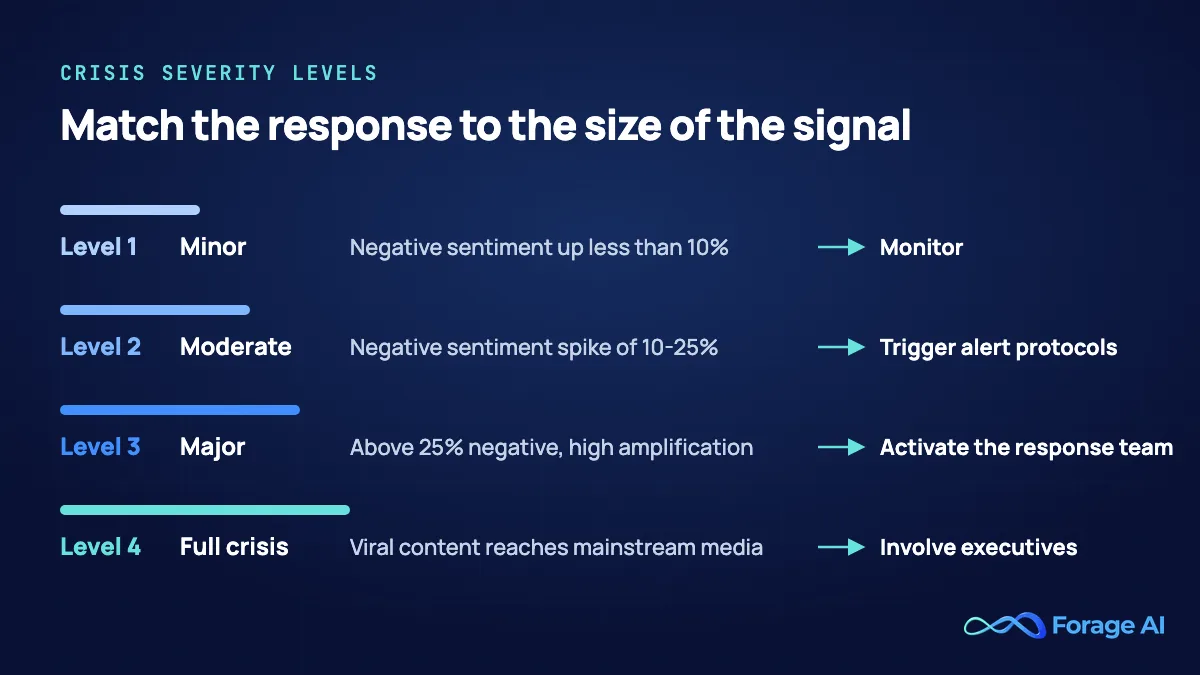
The most effective crisis detection frameworks operate on a four-level severity classification system:
- Level 1 incidents involve minor negative sentiment increases below 10%, typically requiring only monitoring.
- Level 2 moderate threats show 10-25% negative sentiment spikes, triggering alert protocols.
- Level 3 major threats exceed 25% negative sentiment with high amplification potential, demanding immediate response team activation.
- Level 4 full crisis mode occurs when viral negative content achieves mainstream media pickup, requiring executive involvement and comprehensive response strategies.
Chick-fil-A’s response to their BBQ sauce controversy demonstrates this framework in action. Their monitoring system detected unusual sentiment patterns around #BringBackTheBBQ within 90 minutes of the hashtag’s emergence.
The anomaly detection algorithm identified three critical signals: a 300% increase in mention volume within two hours, sentiment shifting from 27% to 73% negative, and high-influence accounts beginning to engage with the topic. This early detection enabled a response that transformed sentiment from 73% negative to 92% positive within 72 hours through strategic engagement and a commitment to relaunch the product.
Technical Architecture Components for rapid detection
The technical architecture supporting this rapid detection requires several integrated components:
- Stream processing systems handle millions of social signals simultaneously
- Distributed rate limiters coordinate API calls across platforms to maximize data collection while respecting limits
- Machine learning models trained on historical crisis data identify pattern anomalies that human analysts might miss, while automated change monitoring systems track shifts in brand perception across platforms
- Geographic distribution tracking shows how issues spread across regions, enabling targeted responses
Organizations implementing these architectures report 300-600% ROI through crisis prevention alone. The key success factor involves establishing clear escalation protocols that connect technical detection with business response. The same early-warning discipline underpins driving business results with intelligent news monitoring, where breaking coverage is surfaced and acted on the moment it appears. Teams new to this discipline can start with an introduction to news crawling, which explains how news sources are monitored at scale to feed these early-warning systems.
Honda’s comprehensive brand protection system exemplifies this integration, combining multi-channel monitoring with predefined response workflows that reduced average crisis resolution time from 48 hours to under 4 hours.
How do you scale social data extraction from pilot to enterprise?
The gap between successful pilots and enterprise-wide implementation remains the primary failure point for brand monitoring initiatives, with 70-90% of programs failing to scale beyond initial deployment. Organizations that successfully navigate this transition follow a structured scaling framework that addresses technical, organizational, and cultural challenges simultaneously.
Designing pilots for scalability
The scaling journey begins with a pilot design that intentionally limits scope while maintaining relevance. Successful pilots:
- Focus on a single business unit or geographic region
- Implement 2-3 specific use cases at maximum
- Involve 50-100 carefully selected users
- Establish clear success metrics with defined exit criteria
Visa’s approach to scaling its social listening program started with SMB customer discovery in one market, using specific keywords like “I own/run/manage” to identify potential clients. This focused pilot achieved 80% user adoption and 25% efficiency improvement before expanding globally.
Technical architecture decisions during the pilot phase determine scalability potential. Separation of discovery and extraction processes prevents bottlenecks as volume increases. Discovery spiders identify and catalog content sources while extraction spiders focus on data retrieval, enabling independent scaling of each function. This architectural pattern supports processing rates from 150 tweets per second in the pilot phase to over 100,000 social interactions per second at enterprise scale.
The transition from pilot to enterprise deployment requires careful orchestration across four phases. Pilot optimization involves analyzing performance gaps, refining processes based on user feedback, and documenting standardized workflows. Scaling preparation includes infrastructure capacity planning, training material development, and risk mitigation strategies. The enterprise rollout itself proceeds through phased deployment by business unit, with continuous monitoring enabling rapid adjustment. Post-deployment optimization focuses on capability building and knowledge transfer across the organization.
Citigroup’s Voice of Customer integration demonstrates effective scaling, expanding from a single product team pilot to enterprise-wide deployment across 100+ countries. Their success hinged on three critical factors: maintaining consistent executive sponsorship throughout the 18-month scaling process, establishing dedicated change champions in each deployment region, and creating standardized training programs that reduced time-to-proficiency from 45 to 15 days.
Lambda architecture patterns for enterprise social data processing
The choice between real-time and batch processing architectures fundamentally shapes an enterprise’s ability to extract value from social data. Lambda architecture, which combines batch processing for historical accuracy with stream processing for real-time insights, has emerged as the dominant pattern for organizations requiring both comprehensive analysis and immediate responsiveness.
The batch layer processes historical social data to create accurate, complete views of brand performance. This layer handles complex analytics like sentiment trend analysis across quarters, comprehensive competitive benchmarking, and deep customer journey mapping. The speed layer processes real-time streams for immediate insights, enabling crisis detection, trending topic identification, and instant customer response. The serving layer merges outputs from both systems, providing unified dashboards that combine historical context with current activity.
A Fortune 500 financial services company‘s implementation illustrates this architecture’s power. Their batch layer processes 50 million historical social interactions nightly, generating comprehensive brand health reports and competitive intelligence.
The speed layer monitors 2 million real-time interactions daily, triggering alerts for unusual patterns or emerging issues. The serving layer combines these perspectives, enabling executives to see both long-term trends and immediate threats in unified dashboards that update every 30 seconds.
Performance optimization within this architecture focuses on three areas.
- Micro-batching strategies balance latency with throughput, processing data in small chunks every few seconds rather than individual records or large batches.
- Intelligent partitioning ensures data locality, reducing network overhead and improving processing speed.
- Caching strategies minimize redundant API calls and database queries, with Redis-based caching reducing average response times from 2 seconds to under 200 milliseconds.
Compliance-first data extraction in the GDPR era
Social data extraction at enterprise scale requires sophisticated approaches to privacy compliance that go beyond basic consent management. With GDPR fines reaching €1.2 billion annually and CCPA enforcement expanding, organizations must architect their social media crawlers with privacy-by-design principles from inception.
Core compliance framework components
The compliance framework for social data begins with explicit consent mechanisms that distinguish between publicly available data and personal information requiring authorization. Modern social media crawlers must implement differential privacy techniques that enable aggregate analysis while protecting individual identity.
This involves:
- Data minimization strategies that collect only necessary information for stated purposes
- Purpose limitation controls that prevent scope creep in data usage
- Automated retention policies that delete data according to regulatory timelines
- Comprehensive audit trails that document every data interaction for compliance verification
The technical implementation leverages consent management platforms that track user permissions across touchpoints. These platforms integrate with social media crawlers through APIs that verify consent status before data collection, maintain consent histories for audit purposes, and automatically halt collection when consent is withdrawn. Data anonymization occurs through multiple techniques, including k-anonymity that ensures individuals cannot be identified within groups smaller than k, differential privacy that adds statistical noise to prevent individual identification, and homomorphic encryption that enables analysis on encrypted data without decryption.
Should you build or buy social data capabilities?
The choice between developing proprietary social media crawlers and partnering with specialized providers represents a strategic inflection point for enterprises entering or expanding brand monitoring capabilities. For a detailed analysis of this decision, see our comprehensive build vs buy guide.
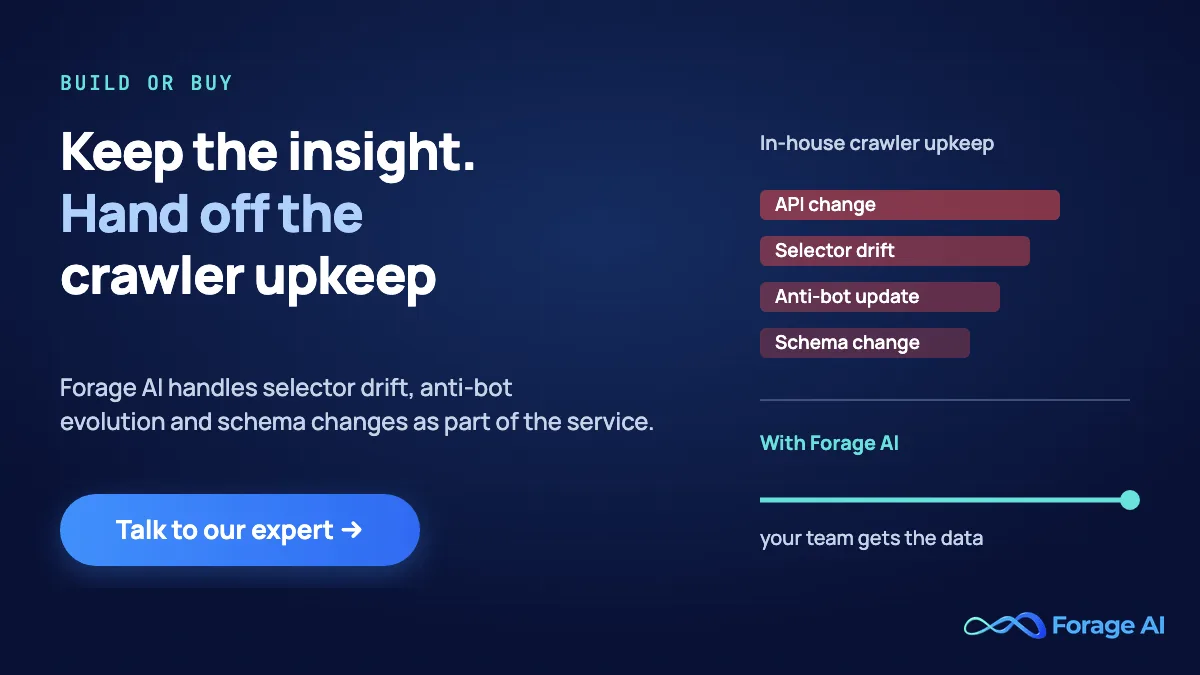
While 45% of global industry leaders initially attempt to build internal solutions, less than 15% successfully maintain these systems beyond two years due to the complexity of managing platform changes, scaling challenges, and resource requirements.
The build approach offers theoretical advantages, including complete customization for specific business needs, full control over data handling and security, and potential long-term cost savings at massive scale.
However, the hidden complexities quickly emerge.
- Social platforms change APIs an average of 8 times annually, requiring constant crawler updates.
- Rate limiting across 50+ platforms demands sophisticated orchestration that takes years to perfect.
- The machine learning models powering sentiment analysis and entity recognition require continuous training on billions of social interactions to maintain accuracy.
Expert Insights
Platform access can also disappear outright. Meta's Transparency Center states that "As of August 14, 2024, CrowdTangle is no longer available," and points researchers to Meta Content Library and its API instead. Every retired tool or changed endpoint means rework for an in-house pipeline, and that upkeep belongs in any build vs buy estimate.
A major automotive manufacturer‘s experience illustrates these challenges. Their two-year effort to build internal social listening capabilities consumed $12 million in development costs, required a dedicated team of 25 engineers and data scientists, and achieved only 60% coverage compared to specialized platforms. The project ultimately pivoted to a hybrid approach, maintaining proprietary analytics while partnering for data extraction.
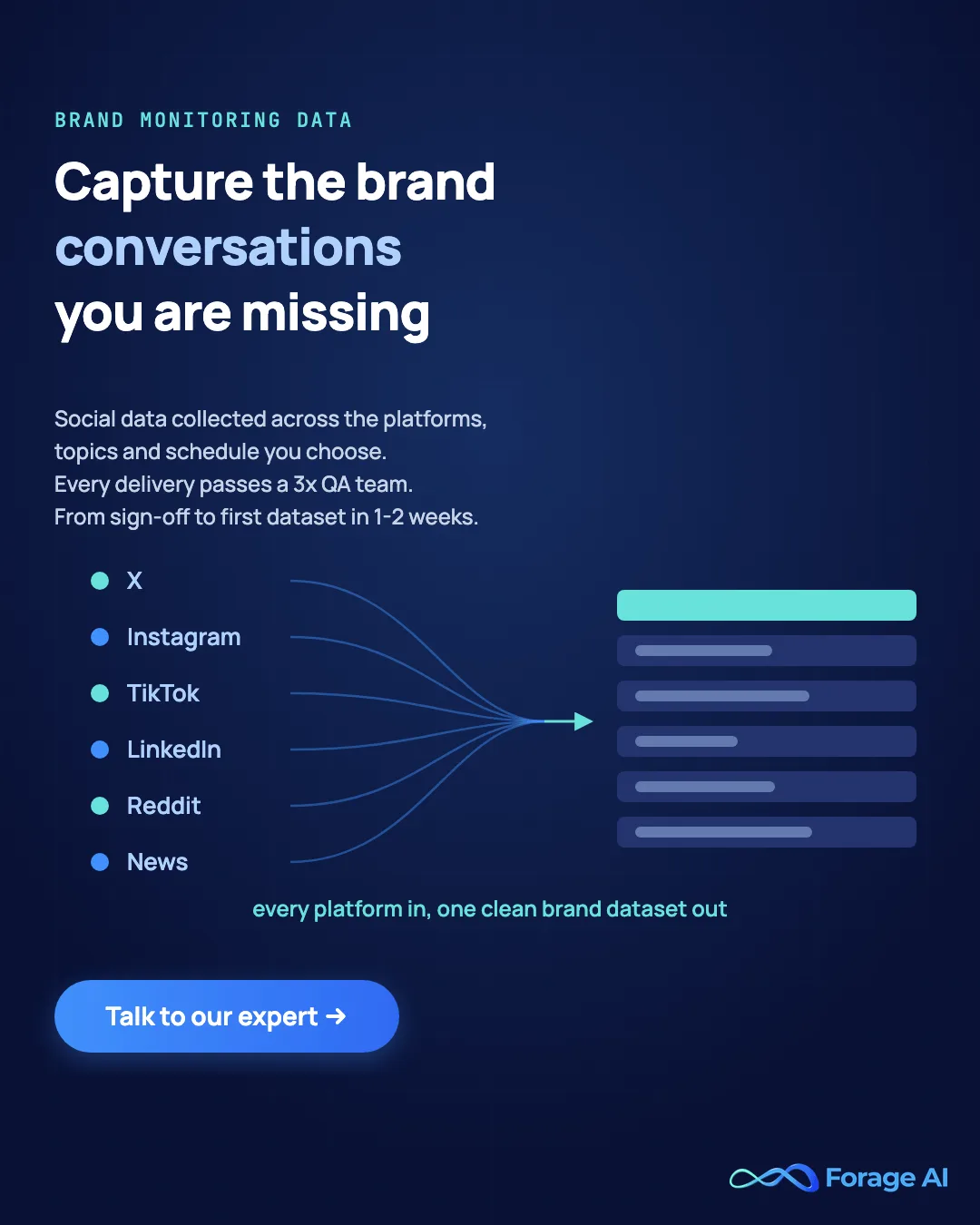
The partner approach leverages specialized expertise and infrastructure developed over years of focused investment. Leading social data providers like Forage AI bring distinct advantages that internal teams struggle to replicate. Their infrastructure covers 500M+ websites, with crawling speeds of over a million social profiles in under half a day. Every delivery passes a 3x QA team before it lands in your system, and handling, retention and deletion rules are agreed per engagement.
Advantages of a specialized data provider partnership
The partner approach leverages specialized expertise and infrastructure developed over years of focused investment. Leading social data providers like Forage AI bring distinct advantages that internal teams struggle to replicate:
- Infrastructure scale: Coverage across 500M+ websites
- Crawling speeds: Over a million social profiles in under half a day
- QA at delivery: Every delivery passes a 3x QA team before it lands in your system
- Governance expertise: Handling, retention, and deletion rules agreed per engagement
Agentic AI for social media data
Forage AI’s evolution from traditional web scraping to sophisticated agentic AI solutions exemplifies the innovation pace that specialized providers maintain. The agentic AI approach moves beyond rigid rule-based extraction to:
- Autonomous agents that adapt to platform changes automatically
- Context understanding through advanced NLP and computer vision
- Self-improvement through reinforcement learning
This takes the constant maintenance burden off your team, because Forage AI handles site changes as part of the service.
The integration capabilities of modern platforms enable enterprises to maintain strategic control while leveraging specialized capabilities:
- API-first architectures support seamless integration with existing automation systems
- Customizable data-as-a-service delivery formats ensure compatibility with internal data lakes and warehouses
- On-premise deployment options address security requirements for sensitive industries
- Dedicated support teams provide ongoing optimization and platform evolution guidance
Decision framework for build vs. buy
For enterprises evaluating a build vs buy decision, the framework should consider:
- Total cost of ownership: Initial investment, ongoing maintenance, updates, and scaling costs
- Time-to-value: Partnered solutions deliver actionable insights within 30-90 days versus 12-18 months for internal builds
- Coverage and accuracy: Specialized providers consistently outperform through aggregated learning across thousands of deployments
- Innovation velocity: Access to the latest AI/ML capabilities and platform features provides sustained competitive advantage
Quick Summary
Q: Should an enterprise build its own social media crawlers or partner with a data provider?
A: Building offers full customization and control, but fewer than 15% of leaders who build internally maintain the system beyond two years, because platforms change APIs about 8 times a year and rate limiting across 50+ platforms takes years to perfect. Partnered solutions deliver actionable insights within 30-90 days versus 12-18 months for internal builds. Compare total cost of ownership, time-to-value, coverage and accuracy, and innovation velocity before deciding.
How do you measure brand monitoring ROI?
Quantifying the value of brand monitoring investments requires moving beyond vanity metrics to outcome-based measurements that connect social intelligence with business results. Organizations achieving 200-300% ROI from their programs focus on four categories of value creation that directly impact financial performance.
1. Crisis prevention value
- Establish baseline crisis frequency before monitoring implementation
- Document crises detected and mitigated through early warning systems
- Calculate avoided costs:
- Legal fees
- PR campaigns
- Lost sales
2. Customer acquisition improvements
- Track social-influenced pipeline generation
- Monitor conversion rate improvements for socially-engaged prospects
- Measure reduced sales cycles through better prospect understanding
3. Competitive intelligence advantages
- Multiple successful content decisions from social intelligence
- Format adaptations and release timing optimizations
- Results: x% annual churn reduction
- Financial impact: billions of dollars in retained revenue
4. Operational efficiency gains
- Document time saved through automation
- Calculate cost avoidance from efficiency improvements
- Track quality improvements in customer interactions
- Quantify the reduction in manual monitoring tasks
The measurement approach documents time saved through automation calculates cost avoidance from efficiency improvements, and tracks quality improvements in customer interactions.
The strategic necessity for enterprise brand monitoring
The convergence of expanding social platforms, advancing AI capabilities, and increasing consumer expectations makes sophisticated brand monitoring a strategic imperative rather than an optional capability.
The path forward requires careful orchestration of technology, partnership, and strategy. Success depends on selecting a data partner that combines comprehensive coverage with enterprise-grade reliability, building cross-functional teams that transform insights into action, and establishing governance frameworks that ensure compliance while enabling agility. The frameworks and methodologies outlined here provide the blueprint, but execution determines outcomes.
For organizations ready to move beyond basic social listening to accurate social intelligence, the opportunity has never been greater. The combination of proven ROI, mature technologies, and specialized partners like Forage AI with 12+ years of expertise eliminates traditional barriers to entry. Forage AI delivers the social and web data behind everything from real-time crisis alerts to competitive intelligence, and its agentic pipelines adapt to platform changes so your team is not stuck maintaining crawlers.
The enterprises winning in this space share one common characteristic: they view social data not as an isolated marketing metric but as strategic business intelligence that drives decisions across the organization. As social platforms become the primary venue for customer expression, brand perception, and market dynamics, the ability to extract, process, and act on this data at scale becomes a defining competitive advantage.
Frequently Asked Questions
What is an enterprise brand monitoring system?
It’s a platform that helps businesses track online mentions, customer sentiment, competitor activity, and reputation risks across digital cha
els like social media, news, and forums.
How does AI improve brand monitoring?
AI enables real-time sentiment analysis, detects anomalies, classifies crises faster, and provides predictive insights that go beyond traditional keyword tracking.
Why do enterprises need brand monitoring systems?
Enterprises use them to protect brand reputation, respond to crises quickly, measure marketing impact, and gain competitive intelligence.
What are the best enterprise brand monitoring services in 2025?
Well-known brand monitoring tools include Sprinklr, Brandwatch, and Meltwater. Forage AI is different: it builds and runs managed pipelines that collect social, news and web data to your fields and deliver it into your own monitoring stack, with real-time alerts where you need them.
How much does an enterprise brand monitoring solution cost?
Pricing varies by volume of data, sources and scale. Forage AI scopes each engagement to the client, from a pilot to full-scale delivery.
What SLA metrics matter most when evaluating a brand monitoring or extraction vendor?
Enterprises should evaluate extraction success rate, data freshness, uptime, platform coverage, and compliance readiness. Forage AI provides transparent, measurable SLAs backed by enterprise-grade monitoring and high-accuracy AI extraction.
By Punith Y