
What Is Data as a Service (DaaS)? A Practical Guide for Buyers
If you’ve ever bought a packaged dataset, plugged it into your product, and discovered that the fields you actually needed (the ones that would have made your product different from the next one) weren’t in there, you’ve already met the wall most Data as a Service buyers hit.
It’s a quiet kind of disappointment. The vendor demo went well. The schema looked complete. The contract got signed. Then your team started building, and the gap emerged: the field you needed for the differentiating use case was either missing, sparse, or defined differently. So you bought a second dataset. Then a third. Now your data team spends Monday mornings reconciling exports from vendors who don’t agree on what a “company” is.
This article is about why that pattern keeps repeating, and what most introductory writing on data as a service gets wrong by treating it as a single category. It isn’t one thing. It’s two, and the difference between them is the difference between “we’re a subscriber” and “we own our data acquisition layer.”
Quick Digest
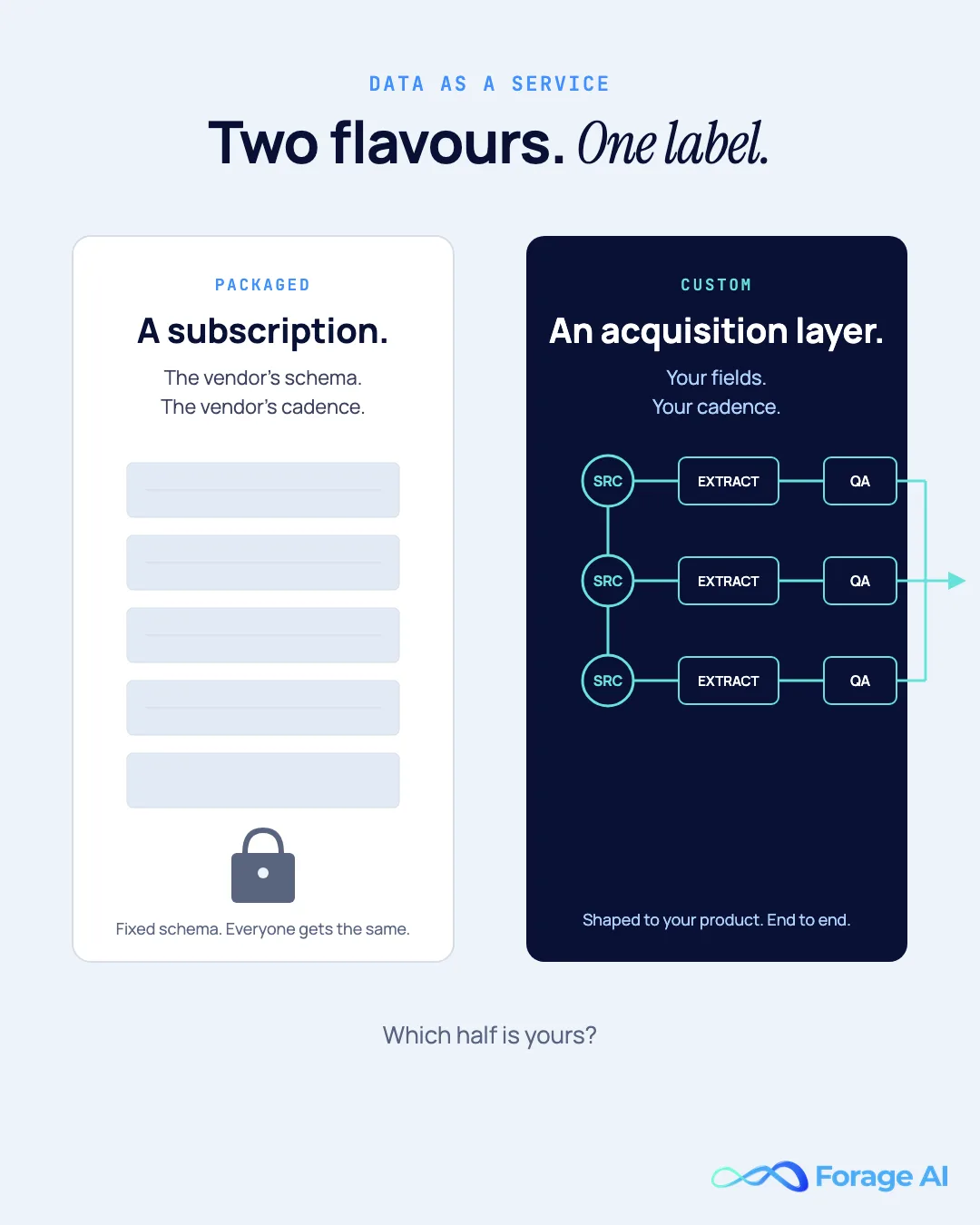
- Two models, one label: DaaS covers both a subscription to a pre-built dataset and a managed custom acquisition relationship, and the buying decision lives in the gap between them.
- Packaged: The vendor owns the schema, the taxonomy, the refresh cadence and the delivery format, so every competitor on the same subscription sees the same records.
- The wrong 60%: Pre-built datasets are built for median demand, so the fields that differentiate your product sit outside them by design.
- Vendor sprawl: Filling those gaps with more subscriptions ends in eight to twelve contracts and a permanent reconciliation cost.
- The test: Four questions on fields, refresh cadence, business rules and delivery format decide whether to subscribe or commission a custom engagement.
What does data as a service actually mean?
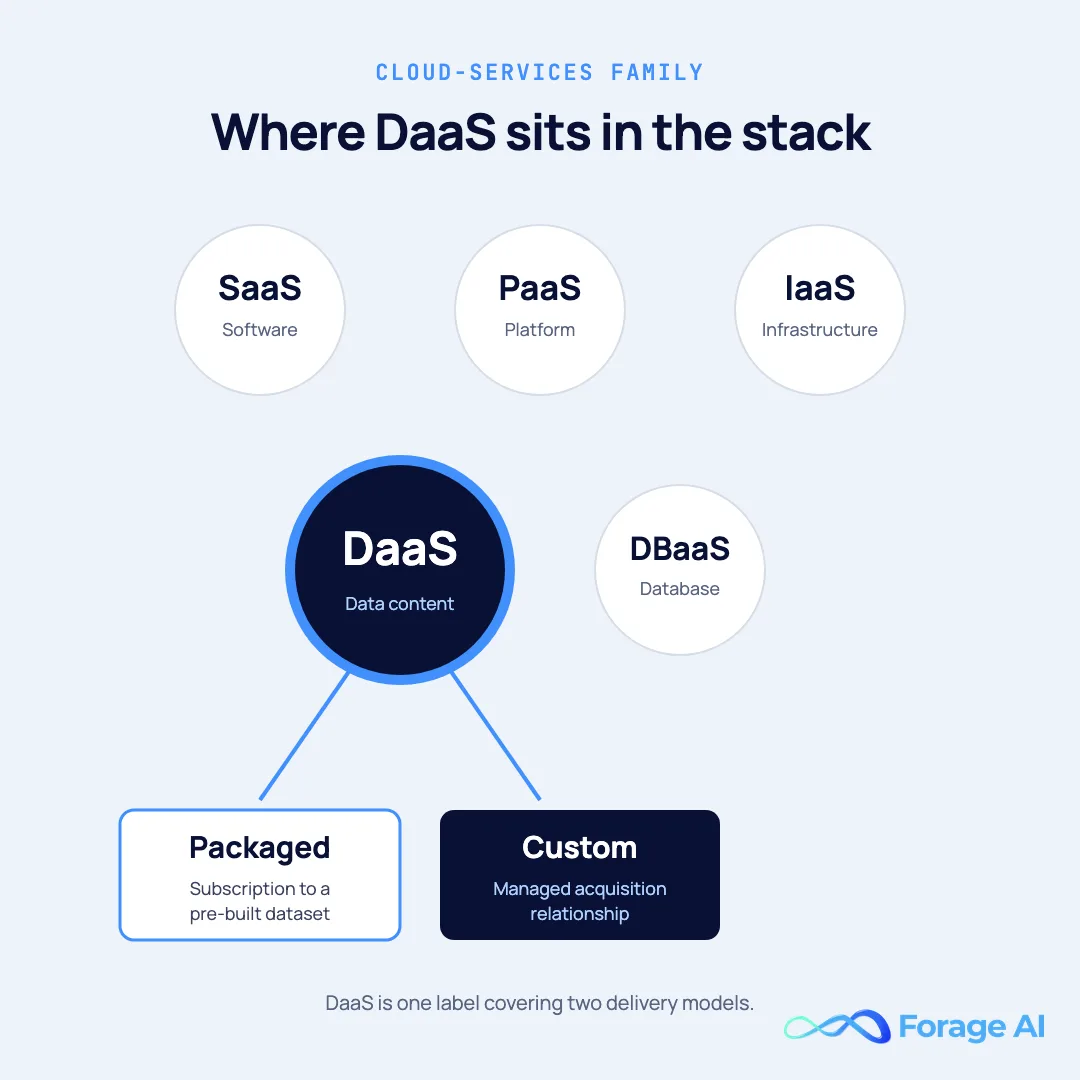
Data as a Service is the practice of delivering external data to a buyer on demand, over the internet, as a subscription or managed engagement, without that buyer having to acquire, clean, normalize, or maintain the data themselves. It sits in the same family as Software as a Service (SaaS), Infrastructure as a Service (IaaS), and Platform as a Service (PaaS): someone else owns the operational layer, and you pay to consume the output.
That’s the simple definition. Here’s the complication every introductory article on DaaS skips: the term covers two very different delivery models, and the buying decision lives in the difference between them.
The first is packaged DaaS, a subscription to a pre-built dataset. The vendor decides which fields the dataset contains, which taxonomy to use, how often it refreshes, and how it’s delivered. You subscribe, you query, you accept the shape of what comes back. Crunchbase for startup and funding data, ZoomInfo for B2B contact and firmographic data, Dun & Bradstreet for company records, Equifax for credit data: all packaged DaaS.
The second is custom DaaS, a managed acquisition relationship. The vendor doesn’t sell you a dataset. They build and run an acquisition pipeline around the specific fields, business rules, refresh cadence, and delivery format your product needs. You own the schema. The vendor owns the acquisition layer behind it.
The reason this split matters is that search engines and most explanatory content treat DaaS as a single category, which obscures the buying decision. The right question isn’t “should we use DaaS?” It’s “which kind of DaaS does our use case need?”, and that question has a structured answer.
The demand for both flavors is growing fast. IDC estimates that 78% of stored enterprise data is now unstructured, with global data volume forecast to grow from 5.5 zettabytes in 2024 to 10.5 zettabytes by 2028, a 16% annual growth rate. And Gartner’s 2026 Data & Analytics Predictions anchor the next several years in a unified data fabric and AI-ready data, both of which depend on a reliable partner to handle external data acquisition.
The DaaS Family Tree: DaaS vs DBaaS vs Data-as-a-Product vs Data Marketplaces
Now that we’ve established what DaaS is, it helps to draw a line around what it isn’t. Four cloud-data terms get conflated constantly, and the distinction matters when you’re scoping a procurement.
- Data as a Service (DaaS) delivers curated, ready-to-use data content on demand. You don’t run the database. You consume the data.
- Database as a Service (DBaaS) delivers managed database infrastructure (Amazon RDS, Google Cloud SQL, MongoDB Atlas). You bring your own data and run your own queries. The vendor handles uptime, backups, and scaling.
- Data as a Product (DaaP) is an internal team philosophy in which each domain within a company owns and publishes its data as a product to other internal teams. The “customer” is another team, not an external buyer.
- Data Marketplace is a discovery and procurement layer where multiple data providers list datasets for sale (think of catalog-style platforms operated by major cloud providers). The marketplace itself doesn’t produce the data; it shelves it.
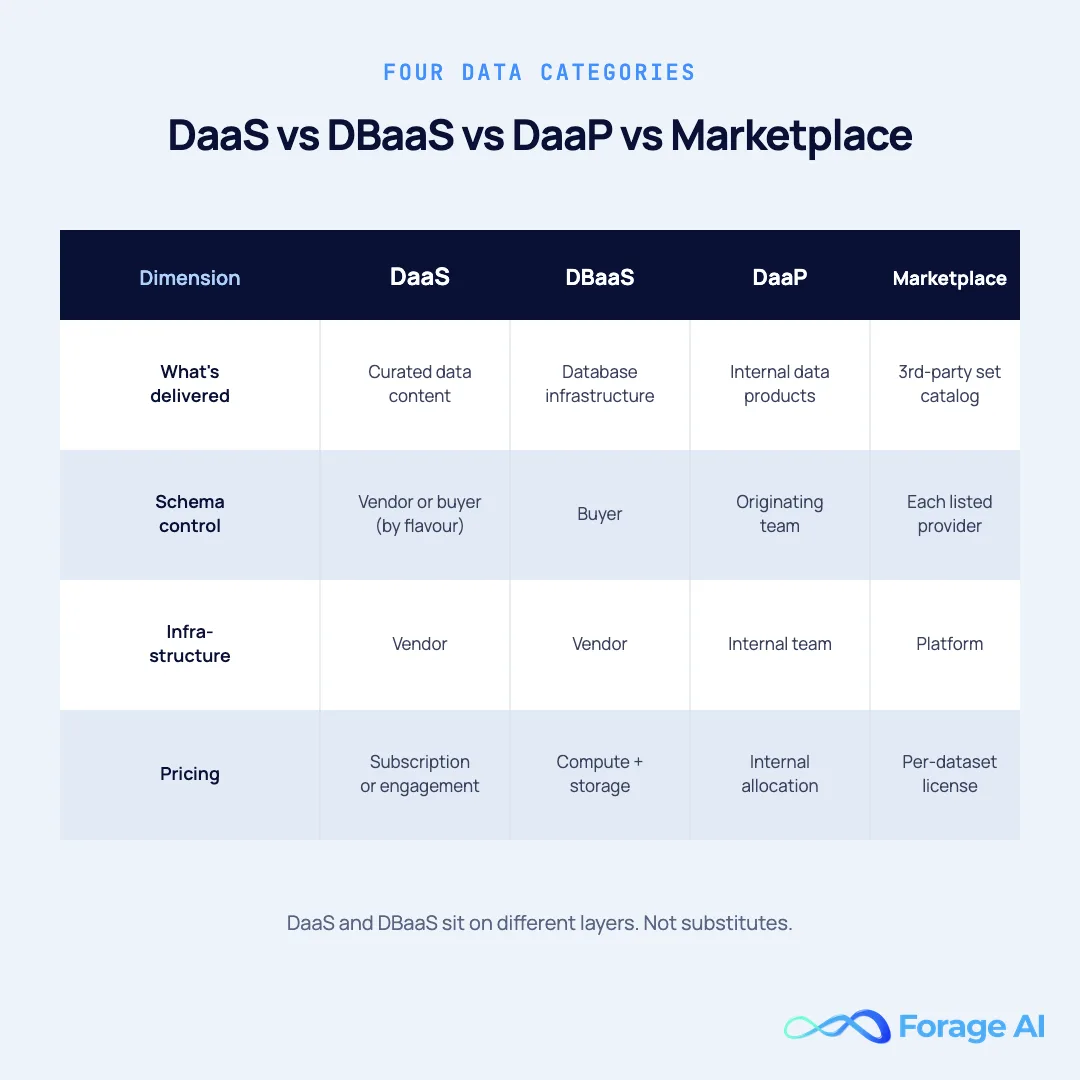
| What’s delivered | Who controls schema | Pricing typically | |
|---|---|---|---|
| DaaS | Curated data content | Vendor (packaged) or buyer (custom) | Subscription or engagement |
| DBaaS | Database infrastructure | Buyer | Compute + storage |
| DaaP | Internal data products | Originating team | Internal allocation |
| Data Marketplace | Catalog of third-party datasets | Each listed provider | Per-dataset license |
The common misconception is that DaaS and DBaaS are interchangeable. They aren’t; they live on different layers of the stack. DBaaS is plumbing for your own data. DaaS is content acquired and curated for you. If you find yourself comparing the two in a vendor evaluation, you’ve probably scoped the wrong question.
Packaged DaaS: What You Get from Crunchbase, ZoomInfo, D&B, and the Rest
With the neighboring categories sorted, the packaged side of DaaS is where most buyers start, so it’s where we start, too. Packaged DaaS is what most people picture when they hear “Data as a Service.” It’s a subscription to a pre-built dataset, with the vendor owning the schema, refresh cadence, and delivery format end-to-end. You don’t tell them what to collect or how to model it. You tell them how much you’ll pay, and you receive the data shaped the way every other customer receives it.
The packaged market is mature and segmented. A few category examples:
- Firmographic and B2B contact data: ZoomInfo, Dun & Bradstreet, Cognism.
- Startup, funding, and private-company data: Crunchbase, PitchBook.
- Consumer and marketing data: Acxiom, NielsenIQ.
- Credit and risk data: Equifax, Experian, TransUnion.
Pricing on this side usually falls into one of three models: per-seat licenses, per-record consumption, or tiered API access (with a free or freemium entry point that scales up to enterprise). For evaluation depth on this layer of the market, see our walkthrough of the best firmographic data providers in 2026, our roundup of the best Data-as-a-Service companies, and the B2B data provider selection guide.
Packaged DaaS works well in certain situations. Your use case maps cleanly onto the vendor’s canonical schema. Coverage matters more than depth: you need a lot of records, and you don’t need each one annotated with fields specific to your product (where annotation itself is the bottleneck, that’s a separate market, mapped in Forage AI’s 2026 data labeling vendor guide). Your team isn’t trying to differentiate on the data itself. Account prioritization, top-of-funnel enrichment, baseline market sizing, credit checks: all good, packaged DaaS use cases.
There’s a less-discussed reality on this side, though, that buyers tend to discover after the contract is signed. Packaged datasets are non-differentiating by design; that’s the point. Every competitor with the same subscription is looking at the same records. And the quality of those records is uneven. A 2026 Landbase analysis found that B2B contact data decays at roughly 2.1% per month (about 22.5% per year) and reported an industry-average B2B data accuracy of around 50%, compared with 97%+ from high-quality providers. The vendor’s standard schema also can’t carry your business rules (your definition of an “active customer,” your deduplication logic, your industry classification dictionary) without a downstream normalization layer that your team has to build and maintain.
Why does packaged DaaS miss what differentiates your product?
Here’s the frame that organizes the rest of this article.
Pre-built datasets are designed to serve the median use case. They cover the fields most buyers in their target segment need most of the time: the canonical 60%. The remaining 40% (the fields that would let your product do something the median customer can’t) is, almost by definition, outside the dataset. We call this the wrong 60%: not because packaged data is wrong, but because it’s the wrong 60% for product builders whose differentiation lives in the other 40%.
The shape of the gap differs by industry, but the pattern is consistent. A healthcare analytics product needs hospital-system affiliation graphs, provider network membership, and sub-specialty practice areas: fields a generic provider directory doesn’t carry. A real-estate intelligence product needs zoning attributes, ownership-entity resolution, and parcel-level utility data: fields beyond what a national listings feed offers, and beyond what most CRE data platforms expose off the shelf. A B2B financial-services product needs deep-nested firmographics (subsidiary structures, ownership cascades, regulatory entity IDs) that don’t fit a flat CRM schema. A regulatory data product needs the URLs for every rule cited, not just the rule itself.
This isn’t a vendor failing. It’s structural. Packaged datasets serve median demand. Differentiating fields are, by definition, non-median. A vendor can’t profitably build and maintain a dataset that includes every long-tail field every buyer wants, so they don’t. The same ceiling shows up outside firmographics: the pre-built ecommerce datasets teams use to train recommendation and forecasting models cover the common benchmarks but freeze at their collection window.
The cost shows up in two places. First, your product roadmap stalls on data dependencies that aren’t in the subscription you bought. Second, and this is the more dangerous one, you start trying to fix it by adding more subscriptions. If you’re already seeing the warning signs that your B2B data provider is limiting your growth, the second pattern is what we cover next.
The AI-readiness dimension makes the gap visible more quickly than before. Gartner’s 2024 forecast projected 60% of AI projects would be abandoned through 2026 due to a lack of AI-ready data. AI/ML training sets need depth, meaning the long-tail fields. Packaged datasets, optimized for median coverage, often fail the readiness check. And MIT Sloan has cited 15–25% of annual revenue lost to poor data quality, much of which traces to the moment a generic schema meets a specific product need.
The 60/40 Frame. Packaged DaaS covers the canonical 60% of the fields your category needs. The differentiating 40% (the fields that make your product yours) is, by definition, not in the package. If your product’s economics live in the 40%, packaged DaaS is incomplete, not wrong.
The 12-Vendor Sprawl Reality: What Actually Happens When Packaged Isn’t Enough
Most enterprise data buyers do not jump from one packaged subscription to a custom acquisition partner in a single move. They take the long way around, and the long way around is what we call the 12-vendor sprawl.
The pattern is consistent enough to be described as a composite. One global B2B firmographics buyer (anonymized; this is a composite story, not a single named account) bought a primary packaged dataset, filled field gaps within six months, and bought a second dataset to fill them. The second had different gaps, so they bought a third. Three years in, they were managing eight to twelve packaged-data subscriptions, each with its own data dictionary, refresh cadence, and definition of what a “company” was. Buyers often arrive at this point after a long detour through alternatives to Bright Data and similar packaged providers, hoping the next vendor will be the one that finally fits. The team whose actual job had become schema reconciliation (figuring out whether Acme Corp in one feed was the same legal entity as Acme Corporation in another) had grown to thirty to fifty people. The bill, between licenses and headcount, was in the eight-figure range a year.
The reason this fails economically isn’t the license cost; it’s the cost of everything around the license. Vendor management, contract renewal, schema reconciliation, dedup against eight different entity IDs, and ongoing drift as each vendor changes their schema independently. And the data still isn’t yours: you don’t own the acquisition layer, you just own the reconciliation cost on top of it. For a more structured walkthrough of how to evaluate vendors before you stack them, our complete guide to selecting a B2B data provider covers the scorecard side of this decision.
Expert Insights
The scale of the surrounding estate is the part buyers underestimate. MuleSoft's 2024 Connectivity Benchmark Report, based on 1,050 IT leaders surveyed with Vanson Bourne, states that "AI further complexifies the tech landscape, with an estimated 991 apps in the average enterprise" and that "only 28% of apps are connected." Eight to twelve data subscriptions do not land in a clean environment; they land in that one, and the reconciliation work is what you are really signing for.
The temptation when you’re already deep in vendor sprawl is to “just add one more” to fix the latest gap. That instinct is what makes the pattern self-reinforcing.
The Augmentation Trap. Stitching outputs from N packaged vendors does not produce a custom dataset. It produces an expensive, fragile, never-finished one, with reconciliation as a permanent line item.
Custom DaaS: Your Fields, Your Business Rules, Your Cadence, Your Format
If packaged DaaS is a subscription to a dataset, custom DaaS is a managed acquisition relationship for a dataset that doesn’t yet exist: your dataset, built around your product. The vendor doesn’t ship you their schema. They build and operate the acquisition pipeline that produces yours.
The shape of a custom DaaS engagement comes down to four levers, and the framing is deliberate: your fields, your rules, your cadence, your format.
- Your fields. The field set is built around your product, not a canonical schema. If your application needs hospital-affiliation graphs, ownership cascades, regulatory URLs, or any of the long-tail attributes that packaged datasets skip, those are line items in the engagement, not feature requests to a vendor roadmap.
- Your business rules. Validation, deduplication, entity resolution, and dictionary mapping are embedded in the pipeline rather than run downstream as a separate normalization step. Your definition of “active customer,” your industry taxonomy, your dedup logic: those are part of the data before it lands in your warehouse, not work your team does after delivery.
- Your cadence. Refresh frequency is tied to your decision velocity, not the vendor’s batch schedule. If your product makes calls hourly, the data refreshes hourly. If quarterly is enough, quarterly is what you pay for.
- Your format. Delivery fits your stack: NDJSON for streaming ingestion, Parquet for warehouse drop, SFTP for legacy pipes, direct-to-warehouse for Snowflake or BigQuery, RAG-ready for AI applications, on-prem for regulated environments.
Most enterprise data engineering teams can run pipelines beautifully. They have the talent, the platform, and the discipline. What they generally can’t reliably do is acquire external data at scale. That gap is what automated data extraction at production scale actually solves. The five disciplines that make external acquisition work (anti-bot evasion, long-tail source discovery, parsing and normalization at variable scale, infrastructure that flexes from a million pages to a billion, and continuous monitoring and repair) don’t usually fit into a single job description. They live in a vendor that does only this.
This is why the more useful framing for enterprise buyers in 2026 is “the data acquisition layer” rather than the internal-infrastructure framing. Your warehouse, transformation, and modeling stack is internal infrastructure. Your acquisition layer is the relationship that feeds them. For a deeper read on what this looks like in practice, our piece on custom web data extraction for competitive advantage walks through where the work concentrates, and our modern data extraction services guide covers the broader category.
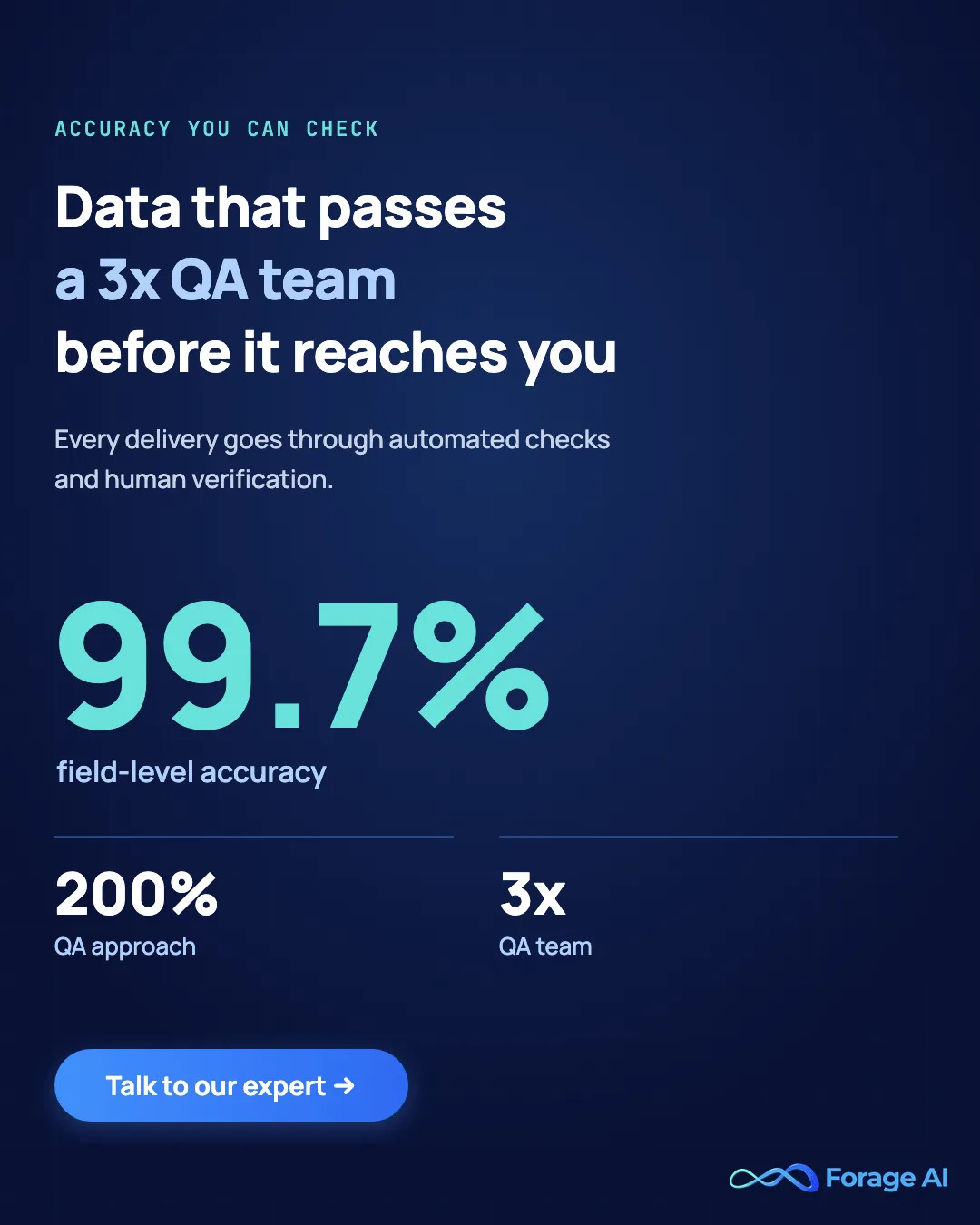
This is the layer Forage AI operates in. Twelve-plus years running external-data acquisition at enterprise scale, 500M+ websites crawled, a hundred-plus extraction specialists, 97% baseline accuracy moving to 99%+ with human-in-the-loop QA, built specifically to be the acquisition layer for product teams whose differentiation lives in the 40%.
Custom DaaS is not consulting. It’s not custom-scraping-by-the-hour. It’s not a packaged dataset with a sticker on it. It’s a continuous, managed acquisition relationship you don’t have to staff, run, or repair, producing a dataset you own outright.
Quick Summary
Q: How is custom DaaS different from a consulting project?
A: Consulting delivers a project and then leaves. Custom DaaS is a continuous managed acquisition relationship built on four levers: your fields, your business rules, your refresh cadence and your delivery format. You own the schema and the dataset that comes out of it, and the vendor owns and repairs the acquisition layer behind it.
The Four Custom Levers. Fields, Rules, Cadence, Format. If a vendor can move all four of them to fit your product, you’re looking at custom DaaS. If they can move none, you’re looking at a packaged subscription with a thicker contract.
How is DaaS priced: subscription, per-record, tiered or custom?
DaaS pricing splits along the same packaged-vs-custom line.
On the packaged side, there are three dominant models. Per-seat subscription charges per user are common in B2B contact platforms, where seats correlate with usage. Per-record consumption charges per row returned, common with enrichment APIs. A tiered API offers stepped quotas (free → pro → enterprise), common in developer-facing data products. All three share the same hidden-cost dynamic: the price you signed for is for fields you can use. Fields you can’t use, fields you have to discard or re-derive, and fields the vendor calls correct, but your audit says aren’t, all stay on the bill.
On the custom side, pricing is engagement-priced, not list-priced. The scope, fields, business rules, refresh cadence, volume, and SLAs vary enough between customers that a public rate card would be misleading. The economic argument for custom engagement isn’t “cheaper per record.” It’s “one predictable contract instead of (license + offshore reconciliation team + internal QA overhead + lost engineering cycles).”
The Gartner 2020 number that keeps getting re-cited has staying power for a reason: poor data quality costs the average organization $12.9 million per year. That figure largely reflects the cost of packaged-DaaS shoppers who were undercounted at the time of signing, and the cost of custom-DaaS engagements is sized to absorb.
A note on framing: cost-effectiveness is a real benefit of moving to a custom engagement once you account for the full picture, but it’s never the lead reason. Buyers who lead with cost end up back in the packaged aisle within a year. Buyers who lead with fit stay.
Sovereignty: Where Your Data Goes, Who Else Sees It, Who Resells It
This article is for informational purposes only and does not constitute legal advice. Consult a qualified attorney for legal guidance specific to your situation.
Pricing decides what you spend. Sovereignty decides what happens to the data once the contract is live, which, for regulated buyers, becomes the bigger procurement question. There’s a dimension of DaaS evaluation that the SERP almost completely ignores: what actually happens to your queries, fields, and derived data once they enter a DaaS vendor’s perimeter.
On the packaged side, many vendors aggregate usage signals across their customer base. Some resell derived datasets back to the market; your query patterns help train models that other customers benefit from. Many rely on third-party LLM APIs for enrichment or classification, meaning prompts (and sometimes data) leave the vendor’s environment and enter the model provider’s environment. None of this is necessarily bad, but it’s often invisible at the time of procurement.
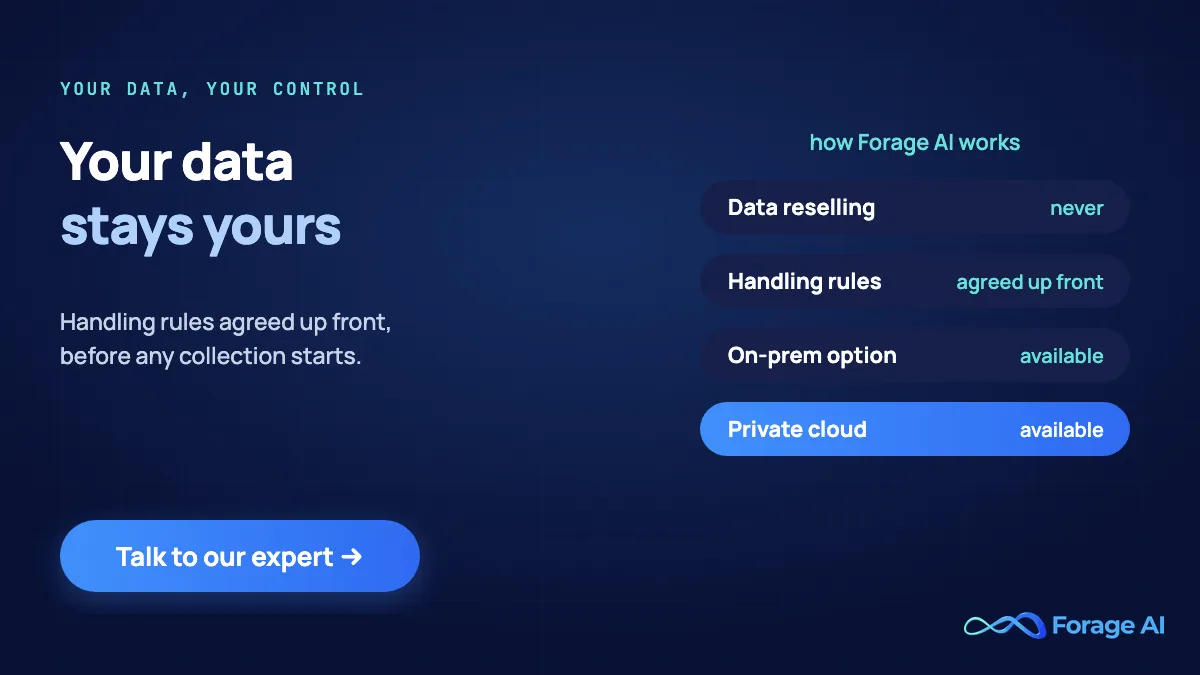
On the custom side, the contract is the control surface. Real engagements include explicit no-resell clauses, no-aggregation clauses, no-third-party-LLM exposure when required by the buyer, and on-premises deployment options for regulated environments. SOC 2 compliance is necessary but not sufficient: SOC 2 attests to operational controls, not to whether your data shows up in someone else’s derivative product.
This matters most in healthcare, finance, and legal, where procurement and legal teams now treat data sovereignty as a primary purchase trigger rather than a nice-to-have. In-house data acquisition is increasingly being blocked by legal review, which pushes the question to the vendor: Can you provide contractual cover for where this data lives, who else sees it, and whether you train on it?
Expert Insights
Cisco's 2025 Data Privacy Benchmark Study, which surveyed 2,600 privacy and security professionals across 12 countries, found that "90% of organizations see local storage as inherently safer, while 91% (up five percentage points year-over-year) trust global providers for better data protection." Buyers hold both beliefs at once, which is exactly why residency and resale terms belong in the contract rather than in a vendor conversation after signing.
For buyers with strict sovereignty requirements (on-prem deployment, contractual no-resell, no third-party LLM exposure), Forage AI’s custom engagements include those terms as standard, not as an upsell.
A Four-Question Test: Should You Subscribe or Commission a Custom DaaS Engagement?
Here is the framework the article has been building toward. Four questions. If you answer “yes” to any one of them, packaged DaaS is not complete for your use case. If you answer “yes” to two or more, custom DaaS is the right move.
1. Does your product depend on fields that packaged vendors don’t carry? If the fields that make your product different from your category’s median offering aren’t in the canonical schemas of the leading packaged vendors, and you’ve checked, not assumed, that’s the wrong-60% signal. Packaged DaaS can supplement, but it can’t be the foundation.
2. Does your refresh cadence need to be tied to your decision velocity, not the vendor’s batch? If your product needs daily, hourly, or event-driven freshness on data the vendor refreshes monthly or quarterly, the cadence mismatch is structural. You can’t fix it with a faster API tier.
3. Do your business rules need to be embedded in the pipeline, not run after delivery? If your team is doing meaningful dedup, validation, entity resolution, or dictionary mapping on packaged data after it arrives, you’re maintaining a second, hidden acquisition layer downstream. Moving those rules upstream into the pipeline is what custom DaaS is for.
4. Does your delivery format need to fit your stack: NDJSON, Parquet, RAG-ready, on-prem drop: rather than the vendor’s standard API? If your engineering team’s first hour with a new dataset is reformatting it, you’ve signed up for that hour every refresh, in perpetuity. Custom delivery formats permanently remove that work.
This is not a “build vs buy” framework. It’s a subscribe vs commission framework. Building the acquisition layer in-house was already off the table for most enterprise buyers once the five-discipline problem (anti-bot, source discovery, parsing/normalization, scaling, monitoring/repair) became clear. The real question for almost every Head of Data Ops in 2026 is which kind of vendor relationship to be in. For a more detailed read on why the build option keeps falling out of favor, our build vs buy decision guide covers the underlying economics; the broader category context is in our modern data extraction services guide.
The Four-Question DaaS Test. One “yes” → packaged is incomplete. Two or more “yes” → custom is the right move. Zero “yes” → packaged DaaS probably fits, and you should stop reading custom DaaS articles.
Conclusion
Come back to the moment we opened with: the field you needed wasn’t in the dataset, so you bought another one, then another. The article’s argument is that pattern isn’t a procurement failure; it’s a category-confusion failure. Data as a Service isn’t one decision; it’s two. Packaged DaaS solves coverage. Custom DaaS solves fit. Which one of your product economics demands comes down to whether your differentiation lives in the canonical 60% or in the 40% the vendor’s schema doesn’t carry.
Most enterprise data programs in 2026 are already running in a hybrid mode (packaged for breadth, custom for depth), and the boundary is moving. AI-readiness pressure is making the wrong-60% cost visible faster than it used to, because models exposed to generic data produce generic outputs.
A custom DaaS engagement is often cheaper than the packaged-plus-offshore-plus-reconciliation reality, once total costs are honestly accounted for. Forage AI runs the acquisition layer for product teams whose packaged vendors fall short, including buyers like Vested, where the relationship has delivered 12 consecutive months of 100% uptime. If your product depends on the differentiating 40%, see how that works in practice.
FAQs
1. What is Data as a Service in simple terms? Data as a Service is on-demand delivery of external data via the cloud: someone else acquires, cleans, and maintains the data, and you consume it via a subscription or managed engagement. It comes in two flavors: packaged (a subscription to a pre-built dataset like ZoomInfo or Crunchbase) and custom (a managed acquisition relationship built around your specific fields, business rules, refresh cadence, and delivery format).
2. What’s the difference between packaged DaaS and custom DaaS? Packaged DaaS provides every customer with the same schema and refresh cadence; the vendor owns the dataset shape end-to-end. Custom DaaS builds the acquisition relationship around your product’s specific fields, your business rules (validation, dedup, taxonomy), your refresh velocity, and your delivery format. The right way to pick: if your product depends on fields outside the median schema, custom DaaS is the model.
3. Is ZoomInfo (or Crunchbase, or D&B) a DaaS? Yes, all three are packaged DaaS. They’re the right call when your use case maps cleanly to their canonical firmographic, funding, or credit data schema and coverage matters more than depth. They’re the wrong call when your product depends on fields outside their schema, when your refresh cadence needs to differ from theirs, or when your business rules need to be embedded in the data before it reaches you.
4. How do DaaS pricing models work? Packaged DaaS uses per-seat licensing, per-record consumption, or tiered API access (free → pro → enterprise). Custom DaaS is engagement-priced based on scope, fields, refresh cadence, volume, and SLAs: one predictable contract instead of license fees, offshore reconciliation, and internal QA overhead. The total-cost comparison usually matters more than the per-record line item.
5. How is DaaS different from DBaaS? DaaS delivers ready-to-use data content; you consume the data the vendor has acquired and curated. DBaaS (Database as a Service) delivers managed database infrastructure; you bring your own data and run your own queries, while the vendor handles uptime and scaling. They sit on different layers of the stack and aren’t substitutes.
6. When does packaged DaaS stop working for an enterprise? When the differentiating 40% of your schema isn’t in the vendor’s dataset, when refresh cadence doesn’t match your decision velocity, when your business rules need to be embedded in the pipeline rather than run after delivery, or when your delivery format needs to fit your stack rather than the vendor’s standard API. Any single one of these signals means the package is incomplete; two or more mean custom DaaS is the right move.
Related Articles
- 5 Best E-commerce Data Extraction Solutions for Business Growth, A side-by-side look at e-commerce data extraction solutions for teams pulling competitor pricing, reviews, and catalog data.
S
Written by
Sai Subramaniam
Data Infrastructure Enthusiast, Forage AI
Sai is a data infrastructure enthusiast who has spent the past two to three years following the AI space closely, from the infrastructure layer to the fast-growing world of data for AI. He is genuinely curious about how modern data pipelines get built and where the data industry is heading, and he writes insightful pieces on the core topics that shape this niche.
Reviewed by the team of experts at Forage AI for accuracy and clarity.