
How to Legally Extract Social Media Data at Scale: The Enterprise Leader’s Framework

Data-driven organizations recognize that consistent access to clean and compliant social media data can differentiate them from industry followers. While most companies understand the potential of social media intelligence, few have mastered the operational framework to acquire and benefit from it.
Wondering why? The struggle isn’t simply the lack of technical or legal expertise; it’s architectural. In simpler terms, for a successful data project, enterprises need systems that deliver high-quality and reliable data, ensure compliance, and adjust to changing data needs. This requires moving beyond basic scraping techniques to robust data acquisition strategies. This is where things get messy.
Quick Digest
- Scale: A system built for scale delivers consistent data flows, which means high-frequency collection, platform-specific handling and processing raw data into a clean, structured format.
- Legal boundaries: Respect each platform's terms of service, apply data privacy principles such as data minimization even to publicly available data, and handle data ethically.
- Choose the right data: Professional and firmographic data suits B2B sales and recruiting, public conversations suit sentiment and market research, and engagement data suits campaign analysis.
- Five-step framework: Define the objective, map data requirements, choose build or buy, validate with a 30-day proof of concept, then integrate and operationalize.
- Before you start: Consult a lawyer before any social media data extraction project, and structure the rollout to show quick wins within 90 days.
What Makes Social Media Data Extraction Hard at Scale?
Building a small prototype is fine; however, deploying the data project into the real world with real data extraction challenges is not always a smooth journey. For social media data projects specifically, scale and compliance are the two key criteria we need to consider to ensure success. The challenge of scale means building a system that delivers consistent, reliable data flows, not just one-time data grabs. It’s about designing for:
- High-Frequency Data Collection: Extracting data every hour, not every day, to ensure data freshness. This can be a key factor when real-time data extraction is important.
- Multiple Platforms compatibility: Each major platform (LinkedIn, Twitter, Reddit, Facebook, etc.) has unique technical structures and anti-bot measures. A one-size-fits-all approach will fail.
- Data Processing: Transforming raw, unstructured data from these different sources into a clean, structured, and analyzable format.
Without a system in place, data pipelines break, insights become stale, and the value of the initiative declines. Your data project will become a liability and fail to fulfill its intended purpose.
The Imperative of Legal Compliance
For social media data extraction projects, operating within strict legal boundaries is non-negotiable. With so much personal and private data involved, this isn’t just about avoiding blocks and scraping respectfully; it’s about mitigating serious legal risk. It also helps to separate fact from fear here, since many of the myths about AI-powered web data extraction wrongly assume that all automated collection is inherently illegal. A compliant approach is built on:
- Respecting Platform Terms of Service: Each platform has its own rules governing automated access and privacy policies. While the legal landscape for scraping public data is complex (e.g., the hiQ v. LinkedIn case), following the basic rules is a critical first step.
- Adhering to Data Privacy Laws: Regulations like GDPR and CCPA apply even to publicly available data. This mandates principles such as data minimization (only collecting what is necessary) and having a lawful basis for collecting and processing data.
- Ethical Data Handling: This involves transparency about data collection and ensuring you’re not infringing on individual data privacy.
Ignoring these aspects exposes the organization to potential legal action, financial penalties, and reputational damage.
Expert Insights
Regulators have been clear that publicly available does not mean unregulated. On 28 October 2024, the UK Information Commissioner's Office and 16 other global data protection authorities issued a follow-up joint statement on data scraping, expecting organisations to "ensure that permissible data scraping for commercial or socially beneficial purposes is done lawfully and in accordance with strict contractual terms." In practice, document the lawful basis and the contract terms for every social data source before collection starts.
Many enterprises today actively search for providers that guarantee compliance with data privacy laws for social media scraping. The demand for such compliant infrastructure has given rise to specialized vendors offering end-to-end legal social media data extraction services, where every stage, from collection to delivery, is aligned with GDPR, CCPA, and platform ToS.
Find the Right Social Data for Your Strategy
Not all social data delivers the same value. The right choice depends entirely on your business objectives. Targeting the wrong source leads to wasted resources and missed insights. This guide will help you align your strategy with the data that actually drives results.
For businesses that depend on scale and compliance, knowing where to find services that handle large-scale social media data collection legally is key. Enterprise-grade providers ensure that extraction frameworks adapt dynamically to platform rules while maintaining ethical data practices.
1. Types of Data Available
Social media is a treasure trove of publicly accessible and valuable data for business analysis:
| Data Type | Best For | How to use it |
| Professional & Firmographic Data | B2B Sales, Recruiting | Map org charts, track employee movement, and identify growing companies. Ideal for feeding into CRM systems. |
| Public Conversations Data | Brand Sentiment, Market Research | Conduct sentiment analysis, track emerging trends, and manage brand reputation. Reveals the public perception. |
| Engagement Data | Campaign Analysis, Content Strategy | Measure campaign ROI, identify influential creators, and refine your content strategy based on what truly resonates. |
2. Platform-Specific Considerations
Each type of online platform requires a different technical and legal approach:
- Professional Networking Platforms: Highly protective with strict policies for automated extraction. Extracting data at scale can require advanced proxy management, fingerprint rotation, and human-like request patterns to stay sustainable and compliant. For instance, proxy solutions like IPFoxy can support such setups by providing stable, diverse IP sources essential for maintaining data accuracy and compliance at scale.
- Social Media Platforms: While many offer official APIs, enterprise-scale use can be costly and restrictive. With custom data extraction, you can extract only what you need, at the scale you require. Ensure you respect rate limits and accessibility rules.
- Community Forums & Discussion Boards: Rich sources for niche insights and public sentiment, but decentralized structures and varying moderation rules make extraction inconsistent. Success requires adaptable parsing systems and clear adherence to community standards.
Expert Insights
Official API pricing shows how quickly costs climb at enterprise volume. X's developer documentation (2026) prices post reads at $0.005 per resource on pay-per-usage plans, and those plans are "capped at 3 million Post reads per monthly billing cycle," with higher volumes moved to an Enterprise plan. Model API costs against your target volume and cadence before you commit to a collection method.
This is why firms specializing in scalable and compliant social media data extraction are becoming crucial partners for enterprise analytics and AI teams. Some even provide automated social media data harvesting platforms with legal safeguards that simplify both compliance and scalability.
3. Legal and Ethical Guidelines
It’s best to always consult a lawyer before embarking on a social media data extraction project. However, the core rule is simple: Ensure you are following the general rules and regulations for data extraction. These include, but are not limited to:
- Following the best practices: Remain respectful to the websites you’re scraping. Follow robot.txt guidelines and websites’ ToS.
- Personal data: Most laws and regulations have specific guidelines for scraping personal data, even if it is publicly available. It’s best to consult your lawyer first.
- Data minimization: Scrape only what is needed, do not store unnecessary data, and allow users to control how and when their data is used.
Expert Insights
France's data protection authority spells out what data minimization looks like in practice. In its June 2025 focus sheet on web scraping, the CNIL lists as mandatory measures to "define, in advance, specific collection criteria," to exclude categories of data that are not necessary, and to delete irrelevant data collected despite those criteria as soon as it is identified. The guidance was written for AI developers, but the same discipline applies to any project that collects personal data from social platforms.
The 5-Step Enterprise Framework for Implementation
Turning theory into practice requires a clear roadmap. Follow these steps to implement a scalable and compliant strategy.
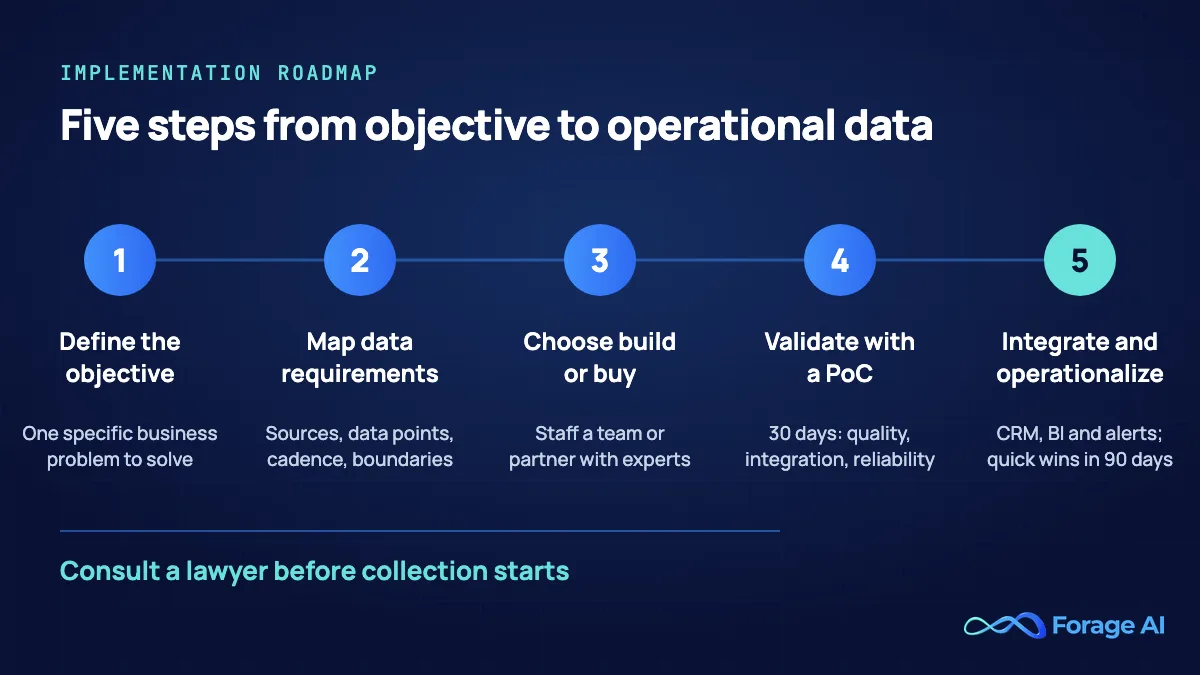
Step 1: Define Your Objective
Before writing a single line of code, answer this: What specific business problem will this data resolve? Vague goals yield vague results. Instead of “track social sentiment,” aim for “track sentiment shifts toward Product X among tech professionals on Twitter and Reddit within 24 hours of a feature launch.” This precision dictates your entire approach.
Step 2: Map Your Data Requirements
With your objective clear, specify exactly what you need:
- Sources: Which specific platforms, subreddits, or forums?
- Data Points: Do you need post text, engagement metrics, author bio, timestamps?
- Cadence: Do you need real-time streaming data or daily/weekly batches?
- Compliance Boundaries: Document GDPR/CCPA alignment and platform ToS adherence
This blueprint prevents scope creep and ensures every data point serves a purpose.
Step 3: Choose Your Path: Build vs. Buy
This is the critical build-versus-buy decision, a choice that will define your project’s cost, timeline, and ultimate success.
- Build Internally: This means staffing and managing a dedicated team for scraping, anti-detection engineering, and legal compliance. It’s a costly, ongoing arms race that diverts resources from your core business.
- Partner Strategically: Leverage experts like Forage AI who provide accurate, hassle-free custom data. Achieve operational data flows in weeks, not months, with predictable costs.
Unless you are building a data product, we recommend working with a partner. Companies like Forage AI manage your entire data pipeline so you can focus on generating insights. Most enterprises find partnering with expert data providers reduces time-to-insight while minimizing the operational and compliance risk that come with managing extraction internally.
Enterprises looking for API access to legally obtain social media data at scale or white-label social media scraping services can benefit from working with managed providers. These solutions handle compliance, infrastructure, and ongoing legal monitoring, allowing internal teams to focus purely on insights and decision-making.
Step 4: Validate with Focused Proof of Concept (PoC)
Test before scaling. A 30-day PoC should validate:
- Data Quality: Accuracy, completeness, and structure
- Compliance: Adherence to your legal framework
- Integration: Seamless flow into your CRM/BI tools
- Reliability: Uptime and consistency during testing
Step 5: Integrate and Operationalize
Define how you will consume the data. Eg:
- Feed CRM systems for sales intelligence and lead scoring
- Connect to BI tools for market trend analysis
- Power real-time alerts for risk management
- Automate talent pipelines for recruitment
Structure your implementation to show quick wins within 90 days.
Social media data extraction Applications That Drive ROI
When executed well, a compliant, large-scale social media data project becomes a competitive advantage:
- Talent Intelligence & Recruitment: Enterprises can analyze millions of professional profiles to identify emerging skills, career movements, and hiring opportunities. By leveraging such insights, organizations have reduced recruiting costs while simultaneously improving candidate quality and fit.
- Market Research & Consumer Insights: Replace lagging surveys with real-time sentiment tracking from targeted forums and groups. Teams that go further use this data for social data mining that tracks audience movement and builds persona signals, turning scattered posts into a living picture of how their market is shifting.
- Sales Intelligence & Lead Generation: Mapping org structures and identifying prospects through hiring trends and tech adoption signals can lead to significantly higher close rates than cold outreach.
- Risk & Crisis Management: Spot emerging brand threats or PR crises in real-time across platforms.
Quick Summary
Q: What does an enterprise need to extract social media data legally at scale?
A: Two things: a system built for scale and a process that stays inside legal boundaries. Scale means high-frequency collection, platform-specific handling and turning raw posts into structured data. Legal operation means respecting platform terms of service, applying principles such as data minimization even to public data, and consulting a lawyer first. A five-step roadmap ties it together: define the objective, map requirements, choose build or buy, run a 30-day proof of concept, then integrate.
How Forage AI Delivers Enterprise-Grade Data Extraction
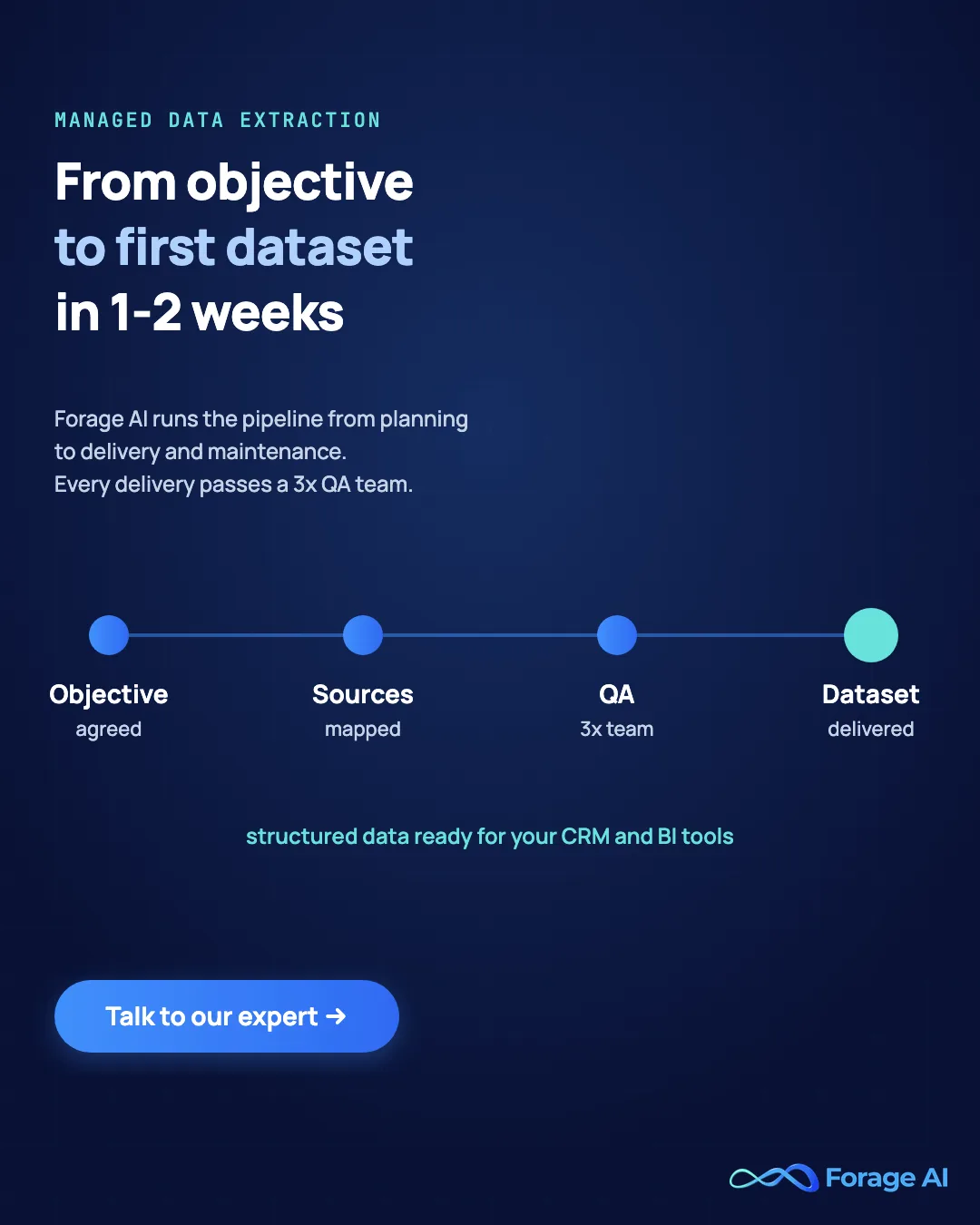
At Forage AI, we help companies bypass the complexity of building and maintaining data infrastructure. Our managed service is built for leaders who need reliable social media data without the technical overhead: Forage AI builds and runs the pipeline to your fields and delivers the data into your systems.
What We Offer:
- Custom Pipelines: Tailored delivery of the exact fields, formats, and frequency you need. Save costs and get what you need.
- Managed Data Extraction: We help you with end-to-end data extraction from planning to delivery and maintenance.
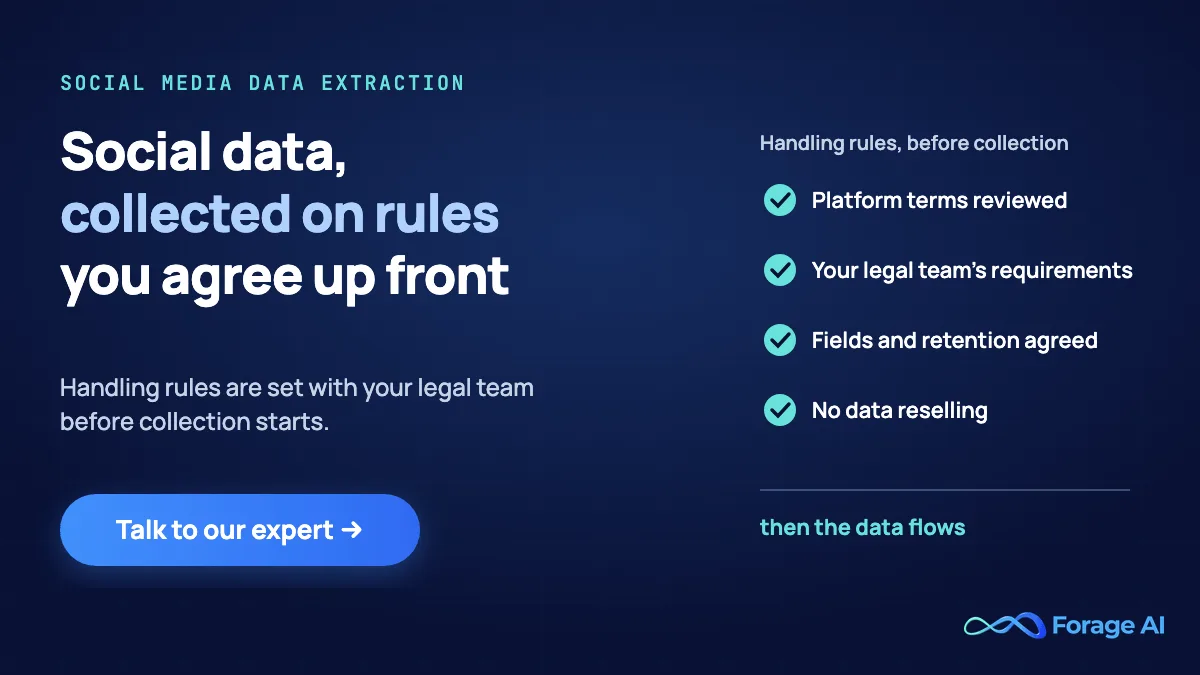
- Handling Rules Agreed Up Front: Platform terms of service and your legal team’s requirements are written into client-specific handling rules before collection starts, and your data is never resold. Forage AI brings deep expertise in social media data extraction, with every dataset collected ethically and stored securely.
- Scalable Infrastructure: Quickly scale from hundreds to millions of data points. With automated proxy management and adaptive anti-blocking tactics, scale as you wish.
Frequently Asked Questions
What’s the difference between using an API and a web scraper?
Official APIs provide hassle-free access to data, but they often come with strict usage limits and high costs at scale. In contrast, web scraping enables the collection of more flexible and customized datasets, but it must be carefully designed to ensure sustainability, compliance with legal regulations, and adherence to platform terms of service.
How does Forage AI avoid getting blocked by platforms?
Forage AI follows responsible collection practices, such as rate limits and careful access patterns, and its team maintains the pipeline as platforms change, so collection keeps running.
Which companies offer enterprise solutions for legal social media data extraction?
Enterprise data providers like Forage AI run managed extraction pipelines with client-specific handling rules, agreed with your legal team up front, that cover platform terms of service.
What’s the safest way to collect social media data at scale?
The safest approach is to partner with compliant data providers who manage privacy, consent, and infrastructure, ensuring regulatory alignment across all regions.
What do I need to get started with a data extraction project?
Define your business objective. From there, Forage AI helps identify the right data sources, fields, and delivery formats to integrate seamlessly into your workflows.
Sai is a data infrastructure enthusiast who has spent the past two to three years following the AI space closely, from the infrastructure layer to the fast-growing world of data for AI. He is genuinely curious about how modern data pipelines get built and where the data industry is heading, and he writes insightful pieces on the core topics that shape this niche.