
LlamaIndex vs LangChain: Which RAG Framework Should You Build On
Choosing between LlamaIndex and LangChain is a commitment, not a library import. The framework you pick will shape how your team models retrieval, how it debugs failures, and how much of the codebase has to move when the next major version lands. You will live inside the winner’s abstractions for years.
The choice is also harder to research than it should be, because most comparison articles still describe the 2023 versions of both projects. LangChain went through a ground-up 1.0 rearchitecture in late 2025. LlamaIndex pivoted from a retrieval library into a multi-agent framework. An article that talks about chains and conversation memory on one side and “just a search tool” on the other is describing software that no longer exists.
The stakes justify getting this right. Enterprise AI spend hit $37 billion in 2025, up 3.2x from the year before, and RAG remains the second-most-common way enterprises customize models (Menlo Ventures, December 2025). The framework decision sits under all of that.
This guide walks through five questions: what LangChain actually is today, what LlamaIndex actually is today, how they compare on verified numbers, the features that genuinely separate them, and the decision rules that map your use case to a framework. Everything version-specific carries a date, because this space does not sit still.
Quick Digest
- The 2026 distinction: Both are MIT-licensed agent frameworks now. LangChain’s center of gravity is orchestration (the LangGraph runtime); LlamaIndex’s is documents and retrieval (Workflows, LlamaParse).
- What changed: LangChain 1.0 (October 2025) rebuilt the framework agent-first around create_agent. LlamaIndex pivoted to multi-agent Workflows with LlamaCloud as its commercial layer.
- Headline numbers (August 4, 2026): langchain ~143.4k GitHub stars and ~299M monthly PyPI downloads; llama_index ~51.4k stars and ~23M monthly downloads across core packages.
- The accuracy myth-buster: an independent June 2026 benchmark found identical answer accuracy across frameworks with components held constant. They differ in overhead and tokens, not correctness.
- Deciding features: retrieval depth and document parsing favor LlamaIndex; durable agent state and human-in-the-loop control favor LangGraph; LangSmith vs LlamaCloud mirror those strengths.
What Is LangChain in 2026?
LangChain is an open-source framework for building LLM applications, and since late 2025 it describes itself as an agent engineering platform. That self-description is accurate, and it marks how far the project has traveled from the chains-and-prompts library most engineers remember.
The 1.0 reset: from chains to agents
LangChain 1.0 shipped on October 22, 2025, and it was a repositioning, not a point release. The legacy surface that defined the framework’s first three years, chains, the old memory classes, the half-dozen coexisting agent patterns, moved out of the core package into langchain-classic. What remained was rebuilt around a single primitive:
That simplification matters for a reason beyond ergonomics. The loudest criticism of pre-1.0 LangChain, on Reddit and everywhere else, was abstraction churn: five different ways to build the same agent, with outdated tutorials ranking in search forever. The 1.0 release is the project’s answer, and practitioner sentiment has noticeably softened since. The advice showing up in r/LangChain threads now is to ignore pre-v1 material entirely and start from the current docs.
LangGraph is the runtime, not a competitor
One clarifier before anything else, because search data shows this confuses more engineers than the LlamaIndex comparison does: LangGraph is not a LangChain alternative. It is the graph-based runtime that LangChain agents now run on. Every create_agent call executes on LangGraph underneath.
The layering is deliberate. create_agent covers the standard shapes: a model, some tools, a loop. You drop down to LangGraph directly when the standard shape stops fitting, when you need a custom state machine with branching and cycles, durable checkpoints that survive a crash mid-run, or a human-approval gate that pauses execution until someone signs off. Multi-agent systems, where several agents hand work to each other under an orchestrator, are built at this layer too.
The commercial layer: LangSmith
Around the open-source core sits LangSmith, the company’s commercial platform for tracing, evaluation, and deployment. When an agent misbehaves in production, LangSmith is where you replay the run step by step and see which tool call or model response went sideways.
The company behind the framework is well capitalized: a $125M Series B at a $1.25B valuation, announced October 2025. The same announcement reported 90M combined monthly downloads, 35% of the Fortune 500 using LangChain products, and 12x year-over-year growth in LangSmith trace volume; treat those three as company-reported rather than independently audited. Current open-source release as of August 2026: langchain 1.3.x, MIT-licensed, in Python and JavaScript/TypeScript.
What Is LlamaIndex in 2026?
LlamaIndex is an open-source framework that started life in November 2022 as GPT Index, with one job: connect LLMs to your data. That data-first origin still defines it, even as the project has grown into something considerably larger.
Retrieval-first, and it shows in the defaults
The core pipeline is ingestion, indexing, and querying. Documents come in through readers, get chunked and embedded into an index, and a query engine answers questions over them. The whole loop fits in five lines:
What the five lines hide is the depth underneath them. Hybrid search combining BM25 keyword matching with dense vectors, reranking pipelines, and a catalog of chunking strategies all arrive as configurable defaults rather than components you assemble by hand. This is the practical meaning of “retrieval-first”: the things a document Q&A system needs to answer well are the things LlamaIndex optimized before anything else.
The pivot: from RAG library to document agents
LlamaIndex has moved well past static question answering. “We’ve fully made the pivot to a multi-agent framework,” co-founder Jerry Liu said in mid-2025, describing classic RAG as “a very fixed process” next to agents that load files dynamically, analyze functions, and search specific pages as a task demands.
Orchestration happens through event-driven Workflows rather than graphs: steps subscribe to events and emit new ones, which composes lightweight pipelines without a state-machine formalism. It is a genuinely different orchestration philosophy from LangGraph’s, lighter and less prescriptive, and llama-deploy exists to take those Workflows to production as services.
The commercial layer: LlamaCloud and LlamaParse
The company’s commercial bet is the document layer. LlamaParse handles the documents that break naive pipelines: scanned PDFs, financial tables, slide decks, embedded charts. LlamaCloud wraps parsing, indexing, and retrieval into a managed service, and both went GA alongside a $19M Series A in March 2025. Today the company describes itself as a document-agent and OCR platform, which tells you where it believes its edge lives.
Current release as of August 2026: llama-index 0.14.x, MIT-licensed, Python and TypeScript. Note the version number honestly: LlamaIndex has not declared a 1.0, which in practice means somewhat more API movement between releases than LangChain’s post-1.0 stability contract.
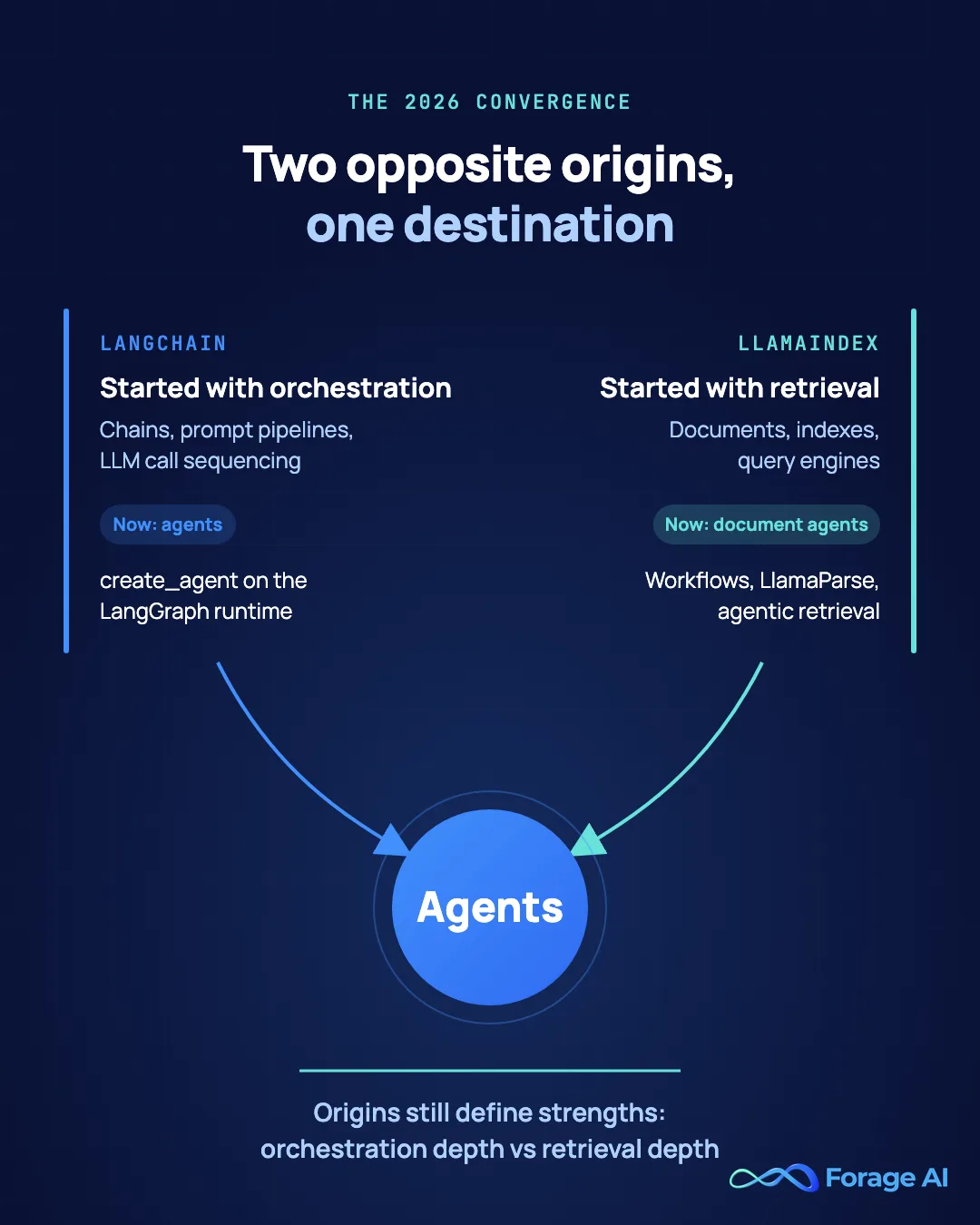
Two claims that ranked in 2023 and are wrong in 2026: “LlamaIndex is just for search” and “LangChain is a chaining library.” Both projects ship full agent tooling today; LangChain’s own tagline is agent engineering, LlamaIndex’s is document agents. Any comparison framed as retrieval-vs-chains predates both rearchitectures.
LlamaIndex vs LangChain: Head-to-Head Comparison
The verified numbers first, then the dimensions that matter. Every figure below was pulled from its primary source on August 4, 2026, because numbers in this space rot fast and most comparison articles never say when theirs were true.
| Metric (as of Aug 4, 2026) | LangChain | LlamaIndex |
|---|---|---|
| Current version | langchain 1.3.14, langgraph 1.2.10 | llama-index 0.14.23 |
| First released | October 2022 | November 2022 (as GPT Index) |
| License | MIT | MIT |
| GitHub stars | ~143.4k + ~38.8k (langgraph) | ~51.4k |
| PyPI downloads, 30 days | ~299M + ~70M (langgraph) | ~15.8M (core) + ~7.1M |
| Languages | Python, JS/TS | Python, TS |
| Commercial layer | LangSmith, LangGraph Platform | LlamaCloud, LlamaParse |
| Funding | $125M Series B, $1.25B valuation (Oct 2025) | $19M Series A (Mar 2025) |
Two honest caveats on that table. Download counts include CI and mirror traffic, so read them as relative scale, not user counts. And llama-index is a meta-package over a modular core, so summing its package downloads undercounts real usage somewhat. The order-of-magnitude gap survives both caveats.
| Dimension | LangChain | LlamaIndex |
|---|---|---|
| Core abstraction | Agents on a graph runtime (create_agent, LangGraph) | Indexes, query engines, event-driven Workflows |
| Retrieval depth | Solid, assembled from components | Deepest defaults: hybrid search, rerankers, chunking |
| Orchestration | Explicit state machines, branching, multi-agent | Event-driven, lighter, less prescriptive |
| State and persistence | Checkpointers, durable execution, time-travel debugging | Workflow context serialization, llama-deploy |
| Document parsing | Loader ecosystem, quality varies | LlamaParse: strongest complex-PDF story |
| Observability | LangSmith, tightly integrated | Open integrations, no first-party equivalent |
| Learning curve | Steeper historically; 1.0 flattened it | Faster to a working RAG prototype |
| API stability | Post-1.0 stability contract | Pre-1.0; more movement between releases |
| Known failure mode | Abstraction churn across major versions | Thinner orchestration for complex agent topologies |
And now the number that should reframe how you read both tables. The most careful independent measurement available says the frameworks do not differ on answer quality at all.
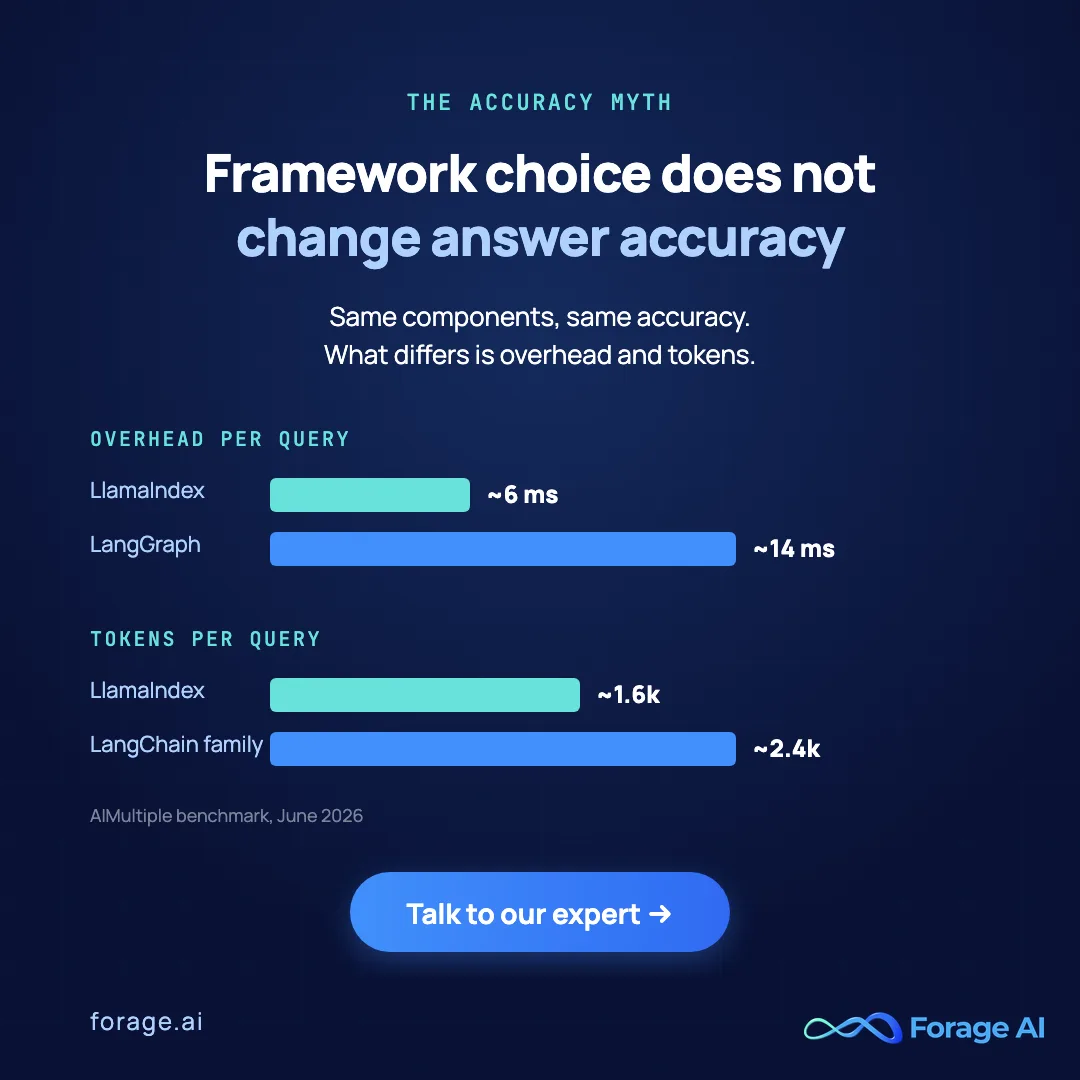
Framework choice does not change answer accuracy. A June 2026 AIMultiple benchmark ran the same agentic RAG workflow (same model, embeddings, vector store, tools; 100 queries, 100 runs per framework) across LangChain, LangGraph, LlamaIndex, Haystack, and DSPy. All hit the same accuracy. What differed: per-query overhead (~6ms LlamaIndex, ~10ms LangChain, ~14ms LangGraph) and tokens per query (~1.6k LlamaIndex vs ~2.0k to 2.4k for the LangChain family). Source: AIMultiple, June 2026.
Read that carefully and the decision reframes itself. You are not choosing which framework answers better. You are choosing which one gets your team to a maintainable system faster, at acceptable token cost, with the orchestration and debugging story your production environment needs. Those token deltas compound, too: at scale, a ~40% difference in tokens per query is a real line item on the inference bill.
Stars and downloads are not a quality signal. PyPI numbers carry CI inflation, and popularity compounds through tutorials and defaults. As one practitioner who has shipped both put it on Reddit: stars don’t answer your users’ questions; retrieval quality does. Use the numbers to gauge ecosystem momentum and hiring pool, nothing more.
The Key Features That Actually Decide It
Feature catalogs don’t settle this choice; both ecosystems check most boxes on paper. Four differences carry real decision weight.
1. Retrieval depth and document parsing
LlamaIndex ships hybrid search (BM25 plus dense vectors), reranking pipelines, and a menu of chunking strategies as defaults rather than assembly work. LangChain can reach the same retrieval quality, but you assemble it from components, and the assembly is where prototypes stall. LlamaParse then extends the lead into the documents that break naive pipelines: scanned PDFs, financial tables, slide decks.
Practitioner sentiment on Reddit is blunt about this edge. In one widely-discussed r/LangChain thread from an engineer who had shipped production systems on both: “LlamaIndex wins on retrieval quality. It’s not close… LlamaIndex was built retrieval-first and it shows.” Their decision rule is worth quoting whole: “If your app is mostly ‘search my documents and answer questions,’ use LlamaIndex. If your app is ‘search my documents, then do 5 other things with the results,’ use LangChain/LangGraph.”
2. Agent orchestration and durable state
LangGraph is why serious multi-step agents land on LangChain. Checkpointers persist agent state across failures, so a crashed run resumes instead of restarting. Human-in-the-loop gates pause execution for approval before an agent does something consequential. Time-travel debugging rewinds a run to inspect the exact state at each step. LlamaIndex Workflows compose multi-step logic cleanly, but the durable-execution and audit story is thinner, and complex agent topologies push its event model harder than LangGraph’s explicit state machines.
Harrison Chase’s framing explains why LangChain invested here: with agents, “the logic for how your application works is not all in the code. A large part of it comes from the model.” When the model owns part of your control flow, you need infrastructure to observe, checkpoint, and override it. That is the entire LangGraph thesis.
3. Observability and evals
LangSmith is the most integrated first-party observability option in either ecosystem: tracing, eval suites, and deployment in one place, wired into the framework. LangChain reports its trace volume grew 12x year over year (company-reported). LlamaIndex takes the opposite approach, integrating with the open observability ecosystem instead of building its own. If your team already standardizes on a third-party tracing stack, you lose little; if you want one vendor and one pane of glass, LangSmith is the argument.
4. The managed platforms mirror the strengths
Look at what each company charges money for and the comparison writes itself. LlamaCloud monetizes the document layer: parsing, indexing, and retrieval as a managed service. LangGraph Platform monetizes the agent layer: deploying and operating long-running, stateful agents. Each company built its business on the thing its framework does best, which is as honest a signal as this market produces.
Quick Summary
Q: Which features actually separate LlamaIndex and LangChain?
A: Four: retrieval depth and parsing (LlamaIndex, extended by LlamaParse), durable orchestration with human-in-the-loop control (LangChain via LangGraph), first-party observability (LangSmith has no LlamaIndex equivalent), and the managed platforms, where LlamaCloud sells the document layer and LangGraph Platform sells the agent layer.
Which One Should You Build On? Use Cases and Decision Rules
Match the framework to the shape of your system, not to star counts. The use cases sort cleanly.
| Your system | Build on | Why |
|---|---|---|
| Document Q&A, knowledge base | LlamaIndex | Retrieval defaults get you to quality fastest |
| Multi-step agents with tools | LangChain + LangGraph | Explicit state machines, durable execution |
| Heavy PDFs, tables, scans | LlamaIndex + LlamaParse | Strongest complex-document story |
| Long-running audited agents | LangGraph | Checkpointers, replay, human gates |
| RAG product on many vector DBs | LangChain | One interface across qdrant, pgvector, Chroma, Pinecone |
| Managed enterprise doc agents | LlamaCloud | Parsing plus retrieval as a service |
The pattern experienced teams converge on uses both. As one r/LangChain practitioner put it: “LangGraph handles orchestration well but LlamaIndex still wins on pure retrieval quality… The combo that’s worked best in practice: LangGraph for the outer loop, LlamaIndex retrievers as tool calls within the agent.” The integration is thin, a LlamaIndex query engine wraps naturally as a LangChain tool, and the split respects each framework’s center of gravity. It is the architecture worth evaluating first for production.
Worth naming the alternatives, briefly. Haystack shows up as the third option in most bake-offs and held its own in the AIMultiple benchmark; teams already deep in its pipeline model have little reason to migrate. And agent-native frameworks like CrewAI and AutoGen answer a different question, multi-agent collaboration, rather than the retrieval-framework question this article covers.
Sometimes the answer is neither. A recurring dissent in practitioner forums, stated plainly in one r/Rag thread: for most simple RAG projects a framework “adds abstraction that makes debugging harder,” and native Python with your vector database’s client is cleaner. Frameworks earn their keep when orchestration complexity arrives, not at hello-world. If your pipeline is load, embed, retrieve, answer, the LLM API and a vector client may be all the framework you need.
The verdict in one line: build document-centric systems on LlamaIndex, build stateful multi-step agents on LangChain with LangGraph, and combine them when you need both depths. Whichever you pick, no framework saves a RAG system from bad data; that failure mode lives upstream, in why RAG pipelines fail in production and in the storage layer under your embeddings. Still weighing whether RAG is the right strategy at all? Start with fine-tuning vs RAG.
Expert Insights
“When you’re building software, all of the logic is in the code. When you’re building an agent, the logic for how your application works is not all in the code. A large part of it comes from the model.”
Harrison Chase, co-founder and CEO, LangChain (Sequoia Capital’s Training Data podcast, 2026)
“We’ve fully made the pivot to a multi-agent framework that appeals to both beginner users as well as advanced users. … A lot of proper enterprise grade agents depend on large volumes of unstructured data… they basically need a data layer.”
Jerry Liu, co-founder and CEO, LlamaIndex (DataCamp’s DataFramed podcast, June 2025)
Frequently Asked Questions
What is the difference between LangChain and LlamaIndex?
Both are MIT-licensed frameworks for LLM applications, and both now build agents. LangChain centers on orchestration: the LangGraph runtime manages agent state, branching, and durable execution. LlamaIndex centers on documents: retrieval defaults, LlamaParse parsing, and event-driven Workflows. The practical difference is where each gets you to production quality with the least custom code, and that follows each project’s origin.
Is LlamaIndex better than LangChain for RAG?
For retrieval itself, usually yes: hybrid search, rerankers, and chunking arrive as defaults instead of assembly work. But an independent June 2026 benchmark found identical answer accuracy across frameworks with the same components, so “better for RAG” in practice means faster to good retrieval at lower token overhead, not better answers. If your RAG system feeds a complex agent, LangGraph’s orchestration may matter more than the retrieval delta.
Are LangChain and LlamaIndex free and open source?
Yes, both core frameworks are MIT-licensed, including LangGraph and Workflows. The companies monetize managed layers: LangSmith and LangGraph Platform on one side, LlamaCloud and LlamaParse on the other. You can run either in production without paying anything, at the cost of assembling your own observability, evaluation, and deployment infrastructure from open components.
Can you use LangChain and LlamaIndex together?
Yes, and for serious systems this is the pattern practitioners increasingly recommend: LlamaIndex handles ingestion, indexing, and retrieval, exposed as tools a LangGraph agent calls during orchestration. The integration is thin, since a LlamaIndex query engine maps naturally onto a LangChain tool interface, and each framework ends up doing the job it was built for.
Is LangChain still relevant in 2026?
More than before, by the numbers: ~299M monthly PyPI downloads as of August 2026, a $1.25B valuation, and a 1.0 release that resolved much of the abstraction churn it was criticized for. The “LangChain is bloated” criticism you’ll find in older Reddit threads largely predates create_agent and the v1 documentation; current practitioner advice is to evaluate the 1.x framework on its own terms.
Related Articles
- What Is Retrieval-Augmented Generation (RAG)?: The foundational explainer on how RAG grounds LLMs in your data
- Why RAG Pipelines Fail in Production: The data-quality failure modes no framework can fix
- Data Storage for LLMs and RAGs: Choosing the vector database and storage layer under your framework
- Fine-Tuning vs RAG: Deciding whether RAG is the right customization strategy at all
Sai is a data infrastructure enthusiast who has spent the past two to three years following the AI space closely, from the infrastructure layer to the fast-growing world of data for AI. He is genuinely curious about how modern data pipelines get built and where the data industry is heading, and he writes insightful pieces on the core topics that shape this niche.