
What a Property Data API Actually Costs (and Why Nobody Will Quote You)
First American's lead form asks for your budget before it will tell you a price. The field is a dropdown: Yes, approved. Yes, planning. Not yet. Prefer not to say. Beside it the form collects your company size, your seniority, your timeline, and whether you already buy from a property or title data provider. All of that, then a sales conversation, then eventually a number.
Anyone who has gone looking for real estate API pricing has hit the same wall from a different angle, and the largest player in the category explains why in a binding document. CoStar's FY2025 Form 10-K, filed on 26 February 2026, tells its investors exactly what it charges on:
"Depending on the type of service, contract rates are generally based on the number of sites, number of users, organization size, the client's business focus, the client's geographic location, the number of properties reported on or analyzed, the number and types of services to which a client subscribes, the number of digital twins hosted, the number of properties a customer advertises, and the prominence and placement of a customer's advertised properties in the search results."
Eleven price dimensions, named by the vendor itself, and not one of them is an API call. No rate card could express that, which is a large part of why there isn't one.
There are five different ways a vendor gates access to US property data, and each costs you something different. Collapsing all five into "enterprise pricing" is the mistake every page on this subject makes. By the end of this article you will be able to build a cost estimate at your own volume, show the arithmetic to whoever signs it off, and know the point at which an API stops being the cheapest way to get the data.
- Nobody here publishes an API rate card: the two largest provider families never had one, and three more deleted or buried theirs on dates this article gives.
- Published effective rates run from about $0.0005 to $0.50 per unit, roughly a thousandfold spread, and four of the biggest names cannot be placed on that scale at all.
- The rates are not comparable, because a call, a matched record, an API Report, a credit, a token and a parcel record with geometry are six different goods.
- Four vendors' live terms restrict using the data inside an AI or machine learning system, in four different shapes, right across that price range.
Why will nobody tell you what property data costs?
And so, with no property data rate card to read, buyers do the only thing left to them, which is ask each other. Measured on 8 October 2026 across three Google suggestion clients that all agreed: on the two largest provider families here, autocomplete finishes the pricing query with reddit. On the generic ones it finishes with free. Two admissions of the same failure.
The absence can be proved rather than asserted. An Internet Archive CDX query for attomdata.com/pricing* and /plans* returns zero snapshots across the entire archive: ATTOM did not remove a rate card, it never had one. A full CDX sweep of datatree.com, 5,000 unique URLs, returns no pricing-shaped URL at any point in its modern history. A neutral data marketplace says the quiet part out loud on its CoreLogic profile, and the identical sentence appears on its Estated profile:
"CoreLogic has not published pricing information for their data services. This is common practice for data vendors. Contact CoreLogic to obtain current pricing."
Publishing a price is not an administrative courtesy this category has neglected. It is a revenue concession it has rationally declined. When a seller can vary both the price and the contents of the dataset, buyer by buyer, the strategy that pays most is to screen each buyer rather than post a number, and a rate card forfeits that. Which is also why the firms with the most data publish the least about price.
The seller of information sets "both its price and the information provided to the buyer, with the goal of screening the buyer's private, partial information."
Dirk Bergemann, Department of Economics, Yale University, and Alessandro Bonatti, MIT Sloan School of Management, in "Markets for Information: An Introduction", Annual Review of Economics, 2019, Vol. 11, pp. 85 to 107.
There is a budget anchor in the market data, and it is moving the wrong way for you. Neudata, whose business is cataloguing commercial datasets, found that as of June 2026 the affordable share of datasets, at or below $25,000 a year, had fallen from nearly 40% to about 31%, with only 4% free.
What matters for your estimate is that "contact us" is not one answer. Sometimes it means expensive. Sometimes it means we charge nothing and the MLS decides. Sometimes it means not for sale to you at any price. Sometimes it means not from where you are sitting. Four different refusals, four different answers, and here are all five gates in one screen.
| Gate | Providers behind it | What stands between you and a number |
|---|---|---|
| 1. A published rate card | Rentcast, Realie, RealEstateAPI.com, BatchData, Regrid, HouseCanary, Melissa, the RapidAPI reseller tier | Nothing. Read it and buy it today. |
| 2. Quote only | CoreLogic / Cotality, ATTOM, DataTree / First American, Datafiniti's pricing URL, Estated, PropMix | A sales process, sometimes a form that asks your budget first. |
| 3. Eligibility | Zillow Group Bridge, Trestle, any MLS-sourced feed | Approval, not budget. Bridge's own fee is $0. |
| 4. Geography | Reonomy, CoStar / LoopNet | Where you are sitting. |
| 5. Prohibition | Realtor.com / Move Inc. | Terms that forbid the use case outright, scraping and LLM training included. |
How to read a price in this market
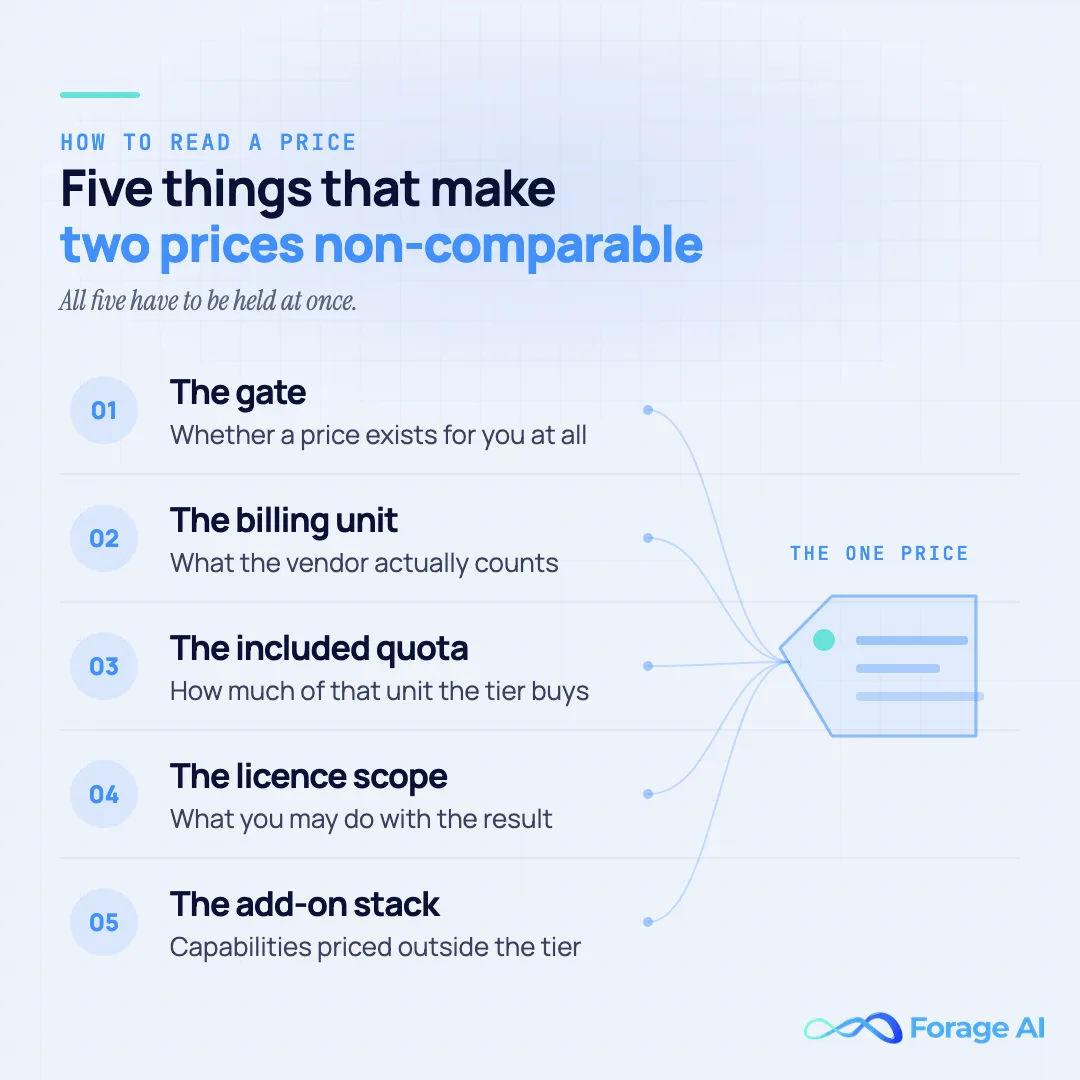
Five things make two published prices non-comparable, and all five have to be held at once: the gate, whether a price exists for you at all · the billing unit, what the vendor actually counts, in its own words · the included quota, how much of that unit the headline tier buys · the licence scope, what you may do with the result · the add-on stack, which capabilities sit outside the tier with prices of their own.
Every figure below carries an evidence tier. Published means read on the vendor's own page and checked on 8 October 2026. Archived means it was on the vendor's page, with the snapshot date given, and is not a current price. Third party means a blog, marketplace or AI summary reports it and the vendor does not, in which case it is named as contested and never used as a price.
Every effective rate here is arithmetic you can redo: published tier price divided by published quota, both numbers shown. No vendor paid for placement. And in the interest of symmetry, Forage AI does not publish a rate card either, because managed extraction is scoped per source and per field and an honest number needs the scope first. That is the same reason the incumbents give, which is worth noticing before you accept it from either of us.
Property data APIs at a glance
Sorted by how you get a number, not by who is better.
- Rentcast: published card, $74 to $449/mo by request volume.
- Realie: published card, $50 to $350/mo by token allowance.
- RealEstateAPI.com: published card, $599 to $2,500/mo, plus $0.10 per record pay-as-you-go.
- BatchData: published card, $1,000 to $10,000/mo by matched records.
- Regrid: published card, $375 or $500/mo for 2,000 parcel records plus tiles.
- HouseCanary: published card, $190 to $1,990/yr plus per-call rates of $0.05 to $6.00.
- Melissa: published card, $1,760/yr for 100,000 records, or credit packs from $40.
- The RapidAPI reseller tier: published cards, $0 to $249/mo, scraped and unlicensed.
- CoreLogic / Cotality: no published price.
- ATTOM: no published price, and none has ever existed.
- DataTree / First American: published card for reports, $4 to $22 each. No published API price.
- Datafiniti: published card, $119 to $3,999/mo, or $60,000/yr unlimited.
- Estated: no published price. Archived at $0.25 and $0.50 per call in May 2022.
- PropMix: no published price, and the contract cites a price list that 404s.
- Zillow Group / Bridge Interactive: $0 Bridge fee. Not a price question.
- Trestle: published card, $30 to $175 per connection per month, plus MLS fees it does not set.
- Reonomy: no published price on the page. Archived at $359 to $399 per seat in October 2020.
- CoStar / LoopNet: no published price. "Pricing dependent on market rates."
- Realtor.com / Move Inc.: not sold to developers at any price.
If what you want is the provider comparison rather than the cost teardown, that is a different article: our ranked comparison of real estate data providers scores them on coverage, freshness and integration. Nothing below is a ranking.
These prices are not measuring the same thing
That roster looks like a ladder. It is not one, and the clearest way to show why is to run the same job twice. Start with dense enrichment: 10,000 known addresses, looked up once, in one month. Every figure is from a live published card, checked 8 October 2026.
| Vendor and tier | What it bills | The bill [OUR ARITHMETIC] | Per property |
|---|---|---|---|
| Datafiniti 10K, $349/mo, 10,000 records | property record | $349 | $0.0349 |
| Rentcast Scale, $449/mo, 25,000 requests | API request | $449 | $0.0449 |
| RealEstateAPI Starter, $599/mo, 30,000 credits | 1 credit = 1 record returned | $599 | $0.0599 |
| Regrid Standard, $375/mo, 2,000 then $0.10 | parcel record with geometry | $375 + (8,000 × $0.10) = $1,175 | $0.1175 |
| First American store, Property Detail Report | report | 10,000 × $4.00 = $40,000 | $4.0000 |
| ATTOM | API Report, per property returned | unpriceable | no published price |
Now change nothing but the shape of the query. Sparse discovery: a filtered survey that returns 1,000,000 records, of which you keep 500. RealEstateAPI publishes "Run a count-only market survey, 0 credits", so the 500 records you keep cost 500 credits and the job fits inside Starter's quota at $599. Regrid publishes the opposite rule, verbatim: it bills "every record in the response counts as billed, even if your application filters it out, hides it, or never shows it to a user." That is $375 + (998,000 × $0.10) = $100,175.
On the first job Regrid costs about twice what RealEstateAPI does. On the second it costs about 167 times as much. Same two vendors, same two cards, and the ratio between them moved by a factor of roughly eighty. Neither vendor is overcharging and neither card is unclear. They are selling different goods: an ex ante sale, where the buyer acquires an information structure, is not the same transaction as an ex post sale, where the buyer pays for specific realizations (Bergemann and Bonatti, 2019). The second job is adversarial to Regrid, and a buyer who read its billing rule would never run it there. That is the point: the rule is published, it is clear, and it is still invisible in a per-record comparison.
At least eight distinct billing units are in live use here, and the word "record" carries six definitions inside them. Black Knight's last standalone 10-K, filed 28 February 2023, names five billing mechanics for one good, property ownership data: a point-in-time licence fee recognised on delivery, a subscription for updates recognised ratably, metered hosted access, closed loan volume above a contractual minimum, and seat count above a minimum. None is an API call.
The rule the rest of this article leans on: the unit is the product. Read a price without it and you have not read a price.
The five ways vendors gate API access
Eighteen providers follow, grouped by gate. The bands describe how each vendor controls access, nothing more. There is no scoring here and no order of merit inside any band.
Gate 1. They publish a rate card
This is the smaller half of the market, and the prices in it are still not comparable to each other. One counter-example sits at the band's edge: First American publishes a complete card you can buy from today, for reports rather than for an API. Its entry is in Gate 2, where its API sits.
Rentcast
| Attribute | Detail |
|---|---|
| Access gate | Published rate card, self-serve |
| Published price (as of October 2026) | Developer $0/mo (50 requests), Foundation $74/mo (1,000), Growth $199/mo (5,000), Scale $449/mo (25,000). Overage $0.20, $0.06, $0.03, $0.015 per request. rentcast.io/api |
| Billing unit | API request, not record |
| Effective cost per unit | $0.0740, $0.0398, $0.0180 [OUR ARITHMETIC] |
| Licence note | The grant includes the right "to sublicense, disclose, display, resell and distribute the API Data to third parties", and "neither use of the RentCast API nor use of the API Data requires attribution". No AI clause, re-confirmed 8 October 2026. No document date, so none is implied. |
This is one end of the redistribution spectrum: resale and sublicensing granted, free, inside the base price, where at the other end the same right costs extra or is refused.
The free tiers in this band are worth pricing honestly, because this is where "is there a free property data API" actually lands. Rentcast gives 50 calls a month, Realie 25 tokens, Regrid a 30-day trial over 7 counties and 2,000 parcel records, Datafiniti 1,000 records for two weeks, Melissa 1,000 credits behind a $4.97 verification fee. None of those ceilings tests a production query pattern, which is the only thing a trial needs to prove.
Realie
| Attribute | Detail |
|---|---|
| Access gate | Published rate card, self-serve |
| Published price (as of October 2026) | Free $0 (25 tokens/mo), Tier 1 $50/mo (1,250), Tier 2 $150/mo (6,000), Tier 3 $350/mo (30,000). Overage $0.15, $0.05, $0.025, $0.012 per token. realie.ai |
| Billing unit | Token, where "a single request can return up to 100 parcels" |
| Effective cost per unit | $0.0400, $0.0250, $0.0117 per token [OUR ARITHMETIC] |
| Licence note | Not located at the URLs read. Bulk delivery "is priced separately based on geography, attributes, and refresh cadence." |
Realie's own card says the tiers are identical in substance: "All plans include the same endpoints, data types, and 100 parcels per request. Higher tiers change the included token allowance and the overage rate." What you buy is volume economics and nothing else, and a token that can carry up to a hundred parcels is not a record, is not a call, and cannot be compared with either.
RealEstateAPI.com
| Attribute | Detail |
|---|---|
| Access gate | Published rate card, self-serve |
| Published price (as of October 2026) | Starter $599/mo (30,000 credits), Growth $1,200/mo (150,000), Pro $2,500/mo (400,000), Enterprise "Contact us", Pay-As-You-Go $0.10/record. "Rates assume annual subscription, billed monthly." realestateapi.com/pricing/ |
| Billing unit | "1 credit = 1 property record". Address autocomplete and count-only surveys cost 0 credits. |
| Effective cost per unit | $0.0200, $0.0080, $0.0063, and $0.1000 on pay-as-you-go [OUR ARITHMETIC] |
| Licence note | Markets "No complicated data license to negotiate" as a headline differentiator, which is third-party confirmation that negotiating rights is a real cost here. |
Inside one vendor's own card the effective rate spans $0.0063 to $0.1000, a 16x range. Pay-as-you-go, marketed as the low-commitment route, is 5x the Starter rate and 16x the Pro rate, so you can overpay by 16x without leaving one pricing page. Published add-ons sit outside all of it: Lender-Grade AVM "starting at $250/mo", involuntary-lien lookups at $0.50 to $1, skip trace at $0.05 per match.
BatchData
| Attribute | Detail |
|---|---|
| Access gate | Published rate card, self-serve |
| Published price (as of October 2026) | Property Data: Growth $1,000/mo (100,000 records), Professional $2,500/mo (300,000), Scale $5,000/mo (750,000), Enterprise $10,000/mo (3,000,000). Skip Tracing $2,000 to $20,000 and Reverse Skip Tracing $3,000 to $30,000 at the same record counts. No overage rate published. batchdata.io/pricing |
| Billing unit | Records per month. "Pay per matched record", so zero-result queries are free. The string "API call" appears zero times on the pricing page. |
| Effective cost per unit | $0.0100, $0.0083, $0.0067, $0.0033 [OUR ARITHMETIC]. The lowest published effective per-record rate located. |
| Licence note | Terms "Last Updated: June 1, 2026". §6.2 bars, among seven clauses, (ii) combining the Services "with other data or software from any other source", (iv) using them "to create, enhance or structure any database", (v) creating "derivative products or derivative datasets", and (vii) aggregating data "in a volume that exceeds three percent (3%) of the total available database". Resale needs a Reseller Addendum signed at Vice President level or above. FCRA breach "is not subject to any cap on liability". §9 caps annual rises at "the greater of 5% or CPI". |
Clause (ii) deserves its own sentence, because read literally it forbids joining this data to your own. With (iv), (v) and that quantified three percent extraction ceiling, the licence restricts a good deal of what a data team buys property records to do, and none of it is expressed in the price. The three percent ceiling is a volume limit with nothing whatsoever to do with what you are willing to pay.
Regrid
| Attribute | Detail |
|---|---|
| Access gate | Published rate card, self-serve |
| Published price (as of October 2026) | Free Trial $0 for 30 days (7 counties, 2,000 parcel records, 10,000 tiles, no credit card). Standard $375/mo and Premium $500/mo, both 2,000 parcel records plus 200,000 tiles. Enterprise "Get a demo". Overage $0.10 and $0.15 per parcel record, $0.001 per tile. app.regrid.com/api/plans |
| Billing unit | Parcel record with boundary geometry, plus map tiles billed separately. Two simultaneous units. |
| Effective cost per unit | $0.1875 per record on quota [OUR ARITHMETIC] |
| Licence note | "In the event that Customer wants to create derivative works of the Data, Customer must receive written approval from Company, and additional fees may be applicable." Termination: "Customer must destroy all parcel records." A new Artificial Intelligence Policy added this year states "No Data may be inputted into an AI Model to customize, train, fine-tune, or improve, directly or indirectly, any artificial intelligence model or product." No document date, so none is implied. |
Two caveats travel with that $0.1875. A parcel record with boundary geometry is not the same product as a property record, and the 200,000 included tiles are real value no per-record figure captures. The honest headline is not that Regrid is expensive. It is that these numbers cannot be compared, and this entry shows why. "Additional fees may be applicable" then does what no secondary source can: a vendor stating, in binding terms, that the right to build a derivative work carries a separate and unquantified fee. The licence is a price dimension, published as one.
HouseCanary
| Attribute | Detail |
|---|---|
| Access gate | Published rate card, self-serve, API access tier-gated |
| Published price (as of October 2026) | Basic $190/yr ($19/mo), Pro $790/yr ($79/mo), Teams $1,990/yr ($199/mo), Enterprise "Contact Us". Usage billed monthly on top: Property Analytics basic endpoints $0.50 / $0.40 / $0.30 per successful call, Premium $4 / $3 / $2.50, Premium Plus $6 / $5 / $4, Property Estimate $0.05, Market Pulse $0, Build to Rent $25. Additional active monthly users $10 each. housecanary.com/pricing |
| Billing unit | Per successful call, banded by endpoint class. "We do not charge for sections returned with a 204 api_code." |
| Effective cost per unit | $0.05 to $6.00 per successful call inside one vendor's own card, a 120x range [OUR ARITHMETIC] |
| Licence note | "Last modified: November 18, 2024". §2(h) bars using the products "as or in AI Input to develop, train, validate, update, enhance, improve, or modify any AI Technology of Customer or a third party". No Underlying Data may be "resold, relicensed, redistributed or used to create derivative works". Nothing may be displayed to a third party for more than thirty days without identifying the date it was made available. Enterprise price rises capped at five percent a year. |
This is the clearest refutation of "what does a property data API cost per call", and it comes from a vendor being unusually open. The API documentation carries zero dollar figures and labels every endpoint with a pricing tier instead: Premium 157, Basic 104, Included with Subscription 14, Premium Plus 3, and one refer-to-pricing-page, for 279 labelled endpoints. Roughly 57% are Premium or Premium Plus [OUR ARITHMETIC], which is $2.50 to $6.00 a call rather than $0.30 to $0.50, so a buyer who models off the basic rate can be out by 8 to 20x. The thirty-day display rule forces an architecture rather than just a budget, and the five percent cap on annual rises is what anyone building a three-year model needs.
Melissa
| Attribute | Detail |
|---|---|
| Access gate | Published rate card, self-serve, "Add to Cart" |
| Published price (as of October 2026) | Property Cloud API $1,760 per 100,000 records per year. Credit packs $40 / 10,000 credits, $350 / 100,000 (12.5% off), $3,200 / 1,000,000 (20% off). melissa.com/pricing |
| Billing unit | Credits. One Property Information lookup costs 9 credits; Property Viewer costs 12. |
| Effective cost per unit | $0.0176 per record on the annual block. A 9-credit lookup is about $0.029 at the largest pack and $0.036 at the smallest [OUR ARITHMETIC]. |
| Licence note | Not published at the URLs checked. melissa.com/company/terms-of-use returns 404 and no API data licence or redistribution clause was located. Recorded as unlocated, not as unrestricted. |
Melissa publishes the credit cost and the pack price and never the per-property dollar rate, so this is the one card that cannot be read at all without doing arithmetic. The detail nobody has written about is at the entry point: the free tier carries a one-time $4.97 KYC/AML verification fee for up to 1,000 credits a month, which is about 111 property lookups [OUR ARITHMETIC]. Melissa's stated reason, quoted as its own characterisation, is that its lookups "can return Personally Identifiable Information (PII)". Identity verification as a cost of entry to property data is a real line item, and it is five dollars.
The RapidAPI reseller tier
| Attribute | Detail |
|---|---|
| Access gate | None, which is the point. Third-party resellers, not vendor pricing. |
| Published price (as of October 2026) | One listing runs Basic $0 (300 requests, then $0.005), Pro $9 (5,000, then $0.003), Ultra $29 (40,000, then $0.002), Mega $99 (200,000, then $0.0005). Others run $0 / $10 / $40 / $100 and $0 / $13.90 / $91 / $249, and one to $1,000 for 2,000,000 at hard limits. |
| Billing unit | Scraped request. No licence, no SLA. |
| Effective cost per unit | $0.0005 per request at the highest tier [OUR ARITHMETIC], the floor of the entire ladder |
| Licence note | One listing describes itself, verbatim, as reproducing "PUBLIC data and features of Realtor - realtor.com", and every tier lists the feature "Overcome bot defender layer", which is the activity the originating portal's terms prohibit. |
Say plainly why the cheap number is cheap: scraped, taken against the source's terms, no SLA, no right to redistribute. The tier's existence is itself a finding, because one major portal has no official public API and the marketplace has filled the vacuum with 21 or more distinct unofficial scraper listings.
One cost line every comparison omits lives here: every listing carries an identical bandwidth platform fee, 10,240MB a month then $0.001 per additional 1MB, which scales with payload size rather than record count.
Gate 2. The price exists but you have to ask
"Contact sales" is this category's default state, not an exception to it, and this band is where the largest names sit. CoreLogic leads it on measured demand rather than on any judgement about the vendors.
CoreLogic / Cotality
| Attribute | Detail |
|---|---|
| Access gate | Quote only |
| Published price (as of October 2026) | No published price. corelogic.com redirects to cotality.com, cotality.com/pricing returns 404, the developer portal renders a sign-in wall footed "© 2026 Cotality", and developer.cotality.com does not resolve. |
| Billing unit | Not published for the direct product. What is published is the Trestle charging unit: "Technology providers and brokers pay a monthly connection fee, which varies based on the number of connections and feed type. MLSs can also set their own data licensing fees." |
| Effective cost per unit | Cannot be computed |
| Licence note | Terms "Last Updated: September 30, 2025". §5a: "You will not charge any fee to any person in connection with the Services". §5d bars using the Services "as a basis for a derivative work". §7 bars "Systematic retrieval of information... to create...a collection, compilation, database". |
The rebrand is a research hazard worth naming: a reader searching "CoreLogic API pricing" lands on pages that have moved, under a name the company no longer trades as, with a developer subdomain that does not exist.
The public record still carries the architecture. CoreLogic's FY2020 10-K, its last, states it plainly: "We typically license data in one of two forms: bulk data licensing and transactional licensing", and adds "We also audit our clients from time to time to ensure compliance with our agreements." That phrase appears in precisely three Form 10-Ks, all CoreLogic's, the last filed 1 March 2021, and after the company deregistered in June 2021 it stops appearing entirely.
ATTOM
| Attribute | Detail |
|---|---|
| Access gate | Quote only |
| Published price (as of October 2026) | No published price, and none has ever existed. A CDX query for attomdata.com/pricing* and /plans* returns zero snapshots across the entire archive. Those paths 404 today and api.developer.attomdata.com returns 403 to automated fetches. |
| Billing unit | The "API Report", defined by ATTOM itself: "The information provided for each property is considered to be a single API Report", and "A Call to an AVM endpoint returning values for 1,000 properties is considered to be 1,000 API Reports." Priced "based on the number of API Reports produced, not the number of calls made." |
| Effective cost per unit | Not computable from any published figure. One buyer-reported ladder gives $0.1667, $0.1500 and $0.1000 per call [OUR ARITHMETIC], with the caveats below. |
| Licence note | Unknown, not absent. ATTOM's website terms exist and bar copying and redistribution of site materials, but those are website terms, not the API data licence, which is not public. |
The $499 you have probably already seen is not the API.
ATTOM's only published figure is $499 a year for Property Navigator, a seat-based end-user research platform with one user, 200 reports a month and a seven-day trial, confirmed live on 8 October 2026. It is not the Property Data API, and it is almost certainly the origin of the ATTOM API price circulating in blogs and AI summaries. Google's own AI Overview says ATTOM "does not publish fixed public pricing" and then cites third-party pages for $95, $500 and $499 a year as though they were a rate card. Those three figures are mutually inconsistent and ATTOM publishes none of them.
There is exactly one dated, citable ATTOM price in the public record, and a buyer put it there. In April 2026 a commercial-real-estate underwriting team published, in a public GitHub issue (dealwire-ai/dealwire issue #194), the tiers an ATTOM representative quoted them on a call: $500 for up to 3,000 calls a month, $750 for 5,000, $1,000 for 10,000, with a trial of "30 days or 1,000 calls (whichever comes first)". [OUR ARITHMETIC] that is $0.1667, $0.1500 and $0.1000 per call on quota, which places ATTOM at the expensive end of the published range, roughly 30 to 50 times BatchData Enterprise's $0.0033 per record. The per-call rate falls 40% from the lowest tier to the highest across a 3.3x volume increase, a volume-discount gradient a rate card would have told every buyer.
The caveats matter more than the number. This is one buyer's note of what one salesperson quoted them on one date, so it is not ATTOM's price, not a rate card, and not necessarily what anyone else would be quoted. The same thread carries a second figure eight days earlier, "$600-700/month, 5K calls/month starter tier", and the two do not reconcile; both are reported rather than averaged, because a discrepancy inside one buyer's own notes is itself evidence of the thing this article is about. ATTOM publishes no price, and that is unchanged. The strongest version of the finding is not the figure: the only way anyone outside ATTOM learns what ATTOM charges is when a buyer writes it down in public.
DataTree / First American
| Attribute | Detail |
|---|---|
| Access gate | Split. A published card for reports and documents, quote only for the API and bulk licensing. |
| Published price (as of October 2026) | dnastore.firstam.com/pricing/: Property Detail Report $4.00, Assessor Map $4.00, Sales Comparables Report $9.00, Procision Power AVM $15.00, Specific Document $15.00, Last Finance Document $15.00, Last Transfer Document $15.00, Transaction History Report $22.00, TotalView Report $22.00, Basic Subscription $25.00/month, Premier Subscription $50.00/month. The API and bulk data carry no published figure at all. |
| Billing unit | Per report or per document image. The subscription is a discount coupon, not a data allowance: Basic buys "a 5% discount on all the property data reports and document images", Premier buys 10%. |
| Effective cost per unit | $4.00 per Property Detail Report, $22.00 per TotalView Report [OUR ARITHMETIC]. For the API and bulk licensing, cannot be computed. |
| Licence note | Not located at the URLs read. The bulk licensing page publishes no terms. |
datatree.com no longer exists as a website; every path redirects to dna.firstam.com. The property research page and the bulk page, headed "BULK DATA", both carry zero dollar figures, one with a "START FREE TRIAL" call to action and the other with "REQUEST A DATA EVALUATION". dna.firstam.com/pricing sits behind a Cloudflare 403, so whether it exists could not be established either way, and is recorded as unestablished rather than absent. The lead form that opens this article is on both pages.
The correction here matters as much as the ATTOM one, because together they stop being an anecdote. Third-party sources and AI summaries circulate "$97/mo Basic, $147/mo Plus, $197/mo Premium" for this store. The live store publishes $25 and $50 and nothing else, and those buy percentage discounts rather than records. So the two largest provider families in this market both publish a price for a seat-or-report product, neither publishes an API price, and in both cases the published number has been laundered into circulation as the API price. One triangulation, with its sample stated: a procurement platform puts First American Data & Analytics' average contract value at $30,555, from "more than 1 unique purchasers and 2 completed deals", on a page carrying no date.
Datafiniti
| Attribute | Detail |
|---|---|
| Access gate | Published rate card on a product page, quote only at the URL a buyer would search for |
| Published price (as of October 2026) | datafiniti.co/data/property-data: Trial 1,000 records free for two weeks, 1K/mo $119, 10K/mo $349, 100K/mo $899, 1M/mo $3,999, unlimited $60,000 a year. "10% off when you pay annually. Custom pricing available for any record volume." |
| Billing unit | Property record, API and bulk at no extra charge: "No extra charges for API access", "No separate fees for portal use", "No feature tiers that limit visibility". |
| Effective cost per unit | $0.1190, $0.0349, $0.00899, $0.0040 [OUR ARITHMETIC] |
| Licence note | §2 permits reproducing, distributing, modifying and building upon the data subject to conditions. §3 prohibits reselling or sublicensing "without any significant modifications", a test the terms never define. §6 requires you on termination to "immediately delete all Datafiniti Data from your systems and certify as to the same". §7 allows Datafiniti to "suspend or throttle Services" at its sole discretion. §5 reserves the right to change the price list at any time, with no refund for prior charges. |
The story here is not the one circulating. Datafiniti's prices have not changed since January 2025. Its pricing page has. The URL a buyer would search for, datafiniti.co/pricing/property-data-pricing, was archived 34 times and returned HTTP 200 on every single capture, the last on 21 January 2025. It 404s today, while the identical five-tier ladder sits live on a product page, inside a collapsed panel, with its highest tier labelled by an infinity-symbol graphic instead of the word "unlimited". The rate card did not go away. The pricing page did. That is a discoverability decision rather than a price change, and a harder thing for a vendor to explain.
Estated
| Attribute | Detail |
|---|---|
| Access gate | Quote only. Rate card deleted, company acquired. |
| Published price (as of October 2026) | None. estated.com/pricing returns 404 with no redirect; estated.com carries the page title "Estated is now part of ATTOM Data". [ARCHIVED: 24 May 2022, not a current price] Essential Property "Pay as you go API: $0.25 /call" and Enhanced Property "$0.50 /call", with 100 free calls to start. |
| Billing unit | API call, with overage charged "only... when a property record is returned". |
| Effective cost per unit | $0.2500 and $0.5000 per call [ARCHIVED], not current prices, and the highest on the published ladder. |
| Licence note | Not re-verified. The archived commercial terms gave annual plans 90 days' written notice to terminate, with fees payable to the termination date. |
The archive trail is unusually clean: HTTP 200 on six captures through 24 May 2022, then a 302 on 26 January 2023 pointing at /api-pricing, which returned 404 in the same crawl. The rate card was not moved, it was redirected into a void. A provider that published $0.25 and $0.50 per call was bought by the provider that has never published anything, and its rate card went with it.
Also in this band, and worth one line. PropMix's own terms, §4.1, direct the customer to a price list: "The pricing for additional resources and services can be found at http://PropMix.io/plans". That URL returns 404, and a full index of 4,134 archived PropMix URLs spanning 2016 to 2026 contains no pricing-shaped URL at any point in the website's history. A binding contract citing a price list that has never existed is the sharpest single version of this whole section.
Gate 3. Approval decides, not budget
In this band the price question has no price answer, because the gate is MLS membership, a broker licence or data-use approval. The fee can be zero and you can still be refused.
Zillow Group / Bridge Interactive
| Attribute | Detail |
|---|---|
| Access gate | Eligibility. The MLS decides. |
| Published price (as of October 2026) | $0 Bridge fee. Under the heading "No additional fees or contracts", verbatim: "We do not charge service fees or force you into unnecessary contracts to get data access from our MLS customers. License agreements and fees are between you and your data provider." |
| Billing unit | Not a price question. Getting started means approaching your local MLS. |
| Effective cost per unit | Not computable. The MLS sets both the fee and the permission. |
| Licence note | MLSs "may require you to execute data license agreements, pay fees or do compliance testing". The MLS "is also able to specify whether you are allowed to replicate datasets", and approves specific feed types with "which fields and which records are available, as well as any conditional field suppression". Zillow's own MLS Listings and Public Records platforms are "currently invite only". |
This is the sharpest "the price was never the constraint" datapoint in the research. The old public Zillow API was free and licence-poisoned. [ARCHIVED: 5 August 2022, not a current price] verbatim: "The Zillow API Network is a free service", with member requirements including a consumer-facing interface with "no caching or data storage", Zillow branding in all API input and output, and the technology made available free to customers. Price $0, and a flat ban on retaining a single record. You can be given the data for nothing and still not be allowed to build on it.
Conditional field suppression is a cost concept nobody writes about and every MLS-sourced buyer meets. Two buyers on the same feed at the same price can receive different fields, because the MLS decides per licence type. No rate card can express that.
Trestle and the MLS layer
| Attribute | Detail |
|---|---|
| Access gate | Eligibility. A published card, and an MLS fee it does not set. |
| Published price (as of October 2026) | Brokers, per connection per month: broker data feeds "Depends on MLO" plus $30/month; all other data feeds "Depends on MLO" plus $100/month. Technology providers, RESO Standardized, per connection per month tiered by total contract count: S $100, M $110, L $125, XL $150, XXL $175, rising to $105 / $115 / $131 / $157 / $183 effective January 2027, a stated 5% increase. Direct feeds $125 / $160 / $200 / $250. trestle-documentation.corelogic.com/data-pricing.html |
| Billing unit | Per connection per month. Volume-independent, and a fifth distinct unit in this one category. |
| Effective cost per unit | Cannot be computed per record at all. |
| Licence note | MLO fees are separate and set by each MLS. "There is zero cost for an MLS to join Trestle." |
This is the only published MLS-layer rate card located anywhere, which makes it the one place "how much does MLS API access cost" has a published answer. It still cannot tell you your bill, because "Depends on MLO" is doing the heavy lifting and each MLS sets that independently. A published rate card that cannot produce a total is a strange object, and it is the most transparent thing in the band. The January 2027 increase is a dated, forward-looking cost fact that appears nowhere else, so put it in your model.
Gate 4. Where you are sitting changes the answer
Geography here is not a dimension of the price. It is a gate on access, and it fires before any price is quoted.
Reonomy
| Attribute | Detail |
|---|---|
| Access gate | Geography. "We detected that you are trying to access Reonomy from outside of the USA. According to our Terms & Conditions, Reonomy can only be accessed from inside the USA." |
| Published price (as of October 2026) | No figure on the page. A regex sweep of the rendered pricing page returns zero currency values. The only dollar figure anywhere is in the page metadata, which states "plans start at $400/mo" in the description, og:description and twitter:description. [ARCHIVED: 31 October 2020, not a current price] Professional "$399 per month, billed monthly" or "$359 per month, billed annually"; Business "$399 per user, per month" with three seats included and a "Minimum $1,197/mo"; Enterprise "Let's Talk"; "All contracts are annual". [ARCHIVED: 16 July 2019] an entirely different ladder: Starter $49/mo, Professional $249/mo, Advanced $399/mo. |
| Billing unit | Per named user. "Reonomy licenses are single seat only and we currently do not support account sharing." Not an API unit at all. |
| Effective cost per unit | Cannot be placed on a per-record ladder. |
| Licence note | Terms "Last Updated: 2020-02-25". No reproducing, distributing, modifying or creating derivative works, and no "robot, spider or other automatic device". No AI-training clause, which makes this the counter-example in the licence section below. |
Use this provider as the worked example of the whole trend, because one vendor carries it across three dated snapshots: two archived ladders eighteen months apart, with different tier names, five tiers collapsing to three, and an entry point that moved from $49 to $359. Then no public price at all. The only surviving figure lives in a meta tag, published where a search engine reads it and not where a buyer does.
CoStar / LoopNet
| Attribute | Detail |
|---|---|
| Access gate | Geography, twice over. The self-serve checkout states "Pricing dependent on market rates" and its footer states "We apologize, but online purchases are not enabled from this region." |
| Published price (as of October 2026) | None. LoopNet publishes the tier ladder and the minimum terms and zero dollar figures: Diamond, Platinum and Gold at a six-month initial term, Silver at three months, priced per listing and ranked by search-result placement. Plans for four or more listings are custom. A reported figure of $89 per listing per month circulates in cluster research and was not verified on this run. |
| Billing unit | Per listing per month, ranked by prominence. Nothing to do with volume of data. |
| Effective cost per unit | Cannot be computed. |
| Licence note | Terms "Last Revised: July 06, 2026". Bars storing, copying or exporting "any portion of the Product into any database or other software program", and using any portion "to create, directly or indirectly, any database or product". The AI clause is in the licence section below. |
"Pricing dependent on market rates" is this category's thesis in four words, published by its largest player on its own checkout. The FY2025 10-K confirms the unit from the revenue side: LoopNet revenue rose "$30 million, or 11%, due to an increase in the number of paid listings and an increase in the average price per listing." This band stays deliberately thin, because commercial real estate platform pricing is a different purchase with a different unit, and our comparison of commercial real estate data tools covers that layer.
One honest blank. Crexi could not be assessed. On 8 October 2026 every pricing and plans URL resolved to a site-wide maintenance page, and no vendor-published figure was obtained. Review aggregators carry figures; none could be verified at source, so none is printed here.
Gate 5. The use case is forbidden outright
The last gate is not a price, a quote, an approval or a border. It is a prohibition, and it is qualitatively different from the other four.
Realtor.com / Move Inc.
| Attribute | Detail |
|---|---|
| Access gate | Prohibition. No developer programme, no sandbox, no self-serve key, no published rate card. realtor.com/developer returns 404, developer.realtor.com and rdc.moveinc.com do not resolve, and the data-licensing pages return 404 and 403. |
| Published price (as of October 2026) | None, and there is no product to price. |
| Billing unit | Not applicable. |
| Effective cost per unit | Not sold to developers. |
| Licence note | Undated: the copyright line carries no year and no last-modified date exists anywhere in the document, so none is implied. Verbatim: "you shall not... scrape, publish, license, create derivative works from... any information", including "'screen scraping,' 'database scraping,'"; nor "text mine or data mine, by automated means or any other method... (e.g., robot, spider, script, service, software)"; and "You shall not use any Content for any machine learning or artificial intelligence purposes, including... developing, building, training, fine tuning, or grounding or otherwise utilizing in any large language models (LLMs), machine learning tools, or generative AI systems." The licence granted is "solely for informational, personal and non-commercial purposes". |
There is no number to find here, because there is no sale. A buyer who spends three weeks chasing a quote in this direction is chasing something that does not exist, and the only way to know is to read the terms rather than the website.
One clause is the one most people miss: your rights "are not expanded, nor are any prohibitions modified or limited, in any way by our use or configuration of exclusionary protocols (e.g., the Robots Exclusion Protocol as implemented through robots.txt files)." A permissive robots.txt does not grant rights. And then the collision that closes the band: the cheapest published prices in this market are for data this portal's own terms forbid being taken, sold on a marketplace from $20 a month by resellers advertising "Overcome bot defender layer" as a feature.
What does a property data API cost per record?
Here is every published figure in one table, normalised so you can see the market's shape. Read the volume assumption first, because the table is meaningless without it.
Effective cost per unit = the published tier price divided by the quota included in that tier, at 100% quota utilisation, per month unless stated otherwise. Use less than your quota and your effective rate rises. Exceed it and the overage rate, a different number, takes over. Every row names the unit it measures, because the units are not the same, and that is the entire point of the table.
| Provider and tier | Gate | Published tier | Effective cost per unit [OUR ARITHMETIC] | What the unit actually is |
|---|---|---|---|---|
| RapidAPI reseller, Mega | 1 | $99/mo, 200,000 requests | $0.0005 | scraped request, no licence, no SLA |
| BatchData Enterprise | 1 | $10,000/mo, 3,000,000 | $0.0033 | matched property record |
| Datafiniti 1M | 2 | $3,999/mo, 1,000,000 | $0.0040 | property record, API and bulk |
| RealEstateAPI Pro | 1 | $2,500/mo, 400,000 credits | $0.0063 | property record returned |
| RealEstateAPI Growth | 1 | $1,200/mo, 150,000 | $0.0080 | property record returned |
| BatchData Growth | 1 | $1,000/mo, 100,000 | $0.0100 | matched property record |
| Realie Tier 3 | 1 | $350/mo, 30,000 tokens | $0.0117 | token, up to 100 parcels |
| Melissa Property Cloud | 1 | $1,760/yr, 100,000/yr | $0.0176 | property record, annual block |
| Rentcast Scale | 1 | $449/mo, 25,000 requests | $0.0180 | API request |
| RealEstateAPI Starter | 1 | $599/mo, 30,000 credits | $0.0200 | property record returned |
| Realie Tier 2 | 1 | $150/mo, 6,000 tokens | $0.0250 | token |
| Datafiniti 10K | 2 | $349/mo, 10,000 | $0.0349 | property record |
| Realie Tier 1 | 1 | $50/mo, 1,250 tokens | $0.0400 | token |
| Rentcast Foundation | 1 | $74/mo, 1,000 requests | $0.0740 | API request |
| RealEstateAPI pay-as-you-go | 1 | $0.10/record | $0.1000 | property record returned |
| ATTOM, buyer-reported April 2026 | 2 | $1,000/mo, 10,000 calls | $0.1000 | API call, see the caveats above |
| Datafiniti 1K | 2 | $119/mo, 1,000 | $0.1190 | property record |
| ATTOM, buyer-reported April 2026 | 2 | $500/mo, 3,000 calls | $0.1667 | API call, see the caveats above |
| Regrid Standard | 1 | $375/mo, 2,000 plus 200,000 tiles | $0.1875 | parcel record with boundary geometry |
Estated Essential [ARCHIVED 24 May 2022] | 2 | $0.25/call | $0.2500 | API call, not a current price |
Estated Enhanced [ARCHIVED 24 May 2022] | 2 | $0.50/call | $0.5000 | API call, not a current price |
| HouseCanary, by endpoint class | 1 | annual tier plus usage | $0.05 to $6.00 | successful call, varies by endpoint class |
| First American store | 2 | $4.00 per Property Detail Report | $4.0000 | report |
| First American store | 2 | $22.00 per TotalView Report | $22.0000 | report |
| Trestle | 3 | $30 to $175 per connection/month | not per record | connection per month |
| CoreLogic / Cotality | 2 | none published | no published price | not disclosed |
| First American API and bulk | 2 | none published | no published price | not disclosed |
| PropMix | 2 | none published | no published price, contract cites a 404 | not disclosed |
| Zillow Group Bridge | 3 | $0 Bridge fee | not a price question | MLS sets fee and permission |
| Realtor.com / Move | 5 | none, no product | not sold to developers | terms prohibit the use case |
Read it correctly and this table is the article. It does not say one vendor is cheaper than another. It says these numbers are not measuring the same thing, so the spread tells you about the market's opacity rather than about value, and the blank cells are the finding. Four of the biggest names here cannot be placed on the scale at all.
Of the ones that can, the published span runs $0.0005 to $0.50 per unit, a factor of about a thousand. Restrict it to vendors that genuinely bill per property record and the spread is still roughly $0.003 to $0.19, about 60x. Include every published unit, reports and endpoint classes among them, and it widens to $0.0005 to $22.00, about 44,000x. The widening is the thesis rather than a rounding artefact: a parcel record with boundary geometry, an API request, a matched record, an API Report, a token carrying up to a hundred parcels, a per-report purchase and a scraped request are seven different goods.
One more reason not to trust a benchmark you did not build. A procurement transparency platform publishes CoStar's minimum at $3,000, average contract value at $15,130 and maximum at $23,000, drawn from "more than 3 unique purchasers and 3 completed deals", on a page carrying no date. Cluster research records a reported median of roughly $40,000 a year for a single CoStar Suite All-Markets licence, which was not verified on this run. Two transparency services, 2.6x apart on the same vendor, neither wrong, almost certainly because they are counting different products. A benchmark is only a price if you know what it counted.
The costs that are not in the price
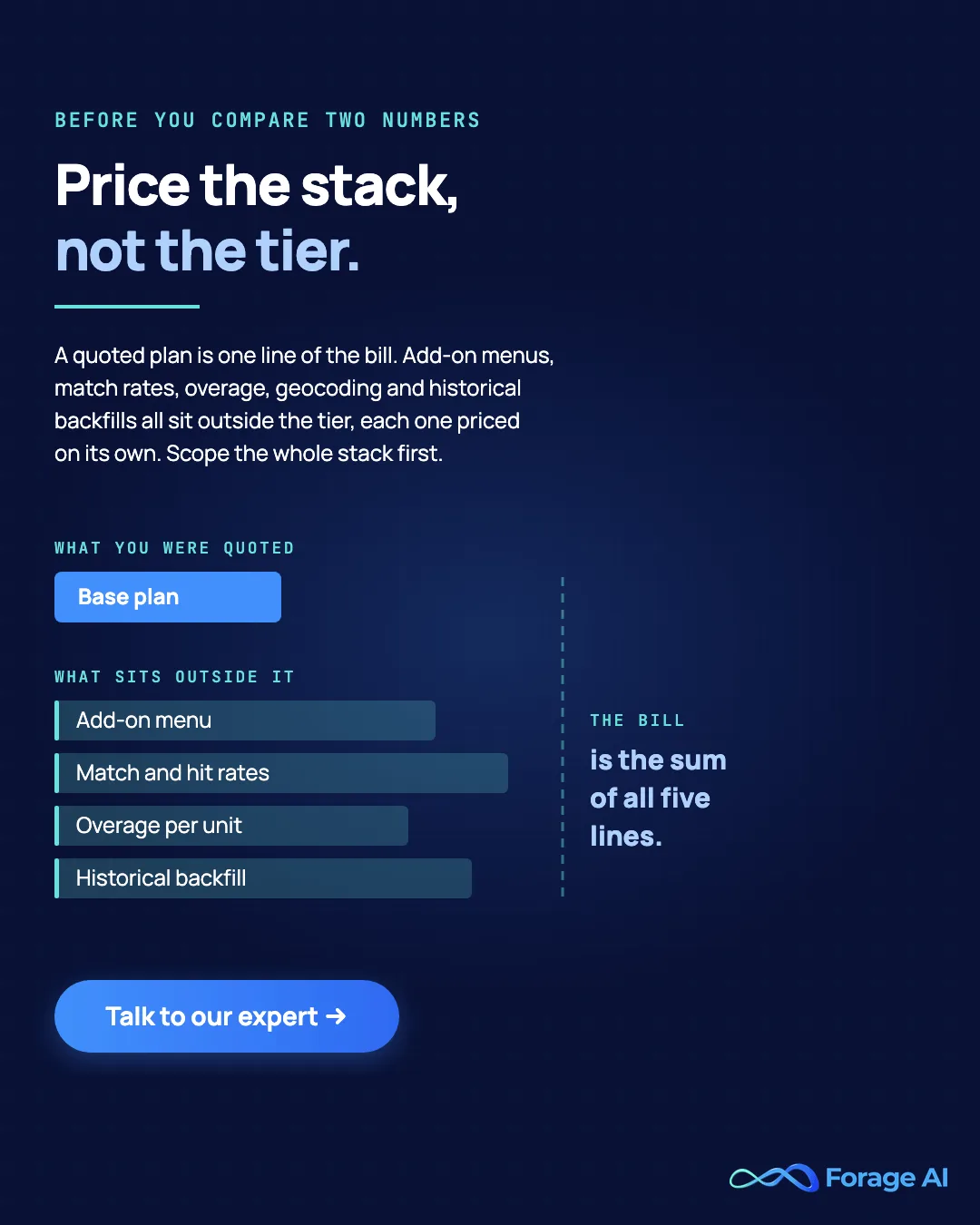
The sticker price is the floor, not the bill, and the figure that most often determines the bill is one nobody quotes you.
| Cost line | Published figure (as of October 2026) | Why a per-record comparison misses it |
|---|---|---|
| Add-on stack | BatchData's nine-item menu: $5,425/mo on Growth, $12,200 on Professional, $23,000 on Scale, $43,250 on Enterprise | Prices scale with your tier, and the stack costs more than 4x the plan at every tier |
| Capabilities with no price | MCP Server, Portfolio Monitoring, Custom Reports, Smart Search API, all "Custom pricing based on your needs" | A quoted plan can exclude the feature you are buying for |
| A second simultaneous unit | Regrid: $0.10 to $0.15 per parcel record and $0.001 per tile | A per-record figure silently omits half the bill |
| Platform and bandwidth fees | Every RapidAPI listing: 10,240MB/month, then $0.001 per 1MB | Scales with payload size, not record count |
| Premium AVM and enrichment | Lender-Grade AVM from $250/mo, involuntary liens $0.50 to $1, skip trace $0.05 per match | AVM is consistently the most expensive endpoint class |
| Per-seat and per-report lines | HouseCanary: $10 per additional active monthly user, $7 to $12 per report, $25 per Interactive Value Check | Billed per person and per document, not per record |
| Endpoint class | HouseCanary: roughly 57% of 279 labelled endpoints are Premium or Premium Plus | Modelling off the basic rate can be out by 8 to 20x |
| Identity verification | Melissa's free tier: $4.97 one-time KYC/AML fee for 1,000 credits a month | A cost of entry that precedes the first record |
| Licence scope | Regrid: derivative works need written approval and "additional fees may be applicable". BatchData: resale needs a Reseller Addendum signed at VP level or above | A priced right with no published price |
| A dated future increase | Trestle, effective January 2027, 5% across all five tiers | Published, verifiable, and absent from every comparison |
| Price-rise caps | BatchData "the greater of 5% or CPI". HouseCanary Enterprise capped at 5% | The one term that makes a three-year model possible |
| Late payment and refunds | PropMix 1.5% per month. HouseCanary 1% per month, and "No refunds for cancellation" | Cash-flow terms, invisible in a rate |
Two lines deserve the arithmetic in full. BatchData publishes a nine-item add-on menu whose prices rewrite themselves when you switch tier, which is exactly why it gets misquoted: taking the whole menu costs $5,425 a month on top of the $1,000 Growth plan, $12,200 on Professional, $23,000 on Scale and $43,250 on Enterprise. At every single tier the complete stack costs more than four times the plan price you were quoted, and you can reproduce it in one command against the vendor's own public config file, curl -s https://batchdata.io/mirror/shortcode/plans.json.
The second is the sharpest worked example here, from a published card and two lines of algebra. First American's store sells a Basic Subscription at $25 a month for a 5% discount on reports, and a Premier Subscription at $50 a month for 10%:
Basic pays for itself when    0.05 × spend > $25        →  spend > $500/month
Premier pays for itself when  0.10 × spend > $50        →  spend > $500/month
Premier beats Basic when      0.10S − 50 > 0.05S − 25   →  spend > $500/month
All three thresholds are the same number. Below $500 a month of report spend neither subscription is worth buying, and above $500 Premier always beats Basic, which means the Basic Subscription is never the right choice at any level of spend. Nothing on the page says so.
One belief worth retiring: that a free tier lets you evaluate a vendor. At 50 calls a month, or 2,000 parcel records across seven counties, none of these ceilings tests a production query pattern. And the sampled outcome is not the one buyers expect. In Neudata's 2026 industry survey of 191 data providers and buyers, released 17 September 2026, 39% named "no discernible signal" as the main reason trials do not convert, against 25% who named price. The likeliest outcome of your trial is not that the data is too expensive. It is that you cannot tell whether it is worth anything.
Are you allowed to use the data for AI?
This article is for informational purposes only and does not constitute legal advice. Consult a qualified attorney for legal guidance specific to your situation.
Not every cost in this market is money. Four of the vendors here restrict outright what you may do with the data inside an AI or machine learning system: Realtor.com, CoStar, HouseCanary and Regrid. A fifth, BatchData, permits it on one condition. The restrictions are not the same shape as each other, and the count has moved in both directions in the last twelve months.
| Vendor | Clause, verbatim | Document date |
|---|---|---|
| Realtor.com / Move | "You shall not use any Content for any machine learning or artificial intelligence purposes, including, without limitation, developing, building, training, fine tuning, or grounding or otherwise utilizing in any large language models (LLMs), machine learning tools, or generative AI systems." | none, confirmed absent |
| CoStar | "expose the Licensed Product to artificial intelligence tools outside of the CoStar Product, or use any portion of the Licensed Product or data generated from it to train, fine-tune, or improve any artificial intelligence or machine learning system, including as input to generative artificial intelligence or retrieval-augmented generation." | "Last Revised: July 06, 2026" |
| HouseCanary §2(h) | must not use the products "as or in AI Input to develop, train, validate, update, enhance, improve, or modify any AI Technology of Customer or a third party" | "Last modified: November 18, 2024" |
| BatchData §6.2(vi), §32 | "use the Services to enable development of machine learning, rules engines, or other similar automated processes", with a carve-out permitting AI "hosted entirely within Customer's own controlled infrastructure" | "Last Updated: June 1, 2026" |
| Regrid | "No Data may be inputted into an AI Model to customize, train, fine-tune, or improve, directly or indirectly, any artificial intelligence model or product." | none, click-accept |
| ICE Mortgage Technology §3.1(k) | no AI clause exists. The operative restriction is on using "the API Technology for the purposes of data replication (e.g., data warehouses or analytics repositories)" | "Rev 05-2021" |
| Reonomy | nothing on the subject | "Last Updated: 2020-02-25" |
Realtor.com forbids the use case outright. CoStar forbids training, fine-tuning and retrieval-augmented generation on its data, and forbids exposing it to any AI tool outside its own product. HouseCanary forbids using its data to train your models or a third party's, while selling an AI assistant of its own. BatchData, as of 1 June 2026, permits AI and machine learning inside your own infrastructure and forbids it through any third-party AI service, with liquidated damages set at the greater of $50,000 an incident or twelve months of fees. Regrid added a policy of its own this year. ICE has no AI clause at all, and forbids replicating the data into a warehouse or analytics repository, which for most teams rules out the same project by a different route. Reonomy's terms, last updated in February 2020, say nothing on the subject, which is what this clause family looked like before it became standard. You cannot compare the restrictions any more easily than you can compare the prices.
The buyer's side of this is now on the public record, dated. Zillow Group's FY2025 10-K, filed 11 February 2026, tells investors that contractual terms may "limit or prohibit certain current or future uses of data, including the training of models, generation of predictive or derivative outputs, or commercialization of products or features that rely on such data, even where we continue to have rights to access or display the underlying data", which could require it to "modify, retrain, suspend, or discontinue affected products or features... incur significant costs". That paragraph is new in this filing year, verified absent from the FY2024 10-K filed 11 February 2025 and the FY2023 10-K filed 15 February 2024. In February 2025 the disclosed risk was that Zillow might lose access or pay more. In February 2026 it is that Zillow might keep access and still be forbidden to use it for AI.
An independent sample agrees. A February 2026 survey of 107 investment-firm professionals, fielded 9 November to 8 December 2025 by Lowenstein Sandler, found 81% had seen cost increases for alternative data products incorporating AI, and the report's own verdict is that firms are encountering "higher costs, tighter licensing terms, and greater restrictions on AI-related data usage, particularly for model training." Those respondents buy alternative data for investment management rather than property data, so read it as the direction of travel in an adjacent market.
The fair counter-argument is that these clauses target bulk database reconstruction and competing AI products, not a customer's internal model, and BatchData's self-hosting carve-out is that argument in writing. The trouble is that you cannot tell from the price which reading applies to you, and the answer arrives in a negotiation rather than on a pricing page. Access is not rights, and a cost that is not money still changes the purchase.
When an API stops being the cheapest option
The question two of the better pages in this market ask and neither answers is at what volume the API stops being the cheap option. One vendor's card is the only place it can be computed honestly. Datafiniti publishes all four of a metered volume ladder, an unlimited annual licence, for the same product, with delivery included at no extra charge: "No extra charges for API access", "No separate fees for portal use". Because API and bulk cost the same there, the crossover is purely a volume question and needs none of the cross-vendor comparison the earlier sections proved invalid.
Top metered tier        $3,999/month for 1,000,000 records  →  $0.003999 per record
Unlimited               $60,000/year                        =  $5,000 per month
Premium for unlimited   $5,000 − $3,999                     =  $1,001/month
What that premium buys  $1,001 ÷ $0.003999                  =  250,313 records
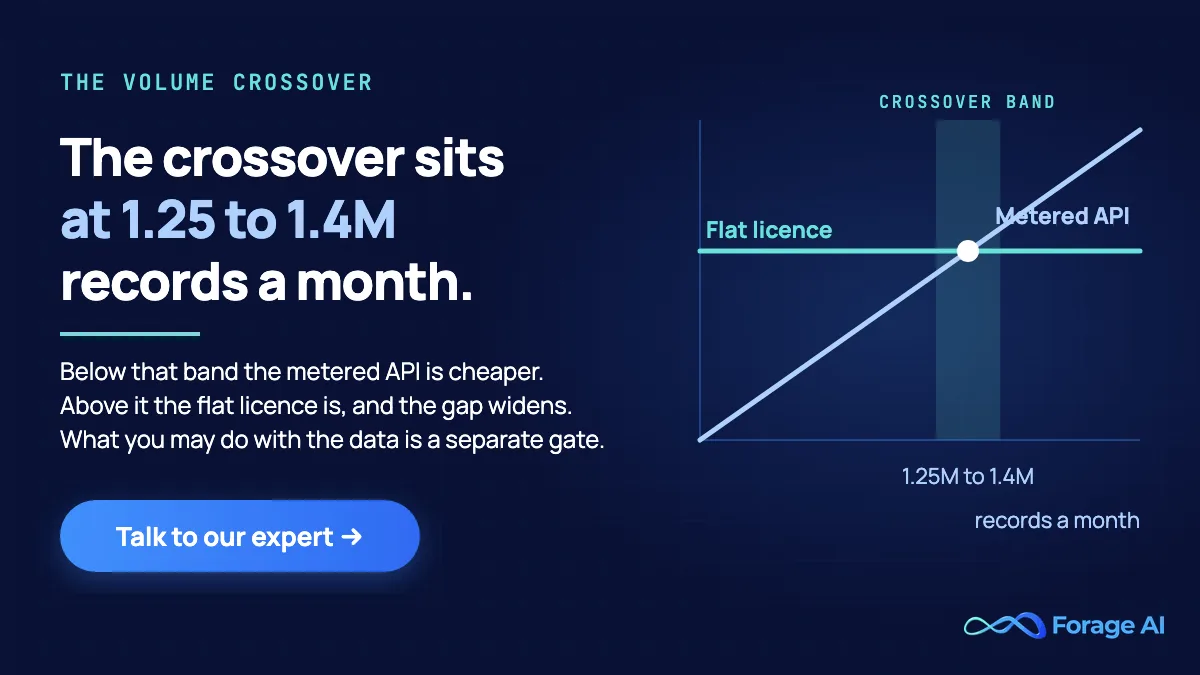
CROSSOVER               1,000,000 + 250,313                 ≈  1,250,000 records/month

With the vendor's own 10% annual discount applied to the metered tier:
1M tier annual          $3,999 × 12 × 0.9 = $43,189/yr = $3,599/mo  →  $0.003599 per record
Premium                 $5,000 − $3,599 = $1,401/month
                        $1,401 ÷ $0.003599 = 389,275 records
CROSSOVER               ≈ 1,389,000 records/month
Below roughly 1.25 million property records a month the metered API is cheaper. Above roughly 1.4 million the flat annual licence is, and every record after that is free, so the licence keeps winning and the gap widens. The crossover band is 1.25 to 1.4 million records a month, about 15 to 17 million a year, and it costs about $5,000 a month to cross.
| Monthly volume | Metered API at $0.003999/record | Unlimited annual licence | Cheaper option |
|---|---|---|---|
| 500,000 | $3,999 (the 1M tier is the one you buy) | $5,000 | metered API |
| 1,000,000 | $3,999 | $5,000 | metered API |
| 1,250,000 | about $4,999 | $5,000 | line ball, the crossover |
| 1,500,000 | about $5,999 | $5,000 | annual licence |
| 3,000,000 | about $11,997 | $5,000 | annual licence |
Three caveats travel with that number and none is optional. Volumes above 1,000,000 extend the highest tier's published rate, which the vendor describes as "Custom pricing available for any record volume", so those rows are our arithmetic rather than a quoted price. "Unlimited" is contractually throttleable: §7 lets the vendor "suspend or throttle Services" at its sole discretion. And this is a mid-market vendor rather than an incumbent, so the figure gives you the order of magnitude at which the question flips, roughly a million records a month. A different route lands in the same place: one vendor's published category range for flat-fee bulk licensing, "often range from $50,000 to $500,000+ annually", works out against $0.0040 a record as about 1.04 million records a month [OUR ARITHMETIC]. That is a vendor's characterisation of its market rather than its own card, and it is as close to corroboration as this market allows.
Two reframings matter more than the arithmetic. The first is that the better question is not a volume threshold at all, it is which fields are public. One working team published their reasoning in an issue tracker: the property-and-owner layer costs them "$0 from county tax parcels + OpenAddresses", and the only pieces worth paying for are the ones they "can't derive from public records", namely new-mover signals and licensed commercial demographics. If the fields you need are derivable from county parcel records and open address data, the layer you are about to buy is already free.
The second is the difference between an expense and an asset, and an auditor made Zillow write it down. Its FY2025 filing splits third-party property data three ways: perpetual rights, capitalised and amortised "from three to seven years"; fixed-term licence; and subscription, where "upon the expiration of such arrangements, we no longer have the right to access the related data, and therefore, the costs incurred under such contracts are not capitalized and are expensed as payments are made." That third category is almost certainly what you are buying, and it leaves you with nothing. Stop paying and the data is gone, including the records you already pulled.
Which brings the second crossover, and it has no volume at all. It is the point where what you want to do with the data stops being something any of these licences will sell you, and you reach it at whatever volume your use case crosses one of those clauses, which might be on day one. BatchData's three percent ceiling is the clearest case: a limit on how much of the database you may take, stated as a percentage, entirely independent of what you are willing to pay. You can be able to afford the data and still not be allowed to have it.
That is where managed data extraction legitimately enters, and not as the cheaper option. Three things change. The rights are specified for your use case rather than inherited from a vendor's standard terms, which is the only way to answer the derivative-works and model-training question before you sign rather than after. An API subscription leaves you nothing at the end, which is Zillow's accounting note rather than our claim. And extraction is scoped to the records you actually need, rather than to a call budget against an endpoint whose query shape you discover after signing. Forage AI does not publish a rate card either, for the reason given earlier, and we do not sell annotation or labelling and do not sell technographic data, so this is a narrower claim than it may read.
Managed extraction is also not always right. Below about 1.25 million records a month, with a stable schema and no derived product, the metered API is cheaper and the licence probably permits what you need, so buy the API. The crossover arithmetic also breaks where the endpoint you need does not support area search, which is worth seeing in code.
# One call. Returns up to 10,000 property records in a postcode. This is DISCOVERY.
GET /propertyapi/v1.0.0/attomavm/detail?postalcode=11201&pagesize=10

# One call. Returns one property. Requires an identifier you must already hold. This is ENRICHMENT.
GET /propertyapi/v1.0.0/preforeclosuredetails?attomid=<id>
Both requests are one API call and both bill identically. One returns a page of a 10,000-property result set; the other will not run unless you already hold the identifier, which means acquiring the list somewhere else first, at some other cost. A budget built on the wrong assumption there can be wrong by any multiple, and the information is not in the price. It is in the query parameters. For the evaluation axes that sit outside cost, our guide to evaluating a real estate data API covers the eight that predict production failure, and real estate data analytics covers what happens to the data next.
What to ask before you sign
One working team published the five axes they used for their own evaluation: per-lookup cost, coverage, data freshness, contract minimums, and API fit for their stack. Use those, and add the four this research suggests nobody asks and everybody needs:
- What exactly counts as a billable unit, in your own words? Get it in writing before the price, because the price is meaningless without it.
- Does the endpoint I need support area search, or only single-record lookup? If the second, your budget needs a discovery layer it does not yet have.
- What happens at the quota boundary? Hard cap, soft overage and auto-upgrade produce three different bills from one headline tier.
- What am I allowed to do with the data, specifically for model training and derivative outputs, and what does that cost? One vendor already answers with "additional fees may be applicable", which means the answer is a number somebody has.
A trial will not settle any of it at these free-tier ceilings, and 39% of failed trials fail on signal rather than price.
Q: When does a property data API stop being the cheapest way to get the data?
A: On published figures, at roughly 1.25 to 1.4 million property records a month, where one vendor's flat annual licence overtakes its own metered ladder. Two other tests matter more than that number. If the fields you need come from county parcel records and open address data, the layer is already free. And if you need to join the data to your own, warehouse it, derive a dataset from it or train on it, the licence decides rather than the price, which is a question no volume threshold answers.
FAQ
How much does a property data API cost per record?
On published rates, $0.0005 to $0.50 per unit at full utilisation of the tier's included quota. Restricted to vendors that genuinely bill per property record, the spread narrows to roughly $0.003 to $0.19, about 60x. Four of the largest names cannot be placed on that scale at all, and the comparable figures measure seven different units, so treat the span as a map of the market's opacity rather than as a price.
How much does the Zillow API cost?
The old public Zillow API, which was free, is gone, and the figures circulating for its replacement are not Zillow's. Bridge Interactive, Zillow Group's developer channel, charges developers nothing: "License agreements and fees are between you and your data provider." Access to Zillow-sourced listing data is gated by eligibility rather than price, and the MLS sets both the fee and the permission. There is no price to find because the price was never the constraint.
How much does MLS API access cost?
One of few questions here with a published answer. Trestle publishes per-connection monthly fees: $30 for broker data feeds and $100 for all other broker feeds, and $100 to $175 for technology providers tiered by total contract count, rising about 5% effective January 2027, and the unit is volume-independent. The card itself states the MLS's own licensing fee as "Depends on MLO", set independently by each MLS, which is why a published rate card still cannot tell you your bill.
How much do enterprise licences cost for nationwide property data?
There is no reference price, because nobody has measured one. What exists is the contract shape: ICE's FY2025 filing discloses about $3.4 billion of performance obligations with only 37% recognised within twelve months and 81% within three years. Two transparency services disagree by 2.6x on the same vendor, one reporting a $15,130 average contract value from three completed deals on an undated page, the other a reported median of roughly $40,000 a year for a differently specified licence.
How are bulk standardised property datasets typically priced by vendors?
Not per call. The two shapes in evidence are a flat annual licence and a per-record block rate. One live card prices an unlimited annual property licence at $60,000 a year against $3,999 a month for a million records, and one vendor's published category range is "$50,000 to $500,000+ annually", its characterisation of the market rather than its own card. The distinction that affects your model is retention: perpetual rights, fixed-term licence and subscription are three different purchases, and only the first two leave you holding anything.
What are affordable alternatives to ATTOM and CoreLogic for property data APIs?
On cost grounds only, several vendors publish rates below the quote-only incumbents: BatchData from $1,000 a month for 100,000 matched records, Datafiniti from $119 a month for 1,000 property records, RealEstateAPI from $599 a month for 30,000 credits, Realie from $50 a month for 1,250 tokens, and Rentcast from $74 a month for 1,000 API requests, all as of October 2026. A lower published rate is not a like-for-like substitution, because the unit, the coverage definition and the licence all differ, and one of the five restricts AI use. For what each provider actually delivers, see our ranked provider comparison.
Conclusion
Every effective rate above is one division you can rerun: published tier price over published quota, with both numbers on the page. Do that at your own volume, against your own query shape, and against any vendor you add to the list. The method outlives the prices, which matters here more than in most categories, because three of the cards above were taken down or buried while their owners were still trading. The figures are stamped as of October 2026 and this article is reviewed quarterly for that reason.
The direction of travel is not toward more disclosure. Across two independent samples, 89% of one plan to increase their alternative-data budget and 97% of another expect their spend to rise or hold steady, and a market with demand that inelastic has no commercial reason to start publishing prices. That is our reading of the cited evidence rather than anyone's forecast, and the practical consequence is the same either way: plan for a world where you have to ask, and walk into the asking with your own arithmetic already done.
When the licence rather than the price turns out to be the constraint, that is the point at which scoping extraction around your own use case starts to beat buying access to someone else's. Forage AI works that way, and we would rather you arrived with the numbers than without them.
Last updated October 2026.
Related Articles
- The Best Real Estate Data Providers 2026: a scored comparison of 15 providers on coverage, freshness and integration, which is the ranking this article deliberately does not do.
- 14 Best Commercial Real Estate Data Tools (2026): the CRE platform layer, including what the platforms cost.
- Real Estate Data API: What to Expect and How to Evaluate Providers: the eight evaluation axes that predict production failure, and the API versus bulk versus managed decision.
- Real Estate Data Analytics: How Property Teams Automate Market Intelligence: what happens to the data once you have bought or built it.
Sai is a data infrastructure enthusiast who has spent the past two to three years following the AI space closely, from the infrastructure layer to the fast-growing world of data for AI. He is genuinely curious about how modern data pipelines get built and where the data industry is heading, and he writes insightful pieces on the core topics that shape this niche.