
When to Outsource Data Extraction: 7 Signs Your Data Engineering Team Has Hit the Wall
The first scraper took a week to build. A year later, the same pipeline takes a day a week to keep running, and nobody ever decided that. It happened one broken layout at a time. The pattern is not limited to scrapers. In a 2026 benchmark survey of 500 senior data leaders at large enterprises, respondents said 53% of their engineering capacity goes to maintaining and troubleshooting data pipelines, and homegrown pipelines broke 30% to 47% more often than the rest.
Knowing when to outsource data extraction is not about admitting defeat. It is about noticing when the work of getting outside data in has started to crowd out the data engineering only your team can do. Below are seven signs, how to check each one this week, and what to keep in-house even after you hand the rest off.
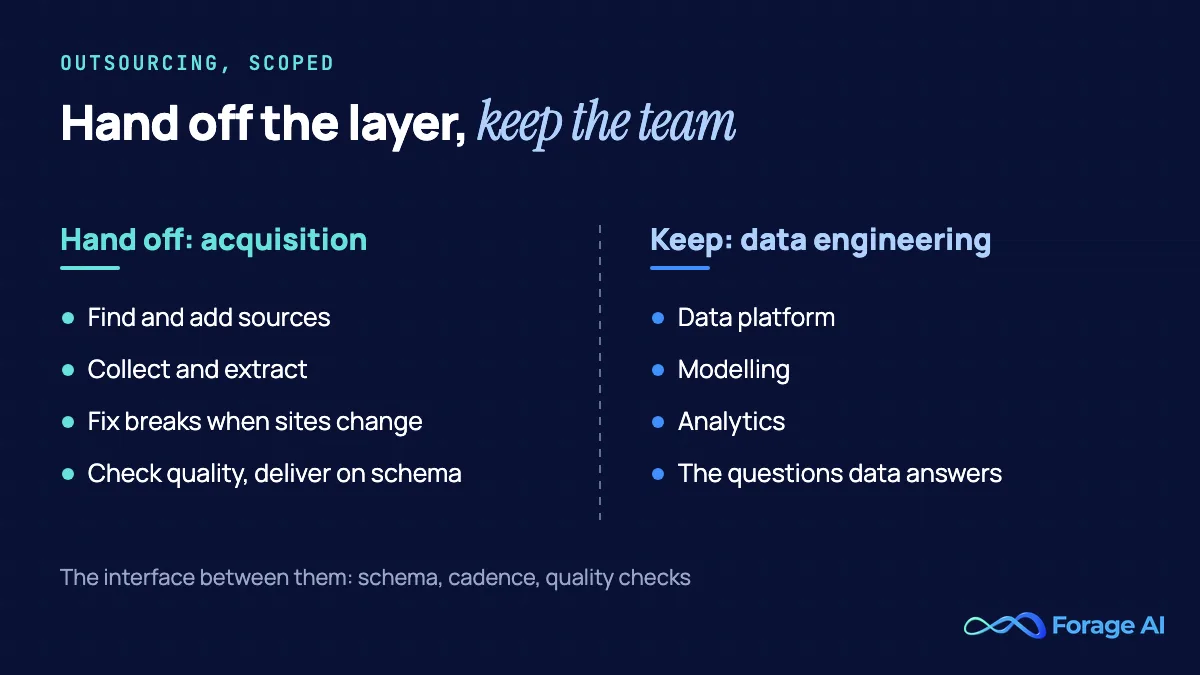
- The split: hand off the acquisition layer (collecting, extracting and delivering outside data), and keep your data platform, modelling and analytics in-house.
- The first sign: when fixing existing pipelines takes more of your team's time than building new ones, upkeep is running your roadmap.
- The risk signs: wrong data reaching the business first, sources blocking you, and a legal "no" carry more weight than engineering cost.
- The test: score your team on the seven signs below; four or more means it is time to make the case.
What you hand off and what you keep
Search for "data engineering outsourcing" and most results are staffing firms offering contract engineers. That is a different decision. This article is about one layer of the work: the acquisition layer.
The acquisition layer is everything between "we need this outside data" and "the data is in our warehouse, on schema, and correct." It covers finding sources, collecting from websites, portals and documents, extracting the fields, keeping collection running when sources change, checking quality, and delivering on a schedule. Everything after that stays with your team: the data platform, the modelling, the analytics, and the questions the data is meant to answer.
Keeping that work is not a consolation prize. It is where data teams struggle most. In Joe Reis's 2026 State of Data Engineering survey of more than 1,000 practitioners, 51% named lack of ownership as a pain point, and Reis summed it up: "The bottlenecks aren't technical." Ownership and definitions are the last things you should hand off.
The acquisition layer strains first because it grows with the outside world, not with your business. Websites redesign, portals add logins, and new sources appear whether or not your team has capacity. The split only works with a clear interface: the schema, the delivery cadence, the destination and the quality checks you expect. Agree on those and the handoff is clean.
If you have not built anything yet, this is a different question. Our build vs buy guide for web data extraction covers that decision.
Seven signs it's time to outsource data extraction
Each sign comes with a way to check it and the point where it starts to count. One sign alone rarely justifies a move. Several together usually do.
1. Upkeep takes more time than new work
| Attribute | Detail |
|---|---|
| How to check it | Tag two weeks of tickets and commits on acquisition code as "new source" or "fix". |
| When it counts as a sign | Fixes take more than half the time. |
| Why it gets worse on its own | Every source you add is another thing that can break. |
The benchmark survey above found pipelines failing 4.7 times a month on average, with each incident taking nearly 13 hours to resolve. Put a price on that. The median US software developer earned $135,980 in May 2025, and benefits make up 30.0% of private-industry compensation (June 2026), which puts a fully loaded engineer near $194,300 a year. If 53% of that time goes to upkeep, roughly $103,000 a year per engineer is spent keeping existing pipelines alive. (Illustrative arithmetic: $135,980 ÷ 0.70, then × 0.53.) And that is the conservative figure: data engineers reported a US median of $150,000 in the 2025 Stack Overflow Developer Survey. Our budget analysis of managed services vs in-house teams takes the full cost model further.
There is a quieter version of this sign: key person risk. If one engineer is the only person who understands the scrapers, the whole pipeline is one failure domain with a notice period. The same applies to dependencies. Practitioners describe scraping stacks that stopped working when a free anti-detection tool maintained by a single developer stopped getting updates.
2. Your source list has outgrown your team
| Attribute | Detail |
|---|---|
| How to check it | Count the sources the business has asked for against the sources that are live, and note how long the last new source took. |
| When it counts as a sign | The backlog grows every quarter, or adding one source takes longer than a sprint. |
| Why it gets worse on its own | The valuable sources are usually in the long tail, not the top three. |
We spoke with a secondary-ticket marketplace whose developer was excellent. He built working scrapers for the three biggest ticket sites in a matter of days. Then someone counted the resale market: hundreds of websites. Three were solved, and the long tail where the pricing gaps lived was untouched. Talent was never the constraint. The number of sources was. It is the same pattern we described in why product teams regret building scraping in-house.
3. Coverage is stuck below target
| Attribute | Detail |
|---|---|
| How to check it | Measure data completeness: divide the entities or websites you get fresh data from by the ones you need. |
| When it counts as a sign | The ratio has stayed flat for two quarters despite added people or spend. |
| Why it gets worse on its own | Partial coverage looks complete in a dashboard, so nobody questions it. |
A healthcare data provider we spoke with needed to monitor about 6,000 hospital websites. They bought an automation license for around $200,000 and staffed an offshore team of five to seven engineers. All in, they spent roughly $400,000 to $500,000 and reached 15% to 20% coverage, while the crawlers kept breaking. More spend did not move the number. The method could not scale to the source count.
4. You bought a tool nobody can run
| Attribute | Detail |
|---|---|
| How to check it | List the extraction and automation licenses you pay for, and the working pipelines each one produces. |
| When it counts as a sign | A tool has been live for more than a quarter with close to zero pipelines, or with pipelines only one person can maintain. |
| Why it gets worse on its own | Sunk cost keeps the license renewing. |
A global asset manager bought a trial license for an enterprise automation tool and handed it to engineering. Nobody on the team had run that class of tool before. The trial expired without a single working pipeline. The healthcare provider above hit the same failure at a much higher price. A tool is not an operating model, and buying one does not buy the people who know how to run it.
5. The business finds data errors before your team does
| Attribute | Detail |
|---|---|
| How to check it | Look at your last five data incidents and note who noticed each one first. Then check whether you monitor null rates per field, row counts against an expected range, the age of the newest record, and one known control record. |
| When it counts as a sign | Most were reported by users or customers, not by monitoring. |
| Why it gets worse on its own | Silent failures: a layout change returns empty or shifted fields and the job still reports success. |
Silent failures are the expensive kind. The pipeline runs in a degraded mode nobody can see, and decisions get made on the data before anyone knows it is wrong. A clean exit code is not a successful run. Data teams know the risk: in dbt Labs' 2026 State of Analytics Engineering survey of 363 data professionals, 71% named incorrect or hallucinated outputs reaching stakeholders as a top concern. Gartner research from 2020 estimated that poor data quality costs organizations at least $12.9 million a year on average.
Gartner analyst Roxane Edjlali put the stakes for AI plainly: "Above all, if the data has issues, then the data is not ready for AI." Gartner predicts that through 2026, organizations will abandon 60% of AI projects that are not supported by AI-ready data. When the business finds your errors first, that readiness gap is already showing.
Source: Gartner press release, "Lack of AI-Ready Data Puts AI Projects at Risk", February 2025
Our piece on why enterprise data pipelines break covers the failure layers in detail.
6. Your sources are fighting back
| Attribute | Detail |
|---|---|
| How to check it | Track the share of runs that hit blocks or CAPTCHAs, and your proxy and anti-bot spend, month by month. |
| When it counts as a sign | Both have risen for two quarters in a row. |
| Why it gets worse on its own | More of the web is moving to deny-by-default. |
The web is getting harder to collect from, not easier. Automated traffic made up more than 53% of all web traffic in 2025, according to Imperva's 2026 Bad Bot Report, and websites are responding. On 1 July 2025, Cloudflare, which says it handles traffic for about 20% of the web, changed its default to block AI crawlers unless a site owner allows them, and its 2025 Year in Review found AI crawlers were the most frequently fully disallowed user agents in robots.txt files.
Your budget feels it before your roadmap does. In a 2026 survey of web-scraping professionals, more than 62% reported higher infrastructure spending and 58.3% higher proxy spending, driven largely by stronger anti-bot protections. Blocking now has legal teeth too: in December 2025 Google sued a search-results scraping service, alleging it circumvented Google's anti-scraping protections. If your block rate is climbing, plan for it as a trend. It is not a bug you can patch once.
Public data is not the same as easy data. When we tested it, a US government statistics website returned "Access Denied" to an automated request while serving the same page to a normal browser. The page was public. Collecting it reliably was still engineering work.
7. Your legal team won't sign off
This article is for informational purposes only and does not constitute legal advice. Consult a qualified attorney for legal guidance specific to your situation.
| Attribute | Detail |
|---|---|
| How to check it | Ask whether legal has paused or refused an acquisition project, and whether there is a written position on terms of service, logins and personal data. |
| When it counts as a sign | A "no", or a hold with no end date. |
| Why it gets worse on its own | Enforcement is growing, and a deletion order can wipe out the dataset your product depends on. |
We have seen this at a financial software firm and, separately, at a global asset manager. Both had the engineers and the budget to build in-house. In both cases their legal teams said no.
The stakes are real, and enforcement is getting sharper. In December 2024, France's data protection authority, the CNIL, fined KASPR €240,000 for collecting LinkedIn contact details that users had chosen to hide, and ordered it to delete the data. Earlier, hiQ Labs v. LinkedIn ended in December 2022 with $500,000 against hiQ and an order to destroy the code and data derived from the scraped profiles.
Be clear about what outsourcing changes. It changes who runs the collection, not who answers for how the data is used. A provider can take on the collection method and its practices. Your use of the data stays yours, so settle whether scraping is legal for your use case with counsel either way.
When should you keep it in-house?
Outsourcing is not always the answer, and a provider that says otherwise is selling. Keep data extraction in-house when:
- Collection is your product. If gathering the data is your moat, the expertise belongs on your payroll.
- Your sources are few and stable. One or two sources with official APIs rarely justify a partner.
- The need is full-time and steady. A team that wants this work, with a steady queue of it, may be cheaper to staff than to contract.
- No third party may touch the data. Contracts or regulations can forbid it. Then build carefully and budget for the upkeep from day one.
Fix the cheap causes first. Practitioners report that sources the business reads weekly rarely need daily collection, and that schema-change alerts catch most breaks early, so lower the frequency and add alerts before you decide. Partial handoffs are valid too. In practice, teams often keep their three core sources in-house and hand off the long tail. Handoffs are also reversible: in Deloitte's 2024 Global Outsourcing Survey of more than 500 executives, 70% had selectively brought previously outsourced work back in-house over the past five years. And outsourcing does not fix an unclear data need. Decide what the data is for before you decide who collects it.
How do you score your own team?
With the seven signs and the exceptions in hand, score your current setup. Answer each row honestly.
| # | Sign | How to check it | It counts when | Your team |
|---|---|---|---|---|
| 1 | Upkeep beats new work | Two weeks of tickets tagged new vs fix | Fixes take over half the time | Yes / No |
| 2 | Source list outgrew the team | Sources asked for vs live, lead time per source | Backlog grows every quarter | Yes / No |
| 3 | Coverage is stuck | Fresh entities or websites ÷ needed | Flat for two quarters despite spend | Yes / No |
| 4 | A tool nobody can run | Licenses vs working pipelines | Near zero after a quarter | Yes / No |
| 5 | Business finds data errors first | Who noticed the last five incidents | Mostly users, not monitoring | Yes / No |
| 6 | Sources fight back | Block rate and anti-bot spend by month | Rising two quarters in a row | Yes / No |
| 7 | Legal won't sign off | Paused or refused projects | A "no" or an open-ended hold | Yes / No |
With zero or one yes, keep the work in-house and fix the specific bottleneck. With two or three, prioritize the worst sources or the long tail, hand those off first and compare. With four or more, it is time to make the case for moving the acquisition layer. If you sit between two bands, let signs 5 and 7 decide, because they carry business and legal risk rather than engineering cost.
What does a managed handoff look like?
If the scorecard points to a handoff, the next question is how it works in practice. A handoff that works is incremental. You share the source list, the schema you need and the delivery target. Start with a pilot batch of your hardest sources: the provider builds collection, runs quality checks and delivers sample data for you to review. Sources move over in batches, and your team keeps monitoring what arrives, because you still own the data once it lands.
Before you choose among outsource data extraction services, ask who owns maintenance when a source changes, how breaks are reported, whether people check the output, who owns the data and the collection code, and how you would leave. Vendor continuity matters as well: we have seen a US broadcaster's analytics vendor go out of business mid-contract, leaving the team scrambling for a replacement. Our data extraction evaluation checklist covers these questions, and our guide to managed web data extraction explains the model in more detail.
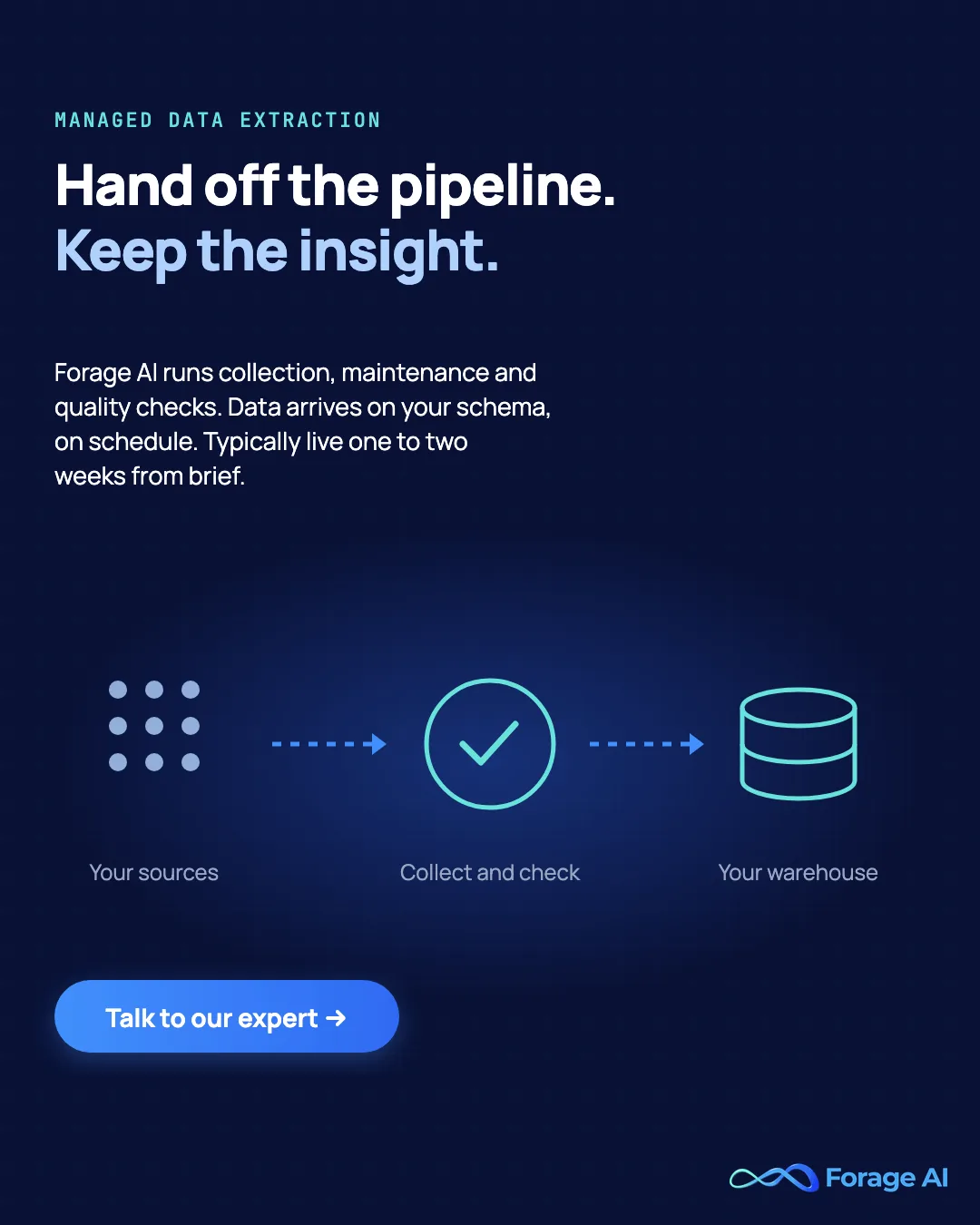
This is the work Forage AI does. We own collection end to end, absorb the maintenance when sources change, put human QA on the output, and never resell your data. A typical engagement goes from brief to a live pipeline in one to two weeks, on infrastructure that has collected from over 500 million websites. Forage AI delivers the data, not just the pipeline.
Upkeep crept in one broken layout at a time, and the handoff can happen the same way, one source at a time. Run the scorecard again every quarter, because the signs move as your source list grows. Move sources in batches, not all at once. And if there is one source your team dreads opening on a Monday, bring that one to us first.
Frequently asked questions
Is outsourcing data extraction cheaper than an in-house team?
Often, once you count upkeep. Compare the fully loaded cost of the engineers maintaining your pipelines, plus infrastructure and anti-bot spend, against a managed contract for the same sources. Our budget analysis walks through the full comparison.
What is the difference between outsourcing data engineering and outsourcing data extraction?
Outsourcing data engineering usually means contracting engineers to work on your data platform. Outsourcing data extraction means a provider runs the collection of outside data and delivers it to you. Your team keeps the platform, the modelling and the analytics.
Can you outsource only part of your sources?
Yes. Teams often keep a few core sources in-house and hand off the long tail, or the sources that break most often. It is a practical way to test a provider before moving more.
How long does it take to move a pipeline to a managed provider?
It depends on the number and difficulty of sources. With Forage AI, a typical engagement goes from brief to a live pipeline in one to two weeks, and larger source lists move over in batches.
What about AI coding tools?
They make fixing a broken scraper faster. They do not tell you it broke, get you past blocking, or check that the output is right. In a 2026 survey of web-scraping professionals, 45.8% already used AI in their workflows, so it is part of the toolkit rather than a replacement for running collection.
Who is responsible for the data if we outsource collection?
This is general information, not legal advice. A provider can take responsibility for how it collects, but your organization remains responsible for how it uses the data. Settle both in the contract and check your use case with counsel.
What should stay in-house after you outsource?
Your data platform, your models, your analytics and the definition of the schema you need. Keep monitoring what arrives too, because you still own the data once it lands.
Related articles
- 2026 Data Extraction Services vs In-House Teams Budget Analysis: the full cost comparison.
- Data Extraction Company: Enterprise Evaluation Checklist: how to choose a provider once you decide to outsource.
- What Is Managed Web Data Extraction?: how the managed model works.
- Build or Buy? Web Data Extraction Decision Guide: for teams that have not built yet.
Sai is a data infrastructure enthusiast who has spent the past two to three years following the AI space closely, from the infrastructure layer to the fast-growing world of data for AI. He is genuinely curious about how modern data pipelines get built and where the data industry is heading, and he writes insightful pieces on the core topics that shape this niche.