
AI-Powered Entity Matching: How AI Agents Transform Data Accuracy
Enterprise data is a tangled web of inconsistencies, making entity matching a critical but often flawed process. Businesses process vast amounts of data daily – customer records, financial statements, regulatory filings, healthcare records, company news articles and the list is endless. However, these records are rarely uniform. With the rise of AI agents and agentic AI systems powered by LLMs, entity matching has shifted from rule-based lookups to intelligent, context-aware automation embedded directly into enterprise AI infrastructure.
A single company might appear across different documents as:
- Acme Corporation
- Acme Corp.
- Acme Inc.
- ACME CORP (US)
For financial firms, this means incorrectly matching regulatory filings. Market intelligence teams risk tracking the wrong company. The cost of misidentifying entities is high – misattributed risk signals, flawed compliance checks, reputational damage, regulatory exposure, and downstream AI decisions built on incorrect data. These AI data quality issues compound rapidly at scale, and they are a major reason RAG pipelines fail in production when the underlying entity data feeding them is unresolved.
Entity Matching – also known as Entity Resolution, Record Linkage, or Data Matching – is the process of linking records that refer to the same real-world entity across disparate sources. Today, it sits at the core of enterprise AI integration and downstream AI workflows.
Quick Digest
- The problem: one company shows up as Acme Corporation, Acme Corp., Acme Inc. and ACME CORP (US), and matching the wrong record misattributes risk signals, compliance checks and downstream AI decisions.
- Five traditional methods and why each breaks: exact matching, keyword and bag-of-words, fuzzy string similarity, rule-based heuristics, and probabilistic scoring.
- What AI adds: vector embeddings and LLM reasoning read context, so an ambiguous reference resolves on industry, geography, organizational structure and history rather than on string distance.
- The agentic workflow: extract and normalize, match with context, score confidence with human-in-the-loop review, run elimination rounds, then decide across multiple sources.
- Where it lands: finance, regulatory operations, market intelligence and supply chain, with company matching, website identification and cross-dataset linkage as the recurring jobs.
Which services offer AI-powered entity matching solutions for large datasets?
Scalable entity matching platforms use AI-driven models to handle millions of records in real time. They combine NLP, clustering, and vector-based similarity search to automate matching at scale, ideal for financial, e-commerce, and market intelligence use cases.
Yet, traditional methods of entity matching are ill-equipped to handle the scale and complexity of modern data landscapes.
Let’s examine why traditional approaches fail, and how Forage AI’s custom-built entity matching agents improve accuracy, adaptability, and automation in entity resolution.
Where can I find AI agents that specialize in entity resolution for business data?
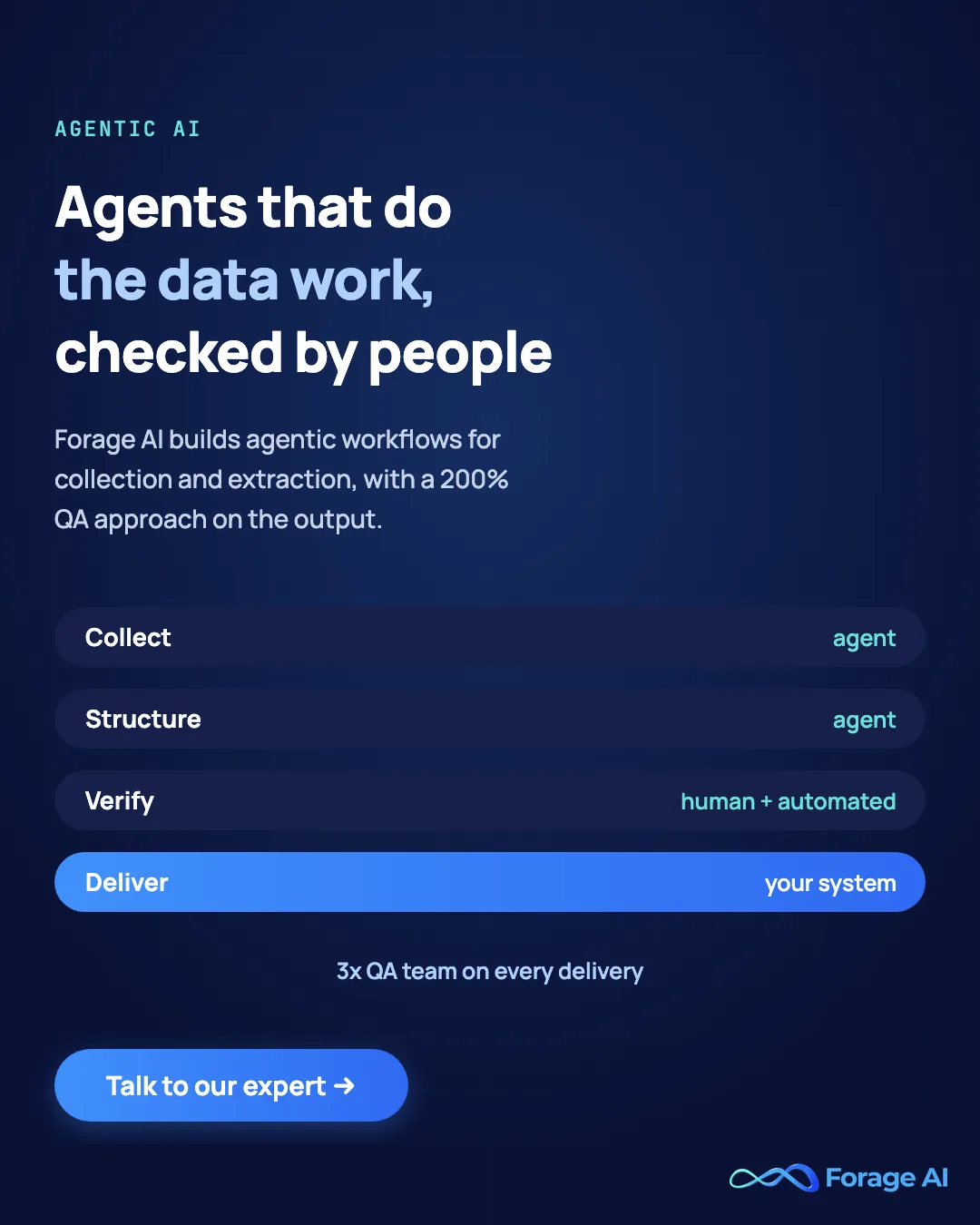
AI agents built for enterprise entity resolution run inside an end-to-end managed data pipeline such as Forage AI’s, built to your own fields and systems. They integrate directly with CRMs, internal databases, and external APIs, automating the process of identifying and linking entities with precision.
What Is AI-Powered Entity Matching?
In simple terms, Entity Matching is about connecting the dots.
Let’s take a real-world example where an enterprise is working on news tracking and reputation monitoring. A corporate intelligence team needs to monitor news about executives. They set up a crawler to scan global news articles, looking for mentions of “John Smith.”
- Problem: “John Smith” is too common. How do you know if an article is about the right John Smith, the CEO of Acme Corp., and not a completely different John Smith?
- Complication: Some articles refer to him as “J. Smith,” others as “Johnathan Smith.” Some sources might mention him indirectly, as “CEO of Acme Corp.”
This is where the difference between agentic AI vs generative AI becomes clear. Generative AI produces text. Agentic AI reasons, verifies, searches, and improves entity resolution autonomously using AI agentic workflows.
What AI services help merge duplicate records using entity matching technology?
Modern AI services merge duplicate records by combining semantic similarity, contextual analysis, and metadata alignment. Using LLM reasoning, they identify when two records represent the same real-world entity even if names, addresses, or identifiers differ slightly.
This is where entity matching is essential. A powerful system should be able to:
- Analyze context (Is this article talking about Acme Corp?)
- Recognize variations (John Smith vs. Johnathan Smith)
- Filter out false positives (Excluding unrelated John Smiths)
Now, scale this problem to millions of records across industries, finance, healthcare, e-commerce, and compliance. Without accurate entity matching, businesses are flying blind.
Modern AI-driven systems use NLP and LLMs to interpret the context behind names, roles, and organizations, enabling significantly more accurate entity linking.
How does entity matching work?
Entity matching works in five steps: standardise the records, block them into candidate pairs, compare each pair, decide which pairs match and group them into entities, then measure the result against pairs a person has labelled. The methods in the next section, from exact rules to LLM agents, differ mainly in how they compare and decide.
- Standardise: put names, addresses and identifiers into one format, so "ACME CORP (US)" and "Acme Corp." stop differing on case, punctuation and legal suffix. A join on cleaned names alone handles the easy cases and quietly mis-joins the rest.
- Block: comparing every record with every other gives entity resolution what Papadakis and colleagues call "inherently quadratic complexity" (ACM Computing Surveys, 2020). Blocking keeps only pairs that share a key, such as a postcode or the first tokens of a name. A pair that never shares a block can never match, so blocking is tuned for recall first.
- Compare: score each candidate pair field by field. The probabilistic version goes back to Fellegi and Sunter's 1969 paper "A Theory for Record Linkage", which sorts pairs into match, non-match and a possible-match band for review. Splink, built by a data-linking team at the UK Ministry of Justice, is a current open-source implementation.
- Decide and cluster: turn pair scores into entities. The usual shortcut, transitive closure, treats "A matches B" and "B matches C" as proof that A matches C. A 2026 study of a self-serve matching pipeline found that one false-positive link can "chain hundreds of records together". In practice, cap cluster size and auto-link only when the top candidate scores high and no close second-best exists. Everything else goes to a reviewer.
- Measure: label a sample of pairs by hand and report precision (how many declared matches are real), recall (how many real matches were found) and F1, which balances the two. Public benchmarks such as Abt-Buy (product listings) and Machamp (seven tasks across structured, semi-structured and text records) let teams compare methods on identical pairs. The threshold that trades precision against recall is a policy decision, and it needs an owner.
Implementation detail for each step is in our guide to automated entity matching for multi-source datasets, and what unresolved entities do to retrieval is covered in entity resolution for RAG.
Traditional vs. AI-Based Entity Matching Methods
1. Exact Matching (Deterministic Rules)
Exact matching uses strict, rule-based logic such as unique identifiers or multi-field comparisons to determine entity equivalence.
Why It Fails:
- Inconsistent identifiers: A company’s tax ID might be missing or different across jurisdictions.
- Minor discrepancies break matches: “IBM Corp.” vs. “International Business Machines.”
- False positives: Many companies share similar names, creating misclassifications.
Expert Insights
The missing-identifier problem has a standing public answer that is worth checking for before any fuzzy matching runs. GLEIF publishes the Legal Entity Identifier as "a unique 20-character alphanumeric code that enables anyone, anywhere in the world, to access clear, unique identification data about a legal entity", covering both "who is who" and "who owns whom", and it is issued as "a public good, available free of charge to all users" (GLEIF, 2026). Where both records carry an LEI, the match is a lookup rather than an inference.
Example: A financial institution uses exact matching for loan applications but fails to recognize that a customer applied with a different phone number, leading to duplicate records.
2. Keyword & Bag-of-Words Matching
This approach tokenizes entity names and compares them based on shared keywords.
Why It Fails:
- Ignores context: “Apple Inc.” vs. “Apple Farms” might be mistakenly linked.
- Misses abbreviations & acronyms: “JP Morgan” vs. “Morgan Chase.”
- Overlaps lead to errors: “Bank of America” vs. “America First Bank.”
Example: A news crawler picks up “Nikola Tesla’s inventions” as relevant for Tesla Inc., creating noisy data.
3. Fuzzy Matching (String Similarity Algorithms)
Fuzzy matching uses algorithms like Levenshtein Distance to link near-identical strings.
Why It Fails:
- Computationally expensive at scale: Millions of comparisons slow down processing.
- Does not understand meaning: “United Airlines” might get linked to “United Health.”
- False positives: “Mark Ford” could be matched with “Mike Ford.”
4. Rule-Based Matching (Heuristic Systems)
Rule-based systems define conditions for entity linkage, such as matching names if similarity is above 80% and addresses align.
Why It Fails:
- Requires constant rule maintenance: As data evolves, rules become obsolete.
- Struggles with variations: If a company changes names (e.g., “Acme Ltd.” to “Acme Technologies”), a static rule set won’t detect it.
- High false positive/negative rates: Too many rules create errors, while too few miss real matches.
From Rule-Based Systems to LLM-Powered Context Understanding
5. Probabilistic Matching
Probabilistic methods assign confidence scores based on similarities.
Expert Insights
This is a research field with a long paper trail, and the survey literature is blunt about why the older methods stall. Reviewing the area, Olivier Binette and Rebecca C. Steorts write that "before such questions can be answered, databases must be cleaned and integrated in a systematic and accurate way, commonly known as record linkage, de-duplication, or entity resolution", tracing modern probabilistic linkage back to "the foundational work that began in the 1940's and 50's" ((Almost) All of Entity Resolution, 2020). The threshold-tuning problem this section describes is a known limitation of that lineage, not a bug in any one vendor's build.
Why It Fails:
- Threshold tuning is difficult: A slight error in the threshold leads to either too many false matches or too many missed links.
- Assumes independent fields: A system might give a high-confidence match to two entities based on a common address when they are actually distinct businesses.
Set side by side, the four families of method trade off like this. None of them wins everywhere, and most production pipelines run more than one.
| Method | How it decides | Needs labelled data? | Wins when | Fails when | Cost at scale |
|---|---|---|---|---|---|
| Rules and exact matching | Fixed conditions on identifiers or agreeing fields | No | Both records carry a shared identifier, such as an LEI or a tax ID | Identifiers are missing, names vary, or the data drifts away from the rules | Cheap per pair; upkeep grows with every rule |
| Probabilistic (Fellegi-Sunter) | Weighs agreement on each field into a score, with a review band between match and non-match | Not strictly; weights can be estimated without labels, as Splink does, but a labelled sample is needed to check them | Several moderately reliable fields and a need for an explainable score | Fields are correlated, such as two firms at one address, or the threshold is set badly | Cheap per pair once blocking has cut the candidates |
| Supervised ML and deep learning | A classifier trained on labelled pairs; Ditto (VLDB 2020) fine-tunes a pre-trained language model on them | Yes; Ditto matched the earlier best results with at most half the labelled data | Messy text with enough labelled examples; Ditto reported 96.5% F1 matching company datasets of 789K and 412K records | Entities unlike the training data; Peeters et al. found fine-tuned models less robust to unseen entities | Training effort up front, then model inference on every pair |
| LLM and agentic | A language model reads both records and reasons with background knowledge; an agent can search for more evidence | Few or none; Peeters et al. (EDBT 2025) found the best LLMs comparable to models fine-tuned on thousands of examples | The pair needs knowledge the records lack, such as a renamed company or a parent and its subsidiary | Plain text overlap already decides it: on Abt-Buy a word-overlap rule scored 0.950 F1 against 0.948 for an LLM (Shrestha, 2026); prompts also need tuning per dataset | Highest per pair, so use it on the pairs cheaper methods leave open |
Quick Summary
Q: Why do traditional entity matching methods fail at scale?
A: Each one breaks for a different reason. Exact matching depends on identifiers that are missing or differ between jurisdictions, so IBM Corp. and International Business Machines never meet. Keyword matching ignores context and links Apple Inc. to Apple Farms. Fuzzy string similarity is expensive across millions of comparisons and has no sense of meaning, so United Airlines can be linked to United Health. Rule-based systems need constant maintenance and miss a company that renames itself. Probabilistic scoring depends on a threshold that is difficult to tune and assumes fields are independent, so two distinct businesses at one address can score as a confident match.
Why Is AI-Driven Entity Matching the Future?
Traditional entity resolution methods were built for structured, small datasets. Today’s AI systems operate across unstructured documents, APIs, web data, and continuously changing entity relationships.
- Data is fragmented across documents, APIs, databases, and unstructured sources.
- Entities frequently change names, locations, and affiliations.
- Real-time matching is critical for compliance, market intelligence, and financial risk management.
- Hyper-scalability is necessary to handle exponentially growing datasets across industries.
- Regulatory compliance alignment ensures adherence to evolving data protection and privacy requirements worldwide.
- AI-driven decision-making integrates seamlessly into enterprise analytics, delivering deeper insights and automation.
- Cross-platform data integration, leveraging multiple sources such as LinkedIn, SEC filings, and government databases.
- Increased automation efficiency, reducing human intervention while improving accuracy.
- Continuous learning models, adapting entity resolution strategies over time based on evolving datasets.
Who offers enterprise-grade AI solutions for entity matching and data cleansing?
Enterprise-grade vendors like Forage AI deliver managed entity matching pipelines with client-specific handling rules and built-in governance controls. These pipelines keep large-scale data cleansing secure and auditable, ensuring trust and transparency.
What companies provide AI-driven entity matching platforms for customer data management?
Leading companies in this space offer AI-driven platforms that unify fragmented customer data across CRMs, marketing platforms, and support systems, ensuring each customer profile is accurate, contextual, and continuously updated through adaptive learning.
How Are AI Agents Changing Entity Matching?
AI-powered entity matching brings context, scalability, and adaptability to the table. Unlike static rule-based systems, AI-driven solutions learn, adapt, and improve over time. Much of that adaptability is powered by the same zero-shot and few-shot learning approaches that let models recognize a new name variation or entity type from only a handful of examples, or none at all.
Key Advantages of AI-Powered Entity Matching:
- Understands context: Uses vector embeddings & NLP to match entities beyond simple text similarity.
- Leverages LLMs for contextual reasoning: Enhances understanding of ambiguous references by interpreting how entities relate across documents and industries.
- Handles ambiguous data: AI models learn variations (e.g., “J. Smith” vs. “Johnathan Smith”).
- Reduces manual effort: AI eliminates endless rule maintenance and flagging false positives manually.
- Works at scale: Built to run at the record volumes each engagement agrees up front, with throughput set per client.
- Advanced confidence scoring: Incorporates multiple criteria like tax IDs, website domains, and contextual signals to ensure precision.
- AI-powered error detection: Flags inconsistencies, identifies potential duplicates, and recommends corrective actions.
Forage AI’s Advanced Entity Matching Agent
Forage AI delivers enterprise-grade agentic AI workflows purpose-built for entity resolution, combining autonomous AI agents, contextual reasoning, and continuous learning inside a managed pipeline that Forage AI builds and runs to your fields and systems. This custom-built service integrates data ingestion, NLP-based entity resolution, and adaptive learning to deliver high accuracy at scale. It also utilizes LLMs to interpret nuanced relationships between entities, improving cross-source linking and minimizing false positives.
The AI Agentic Workflow: How It Works
Entity matching is a multi-step process that mimics how a human researcher analyzes multiple sources, verifies relevance, and determines the best match. Below is an overview of the critical steps in Forage AI’s entity-matching workflow.
Data Extraction & Preprocessing
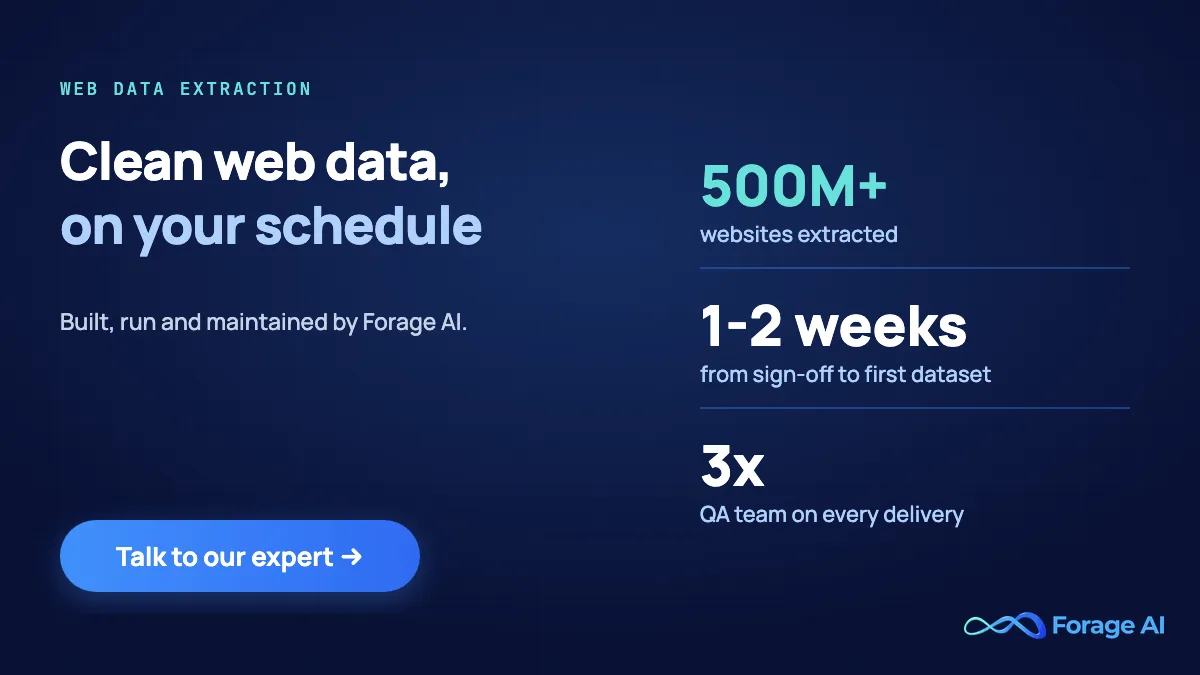
AI-powered crawlers extract data from structured & unstructured sources (web, PDFs, databases, APIs, regulatory filings, and proprietary datasets). The data undergoes cleaning, deduplication, and normalization, followed by feature extraction that turns raw attributes like names, addresses, and identifiers into structured signals the matching models can reason over. This step also includes handling missing data, where AI attempts to fill gaps by searching additional sources.
Context-Aware Matching
Utilizes LLMs (Large Language Models), vector embeddings, NLP models, and knowledge graphs within an agentic architecture that mirrors how human researchers reason, verify, and eliminate false matches. The system analyzes not just names but also industry, geographic presence, organizational structure, and historical affiliations to refine entity resolution. This helps avoid false matches and ensures a more holistic understanding of each entity.
This combination of AI agents and LLM intelligence allows entity resolution models to reason semantically, recognizing not just who an entity is, but how it connects within an ecosystem.
What are the top AI-powered entity matching products for e-commerce databases?
E-commerce platforms benefit from AI systems that reconcile seller, product, and brand data across marketplaces. These tools leverage NLP and vector embeddings to ensure catalog accuracy, reducing duplicates and improving recommendation quality.
Confidence Scoring & Adaptive Learning
- Assigns confidence scores based on multiple attributes, including unique IDs, business registration numbers, website domains, and social graph analysis.
- Cross-reference data points from various sources to enhance accuracy and flag discrepancies.
- Continuously refines its matching logic through human-in-the-loop validation, where flagged cases are reviewed and fed back into the model to improve future accuracy.
- Detects and resolves inconsistencies using historical entity data and real-time updates, ensuring entities remain correctly linked even as their attributes change over time.
- Enriches entity records by proactively sourcing additional context from web crawlers, public registries, and the client’s licensed sources.
Elimination Rounds & Deep Matching
To further refine the results, the system runs multiple elimination rounds, mimicking how a human would verify entities by checking multiple sources.
- AI assesses potential matches using various techniques, such as geolocation comparisons, industry alignment, and secondary data point validation (e.g., checking associated executives or past transactions).
- If confidence remains low, the system searches for additional web-based verification, like news mentions, investor filings, or cross-referencing with business aggregators.
- When multiple close matches exist, the system prioritizes based on entity interconnectedness, ensuring the most reliable record is selected.
Multi-Source Decisioning & Final Match Selection
Just as a human researcher would visit multiple sources, extract relevant data, and determine the most accurate match, Forage AI’s entity-matching agent follows a similar process:
- Aggregates signals from multiple sources, ensuring a match is validated across platforms such as LinkedIn, SEC filings, company websites, and government registries.
- Weighs and ranks the relevance of each source to prevent over-reliance on a single dataset.
- Final match selection occurs when a combination of confidence score thresholds, cross-source verification, and contextual accuracy is achieved.
This multi-layered approach improves accuracy, reducing false positives while maintaining precision at scale.
Core Capabilities
- Data Ingestion: Takes in data from various sources (DB, S3, CSV, APIs, spreadsheets) and handles very large datasets.
- Matching Engine: Uses a combination of fuzzy matching, NLP, geolocation checks, and confidence scoring to resolve entities accurately.
- AI-Driven Crawling: When data is incomplete, the agent searches the web to fill in missing attributes (e.g., company websites, LinkedIn profiles).
- Human-in-the-Loop Review: A QA workflow ensures flagged cases receive human adjudication and continuous improvement.
- Multi-layered validation: Leverages cross-referencing with third-party sources to verify entity authenticity.
- Dynamic entity resolution: Adapts entity profiles based on changes in industry data, ensuring records stay up to date.
- Configurable to any use cases: Designed to adapt to various industry needs, allowing customization in matching criteria, data sources, and confidence scoring models to meet specific business requirements.
Our Use Cases
- Company Matching: Matching multiple datasets across sources like financial databases, firmographic vendors, and internal systems, each with unique identifiers and varying data completeness. Ensuring accurate linkage between datasets, handling formal vs. DBA names, resolving M&A changes, and integrating newly formed companies not previously recorded.
- Website Identification: When company records from government sources lack websites, AI-driven web crawling finds and verifies the correct website by matching it to industry, address, and other attributes.
- Corporate Profile Linking: Mapping company websites to the right LinkedIn company profiles for enriched entity data, enabling better tracking of corporate activities and executive movements.
- People Matching: Identifying LinkedIn, social media, and other professional profiles based on available biographic information, even when only limited data points like name and partial employer details exist.
- News Verification for Experts: Validating whether a news article refers to the correct professional by cross-referencing known identifying characteristics against the found information.
- Multi-Source Entity Resolution: Triangulating entities from government records, business aggregators, LinkedIn data, and company websites to create a comprehensive and unified entity profile.
- Compliance & Risk Analysis: Enhancing regulatory and financial risk assessments by ensuring company names submitted for risk analysis are accurately matched against high-confidence datasets.
Forage AI’s entity matching has helped enterprises in finance, regulatory operations, market intelligence, and supply chain resolve entities across their data.
Quick Summary
Q: How does an agentic entity matching workflow decide that two records are the same?
A: In five steps. Extraction and preprocessing pull records from web pages, PDFs, databases, APIs and filings, then clean, deduplicate and normalize them into structured signals. Context-aware matching compares industry, geography, organizational structure and historical affiliations, not just the name string. Confidence scoring weighs unique IDs, registration numbers, domains and social graph signals, and routes flagged cases to human reviewers whose corrections feed back into the model. Elimination rounds re-check the survivors against geolocation, industry alignment and secondary data points, searching the web for more evidence when confidence stays low. Final selection happens only when confidence thresholds, cross-source verification and contextual accuracy all agree.
The Future of Entity Matching Is Here
Data imbalance and inaccuracies are the silent killers of business intelligence. Organizations drowning in fragmented records, duplicate entities, and mismatched identifiers are operating with a blind spot they can’t afford. The demand for master data management is growing at unprecedented rates, and it’s a mandate for businesses that rely on precision, trust, and speed in decision-making.
AI has finally caught up with the scale and complexity of modern data ecosystems. Entity resolution, once a tedious and error-prone process, has reached a turning point. With autonomous AI agents powered by LLMs, entity matching will soon reason about data in real time, interpreting patterns, relationships, and anomalies autonomously. AI-driven, context-aware entity matching is the new standard for enterprises that refuse to settle for outdated, siloed data. Forage AI builds and runs entity matching pipelines that unify your data and strengthen your audit trail. Talk to us today about entity matching built to your records and fields.
Frequently asked questions
What is AI-powered entity matching?
AI-powered entity matching uses artificial intelligence to link and reconcile records referring to the same entity across multiple data sources. It goes beyond simple text matching by understanding context, relationships, and variations in names or attributes.
Who are the leading suppliers of entity matching solutions for healthcare data?
Healthcare organizations use AI-powered entity matching from providers like Forage AI to unify provider and practice records (healthcare provider directory matching) under client-specific handling rules agreed up front.
What industries benefit most from AI entity matching?
Industries with high data complexity and regulatory requirements benefit the most, including finance, compliance, healthcare, and market intelligence. Accurate entity resolution ensures reliable insights and mitigates operational and legal risks.
What are the best solutions for entity matching in customer data management?
Managed providers like Forage AI resolve fragmented customer records using AI-driven similarity scoring, contextual matching, and multi-source verification, down to one record per customer with a match confidence you can audit.
Which companies offer reliable entity matching services for large enterprises?
Vendors such as Forage AI deliver scalable entity resolution pipelines built for millions of records, with contractual controls and adaptive learning.
What entity matching services provide strong data privacy and compliance features?
Solutions such as Forage AI include enterprise-grade data governance, on-prem or private-cloud deployment, no data reselling, and client-specific handling rules agreed up front, so entity resolution runs under terms you set.
Which platforms provide entity matching capabilities with AI-driven accuracy?
Managed providers like Forage AI use LLM reasoning, embeddings, and contextual vector search to deliver more accurate matches than rule-based systems.
By Manpreet Dhanjal