
What a Provider Directory File Actually Contains: Fields, Sources and Refresh Cadence
Fields and sources checked 26 October 2026. CMS's new directory rule is proposed, not final.
Open a vendor's sample file and the columns look familiar: NPI, name, specialty, address, phone, network, accepting new patients. The dictionary rarely says who wrote each column or how old it is, so teams trust fields the file never asserted and find out at load or audit.
Provider directory data is not one dataset. It is about a dozen fields written by seven origins, on clocks that run from daily to five years. This is provider data, not patient data.
Below are the 12 fields a directory file usually carries, where each comes from, how often that source refreshes, and ten checks to run on a sample first.
- Seven origins: each field has its own writer and its own clock.
- Monthly is not current: CMS says PECOS edits can take up to four months to reach its Doctors and Clinicians data.
- Self-reported: the NPI, taxonomy code and NPPES licence slot come from the provider and certify no licence.
- Test by contact: call on phone, address, network status and accepting new patients, the four fields Medicaid's secret-shopper rule checks.
Provider directory fields at a glance
Each field, who writes it, and how often that writer republishes.
| Field | Written by | Published refresh (as stated) | Watch-out |
|---|---|---|---|
| NPI and entity type | NPPES | Monthly, weekly updates | Type 1 and 2 are separate keys |
| Name and credential text | NPPES, PECOS | Monthly | Typed, not verified |
| Specialty and taxonomy | Provider, PECOS, plan | NUCC: January and July | Self-selected; not a licence |
| Licence and board certification | State boards; DataSpring (formerly CAQH) | Varies by board | NPPES slot is self-reported |
| Practice address | NPPES, PECOS, plan | Monthly | Mailing and practice mixed |
| Phone | NPPES, PECOS, plan | Monthly | Blank may mean several numbers |
| Network participation | The plan only | MA: 30 days | Varies by location and plan |
| Accepting new patients | The plan | 30 days | Per location and network |
| Telehealth | Medicare claims, or the plan | Monthly | Billed vs offered |
| Accessibility and languages | The plan | 30 days | No accuracy study found |
| Group and hospital affiliation | PECOS; Facility Affiliation file | Monthly | Two separate files |
| Record dates | NPPES and each origin | Monthly deactivation file | Updated is not verified |
Cadences as each publisher states them, read 26 October 2026. A release date is not when each value was checked; no source publishes a last-verified date per field.
What must a provider directory contain?
This article is for informational purposes only and does not constitute legal advice. Consult a qualified attorney for legal guidance specific to your situation.
Four lists set the minimum columns behind CMS provider directory requirements, and each is the plan's obligation, not the vendor's.
| Field | MA API (422.120) | Medicaid (438.10(h)(1)) | REAL Health Providers Act (from 2028) | CMS-4214-P (proposed) |
|---|---|---|---|---|
| Name | Yes | Yes | Yes | Yes |
| Group affiliation | No | Yes | No | No |
| Address | Yes | Yes | Yes | Yes |
| Phone | Yes | Yes | Yes | Yes |
| Website | No | Yes | No | No |
| Specialty | Yes | Yes | Yes | Yes |
| Accepting new patients | No | Yes | Yes | Yes |
| Languages and cultural capabilities | No | Yes | Yes | Yes |
| Accessibility | No | Yes | Yes | Yes |
| Telehealth | No | Yes | Yes | Yes |
| Ownership or control disclosure | No | No | No | Yes |
NPI and licence appear in none of the four lists. Medicare Advantage (MA) and Medicaid run 30-day update clocks (42 CFR 422.111(m), 438.10(h)(3)); commercial plans verify every 90 days (No Surprises Act). CMS's proposed directory rule would add 90-day practitioner verification from 2028; comments close 15 December 2026.
Where do provider directory fields come from?
Seven origins write provider directory data, each on its own clock.
- NPPES (National Plan and Provider Enumeration System): the NPI registry, updated by the provider.
- PECOS (Provider Enrollment, Chain, and Ownership System): Medicare enrolment, behind the Doctors and Clinicians files.
- NUCC (National Uniform Claim Committee): the taxonomy code set.
- State licensing boards: issue and verify licences.
- DataSpring (formerly CAQH): where providers attest their own profile.
- The health plan: its directory and Provider Directory API (HL7 Plan-Net is the format CMS encourages).
- LEIE: OIG's List of Excluded Individuals/Entities.
For what each holds and how to access it, see every public provider data source, ranked by coverage and freshness.

The 12 provider directory fields, one by one
Each field card below comes from CMS, NUCC and Plan-Net documentation read in October 2026. Here's how it actually works.
Identity fields
Both come from NPPES; see what NPI datasets and APIs contain.
1. NPI and entity type
| Attribute | Detail |
|---|---|
| What it means | 10-digit ID; Type 1 person, Type 2 organisation |
| Originates at | NPPES; the provider applies |
| That source's published refresh | Monthly file, weekly updates, deactivation file |
| Required by | No list; it is the join key |
| Documented failure | No published measurement found (October 2026) |
| How to test it | Match NPIs to the latest deactivation file; keep Type 1 and Type 2 apart |
CMS states that issuing an NPI "does not ensure or validate" a licence or credential. NPIs are never reassigned (45 CFR 162.408), and per CMS's NPPES data dissemination page, weekly files carry new deactivations. An NPI list is identity, not a directory.
2. Name and credential text
| Attribute | Detail |
|---|---|
| What it means | Legal name, other names, credentials (MD, DO, NP) |
| Originates at | NPPES (self-reported); PECOS |
| That source's published refresh | Monthly |
| Required by | All four lists |
| Documented failure | No published measurement found (October 2026) |
| How to test it | Confirm a Version 2 build |
NPPES dropped Version 1 on 3 March 2026; Version 2 extends first-name and legal-business-name limits, so older Version 1 loads may hold truncated names. Credential text is typed, not verified, though CMS's proposed score calls name "likely to be correct."
Specialty and licensure fields
3. Specialty and taxonomy code
| Attribute | Detail |
|---|---|
| What it means | NUCC taxonomy code; specialty text |
| Originates at | Provider picks the code; PECOS; plan |
| That source's published refresh | NUCC: dated January and July (current 26.1) |
| Required by | All four lists; proposed weight 10 |
| Documented failure | Specialty errors in 22.2% of 2,252 evaluable mental health calls (JAMA Health Forum, October 2026) |
| How to test it | Check codes against the current release |
NUCC says codes "are self-selected by the provider" and scope of licensure "is not within the purview of the taxonomy code set." Doctors and Clinicians specialty is "reported by the individual clinician." A mismatch shows the files disagree, not which is wrong; see which layer fixes it.
4. Licence number, state and board certification
| Attribute | Detail |
|---|---|
| What it means | Licence number, state, status, expiry; board certification |
| Originates at | State board; certifiers such as the American Board of Medical Specialties |
| That source's published refresh | No national cadence; Alabama (2020 statement) and Minnesota daily |
| Required by | None of the four lists |
| Documented failure | Alabama: licensee-submitted specialty and location "not verified" (2020 statement) |
| How to test it | Use a dated board lookup |
DataSpring prompts providers to re-attest every 120 days (its current FAQ, written for dentists; CAQH's 2015 guide gives 120, or 180 in Illinois), confirming a profile, not each field. Exclusion is a monthly LEIE screen.
An NPI, a taxonomy code and an NPPES licence number are all entered by the provider. Only the state board certifies a licence.
Location and contact fields
5. Practice address
| Attribute | Detail |
|---|---|
| What it means | Where care is delivered; often several |
| Originates at | NPPES and Practice Location Reference File; PECOS; plan |
| That source's published refresh | Doctors and Clinicians monthly (next 12 November 2026) |
| Required by | All four lists; proposed weight 20 |
| Documented failure | 21% of in-network maternal health providers did not work at one or more listed locations (OIG, June 2026) |
| How to test it | Label practice vs mailing |
CMS's own README calls mailing and practice addresses "consistently conflated." Medicare-enrolled providers must report practice-location changes in PECOS within 30 days (42 CFR 424.516(d)(1)), but a duty to report is not proof of a report.
6. Phone
| Attribute | Detail |
|---|---|
| What it means | Office number for that location |
| Originates at | NPPES; Doctors and Clinicians; plan |
| That source's published refresh | As the address origins |
| Required by | All four lists; proposed weight 20 |
| Documented failure | Contact errors in 31.0% of evaluable calls; 11.4% hit disconnected numbers (JAMA Health Forum, October 2026) |
| How to test it | Call a random sample |
Doctors and Clinicians lists a phone "only when there is a single phone number available for the address," so a blank can mean several numbers. OIG found 33 percent of in-network providers reported at least one inaccurate phone number and/or address.
Network and availability fields
7. Network and plan participation
| Attribute | Detail |
|---|---|
| What it means | Plans and networks, per location |
| Originates at | The plan only |
| That source's published refresh | MA: 30 days; commercial: verify every 90 |
| Required by | Not a list element; proposed weight 40 |
| Documented failure | 9% of listed providers said they were not in network; 22% in network were unlisted (OIG, June 2026) |
| How to test it | Confirm by phone, per location |
Weight 40 is CMS's view of importance, not error frequency. The No Surprises Act's 2 business days run from a provider's submission, not from the change. Plan-Net puts a network reference on each PractitionerRole, so one clinician's status can differ by location.
8. Accepting new patients
| Attribute | Detail |
|---|---|
| What it means | New patients taken, per location and network |
| Originates at | The plan, from the practice |
| That source's published refresh | 30 days from receipt |
| Required by | Medicaid, REAL Act, proposed rule; weight 3 |
| Documented failure | No published measurement found (October 2026) |
| How to test it | Ask the flag's grain, then call |
Plan-Net models it "by location and network" with four codes: not accepting, accepting, accepting existing patients, and accepting existing patients and their families. A per-provider Y/N loses two states and the grain. CMS weights it 3 because it "could change more frequently."
9. Telehealth
| Attribute | Detail |
|---|---|
| What it means | Billed telehealth, or offers it now |
| Originates at | Medicare claims, or the plan |
| That source's published refresh | Monthly; 12-month claims lookback |
| Required by | Medicaid, REAL Act, proposed rule; weight 3.5 |
| Documented failure | No published measurement found (October 2026) |
| How to test it | Check which meaning applies |
Same column, two meanings. In Doctors and Clinicians, "Y" means Medicare fee-for-service claims indicate the clinician offers telehealth, refreshed "as technically feasible." In a plan directory, it is what the plan says the provider offers. Never merge the two silently.
10. Accessibility and languages
| Attribute | Detail |
|---|---|
| What it means | Disability accommodations; languages, including ASL |
| Originates at | The plan (Plan-Net: accessibility on location, languages on clinician) |
| That source's published refresh | 30 days from receipt |
| Required by | Medicaid, REAL Act, proposed rule; accommodations 3.5 |
| Documented failure | No published measurement found (October 2026) |
| How to test it | Check whose claim, at what grain |
Medicaid's wording is the most specific we found: offices, exam rooms, equipment, American Sign Language and skilled medical interpreters. Because Plan-Net holds the halves at different grains, one per-provider value loses one. CMS leaves languages unscored as "difficult to consistently evaluate."
Affiliation and record-status fields
11. Group and hospital affiliation
| Attribute | Detail |
|---|---|
| What it means | Group practice; hospitals served |
| Originates at | PECOS via Doctors and Clinicians; Facility Affiliation file (CCN) |
| That source's published refresh | Monthly; next 12 November 2026 |
| Required by | Group: Medicaid; hospital: none |
| Documented failure | No published measurement found (October 2026) |
| How to test it | Deduplicate to one row per NPI |
Doctors and Clinicians holds one row per NPI, enrolment, group and address, so a naive NPI join multiplies rows and widens the blast radius of every later error. CMS obtains or verifies part of PECOS group data using claims; see matching one provider across files.
12. Record dates and the missing "last verified"
| Attribute | Detail |
|---|---|
| What it means | Enumeration, update, deactivation dates |
| Originates at | NPPES; each dataset's metadata |
| That source's published refresh | Monthly deactivation file |
| Required by | None; proposed rule adds a "may not be up to date" flag |
| Documented failure | None of the sources we read publishes a per-field last-verified date (October 2026) |
| How to test it | Ask for a verified date per field |
The NPPES Last Update Date records a touch, not a check. Plan-Net's only date is an optional resource-level meta stamp, with no verification-date element, and PECOS edits can take up to four months to reach the public file.
How fast each field's source must record a change
Refresh has two meanings: how often a file is reissued (the roster) and how old a value in it can be (these clocks). Weights show importance, not error frequency.
| Field | Who must record a change, and how fast | What it does not certify | CMS weight (proposed) |
|---|---|---|---|
| NPI and entity type | NPPES 30 days (covered only) | A licence | Not scored |
| Name and credential text | As NPI | A credential | Not scored |
| Specialty and taxonomy | NPPES 30; PECOS 90; plan 30 days | Scope of licensure | 10 |
| Licence and board certification | Board; re-attest every 120 days (DataSpring) | Anything, if from NPPES | Not scored |
| Practice address | PECOS 30; plan 30; then up to 4 months | Current practice there | 20 |
| Phone | NPPES 30; plan 30 days | That it connects | 20 |
| Network participation | Plan: 30 days (MA); verify every 90 | Every location | 40 |
| Accepting new patients | Plan, 30 days | Every location and network | 3 |
| Telehealth | Claims lookback, or plan | Offered today | 3.5 |
| Accessibility and languages | Plan, 30 days | An on-site check | 3.5 (languages unscored) |
| Group and hospital affiliation | PECOS: no day count; hospital: no duty | Current privileges | Not scored |
| Record dates | Not applicable | Last updated is not last verified | "May not be up to date" flag |
Which fields go stale fastest?
No study ranks fields by staleness, and pooled figures would mislead. A value is as current as its origin's clock plus processing lag, not the file's date (see timeliness as a data quality dimension). First, a practice change takes a 30-day PECOS duty, then up to four months of processing.
CMS says changes made in PECOS reach its public Doctors and Clinicians data within 4 months, the time it takes to verify and process them. Source: CMS's About the Data page, read 26 October 2026.
Second, NPPES providers that are not covered entities have no update duty. Third, CMS expects accepting new patients to change more often; fourth, contact information was the most prevalent error type in the JAMA Health Forum study.
"Providers move, change phone numbers, leave practices or otherwise become unavailable, but those changes aren't always reflected in insurance directories." Simon Haeder, Ohio State University, lead author of the JAMA Health Forum study (16 October 2026), which Inseparable funded.
So call on phone, address, network status and accepting new patients first, the four fields Medicaid's secret-shopper rule names (42 CFR 438.68(f)(1)(ii)). Stale is not wrong; a call settles it.
How do you test a provider directory file before relying on it?
A healthcare provider directory verification process for one file: cheap checks first, then a contact test, each from a published design.
File checks
- Layout: NPPES Version 2, with the readme inside the zip, not the 2013 edition CMS still links.
- Deactivations: NPIs matched to the monthly deactivation file and, per CMS, the weeklies.
- Locations: practice and mailing addresses labelled.
- Grain: Doctors and Clinicians deduplicated to one row per NPI.
- Vintage: the release matches the origin's latest. This returns modified, released and nextUpdateDate:
curl -s "https://data.cms.gov/provider-data/api/1/metastore/schemas/dataset/items/mj5m-pzi6"
Contact test
- Frame: a random sample unique on provider, address and phone (proposed rule).
- Oversample: your priority specialties, as the proposed rule does (65% general, 35% mental health or substance use disorder).
- Call first: network status, address, phone and accepting new patients.
- Score per field: never one pass or fail per record.
- Date it: record a verified date and method per field.
No published design sets a sample size or pass threshold; the proposed rule leaves sample size open, and its letter grades are the only provider network accuracy scoring proposed. Two files agreeing is consistency, not currency.
Then ask the vendor each field's origin, vintage, and verified date and method. Go deeper with building the pipeline that keeps those fields current.
Why Forage AI for provider directory data
Re-run the ten checks on every new vendor file and when CMS finalises CMS-4214-P. In practice, the 12 field cards become the specification for whoever builds or buys the file.
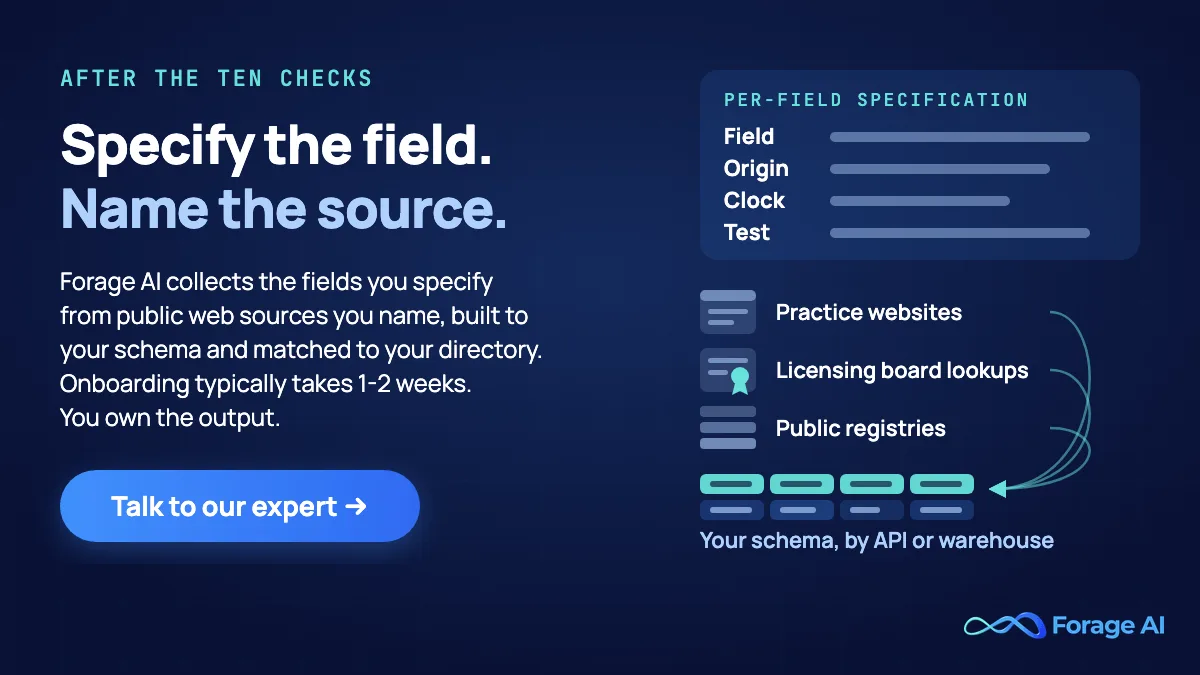
Where a field's only fresh origin is a public web source (practice websites, licensing board lookups, public registries), Forage AI builds and runs provider data extraction for the fields you specify, from sources you name, to your schema, with custom provider directory matching. You own the output, delivered as CSV, JSON or XML, by API or to your warehouse. It is not a pre-built provider file or dataset, directory platform or verification service; verification under CMS rules stays with the plan.
Choose Forage AI if you need specified fields collected fresh from public sources you name and matched to your directory.
Choose a licensed provider directory file if a vendor's existing coverage, refresh and per-field verification method already meet your specification.
Frequently asked questions
What are the CMS provider directory requirements?
Medicare Advantage plans report directory changes within 30 days of becoming aware, and their Provider Directory API carries names, addresses, phone numbers and specialties. Medicaid lists nine elements on a 30-day clock. CMS-4214-P is proposed, not final.
How often must provider directory data be verified?
Commercial plans verify at least every 90 days and update within 2 business days of a provider's submission. CMS's proposed rule would have Medicare Advantage plans verify practitioners every 90 days and facilities every 12 months.
What is the Provider Directory API, and is Plan-Net required?
Medicare Advantage, Medicaid and CHIP plans must offer one with names, addresses, phone numbers and specialties. Plan-Net is the HL7 guide CMS encourages. The API follows the directory's 30-day clock, so it is no more current than a file.
How often is the NPPES data dissemination file updated?
CMS publishes a monthly full file, weekly incrementals (which CMS says include newly deactivated NPIs) and a monthly deactivation file. Only Version 2 has been supported since 3 March 2026.
Related articles
- US Healthcare Provider Data Sources: every public provider data source, ranked by coverage and freshness.
- NPI Data Tools: what NPI datasets and APIs contain.
- Provider Data Management vs Master Data Management: which layer fixes which kind of directory error.
- Healthcare Data Extraction Guide: the practical challenges of pulling health data from public sources.
Sai is a data infrastructure enthusiast who has spent the past two to three years following the AI space closely, from the infrastructure layer to the fast-growing world of data for AI. He is genuinely curious about how modern data pipelines get built and where the data industry is heading, and he writes insightful pieces on the core topics that shape this niche.