
AI-Powered Document Processing: Trends, Challenges, and How to Evaluate Solutions (2026)
Roughly 40% of agentic AI projects are forecast to be canceled by the end of 2027, and the usual cause is cost, unclear value, or weak risk controls, not model quality (Gartner, 2025). That single number reframes the entire AI-powered document processing conversation. The hard part is no longer the accuracy of the model on a clean test set. It is whether the system holds up on your messiest documents, knows when it is unsure, and plugs into the workflow on the other side.
The category is large and growing. The intelligent document processing market is forecast to expand from roughly $4.3 billion in 2026 to $43.9 billion by 2034, a 33.7% compound annual growth rate (Precedence Research, 2025). Independent analysts size the dedicated software market more conservatively, but every methodology points the same direction: up and to the right.
This guide is built for the team doing the evaluation. It covers what AI-powered document processing actually is, the trends moving the category in 2026, the benefits the data supports, the challenges that sink projects, the security and compliance bar, and a repeatable way to evaluate solutions before you sign.
Quick Digest
- What it is: AI-powered document processing stacks LLMs, vision-language models, RAG, and agents on top of OCR, moving from character capture to document understanding at 99%+ accuracy versus a roughly 60% OCR baseline on complex content.
- 2026 trends: the shift is toward agentic processing, with 67% of enterprises evaluating agentic approaches, up from 23% two years earlier, while GenAI commoditizes raw extraction and IDP expands into the front office.
- The benefits: the data supports materially lower error rates than OCR-only pipelines, 95%+ straight-through processing at the top end, faster cycle times, and analytics-ready structured data.
- The challenges: silent table errors, accuracy on handwriting and variable layouts, agent reliability, and integration, the reason most underperforming projects miss their ROI.
- Security and compliance: the EU AI Act made human oversight and retained audit logs procurement requirements, not features.
What Is AI-Powered Document Processing?
AI-powered document processing is intelligent document processing built on generative and agentic AI rather than templates. Where traditional OCR converts an image to characters and rule-based automation reads fixed zones, the modern stack interprets meaning, structure, and relationships. It layers large language models for context, vision-language models for layout, retrieval-augmented generation for cross-referencing, and agentic AI for autonomous classification, validation, and routing.
Expert Insights
The technology stack is converging, which changes where value sits. Generative and agentic AI is “becoming an equalizer that challenges vendors’ ability to differentiate,” per Boris Evelson, VP and Principal Analyst at Forrester, in the firm’s 2025 analysis of the IDP market. When extraction accuracy is table stakes, the differentiator moves to workflow, governance, and accuracy on the edge cases the model gets wrong.
The accuracy gap is the cleanest way to see the difference. Industry benchmarks place best-in-class IDP at 99% or higher extraction accuracy, while OCR on complex or handwritten content drops to roughly 60%. That matters because an estimated 80 to 90% of new enterprise data is unstructured (Gartner), the exact material fixed-field extraction was never built to read.
| Capability | Traditional OCR | RPA-based IDP | AI-powered IDP |
|---|---|---|---|
| Accuracy on complex docs | ~60 to 80% | ~90% | 99%+ with AI plus human review |
| Variable layouts | No | Limited (templates) | Yes (classification + context) |
| Tables and handwriting | Weak | Limited | Strong (vision-language models) |
| Confidence scoring | No | Rare | Per-field, routed to review |
| Real-time adaptation | No | No | Yes (agents + RAG) |
Source: industry analyses, 2026. The pattern across the table is consistent. Each column adds a layer the prior one lacked, and the jump from rules to AI is the jump from reading characters to understanding documents.
The 2026 Trends Reshaping Document Processing
Six shifts are moving the category, and most of them are measurable rather than speculative.
1. Agentic processing is going mainstream
67% of enterprises are evaluating agentic approaches to document processing, up from 23% two years earlier (Gartner). Agents move IDP from passive extraction to an autonomous classify-validate-route loop: they identify the document, pull the fields, check them against business rules, flag low-confidence cases, and push clean data downstream. The better systems also self-correct, reprocessing a page when a validation rule fails rather than passing the error through.
2. GenAI is commoditizing raw extraction
Multimodal models now collapse multi-step pipelines into a single inference call. When any capable model can hit high accuracy on a clean document, raw extraction stops being a differentiator and the advantage moves up the stack to workflow design, governance, and accuracy on the messy edge cases. That is the structural reason the buying criteria have shifted.
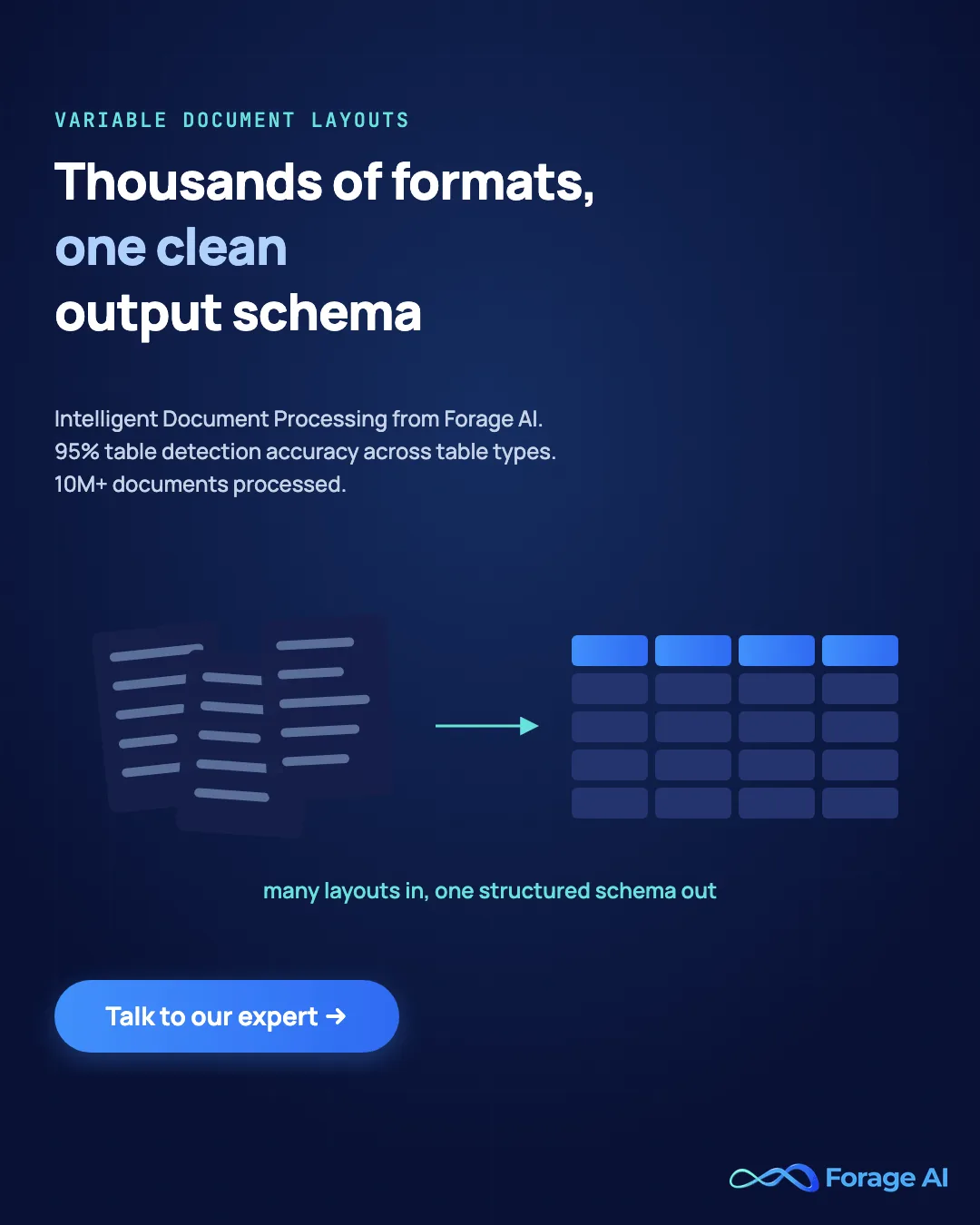
3. Vision-language models close the layout gap
Vision-language models read a document the way a person does, combining the text with its visual structure. That is what makes modern invoice automation viable for finance teams handling thousands of supplier formats, and the same parsing underpins claims processing automation for insurers working through mixed-format submissions, medical records, and adjuster notes.
4. IDP is moving into the front office
The early wins were back-office: accounts payable, records management. The current expansion is front-office, into HR onboarding, contract review, and customer KYC, where document turnaround directly affects revenue and customer experience. The faster a bank can clear onboarding documents, the fewer applicants it loses mid-process.
5. Governance has become a feature, not an afterthought
The EU AI Act’s general-purpose rules took effect in August 2025, with high-risk-system obligations due August 2026. Audit trails, human oversight, and explainability moved from optional to required, and vendors now compete on governance posture rather than treating it as compliance overhead.
6. The benchmark is shifting from accuracy to reliability
As headline accuracy converges across vendors, buyers are re-weighting their scorecards toward reliability at the edge: how the system handles the worst 5% of documents, whether it flags uncertainty, and how cleanly it integrates. The winning metric is no longer “how accurate on average,” it is “how predictable on the hard cases.”
Stat to know
Task-specific AI agents are forecast to appear in 40% of enterprise applications by the end of 2026, up from under 5% in 2025, the clearest signal that agentic document processing is moving from pilot to production. Source: Gartner, 2025.
The Benefits the Data Actually Supports
The case for AI-powered document processing rests on measured outcomes. Six benefits show up consistently across deployments.
- Materially lower error rates. Moving from OCR-only pipelines to AI-powered extraction with human review cuts error rates substantially, because the system validates fields against business rules instead of passing raw text downstream.
- Higher straight-through processing. Top-performing platforms reach 95%+ straight-through processing, where documents flow from intake to output with no human intervention, freeing the team to handle only the genuine exceptions.
- Faster cycle times. Documented deployments report turnaround on high-volume workflows dropping from days to hours, which compounds across thousands of documents a month.
- Lower cost per document at scale. Automating the bulk of extraction shifts the team from data entry to exception handling, and the unit cost falls as volume rises rather than scaling linearly with headcount.
- Analytics-ready structured data. Clean extraction turns documents trapped in PDFs and emails into data that feeds forecasting, risk, and compliance systems. The output is an asset, not just a processed file.
- Front-office acceleration. Faster onboarding, contract, and KYC turnaround reduces drop-off and improves customer experience, which moves the benefit from cost savings into revenue protection.
Expert Insights
Accounts payable offers the clearest public benchmark for cost per document. Ardent Partners’ Accounts Payable Metrics that Matter in 2025 puts the average cost to process a single invoice at $9.40, with Best-in-Class teams at $2.78 against $12.88 for all others, and touchless processing at 49.2% for Best-in-Class versus 23.4% for everyone else (Ardent Partners, 2025). The distance between those two groups is roughly the size of the prize that higher straight-through processing and lower unit cost represent.
The benefit is real, but it is conditional. The same analyst data that shows accelerating adoption also shows that the outcome depends on execution, which is the subject of the next section.
Which Challenges Sink Document Processing Projects?
The failure modes are specific, and most of them are invisible until production. Seven challenges account for the majority of underperforming deployments.
Expert Insights
The maturity gap is wider than the marketing suggests. MIT NANDA’s 2025 report, The GenAI Divide, found that 95 percent of enterprise organizations had gotten zero return from their AI efforts, and that generic tools “fail in critical workflows due to lack of memory and customization” (MIT NANDA, 2025). The implication for buyers is to anchor the project to a specific, measurable failure in the current workflow rather than to the capability of the model.
- Silent table errors. A large share of enterprise data, commonly cited at 40 to 60%, lives in tables, and multi-page tables remain a frequent failure point. The dangerous errors pass through looking correct, then break a reconciliation weeks later. Table-level accuracy on your own documents predicts this, not character accuracy.
- Accuracy on the edge. Cloud services still vary widely on cursive handwriting, low-quality scans, and multilingual text, ranging from roughly 60% to high-80% accuracy. Aggregate accuracy numbers hide the outliers that actually break pipelines. Once a multilingual document is extracted accurately, a tool like Lara Translate can help turn that content into a shared working language for teams who don't read the source document.
- The silent-degradation pattern. A system can work in testing and early production, then quietly degrade as new vendor formats and edge cases accumulate. Each adds a small failure rate that compounds, and because nothing throws an error, the decline is invisible until a downstream report is wrong.
- Human review never fully disappears. Even optimized pipelines route a meaningful share of documents to human review, and at extreme volume that review queue can itself become the bottleneck. Designing the exception path is as important as the extraction model.
- Agent reliability. Gartner expects more than 40% of agentic AI projects to be canceled by the end of 2027 over cost, unclear value, or weak risk controls. Autonomy is only an asset when the system flags what it cannot do rather than guessing.
- Integration, not the model. The model is rarely the bottleneck. Most underperforming projects fail on integration: the output does not flow cleanly into downstream document workflows, or the exception path was never built.
- Compliance exposure. In regulated workflows, a single misread field can mean a fine, a rejected claim, or an audit finding. The cost of a silent error is not the correction; it is the downstream consequence.
Stat to know
More than 40% of agentic AI projects are forecast to be canceled by the end of 2027, over cost, unclear value, or inadequate risk controls, a caution that applies directly to autonomous document processing. Source: Gartner, 2025.
Security, Compliance, and Agent Governance
Security and compliance are no longer a procurement footnote; as of 2025 they are a gate. The EU AI Act’s general-purpose obligations took effect in August 2025, with high-risk-system compliance due August 2, 2026. Article 14 mandates effective human oversight, and deployers must retain automated logs for at least six months. For document workflows, that converts human-in-the-loop and audit trails from nice-to-have features into requirements.
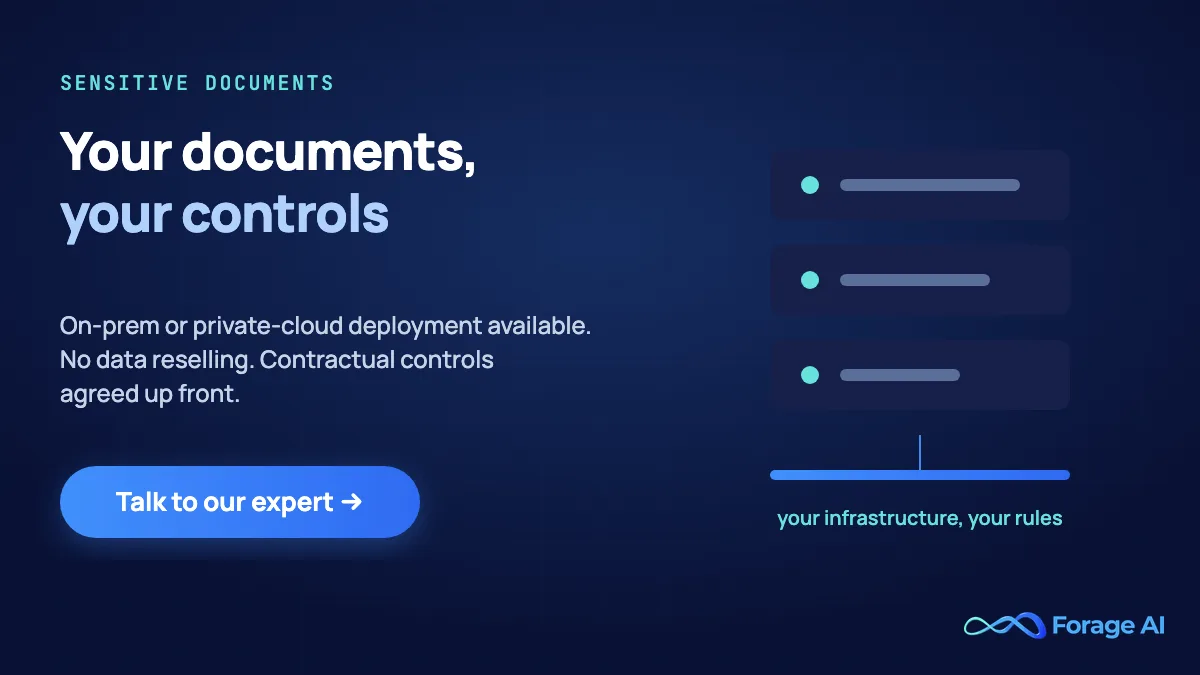
Three controls separate enterprise-grade systems from demos. The first is data governance, meaning SOC 2, GDPR, and HIPAA posture, encryption, and on-premise or private-cloud options for regulated data. The second is traceability, meaning per-field confidence scores, audit logs, and the ability to show why a given extraction was flagged. The third is agent governance, meaning bounded autonomy where the system escalates low-confidence cases rather than guessing. As agents take on more of the workflow, the question is not how much they automate, but how reliably they hand off what they should not.
Top AI-Powered Document Processing Providers, Ranked by AI Capability
These are the providers where AI and agentic workflows are a core capability, not a bolt-on, ordered by the depth of their AI and agentic feature set. Forage AI leads on managed, agentic extraction with human validation. Use the table to shortlist, then run each candidate through the evaluation criteria that follow.
| Provider | AI and agentic capabilities | Best for |
|---|---|---|
| Forage AI | Agentic Unstructured Document Extraction Agent, Human+AI 200% QA, 95% table detection, LLM-agnostic with RAG | Managed extraction on complex, variable, high-volume documents |
| Microsoft Azure AI Document Intelligence | GenAI prebuilt and custom extraction models, surfaced in Azure AI Foundry | Azure-aligned teams wanting API-first extraction |
| Google Document AI | Gemini-powered Layout Parser for RAG, custom extractors fine-tuned on a handful of documents | Google Cloud teams building custom pipelines |
| AWS Intelligent Document Processing | Amazon Textract plus Bedrock foundation models, agentic accelerator with built-in human review | AWS-native teams composing extraction with GenAI |
| UiPath IXP | Generative “Helix” extractor and agentic looping, native to UiPath agents | Teams standardized on UiPath automation |
| Hyperscience (Hypercell) | NVIDIA Nemotron reasoning plus Gemini inference layering, high automation rates | Large, regulated, high-volume enterprises |
| Nanonets | Agentic, auditable workflows with low-confidence flagging | Teams wanting agentic automation with auditability |
| ABBYY Vantage | GenAI extraction via Azure OpenAI across 150+ document skills | Multilingual and handwritten OCR, on-prem deployment |
How Should You Evaluate AI-Powered Document Processing Solutions?
Score every candidate on the same criteria, weighted by your own failure profile. The decisive column is table-extraction accuracy on your documents, not a vendor demo set. The criteria below separate systems that survive production from systems that pass a demo.
| Criterion | What to test | Red flag |
|---|---|---|
| Table-extraction accuracy | Merged cells, multi-level headers, borderless and multi-page tables on your own documents | A single “99% accuracy” with no document-type breakdown |
| Variable-format handling | A layout the system has never seen, no new template | A new template required per format |
| Confidence transparency | Per-field scores you can see and tune | Opaque scoring, no thresholds |
| Human-in-the-loop design | What share routes to review, how fast the queue clears | High accuracy claim with no exception path |
| Agent reliability | Whether agents escalate low-confidence cases instead of guessing | Full autonomy with no confidence gating |
| Compliance and governance | SOC 2, GDPR, HIPAA, audit logs, deployment options | No audit trail or compliance documentation |
| Integration and total cost | Direct ERP, CRM, API delivery; full cost including review labor | Output that needs manual reformatting |
The discipline that makes this work is a proof of concept run on your worst documents, not a clean sample. Measure field-level and table-level accuracy by document type, test the exception path, and price the real total cost including integration and review labor. A platform that looks flawless on curated documents but has no clear human-review path is the profile that gets written off a year later.
The market itself is signaling caution on autonomy. “Most agentic AI projects right now are early stage experiments or proof of concepts that are mostly driven by hype and are often misapplied,” notes Anushree Verma, Senior Director Analyst at Gartner (Gartner, 2025). For an evaluation, that means demanding visibility into how a system handles uncertainty, the low-confidence and edge cases, rather than how it performs on the easy ones.
Should Enterprises Build, Buy, or Manage?
The decision reduces to how much of the pipeline a team wants to own. Engineering-rich organizations inside a single cloud can compose APIs and build the surrounding workflow. Teams that want a turnkey platform can buy one. Teams that want outcomes without operating a pipeline are better served by a managed partner, where the integration risk, the usual reason projects miss ROI, gets absorbed by the vendor rather than the buyer.
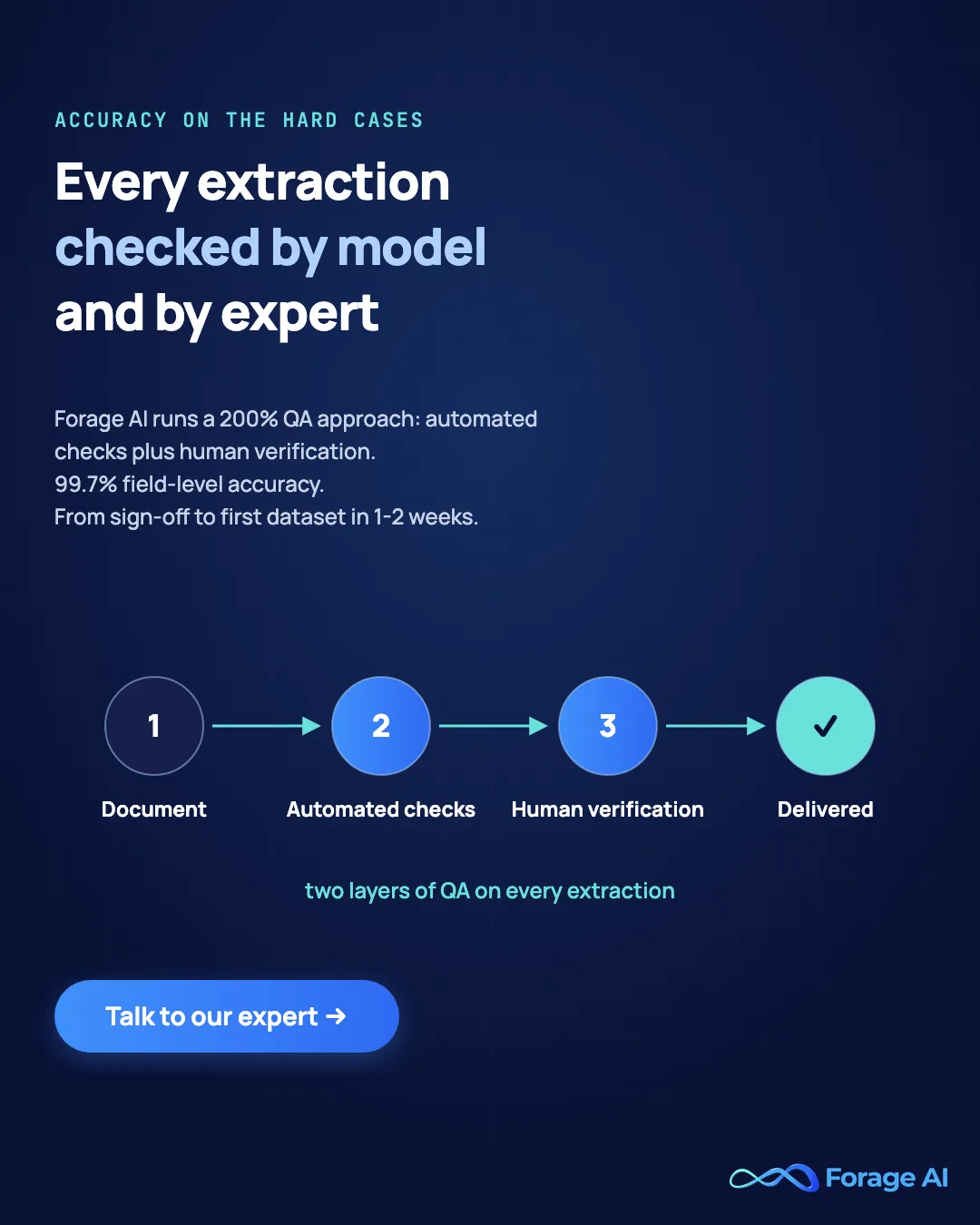
Forage AI sits in that managed category. It runs document extraction as a service, combining in-house ML models with an agentic Unstructured Document Extraction Agent that adapts to new document types at over five times the processing speed, a Human+AI 200% QA process where every extraction is validated and then reviewed by a human expert, and 95% table detection across all table types. It is LLM-agnostic, supports retrieval-augmented generation, and keeps audit trails, with no data reselling and on-premise or private-cloud deployment available. For teams whose constraint is integration and edge-case accuracy rather than raw model access, the managed model removes the operational burden while holding the accuracy line.
Frequently Asked Questions
What is the difference between OCR and AI-powered document processing?
OCR converts images of text into machine-readable characters. AI-powered document processing adds the layers above that, including large language models, vision-language models, RAG, confidence scoring, and agents, so the system understands what a document means and flags what it is unsure about. On complex content, AI-powered IDP runs at 99%+ accuracy where OCR falls to around 60%.
How accurate is AI-powered document processing?
Best-in-class platforms reach 99% or higher extraction accuracy and cut error rates substantially versus OCR-only pipelines. The number that matters for your use case is table-level and field-level accuracy on your own documents, not a blended headline figure, since tables and handwriting are where most systems lose accuracy.
Do AI document processing agents still need human oversight?
Yes. Even optimized pipelines route a share of documents to human review, and the EU AI Act now requires effective human oversight for high-risk systems. The right design is bounded autonomy, where agents handle confident cases and escalate low-confidence ones rather than guessing.
Why do AI document processing projects fail?
Most failures trace to integration rather than the model. Underperforming implementations usually stumble because the output does not flow cleanly into downstream systems or because the exception path was never designed. Diagnosing the specific workflow failure before buying is the single best predictor of success.
Is AI-powered document processing secure for sensitive data?
It can be, when the platform carries SOC 2, GDPR, and HIPAA posture, offers encryption and on-premise or private-cloud deployment, and maintains audit trails. For regulated data, treat compliance certifications and retained logs as baseline requirements, not optional add-ons.
The Real Question
The model is no longer the variable that decides outcomes. With extraction accuracy commoditizing and agents moving into 40% of enterprise applications by year-end, the systems that win are the ones that know when they are wrong, prove what they did, and integrate cleanly into the workflow on the other side. The projects that miss their ROI are not losing on model quality. They are losing on integration, edge-case accuracy, and governance.
Evaluate on your worst documents, weight table accuracy and the exception path above the headline number, and decide build, buy, or manage based on who should carry the integration risk. If you want to see how a managed, agentic approach handles your toughest documents, talk to the Forage AI team about a scoped pilot.