
RAG as a Service in 2026: Top 15 Platforms Compared
Vectara, the loudest pure-play in RAG as a service, now starts at $100,000 a year (vendor pricing page, accessed July 2026). Graphlit, a funded platform still listed as a live option on ranking pages, closes its free-account data exports on August 1, 2026. And the highest-rated product in the category, 4.7 on G2 with 140 reviews, is not a developer RAG platform at all. It is an employee-facing assistant. Three data points, one market: young, consolidating fast, and hard to read from vendor-written lists, because every list that ranks also crowns its own author.
This is a list of platforms you subscribe to: not dev agencies you hire, not RAG evaluation tools, not bare vector databases.
By the end you will know all fifteen credible platforms, which band fits your situation, which review numbers mean something, and the one ceiling no platform can lift.
One more thing before the list: nobody on it is us. Forage AI does not sell RAG as a service. We build the data layer that feeds platforms like these, which is why this list has no self-entry and no horse in the race. More on that near the end.
Quick Digest
- The 15 at a glance: one master matrix maps all fifteen credible platforms by pricing model, typed review signal, best-for, and honest watch-out, as of July 2026.
- The four bands: the market is four different purchases: managed end-to-end platforms, hyperscaler building blocks, dev-first components, and turnkey employee assistants.
- The five-question router: corpus sources, engineering capacity, cloud estate, compliance posture, and end-user type route you to a band.
- Band 1, managed pure-plays: Vectara now starts at $100K/year, Ragie publishes $100 to $500/month tiers, Progress Agentic RAG is mid-rebrand, CustomGPT.ai is the no-code option, SciPhi/R2R the open-source one.
- Band 2, hyperscalers: Bedrock Knowledge Bases, Azure AI Search with Foundry, and Vertex RAG Engine count as managed RAG; none has a review corpus for the RAG feature itself.
The 15 RAG-as-a-Service Platforms at a Glance
Fifteen platforms clear this article’s evidence bar, across four bands, with entry pricing from $0 developer tiers to $500,000 a year on-premises, as of July 2026. The matrix is a map, not a leaderboard: no ranks, no winner, no self-entry.
The 15 platforms at a glance
| Platform | Band | Pricing model + entry point (as of Jul 2026) | Review signal (typed, with n) | Best for | Honest watch-out |
|---|---|---|---|---|---|
| Band 1: Managed end-to-end RaaS | |||||
| Vectara | 1 | Annual platform fee; SaaS from $100K/yr | Ecosystem signal (HHEM leaderboard); no aggregated review base | Accuracy-critical, regulated enterprises | $100K/yr entry; minimal independent reviews |
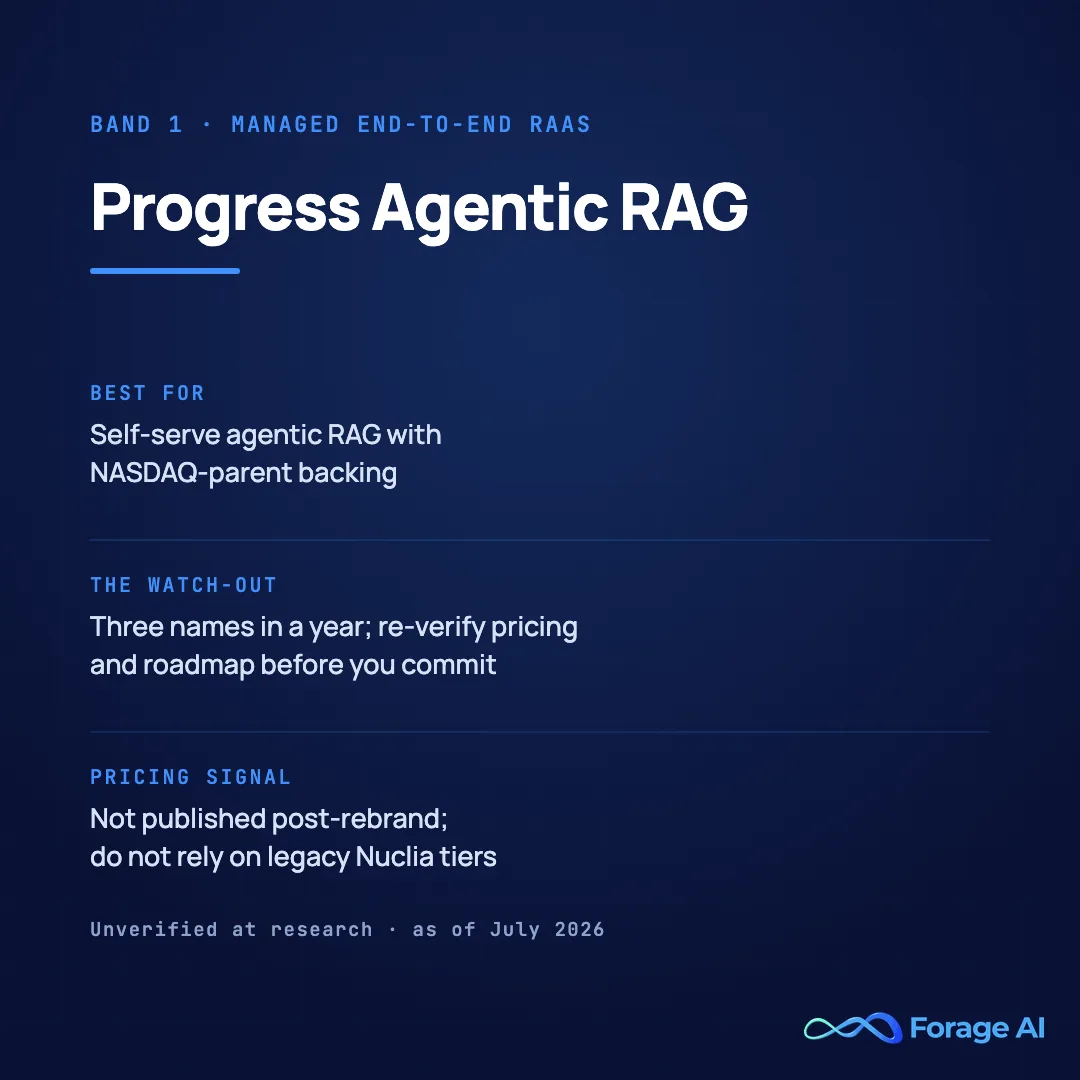
| Progress Agentic RAG (ex-Nuclia) | 1 | Not published post-rebrand (unverified) | No aggregated review base under new name | Self-serve agentic RAG, NASDAQ-parent backing | Three names in a year; re-verify pricing and roadmap |
| Ragie | 1 | Flat + per-page; free dev tier, Starter $100/mo | No aggregated review base (founded 2024) | Developers who want published self-serve pricing | Seed-stage vendor; page metering scales with volume |
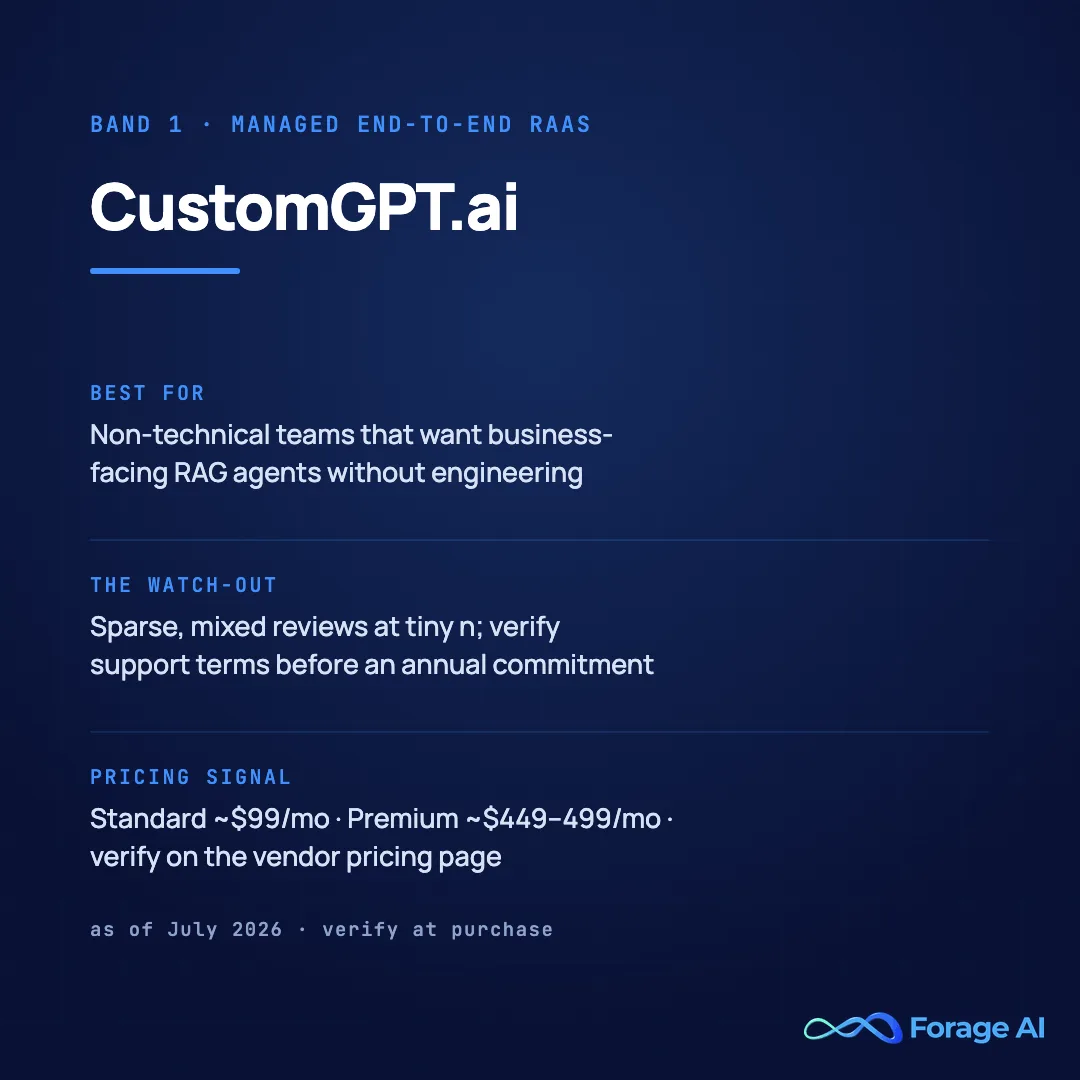
| CustomGPT.ai | 1 | Flat; Standard ~$99/mo (verify at purchase) | Anecdote: Capterra 3.3 (n=3), Product Hunt 3.6 (n=5) | No-code business-facing RAG agents | Sparse, mixed reviews at tiny n |
| SciPhi / R2R | 1 | Open source (MIT); managed free tier | Ecosystem signal (GitHub adoption); no review base | Open-source control with a managed path | Small company; self-hosting means you own ops |
| Band 2: Hyperscaler building blocks | |||||
| AWS Bedrock Knowledge Bases | 2 | Consumption across AWS services; no platform fee | Parent-platform rating only; see entry | Teams standardized on AWS | Customization ceiling; cost spread across services |
| Azure AI Search + AI Foundry | 2 | Consumption on search units + tiers | Parent: G2 4.4 (n=31; rates AI Search) | Microsoft-estate enterprises | You assemble three products; steep free-to-paid jump |
| Vertex AI RAG Engine | 2 | Usage-based GCP metering | Parent: G2 4.3 (n≈594; rates all of Vertex) | GCP-native, Gemini-first teams | Product mid-rename; pricing complexity |
| Band 3: Dev-first APIs and component-plus | |||||
| Pinecone Assistant | 3 | Token-metered; published rates | Parent: G2 4.6 (n=39; rates the vector DB) | Teams already on Pinecone | Assistant itself unreviewed; ownership moved in 2025 |
| LlamaCloud (LlamaIndex) | 3 | Credits; $1.25 per 1,000, 10K free/mo | Ecosystem signal (OSS community); no review base | Document-heavy, parsing-first RAG | Credit burn varies 1–45x per page |
| Cohere (Command APIs + North) | 3 | APIs per-token; North enterprise-quoted | No aggregated review base (zero G2 reviews) | Regulated, air-gapped deployments | No customer reviews; benchmarks are internal |
| Elastic (ESRE) | 3 | Elastic Cloud tiers, hourly-metered | Parent: G2 seller 4.4 (n=525; all Elastic products) | Existing Elasticsearch estates | Retrieval layer only; ops burden |
| Databricks (Mosaic AI) | 3 | Consumption (DBUs) on top of cloud infra | Parent: G2 4.6 (n=657; whole platform) | Data already governed in Databricks | Ecosystem lock-in is the premise; DBU forecasting |
| Band 4: Turnkey enterprise assistants | |||||
| Glean | 4 | Seat-priced, enterprise-quoted | Aggregated: G2 4.7 (n=140; the product itself) | Employee-facing assistant over company knowledge | A different job than developer RaaS; price |
| Contextual AI | 4 | Enterprise-only; no public pricing | No aggregated review base | Hard accuracy needs; tuned retriever + generator | All social proof is vendor-published |
Sources: vendor pricing pages and review platforms (G2, Capterra, Product Hunt), accessed July 23, 2026. Prices are entry points, not total cost of ownership. Re-verify before purchase; this category repriced, renamed, and lost two members inside twelve months.
Two disciplines make this table readable. Every review-signal cell is typed (aggregated, anecdote, vendor-claimed, ecosystem, or none found) and carries its n, because in this category most of the roster has no meaningful n at all. And every pricing cell states the model, because a flat tier, a page meter, a token meter, a consumption bill, and a seat quote are not comparable as raw numbers.
What the matrix shows in one glance: the four bands are four different purchases, with a price spread from $0 to $500K a year. That is why “which is best” is the wrong question, and “which band fits your situation” is the one the router below answers.
Parent-platform ratings are not RAG-feature ratings. Amazon Bedrock, Azure AI Search, Vertex AI, Elastic, Databricks, and Pinecone all carry healthy review bases, for the parent platform. Not one of them has a separate review corpus for its RAG feature. Every such number in this table is labeled with what it actually rates.
The highest rating in the column, Glean’s 4.7, belongs to a different kind of product than the head term implies; the band label prevents the misread.
What Is RAG as a Service?
The matrix names the market; the definition draws its boundaries. RAG as a service is the retrieval-and-generation pipeline (ingest, chunk and embed, retrieve, generate, ground and cite) delivered as a subscription instead of built in-house. That is the definition; our explainer on how retrieval augmented generation works covers the mechanics. This article spends its words on the buying decision.
The market sells that pipeline four ways, and the four bands structure everything below:
| Band | What you buy | Who it fits | Entry pricing shape |
|---|---|---|---|
| 1. Managed end-to-end RaaS | The full pipeline as an API you build your app on | Teams that want production RAG without building the pipeline | Free dev tiers to $100K+/yr platform fees |
| 2. Hyperscaler building blocks | Managed RAG primitives inside a cloud you already pay | Single-cloud shops with procurement gravity | Usage-metered, no platform fee |
| 3. Dev-first APIs / component-plus | Components that grew a managed RAG layer | Engineering teams that want control without full DIY | Published usage pricing (tokens, credits, tiers) |
| 4. Turnkey enterprise assistants | A finished assistant your employees open | Orgs that want employees searching knowledge now | Seat-priced, enterprise-quoted |
Band taxonomy: this article’s analysis of the July 2026 market; exemplars in the roster sections below.
The bands differ on who owns what: the pipeline (Band 1’s provider), the cloud primitives (you, in Band 2), the app layer (yours in Bands 1 through 3), or nothing at all (Band 4 is a finished product). The market is consolidating while you read this: Progress Software (NASDAQ: PRGS) acquired Nuclia, announced June 30, 2025, and relaunched it as Progress Agentic RAG on September 10, 2025 (Progress investor relations). A public company bought its way into Band 1 inside a year.
Three boundary lines keep the category honest. A framework (LangChain, Haystack, RAGFlow) is code you run, not a service you subscribe to. A vector database is a component, not a pipeline. And a dev agency that builds RAG for you is a hiring decision, not a platform subscription. The fourth band exists because a seat-priced assistant is a categorically different purchase from a developer API, and gluing them together, as most ranking pages do, is how buyers end up comparing Glean against Ragie.
One caution that seeds the second half of this article: buying a platform does not buy you out of data preparation. One implementation firm’s published estimate puts content preparation, testing, and integration at two to four weeks of a typical rollout, and that is the part no platform absorbs for you.
How Do You Choose a RAG-as-a-Service Provider?
Five situational questions route you to the right band faster than any feature matrix, because the matrices on this SERP compare features while buyers differ by situation. Answer these before you read a single entry.
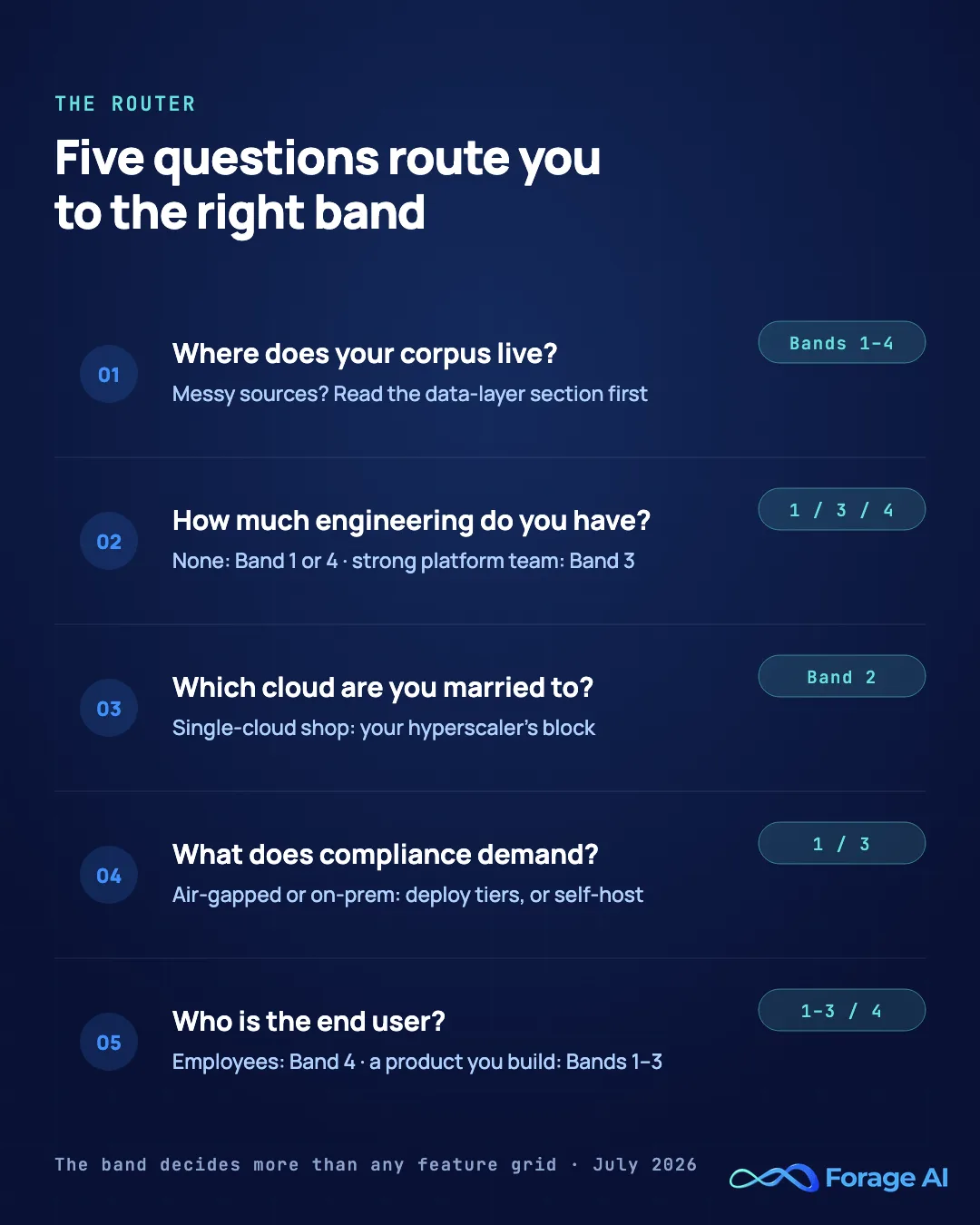
| Question | If your answer is… | Start in band |
|---|---|---|
| 1. Where does your corpus live, and how messy is it? | Internal SaaS docs → any band; public web, portals, PDFs, scans → read the data-layer section first | 1–4 (+ data layer) |
| 2. How much in-house engineering do you have? | None → Band 1 or 4; a strong platform team → Band 3 | 1 / 3 / 4 |
| 3. Which cloud are you married to? | Single-cloud shop with procurement gravity → your hyperscaler’s block | 2 |
| 4. What does your compliance posture demand? | Air-gapped or on-prem → the Cohere / Vectara deployment tiers, or self-host | 1 / 3 |
| 5. Who is the end user? | Employees searching knowledge → Band 4; a product you are building → Bands 1–3 | 1–3 / 4 |
Router: this article’s analysis, July 2026. The band decides more than any feature grid.
The cost question is answered by the pricing model, not a number. The honest spread as of July 2026: flat self-serve tiers at $100 to $500 a month, per-page and per-credit metering where you should model the overage math before committing, consumption metering spread across multiple cloud services where forecasting is the hard part, six-figure annual platform entry at $100K+ a year, and seat-priced enterprise quotes. Entry points, all of them. None is a TCO.
Question 5 carries a lock-in corollary. Ask every vendor what leaving looks like. Re-ingesting, re-chunking, and re-embedding a corpus into the next platform is the real switching cost, and a portable, well-structured corpus is the hedge; the data-layer section returns to this. If your real question is architecture rather than vendor, the fine-tuning versus RAG guide covers that decision.
Build versus buy runs both directions. Buy when the pipeline is not your product and engineering time is the constraint. Build, or go to the component band, when you have unusual data, deep existing infrastructure, or cost-at-scale concerns. The pilot-failure statistics circulating around this decision are vendor-relayed; this article does not repeat numbers it could not trace to a primary source.
Two honest notes before the roster. Benchmarks rarely predict results; RAG quality is corpus-specific, so evaluation on your corpus beats any leaderboard. And EU AI Act obligations phase in through August 2026, which makes deployment posture (question 4) a procurement question. One implementation firm’s estimate puts content preparation, testing, and integration at two to four weeks of a rollout, quiet evidence that data preparation, not platform setup, is the long pole.
Band 1: Managed End-to-End RaaS Platforms
Band 1 is the head-term answer: upload or connect your data, get a retrieval and generation API to build on, and the provider owns the pipeline. The trade is convenience and speed against platform dependence and, at the top end, six-figure entry pricing. Buyer signal: “we want production RAG without building the pipeline.”
1. Vectara
| Attribute | Detail |
|---|---|
| What it is | End-to-end grounded RAG platform (Boomerang retrieval, Mockingbird RAG-tuned LLM) with hallucination measurement built in |
| Best for | Enterprises in regulated, accuracy-critical domains with six-figure platform budget |
| Standout capability | Hallucination measurement: the HHEM evaluation model and the widely-cited LLM Hallucination Leaderboard |
| Pricing (as of July 2026) | SaaS from $100K/yr · VPC from $250K/yr · on-prem from $500K/yr; 30-day free trial (vendor pricing page, fetched 2026-07-23) |
| Deployment | SaaS / VPC / on-premises |
| Watch-out | $100K/yr entry; almost no independent review corpus to check vendor claims against |
| Attribute | Detail |
|---|---|
| Signal type | Ecosystem signal (HHEM leaderboard citation density) + vendor-published case studies (vendor-claimed) |
| Rating (with n, accessed 2026-07-23) | No aggregated review base worth publishing; public review data is minimal |
| What the rating actually rates | n/a; no meaningful review corpus exists for the product |
| What users praise | End-to-end pipeline without assembling components (editorial roundups, 2025–2026); hallucination-leaderboard credibility (dev discourse, ongoing) |
| What users flag | Enterprise-only pricing locks out prototyping developers (structural, 2026); vendor benchmarks carry the trust story (structural) |
| Source | Vendor pricing page (fetched 2026-07-23); developer-community discourse; vendor case studies as claims |
Founded in 2020 by Amr Awadallah (a Cloudera co-founder) and team, with a $25M Series A in July 2024 (BusinessWire), Vectara is the most vocal pure-play in the category, and its trust anchor is unusual: not reviews but the HHEM hallucination-evaluation model and the public LLM Hallucination Leaderboard, both genuinely and widely cited in developer discourse. The product is an opinionated end-to-end stack: Boomerang retrieval, the Mockingbird RAG-tuned model, and hallucination scoring on output. Add-ons include a forward-deployed AI engineer and premium support, both signals of where the product now aims: accounts, not signups.
The decisive fact is the repricing. As of July 2026, Vectara starts at $100,000 a year for SaaS, $250,000 for VPC, and $500,000 for on-premises, with a 30-day free trial (vendor pricing page, fetched July 23, 2026). Ranking pages still describing a free or growth tier are stale; that tier is gone, and the move locks out the prototyping developer who made the brand known. Best for enterprises in regulated, accuracy-critical domains that want accountable, deployable RAG with measurement built in. The watch-out is the pair the tables state: a six-figure entry price and almost no independent review corpus to check vendor claims against. The tier structure maps to deployment posture (SaaS, then VPC, then on-premises), so your compliance requirement, not the feature list, sets the entry price. The 30-day trial is full-featured, which makes a structured bake-off on your own corpus the cheapest diligence this tier allows.
2. Progress Agentic RAG (formerly Nuclia)
| Attribute | Detail |
|---|---|
| What it is | Self-serve agentic RAG SaaS with multimodal, any-format ingestion and citation-grounded answers |
| Best for | Teams wanting self-serve agentic RAG with big-vendor backing |
| Standout capability | Citation-grounded “verifiable answers” lineage that predates the trend (Nuclia-era, from 2019) |
| Pricing (as of July 2026) | Unverified; not captured post-rebrand. Do not rely on legacy Nuclia tiers |
| Deployment | SaaS |
| Watch-out | Mid-rebrand product; pricing and roadmap now serve the Progress platform strategy |
| Attribute | Detail |
|---|---|
| Signal type | None found (as of Jul 2026) + press |
| Rating (with n, accessed 2026-07-23) | G2 listing exists under the new name with zero reviews; absence, not a low score |
| What the rating actually rates | n/a; the new name has no corpus, and legacy Nuclia sentiment is scarce and stale |
| What users praise | Genuinely self-serve posture (press framing, 2025); citation-grounded answers lineage (press, 2025) |
| What users flag | Integration-period turbulence risk post-acquisition (structural, 2025–2026); zero-review base under the new name (2026) |
| Source | Progress investor relations (June and September 2025); G2 listing state (accessed 2026-07-23) |
This entry is the category’s consolidation case study. Founded in 2019 in Barcelona, Nuclia was acquired by Progress Software (NASDAQ: PRGS) in a deal announced June 30, 2025, at an undisclosed price Progress described as immaterial, then relaunched as Progress Agentic RAG on September 10, 2025 (Progress investor relations). Three names in roughly a year, and a G2 listing under the new name with zero reviews: the reviews have not caught up with the rebrand.
What survives the churn is real. Multimodal ingestion across formats, a citation-grounded “verifiable answers” approach that predates the industry trend, a self-serve SaaS posture positioned from SMB through enterprise (vendor framing), and now a NASDAQ-listed parent, which drops the vendor viability risk relative to seed-stage peers in this band. Best for teams that want self-serve agentic RAG with big-vendor backing and grounded citations. The watch-out: this is a mid-rebrand product whose pricing was not published at research time and whose roadmap now serves the Progress platform strategy. Re-verify both before you commit; integration-period turbulence is a standard, fair caution, not an observed defect. The graveyard section’s lesson applies here in its mildest form: put pricing, roadmap commitments, and data-export terms in writing at contract time, then hold the parent to them.
3. Ragie
| Attribute | Detail |
|---|---|
| What it is | Developer-first, fully managed RAG-as-a-service API with connectors for Drive, Notion, and Confluence |
| Best for | Product and engineering teams that want managed RAG plumbing behind their own app |
| Standout capability | Advanced retrieval (hybrid, hierarchical, rerank, entity extraction, recency bias) included at every tier |
| Pricing (as of July 2026) | Free dev tier (1,000 retrievals / 1,000 pages) · Starter $100/mo (10K pages) · Pro $500/mo (60K pages); overages $0.02–0.05/page; storage $0.002/page/mo (vendor pricing page, fetched 2026-07-23) |
| Deployment | SaaS |
| Watch-out | Seed-stage 2024 vendor with no review corpus; page metering means costs scale with document volume |
| Attribute | Detail |
|---|---|
| Signal type | None found (as of Jul 2026) + press |
| Rating (with n, accessed 2026-07-23) | No aggregated review base on any major platform; absence, not a low score; the company is about two years old |
| What the rating actually rates | n/a; no corpus exists |
| What users praise | API simplicity and fast connector-to-production path (launch press, 2024); transparent self-serve pricing (vendor pricing page, 2026) |
| What users flag | Vendor viability questions natural to a seed-stage company (structural, 2026); overage math needs modeling (pricing structure, 2026) |
| Source | Vendor pricing page (fetched 2026-07-23); VentureBeat and Craft Ventures launch coverage (2024) |
Founded in 2024 by Bob Remeika and Mohammed Rafiq, with a $5.5M seed led by Craft Ventures (VentureBeat, August 2024), Ragie is the transparent-pricing exception in a quote-gated category. The tiers are published and modelable: a free developer tier with 1,000 retrievals and 1,000 pages, Starter at $100 a month for 10,000 pages, Pro at $500 a month for 60,000 pages, with overages at $0.02 to $0.05 per page (vendor pricing page, fetched July 23, 2026). Note the 2024 launch coverage described a document-count model that no longer applies; the current model is page-based. Storage is metered too, at $0.002 per page per month (vendor pricing page), a line item that stays small until the corpus is large, which is when every meter in this category stops being small.
The engineering substance holds up: hybrid search, hierarchical retrieval, reranking, entity extraction, and recency bias ship at all tiers, not as enterprise upsells, and connectors for Google Drive, Notion, and Confluence cover the standard SaaS corpus sources. Best for product teams that want managed RAG plumbing behind their own application with pricing they can put in a spreadsheet. The watch-out is twofold: a seed-stage vendor with zero review corpus, so pilots have to do the work social proof normally does, and page metering that ties cost directly to document volume. Model the overage math on your corpus before committing.
4. CustomGPT.ai
| Attribute | Detail |
|---|---|
| What it is | No-code, business-facing RAG agents (support and knowledge chatbots) with anti-hallucination, citation-grounded positioning |
| Best for | Non-technical teams that want a business-facing RAG agent without engineering |
| Standout capability | Genuinely fast no-code setup (anecdotal reviewer theme, tiny n) |
| Pricing (as of July 2026) | Standard ~$99/mo · Premium ~$449–499/mo · Enterprise custom; verify on the vendor pricing page at purchase |
| Deployment | SaaS |
| Watch-out | Sparse, mixed public reviews at tiny n; support and pricing complaints among them |
| Attribute | Detail |
|---|---|
| Signal type | Anecdote (tiny aggregated bases) + vendor-claimed case studies |
| Rating (with n, accessed 2026-07-23) | Capterra 3.3/5 (n=3) · Product Hunt 3.6/5 (n=5), both fetched directly |
| What the rating actually rates | The product itself, but at n=3 and n=5 the bases are statistically meaningless in either direction |
| What users praise | Easy setup (“took me less than a minute”, Product Hunt; date unverified) and clear documentation (Capterra; anecdotal, tiny n) |
| What users flag | Pricing versus competitors, support inflexibility, and speed/relevance complaints (Capterra and Product Hunt; anecdotal, tiny n; quote dates unverified) |
| Source | Capterra and Product Hunt (fetched directly 2026-07-23); vendor case studies as claims |
CustomGPT.ai sells the no-code end of Band 1: business-facing RAG agents for support and knowledge use cases, positioned on anti-hallucination and cited answers, with vendor-published flagship cases (MIT and Bernalillo County, attributed here as vendor claims). The vendor’s headline figures, an 86% AI resolution rate and a 4.81x ROI at Bernalillo County, are vendor-published numbers and should be weighed as claims rather than evidence. It is also the one entry where the thin review data trends negative, which demands the same fairness discipline a thin positive base would get.
The defensible reading: public review data is sparse and mixed, and the vendor publishes strong named case studies. Capterra shows 3.3/5 at n=3 and Product Hunt 3.6/5 at n=5, both fetched directly on July 23, 2026, and both as statistically meaningless as a 4.9 at n=6 would be. The praise themes (fast setup, good documentation) and the flag themes (pricing, support inflexibility, response speed) are all anecdotes at tiny n, and the Product Hunt complaints may date to an early product era. Best for non-technical teams that want a working business-facing agent without engineering time. The watch-out: verify fit on the trial economics and the support terms before an annual commitment, because the review base cannot verify it for you.
5. SciPhi / R2R
| Attribute | Detail |
|---|---|
| What it is | R2R: open-source (MIT) agentic RAG system (ingestion, hybrid search, knowledge graphs, agents, RESTful API); SciPhi is the managed-cloud path |
| Best for | Engineering teams that want open-source control with an optional managed path |
| Standout capability | Frequently described in developer roundups as the most complete open-source RAG system (editorial synthesis) |
| Pricing (as of July 2026) | Open source free (MIT); managed cloud free tier of 300 RAG requests/mo reported, verify liveness at purchase |
| Deployment | Self-hosted / managed cloud |
| Watch-out | Small company with unproven enterprise support depth; self-hosting means you own ops, upgrades, and QA |
| Attribute | Detail |
|---|---|
| Signal type | Ecosystem signal (GitHub adoption) |
| Rating (with n, accessed 2026-07-23) | No review corpus on any major platform; social proof lives on GitHub |
| What the rating actually rates | n/a; adoption signal, not a review score |
| What users praise | Completeness of the open-source stack (developer roundups, 2025–2026); self-hosting escapes every pricing meter in this roster (structural) |
| What users flag | Enterprise support depth unproven (structural, 2026); documentation and maturity complaints appear in GitHub issues (anecdotal) |
| Source | GitHub repository activity (checked 2026-07-23); developer-community editorial |
R2R is the roster’s open-source contender: an MIT-licensed agentic RAG system covering ingestion, hybrid search, knowledge graphs, and agents behind a RESTful API, actively maintained into 2026 (GitHub activity checked July 23, 2026). SciPhi offers the managed path, with a reported free tier of 300 RAG requests a month; verify that tier is live before you plan around it, because the managed shell is far thinner than the open-source core it wraps. Developer roundups repeatedly describe R2R as the most complete open-source RAG system, which is editorial synthesis rather than review data, and is labeled as such here.
The strategic appeal is control. Self-hosting escapes every pricing meter in this roster, and for hard residency requirements it may be the only Band 1 answer that fits. The MIT license is the quiet economic fact: no license fee, ever, and if the company disappears, the repository and your deployment do not. Best for engineering teams that want that control with a managed option in reserve. The watch-out is the honest inverse: a small company with unproven enterprise support depth, in the same young category where two platforms died within the last year (see the exclusions section), and an ops burden that is entirely yours when self-hosting. Pilot with an exit plan.
Quick Summary
Q: Which managed end-to-end RAG-as-a-service platforms lead in 2026?
A: Five credible pure-plays with different entry points: Vectara for accuracy-critical enterprises (now from $100K/year as of July 2026), Progress Agentic RAG for self-serve agentic RAG with NASDAQ-parent backing, Ragie for developers who want published pricing ($100 to $500/month tiers), CustomGPT.ai for no-code business agents, and SciPhi/R2R for open-source control with a managed option. Across all five, aggregated review data is thin to nonexistent, so pilots beat star ratings in this band.
Band 2: Hyperscaler Building Blocks
Band 2 is managed RAG primitives inside a cloud you already pay for: one vendor, one bill, an existing security boundary. The trade is procurement convenience and governance inheritance against deeper cloud lock-in, multi-service cost sprawl, and customization ceilings. Buyer signal: “we’re already on this cloud.” AWS’s own Prescriptive Guidance maintains a neutral documentation page on fully managed RAG options on AWS, a rare vendor-neutral orientation document in this band.
One honesty rule covers all three entries: none of the three has a per-feature review corpus for its RAG product. Every rating below belongs to the parent platform and is labeled as such. This is where the parent-ratings caution from the master matrix pays off in detail, because the parent numbers here are among the largest in the article and the easiest to misread.
6. AWS Bedrock Knowledge Bases
| Attribute | Detail |
|---|---|
| What it is | Zero-ops RAG primitive inside the AWS boundary: one API over many foundation models, S3-native, IAM/VPC governance inherited |
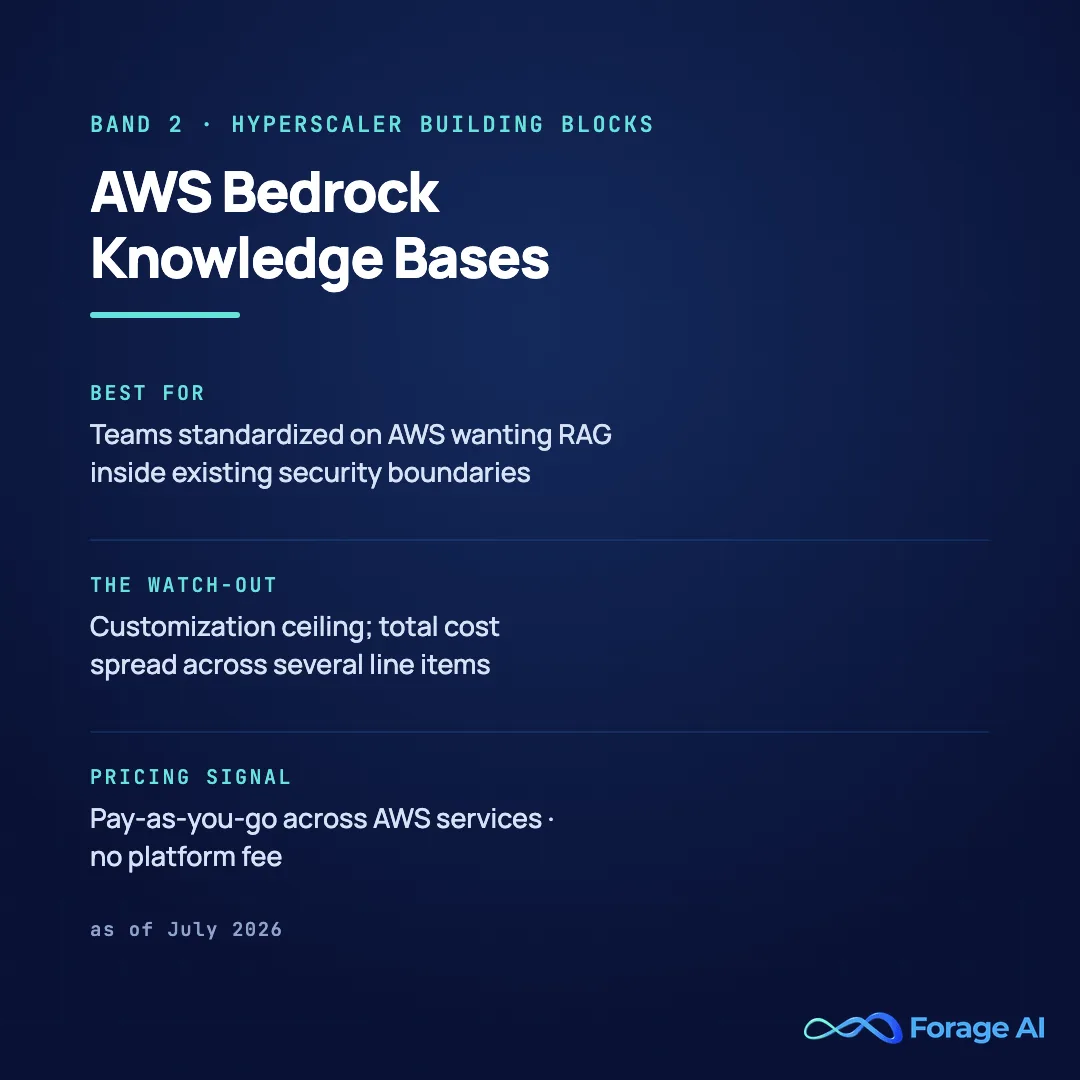
| Best for | Teams standardized on AWS wanting RAG inside existing security and billing boundaries |
| Standout capability | Fastest basic RAG stand-up inside AWS (aggregated reviewer theme, parent-level) |
| Pricing (as of July 2026) | Pay-as-you-go across Bedrock tokens + vector store + storage; no platform fee; see the AWS pricing page for current rates |
| Deployment | AWS cloud |
| Watch-out | Customization ceiling on chunking and retrieval logic; total cost lives in several line items |
| Attribute | Detail |
|---|---|
| Signal type | Aggregated review base, parent platform only |
| Rating (with n, accessed 2026-07-23) | G2 rates AWS Bedrock 4.3–4.4/5; the review count conflicts across G2 snapshots, so no count is printed here |
| What the rating actually rates | The whole Bedrock platform (model access, agents); no per-feature corpus exists for Knowledge Bases |
| What users praise | Easy basic RAG stand-up; well-integrated within AWS (aggregated parent-level themes, 2025–2026) |
| What users flag | “The managed experience can feel like a black box” for custom chunking, metadata reranking, and hybrid-search control (reviewer and editorial language, anecdotal); cost spread across services makes forecasting hard (structural) |
| Source | G2 (accessed 2026-07-23; count unresolved); practitioner editorial |
Knowledge Bases is the fastest way to stand up basic RAG inside AWS: a managed primitive that inherits IAM, VPC, and S3, and exposes one API across many foundation models. Knowledge Bases inherits the AWS compliance perimeter, which for procurement teams is often the entire argument, and reviewers rate the surrounding platform well. G2 rates AWS Bedrock at 4.3 to 4.4 out of 5, but the review count conflicts across G2 snapshots, and none of those reviews rates Knowledge Bases specifically, because no per-feature review corpus exists.
The recurring flag is the ceiling. Reviewer and practitioner language describes the managed experience as a black box once you want custom semantic chunking, metadata reranking, or hybrid-search control; getting those means bypassing the managed service and building your own orchestration. The second flag is structural: Knowledge Bases pricing is Bedrock tokens plus a vector store (OpenSearch Serverless or similar) plus storage, so the total cost lives in several line items rather than one. The single-API-over-many-models design also hedges model churn: swapping foundation models does not mean swapping vendors. Best for teams standardized on AWS that want RAG inside existing security and billing boundaries. The watch-out is the pair above: the customization ceiling, and a bill that takes real work to forecast. Run a pilot-scale month and read the bill by line item; that is the fastest honest forecast this band allows.
7. Azure AI Search + Azure AI Foundry
| Attribute | Detail |
|---|---|
| What it is | An architecture you assemble: AI Search (hybrid keyword + vector + semantic ranking) + Foundry (app and agent layer) + Azure OpenAI models |
| Best for | Microsoft-standardized enterprises building RAG in their own tenancy, especially over M365/SharePoint data |
| Standout capability | Hybrid search strength with deep Azure and M365 integration (aggregated themes) |
| Pricing (as of July 2026) | Consumption on search units + tiers; small free tier; see the Azure pricing page for current SKU rates |
| Deployment | Azure cloud |
| Watch-out | More moving parts than any pure-play; steep step from free to first paid tier |
| Attribute | Detail |
|---|---|
| Signal type | Aggregated review base, parent product only, plus one specific cost anecdote |
| Rating (with n, accessed 2026-07-23) | G2 4.4/5 (n=31) for Azure AI Search |
| What the rating actually rates | AI Search, the search service; not “Azure RAG”; Foundry’s own listing rating was not captured |
| What users praise | Hybrid search speed and capability; low management burden; Azure security integration (aggregated, 2025–2026) |
| What users flag | A TrustRadius reviewer’s estimate that the first paid tier is about 14x the comparable SQL Database full-text tier (anecdotal but specific); 16MB file-size cap and query-rate limits (anecdotal); documentation confusing for beginners (anecdotal) |
| Source | G2 (accessed 2026-07-23); TrustRadius reviewer content (anecdotal) |
One orientation line first, because Microsoft renamed both halves: Cognitive Search became AI Search, and AI Studio became AI Foundry (the Foundry rebrand landed in November 2024). What Microsoft sells for RAG is not a product but an architecture you assemble: AI Search for retrieval (hybrid keyword plus vector plus semantic ranking), Foundry for the app and agent layer with its “on your data” flows, and Azure OpenAI models for generation. Reviewers’ aggregated verdict on that hybrid retrieval stack is that it is fast and more capable than conventional search on enterprise queries.
The review signal follows the same parent-platform rule as the rest of this band, at a smaller n than either neighbor. Azure AI Search rates 4.4/5 on G2 at n=31 (accessed July 2026), and that rating covers the search service, not the assembled RAG flow. The cost anecdote worth knowing: one TrustRadius reviewer put the first paid tier at roughly 14 times the price of the first SQL Database tier that supports full-text search, an anecdotal but unusually specific data point about the free-to-paid jump. For organizations whose highest-value corpus is M365 and SharePoint content, this is the shortest path to permission-respecting retrieval over it, and the free tier is small enough that a paid pilot is the realistic evaluation unit. Best for Microsoft-standardized enterprises building RAG over their own tenancy and M365 data. The watch-out: you are assembling three Azure products, and planning around the 16MB file-size cap and query-rate limits is part of the job.
8. Google Vertex AI RAG Engine
| Attribute | Detail |
|---|---|
| What it is | Managed RAG pipeline framework on Vertex (GA early 2025); RagManagedDb or bring-your-own vector database; strongest paired with Gemini |
| Best for | GCP-native, data-science-heavy teams on Gemini-first stacks |
| Standout capability | Unified managed ML/GenAI lifecycle, the most-praised platform attribute (aggregated, parent-level) |
| Pricing (as of July 2026) | Usage-based GCP metering; no platform fee located; see Google Cloud pricing at purchase |
| Deployment | Google Cloud |
| Watch-out | The product name is in motion; the 4.3 rating belongs to all of Vertex, not this product |
| Attribute | Detail |
|---|---|
| Signal type | Aggregated review base, parent platform only |
| Rating (with n, accessed 2026-07-23) | G2 4.3/5 (n≈594) for Vertex AI |
| What the rating actually rates | The entire Vertex AI platform; RAG Engine, a ~2025 product, has no independent review base |
| What users praise | Unified managed ML and GenAI lifecycle; intuitive for common flows (aggregated, 2025–2026) |
| What users flag | Pricing complexity (“confusing and challenging to navigate for budgeting”); steep learning curve across projects, service accounts, IAM roles, networking, and quotas (aggregated) |
| Source | G2 (accessed 2026-07-23) |
RAG Engine is GCP’s managed pipeline framework, generally available since early 2025, with a managed vector store (RagManagedDb) or bring-your-own. Its strongest showing is on Gemini-first stacks, where the managed pipeline shortens the distance from a governed GCP dataset to a grounded answer. It is also mid-rename as of July 2026: Google’s documentation now files it under the “Gemini Enterprise Agent Platform” umbrella, and the naming confusion across competing comparison pages (Vertex AI Search versus RAG Engine versus Gemini Enterprise) is itself a buyer-confusion fact worth pricing in.
The denominator rule applies at its largest scale here. Vertex AI rates 4.3/5 on G2 at roughly 594 reviews (accessed July 2026), and that number rates the entire Vertex platform; the RAG Engine product has no independent review base at all. Aggregated praise centers on the unified managed lifecycle; aggregated complaints center on pricing complexity and a steep learning curve across IAM roles, quotas, and service accounts. One architecture choice matters early: RagManagedDb keeps the pipeline fully managed, while bring-your-own vector database preserves portability at the cost of more moving parts. Best for GCP-native, data-science-heavy teams already on Gemini-first stacks. The watch-out: a product whose own name is in motion is a roadmap-stability question worth asking directly in procurement.
Band 3: Dev-First APIs and Component-Plus Platforms
Band 3 is components that grew a managed RAG layer: engineering-led adoption, mix-and-match control, published usage pricing. The trade is that you keep the app layer and much of the ops thinking; the platform is a piece of your stack, not all of it. Buyer signal: “we have engineers; we want control without full DIY.”
9. Pinecone Assistant
| Attribute | Detail |
|---|---|
| What it is | A managed RAG/chat API built by the leading vector-database company on top of its own database |
| Best for | Engineering teams already on (or comfortable with) Pinecone wanting managed retrieval plumbing |
| Standout capability | Fully published token metering, among the most transparent price cards in this roster |
| Pricing (as of July 2026) | Assistant token-metered: storage $3/GB/mo · input $8/M tokens · output $15/M · context-processed $5/M; plans from free Starter to Enterprise $500/mo minimum (vendor pricing page, fetched 2026-07-23) |
| Deployment | SaaS |
| Watch-out | Assistant itself is young and unreviewed; company ownership picture moved twice in 2025 |
| Attribute | Detail |
|---|---|
| Signal type | Aggregated review base, parent product only |
| Rating (with n, accessed 2026-07-23) | G2 4.6/5 (n=39) for Pinecone, the vector database; Assistant has no separate review base |
| What the rating actually rates | The underlying vector database, not the Assistant RAG product |
| What users praise | Ease of use, low-latency search, operational burden removed (aggregated parent themes, 2025–2026) |
| What users flag | Pricing climbs fast on Standard/Enterprise tiers at scale (aggregated parent theme); Assistant has zero independent review signal (2026) |
| Source | G2 (accessed 2026-07-23); vendor pricing page (fetched 2026-07-23) |
Pinecone, founded by Edo Liberty with $138M raised and a $750M valuation at its 2023 Series B (TechCrunch), grew a managed RAG layer on top of its vector database: Assistant. The denominator matters here more than anywhere in Band 3. Pinecone, the underlying platform, rates 4.6/5 on G2 at n=39 (accessed July 2026); Assistant has no separate review base at all.
What Assistant does offer is a fully published meter: storage at $3/GB/month, input tokens at $8 per million, output at $15 per million, and context processing at $5 per million (vendor pricing page, fetched July 23, 2026), which makes it one of the few products in this article whose costs you can model to the token before signing anything. One more fact, reported neutrally: 2025 brought a CEO transition (Liberty to Chief Scientist, Ash Ashutosh to CEO) and late-2025 press reports of sale exploration that the CEO publicly denied; the company is independent as of July 2026. One anecdotal cost data point from the parent corpus, labeled as a single voice: a reviewer reported switching from AWS OpenSearch to Pinecone’s serverless tier specifically to cut costs. Best for teams already on Pinecone that want managed retrieval plumbing without assembling it. The watch-out: you are betting on an unreviewed young product from a company whose ownership picture moved twice last year. Check both at contract time.
10. LlamaCloud (LlamaIndex)
| Attribute | Detail |
|---|---|
| What it is | The commercial managed cloud of the LlamaIndex open-source framework; parsing (LlamaParse), ingestion, and retrieval as a service |
| Best for | Document-heavy RAG (filings, contracts, scanned reports) where parsing quality is the bottleneck |
| Standout capability | LlamaParse’s complex-document parsing (tables, charts, images in PDFs), the category-leader claim that recurs across developer discourse |
| Pricing (as of July 2026) | Credits: $1.25 per 1,000; 10,000 free credits/mo; parsing consumes 1–45 credits/page by mode (pricing page via secondary; verify exact plan names at purchase) |
| Deployment | SaaS; self-hosting gated to Enterprise (verify) |
| Watch-out | No customer-review corpus; credit-per-page variance makes cost forecasting the main diligence item |
| Attribute | Detail |
|---|---|
| Signal type | Ecosystem signal (large OSS community) + editorial |
| Rating (with n, accessed 2026-07-23) | No aggregated review corpus for LlamaCloud; single-outlet editorial scores exist but are not customer aggregates |
| What the rating actually rates | n/a; the adoption signal belongs to the open-source framework |
| What users praise | LlamaParse parsing quality on complex documents (aggregated developer discourse, not review-platform data, 2025–2026); free monthly credits make evaluation cheap (pricing page) |
| What users flag | Credit metering needs modeling before scaling; 1–45 credits/page variance (editorial pricing analysis); the app layer is still yours (structural) |
| Source | Vendor pricing page via secondary (accessed 2026-07-23); developer-community editorial; vendor scale claims as claims |
LlamaCloud is the commercial cloud of the LlamaIndex framework, backed by a $19M Series A led by Norwest (vendor blog), and its star is parsing. LlamaParse is the parser developer discourse most consistently names the category leader for complex documents, across editorial reviews and community commentary; that claim is aggregated discourse, not review-platform data, and the vendor’s scale claims (hundreds of millions of documents; logos including Rakuten, Carlyle, Salesforce, and KPMG) are vendor-claimed and labeled as such.
The pricing is a credit system: $1.25 per 1,000 credits, 10,000 free credits a month, with parsing consuming 1 to 45 credits per page depending on mode (pricing page via secondary source, accessed July 2026). That 45x per-page variance is the entry’s real diligence item: on heterogeneous document sets, cost forecasting is genuinely hard, so model your credit burn on your actual document mix before committing. The free monthly allowance translates to roughly 3,300 pages on the cost-effective tier, or about 10,000 on the fast tier (pricing page via secondary), which makes a genuine pilot free. Best for document-heavy RAG where parsing quality is the bottleneck. The watch-out: no customer-review corpus exists, LlamaCloud solves ingestion, parsing, and retrieval but the app layer is still yours, and self-hosting is gated to Enterprise plans (verify current terms).
11. Cohere (Command APIs + North)
| Attribute | Detail |
|---|---|
| What it is | Two surfaces: the Command + Embed + Rerank model APIs (RAG components inside other stacks) and North, a security-first agentic workspace (GA Aug 2025) |
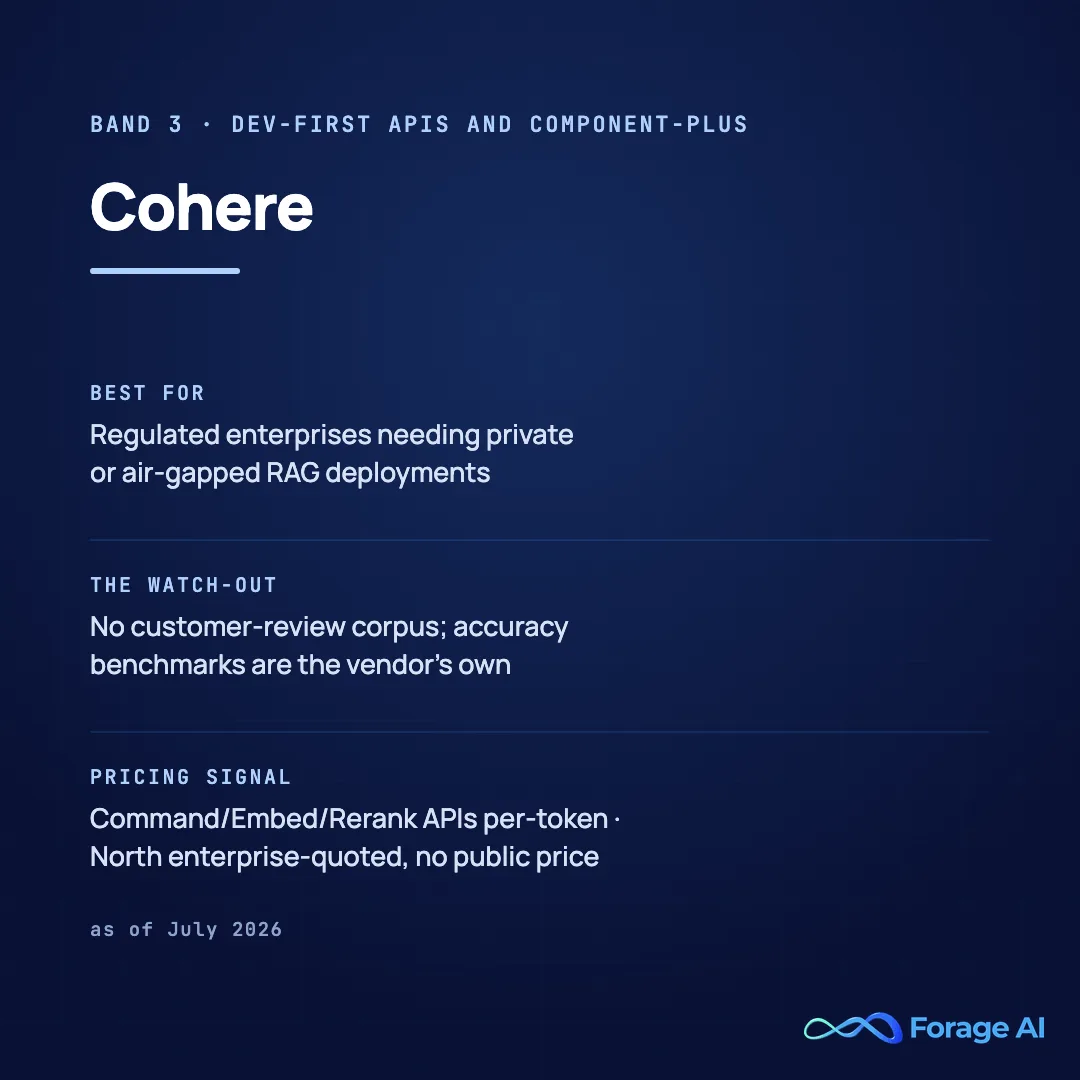
| Best for | Regulated enterprises needing private or air-gapped RAG with a single accountable vendor |
| Standout capability | Deployment flexibility: on-prem, private cloud, air-gapped, “with as few as two GPUs” (vendor and press) |
| Pricing (as of July 2026) | Model APIs published per-token; North enterprise-quoted, no public pricing located |
| Deployment | SaaS / private cloud / on-prem / air-gapped |
| Watch-out | Zero customer-review corpus for the enterprise products; benchmark claims are internal |
| Attribute | Detail |
|---|---|
| Signal type | None found (as of Jul 2026) + press + vendor-claimed |
| Rating (with n, accessed 2026-07-23) | G2 seller listing shows zero verified reviews; no aggregated review base, an absence, not a low score |
| What the rating actually rates | n/a; note that Capterra/GetApp “Cohere” listings likely belong to an unrelated support-software company and are not cited here |
| What users praise | Deployment flexibility (independent press, 2025–2026); Command/Embed/Rerank widely used as RAG components in other stacks (ecosystem signal) |
| What users flag | North is a full workspace, not an embeddable API (structural); no public North pricing; accuracy benchmarks are Cohere’s own (vendor-claimed) |
| Source | G2 listing state (accessed 2026-07-23); press coverage of funding and deployments; vendor claims as claims |
Cohere, founded in Toronto in 2019, is the roster’s model lab: it raised $500M at a $6.8B valuation in August 2025, extended to $7B in September, and drew a roughly €500M Series E commitment led by Schwarz Group in April 2026 (press coverage). Its RAG story has two honest surfaces. The Command, Embed, and Rerank APIs are widely used as retrieval components inside other stacks, an ecosystem signal rather than a review score. North, the security-first agentic workspace (generally available August 2025), is the platform product, deployable on-premises, in private cloud, or air-gapped with as few as two GPUs, per vendor and press.
The evidence picture is the caution. Cohere’s G2 seller listing carries zero verified reviews, which is an absence and not a low score, and North’s claim to outperform rival assistants on RAG accuracy is an internal vendor benchmark, reported here as Cohere’s own claim. Reported revenue crossed $100M annualized in May 2025 (press reports, labeled as reported), so the vendor-viability question that haunts Band 1 does not apply here; the evidence question does. Best for regulated enterprises that need private or air-gapped RAG from a single accountable vendor. The watch-out: a $7B lab with no customer-review corpus for its enterprise products means you are buying the benchmark story on trust. Pilot against your own accuracy bar before you sign.
12. Elastic (Elasticsearch Relevance Engine, ESRE)
| Attribute | Detail |
|---|---|
| What it is | The search incumbent’s RAG toolkit (mid-2023): hybrid retrieval combining BM25, vector search, and the ELSER sparse model as the retrieval layer for RAG |
| Best for | Organizations already running Elasticsearch that want RAG grounded in their existing search estate |
| Standout capability | Battle-tested hybrid retrieval at enterprise scale (long-standing aggregated theme) |
| Pricing (as of July 2026) | Elastic Cloud tiers, hourly-metered; ELSER and vector features gated to paid tiers; see Elastic pricing at purchase |
| Deployment | Elastic Cloud / self-managed |
| Watch-out | A retrieval layer, not end-to-end RaaS: generation, orchestration, and guardrails are still yours to assemble |
| Attribute | Detail |
|---|---|
| Signal type | Aggregated review base, seller-level only |
| Rating (with n, accessed 2026-07-23) | G2 seller 4.4/5 (n=525) |
| What the rating actually rates | All Elastic products together, not ESRE; Gartner Peer Insights lists 316 reviews but the current rating was not captured |
| What users praise | Mature retrieval at enterprise scale; genuinely strong hybrid search; add RAG without new vendors on existing estates (aggregated, long-standing) |
| What users flag | Operational complexity and cluster-tuning burden (the perennial aggregated complaint); licensing and tier complexity (aggregated) |
| Source | G2 (accessed 2026-07-23); Gartner Peer Insights listing state (rating not captured) |
Elastic (NYSE: ESTC) approaches RAG from the retrieval side. ESRE, launched mid-2023, combines BM25, vector search, and the ELSER sparse model into hybrid retrieval that Elastic’s enterprise search installed base has already pressure-tested. For an organization with an existing Elasticsearch estate, it is the shortest path to RAG-grade retrieval without adding a vendor, and the team skills transfer directly. ELSER, the sparse retrieval model, is what upgrades classic keyword estates to hybrid search without re-platforming.
The review base is the largest in Band 3 and carries the same caveat as every large number in this article. Elastic’s G2 seller rating is 4.4/5 at n=525, covering all Elastic products together; not one of those reviews rates the ESRE toolkit. Gartner Peer Insights lists 316 reviews for Elastic’s search products, but the current rating was not captured in research, so no number is printed here. The category truth that keeps ESRE in Band 3 rather than Band 1: it is a retrieval layer. Generation, orchestration, and guardrails are still yours to assemble. Best for organizations already running Elasticsearch that want RAG grounded in their existing estate. The watch-out: operational complexity and cluster tuning are the perennial reviewer complaints, and they do not disappear because the use case is new.
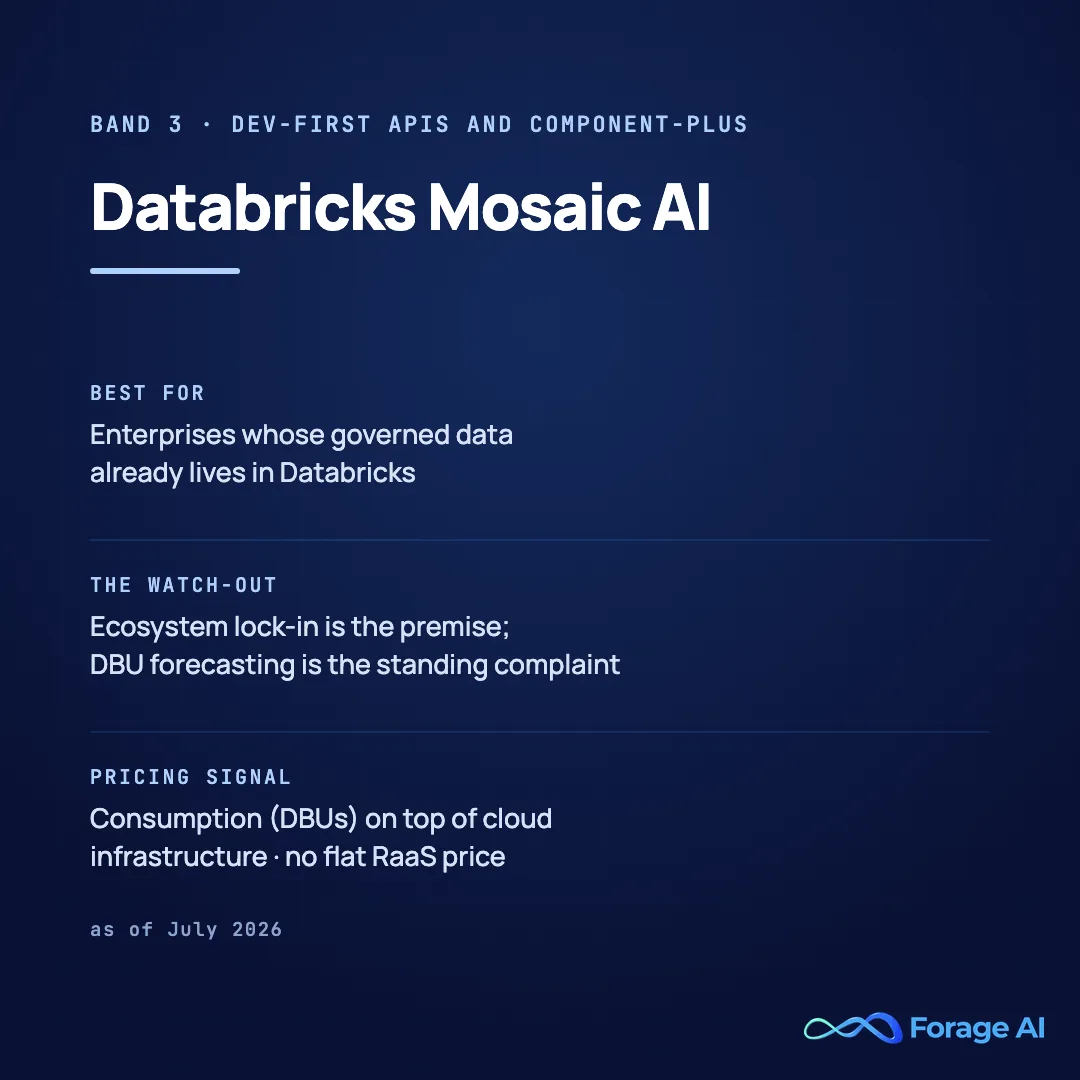
13. Databricks (Mosaic AI)
| Attribute | Detail |
|---|---|
| What it is | Data-platform-native RAG: Mosaic AI (Vector Search with Delta Sync, Foundation Model APIs, Model Serving, MLflow evaluation) plus Agent Bricks |
| Best for | Enterprises whose governed data already lives in Databricks |
| Standout capability | RAG pipelines under the same governance plane as the data (Unity Catalog) |
| Pricing (as of July 2026) | Consumption (DBUs) on top of cloud infrastructure; Vector Search and Model Serving metered separately; no flat RaaS price |
| Deployment | Databricks on your cloud |
| Watch-out | The RAG tooling assumes you are in the Databricks ecosystem; assembling Mosaic components is engineering work, not a managed endpoint |
| Attribute | Detail |
|---|---|
| Signal type | Aggregated review base, platform-level only, plus vendor-claimed scale figures |
| Rating (with n, accessed 2026-07-23) | G2 4.6/5 (n=657) for the Data Intelligence Platform, with 78% five-star |
| What the rating actually rates | The whole Databricks platform, not Mosaic AI or Agent Bricks |
| What users praise | Unified data and AI governance via Unity Catalog (aggregated + structural); Delta Sync vector indexing (practitioner write-ups, editorial) |
| What users flag | DBU cost complexity, the recurring platform-level theme (aggregated); ecosystem lock-in as the operating premise (structural) |
| Source | G2 (accessed 2026-07-23); vendor claims (Agent Bricks scale) as claims |
Databricks holds the biggest verified review base in this article, and the same denominator caveat applies to it as to every hyperscaler. The G2 rating of 4.6/5 at n=657 (78% five-star, accessed July 2026) covers the Data Intelligence Platform as a whole, not Mosaic AI or Agent Bricks. The vendor’s Agent Bricks scale figures (100,000+ agents, over a quadrillion tokens a year) are vendor-claimed and labeled as such.
The pitch is structural rather than feature-led: RAG pipelines live where the governed data already lives. Vector Search indexes sync automatically from Delta tables, models serve under the same access controls, and Unity Catalog governs the lot. The composition is the point: Vector Search feeds retrieval, Foundation Model APIs and Model Serving handle generation, and MLflow closes the loop with evaluation, all inside one governance plane. For an enterprise whose data estate is already in Databricks, that is a genuinely different value proposition from every pure-play in Band 1. Best for exactly those enterprises. The watch-out is the fit truth: as a standalone RaaS for a non-Databricks shop this is the wrong buy, assembling Mosaic components is engineering work rather than a managed endpoint, and DBU cost forecasting is the standard reviewer complaint. Ecosystem lock-in here is the premise, not a side effect.
Band 4: Turnkey Enterprise Knowledge Platforms
Band 4 is the far end of the buy spectrum: an employee-facing assistant over company knowledge, seat-priced, live in weeks. The trade is the fastest time-to-value for the organization against the least composability and the highest per-seat TCO; you cannot build your product on it. Buyer signal: “we want employees searching company knowledge tomorrow.” One category-honesty line before the entries: this band answers a different job than Bands 1 through 3, and putting Glean beside Ragie without saying so is the standard category sin of this SERP.
14. Glean
| Attribute | Detail |
|---|---|
| What it is | Work-AI assistant and enterprise search over 100+ connectors with permission-aware retrieval |
| Best for | Enterprises that want RAG delivered as an employee-facing assistant over internal tools |
| Standout capability | Permission-aware retrieval across a large connector estate, with the only enterprise-weighted true review base in this article |
| Pricing (as of July 2026) | Enterprise-quoted, per-seat; no public price card; seat-priced with six-figure first-year commitments commonly reported (reported, not vendor-confirmed) |
| Deployment | SaaS |
| Watch-out | It solves a different job than developer RaaS; if you need a retrieval API inside your product, this is the wrong aisle |
| Attribute | Detail |
|---|---|
| Signal type | Aggregated review base (the healthiest true product-level base in this article) |
| Rating (with n, accessed 2026-07-23) | G2 4.7/5 (n=140; 53.7% of reviewers from enterprise-size companies) |
| What the rating actually rates | The product itself; n/a caveat, a true product-level base exists |
| What users praise | User-friendly interface; easy integrations with Slack and Google Workspace (aggregated, 2025–2026) |
| What users flag | Pricing higher than competitors (recurring aggregated theme); UI “can be somewhat unintuitive” in places (reviewer language) |
| Source | G2 (accessed 2026-07-23); funding and ARR from CNBC and multiply-reported press (2025–2026) |
Glean is the best-reviewed product in this article, for a different job. Founded in 2019 in Palo Alto by Arvind Jain (ex-Google, Rubrik), it raised a $150M Series F at a $7.2B valuation (CNBC, June 10, 2025) and reached $300M ARR by May 2026, up 89% year over year (multiply-reported press). The product is a work-AI assistant and enterprise search layer over 100+ connectors, with permission-aware retrieval as the load-bearing enterprise feature: answers inherit the access controls of the underlying systems, which is the difference between an assistant an enterprise can deploy and one it cannot.
The review base deserves its own sentence, because it is the exception in this article. G2 rates Glean 4.7/5 at n=140, with 53.7% of reviewers at enterprise-size companies, which makes it the one reviewer base in this roster that actually matches the target buyer. Aggregated praise centers on the interface and integrations; the recurring flag is price, and pricing itself is enterprise-quoted with no public card, with six-figure first-year commitments commonly reported (reported figures, not vendor-confirmed). Procurement reality: the quote is the price card, so bring seat counts and a comparable from your existing search spend to the first call. Best for enterprises that want RAG delivered as an employee-facing assistant over internal tools rather than as an API. The watch-out is category fit, not quality: if what you need is retrieval inside your own product, this is the wrong aisle, however good the reviews.
15. Contextual AI
| Attribute | Detail |
|---|---|
| What it is | End-to-end platform for specialized RAG agents in high-stakes domains; “RAG 2.0” = retriever and generator jointly optimized rather than assembled from frozen components |
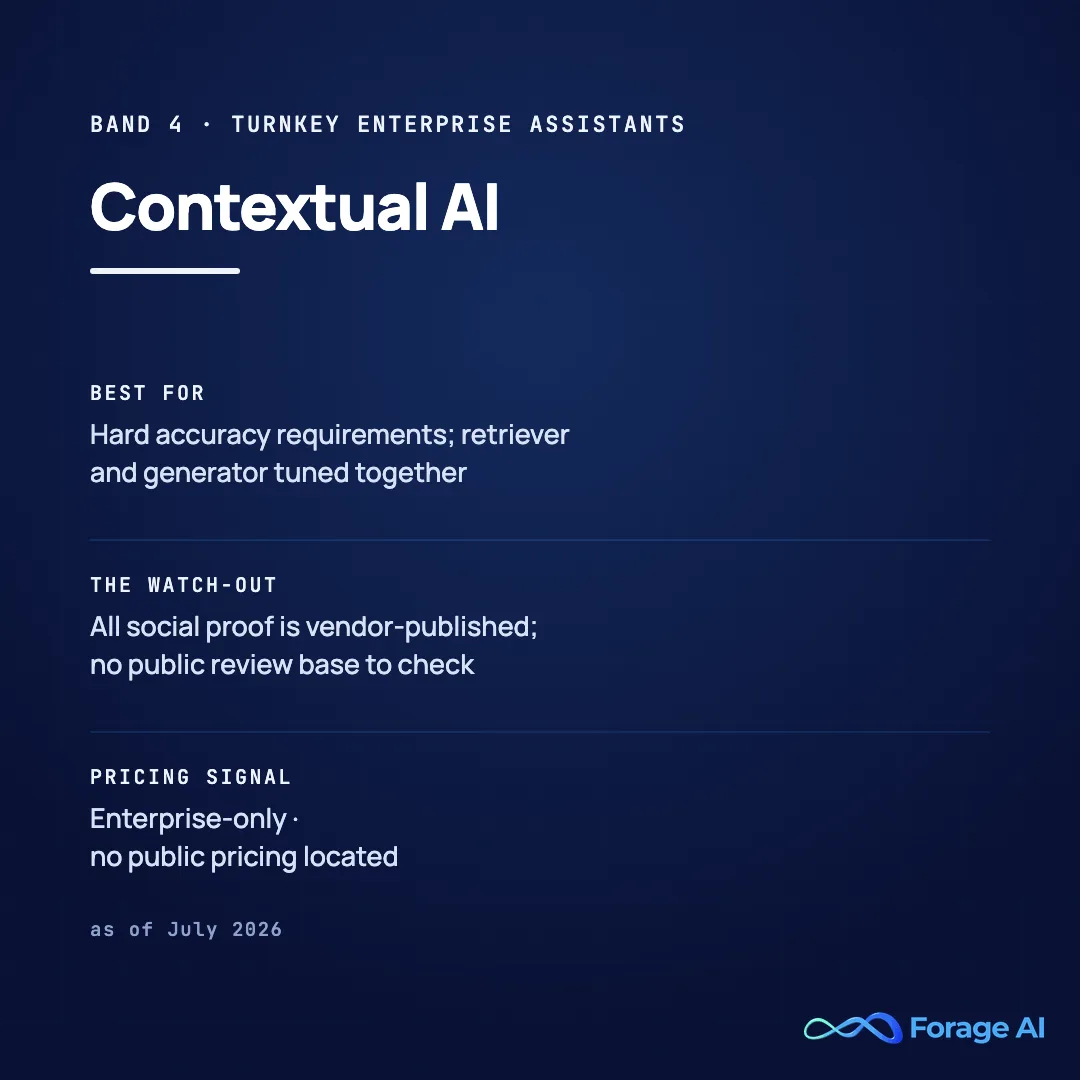
| Best for | Enterprises with hard accuracy requirements who want the retriever and generator tuned together |
| Standout capability | Founder pedigree: CEO Douwe Kiela co-created the original RAG technique at Meta AI (2020) |
| Pricing (as of July 2026) | Enterprise-only; no public pricing located (unverified) |
| Deployment | Enterprise deployment; verify current options at purchase |
| Watch-out | No public review base exists to check; all social proof is vendor-published |
| Attribute | Detail |
|---|---|
| Signal type | None found (as of Jul 2026) + vendor-claimed case studies |
| Rating (with n, accessed 2026-07-23) | No review corpus on any major platform; absence, not a low score; enterprise-sales product, roughly three years old |
| What the rating actually rates | n/a; no corpus exists |
| What users praise | The RAG-paper lineage and the jointly-optimized architecture (technical discourse; the research claims are vendor-published, attributed) |
| What users flag | Enterprise-only opacity: no published pricing, no self-serve path (structural, 2026) |
| Source | Press coverage of the Series A (2024); vendor research publications as claims |
Contextual AI is this article’s roster-completeness proof: it appears on none of the eight ranking rosters this research analyzed, despite being a credible, well-funded, generally available platform. Founded in 2023 by CEO Douwe Kiela, co-creator of the original RAG technique at Meta AI in 2020, and CTO Amanpreet Singh, it raised an $80M Series A in August 2024 led by Greycroft (press coverage). Its presence here is evidence this list was researched rather than aggregated from other lists.
The positioning is “RAG 2.0”: the retriever and generator jointly optimized as one system rather than assembled from frozen components, aimed at high-stakes, knowledge-intensive enterprise work, and generally available since January 2025. The founder pedigree is the strongest trust signal in this roster and it is factual and well-documented; the supporting benchmark research is vendor-published and attributed as such. Best for enterprises with hard accuracy requirements that want the retriever and generator tuned together, not assembled. The watch-out: you are trusting research pedigree and pilots. No public review base exists to check the claims, all social proof is vendor-published, and pricing is enterprise-only with nothing public to model. Ask for the evaluation protocol in writing (which benchmarks, whose corpus, who runs it), because vendor-run benchmarks are the only public numbers that exist.
What We Left Off the List, and Why
Four classes of tools were excluded on purpose, and two platforms were excluded because they are dead. The evidence bar stated as policy: if we cannot fill an honest review-signal table for a platform, it does not get a roster entry.
| What we excluded | Named examples | Why |
|---|---|---|
| DIY frameworks | LangChain (+ LangGraph/LangSmith), Haystack (deepset), RAGFlow | Code you run, not services you subscribe to; genuinely excellent, categorically different |
| Bare vector databases | Weaviate, Qdrant, Milvus | Components, not pipelines |
| Dev agencies | The “RAG as a service providers” search contamination | Firms that build you RAG are a hiring decision, not a platform subscription |
| Evidence-standard cuts | Onyx, Writer, plus the micro-SaaS long tail (Personal AI, Ragu AI, et al.) | No honest review-signal table could be filled; named on ranking pages, under-evidenced in research |
| The graveyard | Graphlit (sunsetting), Mendable (shut down 2025) | Dead or dying; see below |
Exclusion classes: this article’s editorial policy, July 2026. Vector databases are covered in our guide to vector databases and LLM data storage.
The frameworks and vector databases are quality tools in the wrong category, and the dev-agency exclusion resolves the search-intent confusion named in the intro. Onyx and Writer are the evidence-standard cuts: both appear on ranking pages (Onyx as #1 on its own list), but our research could not fill an honest review-signal table for either, and fabricating one would be the worst failure available to this article. Readers are welcome to hold us to that same bar.
The graveyard is the currency proof. Graphlit, a funded pure-play (roughly $3.56M raised, PitchBook-sourced), is winding down: signups are closed, and free-customer data export closes on August 1, 2026 (fetched directly from the vendor’s pricing and sunset pages, July 23, 2026). Founder and CEO Kirk Marple announced the wind-down on LinkedIn: “After five years, I’m making the hard call…” Mendable, an early RaaS product, was shut down by its own team in 2025; co-founder Eric Ciarla wrote, “We shut down our $250K ARR AI startup…” (LinkedIn, 2025), and the team moved on to other work.
What the graveyard means for the buyer: in a category this young, vendor viability is a first-order evaluation criterion. Funding cushion, revenue signals, parent backing, and data-export terms belong on the diligence list next to features. The export-deadline detail shows why: platform death hands you a migration on the vendor’s timeline, not yours.
Two platforms still listed on current “best RAG as a service” roundups are already dead. Graphlit is sunsetting (free-account data export closes August 1, 2026) and Mendable shut down in 2025. If a list recommends either as a live option, the list is stale.
Why Is Your RAG Only as Good as Its Corpus?
Every platform in Bands 1 through 4 retrieves what it is given. None of them can retrieve facts the corpus never contained, and none can un-rot a stale corpus. This section serves two readers: the greenfield buyer about to feed a platform, and the lead whose existing RAG answers badly and who is pricing a switch. For the second reader, the data usually points somewhere cheaper than a migration.
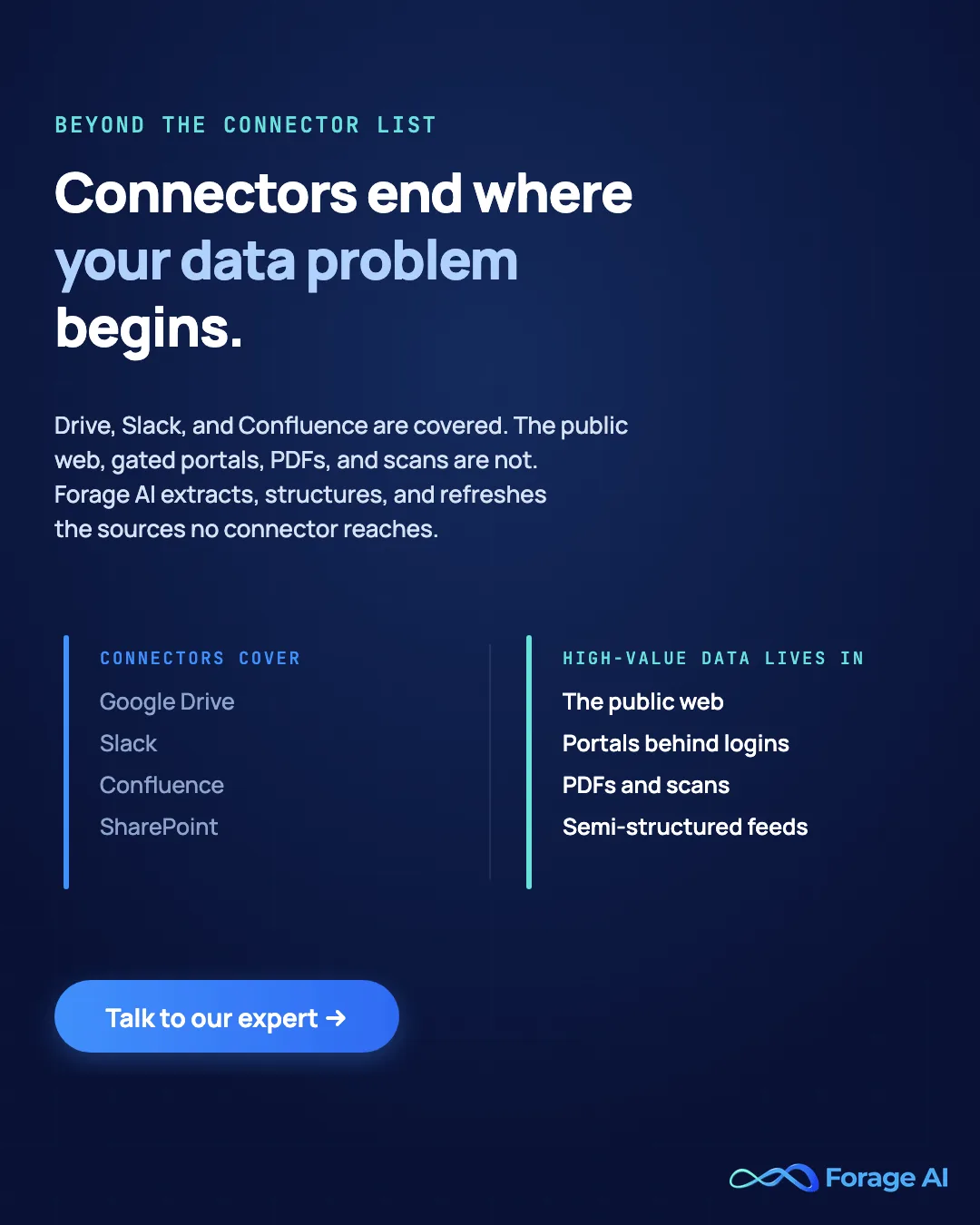
Connectors end where your data problem begins. Connector counts (100+, 40+) cover SaaS applications: Drive, Slack, Confluence, SharePoint. They do not cover the sources where the highest-value corpus data usually lives: the public web, portals behind logins, PDFs and scans, semi-structured feeds. What happens before the connector is invisible on every platform page in this article, as of July 2026. Corpus work is its own discipline: extraction quality from messy sources, structure and normalization, deduplication, and freshness pipelines, because a corpus rots at the speed of its sources. The platform-side evidence agrees: one implementation firm’s estimate puts content preparation at two to four weeks of a rollout, the long pole ahead of platform setup, and the same firm’s warning is the one honest sentence of its kind on this SERP: if your documents are messy, outdated, or inconsistent, your AI answers will be too.
The hallucination chain runs backward through the corpus. Hallucination statistics are quoted on competing pages without explanation. The causal chain those pages skip: a hallucination traces to a retrieval miss, and a retrieval miss traces to a corpus gap. Detection tooling (Vectara’s HHEM among others) flags ungrounded output; it cannot recover facts the corpus never contained. For the full failure-mode breakdown, our diagnosis of why RAG pipelines fail in production walks the chain in detail; this article routes to it rather than re-arguing it. The practical order of operations for the failing-RAG reader: audit the corpus before you re-platform.
A RAG platform cannot fix bad source data. If the corpus is stale, incomplete, or badly extracted, every platform on this list will return confident garbage: grounded, cited, and wrong. Diagnose the corpus before you re-platform.
There is also a switching-cost completion to the router’s question 5. A portable, well-structured, platform-independent corpus is the lock-in hedge: re-platforming is re-ingesting, and teams whose corpus lives clean outside the platform switch cheapest. Freshness compounds the point in time-sensitive domains; real-time RAG in finance shows what continuous corpus refresh looks like when staleness has a price per hour.
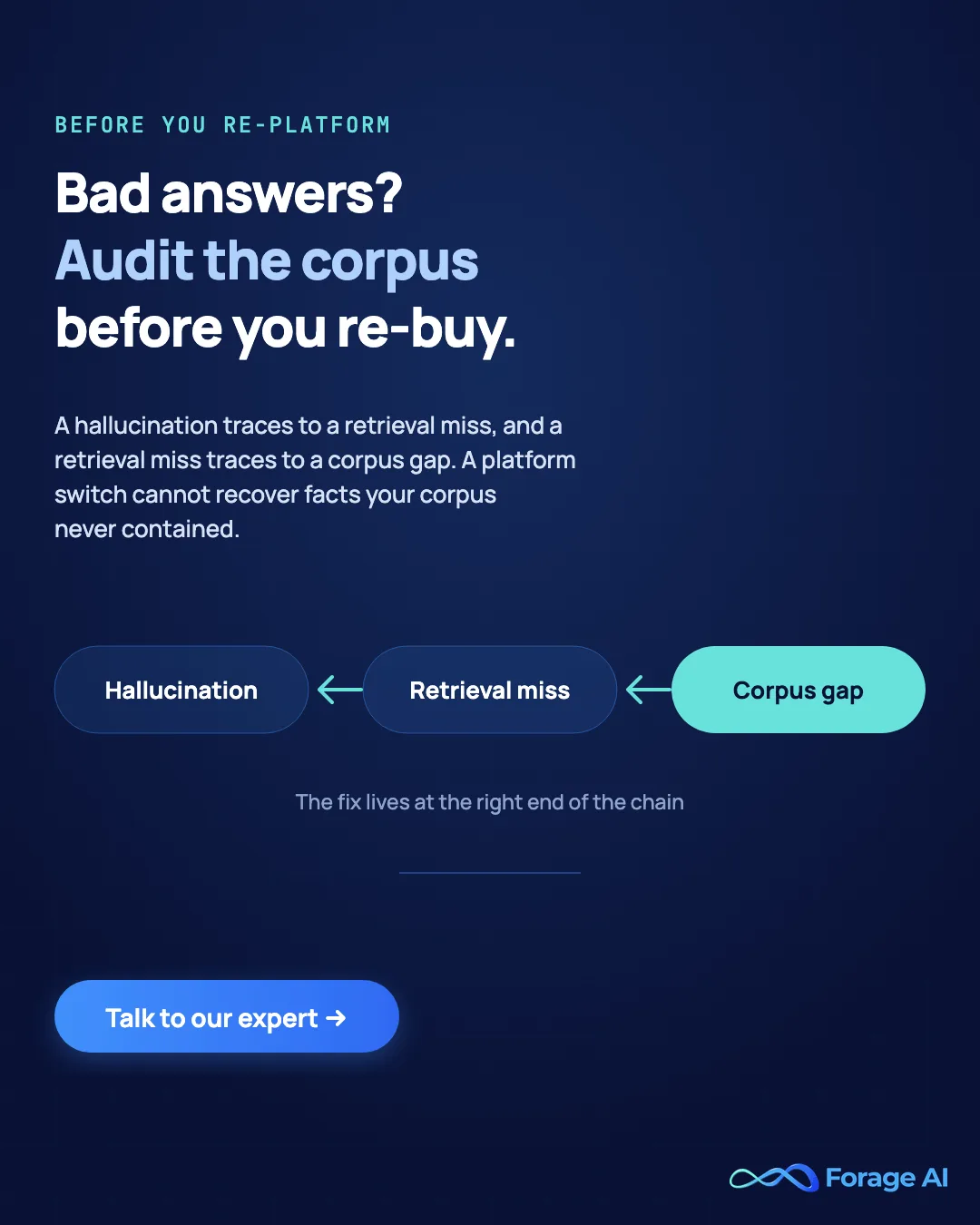
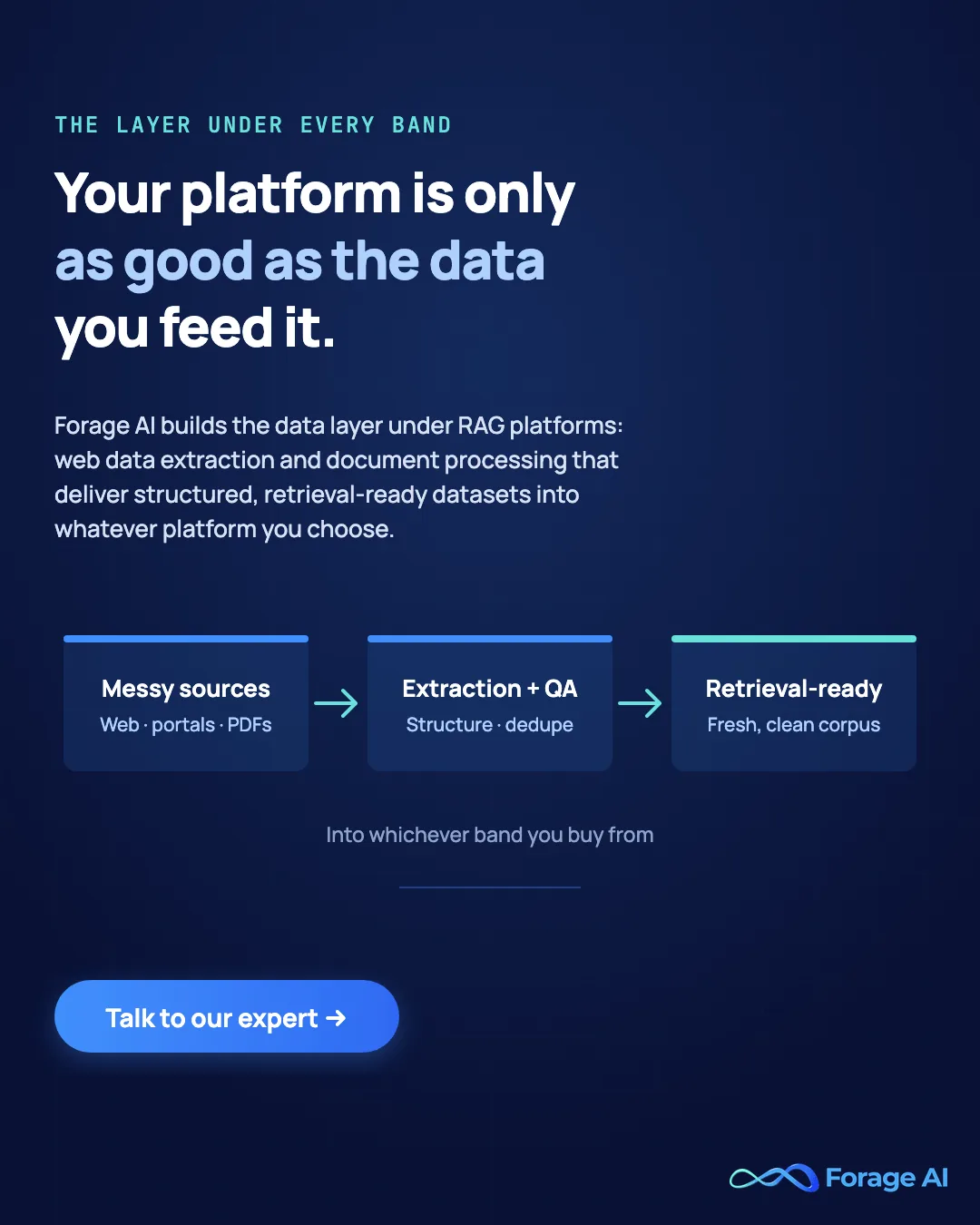
Whichever band you buy from, someone has to own the layer under it: extracting from the messy sources connectors do not reach, structuring it, deduplicating it, keeping it fresh. That layer is what we build at Forage AI: web data extraction and document processing that deliver structured, retrieval-ready datasets into whatever platform you chose above. The platforms on this list solve real problems the data layer does not, retrieval quality, generation, permissions among them. The corpus sets the ceiling; the platform decides how close you get to it.
Quick Summary
Q: What should you check before you blame the platform for bad RAG answers?
A: The corpus, first. A hallucination traces back to a retrieval miss, and a retrieval miss traces back to a corpus gap, so a stale, incomplete or badly extracted corpus returns confident, cited, wrong answers on every platform in this list. Connectors reach SaaS applications, not the public web, login-gated portals, PDFs and scans, which is where the highest-value corpus data usually sits. Audit and fix the corpus before you price a migration.
When Is RAG as a Service the Wrong Buy?
Four situations, honestly: a corpus too small to justify a platform, residency constraints no deploy tier meets, a bottleneck that is data acquisition, and an existing RAG whose problem is the corpus. An honest list says who should not buy, so here is the table no vendor page runs.
| Situation | Why RaaS is the wrong buy | What to do instead |
|---|---|---|
| Tiny, static corpus | Long-context models or a hyperscaler file-search feature covers it; a platform subscription is overkill | Long-context or built-in file search; accept per-call token economics |
| Hard residency or air-gap beyond even private-deploy tiers | No managed tier fits | Self-host (R2R, or the framework route excluded above for other buyers); you own ops |
| Your need is heavy external or web data | The platform will not go get that data for you; your bottleneck is acquisition, not retrieval | Fix the acquisition layer first, with engineering or a data partner |
| Your RAG exists and answers badly | The fix is usually the corpus, not a platform migration | Diagnose the corpus before you re-buy; see the data-layer section above |
Situations: this article’s analysis, July 2026.
Each “instead” has its own cost, stated plainly. Self-hosting means you own operations, upgrades, and QA. Long-context means per-call token economics that stop making sense as the corpus grows; the capability shift that made this viable is a 2025–2026 development, so re-run the math on current models. Corpus-first means engineering time or a data partner. And there is a price-floor mismatch worth naming: if the entry price of the accuracy-tier pure-plays ($100K+ a year as of July 2026) exceeds the value of the project, the project belongs in a lighter band, or not in RAG as a service at all.
The build-versus-buy data cuts both ways, and an honest read keeps both directions. Buying decisions reverse cheaply on paper and expensively after re-ingestion; that is the switching-cost echo from the router. One practitioner’s framing of the trade has aged well: RAG as a service versus assembling your own is “a buffet of AI tools or a personal AI chef” (Archana, writing in the tinyml Substack newsletter, 2024; anecdotal, verify verbatim at publish). Three of this table’s four answers route to purchases that make this article’s author nothing: long-context, self-hosting, a lighter band. That is what a no-self-entry list is for.
Expert Insights
The evidence threads from the sections above, distilled and sourced.
Expert Insights
– The parent-denominator problem, in one pair of numbers: Google’s Vertex AI rates 4.3/5 on G2 at roughly 594 reviews (accessed July 2026), and every one of those reviews rates the entire Vertex platform, not the RAG Engine product this article covers. By contrast, Glean’s 4.7/5 at n=140 (G2, accessed July 2026, 53.7% of reviewers at enterprise-size companies) is the healthiest true product-level review base in the category, and it belongs to an employee assistant, not a developer platform. The biggest numbers rate the wrong thing, and the best-rated product answers a different question. The count of reviews that rate Bedrock Knowledge Bases, the Foundry RAG flows, or Vertex RAG Engine specifically, anywhere, is zero.
– Consolidation is documented fact, not forecast: Progress Software announced its acquisition of Nuclia on June 30, 2025 (price undisclosed, described as immaterial to Progress financials) and relaunched the product as Progress Agentic RAG on September 10, 2025 (Progress investor relations). Two other platforms in this article’s research set died in roughly the same window. In a category this young, corporate motion is a first-order fact about every vendor on the list.
– The most honest timeline figure on this SERP is not a platform benchmark: one implementation firm’s published estimate puts content preparation, testing, and integration at two to four weeks of a typical RAG rollout, ahead of platform setup as the long pole. That estimate is single-source and attributed as such. Every connector count in this article covers SaaS applications; none covers the public web, gated portals, or document archives.
– Band 1’s evidence base is prices and dates, not stars: Vectara’s fetched July 2026 pricing starts at $100,000 a year where stale roundups still describe a free tier; Ragie’s fetched tiers run $0 to $500 a month with per-page overages. The same band, a free developer tier at one end and a six-figure annual platform fee at the other. A band with that spread is a band where “which is best” has no meaning without the five-question router.
– Band 3’s most decision-useful data is its published meters: Pinecone Assistant prices to the token ($3/GB/month storage, $8 per million input tokens, $15 per million output, fetched July 2026), and LlamaCloud prices to the credit ($1.25 per 1,000, with parsing consuming 1 to 45 credits per page). Both are modelable in a spreadsheet before a single procurement call, which no Band 2 consumption bill and no Band 4 seat quote allows.
– Band 4 marks the extremes of the evidence spectrum: Glean, at 4.7/5 (n=140, 53.7% enterprise reviewers) and $300M ARR by May 2026, is proven by its customers; Contextual AI, with zero reviews anywhere and the co-creator of RAG as CEO, is proven by its authors. Both patterns are legitimate; they demand different diligence, seat-economics scrutiny for the first, accuracy pilots for the second.
– The graveyard’s two named voices are the most honest data in this article. “After five years, I’m making the hard call…” wrote Kirk Marple, Founder and CEO of Graphlit, announcing the wind-down on LinkedIn. “We shut down our $250K ARR AI startup…” wrote Eric Ciarla, Mendable co-founder, in 2025. A funded, well-regarded platform and a revenue-generating one, both gone inside the category’s fifth year. That is what vendor-viability risk looks like when it stops being hypothetical.
– The framing that best survives contact with this market predates most of the roster: managed RAG versus DIY is “a buffet of AI tools or a personal AI chef” (Archana, tinyml Substack, 2024; anecdotal single voice, labeled as such). Two years later the buffet is bigger, four bands instead of a handful of tools, and the chef still costs engineering headcount. What changed is the fourth option this article documents: knowing when to order neither.
Frequently Asked Questions
What is RAG as a service, and how is it different from building RAG yourself?
RAG as a service is the retrieval-and-generation pipeline (ingest, chunk and embed, retrieve, generate, ground) delivered as a subscription instead of built in-house. The difference is who owns ingestion, retrieval infrastructure, and maintenance: the provider does, instead of your engineers. The counter-intuitive part: buying the platform does not buy you out of corpus preparation, which one implementation firm estimates at two to four weeks of a typical rollout.
Which RAG-as-a-service platform is best for enterprise use?
It depends on the band, not on a rating. Accuracy-critical enterprises with platform budget look at Vectara (from $100K/year as of July 2026); single-cloud shops use their hyperscaler’s building blocks; Databricks estates use Mosaic AI; and organizations that want an employee-facing assistant look at Glean, the best-reviewed true base in the category at 4.7/5 (n=140). The misconception to avoid: “best-rated” is not “right band,” because the highest-rated product here answers a different job than a developer RAG API.
Do the hyperscaler options (Bedrock, Azure AI Search, Vertex) count as RAG as a service?
Yes, as managed building blocks inside a cloud you already pay for rather than as standalone platforms. The counter-point buyers miss: none of the three has a review corpus for the RAG feature itself. Every rating you will see (Bedrock 4.3–4.4, Azure AI Search 4.4 at n=31, Vertex 4.3 at n≈594, all accessed July 2026) rates the parent platform.
How much does RAG as a service cost?
The honest spread as of July 2026: $0 developer tiers, $100 to $500 a month self-serve (Ragie’s published tiers, Pinecone’s plans), usage-metered hyperscaler billing where forecasting is the hard part, $100K+ a year for enterprise pure-play entry (Vectara), and seat-quoted turnkey assistants. All of these are entry points rather than total cost of ownership, and the pricing models (flat, per-page, per-token, credits, consumption, per-seat) are not comparable as raw numbers.
Can a RAG platform fix bad source data?
No. Retrieval finds what exists; if the corpus is stale, incomplete, or badly extracted, every platform on this list returns confident, cited, wrong answers. Hallucination detection flags ungrounded output but cannot recover facts the corpus never contained. The diagnosis path is corpus-first, and our breakdown of why RAG pipelines fail in production covers the failure modes in detail.
When is RAG as a service the wrong buy?
Four situations: a corpus small and static enough for long-context models or built-in file search; residency constraints that rule out even private-deploy tiers, where self-hosting is the answer; a need that is external data acquisition, which no retrieval platform performs; and an existing RAG whose problem is the corpus. The misconception: an existing bad RAG usually needs a corpus fix, not a platform migration.
The Corpus Ceiling
The fifteen platforms above differ enormously: $0 tiers to $500K a year, APIs to assistants, a band for every situation, and the router tells you which to shortlist. The one property they share is the one no pricing page states. Each is a retrieval engine parked on top of the corpus you feed it.
The platform decides how well you search what you have. The corpus decides what there is to find. That is the corpus ceiling, and it is why the data layer is the first decision and the platform the second. For teams whose corpus is the bottleneck, the data layer is where the work, and this article’s author, lives.
One last freshness note: this market repriced, renamed, and buried two platforms inside twelve months. Every figure above is stamped as of July 2026. Re-verify pricing before you sign.
Related Articles
- Why RAG Pipelines Fail in Production: The diagnosis piece this article routes to: the failure modes that trace back to the corpus.
- What Is Retrieval Augmented Generation (RAG)?: The mechanics explainer for readers who need the pipeline, not the purchase.
- Fine-Tuning vs Knowledge Bases (RAG): The Ultimate Guide to AI Model Optimization: For the reader whose real question is architecture, not vendor.
- Data Storage Solutions for LLMs and RAGs: Where vector databases fit, and why they are components rather than pipelines.
Sai is a data infrastructure enthusiast who has spent the past two to three years following the AI space closely, from the infrastructure layer to the fast-growing world of data for AI. He is genuinely curious about how modern data pipelines get built and where the data industry is heading, and he writes insightful pieces on the core topics that shape this niche.