
Legal Document Processing Solutions: The 2026 Guide for Legal Teams
This article is for informational purposes only and does not constitute legal advice. Consult a qualified attorney for legal guidance specific to your situation.
The most-cited contract AI on legal software rankings was acquired by Litera in August 2021, and its entire public review corpus is three reviews, all filed before the deal. The best-funded legal AI company in the world carries exactly two. And of the six software categories a search for legal document processing solutions returns, only one actually extracts data from legal documents at volume. Three signals from one SERP: ownership-stale, review-thin, and category-confused.
This guide covers that one lane. It ranks solutions whose job is intake, classification, extraction, validation, and delivery of data from legal documents at volume: software platforms, cloud APIs, and one managed service lane. Not where documents are stored (that is document management), not contract lifecycle workflow, not drafting copilots, not litigation review. The full map is two scrolls down.
By the end, you will know which of the six categories your requirement actually lives in, which of the fourteen credible solutions fits your document types, what each costs as of July 2026, and which review numbers deserve your trust.
Quick Digest
- The six-lane map: the keyword conflates six categories; only intelligent document processing (IDP) extracts data at volume, while document management systems (DMS) store documents, contract lifecycle management (CLM) manages lifecycles, copilots review single documents, research AI answers legal questions, and e-discovery reviews litigation evidence.
- The audit bar: vendors are graded on human-in-the-loop (HITL) QA model, page-level cite-back, factual privilege posture, field-level accuracy validation, and document-type coverage; zero of the 12 analyzed ranking pages grade on any of them.
- The four bands: 14 solutions: managed (Forage AI), legal-specialist (Kira, Luminance, Evisort, LinkSquares, Lexion), general IDP (ABBYY, Hyperscience, Nanonets, Docsumo, Rossum, UiPath Document Understanding), and cloud APIs (Azure AI Document Intelligence, AWS Textract).
- Ownership currency: Kira has been Litera’s since August 2021, Casetext became Thomson Reuters CoCounsel ($650M, 2023), Lexion went to DocuSign ($165M, 2024), and Evisort completed into Workday in October 2024; every competing list is stale on at least one.
- Review honesty: every rating prints with its review count, parent and seller aggregates never stand in for product ratings, and four conflicted counts print no count at all.
Why legal document processing is its own problem
Legal documents carry consequences that generic paperwork does not. Attorney-client privilege and confidentiality duties attach to the content, court deadlines attach to the workflow, and malpractice exposure attaches to the errors.
2.1 hours per lawyer per day goes to document-related tasks, roughly 26% of the working day. Source: Thomson Reuters research, 2025.
The volume is as real as the stakes. Contracts, case files and pleadings, discovery productions, court records, corporate filings, deeds and leases, and billing paperwork: seven document types, most of which defeat templated review because no two law firms, courts, or counterparties format them the same way. Our practitioner guide to legal document processing covers that architecture in depth; this article stays on the vendor question.
OCR converts a document image into raw text; intelligent document processing (IDP) classifies the document, extracts specific fields, validates them, and delivers structured data, which is why every credible entry below is an IDP system rather than an OCR tool (fuller treatment in our guide to intelligent document processing).
The consequence for buyers: when documents are where the data lives, extraction quality is a legal-risk variable, not an ops metric. That is why this vertical grades tools differently, and why the market consolidated: four of its best-known vendors were acquired between August 2021 and October 2024. Both facts shape everything below.
What counts as a legal document processing solution?
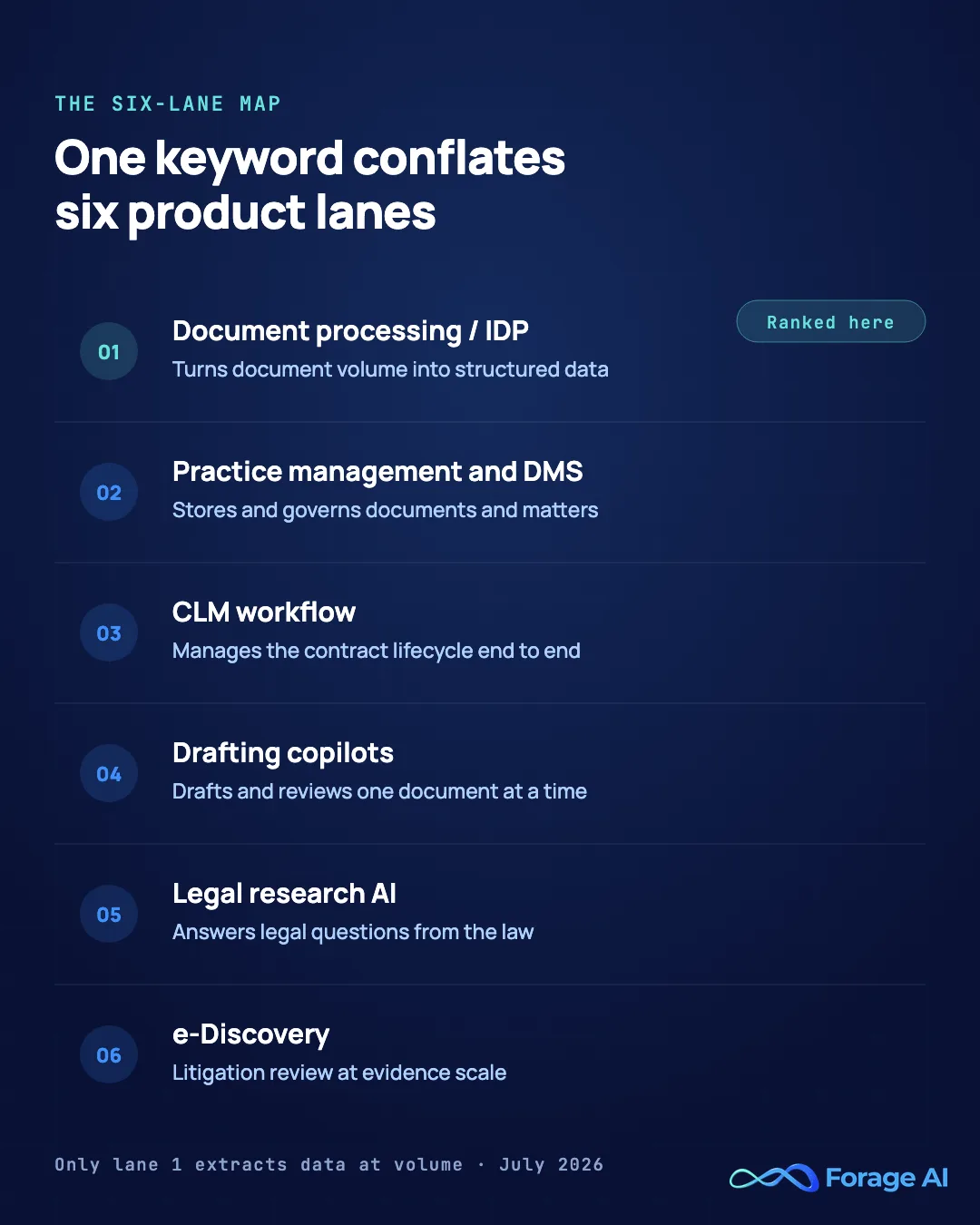
A legal document processing solution’s job is getting accurate, auditable data out of legal documents at volume. Every other category on this SERP does something else, and every ranking list for this keyword silently substitutes its own category. The map below is the correction.
Up to six product categories appear mixed inside single rosters of 5 to 20 entries across the five ranking listicles deep-analyzed for this article (SERP analysis, accessed July 2026).
| Lane | What it actually does | Representative names | You need it when | It is NOT |
|---|---|---|---|---|
| 1. Document processing / IDP (this article) | Intake, classification, extraction, validation, delivery of data at volume | The 14-entry roster below | You need structured data out of document volume | A place to store or draft documents |
| 2. Practice management and legal DMS | Stores, organizes, and governs documents and matters | Clio, iManage, NetDocuments | You need a system of record for files and matters | An extraction engine |
| 3. CLM workflow | Manages the contract lifecycle; extraction is a feature inside it | Ironclad, Icertis, Agiloft, ContractPodAi, Juro, Concord | You need contract workflow end to end | A volume data pipeline |
| 4. Drafting copilots and document assembly | Drafts, reviews, or generates one document at a time in a lawyer’s workflow | Spellbook, Robin AI, HotDocs, Gavel, Briefpoint | A lawyer needs help on the document in front of them | Built for ten thousand documents |
| 5. Legal research AI | Answers legal questions and drafts memos from the law | Harvey, Thomson Reuters CoCounsel (ex-Casetext), Westlaw/Lexis+ AI | You need answers about the law | Field extraction from your documents |
| 6. e-Discovery | Litigation review at evidence scale under court rules (technology-assisted review, TAR) | Relativity, Everlaw | You are producing or reviewing discovery | An IDP procurement at all |
Lane assignments as of July 2026; copilot and research-AI scopes move quickly.
The reading rule: storage and governance is lane 2, contract workflow lane 3, one document at a time in Word lane 4, questions about the law lane 5, and discovery productions lane 6, its own procurement universe. Only lane 1 turns document volume into structured, auditable data, and only lane 1 is ranked below.
One boundary judgment needs stating. LinkSquares, Evisort, and Lexion are CLM-resident: they entered the market extraction-first, so they stay rostered with their category labeled; workflow-first CLMs (Ironclad, Icertis) sit in lane 3. There is also a services lane: legal process outsourcing providers rank for this exact keyword, proof of managed demand no software listicle serves. Notably, no “legal IDP” category exists on G2 or Capterra; the closest is Contract Analytics.
Most tools sold as “legal AI” do not do extraction. Harvey, CoCounsel, and Spellbook are lawyer-facing assistants; iManage and NetDocuments are document stores. None of them is a document processing pipeline, and buying one to solve a volume-extraction requirement is a category error.
One adjacent note: running client documents through general-purpose chatbots raises the confidentiality questions the next section grades vendors on, factually.
Names you expected that are not on the list
- Harvey, Thomson Reuters CoCounsel, Spellbook: lanes 4 and 5, assistants rather than pipelines. Harvey’s located public review base is two reviews, a count worth knowing about a company valued at $11B in March 2026 (press-reported). No star ratings print for any of the three.
- Relativity, Everlaw: lane 6. Relativity carries a large review base (G2 4.6, n=615, corroborated via secondary sources), and it rates e-discovery, not IDP.
- Robin AI: a copilot with a managed-review layer, cut because an honest evidence table is not currently possible: no captured rating, and G2’s “Robin” namespace collides with an unrelated desk-booking product.
- Ontra: contract automation plus a lawyer network for private markets, the closest philosophical neighbor to managed human-in-the-loop processing, but niche (fund NDAs, routine contracts) and rating-uncaptured.
- Instabase: an enterprise IDP platform cut on the evidence standard; a public review base of two reviews cannot support the two-table treatment every roster entry gets.
- Klarity: pivoted to revenue-accounting document AI; no longer a legal roster candidate.
Quick Summary
Q: What counts as a legal document processing solution?
A: The lane whose job is intake, classification, extraction, validation and export: a legal document goes in and structured, checkable data comes out. Contract lifecycle management, document storage and governance, drafting add-ins and lawyer-facing research assistants sit in the other five lanes, which is why a roster that mixes six categories is answering a different question from the one you asked.
How did we set the audit bar for evaluation?
Feature counts do not decide legal purchases; privilege duties, auditability, and malpractice exposure do. This article grades every entry on five criteria, reused as rows in every entry’s tables.
0 of 12 ranking pages analyzed for this keyword grade tools on human review, page-level cite-back, or privilege posture (SERP analysis, accessed July 2026).
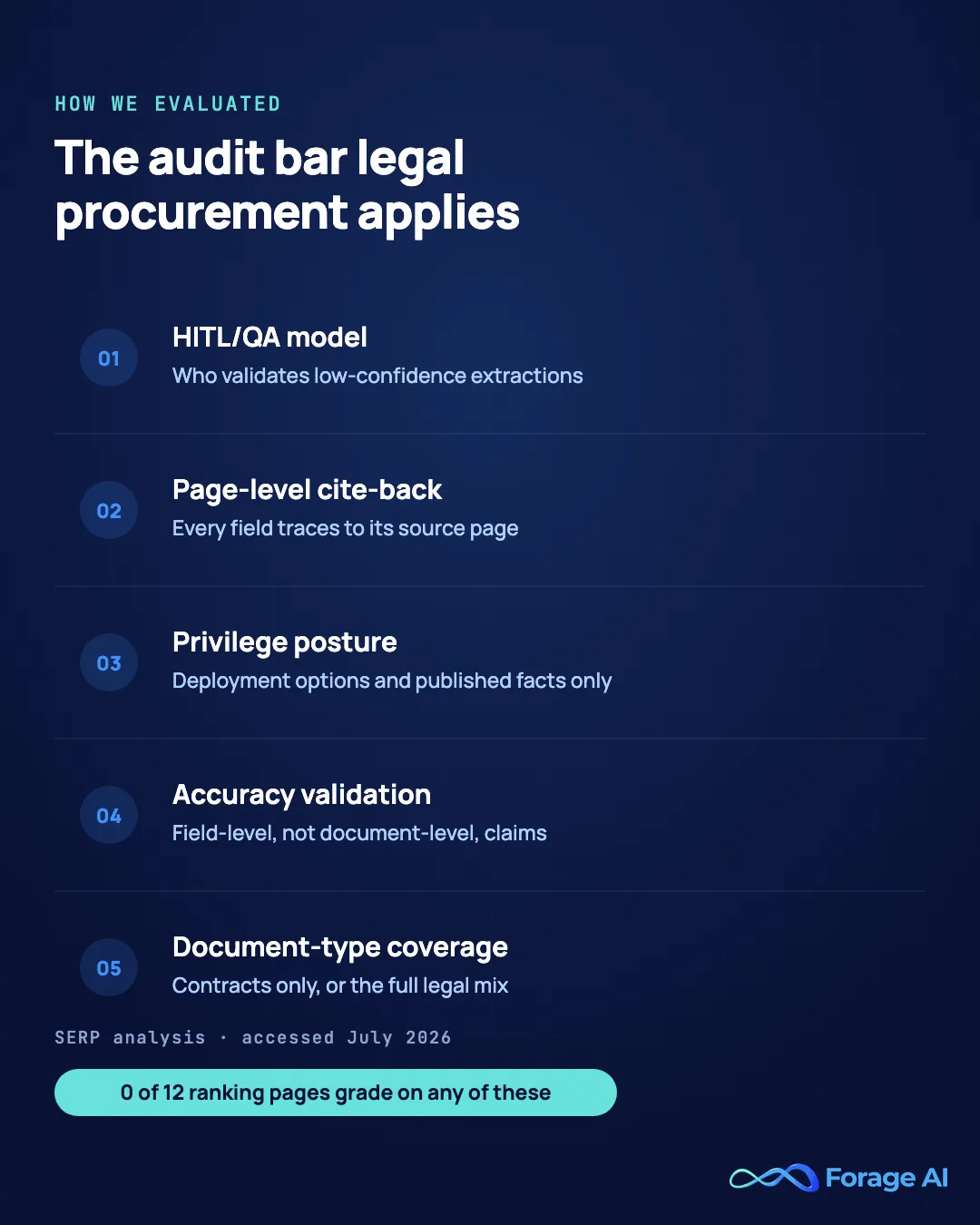
- HITL/QA model. Who validates low-confidence extractions: built-in human review, a paid add-on, or entirely the buyer’s problem?
- Page-level cite-back and audit trail. Can every extracted field be traced to its source page for an auditor, a court, or opposing counsel?
- Privilege and confidentiality posture. Factual posture only: deployment options (SaaS, VPC, on-prem), published data-handling and retention statements, certifications the vendor publishes. Grading reports what exists; it never promises outcomes, for any vendor.
- Accuracy validation. Field-level versus document-level accuracy, what a vendor’s “99%” actually measures, and whether the claim is independently checkable. A document-level number leaves your field-level error rate unknown.
- Document-type coverage. Contracts only, or case files, court records, corporate filings, deeds and leases, handwriting, and low-quality scans too?
Criterion 3 is grounded in a citable standard: ABA Model Rule 1.6 sets the confidentiality duty that makes vendor data handling a procurement question rather than an IT preference.
Vendor ROI numbers are vendor-claimed. Figures like “10x faster,” “90% cost reduction,” and “80% time savings” circulate on vendor pages and in look-alike listicles without independent verification. This article labels every such number vendor-claimed and never grades on them.
Expert Insights
A Stanford RegLab and Stanford HAI team led by Varun Magesh and Daniel E. Ho benchmarked the leading AI legal research tools in 2024 and found that they "hallucinate between 17% and 33% of the time". That is the case for grading human review and page-level cite-back rather than a vendor accuracy headline: on legal documents, the unverified share is the part that costs you.
How we researched: review platforms (with counts and denominators), vendor documentation, and primary press releases or filings, accessed 2026-07-23; no vendor paid for placement. One honesty rule runs through every entry: “99% accurate” without a denominator is a marketing sentence, not a measurement.
The 14 legal document processing solutions at a glance
Graded on that five-criterion bar, four bands organize the roster: Band 1 is managed processing delivered as a service, Band 2 is software built for legal documents, Band 3 is general IDP with legal strength, and Band 4 is cloud APIs you build on. The matrix below is the article’s only horizontal table; deep dives with two evidence tables per entry follow.
A platform rating is not a module rating. UiPath’s platform has thousands of reviews; UiPath Document Understanding, the product on this list, has sixteen. ABBYY’s 4.5 seller score is dominated by a desktop OCR product. Where a rating belongs to a parent or a seller aggregate, this article says so in the entry.
| Solution | Band | Best for | Pricing model (as of July 2026) | Review signal | Audit-bar standout |
|---|---|---|---|---|---|
| Forage AI | 1. Managed | Heterogeneous legal document volume, done for you | Custom-quoted managed service | G2 4.8 first-party, thin base | HITL standard; 200% QA (company-published) |
| Kira (Litera) | 2. Legal-specialist | M&A due-diligence extraction | CA$10,000/user/yr listed, vintage unverified | Capterra 4.7 (n=3, 2019–2021, stale) | Lawyer review tool, not a pipeline |
| Luminance | 2. Legal-specialist | AI-first contract review, UK/EU presence | Quote-only | G2 4.9 (n=5), negligible base | Pilot on your own documents |
| Evisort (Workday) | 2. Legal-specialist | Contract intelligence over legacy repositories | Quote-only | G2 4.6 (n=91); Capterra 4.8 (n=19) | CLM-resident extraction heritage |
| LinkSquares | 2. Legal-specialist | Post-signature contract visibility in-house | Quote-only | G2 4.7 (n=427, seller-level) | Seller aggregate until resolved |
| Lexion (DocuSign) | 2. Legal-specialist | DocuSign-estate agreement workflow | CLM quote-only | G2 4.3 (count unresolved) | You buy DocuSign’s roadmap |
| ABBYY | 3. General IDP | Configurable enterprise capture, on-prem | Quote-only | G2 IDP 4.2 (count unresolved) | You build the legal layer |
| Hyperscience | 3. General IDP | High-volume records and handwriting | Quote-only | G2 4.6 (n=54) | HITL workflow built in |
| Nanonets | 3. General IDP | Self-serve custom extraction models | Published: free tier + per-page + Pro | Capterra 4.9 (n=80); G2 4.8 (n=96) | Best price transparency in roster |
| Docsumo | 3. General IDP | Mid-market standardized paperwork | Published tiers (reported) | G2 4.7 (n=67) | Seed-scale vendor, diligence viability |
| Rossum | 3. General IDP | Transactional paperwork (billing, AP) | Quote-only | G2 4.5 (n=127, AP-use corpus) | Wrong pick for contracts or records |
| UiPath Document Understanding | 3. General IDP | Legal-ops flows inside UiPath estates | Platform AI units, no standalone price | G2 4.6 (n=16, module listing) | Platform corpus never transfers |
| Azure AI Document Intelligence | 4. Cloud API | Engineering teams on Azure | Published pay-per-page | G2 4.4 (n=19) | QA, audit trail, plumbing all DIY |
| AWS Textract | 4. Cloud API | Engineering teams on AWS | Published per-page by feature | G2 4.3 (count unresolved) | Raw JSON out; post-processing DIY |
All ratings accessed 2026-07-23; conflicted review counts print as unresolved rather than as a number. Pricing column reflects the published model, not negotiated rates.
Band 1: Managed legal document processing
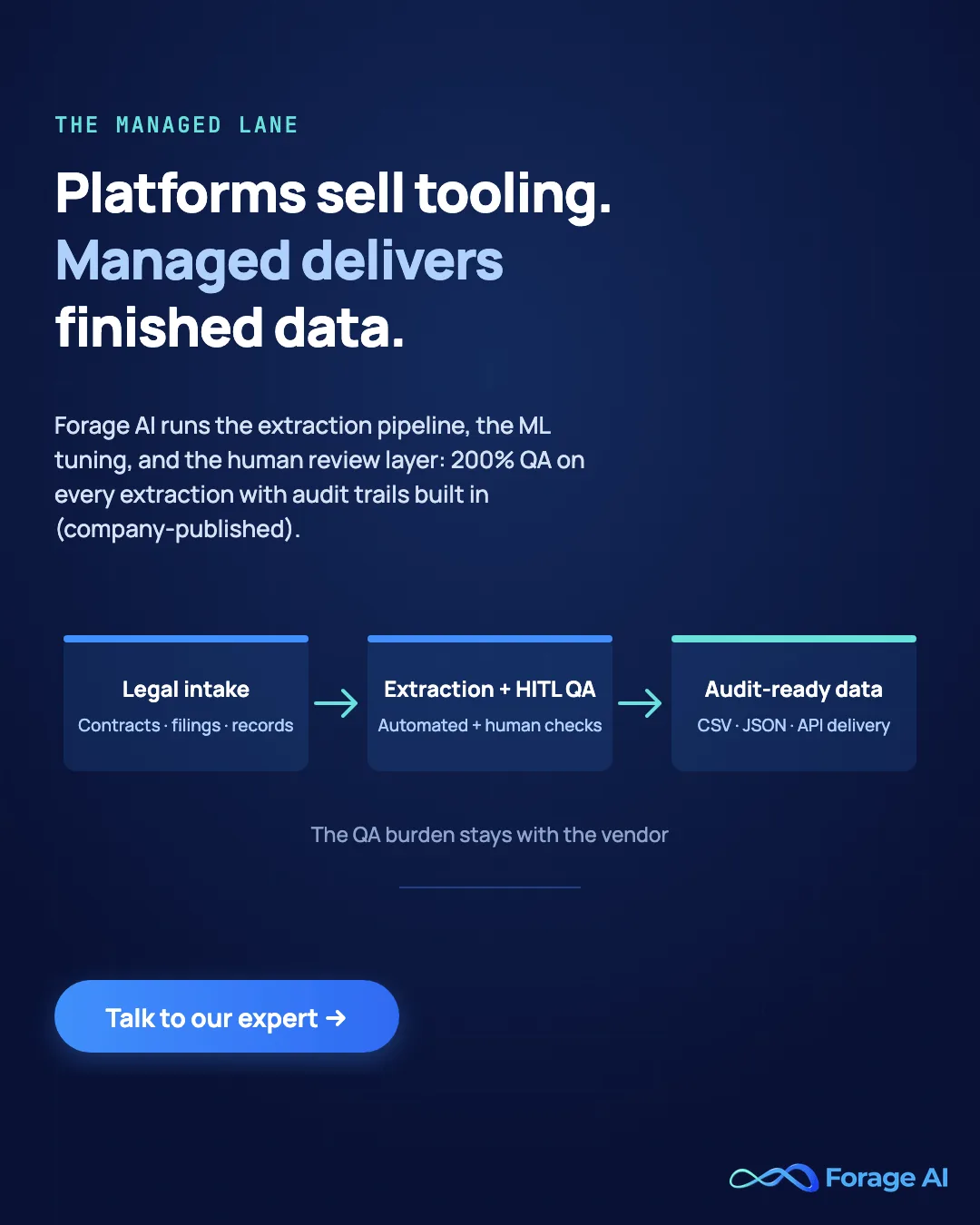
Managed processing is the lane every software listicle omits while legal process outsourcing service pages rank for the same keyword: document processing delivered as a managed service with human-in-the-loop QA, sold as finished data rather than software you configure. The trade is accountability and zero internal build against less self-serve control and a thinner public review base than platform incumbents.
1. Forage AI
| Attribute | Detail |
|---|---|
| What it is | Managed legal document processing: enhanced OCR, in-house ML, and human expert validation in one accountable pipeline (company-published) |
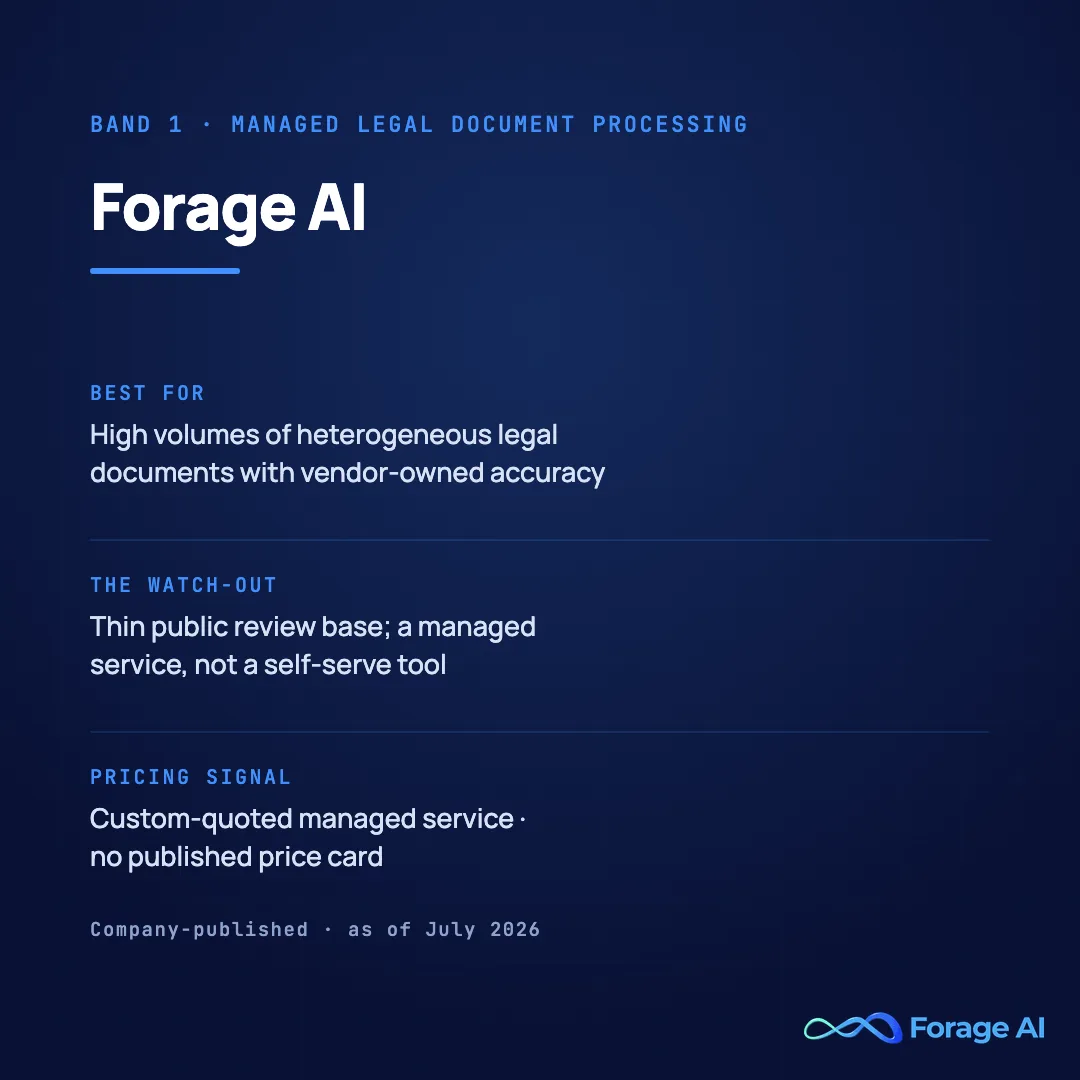
| Best for | Legal-adjacent operations processing high volumes of heterogeneous legal documents who want vendor-owned accuracy and a built-in audit trail |
| Legal documents handled | Legal document extraction (deeds, filings, regulatory documents) is a named use case; formats include PDF, DOC, EML, and images, with handwriting and low-resolution scans; documents beyond 2,000 pages (company-published) |
| HITL/QA and audit trail | Human review is the standard operating layer, not an add-on: 200% QA, meaning automated checks and human verification on every extraction, with a QA team three times the industry average relative to delivery (company-published) |
| Deployment & confidentiality posture | Workflows run under contractual controls and client-specific handling rules agreed up front, with built-in validation, audit trails, and encryption (company-published posture, not a guarantee) |
| Pricing (as of July 2026) | Custom-quoted managed service; no published price card |
| Watch-out | Thin public review base; a managed service is not a self-serve tool you configure in an afternoon |
| Attribute | Detail |
|---|---|
| Signal type | First-party + named-client testimonial |
| Rating (accessed 2026-07-23) | G2 4.8, first-party claim published on forage.ai, on a thin review base |
| What the rating actually rates | The managed service itself, on a thin base: service businesses accumulate platform reviews slower than self-serve SaaS, so this base is disclosed the same way this article discloses Luminance’s n=5. No Capterra or TrustRadius corpus located (absence, not a low score) |
| What users praise | Custom-built extraction per document type; human-in-the-loop QA as standard; no internal ML or template maintenance burden (company positioning + named-client testimonial, labeled as such) |
| What users flag | Thin public review corpus; managed model means less self-serve control than a platform (stated by us, same rules as everyone) |
| Source | forage.ai (first-party) + named client testimonial (Expert Institute); review platforms checked 2026-07-23 |
Forage AI is the managed option most software lists omit. Instead of licensing a platform and owning the QA burden, the buyer hands over the document flow and receives structured, validated, audit-ready data; the extraction pipeline, the ML tuning, and the human review layer are Forage AI’s to run. Onboarding typically takes 1–2 weeks from brief to live pipeline, and delivery lands in whatever format the receiving system needs, from CSV and JSON to direct API and webhook integration (company-published). Against the audit bar, the relevant fact is that HITL is the default operating model rather than an enterprise add-on, and the confidentiality posture is stated above as published fact, not as a promise.
The evidence base is honest about its own shape. The G2 4.8 is first-party and thin-based, disclosed in the table exactly as every thin base in this article is. The stronger evidence class is a named legal-sector client. Rachel DeMel, Director of Product & Content Strategy at Expert Institute, a legal-services company in expert-witness search and litigation support: “Partnering with Forage AI has been an absolute game-changer for our company.” And on the model itself: “What sets Forage AI apart is that they don’t just provide off-the-shelf solutions; instead, they delve deep into our requirements.” (First-party, named-client testimonial; Expert Institute is a legal-sector customer most IDP vendors cannot show by name.)
Best for: legal-adjacent operations processing high volumes of heterogeneous legal documents (contracts, court records, filings, case files) who want accuracy owned by the vendor and an audit trail built in. Watch-out: the thin public review base is real, and buyers who want a DIY platform they configure themselves should read Bands 2 through 4.
Band 2: Legal-specialist extraction and contract intelligence
Software built for legal documents, where extraction is the core job: due-diligence engines and contract intelligence, including three entries that now live inside bigger parents (Litera, Workday, DocuSign). The trade is legal-native depth against lawyer-facing rather than ops-pipeline design, plus a consolidation wave that makes roadmap ownership a real procurement question. One boundary note repeats from the six-lane map: LinkSquares, Evisort, and Lexion are CLM-resident, rostered here because they entered the market extraction-first, while workflow-first CLMs (Ironclad, Icertis) stay in lane 3. For the how-to side of contract work, see our guide to contract data extraction.
Four acquisitions reshaped this band: Kira to Litera, announced August 10, 2021; Casetext to Thomson Reuters, $650M, closed August 17, 2023; Lexion to DocuSign, $165M, announced May 6, 2024; Evisort to Workday, completed October 8, 2024. Sources: primary press releases and filings.
2. Kira (Litera)
| Attribute | Detail |
|---|---|
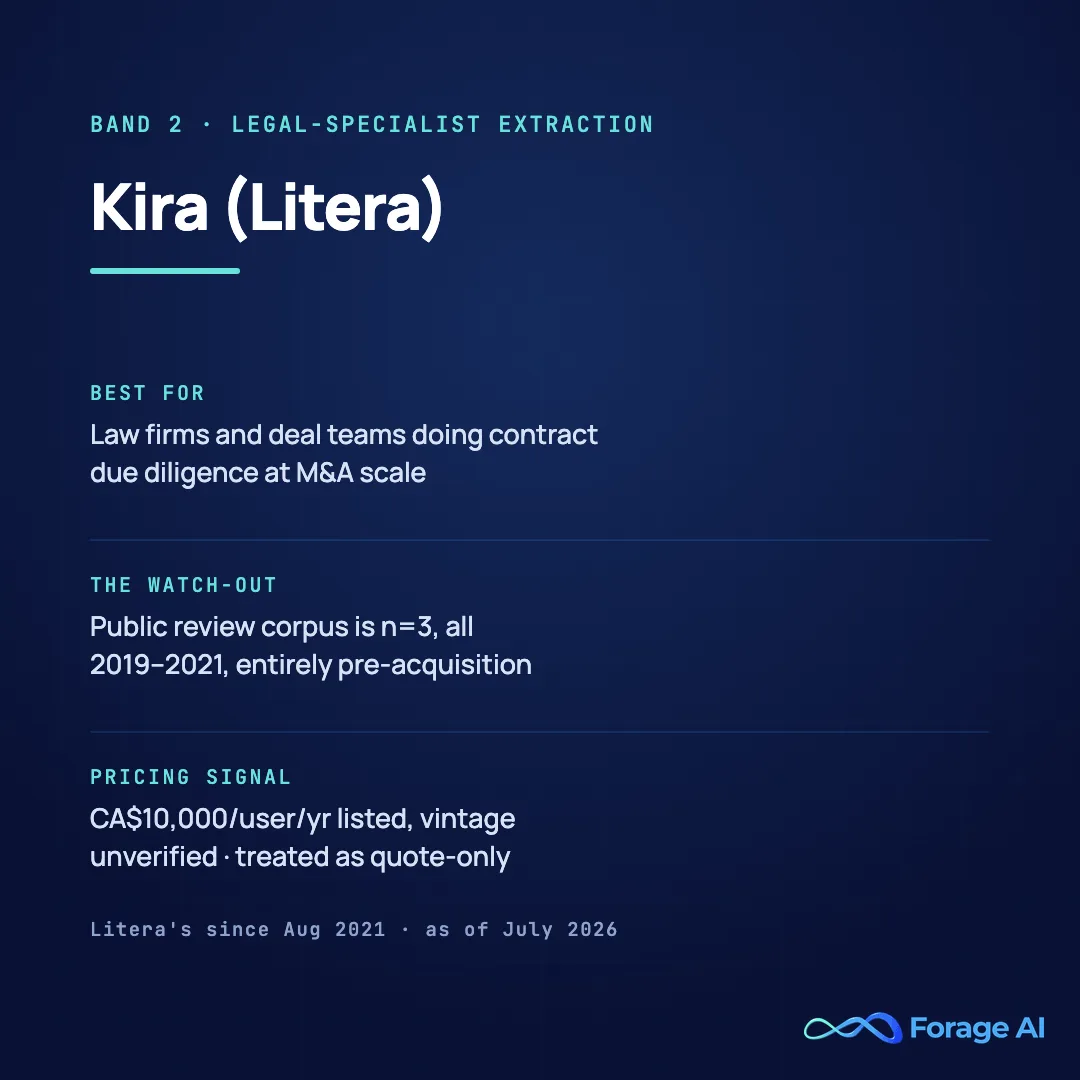
| What it is | The original contract-analysis AI for law firms: clause identification and extraction for M&A due diligence, sold as Litera Kira since the August 2021 acquisition |
| Best for | Law firms and deal teams doing contract due diligence at M&A scale |
| Legal documents handled | Contracts across data rooms; leases and loan agreements per reviewer anecdotes; 1,000+ built-in smart fields and provision models (vendor-claimed) |
| HITL/QA and audit trail | Lawyer-in-the-loop by design: the lawyer reviews the AI’s findings inside the tool; no ops-pipeline QA service |
| Deployment & confidentiality posture | Enterprise SaaS within the Litera suite; published posture facts only, no guarantees stated here |
| Pricing (as of July 2026) | Capterra lists from CA$10,000/user/year, possibly pre-acquisition vintage; treated as quote-only until verified |
| Watch-out | A lawyer’s review tool, not a volume IDP pipeline; the public review corpus predates its current ownership entirely |
| Attribute | Detail |
|---|---|
| Signal type | Aggregated review base, tiny and stale, plus one feature-score signal |
| Rating (accessed 2026-07-23) | Capterra 4.7 (n=3, all reviews 2019–2021, pre-acquisition; fetched directly). G2 Data Extraction feature score 9.6/10 (corroborated via secondary sources) |
| What the rating actually rates | The product, but from a corpus filed entirely before the Litera deal; Litera’s seller rating (4.2, n=61) spans the whole Litera suite and is not a Kira rating |
| What users praise | Due-diligence extraction across data rooms; summarization of leases and loan agreements; handles grainy scanned text (anecdotal, n=3, 2019–2021 vintage) |
| What users flag | Weaker on heterogeneous, non-similar agreements (anecdotal); post-acquisition innovation pace questioned in legal-tech commentary (editorial) |
| Source | Capterra (fetched directly), G2 (secondary), BusinessWire acquisition PR |
Kira effectively created the AI contract-review market for due diligence, founded 2011 in Toronto by Noah Waisberg and Dr. Alexander Hudek. The ownership fact matters most in 2026: Litera announced the acquisition on August 10, 2021 (BusinessWire), and ranking lists still describing a standalone “Kira Systems” are nearly five years stale. The staleness extends to the evidence base, and that is this entry’s real finding: the entire located Capterra corpus is three reviews, all filed 2019–2021, before the deal. A 4.7 on that base is a historical signal, not current sentiment.
The capability signal that survives is specific: a G2 Data Extraction feature score of 9.6/10 (corroborated via secondary sources), consistent with Kira’s reputation for clause extraction across data rooms, backed by 1,000+ built-in smart fields and provision models (vendor-claimed). Litera claimed 15,000+ customers across its suite at acquisition, also vendor-claimed. The only public price signal, a Capterra listing from CA$10,000 per user per year, is possibly pre-acquisition vintage and is treated as quote-only until verified.
For a 2026 buyer that leaves two usable facts: the extraction pedigree is real, and the current product experience under Litera is essentially unreviewed in public. Best for M&A diligence at law-firm scale. Watch-out: this is a lawyer’s review tool rather than an ops pipeline, and every current-state claim about it deserves a pilot rather than a rating lookup.
3. Luminance
| Attribute | Detail |
|---|---|
| What it is | Legal-trained AI from Cambridge (founded 2015) for first-pass contract review and anomaly detection across document sets |
| Best for | In-house legal and law-firm teams wanting AI-first contract review with UK/EU presence |
| Legal documents handled | Contracts and diligence document sets; product naming spans Diligence, Discovery, and Corporate, which can blur scope for buyers comparing against IDP |
| HITL/QA and audit trail | Lawyer-facing review workflow; the lawyer is the validation layer |
| Deployment & confidentiality posture | Enterprise SaaS; published posture facts only |
| Pricing (as of July 2026) | Quote-only; no public price card |
| Watch-out | Essentially no aggregated review corpus to check vendor claims against |
| Attribute | Detail |
|---|---|
| Signal type | Negligible aggregated base; press and vendor case studies carry the social proof |
| Rating (accessed 2026-07-23) | G2 4.9 (n=5): a negligible base, stated as such. A duplicate zero-review G2 listing exists and is not rendered as a score |
| What the rating actually rates | The product, on five reviews; at this n the star value carries almost no information |
| What users praise | Legal-grade AI trained on legal documents; first-pass review speed (editorial and vendor-echoed, labeled) |
| What users flag | No meaningful review corpus in more than a decade; enterprise sales motion with no published pricing (structural) |
| Source | G2 (secondary), funding press coverage |
Luminance’s numbers tell an unusual story. A company founded in 2015 raised a $75M Series C in early 2025 (Point72, March Capital, press-reported), and its entire located review base is five G2 reviews at 4.9. A duplicate G2 listing shows zero reviews and is not rendered as a score, because absence is not a 0.0. That gap between funding momentum and customer evidence is the finding, and it runs through this category: in legal AI, funding and public reviews are close to inversely correlated.
The “90% time savings” figure that circulates with Luminance coverage is a vendor and affiliate-editorial claim, labeled per this article’s rules. Trackers put total funding near $115M across three rounds; the Series C is the citable event. One practical evaluation note: the product line spans Diligence, Discovery, and Corporate, three different jobs under one brand, worth a clarifying question early in any comparison against IDP platforms.
Best for teams that want AI-first review with UK/EU presence and are prepared to run their own pilot. Watch-out: with n=5, your own documents are the only benchmark that means anything, and this is a lawyer-facing review product with quote-only pricing, not an ops extraction pipeline.
4. Evisort (Workday)
| Attribute | Detail |
|---|---|
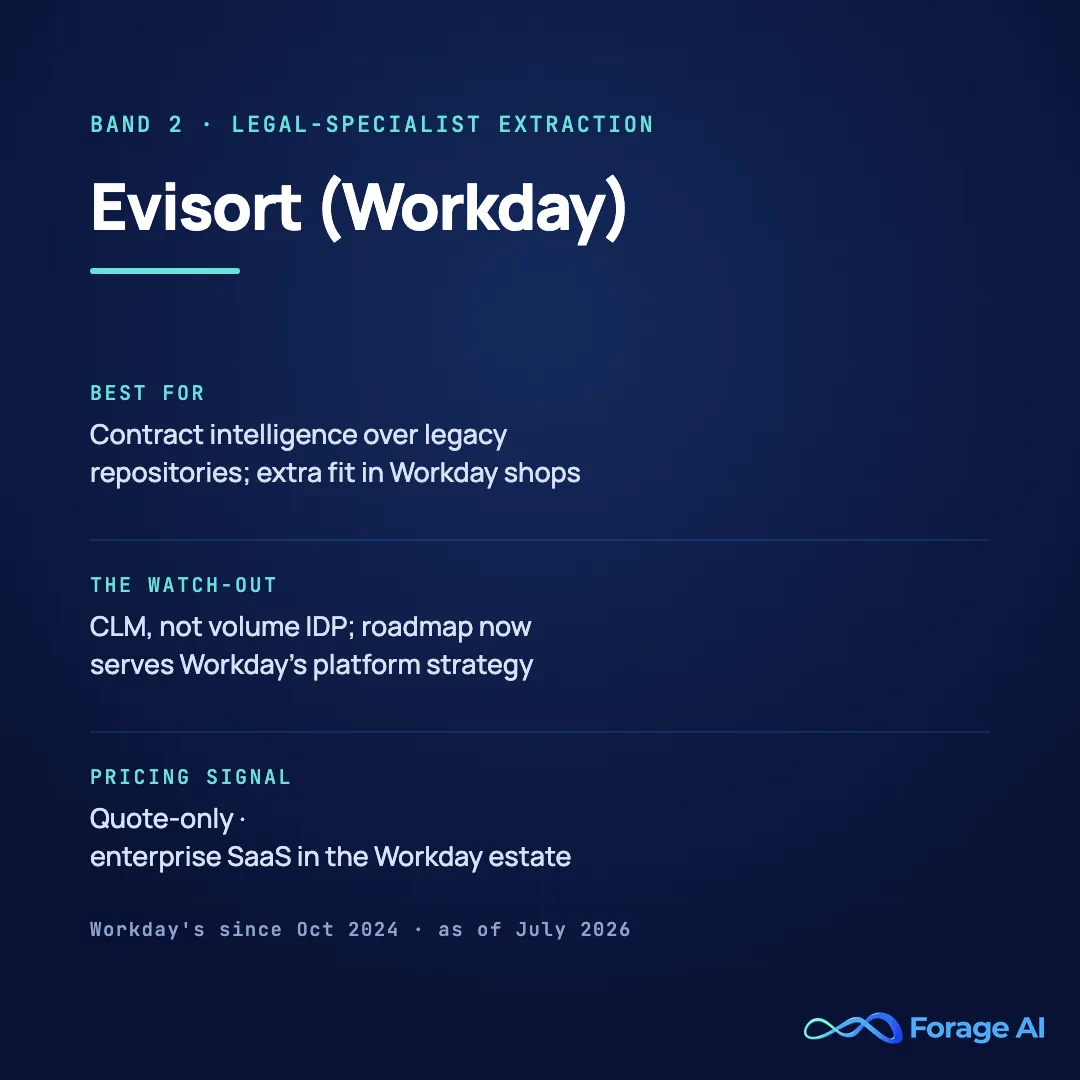
| What it is | AI contract intelligence, now sold as “Workday CLM, powered by Evisort”; CLM-resident, rostered for its extraction-first heritage |
| Best for | Enterprises, especially Workday shops, wanting AI-first contract repository plus extraction across legacy contracts |
| Legal documents handled | Contracts at repository scale; the “document intelligence” engine over legacy agreements is the praised core |
| HITL/QA and audit trail | Repository-review workflow; validation sits with the buyer’s legal team |
| Deployment & confidentiality posture | Enterprise SaaS inside the Workday estate; published posture facts only |
| Pricing (as of July 2026) | Quote-only |
| Watch-out | It is CLM, not volume IDP, and it now lives inside Workday’s ecosystem |
| Attribute | Detail |
|---|---|
| Signal type | Aggregated review base, the healthiest in Band 2 |
| Rating (accessed 2026-07-23) | G2 4.6 (n=91, listing renamed post-acquisition) and Capterra 4.8 (n=19), both corroborated via secondary sources |
| What the rating actually rates | The product, though the corpus largely predates the Workday integration |
| What users praise | AI extraction quality; support and implementation experience; contract search visibility (aggregated) |
| What users flag | Steep admin learning curve; integration limits; roadmap now serves Workday’s platform strategy (aggregated and structural) |
| Source | G2 and Capterra (secondary), Workday newsroom, SEC filing |
Evisort, founded 2016, built its reputation on document intelligence over legacy contracts, and it carried the strongest standalone review base among legal-specialist extraction tools when Workday announced the acquisition on September 17, 2024, completing it on October 8, 2024. The G2 listing now reads “Workday CLM, powered by Evisort,” which is itself a currency check for any list still ranking a standalone Evisort. The deal price is undisclosed; the citable number is the $311M acquisition-date fair value reported in Workday’s 10-Q (SEC). Analyst estimates of $250–300M exist but are estimates, and they are labeled that way.
For buyers, the review corpus (4.6 on 91 G2 reviews) genuinely rates the product’s extraction heritage, with the caveat that most of it predates the Workday era. The pre-acquisition customer list Workday’s announcement named, including Microsoft, McKesson, BNY Mellon, Western Union, and NetApp, is vendor-claimed and labeled as such. Aggregated flags center on the admin learning curve and integration limits, and the roadmap now serves Workday’s platform strategy, a structural fact rather than a criticism.
Best for enterprises that want AI-first contract intelligence over a legacy repository, with obvious extra fit inside Workday accounts. Watch-out: a standalone buyer in 2026 is buying a Workday product line, and standalone fit deserves a re-check at contract time.
5. LinkSquares
| Attribute | Detail |
|---|---|
| What it is | Post-signature contract intelligence for in-house teams: AI extraction (“Analyze”) over executed contracts plus drafting workflow (“Finalize”); CLM-resident |
| Best for | In-house legal teams wanting AI-searchable executed-contract repositories with drafting workflow |
| Legal documents handled | Executed contracts, including legacy repositories; built for in-house legal rather than procurement-first workflows |
| HITL/QA and audit trail | Legal team reviews extracted terms in the repository; no managed QA layer |
| Deployment & confidentiality posture | Enterprise SaaS; published posture facts only |
| Pricing (as of July 2026) | Quote-only, annual contracts |
| Watch-out | CLM category, not pipeline IDP; the headline rating is a seller aggregate until resolved |
| Attribute | Detail |
|---|---|
| Signal type | Aggregated review base, seller-level |
| Rating (accessed 2026-07-23) | G2 4.7 (n=427), a seller-level aggregate across LinkSquares products; per-product counts unresolved |
| What the rating actually rates | The LinkSquares seller across Analyze and Finalize, not one product; the per-product denominator is the open question |
| What users praise | AI-extracted terms and dates across legacy contracts; sustained satisfaction standing over years (aggregated and platform signals) |
| What users flag | Extraction accuracy on unusual or scanned legacy contracts (editorial, not yet corroborated against fetched reviews); pricing opacity (structural) |
| Source | G2 (secondary), BusinessWire funding PR |
LinkSquares, founded 2015 in Boston, raised a $100M Series C on April 1, 2022 at a reported ~$800M valuation (BusinessWire). Its core promise is post-signature visibility: point Analyze at years of executed contracts and get searchable, AI-extracted terms and dates without re-reading the archive. The design center is in-house legal rather than procurement, which shows in the praised use cases: renewal dates, obligations, and terms surfaced across legacy paper.
The product split matters for scoping: Analyze reads executed agreements and extracts terms and dates; Finalize handles drafting workflow upstream. Total funding stood at $161.5M as of the Series C (BusinessWire), a scale that answers the viability question smaller Band 3 vendors face.
The rating discipline matters here more than the rating. The visible G2 4.7 sits on 427 reviews at seller level, spanning those products; this article prints it labeled that way rather than as a product score. The vendor’s “Contract Management Leader, 17 consecutive quarters” line is a vendor-reported claim about G2 data, treated accordingly. Best for in-house teams whose contracts are already signed and scattered. Watch-out: it is a CLM-resident tool for legal users, not a volume pipeline, and the per-product review denominator is unresolved as of July 2026.
6. Lexion (DocuSign)
| Attribute | Detail |
|---|---|
| What it is | Extraction-first CLM absorbed into DocuSign: Lexion’s AI now lives inside the DocuSign IAM/CLM platform |
| Best for | Enterprises standardizing agreement workflow end to end on the DocuSign estate who want Lexion-heritage AI included |
| Legal documents handled | Agreements across the DocuSign workflow estate |
| HITL/QA and audit trail | Workflow-embedded review by the buyer’s team; audit features at platform level |
| Deployment & confidentiality posture | Public-company SaaS platform; published posture facts only |
| Pricing (as of July 2026) | CLM is quote-only; eSignature tiers are published, CLM is not |
| Watch-out | You are buying DocuSign’s platform roadmap, not the startup that ranking lists still describe |
| Attribute | Detail |
|---|---|
| Signal type | Aggregated review base; count in conflict |
| Rating (accessed 2026-07-23) | DocuSign CLM rates G2 4.3; the review count conflicts across snapshots, so no count prints until resolved |
| What the rating actually rates | DocuSign CLM the product; the 3,395-review DocuSign seller aggregate is eSignature-heavy and never appears here as a CLM rating; Lexion’s own pre-acquisition corpus is historical |
| What users praise | Deep integration with the eSignature estate legal teams already run; workflow maturity at enterprise scale; Lexion-derived AI agreement analysis now embedded (aggregated; the corpus predates much of the AI work) |
| What users flag | Implementation complexity and cost for full CLM; the 4.3 sits visibly below CLM leaders on the same grid; AI depth versus AI-native rivals still maturing (aggregated and editorial) |
| Source | G2 (secondary), DocuSign investor relations |
Lexion is the entry for the mis-landed searcher who remembers the Seattle startup. Founded 2018 by Gaurav Oberoi, Emad Elwany, and James Baird, who met at the Allen Institute for AI (GeekWire), it raised roughly $36M before DocuSign announced the $165M cash acquisition on May 6, 2024 (DocuSign IR). The founders joined DocuSign product and engineering, and the AI was folded into the IAM/CLM platform.
What you can buy in 2026 is therefore DocuSign CLM with Lexion heritage inside. The grid position is honest: a 4.3 that trails CLM leaders in the 4.6–4.7 range, with a review count this article declines to print until the conflict across snapshots resolves. The pricing asymmetry is a useful tell about the sales motion: eSignature tiers are published, CLM is not, as of July 2026. And because the Lexion-derived AI shipped recently, the review corpus that exists mostly predates the capability a 2026 buyer would be buying it for.
Best for enterprises already standardizing on DocuSign agreements end to end. Watch-out: the startup is gone; evaluate the platform, its implementation weight, and its roadmap as DocuSign’s.
Band 3: General IDP with legal strength
Horizontal IDP engines that handle legal documents among many: proven extraction at volume, configured rather than born for legal. The trade is engine strength and real review corpora against configuration burden and no legal-native clause intelligence; the buyer builds the legal layer. One band-wide rule applies to the denominators: the biggest brand names here carry ratings that do not belong to the product on this list, and each entry’s second table says what its number actually rates.
7. ABBYY (FlexiCapture / Vantage)
| Attribute | Detail |
|---|---|
| What it is | The IDP incumbent, founded 1989 by David Yang: FlexiCapture (classic capture) and Vantage (cloud IDP with “AI skills”) |
| Best for | Enterprises with high-volume, repeatable legal document flows wanting a proven, deployable IDP engine with on-prem options |
| Legal documents handled | Contracts, case files, court records, corporate filings at volume; a general engine legal ops teams configure, not legal-native AI |
| HITL/QA and audit trail | Verification workflows configurable in-platform; who staffs them is the buyer’s decision |
| Deployment & confidentiality posture | Cloud, hybrid, and on-prem options; on-prem depth is a long-standing strength; published posture facts only |
| Pricing (as of July 2026) | Quote-only enterprise |
| Watch-out | Your team builds and trains the legal “skills”; cost and configuration burden are the recurring reviewer themes |
| Attribute | Detail |
|---|---|
| Signal type | Aggregated review bases; product-level count in conflict |
| Rating (accessed 2026-07-23) | G2 IDP-product 4.2, count unresolved (snapshots conflict), so no count prints; Capterra FlexiCapture 4.2 (n=17, secondary); Gartner Peer Insights listings exist but their figures are unverified in this research pass, so none prints |
| What the rating actually rates | ABBYY’s IDP line. The visible G2 seller score of 4.5 on 364 reviews is dominated by FineReader, a desktop OCR product, and is not used here as an IDP rating |
| What users praise | Accuracy across structured and unstructured formats; production stability (a “90%+ touchless rate” quote is a single-reviewer anecdote, typed as such); deep configurability and on-prem deployment (aggregated) |
| What users flag | Price (“costs more than simpler alternatives,” recurring); FlexiCapture configuration complexity and learning curve (aggregated) |
| Source | G2, Capterra, Gartner Peer Insights listings (all secondary this pass) |
ABBYY is the roster’s clearest case of the seller-aggregate trap. The number a casual search surfaces is 4.5 across 364 G2 reviews, and it mostly rates FineReader, the desktop OCR product. The IDP line the legal buyer would actually evaluate rates 4.2 on a count this article leaves unresolved rather than guesses. Headquarters moved to Austin, Texas in October 2024, with Marlin Equity Partners the largest shareholder since 2021 (reported via secondary sources).
On capability, the aggregated themes are consistent: strong accuracy across mixed formats, production stability, and genuine on-prem depth, priced and configured like the enterprise platform it is. The product pair matters for evaluation: FlexiCapture is the classic template-and-ML capture line reviewers flag for configuration complexity, while Vantage is the current cloud IDP platform with an “AI skills” marketplace; Capterra’s FlexiCapture listing rates 4.2 on 17 reviews (secondary). Pricing is quote-only enterprise.
Best for high-volume, repeatable legal document flows with an ops team that will own configuration. Watch-out: the legal layer is built, trained, and maintained by you, and reviewers keep flagging cost.
8. Hyperscience
| Attribute | Detail |
|---|---|
| What it is | Enterprise IDP (platform: Hypercell) for high-volume records, forms, and handwriting; founded 2014, New York |
| Best for | Enterprises and government-adjacent legal operations digitizing high-volume case files and records with handwriting |
| Legal documents handled | Case files, claims, records at volume, including handwriting and messy forms; used more for records volume than contract intelligence |
| HITL/QA and audit trail | Human-in-the-loop QA workflow built into the platform, the band’s closest analogue to the audit bar’s HITL criterion |
| Deployment & confidentiality posture | Enterprise deployment (including via AWS Marketplace); published posture facts only |
| Pricing (as of July 2026) | Quote-only |
| Watch-out | Built for back-office volume, not lawyer-facing contract intelligence; expect an enterprise sales and deployment cycle |
| Attribute | Detail |
|---|---|
| Signal type | Aggregated review base; vendor benchmark claims excluded |
| Rating (accessed 2026-07-23) | G2 4.6 (n=54, secondary) |
| What the rating actually rates | The product; a clean denominator, which is worth saying in this band |
| What users praise | Easier to use, set up, and administer than ABBYY per G2 comparison synthesis; handwriting accuracy at volume (vendor-curated quote roundups exist and are treated cautiously) |
| What users flag | Enterprise-weight deployment rather than a light self-serve tool; quote-only pricing (structural) |
| Source | G2 (secondary), funding trackers (~$439M total raised, tracker-reported) |
Hyperscience is the records-volume pick: case files, claims, and forms at scale, with handwriting handled better than most of the band. Founded in 2014 in New York and now shipping under the Hypercell platform brand, it ships with a built-in human-in-the-loop QA workflow, which maps directly onto the audit bar’s first criterion, though the humans staffing it are still yours.
This entry is also the article’s sharpest example of vendor-claim discipline. The figures “67% lower error rates,” “10x faster,” and “90% cost reduction” circulate on comparison pages around Hyperscience; all are vendor-claimed, none is review-sourced, and none is graded on here. The review-sourced signal is a G2 4.6 on 54 reviews with a clean denominator, and the aggregated comparison verdicts run in its favor on ease of setup and administration versus ABBYY. Funding stands near $439M total, tracker-reported; distribution includes an AWS Marketplace listing with non-public contract pricing.
Best for high-volume records digitization under enterprise procurement, particularly where handwriting volume defeats lighter tools. Watch-out: it is back-office infrastructure with an enterprise deployment cycle, not a contract-intelligence tool.
9. Nanonets
| Attribute | Detail |
|---|---|
| What it is | Self-serve AI-OCR/IDP: custom extraction models plus workflow automation; founded 2017, San Francisco |
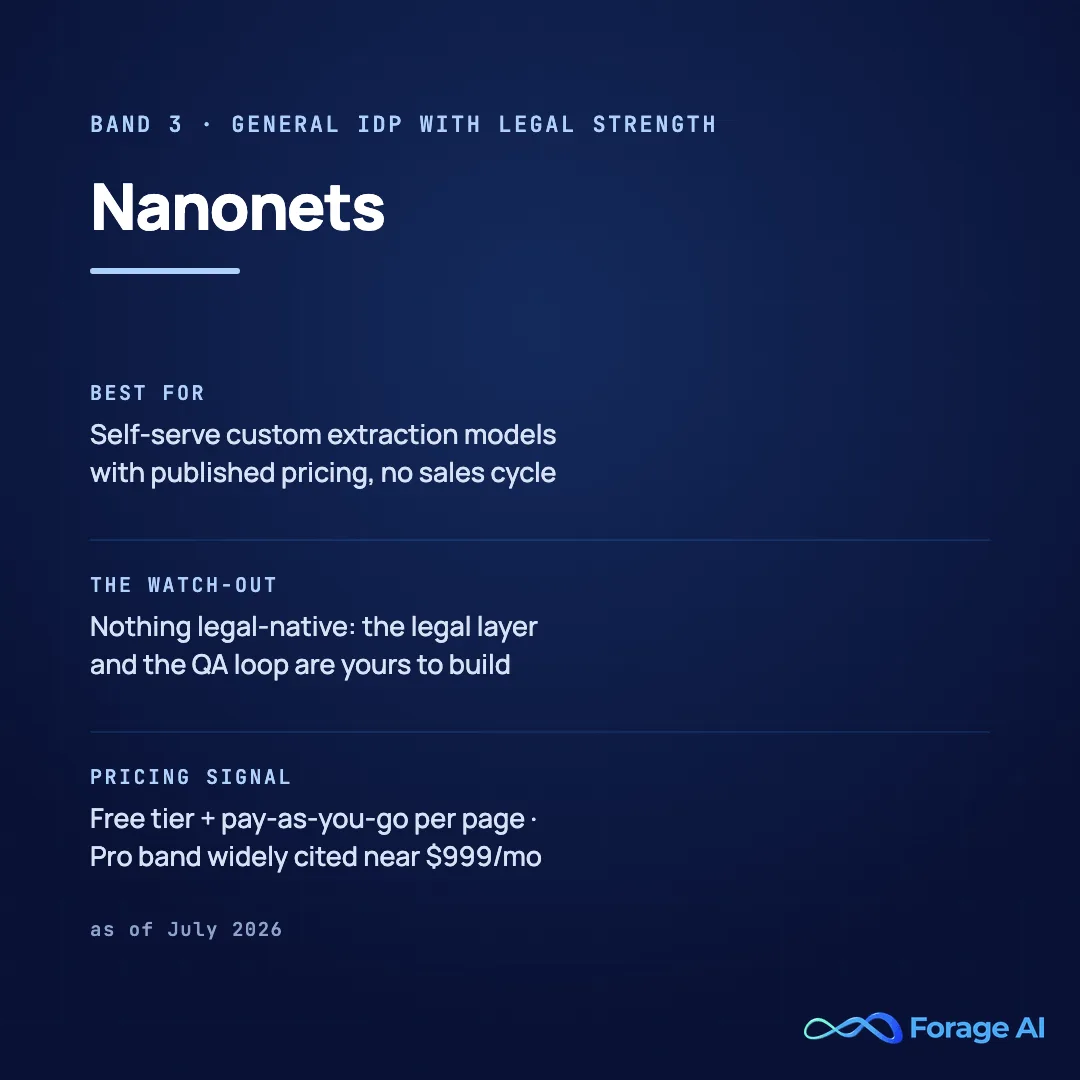
| Best for | Teams that want to build their own extraction models for legal paperwork quickly, with published pricing and no enterprise sales cycle |
| Legal documents handled | Legal documents as custom models: a general engine, not legal-tuned; no legal clause library |
| HITL/QA and audit trail | Buyer-run verification; initial model training needs manual checking per reviewers |
| Deployment & confidentiality posture | SaaS-first; on-prem depth called out as a gap by reviewers; published posture facts only |
| Pricing (as of July 2026) | Published self-serve: free tier + pay-as-you-go per page + Pro tier (~$999/mo band widely cited) |
| Watch-out | No legal-specific clause library; the legal layer and the QA bar are yours to build |
| Attribute | Detail |
|---|---|
| Signal type | Aggregated review base, the healthiest dual-platform base among pure IDP entries |
| Rating (accessed 2026-07-23) | Capterra 4.9 (n=80, fetched directly) and G2 4.8 (n=96, secondary) |
| What the rating actually rates | The product, on two independent platforms with real counts |
| What users praise | Ease of use (“one of the easiest softwares to use in the industry,” Capterra, fetched); self-learning accuracy; support responsiveness (aggregated) |
| What users flag | Mixed pricing sentiment; initial model training needs manual verification; export options and on-prem depth gaps (aggregated) |
| Source | Capterra (fetched directly), G2 (secondary), funding press ($42M total; $29M Series B 2022 led by Accel) |
Nanonets is the roster’s self-serve benchmark on two counts. First, evidence: Capterra 4.9 on 80 reviews fetched directly, plus G2 4.8 on 96, the healthiest dual-platform base among the pure IDP entries here. Second, transparency: it is one of only two roster entries with genuinely published pricing, from a free tier through pay-as-you-go to a Pro band.
The honest boundary is that nothing about it is legal-native. You train custom models on your deeds, filings, or contracts, you verify the early output (reviewers note initial training needs manual verification), and you own the QA loop that legal’s audit bar demands. The company profile supports the self-serve read: founded 2017 in San Francisco, $42M raised in total with a $29M Series B in 2022 led by Accel, and a product motion built around signup rather than sales calls.
Best for teams that want working extraction on legal paperwork this quarter without an enterprise sales cycle. Watch-out: reviewers flag on-prem and export depth, pricing sentiment is mixed, and the legal layer is entirely configured, not built in.
10. Docsumo
| Attribute | Detail |
|---|---|
| What it is | Mid-market IDP focused on lending, insurance, and financial documents, applicable to legal-ops paperwork; founded 2019 |
| Best for | Mid-market ops teams processing standardized legal-adjacent paperwork who want fast setup without enterprise procurement |
| Legal documents handled | Loan documents, KYC, standardized filings, and similar legal-adjacent paperwork; not contract intelligence |
| HITL/QA and audit trail | Buyer-run review of extracted fields; straight-through rates depend on document standardization |
| Deployment & confidentiality posture | SaaS; published posture facts only |
| Pricing (as of July 2026) | Published tiers historically (~$500/mo Growth band per third-party roundups); treat as quote-adjacent until verified |
| Watch-out | A seed-scale vendor enterprise legal buyers will diligence for viability |
| Attribute | Detail |
|---|---|
| Signal type | Aggregated review base; negative themes not yet directly captured |
| Rating (accessed 2026-07-23) | G2 4.7 (n=67, secondary); no Capterra rating captured this pass, so none prints |
| What the rating actually rates | The product |
| What users praise | Value for money; high auto-match and straight-through rates (a “>98% auto match” figure is a single-reviewer anecdote, typed as such) |
| What users flag | Negative review themes were not directly captured in this research pass, so the con column is incomplete; template and edge-case tuning on unusual documents (editorial, not yet corroborated against fetched reviews) |
| Source | G2 (secondary), Tracxn funding data |
Docsumo’s structural fact doubles as its diligence question: roughly $3.72M raised across three rounds (Tracxn), a fraction of what every other Band 3 vendor carries. That is not a flaw; it is a fact an enterprise legal buyer prices in as vendor-viability risk, stated here the same way a review count is. Founded in 2019, its marketing center of gravity is lending, insurance, and financial documents, which is exactly the standardized-paperwork profile where its straight-through rates hold up.
The evidence that exists is favorable: 4.7 on 67 G2 reviews, with value for money the recurring theme and straight-through processing rates the recurring praise (the “>98% auto match” figure is one reviewer’s anecdote, typed as such in the table). Later funding rounds included customer-investors, tracker-reported, a small signal that existing users doubled down. The gap in the evidence is stated in the table: negative themes were not directly captured this pass, so the con column reads incomplete rather than clean.
Best for mid-market teams with standardized, legal-adjacent paperwork and no appetite for enterprise procurement. Watch-out: viability diligence belongs in the evaluation, the published-tier pricing needs a live check, and the review base, while solid, is a fraction of the incumbents’.
11. Rossum
| Attribute | Detail |
|---|---|
| What it is | Transactional-document IDP, purpose-built for invoices, POs, and AP/AR; founded 2017, Prague, by Tomáš Gogar, Petr Baudiš, and Tomáš Tunys |
| Best for | Legal and finance ops automating transactional paperwork (billing, vendor invoices) adjacent to the legal workflow |
| Legal documents handled | Legal-ops billing and vendor paperwork; NOT contracts, case files, or diligence: the fit is real but narrow |
| HITL/QA and audit trail | Queue-based human validation in-product; buyer staffs it |
| Deployment & confidentiality posture | SaaS; published posture facts only |
| Pricing (as of July 2026) | Quote-only; tiers exist without public prices |
| Watch-out | Invoice-first design: for contracts or court records, this is the wrong entry in the right band |
| Attribute | Detail |
|---|---|
| Signal type | Aggregated review base with a corpus caveat |
| Rating (accessed 2026-07-23) | G2 4.5 (n=127, secondary) and Capterra 4.3 (n=13, fetched directly) |
| What the rating actually rates | The product in AP and invoice use; the corpus says little about contracts, court records, or diligence work |
| What users praise | Fast onboarding and user-friendliness (“any user learns easily how to use it really quickly,” Capterra, fetched); accurate invoice extraction; responsive support (aggregated) |
| What users flag | Cost (“prohibitive, particularly for small businesses,” Capterra, fetched); non-English documents and complex or unusual layouts degrade accuracy; setup and configuration tedium (aggregated) |
| Source | G2 (secondary), Capterra (fetched directly), funding press (>$100M raised by Oct 2021) |
Rossum stays on the roster precisely because its boundary is honest. We map that boundary and the field around it in our comparison of Rossum alternatives. Founded in Prague in 2017 by three PhD students, it is a genuinely strong transactional-document engine, with more than $100M raised by October 2021 (including a $100M Series A led by General Catalyst) and a real 127-review G2 base, and that base is almost entirely AP and invoice use. Its ratings therefore tell a legal buyer about billing paperwork, not about contracts or case files.
That makes the fit narrow and real: legal-ops billing, vendor invoices, and the transactional paper that surrounds legal work. Reviewers’ flags travel too: non-English documents and unusual layouts degrade accuracy, accuracy dips on infrequently used queues, setup has its tedium, and cost recurs as a complaint, with one fetched Capterra reviewer calling it “prohibitive, particularly for small businesses.” Onboarding speed is the counterweight the same corpus keeps praising.
Best for the billing-and-vendor-paperwork slice of legal operations, where its 127-review base actually applies. Watch-out: if your documents are contracts, court records, or diligence sets, every other entry in this band fits better.
12. UiPath Document Understanding
| Attribute | Detail |
|---|---|
| What it is | IDP module of the UiPath automation platform (UiPath, Inc., NYSE: PATH); not a standalone product |
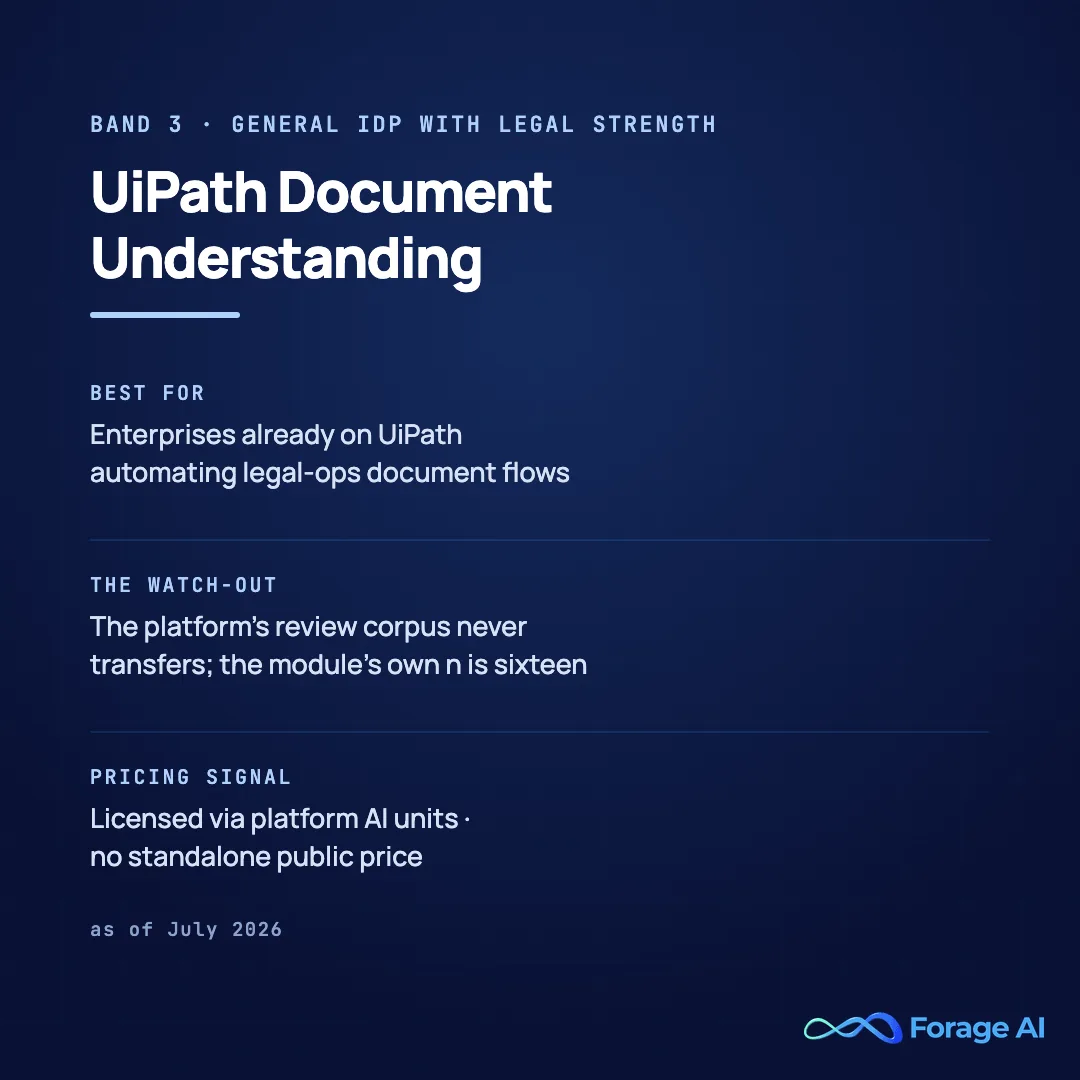
| Best for | Enterprises already on UiPath automating legal-ops document flows end to end |
| Legal documents handled | Legal-ops document flows configured inside UiPath workflows; general engine, not legal-native |
| HITL/QA and audit trail | Human-in-the-loop validation stations for low-confidence fields; buyer staffs them |
| Deployment & confidentiality posture | Deployed within the UiPath platform estate; published posture facts only |
| Pricing (as of July 2026) | Licensed via UiPath platform consumption (“AI units”); no standalone public price |
| Watch-out | The impressive UiPath review numbers belong to the RPA platform; the module you are evaluating has sixteen reviews |
| Attribute | Detail |
|---|---|
| Signal type | Aggregated review base, small n, module-level |
| Rating (accessed 2026-07-23) | G2 Document Understanding product listing: 4.6 (n=16), the right listing, printed with its n visible |
| What the rating actually rates | The DU module specifically; the UiPath platform’s thousands of reviews rate a different product and never transfer |
| What users praise | Meets business needs versus other IDP tools; active learning reduces annotation and training effort; native fit with existing UiPath RPA workflows (aggregated, small n, typed as such) |
| What users flag | High dependence on human-in-the-loop for low-confidence fields limits straight-through rates (reviewer theme); requires the UiPath platform context (structural) |
| Source | G2 product listing (secondary) |
Document Understanding is the article’s cleanest denominator case. UiPath the platform carries thousands of reviews; Document Understanding, the product a legal buyer would actually evaluate, carries sixteen, rating 4.6. Both numbers are real. Only one of them describes this module, and ranking pages that decorate DU with the platform’s corpus are measuring a different product.
One reviewer theme deserves an honest sentence: DU’s dependence on human-in-the-loop review for low-confidence fields is flagged as a cost by RPA-minded reviewers, while legal’s audit bar treats exactly that dependence as a requirement. Whether it is a bug or a feature depends on which vertical you buy for. The small corpus also praises active learning, which cuts annotation and training effort and lets non-ML users train models, plus the native fit with existing UiPath RPA workflows, which is the real reason this entry exists: nobody buys DU standalone, because it is not sold standalone.
Best for enterprises already running UiPath that want document flows inside the same estate. Watch-out: licensing runs through platform AI units with no standalone public price, and the evidence base is sixteen reviews, not thousands.
Quick Summary
Q: Which general IDP platforms are strongest for legal documents?
A: Six, with different centers of gravity: ABBYY for configurable enterprise capture with on-prem depth, Hyperscience for high-volume records and handwriting, Nanonets for self-serve speed with published pricing and the band’s healthiest review base (Capterra 4.9, n=80), Docsumo for mid-market value, Rossum for transactional paperwork only, and UiPath Document Understanding for existing UiPath estates. In this band the denominators matter most: the biggest brand names carry ratings that belong to parent platforms or seller aggregates, not the product you would actually buy.
Band 4: Cloud building blocks
Extraction APIs you build a legal pipeline on: the cheapest entry point and the most engineering. The trade, stated plainly: published per-page pricing and hyperscaler scale against DIY everything legal actually grades on, because the QA layer, privilege plumbing, audit trail, and validation are all yours to build. Google’s Document AI belongs in this band conceptually, but our evidence file carries no researched review base for it, and under this article’s two-table standard that means an honest entry cannot be built; it is named here rather than fabricated, the same bar applied to every cut.
13. Azure AI Document Intelligence
| Attribute | Detail |
|---|---|
| What it is | Microsoft’s cloud extraction API, renamed from Form Recognizer in 2023: prebuilt models including a contract model, plus custom model training |
| Best for | Engineering teams building custom legal-document pipelines inside the Azure estate |
| Legal documents handled | Contracts via the prebuilt model; other legal document types via custom training; accuracy drops on low-quality scans and handwriting per reviewers |
| HITL/QA and audit trail | None supplied: validation, review, and audit trail are the buyer’s builds |
| Deployment & confidentiality posture | Azure cloud service; posture is whatever your Azure architecture provides, plus Microsoft’s published platform facts |
| Pricing (as of July 2026) | Published pay-per-page consumption; rates vary by model and region on the Azure pricing page (as of July 2026) |
| Watch-out | An API, not a solution: the pieces legal grades on are all yours to build |
| Attribute | Detail |
|---|---|
| Signal type | Aggregated review base, small for a hyperscaler |
| Rating (accessed 2026-07-23) | G2 4.4 (n=19, secondary) |
| What the rating actually rates | The service; the base is small because reviews pool at the Azure platform level, an absence-adjacent fact stated as such |
| What users praise | Customizable extraction adaptable across use cases; tight integration with the rest of the Azure ecosystem (aggregated) |
| What users flag | Costs scale quickly at volume; prebuilt models weak on uncommon document types; accuracy drops on low-quality scans and handwriting; steep learning curve for custom models (aggregated) |
| Source | G2 (secondary), Azure pricing documentation |
Azure AI Document Intelligence is the realistic starting point for a Microsoft-estate engineering team: a prebuilt contract model, custom training for everything else, and per-page pricing you can model in a spreadsheet. That is the whole offer, and its edges are visible in the review themes: uncommon document types need custom training, handwriting and poor scans degrade output, and consumption costs climb with volume.
The audit-bar view is the decision-relevant one. Nothing in the API validates a low-confidence field, traces an extraction to a page for opposing counsel, or supplies the confidentiality plumbing a legal workflow needs; each of those is a separate internal build with an ongoing owner. The review base is small for a hyperscaler service (n=19) because reviews pool at the Azure platform level, an absence-shaped fact rather than a verdict. One orientation note for anyone comparing older lists: this is the product previously called Form Recognizer, renamed in 2023.
Best for engineering teams that want pipeline control inside Azure, with the prebuilt contract model as a genuine head start. Watch-out: you are buying extraction, not a legal document processing operation.
14. AWS Textract
| Attribute | Detail |
|---|---|
| What it is | AWS’s OCR and structure-extraction service (GA 2019): text, forms, tables, and queries; Bedrock adds LLM-based extraction patterns |
| Best for | Engineering teams building custom legal-document pipelines on AWS |
| Legal documents handled | Any document as raw text, forms, and tables; no legal models; handwriting and complex layouts have limits per reviewers |
| HITL/QA and audit trail | None supplied: classification, validation, QA, and audit trail are separate builds |
| Deployment & confidentiality posture | AWS cloud service; posture is your AWS architecture plus AWS’s published platform facts |
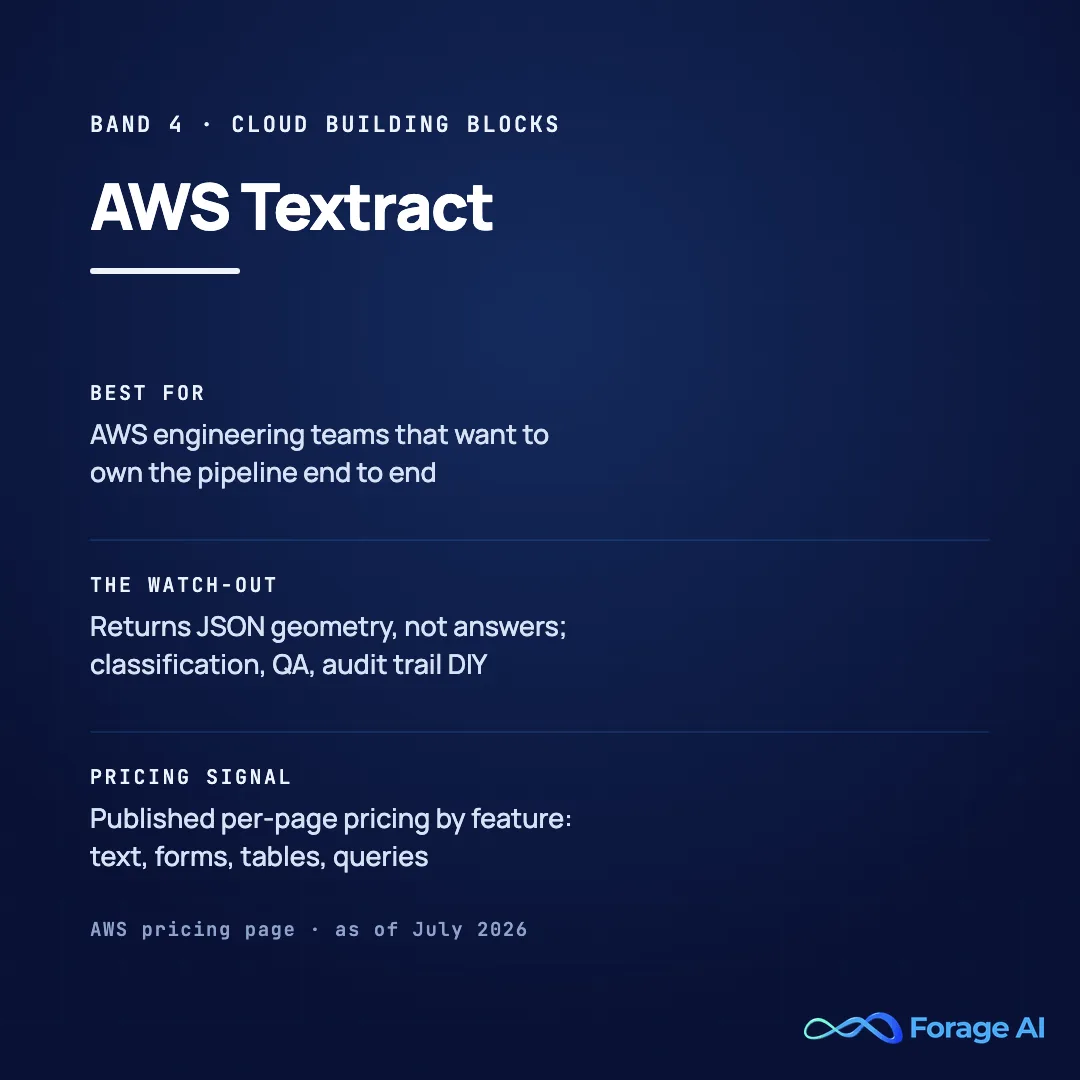
| Pricing (as of July 2026) | Published per-page API pricing by feature (text vs forms vs tables vs queries) on the AWS pricing page (as of July 2026) |
| Watch-out | What comes back is geometry, not answers |
| Attribute | Detail |
|---|---|
| Signal type | Aggregated review base; count in conflict |
| Rating (accessed 2026-07-23) | G2 4.3; the review count conflicts across snapshots, so no count prints until resolved |
| What the rating actually rates | Textract the OCR service, on a tiny base relative to actual usage because cloud-service reviews pool elsewhere |
| What users praise | Accurate OCR including forms and tables at scale; pay-per-use with no platform fee; AWS ecosystem integration (aggregated) |
| What users flag | Raw output needs significant post-processing; handwriting and complex-layout limits; multi-service cost assembly (Textract + Bedrock + storage) complicates forecasting (aggregated and structural) |
| Source | G2 (secondary), AWS pricing documentation |
Textract’s single most decision-relevant fact sits in its output format: the API returns JSON geometry, not business objects. Text, bounding boxes, key-value pairs, and tables come back accurately at scale, and turning them into “the indemnity cap in this contract is $2M” is your pipeline’s job. Bedrock adds LLM-based extraction patterns on top, with no per-feature review corpus for legal extraction on Bedrock, the same denominator logic as everywhere else in this article.
Cost forecasting deserves one honest sentence: per-page pricing by feature (text, forms, tables, queries) is published and genuinely cheap at entry, with pay-per-use and no platform fee among the aggregated praise themes, and a production legal pipeline assembles Textract with Bedrock, storage, and orchestration, which is where forecasting gets harder. The service has been generally available since 2019, and its review base stays tiny relative to actual usage because cloud-service reviews pool elsewhere, the same absence-shaped denominator as Azure’s.
Best for AWS engineering teams that want to own the pipeline end to end. Watch-out: classification, validation, QA, and the audit trail are separate builds, and legal’s bar makes those the expensive part.
Which solution for which legal documents?
Document type is the first routing variable, before features and before price. The router below is the article’s second signature asset.
Contracts are the only document type any of the 12 analyzed ranking pages maps to specific tools; case files, court records, corporate filings, deeds, and discovery productions go unmapped everywhere (SERP analysis, accessed July 2026).
| Document type | Best-fit band(s) | Representative picks | When NOT / boundary note |
|---|---|---|---|
| Contracts at volume (diligence, repositories) | Band 2, or Band 1 for mixed-type volume | Kira for M&A diligence; Evisort, LinkSquares, Lexion for repositories; Forage AI managed | Not a copilot: one document at a time does not scale |
| Case files and pleadings | Band 3, or Band 1 | Hyperscience for volume and handwriting; ABBYY; Forage AI managed | Not contract-intelligence tools |
| Discovery productions | NONE of this roster | Relativity, Everlaw (e-discovery/TAR) | Court rules and defensibility make this its own procurement universe |
| Court records and dockets at scale (PACER) | Band 1 or Band 3 + engineering; Band 4 if building | Forage AI managed; ABBYY; Azure/Textract for builders | Not lawyer-facing review tools |
| Corporate filings and registries (EDGAR/SEC) | Band 3 or Band 1; Band 4 for engineering teams | ABBYY, Nanonets; Forage AI managed | Not CLM repositories |
| Deeds and leases | Band 2 (lease-abstraction heritage) or Band 1; Band 3 configurable | Kira (lease anecdotes, n=3 vintage); Forage AI managed (deeds a named use case) | Not transactional-document engines |
| Legal-ops transactional paperwork (billing, vendor invoices) | Band 3’s transactional slot | Rossum; Docsumo; Nanonets | Not Band 2: contract intelligence is the wrong engine for invoices |
Routing reflects evidence in the entries above; accessed 2026-07-23. Forage AI rows reflect company-published use cases.
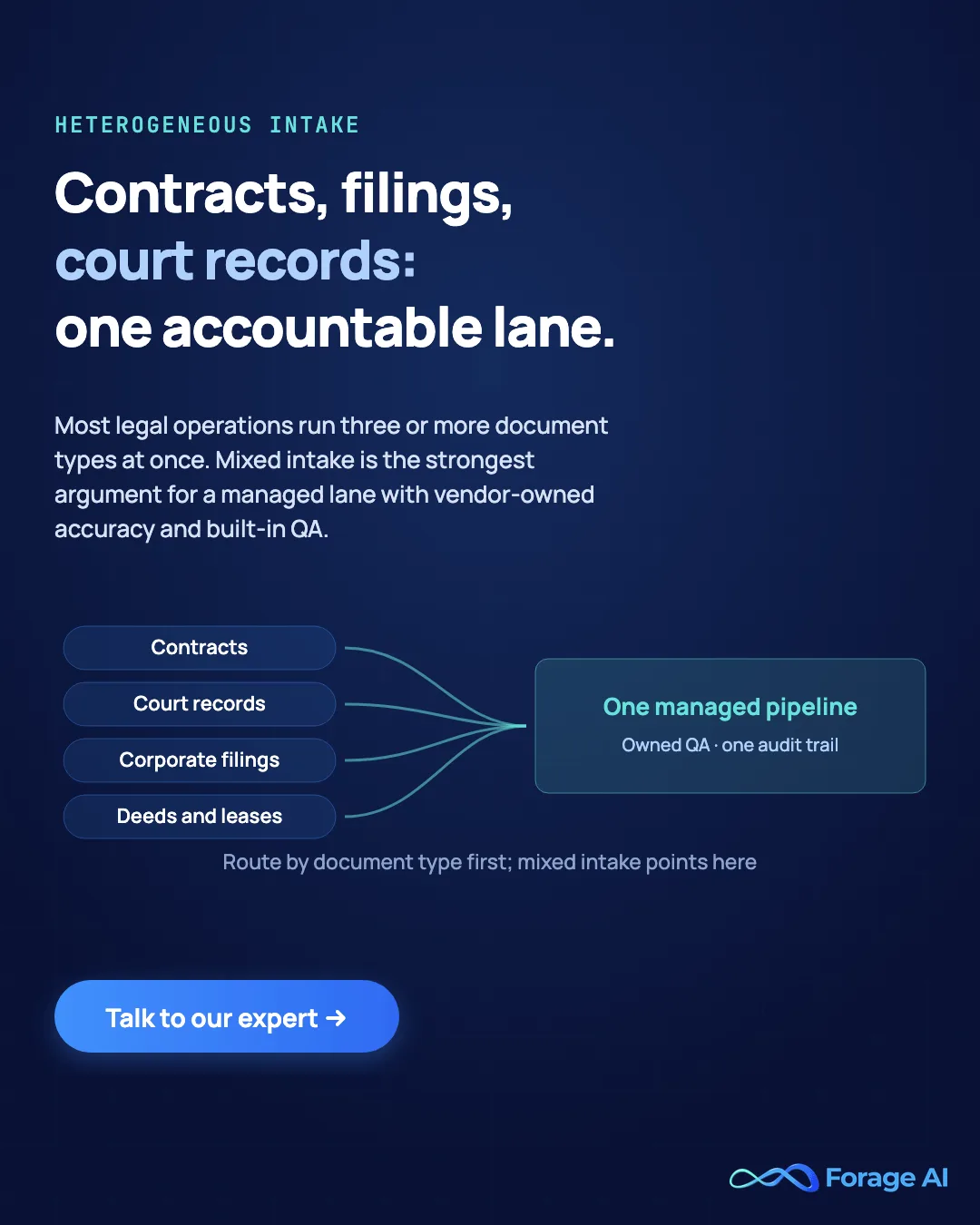
Three reasoning rules fall out of the table. If your mix is contracts-only, Band 2 earns its premium. If your intake is heterogeneous volume with a real audit bar, the choice is Band 1 or a Band 3 platform plus your own QA team, because most legal operations run three or more document types at once, and mixed intake is the strongest argument for either a managed lane or a platform with owned QA. If you have engineers and the appetite to own a pipeline, Band 4 is the cheapest entry and the largest build.
The rows also expose where the SERP’s contract-only framing fails buyers. Court records at PACER scale and corporate filings at EDGAR scale are volume extraction jobs with no contract-intelligence answer, which is why their rows route to general IDP, managed processing, an engineering build, or to the legal data providers that sell this material already structured, rather than to Band 2’s better-known names.
Two boundary notes carry the negative knowledge. Discovery productions do not belong in an IDP pipeline: court rules, TAR case law, and defensibility make e-discovery its own procurement universe, and that row is the most expensive category error on this page. And handwriting or low-quality scans split every row: exactly where Hyperscience earns its slot and Azure’s reviewers report degradation.
How do you choose a legal document processing solution?
Four questions, asked in order, settle most evaluations.
- Which lane are you actually in? Run the six-lane check first. If your requirement is storage, workflow, drafting, research, or discovery, five other categories serve it better than anything ranked here.
- Which document types, at what volume? The doc-type router above is the map. Contracts-only points one way; heterogeneous intake points another.
- What team shape do you have? No engineers and no appetite to own QA points to the managed lane (Band 1) or the most self-serve SaaS IDP; a legal-ops admin team can run Band 2 or Band 3; an engineering team can own Band 4.
- How hard is your audit bar? Filings and diligence make human-in-the-loop non-negotiable; internal ops paperwork can run softer.
Pricing models deserve their own minute.
3 of 12 ranking pages analyzed for this keyword display any pricing information; none explains pricing models or maps model fit to volume profile (SERP analysis, accessed July 2026).
The models in this roster, as of July 2026: per-page consumption (the cloud APIs, Nanonets), per-user or per-seat (Kira’s listed vintage price; copilots generally), platform license plus consumption units (UiPath AI units), enterprise quote-only (most of Bands 2 and 3), and managed-service custom quotes (Band 1). Model-fit follows volume profile: spiky volume favors consumption over seats, while high steady volume makes quotes negotiable.
The TCO sentence, honestly: if the audit bar is real, the QA cost lives somewhere, in the license, your headcount, or the managed fee. Pilot on your worst documents (scans, handwriting, exhibits), demand field-level accuracy on your fields, and ask who owns the QA loop. Choosing by headline rating is the worst method available in this category; the denominators above showed why. For the fuller procurement checklist, our practitioner guide carries seven questions to put to any vendor on this list.
What the market data actually shows
Expert Insights
– The market’s clock runs on acquisition dates, not feature releases: between August 2021 and October 2024, Kira, Casetext, Lexion, and Evisort were absorbed by Litera, Thomson Reuters ($650M), DocuSign ($165M), and Workday respectively; every competing ranking list is stale on at least one of the four (primary press releases and filings; verified dates in Band 2).
– The category is graded nowhere it counts: zero of the 12 analyzed ranking pages grade vendors on HITL model, page-level cite-back, or privilege posture, and only one carries any comparison table. Neither G2 nor Capterra maintains a “legal IDP” category; the closest is Contract Analytics, one reason rosters of 5 to 20 tools mix as many as six product categories (SERP analysis, accessed July 2026).
– The denominator, not the star value, carries the information: four of the 14 entries print no review count because their counts conflict or pool at seller level, one prints a stale n=3 (Kira, 2019–2021, pre-acquisition), and one prints n=5 (Luminance). The sharpest pair: UiPath Document Understanding at 4.6 (n=16) against a parent-platform corpus in the thousands that never transfers, with ABBYY’s FineReader-dominated 4.5 (n=364) close behind (review platforms, accessed 2026-07-23).
– Funding and public reviews run close to inversely correlated in legal AI: the lane’s best-funded company carries two located reviews at an $11B valuation (March 2026, press-reported) and Luminance carries five, while the healthiest dual-platform base among pure IDP entries belongs to self-serve Nanonets (Capterra 4.9, n=80; G2 4.8, n=96, accessed 2026-07-23).
– The only band with fully published rates ships no QA: both hyperscaler APIs publish real per-page pricing while their located review bases are n=19 and a conflicted count, because cloud-service reviews pool at platform level; everything legal procurement grades, from HITL to the audit trail, is the buyer’s to build (G2 and vendor pricing pages, accessed 2026-07-23).
– “Partnering with Forage AI has been an absolute game-changer for our company. What sets Forage AI apart is that they don’t just provide off-the-shelf solutions; instead, they delve deep into our requirements.” (Rachel DeMel, Director of Product & Content Strategy, Expert Institute; named first-party client testimonial, legal sector, cleared for use.)
FAQ
What is legal document processing software, and how is it different from CLM or legal AI copilots?
Legal document processing software extracts structured data from legal documents at volume; CLM manages contract lifecycles with extraction as one feature inside a system of record; copilots review one document at a time inside a lawyer’s workflow. The misconception worth correcting: “legal AI” is six different product categories wearing one label, and only one of them is a processing pipeline.
Which document processing solution is best for law firms?
It depends on document type; any list that crowns a single winner without asking about your document mix is selling something. Contract volume routes to Band 2 (Kira, Evisort, LinkSquares, Lexion), records volume to Band 3 (Hyperscience, ABBYY), mixed intake with an audit bar to the managed lane (Band 1), and engineering-owned pipelines to the cloud APIs (Band 4).
Can AI accurately extract data from legal documents?
Yes, at high but not perfect rates; the operative question is what the number measures. Field-level accuracy tells you your error rate per extracted field, document-level accuracy leaves it unknown, and someone has to catch the residual errors either way. That is why legal’s audit bar makes human-in-the-loop review the standard for filings and diligence work.
How much does legal document processing software cost?
By model rather than by list price: per-page consumption for the cloud APIs and Nanonets, per-seat for specialist and copilot tools, platform consumption units for UiPath, enterprise quotes for most of Bands 2 and 3, and custom managed-service pricing for Band 1 (as of July 2026). Published numbers exist only where the entries above cite them; the rest is quote-only.
What about privilege and confidentiality when processing legal documents?
Grade vendors on factual posture: deployment options (on-prem, VPC, SaaS), published data-handling and retention statements, and certifications the vendor actually publishes. ABA Model Rule 1.6 grounds the confidentiality duty, and your obligations under it are a question for counsel. No tool makes a compliance promise for you, and this article makes none for any vendor.
Should a firm buy software or use a managed document processing service?
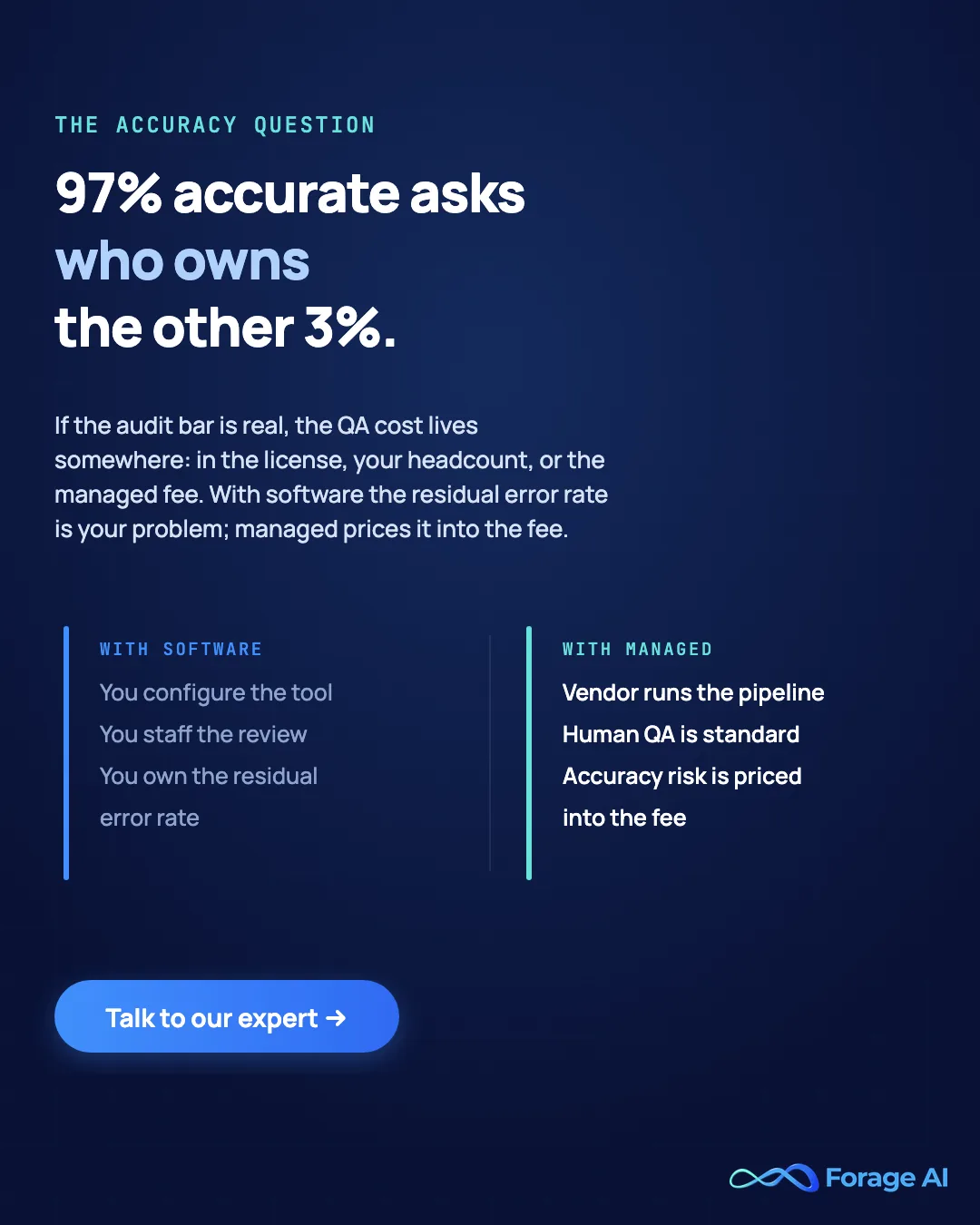
Software fits teams with the capacity to own configuration and QA; a managed service fits teams that want accountable, audit-ready output without building the capability. The trade is control against ownership of the accuracy risk: with software, the residual error rate is your problem; with a managed service, it is priced into the fee.
Conclusion
Fourteen solutions, four bands, pricing from per-page cents to six-figure enterprise quotes: the spread resolves into one variable, which is where the audit bar’s cost lands. Cloud APIs hand you all of it. Platforms hand you the QA loop and the audit trail. Legal-specialist tools clear the bar for one document family, contracts, and hand you the rest. The managed lane prices the cleared bar into the fee.
That is the reframe this market needs in 2026: “97% accurate” is a selling point in every other vertical; in legal it is a question, namely who owns the other 3%. Answer that before you shortlist, and the roster above sorts itself. For the architecture and procurement depth behind that question, start with our practitioner guide to legal document processing; if the answer is “someone accountable, not us,” Band 1 is the lane built for exactly that.
Related Articles
- Legal Document Processing: A Practitioner’s Guide: The architecture, privilege, and procurement depth behind this listicle’s grading criteria.
- Contract Data Extraction: How Legal Teams Automate Processing Without Losing Accuracy: The how-to complement to Band 2’s contract-intelligence entries.
- Best Insurance Data Extraction Software: The sibling vertical listicle, same banded-roster and honesty rules.
- Top 10 Document Processing Solutions for Financial Services in 2026: The financial-services sibling roster.
Sai is a data infrastructure enthusiast who has spent the past two to three years following the AI space closely, from the infrastructure layer to the fast-growing world of data for AI. He is genuinely curious about how modern data pipelines get built and where the data industry is heading, and he writes insightful pieces on the core topics that shape this niche.