
How Automated Web Scraping Companies Build Reliable QA Workflows
Imagine feeding your company’s multi-million-dollar AI model a daily diet of corrupted, mismatched, and incomplete data. For enterprises that treat web scraping as a simple “fetch and parse” script, this nightmare is often a reality.
In modern enterprises, web scraping is no longer just about writing a quick Python script. It is a complex data engineering and ETL pipeline that ensures high-quality data extraction. Websites constantly change their layouts, deploy aggressive bot software, and serve dynamic content, and without a robust Quality Assurance system, your data pipeline will inevitably break, taking your analytics and AI models down with it.
So, how do leading automated web scraping companies guarantee data accuracy at an enterprise scale? According to IBM’s 2026 Data Quality Research, 43% of operations leaders now rank it as a top priority. The secret lies in a multi-layered QA process.
Quick Digest
- Define first: Specify which fields are needed, what valid values look like, how complete the dataset must be and how often it refreshes, before the scraper is written, so validation becomes measurable instead of reactive.
- Three stages: Pre-scrape setup with fallback selectors and an anti-block strategy, real-time monitoring of response codes and CAPTCHA walls with automated retries, then post-scrape schema, type, deduplication and anomaly checks.
- Rules plus context: A rule-based check accepts a one-rupee luxury hotel room rate because it is a valid integer, while a context-aware validation engine flags it as a promotional glitch or a parsing error.
- Five signals: Completeness, validity, consistency, accuracy and freshness are the criteria every check maps back to, each catching a different class of failure.
- Humans as input, not labour: Reviewers resolve the flagged edge cases and those resolutions are converted into new automated rules, which is how review volume shrinks instead of growing with the dataset.
Why Define the Output Before Writing the Scraper?
The first meaningful shift is a process shift. Teams have to move on from thinking about collecting data to first defining it. Instead of extracting whatever is available, try to specify things like:
- Which fields are needed
- What valid values look like
- How complete should the dataset be
- How frequently should it update
Why is this so crucial? Without clear expectations, data validation in web scraping becomes reactive. With defined expectations, validation becomes measurable. Teams know what “correct” looks like and can detect when the system deviates from it.
Expert Insights
Defining the output first is what stops a small ingestion fault from compounding downstream. Nithya Sambasivan, Shivani Kapania, Hannah Highfill, Diana Akrong, Praveen Paritosh and Lora Aroyo of Google Research interviewed 53 practitioners building high-stakes AI systems and named the pattern in their paper "Everyone wants to do the model work, not the data work: Data Cascades in High-Stakes AI" (ACM SIGCHI, 2021). They define data cascades as "compounding events causing negative, downstream effects from data issues" and report that they are "pervasive (92% prevalence), invisible, delayed, but often avoidable". Invisible and delayed is the operative part: with no written expectation for a field, nothing in the pipeline is in a position to notice when that field quietly goes wrong, so the cost surfaces much later and much further down.
In practice, automated web scraping companies use this step to anchor their QA workflows because every validation rule, alert, and review process depends on these definitions.
The Three-Stage QA Architecture
Professional web scraping companies build QA into the very crux of the data pipeline. This is typically structured in three distinct stages.
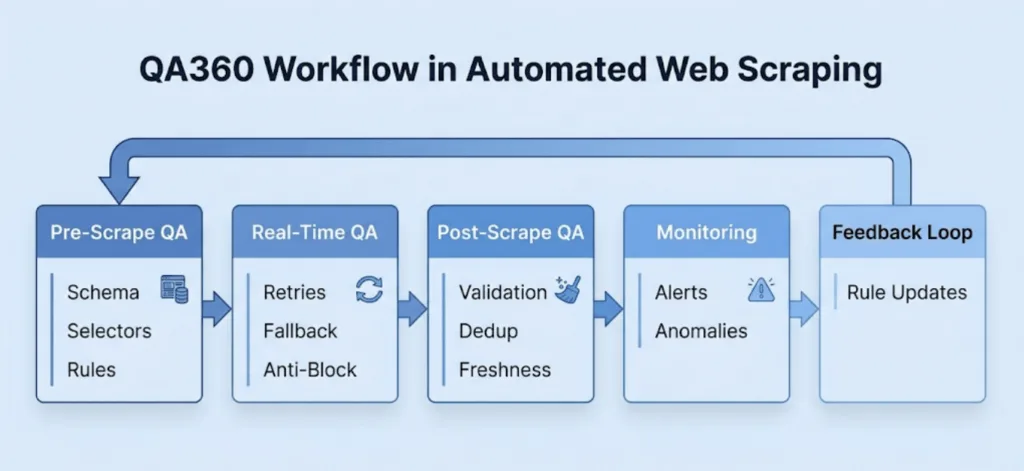
- Pre-Scrape Setup
The best way to handle an error is to prevent it from happening in the first place. Before a single byte of data is scraped, enterprise teams lay down a strong foundation that includes:
- Adaptive Selectors: Relying on a single CSS or XPath selector is a recipe for disaster. QA-driven setups build in fallback logic, ensuring that if a primary selector fails due to a minor UI update, the secondary and tertiary selectors immediately take over.
- Anti-Block Strategy: To deal with antibots, engineers configure intelligent IP rotation, header spoofing, and browser fingerprinting. This ensures the scraper is treated like a legitimate user rather than a suspicious bot. Teams weighing proxy-heavy infrastructure against fully managed pipelines often evaluate managed Bright Data alternatives at this stage.
- Real-Time Monitoring During Extraction
You need to ensure the scraper is extracting the exact data it is supposed to. Real-time QA acts as the pipeline’s immune system. Engineers depend on techniques like:
- Network & Captcha Monitoring: The system actively monitors HTTP response codes. If the scraper hits a wall of 403 Forbidden errors or triggers a CAPTCHA, it doesn’t just fail blindly. With AI-powered extraction, it is possible to circumvent the blocks during the crawl.
- Automated Recovery: When transient network issues or active blocking occurs, the system initiates automated retries and deploys fallback parsers, keeping the pipeline flowing without requiring manual intervention.
- Post-Scrape Validation
Extraction is only half the battle. Before the data is allowed anywhere near a production database, it must pass through a series of quality checks. Some are pretty basic, like checking the total number of entries, while others are advanced to ensure contextual accuracy. Here are a few examples:
- Schema Validation & Type Checking: Is the “Price” column actually a number? Are the “Date” formats standardized?
- Deduplication & Anomaly Detection: The system automatically scrubs duplicate entries and flags statistical anomalies, ensuring that downstream systems receive only clean, structured, and predictable data.
Rule-Based or AI-Assisted Validation?
Traditionally, post-scrape validation relied entirely on rigid, rule-based systems, sometime with human-in-the-loop. While these are great for basic schema checks, they struggle with contextual ambiguity.
Expert Insights
The reason a fixed rule set runs out of road is that production behaviour cannot be fully written down in advance. Eric Breck, Shanqing Cai, Eric Nielsen, Michael Salib and D. Sculley of Google set out a 28-point rubric for exactly this problem in "The ML Test Score: A Rubric for ML Production Readiness and Technical Debt Reduction" (IEEE Big Data, 2017), opening with the observation that "Creating reliable, production-level machine learning systems brings on a host of concerns not found in small toy examples or even large offline research", and that "the actual prediction behavior of any given model is difficult to specify a priori". Read that across to extraction: the schema check is the toy-example half of the job, and the contextual half needs scored tests and monitoring rather than one more rule.
Imagine a scraper pulling pricing data for luxury hotels. A rule-based system might happily accept a room rate of ₹1 because it is technically a valid integer. An AI-assisted validation engine, however, understands context. It recognizes that a ₹1 per night luxury hotel room is highly improbable. It would likely be a promotional glitch or a parsing error, and it flags it for review. Integrating LLMs to determine contextual plausibility is an ideal example of AI-powered data validation.
What Does Validation Actually Measure?
What do we mean when we say validation? Well, most pipelines work on these 5 points to ensure complete data accuracy.
- Data completeness – Measures whether the dataset has all expected records and fields.
- Data validity – Ensures that the scraped data adheres to predefined formats, constraints, and rules.
- Data consistency – Ensures that the data is uniform, synchronized, and free from contradictions across the dataset.
- Accuracy signals – Indicates how closely the scraped data matches the real-world information.
- Data freshness – Measures how current the data is.
These checks form the core of automated web scraping QA.
| QA Signal | What It Measures | What it detects |
| Data Completeness | Are all expected records present? | Missing product listings due to pagination, Record coverage, etc. |
| Validity | Are values within expected formats? | Price showing as text instead of numeric. Includes format and range checks. |
| Consistency | Is data uniform across sources? | Different date formats across websites, ensures data uniformity and uniqueness as well as schema consistency. |
| Accuracy | Does data match the source? | Spots incorrect data using spot checks, cross-source verification, and outlier detection – is the value unusually high or low? |
| Data freshness | Is data fresh and updated? | Checks if outdated listings are not refreshed using timestamping and log monitoring. |
Human-in-the-Loop Feedback Cycle
Even with advanced AI, human oversight remains critical. Even though its role has evolved. In mature automated data extraction processes, humans shouldn’t be tasked with permanent, repetitive, and unscalable data cleaning. Instead, human review serves as a strategic input.
At Forage AI, we incorporate an automated system that flags a highly complex edge case, and a human reviews it. That human resolution is then used to refine the validation rules and train the system. By converting edge cases into automated rules, we’re able to continuously reduce technical debt and build smarter, more autonomous pipelines.
You must be wondering – why go through all this trouble? Well, because the quality of your web data directly dictates the intelligence of your AI. In the era of LLMs and RAGs, a common misconception is that more data equals a better model. The reality is that data must be structured, predictable, and highly accurate.
If your RAG system ingests scraped data with inconsistent formatting or missing fields, it directly degrades the context window provided to the LLM. The result? Your AI hallucinates, provides poor retrieval quality, and ultimately loses the trust of your users. You simply cannot build a reliable AI application on a foundation of bad data.
Enterprise scraping companies like Forage AI embed multi-layered QA processes into every stage of the workflow, ensuring data remains accurate, fresh, and dependable. As web data increasingly powers analytics and AI systems, QA-driven automation is foundational. When choosing a provider, it helps to work through an enterprise evaluation checklist for data extraction so QA depth, not just uptime, drives the decision.
Custom QA For Custom Data
When dealing with custom automated data extraction workflows, the QA process becomes even more specialized. Because custom pipelines often target niche, highly complex, or heavily authenticated data sources, standard validation rules aren’t enough. As a custom data extraction partner, we build custom QA rules and guidelines for every project, integrating industry-specific context, schema validations, dynamic anomaly-detection thresholds, and tightly integrated human-in-the-loop workflows, guaranteeing that the final datasets perfectly align with our client’s highest operational standards.
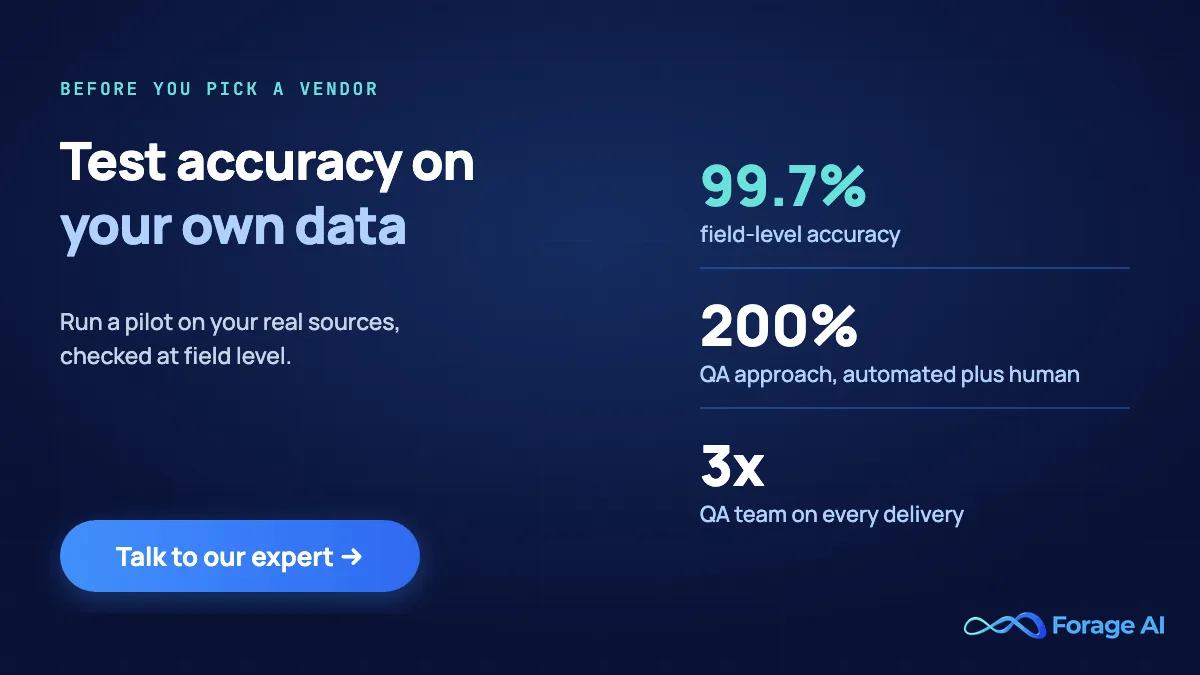
If you’d like to chat more about our QA processes and how to improve the data quality of your project, reach out to us.
FAQs
What is a QA workflow in automated web scraping?
A QA workflow is a series of validation steps that ensure scraped data is accurate, complete, and reliable. It spans pre-scrape setup, real-time monitoring, and post-scrape checks to maintain data quality for enterprise use.
How do automated web scraping companies ensure data accuracy?
They use schema validation, field-level checks, deduplication, change detection, and automated workflows that flag anomalies. These steps prevent incorrect, missing, or inconsistent data from reaching downstream systems.
Why is QA important in automated scraping workflows?
QA prevents data errors caused by site changes, blocking, or extraction failures. Without strong QA, enterprises risk unreliable analytics, broken models, and inaccurate reporting.
What QA tools are commonly used in automated scraping?
Most providers use selector health monitoring, anomaly detection, automated diff checks, browser automation, and workflow engines that apply validation rules at each processing stage.
What should enterprise teams look for in a managed scraping provider's QA process?
Schema documentation and versioning, visibility into validation logs and error rates, defined SLAs that cover data quality, not just uptime, custom validation rule support for industry-specific data, a documented human review process for anomaly resolution, and regression testing that converts past failures into permanent coverage. A provider that only offers uptime guarantees is not covering the failure modes that matter most.
Is the three-stage QA only realistic for large teams?
No. The three stages of QA - pre-scrape, real-time, and post-scrape are not optional layers that teams adopt at scale. They are fundamental to producing clean, reliable data. Every production pipeline operates across these stages, whether explicitly designed or implicitly handled through ad-hoc fixes.rnThe difference is not whether teams implement them, but whether they are structured deliberately from the start or emerge reactively as failures occur.
By Krittika Arora