
Top Investment Intelligence Providers in 2026: 20 Platforms by Evidence Layer
Ask a research desk which investment intelligence providers they use and you will get a list of logos. Ask them which question each one answers and the room goes quiet. That gap is expensive. The 2026 InvestOps Report, built on 200 global buy-side leaders, found that 63% of firms still lack real-time data visibility across the investment lifecycle, and only 20% have a unified platform that delivers instant front-office decision support. Most of those firms are not short of subscriptions. They are short of a map.
We work with data teams inside investment firms, and the pattern repeats. A fund licenses a terminal, a private-market database, a document search tool, and two alternative datasets, then discovers that three of the five prove roughly the same thing while the one question actually blocking the investment committee has no vendor attached to it at all. Buying more platforms does not fix that. Knowing what each layer proves does.
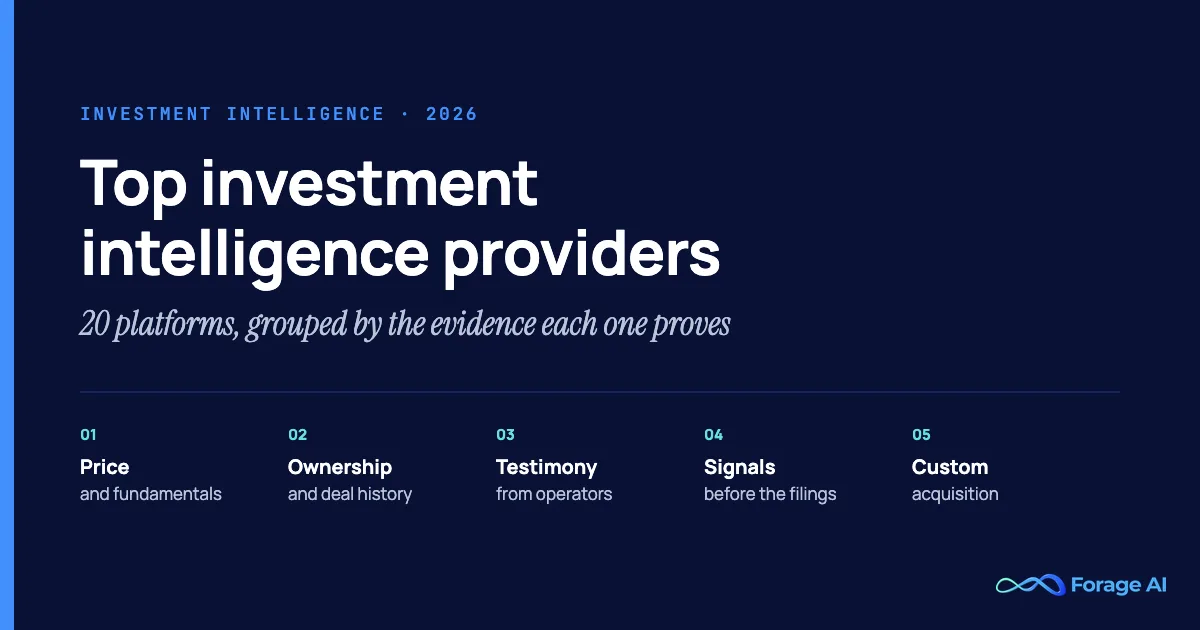
So this list is grouped differently. Every other roundup on this topic is a flat shelf of twenty names. This one sorts the same twenty providers into five evidence layers, each defined by the question an analyst cannot answer without it. Pick the layer where your case keeps breaking, then pick the platform.
Quick Digest
- The five evidence layers: investment intelligence providers split into price and fundamentals, the private-market ledger, the qualitative record, leading indicators, and custom acquisition. Most firms over-buy in two layers and have nothing in a third.
- Layer 1, price and fundamentals: Bloomberg Terminal, LSEG Workspace, FactSet, S&P Capital IQ Pro and Koyfin answer what an asset is worth right now. Bloomberg seats are commonly benchmarked near $32,000 per year, which makes this the layer where seat discipline pays.
- Layer 2, the private-market ledger: PitchBook, Preqin, CB Insights, Grata and Tracxn answer who owns an asset and what it last traded at. PitchBook carries 12M+ company profiles and 3.1M+ deals; Grata reaches 19M+ companies for origination.
- Layer 3, the qualitative record: AlphaSense, Hebbia, Third Bridge and Guidepoint answer what operators who ran the business actually say. AlphaSense passed $700M ARR in Q2 2026 with 7,800 customers and a library above 500 million documents.
- Layer 4, leading indicators: YipitData, M Science, Similarweb, Placer.ai and Neudata answer what is moving before it reaches a filing. Investment managers spent about $2.8bn on alternative data in 2025, up 17% year on year, per Neudata.
How we evaluated these investment intelligence providers
We judged every platform on what it can prove to an investment committee, not on feature counts. Six criteria, applied identically across all twenty.
Expert Insights
"Data has become the determining factor in how quickly businesses can move from opportunity to outcome." Liam Healy, Chief Executive Officer at FE fundinfo, framing the June 2026 research that found two thirds of asset managers still blocked by fragmented data. The point that matters for a buying decision is the word "quickly". Most firms in that survey already had the data somewhere. What they lacked was a path from holding it to acting on it.
| Criterion | The question it answers | Why it decides the purchase |
|---|---|---|
| Evidence layer | Which of the five questions does this platform answer? | A platform that duplicates a layer you already own adds cost, not conviction. |
| Coverage universe | Which companies, assets and geographies are actually in scope? | Coverage gaps surface at the worst moment, halfway through diligence. |
| Point-in-time integrity | Can you see what the data said on the day the decision was made? | Without it, backtests overstate and post-mortems are unfalsifiable. |
| Freshness and cadence | How long between the event and the record? | A private-market comp two quarters stale is a different number. |
| Licensing and redistribution | Can the output reach a client deck, a model, or an LLM? | The cheapest platform you cannot redistribute is the most expensive one. |
| Public review evidence | What do verified users say, and how many of them are there? | A 4.8 rating from nine reviewers is a rumour, not a signal. |
65% of asset managers say fragmented fund data is what prevents them improving operational efficiency, and 69% say data speed and accuracy now decide which distribution partnerships they win. Source: FE fundinfo research, 200 senior asset managers, June 2026. Three things we did not do. We took no payment for placement, and no vendor reviewed this piece before publication. We did not invent pricing. Where a provider does not publish rates we describe the model and say so. We did not paper over thin review data. Six of the twenty platforms here have G2 pages we could not verify a rating from, and those entries say "no verified public rating" rather than borrowing a number from a comparison blog. Last updated September 2026. This category moves through acquisitions, so we re-check the roster quarterly. Two consolidations already changed this list: AlphaSense absorbed Tegus, and LSEG retired Refinitiv Eikon in favour of Workspace. Neither acquired brand gets its own entry, because listing a company that no longer operates independently helps nobody.
Investment intelligence providers at a glance
Read this table down the Layer column before you read it across. Two providers on the same layer are genuine alternatives to each other. Two on different layers are not, whatever their sales decks imply, and the firms we work with that run eight overlapping subscriptions almost always got there by comparing across layers.
| # | Provider | Evidence layer | Best for |
|---|---|---|---|
| 1 | Forage AI | Custom acquisition | Evidence that is public but unpackaged, built to your schema |
| 2 | Bloomberg Terminal | Price and fundamentals | Cross-asset desks that need one place for pricing, news and execution |
| 3 | LSEG Workspace | Price and fundamentals | Firms wanting terminal breadth with a lower seat cost than Bloomberg |
| 4 | FactSet | Price and fundamentals | Quant and integration-heavy teams that live in the API |
| 5 | S&P Capital IQ Pro | Price and fundamentals | Credit, banking and comps work with private-market depth attached |
| 6 | Koyfin | Price and fundamentals | Small funds and family offices priced out of a terminal |
| 7 | PitchBook | Private-market ledger | Valuation history, fund benchmarks and LP intelligence |
| 8 | Preqin | Private-market ledger | Fund performance and LP-GP relationships across alternatives |
| 9 | CB Insights | Private-market ledger | Venture and technology trend mapping |
| 10 | Grata | Private-market ledger | Origination and proprietary deal sourcing in the middle market |
| 11 | Tracxn | Private-market ledger | Emerging-sector and non-US private company discovery |
| 12 | AlphaSense | Qualitative record | Search across filings, transcripts, broker research and expert calls |
| 13 | Hebbia | Qualitative record | Document-heavy diligence workflows run agentically |
| 14 | Third Bridge | Qualitative record | Analyst-moderated primary research for PE diligence |
| 15 | Guidepoint | Qualitative record | Breadth of advisors across niche and industrial verticals |
| 16 | YipitData | Leading indicators | KPI estimates for consumer and internet names |
| 17 | M Science | Leading indicators | Analyst-curated reads across blended transaction data |
| 18 | Similarweb | Leading indicators | Web and app demand as a revenue proxy |
| 19 | Placer.ai | Leading indicators | Physical foot traffic for retail, restaurants and real assets |
| 20 | Neudata | Leading indicators | Scouting which dataset to license before you license it |
Only 20% of buy-side firms have a unified platform delivering instant front-office decision support, and 63% lack real-time data visibility across the investment lifecycle. Source: InvestOps Report 2026, n=200 global buy-side leaders.
The 20 top investment intelligence providers in 2026
The custom evidence layer: when no vendor sells what your thesis needs
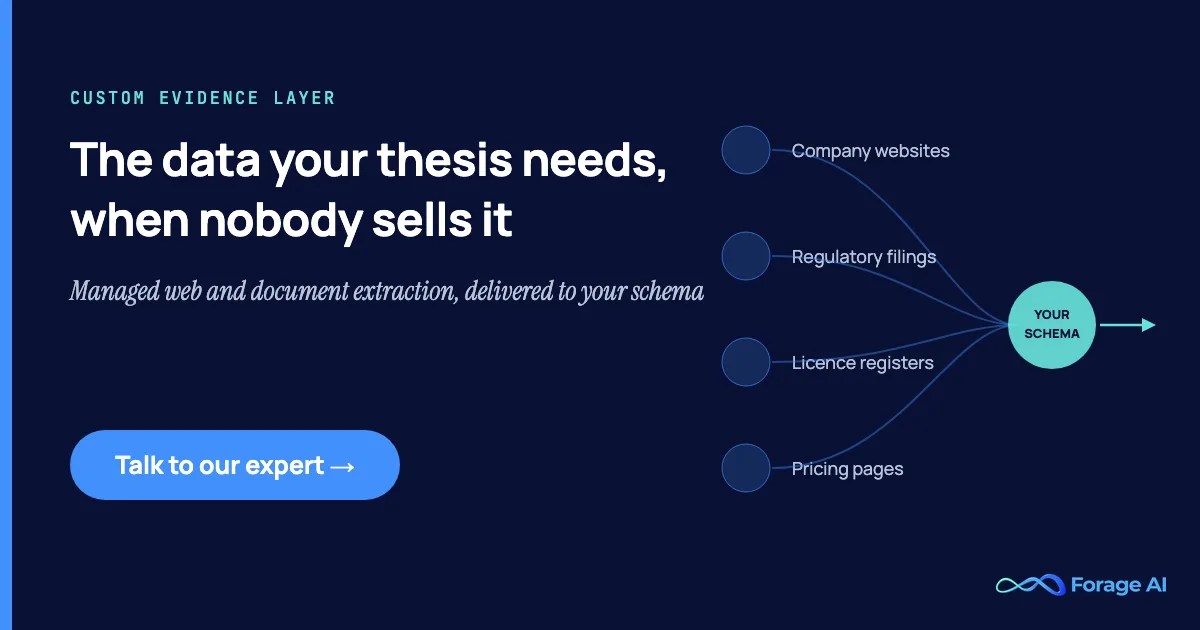
Every list of investment intelligence providers has the same blind spot. It assumes the evidence exists as a product. Often it does not. Say your thesis turns on dealer inventory across thousands of independent websites, or on hiring pages at several hundred private clinics, or on the exact wording of one covenant clause across a decade of filings. None of that is a subscription. It is an extraction problem. This layer exists because the moment you find real edge, you usually find that nobody has packaged it.
1. Forage AI
| Attribute | Detail |
|---|---|
| Best for | Investment teams whose thesis depends on public web or document evidence that no vendor sells packaged |
| What it actually proves | Whatever the thesis needs, structured to your schema and refreshed on your cadence |
| Coverage | 500M+ websites and 10M+ documents processed across the platform, plus 5M+ professionals in firmographic data |
| Pricing model | Managed engagement, scoped per project. Not published |
| Watch-out | This is a build, not a login. If a vendor already sells your dataset cleanly, buy it instead |
| Source | Rating | Reviews (n) | As of |
|---|---|---|---|
| G2 | No verified public rating | n/a | Sep 2026 |
| Clutch | No verified public rating | n/a | Sep 2026 |
Forage AI is the answer when the evidence is public but unpackaged. The work is managed web data extraction and Intelligent Document Processing, delivered as a dataset rather than a tool. That distinction is the whole point of this layer. A scraping platform hands you infrastructure and leaves selector drift, anti-bot evolution and schema changes on your desk. Forage AI handles selector drift, anti-bot evolution, and schema changes as part of the service, and every delivery passes a 3x QA team before it lands in your system.
Not for you if you want self-serve. There is no free tier and no dashboard to poke at on a Friday afternoon, and from sign-off to first dataset takes one to two weeks rather than minutes. That trade is deliberate. The teams that get value here are the ones who have already tried to maintain a scraper fleet in-house and priced the maintenance honestly. For a walk-through of how extraction pipelines feed an investment process, our guide on how investment firms extract market data and intelligence covers the mechanics.
Layer 1. Price and fundamentals: what is it worth right now?
This is the layer everyone buys first, and where budgets leak hardest. All five platforms below will quote you a price, a fundamental and a filing. What separates them is the shape of the workflow around that data, and the seat cost. Terminals are priced per user and per year, so the discipline question is not which one is best. It is how many people genuinely need one.
2. Bloomberg Terminal
| Attribute | Detail |
|---|---|
| Best for | Cross-asset desks that need pricing, news, messaging and execution in one place |
| What it actually proves | Live market state, and what the market is saying about it right now |
| Coverage | Broadest cross-asset coverage in the category, including fixed income and derivatives |
| Pricing model | Per seat, per year. Commonly benchmarked near $32,000 single seat, around $28,320 per seat on multi-terminal agreements |
| Watch-out | The Terminal is a workflow, not just data. Firms that buy it for data alone overpay by a wide margin |
| Source | Rating | Reviews (n) | As of |
|---|---|---|---|
| G2 | 4.4 / 5 | 69 | 2026 |
Bloomberg remains the default for anyone who trades rather than only researches. Fixed income coverage, the messaging network and execution in the same window are genuinely hard to replicate, and the network effect of everyone on the buy and sell side being reachable through it is a real asset. Nobody licenses a terminal because of the charting.
The watch-out is seat sprawl. At roughly $32,000 a seat, the difference between eight terminals and fourteen is a headcount. We have seen research teams cut the count in half by moving fundamentals-only users to Koyfin or Capital IQ and reserving terminals for the people who actually execute. That is a Layer 1 optimisation, and it usually funds a Layer 3 or Layer 4 subscription outright.
3. LSEG Workspace
| Attribute | Detail |
|---|---|
| Best for | Firms that want terminal-class breadth without Bloomberg's per-seat commitment |
| What it actually proves | Global market data, filings and news across a very wide industry and geography set |
| Coverage | Broad global market and reference data, strong outside the US |
| Pricing model | Per seat, per year, negotiated. Generally below Bloomberg |
| Watch-out | Eikon was retired on 30 June 2025. Anything you read about Eikon now describes a product that no longer ships |
| Source | Rating | Reviews (n) | As of |
|---|---|---|---|
| G2 | 3.8 / 5 | 4 | 2026 |
Workspace is the credible terminal alternative, and its strength is geographic reach. Reviewers consistently praise the width of the industry and regional database, which matters if your universe extends past US large caps. The four-review sample size on G2 is not a verdict on quality. It is a reminder that terminal buyers do not write software reviews, so this is a category where reference calls beat star ratings.
The honest complaint is support responsiveness. Public reviews raise live helpdesk quality more than any other issue. If your team leans on a desk for data questions during market hours, test that specifically in the trial rather than testing the data, which will almost certainly be fine.
4. FactSet
| Attribute | Detail |
|---|---|
| Best for | Quant teams and any workflow where the data has to leave the interface |
| What it actually proves | Consistent, well-documented fundamentals and estimates that survive being modelled |
| Coverage | Nearly 8,000 global clients; deep fundamentals, estimates and portfolio analytics |
| Pricing model | Per seat plus data feed licensing, negotiated |
| Watch-out | Strongest as a data and API platform. Traders wanting execution and messaging will still reach for a terminal |
| Source | Rating | Reviews (n) | As of |
|---|---|---|---|
| G2 | 4.3 / 5 | 35 | 2026 |
FactSet wins on integration. The APIs are clean and documented well enough that a quant team can build against them without a vendor engineer on the call, which is why FactSet shows up as the underlying data layer inside other platforms, including Hebbia. If your investment process ends in a model rather than a screen, this matters more than any interface comparison.
FactSet has moved fast on unstructured search. In March 2026 it deployed AI-enabled Document Search to more than 85,000 users in broad beta, letting analysts query transcripts, earnings calls, filings and news in natural language with source-linked results. That narrows the historic gap with Layer 3 tools, though it does not close it, since FactSet does not carry an expert-call library.
5. S&P Capital IQ Pro
| Attribute | Detail |
|---|---|
| Best for | Credit analysis, banking comps and public-to-private workflows in one platform |
| What it actually proves | Company financials, credit posture and, increasingly, private-market benchmarks |
| Coverage | Public fundamentals plus expanded private-market datasets from With Intelligence, added July 2026 |
| Pricing model | Per seat, per year, negotiated |
| Watch-out | The Excel plug-in is the real product for many users. Evaluate it, not the web interface |
| Source | Rating | Reviews (n) | As of |
|---|---|---|---|
| G2 | No verified public rating | 36 reviews listed | 2026 |
Capital IQ Pro is the crossover platform in Layer 1. S&P acquired With Intelligence in 2025 and shipped its private-markets datasets into Capital IQ Pro in July 2026, which means the historic wall between public fundamentals and private benchmarks is thinner here than anywhere else on this list. For a credit team that also underwrites private borrowers, that consolidation is worth more than a marginal data advantage.
The Excel add-in is the workflow. Ask any banking analyst what they use Capital IQ for and the honest answer involves a spreadsheet, not a browser. Evaluate accordingly, and test the templates your team actually builds rather than the demo dashboards.
6. Koyfin
| Attribute | Detail |
|---|---|
| Best for | Small funds, family offices and independent analysts priced out of a terminal |
| What it actually proves | Public market fundamentals, charting and screening at a fraction of terminal cost |
| Coverage | Global public equities, ETFs, macro series. No private-market or fixed-income depth |
| Pricing model | Published per-user subscription tiers, including a free tier |
| Watch-out | Not a terminal replacement for fixed income, execution or messaging |
| Source | Rating | Reviews (n) | As of |
|---|---|---|---|
| G2 | 4.8 / 5 | n not verified | 2026 |
Koyfin is the honest answer for the fundamentals-only user. It covers screening, charting, macro series and company fundamentals at published prices, and it is the single most common way we see firms cut terminal seats without cutting capability for the people who were only ever reading fundamentals anyway.
Do not oversell it internally. Koyfin is a Layer 1 tool with a public-equity universe. It will not price a bond, source a private deal or find you a transcript. Positioned as what it is, it saves real money. Positioned as a terminal replacement for a whole desk, it creates a gap somebody discovers mid-diligence.
Quick Summary
Q: What is the best investment intelligence platform for price and fundamentals?
A: Bloomberg Terminal if the team executes trades or works in fixed income, because messaging and execution sit alongside the data. LSEG Workspace if you want comparable breadth at a lower negotiated seat cost, especially outside the US. FactSet when the data has to leave the screen and enter a model. S&P Capital IQ Pro if credit work and private-market comps sit in the same workflow. Koyfin for fundamentals-only users sitting in a $32,000 seat.
Layer 2. The private-market ledger: who owns it and what did it last trade at?
Public markets print a price every second. Private markets print one when somebody decides to tell you. That is the entire problem this layer solves, and it is why private equity data providers and deal sourcing platforms command the highest commercial value in this whole category. The five below differ on one axis that matters more than features: are you researching a market, or are you trying to find a company nobody else has called yet?
7. PitchBook
| Attribute | Detail |
|---|---|
| Best for | Valuation history, fund benchmarks and LP intelligence across private and public markets |
| What it actually proves | What an asset last traded at, who backed it, and how its fund performed |
| Coverage | 12M+ company profiles, 3.1M+ deals, 164K+ funds, 63,000+ LPs, 450,000+ credit data points, 528,000+ debt financings |
| Pricing model | Annual subscription, quoted on request. Not published |
| Watch-out | Qualitative depth is thinner than a Layer 3 tool. It carries transcripts but not an expert library |
| Source | Rating | Reviews (n) | As of |
|---|---|---|---|
| G2 | ~4.5 / 5 | 256+ | 2026 |
PitchBook is the reference ledger for private markets. Fund performance benchmarks, verified deal data and LP intelligence are the things it does that a general market intelligence platform simply cannot, and the coverage universe is both broader and deeper than most alternatives. It also carries non-financial signals like patent data and headcount, which is useful for triangulating a private company that files nothing.
Where teams get frustrated is the qualitative side. PitchBook includes earnings call transcripts for public companies, but its library of expert transcripts, trade journals and analyst research is not in the same class as AlphaSense. That is a layer boundary, not a defect. Firms that expect PitchBook to answer "how does this business actually run" are asking Layer 2 a Layer 3 question.
8. Preqin
| Attribute | Detail |
|---|---|
| Best for | Alternatives allocators tracking fund performance and LP-GP relationships |
| What it actually proves | How a fund performed, who committed to it, and where the capital is moving |
| Coverage | 12,000+ PE firms, 110,000+ private market funds, 600,000+ portfolio companies across PE, VC, credit, real estate, infrastructure and hedge funds |
| Pricing model | Annual subscription, quoted on request |
| Watch-out | Now part of BlackRock following the 2025 acquisition. Some allocators weigh that in vendor-neutrality reviews |
| Source | Rating | Reviews (n) | As of |
|---|---|---|---|
| G2 | No verified public rating | Preqin Pro page listed | 2026 |
Preqin is the LP-side counterpart to PitchBook's deal-side view. If your question is about fundraising, manager selection or where allocator capital is rotating, Preqin's coverage of funds and commitments across every alternative asset class is the most direct route. Its 2026 Global Reports draw on 430 investors and 550 fund managers, which makes the accompanying research genuinely primary rather than a repackaging of press releases.
The ownership question is a real evaluation input. Preqin was acquired by BlackRock in 2025. That has not visibly changed the product, but allocators running vendor-neutrality checks now raise it, and it is worth surfacing in your own diligence rather than discovering it later.
9. CB Insights
| Attribute | Detail |
|---|---|
| Best for | Venture and technology trend mapping, market landscapes and emerging-theme tracking |
| What it actually proves | Where a technology market is heading and who is funded to get there |
| Coverage | Strong in tech and venture. Thinner outside technology-heavy sectors |
| Pricing model | Annual subscription, quoted on request |
| Watch-out | Best used for narrative and landscape work. Not the tool for a valuation comp |
| Source | Rating | Reviews (n) | As of |
|---|---|---|---|
| G2 | 4.4 / 5 | 16 | 2026 |
CB Insights earns its place on market maps. The visual landscape work and emerging-theme tracking is genuinely useful for a partner meeting or an investment committee memo that has to explain a market before it argues about a company. Corporate strategy teams get as much from it as funds do.
Coverage narrows fast outside technology. Reviewers consistently note that non-tech sectors are less well served, and the 16-review sample on G2 means public sentiment here is thin. If your universe is industrials or healthcare services, test coverage against a live pipeline before committing.
10. Grata
| Attribute | Detail |
|---|---|
| Best for | Proprietary origination in the middle market, where the target has no filings |
| What it actually proves | That a company exists, what it does, and who to call |
| Coverage | 19M+ companies with fundamentals, filings and transactions, plus 8M+ executive contacts |
| Pricing model | Annual subscription, quoted on request |
| Watch-out | Built for sourcing, not for fund benchmarking or LP analysis |
| Source | Rating | Reviews (n) | As of |
|---|---|---|---|
| G2 | 4.8 / 5 | 79 | 2026 |
Grata is the origination tool in this band, and the 4.8 rating across 79 reviews is the strongest verified sentiment of any private-market platform here. The search approach is built for the problem middle-market deal teams actually have, which is finding companies that do a specific thing rather than companies that appear in a database because somebody funded them.
It answers a different question from PitchBook. Grata tells you who exists and how to reach them. PitchBook tells you what things traded for. Teams that own both use Grata to build the pipeline and PitchBook to price it, and teams that own one usually discover the gap about six weeks in.
11. Tracxn
| Attribute | Detail |
|---|---|
| Best for | Emerging-sector and non-US private company discovery |
| What it actually proves | That a private company in a given sector and geography exists, and who funded it |
| Coverage | 5M+ private companies, 3,000+ sectors, 30+ geographies, with daily funding and acquisition updates |
| Pricing model | Annual subscription tiers, quoted on request |
| Watch-out | Breadth over depth. Profile richness varies by sector and region |
| Source | Rating | Reviews (n) | As of |
|---|---|---|---|
| G2 | No verified public rating | Page listed | 2026 |
Tracxn's advantage is sector granularity outside the usual geographies. Three thousand sector taxonomies is an unusual way to slice a private-company universe, and it is the reason Tracxn surfaces companies in emerging Asian and European markets that a US-centric database will not.
Treat depth as variable. The trade for that breadth is uneven profile quality, which is fine when the job is discovery and a problem when the job is diligence. Used as a top-of-funnel discovery layer feeding a richer database, it works well.
Layer 3. The qualitative record: what do the people who ran it say?
Numbers tell you what happened. They rarely tell you why, and almost never tell you whether it repeats. This layer is where an analyst goes from a model to a view. The 2026 InvestOps Report found that 70% of investment firms now run AI in the front office while only 18% run predictive analytics there, which is a precise description of what these tools do: they are reading and synthesis engines, not forecasting engines.
Expert Insights
"As AI minimizes innovation cycles, the front office has emerged as the battleground for competitive advantage." Julia A. Cloud, Global Investment Management Leader at Deloitte Global, in the 2026 InvestOps Report. The same study found 70% of investment firms now run AI in the front office while only 18% run predictive analytics there. Read together, those numbers describe a market that has adopted reading and synthesis tools at scale and has barely started on prediction.
12. AlphaSense
| Attribute | Detail |
|---|---|
| Best for | One search across filings, transcripts, broker research, news and expert calls |
| What it actually proves | What has already been said about a company, by whom, and when |
| Coverage | 500M+ premium business documents; the Tegus expert transcript library, growing by roughly 7,000 transcripts a month |
| Pricing model | Per seat, per year. Third-party benchmarks commonly cite $10,000 to $20,000 per user, rising with content add-ons |
| Watch-out | Content add-ons drive the real cost. The base seat price is rarely the final number |
| Source | Rating | Reviews (n) | As of |
|---|---|---|---|
| G2 | 4.6 / 5 | 317 | 2026 |
AlphaSense is the deepest qualitative library in this category, by some distance. It passed $700M ARR in Q2 2026 with 7,800 customers, and the 2024 acquisition of Tegus for roughly $930M folded the largest expert-transcript library in the market into the same search box. The company has said it invests over $100M a year expanding that library. For an analyst, the practical effect is that the expert call you were about to commission may already exist as a transcript.
Budget for the add-ons, not the seat. The published-sounding per-seat benchmarks understate what a research team actually spends, because broker research and expert content are licensed on top. The other honest limit is that AlphaSense tells you what has been said. It does not tell you what is happening right now, which is Layer 4's job.
13. Hebbia
| Attribute | Detail |
|---|---|
| Best for | Document-heavy diligence run as an agentic workflow rather than a search |
| What it actually proves | Answers extracted across hundreds of documents at once, with sources attached |
| Coverage | Your own data room plus integrations with FactSet, PitchBook and S&P Capital IQ |
| Pricing model | Enterprise contract, quoted on request |
| Watch-out | Value depends on the corpus you feed it. It is not a content library of its own |
| Source | Rating | Reviews (n) | As of |
|---|---|---|---|
| G2 | No verified public rating | n/a | Sep 2026 |
Hebbia is the workflow answer to AlphaSense's library answer. Rather than searching a vendor's corpus, it runs structured extraction across whatever documents you point it at, which is why it lands in private equity and credit diligence where the important material sits in a data room nobody else has. It reports serving teams managing over $15 trillion in assets and roughly 30% of the top 50 asset managers by AUM.
Its ceiling is your corpus. Hebbia does not sell content, so a team without a document problem will not feel the benefit. Where it earns its keep is the 200-document credit agreement review that used to take an associate a week, and that is a workflow argument rather than a data argument.
14. Third Bridge
| Attribute | Detail |
|---|---|
| Best for | Analyst-moderated primary research, especially private equity diligence |
| What it actually proves | What an operator or customer says under structured questioning |
| Coverage | 12 offices across four continents, 1,000+ clients, with in-house analyst moderation |
| Pricing model | Subscription plus per-interaction, quoted on request |
| Watch-out | Moderated depth costs more than raw call volume. Wrong choice if you just need many quick calls |
| Source | Rating | Reviews (n) | As of |
|---|---|---|---|
| G2 | No verified public rating | n/a | Sep 2026 |
Third Bridge's differentiator is moderation. Its interviews are run by in-house analysts rather than left entirely to the client, which produces consistency across a research programme. On a multi-call diligence where you need the same questions asked the same way across fifteen operators, that consistency is the product.
It is a considered purchase, not an impulse one. If your need is a handful of quick expert calls at low cost, a breadth-first network fits better. If your need is a defensible primary-research file that an investment committee will interrogate, moderation is what you are paying for.
15. Guidepoint
| Attribute | Detail |
|---|---|
| Best for | Breadth of advisors across niche, industrial and healthcare verticals |
| What it actually proves | Access to a specific practitioner, fast, in almost any sector |
| Coverage | 5,000+ client organisations, 1.75M+ advisors, 150+ industries |
| Pricing model | Flexible, from per-call to subscription, quoted on request |
| Watch-out | Consistency across a large project depends on how well you standardise your own questions |
| Source | Rating | Reviews (n) | As of |
|---|---|---|---|
| G2 | No verified public rating | n/a | Sep 2026 |
Guidepoint competes on reach and pricing flexibility. With 1.75M+ advisors across 150+ industries, it is the network most likely to find a practitioner in an obscure vertical, and the flexible pricing suits firms whose expert-call volume is lumpy rather than steady.
Breadth shifts the work onto you. On large projects, output quality tracks how well the client standardises the interview guide, because the moderation layer is lighter than Third Bridge's. That is a fair trade for many teams, as long as somebody owns the question set.
Layer 4. Leading indicators: what is moving before the filings say so?
This band is deliberately short, because the full roster lives in our comparison of top alternative data vendors. Here we care only about the layer question: which providers give an investment team a read on a business before the business reports it. Investment managers spent roughly $2.8bn on alternative data in 2025, up 17% year on year, and the number of listed datasets grew from 2,215 to 2,805 over the same period, per Neudata's February 2026 market study.
16. YipitData
| Attribute | Detail |
|---|---|
| Best for | KPI estimates on consumer, internet and payments names ahead of the print |
| What it actually proves | How a tracked company is performing this quarter, before it reports |
| Coverage | 1,000+ companies tracked from web-scraped data, card transactions and email receipts |
| Pricing model | Enterprise subscription per dataset or sector, quoted on request |
| Watch-out | Priced for funds. The coverage universe is the constraint, not the accuracy |
| Source | Rating | Reviews (n) | As of |
|---|---|---|---|
| G2 | No verified public rating | Page listed | 2026 |
YipitData is the reference name for KPI prediction, valued around $3bn and tracking real-time performance for more than a thousand companies by blending web data, card transactions and receipts. For a long-short equity team covering consumer and internet, this is often the first alternative data line item.
The question to ask is coverage, not accuracy. Ninety percent of the value is whether your specific names are tracked. If they are not, no amount of methodology quality helps, and that is exactly the situation that pushes teams into Layer 5.
17. M Science
| Attribute | Detail |
|---|---|
| Best for | Analyst-curated reads rather than raw datasets |
| What it actually proves | An interpreted view of company performance across blended transaction sources |
| Coverage | Multi-source transaction and behavioural data, delivered as research |
| Pricing model | Enterprise subscription, quoted on request |
| Watch-out | You are buying an interpretation. Teams that want to model the raw data themselves may find it constraining |
| Source | Rating | Reviews (n) | As of |
|---|---|---|---|
| G2 | No verified public rating | n/a | Sep 2026 |
M Science sits between a data vendor and a research house, blending diverse sources and delivering them through analyst-curated research rather than as a feed. That suits fundamental teams without a data science function, which is a large share of the market.
The trade is control. If your edge comes from your own modelling of raw signals, a curated read is a layer you did not want. If your edge is judgement applied to a clean read, it saves you a quant hire.
18. Similarweb
| Attribute | Detail |
|---|---|
| Best for | Web and app demand as a proxy for revenue trajectory |
| What it actually proves | Whether attention to a digital business is growing or shrinking |
| Coverage | Global web and app traffic, search and engagement estimates |
| Pricing model | Published tiers plus enterprise contracts |
| Watch-out | Estimates, not measurements. Directionally strong, precisely wrong at small scale |
| Source | Rating | Reviews (n) | As of |
|---|---|---|---|
| G2 | 4.5 / 5 | 1,577 | 2026 |
Similarweb carries by far the largest verified review base in this entire list, 1,577 reviews at 4.5, which reflects that it sells well beyond investment teams. For investors, its use is narrow and reliable: a demand proxy for digital businesses, checked quarter over quarter.
Read it as a trend, never as a number. Traffic estimates at the tail are noisy, and treating an estimate as a measurement is the most common way this dataset produces a bad call. Used as one input among several, it is a good one.
19. Placer.ai
| Attribute | Detail |
|---|---|
| Best for | Physical foot traffic for retail, restaurants, and real asset underwriting |
| What it actually proves | Whether people are actually showing up at a location |
| Coverage | US-centric foot traffic across retail and commercial locations |
| Pricing model | Subscription tiers, quoted on request |
| Watch-out | Panel-based. Coverage and confidence vary by location type and region |
| Source | Rating | Reviews (n) | As of |
|---|---|---|---|
| G2 | 4.3 / 5 | 10 | 2026 |
Placer.ai is the foot-traffic standard, and it earns a place in an investment stack for retail, restaurant and real-asset work where the store-level read arrives months before a comparable sales number does.
Ten public reviews is a thin sample, so evaluate on a live pilot against locations you already know. Panel-derived data is only as good as panel coverage in your specific geography, and that varies more than the marketing suggests.
20. Neudata
| Attribute | Detail |
|---|---|
| Best for | Deciding which dataset to license before you spend on licensing it |
| What it actually proves | What exists in the alternative data market and who else is already using it |
| Coverage | 2,805 datasets listed on its Scout platform in 2025, up from 2,215 in 2024 |
| Pricing model | Subscription to the scouting platform and research |
| Watch-out | It is a scouting layer, not a data source. It will not give you a signal, only a shortlist |
| Source | Rating | Reviews (n) | As of |
|---|---|---|---|
| G2 | No verified public rating | n/a | Sep 2026 |
Neudata is the only entry here that sells no data at all, and it is on the list because dataset selection is where most alternative data budgets are wasted. Scouting 2,805 listed datasets before committing to two is cheaper than committing to five and discovering three overlap.
Its own research is a useful early warning. Neudata's finding that the average dataset is now bought by around 20 investment clients, down from 25 in 2024, is worth internalising before any Layer 4 purchase. Fewer buyers per dataset means the market is fragmenting, which is good for edge and bad for anyone assuming a popular dataset is a proven one. If you are new to this layer, our alternative data guide covers the source categories first.
How do the 20 providers compare?
The same twenty, now with pricing model and rating evidence alongside the layer. Nine carry no verified public rating, which is worth more attention than any star count here: in this category reference calls do the work that reviews do elsewhere.
| Provider | Layer | What it proves | Pricing model | Rating (n) | Best for |
|---|---|---|---|---|---|
| Forage AI | Custom acquisition | Evidence nobody packages, to your schema | Managed engagement | No verified rating | Public but unpackaged data |
| Bloomberg Terminal | Price and fundamentals | Live market state | ~$32,000/seat/yr | 4.4 (69) | Cross-asset trading desks |
| LSEG Workspace | Price and fundamentals | Global market and reference data | Per seat, negotiated | 3.8 (4) | Non-US breadth |
| FactSet | Price and fundamentals | Modellable fundamentals | Seat plus feed | 4.3 (35) | Quant and API workflows |
| S&P Capital IQ Pro | Price and fundamentals | Financials plus credit and private comps | Per seat, negotiated | No verified rating (36 listed) | Credit and banking |
| Koyfin | Price and fundamentals | Public fundamentals and screening | Published tiers, free tier | 4.8 (n not verified) | Small funds and family offices |
| PitchBook | Private-market ledger | What it last traded at | Annual, quoted | ~4.5 (256+) | Valuation and fund benchmarks |
| Preqin | Private-market ledger | Fund performance and LP behaviour | Annual, quoted | No verified rating | Alternatives allocators |
| CB Insights | Private-market ledger | Where a tech market is heading | Annual, quoted | 4.4 (16) | Venture and tech mapping |
| Grata | Private-market ledger | That a company exists and who to call | Annual, quoted | 4.8 (79) | Middle-market origination |
| Tracxn | Private-market ledger | Sector and geography discovery | Annual tiers | No verified rating | Non-US private discovery |
| AlphaSense | Qualitative record | What has been said, by whom | ~$10K-$20K/seat/yr | 4.6 (317) | Cross-source research |
| Hebbia | Qualitative record | Answers across your own documents | Enterprise contract | No verified rating | Data-room diligence |
| Third Bridge | Qualitative record | Moderated operator testimony | Subscription plus usage | No verified rating | PE diligence programmes |
| Guidepoint | Qualitative record | Fast access to niche practitioners | Flexible, per call or subscription | No verified rating | Hard-to-find verticals |
| YipitData | Leading indicators | This quarter, before the print | Enterprise, per sector | No verified rating | Consumer and internet KPIs |
| M Science | Leading indicators | An interpreted performance read | Enterprise, quoted | No verified rating | Teams without a data function |
| Similarweb | Leading indicators | Digital demand trajectory | Published tiers plus enterprise | 4.5 (1,577) | Online business proxies |
| Placer.ai | Leading indicators | Physical foot traffic | Subscription tiers | 4.3 (10) | Retail and real assets |
| Neudata | Leading indicators | What datasets exist and who uses them | Platform subscription | No verified rating | Pre-purchase scouting |
Ratings are public G2 figures with their sample sizes, captured September 2026. Where we could not verify a rating we say so rather than borrowing a number from a comparison blog. Nine of the twenty have no verified public rating at all, which tells you something about the category: these are relationship sales, and reference calls carry more information than stars.
How do you choose an investment intelligence provider?
Four gates, in this order. The order is the point. Most procurement processes run gate three first, which is how firms end up with a defensible contract for a dataset they did not need.
Gate 1. Coverage universe. Before anything else, hand the vendor a list of twenty names from your actual pipeline and ask which of them are covered, at what depth, from what date. Not a demo list. Yours. A platform that covers 12 million companies and misses eight of your twenty is worse for you than one that covers two million and hits all twenty. This single test kills more deals than every other gate combined, and it takes an afternoon.
Gate 2. Point-in-time integrity. Ask whether you can retrieve what the record said on a given historical date, not what it says today about that date. Restated fundamentals, revised deal values and back-filled private valuations all quietly inflate a backtest. If the vendor cannot answer this cleanly, treat every historical study you run on their data as directional only.
Gate 3. Licensing and redistribution. Establish in writing what you can put in a client deck, an LP report, a model that leaves the building, and an internal LLM. That last one is now the live question. Firms are pushing licensed content into retrieval systems, and a licence written before 2024 often says nothing useful about it. The cheapest platform you cannot redistribute is the most expensive one you own.
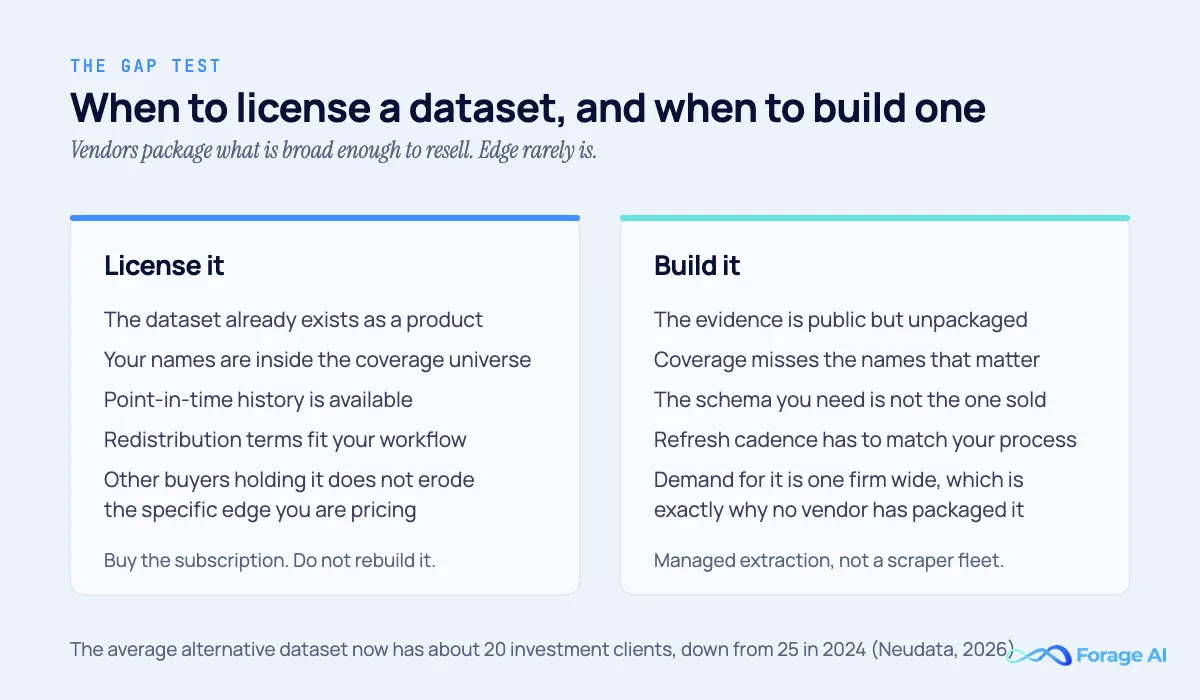
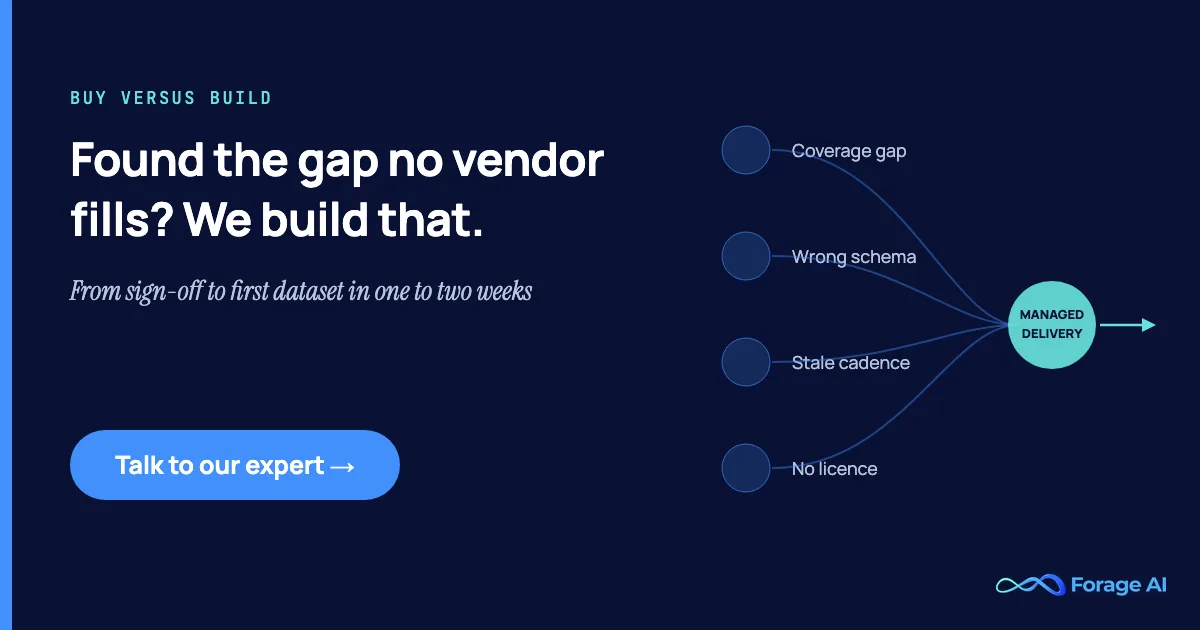
Gate 4. The gap test. Write down the three questions your investment committee asks that no current subscription answers. Then check whether any vendor sells that answer at all. Sometimes one does and you missed it. Sometimes the evidence is public, sitting across ten thousand websites or a decade of filings, and no vendor has bothered to package it because the demand is one firm wide. That is the build case, and it is the honest end of a buy-versus-build conversation rather than the start of one. Our executive framework for evaluating financial data solutions goes deeper on the total-cost side of that decision.
Edge decays as buyers accumulate. The average alternative dataset is now used by about 20 investment clients, down from 25 in 2024. Fewer buyers per dataset means the market is fragmenting, so a widely-held dataset is a commodity input and a thinly-held one is where the asymmetry sits. Source: Neudata, February 2026. Two more inputs worth pricing into any multi-year commitment. Vendor consolidation is running hot, and 89% of asset managers expect industry consolidation to increase within 12 months, per FE fundinfo's June 2026 research. Two names on this list changed hands recently and a third absorbed its largest competitor. Ask what happens to your terms if your vendor is acquired. And be realistic about what AI in your stack is actually doing. Neudata found 66% of investment firms use AI mainly for productivity and only 31% use it to shape investment or trading strategy. A platform sold on strategy generation is usually bought for reading faster, and that is a fine reason to buy it, priced honestly.
"True data democratization requires not only technology and access, but a cultural shift, training, oversight, and trust." Terri Messina, Managing Director and Global Head of Operations for Investment Operations at Principal Financial, in the 2026 InvestOps Report. It is the reason the fourth gate is a conversation with your investment committee rather than a procurement exercise. A platform nobody trusts enough to act on is shelfware with a good rating.
Frequently asked questions
What is investment intelligence? Investment intelligence is the combined evidence an investment team uses to form and defend a view: market prices and fundamentals, private-market ownership and transaction history, qualitative testimony from operators and experts, and leading indicators drawn from behavioural or transactional data. No single platform covers all four, which is why most firms run a stack rather than a subscription.
What is the difference between market intelligence and investment intelligence? Market intelligence is broad business and competitive insight, usually bought by strategy or go-to-market teams. Investment intelligence is narrower and harder-edged. It is built around ownership, valuation, deal history and performance evidence, and its output has to survive an investment committee rather than a positioning workshop. Tools built for one are usually a poor fit for the other.
How much do investment research platforms cost? It varies by an order of magnitude across the layers. Bloomberg Terminal seats are commonly benchmarked near $32,000 per year, AlphaSense seats around $10,000 to $20,000 before content add-ons, and Koyfin publishes consumer-level tiers including a free one. Most private-market and alternative data platforms do not publish pricing at all and quote per firm, per sector or per dataset.
Is there a free investment research platform? Koyfin is the only entry on this list with a genuine free tier, and it covers public equity fundamentals, screening and charting. Nothing in the private-market, qualitative or leading-indicator layers is free, because the underlying data is either licensed or collected at real cost.
Which investment intelligence provider is best for private equity? Most PE teams run at least three. PitchBook or Preqin for valuation history and fund benchmarks, Grata for proprietary origination in the middle market, and Third Bridge or Guidepoint for primary diligence. Hebbia is increasingly the fourth, because most of a PE diligence file lives in a data room rather than a vendor library.
When should we build a dataset instead of buying one? When the evidence is public and specific to your thesis, and no vendor packages it. That happens more than the market suggests, because vendors build for demand that is broad enough to resell. If your investment committee's blocking question depends on data scattered across thousands of websites or documents, a managed extraction partner will usually deliver it faster and cheaper than a licence you cannot buy or a scraper fleet you have to maintain. Forage AI works as an extension of your data team on exactly this problem, with first dataset delivered in one to two weeks from sign-off.
Related articles
- Top Alternative Data Vendors: Coverage, Compliance, and Delivery the full Layer 4 roster, compared on dataset class and compliance posture
- Financial Data Providers the feed-level comparison of market and reference data sources
- Alternative Data Guide: Sources, Use Cases, and How Teams Buy It the foundational primer if Layer 4 is new to your team
- Strategic Framework for Evaluating Financial Data Solutions the long-form executive version of the four gates