
Top Financial Data Providers 2026: A Buyers Guide
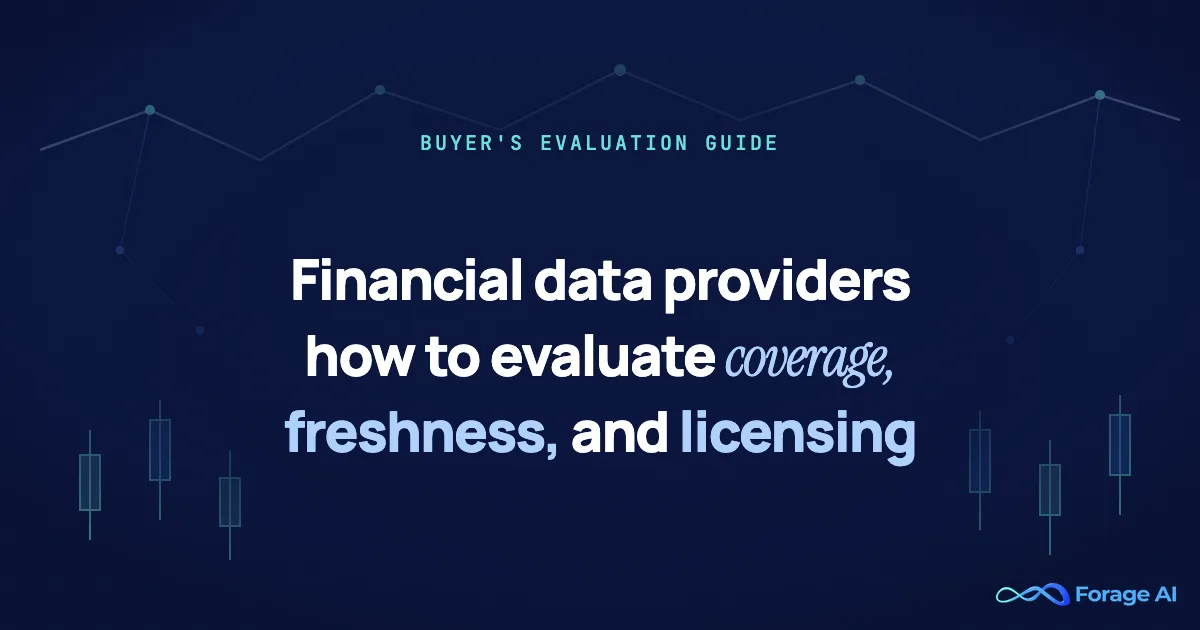
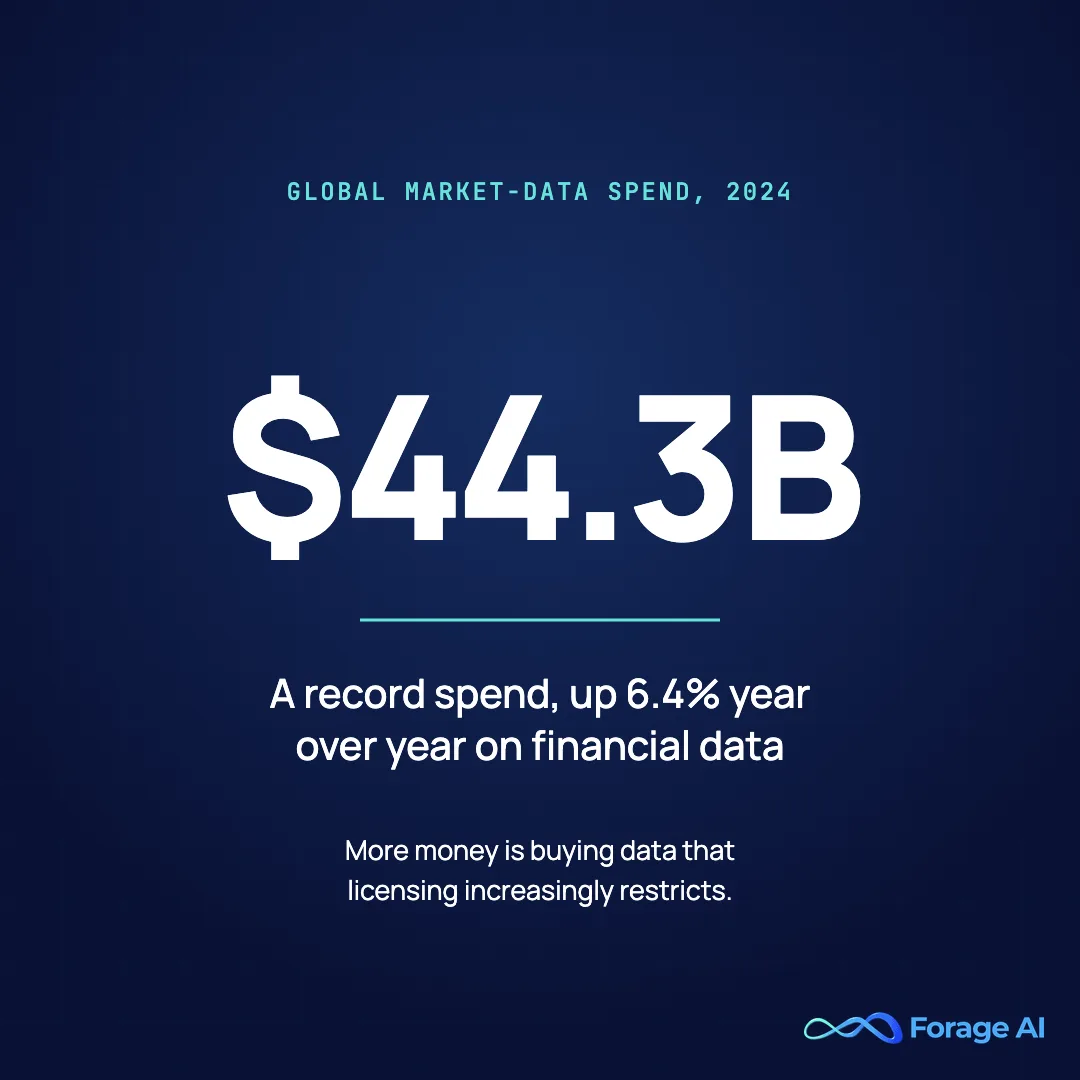
Global spending on financial market data climbed 6.5% to $49.2 billion in 2025, according to Burton-Taylor’s March 2026 market sizing. That is the line buyers can see. The line they cannot see is what gets bought wrong. The pattern across the dataset is consistent: a feed that looked finished at signing breaks in production.
A bought financial data feed fails in the parts that no demo exposes. Coverage and price are visible; redistribution rights and point-in-time accuracy are not. Those last two determine whether the feed passes an audit, supports a model-training use case, or holds up in a backtest. Most rankings of financial data providers compare the visible parts and skip the two that break.
This guide ranks 20 providers by data type, with Forage AI at #1 as the managed data pipeline option for when a packaged feed clears none of the gates. Each entry carries its own comparison table on the axes that actually break a feed, plus an honest read on what users praise and complain about.
The evaluation framework comes after the list, so you can shortlist first and run a repeatable check before you sign.
| Provider | Best for | Pricing model | Licensing and redistribution | Public rating |
|---|---|---|---|---|
| 1. Forage AI | A packaged feed’s licensing or freshness blocks the use case and you need the data on your own schema, with ownership you control. | Managed service, quote-based per scope and cadence | You own the delivered data; no data reselling; on-prem or private-cloud deployment available; handling rules agreed per engagement | 4.8/5 (n=9; small sample) |
| 2. Bloomberg | Front-office breadth across markets, news, and analytics. | Per-seat Terminal subscription; enterprise Data License | Enterprise redistribution licensing required; restrictive on external use | 4.4/5 (n=69) |
| 3. LSEG (Refinitiv) | Markets data plus infrastructure at scale. | Subscription; enterprise feeds, quote-based | Internal-product-embedding terms reported as restrictive | 3.8/5 (n=4; small sample) |
| 4. FactSet | Equity research, portfolio analytics, and ownership data. | Subscription; enterprise | Redistribution restricted per third-party data terms | 4.2/5 (n=72) |
| 5. S&P Global Market Intelligence (Capital IQ) | Fundamentals, estimates, and as-of accuracy via Compustat Point-In-Time. | Subscription; enterprise | Standard enterprise restrictions; point-in-time product available | 4.3/5 (n=68) |
| 6. Financial Modeling Prep | Broad coverage on a budget with dev-friendly REST endpoints. | Tiered subscription; budget and dev tiers | Tier-dependent; check redistribution terms per plan | 4.6/5 (n=6; small sample) |
| 7. Finnhub | Real-time data and fundamentals via API, with a generous free tier. | Freemium; generous free tier | Tier-dependent | No verified public reviews |
| 8. Intrinio | Institutional-grade US fundamentals, ESG, and holdings via API. | Individual plan $150 a month; enterprise quoted (pricing page, Oct 2026) | Tier-dependent | No verified public reviews |
| 9. Alpha Vantage | A budget API with a strong free tier. | Free tier of 25 requests a day; premium from $49.99 a month (pricing page, Oct 2026) | Licensed-exchange-sourced; tier-dependent | 2.4/5 (n=11) |
| 10. Twelve Data | Developer-friendly real-time and historical multi-asset data. | Tiered subscription | Tier-dependent | 4.7/5 (n=3; small sample) |
| 11. Massive (formerly Polygon.io) | US-equities real-time streaming and minute-bar history. | Free Basic tier (5 calls/min, 2 years of history); stocks plans $29, $79 and $199 a month (pricing page, Oct 2026) | Tier-dependent | 2.3/5 (n=6; small sample) |
| 12. Nasdaq Data Link | A marketplace of niche financial, economic, and alternative datasets. | Marketplace; free datasets plus per-dataset premium subscriptions | Per-dataset terms; varies by publisher | No verified public reviews |
| 13. ICE Data Services | Fixed-income pricing and evaluated data at scale. | Enterprise, quote-based | Enterprise terms; redistribution licensed | No verified public reviews |
| 14. Exchange Data International (EDI) | Reference data and corporate actions. | Subscription, quote-based | Subscription terms; check redistribution | No verified public reviews |
| 15. Cbonds | Fixed-income specialist coverage. | Subscription | Subscription terms | No verified public reviews |
| 16. Dun & Bradstreet | Company financials, credit risk, and firmographics. | Enterprise subscription, quote-based | Enterprise terms; check redistribution and resale clauses | 4.5/5 (n=105) |
| 17. Morningstar PitchBook | Private-capital and venture market intelligence. | Subscription; enterprise, quote-based | Enterprise terms; redistribution licensed | 4.5/5 (n=268) |
| 18. AlphaSense | AI-search across filings, transcripts, and broker research. | Subscription; enterprise, quote-based | Enterprise terms; content-source-dependent | 4.6/5 (n=367) |
| 19. Kaiko | Institutional crypto market data. | Subscription, quote-based | Enterprise terms; check redistribution | No verified public reviews |
| 20. Bright Data | A web-data marketplace with financial and crypto datasets. | Financial datasets from $250 per 100K records, $250 minimum order (pricing page, Oct 2026) | Marketplace terms; source-rights dependent | 4.7/5 (n=348) |
Quick Digest
- What actually breaks a feed: Coverage and price are visible in a demo; redistribution rights and point-in-time accuracy are not, and those two decide whether the feed survives an audit, a model-training use case or a backtest.
- The list: Twenty providers grouped by data type, each with the same comparison columns on licensing, point-in-time accuracy, coverage and reference data.
- Licensing: Internal use, redistribution, resale, AI training and retention are separate rights, and most enterprise licenses restrict the ones buyers most want.
- Point-in-time accuracy: A 2026 preprint on India's NIFTY Smallcap 250 found survivor-only backtests reporting 26.17% annual returns against 21.23% for the delisting-inclusive universe, a 4.94 percentage-point overstatement.
- The method: Run four gates in order, rights clearance, a point-in-time test, a coverage probe and a reference-data consistency check, then break ties on the gate whose failure costs the most in year two.
How did we judge these providers?
Every provider below is scored against four factors in the order that determines whether a feed survives a use case. Rights and as-of accuracy come first because they are the two axes a generic ranking never tests. Coverage and reference-data consistency layer on top.
| Factor | What it asks | Why it decides the buy |
|---|---|---|
| Licensing & redistribution | Can you embed, resell, AI-train, and retain the data? | Internal use, redistribution, model training, and retention are separate rights; most enterprise licenses restrict the ones buyers most want |
| Point-in-time accuracy | Does it return data as it appeared then, with restatement lineage and delisted names? | Survivorship and look-ahead bias overstate every backtest built on overwritten history |
| Coverage depth | Does it cover the long tail and delisted names you actually need? | A bigger provider is deep on large-cap and thin in the tail; “best” is use-case-specific |
| Reference-data consistency | Do identifiers map cleanly across your existing feeds? | Identifier mismatch across CUSIP, ISIN, and SEDOL is the most common silent break |
The first factor splits into four rights the buyer clears one at a time: embed in a product, resell a derived dataset, train a model, and retain the data after the contract ends.
Internal use is the base grant. Everything past it costs more and is audited more closely, and most enterprise licenses restrict it.
Categorize a provider by what it actually sells before comparing it to anything else, because the data type predicts the licensing posture and the failure mode.
Financial data is split into eight broad types, and the type is the first thing to match against your use case.
| Data type | What it is | The rights or risk that bites |
|---|---|---|
| Market/pricing | Real-time and historical quotes, OHLCV, order books, corporate actions | Exchange redistribution licensing; vendor-agnostic exchange fees |
| Company fundamentals | Statements, ratios, estimates; as-reported vs standardized | Restatement and point-in-time accuracy; look-ahead bias |
| Reference/entity | Identifiers, security master, classifications, mappings | Identifier fragmentation across CUSIP/ISIN/SEDOL; reconciliation breaks |
| Filings & regulatory | SEC/EDGAR filings, ownership, insider transactions | Source licensing, latency and correction handling |
| Alternative | Web/scraped, satellite, foot traffic, card, social, job postings | MNPI and diligence risk; redistribution and source rights |
| ESG | Environmental, social, governance scores and disclosures | Methodology disagreement; restatement of scores |
| Credit/firmographic | Ratings, credit risk, default, and company financial health | Private-company coverage gaps; redistribution limits |
| News & sentiment | News feeds, NLP-derived sentiment signals | Coverage completeness, parsing, and timeliness |
- Match the type to the use case first. Backtesting lives on fundamentals plus point-in-time integrity. In-product display lives on exchange redistribution licensing. Alternative data carries MNPI and diligence risk that the others do not.
- Reference data sits underneath all of it. When the join keys do not line up, the other seven types stop reconciling, which is why identifier mapping is the quiet break.
- Rights scale with the type. Market data is priced per exchange, display and use; fundamentals by seat and history depth; alternative data dataset by dataset, which is why one contract rarely covers a whole stack.
The U.S. Treasury’s Office of Financial Research put it plainly in March 2017: “Variations in reference data terminology also hamper attempts to consolidate financial instrument data across the financial sector.” The paper names CUSIP and ISIN alongside proprietary and internal identifiers. Reference-data consistency is a recognized systemic-data-quality problem, not a vendor talking point, and it is the join-key layer that determines whether the other seven data types reconcile (OFR Viewpoint Paper 17-03).
Quick Summary
Q: How were these financial data providers judged?
A: Every provider is scored on four factors in a fixed order: licensing and redistribution rights, point-in-time accuracy, coverage depth, and reference-data consistency. Rights and as-of accuracy come first because they are the two axes a generic ranking never tests, and the data type a provider sells predicts which of the two will bite.
The 20 financial data providers, ranked by data type
The right provider is use-case-specific, so this list is grouped by what each one is genuinely best for, with Forage AI at #1 as the option for when a bought feed clears none of the gates. Every entry uses the same comparison columns because the cleanest way to compare 20 providers is a single, consistent read on the axes that break a feed.
Pricing is described as a model where no public figure is verified. Review sentiment is attributed to the platform it came from, never to the vendor. Each entry also carries a second table with its public review ratings and the number of reviews behind them, read on 20 October 2026; where a platform lists no reviews, the table says so. Trustpilot TrustScores are weighted, so they are not directly comparable with G2 or Capterra stars.
1. Forage AI
| Field | Detail |
|---|---|
| Best for | Custom financial datasets built to your own fields when a packaged feed’s licensing or freshness blocks the use case |
| Key use cases | In-product embedding, AI-training datasets, filings and fundamentals extraction, alternative-data feeds, retention you control |
| Pricing model | Managed service, quote-based per scope and cadence |
| Licensing & redistribution | You own the delivered data; no data reselling; on-prem or private-cloud deployment available; handling rules agreed per engagement |
| Data types & coverage | Filings, fundamentals, news/sentiment, firmographic, and alternative/web data; 500M+ websites and 10M+ documents across sectors |
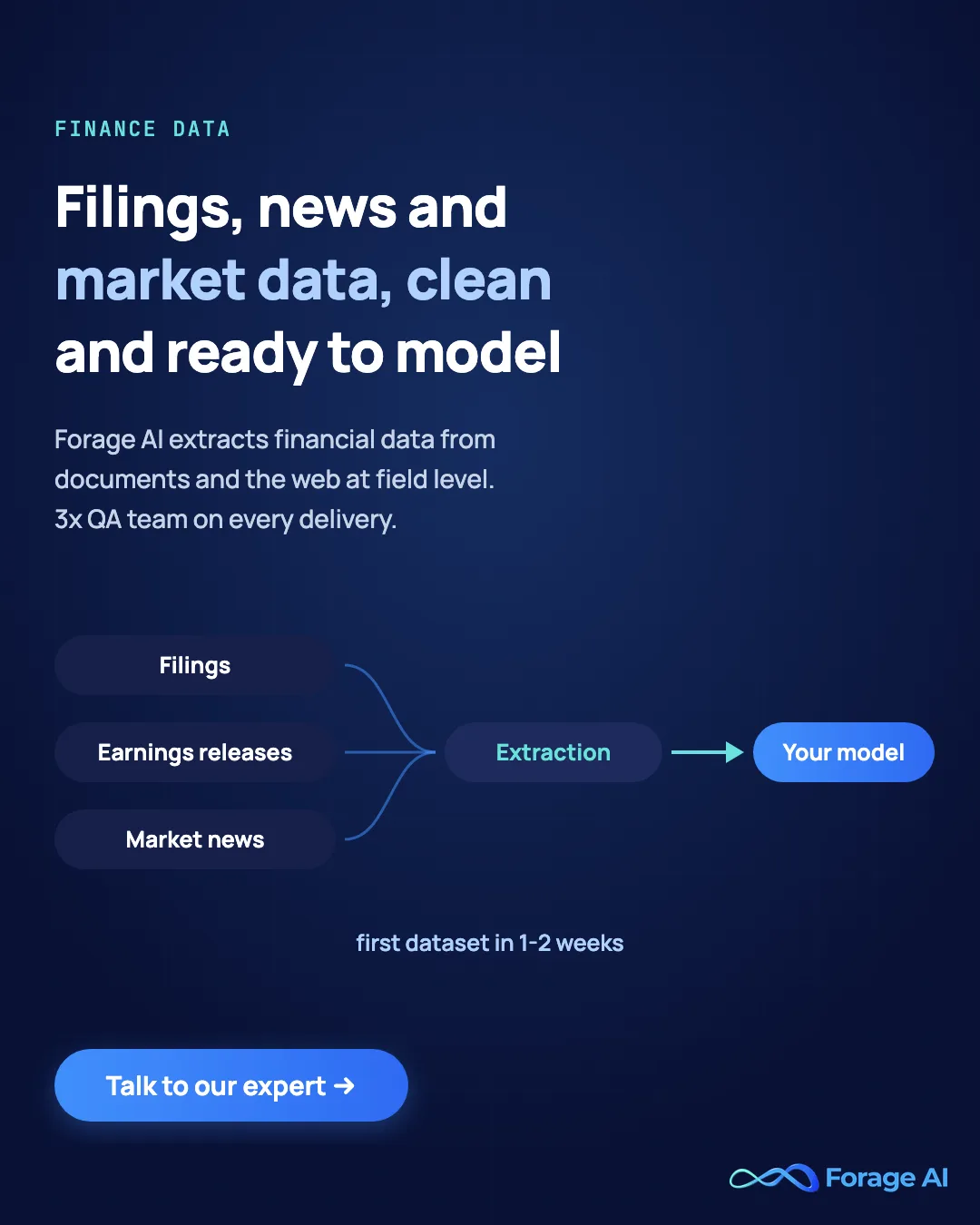
| Standout strength | An end-to-end managed data pipeline (discovery, extraction, structuring, quality checks, delivery) built to your fields and cadence, with a 3x QA team on every delivery |
| Watch-out | Not a packaged terminal, not a 30-year fundamentals warehouse, not a real-time market-data feed |
| Review platform | Rating | Reviews (n) | As of |
|---|---|---|---|
| G2 (Forage AI) | 4.8/5 | 9 (small sample) | Oct 20, 2026 |
| Capterra | No verified reviews | 0 | Oct 20, 2026 |
| Review attribute | Detail |
|---|---|
| What users like | No pros-and-cons summary published at this review volume. |
| What users flag | No pros-and-cons summary published at this review volume. |
Forage AI is for the buyer who hits the licensing or freshness wall on a packaged feed. It is not a terminal or a market-data vendor, and it sells no pre-built datasets. It is an end-to-end managed data pipeline that automates discovery, extraction, structuring, quality checks and delivery, built to your own fields and systems, for when a bought feed breaks on the two axes this guide leads with.
When a license will not let you embed a feed in-product, resell a derived dataset, train a model on it, or retain it after the contract ends, Forage AI builds a custom dataset from the underlying public sources to your fields and your cadence, with ownership you actually control. The output is yours, and it is never resold.
The ownership and no-resell posture is co-primary, not a footnote, because the buyers who hit the licensing wall hardest sit in regulated verticals where redistribution and retention rights are the whole decision. On-prem or private-cloud deployment keeps the data inside your infrastructure.
For point-in-time and coverage gaps, the model is the same: rather than inheriting an exchange or vendor’s correction behavior and long-tail thinness, you specify the capture, and the service handles selector drift, anti-bot evolution, and schema changes as part of the work.
Forage AI delivers the data, not just the pipeline, and works as an extension of your data team, from sign-off to first dataset in 1-2 weeks, under handling rules agreed up front. The watch-out: this is not a replacement for a terminal you already run well.
Forage AI is the option for when a feed’s coverage or license blocks the use case. The build-vs-buy mechanics sit in our piece on how financial data extraction works.
Institutional platforms and terminals
The institutional terminals win on bundled breadth, and the recurring trade-off across all four is the same: enterprise cost and redistribution restrictions that determine whether the feed survives embedding or AI training.
None is the wrong choice for front-office breadth. All four require the rights review before the buy.
2. Bloomberg
| Field | Detail |
|---|---|
| Best for | Front-office breadth across markets, news, and analytics |
| Key use cases | Trading, research, real-time market monitoring, enterprise data feeds |
| Pricing model | Per-seat Terminal subscription; enterprise Data License |
| Licensing & redistribution | Enterprise redistribution licensing required; restrictive on external use |
| Data types & coverage | Market, fundamentals, news, reference; deep cross-asset breadth |
| Standout strength | Breadth and bundled depth as the front-office benchmark |
| Watch-out | Cost and the enterprise redistribution licensing layered on top |
| Review platform | Rating | Reviews (n) | As of |
|---|---|---|---|
| G2 (Bloomberg Terminal) | 4.4/5 | 69 | Oct 20, 2026 |
| Capterra (Bloomberg Terminal) | 4.4/5 | 15 | Oct 20, 2026 |
| Review attribute | Detail |
|---|---|
| What users like | Breadth of financial information and the accuracy and timeliness of it (2 mentions each), customer support (2) |
| What users flag | Navigation and information overload (1 mention each), cost (1). Only a handful of themes clear G2's threshold on n=69. |
Bloomberg is for front-office teams that need everything in one place. It is the front-office benchmark, and its breadth across markets, news, and analytics is unmatched by any other single source.
The gripe that recurs in practitioner forums is consistent: cost and the enterprise redistribution licensing that sits atop the seat fee.
For a buyer trying to surface Bloomberg data within a product they ship or to train a model on it, the licensing review is the sole decision, not the data quality. The watch-out is the rights ceiling, not the data: the breadth is real, and so is the redistribution restriction that comes with it.
3. LSEG (Refinitiv)
| Field | Detail |
|---|---|
| Best for | Markets data plus infrastructure at scale |
| Key use cases | Enterprise market data, feeds, workflow via Workspace |
| Pricing model | Subscription; enterprise feeds, quote-based |
| Licensing & redistribution | Internal-product-embedding terms reported as restrictive |
| Data types & coverage | Market, fundamentals, reference; broad cross-asset scale |
| Standout strength | Scale and infrastructure across markets data |
| Watch-out | Redistribution and embedding licensing can be restrictive |
| Review platform | Rating | Reviews (n) | As of |
|---|---|---|---|
| G2 (LSEG Workspace) | 3.8/5 | 4 (small sample) | Oct 20, 2026 |
| Capterra | No verified reviews | 0 | Oct 20, 2026 |
| Review attribute | Detail |
|---|---|
| What users like | No pros-and-cons summary published at this review volume. |
| What users flag | No pros-and-cons summary published at this review volume. |
LSEG (Refinitiv) is for teams that need both market data scale and infrastructure. It brings one of the largest market data footprints in the category. The Refinitiv name survives mainly in search: LSEG has retired the brand, the products now sit under LSEG Data & Analytics, and Eikon has been replaced by LSEG Workspace.
Platform-comparison analyses note that its internal-product-embedding terms can be restrictive, which matters most for teams trying to surface the data inside a product they ship rather than use it internally.
As with every terminal here, the scale is a genuine strength, and the embedding posture is the gate. If the use case is internal analytics, the licensing rarely bites. The watch-out: if it is in-product or model-training, read the redistribution clause before you shortlist.
4. FactSet
| Field | Detail |
|---|---|
| Best for | Equity research, portfolio analytics, and ownership data |
| Key use cases | Buy-side and sell-side research, portfolio analytics, ownership analysis |
| Pricing model | Subscription; enterprise |
| Licensing & redistribution | Redistribution restricted per third-party data terms |
| Data types & coverage | Fundamentals, ownership, estimates |
| Standout strength | Research and ownership depth |
| Watch-out | Redistribution difficult under third-party terms |
| Review platform | Rating | Reviews (n) | As of |
|---|---|---|---|
| G2 (FactSet Workstation) | 4.2/5 | 72 | Oct 20, 2026 |
| Capterra (FactSet) | 4.9/5 | 9 (small sample) | Oct 20, 2026 |
| Review attribute | Detail |
|---|---|
| What users like | Customisation for research workflows (2 mentions), ease of use with the tools centralised (2), depth of historical data (1) |
| What users flag | Usability, specifically a clunky Excel API and repetitive alerts (2 mentions); report complexity (1); erroneous date filings (1) |
FactSet is for buy-side and sell-side analysts who live in research and ownership data. It is strong on research and a default for analysts who live in portfolio analytics. It has been buying into the trading side too: LiquidityBook (order management) closed in February 2025, and in September 2026 it announced a deal for BCC Group International, a real-time market data distributor.
The same platform-comparison analyses note redistribution is difficult under its third-party data terms, which the vendor documents on its own third-party-terms page.
The depth of ownership and estimates is the reason teams pick it. The watch-out is the same redistribution ceiling that applies to the rest of the institutional tier, so the rights review should come before the buy for any external-use case.
5. S&P Global Market Intelligence (Capital IQ)
| Field | Detail |
|---|---|
| Best for | Fundamentals, estimates, and as-of accuracy via Compustat Point-In-Time |
| Key use cases | Fundamentals, estimates, credit, private company |
| Pricing model | Subscription; enterprise |
| Licensing & redistribution | Standard enterprise restrictions; point-in-time product available |
| Data types & coverage | Fundamentals analysis, point-in-time backtesting, private company, and credit research |
| Standout strength | Compustat Point-In-Time as the as-of reference standard |
| Watch-out | Enterprise cost; licensing for derived use |
| Review platform | Rating | Reviews (n) | As of |
|---|---|---|---|
| G2 (S&P Capital IQ Pro) | 4.3/5 | 68 | Oct 20, 2026 |
| Capterra (S&P Capital IQ Pro) | 4.5/5 | 2 (small sample) | Oct 20, 2026 |
| Review attribute | Detail |
|---|---|
| What users like | No pros-and-cons summary published at this review volume. |
| What users flag | No pros-and-cons summary published at this review volume. |
S&P Global Market Intelligence (Capital IQ) is for quant teams that need survivorship-clean, restatement-aware history. It carries fundamentals, estimates, credit, and private-company data, and its Compustat Point-In-Time product is the category reference standard for as-of fundamentals. Its private-markets coverage grew in November 2025, when S&P Global completed its $1.8 billion acquisition of With Intelligence.
S&P describes it as point-in-time snapshot data that records every change to a fundamental item with the date it took effect, with North American snapshots back to 1987. This is the benchmark against which the rest of the list is measured.
The trade-off is the institutional one: enterprise cost and licensing for derived use. The point-in-time depth is the reason it earns the slot. The watch-out is cost: confirm the specific product tier covers the use case before signing.
🧭 Expert Insight
The breadth of a terminal does not settle the corrections question. As CP Capital founder Chris Petrescu observed, “Some datasets will remove companies that have gone bankrupt, or overwrite companies that have been acquired. It sounds simple, but some of the largest data vendors in the world don’t grasp these concepts, or don’t care to” (Calcbench, 2022). For the institutional tier, a per-provider read on how each one stores and versions history matters more than the bundled feature list.
Fundamentals and API-first developer tiers
The developer tier wins on budget and flexibility, and the public-review pattern is consistent across G2, Capterra, and Reddit threads: praise for the free and budget tiers, complaints about rate limits and long-tail coverage once a use case scales.
For any of these, the licensing column is tier-dependent, so the redistribution and AI-training rights have to be read against the specific tier, not the brand.
6. Financial Modeling Prep
| Field | Detail |
|---|---|
| Best for | Broad coverage on a budget, dev-friendly |
| Key use cases | Prices plus fundamentals via practical REST endpoints |
| Pricing model | Tiered subscription; budget and dev tiers |
| Licensing & redistribution | Tier-dependent; check redistribution terms per plan |
| Data types & coverage | Prices plus fundamentals |
| Standout strength | Practical REST endpoints, broad coverage at a low price |
| Watch-out | Coverage depth varies in the long tail |
| Review platform | Rating | Reviews (n) | As of |
|---|---|---|---|
| G2 (Financial Modeling Prep) | 4.6/5 | 6 (small sample) | Oct 20, 2026 |
| Capterra | No verified reviews | 0 | Oct 20, 2026 |
| Review attribute | Detail |
|---|---|
| What users like | No pros-and-cons summary published at this review volume. |
| What users flag | No pros-and-cons summary published at this review volume. |
Financial Modeling Prep is for teams that want fundamentals and prices without a terminal contract. It draws repeated praise across G2 and developer threads for practical REST endpoints and broad coverage at a low price. It is a common first stop for budget fundamentals.
The recurring caveat in the same reviews is that long-tail depth varies, so a coverage probe against your actual universe matters more here than the headline endpoint list. The watch-out: for deep long-tail or delisted coverage, test before you commit.
7. Finnhub
| Field | Detail |
|---|---|
| Best for | Real-time plus fundamentals via API |
| Key use cases | Real-time quotes, fundamentals, and alternative-data signals |
| Pricing model | Freemium; generous free tier |
| Licensing & redistribution | Tier-dependent |
| Data types & coverage | Real-time, fundamental, alternative |
| Standout strength | Generous free tier and alt-data breadth |
| Watch-out | Rate limits on the free tier at scale |
| Review platform | Rating | Reviews (n) | As of |
|---|---|---|---|
| G2, Capterra, Trustpilot | No verified reviews | 0 | Oct 20, 2026 |
| Review attribute | Detail |
|---|---|
| What users like | No public review corpus to draw from. |
| What users flag | No public review corpus to draw from. |
Finnhub is for developers prototyping across real-time, fundamental, and alternative data. Its generous free tier is the headline in community sentiment, and its breadth across data types makes it a flexible starting point. The most common complaint in those same threads is rate limits once a use case scales past the free tier.
For prototyping and lower-volume production, the free and budget tiers are the draw. The watch-out as volume grows: rate limits and the tier-dependent redistribution terms, the two things to confirm against the paid plan.
8. Intrinio
| Field | Detail |
|---|---|
| Best for | Institutional-grade US fundamentals, ESG, and holdings via API |
| Key use cases | US market data, fundamentals, ESG, institutional holdings |
| Pricing model | Individual plan $150 a month; enterprise quoted (pricing page, Oct 2026) |
| Licensing & redistribution | Tier-dependent |
| Data types & coverage | US market, fundamentals, ESG, holdings |
| Standout strength | Institutional-grade access via API |
| Watch-out | Pricing scales with scope |
| Review platform | Rating | Reviews (n) | As of |
|---|---|---|---|
| G2 (Intrinio Financial Data API) | No verified reviews | 0 | Oct 20, 2026 |
| Review attribute | Detail |
|---|---|
| What users like | No public review corpus to draw from. |
| What users flag | No public review corpus to draw from. |
Intrinio is for teams that want cleaner institutional data without a full terminal. It positions as institutional-grade access via API across US market data, fundamentals, ESG, and institutional holdings. It sits a step above the pure budget tier.
The recurring sentiment is that pricing scales with scope, so the cost advantage over a terminal narrows in broad multi-feed use cases. The watch-out: for a focused US fundamentals or holdings feed, it is a strong fit, but the cost climbs with scope.
9. Alpha Vantage
| Field | Detail |
|---|---|
| Best for | Budget API with a strong free tier |
| Key use cases | Equities and FX for development and lower-volume production |
| Pricing model | Free tier of 25 requests a day; premium from $49.99 a month (pricing page, Oct 2026) |
| Licensing & redistribution | Licensed-exchange-sourced; tier-dependent |
| Data types & coverage | Equities, FX, sourced from NASDAQ and OPRA |
| Standout strength | Strong free tier as a budget entry point |
| Watch-out | Rate limits and coverage gaps |
| Review platform | Rating | Reviews (n) | As of |
|---|---|---|---|
| Trustpilot (TrustScore, weighted) | 2.4/5 | 11 | Oct 20, 2026 |
| G2, Capterra | No listing | n/a | Oct 20, 2026 |
| Review attribute | Detail |
|---|---|
| What users like | No pros-and-cons summary published at this review volume. |
| What users flag | No pros-and-cons summary published at this review volume. |
Alpha Vantage is for a lightweight or early-stage equities and FX feed. It sources from licensed exchanges, including NASDAQ and OPRA, and is a common budget entry point. The strong free tier is the recurring draw in developer reviews.
The recurring sentiment is that rate limits and coverage gaps occur once a use case scales, the same pattern that runs across the budget API group. The watch-out: for production breadth, test the coverage and the limits first.
10. Twelve Data
| Field | Detail |
|---|---|
| Best for | Developer-friendly real-time and historical multi-asset data |
| Key use cases | Real-time and historical stocks, forex, and crypto via API |
| Pricing model | Tiered subscription |
| Licensing & redistribution | Tier-dependent |
| Data types & coverage | Stocks, forex, crypto |
| Standout strength | Developer-friendly real-time access across asset classes |
| Watch-out | Coverage gaps in the long tail |
| Review platform | Rating | Reviews (n) | As of |
|---|---|---|---|
| G2 (Twelve Data) | 4.7/5 | 3 (small sample) | Oct 20, 2026 |
| Review attribute | Detail |
|---|---|
| What users like | No pros-and-cons summary published at this review volume. |
| What users flag | No pros-and-cons summary published at this review volume. |
Twelve Data is for a multi-asset real-time feed at developer scale. It is favored in developer reviews for real-time and historical access to stocks, forex, and crypto in a single API. The multi-asset breadth and developer-friendly interface are why teams reach for it.
The same long-tail caveat applies as it does to the rest of the group, and the redistribution terms are tier-dependent. The watch-out: probe the tail for niche instruments before you commit.
11. Massive (formerly Polygon.io)
| Field | Detail |
|---|---|
| Best for | US-equities real-time streaming and minute-bar history |
| Key use cases | Real-time US stock streaming, historical minute bars, trading apps |
| Pricing model | Free Basic tier (5 calls/min, 2 years of history); stocks plans $29, $79 and $199 a month (pricing page, Oct 2026) |
| Licensing & redistribution | Tier-dependent |
| Data types & coverage | US stocks, forex, crypto; real-time and historical |
| Standout strength | WebSocket streaming and minute-data depth in US markets |
| Watch-out | Reported gaps in dividend and split data; thin free tier |
| Review platform | Rating | Reviews (n) | As of |
|---|---|---|---|
| Trustpilot (polygon.io, TrustScore, weighted) | 2.3/5 | 6 (small sample) | Oct 20, 2026 |
| G2, Capterra | No listing | n/a | Oct 20, 2026 |
| Review attribute | Detail |
|---|---|
| What users like | No pros-and-cons summary published at this review volume. |
| What users flag | No pros-and-cons summary published at this review volume. |
Massive is for real-time US equities and minute-bar history at throughput. Polygon.io renamed itself Massive on 30 October 2025; existing API keys and the api.polygon.io endpoints keep working, so older code and older reviews still refer to Polygon. It is built around US-equities performance, and its WebSocket streaming and minute-bar history are what developers single out in reviews.
If the use case is streaming every trade for a US ticker or pulling years of minute data, it handles the throughput that lighter APIs do not.
The watch-outs that recur in developer write-ups and GitHub issue threads are corporate actions gaps, with reports of missing dividend and split data on even well-known tickers, and a free tier that is thin for anything past development.
The watch-out: if your model depends on a clean corporate actions history, validate that layer specifically.
12. Nasdaq Data Link
| Field | Detail |
|---|---|
| Best for | A marketplace of niche financial, economic, and alternative datasets |
| Key use cases | Pulling specific economic, financial, and alternative datasets via API |
| Pricing model | Marketplace; free datasets plus per-dataset premium subscriptions |
| Licensing & redistribution | Per-dataset terms; varies by publisher |
| Data types & coverage | Financial, economic, and alternative datasets from many publishers |
| Standout strength | Breadth of niche datasets with R, Python, and Excel integration |
| Watch-out | Per-dataset licensing makes total spend hard to forecast |
| Review platform | Rating | Reviews (n) | As of |
|---|---|---|---|
| G2 (Nasdaq Data Link) | No verified reviews | 0 | Oct 20, 2026 |
| Review attribute | Detail |
|---|---|
| What users like | No public review corpus to draw from. |
| What users flag | No public review corpus to draw from. |
Nasdaq Data Link is for a team that needs one or two niche economic or alternative feeds. Formerly Quandl, it runs a marketplace model: free datasets sit alongside premium ones from many publishers, accessed through well-documented APIs with R, Python, and Excel integration. The catalog breadth is the draw.
The watch-out, noted across developer comparisons, is the marketplace structure itself: per-dataset licensing and pricing make total spend harder to forecast when a workflow pulls across several premium sources, and redistribution terms vary by publisher.
The watch-out: read each dataset’s terms separately rather than assuming one platform-wide license.
The budget-tier complaints about coverage gaps point at the same root cause that breaks larger feeds: what a provider does with bankrupt, delisted and acquired names. For an API tier, the rate-limit ceiling is visible at signup; the corrections and delisting behavior is not, and it is the one to test directly.
Reference, fixed-income, and specialists
The specialists win on depth in one data type, which is the right call when the failure mode you face is reference-data consistency or fixed-income coverage rather than breadth.
None of the three is a full-market terminal, and that is the point: when the gap is deep in one type, a specialist clears it where a generalist will not.
13. ICE Data Services
| Field | Detail |
|---|---|
| Best for | Fixed-income pricing and evaluated data |
| Key use cases | Evaluated pricing and reference data at scale |
| Pricing model | Enterprise, quote-based |
| Licensing & redistribution | Enterprise terms; redistribution licensed |
| Data types & coverage | Fixed-income, evaluated pricing, reference |
| Standout strength | Evaluated pricing depth at scale |
| Watch-out | Enterprise cost and scope |
| Review platform | Rating | Reviews (n) | As of |
|---|---|---|---|
| G2, Capterra (product level) | No verified reviews | 0 | Oct 20, 2026 |
| Review attribute | Detail |
|---|---|
| What users like | No public review corpus to draw from. |
| What users flag | No public review corpus to draw from. |
ICE Data Services is for a fixed-income desk that needs to evaluate pricing at scale. It is the reference for fixed-income pricing and evaluated data, the layer where instruments do not trade often enough for a last-price feed to be enough. For evaluated pricing across a large fixed-income book, the depth is the reason it earns the slot.
The trade-off is enterprise cost and scope, and redistribution is licensed under enterprise terms. The watch-out: for a generalist use case it is more than the gap requires.
14. Exchange Data International (EDI)
| Field | Detail |
|---|---|
| Best for | Reference data and corporate actions |
| Key use cases | Security master, corporate actions, historical pricing |
| Pricing model | Subscription, quote-based |
| Licensing & redistribution | Subscription terms; check redistribution |
| Data types & coverage | Reference, corporate actions, pricing |
| Standout strength | Corporate-actions and reference accuracy |
| Watch-out | Narrower than full-market terminals |
| Review platform | Rating | Reviews (n) | As of |
|---|---|---|---|
| G2, Capterra, Trustpilot | No verified reviews | 0 | Oct 20, 2026 |
| Review attribute | Detail |
|---|---|
| What users like | No public review corpus to draw from. |
| What users flag | No public review corpus to draw from. |
EDI is for a team whose break is in the reference layer, not market breadth. Exchange Data International is built around reference data, corporate actions, and historical pricing, the layer that determines whether your security master reconciles. When the failure mode is an identifier mapping or a missed corporate action, the specialist addresses it directly.
It is narrower than a full-market terminal, and that is by design. The watch-out: it is not a market-breadth feed, so the focused accuracy is worth more than a generalist’s wider but shallower coverage only when reference data fills the gap.
15. Cbonds
| Field | Detail |
|---|---|
| Best for | Fixed-income specialist coverage |
| Key use cases | Bond pricing and reference depth |
| Pricing model | Subscription |
| Licensing & redistribution | Subscription terms |
| Data types & coverage | Fixed-income, bond reference |
| Standout strength | Bond-market specialist depth |
| Watch-out | Specialist scope, not full-market |
| Review platform | Rating | Reviews (n) | As of |
|---|---|---|---|
| G2, Capterra, Trustpilot | No verified reviews | 0 | Oct 20, 2026 |
| Review attribute | Detail |
|---|---|
| What users like | No public review corpus to draw from. |
| What users flag | No public review corpus to draw from. |
Cbonds is for a credit or fixed-income team that needs broad bond coverage. It is a fixed-income specialist with bond-market depth and reference coverage the generalist terminals do not match in that one type. It reaches instruments that a market-data generalist treats as an afterthought.
Its scope is deliberately fixed-income rather than full-market, so it sits alongside a broader feed rather than replacing one. The watch-out: it is a specialist, not a full-market feed, but when the gap is bond depth, it clears it.
Credit, firmographic, and private markets
This category fills the private-company and credit gap that the public market leaves open. Public-market terminals are deep on listed securities and thin on private entities.
So credit, firmographic, and private-capital providers exist as their own category for due diligence, risk, and private markets work.
16. Dun & Bradstreet
| Field | Detail |
|---|---|
| Best for | Company financials, credit risk, and firmographics |
| Key use cases | Third-party-risk screening, private-company intelligence, due diligence |
| Pricing model | Enterprise subscription, quote-based |
| Licensing & redistribution | Enterprise terms; check redistribution and resale clauses |
| Data types & coverage | Private company and firmographic depth public-market feeds lack |
| Standout strength | Private-company and firmographic depth public-market feeds lack |
| Watch-out | Coverage and freshness vary by region and entity tier |
| Review platform | Rating | Reviews (n) | As of |
|---|---|---|---|
| G2 (D&B Finance Analytics Credit Intelligence) | 4.5/5 | 105 | Oct 20, 2026 |
| Capterra (D&B Finance Analytics) | 4.5/5 | 137 | Oct 20, 2026 |
| G2 (D&B Hoovers) | 4.1/5 | 782 | Oct 20, 2026 |
| Review attribute | Detail |
|---|---|
| What users like | Ease of use in credit decisioning (43 mentions), the predictive analysis on supplier creditworthiness (22), real-time data (16) |
| What users flag | Data accuracy: stale updates and missing detail (20 mentions), outdated information delaying risk assessment (14), fluctuating reports |
Dun & Bradstreet is for due diligence and third-party risk work, not market trading. It has been private since August 2025, when Clearlake Capital completed its take-private and the stock left the NYSE. It fills the private company and firmographic gaps that the public market leaves open. It is the reference for company financials, credit risk, and firmographic screening.
The recurring sentiment caveat across review platforms is that coverage depth and freshness vary by region and by how far down the entity tier you go, the same long-tail point that applies to every coverage claim in this guide. The watch-out: coverage and freshness thin out by region and entity tier, so probe the universe you actually screen.
17. Morningstar PitchBook
| Field | Detail |
|---|---|
| Best for | Private-capital and venture market intelligence |
| Key use cases | Deal-flow intelligence, PE and VC research, private-company profiles |
| Pricing model | Subscription; enterprise, quote-based |
| Licensing & redistribution | Enterprise terms; redistribution licensed |
| Data types & coverage | Private-capital, venture, M&A, private-company financials |
| Standout strength | Depth and breadth of private-capital coverage |
| Watch-out | Private-market data freshness depends on disclosure and self-reporting |
| Review platform | Rating | Reviews (n) | As of |
|---|---|---|---|
| G2 (PitchBook) | 4.5/5 | 268 | Oct 20, 2026 |
| Capterra (PitchBook) | 4.4/5 | 38 | Oct 20, 2026 |
| Review attribute | Detail |
|---|---|
| What users like | Data accessibility including mobile and alerts (64 mentions), customer support (45), database breadth (44), ease of use (44) |
| What users flag | Outdated company records needing re-confirmation (36 mentions), thin coverage of smaller companies (29), deal-tagging errors (20), price |
Morningstar PitchBook is for a team whose use case is private-market deal intelligence. PitchBook, part of Morningstar (which also bought CRSP in February 2026), is a default for private capital and venture intelligence, and reviewers on G2 consistently point to its depth and breadth of data across deal flow, PE, and VC coverage. It covers entities the public-market feeds do not track.
The inherent watch-out for private-market data, true of the category and not unique to PitchBook, is that freshness depends on disclosure and self-reporting, so private-company figures tend to lag and be more estimated than listed fundamentals. The watch-out: treat the private-company financials as directional rather than as filed.
News, sentiment, alternative, and web data
This category serves the data types that the traditional feeds do not. Research-search, news and sentiment, crypto, and web-sourced data each raise their own questions of rights and freshness.
For the marketplace and web models, the source rights and point-in-time checks matter even more than with a single-source feed.
18. AlphaSense
| Field | Detail |
|---|---|
| Best for | AI-search across filings, transcripts, and broker research |
| Key use cases | Market intelligence, thesis validation, document and earnings-call search |
| Pricing model | Subscription; enterprise, quote-based |
| Licensing & redistribution | Enterprise terms; content-source-dependent |
| Data types & coverage | Filings, transcripts, broker research, news, expert interviews |
| Standout strength | AI search across a large content set, strong support |
| Watch-out | Steep onboarding; price hard to justify for lighter use |
| Review platform | Rating | Reviews (n) | As of |
|---|---|---|---|
| G2 (AlphaSense) | 4.6/5 | 367 | Oct 20, 2026 |
| Capterra | No verified reviews | 0 | Oct 20, 2026 |
| Review attribute | Detail |
|---|---|
| What users like | Ease of use and time saved by summaries (60 mentions), search over unique content such as broker and expert material (43), the AI summarisation (33) |
| What users flag | Search precision, filtering out irrelevant results (19 mentions), gaps in structured industry reports (17), learning curve (15) |
AlphaSense is for a research team that lives in filings and transcripts. It is a research and market intelligence platform that runs AI search across company filings, broker research, earnings transcripts, news, and expert interviews.
It holds a strong rating on G2 based on hundreds of reviews, where users single out the AI summaries and responsive support as reasons it speeds up thesis validation.
The recurring complaints in those reviews are a steep onboarding curve, with new users describing the feature set as overwhelming, and a price some find hard to justify against lighter AI research tools. The watch-out: for occasional use, the cost and learning curve outweigh the search depth.
19. Kaiko
| Field | Detail |
|---|---|
| Best for | Institutional crypto market data |
| Key use cases | Crypto price feeds, order-book analytics, indices, DeFi research |
| Pricing model | Subscription, quote-based |
| Licensing & redistribution | Enterprise terms; check redistribution |
| Data types & coverage | Crypto market data, order books, DeFi |
| Standout strength | Institutional-grade crypto depth |
| Watch-out | Scope limited to crypto |
| Review platform | Rating | Reviews (n) | As of |
|---|---|---|---|
| G2, Capterra, Trustpilot | No verified reviews | 0 | Oct 20, 2026 |
| Review attribute | Detail |
|---|---|
| What users like | No public review corpus to draw from. |
| What users flag | No public review corpus to draw from. |
Kaiko is for desks that need reliable, institutional crypto data. It delivers crypto market data, with order books, trades, and DeFi metrics at a depth retail crypto APIs do not reach. It is the specialist that the generalist cannot match in that type. Since buying Vinter in November 2024 it also runs regulated crypto indices.
Its scope is deliberately limited to crypto rather than full-market coverage, so it sits alongside a traditional feed rather than replacing one. The watch-out: scope is crypto-only, but when the data type is crypto, and the bar is institutional, it clears it.
20. Bright Data
| Field | Detail |
|---|---|
| Best for | A web-data and scraping marketplace with financial datasets |
| Key use cases | Web-sourced financial and crypto datasets |
| Pricing model | Financial datasets from $250 per 100K records, $250 minimum order (pricing page, Oct 2026) |
| Licensing & redistribution | Marketplace terms; source-rights dependent |
| Data types & coverage | Web-scraped financial and crypto data |
| Standout strength | Breadth of web-sourced datasets |
| Watch-out | Source rights and freshness vary by dataset |
| Review platform | Rating | Reviews (n) | As of |
|---|---|---|---|
| G2 (Bright Data) | 4.7/5 | 348 | Oct 20, 2026 |
| Capterra (Bright Data) | 4.7/5 | 68 | Oct 20, 2026 |
| Review attribute | Detail |
|---|---|
| What users like | Customer support (48 mentions), ease of use (40), collection reliability (37) |
| What users flag | Cost for smaller teams (8 mentions on expense, 8 on pricing), documentation and debugging (8) |
Bright Data is for a team that needs web-derived signals rather than exchange or fundamentals feeds. It is a web data and scraping marketplace that includes financial and crypto datasets, and its breadth of web-sourced data is the draw. The catalog reaches sources that the traditional providers do not.
The watch-out that applies to any marketplace model is that source rights and freshness vary from dataset to dataset, so rights clearance and point-in-time checks matter even more here than with a single-source feed. The watch-out: clear source rights and freshness per dataset, not platform-wide.
The alternative-data category as a whole, including the MNPI and diligence questions that come with non-traditional signals, is covered in our guide to evaluating alternative data providers. For the wider packaged-data market these financial feeds sit inside, see our roundup of the Data-as-a-Service (DaaS) companies. Funds with property exposure will also want our guide to CRE data providers.
The pattern holds across every group above. Marketplace and web-sourced data add a second layer, because the rights and the refresh schedule can differ dataset by dataset inside one catalog. A per-provider read on licensing and freshness surfaces what a feature list hides.
How do you choose a financial data provider?
This article is for informational purposes only and does not constitute legal advice. Consult a qualified attorney for legal guidance specific to your situation.
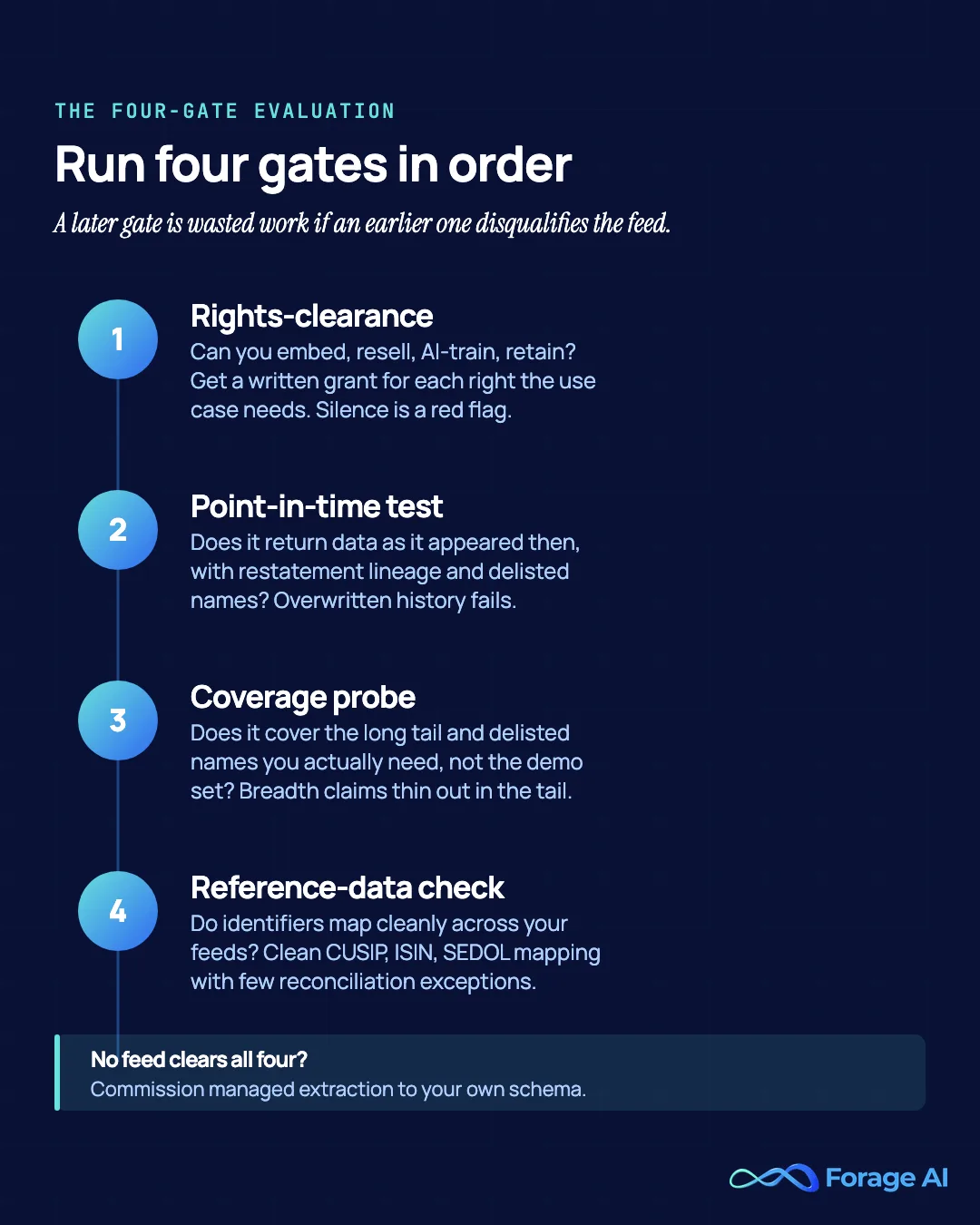
The list has answered which providers fit which use case. Here is the repeatable method for deciding between them. Run four gates in order.
The sequence matters because clearing a later gate is wasted work if an earlier one already disqualifies the feed. Clear rights first, then run the point-in-time test, then the coverage probe, then the reference-data consistency check.
This four-gate evaluation replaces the generic six-factor checklist (accuracy, coverage, latency, price, integration, support) that every ranking ships and that ignores the two axes where feeds actually break.
| Gate | What to ask | What good looks like | Red flag |
|---|---|---|---|
| 1. Rights-clearance | Can we embed, resell, AI-train and retain this data? | A written grant for each right the use case needs | Silence or case-by-case approval on the right you need |
| 2. Point-in-time test | Does it return data as it appeared then, with restatement lineage and delisted names? | As-of snapshots, versioned history, delisted coverage | Overwritten history; survivors only |
| 3. Coverage probe | Does it cover the long tail and delisted names we need? | Depth in your actual universe, not the demo set | Breadth claims that thin out in the tail |
| 4. Reference-data check | Do identifiers map cleanly across our feeds? | Clean CUSIP/ISIN/SEDOL mapping, few exceptions | Reconciliation exceptions on shared entities |
Gate 1: Can you actually use the data you licensed?
Often not by default. A license is not ownership: internal use, redistribution, resale, AI training, and retention are separate rights, and licensing a feed for internal analytics does not grant the right to embed it in a product you sell, resell it, train a model on it, or keep it after the contract ends.
Most enterprise licenses restrict the buyers who want the most.
Two operational realities make this expensive to get wrong. First, exchange license fees are vendor-agnostic. They are owed regardless of which provider you choose. NYSE’s October 2026 price list shows the range for one exchange: user fees from $0.20 to $78 a month, and for its Integrated feed a monthly access fee of $8,400, a redistribution fee of $4,400 and non-display fees of $22,400 per category. Delayed data is not a loophole either. NYSE counts anything shown before its 15-minute or midnight delay as real-time, and redistributing its data to external users, delayed included, needs a license.
Second, the audit looks backward, so a license that changes retroactively bills for data already consumed, and a derived-data license costs materially more than a raw-data one. As of January 2026, CME’s delayed-data fee was $304 per month. WatersTechnology’s worked example for one bank licence stack (three vendor feeds, CME’s five exchange products, three data centers) came to $273,600, an illustration of how per-product fees multiply rather than a typical bill (WatersTechnology, 2026).
Expert Insights
The CME licensing overhaul shows how live this risk is. CME ended free end-of-day licenses for CME, CBOT, Nymex, and Comex, reclassified end-of-day as chargeable delayed data, and back-billed fees despite limited access controls. On whether the IPUG user group would pursue litigation, IPUG chair and bank market-data procurement head Caroline Poisson said, “It’s something we’re looking at” (WatersTechnology, 2026). When a license changes retroactively, the exposure is measured in years of back-billing, which is why the rights review belongs before the buy.
The implication for sequencing is direct. If your use case is AI training or in-product embedding, most enterprise licenses restrict it, so clear the right before you shortlist, not after, and start the licensing process three to six months before you need the feed live.
If the feed is sovereign or regulated, the redistribution and retention posture is decisive, not cost. For the licensing nuances specific to non-traditional sources, see our alternative data sources and licensing guide.
Gate 2: Is it accurate as of, not just complete today?
A feed can be complete today and still wrong for a backtest. The reason is point-in-time integrity: whether the data returns as it appeared at the time, with the restatement lineage intact, rather than as it looks now after corrections.
As-reported figures are the original numbers a market saw on the filing date. Restated and standardized figures overwrite them later. Point-in-time data preserves the as-reported view a model would actually have had.
Two biases follow from getting this wrong. Survivorship bias comes from dropped and delisted names that quietly vanish from the dataset, leaving only the winners. Look-ahead bias arises when a backtest sees numbers that were not known on the date it claims to trade. Both inflate results in the same direction: returns up, drawdowns down.
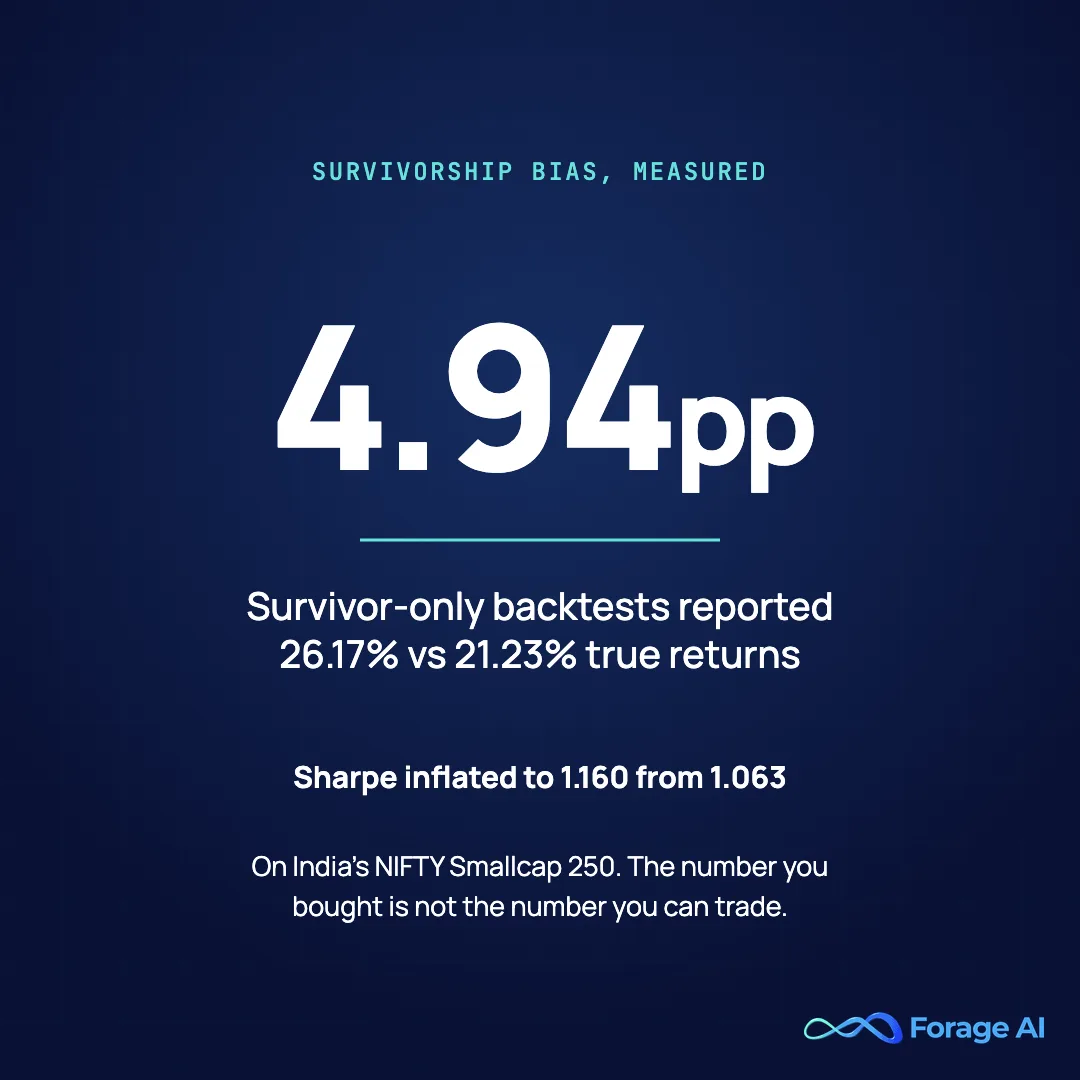
The magnitude is measurable, not theoretical. A 2026 preprint on India’s NIFTY Smallcap 250 found survivor-only backtests reported 26.17% annual returns against 21.23% for the true delisting-inclusive universe, a 4.94-percentage-point overstatement, with the Sharpe ratio inflated to 1.160 from 1.063.
The same preprint found the survivor-only test understated the worst drawdown by 6.4 percentage points (−42.3% against −48.7%). The problem is not limited to one market. Aiken, Clifford and Ellis (Review of Financial Studies, 2013) rebuilt hedge-fund returns from SEC filings and found that funds reporting to commercial databases performed significantly better than funds that never reported. The number you bought is not the number you can trade.
📊 4.94-percentage-point overstatement
Survivor-only backtests of India’s NIFTY Smallcap 250 reported 26.17% annual returns against 21.23% for the true delisting-inclusive universe, with the Sharpe ratio inflated to 1.160 from 1.063. Source: arXiv 2603.19380, a 2026 preprint.
Restatements move rankings, not just point estimates. After restatement, one company fell from a top-5% return-on-equity ranking to the 88th percentile, and another shifted from the 92nd to the 27th percentile (Eagle Alpha, 2024). The data changed under the model, which is exactly the failure point-in-time integrity is meant to catch.
Run a point-in-time test before you buy: confirm the feed returns data as it appeared then, carries restatement lineage, and includes delisted names, and ask the vendor directly how they store and version historical data. The mechanics of point-in-time capture are covered in our piece on how financial data extraction works.
The corrections layer is where vendors quietly differ, the same point the CP Capital quote in the institutional section makes. Headline coverage does not reveal it. Only a point-in-time test does.
Gates 3 and 4: coverage depth and reference-data consistency
After rights and freshness, coverage and reference data consistency determine the rest. Coverage is not one number. It splits into breadth, the count of securities or entities, and depth, how far into the long tail and the delisted names the feed actually goes.
A feed can claim broad coverage and still be thin where it matters: small caps, private companies, emerging markets, and names that have since dropped off. A bigger provider does not mean better data, and breadth claims mean little without long-tail and delisted depth.
Reference data is the quieter failure. Identifiers, CUSIP, ISIN, and SEDOL, plus internal IDs, are the join keys that let feeds reconcile. When two feeds disagree on the same entity, the cause is usually an identifier mapping issue, not the underlying numbers.
That mismatch is the silent break: both feeds look correct on their own, and the exceptions only appear when you join them. Teams feel it in reconciliation time. In Aqua Global’s July 2026 survey of 150 European banking IT leaders, 29% said reconciliation mismatches typically take more than a day to resolve, and poor-quality or incomplete upstream data topped the named causes.
Two probes settle it. Run a coverage probe against the long tail and the delisted names you actually need, not the headline universe a demo shows. Run a reference-data consistency check to confirm that identifiers map cleanly across your existing feeds before you add another one.
The demand signal is strong: Mordor Intelligence sizes the alternative-data market at $11.70 billion in 2025 and projects $143.87 billion by 2031, a 51.91% CAGR (report updated September 2026), so coverage demand is expanding precisely where bad coverage costs the most.
Breaking ties, and when no feed clears all four
Apply a tie-breaker when two providers clear the gates closely. If both pass all four and the decision sits within a narrow margin, break the tie on the gate whose failure would cost the most in year two.
For most regulated and product-embedding use cases, that is, rights-clearance, because a rights gap surfaces as back-billing or a forced product change long after the contract is signed. For quant backtesting, the tie-breaker is point-in-time integrity, because a survivorship or look-ahead gap silently overstates every result built on it.
The gate order is not arbitrary; it tracks where the largest exposure sits. A rights gap surfaces years after signing, as back-billing or a forced product change, which is why rights-clearance runs first in the four-gate sequence.
When no packaged feed clears all four for your use case, commission a managed data pipeline built to your own schema. This is the rational move when you need in-product embedding, AI training rights, retention, and long-tail coverage at once, and no single feed provides them all.
Forage AI fits here: it runs the end-to-end managed data pipeline and delivers a custom dataset to your schema and cadence, with ownership and retention you control, which is decisive in regulated contexts where the rights posture, not the price, is the sole decision. The broader build-vs-buy architecture sits in our solution-level evaluation framework.
Quick Summary
Q: How should you evaluate and choose a financial data provider?
A: Run four gates in order: rights-clearance, a point-in-time test, a coverage probe, and a reference-data consistency check. Break ties on the gate whose failure costs the most in year two, usually rights for regulated or product use cases, and point-in-time for backtesting. Commission managed extraction when no packaged feed clears all four.
Financial data vendors, providers, or solutions: are they the same thing?
One terminology question lies beneath the entire evaluation, and it maps directly to the scope of the decision in front of you. “Vendor” and “provider” mean the same thing here: who you buy from. “Company” is used interchangeably with both.
“Solutions” is the broader category, the build-or-assemble layer that sits above any single provider, which is why a solutions decision is an architecture decision and a provider decision is a selection decision. This guide is about who you buy from.
Pick the word for the decision in front of you. Provider or vendor selection is what this article supports. The solution-level architecture is covered in our solution-level evaluation framework, the target for the broader financial data solutions decision. The sourcing method, when extraction is the answer, is covered in how financial data extraction works.
Conclusion
A provider’s headline coverage is the part a demo shows. Its redistribution rights and its accuracy as of now are the factors that determine whether the feed survives your use case and your next audit. That is the bought-data trap: the buy looks finished at signing and breaks where you were not looking, in the contract and in the historical archive.
The four-gate evaluation is the lens that keeps it from happening. Clear the rights, run the point-in-time test, probe the long-tail coverage, check the reference-data mapping, in that order, and the “best provider” question answers itself against your actual use case.
When no packaged feed clears all four, the move is managed extraction to a schema and a rights posture you control. For the broader architecture decision behind that call, the solution-level evaluation framework is the next step.
FAQ
What are the main types of financial data providers?
They map to eight data types: market/pricing, fundamentals, reference/entity, filings and regulatory, alternative, ESG, credit/firmographic, and news/sentiment. The type predicts the risk, so market-data providers carry exchange-licensing risk while fundamentals providers carry restatement and point-in-time risk.
Can I redistribute or train an AI model on licensed financial data?
Usually not by default. Internal use, redistribution, resale, AI training, and retention are separate rights, and most enterprise licenses restrict the ones buyers most want. Clear the specific rights your use case needs in writing before you shortlist.
What’s the difference between as-reported and point-in-time (restated) financial data?
As-reported is the original figure a market saw on the filing date. Point-in-time data preserves the data as it appeared then, with restatement lineage, so a model only sees what was knowable at the time. Without it, backtests inherit look-ahead and survivorship biases, which a 2026 NIFTY Smallcap preprint measured at a 4.94 percentage-point return overstatement.
How much do financial data providers cost?
Published API plans start free and run from about $30 to $250 a month for individual use (Alpha Vantage from $49.99, Massive from $29, Intrinio from $150, per their pricing pages in October 2026). Terminals and enterprise feeds are quoted per seat and scope. Exchange fees sit on top and are owed whichever vendor you use: NYSE alone charges $0.20 to $78 per user a month, plus feed, redistribution and non-display fees.
Which financial data provider is best for backtesting, fundamentals, market data, or alt data?
It is use-case-specific. Backtesting needs point-in-time and survivorship-clean fundamentals; in-product market display needs redistribution rights; alternative data needs MNPI diligence. Match the provider to the data type and the rights your use case requires, not to brand size.
How do I find financial data on private companies?
Use firmographics and credit providers such as Dun & Bradstreet, private capital intelligence such as Morningstar PitchBook, or platforms with private company coverage such as Capital IQ. Private-company coverage is a distinct gap that public-market feeds do not fill, so treat it as its own category in the evaluation.
Related Articles
- Strategic Framework for Evaluating Financial Data Solutions: An Executive Guide: the solution-level decision above provider selection, covering build, buy, or assemble across the eight data types.
- Top Alternative Data Vendors: How to evaluate alternative data providers, including the MNPI and diligence questions specific to non-traditional signals.
- Alternative Data Guide: alternative data sources and the licensing nuances that come with web, satellite, and transaction data.
- What is Financial Data Extraction: the mechanics of capturing financial data into your own schema when a packaged feed will not.
Sai is a data infrastructure enthusiast who has spent the past two to three years following the AI space closely, from the infrastructure layer to the fast-growing world of data for AI. He is genuinely curious about how modern data pipelines get built and where the data industry is heading, and he writes insightful pieces on the core topics that shape this niche.