
Evaluating Top Alternative Data Vendors: Coverage, Compliance, and Delivery Quality
Investment managers spent about $2.8 billion on alternative data in 2025, up 17% year on year, and the typical dataset is now used by around 20 investment clients, down from 25 a year earlier (Neudata, February 2026). The market has matured into a procurement category. The signal you bought last cycle is crowded enough that your edge is decaying inside your renewal window.
Most “best alternative data providers” lists optimize for the first-time analyst. You’re a VP/SVP of Data running a defensible evaluation after a feed broke, a renewal spiked, or Legal flagged the DDQ. Your buying committee will ask you to defend the scorecard, not the shortlist. This guide gives you the scorecard, the SERP gaps competitors miss, and a 90-day cutover plan.
Quick Digest
- The market: Investment managers spent about $2.8 billion on alternative data in 2025, up 17% year on year, and the typical dataset now serves around 20 investment clients, down from 25 (Neudata, February 2026).
- The scorecard: Score every vendor 1 to 5 on coverage breadth, signal uniqueness, delivery latency, compliance posture and historical depth, with one due-diligence verification per axis.
- The uniqueness test: Regress the vendor signal against your own factor stack; a correlation above 0.9 on signed returns means the dataset is redundant.
- The third option: Packaged feed, directory shopping and a custom acquisition layer are three different buys, and the third resolves the tension between coverage and uniqueness.
- When a feed breaks: Run the 30/60/90 playbook, contain, re-evaluate, then cut over only after 30 days of live-historical reconciliation.
Why did alt-data vendor evaluation just get harder?
Three structural shifts changed the math. Alpha decay is now measured: Di Mascio, Lines & Naik on Alpha Decay and Institutional Trading find ~50% of documented anomaly alpha disappears post-publication. Panel attrition has thinned cohorts within packaged feeds; post-IDFA geolocation and credit card panels are leaner than the decks suggest. And SEC enforcement is real: the App Annie $10M+ settlement (September 2021) was the first action against an alt-data vendor, and the 2022 Risk Alert flagged “ad hoc and inconsistent diligence.” A three-year-old evaluation underwrites yesterday’s risks.
Expert Insights
The enforcement precedent behind that third shift is specific. Announcing the App Annie settlement in September 2021, Gurbir S. Grewal, Director of the SEC’s Enforcement Division, said the company and its founder “lied to companies about how their confidential data was being used and then not only sold the manipulated estimates to their trading firm customers, but also encouraged them to trade on those estimates” (U.S. Securities and Exchange Commission, 2021). The order carried a $10 million penalty, which is why provenance now belongs in the scorecard rather than in an appendix.
Lowenstein Sandler’s 2025 Alternative Data Report puts adoption at 90% of respondents, up from 67% in 2024. Experiment to procurement inside one renewal cycle.
Quick Summary. “Why is this evaluation harder?” Alpha decay, panel attrition, and 204A exposure are now included in the evaluation rather than excluded.
The 5-Axis Alt-Data Vendor Scorecard
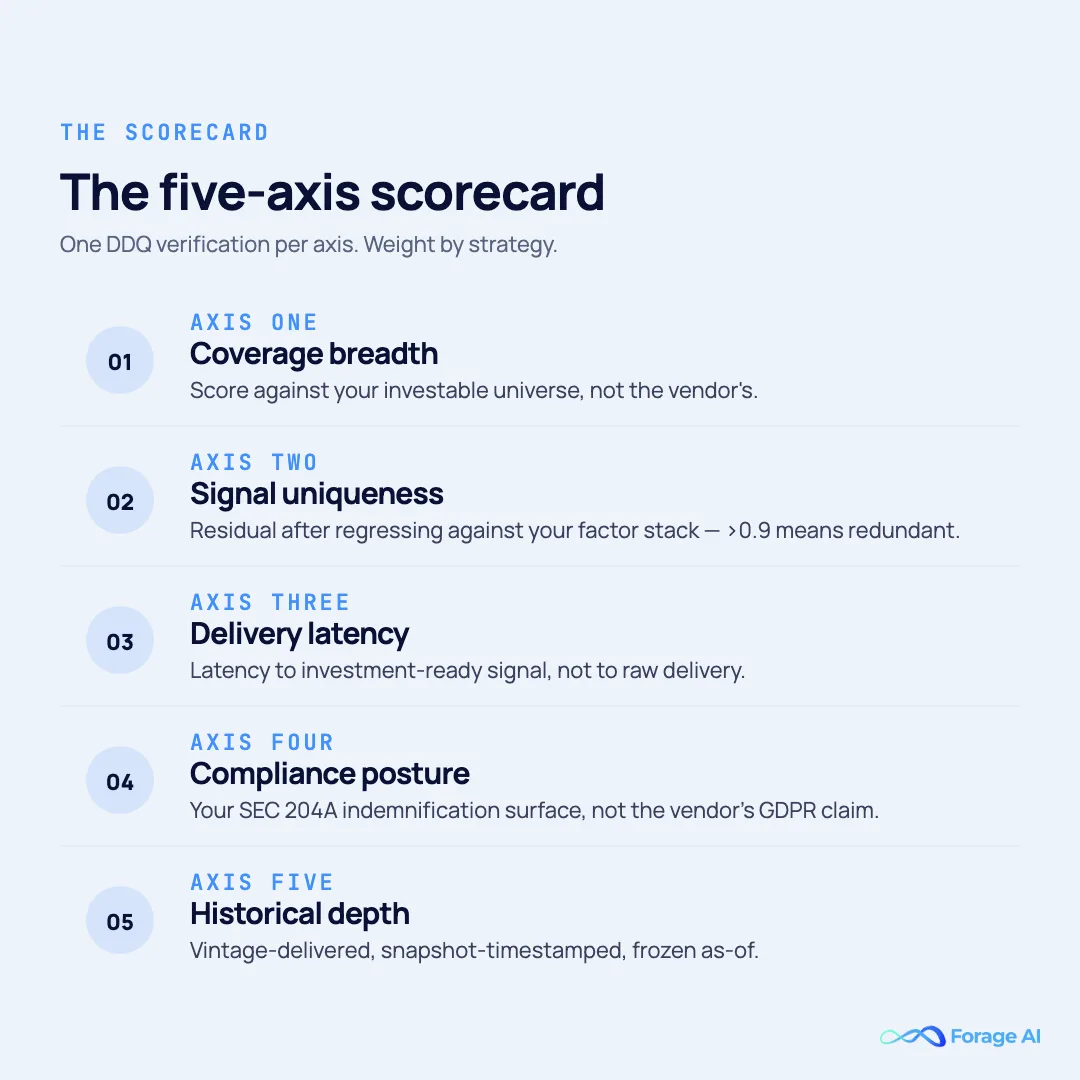
If those three shifts reset the risks, the evaluation framework has to absorb them. Score vendors on the five axes that price into your edge, your indemnification, and your backtest. Each axis carries one DDQ-grade verification.
| Axis | Score 1-5 | DDQ Verification |
|---|---|---|
| Coverage Breadth | 1 = <50% watchlist overlap · 5 = >95% with full field depth | “Express coverage against this watchlist; show entity-mapping accuracy on a 100-name sample.” |
| Signal Uniqueness | 1 = >0.9 correlation with our factor stack · 5 = <0.4 residual on signed returns | “How many funds license this dataset; what’s your tiered-licensing policy?” |
| Delivery Latency | 1 = batch only · 5 = intraday cleaned, normalized, entity-tagged | “Latency-to-investment-ready signal, not latency-to-raw-delivery?” |
| Compliance Posture | 1 = GDPR claim only · 5 = sourcing warranties, audit rights, MNPI attestation, indemnification | “Show the contract clauses that survive a 204A examination.” |
| Historical Depth | 1 = <2 yrs, no PIT · 5 = ≥5 yrs vintage-delivered, frozen as-of, snapshot-timestamped | “Show the as-of timestamp on a 36-month-old vintage record.” |
Three archetypes score differently. A broad packaged feed typically scores 5/2/4/3/4. A niche specialist scores 2/5/3/3/2. A custom acquisition layer scores 5/5/4/5/2 in year one, approaching 5/5/4/5/5 by year three as you accumulate your own vintages.
The axes pull against each other. High coverage means crowded uniqueness; low latency often means thinner history. Compliance is embedded in delivery, not bolted on. Don’t weight axes equally: a credit fund under the EU AI Act Annex III weights Compliance more heavily; a discretionary PM weights Latency lighter than a quant pod.
Tie-breaker rule. If two vendors land within 5% of each other on the weighted score, break the tie on the dimension that costs the most in year two if it fails. For institutional buyers, that’s usually Compliance or Historical Depth; for intraday quant books, Latency.
See Forage AI’s enterprise evaluation checklist and the broader financial-data evaluation framework.
Eagle Alpha’s 2025 catalog tracks 1,900+ providers across 56 sub-categories. Sourcing is solved; fit isn’t. The scorecard compresses the catalog to three defensible candidates. Sub-category guides help too: for property exposure, start with our comparison of real estate data platforms.
Quick Summary. “How do I evaluate an alternative data provider?” Score 1-5 across the five axes, weight by strategy, demand one DDQ verification per axis. The shortlist falls out of the scorecard.
Whose investable universe is the coverage scored against?
Start with the first axis. Vendor coverage claims are denominated in their universe, not yours. The only useful stat is overlap with your investable universe. Demand vendor-side coverage against your watchlist on a 100-name sample. Verify entity mapping (ticker, ISIN, CUSIP, parent issuer) before signing; it’s the largest invisible integration cost in alt-data. Audit field-level completeness, not just record presence: a vendor that covers your tickers but misses the issuer-parent field has zero effective coverage for credit signals.
The decision band is narrower than teams expect. Above ~95% watchlist coverage, additional breadth is noise. Below ~80%, the gap is a deal-breaker. The most expensive failures aren’t missing records; they’re silently missing fields. Forage AI’s work on AI-powered market data extraction routinely surfaces these gaps.
Quick Summary. “How much coverage is enough?” Above 95%, breadth is noise. Below 80%, deal-breaker. Score against your universe and entity-map quality.
Signal Uniqueness: The 0.9 Correlation Test
Coverage shows whether the vendor can see your names. Uniqueness tells you whether anyone else’s edge is already reflected in the price. Signal uniqueness is the residual after you regress the vendor’s signal against your factor stack, not what the vendor claims. The test is mechanical: if the correlation on signed returns exceeds 0.9, the dataset is redundant.
Expert Insights
Vinesh Jha, CEO of ExtractAlpha, framed it in a March 2026 piece on durable alpha: “Signals get crowded… not because they’re wrong, because they work. Capital flows to what works. As adoption grows, excess returns compress. Over time, edge erodes.”
Run the correlation on ≥24 months of vendor historical signal against your live factors before signing. Demand exclusivity or tiered licensing scaled to expected alpha half-life. Neudata’s 2025 fragmentation benchmark of ~20 funds per dataset is your reference; above 50, you’re buying a commodity. Price license-term decay into procurement: if the alpha half-life is 18 months, the contract shouldn’t be a 36-month commitment at full price. Uniqueness is empirical, not categorical; don’t chase exotic data types as a proxy for uniqueness.
Stat Callout. Roughly 50% of documented anomaly alpha disappears post-publication (Di Mascio, Lines & Naik, SSRN). Treat alpha half-life as a procurement input.
Quick Summary. “How do I verify a vendor’s signal is unique?” Regress against your factor stack. >0.9 on signed returns means redundant. Demand current-licensee count. Tier the contract to an alpha half-life.
Delivery Latency: Match Cadence to Decision Cadence
Latency is decision-cadence-dependent. Daily refresh on a quarterly-rebalance book is a waste. The question is latency to investment-ready signal, with vendor-side QA, normalization, and entity tagging included.
Set acceptable latency by use case: event-driven needs <1 hour intraday, daily systematic tolerates T+1, thematic absorbs weekly. Audit delivery-rail compatibility (Snowflake, AWS Data Exchange, BigQuery, S3, REST, webhooks). A vendor whose only delivery is SFTP into a Snowflake stack just added two weeks of engineering per refresh.
Require cleaned, normalized, entity-tagged output. 2025 buy-side analysis indicates ~62% of firms now demand cleaned-and-tagged delivery over raw. Raw-faster is often slower once your team has to clean it. Don’t pay daily-refresh premiums for signals you consume weekly.
Quick Summary. “What latency do I need?” Match decision cadence. Score latency-to-signal, not latency-to-raw.
Compliance Posture: Your SEC 204A Indemnification Layer
Cadence handled. The next axis is where the cost of a wrong answer jumps an order of magnitude. Under Section 204A of the Investment Advisers Act, the failure to prevent MNPI receipt is itself a violation. Your vendor’s compliance is not your indemnification. Treat compliance as your indemnification surface, not a checkbox.
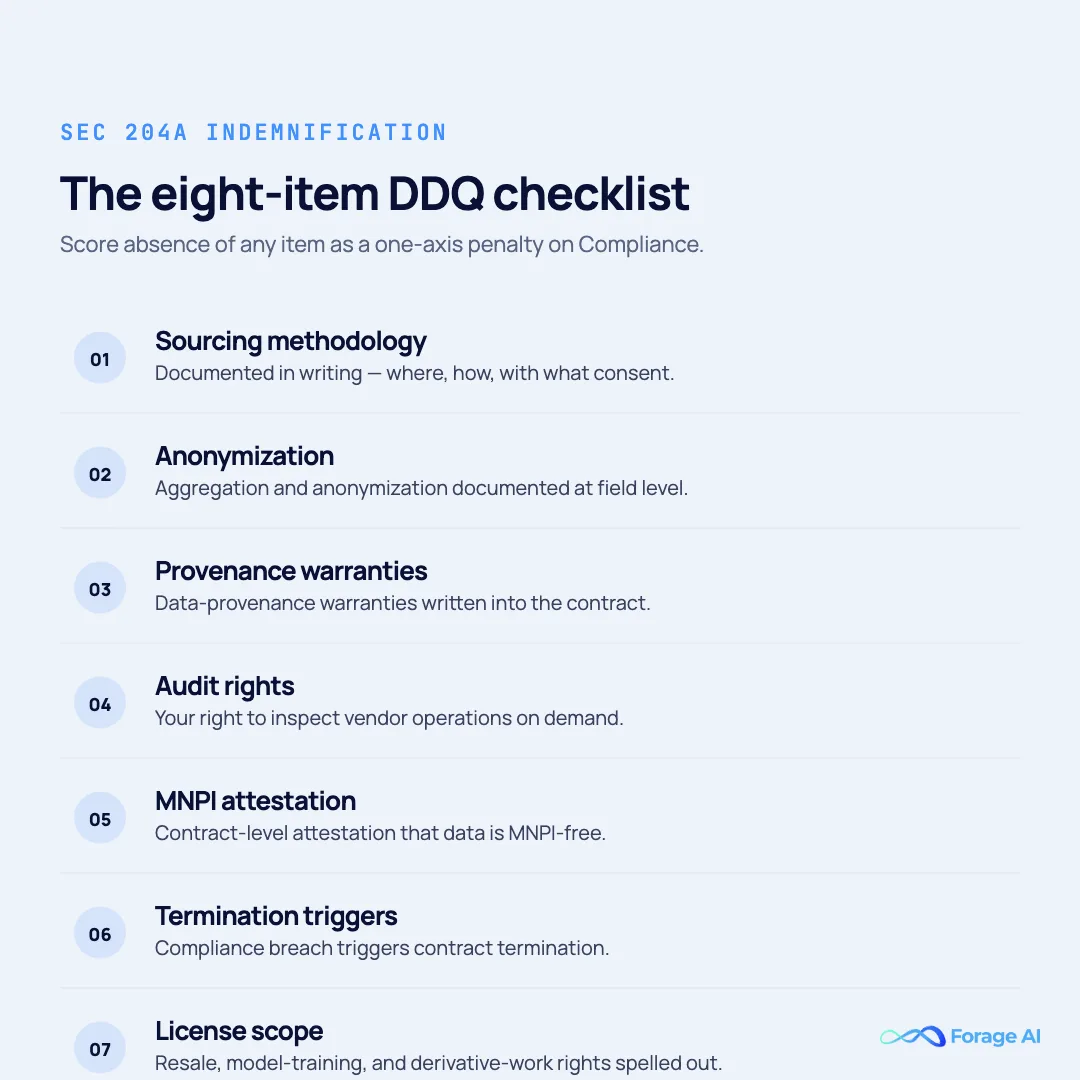
The 204A Indemnification DDQ Checklist
- Sourcing methodology documented in writing: where, how, with what consent.
- Anonymization and aggregation are documented at the field level.
- Data-provenance warranties in the contract.
- Audit rights: your right to inspect on demand.
- MNPI attestation language in the contract.
- Termination triggers tied to compliance breach.
- License scope: resale, model-training, derivative-work rights.
- Indemnification language: financial recourse if sourcing is challenged.
Flag platform-fee gotchas: a vendor pricing “platform access” separately from “dataset access” preserves the option to raise TCO by 30-40% at renewal. Reference FISD Alternative Data Council and Neudata Sentry standards when building the DDQ.
Expert Insights
Examiners have already described what a thin diligence file looks like. In its Risk Alert of 26 April 2022, Investment Adviser MNPI Compliance Issues, the SEC Division of Examinations reported that “Advisers did not appear to adequately memorialize diligence processes or follow them consistently and instead engaged in ad hoc and inconsistent diligence of alternative data service providers” (U.S. Securities and Exchange Commission, 2022). The eight items above exist so the file answers the examiner before the examiner asks.
“GDPR-compliant” refers to vendor EU exposure, not your 204A exposure. SOC 2 covers infosec, not sourcing legality. The SEC’s App Annie logic: products had the potential to contain MNPI was sufficient grounds. If your DDQ is a one-pager, the 2022 Risk Alert’s “ad hoc and inconsistent diligence” finding describes you. Meta v. Bright Data (N.D. Cal., January 2024) largely closed CFAA exposure for scraping public data; contractual and state-law claims now dominate. For the legal side of sourcing, see our guide to web scraping legal compliance. Forage AI also publishes a reference on audit-grade financial data accuracy. This article is general guidance, not legal advice; consult qualified counsel for your specific requirements.
Forage AI: the sovereignty layer. Lowenstein 2025 flags data ownership and privacy as the top buy-side concern at 42%. The answer is contractual. Forage AI runs pipelines under contractual controls and client-specific handling rules agreed up front, with documented sourcing, a no-client-data-resale clause, and on-prem deployment for sensitive workloads. The acquisition layer you commission is yours.
Stat Callout. App Annie paid $10M+ in September 2021, the first SEC enforcement against an alt-data provider. EU AI Act Annex III high-risk rules apply August 2, 2026, capturing alt-data-fed creditworthiness models.
Quick Summary. “Isn’t ‘GDPR-compliant’ enough?” No. GDPR is the vendor’s EU posture; 204A is your indemnification surface. Run the 8-item DDQ; treat August 2, 2026 as a 2026 deadline.
Historical Depth & Point-in-Time Integrity: The Backtest Killer
Compliance protects today’s deal; the final axis protects every backtest you’ve already run. Historical depth alone doesn’t make a backtest defensible. Point-in-time data integrity does. BMLL Tech’s 2025 commentary reports that 77% of funds with AUM above $5B name backtesting as their biggest challenge with alt data. Practitioner minimum: ≥5 years at the granularity you trade.
Backfills, retroactive revisions, and source-side restated values are the three mechanisms that destroy backtest integrity. The marketing line is “ten years of history.” The question is what that history looked like at each moment, not what it looks like now.
The 4-Technique Point-in-Time Verification Stack
- Vintage delivery: vendor ships data as it looked at the as-of timestamp, not today.
- Snapshot timestamps on every record: not just on the file. File-level masks intra-file revisions.
- Frozen as-of files: read-only after publication.
- Parallel live-historical reconciliation: run live alongside historical extract for 30 days; convergence proves trustworthy history.
Demand all four during the DDQ. Score absence of any as a one-axis penalty. Don’t accept “we don’t restate” without contract language. Don’t confuse “history available” with “history at the granularity I trade.”
Stat Callout. 77% of funds above $5B AUM say backtesting alt data is their #1 challenge (BMLL Tech, 2025); ≥5 years is the practitioner minimum.
Quick Summary. “What is point-in-time integrity?” Data delivered as it looked at historical timestamps, with row-level snapshots, frozen-as-of files, and 30-day live-historical reconciliation. Without it, the backtest is fiction.
Off-the-shelf or custom acquisition: which fork fits?
The scorecard tells you how to score what’s on offer. The harder question is which kind of offer to score. Every other guide on this SERP assumes that off-the-shelf is the only option. The real choice is a three-way fork: packaged feed, directory shopping, or a custom acquisition layer. The third option resolves the coverage-vs-uniqueness tension because you own the sourcing, the schema, and the alpha half-life.
| Dimension | Packaged Feed | Directory Shopping | Custom Acquisition Layer |
|---|---|---|---|
| Coverage Fit | Vendor universe | Multi-vendor patch | Your universe by spec |
| Uniqueness | Low (sold to many) | Medium | High (your sourcing) |
| Latency Control | Vendor cadence | Mixed | Your cadence |
| Compliance Surface | Shared | Multiplied | Yours, contained |
| Historical Depth | Vendor’s vintage | Patchwork | Builds from go-live |
| Time to Deploy | Weeks | Weeks | Weeks to months |
| Best For | Commoditized signals, deep history | Discovery, pilots | Niche universe, sovereignty |
Fork to custom acquisition when your investable universe has <80% overlap with packaged-feed coverage, the signal lives in sources no vendor packages, measured alpha decay puts packaged-feed uniqueness below your residual threshold, compliance rules out third-party-aggregated data, or you have engineering capacity to consume but not to source and QA. Off-the-shelf wins when the signal is commoditized, historical depth is the binding constraint with 10+ years clean PIT available, or time-to-deploy beats the custom-build break-even.
Don’t confuse custom acquisition with DIY scraping. DIY fails at scale (anti-bot escalations, schema drift, 1-2 FTE maintenance debt). Budget custom acquisition against the total cost of the program, including the engineering it replaces, not against per-record packaged pricing. See Forage AI’s build-vs-buy framework and firmographic data product as worked examples.
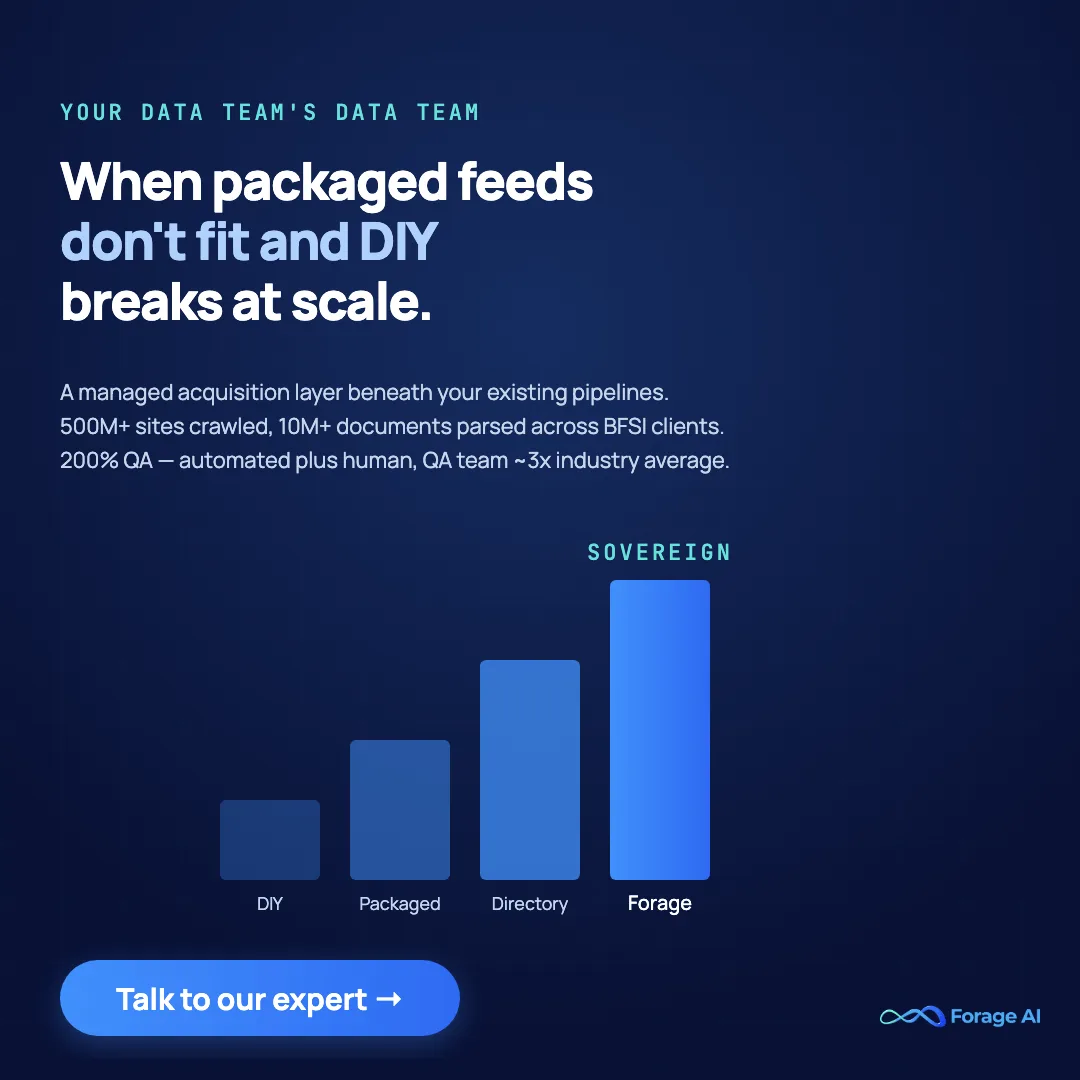
Forage AI: your data team’s data team. When packaged feeds don’t fit and DIY breaks, the third option is a managed acquisition layer delivering cleaned, normalized, entity-tagged data into your existing pipelines. 500M+ sites crawled, 10M+ documents parsed across BFSI clients. 200% QA approach (automated plus human), QA team ~3× industry average. Multi-method extraction (XPath, NLP, custom ML) per source. Your data acquisition strategy, your schema, your indemnification surface.
Quick Summary. “Off-the-shelf vs. custom?” Off-the-shelf is a packaged feed sold to many: fast, commoditized. Custom is a bespoke acquisition layer to your spec. The third option resolves coverage-vs-uniqueness when neither pure-buy nor pure-build is defensible.
The Vendor Failure Recovery Playbook: 30 / 60 / 90
The fork is the right call before you sign. The playbook is what you run when the signed deal breaks. A feed broke, a renewal spiked, or Compliance flagged the DDQ. You need a 90-day defensible cutover, not a panicked re-sign. AIMA’s “Casting the Net” survey of 100 funds with $720bn in AUM cites “data incompatibility” and “lack of time to evaluate” as the leading barriers; a structured cutover prevents both.
| Window | Actions | Artifacts | Risks if Skipped |
|---|---|---|---|
| Day 0-30: Containment | Parallel-run on fallback / stitched source set. Freeze the broken vendor’s last clean snapshot. Notify Compliance and the IC in writing. | Remediation memo. Frozen snapshot. Fallback contract. | 5-Axis Scorecard on three candidates. Three-way fork. 0.9 correlation against the current factor stack. 204A DDQ. |
| Day 31-60: Re-evaluation | Sign a new provider. 30-day live-historical reconciliation. Validate PIT via 4-technique stack. Retire old feed only after convergence. | Scorecard. Correlation report. Completed DDQ. IC memo. | Contract with a termination-for-cause clause. Reconciliation report. Retirement sign-off. |
| Day 61-90: Cutover | Sign new provider. 30-day live-historical reconciliation. Validate PIT via 4-technique stack. Retire old feed only after convergence. | Panicked, re-sign with the nearest substitute. | Clean-looking cutover that invalidates 3 years of backtest. |
Don’t skip the written Day-30 compliance memo. Proskauer’s reading of SEC enforcement logic: inadequate prevention is itself the violation. Don’t cut over without the 30-day reconciliation. Don’t renew the broken vendor “while we figure it out” without preserving termination for cause. See Forage AI’s audit-readiness reference.
Quick Summary. “How do I switch alt-data vendors without breaking my backtests?” Run the 30/60/90: contain, re-evaluate, cut over only after 30 days of reconciliation. Skipping any window is how clean cutovers become silent failures.
Frequently Asked Questions
Q1. How do you evaluate an alternative data provider?
Score 1-5 on five axes: Coverage scoped to your investable universe, Uniqueness (0.9 correlation residual), Latency matched to decision cadence, Compliance as your SEC 204A indemnification surface, Historical Depth with PIT integrity. Weight by strategy.
Q2. What is point-in-time data integrity?
Data delivered as it would have looked at a historical timestamp, with no backfills, retroactive revisions, or restated values. Without it, backtests are inflated by survivorship and revision bias. BMLL Tech reports 77% of >$5B AUM funds name this their biggest alt-data challenge.
Q3. How much do alternative data providers cost?
Packaged datasets typically cost tens to hundreds of thousands of dollars a year, and renewals often carry uplifts and platform-fee surcharges. Total program cost scales with the number of datasets and the engineering needed to onboard them.
Q4. What are the compliance risks?
SEC Section 204A: Inadequate prevention of MNPI receipt is itself a violation. The App Annie $10M+ settlement (September 2021) was the first enforcement action; the 2022 Risk Alert called out “ad hoc and inconsistent” diligence.
Q5. How long does an alt-data pilot take, and what should it test?
4-8 weeks. One historical backtest case and one live case in parallel. Run the 0.9 correlation test, validate point-in-time integrity, stress-test entity mapping on a 100-name sample.
Q6. Off-the-shelf vs. custom alt-data acquisition?
Off-the-shelf is a packaged feed sold to many funds: fast, commodity-specific, and vendor-specific. Custom is a bespoke acquisition layer you commission: sourced and QA’d to spec, you own the data, uniqueness scales with sourcing niche.
Conclusion
The shortlist isn’t the answer; the framework is. The right alternative data provider scores defensibly on your weighted axes, fits your decision cadence, and survives an SEC 204A DDQ. For the buyer-side view of the wider market this sits inside, see our guide to the top financial data providers, our roundup of the leading data-as-a-service companies, and for the upstream practitioner view, how hedge funds source and evaluate alternative data for alpha. That might be a packaged feed today, a custom acquisition layer next renewal, and something different again the cycle after.
Three frameworks travel with you: the 5-Axis Scorecard, the 0.9 Correlation Test, and the 30/60/90 Vendor Failure Recovery Playbook. When packaged feeds don’t fit and DIY breaks, the third option is a managed acquisition layer beneath your existing pipelines. That’s where Forage AI sits.
EU AI Act Annex III rules apply on August 2, 2026. For credit funds, that’s a 2026 problem. Run the 5-Axis Scorecard against your shortlist this quarter, or scope a custom acquisition layer before renewal.
Related Articles
- Build vs Buy Web Data Extraction, Underlying framework feeding the three-way fork.
Sai is a data infrastructure enthusiast who has spent the past two to three years following the AI space closely, from the infrastructure layer to the fast-growing world of data for AI. He is genuinely curious about how modern data pipelines get built and where the data industry is heading, and he writes insightful pieces on the core topics that shape this niche.