
Is Scraping Court Records Legal? The Four Gates That Decide It
This article is for informational purposes only and does not constitute legal advice. Consult a qualified attorney for legal guidance specific to your situation.
The blast radius of a court-records scraper is rarely the scraper itself.
Collection is usually the part a team can defend. The exposure tends to show up later: in the court's terms, in a record that was sealed after you copied it, or in the report your customer used to turn down a tenant.
That is why "is scraping court records legal?" gets two confident and opposite answers online. Both are answering a different part of the question. There are four gates, each run by a different rule-maker, and a use case can clear one while failing another. This article walks through all four, so you can take a specific risk map to your legal team rather than a yes or a no.
Quick Digest
- The short answer: in the US, reading court records that anyone can open is generally lawful at the access layer, but legality is decided at four separate gates: access law, the court's own rules, the record's status, and the law that governs how the data is used.
- The court's own rules: PACER states that billing-avoiding automated collection "may result in criminal prosecution or civil action," California limits bulk distribution by rule, Maryland added a CAPTCHA in 2022, and South Carolina's terms prohibit scrapers outright.
- The South Carolina case: the January 2023 ruling let a First Amendment claim proceed; it did not hold that scraping court records is protected, and the case settled in September 2023 for records access without a merits decision.
- Record status: the Fair Credit Reporting Act (FCRA) requires reasonable procedures for maximum possible accuracy. The Consumer Financial Protection Bureau (CFPB) applied that duty to expunged, sealed and disposition-less records in a January 2024 opinion, then withdrew the opinion in May 2025; the statute did not change.
- Use law: FCRA's accuracy and public-record rules govern what a background or tenant-screening product does with court data, name-only matching is the classic failure, and the California Consumer Privacy Act's (CCPA) public-records carve-out is narrower than "it was online."
Is scraping court records legal?
The access baseline is settled. In the United States, courts recognise a common-law right to inspect and copy judicial records that long predates online case search and bulk collection tools. The Supreme Court put it plainly in 1978:
"The courts of this country recognize a general right to inspect and copy public records and documents, including judicial records and documents." (Nixon v. Warner Communications, Inc., 435 U.S. 589, 597)
Courts now publish that access online, through PACER at the federal level and county or state case-search portals below it. A scraper is automated reading of those same pages. At the layer that asks "may I look at this," the short answer is generally yes.
The trouble is that nobody building a product only looks. You collect, store, match and report, and each of those steps answers to a different rule-maker. We treat each as its own failure domain, and use four gates to keep them apart:
| Gate | What it asks | Who sets the rule | What failure looks like |
|---|---|---|---|
| 1. Access law | Were you allowed to reach the page at all? | Congress (CFAA), courts interpreting it | Entering login-only areas, using fake or shared accounts |
| 2. The court's own rules | Does this court permit automated or bulk collection? | Court administrators, the Judicial Conference | Terminated access, bar discipline, or for PACER, possible criminal prosecution or civil action |
| 3. Record status | Is this record still public today? | Judges' sealing and expungement orders | Reporting a record that was sealed or expunged after collection |
| 4. Use law | What may this data be used for, and how accurate must it be? | FCRA, the courts and regulators enforcing it, state privacy statutes | Background or tenant reports that break accuracy duties |
Each gate fails independently. Clearing Gate 1 says nothing about Gates 2 through 4. In the twelve sources we reviewed for this piece in September 2026, not one treated court records as a data category with its own access rules, which is why the public answers contradict each other. (Forage AI review of ranking search results, September 2026)
If you want the general body of US scraping law first, our guide to web scraping legal compliance covers it. Here we stay on court records.
Gate 1: what access law allows
The Computer Fraud and Abuse Act is the statute people worry about first, and after 2021 it is also the easiest gate to reason about.
In Van Buren v. United States, the Supreme Court narrowed what "exceeds authorized access" means. The Court described the test as binary:
Liability "stems from a gates-up-or-down inquiry: one either can or cannot access a computer system, and one either can or cannot access certain areas within the system." (Van Buren v. United States, 593 U.S. 374 (2021), opinion of the Court; punctuation adapted)
The Court then defined the phrase: a person "exceeds authorized access" when they access a computer with authorization "but then obtains information located in particular areas of the computer, such as files, folders, or databases, that are off limits to him." (same opinion, Part IV; punctuation adapted)
For court records, that maps cleanly. A docket page anyone can open without logging in is an open gate. Closed gates look different: an attorney-only filing tier, a registered-user area, a restricted document class, and any area you reach through a borrowed login or an invented account.
Most coverage leaves out how hiQ Labs v. LinkedIn ended. hiQ is remembered as the case where scraping public profiles survived a CFAA challenge at the Ninth Circuit in April 2022. It did survive.
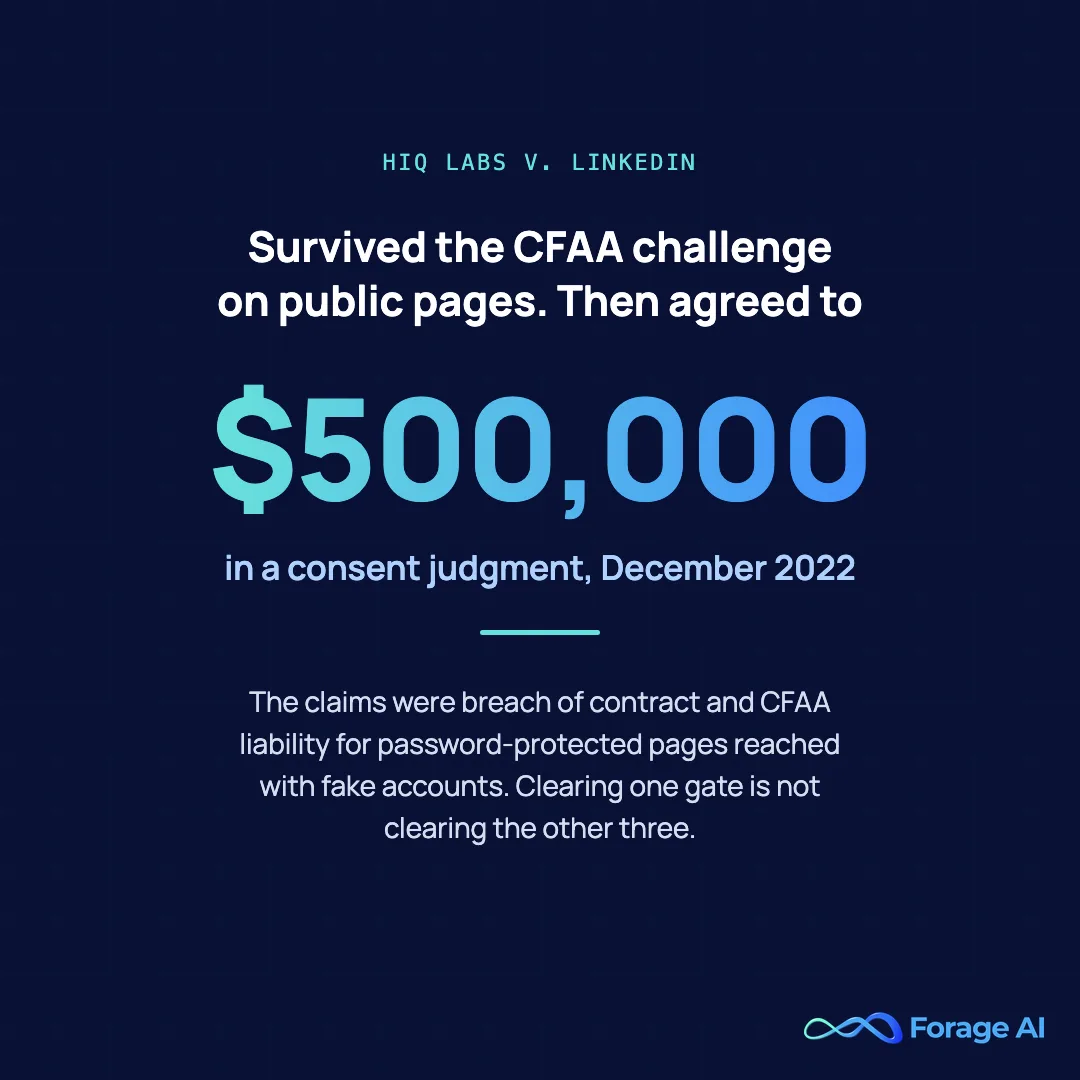
Winning the CFAA question is not winning the case. In December 2022, hiQ stipulated to a $500,000 judgment against it for breaching LinkedIn's user agreement and for CFAA liability "based on hiQ's direct access to password-protected pages on LinkedIn's platforms using fake accounts," along with a permanent injunction. (Consent judgment as reported by Proskauer, 8 December 2022)
For a court-records team, the lesson is narrow and useful. Stay on pages that are open to everyone, never manufacture access, and treat the site's terms as a separate gate rather than something the CFAA analysis has already cleared.
Gate 2: the court's own rules
Gate 1 asks whether you could reach the page. Gate 2 asks whether the court that published it lets you collect it this way.
A court is both the publisher of its records and the rule-maker for how they are read. That dual role is why the same record can be open to a person at a public terminal and closed to a bulk collector.
The four systems below show the range. None of them turns on the CFAA.
| Court system | Access channel | Stated rule on automation or bulk | Technical gate | Consequence named |
|---|---|---|---|---|
| PACER (federal) | Paid account; $0.10 per page, $3 cap per case document | No automated collection that avoids billing | Account-based | "criminal prosecution or civil action"; privileges terminated |
| California state courts | Case-by-case electronic access | Bulk distribution only of calendar, register of actions and index (rule 2.503(g)) | Rule-based | Bulk records beyond the index not provided |
| Maryland Judiciary | Record Search Portal | Confirms users are not "robots or other automated systems" | CAPTCHA, from 28 March 2022 | Must pass a CAPTCHA before searching |
| South Carolina Public Index | County-by-county public search | Terms expressly prohibit "a site data scraper or any similar software" | Detection that freezes the querying browser | Bar members subject to discipline, including disbarment |
PACER: the billing rule is the scraping rule
PACER does not ban automation in general. It bans automation that avoids paying.
"Any attempt to collect data from PACER in a manner that avoids billing is strictly prohibited and may result in criminal prosecution or civil action." PACER lists misuse as including "using an automated process to repeatedly access those portions of the PACER application that do not assess a fee (i.e., calendar events report or case header information) for purposes of collecting case information," and states that privileges "will be terminated if, in the judgment of judiciary personnel, they are being misused." (PACER Policy & Procedures, as of September 2026)
The fee schedule itself is modest: $0.10 per page, capped at $3 per case document, with fees waived for accounts spending $30 or less in a quarter and court opinions always free. The cap does not apply to search results, non-case reports or transcripts, which is where a naive bulk pull runs up cost. (PACER Pricing, as of September 2026)
def pacer_cost(doc_pages):
    """Estimate document fees before a pull. doc_pages: page count per case document."""
    return round(sum(min(pages * 0.10, 3.00) for pages in doc_pages), 2)
How PACER's case locator, bulk options and free archives work is a sourcing question rather than a legal one. Our comparison of legal data providers covers that side in detail.
State courts: rules, terms and technical gates
California is the clearest example of a court limiting bulk access by rule rather than by technology.
Rule 2.503(f) allows electronic access "only… when the record is identified by the number of the case, the caption of the case, or the name of a party, and only on a case-by-case basis." Rule 2.503(g) allows "bulk distribution of only its electronic records of a calendar, register of actions, and index." (California Rules of Court, as of September 2026)
Maryland chose a technical gate instead. From Monday, 28 March 2022, every registered user of the Maryland Judiciary Record Search Portal has had to pass a CAPTCHA "to confirm users are not robots or other automated systems."
South Carolina used both. Its Public Index terms state that access "by a site data scraper or any similar software intended to discover and extract data from a website through automated, repetitive querying for the purpose of collecting such data is expressly prohibited." According to the 2022 complaint challenging the rule, bar members who violate those terms face potential discipline including disbarment, and the system uses detection that freezes a browser it identifies as automated.
In practice, routing around any of these is the fastest way to lose access entirely, and it moves the argument from "was this public?" to "did you ignore the court's stated terms?"
California's Judicial Council explains why its rule treats bulk access differently from case-specific access: bulk information "may be manipulated to compile personal information culled from any document, paper, or exhibit filed in a lawsuit," and "may be exploited for commercial or other purposes unrelated to the operations of the courts, at the expense of privacy rights of individuals." That is the court's own stated reason, and it is the argument a legal team will expect you to have answered.
Source: Advisory Committee Comment, California Rules of Court, rule 2.503
What did the South Carolina scraping case actually decide?
South Carolina's ban went to federal court. The most-cited court-records scraping case did not establish a right to scrape court records. The top search results for this question say otherwise, so the procedural detail matters.
In March 2022, the South Carolina State Conference of the NAACP sued the state's court administration over the Public Index scraping ban (S.C. State Conference of the NAACP v. Kohn, D.S.C. No. 3:22-cv-01007). The NAACP's Housing Navigator program wanted to scrape eviction filings to identify tenants who needed help before they were removed from their homes.
On 10 January 2023, U.S. District Judge Mary Geiger Lewis denied the motion to dismiss. She found the NAACP had "stated a claim that the First Amendment prohibits defendants' ban on scraping," and treated disputes over whether the ban was sufficiently justified as "more suitable for a motion for summary judgment." That is a finding that the claim was plausible enough to proceed. (Order of 10 January 2023, as reported by Troutman Pepper)
This case did not end with a ruling that scraping court records is protected. It settled on 13 September 2023. The NAACP received historical eviction records and timely access to new eviction filings, and the published settlement release does not state that the scraping ban was lifted or struck down. No merits decision was issued. (ACLU settlement release, 13 September 2023)
The practical remedy was data access, not a licence to scrape. For a product team, that points toward asking a court for records through an official channel before building around its terms.
Expert Insights
Announcing the settlement, the ACLU of South Carolina's legal director said: "I am proud that we were able to vindicate important First Amendment concerns while also ensuring that the South Carolina NAACP has the tools it needs to conduct its important and urgently needed advocacy around South Carolina's eviction crisis." The outcome he describes is records access secured by agreement, not a ruling that scraping is protected.
Source: Allen Chaney, Legal Director, ACLU of South Carolina, on the settlement (September 2023)
Both sides of the policy argument are still live. Plaintiffs' counsel read the ruling strongly: announcing the settlement, Esha Bhandari of the ACLU said the district court "properly recognized that the South Carolina NAACP's proposed scraping of public court records is activity protected by the First Amendment." The order's own posture was narrower, a finding that the claim was plausibly stated, and the settlement left the question without a merits decision.
Gillian Diebold of the Center for Data Innovation argued in 2022 that "no branch of government, at the federal or state level, should impose unnecessary technical or legal restrictions on this activity." On the other side sits the privacy rationale California states in its own rule: bulk court data can be compiled "at the expense of privacy rights of individuals." As of September 2026, whether a state court may categorically ban automated access to its public records remains unresolved.
Quick Summary
Q: Did a court rule that scraping court records is protected by the First Amendment?
A: No. In January 2023, a federal judge in South Carolina ruled only that the NAACP had stated a plausible First Amendment claim against the state's scraping ban, leaving the justification question for later. The case settled in September 2023 for access to eviction records, with no merits decision, so whether a court may ban automated access to public records is still open.
Gate 3: a record's legal status can change
Gates 1 and 2 decide whether you may collect a record. Gate 3 is about what happens to that record after you hold it, long after the collection question was answered.
A court record is not frozen when you copy it. Judges seal records, grant expungements and restrict access after the original filing, sometimes years later.
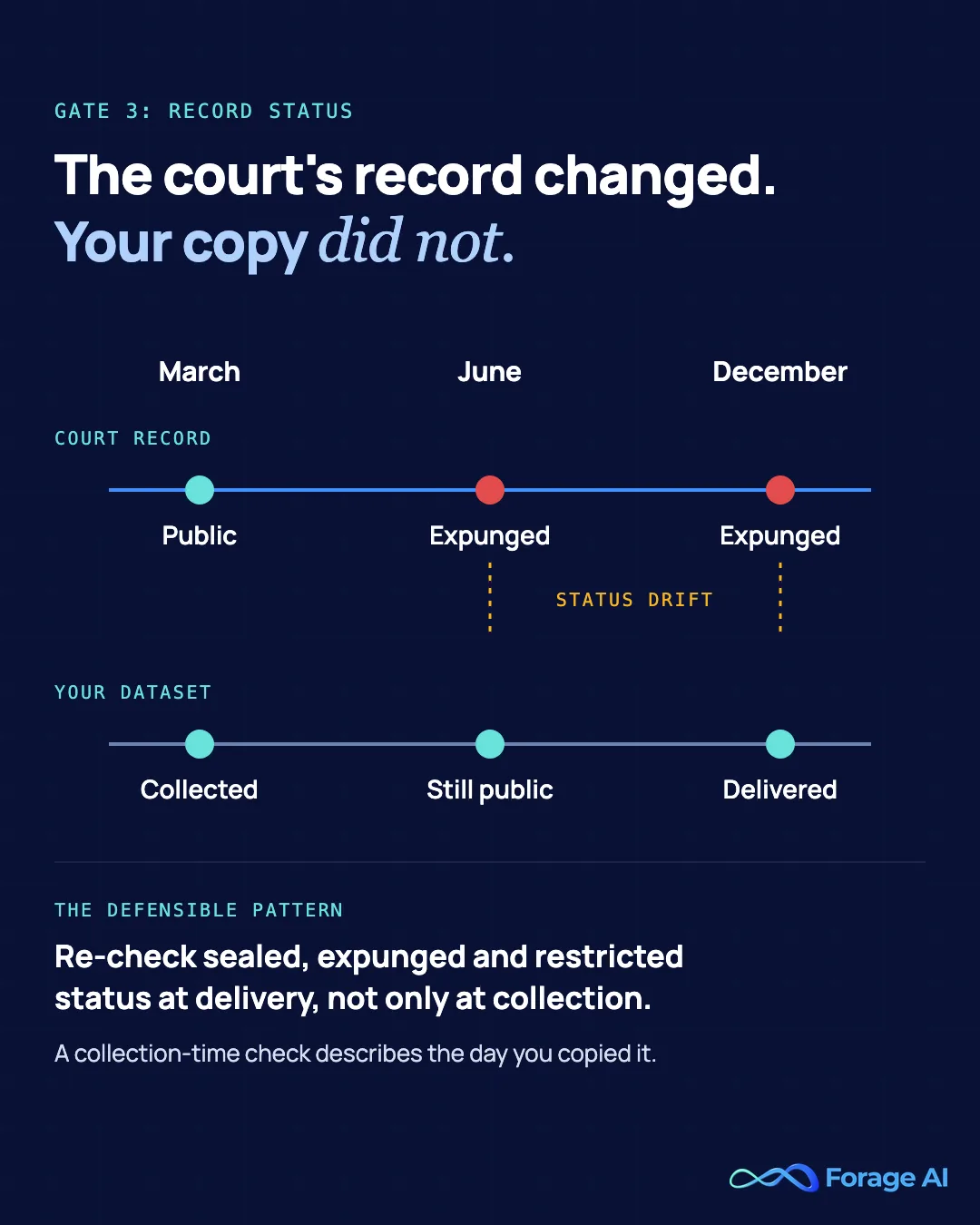
The copy in your dataset does not update itself. A record scraped in March can be expunged in June and still sit in your warehouse in December, looking exactly as it did on the day you collected it. The collection was lawful. Reporting that record now is what your legal team will ask about.
Background-screening reports are where the Consumer Financial Protection Bureau addressed this most directly, in a January 2024 advisory opinion:
A consumer reporting agency "is not using reasonable procedures to assure maximum possible accuracy under section 607(b) of the Fair Credit Reporting Act (FCRA) if it does not have procedures in place that: (1) prevent reporting information that is duplicative or that has been expunged, sealed, or otherwise legally restricted from public access; and (2) include any existing disposition information if it reports arrests, criminal charges, eviction proceedings, or other court filings." (CFPB advisory opinion, Fair Credit Reporting; Background Screening, January 2024; withdrawn 12 May 2025)
That opinion is no longer in force, and the duty behind it is. The CFPB withdrew it on 12 May 2025, one of 67 guidance documents withdrawn that day. The statute it interpreted still requires a consumer reporting agency to "follow reasonable procedures to assure maximum possible accuracy of the information concerning the individual about whom the report relates," and accuracy claims can still be brought in court. Read the 2024 opinion as a regulator's worked example of that duty for court records, not as a rule you can point to today. (15 U.S.C. §1681e(b); CFPB withdrawn-guidance list, as of September 2026)
Redaction is not a safety net either. Federal Rule of Civil Procedure 5.2 limits filings to the last four digits of a Social Security or taxpayer number, the year of birth, a minor's initials and the last four digits of a financial account, unless the court orders otherwise. That duty sits with whoever files the document. Nothing guarantees a filer met it, so a scraped PDF can carry identifiers the rule says should not be there.
Accuracy claims over expunged records are already litigated. One class action alleging a screening provider reported convictions a California court had expunged settled for $487,000, according to published reports.
The defensible pattern is to re-check status at the moment you deliver, not only at the moment you collect:
RESTRICTED = {"sealed", "expunged", "restricted"}
NEEDS_OUTCOME = {"arrest", "charge", "eviction"}

def publishable(record, current_status):
    """Gate a record at delivery time, not only at collection time."""
    if current_status(record.court, record.case_no) in RESTRICTED:
        return False                       # status changed after collection
    if record.kind in NEEDS_OUTCOME and not record.disposition:
        return False                       # filing without its outcome
    return True
Gate 4: what you may use the data for
For a commercial court-records product, the use gate is usually where legal review spends its time. Collection rules decide whether you may hold the data. Use rules decide whether you may sell a conclusion drawn from it.
Scope comes first. The Fair Credit Reporting Act's accuracy duties attach to consumer reporting agencies and to reports used for covered decisions such as employment, housing and credit. A team scraping dockets for litigation analytics sits in a different position from a team selling tenant-screening reports. Which one you are is the first question to settle with counsel.
For employment reports, the statute is specific:
Under 15 U.S.C. §1681k, an agency reporting public-record items likely to adversely affect a consumer's employment must either notify the consumer when it reports them, or maintain "strict procedures" so the information is complete and up to date. Arrests, indictments, convictions, suits, tax liens and outstanding judgments count as up to date only if "the current public record status of the item at the time of the report is reported." (15 U.S.C. §1681k)
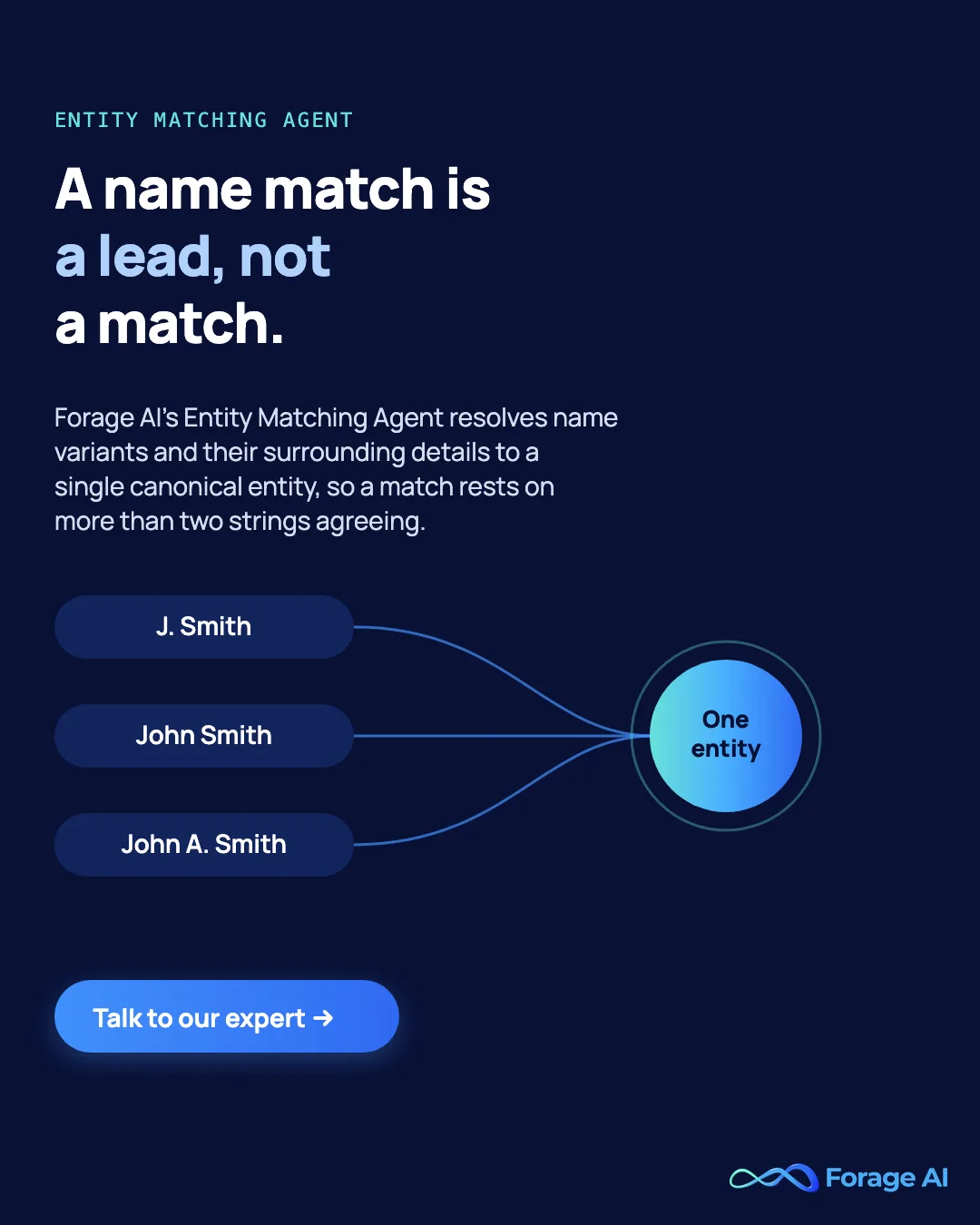
A name is not an identity. In November 2021, the CFPB concluded that name-only matching, which links a record to a person "based solely on whether the consumer's first and last names are identical or similar to the names associated with the information," is not a reasonable procedure under FCRA. It withdrew that opinion in May 2025. The accuracy duty stayed in the statute, and with common names, a name-only match is how a lawful record ends up in a report about the wrong person.
IDENTIFIERS = ("dob", "address", "middle_name", "party_id")

def is_match(record, person, min_identifiers=2):
    """A name match is a lead, not a match."""
    agreed = sum(1 for k in IDENTIFIERS
                 if record.get(k) and record.get(k) == person.get(k))
    return record["name"].casefold() == person["name"].casefold() and agreed >= min_identifiers
This is the job Forage AI's Entity Matching Agent is built for: resolving variants of a name and its surrounding details to a single canonical entity, so that a match rests on more than two strings agreeing.
Privacy law has a narrower carve-out than most teams assume. California's privacy statute excludes "publicly available" information from personal information, and defines the term precisely:
"'Publicly available' means information that is lawfully made available from federal, state, or local government records." The definition also states that it does not mean biometric information collected about a consumer without the consumer's knowledge. (Cal. Civ. Code §1798.140)
"Lawfully made available from government records" is a different test from "we found it online." A record copied from a court portal against its terms, or enriched with data from elsewhere, is a harder fit. Our CCPA guide for external data covers that statute in depth, and our map of US web scraping laws covers the other state privacy laws and data-broker registration.
How do you build a pipeline that passes legal review?
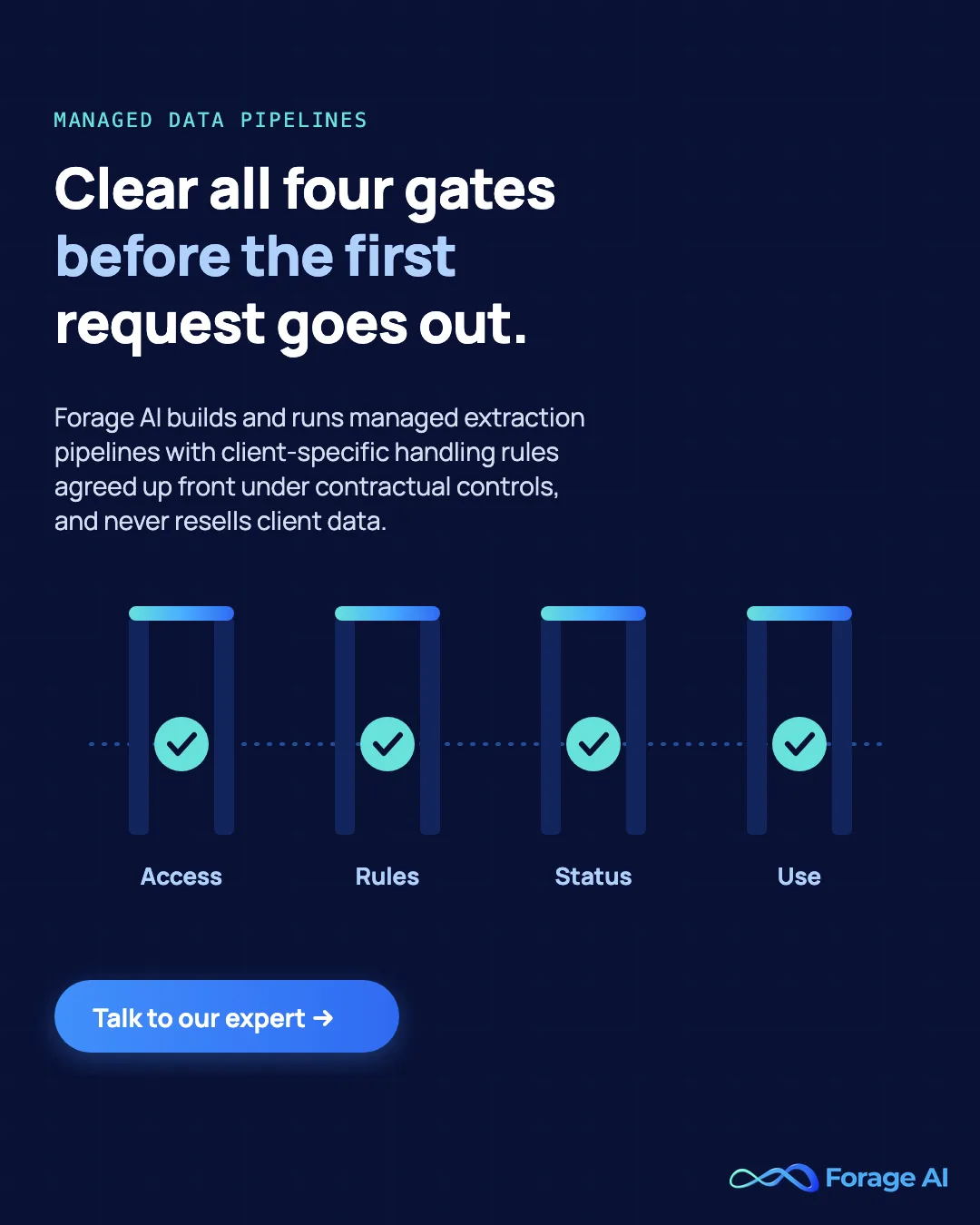
Legal review asks for evidence, not assurances. The four gates become four columns in a source register, filled in before the first request goes out.
| Gate | Question to answer before collecting | Evidence to keep |
|---|---|---|
| 1. Access law | Is every target page reachable without logging in, and are we using only our own credentials? | Page-level access notes; account ownership |
| 2. Court rules | What do this court's terms, fee rules and bulk policies say about automation? Is there an official bulk channel or data request? | Terms snapshot with date; correspondence with the court |
| 3. Record status | How will we detect sealing, expungement and restriction after collection? | Status re-check log at delivery; suppression list |
| 4. Use law | Are we a consumer reporting agency for any customer use? Which identifiers must agree before a match? | Use-case classification signed off by counsel; match-rule definition |
Write the answers into configuration the pipeline actually reads, so a source cannot run without its gate decisions attached:
SOURCE_POLICY = {
    "pacer": {
        "gate1_access": "own paid account only",
        "gate2_rules": "no collection that avoids billing",
        "bulk_channel": "check official options before scraping",
        "gate3_recheck_at_delivery": True,
        "gate4_match_min_identifiers": 2,
    },
    "sc_public_index": {
        "gate1_access": "public search",
        "gate2_rules": "terms prohibit scrapers",
        "action": "request records or obtain counsel review; do not automate",
    },
}
Prefer official channels where they exist. The South Carolina case is the useful model: the NAACP ended up with eviction records through an agreement with the court, not a court-approved scraper. Free Law Project's RECAP works in a similar spirit for federal records, sharing documents that users have already paid PACER for, rather than working around the fee.
Court filings are documents before they are data. Dockets link to PDFs, scanned orders and exhibits, which is where Forage AI's Intelligent Document Processing does the extraction, with 95% table detection accuracy across all table types. Our guide to legal document processing covers that side of the work.
A managed pipeline moves the gate work into the engagement itself. Forage AI agrees client-specific handling rules up front under contractual controls, and never resells client data.
Clearing all four gates still leaves risk you cannot engineer away. Whether a state court may categorically ban automated access to its public records is an open First Amendment question after the South Carolina case settled, and rules differ court by court. A pipeline that is defensible in California can be non-compliant in South Carolina on the same day.
So the honest question to take into your next legal review is not whether court records are public. It is which of the four gates carries the risk your product cannot absorb, and whether you have written down how you cleared the other three.
Frequently asked questions
Is it legal to scrape PACER?
PACER permits paid access but prohibits automated collection that avoids its fees. Its policy states that such collection "may result in criminal prosecution or civil action," and it names repeated automated access to free portions such as case header information as misuse. The published rule targets collection that avoids billing; it does not say other automated use is approved, so confirm how your own access fits PACER's terms before relying on it.
Can a state court ban scraping its case search website?
Several state courts restrict automated access through terms of service, technical gates such as CAPTCHAs, or court rules on bulk distribution. Whether a categorical ban survives a First Amendment challenge is unresolved: the South Carolina case that raised it settled in 2023 without a merits ruling. Until a court decides otherwise, those terms still carry consequences. Courts can cut off access, and South Carolina's terms expose bar members to potential discipline.
Can I use scraped court records for tenant screening or background checks?
Only inside the Fair Credit Reporting Act's accuracy rules if you are acting as a consumer reporting agency. The statute requires reasonable procedures to assure maximum possible accuracy. CFPB opinions from 2021 and 2024 read that duty as excluding expunged and sealed records, including dispositions, and ruling out name-only matching; the CFPB withdrew both in May 2025, and the statute behind them still applies. The legality of collecting the record does not settle whether a report built from it is accurate.
Does the CCPA apply to court records?
California's privacy law excludes "publicly available" information, defined as information "lawfully made available from federal, state, or local government records." That covers court records obtained lawfully from government sources. It does not cover everything found online. Data collected against a court's terms, or combined with non-government sources, is a harder fit for the exemption.
What should I do if my dataset contains a record that was later expunged?
Stop reporting it and suppress it from future deliveries. A copy does not update when the court's record changes, so the reliable approach is to re-check a record's current status at the time you deliver it, not only when you collected it. Keep a log of those checks, because that log is the evidence a legal review will ask for.
Are court records in the public domain?
Court records are generally open to public inspection, which is different from being free of every restriction. Courts can seal or expunge records, limit bulk distribution, and set terms for their online systems, and laws such as FCRA regulate how records are used in consumer reports. "Public" describes access, not an unrestricted licence.
Related Articles
- Top 10 Legal Data Providers: where court and legal data comes from, and which vendor class sells which part of it.
- US Web Scraping Laws: the federal and state law map for scraping teams, including data-broker registration.
- Is Web Scraping Legal? What Data Laws Mean for Your Pipeline: the general legal picture for web scraping, beyond court records.
- Legal and Ethical Issues in Web Scraping: the foundational guide to scraping ethics and compliance.
Sai is a data infrastructure enthusiast who has spent the past two to three years following the AI space closely, from the infrastructure layer to the fast-growing world of data for AI. He is genuinely curious about how modern data pipelines get built and where the data industry is heading, and he writes insightful pieces on the core topics that shape this niche.