
Web Scraping Legal Compliance: Code Patterns That Survive Legal Review
This article is for informational purposes only and does not constitute legal advice. Consult a qualified attorney for legal guidance specific to your situation.
Counsel pings on Slack at 4:47 PM Thursday: a regulator sent questions about your crawl and wants a one-pager by Friday morning. Robots.txt handling. Terms of service posture. Lawful basis for personal data. Audit trail. Engineers know the words. The pipeline does not say them in code.
This article is for the data engineer or data product manager who has to ship that pipeline. Not the legal essay version. Not the “respect everything, talk to your lawyer” version. The version where every section maps a specific 2024-2025 ruling or regulation to the architectural primitive it forces, with the code, schema, or decision rule. You can land this in a pull request this week.
Four primitives carry the weight: a real robots.txt parser tied to a CI gate, a hash-and-diff loop on each target’s terms of service, a per-jurisdiction policy switch driven from a routing table, and an append-only provenance ledger that your counsel can read without translation. Build those, and a legal review becomes a code review.
Quick Digest:
- Web scraping legal compliance is an engineering problem with a legal acceptance test.
- Four primitives carry the weight: a real RFC 9309 robots.txt parser tied to a CI gate, a hash-and-diff loop on each target’s terms of service, a per-jurisdiction policy switch driven by a routing table, and an append-only provenance ledger that counsel can read without translation.
- This article maps every recent ruling (hiQ v. LinkedIn, Van Buren v. United States, Meta v. Bright Data) to the architectural primitive it forces, and ships the code, schemas, and decision rules to land in your pipeline this week.
What Does the 2024-2025 Legal Landscape Mean for Engineers?
Note: This article is implementation guidance, not legal advice. Engage qualified counsel for jurisdiction-specific questions and any matter touching personal data.
The headline rulings of the last four years did not give scrapers a green light. They gave engineers a coordinate system. Two cases narrowed the federal hacking statute, one case narrowed contract law against logged-off bots, and a fourth signals the next wave of suits toward copyright and anti-circumvention rather than the Computer Fraud and Abuse Act.
hiQ Labs v. LinkedIn and Van Buren: the gates-up rule
In hiQ Labs v. LinkedIn (9th Cir., 31 F.4th 1180, April 2022), the Ninth Circuit reaffirmed that scraping public LinkedIn profiles likely does not violate the CFAA’s “without authorization” prong, because public pages are gate-opened by default. A year earlier, Van Buren v. United States (593 U.S. 374, 2021) applied the same gates-up versus gates-down logic at the Supreme Court level, narrowing “exceeds authorized access” to mean accessing files the user has no permission to reach at all. For an engineer, this collapses to a simple invariant: if your dispatcher only fetches URLs that any unauthenticated user can fetch, the CFAA is not the statute that ends your weekend.
Meta v. Bright Data and X Corp v. Bright Data: terms of service have a session
In January 2024, Judge Edward Chen granted Bright Data summary judgment on its breach-of-contract claim, holding that Facebook and Instagram’s terms of service govern only logged-in use. Bright Data was not a “user” of those services when it scraped public pages while logged off. A parallel ruling in X Corp v. Bright Data later that year reached a similar conclusion and added a copyright-preemption theory: claims based purely on copying public data were preempted by the Copyright Act. The architectural takeaway is sharp. ToS binds a session, not an IP address. Sessions are something your fetch layer either holds or does not, and that distinction has to be a predicate, not a comment in the runbook.
RFC 9309: voluntary protocol, evidentiary weight
The Robots Exclusion Protocol became a real IETF standard in September 2022 as RFC 9309. It is voluntary. It is also the closest thing to a documented expression of the site operator’s intent, and regulators read it that way. France’s CNIL, in its 2024 focus sheet on legitimate interest, explicitly cited robots.txt compliance as a factor in any Article 6(1)(f) balancing test. Ignoring a Disallow does not automatically make a scrape unlawful. It makes a defensible posture harder to maintain, and a thin posture untenable.
GDPR and CCPA in one paragraph each
GDPR Article 6(1)(f) lets you process personal data on a “legitimate interest” basis if you can document necessity, proportionality, and safeguards. Article 14 obliges you to notify data subjects when you obtain their data indirectly (which is what scraping is) within one month, with a narrowly construed disproportionate-effort exemption. Maximum administrative fines reach €20M or 4% of global annual turnover. CCPA and CPRA carve out “publicly available” information lawfully made available from government records or that is not restricted by the consumer. The carve-out is real but narrower than most engineers assume: a profile set to “everyone” is publicly available; one restricted to “friends” is not, even if a logged-in scraper can see it. When the personal data reaches your pipeline from an external vendor or data broker rather than your own crawler, the downstream obligations it triggers are mapped out in our enterprise guide to CCPA implications for external data use.
Quick Summary
Q: What did the recent rulings actually change for engineers?
A: They handed engineers a coordinate system rather than a green light. Public pages are gates-up under hiQ and Van Buren, terms of service bind a session rather than an IP address after the Bright Data rulings, and the Robots Exclusion Protocol is voluntary but carries evidentiary weight as RFC 9309. Each of those maps to a primitive in the fetch path: a session-state predicate at the dispatcher, a hash-and-diff loop on the terms document, and a real robots parser wired into the build.
Robots.txt Handling: From Polite Suggestion to CI Gate
The first failure mode is treating robots.txt as a string match in a long-forgotten module. RFC 9309 introduced wildcard semantics, including * an end-of-line $, which string matching gets wrong silently. A 2025 ACM Internet Measurement Conference study confirmed what site operators already knew: scrapers selectively respect robots.txt, and AI search crawlers often do not check it at all. Both behaviors show up in litigation discovery.
The pattern is to use a real parser, log every decision, and gate the build.
# robots_gate.py - wraps urllib.robotparser.
# For stricter RFC 9309 wildcards, swap in robotspy.
from urllib.robotparser import RobotFileParser
from urllib.parse import urlparse
import hashlib, time

class RobotsGate:
    def __init__(self, user_agent: str, audit_sink):
        self.user_agent = user_agent
        self.audit_sink = audit_sink
        self._cache: dict[str, tuple[RobotFileParser, str]] = {}

    def _load(self, host: str) -> tuple[RobotFileParser, str]:
        if host in self._cache:
            return self._cache[host]
        rp = RobotFileParser()
        rp.set_url(f"https://{host}/robots.txt")
        rp.read()
        # In practice, fetch the bytes yourself and pass them to rp.parse(...)
        # so you can hash exactly what the parser saw.
        body = b""
        digest = hashlib.sha256(body).hexdigest()
        self._cache[host] = (rp, digest)
        return rp, digest

    def can_fetch(self, url: str) -> bool:
        host = urlparse(url).netloc
        rp, digest = self._load(host)
        allowed = rp.can_fetch(self.user_agent, url)
        self.audit_sink.write({
            "ts": time.time(),
            "url": url,
            "ua": self.user_agent,
            "robots_sha256": digest,
            "decision": "allow" if allowed else "deny",
        })
        return allowed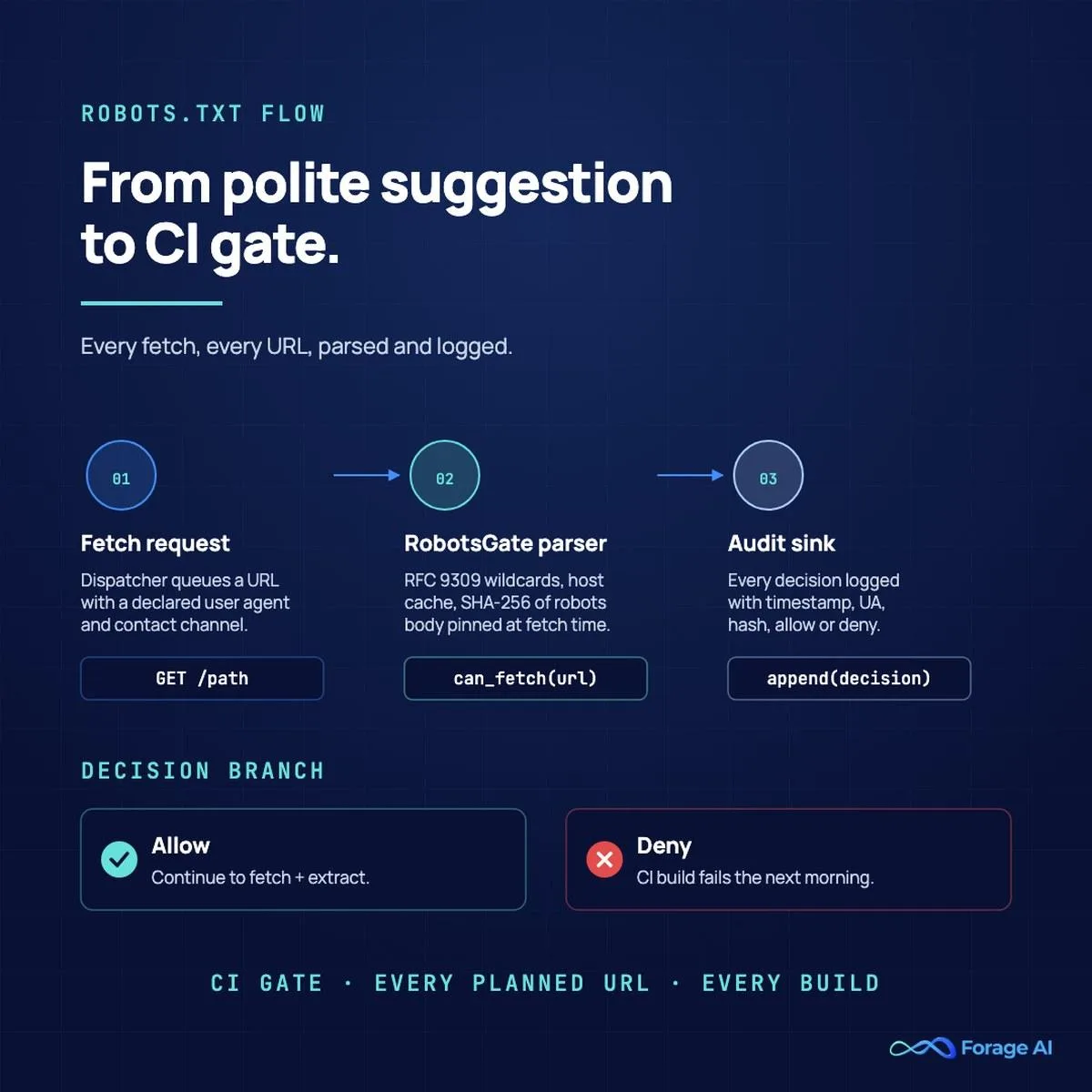
Two practitioner notes. First, the standard library parser still trails RFC 9309 on wildcard edge cases; if your targets use Allow: /api/*$ patterns, prefer robotspy, which tracks the RFC. Second, the audit sink call is not optional. Without a per-decision log, you cannot reconstruct what the file said the day you fetched it, which is exactly what counsel will ask.
Expert Insights
The Robots Exclusion Protocol stopped being folklore in September 2022, when the IETF published it as RFC 9309, authored by M. Koster, G. Illyes, H. Zeller and L. Sassman. The document "specifies the rules originally defined by the Robots Exclusion Protocol that crawlers are requested to honour when accessing URIs". Requested rather than required is exactly why the parser belongs in CI: the RFC is the yardstick a reviewer will hold your fetch path against.
The CI gate closes the loop. Before any new crawl plan ships, run a smoke test that loads each target’s robots.txt, walks the planned URL set, and fails the build if any planned URL is disallowed for your declared user agent. Site operators change their robots.txt; your test catches it the morning after, not the morning of the regulator’s email.
Terms of Service Enforcement at Scrape Time
Bridging from robots.txt to ToS: where robots.txt is a public, machine-readable signal, terms of service are a private contract whose binding force depends on a session that may or may not exist. Most teams read them once at project kickoff and never again. Meta v. Bright Data turned that habit into a real risk surface. The ruling does not say that ToS never matters. It says ToS binds a session, and your fetch layer is the only place that knows whether a session exists.
A defensible architecture builds three things into the fetch path.
First, a session-state predicate at the dispatcher: a fetch is logged off if and only if no cookie, header, or token implies an authenticated session. This sounds obvious. It breaks the moment a developer adds a Cookie: header for caching purposes or a partner integration leaves an OAuth token in the default client. Make the predicate a single function that the dispatcher calls, and have it return a typed value that a logger and a policy switch both consume.
Second, a hash-and-diff loop on the ToS document itself.
import hashlib, requests, datetime

def tos_fingerprint(tos_url: str) -> dict:
    r = requests.get(tos_url, timeout=10)
    r.raise_for_status()
    body = r.text.encode("utf-8")
    return {
        "tos_url": tos_url,
        "fetched_at": datetime.datetime.utcnow().isoformat() + "Z",
        "sha256": hashlib.sha256(body).hexdigest(),
        "length": len(body),
    }

def assert_tos_unchanged(target: str, ledger):
    current = tos_fingerprint(target)
    last = ledger.last_for(target)
    if last and last["sha256"] != current["sha256"]:
        ledger.flag(target, current, last, severity="HIGH")
        raise ToSChangedError(
            f"ToS for {target} changed; pipeline halted for review."
        )
    ledger.append(target, current)
Run this on a daily schedule. When the hash changes, the pipeline halts that target until a human reviews the diff. That single move converts the most common failure mode (silent ToS drift) into an alert with two known states the on-call engineer can act on.
Third, a decision rule any reviewer can read. Document, for each target domain, the matrix of session state by data type by lawful basis. The matrix is small enough to fit in a wiki page and important enough that it lives in version control next to the crawler config. Your compliance architecture should make this matrix the single place a “can we scrape X” question gets answered, with the deeper reasoning one click away.
Per-Jurisdiction Policy Switches That Survive a Real Legal Review
Bridging from ToS to jurisdiction: once the dispatcher knows whether a session exists, it has to know which legal regime the target sits inside. Counsel does not care that GDPR is “stricter than CCPA.” Counsel cares that for any given URL your pipeline touches, you can name the lawful basis, the allowed fields, the retention class, and whether an Article 14 notice fires. That is a routing problem, and it has the shape of a routing table.
The routing table maps a target signal (registrant country, TLD, content-language headers, the data type) to a PolicyBundle:
from dataclasses import dataclass
from typing import Literal

LawfulBasis = Literal[
    "legitimate_interest_gdpr",
    "publicly_available_ccpa",
    "consent",
    "legal_obligation",
    "no_personal_data",
]

@dataclass(frozen=True)
class PolicyBundle:
    jurisdiction: str            # e.g. "EU", "US-CA", "UK", "ROW"
    lawful_basis: LawfulBasis
    allowed_fields: frozenset[str]
    retention_days: int
    article_14_notice: bool      # GDPR personal data indirectly obtained
    bundle_id: str               # version pin, e.g. "eu-public-2025-09"

POLICY_TABLE: dict[str, PolicyBundle] = {
    "EU": PolicyBundle(
        jurisdiction="EU",
        lawful_basis="legitimate_interest_gdpr",
        allowed_fields=frozenset({"company", "title", "public_post_text"}),
        retention_days=180,
        article_14_notice=True,
        bundle_id="eu-public-2025-09",
    ),
    "US-CA": PolicyBundle(
        jurisdiction="US-CA",
        lawful_basis="publicly_available_ccpa",
        allowed_fields=frozenset({
            "company", "title", "public_post_text", "email_business",
        }),
        retention_days=365,
        article_14_notice=False,
        bundle_id="us-ca-public-2025-09",
    ),
}

def policy_for(target_url, registrant_country, content_lang) -> PolicyBundle:
    if registrant_country in {"DE", "FR", "IE", "NL", "ES", "IT", "PL"}:
        return POLICY_TABLE["EU"]
    if registrant_country == "US" and "ca" in target_url:
        return POLICY_TABLE["US-CA"]
    # ROW fallback should be the most conservative bundle, not the most permissive.
    return POLICY_TABLE["EU"]
Two non-obvious rules. The default fallback for an unknown target should be the strictest bundle in your table, not a permissive one. Defaults travel; if the table is missing a row tomorrow, the strict default fails closed instead of open. And the bundle ID belongs in your provenance ledger on every record, so a future audit can pin a row to the exact policy that produced it.
The Article 14 notice is the hardest mechanical piece, and the one teams skip. CNIL has been explicit that the “disproportionate effort” exemption is narrow; the Polish DPA’s €220,000 fine on a scraper who already had contact details settled the question for that fact pattern. The pragmatic pattern is a notice generator that runs nightly, batches new EU-bundle records, sends notices through a verified channel where one exists, and posts a public notice on a transparency page when no verified channel does. That public-notice fallback is not a guarantee, but it is the documented good-faith effort regulators and counsel both expect to see.
Looking for a managed pipeline with all four primitives baked in? Forage AI runs managed extraction with provenance, jurisdiction routing, and audit trails included by default. Talk to our team: Forage AI managed extraction.
The Audit Trail: Provenance Schema That Counsel Can Read
Bridging from policy to provenance: the policy bundle answers “should we have fetched this?” The audit trail answers “can you prove what you fetched, what the rules said, and which bundle decided?” A defensible audit trail is not “we have logs.” It is an append-only, content-addressed ledger where every extracted record points at the bytes, decisions, and policies that produced it. The schema below is the smallest viable shape; teams that ship this rarely regret it.
@dataclass(frozen=True)
class ProvenanceRecord:
    record_id: str               # UUID of the extracted row
    source_url: str
    fetched_at: str              # RFC 3339 UTC
    response_sha256: str         # hash of the HTTP response body
    robots_sha256: str           # hash of robots.txt at fetch time
    tos_sha256: str | None       # hash of the ToS document at fetch time
    parser_version: str          # semver of the parser
    user_agent: str
    session_state: Literal["logged_off", "logged_in", "api_key"]
    policy_bundle_id: str        # FK into your policy table
    lawful_basis: LawfulBasis
    retention_class: str         # e.g. "180d", "365d", "indefinite_business"
    extracted_fields: list[str]  # fields the policy permitted
Three reasons this schema is worth the storage cost. First, the response hash plus the parser version lets you reproduce any extraction bit-for-bit, which is the only way to defend against a “you fabricated this” claim. Second, the robots and ToS hashes pin the site operator’s stated intent at fetch time, which is exactly what regulators reach for when assessing a legitimate-interest balancing test. Third, the policy bundle ID and lawful basis travel with the record forever, which means a deletion request months later can be answered by a single SQL query rather than a forensic project.
Storage shape: an append-only raw history table, a canonical current-state table populated by an idempotent transform, and a change-log that records every state transition. The append-only history is the part counsel actually wants. Do not let an over-eager DBA “compact” it.
How Does Case Law Map to Code?
Bridging from schema to direct mapping: if every primitive above feels like a separate engineering choice, this table is the connective tissue. Rulings are not abstractions; they pin down where in your codebase a primitive belongs.
| Ruling or rule | Architectural primitive it forces | Where it lives in code |
|---|---|---|
| hiQ v. LinkedIn, Van Buren v. US | Public-only crawl flag at the dispatcher | Dispatcher.fetch_plan() checks is_public(url) before queueing |
| Meta v. Bright Data, X Corp v. Bright Data | Session-state predicate at the fetch layer | session_state(request) returns a typed value |
| RFC 9309 + CNIL focus sheet | Real robots.txt parser plus per-decision log | RobotsGate.can_fetch() with audit sink |
| GDPR Art 6(1)(f) and Art 14 | Lawful-basis tag and notice generator | PolicyBundle.lawful_basis, nightly notice job |
| CCPA “publicly available” | Explicit publicly_available_ccpa basis pinned per record | PolicyBundle.lawful_basis for US-CA bundle |
| Reddit v. Perplexity (DMCA §1201) | No-circumvention rule: never break paywalls or anti-bot tokens | Dispatcher refuses URLs that required CAPTCHA solve or token theft |
The map is the deliverable for your one-pager. Counsel reads the left column. Engineering owns the right two.
Expert Insights
Justice Amy Coney Barrett, writing for the Supreme Court in Van Buren v. United States on 3 June 2021, held that an individual "exceeds authorized access" under the CFAA "when he accesses a computer with authorization but then obtains information located in particular areas of the computer, such as files, folders, or databases, that are off limits to him". In code that is a gate check, not a purpose check: your dispatcher has to answer whether a gate exists, not whether the site owner would approve of the use.
Which Failure Modes Get Pipelines Subpoenaed?
Four failure modes recur in litigation discovery. Each has a code-level fix, and each is the kind of thing that looks fine in normal operation and catastrophic in cross-examination.
Silent retry storms after a 429. A rate-limited fetch path that retries without exponential backoff or a circuit breaker reads, in logs, exactly like a denial-of-service attempt. Implement decorrelated jitter, a per-host concurrency cap, and a hard ceiling that pages on-call before it reaches the magnitude that would trigger an abuse report.
Mixed crawler identities across IPs. Rotating user agents while rotating IPs without declaring a contact channel reads as evasive. Pick one declared user-agent string per project, include a contact URL in it, and rotate IPs only with a documented rate-limiting purpose, not an identity-laundering one.
Stale ToS hash, no diff. If you cannot prove what the ToS said the day you scraped, you cannot prove your interpretation was reasonable. The hash-and-diff loop above is the smallest move that closes this gap.
No Article 14 mailbox. A pipeline that processes EU-bundle records without a deletion-request mailbox and a documented response SLA is, mechanically, in violation. Stand up the mailbox before the first production EU crawl, not after the first request.
How Does Forage AI Build These Primitives In?
Forage AI’s managed extraction pipelines build these primitives in by default: real RFC 9309 parsing on every fetch, hash-and-diff on terms of service per target, jurisdiction-routed policy bundles with versioned IDs, and append-only provenance ledgers your counsel can query directly. Together these primitives are what turns ad-hoc scraping into automated data collection a regulator can audit on demand. This is what compliance-first data extraction automation looks like in practice: the legal review surface is engineered in, not bolted on after the first regulator email. The same primitives carry into adjacent workflows where counsel review is the gate, including contract data extraction for legal teams that need provenance and accuracy held to the same standard, and high-volume ecommerce data scraping programs where catalog, pricing, and review extraction, including downstream price intelligence feeds and competitor price tracking, must clear the same robots.txt, ToS, and jurisdiction gates before a single product page is fetched. Compliance is the gate that lets teams adopt modern data extraction services without rebuilding the legal-review surface in-house. The Forage AI QA layer is three times the industry-average size, and every extraction carries the bundle ID, lawful basis, and retention class that produced it. Teams ship faster because the legal-review surface is built once, by the partner, instead of rebuilt every quarter by an engineering team that would rather be working on data products.
Managed web scraping at enterprise scale, with audit trails, jurisdiction routing, and Article 14 workflows handled for you. See how Forage AI does it: Forage AI managed extraction.
Frequently Asked Questions
Is web scraping legal in the US in 2026? Scraping publicly accessible web pages is generally not a CFAA violation in the Ninth Circuit and most other circuits after Van Buren. State common-law claims, copyright, and DMCA §1201 anti-circumvention remain live theories, especially where a scraper bypasses anti-bot measures.
Does respecting robots.txt give legal cover? Not by itself. Robots.txt is a voluntary protocol under RFC 9309. Compliance is a strong positive signal in regulatory and judicial reasoning; ignoring it is a strong negative signal. It is necessary but not sufficient.
Do platform terms of service bind a logged-off scraper after Meta v. Bright Data? Generally not, when the scrape is genuinely logged off and the data is public. The architectural commitment that gives this defense its weight is a session-state predicate at the fetch layer that proves no session existed.
What lawful basis covers scraping personal data under GDPR? In practice, only Article 6(1)(f) legitimate interest is workable for scraping at scale, and only with a documented Legitimate Interest Assessment covering necessity, proportionality, and safeguards. Consent is impractical at scrape time.
When does Article 14 notice apply, and how do I scale it? It applies whenever you obtain personal data indirectly, which is exactly what scraping does, and the deadline is one month. Scale it with a nightly notice job, a verified-channel send (if one exists), and a public-transparency page (if one does not).
Does CCPA’s “publicly available” exemption cover scraped social profiles? It covers profiles that the consumer has not restricted to a specific audience. A profile set to “friends only” is not publicly available, even if a logged-in account can see it.
Can I scrape data behind a CAPTCHA or anti-bot system? Treat any technical protection measure as a hard stop. Bypassing it exposes you to DMCA §1201 anti-circumvention liability, which carries statutory damages far higher than those for a contract-breach claim.
What does a defensible audit trail actually look like? An append-only ledger in which every extracted record includes the source URL, fetch timestamp, response hash, robots.txt hash, ToS hash, parser version, policy bundle ID, lawful basis, and retention class. If any of those fields is missing, the trail is not yet defensible.
Conclusion
Web scraping legal compliance is an engineering problem with a legal acceptance test. A real RFC 9309 parser with an audit sink answers the robots.txt question. A hash-and-diff loop on terms of service plus a session-state predicate answers the contract question. A jurisdiction policy switch with a strict default and an Article 14 notice generator answers the GDPR question. An append-only provenance ledger answers every other question counsel will ever ask. Build those four primitives once, and a legal review becomes a code review you can pass on the first pass, every quarter, without rewriting the pipeline.
Related Articles
- A Guide To Modern Data Extraction Services in 2026. The pillar overview of the modern data extraction services landscape, from build-versus-buy to compliance-first delivery.
- Legal and Ethical Issues in Web Scraping: What You Need to Know. The companion awareness guide covers the legal landscape end-to-end.
- Debunking Common Myths About AI-Powered Web Data Extraction. Practical compliance guidance for AI-driven extraction programs.
- Solving the AI Training Data Crisis With Compliant Web Scraping. Compliance frameworks for AI training data programs.
- How to Legally Extract Social Media Data at Scale. Platform-specific compliance for social data programs.
Sai is a data infrastructure enthusiast who has spent the past two to three years following the AI space closely, from the infrastructure layer to the fast-growing world of data for AI. He is genuinely curious about how modern data pipelines get built and where the data industry is heading, and he writes insightful pieces on the core topics that shape this niche.