
Legal Document Processing: How Law Firms Automate Contract and Case File Review
This article is for informational purposes only and does not constitute legal advice. Consult a qualified attorney for legal guidance specific to your situation.
It is a Sunday afternoon in a conference room. The closing books for a $1.2 billion carve-out are stacked on the table: 826 documents, 41 jurisdictions, and four bidder iterations of every NDA. The senior associate has not slept properly since Thursday. Counsel for the buyer is asking for an updated change-of-control summary by 7 a.m. Monday. Nobody on the team is reading every page anymore. They are skimming, sampling, and trusting that the diligence binder is clean.
This is what legal document processing is supposed to fix. The promise sounds clean: classify every incoming document, extract the load-bearing clauses, validate against the term sheet, route exceptions to a partner. The promise is also where most legal-tech projects quietly fail. Not because the technology cannot extract, but because the technology that extracts often cannot be defended in a privilege review, cannot keep client memoranda within the firm’s perimeter, and cannot withstand the variability of real legal documents.
This guide is for the Legal Ops Director who has tried point tools, hit a wall, and now has to convince a Managing Partner, a General Counsel, and a Compliance lead simultaneously. We will cover what legal document processing actually is in 2026, the seven document types that defeat templated review, the privilege-waiver precedent that quietly broke most public AI tools for law, the IDP-plus-human-review architecture that survives both a state bar review and a Big Four audit, and the seven vendor questions that separate the partners that hold up from the ones that demo well.
Quick Digest
- Lawyers spend ~2.1 hours per day, 26% of the working day, on document drafting and review tasks that can be automated (Thomson Reuters Legal Technology Survey 2025). Returning that time to higher-value work is the operational case.
- Seven document types defeat templated review: multi-party contracts, case files and pleadings, regulatory filings, deeds and leases, eDiscovery production sets, M&A diligence binders, and privileged client memoranda.
- Consumer GenAI exchanges are not privileged. Judge Rakoff held in February 2026 that a defendant’s exchanges with a consumer AI assistant were never protected by attorney-client privilege or the work-product doctrine. Most legal SaaS routes documents through those same models.
- The defensible architecture is layered: enhanced OCR, ML-based extraction per document family, rule-based validation, human-in-the-loop review for exceptions, and write-back to the firm’s DMS or CLM. No single layer carries the accuracy on its own.
- The audit trail required for legal work is page-level cite-back, not document-level confidence scores. Every extracted value links to its source span, model version, and reviewer ID.
What is legal document processing in 2026?
Legal document processing is the combination of intelligent document processing (IDP), business-rule validation, and human-in-the-loop review that turns the unstructured artifacts of legal work, contracts, filings, pleadings, deeds, and memoranda into structured records that downstream systems can consume. It covers intake classification, clause-level extraction, jurisdiction and party validation, exception routing, and write-back to the firm’s document management system (DMS) or contract lifecycle management (CLM) platform.
It is not a system that gives legal advice. Counsel still owns the opinion, the negotiation, and the strategy. Automation belongs in the document handling, classification, extraction, and validation layers that surround a lawyer’s judgment, never on top of it. Readers new to the technology stack underneath this work will get a faster orientation from our OCR vs IDP comparison; this guide assumes you already know why plain OCR is not enough for legal documents.
The 2026 environment is different from the 2023 environment in three structural ways. Privilege rules now cover AI exposure. Most state bars have followed the ABA in clarifying that submitting privileged content to a public AI tool implicates the duty of confidentiality, and a US District Court ruling in February 2026 has made that case law. Adoption has crossed the Rubicon. Thomson Reuters reports generative AI usage at 28% in law firms and 23% in corporate legal departments in 2025, with 53% of small firms and solos integrating generative AI into their workflows (up from 27% in 2023). And vendor stacks have multiplied: CLM, contract drafting, eDiscovery, IDP, legal research, and matter management each have their own tools, each touching the same privileged documents.
The cleanest definitional line we use with firm leadership: if the system would ever generate a final piece of advice without a human signing off, it is out of scope. If the system says “this matter is ready for an associate, here are the extracted clauses and the flagged exceptions,” it is in scope. The boundary is the legal judgment, not the document.
The seven legal document types that defeat templated review
Most legal-tech demos show a clean, well-formed contract being read correctly and call it a day. Real legal documents are messier than the demo. These seven document classes are where templated extraction stops working, and where the gap between vendor accuracy claims and field performance shows up under load.
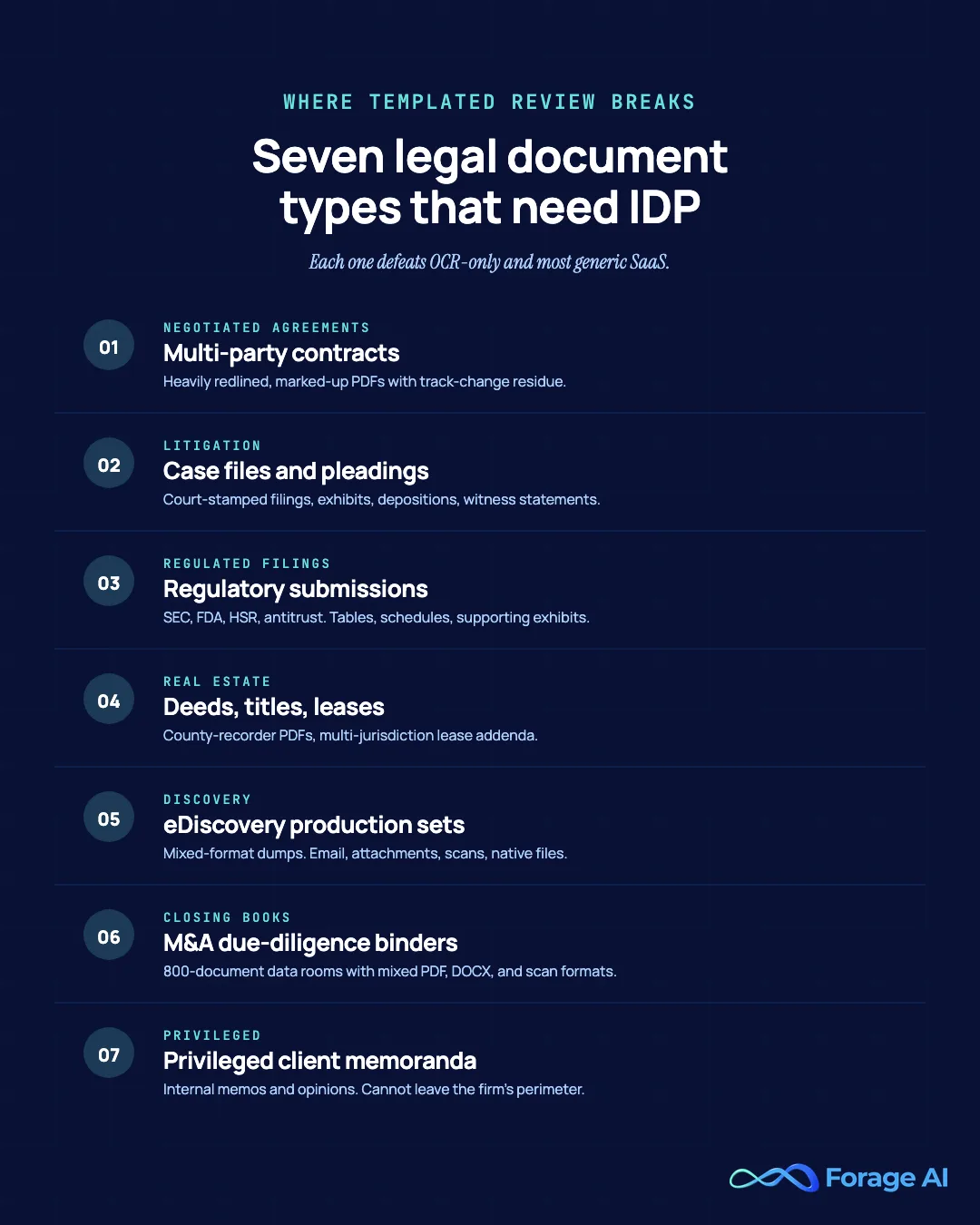
- Multi-party contracts. Master services agreements, joint ventures, and partnership deeds carry heavy redlining, track-change residue, multi-counterparty annexes, and side letters. A clause-extraction model trained on a clean buyer-seller NDA does not survive a 12-party joint venture document. Real-world contract data extraction has to handle this variance per clause family, not per document template.
- Case files and pleadings. Court-stamped filings, exhibits, depositions, expert reports, and witness statements arrive in formats that vary by court, state, and filing system, which is also why teams that need this material in bulk rather than matter by matter start from where litigation and court-record data actually comes from. Templated OCR misses exhibit references, footnotes, and handwritten judicial markings.
- Regulatory submissions. SEC 10-Ks, FDA NDAs, HSR antitrust filings, and FTC second requests. Tables, schedules, footnotes, and supporting exhibits can add up to thousands of pages. Each regulator’s filing system has its own structural quirks.
- Deeds, titles, and lease addenda. County-recorder PDFs and multi-jurisdiction lease addenda. Real estate documents specifically defeat single-template OCR because the format varies county by county, and the same document family will arrive scanned, born-digital, and re-photocopied within a single binder.
- eDiscovery production sets. Mixed-format dumps with email, attachments, OCR’d scans, native files, and metadata. Technology-assisted review (TAR) is now standard in large litigation, but the underlying IDP layer must handle format variance before TAR can do its job.
- M&A diligence binders. 800-document data rooms with mixed PDF, DOCX, scan, and image formats. The clause that decides the price often sits on page 41 of a 60-page schedule. Templated review at this volume is the single biggest predictable failure mode in transactional practice.
- Privileged client memoranda. Internal opinions, work product, ethics memos. This is the document family that cannot leave the firm’s perimeter under any circumstances. Any IDP solution that routes through third-party LLMs is structurally excluded from this category by design.
Templated review works on documents that do not vary. Legal documents always vary, and the variation is the work product. That is why teams that try to standardize their way into automation discover that the standardization itself is the bottleneck.
Expert Insights
Stanford RegLab and Stanford HAI researchers Varun Magesh, Faiz Surani, Matthew Dahl, Mirac Suzgun, Christopher D. Manning and Daniel E. Ho, in “Hallucination-Free? Assessing the Reliability of Leading AI Legal Research Tools” (2024), found that the purpose-built legal AI research tools they tested “hallucinate between 17% and 33% of the time”. That is the range a single headline accuracy number hides, and it is the argument for measuring clause-level accuracy per document family instead of accepting one figure for contracts.
The accuracy benchmark we trust on legal files is clause-level by document family, by jurisdiction. A vendor reporting “94% accuracy on contracts” is hiding the fact that simple NDAs are perfect and 12-party joint ventures are 60 percent. Counsel only cares about the documents where the accuracy is hardest to achieve.
Quick Summary
Q: Quick Summary. “Why does templated review keep failing on legal documents?” Because templates assume document stability and legal documents are structurally unstable. Per-family extraction with ML plus rules plus human-in-the-loop is the only architecture that survives the variance.
A:
Why does most legal SaaS fail the privilege test?
This is the section most legal-tech vendors pitch. Almost every IDP and contract-review SaaS product on the market today routes documents through third-party large language models, OpenAI, Anthropic, Google, or one of the major hyperscaler-hosted variants, to do the heavy lifting of parsing, summarization, and clause extraction. For most use cases, that is operationally fine. For legal work, it is a privilege problem with case law behind it.
In February 2026, in United States v. Heppner, US District Judge Jed S. Rakoff held that a defendant’s written exchanges with a consumer AI assistant were not protected by attorney-client privilege or the work-product doctrine. The reasoning is narrow but pointed: the assistant is not an attorney, the exchanges were not confidential because the platform’s own terms allowed the inputs to be used and disclosed, and they were not made at the direction of counsel. Privilege never attached in the first place.
Expert Insights
The precise language is worth keeping to hand. Reporting the opinion in March 2026, the Harvard Law Review Blog recorded that Judge Rakoff determined the communications “were not protected by attorney-client privilege or the work product doctrine”, because they failed the privilege’s foundational requirement of being “between a client and his or her attorney”. Read the holding narrowly, then read your own sub-processor list: the case turns on who is on the other end of the prompt, and the sub-processor list is the only place that is written down.
The operational consequence is that any document-processing tool whose extraction pipeline hits OpenAI, Anthropic, Google, or any other third-party LLM hands the firm or the legal department a privilege risk it did not have before procurement signed the contract. Vendor terms that “do not train on your data” do not solve this; the test the courts apply is disclosure to a third party, not training. Once the document leaves the perimeter, the privilege analysis is over.
This is the gate at which most legal-IDP deals quietly die. Compliance asks for the sub-processor list. The list has five LLM vendors. The legal review ends. The procurement team moves on.
The way Forage AI is built avoids this category of risk by design. Extraction runs within Forage AI’s own systems, with on-premises and VPC deployments available for environments where the documents must remain within the firm’s perimeter. No third-party LLM sits in the data path. Client data is never sent to public AI services, never aggregated across clients, never resold, and never used to train external models. Contractual handling controls are not configuration options; they are how the service is built. Detail: forage.ai/intelligent-document-processing.
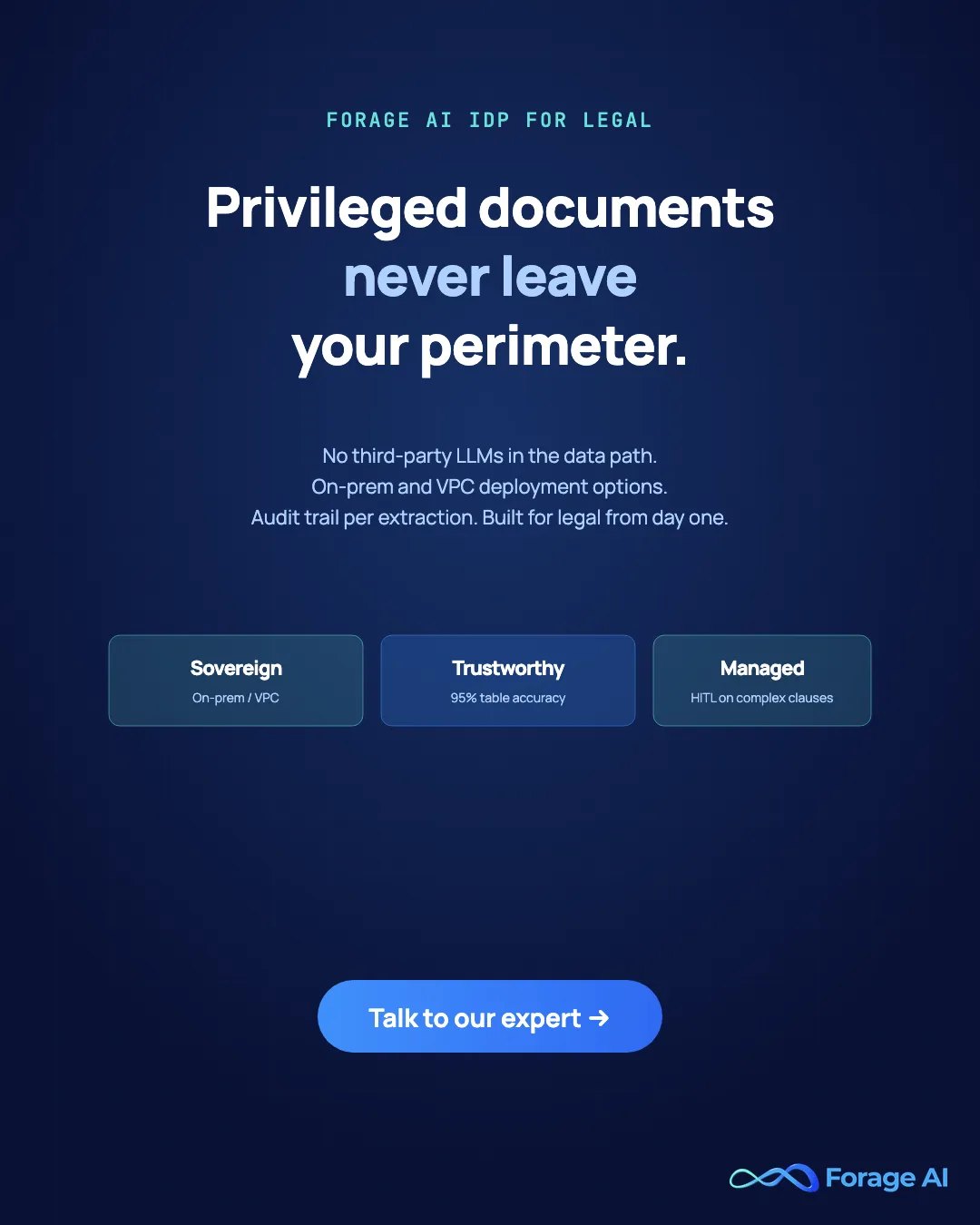
The fastest way to lose a legal-IDP deal in 2026 is to hand the General Counsel a sub-processor list with five upstream LLM providers on it. The fastest way to win the same deal is the one-line answer: no third-party LLM in the data path, on-prem or VPC deployment, audit trail per extraction. Procurement gates have moved upstream; a contract that says “we do not use OpenAI” closes more legal-ops business than any feature bullet.
Quick Summary
Q: Does routing documents through a third-party model put privilege at risk?
A: Treat it as a live risk rather than a settled question. The February 2026 ruling turned on a consumer AI assistant used by a party, not by counsel, and privilege never attached in that setting. Counsel-directed use of a vendor tool under contract is a different analysis. What does not change is the test a General Counsel applies in procurement: where does the document physically go, who else can read it, and is that written into the sub-processor list. A pipeline that stays inside your own perimeter never has to answer the harder version of that question.
The defensible architecture: IDP plus human review for legal work
The pattern that holds up at scale on legal documents is layered. No single layer carries the accuracy on its own; each layer covers a different failure mode that the next one would otherwise propagate.
Enhanced OCR runs first, with HDR image processing, handwriting recognition, table detection, and signature and stamp recognition. Machine learning extraction reads clause-level content with models trained per document family, contracts, filings, deeds, and exhibits. Rule-based validation checks the extracted values against jurisdiction, party names, term sheets, and fund mandates, catching the cases where the model is confidently wrong. Human-in-the-loop review handles edge cases that the rules cannot specify: unusual indemnification language and a side letter that contradicts the master agreement. And delivery writes the validated record back into the firm’s DMS (iManage, NetDocuments, SharePoint) or CLM platform, where the lawyer’s normal workflow picks it up.
The reason layering wins is not that any single layer is unusually strong. It is that the layers overlap in their failure modes. ML catches what templates miss. Rules catch what ML hallucinates. Humans catch what rules cannot specify. And the human corrections compound back into the model over time. Single-model stacks have to be perfect on day one and degrade from there. Layered stacks accumulate institutional memory.
Forage AI has built this model across more than 10 million parsed documents in financial, legal, and healthcare workflows. The QA team is sized at roughly three times the industry average relative to delivery. That ratio sounds excessive until the first sanctions motion arrives and counsel has to defend a 94% field-level accuracy claim with no human verification log.
The human review layer is also where firm-specific institutional memory accumulates. After a year of running a firm’s M&A binder flow, the reviewers have seen the same edge cases hundreds of times: the buyer who always asks for a non-standard MAC, the seller’s counsel who buries the indemnification cap in a schedule. That pattern set trains the next quarter’s model. Pipelines without a human layer never accumulate this asset.
What audit trail does legal work require?
Legal work is judged twice: once when it is filed, and once when something goes wrong. The second judgment is unforgiving. When a state bar inquiry, a sanctions motion, or a regulator’s question arrives, the answer to “where did this number come from?” cannot be “the IDP extracted it.” The answer has to include which document, which page, which bounding box on that page, which extraction model version, which validation rules fired, which human reviewer touched it, what they changed, and when.
This is field-level, cite-back lineage, not document-level audit logs. Most generic IDP products produce the latter and call it an audit trail. They tell you that document X was processed at time Y with confidence Z. They do not tell you which span on which page produced the extracted clause, nor do they retain a tamper-evident history of human corrections. The first time a partner has to defend an extracted value to opposing counsel, the gap shows.
The test is simple. Pick any closed matter from six months ago. Try to reconstruct, in 60 seconds, the source span for the three most decision-relevant extracted values in that matter. If you cannot, the firm does not have an audit trail. It has a logfile. The distinction matters at exactly the worst possible time.
The single most diagnostic question in any legal-IDP vendor evaluation is “can you walk me through a closed matter from six months ago and show me where each extracted clause came from?” Vendors that pass that test almost always pass the rest of the evaluation. Vendors that pivot to talking about confidence scores are quietly admitting their audit trail is document-level.
Where does automation belong in legal work?
A clean way to think about scope: automation belongs wherever the work is mechanical extraction, classification, routing, or validation against a known rule. It does not belong in strategic advice, negotiation positioning, opinion work, privileged client communication, or any decision that requires reading the spirit of a contract or the politics of a counterparty.
The high-fit moments across a legal workflow are intake classification (separating contracts from correspondence from exhibits), clause and party extraction (pulling names, dates, jurisdictions, governing law, indemnification language), term-sheet versus draft validation (catching the cases where the negotiated draft diverges from the agreed term sheet), diligence-binder indexing (turning 800 documents into a navigable index in hours, not days), conflict checks across filings, and bill-back coding for matter management. For a deeper treatment of the orchestration around extraction, see our document workflow automation guide.
The low-fit moments are strategic advice, negotiation positioning, privileged client memoranda, witness preparation, settlement and arbitration calls, and any ethical-screen judgment that requires reading the relationship between counsel and client. Assistive AI can support these, surfacing precedent, summarising the matter history, flagging anomalies, but the lawyer stays in the loop, and the automation stays in support. The boundary is the judgment, not the document.
Firms that try to automate the judgment work end up either over-recommending the conservative position (model takes the path of least resistance) or under-flagging the risky one (model penalizes anything novel). Both outcomes show up in malpractice reviews. Counsel staying in the judgment seat is not a brake on automation; it is the design.
The lifecycle map also helps with change management on the associate floor. Associates resist “the AI is replacing me” framing and accept “the AI is opening the binder and indexing it; you are reading what matters” framing. The map gives partners and ops leads something concrete to point at when they explain scope.
The ROI case for the GC and the firm COO
General Counsel and firm COOs do not buy automation on the promise of speed. They buy it on a defensible model of hours returned to higher-value work, error reduction, and cycle-time-driven client retention. At enterprise scale this is where the operational case turns strategic: firms that treat document processing as a competitive advantage redirect partner leverage and associate utilisation toward client-facing work their slower competitors cannot match.
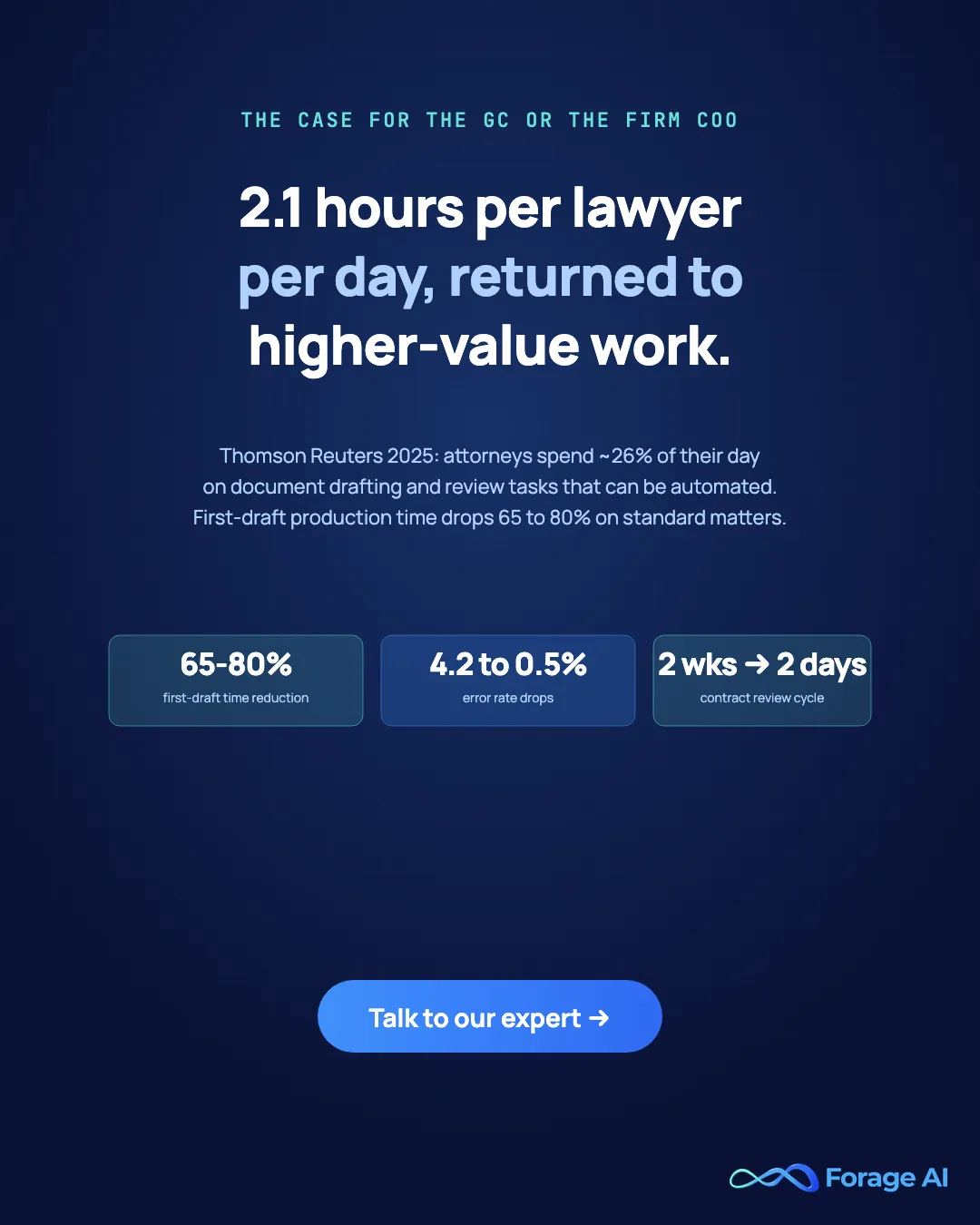
The anchor numbers, all from third-party 2025 research. 2.1 hours per attorney per day on document drafting and review, equivalent to 26% of the working day (Thomson Reuters Legal Technology Survey 2025). 65 to 80% reduction in first-draft production time on standard matter types: contracts, pleadings, client letters, engagement agreements. Error rate drops from 4.2% manual to under 0.5% automated on document assembly (ALM Intelligence). Contract review cycles compress from two weeks to two days on representative deal flow.
A workable model: take the average fully-loaded cost per attorney hour, multiply by the share of attorney time spent on document handling (typically 20 to 30% depending on practice mix), and model the reduction under realistic adoption assumptions. Add the error-reduction line (malpractice premiums, rework cost, client-confidence cost). Subtract the software cost, integration cost, and change-management cost. Discount the first-year ROI by 40 to 50% to absorb the realistic ramp.
Cost is the closing argument in the GC or COO conversation, not the opener. The opener is privilege defensibility, audit-trail granularity, and the cost of doing nothing through the next CAT-volume quarter.
The number that lands hardest in a partner conversation is billable hours redirected from review to advice. If document handling delays compress associate capacity by even one hour per day per attorney, that is real client-billable time the firm is leaving on the table. Frame the ROI in terms of partner leverage and associate utilisation as much as in terms of error reduction.
Seven questions to ask any legal IDP partner before procurement
When the field of vendors narrows and the evaluation moves into procurement, these criteria separate partners that survive Legal review from partners that pass on the demo floor.
| Criterion | What to ask | Red flag |
|---|---|---|
| “Generic REST API, you build it.” | Sub-processor list in writing. Where is the model hosted? | “We use industry-leading AI” with no named vendor |
| On-prem or VPC option | Privileged work product never leaves the firm’s perimeter. | “Cloud-only” with no isolation option |
| Cite-back audit trail | Page, span, model version, reviewer. Reconstruct any closed matter in 60 seconds. | Logs only, no chain of custody |
| Legal-format coverage | By document family and by jurisdiction. | Demos a clean NDA, no real-format coverage data |
| Human-in-the-loop QA | Named QA ratio relative to delivery, not “AI-powered QA.” | No human review layer at all |
| DMS / CLM integration | iManage, NetDocuments, SharePoint, Ironclad, Agiloft. | “Generic REST API, you build it” |
| Indemnification on privilege waiver | Who pays if sourcing or processing waives privilege downstream? | Silence, or boilerplate carve-outs |
The criteria are uneven on purpose. Sovereignty and audit trail outweigh integration in importance. A partner that integrates fast but fails the privilege review will cost the firm more in malpractice exposure than any integration ever saved.
The most reliable closing question in a legal-IDP evaluation is “will your team sit in the room with our Legal lead and walk through the architecture together?” Vendors that say yes almost always pass the privilege review. Vendors that route the question to a sales engineer who promises a follow-up rarely close the deal.
How Forage AI approaches legal document extraction
Forage AI is not a CLM, not a legal-research platform, and not a contract-drafting tool. We do not give legal advice, adjudicate clauses, or replace the firm’s case management system. We act as the acquisition layer for the document data that flows into those systems: the extraction, structuring, and quality assurance work that must happen between the document’s arrival and the matter being workable.
Our approach combines multi-method extraction (XPath plus NLP plus custom-trained ML models running in parallel, so accuracy holds when one method degrades), a 200% QA model with a QA team roughly three times the industry average size, and a delivery model where data stays inside our perimeter and yours. We have parsed more than 10 million documents across financial, legal, and healthcare workflows. Legal sits at the intersection of all three, which is why the same patterns that hold up for KYC, contract data extraction, and clinical document workflows hold up for case files.
Sovereign by design means client data never trains third-party models, never gets resold, never aggregates across clients. Contractual handling controls are not a configuration option; they are how the service is built. On-premises deployment is available when the document corpus must remain within the firm’s perimeter. The signal phrase is the one Legal needs to hear: your privileged content stays in our perimeter. The contract backs the marketing.
Onboarding typically takes one to two weeks per document family. The team is dedicated, not a ticket queue. The acquisition layer is yours. The team operating it is ours.
The most common reason firms move from a generic IDP product to a Forage AI engagement is not accuracy. It is document-family expansion velocity. The firm’s queue keeps absorbing new jurisdictions, new regulators, new post-M&A document families, and the existing tool cannot keep up. The dedicated-team model exists for exactly that pattern.
Frequently Asked Questions
How accurate is legal document processing today?
Honest accuracy claims are clause-level, by document family, by jurisdiction. A reasonable expectation is 95 to 97% accuracy on standard contracts and 85 to 92% on multi-party agreements, regulatory filings, and scanned exhibits, with the gap closed to 99% plus through human-in-the-loop review on the exceptions that fall below a confidence threshold. Document-level accuracy numbers in vendor decks usually overstate what survives a partner review.
Does using AI in document review waive the attorney-client privilege?
Treat it as unprotected. In February 2026, in United States v. Heppner, US District Judge Rakoff held that a defendant’s exchanges with a consumer AI assistant were not covered by attorney-client privilege or the work-product doctrine, because the assistant is not an attorney, the exchanges were not confidential, and they were not made at the direction of counsel. A sovereign IDP that processes inside the firm’s perimeter, with no third-party LLM in the data path, does not implicate the same disclosure analysis. This article is general guidance, not legal advice; consult qualified counsel for your specific situation.
What is the difference between IDP and a CLM?
A CLM stores, manages, and tracks contracts after they exist as structured records. IDP is the layer that turns inbound, unstructured legal documents (PDFs, scans, mixed-format diligence binders) into the structured records a CLM, DMS, or matter system can consume. The two are complementary; IDP feeds the CLM.
Can we automate contract drafting?
Partially. Standard-matter first-draft production is well-served by automation (65 to 80% time reduction on engagement agreements, NDAs, and similar). Negotiated draft work, opinion letters, and bespoke transaction documents stay with counsel. The automation belongs around the drafting, not in it.
How long does it take to deploy legal document processing?
For an extraction layer on a single document family (say, NDA extraction or county-recorder deed extraction), one to two weeks from brief to live with a competent partner. For a full multi-family rollout integrated with the firm’s DMS or CLM, three to six months is realistic. Most of the timeline is integration, change management on the associate floor, and document-family coverage expansion.
Related Articles
- AI-Powered Intelligent Document Processing Solutions 2025, broader overview of how AI-powered IDP works across regulated industries.
- Invoice Automation: How Modern AP Teams Are Eliminating Manual Document Processing, the AP-side companion: how the same IDP-plus-human-review architecture handles invoice capture, validation, and ERP write-back.