
Law Firm Data: How to Track Firm Size, Practice Areas, and Attorney Counts

Most law firm data problems are not collection problems. Pulling a list of firms is the easy part. Keeping each firm's identity, headcount, practice mix and offices correct while the market moves is what decides whether a data product holds up, and it usually gets budgeted last.
The market does move. Fairfax Associates counted 59 completed law firm mergers in 2025, and each one changed the shape of a record someone was already selling. Attorney counts drift as well, because every source counts lawyers on its own basis and rarely says which one.
The data product teams we work with that get this right do three things. They define what a firm record must carry before picking a source, plan for how it breaks once coverage reaches past the largest firms, and decide on purpose who sources and maintains it. Most inherit that last answer from whichever vendor they trialled first.
This guide follows the same order. It covers the six fields of a law firm record, the four failure modes that appear at scale, and how to choose between licensing a database, building the pipeline, or handing it to a managed partner. If you only need a one-off list of firms for outreach, licensing is usually the right call, and the final section explains when.
It starts with the unit of the record, because every field after it depends on getting that right.
Quick Digest
- The six fields: identity, size, practice mix, footprint, movement and signals. Identity comes first because every other field joins on it, and every field needs a source and an as-of date.
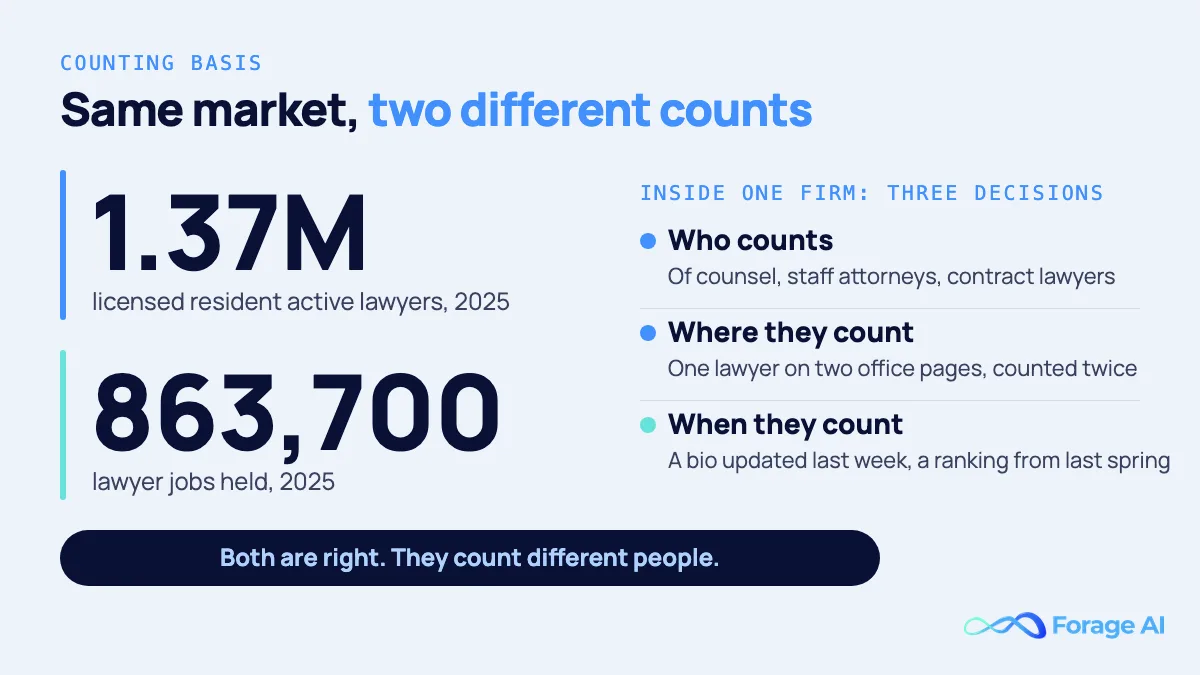
- Why counts disagree: the ABA counted 1.37 million licensed lawyers in 2025 while BLS counted 863,700 lawyer jobs. Both are right, because they count different populations. A headcount without a counting basis is not a data point.
- How fast it goes stale: law firm headcount grew 2.9% in 2025 and firms completed 59 mergers, so identity needs event-driven updates and movement needs weekly refresh.
- What breaks at scale: merger and rebrand identity drift, multi-office rollup errors, practice-area taxonomy mismatch, and thin coverage below the largest firms.
- Who should own it: license when your segment is the top firms and the licence allows redistribution, build when sources are few, and use a managed partner when the segment is broad and refresh is weekly. Break ties on identity resolution.
What law firm data is
Law firm data is information about firms as organisations: who the firm is, how big it is, what it practises, where it sits, who is moving in and out, and what signals it gives off. The search term is ambiguous. Half of what ranks for it is about data a firm holds internally, billing and matters and client files, which is a different job entirely.
The unit here is the firm. A firm record sits on top of attorney-level records, and the individual license and directory entries behind those records are their own sourcing discipline, covered in our guide to how individual attorney license records are sourced and verified. This guide starts where those records stop.
Who needs the firm layer? The buyers we see fall into two groups. The first builds products on it: legal market intelligence platforms, legal directories and marketplaces, data resellers and alternative-data vendors, plus enterprise data teams that treat the legal market as an entity class. The second buys law firm leads, a list of firms for a legal-tech sales motion. The second group needs a snapshot. The first needs a record that stays true, because the record is what they sell.
The population is large and growing. The ABA's 2025 Profile of the Legal Profession counted 1,374,720 lawyers, up from 1,355,963 in 2024.
Growth is also uneven across firm types. The Thomson Reuters Institute's 2026 report splits firms into the Am Law 100, the Am Law Second Hundred and Midsize, and found smaller firms captured most of 2025's demand growth. If your product only tracks the top of that ladder, it misses where the movement is.
For the general case of company-level sourcing, our piece on firmographic data sourcing covers the fundamentals; law firms break several of those assumptions, as the next section shows.
The six fields of a law firm record
There are six fields every firm record needs before anything else is worth building, and the order matters. We have watched teams start with practice areas because customers ask about them first, then spend a quarter untangling duplicates. Start with identity.
- Identity. Legal name, name variants, parent and child entities, merger history, and the date the identity was last confirmed.
- Size. An attorney count with its counting basis stated, plus a size band derived from that count, never typed in by hand.
- Practice mix. Practice areas with the share of attorneys in each, mapped to one controlled list. A checkbox of 40 practice areas tells a buyer nothing.
- Footprint. Offices, attorneys per office, and which office is the headquarters.
- Movement. Laterals in and out, promotions, departures and net growth over a stated window.
- Signals. Revenue proxies, technology adoption and hiring activity, each labelled as a signal rather than a fact.
| Field | What it answers | Where it usually comes from | How fast it goes stale |
|---|---|---|---|
| Identity | Is this the same firm as last month? | Firm websites, business registries, merger announcements | On events (mergers, rebrands) |
| Size | How many lawyers, on what basis? | Rolled up from attorney records | Monthly |
| Practice mix | What does the firm actually do? | Attorney bios, practice pages | Quarterly |
| Footprint | Where are its lawyers? | Office pages, attorney bios | Quarterly |
| Movement | Who joined, who left? | Bio changes, announcements, licensed feeds | Weekly |
| Signals | Is it growing, spending, hiring? | Careers pages, published financials for top firms | Varies by signal |
Identity is field one because a firm name is not a firm identity. Fairfax Associates tracked 59 completed law firm mergers in 2025, up 18% from 50 in 2024. Troutman Pepper (1,074 lawyers) and Locke Lord (556) became Troutman Pepper Locke; McDermott Will & Emery and Schulte Roth & Zabel became McDermott Will & Schulte. A record keyed on the old name either duplicates the new firm or loses its history. For the registered-entity side of identity, our ranking of state business registries shows which states make that lookup practical.
Common mistake: keying a firm record on its name. When Troutman Pepper and Locke Lord merged, the name changed, and a name-keyed record either duplicates the firm or loses its history.
Revenue deserves a caveat. Law firm revenue data is published for the largest firms and almost nobody else, so for most of the market the signals field holds proxies: headcount trend, office openings, hiring pages and technographic signals such as which practice-management or AI tools a firm adopts.
In practice, the spec is easier to enforce when it is written as a schema. One record, with illustrative values, looks like this:
One law firm record as JSON (illustrative values)
{
  "firm_id": "fr_000123",
  "identity": {
    "legal_name": "Example Firm LLP",
    "name_variants": ["Example Firm", "Example Firm L.L.P."],
    "predecessors": [{"name": "Example & Partners LLP", "merged_on": "2025-01-01"}],
    "confirmed_as_of": "2026-09-01"
  },
  "size": {
    "attorney_count": 412,
    "counting_basis": "US-based attorneys incl. of counsel, primary office only",
    "size_band": "251-500",
    "as_of": "2026-09-01"
  },
  "practice_mix": [{"area": "Litigation", "share": 0.34}, {"area": "Corporate", "share": 0.22}],
  "footprint": [{"office": "Chicago", "attorneys": 180, "hq": true}],
  "movement_90d": {"laterals_in": 9, "laterals_out": 6},
  "signals": {"open_attorney_roles": 5, "revenue_disclosed": false},
  "sources": ["firm_website", "attorney_bios", "business_registry"]
}
Of the six, field two is where records start to disagree, and it deserves its own section.
Why do attorney counts disagree across sources?
Attorney counts disagree because sources count different people, in different places, on different dates. None of them has to be wrong for two numbers to be far apart.
The cleanest public example sits in two government-grade sources. The American Bar Association counted 1.37 million lawyers in 2025, based on resident active lawyers reported by state licensing bodies. The Bureau of Labor Statistics counted 863,700 lawyer jobs in 2025. The gap is the difference between holding a license and being employed as a lawyer.
| Source | What it counts | 2025 figure |
|---|---|---|
| ABA Profile of the Legal Profession | Resident active licensed lawyers, reported by state licensing bodies | 1.37 million |
| BLS Occupational Outlook Handbook | Jobs held in the lawyer occupation | 863,700 |
The same gap opens inside a single firm. Every firm count your product publishes inherits three decisions, and we all know they rarely get written down:
- Who counts. Partners and associates, certainly. Of counsel, staff attorneys, contract lawyers, non-US lawyers and lawyers on leave are where two sources diverge.
- Where they count. A lawyer listed in two offices is one lawyer. Summing office pages double counts them, which inflates exactly the multi-office firms buyers care about.
- When they count. A bio page updated last week and a ranking compiled last spring describe different firms.
A headcount without a counting basis and a date is not a data point. The fix is not to find the "true" number. It is to pick the definition your customer's question needs, apply it the same way to every firm, and publish the basis next to the figure. A recruiter wants lawyers who can move. A benchmarking product wants something closer to full-time headcount.
Common mistake: publishing a headcount with no counting basis or as-of date. Nobody downstream can reconcile it with any other source.
Attorney counts roll up from individual bar and directory records, which is why the rollup can never be better than those records. The mechanics of sourcing them are covered in our attorney license verification guide. The ABA's Profile of the Legal Profession is the reference point most teams calibrate against at the national level. Calibrating the count still leaves a harder question: where the records underneath it come from.
Quick Summary
Q: Why do attorney counts for the same firm or market differ between sources?
A: Attorney counts differ because sources define the population differently. In 2025 the ABA counted 1.37 million licensed resident lawyers, while BLS counted 863,700 lawyer jobs. At firm level, the gap comes from who is counted (of counsel, staff attorneys), where (multi-office double counting) and when (as-of date). Declare all three with every published count.
Where law firm data comes from
Firm-level data reaches a product through three routes, and most mature teams end up using all of them.
1. Licensed legal databases. Firm-intelligence platforms concentrate on the largest firms, where buyers pay most. One of the larger ones describes coverage of 6,000+ law firms and more than 425,000 attorney and legal professionals, updated twice a week (its own product description, as of September 2026). That is deep coverage of the top of the market, and a small fraction of the firms that exist. Our comparison of legal data providers by vendor class covers what each type of vendor sells.
2. Public and published sources. Firm websites and attorney bios are the most current source for offices and practice areas and the least uniform to extract. Business registries give you the legal entity but not the headcount. Merger announcements tell you when identity changes. Rankings tell you who is biggest.
3. Government statistics. These size the universe; they do not give you rows. BLS reports that 52% of lawyers work in legal services and 11% are self-employed. That 11% alone is a population no ranking will ever list.
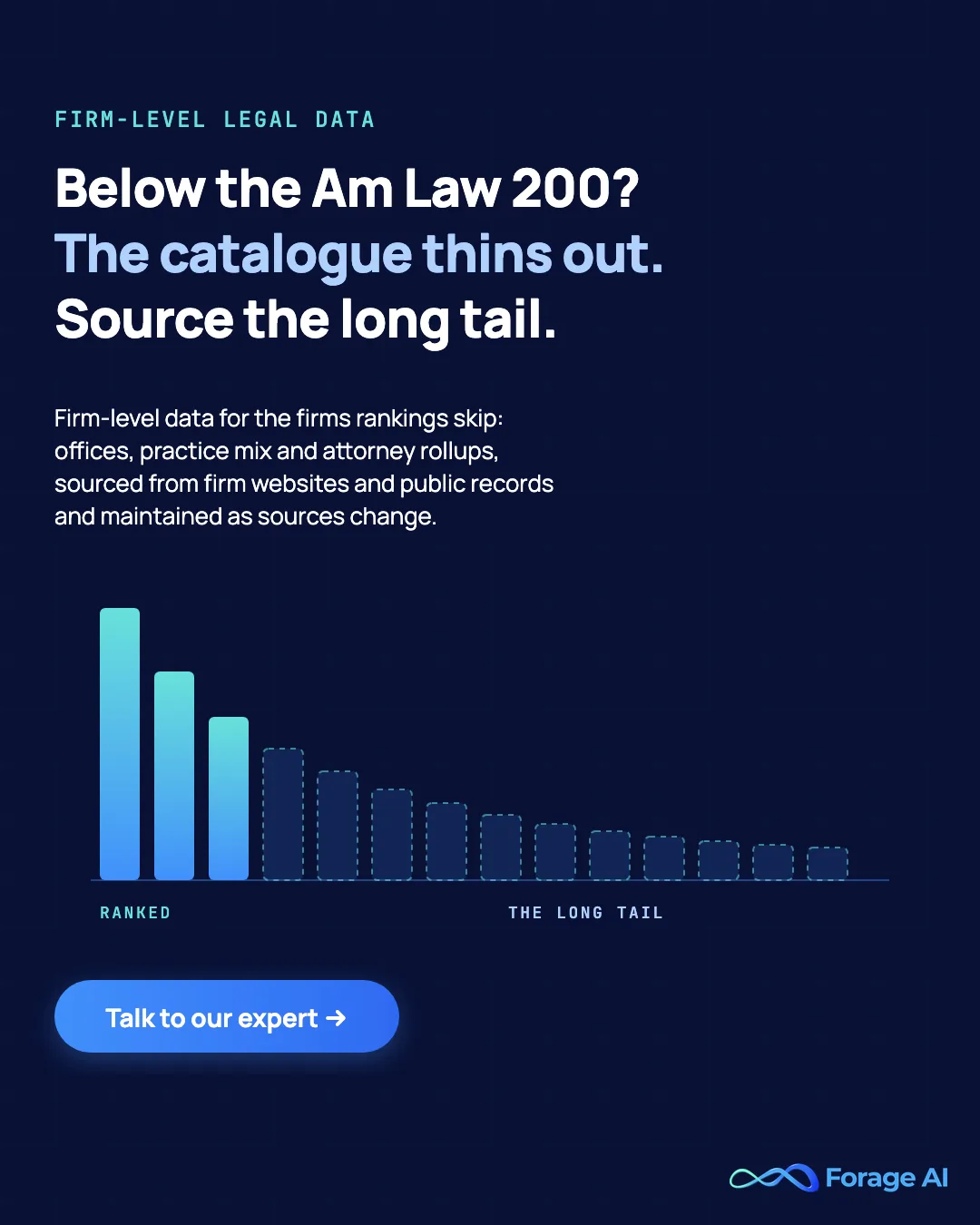
Which brings us to the largest law firms lists. They are useful and widely searched, and they are not a law firm database. A ranking is an annual snapshot of the top few hundred firms, compiled by the publisher's own counting rules. Teams that seed a product from rankings get a clean top tier and nothing underneath it, which is where most firms and most lawyers are.
Common mistake: seeding a law firm database from rankings. You get a clean top tier and nothing underneath it.
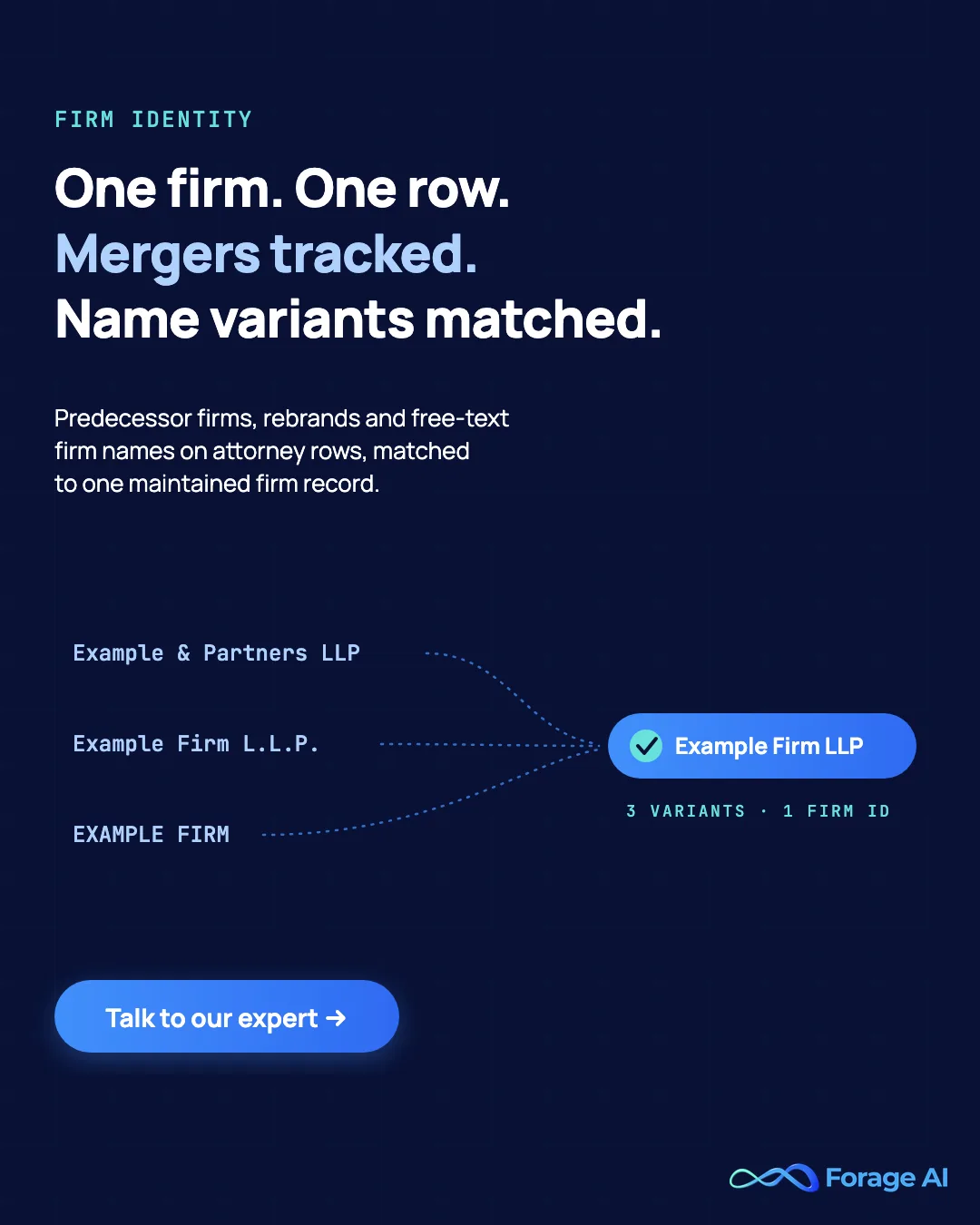
Directory scraping has its own trap. It returns attorney rows with a free-text firm name, so "Smith & Jones", "Smith and Jones LLP" and "Smith Jones" arrive as three firms until someone resolves them. And whichever route a record takes, it starts ageing on arrival.
How fast does law firm data go stale?
Faster than a yearly refresh can keep up with, and not evenly. The Thomson Reuters Institute's 2026 report found law firms grew lawyer headcount by 2.9% in 2025, the third straight year of strong hiring, and that the average Midsize and Second Hundred firm has grown headcount by more than 8% since January 2023, against 5% for the Am Law 100.
2.9% lawyer headcount growth at US law firms in 2025, and more than 8% since January 2023 at the average Midsize and Second Hundred firm. Source: Thomson Reuters Institute, 2026 Report on the State of the US Legal Market.
Read that twice if you run a firm-level product. The fastest-changing firms are the ones outside the Am Law 100, which is also where licensed coverage tends to be thinnest.
Movement is messier than the headline number. The same report notes that less than one-third of laterals bring their entire book and team. A lateral partner record that does not track whether the team followed tells a buyer half the story. And identity keeps shifting: Fairfax Associates counted 59 completed mergers in 2025, 76% of them involving a small firm, with 16 more already announced for 2026 when its January report came out.
So set cadence per field, not per dataset:
- Identity: on events. A merger or rebrand should trigger an update, not wait for the next cycle.
- Movement: weekly. Laterals and departures are the fastest-decaying field and the one buyers notice.
- Size: monthly, recalculated from the attorney rollup.
- Footprint and practice mix: quarterly, unless an event says otherwise.
- Signals: whatever the signal supports. Hiring pages change weekly; published financials change annually.
A purchased snapshot starts decaying the day it lands. That is fine for a one-time outreach list and a real cost for a product. The full Thomson Reuters Institute 2026 State of the US Legal Market report breaks the growth down by segment.
Refresh is the visible cost. The less visible one is what goes wrong inside the data as it grows.
What breaks at product scale?
Four failure modes appear, in roughly this order, once a firm-level dataset grows past what one analyst can check by hand.
1. Identity drifts. Mergers, rebrands and spin-offs change the firm under the record. It happens in the data layer too: Leopard Solutions, a long-standing firm and attorney data provider, now operates as SurePoint Legal Insights, and its old domain redirects. If your identity field has no predecessor history, every merger either duplicates a firm or silently erases one.
2. The rollup miscounts. Multi-office lawyers get counted twice. Attorneys whose firm string never resolves become orphans that belong to no firm. We see both at once more often than either alone: large firms inflated, small firms undercounted, and a size band that is wrong in both directions.
3. Practice taxonomies do not join. One source says "Commercial Litigation", another "Business Disputes", a third lists 60 practice areas for a firm of 40 lawyers. Until every label maps to one controlled list, practice mix cannot be compared across firms, which is the comparison most buyers came for.
4. Coverage thins below the top. The long tail is where refresh slows and fields go blank. It also behaves differently. In the ABA's 2024 Legal Technology Survey, 46% of respondents at firms of 100 or more attorneys reported using AI tools, against 30% at firms of 10 to 49 and 18% of solo practitioners. A signals field tuned on large firms misreads small ones.
46% vs 18%: AI tool use reported at firms of 100+ attorneys versus solo practitioners (2024 survey, released March 2025). Source: ABA Legal Technology Survey Report.
We all know how each of these gets patched the first time: someone fixes the record by hand in a spreadsheet. The hand fix is not in the pipeline, so the next refresh reverts it. At a few hundred firms that is tolerable. At a data product rolling up hundreds of thousands of attorney records, it is the job. That raises the obvious next question: whose job.
Should you license, build or outsource law firm data?
The honest answer depends on your segment, your cadence and your engineering calendar. Each route has a clear win condition.
| Route | Wins when | Costs you |
|---|---|---|
| License a legal database | Your segment is the largest firms, their refresh matches yours, and the licence permits your product's use | Redistribution limits, thin long-tail coverage, their counting basis instead of yours |
| Build the pipeline in-house | Sources are few, the segment is narrow, and engineers have room on the roadmap | Continuous maintenance as firm websites change, plus the identity-resolution review loop |
| Managed sourcing partner | The segment is broad, sources run into the hundreds or thousands, refresh is weekly, and engineering time is the constraint | Scoping time up front and a partner relationship to manage |
License when your customers care about the Am Law tier and an annual or twice-weekly vendor cadence is enough. Read the redistribution clause before anything else if you resell: a licence that permits internal research does not permit a product. Our comparison of legal data providers is the place to start that shortlist.
Build when the scope is contained. The first version is rarely the hard part. The maintenance is: firm websites change layouts, attorney bios move, and the identity queue never empties.
Hand it to a managed partner when the firm layer is the product and the long tail matters. This is the route Forage AI works on: sourcing firm-level data from firm websites, attorney bios and public records, resolving it into firm records to your schema, and handling source changes as part of the service. Every Forage AI delivery passes a 3x QA team, and first datasets typically arrive 1-2 weeks after sign-off. You own the data, handling and retention rules are agreed per engagement, and Forage AI does not resell it.
If two routes score close, break the tie on identity resolution. Pick the route that fails least badly when a firm merges or renames, because every other field joins on identity and an identity error spreads to all of them.
The spend context points the same way. Thomson Reuters found firms' technology spending grew 9.7% and knowledge management spending 10.5% in 2025. Firms are changing how they operate, and the records describing them will keep moving with them.
Expert Insights
"The law firms that will define the next era of legal services will be determined not by how much they invest in technology and talent, but by how boldly they reimagine their entire operating model." Raghu Ramanathan, President, Legal Professionals, Thomson Reuters (January 2026). The Thomson Reuters Institute's 2026 report found technology spending grew 9.7% and knowledge management spending 10.5% in 2025.
The firm record is never finished. It is a living asset that stays honest only if the counting basis is published, refresh is set per field and identity is maintained before anything else. That discipline is what keeps a firm-level product worth renewing. If you are working through the same counting and cadence decisions, compare notes with peers who publish their basis, because the market gets better data when more of us do.

Frequently asked questions
How many law firms are there in the US?
There is no single authoritative firm count, because published figures depend on whether they count establishments, legal entities or firms with a minimum number of lawyers. The lawyer figures are firmer: the ABA counted 1.37 million lawyers in 2025, and BLS reported 863,700 lawyer jobs, with 11% of lawyers self-employed. Treat any firm total as a definition before you treat it as a number.
How do I get a list of law firms by size?
Start with a declared counting basis, then derive size bands from the count. Rankings give you the largest few hundred firms by their own rules. A list that includes small and midsize firms has to be rolled up from attorney-level records, which is why size lists below the top tier vary so much between sources.
Where do legal-tech companies get law firm leads?
Most license a list or a sales database for outreach, which is the right call for a one-time campaign. Lead intelligence platforms add enrichment on top. The trouble starts when a lead list gets reused as a product dataset, because nobody refreshes it and its counting basis is unknown.
Is law firm revenue data public?
Only for the largest firms, where rankings and legal press publish financial estimates. Most law firms publish no financials at all. For them, revenue has to be approximated with labelled proxies such as headcount trend, office growth and hiring, never presented as reported revenue.
What is the difference between law firm data and attorney data?
Attorney data describes individual lawyers: licensure, admissions, practice history. Law firm data describes the firm those lawyers belong to and is built by rolling attorney records up into resolved firm entities. The firm record can only be as accurate as the attorney records underneath it.
How often should a law firm database be refreshed?
Per field. Movement weekly, size monthly, footprint and practice mix quarterly, and identity whenever a merger or rebrand happens. A single annual refresh leaves the fastest-growing segments, Midsize and Second Hundred firms, the most out of date.
Sources
- American Bar Association, 2025 Profile of the Legal Profession (December 2025)
- U.S. Bureau of Labor Statistics, Occupational Outlook Handbook: Lawyers (2025 data)
- Thomson Reuters Institute and Georgetown Law Center on Ethics and the Legal Profession, 2026 Report on the State of the US Legal Market (January 2026)
- Thomson Reuters press release, 7 January 2026
- Fairfax Associates, "Law firm mergers up in 2025, more mergers announced for 2026" (January 2026)
- American Bar Association, 2024 Legal Technology Survey Report (released March 2025), as reported by LawSites
Related articles
- Top 10 Legal Data Providers: How Intelligence Teams Buy Legal Data: the four classes of legal data vendor and how to test each
- Firmographic Data Sourcing: Why Real-Time Extraction Beats Static Databases: company-level data sourcing fundamentals
- US Business Registries: All 51 Ranked by Accessibility: where registered-entity data is practical to pull
- The Complete Guide to Selecting Your B2B Data Provider: evaluation criteria for any data vendor
Sai is a data infrastructure enthusiast who has spent the past two to three years following the AI space closely, from the infrastructure layer to the fast-growing world of data for AI. He is genuinely curious about how modern data pipelines get built and where the data industry is heading, and he writes insightful pieces on the core topics that shape this niche.