
Building an Attorney Database: Sourcing Bar, License, and Discipline Records Across 50 States
Data teams tend to treat lawyer licensing as a solved public-records job. Every state publishes a search page, the records are official, and the first scrape usually works.
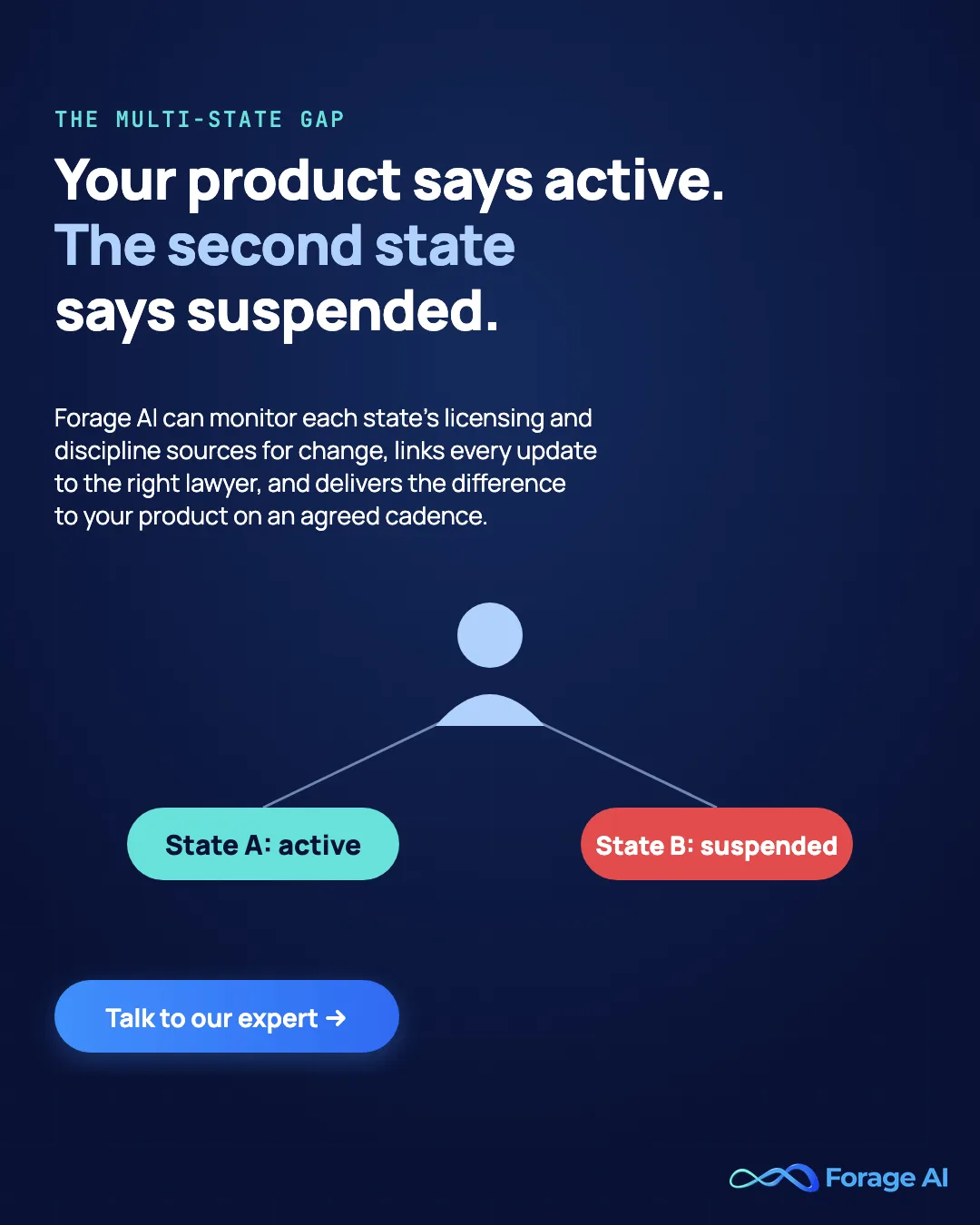
The first real test of an attorney database tends to be a multi-state lawyer: current in one state, suspended in a second, registered under a former name in a third. The product keeps saying active for months, because nothing in the pipeline was built to notice.
If you need to check one lawyer, the licensing authority's own search is the right tool. This article is for teams building attorney data as a product: legal directories and lawyer-profile platforms, marketplaces and referral networks, legal intelligence vendors, background-screening firms and data resellers.
The population is more than 1.3 million resident active attorneys (American Bar Association, 2024 data), and none of them carries a national identifier. What keeps a dataset that size correct is five layers: a source registry, an identity model, status normalization, discipline linkage and change monitoring. We walk through why each layer exists, what breaks without it, and how to decide which ones to build yourself.
Quick Digest
- Record anatomy: An attorney database stores one person with a separate admission per jurisdiction, each carrying its own bar number, status, dates and public discipline, plus the date each fact was true.
- Where records come from: License status comes from each jurisdiction's licensing authority, discipline from orders and the ABA's National Lawyer Regulatory Data Bank, and each source is published, accessed and restricted differently.
- Why the data goes stale: Status labels do not translate between states, reciprocal discipline arrives on different calendars, and the ABA's own national count reused prior-year figures for 10 jurisdictions in 2024.
- The five layers: Source registry, identity, status normalization, discipline linkage and change monitoring run as a loop rather than a one-time build.
- Build, buy or hand off: In-house pulls fit one or two jurisdictions, derived datasets fit when a lag is acceptable, and a managed partner fits when every jurisdiction has to stay current.
What an attorney database has to hold
Start with the unit. The record is the individual lawyer, not the firm. Headcount, practice mix and office footprints are roll-ups computed from lawyer records, and they deserve their own model; our guide to firm-level data covers that side.
The regulators already publish the minimum record. The State Bar of California's certificate of standing verifies "an attorney's name, bar number, admission date, current status, any name or status changes, and any public discipline, as of the date" it is issued. That last phrase is the one most schemas drop. A license status with no date attached is a guess about the present.
The population is large, and it moves. The ABA counted 1,322,649 resident active attorneys for 2024 in its National Lawyer Population Survey, and its 2025 Profile of the Legal Profession reported the first rise in the overall lawyer count since 2020. Every new admission is a new record, and every renewal cycle is a batch of status events.
Expert Insights
Rachel Ellett, associate director of research at the ABA Center for Bar Leadership, said of the 2025 figures that "this year's data suggest that the labor market was able to absorb 2024's large graduating class," a class nearly 12% larger than any since 2012. For an attorney database, a larger class means more first-year records and more first renewals arriving together.
Here is what one lawyer admitted in two jurisdictions looks like when the model holds up. The values are fictional; the fields map to what licensing authorities publish.
Illustrative attorney record (JSON, fictional values)
{
  "person_id": "atty_000142",
  "name": { "current": "Jane Q. Example", "prior": ["Jane Q. Sample"] },
  "admissions": [
    {
      "jurisdiction": "NY",
      "bar_number": "0000000",
      "admitted_on": "2011-01-19",
      "status_source_label": "CURRENTLY REGISTERED",
      "status_normalized": "authorized",
      "status_effective_from": "2025-03-02",
      "discipline": [],
      "source_url": "https://licensing-authority.example/ny/0000000",
      "retrieved_at": "2026-09-01T06:00:00Z"
    },
    {
      "jurisdiction": "TX",
      "bar_number": "00000000",
      "admitted_on": "2014-11-07",
      "status_source_label": "Inactive",
      "status_normalized": "inactive_voluntary",
      "status_effective_from": "2023-06-01",
      "discipline": [
        { "sanction": "suspension", "ordered_on": "2022-05-10", "stayed": true, "order_ref": "order-0001" }
      ],
      "source_url": "https://licensing-authority.example/tx/00000000",
      "retrieved_at": "2026-09-01T06:00:00Z"
    }
  ]
}
Bar numbers only work inside one state
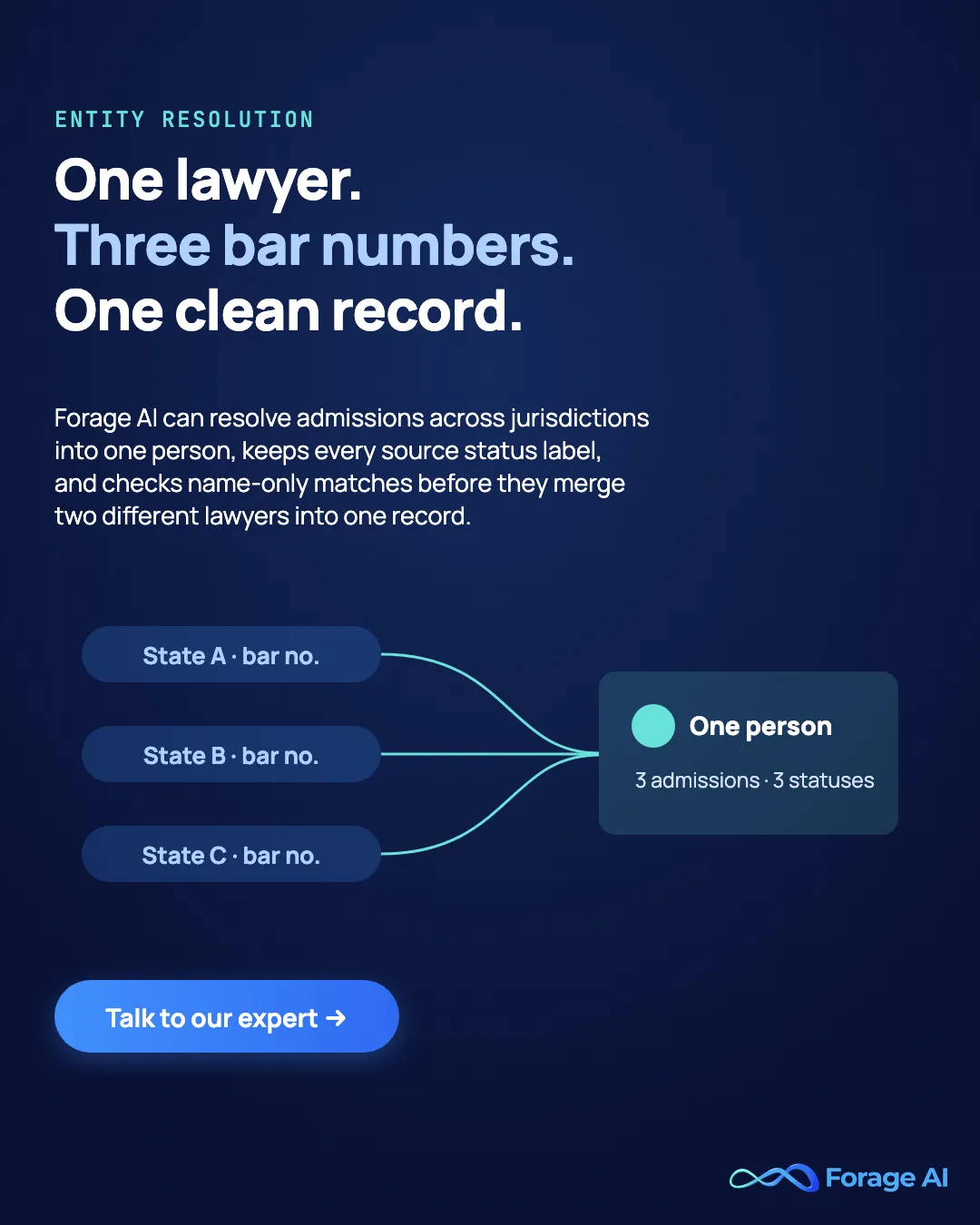
Every jurisdiction issues its own bar number. A lawyer admitted in New York, New Jersey and Texas holds three, and no national lawyer identifier ties them together. Healthcare has one for providers, which is why healthcare provider data looks similar in shape and behaves better in practice.
So the key is a pair: jurisdiction plus bar number. Connecting three admissions to one person is an entity matching job across multi-source datasets, using name history, admission dates and address signals. Name-only matching is where this goes wrong. Two lawyers with a common name in the same metro area merge, and one of them inherits the other's discipline.
Where do attorney records actually come from?
This article is for informational purposes only and does not constitute legal advice. Consult a qualified attorney for legal guidance specific to your situation.
Knowing what the record holds, the next question is where each field comes from. Fewer places than people expect, and each one is authoritative for different fields.
The system of record for license status is each jurisdiction's licensing authority, which is not always the organization with "bar" in its name. In New York, attorney registration runs through the Office of Court Administration. The New York State Bar Association says plainly that it is not the official bar and is not responsible for licenses or registration, and certificates of good standing come from the Appellate Division where the lawyer was admitted.
Discipline travels a separate route. Disciplinary boards and courts issue orders, and the ABA National Lawyer Regulatory Data Bank, operating since 1968, collects public regulatory actions reported by every state and the District of Columbia. The public can request name searches in writing, for a fee, and bulk searches are offered.
| Source | Authoritative for | How you get it | Freshness | Watch-out |
|---|---|---|---|---|
| State licensing authority search | Current status, bar number, admission date | Web search per jurisdiction; phone in a few | Live, usually without change history | Formats, labels and terms of use differ by state |
| Discipline orders (boards, courts) | Sanction type, dates, stays | Published orders, opinions, records requests | As issued | Often PDFs; private discipline never appears |
| ABA National Lawyer Regulatory Data Bank | Public regulatory actions across states | Written request, for a fee; bulk offered | Depends on agency reporting | Not a license-status feed |
| ABA National Lawyer Population Survey | Headcounts by jurisdiction | Annual publication | Annual; non-responders carried forward | Counts, not records |
| Certificate of good standing | Formal status on a date | Request per lawyer | Point in time | One lawyer per request |
| Derived datasets (directories, scraper output) | Coverage and convenience | License or marketplace purchase | As of their last pull | Inherit every gap above, plus their own lag |
Access is uneven, and it shapes the design. The Department of Justice's Executive Office for Immigration Review lists telephone numbers, not search pages, for confirming licensure in New Hampshire and South Dakota on its verification page (dated January 2023). Illinois sits at the other end: as of September 2026, the Attorney Registration and Disciplinary Commission (ARDC) lawyer search includes a view of lawyers no longer authorized to practice because of recent registration, continuing-education, discipline or disability changes.
Then come the terms of use. The State Bar of Texas terms of use (accessed September 2026) prohibit capturing site data "through repetitive or automated means", with an exception for search engine crawlers. Terms like these decide which sources you automate, which you license and which you request by hand, so they belong in the source registry next to the URL. For the broader legal picture, see how scraping law treats public data.
Watch-out: The ABA Data Bank is not a license-status feed. It holds public regulatory actions that agencies report, searched on written request, so current status still has to come from each licensing authority.
Why do multi-state attorney databases go stale?
Picking the right source for each field solves the first half of the job, and it is the easier half. We all know how this goes. The pipeline runs, the row counts look right, and the first sign of trouble is a customer who found a suspension the product did not show.
In practice, attorney data goes stale for five reasons. Each one is its own failure domain, and each maps to a layer later in this article.
1. Status labels do not translate. New York publishes nine registration statuses, from "Currently Registered" and "Delinquent" to two different kinds of resignation, one of them for disciplinary reasons. Texas has two membership statuses, active and inactive, and publishes eligibility to practice separately on an ineligible attorney list that it updates daily. Collapse all of that into one "active" flag and the dataset is wrong in two directions at once.
2. Discipline lands on different calendars. Under the ABA's model rule on reciprocal discipline, a lawyer disciplined in one jurisdiction must promptly inform disciplinary counsel in the others, and a second state may impose identical discipline, something different, or defer while a stay runs. Brian Faughnan, an ethics lawyer, describes a lawyer free of probation in Tennessee from August 2024 but still on probation for almost all of 2025 in Minnesota. And in June 2025 the Supreme Court of Texas held in Lane v. Commission for Lawyer Discipline that Texas's four-year limitations period applies to reciprocal discipline and runs from the original misconduct, which ended a Texas case that followed an Illinois suspension. A sanction in one state does not guarantee a matching record in the next.
Expert Insights
Brian Faughnan of Faughnan Law, writing on reciprocal discipline, put the timing gap plainly: "While the lawyer could be both up and running and completely free from any probation requirements in Tennessee as of August 2024, they will still be subject to probation throughout just about all of 2025 in Minnesota." One lawyer, two states, two statuses for more than a year.
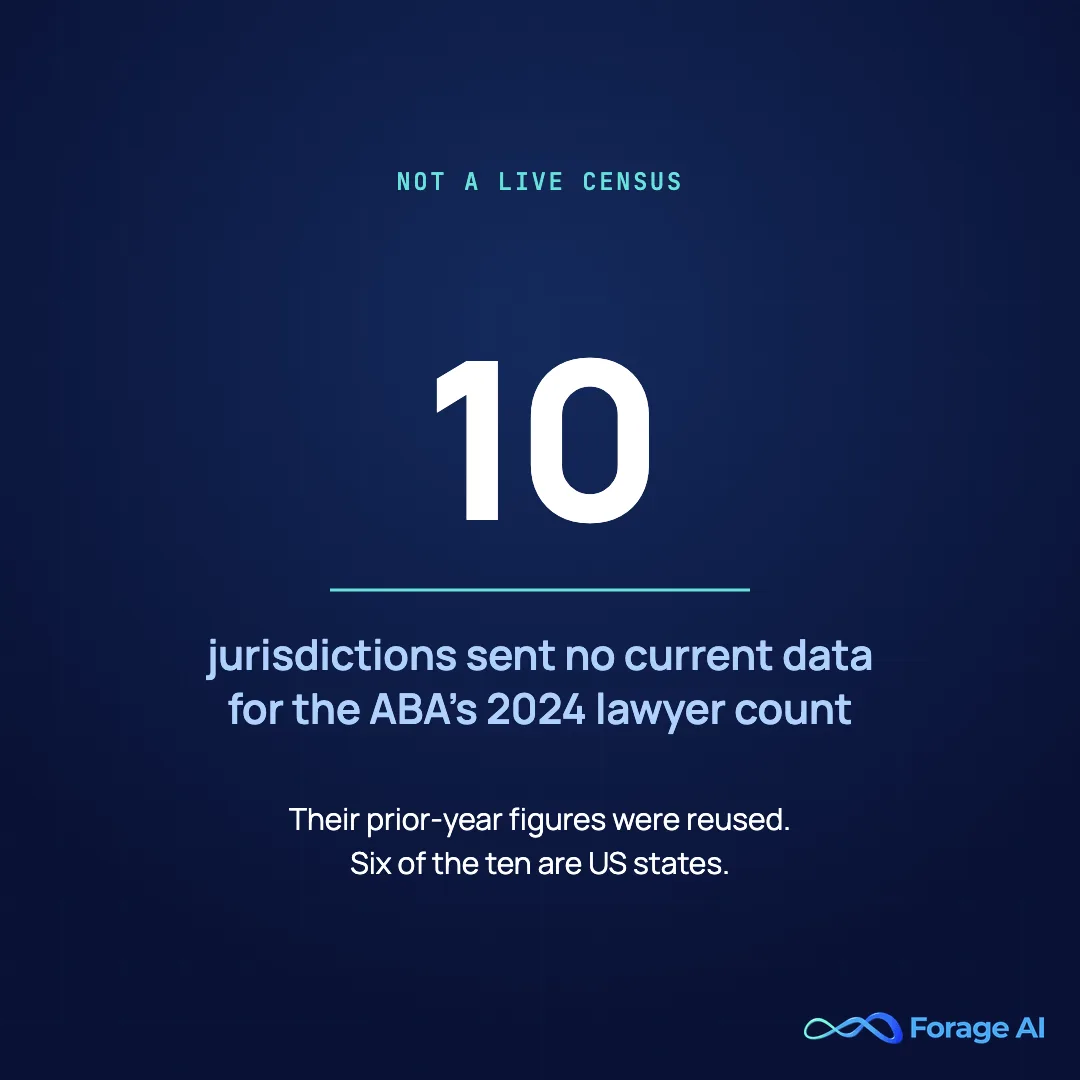
3. Even the national count is partly carried forward. For 2024, the ABA's population survey reused the prior year's figure for 10 jurisdictions that sent no current data, among them Arkansas, Delaware, Maryland, Minnesota, South Carolina and Vermont.
Watch-out: The ABA's national lawyer count is not a live census. In the survey's own words, "When no data is collected, the survey carries over last year's data," and it notes there is "no uniform definition of resident and active" across states.
4. Complaints are not discipline. In fiscal year 2025 the State Bar of California's Office of Chief Trial Counsel opened more than 21,000 cases and obtained discipline for 154 attorneys, including 69 disbarments, down from 229 disciplined attorneys the year before, according to its fiscal year 2025 Annual Discipline Report. The report counts its reprovals as "both public and private", and private ones never reach a public record. A product that treats complaint volume as a risk score is measuring something else.
5. Collectors decay. Search pages get redesigned, fields move, labels get renamed. A scraper that worked in March can return empty rows in June, and unless something compares the output against the last verified pull, nobody notices for weeks. The fix starts with observability for third-party datasets.
Quick Summary
Q: Why do multi-state attorney databases go stale?
A: Five reasons, all of them quiet: - Status labels do not mean the same in every state. - Reciprocal discipline arrives late, differently, or not at all. - The ABA's national count reuses prior-year figures for non-responding jurisdictions. - Most complaints never become public discipline. - Collectors break without raising an error.
Five layers of an attorney database
There are five layers every attorney data team ends up building, whether they plan to or not. Each one below comes with a regulator or court already doing a version of it, which is the best evidence we have that the layer is necessary.
1. Source registry
One system of record per jurisdiction, with its access method and terms attached. New York is why this has to be explicit: registration sits with the Office of Court Administration and good standing with the Appellate Division, not with the association most people search first. The registry breaks quietly when a jurisdiction moves its portal, so give it an owner and treat it as data.
2. Identity
Store a person, then attach admissions to that person, keyed on jurisdiction plus bar number. In Texas, state law requires its chief disciplinary counsel to "establish a process to regularly search the National Lawyer Regulatory Data Bank" to catch Texas lawyers disciplined elsewhere. If a regulator has to poll a national repository to connect one lawyer across states, a product cannot assume the connection exists. Name-only merges are the failure to design against.
3. Status normalization
Keep three values for every status: the verbatim source label, a normalized value, and the date it took effect. The normalized value is what the product filters on. The verbatim label is what you show a customer who asks why. The date answers the question that matters in disputes: was this lawyer authorized on the day in question?
| Source label (jurisdiction) | Normalized value | Why it needs its own value |
|---|---|---|
| Currently Registered (NY) | authorized | Registration filed and current |
| Due to Re-register Within 30 Days of Birthday (NY) | authorized_renewal_due | Still registered; recheck next cycle |
| Delinquent (NY) | not_authorized_administrative | Missed filing; may be referred for discipline |
| Suspended (NY) | suspended | Reason comes from the order, not the label |
| Disbarred (NY) | disbarred | Struck from the roll of attorneys |
| Resigned from Bar, Disciplinary Reason (NY) | resigned_disciplinary | Pending discipline at resignation |
| Resigned (NY) | resigned_voluntary | Non-disciplinary |
| Deceased / Incapacitated (NY) | deceased / incapacitated + presumed flag | Can be presumed from age |
| Active (TX) | authorized unless on the ineligible list | Membership and eligibility live on different pages |
| Inactive (TX) | inactive_voluntary | Not practicing in Texas |
| On the ineligible attorney list (TX) | not_authorized + reason | Updated daily |
| Not currently authorized, recent status change (IL) | not_authorized + reason | Registration, continuing education, discipline or disability |
Source labels: New York State Unified Court System, Description of Registration Statuses for NYS Attorneys; State Bar of Texas; Illinois ARDC. The normalized values are our proposed model, not any regulator's taxonomy.
Watch-out: "Resigned" is not one status. New York separates resignation for disciplinary reasons from voluntary resignation, and a model that stores both as "resigned" hides a disciplinary outcome.
We see the same pattern in healthcare provider data, where state boards describe one license state in different words. The fix is the same too: never throw the source label away.
4. Discipline linkage
Link every order to the admission it affects, and record the sanction, its dates and whether it is stayed. The ABA's model rule defers reciprocal discipline while the original sanction is stayed, so a stayed suspension stored as a live one misstates whether the lawyer can practice. Orders often arrive as PDFs or court opinions, which makes this document extraction as much as web collection; the mechanics overlap with legal document processing. For actions taken in other states, the Data Bank is the backstop, which is exactly how Texas uses it.
5. Change monitoring and provenance
Diff, don't re-scrape. Where a source publishes changes, use them: Illinois exposes recent status changes as a search, and Texas refreshes its ineligible list daily. Most jurisdictions publish no delta at all, so in practice you build the diff yourself, comparing each pull with the last verified one and reviewing changed records first. Every value carries its source URL and retrieval time, which turns "is this right?" into a question with an answer. The mechanics match any website change monitoring program.
The layers form a loop. What monitoring finds feeds the registry and the identity model, and that loop, more than any single pull, is the product.
Should you build, buy or outsource it?
With the five layers defined, the practical question is which of them your team should own. The coverage math explains most of that decision. Five jurisdictions (New York, California, Texas, Florida and Illinois) account for 604,057 of the 1,322,649 resident active attorneys the ABA counted for 2024, about 46% by our arithmetic. Covering those five well is within reach of an in-house team. The long tail, with its phone lines, carried-forward counts and one-off formats, is where approaches separate.
Marketplace scrapers lower the cost of a first pull. On Apify's marketplace, one state bar actor ships California only and treats every state as a separate adapter; a multi-state actor covers 14 states and notes its Minnesota records skew toward admissions from about 2009 onward (both accessed September 2026). Neither owns what happens after the pull.
| Approach | Fits when | Breaks when | Who owns monitoring |
|---|---|---|---|
| In-house pulls from licensing authorities | One or two jurisdictions, or a one-time study | Coverage outgrows one engineer's maintenance time | You |
| Marketplace scraper actors | Prototyping, or a state the actor covers | You need uncovered states or status history | You |
| Licensed directory or legal data provider | A lag of weeks is acceptable | The product promises current status | The provider, on its schedule |
| Background-screening data | Point-in-time checks on individuals | You need a refreshed feed for a whole population | The screening firm, per request |
| Managed multi-state pipeline | Every jurisdiction has to stay current in the product | You need one or two states | The partner, to an agreed cadence |
If you are shortlisting ready-made datasets instead, our comparison of legal data providers sorts them by vendor class. When two options look even, pick the one that owns change monitoring. It is the layer that fails without an error message, and every other layer depends on it.
Background-screening firms carry an extra consideration. The FTC's guidance for employment screening companies says reports used in hiring decisions can be consumer reports under the FCRA, and that screening companies must follow reasonable procedures to assure "maximum possible accuracy". An undated license status makes that standard harder to show. This is general information, not legal advice. Consult qualified counsel about your obligations.
Where Forage AI fits is narrower than a pitch would suggest, and we would rather say so up front. If a product needs one or two states, build it. If a lag is fine, license a derived dataset. Forage AI earns its place when every jurisdiction has to stay current: managed multi-state sourcing, entity resolution across admissions, and change monitoring run as a service, with selector drift, anti-bot evolution and schema changes handled as part of it. The closest proof shape is licensed-professional data in healthcare, with 99.7% field-level accuracy, client-reported, on healthcare provider data. Every delivery passes a 3x QA team, the client owns the data and Forage AI never resells it, handling and retention rules are agreed per engagement, and the first dataset typically lands in 1-2 weeks.
Keeping an attorney database honest after launch
An attorney database is never finished, and that is the part worth planning for. New admissions arrive every year, statuses change on dates nobody announces, and a sanction in one state takes its own route to the next.
The habit that keeps it true is small. Watch the deltas where regulators publish them, audit a sample of changed records every cycle, and keep the "as of" date visible to your own customers. If you are mapping status labels across jurisdictions right now, we would like to compare notes on the edge cases, especially the ones that fit no normalized value yet.
Frequently asked questions
Is there a national database of all licensed attorneys in the US?
Not a live one. Licensing runs jurisdiction by jurisdiction, so current status has to come from each licensing authority. The ABA's Data Bank covers public regulatory actions rather than status, and its population survey is an annual count, not a register.
Does a lawyer have one bar number or a different one in each state?
One per jurisdiction of admission. A lawyer admitted in three states holds three numbers, and no national identifier links them. That is why an attorney bar number lookup only identifies a lawyer inside the state that issued the number.
Can you scrape state bar directories to build an attorney database?
Sometimes, but the terms matter and so does everything after the first pull. The State Bar of Texas terms of use, for example, prohibit capturing data through repetitive or automated means. Where automation is permitted, a scrape is the start of maintenance, because labels, layouts and statuses keep changing. This is general information, not legal advice.
How often should attorney license data be refreshed?
As often as the product's promise requires, and never less often than the sources change. Status can change on any day, which is why Texas updates its ineligible attorney list daily. Use published deltas where they exist, diff everything else against the last verified pull, and show the retrieval date next to every status.
Is the ABA's lawyer discipline Data Bank public?
Yes, with limits. The ABA runs name searches for the public on written request, for a fee, and offers bulk searches. It covers public regulatory actions only, so private discipline and current status sit outside it. At least one consumer guide ranking for these searches wrongly says it is not publicly accessible.
How do I look up one attorney's license?
Use the licensing authority's search for the state where the lawyer says they are admitted, and match the name, bar number, admission date and status. For a formal record, request a certificate of good standing. That approach works well for a single attorney license lookup and does not scale to a product.
Related articles
- Top 10 Legal Data Providers: How Intelligence Teams Buy Legal Data: how the four classes of legal data vendor differ, for teams buying rather than building
- US Healthcare Provider Data: Every Public Source, Ranked: the same licensed-professional sourcing challenge, in healthcare
- US Business Registries: All 51 Ranked by Accessibility: another 51-system source landscape and how accessible each one is
- Data Observability for Third-Party Datasets: freshness checks and alerts that catch silent extraction failures
Sai is a data infrastructure enthusiast who has spent the past two to three years following the AI space closely, from the infrastructure layer to the fast-growing world of data for AI. He is genuinely curious about how modern data pipelines get built and where the data industry is heading, and he writes insightful pieces on the core topics that shape this niche.