
Vectara vs Pinecone Assistant vs Amazon Bedrock Knowledge Bases: Three Products, Three Buying Models
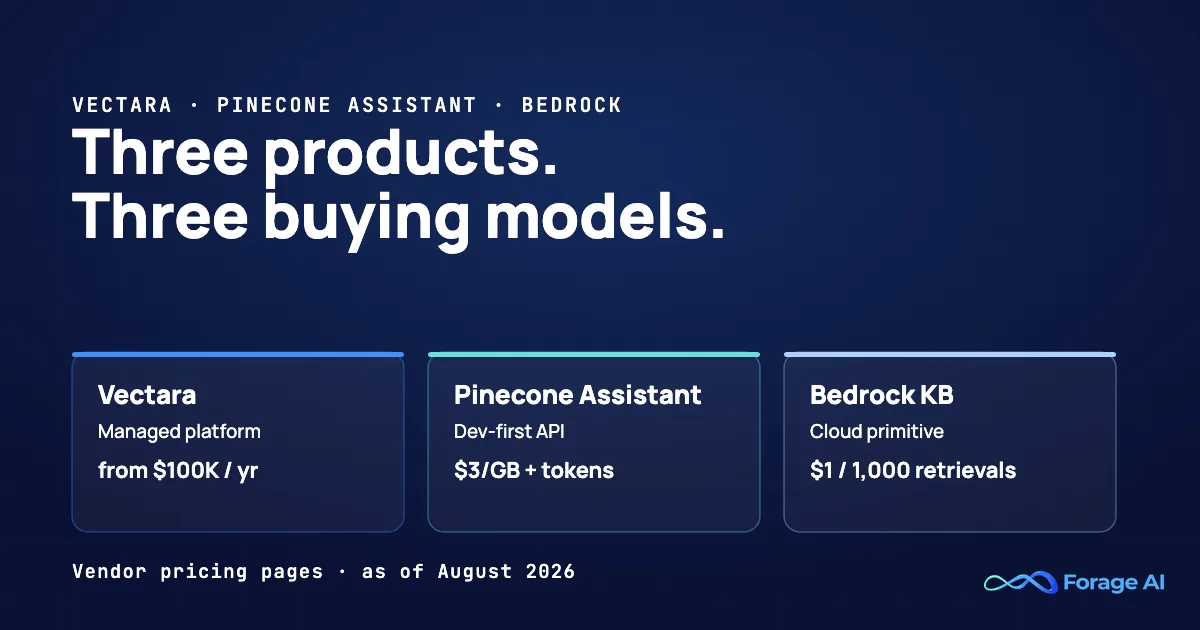
Vectara starts at $100,000 a year. Pinecone Assistant starts at $3 per gigabyte per month plus metered tokens. Amazon Bedrock Knowledge Bases starts at $1 per thousand retrieval calls with parsing and embedding included. Three price tags, three orders of magnitude, and almost every comparison page on the internet puts them in the same table as though they were three versions of the same thing.
They are not. One is a full managed platform with its own retrieval and generation models and a six-figure annual floor. One is a metered service layered on top of a vector database. One is a cloud primitive that can, incidentally, use the second one as its storage engine.
That distinction decides the outcome of your evaluation before any feature comparison starts. A shortlist built on the assumption that these are interchangeable line items produces a decision made on price, and price is the dimension where they are least comparable. This article compares them on the dimensions where the comparison is real: what you actually get, what it actually costs at a stated workload, where each one stops, what it costs to leave, and which situation each one is built for. If you are earlier in the process and still deciding which category to buy from at all, our comparison of 15 RAG-as-a-service platforms maps the full field first.
Quick Digest
- Three bands, not three peers: Vectara is a managed end-to-end platform, Pinecone Assistant is a dev-first API on top of a vector database, and Amazon Bedrock Knowledge Bases is a hyperscaler primitive. Pinecone is also a supported vector store inside Bedrock Knowledge Bases, so the three do not sit on one axis.
- What each does end to end: Vectara ships its own retrieval model, generation model and a factual consistency score. Pinecone Assistant manages chunking, embedding, retrieval, generation and citations behind one API. Bedrock split into Managed and Customer-managed flavours in 2026, and only the Managed one carries third-party connectors, document-level permissions and agentic retrieval.
- Cost shapes: Vectara is a fixed annual floor from $100,000. Pinecone Assistant is metered on storage and tokens. Bedrock Managed Knowledge Bases is metered on stored data and API calls, with parsing, embedding and reranking included but generation billed separately.
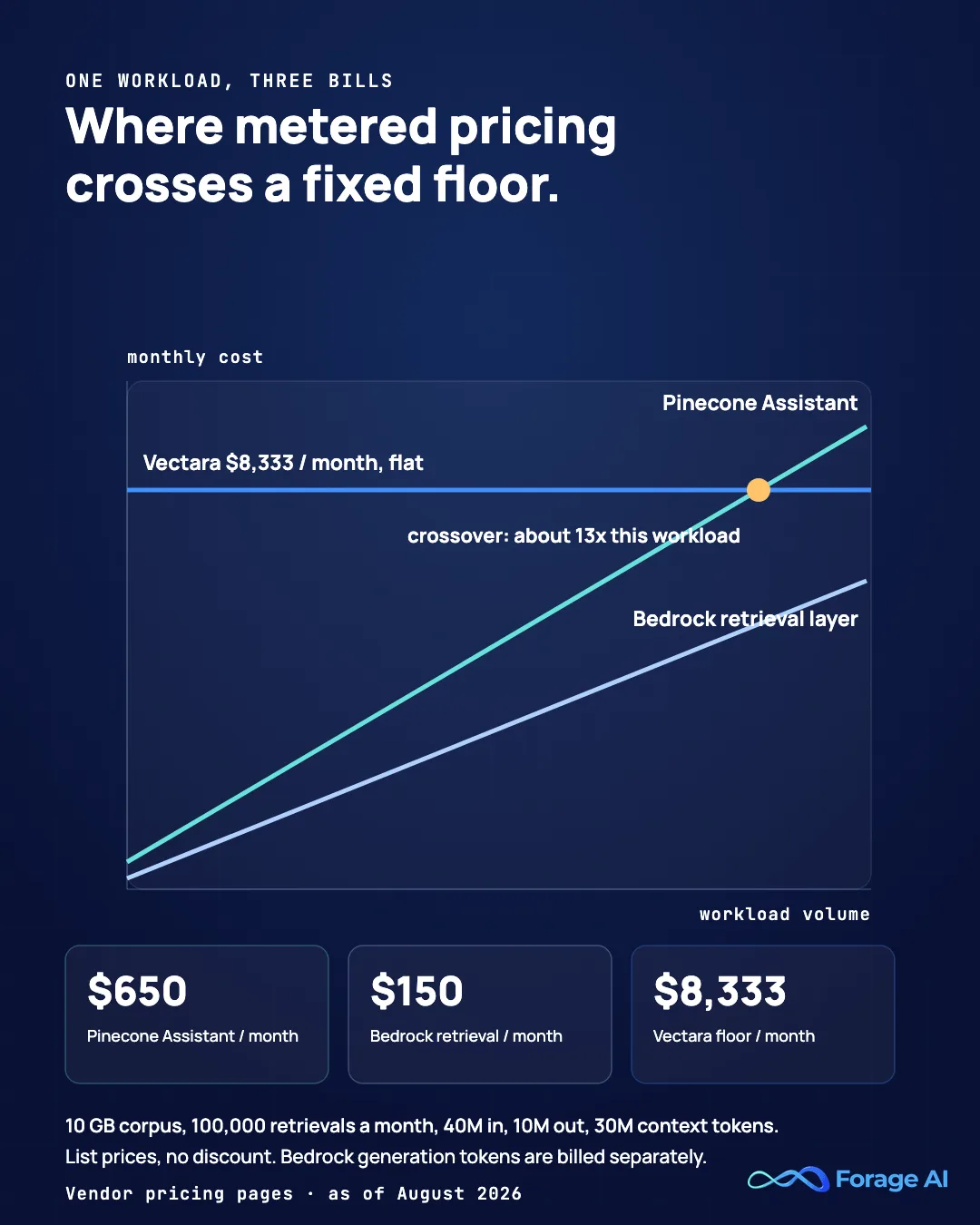
- The crossover: on a 10 GB corpus with 100,000 monthly retrievals, Pinecone Assistant lands near $650 a month and the Bedrock retrieval layer near $150 a month. Vectara’s floor is roughly $8,333 a month whatever the volume, which means it is a different purchase, not an expensive version of the same one.
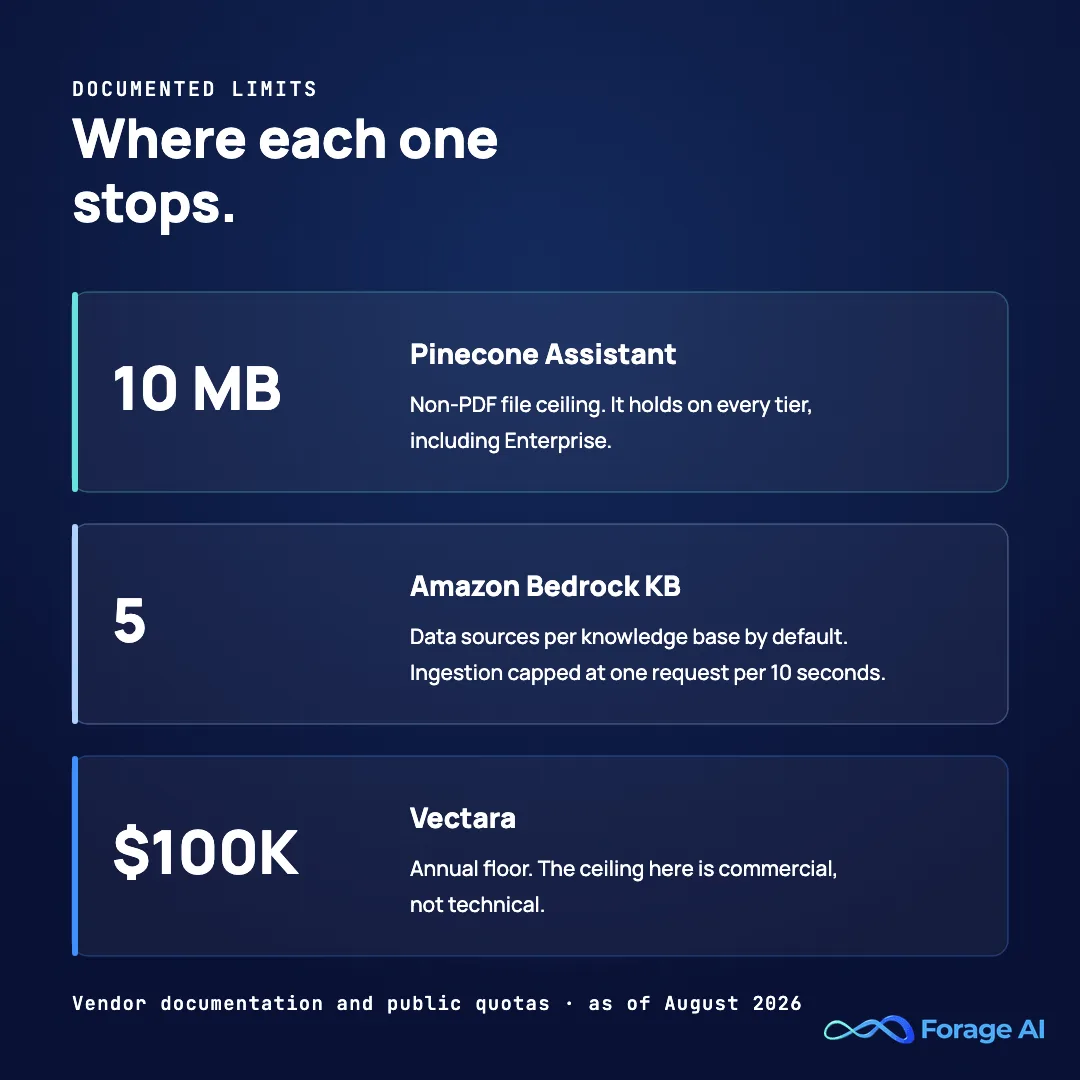
- Where each stops: Pinecone Assistant caps non-PDF files at 10 MB on every tier including Enterprise. Bedrock allows 50 knowledge bases per account per Region, five data sources per knowledge base by default, and one ingestion job request every ten seconds. Vectara’s ceiling is commercial, not technical.
Are these three the same product in different wrappers?
Vectara, Pinecone Assistant and Amazon Bedrock Knowledge Bases occupy three different bands of the retrieval-augmented generation market, and each band answers a different procurement question. Buying across bands on a feature grid is the most common evaluation error on this shortlist.
Retrieval-augmented generation is the technique of grounding a language model’s answer in your own documents at query time. The three products all do it. What separates them is how much of the pipeline they own and how much of it you own.
| Vectara | Pinecone Assistant | Amazon Bedrock Knowledge Bases | |
|---|---|---|---|
| What it is | Managed end-to-end platform with its own retrieval and generation models | Managed RAG layer on top of a vector database | Cloud primitive, in Managed and Customer-managed flavours |
| Band | Managed RAG-as-a-service | Dev-first API | Hyperscaler building block |
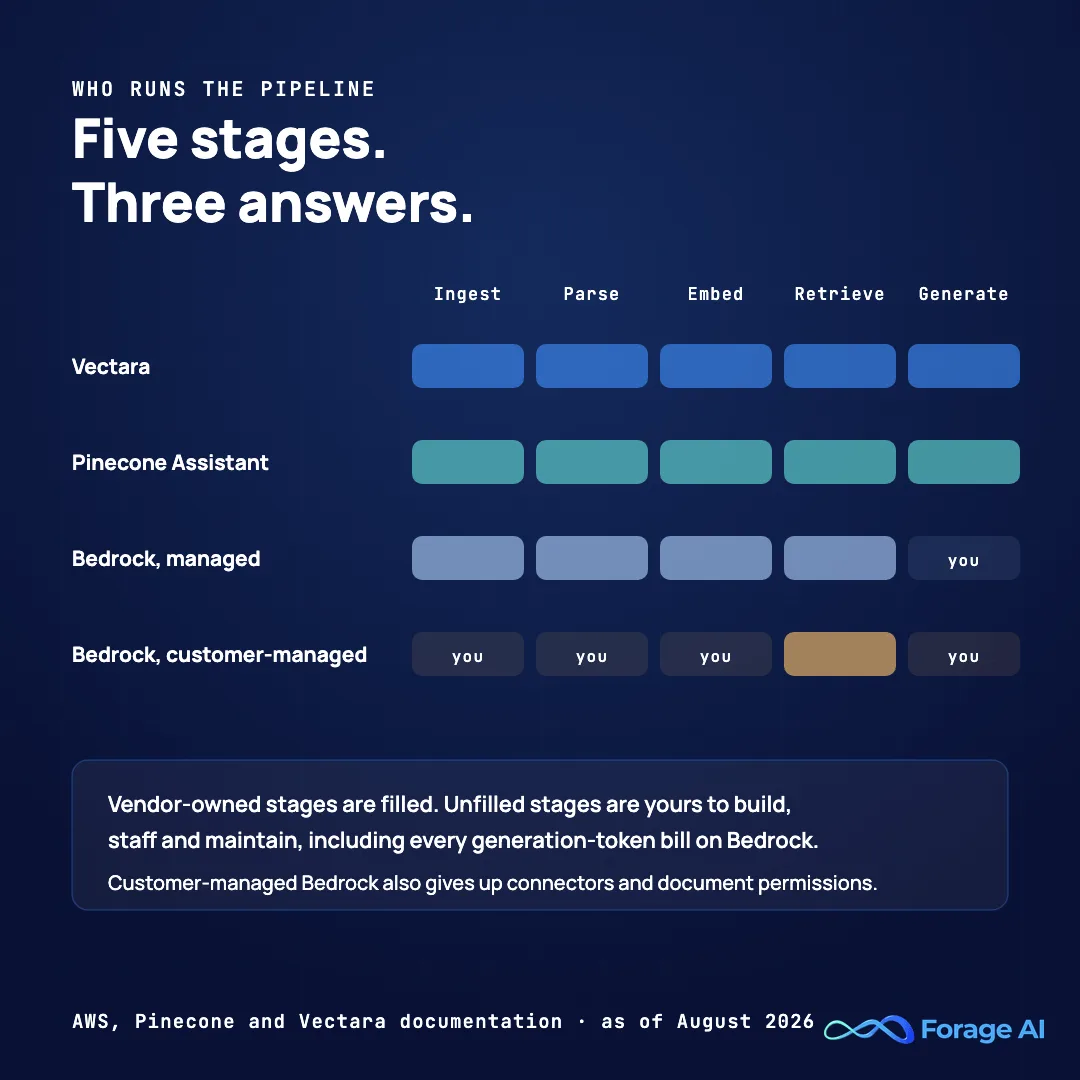
| Who runs the pipeline | Vectara | Pinecone | AWS on Managed, you on Customer-managed |
| Entry price | From $100,000 per year | Metered from $3/GB/month plus tokens | Metered from $5/GB/month plus $1 per 1,000 retrievals |
| Deployment | SaaS, VPC, on-premises, air-gapped | Managed cloud, US and EU regions | AWS Regions |
| Procurement shape | Annual contract, security review | Credit card to start, contract later | Already on your AWS bill |
Sources: vendor pricing and documentation pages, accessed August 2026. See the Sources section.
The nuance that breaks the peer framing is this. Pinecone is a supported vector store inside Amazon Bedrock Knowledge Bases. A team can build on Bedrock, select Pinecone as the backing store, and pay both companies inside one architecture. Two of the three products on your shortlist can appear in the same deployment, on the same invoice cycle, playing different roles.
Not the same thing: A vector database is not a RAG platform. Pinecone Assistant is the managed layer that turns a vector database into a question-answering service. The database underneath it is a component, and components can be swapped. Platforms cannot.
The market is young enough that this confusion is priced in. Retrieval-augmented generation was estimated at $1.94 billion in 2025 and is projected by MarketsandMarkets to reach $9.86 billion by 2030, a 38.4% compound annual growth rate. Categories growing that fast do not have settled taxonomies, and vendor comparison pages are written by vendors.
What does each platform actually do end to end?
All three take documents in and return grounded answers with citations. The differences sit in what each one lets you change and what it refuses to expose.
Vectara
Vectara runs the full pipeline on its own models. Boomerang handles retrieval, Mockingbird handles generation, and bring-your-own-model is supported if you would rather generate with GPT, Claude or Gemini. The platform layers on multi-modal retrieval, conversational assistants, autonomous agents and workflow orchestration, with fine-grained access control, audit logging and a stated policy of zero training on customer data. It holds SOC 2 Type II. Deployment runs from SaaS through VPC, on-premises and air-gapped.
The differentiator Vectara has invested most heavily in is hallucination measurement. HHEM, the Hughes Hallucination Evaluation Model, is a classification model rather than a language model acting as a judge. It scores whether a generated answer is actually supported by the retrieved source and returns a factual consistency score between 0 and 1. The commercial version runs inside the Query API. The open-weights version, HHEM-2.1-Open, has passed five million downloads on Hugging Face and powers Vectara’s public hallucination leaderboard.
That open model is worth reading as a business signal rather than a technical one. A vendor that publishes its own accuracy instrument, and lets anyone run it against anyone’s system including its own, is making a durability bet on transparency.
Pinecone Assistant
Pinecone Assistant is described in Pinecone’s own documentation as a managed service for building production-grade retrieval-augmented chat and agent applications grounded in your data. Upload documents and the assistant handles chunking, embedding and storage. Query it and it retrieves context, calls a language model for a grounded answer, and returns citations with the source document, page and file metadata attached.
Around that core it adds custom instructions, metadata filtering to cut latency and improve precision, context-snippet retrieval for use in your own orchestration, and built-in response evaluation on correctness, completeness and alignment. It runs in US and EU regions and is reachable through the API or the Python and Node SDKs.
What the documentation does not publish is as decision-relevant as what it does. There is no published connector catalogue, no documented embedding-model selection, no stated model menu beyond the GPT-4o example in the quickstart, and no published SLA thresholds. For a team that wants an API and does not want to argue about chunk sizes, that opacity is the product working as intended. For a team with a compliance reviewer who asks which model touched the data, it is a question to raise in the sales call.
Amazon Bedrock Knowledge Bases
Bedrock Knowledge Bases changed shape in 2026, and most comparison content has not caught up. It is now two products.
Managed Knowledge Base hands ingestion, indexing, storage and retrieval to AWS. It carries multi-modal ingestion, storage auto-scaling, service-managed embedding and reranking models with the option to substitute your own, and agentic retrieval, which decomposes a complex query into sub-queries, retrieves iteratively across multiple knowledge bases and evaluates whether the result is sufficient. Smart Parsing selects a parsing strategy per document type, covering PDFs, PPTX, DOCX, documents with embedded visuals, audio, video and scanned documents. Connectors cover Amazon S3, SharePoint, Confluence, Google Drive, OneDrive and a web crawler, with document-level permission filtering through access control lists applied at retrieval time on every connector except the crawler. Native AgentCore Gateway integration means any MCP-compatible agent framework can discover and call the knowledge base as a tool without custom code.
Customer-managed Knowledge Base gives you the vector store and the control that comes with it. You choose Amazon OpenSearch Serverless, Amazon Aurora, Amazon Neptune Analytics or S3 Vectors, and you own ingestion, parsing, indexing and storage configuration. You also give things up: third-party connectors, document-level permissions and native AgentCore Gateway integration are Managed-only features. If the vector store choice itself is the decision you are working through, our guide to data storage architectures for LLM and RAG systems covers the trade-offs at that layer.
Quick Summary
Q: What does each platform actually handle for you end to end?
A: Vectara handles everything including the retrieval and generation models themselves, and adds a factual consistency score on every answer. Pinecone Assistant handles chunking, embedding, retrieval, generation and citations behind one API, with limited published configurability. Amazon Bedrock Knowledge Bases handles all of it on the Managed flavour, or hands you the vector store and the configuration burden on the Customer-managed flavour, where you also lose third-party connectors and document-level permissions.
How do the three price, and on what axis?
Vectara sells an annual commitment. Pinecone Assistant meters storage and tokens. Bedrock meters stored data and API calls. Those are not three prices for one thing; they are three billing philosophies, and comparing the entry numbers directly produces a wrong answer.
| Billing unit | What triggers the charge | What is included | What costs extra | |
|---|---|---|---|---|
| Vectara | Annual license | Deployment type | Boomerang retrieval, Mockingbird generation, bring-your-own-model, all platform features | Forward-deployed AI engineer, platinum support |
| Pinecone Assistant | Storage plus tokens | GB stored, tokens in and out, ingestion units | Chunking, embedding, storage, retrieval, generation, citations | Nothing separately metered beyond the above |
| Bedrock Managed KB | Stored data plus API calls | GB of raw data, retrieval calls | Multimodal parsing, embedding, reranking with managed models | Generation tokens, custom embedding or reranking models, agentic retrieval planning |
Sources: vendor pricing pages, accessed August 2026.
The published numbers, as of August 2026. Vectara runs from $100,000 a year for one SaaS deployment, $250,000 a year for a VPC deployment and $500,000 a year for on-premises, with a 30-day full-feature trial. Pinecone Assistant charges $3 per gigabyte per month for storage, $8 per million chat input tokens, $15 per million output tokens, $5 per million context-retrieval tokens, and $0.0005 per ingestion unit of roughly 400 tokens, with multimodal PDFs at about twice that ingestion rate. Bedrock Managed Knowledge Bases charges $5 per gigabyte of raw data per month for index storage and $1 per 1,000 standard retrieval calls, with agentic retrieval at $4 per 1,000 agentic calls on top of the underlying $1 per 1,000. Parsing, embedding and reranking are included when you use the managed models.
The same workload, priced three ways
Take a corpus of 10 GB of source documents, 100,000 retrievals a month, and roughly 40 million chat input tokens, 10 million output tokens and 30 million context tokens over that month. Assumptions are stated so you can substitute your own: text at approximately four characters per token, no multimodal premium, list prices with no negotiated discount.
Pinecone Assistant. Storage runs 10 GB at $3, so $30 a month. Chat input is 40 million at $8 per million, so $320. Output is 10 million at $15 per million, so $150. Context retrieval is 30 million at $5 per million, so $150. Steady state lands near $650 a month, roughly $7,800 a year. One-time ingestion of that corpus works out near $780 at the stated token assumption, and about double that if the corpus is scanned PDFs.
Bedrock Managed Knowledge Base. Index storage runs 10 GB at $5, so $50 a month. Retrieval runs 100,000 calls at $1 per thousand, so $100. Parsing, embedding and reranking are included. The retrieval layer lands near $150 a month, roughly $1,800 a year. Generation is billed separately at the Bedrock model rates, which for a model in the GPT-4o class at this token volume adds a figure in the same order as Pinecone Assistant’s token line.
Vectara. The workload does not change the number. The SaaS floor of $100,000 a year is roughly $8,333 a month at any volume in this range.
That last line is the finding, not the footnote. At this workload Pinecone Assistant would need roughly thirteen times the volume before its metered bill reached Vectara’s floor. Vectara is not an expensive version of the same purchase. It is a different purchase: a deployment posture, a support relationship and an accuracy instrument, sold as an annual commitment.
Not the same thing: Cheapest at this workload is not cheapest at every workload. Metered pricing crosses fixed pricing at some volume. Find your crossover before you sign anything, because the crossover point, not the entry price, is what a three-year contract is actually pricing.
These figures are list prices at a single stated workload, built to be recalculated with your own numbers rather than quoted. Vendor pricing changes; verify against the current pricing pages before any figure reaches a budget document.
Quick Summary
Q: Which of the three is actually cheapest?
A: It depends on volume, because the three bill on different axes. At the worked example above, 10 GB of documents and 100,000 retrievals a month, the Bedrock retrieval layer lands near $150 a month and Pinecone Assistant near $650, while the Vectara SaaS floor is $100,000 a year at any volume in that range. Metered pricing crosses fixed pricing somewhere, so what a three-year contract is really pricing is your crossover point, not the entry number.
Where does each one hit its ceiling?
Vectara, Pinecone Assistant and Amazon Bedrock Knowledge Bases each carry a documented limit that quietly decides architectures. None of the three markets it.
Pinecone Assistant caps non-PDF files at 10 MB, and that cap holds on every tier including Enterprise. PDFs scale with the plan, at 10 MB on Starter, 50 MB on Builder and 100 MB on Standard and Enterprise. A .docx, .txt, .md or .json file above 10 MB does not get through at any price. Teams whose corpus includes large exported transcripts, consolidated JSON feeds or long-form structured documents run into that wall on day one, and no amount of upgrading moves it.
Bedrock’s constraints are quota-shaped rather than file-shaped. As of August 2026 the documented defaults are 50 knowledge bases per AWS account per Region, five data sources per knowledge base as an adjustable soft limit, five concurrent ingestion jobs per account with one per knowledge base and one per data source, and a `StartIngestionJob` rate limit of 0.1 requests per second, meaning one request every ten seconds per Region. Multimodal ingestion caps JPEG and PNG files at 3.75 MB each, and files per ingestion job cap at 15,000 with Nova Multimodal Embeddings or 1,000 with Bedrock Data Automation.
Chunking carries its own bounds. Chunk size runs from a minimum of 20 tokens to a maximum of 8,192, bounded by the embedding model’s context length, so a Cohere embedding model caps the chunk at 512. Custom metadata is limited to roughly 1 KB and 35 keys per vector. Hierarchical chunking stores parent-child relationships as non-filterable metadata, which means high token counts can breach that metadata ceiling, and AWS does not recommend hierarchical chunking with an S3 vector bucket at all.
An independent April 2026 benchmark of five chunking strategies inside Bedrock Knowledge Bases is the most useful third-party evidence available on any of the three products. Its author found that semantic chunking and no-chunking both failed at ingestion before they could be scored fairly, with semantic chunking hitting an empirical limit near 1 MB per file and failing on most technical documentation. The production recommendation that came out of it was fixed-size chunking at 512 tokens with 20% overlap, on S3 Vectors, with periodic evaluation. One practitioner’s benchmark is not a study of record, and it should be read as a single data point. It is still one more independent data point than either of the other two products has.
Vectara’s ceiling is commercial. There is no published file-size wall or ingestion rate limit that shapes the architecture. The $100,000 annual floor is the constraint, and it prices the platform out of pilots, proofs of concept and any project that has not already cleared a budget cycle. The 30-day full-feature trial exists precisely because the floor makes casual evaluation impossible.
Switching costs are the line item nobody prices
Leaving Vectara, Pinecone Assistant or Amazon Bedrock Knowledge Bases means rebuilding the corpus inside whichever one comes next. That work is invisible during evaluation and expensive during migration, and it is the reason platform choice behaves more like an architecture decision than a subscription decision.
What travels between platforms is the source material: the original documents, the folder structure, the metadata schema you designed. What does not travel is everything downstream of ingestion. Embeddings are vectors produced by a specific model, and they are meaningless to a platform running a different one, so the whole corpus is re-embedded. Chunking strategies are platform-specific, so the chunk boundaries are recomputed. Evaluation history, tuned retrieval settings and permission mappings are configuration living inside the vendor’s system, and none of it exports cleanly.
Expert Insights
Niklas Muennighoff, Nouamane Tazi, Loic Magne and Nils Reimers, introducing the Massive Text Embedding Benchmark in 2022, reported that "We find that no particular text embedding method dominates across all tasks." That is why the re-embedding step is unavoidable rather than an implementation detail: each platform ships its own embedding choice, and there is no universal model whose vectors would carry across a switch.
The re-ingestion arithmetic is calculable in at least one case. Pinecone Assistant’s published ingestion rate of $0.0005 per unit of roughly 400 tokens puts a 10 GB text corpus near $780 to ingest once, and about twice that if the source is scanned PDFs. That is the cheap part. The expensive part is the engineering time to rebuild the pipeline, re-tune retrieval and re-validate answer quality against whatever evaluation set you have, which for a production system is typically measured in engineering weeks rather than hours.
Bedrock carries a migration cost inside its own product line. Moving from a Customer-managed Knowledge Base to a Managed one, or the reverse, is not a settings change. The Customer-managed flavour does not offer third-party connectors, document-level permission filtering or native AgentCore Gateway integration, so a team that starts Customer-managed for the control and later wants the managed connector set is re-architecting the ingestion path, not toggling a feature.
The hedge is the same in all three directions and it is the one thing fully inside your control: keep the corpus itself portable. Source documents in a structure you own, metadata in a schema you designed, extraction pipelines that write to your storage before they write to any vendor’s. A corpus built that way makes any of these three a reversible decision. A corpus that only exists inside a vendor’s index makes all three permanent.
Which one to sign, by situation
Cost, ceilings and switching risk resolve into one table. The routing below is deliberately situational rather than scored. A weighted matrix across products in three different bands produces a number that looks decisive and means very little.
| Your situation | The fit | Why | Check before signing |
|---|---|---|---|
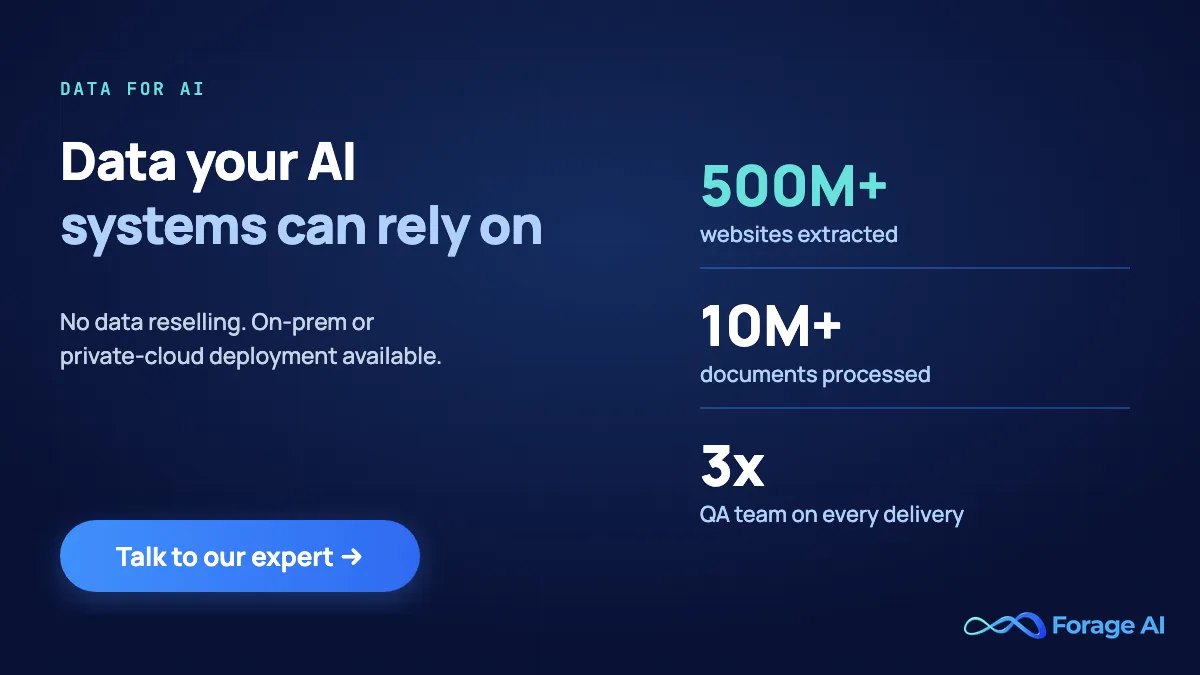
| Data already in S3, identity already IAM, procurement wants one vendor | Bedrock Managed Knowledge Base | Lowest procurement friction, no new vendor, parsing and embedding included | Whether five data sources per knowledge base covers your source count, and whether the quota increase is approved in your Region |
| Engineering team wants an API, metered spend, no annual commitment | Pinecone Assistant | Fastest path from zero to a grounded answer, no contract | Whether any file in your corpus exceeds 10 MB and is not a PDF |
| Regulated deployment, on-premises or air-gapped, budget already approved | Vectara | The only one of the three offering on-premises and air-gapped deployment | The 2026 leadership change: founding CEO Amr Awadallah stepped back and co-founder Tallat Shafaat took the CEO role, so ask about roadmap continuity and renewal terms |
| Multi-cloud, or a corpus that is mostly external web and portal data | None of the three, on its own | All three assume the documents already exist somewhere they can reach | Who is building the extraction layer that produces the corpus in the first place |
The tie-breaker. When two of these look close on your criteria, and they often will between Pinecone Assistant and Bedrock, break the tie on the dimension with the highest year-two downside. For most teams that is ingestion coverage rather than retrieval quality, because retrieval quality is fixable with tuning and ingestion coverage is fixable only by re-architecting. Ask which platform can reach every source you will need in eighteen months, not every source you have today.
Five questions worth asking each vendor before a contract:
- Which model produced the embeddings, and what happens to my index when that model is deprecated?
- What is the documented path to export my data, and has any customer actually run it?
- Which limits on your public documentation are soft quotas, and what is the approval time to raise them?
- What does the price look like at three times my current volume, in writing?
- Who owns retrieval quality when answers are wrong, and what does your support process actually do about it?
The accuracy ceiling none of the three can raise
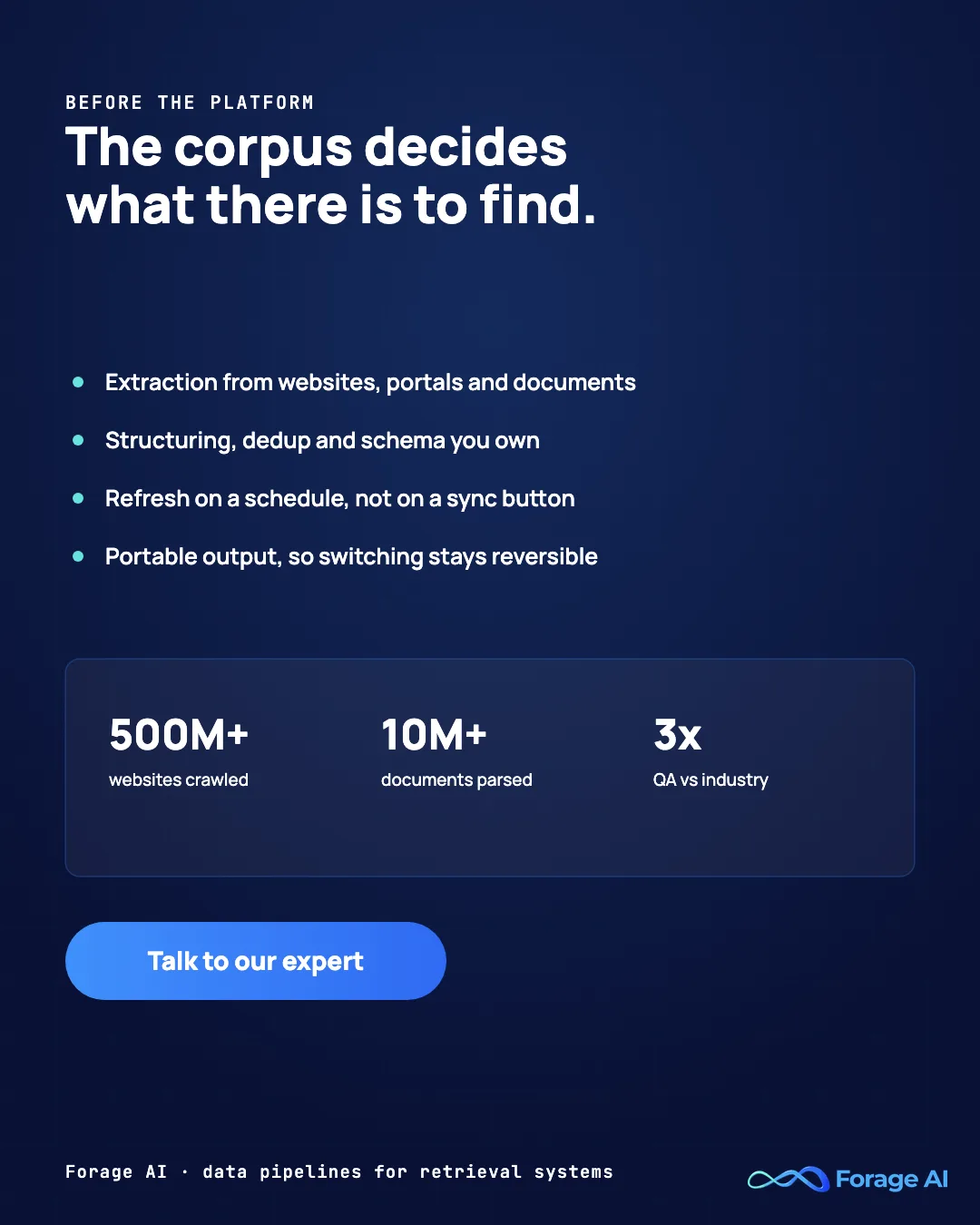
The platform decides how well you search what you have. The corpus decides what there is to find. No configuration on any of the three changes that order of operations.
The clearest evidence available is not from a vendor. Researchers at Stanford tested the two leading commercial AI legal research tools against a preregistered dataset of 202 legal queries. Every tool under test was a retrieval-augmented system, purpose-built, expensively engineered, sold to a profession where a wrong citation is a career event. Both tools hallucinated on more than 17% of the 202 preregistered queries. The work was published in the Journal of Empirical Legal Studies in 2025, with the preprint released in 2024.
Expert Insights
On how far retrieval quality carries from one system to another. Nandan Thakur, Nils Reimers, Andreas Rücklé, Abhishek Srivastava and Iryna Gurevych built BEIR to test retrieval models on 18 datasets they had not been tuned for, and reported that "re-ranking and late-interaction-based models on average achieve the best zero-shot performances, however, at high computational costs." No single retrieval approach wins everywhere, which is why a benchmark run on somebody else’s corpus tells you very little about yours.
Thakur et al., BEIR, NeurIPS 2021 Datasets and Benchmarks Track
On what the evidence actually shows about retrieval-augmented systems. The Stanford RegLab and Human-Centered AI study by Varun Magesh, Faiz Surani, Matthew Dahl, Mirac Suzgun, Christopher D. Manning and Daniel E. Ho tested whether retrieval augmentation eliminates hallucination in commercial legal research tools. It does not. Both tools hallucinated on more than 17% of the 202 preregistered queries, which reframes retrieval-augmented generation as a mitigation rather than a fix.
Magesh et al., Journal of Empirical Legal Studies, 2025
Those systems did not fail because the vendors picked the wrong platform. They failed at the point where retrieval returned something plausible and incomplete, which is a corpus and chunking outcome long before it is a generation outcome. The chain runs backwards from the symptom: a wrong answer comes from a wrong retrieval, a wrong retrieval comes from a bad chunk, and a bad chunk comes from a document that was parsed badly, ingested stale, or never ingested at all. We have written the full diagnostic version of that chain in why RAG pipelines fail in production.
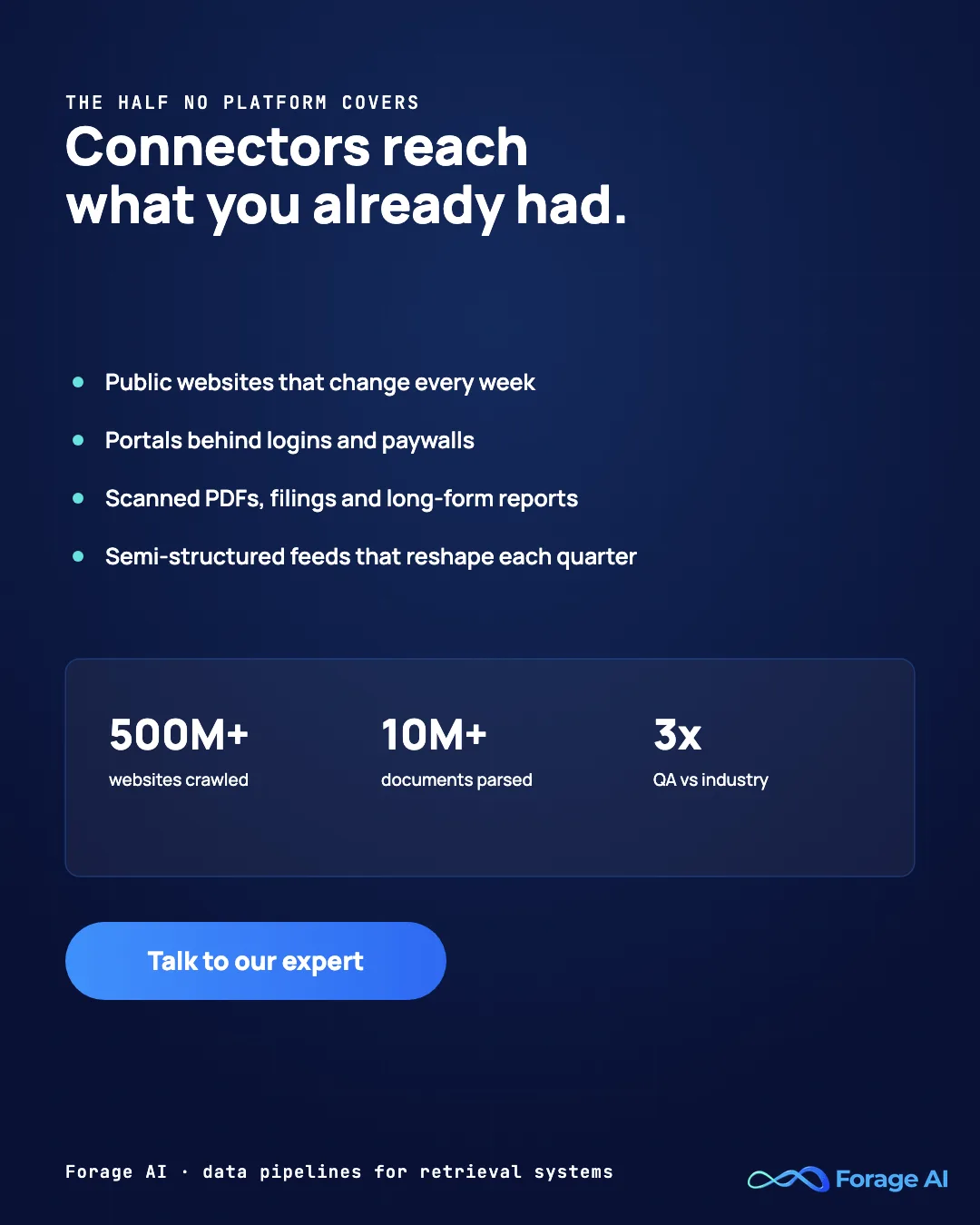
This is where the connector counts on every vendor comparison page quietly mislead. Connectors reach SharePoint, Confluence, Google Drive, OneDrive and S3. Those are the sources that were already structured and already yours. They do not reach the sources that make an enterprise knowledge base worth building: public websites that change weekly, portals behind logins, regulatory filings, scanned PDFs, and semi-structured feeds that arrive in a different shape every quarter. Bedrock’s web crawler is the closest any of the three comes, and it is also the one connector that document-level permission filtering does not cover.
That gap is the layer Forage AI works in. We build and run the extraction pipelines that produce the corpus before any platform sees it: sourcing from websites, portals and documents, structuring the output, deduplicating it, and keeping it fresh on a schedule, with a QA team three times the industry average size relative to delivery. Across 12+ years we have crawled 500M+ websites and parsed 10M+ documents into structured form. It is deliberately not a RAG platform, which is why this comparison has no fourth column. If the extraction half of the problem is the one that is actually limiting you, that is the conversation to have, and our work on data extraction automation is the place to start.
Which leaves the shortlist looking different than it did at the top of this article. Three price tags spanning two orders of magnitude, and one number none of them publish: 17%, from a peer-reviewed study of systems built by people with every incentive to get it right. That is the ceiling figure. Vectara, Pinecone Assistant and Amazon Bedrock Knowledge Bases each decide how close you get to it, at very different prices, on very different contracts. What decides where the ceiling sits was settled before any of them saw the data.
Quick Summary
Q: Can any of the three platforms raise your accuracy ceiling?
A: No. The platform decides how well you search what you have, and the corpus decides what there is to find. In the Stanford test cited above, purpose-built legal research systems still hallucinated on more than 17% of 202 preregistered queries. A wrong answer traces back to a wrong retrieval, a wrong retrieval to a bad chunk, and a bad chunk to a document that was never extracted cleanly, which is work that happens before any of these three sees the corpus.
Frequently asked questions
Is Pinecone Assistant the same as Pinecone the vector database?
No. Pinecone is a vector database, which stores embeddings and serves similarity search. Pinecone Assistant is a managed service built on top of it that handles chunking, embedding, retrieval, generation and citations behind a single API. You can use the database without the assistant. Most comparison articles list the database when they mean the assistant, which is why the pricing they quote often does not match what you get billed.
Can you use Pinecone with Amazon Bedrock Knowledge Bases?
Yes. Pinecone is a supported vector store for Amazon Bedrock Knowledge Bases, which means a single architecture can use Bedrock for the knowledge base layer and Pinecone for storage. That is the clearest evidence that these products are not straightforward competitors. It also means a shortlist that treats them as mutually exclusive is asking the wrong question.
How much does Vectara cost?
As of August 2026, Vectara publishes a SaaS floor of $100,000 a year, a VPC floor of $250,000 a year and an on-premises floor of $500,000 a year, each covering one deployment, with a 30-day full-feature trial. Those are floors rather than list prices, so the real number comes from a sales conversation. The floor is the strategically relevant figure because it defines who the product is not for.
Which is cheapest for a small pilot?
Pinecone Assistant, on the Starter tier, which allows five assistants, 1 GB of file storage and 500,000 chat input tokens a month at no cost. Amazon Bedrock Knowledge Bases has no platform fee and bills only for what you use, which makes it close to free at pilot volume if you are already an AWS account holder. Vectara’s trial is full-featured but time-boxed at 30 days, and the annual floor after it makes the product a poor fit for anything that has not already been funded.
Does the platform choice determine answer accuracy?
Less than most buyers expect. The Stanford study found both leading commercial legal AI research tools hallucinating on more than 17% of queries, in systems purpose-built for a profession with no tolerance for wrong citations. Retrieval quality is bounded by what is in the index, which is bounded by what the ingestion pipeline extracted and how well it was structured. Platform selection moves the last few percent. Corpus quality moves the rest.
Related Articles
- RAG as a Service in 2026: 15 Platforms Compared: The full field across four buying bands, if these three are not yet your shortlist
- Why RAG Pipelines Fail in Production: The diagnostic version of the corpus argument, with the failure modes named
- Fine-Tuning or RAG: Which AI Model Strategy Is Right for You?: The decision one step upstream of platform selection
- AI Training Data Providers: How to Evaluate the Top Vendors: The diligence checklist for the data supply side
Sai is a data infrastructure enthusiast who has spent the past two to three years following the AI space closely, from the infrastructure layer to the fast-growing world of data for AI. He is genuinely curious about how modern data pipelines get built and where the data industry is heading, and he writes insightful pieces on the core topics that shape this niche.