
Residential vs Datacenter vs ISP Proxies: Choosing the Right Type for Large-Scale Data Collection
On a small scrape, the proxy question barely matters. Almost anything works, the job finishes, and nobody opens the invoice twice. At scale the same decision turns into the largest line item on the bill and the difference between a run that completes and one that quietly stalls at 60% coverage.
We have watched teams discover this the hard way. The crawl looks healthy for a week, the dashboard shows requests going out, and then somebody asks why the dataset is missing a third of the catalogue. Nothing crashed. The pool was simply being refused, one request at a time.
Datacenter, residential and ISP proxies are not ranked good to bad. Each has a job it does better than the other two. What has changed is the web those jobs run against, and the balance has shifted decisively toward one of them.
This guide walks the decision the way a data team actually runs it. Look at what the current research says about the environment, define the three types precisely, then work the cost and pool-sizing math until the answer is obvious. Two kinds of numbers appear below. The market and detection figures are real, drawn from 2025 industry research. The per-type cost and success figures are illustrative round numbers chosen to show the mechanics. Plug in your own measured rates and the method still holds.
Quick Digest
- The short answer: pick the cheapest type that clears your target's block rate. On today's defended web that is increasingly residential.
- Datacenter proxies: cloud and hosting IPs, cheap per gigabyte, very high concurrency, easy for a target to recognise. Right for open targets and discovery passes.
- Residential proxies: real household connections, highest pass rate when blocks start biting, resolves to the city. Right for hard, protected targets at scale.
- ISP proxies: hosted IPs registered to a residential provider, static by design. Right for one narrow job, the logged-in or static-identity session.
- The formula that decides the budget: effective cost per gigabyte equals list price per gigabyte divided by success rate. A cheap IP with a low success rate is expensive.
- The flip: on a hard target an illustrative $0.80 datacenter gigabyte costs $10.00 per usable gigabyte at 8% success, while a $5.00 residential gigabyte holds near $5.56 at 90%.
- The saving: route the cheap 90% of the job to datacenter and reserve residential for the 10% that actually gets blocked, and blended effective cost lands near $1.69 per gigabyte instead of $5.26.
- The failure mode nobody budgets for: below a certain success rate the run stops being merely expensive and simply cannot reach full coverage.
This guide was produced with Dexodata as part of a content partnership. Forage AI wrote and edited this version, and the measurement method it describes is vendor-neutral.
What the 2025 data shows
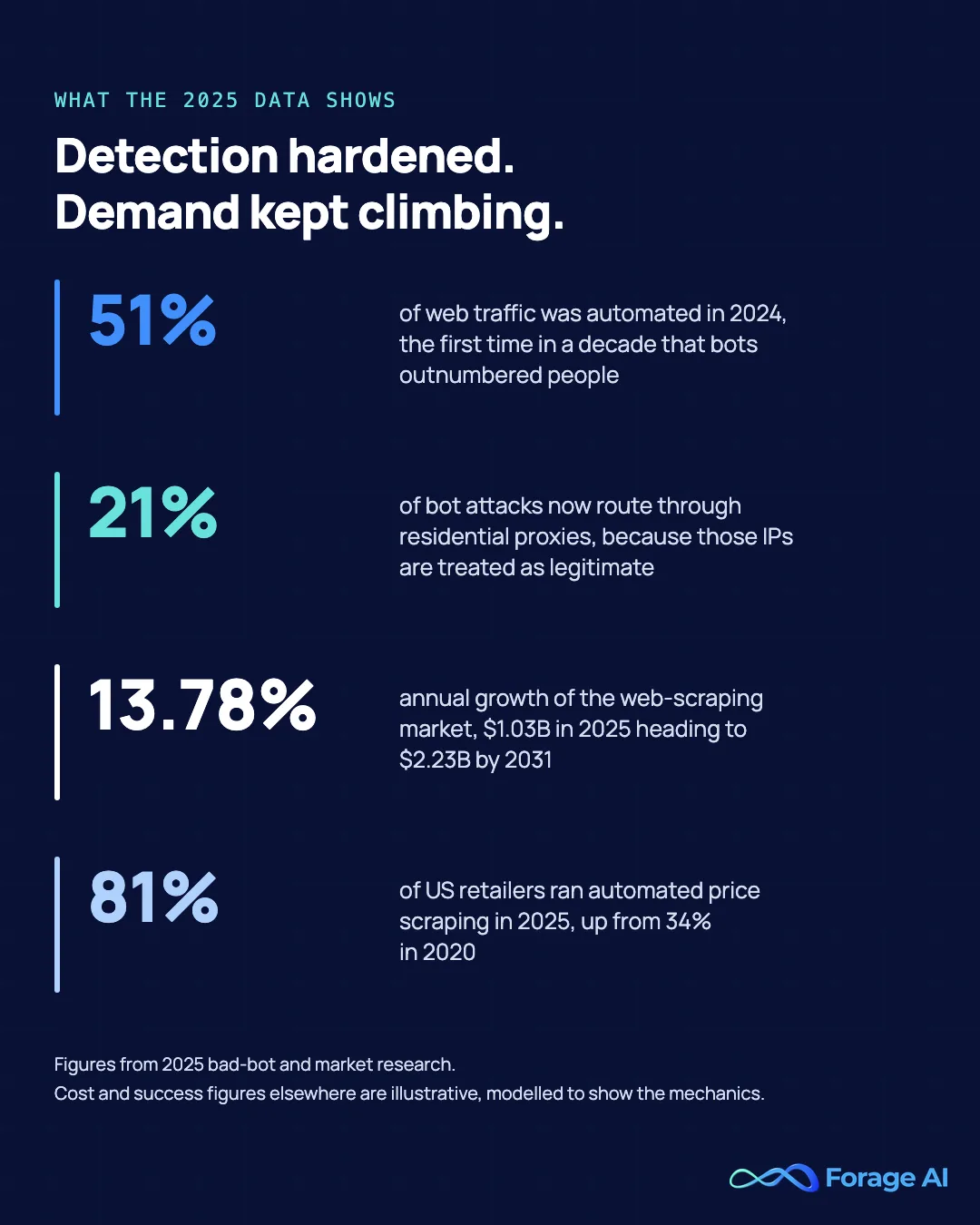
Start with the ground truth about the environment you are collecting from. The 2025 edition of the industry's most-cited annual bad-bot study found that automated traffic reached 51% of all web activity in 2024, the first time in a decade that bots outnumbered people, with 37% of traffic classed as outright malicious. Defenders responded by scrutinising the network layer harder than ever, and a hosting range is the easiest thing in the world to flag.
The same 2025 research found that 21% of bot attacks already route through residential proxies, specifically because residential addresses are treated as trustworthy and blend into ordinary user traffic.
51% of web traffic was automated in 2024, and 21% of bot attacks now route through residential proxies. When the most evasive traffic migrates to a network type to survive detection, it is telling you where reliability lives on protected targets. (2025 industry bad-bot research)
Demand is climbing to meet those defenses. 2025 market forecasts put the web-scraping market near $1.03 billion in 2025 and heading past $2.2 billion by 2031, with buyers pushed toward anything that can sustain success rates under tightening anti-bot pressure. Rotating residential is the quickest-growing proxy segment those forecasts track, and 81% of US retailers now run automated price scraping, up from 34% in 2020.
Read as a legitimate collector, the signal is clear. That same trust is exactly why abuse hides there too, and it cuts both ways, but the mechanism is real. It is the reason residential, not datacenter, is now the default for hard collection at scale.
Quick Summary
What changed in 2025 that affects proxy choice?
Bots passed humans as a share of web traffic, so defenders now inspect the network layer first, and hosting ranges are the easiest thing to spot. At the same time, 21% of bot attacks moved to residential IPs because those addresses read as ordinary users. For a legitimate collector, that migration is a signal about which type still clears protected targets.
The three types, and why residential now leads
Datacenter proxies
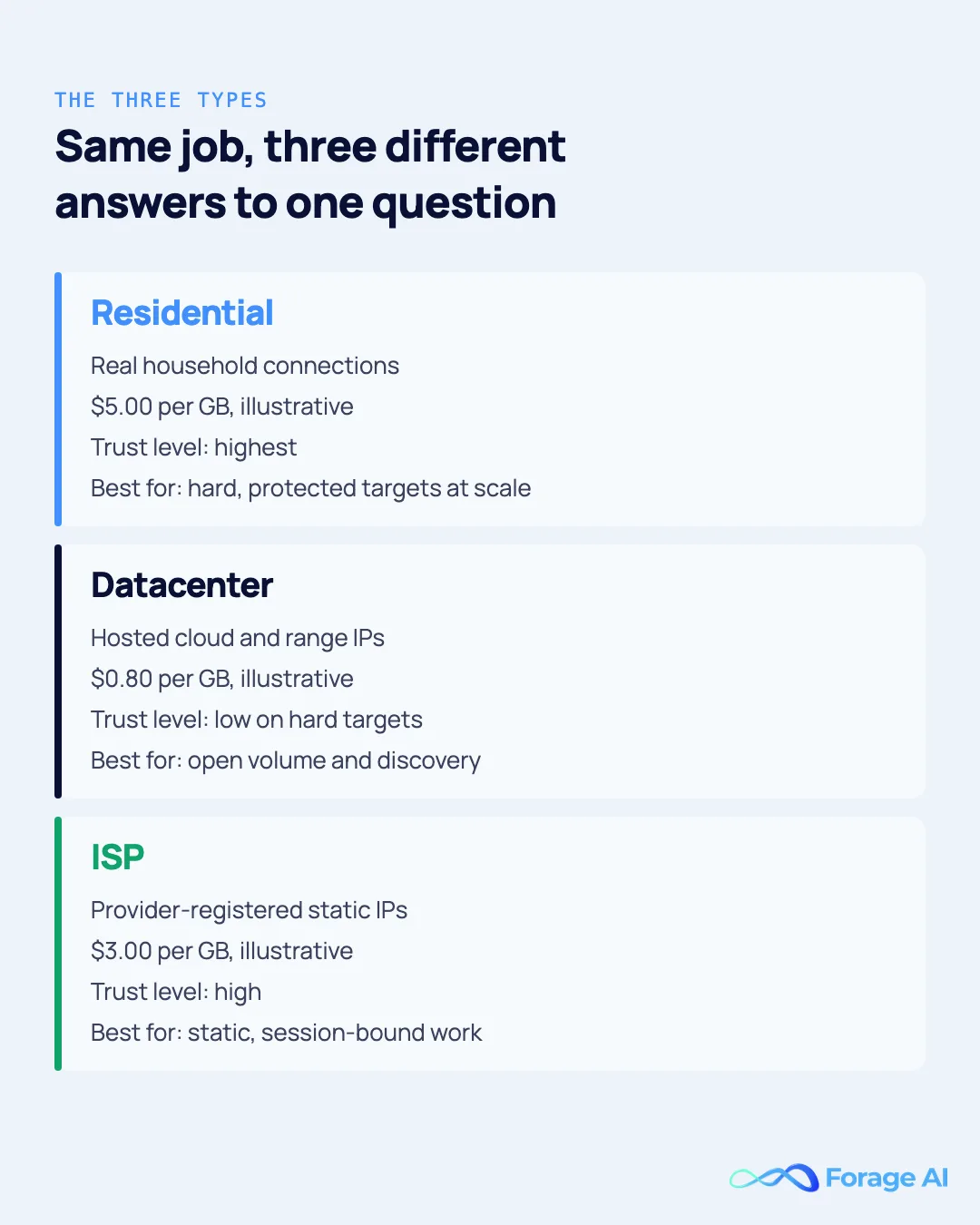
Datacenter proxies are IP addresses issued from cloud and hosting ranges. They are abundant, cheap per gigabyte and support very high concurrency, which makes them the right workhorse for open or lightly protected targets, discovery passes and internal load testing.
Their limitation is legitimacy. A hosting range is one of the easiest things for a target to recognise, so success falls sharply the moment a site cares who is knocking.
Residential proxies
Residential proxies route through real household connections that consumer internet providers assign to real devices. That origin is the whole point. To a target, the traffic looks like an ordinary person on an ordinary home connection, so it carries the legitimacy a hosting range cannot fake.
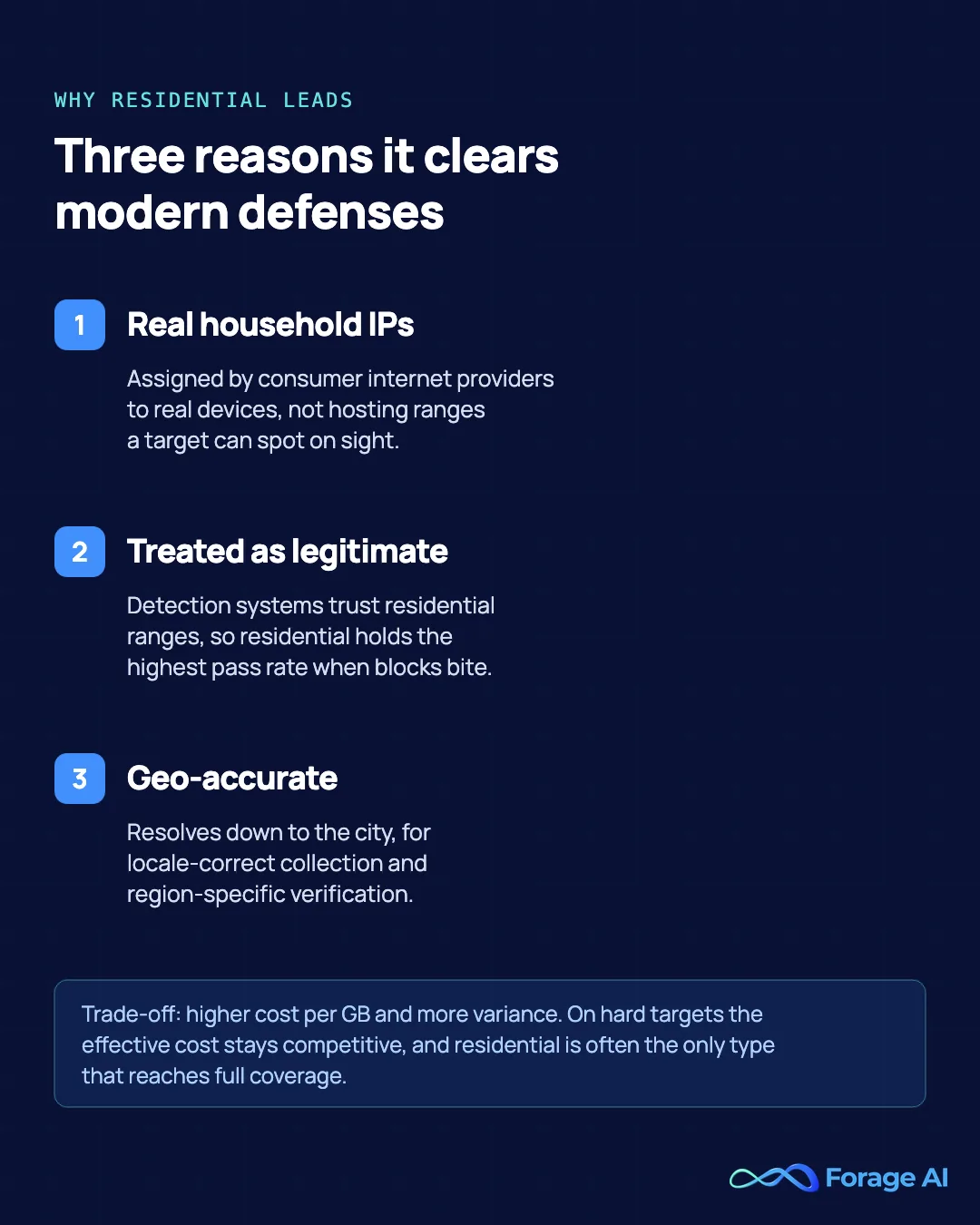
On hard, heavily protected targets this is the difference between a job that completes and one that stalls. Residential holds the highest pass rate exactly when blocks start biting, and it resolves down to the city, which makes locale-correct and region-specific collection possible.
The trade-offs are real and worth stating plainly. You pay per gigabyte at the top of the range. Because you are borrowing capacity from live consumer networks, throughput and latency vary more than they do on a dedicated pool. The effective-cost math below shows why that premium is often the cheaper choice on protected targets: a high pass rate means few retries, and few retries keep both the bill and the coverage where you need them.
For the growing share of large-scale work aimed at defended sites, including price intelligence, alternative data and AI-training extraction, residential is the type built to sustain success rates rather than fight them.
ISP proxies
ISP proxies, sometimes called static residential, are hosted IPs registered to a residential provider rather than to a hosting range. They pair residential-looking legitimacy with a static assignment that does not rotate underneath you.
That makes them a narrow, useful tool for one job in particular: static-identity or logged-in sessions that must hold the same address from the first request to the last. Outside that niche they are rarely the default, because on open targets datacenter is cheaper and on hard targets rotating residential clears more.
Quick Summary
What is the difference between residential, datacenter and ISP proxies?
Datacenter IPs come from cloud and hosting ranges: cheapest, highest concurrency, easiest to spot. Residential IPs come from real household connections, so they read as ordinary users and hold the highest pass rate on protected targets. ISP IPs are hosted addresses registered to a residential provider, which buys residential-looking legitimacy with a static assignment for logged-in sessions.
How targets actually spot a proxy
Success rates are not random. They track how much of your setup a target can inspect. The IP is only the first check. A hosting range is recognisable on sight, which is why datacenter addresses struggle the moment a site cares.
Past that, targets correlate request timing, header order and TLS characteristics. They watch whether a session's cookies and locale stay consistent. They compare the claimed geolocation against the language and time zone your client reports. A residential IP behind a mismatched browser locale gets flagged as fast as a raw datacenter one.
A residential pool is not an anti-detection strategy. It buys legitimacy at the network layer, which is the layer defenders now inspect first. You still have to earn it everywhere else: consistent locale and time zone, human-scale pacing, and sessions that persist the way a real user's would.
This is why the type you pick and the way you run it are inseparable. Get the operational details right on top of a residential pool and you clear the checks that stop everything else. Our practitioner guide to web scraping without getting blocked covers the fingerprinting and pacing side in more depth, and how proxy infrastructure affects web data quality covers what rotation choices do to the data itself.
Quick Summary
How do websites detect proxies?
The IP range is the first check and the easiest to fail, since hosting ranges are recognisable on sight. After that, targets correlate request timing, header order and TLS characteristics, check whether cookies and locale stay consistent across a session, and compare the claimed geolocation with the language and time zone the client reports. Network-layer legitimacy only helps when the rest of the setup agrees with it.
What large-scale collection actually stresses
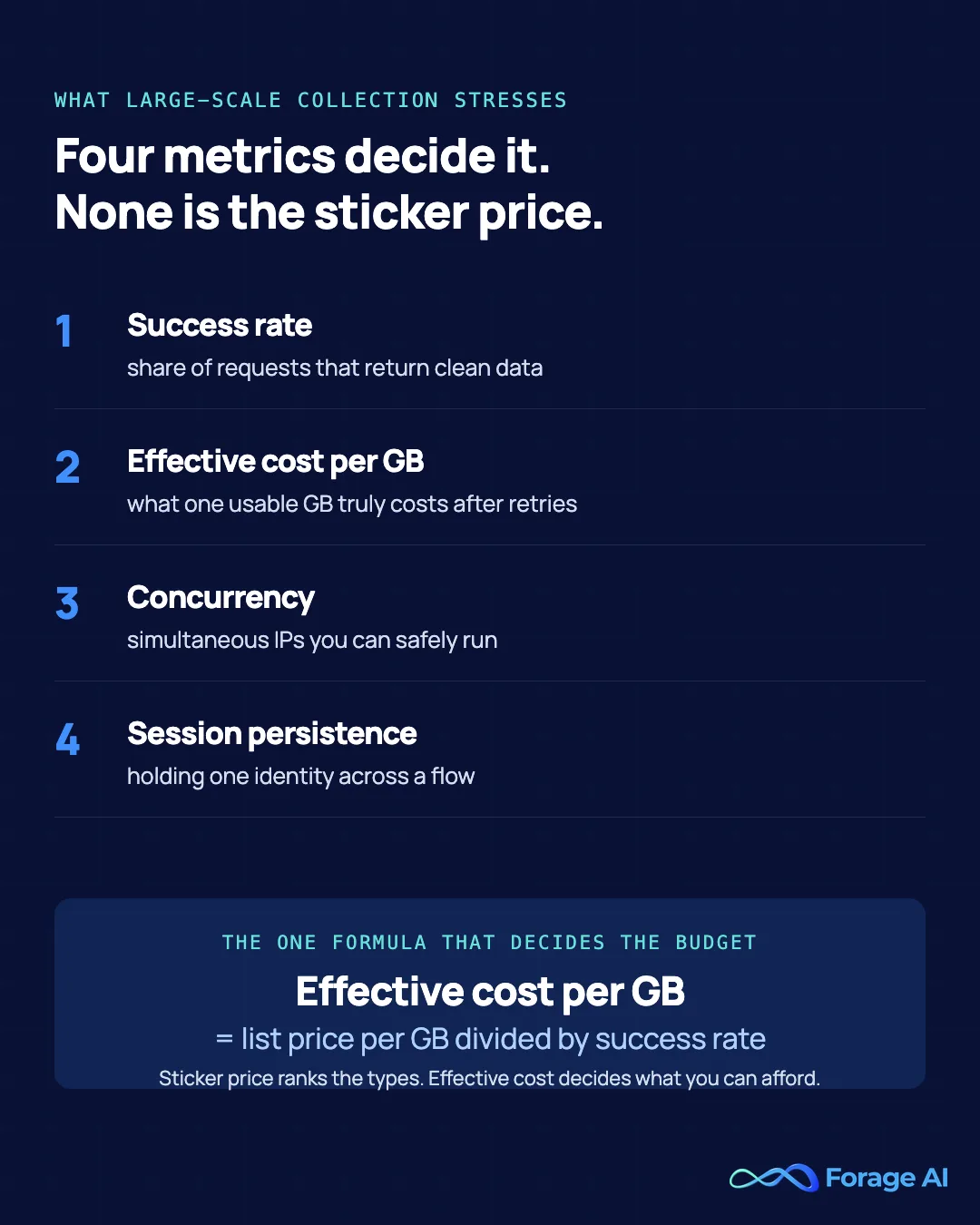
Four things decide whether a large job succeeds, and none of them is the sticker price. Success rate is the share of requests that come back with clean data. Effective cost per gigabyte is what one usable gigabyte actually costs once you account for the retries that failures force. Concurrency is how many IPs you can safely run at once. Session persistence is your ability to hold a single identity across a multi-step flow.
The metric that ties them together is effective cost, and it comes from one formula:
Effective cost per GB = list price per GB ÷ success rate. A cheap IP with a low success rate is expensive. A pricey IP with a high success rate can be the bargain. Sticker price ranks the types. Effective cost decides which one you can afford.
The math that decides the budget
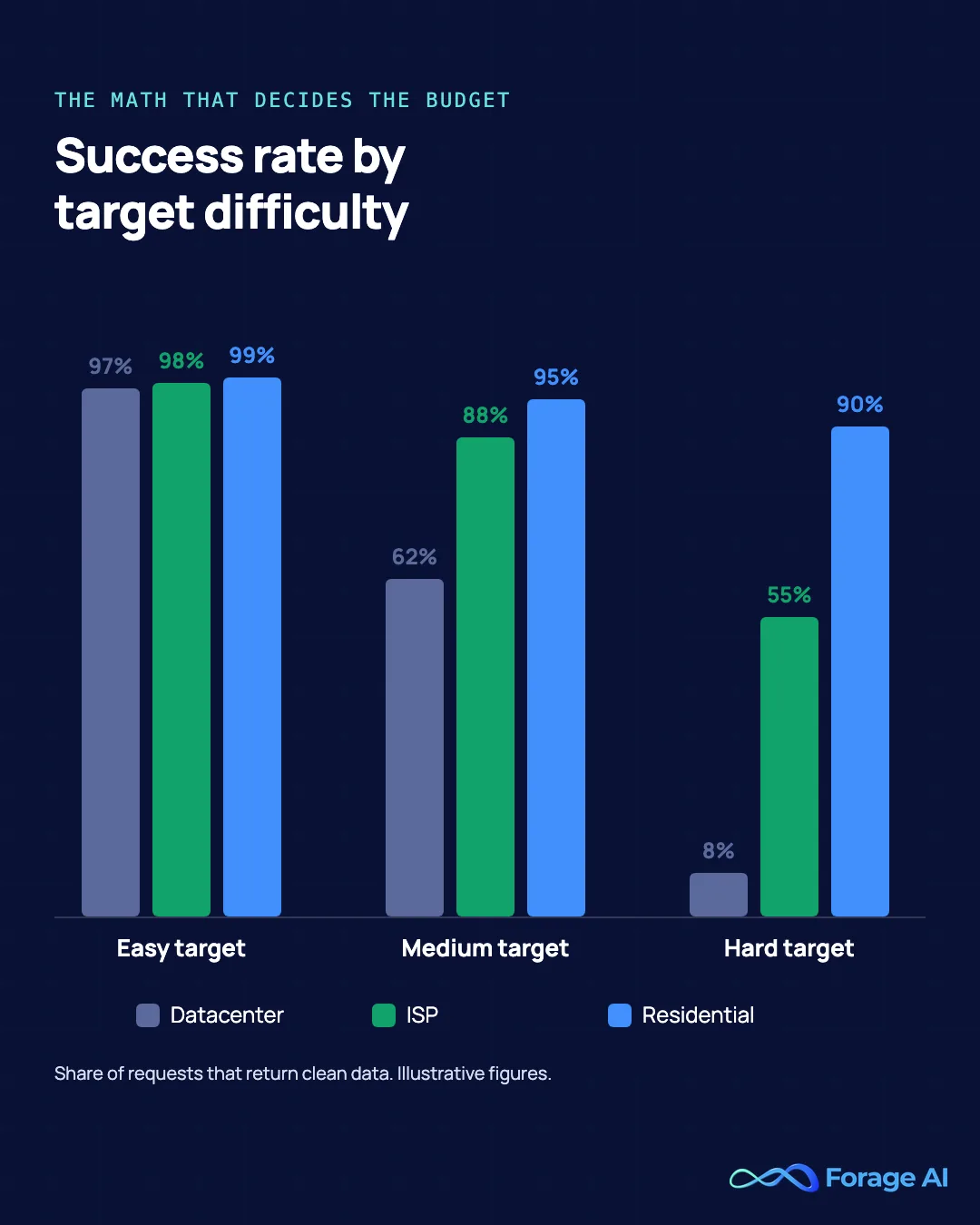
Run the numbers and the ranking moves with target difficulty. On an easy target, datacenter clears about 97% and its $0.80 list becomes roughly $0.82 effective, which is hard to beat. Residential clears 99%, but its $5.00 list stays near $5.05, so on easy work you would be paying six times as much for a rounding error of extra success. This is the case for datacenter, and it is a strong one wherever targets do not fight back.
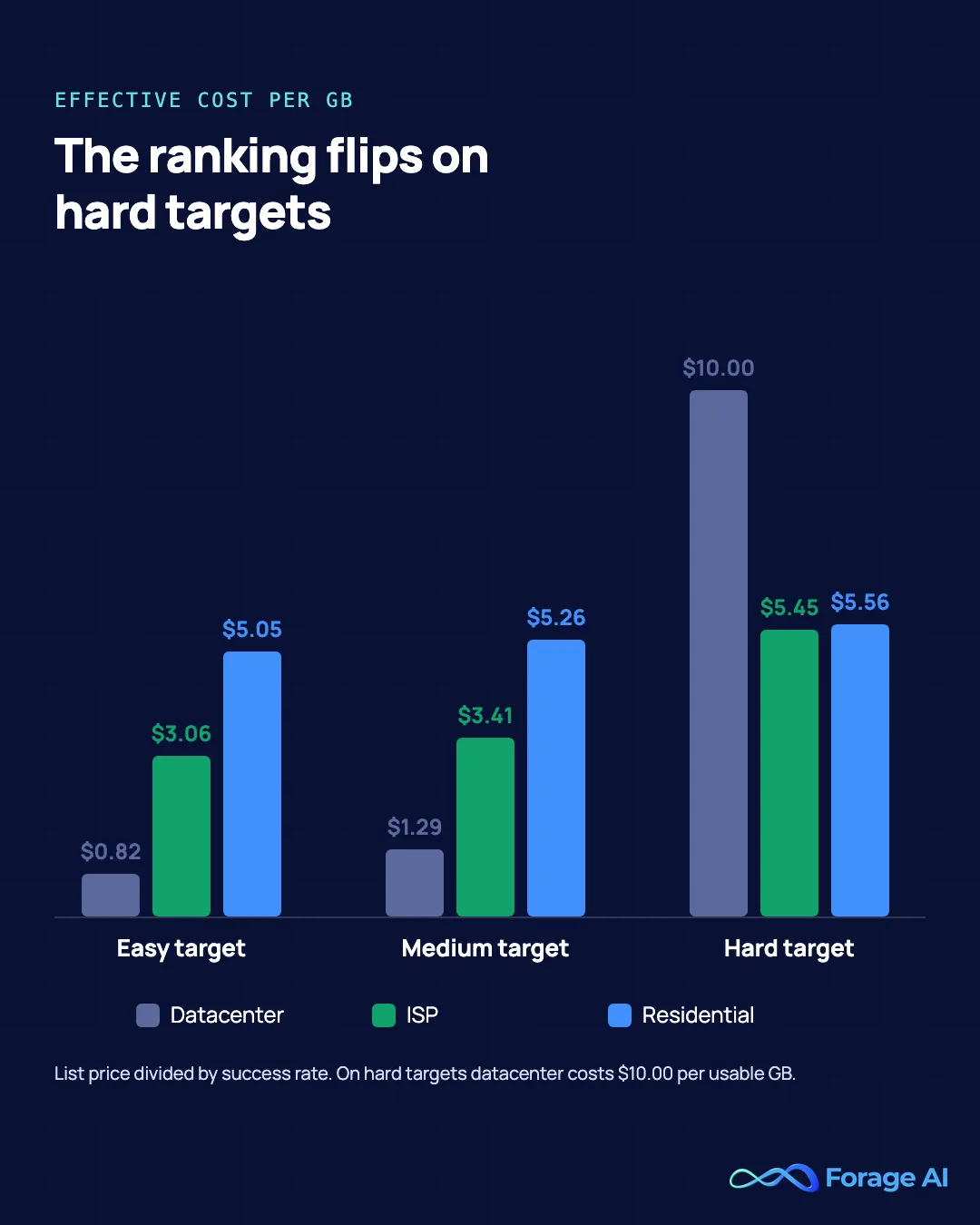
Push to a hard, heavily protected target, the kind that now makes up a growing share of the work, and the picture inverts. Datacenter success can collapse to single digits, call it 8%, which turns that $0.80 list into $10.00 per usable gigabyte once you pay for every failed attempt. Residential holds near 90%, so its $5.00 list stays around $5.56, and ISP sits in between at roughly 55% and $5.45.
The cheap option is now the most expensive, and residential is the only type that both stays affordable and actually finishes the job.
Quick Summary
How do you calculate the real cost of a proxy?
Divide list price per gigabyte by your measured success rate on your own targets. On an easy target an illustrative $0.80 datacenter gigabyte stays near $0.82, so the cheap type wins. On a hard target, where success can fall to 8%, the same gigabyte costs about $10.00 usable, while residential at 90% holds near $5.56. Sticker price ranks the types, effective cost decides which one you can afford.
A worked example: five million pages
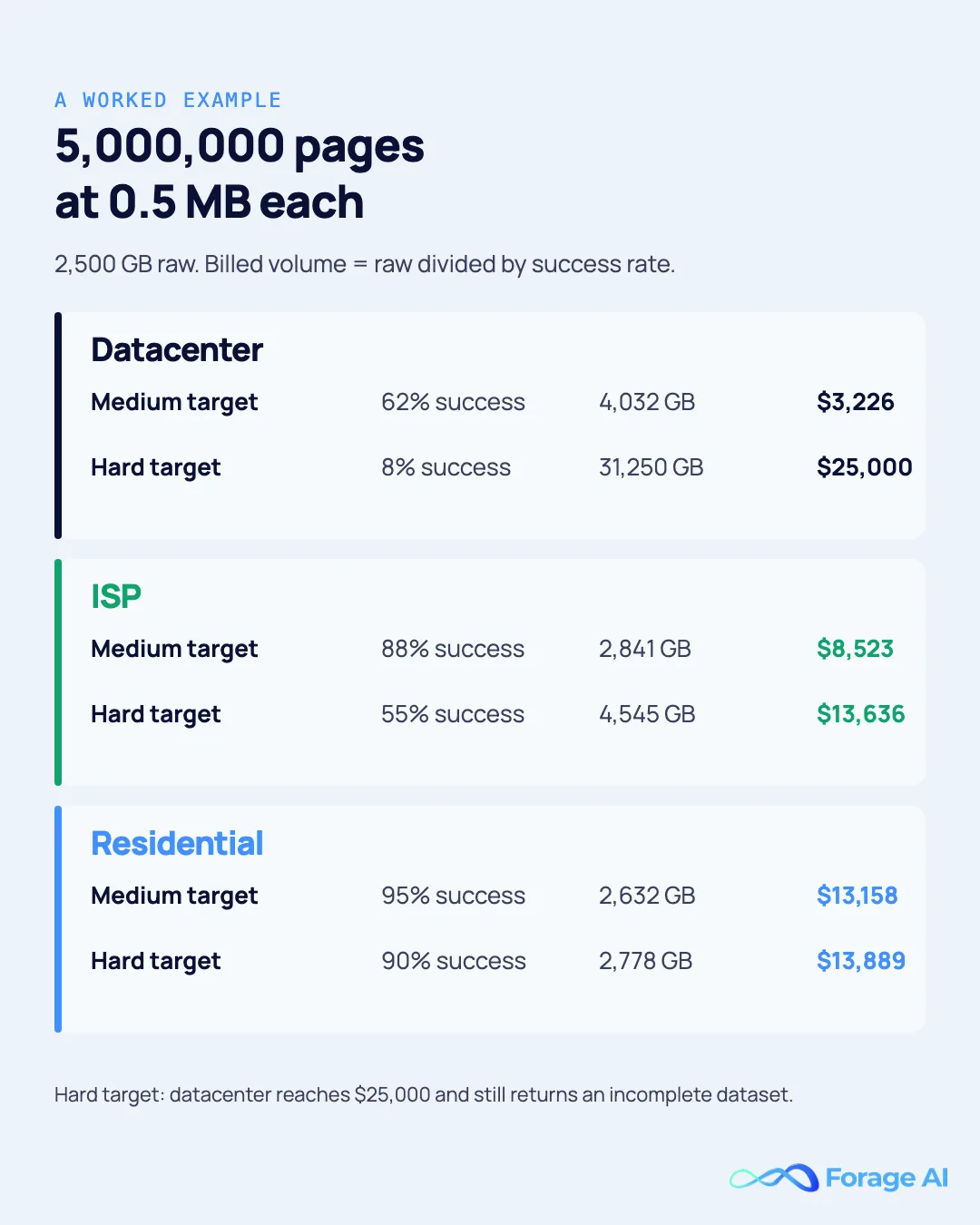
Make it concrete. Say you need 5,000,000 pages at half a megabyte each, which is 2,500 gigabytes of raw data. Bandwidth billed is raw volume divided by success rate, because every retry re-downloads the page.
On a medium target, datacenter bills about 4,032 GB for roughly $3,226, while residential bills 2,632 GB for about $13,158. Datacenter wins by four to one, and for that difficulty it is the right call.
Run the identical job against a hard target and it flips. Datacenter now bills 31,250 GB, about $25,000, and often still returns an incomplete dataset, while residential lands near $13,889 for a near-complete one.
Framed per million clean pages, the same gap is stark. On a medium target datacenter costs about $645 against roughly $2,632 for residential. On a hard target datacenter climbs to about $5,000 per million while residential holds near $2,778.
Cost is only the visible half of this failure. Below a certain success rate a datacenter run stops merely being expensive and simply cannot reach full coverage, because the target caps the range long before your budget runs out. Residential is what buys that coverage back.
Quick Summary
What does five million pages cost by proxy type?
At 0.5 MB per page, 2,500 GB raw. On a medium target, datacenter bills about 4,032 GB for roughly $3,226 against residential at 2,632 GB for about $13,158, so datacenter wins. On a hard target, datacenter bills 31,250 GB for about $25,000 and still returns an incomplete dataset, while residential lands near $13,889 for a near-complete one.
Concurrency and pool sizing
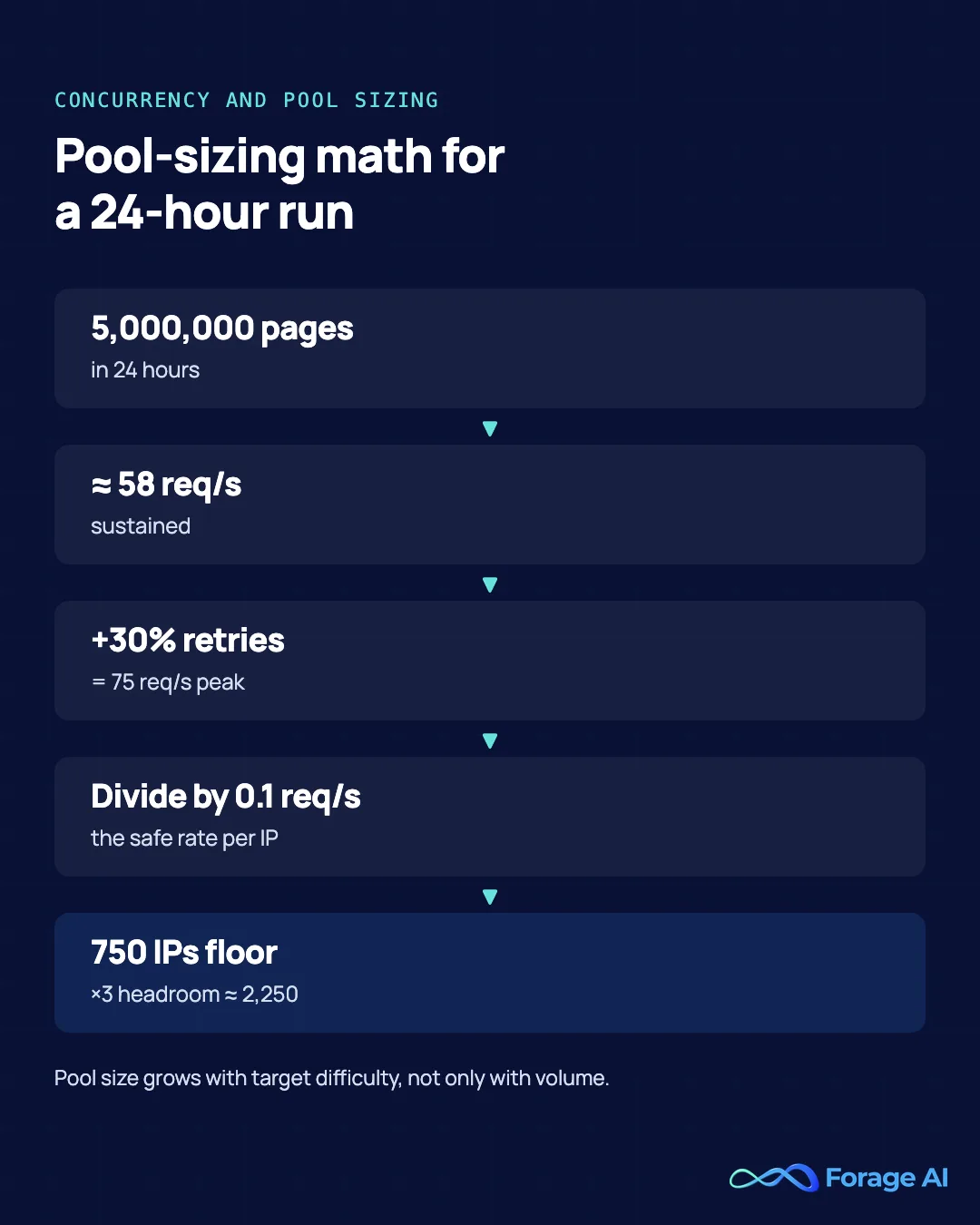
Cost is only half the plan. You also have to move the volume inside a deadline. Five million pages in 24 hours is about 58 requests per second sustained. Add 30% for retries and you are targeting roughly 75 requests per second at peak.
Now divide by the safe per-IP rate. On a medium target you might hold about 0.1 requests per second per IP, six a minute, before you start drawing challenges. That puts the floor at 750 concurrent IPs, and you want around three times that as a working pool, roughly 2,250, so rotation, cool-downs and retirements never starve the crawl.
The safe per-IP rate falls as targets get harder, so pool size grows with difficulty and not only with volume. That is exactly why residential pools have to be sized largest on the hard targets where they earn their keep. Datacenter can sustain far higher per-IP rates on easy targets, where a handful of addresses may cover the same load.
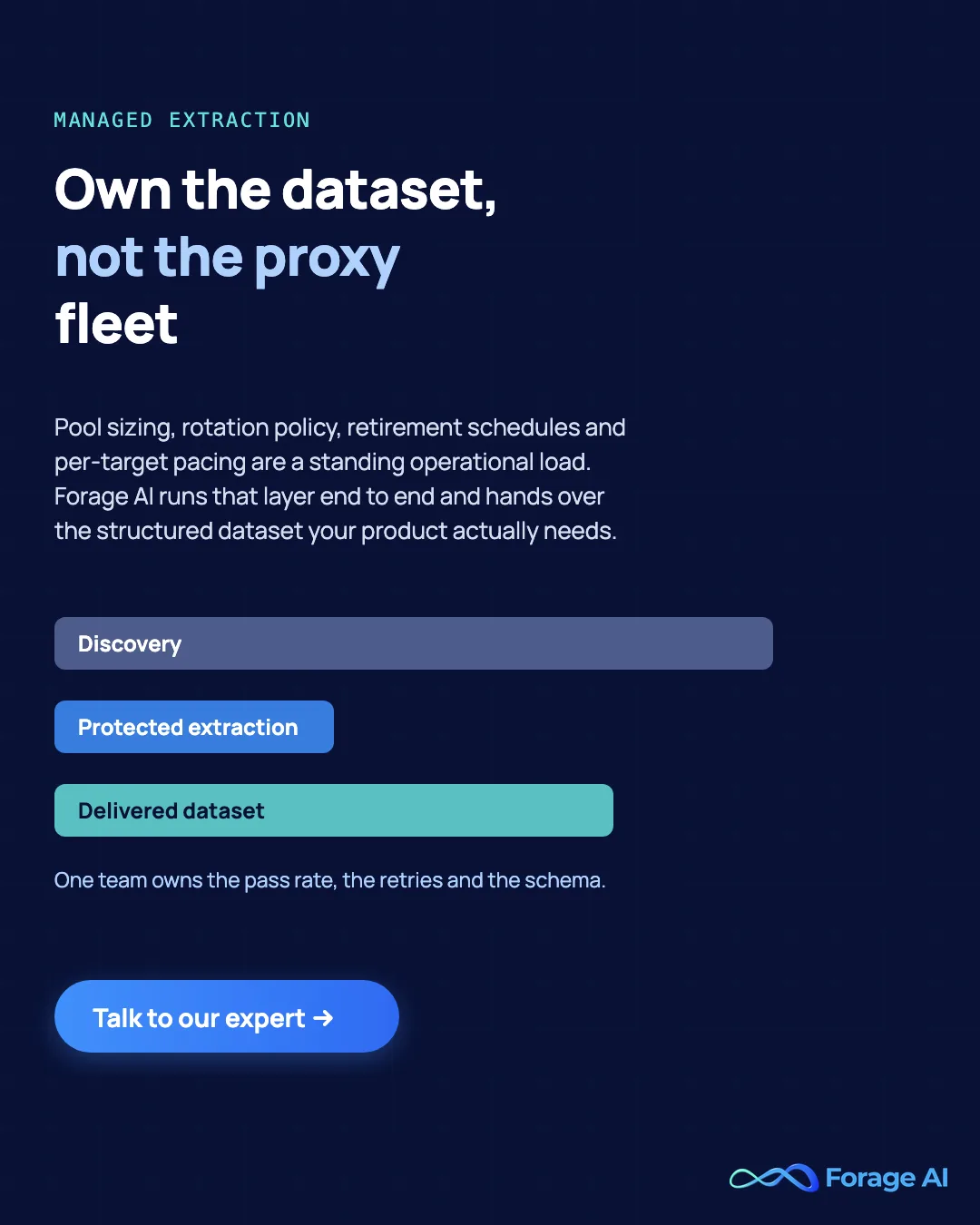
In practice, this is the point where a lot of teams stop wanting to own the plumbing. Pool sizing, rotation policy, retirement schedules and per-target pacing are a standing operational load, not a one-time setup. Forage AI runs that layer as managed web data extraction, so the team on the other side owns the success rate and you get the dataset.
Quick Summary
How many proxies do you need for a large crawl?
Start from the deadline. Five million pages in 24 hours is about 58 requests per second, roughly 75 at peak once you allow 30% for retries. Divide peak requests per second by the safe per-IP rate, about 0.1 on a medium target, which gives a floor of 750 concurrent IPs. Keep about three times that as a working pool so rotation and cool-downs never starve the run.
Choosing a type
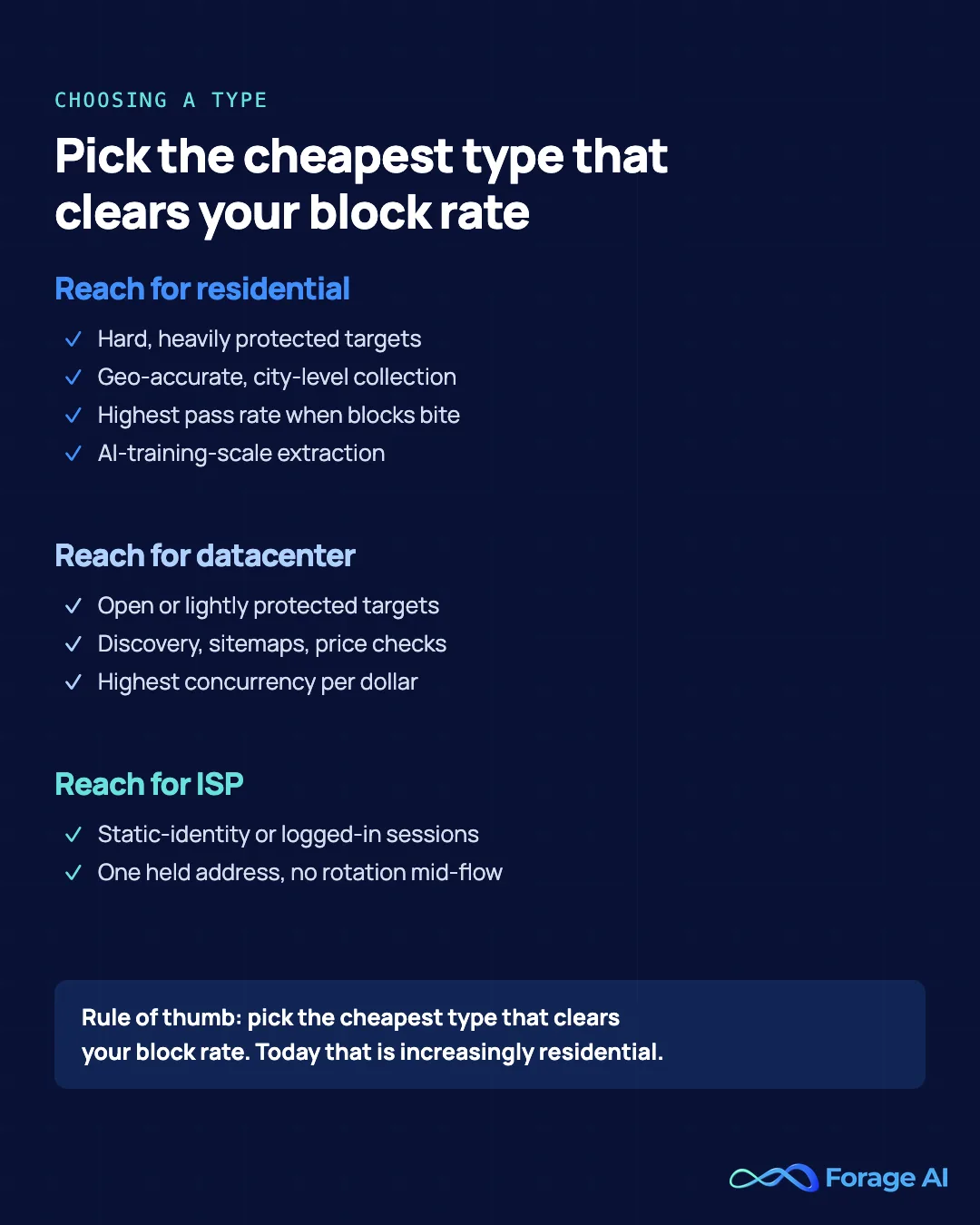
Put it together and the choice follows the target.
- Reach for datacenter on open or lightly protected targets, for discovery passes like crawling sitemaps and price lists, and anywhere concurrency per dollar is what matters.
- Reach for ISP in one narrow case, the static-identity or logged-in session that must not rotate mid-flow.
- Reach for residential everywhere the target fights back: hard, heavily protected sites, geo-accurate collection down to the city, AI-training-scale extraction, and any job where a high pass rate under active blocking is not negotiable.
The rule of thumb: pick the cheapest type that clears your target's block rate. On the modern, defended web that is increasingly residential. For a deeper walk through selection and operation on AI-scale jobs, see our guide to the top proxies for AI data extraction.
Blend to cut the bill
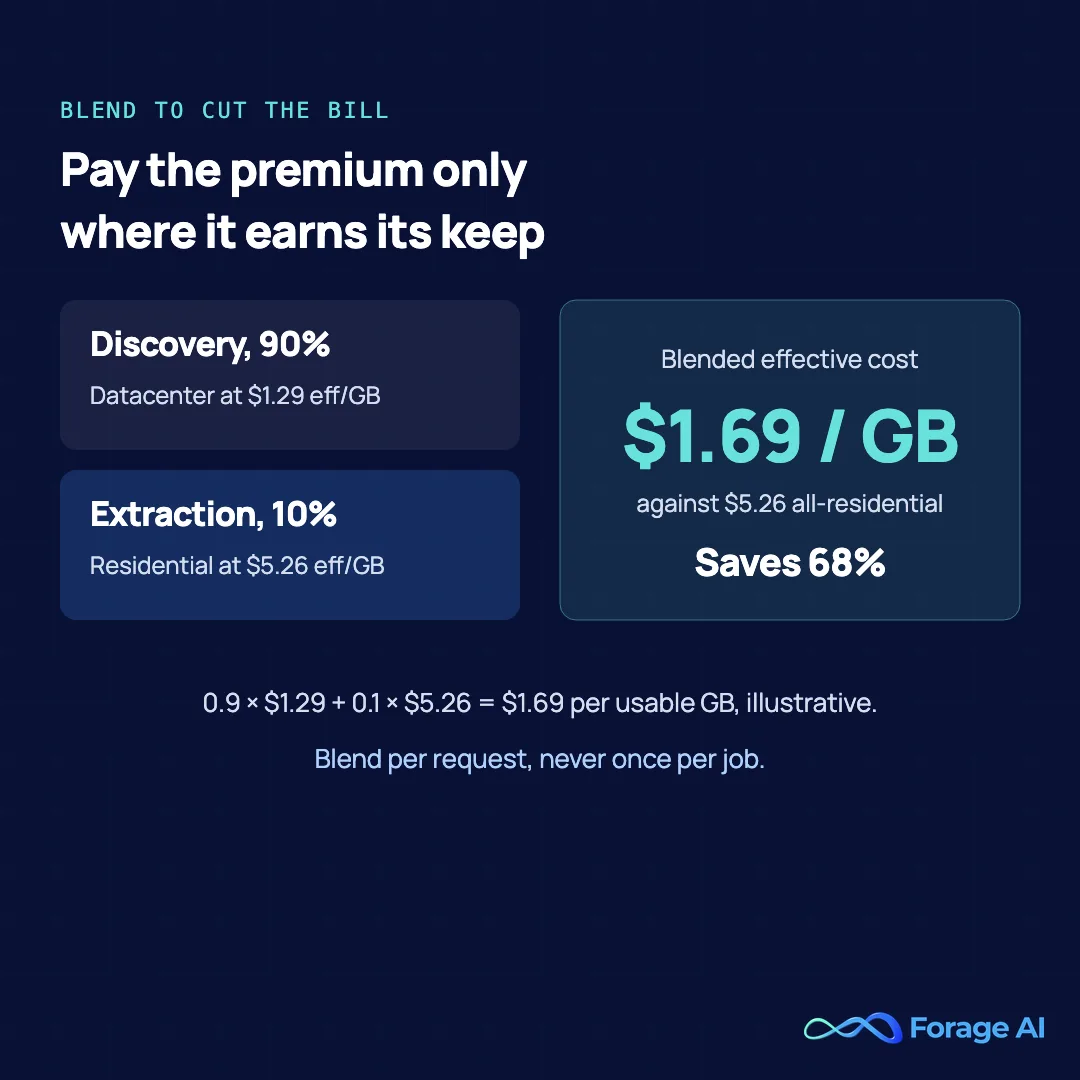
Blending is where mature teams save the most, and it is what keeps residential affordable at scale. Most large jobs are mostly cheap work, meaning discovery, listing pages and low-value fetches, with a thin layer of genuinely hard extraction on top.
Route the cheap 90% to datacenter and reserve residential for the 10% that actually gets blocked. Blended effective cost lands near $1.69 per gigabyte against $5.26 for an all-residential run, from 0.9 × $1.29 + 0.1 × $5.26. That is about a 68% cut, and it puts residential exactly where it earns its premium without paying that premium on traffic that never needed it.
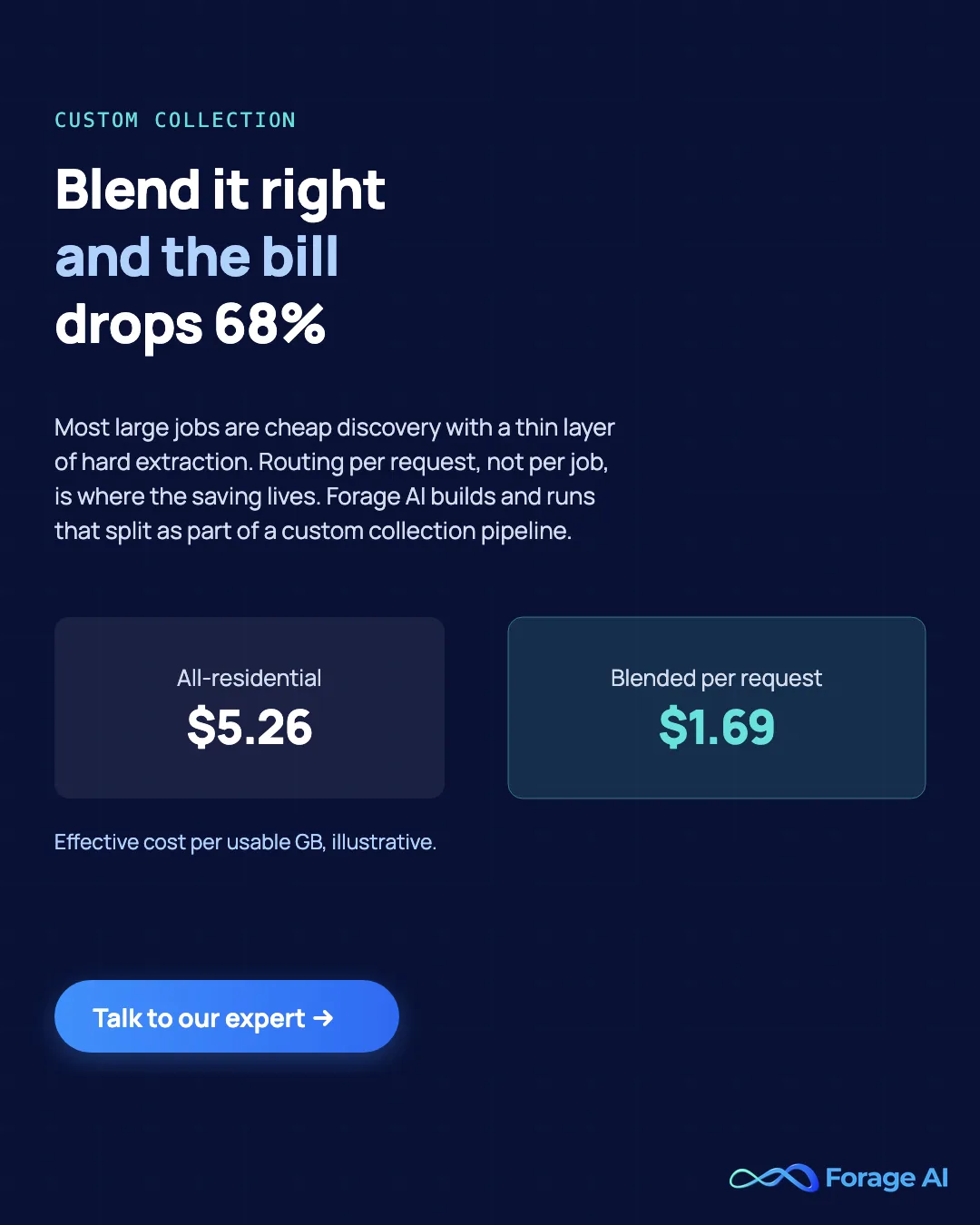
The mechanics matter here. Blend per request, not once per job. A per-job split sends whole categories of cheap traffic through the expensive pool and leaves protected steps on the cheap one, which is the worst of both.
Field-tested habits
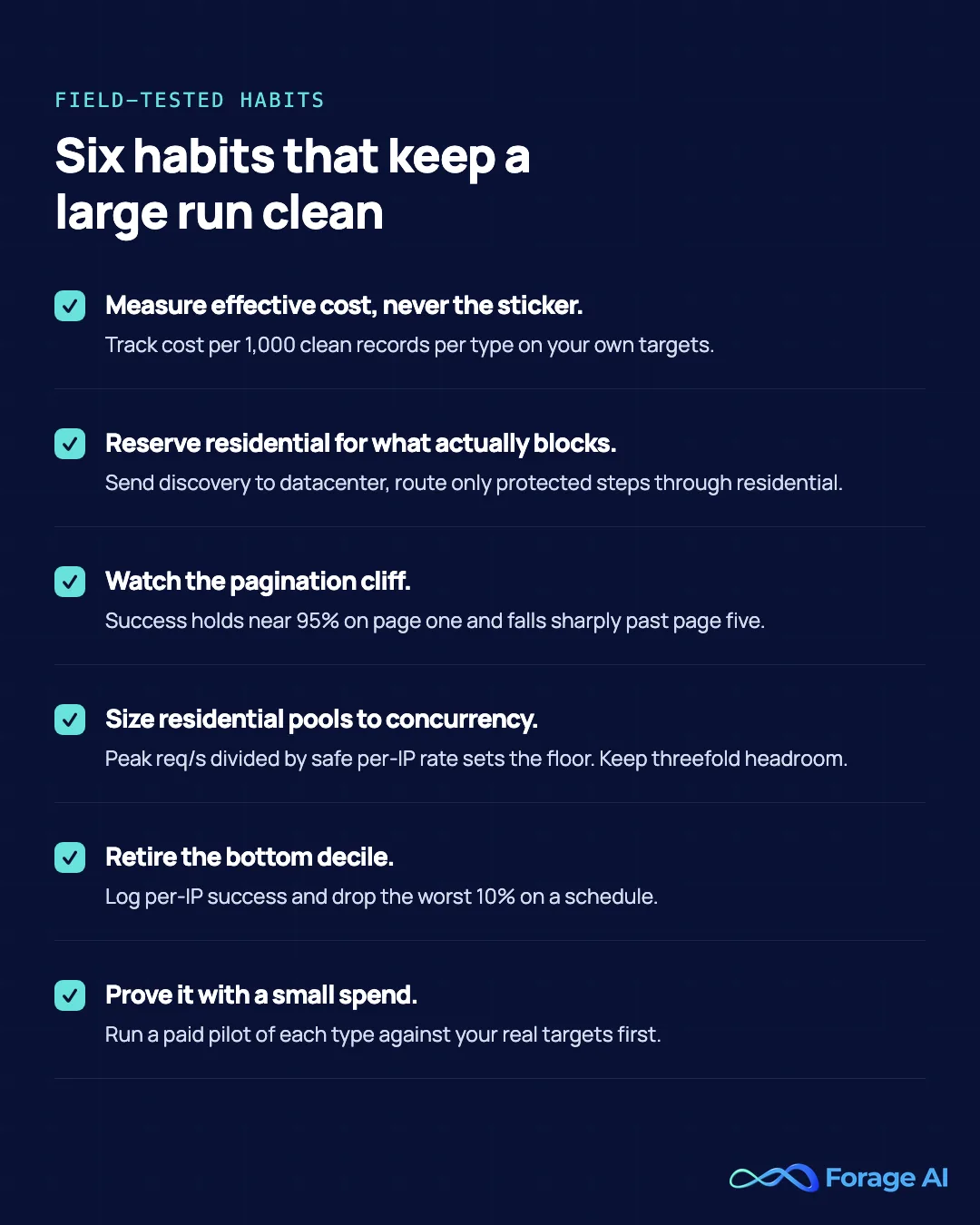
A few habits separate teams that run clean at scale from teams that fight fires. They are cheap to adopt and they compound.
- Measure effective cost, never the sticker. Track cost per 1,000 clean records per type on your own targets. The ranking you get will rarely match the price list, and on hard targets it usually favours residential.
- Reserve residential for what actually blocks. Route discovery to datacenter and send only the protected steps through residential, per request rather than once per job. That is the whole saving.
- Watch the pagination cliff. Success often holds near 95% on page one and falls sharply past page five, because targets correlate deep pagination with automation. If yield drops mid-crawl, the request pattern may be the culprit rather than the pool.
- Size residential pools to concurrency. Peak requests per second divided by safe per-IP rate sets the floor. Keep threefold headroom for rotation and cool-downs so a block wave never starves the run.
- Retire the bottom decile. Log per-IP success and drop the worst 10% on a schedule. A small number of poisoned addresses drags an entire batch's success rate down.
- Prove it with a small spend. Before committing to millions of requests, run a paid pilot of each type against your real targets. Measured numbers beat any vendor benchmark, because block behaviour is specific to the sites you actually hit.
Where this leaves you
There is no universally best proxy type, only the best fit for a specific target, scale and persistence requirement. Datacenter still owns the cheap, open volume. ISP holds the static, session-bound niche.
But as more than half the web's traffic turns automated and defenses harden around the network layer, residential has become the type that actually completes protected, large-scale jobs. That is why it is the quickest-growing segment of the market and the backbone of serious collection today.
The teams that run this well are not the ones with the biggest budget. They are the ones who measured. Get the effective-cost math right, size the pool to your concurrency, and blend so residential lands only where it earns its premium, and a bill that looked alarming turns into a line item you can defend.
The cleanest way to pin these numbers to your own work is to measure them on your own targets. Running residential, mobile and datacenter from one balance on a pay-as-you-go basis, as the Dexodata network does, with a $1 starting balance, lets you benchmark real success and effective cost per type before you scale instead of trusting a list price.
Whatever you choose, let the measured cost per clean record make the call.
Frequently asked questions
Which proxy type should I choose for large-scale data collection?
Match the type to the target. Datacenter is cost-efficient and high-concurrency, for open targets and discovery. Residential carries real household legitimacy and the highest success rate on hard, protected targets. ISP suits static-identity or logged-in sessions on one held address. Dexodata runs all three from one balance.
How do I work out the real cost of a proxy, not just the sticker price?
Effective cost per GB equals list price per GB divided by success rate. A cheap IP with a low success rate turns expensive after retries, and a pricier IP with a high one can cost less on protected targets. Measure success on your own targets, because that ratio sets the budget.
Can I combine residential, mobile and datacenter proxies in one project?
Yes. Send discovery to datacenter and reserve residential for the steps that get blocked, because that blend is usually cheapest at scale. In Dexodata all three share one pay-as-you-go, tokenized balance, switchable per task.
How precise is Dexodata's geotargeting?
By country, region, city and ISP. City level drives locale-correct collection and region-specific verification, and ISP level targets traffic tied to a specific provider. Match locale and time zone to the geotarget so the request reads as a real local user.
How does IP rotation work, and how do I choose a setting?
Rotate every request, on a timer, or per link, or hold a static address. Per-request suits high-volume, stateless collection, and a held identity suits logged-in flows. Size the pool as peak requests per second divided by safe per-IP rate, plus about threefold headroom.
Can I automate collection at scale through an API?
Yes. Dexodata's API provisions access, manages rotation and wires proxy selection into your crawler, so per-request blending runs automatically: datacenter for discovery, residential for the hard steps.
Will Dexodata work with my existing stack, VPN or anti-detect setup?
Yes. API access, WireGuard compatibility and Xray support fit it alongside common tooling. The network layer is covered, so keep locale, time zone and pacing consistent on top, since targets inspect more than the IP.
Where do the IP addresses come from, and is this compliant?
Every IP in the Dexodata network is sourced with user consent and meets KYC and AML standards. That sourcing is part of why residential addresses read as legitimate, and it keeps sensitive collection sound at scale.
How can I stop traffic reaching the wrong destinations and wasting budget?
Use the built-in firewall's domain allowlists and blocklists to set exactly which domains traffic can reach. That contains spend, cuts data noise and keeps a large crawl in scope.
What does it cost to test Dexodata before scaling?
A free $1 balance plus a 25% first-deposit bonus, pay-as-you-go, tokenized, no commitment. Enough to pilot residential, datacenter and ISP against real targets and measure effective cost per type before scaling.
Related articles
- Top Proxies for AI Data Extraction: selecting and operating proxy pools for AI-scale extraction jobs.
- Web Scraping Without Getting Blocked: fingerprinting, rate shaping and the operational habits that keep pass rates high.
- How Proxy Infrastructure Affects Web Data Quality: what rotation and pool choices do to the data itself, not just the success rate.
- What Is Managed Web Data Extraction?: when to hand the whole collection layer to a managed provider.
Sai is a data infrastructure enthusiast who has spent the past two to three years following the AI space closely, from the infrastructure layer to the fast-growing world of data for AI. He is genuinely curious about how modern data pipelines get built and where the data industry is heading, and he writes insightful pieces on the core topics that shape this niche.