
How Proxy Infrastructure Affects External Web Data Quality for AI and Analytics

Teams often talk about external web data quality as if it starts after collection. They focus on schema normalization, entity resolution, labeling, enrichment, and downstream validation. Those steps matter, but they all assume the source data was captured reliably in the first place.
In practice, that assumption breaks often.
For AI and analytics teams, collection infrastructure has a direct effect on dataset quality. If access is inconsistent, geography is inaccurate, or session stability is weak, the result is not just a technical inconvenience. It changes recall, freshness, market representation, and the reliability of downstream insights.
This is why proxy infrastructure should be treated as part of the data quality stack rather than a background implementation detail.
Quick Digest
- Data quality problems often start at collection, not transformation: blocked requests, wrong-region content, and silent failures skew datasets before any pipeline logic runs.
- Proxy performance shapes at least five quality dimensions: coverage, freshness, geo fidelity, usable yield, and operational consistency.
- Residential proxies matter most on strict targets and location-sensitive collection, where datacenter traffic gets blocked or served different content.
- Common failure patterns, like partial page capture and geographic drift, masquerade as parser bugs while quietly degrading the dataset.
- The right way to evaluate proxy infrastructure is comparative testing at the workflow level, measured in cost per usable record rather than cost per gigabyte.
Why is access quality part of data quality?
A dataset does not become biased only because of labeling or transformation errors. Bias can enter much earlier, at the point of collection.
If a pipeline systematically fails on harder-to-access pages, the final dataset becomes skewed toward sources that are easier to retrieve. If localized content is collected from the wrong geography, regional pricing, search results, product availability, and language variants become distorted. If success rates drop during refresh cycles, the data gets older even when the pipeline is still running.
For teams building AI training sets, competitive intelligence systems, pricing monitors, SERP pipelines, or market research datasets, these are not edge cases. They are structural quality issues. This is the same reason a data quality framework for external sources has to start at acquisition, not at the warehouse.
A useful way to think about this is that proxy performance influences at least five data-quality dimensions:
| Dimension | What it measures | How weak infrastructure degrades it |
|---|---|---|
| Coverage | Whether the pipeline reaches the full target set rather than only the easiest pages | Hard-to-access sources drop out, skewing the dataset toward permissive sites |
| Freshness | Whether recurring extraction jobs complete on schedule | Retry pressure stretches refresh cycles; data ages while jobs still “run” |
| Geo fidelity | Whether collected content matches what users in the intended region actually see | Wrong-region IPs pull mispriced, mislocalized, or wrong-language variants |
| Usable yield | How much of the collected volume is valid and production-ready | Fallback templates and partial captures inflate volume without adding usable records |
| Operational consistency | How much retry overhead, blocking, and manual intervention the pipeline absorbs | Engineering time shifts from building datasets to fighting access failures |
Where Residential Proxies Matter
For many external data workflows, the problem is not simply volume. It is access realism.
Residential proxies route traffic through ISP-assigned IPs associated with real users rather than datacenter ranges. On targets that inspect traffic patterns, ASN reputation, or geolocation consistency, that difference materially affects extraction quality. We cover the operational side of this choice in our guide to proxies for AI data extraction.
This matters in three common ways.
First, residential traffic often improves access stability on stricter targets. That does not mean every request succeeds automatically, but it can reduce failure concentration on high-friction domains and improve total usable yield.
Second, residential infrastructure improves geo accuracy. Many websites serve different content depending on country, city, or network context. For e-commerce monitoring, local SERP collection, marketplace analysis, and ad verification, realistic location behavior is part of the data requirement, not a bonus feature.
Expert Insights
Independent measurement work says location is the part you should trust least by default. Syed Tauhidun Nabi, Jocelyn Bliton, Tijay Chung and Shaddi Hasan, in "Lost in the Prefix: Revisiting IP Geolocation Accuracy Across Networks and Geographies" (arXiv, May 2026), evaluated four major geolocation databases against ground truth across 175 countries and found that "mobile networks exhibit median errors more than 10 times higher than fixed networks across all providers (179-207 km vs. 3-16 km)", with failure rates of "53-61%" in Asia and "66-72%" in Africa against "9-20% in Europe". If your dataset depends on which city or country a page was served to, the label on the IP is evidence, not proof.
Third, residential proxies help reduce collection bias introduced by infrastructure mismatch. If some targets are disproportionately difficult for datacenter traffic, datasets collected only through server IPs can become systematically incomplete.
What does this change for AI and analytics teams?
Once external data is used for AI, enrichment, or analytics, the question is no longer “Can we scrape this site?” It becomes:
Can we collect enough of the right data, from the right regions, at the right frequency, with enough consistency for downstream systems to trust it?
That question pushes teams toward infrastructure decisions, not just parser decisions. It is also why quality beats quantity in AI training data: a larger dataset collected through unreliable access is often worse than a smaller one collected cleanly.
A technically functioning pipeline may still be low quality if it misses regional variants, over-collects easy pages while under-collecting protected ones, refreshes too slowly under retry pressure, returns inconsistent content by geography, or requires so much maintenance that scaling becomes operationally fragile.
In other words, infrastructure affects not only access, but representativeness.
Andrew Ng, founder of DeepLearning.AI and a leading voice of the data-centric AI movement, has argued that since roughly 80 percent of machine learning work is data preparation, ensuring data quality is the most critical task for an ML team. The data-centric framing applies one layer earlier than most teams take it: if the acquisition layer skews what enters the corpus, no amount of downstream cleaning restores what was never collected.
Common Failure Patterns in External Data Collection
One reason proxy strategy is often underestimated is that infrastructure problems do not always look like infrastructure problems.
A team may think it has a parser issue when the real problem is that the page is intermittently returning a fallback template. It may interpret missing values as extraction noise when the actual cause is geo mismatch. It may assume a source has become less active when repeated blocks are silently reducing coverage.
Several common failure patterns show up across production pipelines:
Partial page capture. The request succeeds, but the returned content is incomplete, localized incorrectly, or stripped down compared with what users actually see.
Retry amplification. A moderate drop in success rate creates a disproportionately large increase in retries, crawl time, and infrastructure cost.
Geographic drift. A pipeline intended to collect market-specific content gradually starts mixing outputs from the wrong regions.
False stability. Dashboards may show that jobs are still running on schedule even while usable yield is falling underneath them. Catching this early is an observability problem as much as an infrastructure one; we break down the early-warning signals in our guide to data observability for third-party datasets.
Sampling distortion. Sources that are easier to fetch begin to dominate the dataset, while protected or dynamic sources become underrepresented.
These are not only scraping issues. They are data quality issues that shape what analysts and models see downstream.
How should teams test proxy impact?
Proxy infrastructure is easier to discuss in theory than to evaluate in practice. The best approach is usually comparative testing at the workflow level rather than relying on vendor-level claims alone.
Teams can learn a lot from a small structured test batch. The goal is not simply to ask whether a page loads, but whether the resulting data is good enough for production use.
A useful evaluation process usually includes:
- checking success rate across a mixed sample of easy and difficult targets
- comparing content output by region to confirm location-sensitive accuracy
- measuring usable records instead of raw request completion
- tracking retry volume and crawl duration under the same extraction rules
- reviewing whether dynamic or protected sources degrade more than static ones
This kind of test often changes the decision criteria. What looks inexpensive by bandwidth or IP pricing may turn out to be expensive once teams account for missing records, stale refresh cycles, and manual cleanup.
For teams handling large-scale, geo-sensitive collection, a number of residential proxy providers, including Thordata, support this kind of workflow.
How to Evaluate Proxy Infrastructure for External Data Pipelines
For professional data teams, comparing proxy providers only by IP count is not useful enough. A more practical evaluation framework includes several factors.
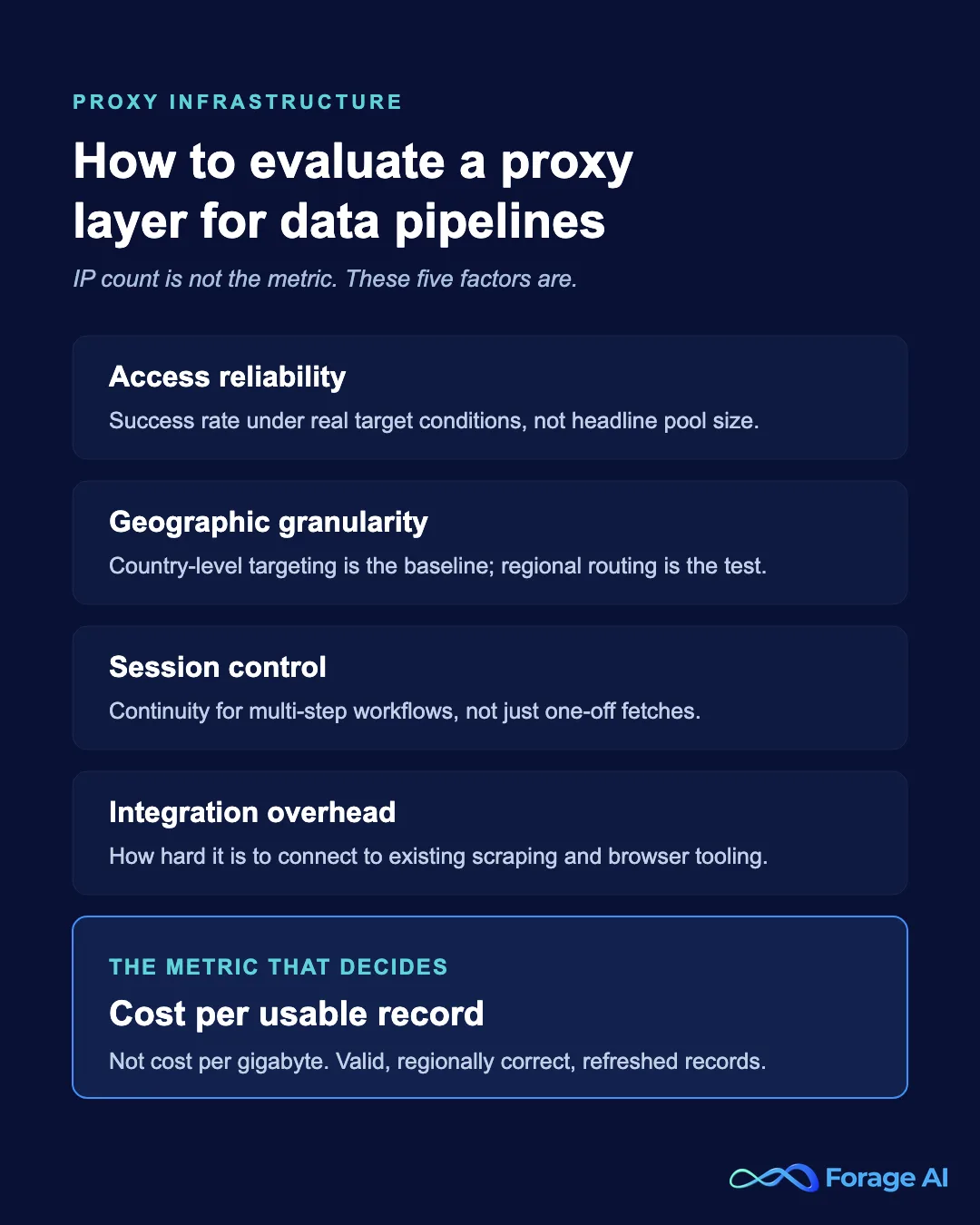
Access reliability matters more than headline pool size. The relevant metric is success rate under real target conditions.
Geographic granularity also matters. Country-level targeting is only the baseline; the real question is whether regional routing is good enough for the dataset you want to build.
Session control is important for workflows that require continuity rather than one-off fetches.
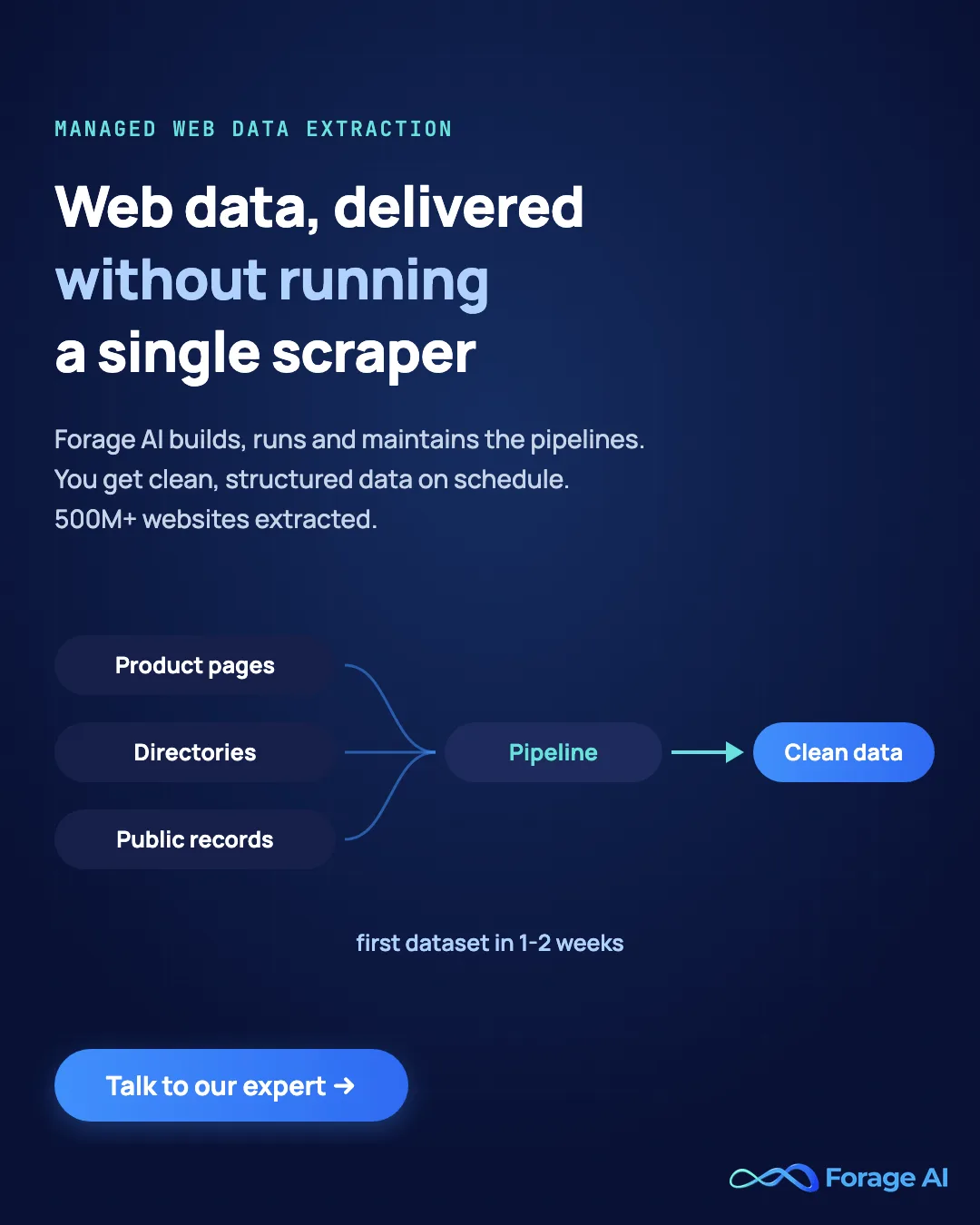
Integration overhead should not be ignored. If the proxy layer is difficult to connect to existing scraping and browser workflows, operational cost rises quickly. This is one of the reasons many enterprise teams route around the problem entirely with managed web data extraction, where the provider owns the proxy layer, the retries, and the yield.
Finally, teams should think in terms of cost per usable record rather than cost per gigabyte alone. The meaningful comparison is the total cost required to produce valid, regionally correct, refreshed records.
Gartner has estimated that poor data quality costs organizations an average of 12.9 million dollars per year. The figure is usually quoted in the context of warehouses and analytics, but for teams that buy or build external web datasets, a meaningful share of that cost is created upstream, in records that were never captured, captured from the wrong region, or captured too late to be useful.
Expert Insights
Some of that upstream loss is now structural rather than technical. Shayne Longpre and co-authors, in "Consent in Crisis: The Rapid Decline of the AI Data Commons" (arXiv, July 2024), audited 14,000 web domains behind common training corpora and found that within a single year roughly 5% of tokens in the C4 corpus became fully restricted by robots.txt, 28% of the most actively maintained critical sources became fully restricted, and 45% of C4 is restricted by terms of service. They attribute it to "ineffective web protocols, not designed to cope with the widespread re-purposing of the internet for AI". Coverage you never had is a quality problem your dashboards cannot show you.
Final Thought
Proxy strategy is often treated as an implementation detail. For external web data teams, it is closer to a quality decision.
If collection infrastructure is weak, data pipelines become incomplete before they ever reach transformation, enrichment, or modeling. Residential proxies do not solve every extraction challenge, but they materially improve one of the first conditions for usable external data: reliable, regionally accurate, repeatable access. And if the acquisition layer is the part of the stack your team would rather not own at all, that is exactly the layer reliable extraction pipelines are built to absorb.

Related Articles
- Top Proxies for AI Data Extraction: the practitioner guide to residential vs datacenter vs ISP proxies, rotation, and cost-vs-success tradeoffs
- Data Quality Framework for External Sources: the validation workflow and QA checklist that sits downstream of the access layer
- Data Observability for Third-Party Datasets: how to catch silent yield drops before your dashboards do
- Automated Data Collection: How Enterprise Teams Build Reliable Extraction Pipelines: the reference architecture for the pipeline this article’s infrastructure layer feeds
S
Written by
Sai Subramaniam
Data Infrastructure Enthusiast, Forage AI
Sai is a data infrastructure enthusiast who has spent the past two to three years following the AI space closely, from the infrastructure layer to the fast-growing world of data for AI. He is genuinely curious about how modern data pipelines get built and where the data industry is heading, and he writes insightful pieces on the core topics that shape this niche.
Reviewed by the team of experts at Forage AI for accuracy and clarity.