
Best Invoice Data Extraction Tools for Enterprises (2026)
Reading an invoice number is a solved problem. Posting an invoice with zero human touch is not. The gap between those two things, the part where line items have to be pulled from a multi-page table, matched against a purchase order and a goods receipt, reconciled with a tax rule, and posted to the right GL code in your ERP, is the entire challenge of invoice data extraction. That gap is also what decides which tool you should buy.
Most “best invoice software” lists miss this. They mix consumer receipt scanners with enterprise accounts-payable suites, quote a header-field accuracy number off a clean sample, and never separate the tool that reads an invoice from the platform that processes one. For an enterprise running hundreds of thousands of invoices a month across thousands of supplier layouts, that is the wrong lens. The operative metric is your touchless rate, the share of invoices that post with no human intervention, and Ardent Partners' 2025 benchmarks put the cost difference at $2.78 per invoice for Best-in-Class operations versus $12.88 for everyone else.
So this guide is built for the enterprise AP and finance-operations buyer. We will start with why invoices are genuinely harder than other documents, lay out an evaluation rubric customized to invoice extraction (not generic document AI), then walk the tools grouped by how you actually buy them: managed services, AP automation suites, IDP capture engines, and cloud document-AI APIs. Each tool gets its own breakdown with what real users say. Forage AI leads the managed category because that is the lane it competes in, and we will be precise about where every other tool is the better call.
Quick Digest
- Best managed / done-for-you: Forage AI, hand over your invoice streams and get validated header + line-item data delivered to your AP/ERP schema.
- Best enterprise AP suites: Tipalti, Basware, Esker, Medius, capture plus workflow plus payment in one platform.
- Best invoice-specialist capture engine: Rossum, purpose-built, template-free, strong line-item handling.
- Best broad IDP platforms: ABBYY and Hyperscience for enterprise-scale, on-prem-capable document processing.
- Best fast-setup IDP: Docsumo and Nanonets for quick deployment and ERP integrations.
Why is invoice extraction harder than it looks?
Every supplier’s invoice is a different layout. There is no standard. Template or zonal OCR works until a new vendor sends a new format, and at enterprise scale new formats arrive constantly. The only thing that scales is template-free, machine-learning capture that generalizes to layouts it has never seen.
Line items are the hard part. Header fields, the invoice number, date, and total, are comparatively easy and most modern models read them well. The accuracy collapse happens in the line-item table: multi-page, nested, inconsistent columns, wrapped descriptions, and subtotals. Line-item extraction is the single capability that separates a serious invoice tool from a demo.
Reading is not the job, matching is. An extracted invoice has to be matched to its purchase order and goods receipt (2-way or 3-way), validated against your ERP vendor master and GL coding, and checked for country-specific tax (VAT, GST), multiple currencies, and e-invoicing rules. Then there are the messy inputs: scanned PDFs, email attachments, photos, stamps. The work is the exceptions, not the easy ones.
A field-accuracy number on a vendor slide is not a touchless rate. Ask any vendor for straight-through processing on your own invoice mix, including line items and 3-way matching, not header accuracy on a clean sample. The distance between those two numbers is exactly where AP teams lose their time.
Industry benchmarks (Ardent Partners, 2025) put Best-in-Class invoice processing at $2.78 per invoice against $12.88 for all other teams, a gap driven almost entirely by automation and touchless rates rather than OCR quality. The lesson for buyers: evaluate exception handling and matching, because that is where the cost actually lives.
What should you evaluate in an invoice extraction tool?
Line-item and table accuracy. Score this first, on your own invoices, because it is where tools diverge most. Header-only accuracy tells you almost nothing.
Touchless / straight-through rate and exception handling. What share of invoices post with no human touch, and how clean is the queue for the ones that do not? This is the number that maps to cost.
Matching and ERP posting. Native 2-way and 3-way matching against POs and goods receipts, plus deep integration with your ERP (SAP, Oracle, NetSuite, Coupa, Dynamics, Workday). A tool that extracts but cannot post leaves the hardest work on your desk.
Template-free capture, tax, and global coverage. Handling unseen layouts, multi-currency, VAT/GST, and multi-language invoices. Then deployment, security, and compliance: cloud or on-prem, data residency, audit trail, and SOX readiness, all of which matter more at enterprise scale than a feature checkbox.
Invoice data extraction tools at a glance
Fourteen tools, grouped by how an enterprise actually procures them. Managed when you want the data delivered, AP suites when you want capture plus workflow plus payment, IDP engines when you want best-in-class capture in your own stack, and cloud APIs when your developers are building it themselves.
| Tool | Category | Best for | Deployment |
|---|---|---|---|
| Forage AI | Managed | Validated invoice data delivered to your ERP | Done-for-you |
| Tipalti | AP suite | Global AP + payments | Cloud |
| Basware | AP suite | Large-enterprise AP + e-invoicing | Cloud |
| Esker | AP suite | AP within source-to-pay | Cloud |
| Medius | AP suite | AP + spend management | Cloud |
| Rossum | IDP engine | Purpose-built invoice capture | Cloud / on-prem |
| ABBYY | IDP engine | Enterprise IDP, on-prem option | Cloud / on-prem |
| Hyperscience | IDP engine | High-automation regulated enterprises | Cloud / on-prem |
| Docsumo | IDP engine | Fast-setup invoice + line items | Cloud |
| Nanonets | IDP engine | Workflow + broad integrations | Cloud / on-prem |
| Azure AI Document Intelligence | Cloud API | Prebuilt invoice model | Cloud API |
| Google Document AI | Cloud API | Invoice Parser on GCP | Cloud API |
| AWS Textract | Cloud API | Analyze Expense on AWS | Cloud API |
| Mindee | Cloud API | Developer-first invoice API | Cloud API |
The tools, by category
Managed and done-for-you
This is the category for teams that want validated invoice data delivered, not a capture engine to tune. You hand over the invoices; someone else owns extraction, line items, validation, matching support, and delivery into your ERP.
1. Forage AI: best managed invoice data extraction
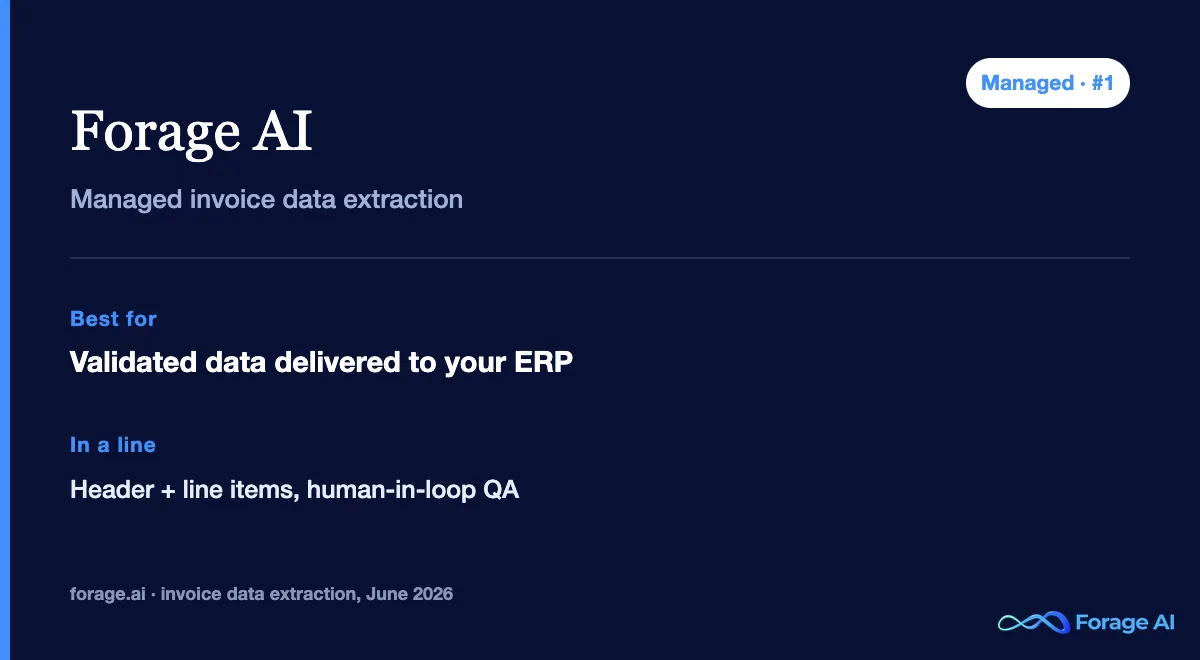
What it is. Forage AI is the managed alternative to running an invoice capture engine yourself. Instead of licensing software and staffing the tuning, you hand over your invoice streams and Forage AI extracts header fields and line items, validates them, and delivers structured data to your AP or ERP schema, with human-in-the-loop QA and compliance handled on their side. It is intelligent document processing run as a service rather than a tool you operate.
Best for. Enterprises that want the data, not another platform to own, especially those with high volume, many supplier layouts, and a thin internal automation team. It fits ongoing, custom invoice pipelines and complex exception handling where a managed QA layer matters more than a self-serve console. If you want to click into a dashboard and configure rules yourself, the AP suites and IDP engines below fit better.
What customers say. Clients frame the value as offloading the entire extraction-and-validation burden rather than buying more software. On service-review platforms such as Clutch, Forage AI draws strong marks for reliability and clean, to-spec delivery on custom data projects. The honest counterpoint: because it is scoped and managed, it is not a self-serve AP application, and pricing is quoted to the project rather than a public per-document rate.
| Category | Managed / done-for-you extraction (IDP as a service) |
| Line items | Header + multi-page line items, validated |
| Touchless | Human-in-the-loop QA on exceptions; delivered clean |
| Matching / ERP | Delivered to your AP/ERP schema; supports matching workflows |
| Deployment | Managed service, compliance handled |
| Pricing | Scoped to project (custom) |
| What users say | Strong on Clutch for reliability and clean delivery |
| Best for | Enterprises that want validated invoice data delivered |
Enterprise AP automation suites
This is the category for teams that want capture, approval workflow, matching, and payment in one platform. Extraction is one feature inside a broader accounts-payable system, which is the right fit when you are buying the whole AP process, not just the reading of an invoice.
2. Tipalti: global AP and payments
What it is. Tipalti is an end-to-end global AP automation platform with AI invoice capture, PO matching, approval workflows, tax and compliance handling, and mass cross-border payments. Extraction feeds a full payables pipeline rather than standing alone.
Best for. Mid-market to enterprise finance teams paying many suppliers globally, especially those that value built-in payment rails and tax compliance alongside capture.
What customers say. Tipalti holds around 4.5 out of 5 on G2 as of June 2026. Reviewers praise the global payment automation and the reduction in manual AP work; the recurring critiques are setup effort and cost, and some note the capture is strong but still benefits from review on complex invoices.
| Category | Enterprise AP automation suite |
| Line items | AI capture with PO matching |
| Touchless | High within its workflow; approvals automated |
| Matching / ERP | 2-/3-way matching; ERP integrations (NetSuite, others) |
| Standout | Global mass payments + tax compliance |
| What users say | ~4.5/5 on G2; praised for payments, flagged for setup and cost |
| Best for | Global payables at mid-market to enterprise scale |
3. Basware: large-enterprise AP and e-invoicing
What it is. Basware is a large-enterprise AP automation and e-invoicing standard, with deep capture, a global e-invoicing network, and strong touchless processing aimed at complex, high-volume payables. It is built for SAP- and Oracle-grade environments.
Best for. Large enterprises with high invoice volume and strict compliance and e-invoicing mandates, particularly those wanting a global network and maximum straight-through processing.
What customers say. Basware sits around 4.0 to 4.2 out of 5 on G2 as of June 2026. Reviewers value the e-invoicing network and high touchless rates at scale; the common critiques are a dated interface and a heavy, longer implementation typical of large-enterprise software.
| Category | Enterprise AP automation suite |
| Line items | Strong capture + e-invoicing data |
| Touchless | High; built for straight-through at scale |
| Matching / ERP | 2-/3-way matching; deep SAP / Oracle integration |
| Standout | Global e-invoicing network |
| What users say | ~4.0-4.2/5 on G2; praised for touchless, flagged on UI and rollout |
| Best for | Large enterprises with compliance-heavy, high-volume AP |
4. Esker: AP within source-to-pay
What it is. Esker offers AP automation inside a broader source-to-pay suite, with AI-driven capture, a supplier portal, and approval workflows. It suits organizations standardizing procure-to-pay end to end, not just invoice capture.
Best for. Mid-market to enterprise teams that want AP as part of a connected source-to-pay platform, with a supplier portal and strong customer support.
What customers say. Esker holds around 4.6 out of 5 on G2 as of June 2026, one of the higher AP-suite scores. Reviewers praise the automation depth and the support; the recurring notes are implementation time and cost for the full suite.
| Category | Enterprise AP automation suite (source-to-pay) |
| Line items | AI capture with line-item handling |
| Touchless | High; workflow + supplier portal |
| Matching / ERP | 2-/3-way matching; broad ERP integrations |
| Standout | Connected source-to-pay + support |
| What users say | ~4.6/5 on G2; praised for automation and support, flagged on rollout cost |
| Best for | Teams standardizing procure-to-pay end to end |
5. Medius: AP and spend management
What it is. Medius provides AP automation and spend management with AI invoice capture and an “autonomous AP” positioning, aimed at reducing manual handling across the payables cycle.
Best for. Enterprises wanting AP automation alongside broader spend management, with a focus on high automation and fraud controls.
What customers say. Medius sits around 4.3 out of 5 on G2 as of June 2026. Reviewers praise the invoice automation and the reduction in manual entry; the common critiques are occasional matching tweaks and configuration effort during setup.
| Category | Enterprise AP automation + spend management |
| Line items | AI capture with line-item extraction |
| Touchless | High; “autonomous AP” positioning |
| Matching / ERP | 2-/3-way matching; ERP integrations |
| Standout | Spend management + fraud controls |
| What users say | ~4.3/5 on G2; praised for automation, flagged on matching config |
| Best for | AP plus spend management in one platform |
| Tool | Standout | Rating | Trade-off |
|---|---|---|---|
| Tipalti | Global payments + tax | ~4.5/5 G2 | Setup and cost |
| Basware | E-invoicing, high touchless | ~4.0-4.2/5 G2 | UI, heavy rollout |
| Esker | Source-to-pay + support | ~4.6/5 G2 | Implementation cost |
| Medius | AP + spend management | ~4.3/5 G2 | Matching config |
Invoice-specialist and IDP platforms
This is the category for teams that want a best-in-class capture engine inside their own stack. You get the extraction layer, often template-free and tunable, and you wire it into your existing AP workflow and ERP rather than buying the whole process.
6. Rossum: purpose-built invoice capture
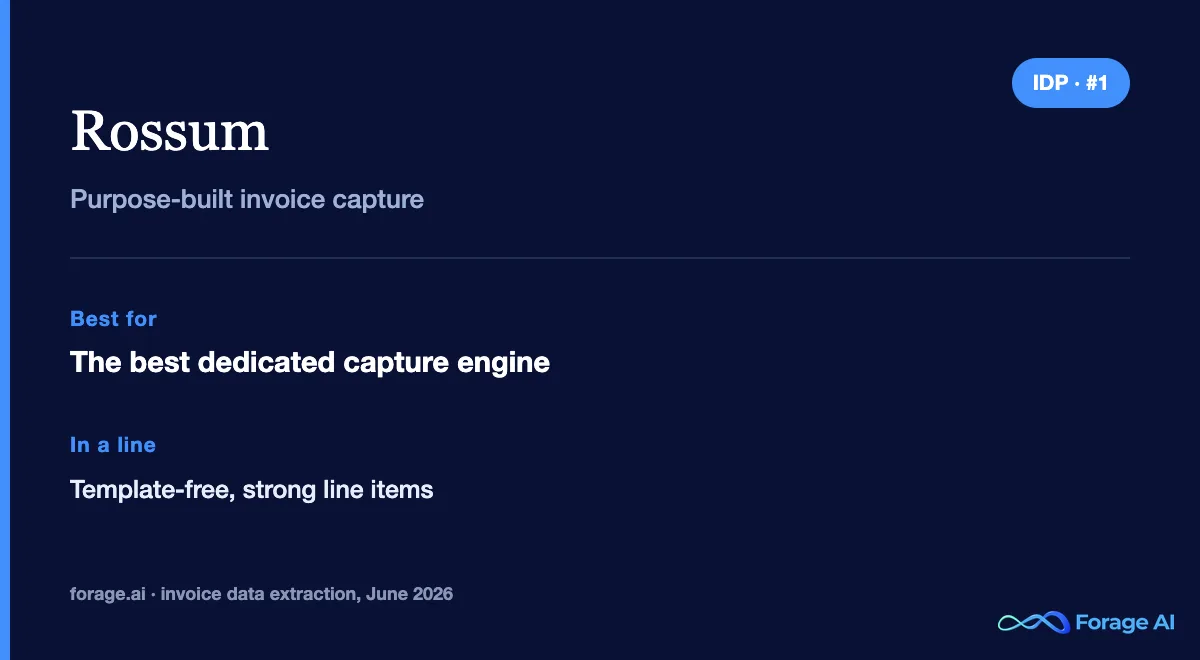
What it is. Rossum is the invoice-specialist capture engine, purpose-built for AP documents. Its cognitive, template-free approach handles unseen layouts and is known for strong line-item extraction and high touchless rates, with a workflow layer for validation and exceptions. Teams outgrowing it on price or document scope can read our 15 Rossum alternatives compared. If a tool in this category is the category leader for invoices specifically, it is this one.
Best for. Enterprises that want the best dedicated invoice capture engine to plug into their AP process, prioritizing template-free accuracy and touchless rate over a full payments suite.
What customers say. Rossum holds around 4.4 out of 5 on G2 as of June 2026. Reviewers praise the template-free accuracy, the line-item handling, and the ease of validation; the recurring critiques are price and occasional line-item edge cases on unusual layouts.
| Category | Invoice-specialist IDP capture engine |
| Line items | Strong; a core strength |
| Touchless | High; template-free, generalizes to new layouts |
| Matching / ERP | Validation workflow; integrations to AP/ERP |
| Deployment | Cloud (on-prem options) |
| What users say | ~4.4/5 on G2; praised for template-free accuracy, flagged on price |
| Best for | A dedicated, best-in-class invoice capture engine |
7. ABBYY: enterprise IDP with on-prem
What it is. ABBYY is a long-standing IDP leader (Vantage and FlexiCapture) with prebuilt invoice skills, mature OCR, and both cloud and on-prem deployment. It handles a wide range of document types beyond invoices, which suits enterprises consolidating document automation.
Best for. Enterprises needing on-prem or hybrid deployment and broad document coverage, where invoices are one of several document types under one platform.
What customers say. ABBYY sits around 4.3 out of 5 on G2 as of June 2026. Reviewers praise the accuracy, flexibility, and on-prem option; the common critiques are a learning curve and the developer effort to configure it well.
| Category | Enterprise IDP platform |
| Line items | Strong via prebuilt invoice skills |
| Touchless | High once tuned |
| Matching / ERP | Integrations across enterprise systems |
| Deployment | Cloud and on-prem |
| What users say | ~4.3/5 on G2; praised for accuracy and on-prem, flagged on learning curve |
| Best for | On-prem-capable, multi-document enterprise IDP |
8. Hyperscience: high-automation enterprise IDP
What it is. Hyperscience is an ML-first enterprise IDP platform built for high straight-through automation on complex documents, often deployed in regulated and large organizations where accuracy and control matter.
Best for. Large, regulated enterprises that need high automation with control across mixed document types including invoices, and have the scale to justify the platform.
What customers say. Hyperscience holds around 4.4 out of 5 on G2 as of June 2026. Reviewers praise the automation rates and accuracy on complex documents; the recurring critiques are enterprise pricing and implementation effort.
| Category | Enterprise IDP platform |
| Line items | Strong on complex, mixed documents |
| Touchless | Very high; built for straight-through |
| Matching / ERP | Enterprise integrations |
| Deployment | Cloud and on-prem |
| What users say | ~4.4/5 on G2; praised for automation, flagged on price and rollout |
| Best for | Regulated enterprises wanting high automation with control |
9. Docsumo: fast-setup invoice IDP
What it is. Docsumo is a document-AI platform with strong invoice support, known for quick setup, solid line-item capture, and ready ERP integrations. It targets teams that want IDP value without a long enterprise rollout.
Best for. Mid-market to enterprise teams wanting fast time-to-value on invoice automation, with line-item extraction and integrations out of the box.
What customers say. Docsumo holds around 4.6 out of 5 on G2 as of June 2026. Reviewers praise the quick setup, line-item handling, and responsive support; the recurring note is occasional accuracy dips on very poor scans that need review.
| Category | Invoice / document IDP platform |
| Line items | Strong; a focus area |
| Touchless | High; quick to configure |
| Matching / ERP | Ready ERP / accounting integrations |
| Deployment | Cloud |
| What users say | ~4.6/5 on G2; praised for fast setup and support, flagged on poor scans |
| Best for | Fast time-to-value invoice automation |
10. Nanonets: workflow and integrations
What it is. Nanonets is an invoice OCR and IDP platform with workflow automation and broad integrations. It pairs ML capture with a flexible workflow layer and a large catalog of connectors, friendly to both operations and developers.
Best for. Teams wanting flexible invoice automation with many integrations and the option to train models on their own document types.
What customers say. Nanonets holds around 4.7 out of 5 on G2 as of June 2026, among the highest here. Reviewers praise the ease of use, integrations, and value; the recurring note is that complex or unusual documents need some training to hit top accuracy.
| Category | Invoice OCR / IDP + workflow |
| Line items | Strong; trainable on your docs |
| Touchless | High; workflow automation built in |
| Matching / ERP | Broad integration catalog |
| Deployment | Cloud and on-prem |
| What users say | ~4.7/5 on G2; praised for ease and value, flagged on training complex docs |
| Best for | Flexible invoice automation with many integrations |
| Tool | Standout | Rating | Trade-off |
|---|---|---|---|
| Rossum | Purpose-built, template-free | ~4.4/5 G2 | Price, edge cases |
| ABBYY | On-prem, multi-document | ~4.3/5 G2 | Learning curve |
| Hyperscience | Very high automation | ~4.4/5 G2 | Price, rollout |
| Docsumo | Fast setup, line items | ~4.6/5 G2 | Poor-scan dips |
| Nanonets | Integrations, value | ~4.7/5 G2 | Training complex docs |
Cloud document-AI APIs
This is the category for teams that want to build invoice extraction into their own application. You get a prebuilt invoice model behind an API, pay per document, and own the integration, matching, and workflow yourself.
11. Microsoft Azure AI Document Intelligence
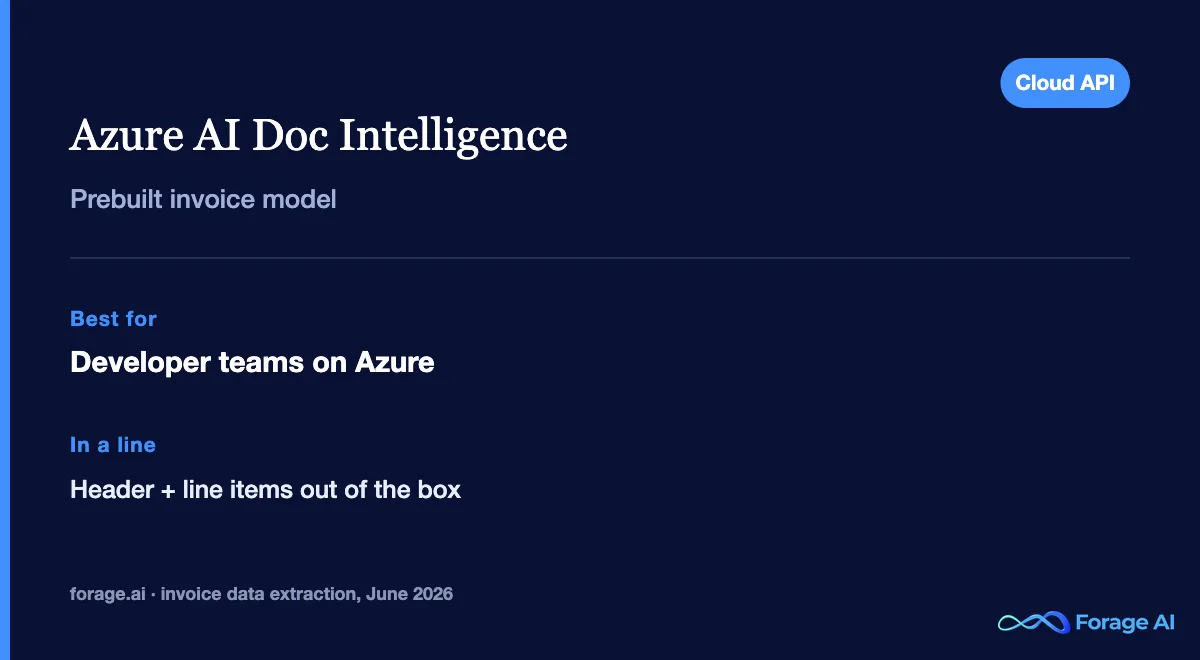
What it is. Azure AI Document Intelligence ships a prebuilt invoice model that extracts header fields and line items out of the box, with custom-model options and tight integration into the Azure ecosystem.
Best for. Developer teams already on Azure who want a strong prebuilt invoice model to embed and control themselves.
What customers say. Reviewers praise the prebuilt invoice accuracy and the Azure integration; the recurring caveat is that, like any API, it needs developer work and post-processing to become a full AP workflow with matching and exceptions.
| Category | Cloud document-AI API |
| Line items | Yes; prebuilt invoice model |
| Touchless | You build the workflow around it |
| Matching / ERP | Your integration to build |
| Pricing | Pay per page / document |
| What users say | Praised for prebuilt accuracy and Azure fit; needs dev work |
| Best for | Developer teams on Azure building custom AP |
12. Google Document AI
What it is. Google Document AI offers an Invoice Parser processor that extracts structured invoice fields and line items, backed by Google’s ML and scalable on GCP.
Best for. Developer teams on Google Cloud who want strong ML extraction to integrate into their own pipeline.
What customers say. Reviewers praise the ML quality and scalability; the recurring caveats are GCP ecosystem lock-in and the setup work to operationalize it into AP.
| Category | Cloud document-AI API |
| Line items | Yes; Invoice Parser processor |
| Touchless | You build the workflow around it |
| Matching / ERP | Your integration to build |
| Pricing | Pay per page / document |
| What users say | Praised for ML quality and scale; GCP lock-in, setup work |
| Best for | Developer teams on Google Cloud |
13. AWS Textract
What it is. AWS Textract provides an Analyze Expense API tuned for invoices and receipts, extracting fields and line items, and it pairs naturally with the rest of the AWS stack.
Best for. Developer teams on AWS building invoice processing into a custom application or pipeline.
What customers say. Reviewers praise the AWS integration and the Analyze Expense capability; the recurring caveat is that the raw output needs post-processing and orchestration to become a touchless AP flow.
| Category | Cloud document-AI API |
| Line items | Yes; Analyze Expense |
| Touchless | You build the workflow around it |
| Matching / ERP | Your integration to build |
| Pricing | Pay per page / document |
| What users say | Praised for AWS fit; raw output needs post-processing |
| Best for | Developer teams on AWS |
14. Mindee: developer-first invoice API
What it is. Mindee is a developer-first invoice OCR API known for fast integration, clean documentation, and a pay-per-document model. It targets teams that want to ship invoice extraction quickly.
Best for. Developers who want a fast, well-documented invoice API to embed without committing to a cloud platform’s wider ecosystem.
What customers say. Reviewers praise the speed of integration and the documentation; the recurring caveat is that very complex layouts and long line-item tables can vary and may need custom handling.
| Category | Cloud document-AI API |
| Line items | Yes; varies on complex layouts |
| Touchless | You build the workflow around it |
| Matching / ERP | Your integration to build |
| Pricing | Pay per document |
| What users say | Praised for fast integration and docs; complex layouts vary |
| Best for | Developers wanting a fast, portable invoice API |
The tools compared
All fourteen on the columns that matter for invoices. Read it as a shortlist builder: pick your category, then compare line items, touchless, matching, and deployment.
| Tool | Category | Line items | Matching / ERP | Deployment | Rating |
|---|---|---|---|---|---|
| Forage AI | Managed | Header + line items, validated | Delivered to AP/ERP schema | Done-for-you | Strong on Clutch |
| Tipalti | AP suite | AI capture | 2-/3-way + ERP | Cloud | ~4.5/5 G2 |
| Basware | AP suite | Capture + e-invoicing | Deep SAP/Oracle | Cloud | ~4.0-4.2/5 G2 |
| Esker | AP suite | AI capture | 2-/3-way + ERP | Cloud | ~4.6/5 G2 |
| Medius | AP suite | AI capture | 2-/3-way + ERP | Cloud | ~4.3/5 G2 |
| Rossum | IDP engine | Strong (core strength) | Validation + integrations | Cloud / on-prem | ~4.4/5 G2 |
| ABBYY | IDP engine | Strong (prebuilt skills) | Enterprise integrations | Cloud / on-prem | ~4.3/5 G2 |
| Hyperscience | IDP engine | Strong on complex docs | Enterprise integrations | Cloud / on-prem | ~4.4/5 G2 |
| Docsumo | IDP engine | Strong (focus area) | ERP / accounting | Cloud | ~4.6/5 G2 |
| Nanonets | IDP engine | Strong, trainable | Broad integrations | Cloud / on-prem | ~4.7/5 G2 |
| Azure AI Doc Intelligence | Cloud API | Yes (prebuilt model) | You build it | Cloud API | Strong, dev-led |
| Google Document AI | Cloud API | Yes (Invoice Parser) | You build it | Cloud API | Strong, dev-led |
| AWS Textract | Cloud API | Yes (Analyze Expense) | You build it | Cloud API | Strong, dev-led |
| Mindee | Cloud API | Yes (varies on complex) | You build it | Cloud API | Strong, dev-led |
How do you choose by use case?
If you want the data delivered, not a platform to run, choose managed extraction (Forage AI), especially with high volume, many layouts, and a thin internal team. You get validated header and line-item data in your ERP without owning a model or a suite.
If you are buying the whole AP process, capture plus approvals plus payment, choose an AP suite (Tipalti, Basware, Esker, Medius), picking on payment reach, e-invoicing, and ERP depth.
If you want a best-in-class capture engine in your own stack, choose an IDP platform: Rossum for purpose-built invoice accuracy, ABBYY or Hyperscience for on-prem and scale, Docsumo or Nanonets for fast setup and integrations.
If your developers are building it, choose a cloud API (Azure, Google, AWS, Mindee) on your existing cloud, and budget for the matching, exception, and ERP work the API does not do. Whichever path you take, two rules hold: demand touchless on your own invoice mix, and never accept template-based OCR at enterprise supplier counts.
Doing it right at enterprise scale
Measure touchless, not field accuracy. Pilot on your worst invoices and longest line-item tables, wire the tool to your ERP and 3-way matching from day one, and design the exception queue deliberately, because exceptions are where the cost hides. Then treat data residency, audit trail, and SOX readiness as requirements, not afterthoughts, since invoice data is financial data.
Template-based OCR does not scale to enterprise supplier counts. If a tool needs a template per vendor layout, every new supplier becomes a project and your touchless rate erodes as the supplier base grows. Insist on template-free, machine-learning capture that generalizes to layouts it has never seen.
Get invoice data delivered, not wrangled
Frequently asked questions
What makes invoice data extraction harder than other documents?
Three things: every supplier uses a different layout so template OCR breaks, the value sits in multi-page line-item tables that are far harder than header fields, and the job is not just reading but matching to a PO and goods receipt, applying tax and currency rules, and posting to an ERP. The measure of success is the touchless rate, not header accuracy.
What is a good touchless rate and accuracy for invoices?
Best-in-Class AP teams process about 49% of invoices straight through, with no human touch, against about 23% for everyone else, and the overall average is 32.6% (Ardent Partners, 2025). Judge accuracy on line items and on your own invoice mix, not on header fields from a clean sample, because that is where tools diverge and where cost lives.
Should I build with a cloud API, buy an AP suite, or use managed extraction?
Build with a cloud API when developers want full control and will own matching and posting. Buy an AP suite when you want the whole payables process including payment in one platform. Use managed extraction when you want validated invoice data delivered to your ERP without operating a model or a suite. The right answer depends on how much of the process you want to own.
Which tool is best for SAP, Oracle, or NetSuite integration?
Among AP suites, Basware is known for deep SAP and Oracle integration, and Tipalti and others integrate with NetSuite and major ERPs. IDP engines like Rossum, ABBYY, and Nanonets offer ERP connectors, and a managed service delivers straight to your ERP schema. Confirm the specific connector and matching support for your ERP and version during the pilot.
Can these tools handle line items and 3-way matching?
Line-item extraction is supported across IDP engines, AP suites, and the cloud prebuilt invoice models, but quality varies most on complex, multi-page tables, so test it on yours. Native 2-way and 3-way matching is a feature of AP suites and many IDP platforms; with a cloud API you build matching yourself, and with managed extraction it is handled or supported as part of delivery.
Related reading
- Best Insurance Data Extraction Software
- A Guide to Company Data Extraction
- Data Extraction Companies vs. Tools
- Modern Data Extraction, Explained
Sai is a data infrastructure enthusiast who has spent the past two to three years following the AI space closely, from the infrastructure layer to the fast-growing world of data for AI. He is genuinely curious about how modern data pipelines get built and where the data industry is heading, and he writes insightful pieces on the core topics that shape this niche.