
Rossum Alternatives: 15 IDP Platforms Compared for Document Processing (2026)
Last updated: August 2026
Most teams do not go looking for Rossum alternatives because the extraction stopped working. They go looking because a renewal quote landed, or because the acquisition headline showed up in a Slack channel and somebody asked whether the roadmap still points where they thought it did.
Both are legitimate reasons to re-shop. Neither is a good reason to panic-migrate.
We have watched enough document pipelines get replaced to know where these projects actually go wrong. It is almost never extraction accuracy. It is a shortlist built from a feature matrix instead of from the document mix, and a switching cost that nobody priced until the schema rework started.
So here is the article in three parts: four categories that describe the real shapes this decision comes in, fifteen platforms with their public ratings and the sample sizes behind them, and five gates you can run against your own volume before you take a single demo.
Quick Digest
- Why teams are shopping: Three triggers drive most 2026 searches for Rossum alternatives, and only one of them is the Coupa acquisition. Renewal pricing is the loudest complaint in published reviews, and at 50 invoices a month an $18,000 annual floor works out to $30 per invoice in software fees alone.
- What the acquisition changes: Coupa acquired Rossum on 12 May 2026. For a Coupa shop the integration is the point. For everyone else it is a roadmap signal pointed at spend management, not an eviction notice.
- What Rossum is genuinely good at: Transactional documents. Aurora, its Transactional LLM, is trained on roughly 11 million transactional documents with a vendor-stated 92.5% average accuracy and 276 supported languages. It rates 4.5 on G2 across 127 reviews.
- How we picked and how to read the ratings: Every rating in this article carries its sample size and the date it was read. Where no verifiable public rating exists, the entry says so instead of guessing.
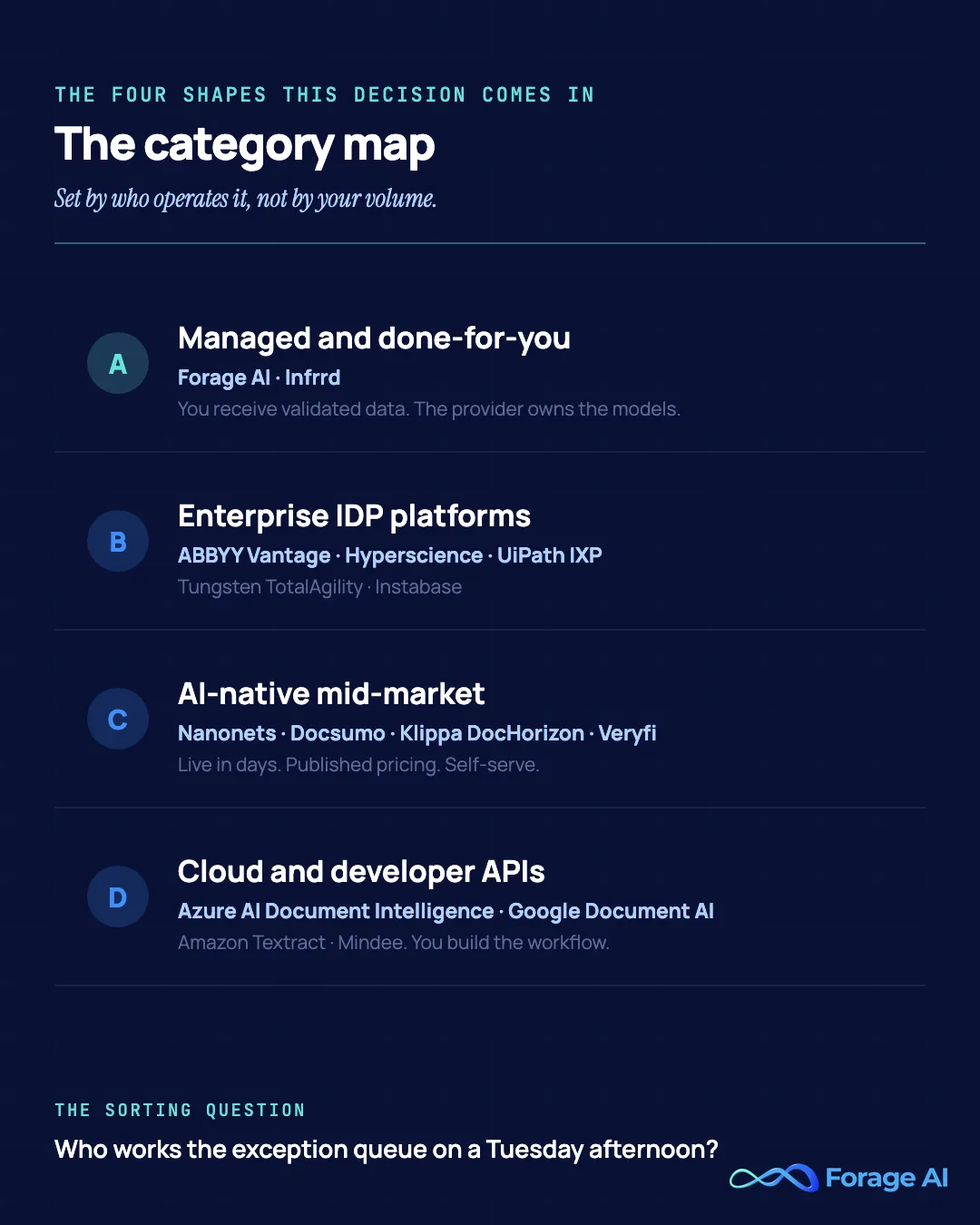
- The four categories: Managed and done-for-you, enterprise IDP platforms, AI-native mid-market platforms, and cloud or developer APIs. The category you belong in is set by who is going to operate the thing, not by your document volume.
Why teams are shopping for Rossum alternatives right now
Three things push a team onto this search, and they show up in a fairly reliable order.
The first is renewal pricing. It is the single most repeated complaint in Rossum’s published reviews. Smaller teams describe the entry point as prohibitive, and several reviewers report steep increases at renewal. That is worth reading carefully: these are complaints about the commercial relationship, not about whether the model reads an invoice correctly.
The arithmetic explains why the complaint clusters where it does. Rossum’s published floor is $18,000 per year on the Starter plan. At 50 invoices a month, that is $30 per invoice in software fees alone. At 100 a month it is $15. The platform does not get cheaper until volume does the work, and a lot of teams shortlisted it before their volume was ready.
The second is document scope. Rossum is a transactional-document product and it is honest about that. Invoices, purchase orders, packing lists, bills of lading, customs declarations. When a team’s estate grows sideways into contracts, clinical records, loan files or long-form filings, the tool that was excellent on AP starts being asked to do something it was not built for. Reviewers report the accuracy floor showing up on documents with intricate formatting or unusual layouts, which is exactly what that sideways growth looks like from the inside.
The third is the acquisition, and it arrived last. It is also the one that produces the most unnecessary migrations.
A note on what an acquisition is not: Coupa buying Rossum does not deprecate the product, does not force a Coupa purchase, and does not invalidate an existing contract. Treat it as a roadmap signal, not an eviction notice. There is a fourth trigger worth naming even though it rarely gets written down: somebody senior asked why the AP pipeline costs what it costs, and the honest answer required a market check. If that is where you are, the useful output of this exercise is not a migration. It is a defensible shortlist and a renewal conversation with numbers in it. The same evaluation discipline applies whether you are replacing the platform or renewing it, and if the underlying workflow is the thing you are actually unhappy with, that is a different article: see our guide to end-to-end invoice automation.
What the Coupa acquisition actually changes
That third trigger deserves its own section, because it is the one people act on fastest and understand least.
Coupa announced the acquisition of Rossum on 12 May 2026 at Coupa Inspire in Las Vegas. Guggenheim Securities acted as exclusive financial advisor to Rossum with Orrick as legal advisor; Kirkland & Ellis acted for Coupa. The two companies had partnered since 2024, so this is a partnership converting into ownership rather than a cold acquisition.
Expert Insights
“By combining our proprietary T-LLM transactional intelligence with Coupa’s massive $10T data set, we are well positioned to create immediate customer value and fundamentally change how the world buys and sells.”
Tomáš Gogár, Co-Founder and CEO, Rossum (May 2026)
“Joining Coupa is the natural evolution of a years-long partnership built on a shared AI-first culture.”
Tomáš Gogár, Co-Founder and CEO, Rossum (May 2026)
Read that second quote as a buyer rather than as a press release. Transactional intelligence, spend data, buying and selling. It is a clear statement of where the product is heading, and clarity is worth more to your decision than reassurance would be.
There are three readers of that news and they get three different answers.
If you already run Coupa, the acquisition is straightforwardly good news and the integration is the entire point. Rossum’s Transactional LLM feeding Coupa’s agentic layer across source-to-pay is the thesis. You are the customer this deal was designed for.
If you do not run Coupa, read the direction, not a deadline. The roadmap now has a spend management center of gravity. Investment will concentrate where invoices, POs and supplier documents meet procurement workflow. That is fine if that is your workload. It is a slow-moving problem if your document estate is drifting toward claims, contracts or clinical records, because those are now further from the roadmap’s core than they were in April.
If you are mid-contract, nothing changes today. What changes is the two questions you should ask at renewal: what happens to standalone pricing for non-Coupa customers, and what is the committed roadmap for document types outside the transactional set. Get both in writing. Neither is an unreasonable ask and the answers will tell you more than any analyst report.
Rossum’s own framing is useful precisely because it is candid about where the value sits.
What is Rossum actually good at?
Before listing fifteen replacements, it is worth stating plainly what you would be replacing. A shortlist built on a caricature of the incumbent produces bad decisions, and the most expensive of those is migrating away from a product that was doing the job.
Rossum is a strong transactional-document product. Aurora, its proprietary Transactional LLM (T-LLM), is trained on roughly 11 million transactional documents and the company states a 92.5% average accuracy across customers and use cases. That is a vendor-published figure rather than an independent benchmark, and it should be read as one, but the number is specific and the training corpus is disclosed, which is more than most of this category offers. Language coverage is 276 languages with 30 supported for handwriting. Everest Group placed it as a Leader in its 2026 IDP PEAK Matrix assessment.
The review data tells a consistent story. On G2 it holds 4.5 out of 5 across 127 reviews, one of the larger review bases in the category. On Capterra it sits at 4.3 out of 5 across 13 reviews, with sub-scores of 4.6 for ease of use, 4.5 for features, 4.2 for customer service, and 4.2 for value for money.
That last sub-score is the whole story in one number. Value for money is Rossum’s weakest published dimension, and it is weakest by a margin. The migration trigger is visible in the ratings, not just in the anecdotes. What reviewers praise is the review interface, the real time saved on AP data entry, and a product team they describe as receptive. What they complain about is what it costs to keep.
So the honest framing for the rest of this article: if your volume is transactional, your languages are covered, and your renewal number is acceptable, you may not have a technology problem at all. Everything below is for the teams where one of those three is no longer true.
How did we pick and rate these platforms?
Every roster in this category is assembled by someone with a stake in it, including this one. So here is the method before the list.
Fifteen platforms made this list. They were selected on three tests, and it is worth stating them because most rosters in this category are assembled by whoever the publisher competes with least.
Test one: does it get named as a Rossum alternative by more than one independent source? Either on multiple ranking comparison pages or in Gartner Peer Insights’ own alternatives list for Rossum.
Test two: is it actively selling into the IDP category as of August 2026? Products in maintenance mode were cut regardless of historical standing.
Test three: is it genuinely different from at least one other entry? Two vendors that would win the same deal for the same reason do not both belong on a shortlist. This is why parsing libraries, template-based email parsers and resume-specific extractors were excluded even though they surface on this search. They are a tier below Rossum, not an alternative to it.
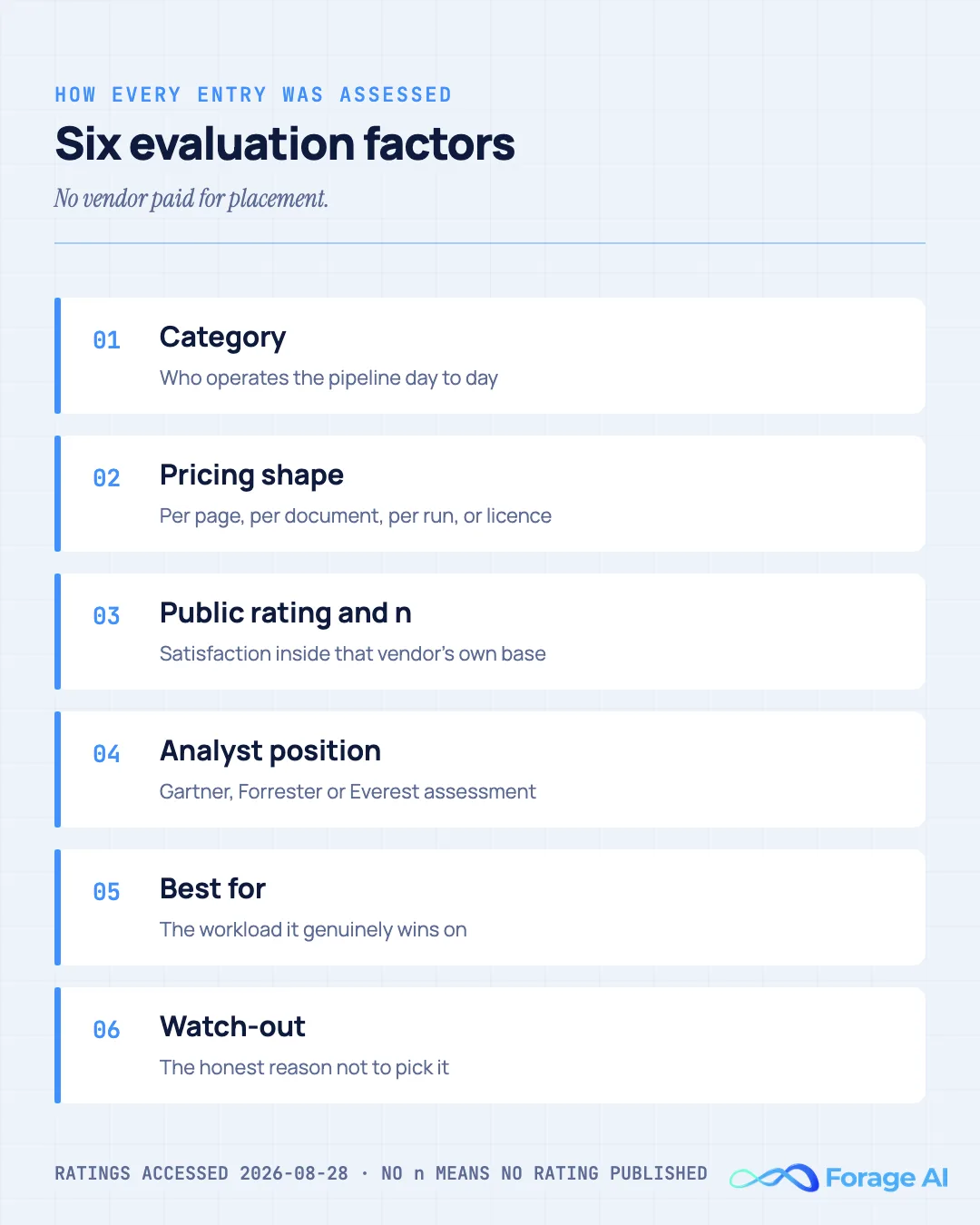
| Factor | What it tells you | How it was sourced |
|---|---|---|
| Category | Who operates the thing day to day | Editorial judgment, stated per entry |
| Pricing shape | Per page, per document, per run, or licence | Vendor pricing pages and public buying guides, dated |
| Public rating and n | Satisfaction inside that vendor’s own customer base | G2, Capterra, Gartner Peer Insights, PeerSpot, accessed 2026-08-28 |
| Analyst position | Whether an independent evaluator has assessed it | Gartner MQ Sep 2025, Forrester Wave Q2 2026, Everest Group 2026 |
| Best for | The workload it wins on | Editorial judgment from capability and review evidence |
| Watch-out | The honest reason to not pick it | Published review complaints and pricing structure |
Every rating in this article carries its sample size and the date it was read. A rating without an n is not evidence, it is decoration. Where a vendor has no verifiable public rating at the time of writing, the entry says “no verified public rating (accessed 2026-08-28)” rather than borrowing a number from a category listing or estimating one. Six of the fifteen entries fall into that bucket. That is a real finding about this market, not a gap in the research.
A higher star rating is not a better fit. Nanonets rates above ABBYY on G2 and the two are not competing for the same deal. A rating tells you how satisfied a vendor’s existing customers are with the product they bought. It tells you nothing about whether that product suits your document mix. Two pieces of independent context are worth carrying into the roster. Gartner published its first-ever Magic Quadrant for Intelligent Document Processing Solutions on 3 September 2025, evaluating 18 vendors and naming ABBYY, Hyperscience, Infrrd, Tungsten Automation and UiPath as Leaders, with Hyperscience positioned furthest for completeness of vision. And Gartner puts the wider IDP market at over 100 vendors, which is why a fifteen-name list is a filter rather than a census. Disclosure: Forage AI publishes this article and appears on the list, first, under its own category. No vendor paid for placement and no vendor was contacted for input. Where Forage AI has no public rating, the entry says so, same as every other vendor in that position.
Expert Insights
Independent benchmarking makes the same point about fit. Linke Ouyang and colleagues released OmniDocBench in December 2024, annotating documents from nine sources including "handwritten notes and densely typeset newspapers", and reported that evaluating both pipeline-based methods and end-to-end vision-language models revealed "their strengths and weaknesses across different document types". No parser wins everywhere, which is why the document mix is the first question and the star rating is not.
The most common failure in vendor shortlisting is treating a review score as a fit score. Satisfaction is measured inside a vendor’s existing customer base, which self-selects hard. A 4.8 from ninety-six mid-market teams and a 4.2 from fifty-six enterprises are not on the same axis, and averaging them is worse than reading neither. (Forage AI IDP team)
Quick Summary
Q: How were these fifteen platforms picked and rated?
A: Three tests decided the roster: named as a Rossum alternative by more than one independent source, actively selling into the IDP category as of August 2026, and genuinely different from at least one other entry. Every rating carries its sample size and the date it was read, and a star rating is treated as a satisfaction signal rather than a fit signal.
The 15 Rossum alternatives, grouped by what they actually replace
The useful way to group this market is not by size or by price. It is by who operates the thing on a Tuesday afternoon when a new supplier format shows up and three invoices fall into the exception queue.
That question sorts fifteen platforms into four categories cleanly, and it sorts them differently than a feature matrix would.
Rossum alternatives at a glance
| # | Platform | Category | Best for |
|---|---|---|---|
| 1 | Forage AI | Managed | Delivered, QA’d data across a mixed document estate. |
| 2 | Infrrd | Managed | Mortgage and insurance documents with fraud detection |
| 3 | ABBYY Vantage | Enterprise platform | The widest document-type coverage under one vendor |
| 4 | Hyperscience | Enterprise platform | Hard structured and semi-structured forms |
| 5 | UiPath IXP | Enterprise platform | Estates that already run UiPath |
| 6 | Tungsten TotalAgility | Enterprise platform | On-premises and hybrid capture estates |
| 7 | Instabase | Enterprise platform | Long, unstructured documents needing interpretation |
| 8 | Nanonets | AI-native | The fastest broad-coverage start |
| 9 | Docsumo | AI-native | Financial documents with heavy validation rules |
| 10 | Klippa DocHorizon | AI-native | European invoices and expenses, GDPR-forward |
| 11 | Veryfi | AI-native | Receipts and mobile camera capture |
| 12 | Azure AI Document Intelligence | Cloud API | Cheapest structured extraction, on Azure |
| 13 | Google Document AI | Cloud API | Google Cloud estates |
| 14 | Amazon Textract | Cloud API | AWS invoice and receipt pipelines |
| 15 | Mindee | Developer API | Developer-led teams at low to mid volume |
Every entry below uses the same six attributes in the same order, so the fifteen read as one comparison rather than fifteen unrelated fact sheets.
Managed and done-for-you
The category the rest of this market pretends does not exist. Here you are not buying a platform, a console or a seat count. You are buying extracted data delivered on a schedule, with somebody else owning the models, the exception queue and the schema drift.
It is the right shape when nobody on the team wants a second system to operate, and it is the wrong shape when the requirement is a per-page API your engineers call from their own code. If the surrounding orchestration is the real gap, our guide to document workflow automation covers that layer separately.
1. Forage AI
| Attribute | Detail |
|---|---|
| Best for | Teams that want extracted, QA’d data delivered on a schedule rather than a platform to configure and staff, particularly where transactional documents are only part of the volume. |
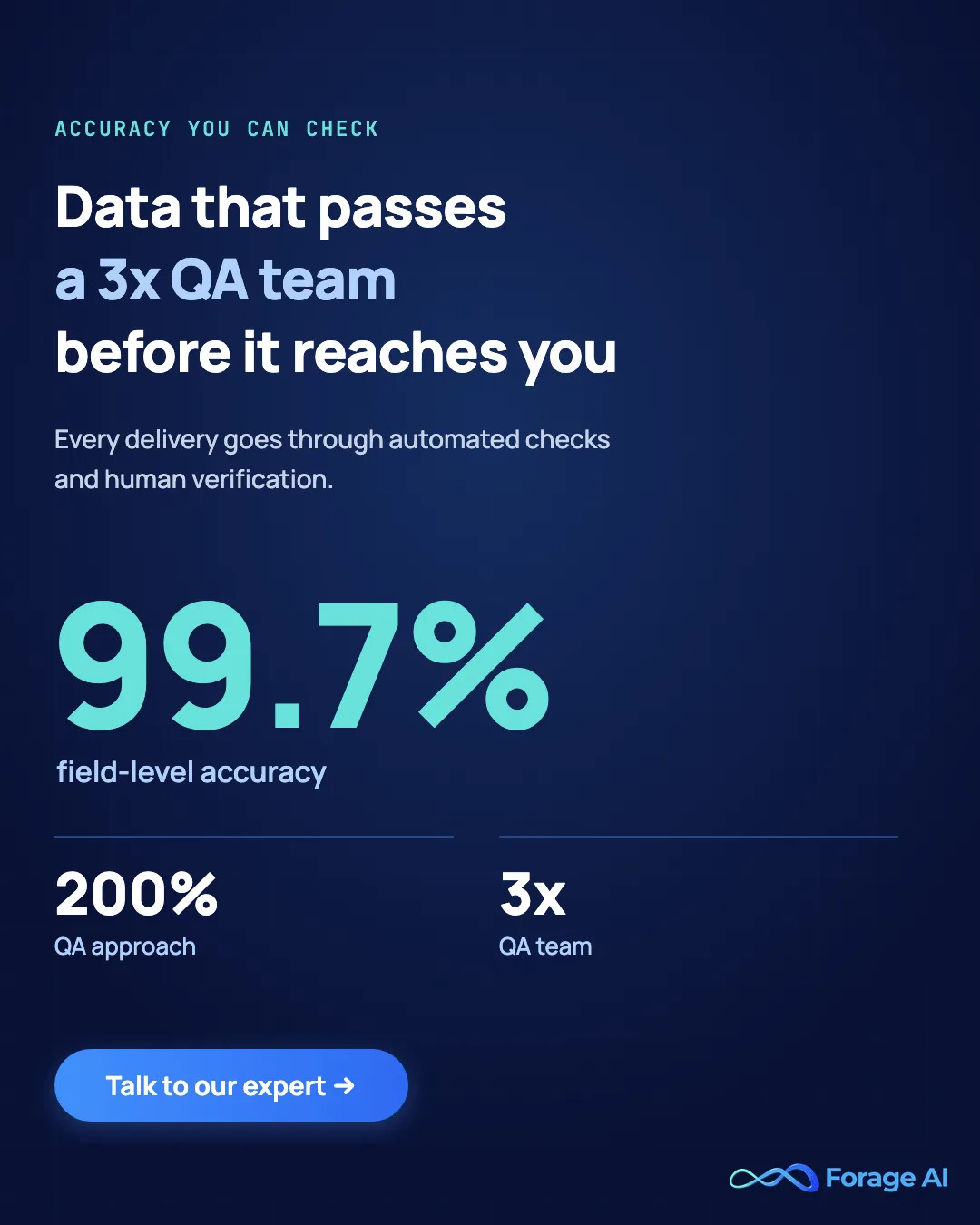
| Top capabilities | Intelligent Document Processing (IDP) across PDFs, contracts, filings and reports. 10M+ documents processed. A 3x QA team on every delivery. Onboarding in 1-2 weeks. No data reselling. Web Data Extraction and Firmographic Data on the same delivery model. |
| Pricing | Not published. Scoped per engagement. |
| User reviews | No verified public rating (accessed 2026-08-28). |
| Watch-out | This is a service model, not a self-serve product. There is no free tier and no console to trial on a Friday afternoon. If the requirement is a per-page API your team calls from its own code, categories three and four fit better. |
| Better than Rossum when | The document mix is broader than transactional, or nobody on the team wants to own model tuning, exception queues and schema drift. |
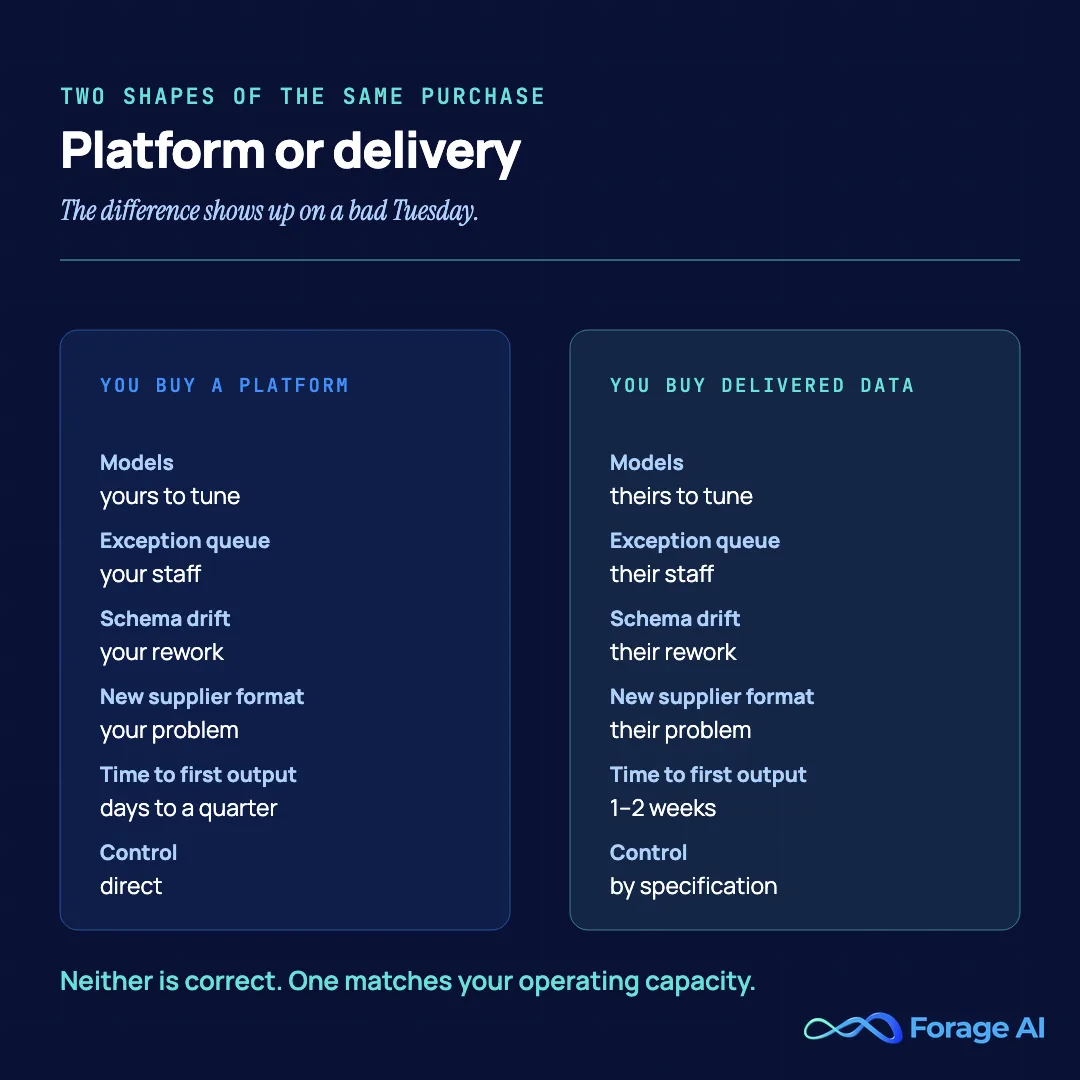
Forage AI delivers the data, not just the pipeline. That distinction is the whole category. On a platform, accuracy on a new supplier format is your problem to fix through retraining and rule changes. On a managed engagement, it is the provider’s problem, and the thing that lands in your system is a validated record rather than a confidence score to triage.
Who it is for: operations teams whose document estate has outgrown a single-purpose tool but who cannot justify a platform team to run the replacement. That is a common position and it is badly served by this market, because every vendor comparison assumes a buyer who wants a console.
The honest watch-out is the flip side of the same thing. You give up direct control of the extraction layer. Teams that want to tune a model themselves at 2am will find the service model frustrating, and they should pick a platform. There is also no way to evaluate this in an afternoon: onboarding runs 1-2 weeks to a first dataset, which is fast for a managed engagement and slow compared to signing up for an API. Forage AI works as an extension of your data team, which is a good fit or a bad one depending entirely on whether you wanted a team.
2. Infrrd
| Attribute | Detail |
|---|---|
| Best for | Complex, heavily services-wrapped enterprise deployments in mortgage, insurance, finance and engineering. |
| Top capabilities | No-Touch Processing framework, 13+ patents, document fraud detection, accuracy reasoning, automated document splitting, embedded chatbot assistant. Structured and unstructured. |
| Pricing | Not published. Enterprise quote. |
| User reviews | Listed on G2 and Gartner Peer Insights; no rating with a disclosed sample size at time of access (2026-08-28). |
| Watch-out | The engagement is consultative and enterprise-paced. Not a fit for a team that wants to be live in two weeks on a credit card. |
| Better than Rossum when | Fraud detection on submitted documents matters, or the document set is mortgage and insurance rather than accounts payable. |
Infrrd is the closest named competitor to the managed model, and it carries analyst weight that the category rarely has. It was named a Gartner Magic Quadrant Leader in the September 2025 IDP quadrant and a Leader in Everest Group’s PEAK Matrix 2026, where its differentiation was cited as document fraud detection, accuracy reasoning and automated document splitting. It marked ten years in IDP in 2026, which in a category with 100+ vendors is itself a signal.
Who it is for: mortgage and insurance operations, where the documents arrive from outside your organisation and somebody has an incentive to alter them. That is a genuinely different problem from AP, and it is the one place on this roster where fraud detection is a first-class capability rather than a checkbox.
The watch-out is pace and opacity. Pricing is not published, the sales motion is consultative, and there is no public rating with a disclosed sample size to sanity-check against. You will learn what this costs and how it performs in a procurement cycle, not on a website. That is normal at this tier and it is still a real cost in weeks.
Which Rossum alternative is best for teams that do not want to run a platform?
The managed category, which contains Forage AI and Infrrd. Both replace the platform with a delivery relationship: the provider owns the models, the exception queue and the schema drift, and you receive validated records. Forage AI fits mixed document estates and delivers a first dataset in 1-2 weeks. Infrrd fits mortgage and insurance workloads where document fraud detection matters and where an enterprise-paced, consultative engagement is acceptable.
Enterprise IDP platforms
The tier Rossum competes with at the top of the market. Four of these five were named Leaders in Gartner’s first-ever IDP Magic Quadrant, published 3 September 2025 across 18 evaluated vendors.
One number is worth carrying through this whole band. PeerSpot’s August 2026 mindshare figures show ABBYY Vantage at 5.0%, down from 13.6% a year earlier; Tungsten TotalAgility at 4.0%, down from 8.6%; and Instabase at 2.3%, down from 4.7%. Mindshare measures share of buyer conversation rather than revenue, so read it as attention rather than money. But three incumbents losing half or more of their share of the conversation in twelve months is what a category being re-shopped looks like from the outside. ABBYY’s drop is the steepest in relative terms, at roughly 63%.
3. ABBYY Vantage
| Attribute | Detail |
|---|---|
| Best for | The widest document-type coverage available under one vendor, with 200+ pre-trained document types. |
| Top capabilities | Mature ML, deep RPA integration, large pre-trained skill library, 35+ years of OCR heritage. |
| Pricing | Not published. Public buying guides place typical implementations at $50,000 to $200,000+ including system-integrator fees, with three-year contracts and six to twelve month deployment timelines. Directional. |
| User reviews | G2 4.2/5 (n = 56) in the IDP category; Gartner Peer Insights 4.4/5 (n = 52). ABBYY across all products rates 4.5/5 from 411 G2 reviews. Accessed 2026-08-28. |
| Watch-out | Reviewers repeatedly say it costs more than simpler alternatives. Cost, not capability, is its weakest published dimension, which is the same shape of complaint that sends teams away from Rossum. |
| Better than Rossum when | The estate spans far beyond transactional documents and you want one vendor covering all of it. |
ABBYY is the breadth answer. If your document estate includes invoices and contracts and IDs and forms and shipping paperwork, and you want that under one contract with one support relationship, this is the shortest path to it. The pre-trained skill library is the deepest in the category and it is the reason the deployment timeline is measured in months rather than quarters despite the breadth.
Who it is for: enterprises consolidating several point tools. The business case is almost never “ABBYY is more accurate.” It is “ABBYY replaces four vendors,” and that case holds up well.
The watch-out is the total number, not the licence. Public buying guides put typical implementations between $50,000 and $200,000 once system-integrator fees are included, on three-year terms. If you are leaving Rossum over an $18,000 floor, this is not the direction to walk. It is also worth asking directly about the mindshare drop: 13.6% to 5.0% in a year, roughly 63% in relative terms, is a question a vendor should be able to answer comfortably, and how they answer tells you something.
4. Hyperscience
| Attribute | Detail |
|---|---|
| Best for | High-accuracy extraction on hard structured and semi-structured forms, particularly in financial services, insurance and government. |
| Top capabilities | Born-ML platform with a layered inference architecture. Among the strongest available on complex multi-page structured documents. |
| Pricing | Not published. Public buying guides place it in six figures and up. Directional. |
| User reviews | G2 4.6/5 (n = 54), accessed 2026-08-28. Satisfaction runs 4.5 to 4.7 consistently across G2, Capterra and TrustRadius. |
| Watch-out | Forms-shaped strength. If the volume is invoices, you are paying for an accuracy edge on documents the platform was not built to differentiate on. |
| Better than Rossum when | Claims forms, loan applications and government submissions dominate the volume, not invoices. |
Hyperscience was positioned furthest for completeness of vision in the September 2025 Gartner IDP Magic Quadrant, and was named a Leader and Customer Favorite in Forrester’s Q2 2026 Wave for Document Mining and Analytics Platforms. It also holds the most consistent cross-platform satisfaction on this roster, which matters more than a single high score: 4.5 to 4.7 across three independent review sites is a narrow band and narrow bands are trustworthy.
Who it is for: teams whose hardest documents are multi-page structured forms with variable layouts. Claims packets, loan files, government submissions. The layered inference architecture is genuinely different from template matching, and it shows up on exactly those documents.
The watch-out is fit, not quality. This is the strongest form-processing platform on the list and forms are not invoices. A team leaving Rossum over AP economics will find Hyperscience more expensive and no better at the specific job they need done. The switch makes sense when the document mix has moved, not when the price has.
5. UiPath IXP and Document Understanding
| Attribute | Detail |
|---|---|
| Best for | Estates already running UiPath. IXP combines Document Understanding, Communications Mining and Generative Extraction in one experience. |
| Top capabilities | Multi-modal extraction with native handoff into the surrounding RPA and agentic orchestration layer. |
| Pricing | Not published separately. Consumed through UiPath platform licensing. |
| User reviews | G2 4.6/5 (n = 16) for Document Understanding, accessed 2026-08-28. UiPath across all products carries 7,768 G2 reviews. |
| Watch-out | The sample size on the Document Understanding listing is small at 16. Read the platform-level reviews alongside it, and remember you are buying into UiPath’s licensing model rather than a standalone IDP tool. |
| Better than Rossum when | UiPath already owns the workflow layer and extraction is the last piece sitting outside it. |
A Gartner MQ Leader, and the easiest decision on this roster when the precondition holds. If UiPath already runs your downstream automation, moving extraction inside the same platform removes an integration surface, a vendor relationship and a support escalation path in one move. That is worth real money even if the extraction is merely comparable.
Who it is for: organisations where the RPA estate came first and the IDP tool was bolted on. That sequence is common and it usually leaves the extraction step as the only non-native component in an otherwise consolidated stack.
The watch-out is the precondition. If you do not already run UiPath, this is not an IDP purchase, it is an automation-platform purchase with IDP included, and it should be evaluated as one. The n of 16 on the Document Understanding listing is also too small to lean on: it is a real rating from real users, but sixteen reviews cannot tell you about edge-case behaviour. Weight the platform-level review base accordingly.
6. Tungsten Automation TotalAgility
| Attribute | Detail |
|---|---|
| Best for | Large capture estates, on-premises or hybrid deployments, and regulated environments that will not move to a cloud-only control plane. |
| Top capabilities | Deep document-capture heritage, process orchestration, genuine on-premises capability. |
| Pricing | Not published. Enterprise quote. |
| User reviews | PeerSpot 8.2/10 (n not disclosed), accessed 2026-08-28. |
| Watch-out | PeerSpot mindshare fell from 8.6% to 4.0% between August 2025 and August 2026. That measures share of buyer conversation, not revenue, but a drop of roughly 53% in a year is worth raising with the vendor directly. |
| Better than Rossum when | The deployment cannot be cloud-only, or the estate already runs Kofax capture. |
Tungsten Automation was formerly Kofax, and TotalAgility is a Gartner MQ Leader in the September 2025 quadrant. The reason to shortlist it is almost always deployment topology rather than extraction capability. If your compliance posture, data-residency requirement or existing scanning infrastructure rules out a SaaS-only control plane, the list of serious options gets short fast, and this is on it.
Who it is for: organisations with an installed capture estate and a genuine on-premises requirement. Public sector, regulated financial services, and any environment where the documents cannot leave a specific network boundary.
The watch-out is momentum. A mindshare halving does not mean a product is failing, and capture platforms have long, quiet, profitable lives. But it does mean fewer new deployments, which over time means fewer peers to compare notes with and a smaller pool of implementation partners. Ask about roadmap investment and reference customers deployed in the last twelve months specifically.
7. Instabase
| Attribute | Detail |
|---|---|
| Best for | Complex unstructured documents where the work is reasoning over content rather than reading fields off a form. |
| Top capabilities | AI Hub, an apps-on-platform model, and agentic document workflows. |
| Pricing | Not published. AI Hub offers two subscription tiers, mid-market and enterprise. Trial accounts include $75 of usage over 14 days. |
| User reviews | Listed on G2; no rating with a disclosed sample size at time of access (2026-08-28). |
| Watch-out | Publicly characterised as a higher price tier with a steeper initial cost, and reviewers describe the cost as challenging relative to alternatives. Not a Leader in the September 2025 Gartner quadrant. |
| Better than Rossum when | The documents are long, unstructured, and need interpretation rather than field capture. |
The outlier in this band, and the one whose value depends most on your document type. Where the other four are extraction platforms with reasoning added, Instabase is closer to a reasoning platform with extraction included. On a fifty-page credit memo or a dense regulatory filing, that architectural difference is the entire point. On an invoice, it is overhead.
Who it is for: teams whose documents cannot be described as forms. Long-form filings, memos, correspondence, mixed packets where the useful output is an interpretation rather than a field set.
The watch-out is price against a shrinking conversation. PeerSpot mindshare fell from 4.7% to 2.3% in the year to August 2026, roughly 51% in relative terms, the entry price is publicly described as steep, and there is no rating with a disclosed sample size to check the experience against. The $75 trial credit over fourteen days is genuinely useful here: use it on your ugliest real document before anything else, because that is the only test that distinguishes this category from the one below it.
AI-native mid-market platforms
This tier exists because the enterprise floor priced out the middle of the market. These four are self-serve or near-self-serve, publish at least some pricing, and are designed to be running inside a week rather than a quarter.
They are the natural landing spot for a team leaving Rossum over economics rather than capability. If the workload is specifically invoice capture, our comparison of invoice data extraction tools goes deeper on that slice.
8. Nanonets
| Attribute | Detail |
|---|---|
| Best for | Fast time-to-value across a broad range of document types without a long implementation, with an interface accessible to non-technical operators. |
| Top capabilities | Pre-trained models across many document types, composable workflow blocks, self-serve onboarding. |
| Pricing | Free Starter tier with $200 of non-expiring credits. Quote-based Growth plan with volume discounts up to 40%. Custom Enterprise. Metered per workflow block: $0.02 per run for simple operations, $0.10 for standard AI blocks, $0.30 for complex AI such as extraction. Accessed 2026-08-28. |
| User reviews | G2 4.8/5 (n = 96), accessed 2026-08-28. The highest-rated entry on this roster with a disclosed sample size above 50. |
| Watch-out | Per-run metering across workflow blocks means the bill tracks pipeline design, not document count. Model a real workflow before committing, or the unit economics will surprise you at volume. |
| Better than Rossum when | You want to be live in days and the volume does not justify a five-figure floor. |
The default AI-native alternative, and the ratings support it: 4.8 across 96 reviews is the strongest combination of score and sample size in this comparison. The credit is not that Nanonets out-extracts an enterprise platform. It is that a non-technical operations person can stand up a working pipeline without a professional-services engagement, which changes who inside your organisation can own the project.
Who it is for: teams under a few thousand documents a month who need coverage across several document types and cannot wait a quarter. It is also the most reasonable first stop for anyone leaving Rossum specifically over the entry price, because the free tier lets you benchmark on your own documents before spending anything.
The watch-out is genuinely important and easy to miss. Billing is per workflow block, not per document. A pipeline that classifies, splits, extracts, then validates runs four metered operations per document, and complex AI blocks run at $0.30 each. A document count tells you nothing about your bill. Build your actual workflow in the free tier and multiply from there, because the difference between a naive estimate and a real one can be several times over.
9. Docsumo
| Attribute | Detail |
|---|---|
| Best for | Financial documents where a validation-rules engine and a human cross-verification interface matter more than raw throughput. |
| Top capabilities | Configurable validation rules, a review UI built for accuracy over speed, financial-document specialisation. |
| Pricing | Free 14-day trial with 1,000 pages. Starter $299/month for 1,000 pages; Growth $799/month for 3,000 pages. As of 2026 the pricing page routes prospects to a sales form rather than self-serve checkout. Setup fees charged separately. Accessed 2026-08-28. |
| User reviews | G2 4.7/5 (n = 67), accessed 2026-08-28. |
| Watch-out | The move behind a sales form is a signal that the published tiers may not be the tiers you are quoted. Get the setup fee in writing before the pilot starts. |
| Better than Rossum when | Accuracy on financial statements matters more than AP throughput, and the review workflow is the thing you are actually buying. |
Docsumo is the accuracy-first option in this tier, and the distinction shows up in what it optimises. The validation-rules engine and the cross-verification interface are built on the assumption that a human is going to check the output, and the product’s job is to make that check fast and reliable rather than to eliminate it. For financial statements, bank statements and rent rolls, that is the right assumption.
Who it is for: lending, underwriting and financial-analysis teams where a wrong number is materially worse than a slow one. The $299 entry at 1,000 pages is roughly the volume where a five-figure annual floor stops making sense, which places it squarely in the Rossum-refugee lane.
The watch-out is commercial transparency. Published tiers exist but the pricing page now routes to sales, and setup fees are separate and unpublished. That combination usually means the number you are quoted depends on the conversation. It is not a reason to avoid the product, but it is a reason to get the total first-year cost, including setup, in writing before the trial converts.
10. Klippa DocHorizon
| Attribute | Detail |
|---|---|
| Best for | European mid-market teams processing invoices and expenses who need GDPR-forward data handling and document fraud detection. |
| Top capabilities | Invoice and expense capture, document fraud detection, GDPR-forward handling, faster deployment than the enterprise tier. |
| Pricing | Not published on G2 or Capterra. Subscription tiers described publicly as accessible to mid-market budgets. Directional. |
| User reviews | Capterra 4.8/5 (n not disclosed in source), accessed 2026-08-28. |
| Watch-out | Pricing is not published anywhere public, so the comparison has to happen in a sales conversation. Budget the calendar time. |
| Better than Rossum when | Data residency and GDPR are the gating items, or fraud detection on submitted expenses is in scope. |
The European answer, and the differentiation is regulatory rather than technical. When data residency is a hard requirement rather than a preference, the shortlist shortens fast, and Klippa is built for that conversation rather than retrofitted into it. The fraud-detection capability on expenses is the second reason to look, and it is unusual at this price tier.
Who it is for: European mid-market finance and shared-services teams, particularly those handling employee expense submissions where altered receipts are a real and quantified problem.
The watch-out is opacity in a tier that otherwise publishes. Nanonets, Docsumo, Veryfi and Mindee all publish something. Klippa publishes nothing, which makes a like-for-like comparison impossible without a sales cycle. The Capterra rating is strong at 4.8 but the source does not disclose the sample size, so treat it as directional rather than as evidence.
11. Veryfi
| Attribute | Detail |
|---|---|
| Best for | Receipts, expenses and camera-based mobile capture. The most transparently priced entry on this roster. |
| Top capabilities | Purpose-built mobile capture SDK, OCR API, per-document pricing published openly on the website. |
| Pricing | Per document: $0.08 per receipt, $0.16 per invoice, decreasing with volume. Monthly minimum $500, which includes 6,250 receipts or 3,125 invoices. Free plan up to 100 documents per month, receipts and invoices only. Accessed 2026-08-28. |
| User reviews | Listed on G2 and Capterra; no rating with a disclosed sample size at time of access (2026-08-28). |
| Watch-out | The $500 monthly minimum is a floor, not a starting point. Below roughly 3,000 invoices a month you are paying for headroom you are not using. |
| Better than Rossum when | The capture surface is a phone camera, or the finance team needs an expense pipeline rather than an accounts payable pipeline. |
Veryfi is the only vendor in this comparison that lets you calculate your bill from a website without talking to anyone: $0.08 per receipt, $0.16 per invoice, published, with volume tiers. In a category where “contact sales” is the default answer to a pricing question, that is worth noting on its own.
Who it is for: expense management rather than accounts payable. The mobile SDK is the real product, and it is genuinely strong on photographed receipts, which is a harder computer-vision problem than scanned invoices and one most IDP platforms treat as an afterthought.
The watch-out is the minimum. If your actual volume is 400 invoices a month, your effective per-document cost is $1.25, not $0.16, which is eight times the headline rate. The published pricing is honest; the arithmetic is still yours to run. Below that threshold the free tier or a developer API in the next category will cost less.
Headline unit prices in this tier are close to meaningless without a workflow model. One vendor meters per document, one per page, one per workflow block, and one enforces a monthly minimum. The same 2,000 invoices a month can produce bills that differ by an order of magnitude across four products that all look similarly priced on their pricing pages. Build the model before the demo. (Forage AI IDP team)
Cloud and developer APIs
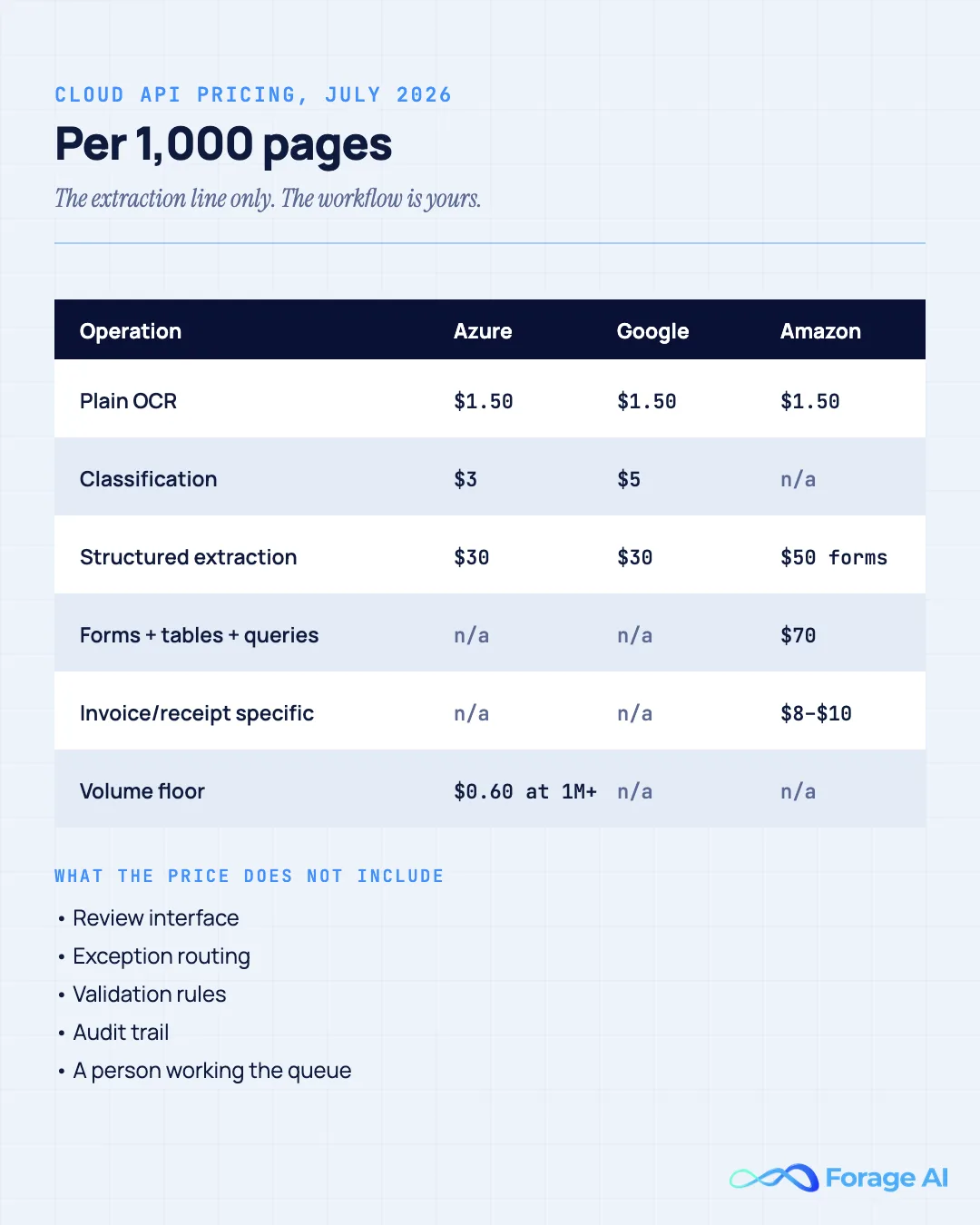
The cheapest per page by a wide margin, and the most expensive in engineering time. These four give you extraction as a call. Everything around it, the review interface, the exception routing, the validation rules, the audit trail and the human QA, is yours to build and staff.
As of July 2026 the price grid looks like this. Plain OCR is $1.50 per 1,000 pages at all three hyperscalers. Structured extraction runs $30 per 1,000 pages on both Azure custom extraction and Google Custom Extractor, against $50 per 1,000 for Forms on Amazon Textract and $70 for Forms plus Tables plus Queries. Textract’s purpose-built Analyze Expense API for invoices and receipts sits closer to $8 to $10 per 1,000 pages. Classification is $3 per 1,000 on Azure against $5 on Google. Azure Read drops to $0.60 per 1,000 pages above one million pages a month.
Hold those numbers next to an $18,000 annual floor and the comparison stops being about software. If the reason you are here is the difference between OCR and true document intelligence, our OCR versus IDP comparison covers where one stops and the other starts.
12. Microsoft Azure AI Document Intelligence
| Attribute | Detail |
|---|---|
| Best for | The cheapest structured extraction and the cheapest classification of the big three, inside an existing Azure estate. |
| Top capabilities | Prebuilt and custom models, Read OCR, layout analysis, document classification. |
| Pricing | Read OCR $1.50 per 1,000 pages on S0, falling to $0.60 per 1,000 above one million pages a month. Custom extraction $30 per 1,000 pages. Classification $3 per 1,000 pages. July 2026. |
| User reviews | No consolidated rating with a disclosed sample size (accessed 2026-08-28). |
| Watch-out | The price is the extraction line only. Review interface, exception routing, validation rules and human QA are yours to build and staff. |
| Better than Rossum when | You have engineers, you already run Azure, and volume is high enough that per-page arithmetic beats a platform licence. |
The price leader on structured extraction, and by enough of a margin that at high volume the comparison is not close. Classification at $3 per 1,000 pages against Google’s $5 compounds quietly: at two million classified pages a year that difference alone is $4,000.
Who it is for: engineering-led teams already on Azure with the appetite to own a workflow layer. The models are good and the pricing is the best in the category, which means the entire decision reduces to whether you want to build and maintain everything that is not extraction.
The watch-out is the honest cost of that build. A production document pipeline needs a review queue, an exception taxonomy, confidence thresholds, a validation rule set, an audit trail and somebody working the queue daily. That is a real system with a real maintenance load. Teams that skip the estimate and price only the API calls are the ones that end up back on this search eighteen months later.
13. Google Document AI
| Attribute | Detail |
|---|---|
| Best for | Specialised prebuilt processors and Custom Extractor inside a Google Cloud estate. |
| Top capabilities | Prebuilt specialised processors, Custom Extractor, Document AI Workbench for model tuning. |
| Pricing | Plain OCR $1.50 per 1,000 pages. Custom Extractor $30 per 1,000 pages. Classification $5 per 1,000 pages. July 2026. |
| User reviews | No consolidated rating with a disclosed sample size (accessed 2026-08-28). |
| Watch-out | Same build-it-yourself caveat as Azure, plus classification running $2 per 1,000 pages above Azure, which compounds at volume. |
| Better than Rossum when | The stack is already Google Cloud and the team can own the workflow layer. |
Effectively at parity with Azure on custom extraction pricing, and the choice between them is almost always determined by where the rest of the data already lives rather than by capability. The specialised prebuilt processors are the differentiator worth checking: for certain document types they remove the training step entirely, which changes the project from a machine-learning exercise into an integration one.
Who it is for: Google Cloud estates, and specifically teams whose document types map onto an existing specialised processor. Check that list before assuming you need Custom Extractor, because the answer changes the timeline materially.
The watch-out is the same build, plus a small tax. That is immaterial at pilot volume and it is not immaterial at a few million pages a year. If you are genuinely cloud-agnostic, price the whole workload including classification rather than comparing the headline extraction rate.
14. Amazon Textract
| Attribute | Detail |
|---|---|
| Best for | AWS-native pipelines, and specifically the purpose-built Analyze Expense API for invoices and receipts. |
| Top capabilities | Detect Text, Analyze Document for Forms, Tables and Queries, Analyze Expense, Analyze ID. |
| Pricing | Plain OCR $1.50 per 1,000 pages. Tables roughly $15 per 1,000. Forms roughly $50 per 1,000. Forms plus Tables plus Queries $70 per 1,000. Analyze Expense roughly $8 to $10 per 1,000 pages. July 2026. |
| User reviews | No consolidated rating with a disclosed sample size (accessed 2026-08-28). |
| Watch-out | The most expensive of the three for general structured extraction, at $50 to $70 per 1,000 pages against $30 elsewhere. |
| Better than Rossum when | The workload is invoices and receipts on AWS and Analyze Expense covers the fields you need. |
Textract is the most expensive general-purpose option of the three hyperscalers and the cheapest specific one, which makes it easy to get wrong. General Forms extraction at $50 per 1,000 pages is 67% above Azure and Google. Analyze Expense at $8 to $10 per 1,000 pages is roughly a third of their custom-extraction rate.
Who it is for: AWS teams whose workload is invoices and receipts, full stop. If Analyze Expense returns the fields you need, it is the cheapest credible extraction on this entire roster and nothing else is close.
The watch-out is the field list. Analyze Expense is a fixed-schema API. It returns what it returns. The moment you need a field it does not extract, you are on general Forms or Queries pricing and the economics invert completely. Test Analyze Expense against your actual required field list before you build anything, because that single check decides whether Textract is the cheapest option here or one of the more expensive ones.
15. Mindee
| Attribute | Detail |
|---|---|
| Best for | Developer-first teams that want published per-page pricing, a real free tier, and an API rather than a console. |
| Top capabilities | OCR API, prebuilt document APIs, and a visual workflow builder for non-technical operators. |
| Pricing | Free tier up to 250 pages a month with no card. Starter EUR 44/month for 500 pages. Pro EUR 179/month for 2,500 pages. Business EUR 584/month for 10,000 pages. Overage from $0.05 per page. Accessed 2026-08-28. |
| User reviews | Listed on G2, Capterra and GetApp; no rating with a disclosed sample size at time of access (2026-08-28). |
| Watch-out | Tiers are page-allowance-shaped, so a bursty month costs more than a flat one at the same annual volume. Pricing is also quoted in euros. |
| Better than Rossum when | The team is engineering-led, volume is under a few thousand pages a month, and a five-figure floor cannot be justified. |
The most accessible starting point on the roster. 250 pages a month free with no card is enough to genuinely benchmark against your own documents, and the paid tiers start at EUR 44. For a team that wants to know whether an API-first approach is viable before committing to anything, this is the cheapest way to find out.
Who it is for: developer-led teams at low to mid volume, and evaluators who want a real test rather than a vendor-run demo on vendor-chosen documents. The visual workflow builder also makes it usable by an operations person once a developer has set it up, which is an unusual combination at this price.
The watch-out is the allowance shape. Tiers bundle a monthly page allowance with overage on top. A finance operation with a month-end spike pays for the peak, not the average, which means the same 30,000 annual pages cost noticeably more if they arrive unevenly. Model your real monthly curve, not your annual total divided by twelve.
Rossum alternatives compared: the master table
Fifteen entries is a lot to hold at once, so here is the whole roster on one screen.
Rossum is included as the baseline row so the comparison reads against the incumbent rather than in the abstract. Ratings were read on 2026-08-28 and every one carries its sample size or an explicit note that the source did not disclose it.
| Platform | Category | Pricing shape | Public rating (accessed 2026-08-28) | Best for |
|---|---|---|---|---|
| Rossum (incumbent) | AI-first transactional IDP | From $18,000/yr; higher tiers quote-only | G2 4.5 (n=127) · Capterra 4.3 (n=13) | Invoices, POs and customs documents at scale |
| Forage AI | Managed | Scoped per engagement | No verified public rating | Delivered data across a mixed document estate |
| Infrrd | Managed | Enterprise quote | No rating with disclosed n | Mortgage and insurance, fraud detection |
| ABBYY Vantage | Enterprise platform | $50k-$200k+ typical, directional | G2 4.2 (n=56) · Gartner 4.4 (n=52) | Widest document-type coverage |
| Hyperscience | Enterprise platform | Six figures, directional | G2 4.6 (n=54) | Hard structured and semi-structured forms |
| UiPath IXP | Enterprise platform | Platform licensing | G2 4.6 (n=16) | Existing UiPath estates |
| Tungsten TotalAgility | Enterprise platform | Enterprise quote | PeerSpot 8.2/10 (n not disclosed) | On-premises and hybrid capture estates |
| Instabase | Enterprise platform | Two tiers, not published | No rating with disclosed n | Long unstructured documents |
| Nanonets | AI-native | Free tier; $0.02-$0.30 per workflow run | G2 4.8 (n=96) | Fastest broad-coverage start |
| Docsumo | AI-native | $299/mo for 1k pages; $799/mo for 3k | G2 4.7 (n=67) | Financial documents, validation rules |
| Klippa DocHorizon | AI-native | Not published; mid-market tiers | Capterra 4.8 (n not disclosed) | EU invoices and expenses, fraud detection |
| Veryfi | AI-native | $0.08/receipt, $0.16/invoice, $500/mo minimum | No rating with disclosed n | Receipts and mobile capture |
| Azure AI Document Intelligence | Cloud API | $30 per 1,000 pages custom extraction | No consolidated rating | Cheapest structured extraction, on Azure |
| Google Document AI | Cloud API | $30 per 1,000 pages Custom Extractor | No consolidated rating | Google Cloud estates |
| Amazon Textract | Cloud API | $50-$70 per 1,000 Forms; Expense $8-$10 | No consolidated rating | AWS invoice and receipt pipelines |
| Mindee | Developer API | Free 250 pages; EUR 44-584/mo tiers | No rating with disclosed n | Developer-led, low to mid volume |
Sources: G2, Capterra, Gartner Peer Insights and PeerSpot ratings accessed 2026-08-28. Cloud API pricing from vendor pricing pages, July 2026. Enterprise price bands from public buying guides and marked directional throughout.
How do you actually choose between them?
The table narrows the field. It does not make the call, and neither does a feature checklist.
Five gates, in this order. The order matters more than the gates do, because the first one invalidates more shortlists than the other four combined and it is almost always run last.
Gate 1: What share of your volume is not transactional?
Run this before anything else. Pull ninety days of actual document volume, not the estimate in your head, and split it into transactional documents (invoices, POs, packing lists, customs declarations, receipts) and everything else (contracts, claims packets, clinical records, loan files, correspondence, filings).
| Non-transactional share | What it means | Where to look |
|---|---|---|
| Under 20% | You have an AP problem with a rounding error attached | AI-native or cloud API. Solve the 80% cheaply and route the rest to manual. |
| 20% to 50% | You have two problems and one budget | Enterprise platform for breadth, or managed if the tail is genuinely varied |
| Over 50% | You do not have an AP problem, you have a document problem | Managed, or an enterprise platform built for unstructured content |
Most teams discover their non-transactional share is higher than they assumed, because the tail arrives through email and never enters the count. The tail is what kills platform selections, not the core volume, and it is why a shortlist built from an invoice benchmark so often fails in production. Where the tail is contracts specifically, our guide to contract data extraction explains why those documents behave differently.
Gate 2: Who works the exception queue, and what do they get?
Every platform on this list will extract a clean invoice. The differences appear on the 3% to 15% that do not come back clean.
Ask three questions in the demo, on your own documents. How does a document get flagged? Confidence threshold, validation rule, or both, and can you set the threshold per field rather than per document. What does the reviewer see? A form with the source document beside it and the low-confidence fields highlighted, or a JSON blob. What happens to the correction? Does it train the model, update a rule, or vanish.
The third question is the one that separates products. A correction that improves future extraction compounds. A correction that only fixes one record is data entry with extra steps.
Gate 3: What does the extracted record have to land in, and does the vendor speak it natively?
Name the destination system precisely, then ask for a customer reference running that exact integration in production. Not a connector on a logo wall. A named deployment.
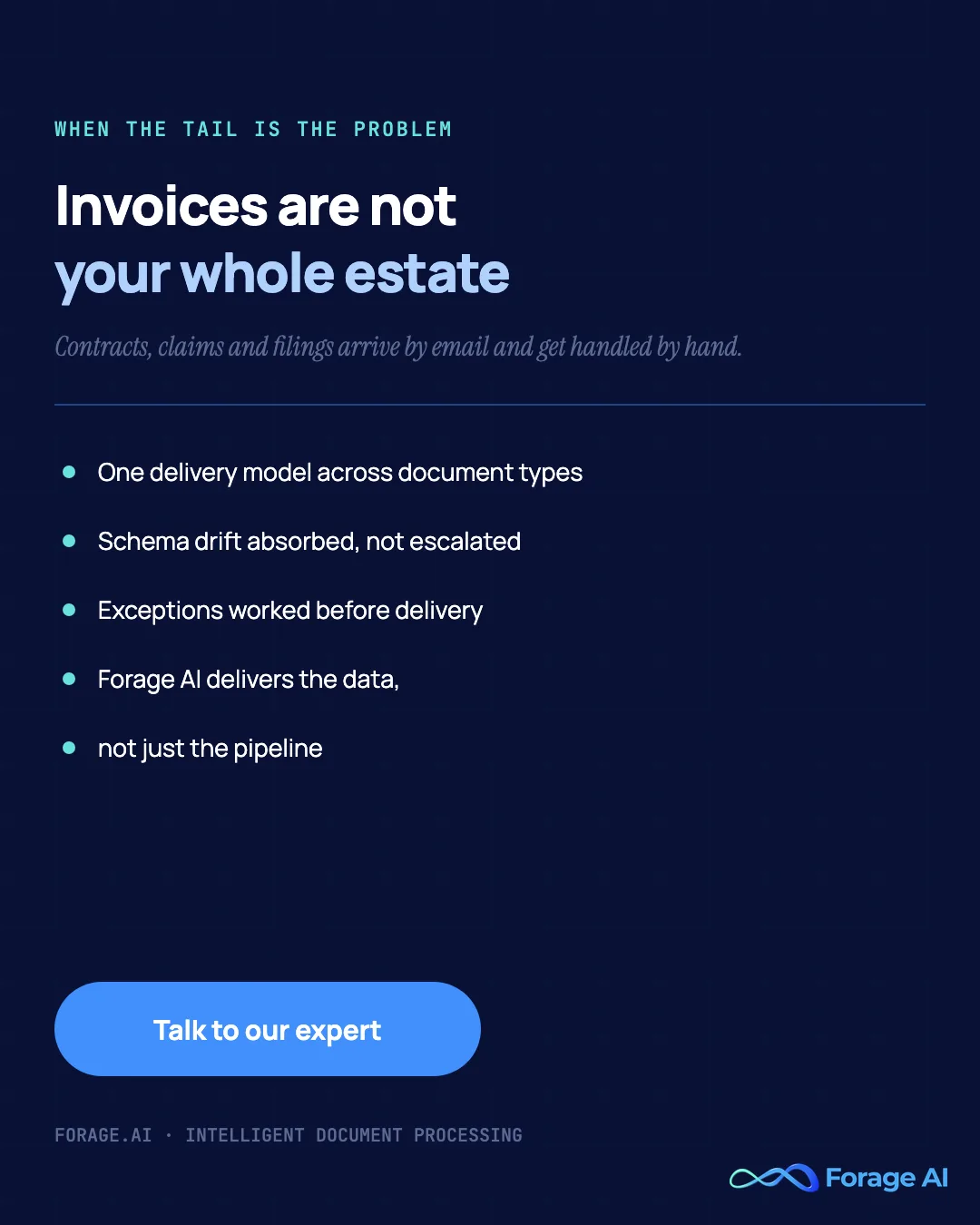
This gate is where the UiPath entry wins or loses on its own. If the destination is already inside a UiPath-orchestrated workflow, native handoff removes an integration surface permanently. If it is a bespoke ERP with a custom API, every vendor on this list will need the same middleware and the integration question stops discriminating between them.
Gate 4: What shape is the pricing, and what does twelve real months cost?
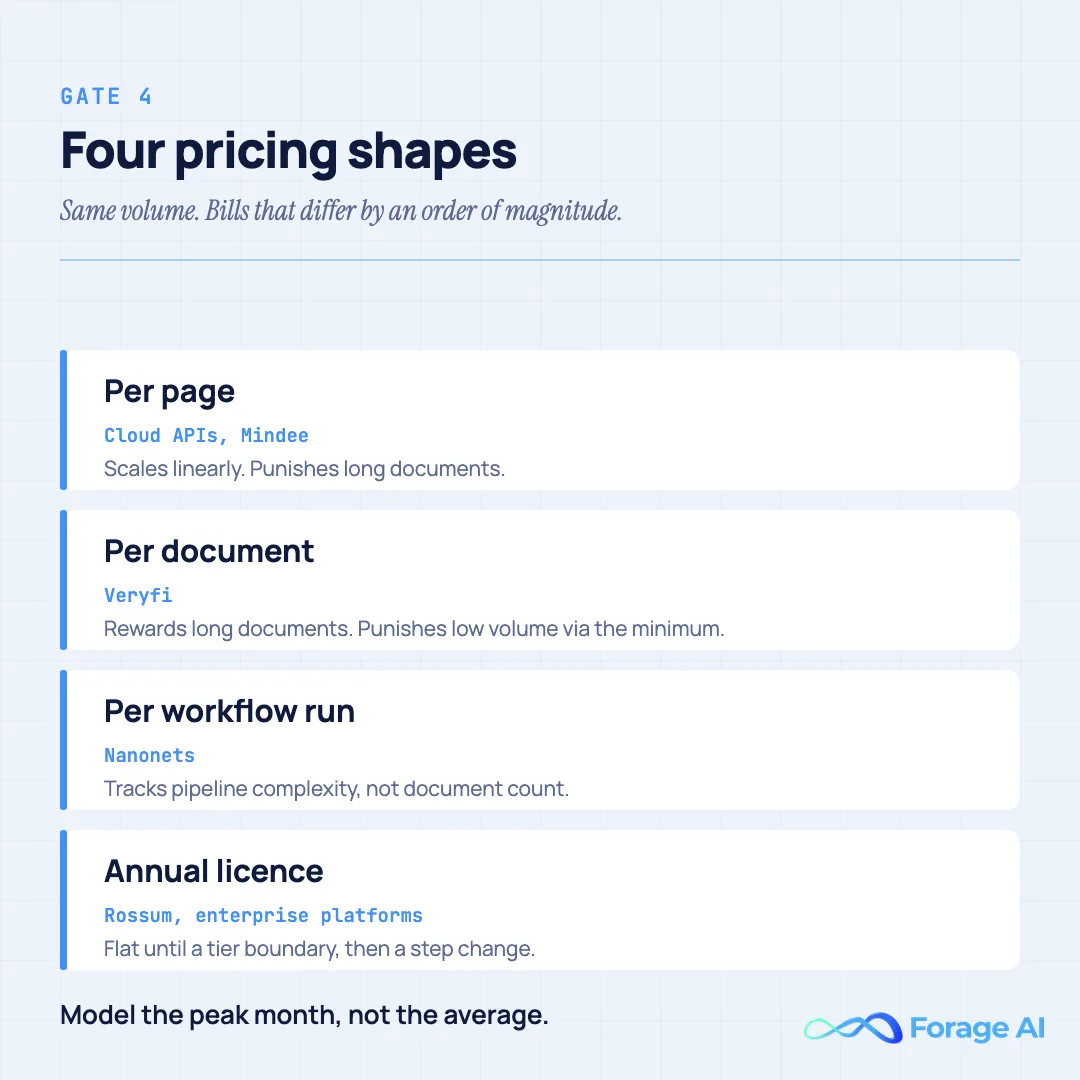
Four shapes appear on this roster and they behave completely differently under the same volume.
- Per page (cloud APIs, Mindee): scales linearly, punishes long documents, rewards flat volume.
- Per document (Veryfi): rewards long documents, punishes low volume through the monthly minimum.
- Per workflow run (Nanonets): tracks pipeline complexity, not document count. A four-step pipeline costs four times a one-step pipeline on identical volume.
- Annual licence (Rossum, enterprise platforms): flat until a tier boundary, then a step change.
Build one spreadsheet, your real twelve-month volume curve by month, and run every finalist through it. Model the peak month, not the average, because allowance-shaped pricing charges you for the peak. This is the single highest-yield hour in the whole evaluation and it is routinely skipped.
Gate 5: When accuracy drops on a new supplier format, whose problem is it?
The answer is structural, not contractual, and it follows directly from the category.
On a cloud API, it is yours. On an AI-native or enterprise platform, it is yours, with vendor support available. On a managed engagement, it is the provider’s, and that is most of what you are paying for. Every Forage AI delivery passes a 3x QA team before it lands in your system, which is a different answer to this gate than a confidence score is, and it is the reason the managed model exists as a category at all.
This is the Tuesday-afternoon question from the top of the roster, asked in its final form. There is no correct answer to it. There is only an answer that matches how much operational capacity you actually have, and the failure mode is choosing the platform your budget allows and the operating model your team cannot staff. For a broader view of the vendor landscape beyond the Rossum-replacement lens, our IDP solutions roundup covers the category on its own terms, and claims processing automation covers the insurance-specific version of gate one.
How do you actually choose between fifteen platforms?
Five gates, in order, because the first one invalidates most shortlists. What share of your volume is not transactional. Who works the exception queue and what they get. What system the extracted record has to land in, and whether the vendor speaks it natively. What shape the pricing is across twelve real months of your own volume. And whose problem it is when accuracy drops on a new supplier format.
What switching actually costs
Suppose the five gates gave you an answer and it is not your incumbent. The next question is what the move costs, and this is where the estimates are usually wrong.
Almost nothing in a migration goes wrong at the extraction step. Every platform on this list reads an invoice. The cost concentrates in schema and downstream integration, and it is routinely under-budgeted by a factor of two or three.
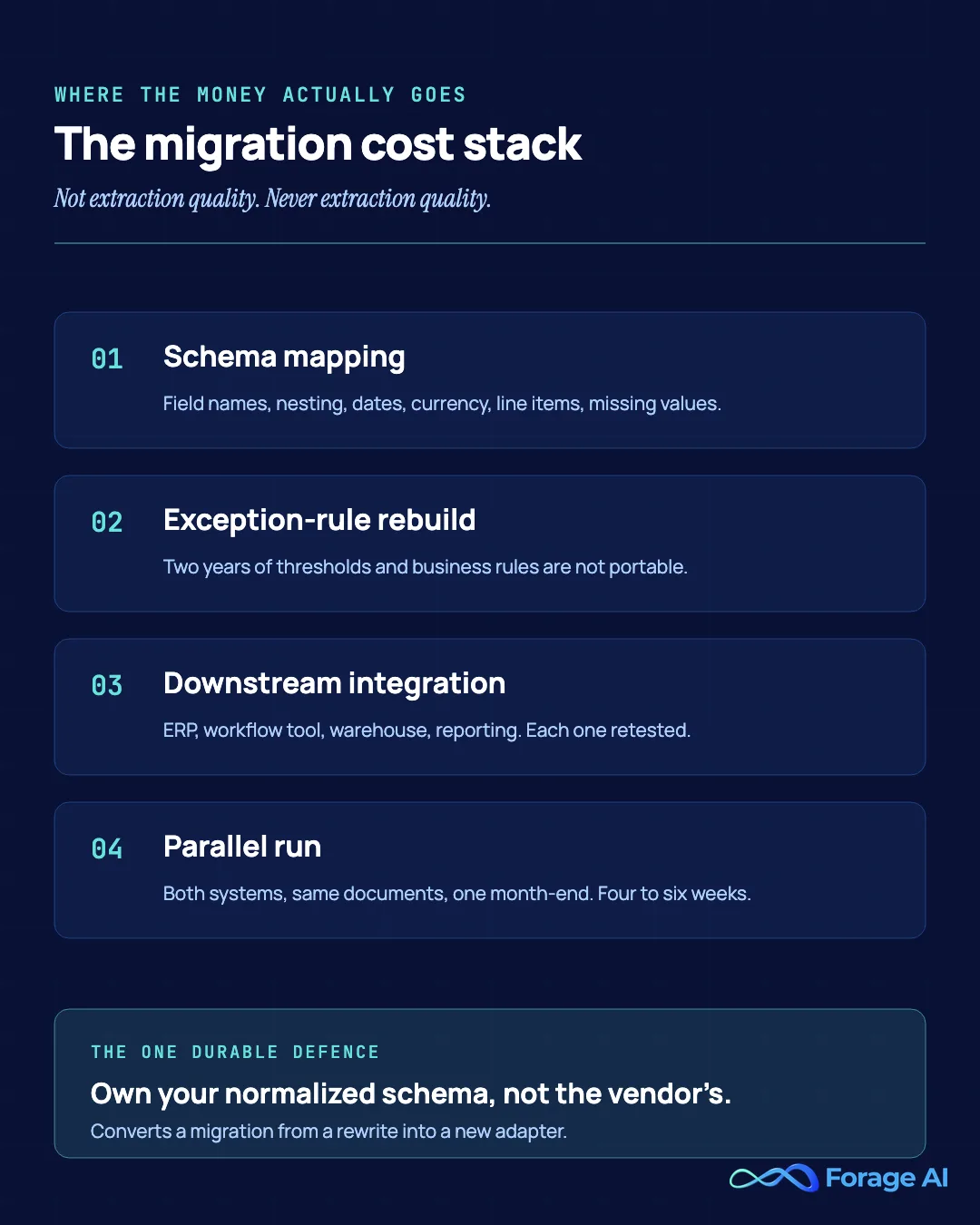
Four line items, in the order they hit.
Schema mapping. Your current extracted record has a shape, and it was shaped by your current vendor. Field names, nesting, date formats, currency handling, how line items are represented, what happens to a missing value. The new vendor has a different shape. Somebody has to write and test that translation, and every downstream consumer of the old shape has to be checked against the new one.
Exception-rule rebuild. The validation rules you accumulated over two years are not portable. Every threshold, every business rule, every “if the supplier is X then the tax field means Y” is institutional knowledge encoded in a vendor’s configuration language. Budget a full rebuild, and budget the archaeology of working out why each rule exists.
Downstream integration. The ERP, the workflow tool, the data warehouse, the reporting layer. Each one consumes the extracted record and each one needs testing against the new source. This is where timelines slip, because the work is spread across teams that did not choose this project.
Parallel run. Both systems processing the same documents for a period long enough to cover a month-end and at least one unusual supplier. Skipping this is the most expensive saving available. Four to six weeks is normal.
There is one durable defence against all four, and it is worth building whether or not you migrate now.
Own your normalized schema, not the vendor’s. Define the record shape your business needs, in your own repository, and treat every vendor’s output as something to be mapped into it. The mapping layer is small, boring code that you control. It converts a migration from a rewrite into a new adapter.
{
  "document_id": "string",
  "document_type": "invoice | purchase_order | receipt | other",
  "source": { "vendor": "string", "extracted_at": "ISO-8601", "confidence": 0.0 },
  "supplier": { "name": "string", "tax_id": "string", "address": "string" },
  "totals": { "currency": "ISO-4217", "net": 0.0, "tax": 0.0, "gross": 0.0 },
  "line_items": [
    { "description": "string", "quantity": 0.0, "unit_price": 0.0, "amount": 0.0 }
  ],
  "exceptions": [
    { "field": "string", "reason": "low_confidence | validation_failed", "value": null }
  ]
}
Nothing in that shape is vendor-specific. That is the point. Teams that own a schema like this switch vendors in weeks. Teams that inherited their vendor’s schema switch in quarters, and some of them do not switch at all, which is a commercial position you do not want to be in at renewal.
Where to start this week
If you take one thing from this into Monday, make it the ninety-day document count. Not the estimate, the count. Pull the actual volume, split transactional from everything else, and look at the ratio. That number will tell you which of the four categories you belong in before you have spoken to a single vendor, and it will save you the demo cycle that ends with the wrong shortlist.
Then build the pricing model. One spreadsheet, twelve months of real volume by month, every finalist run through it including the peak. An hour of that work is worth more than a week of demos, and it is the part teams skip because it is boring.
Everything else follows from those two artefacts. The exception-queue questions get sharper because you know your document mix. The integration conversation gets shorter because you know what the record has to land in. And the renewal conversation, if that is where this ends up, has numbers in it instead of frustration.
We would genuinely like to know what your ratio came out at. This category is short on honest operating data and long on vendor claims, and the gap gets closed by practitioners comparing notes rather than by another comparison table.
Frequently asked questions
Did Coupa buy Rossum?
Yes. Coupa announced the acquisition on 12 May 2026 at Coupa Inspire in Las Vegas, converting a partnership that had run since 2024. Guggenheim Securities advised Rossum financially with Orrick as legal counsel; Kirkland & Ellis acted for Coupa. Existing Rossum contracts are unaffected, and the product has not been deprecated. The practical change is directional: investment now concentrates where document processing meets spend management.
How much does Rossum cost?
Rossum’s published entry point is $18,000 per year on the Starter plan, with Business, Enterprise and Ultimate tiers quoted on request. SAP Store listings have shown Silver at $40,000 a year for 100,000 document pages and Gold at $70,000. The number that matters more than the licence is the effective per-document cost: at 50 invoices a month, an $18,000 floor works out to $30 per invoice in software fees alone.
What is the best Rossum alternative for invoices specifically?
It depends on volume and on who operates the pipeline. Below a few thousand invoices a month, Nanonets or Docsumo will be materially cheaper with comparable results on standard layouts. On AWS with engineering capacity, Amazon Textract’s Analyze Expense API at roughly $8 to $10 per 1,000 pages is the cheapest credible option on this roster, provided its fixed field schema covers what you need. Above that, if invoices are genuinely the whole workload, Rossum is a reasonable product and the honest question is your renewal number rather than your vendor.
Is there a free alternative to Rossum?
There are free tiers, not free platforms. Mindee processes up to 250 pages a month at no cost with no card required. Nanonets offers a free Starter tier with $200 of non-expiring credits. Docsumo runs a 14-day trial covering 1,000 pages, Veryfi has a free plan up to 100 documents a month, and Instabase trial accounts include $75 of usage over 14 days. All are genuinely useful for benchmarking on your own documents, which is a better use of them than treating them as a production tier.
Is Rossum still worth buying after the acquisition?
For transactional documents at meaningful volume, yes. It holds 4.5 on G2 across 127 reviews, states 92.5% average accuracy on its Aurora Transactional LLM, supports 276 languages, and was named a Leader in Everest Group’s 2026 IDP PEAK Matrix. The two questions worth getting in writing at renewal are standalone pricing for non-Coupa customers and the committed roadmap for document types outside the transactional set. If both answers are acceptable, an acquisition on its own is not a reason to migrate.
What is the best IDP software overall?
There is no single answer, and any article that gives you one is selling something. The category splits by operating model, not by quality. Gartner named ABBYY, Hyperscience, Infrrd, Tungsten Automation and UiPath as Leaders in its first IDP Magic Quadrant in September 2025, and all five are strong at enterprise breadth. Nanonets holds the highest rating on this roster with a substantial sample at 4.8 across 96 G2 reviews. Cloud APIs are cheapest per page by a wide margin. Managed providers are the answer when you do not want to operate a platform at all. Start with which of those four sentences describes your team.
Related Articles
- OCR vs IDP: Why Document Intelligence Beats Plain Text Recognition. Where OCR stops, where IDP starts, and the cost of choosing wrong.
- Invoice Automation: End-to-End Data Capture and Workflow. The full AP pipeline around the extraction step, from capture to exception routing.
- Document Workflow Automation: From Capture to Delivery. How IDP and workflow orchestration fit together in production.
- Top 10 Intelligent Document Processing Solutions. The wider IDP vendor landscape, evaluated without the Rossum-replacement lens.
Sai is a data infrastructure enthusiast who has spent the past two to three years following the AI space closely, from the infrastructure layer to the fast-growing world of data for AI. He is genuinely curious about how modern data pipelines get built and where the data industry is heading, and he writes insightful pieces on the core topics that shape this niche.