
Best Insurance Data Extraction Software: 14 Tools Compared (2026)
The hard part of insurance data extraction was never the software. It is the documents. A clean ACORD 25 from one carrier’s system and the same form from a different agency look nothing alike to a parser, a loss run arrives as a sprawling Excel file, and half your claims intake is scanned, stamped, and handwritten. Pick a tool that demos beautifully on a pristine PDF, and you will discover its real accuracy the first week a stack of faxed supplements hits the queue.
So this guide starts where the work actually breaks. First, what makes insurance documents hard and what “good” extraction looks like. Then the software, with a genuine reputation for insurance data, is judged on insurance documents rather than generic benchmarks. Then a comparison, how to choose, and the part most roundups skip: how to set it up so that straight-through processing does not quietly ship wrong data into your policy and claims systems.
The timing is not subtle. The share of insurers running full-scale AI adoption jumped from 8% in 2024 to 34% in 2025, and document extraction is usually the first place it lands.
Quick Digest
- The documents are the hard part: ACORD forms render differently across agency management systems, so template-based extraction breaks across carriers; template-free AI is what survives.
- Structured vs free-text are different problems: ACORD forms and COIs extract differently from claims narratives and adjuster reports, and few tools are great at both.
- Managed / done-for-you: Forage AI is the top pick when you want validated insurance data delivered to your schema, not software to run.
- Insurance-specialist IDP: Infrrd, Hyperscience, Docsumo, Indico, SortSpoke, and Lido are built or tuned for insurance documents.
- General IDP used in insurance: ABBYY Vantage, Rossum, Nanonets, and Sensible bring strong platforms you configure for insurance.
What makes insurance data extraction hard?
Before you compare tools, get clear on what you are actually asking them to do. Insurance documents fail to be extracted in specific, repeatable ways, and the software that wins is the software built for those failure modes.
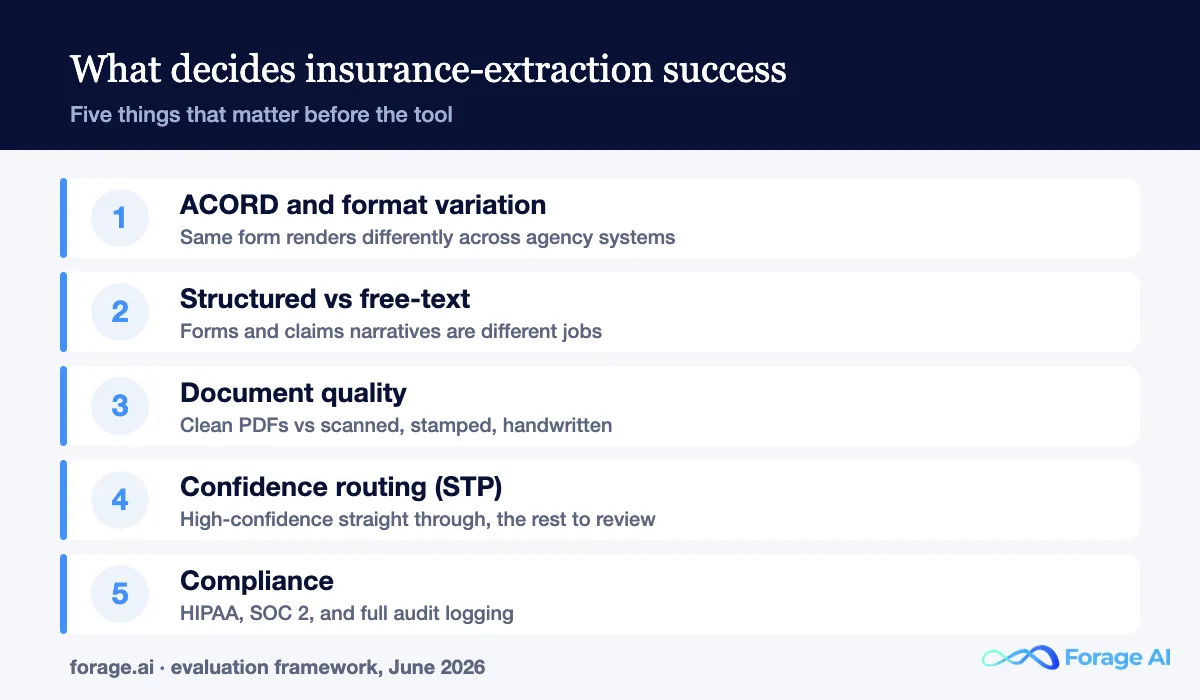
ACORD variation is the core problem, not the ACORD standard. An ACORD 25 certificate generated by Applied Epic, Vertafore AMS360, and HawkSoft carries the same fields in different positions. Template-based extraction that you tune for one carrier’s layout breaks the moment a different agency sends theirs. As one extraction guide puts it, the challenge “is not the form standard itself but the implementation variation across agency management systems.” When you receive forms from hundreds of agencies, template-free AI extraction is the only approach that scales.
Common misconception
Template-based extraction is not “good enough to start.” It works for one carrier’s ACORD 25 and breaks on the next agency’s rendering, so the configuration debt grows with every source you add.
Structured forms and unstructured free-text are two different jobs. An ACORD 125 application mixes printed fields, handwriting, and dense tables. A claims narrative, an adjuster’s report, or a policy endorsement is free text, where the meaning lies in the prose. Tools tuned for structured forms often stumble on narratives, and tools built for unstructured language need training before they can read a standard form well. Map your document mix before you shortlist anything.
Accuracy tracks document quality. Clean digital PDFs from carrier systems extract at near-perfect rates; scanned forms with handwriting and stamps score lower, which is exactly why handwriting recognition (strongest in the cloud document-AI engines) matters for claims intake.
Straight-through processing is a routing decision, not a switch. Real deployments set a confidence threshold: high-confidence extractions flow straight through, and the 3 to 5% that fall below it queue for human verification. Simple, standardized risks straight-through cleanly; complex and specialty risks still need an underwriter’s eyes.
Common misconception
A benchmark accuracy number is not your straight-through rate. Vendor “99%” is usually measured on clean digital PDFs. On scanned, handwritten ACORD 125s the rate drops, and whatever falls below your confidence threshold has to reach a human or you ship silent errors into claims.
Compliance is table stakes, not a feature. Health claims pull you into HIPAA; enterprise procurement will want SOC 2 and full audit logging of every extraction. And the document set is wider than ACORD forms: COIs, EOBs, loss runs (often Excel), adjuster and inspection reports, medical records, policy documents and endorsements, and claims correspondence.
Insurance extraction software at a glance
Here is the full roster, grouped by how each tool fits an insurance operation. The deep dives and the decision framework follow.
| Software | Category | Best for in insurance |
|---|---|---|
| Forage AI | Managed / done-for-you | Validated insurance data delivered, no platform to run |
| Infrrd | Insurance-specialist IDP | Pre-trained insurance models (ACORD, EOB, COI) |
| Hyperscience | Insurance-specialist IDP | High-accuracy structured forms at scale |
| Docsumo | Insurance-specialist IDP | ACORD 24/25 with a strong review interface |
| Indico Data | Insurance-specialist IDP | Unstructured claims narratives and policy language |
| SortSpoke | Insurance-specialist IDP | Underwriting submission and ACORD intake |
| Lido | Insurance-specialist IDP | Template-free extraction across submission packages |
| ABBYY Vantage | General IDP | Enterprise-scale, multi-department document ops |
| Rossum | General IDP | Transactional documents, fast model training |
| Nanonets | General IDP | Flexible, quick-start extraction with review |
| Sensible | General IDP | Developer-first extraction with an insurance library |
| Azure AI Document Intelligence | Cloud building block | Custom-trained models, strong handwriting |
| Google Document AI | Cloud building block | Best-in-class handwriting, custom training |
| AWS Textract | Cloud building block | Tables and key-value pairs from forms and claims |
The software, by category
Managed and done-for-you
Forage AI
This is the option most teams skip past, because they assume “software” means a platform their team operates. The real question for many insurance ops leads is whether they should be running an extraction platform at all.
| Best for | Teams that want validated data, not a platform to run |
| Insurance docs | ACORD, claims, policy docs, health claims, loss runs |
| Accuracy / STP | AI plus human validation to your accuracy bar |
| Deployment | Fully managed service, delivered to your schema |
| Standout | Owns extraction, QA, and maintenance end to end |
| Watch-out | A managed service, not a self-serve tool you log into |
Core features: managed extraction across ACORD, claims, policy, and health-claim documents; enhanced OCR for faded and handwritten scans; in-house ML with 95% table-detection accuracy; human validation on every extraction; delivery in your schema with ERP, CRM, and claims-system integration.
Forage AI is the right move when accuracy and coverage matter more than owning the tooling. Its intelligent document processing combines enhanced OCR for faded and handwritten scans, in-house ML models with 95% table-detection accuracy, and human validation on every extraction, the multi-layer QA that decides whether a 3 to 5% low-confidence tail becomes a clean review or silent leakage. It covers the full insurance document set and delivers structured data in the schema and format your policy and claims systems expect.
Two things set it apart from a platform you configure yourself. Validation and audit-logging workflows are built in, with regulated health-claims data handled under contractual controls and client-specific handling rules agreed up front, and your data stays yours, never resold. The honest trade-off: this is a partnership, not a self-serve dashboard you can complete in an afternoon. If you have the engineers and want to own the models, the platforms below fit better. If you want validated insurance data to simply arrive, this is the category.
Best for insurance when: you would rather receive clean, audited data than build and maintain an extraction pipeline.
In insurance document work, the human-review layer is the product, not an add-on. Anyone can hit 95% on clean forms; the value is in catching the field that scored 0.62 on a handwritten ACORD 125 before it posts to a policy. Whether you buy managed or build in-house, budget as much design effort for the review queue as for the model.
Quick Summary
Q: When does managed extraction beat buying an IDP platform?
A: When your bottleneck is people and accuracy, not tooling. A managed provider like Forage AI absorbs extraction, QA, and maintenance and delivers validated data, which is the work a platform leaves to your team. If you have engineers and want to own the models and review workflow, a platform wins.
Insurance-specialist IDP platforms
Infrrd
| Best for | Pre-trained insurance document models |
| Insurance docs | ACORD, EOB, COI, adjuster reports, medical records |
| Structured vs free-text | Both, including degraded scans |
| Watch-out vs Forage AI | You still run the platform and review workflow |
Core features: blended AI, ML, and rules-based extraction; confidence scoring with human-in-the-loop review; classification and field extraction across multi-page, low-quality documents; straight-through processing with reviewer feedback; API and workflow integration.
Infrrd ships models trained specifically on insurance document types, ACORD forms, explanations of benefits, certificates of insurance, adjuster inspection reports, and medical records, and it is built to read handwritten statements and degraded scanned correspondence where fields land in different places across submissions.
What users say: reviewers and analysts credit its insurance focus and tolerance for messy, multi-page documents, which is where horizontal tools tend to slip. The trade-off is the usual platform reality: you own configuration, the review queue, and ongoing tuning.
Best for insurance when: you want pre-trained coverage for the messy insurance document set out of the box.
Hyperscience
| Best for | High-accuracy structured forms at scale |
| Insurance docs | Structured ACORD and forms-heavy intake |
| Accuracy / STP | 99.5% accuracy, 98% automation (vendor) |
| Watch-out vs Forage AI | Weaker on free-text claims narratives |
Core features: supervised-ML classification, extraction, and validation modules; a low-code workflow builder; continuous retraining from reviewer corrections; flexible human-in-the-loop routing; on-premise or cloud deployment.
Hyperscience reports 99.5% accuracy and 98% automation across the structured documents insurers run on, and it pairs that with one of the stronger human-review interfaces, which matters when every field has to be verifiable.
What users say: reviewers rate it highly for structured, forms-heavy workloads, but flag that free-text and unstructured content, claims narratives, adjuster reports with embedded prose, and non-standard endorsements, do not extract at the same quality as clean forms. Pair it with something narrative-aware if your mix is heavy on prose.
Best for insurance when: your volume is dominated by structured forms and verification is non-negotiable.
Docsumo
| Best for | ACORD 24/25 with a strong review interface |
| Insurance docs | ACORD 24/25, COIs, loss runs |
| Accuracy / STP | 98.5% on supported document types (vendor) |
| Watch-out vs Forage AI | Best on supported types; edge cases need review |
Core features: pre-built insurance models plus custom training; table and line-item extraction; configurable validation rules; a review dashboard with side-by-side source images; REST API and downstream integrations.
Docsumo targets insurance directly, automatically extracting structured data from ACORD 24 and 25 forms and reporting 98.5% accuracy on supported document types, with a review interface that catches the remaining edge cases.
What users say: G2 reviewers consistently praise its ease of use and flexibility and credit it with cutting manual data entry on ACORD intake. For insurance claims where every field must be verified, its human-review interface is among the strongest in this group.
Best for insurance when: ACORD-heavy intake plus a fast, reliable review loop is the priority.
Indico Data
| Best for | Unstructured claims and policy language |
| Insurance docs | Claims narratives, policy language, correspondence |
| Structured vs free-text | Built for free-text |
| Watch-out vs Forage AI | Training-data investment before production quality |
Core features: LLM and transformer-based document understanding; teach-by-example model training; classification and workflow automation beyond extraction; a review interface tuned for unstructured content.
Indico takes the opposite bet from the forms specialists, building for unstructured documents: claims narratives, policy language, and legal correspondence where the answer is in the prose, not a labeled field.
What users say: Gartner Peer Insights reviewers value its unstructured strength, but note it lacks pre-trained models that work out of the box for standard insurance forms the way ABBYY or Docsumo do, so getting to production quality on a given document type takes an upfront training-data investment.
Best for insurance when: your hardest documents are narratives and correspondence, not forms.
SortSpoke
| Best for | Underwriting submission and ACORD intake |
| Insurance docs | ACORD forms, submission packages |
| Structured vs free-text | Mostly structured, submission-focused |
| Watch-out vs Forage AI | Narrower scope, underwriting-centric |
Core features: no-code “teach the machine” setup; human-in-the-loop review; submission triage and routing; structured output that drops into underwriting workflows.
SortSpoke is built around the underwriting submission, processing ACORD forms and submission packages and positioning itself on speed, extracting submission data several times faster than manual intake.
What users say: teams pick it for the narrow, well-defined job of turning a submission package into structured data for underwriting, where its focus is an advantage over broader platforms. If your need spans claims and policy admin too, it is one piece of the stack rather than the whole.
Best for insurance when: underwriting submission intake is the specific problem you are solving.
Lido
| Best for | Template-free extraction across a submission |
| Insurance docs | ACORD, loss runs, financial statements |
| Structured vs free-text | Both, no templates or rules |
| Watch-out vs Forage AI | Newer, lighter enterprise track record |
Core features: natural-language field prompts with no templates or training set; mixed submission-package handling (ACORD, loss runs, financials); spreadsheet-native structured output; fast time-to-first-extraction.
Lido reads insurance submission documents without templates, training sets, or rules. You upload an ACORD form, a loss run, or a financial statement, tell it which fields you need, and the AI extracts them, which directly addresses the multi-carrier variation problem.
What users say: the draw is speed-to-value, no per-format configuration before you get data, which suits teams drowning in layout variation. As a newer entrant, weigh its enterprise and compliance track record against the more established platforms for high-stakes claims.
Best for insurance when: format variation is your main pain and you want extraction without template upkeep.
General IDP platforms used in insurance
ABBYY Vantage
| Best for | Enterprise-scale, multi-department document ops |
| Insurance docs | Broad set across claims, underwriting, finance |
| Accuracy / STP | ~90% initial, improves with tuning (vendor) |
| Watch-out vs Forage AI | Enterprise weight; you run and tune it |
Core features: a marketplace of pre-trained document skills; NLP and classification; process intelligence and analytics; broad format and language support; on-premise or cloud deployment.
ABBYY is a long-standing enterprise IDP leader used across insurance for large-scale document operations spanning claims, underwriting, finance, and legal, with pre-trained models that reach roughly 90% accuracy on initial deployment and improve as you tune.
What users say: reviewers value the breadth, maturity, and professional-services depth for enterprise rollouts. The flip side is enterprise weight: it is a platform you staff and operate, which is overkill for a narrow ACORD-intake use case.
Best for insurance when: you are standardizing document processing across many departments at enterprise scale.
Rossum
| Best for | Transactional documents, fast model training |
| Insurance docs | Transactional intake, extends to insurance forms |
| Accuracy / STP | 92.6% after ~20 docs, 95% STP (vendor) |
| Watch-out vs Forage AI | Strength is transactional, not insurance-native |
Core features: cognitive data capture with email and document ingestion; an inline validation UI; fast example-based model training; API-first integration into downstream systems.
Rossum is known for fast learning on transactional documents, reaching 92.6% accuracy after roughly 20 documents and 95% straight-through processing on the document classes it specializes in. For the wider field around it, see our guide to Rossum alternatives.
What users say: reviewers appreciate the quick learning curve and a clean review experience. Its heritage is accounts payable and transactional capture rather than insurance-native forms, so validate it against your ACORD and claims documents specifically before committing.
Best for insurance when: your highest volume is transactional, and you want fast model training.
Nanonets
| Best for | Flexible, quick-start extraction with review |
| Insurance docs | General forms, configurable for insurance |
| Accuracy / STP | 93-99% field, 70-90% STP (vendor) |
| Watch-out vs Forage AI | OCR struggles on blurred or low-quality scans |
Core features: pre-built and custom models; approval and review workflows; line-item and table extraction; integrations with accounting and ERP tools plus a REST API.
Nanonets is a flexible, quick-start IDP platform that reports 93 to 99% field-level accuracy and 70 to 90% straight-through processing in mature implementations, with a configurable model-plus-review workflow.
What users say: G2 reviewers praise its ease of use and accuracy, while consistently flagging OCR issues with blurred documents, incorrect mappings and trouble on low-quality scans. For insurance, that points straight at your faxed and photographed claims documents, so test those first.
Best for insurance when: you want a fast, flexible start and your scans are reasonably clean.
Sensible
| Best for | Developer-first extraction with insurance library |
| Insurance docs | Insurance solution library, configurable |
| Structured vs free-text | Both, via templates plus LLM prompts |
| Watch-out vs Forage AI | You build and maintain the configurations |
Core features: the SenseML query language combined with GPT-based prompts; reference documents and validation checks; a developer SDK and API for code-level control; an insurance solution library to start from.
Sensible is built for developers, combining template-based methods with LLM prompts and shipping an insurance-focused solution library so engineering teams can stand up document-specific extraction with code-level control.
What users say: engineering teams like the control and the prompt-plus-template flexibility. The cost is ownership: you design, build, and maintain the extraction logic, which is leverage if you have developers and overhead if you do not.
Best for insurance when: you have engineers who want to own extraction in code.
Cloud document-AI building blocks
Azure AI Document Intelligence
| Best for | Custom-trained models, handwriting, unstructured |
| Insurance docs | Forms plus correspondence, with custom training |
| Structured vs free-text | Both, you label and train |
| Watch-out vs Forage AI | You assemble the pipeline and review layer |
Core features: prebuilt models (invoice, ID, receipt), custom models, and a general layout model; key-value, table, and selection-mark extraction; handwriting support; an async API with an on-premise container option.
Azure AI Document Intelligence, formerly Form Recognizer, is an end-to-end building block with custom labeling and training, plus strong handwriting recognition and NLP for unstructured content such as correspondence and endorsements.
What users say: engineering teams rate it for its custom-training controls and handwriting quality, and it edges out AWS on irregular or older documents. The catch is that it is a primitive, not a solution: you build classification, routing, the review queue, and insurance logic on top of it.
Best for insurance when: you have an engineering team building a custom pipeline and want trainable models with good handwriting.
Google Document AI
| Best for | Best-in-class handwriting, custom training |
| Insurance docs | Forms and handwritten claims, with custom training |
| Structured vs free-text | Both, you label and train |
| Watch-out vs Forage AI | You assemble the pipeline and review layer |
Core features: specialized and general processors (OCR, form parser, custom extractor); a Workbench for training custom models; entity extraction; native integration across Google Cloud.
Google Document AI offers custom labeling and training like Azure, and is repeatedly singled out alongside it for the best handwriting recognition, which is the deciding factor on handwritten claims and supplements.
What users say: teams choose it for handwriting accuracy and the ability to train on their own document types. As with Azure, it is a component: the insurance-specific intelligence, routing, and human review are yours to build and run.
Best for insurance when: handwritten documents are central and you have engineers to build around the API.
AWS Textract
| Best for | Tables and key-value pairs from forms |
| Insurance docs | Structured forms and claims, tables |
| Structured vs free-text | Structured, as-is models |
| Watch-out vs Forage AI | No custom training; you build everything around it |
Core features: AnalyzeDocument for forms, tables, and natural-language Queries; AnalyzeExpense for invoices and receipts; asynchronous processing for multi-page documents; native integration across AWS services.
AWS Textract is strong at pulling text, tables, and key-value pairs from forms, with invoices, insurance claims, and receipts squarely in its sweet spot.
What users say: developers rate it for reliable structured extraction, but note the hard limit: Textract is provided as-is with Amazon’s pre-trained models and does not allow custom training on your own document types. For non-standard insurance forms, that pushes the burden onto your downstream logic.
Best for insurance when: you need dependable table and key-value extraction from standard forms and will build the rest.
How the insurance extraction tools compare
The roster lists who is on the list; this table shows how they differ along the axes that determine an insurance deployment. Accuracy and STP figures are vendor-reported, as of June 2026.
| Software | Insurance docs | Accuracy / STP (vendor-reported) | Structured vs free-text | Deployment | Compliance |
|---|---|---|---|---|---|
| Forage AI | ACORD, claims, policy, health claims | AI + human validation to your bar | Both (managed) | Managed service | Contractual controls; no data resale |
| Infrrd | ACORD, EOB, COI, adjuster, medical | Insurance-tuned models | Both | Platform | Enterprise |
| Hyperscience | Structured insurance forms | 99.5% acc / 98% automation | Structured (weak free-text) | Platform | Enterprise |
| Docsumo | ACORD 24/25, COI, loss runs | 98.5% on supported types | Mostly structured | Platform | SOC 2 |
| Indico Data | Claims narratives, policy language | Needs training data upfront | Free-text (unstructured) | Platform | Enterprise |
| SortSpoke | ACORD, submissions | “5x faster” intake | Mostly structured | Platform | Enterprise |
| Lido | ACORD, loss runs, financials | Template-free, no training set | Both | Platform | SOC 2 |
| ABBYY Vantage | Broad insurance doc set | ~90% initial, improves | Both | Platform | Enterprise |
| Rossum | Transactional + extends to insurance | 92.6% after ~20 docs, 95% STP | Mostly structured | Platform | SOC 2 |
| Nanonets | General + insurance forms | 93-99% field, 70-90% STP | Both (config) | Platform | SOC 2 |
| Sensible | Insurance solution library | Template + LLM prompts | Both (you build) | Developer API | SOC 2 |
| Azure AI Document Intelligence | Forms + handwriting + NLP | Custom-trained | Both (you build) | Cloud API | Enterprise cloud |
| Google Document AI | Forms + best handwriting | Custom-trained | Both (you build) | Cloud API | Enterprise cloud |
| AWS Textract | Tables, key-value, forms | As-is, no custom training | Structured | Cloud API | Enterprise cloud |
How do you choose insurance extraction software?
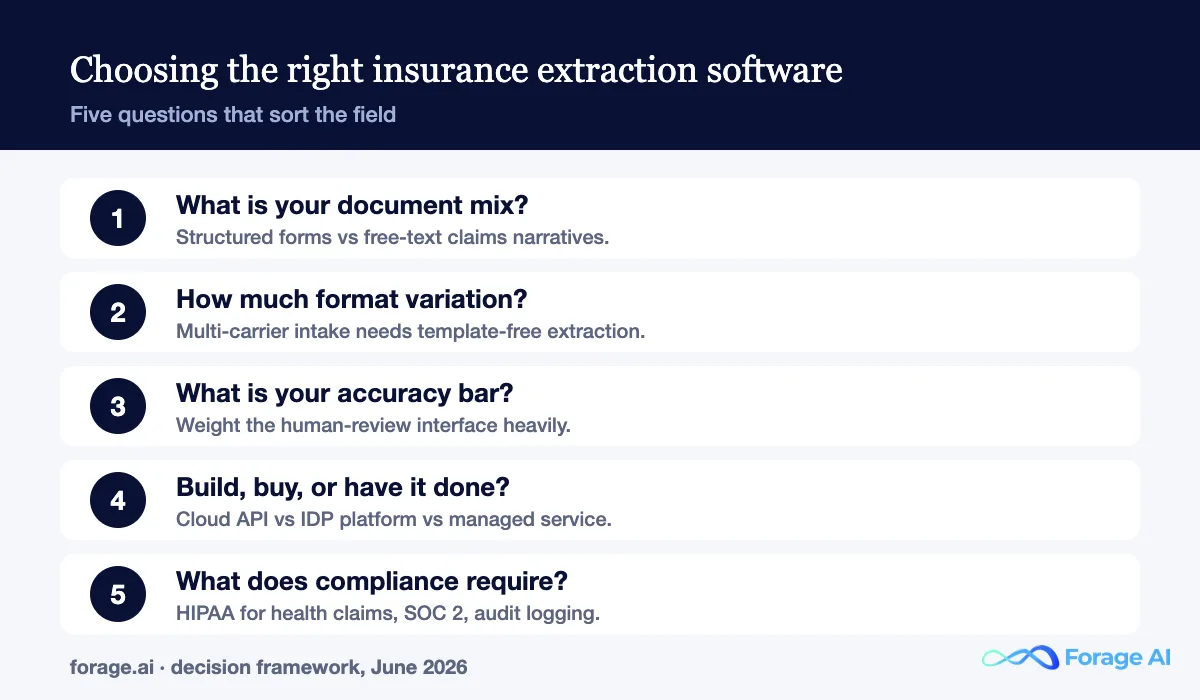
Start from your documents and your team, not the feature list. Five questions sort the field.
- What is your document mix? Mostly structured ACORD forms and COIs points to Hyperscience, Docsumo, or SortSpoke; heavy free-text claims narratives points to Indico or an NLP-strong cloud engine; a real mix points to a specialist that does both or a managed layer.
- How much format variation and volume? Intake from hundreds of agencies makes template-free extraction (Lido, the AI-first specialists, or managed) non-negotiable, because template upkeep does not scale across carriers.
- What is your accuracy bar, and who verifies? If every field must be checked, weight the human-review interface heavily; Docsumo and Hyperscience lead there, and a managed provider builds the review into delivery.
- Build, buy, or have it done? Engineers who want control build on Azure, Google, or Textract; teams wanting a working platform buy an IDP; teams wanting validated data without operating anything choose managed.
- What does compliance require? Health claims mean HIPAA; enterprise procurement means SOC 2 and audit logging. Rule out anything that cannot evidence both before you pilot.
And the honest counter-case: if your documents are clean, standard, structured forms and you have an engineering team, a cloud building block like Textract or Azure can be all you need. The managed and specialist options earn their keep when documents are messy, mixed, high-stakes, or your team is small.
Setting it up so it actually works
The software choice is maybe half the outcome; the setup is the rest. This is where insurance extraction projects quietly succeed or fail, and it is the part most comparisons leave out.
- Set a confidence threshold before go-live, not after. Decide what score routes straight through and what queues for review. Without an explicit cutoff, the tool either overrejects and buries your team or overaccepts and posts incorrect fields to policies and claims.
- Design the human-review queue as a first-class workflow. The 3 to 5% below threshold is where accuracy is won or lost. Make the review fast, give reviewers the source image next to the extracted field, and feed corrections back to improve the model.
- Test on your worst documents, not the demo set. Run the faxed supplements, the handwritten loss runs, the ACORD 125s from your messiest agencies. The clean-PDF accuracy number is not the one you will live with.
- Plan the integration into policy and claims systems. Extraction that produces a spreadsheet nobody ingests is not automation. Confirm the output schema and the path into your downstream systems before you scale.
- Bake in compliance and audit logging. For health claims, confirm HIPAA handling; for procurement, confirm SOC 2 and a complete audit trail of every extraction and override.
- Monitor for drift and silent failure. A new carrier format or a model update can quietly drop accuracy on one document type. Track field-level accuracy and STP over time so a regression surfaces before a customer or auditor finds it.
Last updated June 2026. No vendor paid for placement in this comparison; rankings reflect public reviews, analyst sources, vendor-reported benchmarks, and fit against real insurance document workflows.
FAQ
What is the best software to extract data from ACORD forms?
For ACORD-heavy intake, the insurance specialists lead: Docsumo and Infrrd ship pre-trained ACORD coverage, and Lido and SortSpoke handle format variation without templates. The key requirement is template-free extraction, because ACORD forms render differently across agency management systems, so a tool tuned to one carrier’s layout will fail on another’s.
How accurate is insurance data extraction, realistically?
Vendors report 90-99% accuracy, but those figures are usually measured against clean, structured documents. On scanned and handwritten forms, the rate drops, and field-level accuracy of 93 to 99% with 70 to 90% straight-through processing is a realistic range for mature deployments. The remaining low-confidence fields should route to human review rather than flow through automatically.
Which tools handle free-text claims narratives, not just forms?
Indico Data is built for unstructured content like claims narratives, policy language, and correspondence, and the cloud engines (Azure AI Document Intelligence, Google Document AI) provide strong NLP for free text when you train them. Forms specialists such as Hyperscience are excellent with structured documents but weaker with free text, so a mixed document set often requires two tools or a managed layer that covers both.
Is insurance data extraction HIPAA compliant?
It can be, but compliance lives with the deployment, not the algorithm. For health claims, you need HIPAA-compliant handling, and most enterprise buyers also require SOC 2 and full audit logging of every extraction and override. Confirm that a vendor can provide evidence of those before piloting; a managed provider typically builds compliance and the audit trail into delivery.
Should we build on a cloud OCR API or buy a platform?
Build on Azure, Google, or AWS Textract if you have engineers to assemble classification, confidence routing, a review queue, and insurance logic on top of the OCR. Buy an IDP platform, or use a managed provider, if you want a working insurance pipeline without staffing that builds. The cloud APIs are strong primitives, not finished insurance solutions.
Related Articles
- Top 10 Intelligent Document Processing Solutions. The general IDP list, for document workloads beyond insurance.
- Contract Data Extraction. How teams automate clause and entity extraction without losing accuracy.
- Document Digitization. Turning physical records into searchable, structured data at scale.
- AI Document Processing in Healthcare. The compliance-heavy cousin of insurance claims extraction.
Sai is a data infrastructure enthusiast who has spent the past two to three years following the AI space closely, from the infrastructure layer to the fast-growing world of data for AI. He is genuinely curious about how modern data pipelines get built and where the data industry is heading, and he writes insightful pieces on the core topics that shape this niche.