
Best News APIs and News Data Providers (2026): 18 Compared
Ask two buyers for the best news API and you get two different shopping lists. A developer wants a self-serve endpoint that survives past the free tier. A fund, a risk team or an AI team wants licensed archives and newswires, with rights attached to the text.
One self-described customer on Hacker News split the market into "the buyers and the scrapers" in April 2024. Buyers "have licencing agreements with publishers", while "few, if any [scrapers] provide full text". That split still decides what you can do with news data: articles delivered as data (text, timestamps, metadata) rather than read in an app.
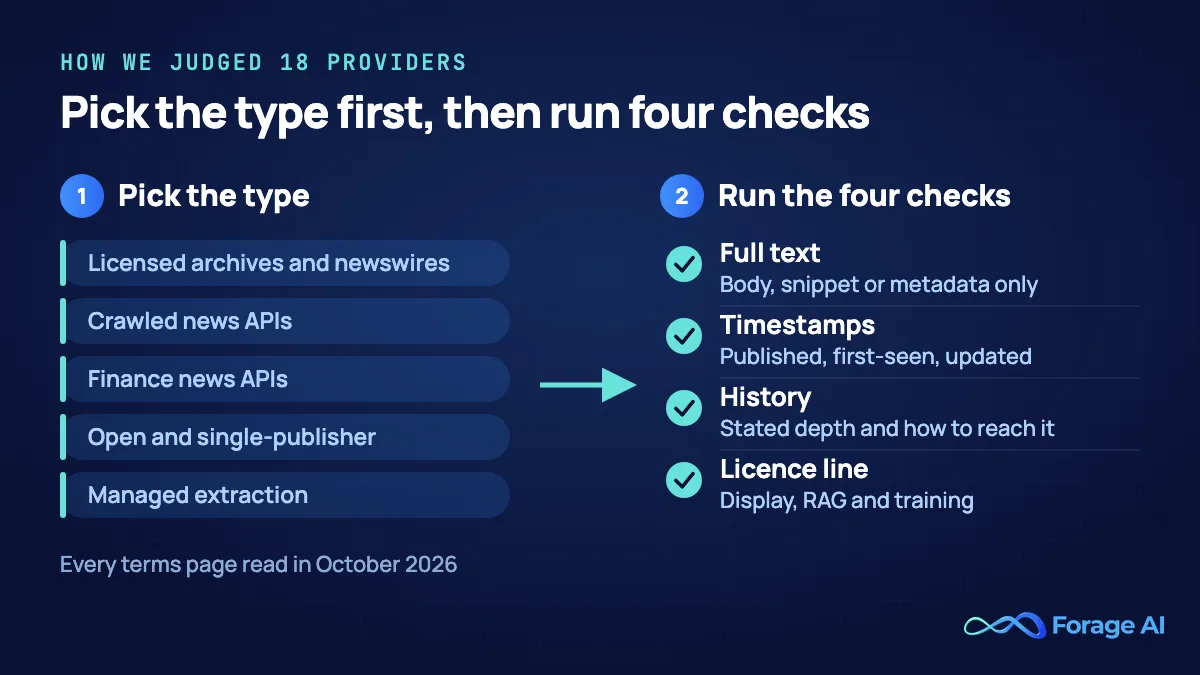
So this list covers both worlds. It sorts 18 news data providers into five types by how each one gets its text, then checks every entry on four points: full text, timestamps, history and the licence line for display, RAG and training.
The ground moves, too. Microsoft retired its Bing Search APIs, Bing News Search included, on 11 August 2025, and two ranking pages still sell it as live. By the end of this article, you will have a shortlist of two or three providers in the right type and a trial checklist to test them on.
- Type first: a news data provider is a licensed archive, a crawled API, a finance API, an open or single-publisher source, or managed extraction, and the type sets your rights.
- Full text is not the default: NewsAPI.org, Tiingo, Alpha Vantage and Marketaux return snippets, descriptions or summaries; GDELT returns metadata and links, not article text.
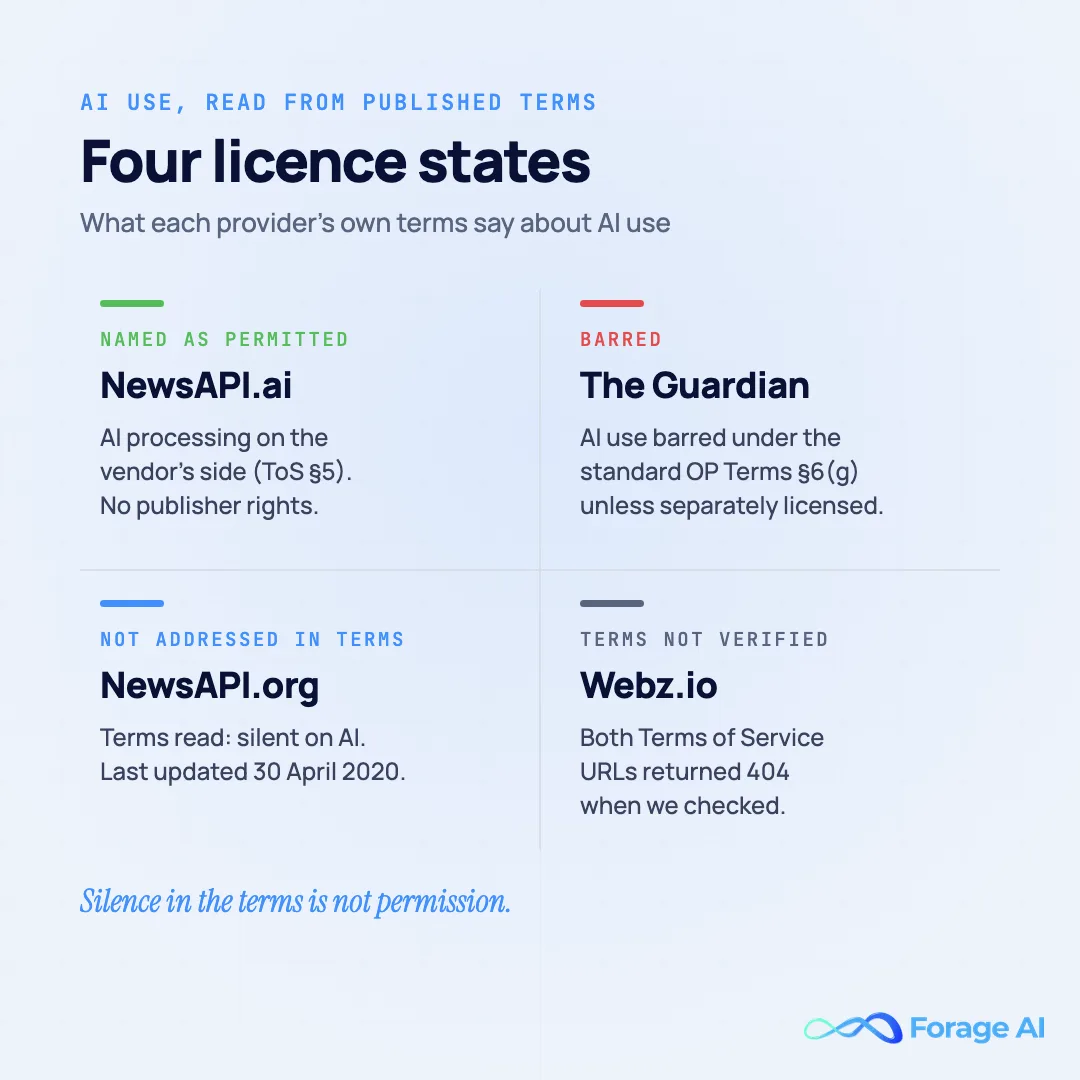
- Licences rarely answer the AI question: only NewsAPI.ai's terms name AI processing as permitted (on its own side, no publisher rights); the Guardian's standard terms bar AI use; most terms say nothing about RAG or training.
- Test before you sign: run the same queries on two vendors, check which timestamp your date filter uses, ask what you must delete when you cancel, and get the AI clause in writing.
Need more outlets than any single API carries? We run news data collection across the outlets you actually care about. Talk to us about coverage.
How did we judge news data providers?
We judged every provider on the same seven rows, across all five types, so a licensed newswire and a free headline API can be read side by side. These are the checks a buyer runs anyway before a trial.
| Factor | What we checked |
|---|---|
| What "source" means | The vendor's own definition, or "not defined" |
| Full text vs snippet | Body, description, summary, headline or metadata only |
| Timestamps & freshness | Documented fields (published, first-seen, updated) and any stated delay |
| History | Stated depth and start date, and the delivery route that reaches it |
| Licence incl. AI use | Display, RAG/grounding and training as three lines, from published terms |
| Delivery | REST, stream, bulk, BigQuery, RSS |
| Pricing model | Model plus one dated listing; no price-level comparison |
Licence is a row, not a footnote, because the same article text carries different rights depending on who supplies it. Latency is not scored: no measured latency exists for any provider here, only vendor statements, so it moves to the trial checklist.
We read the published terms of every provider that publishes them. Where a licence says nothing about AI use, the row reads "not addressed in published terms", never "permitted".
Counts need the same care. "Source" is undefined by every crawled provider we read, and ranking pages print some vendors' counts at up to a third of the vendor's own figure. So every count below comes from the vendor's own page, dated.
G2 reviews are cited only where n ≥ 20 and the rated product is the API. One honest caveat on the method: a provider that documents less is not necessarily worse, it is harder to check. No vendor paid for placement. Every terms page was read on 22 October 2026.
News data providers at a glance
Here is the answer in one screen. The Type column shows each buyer world its tier, and the flags surface deal-breakers (snippet only, non-commercial keys, internal use) early.
Verified October 2026. Every figure is the vendor's own.
| Provider | Type | Full text? | AI-use clause | Price model | Best for |
|---|---|---|---|---|---|
| Dow Jones Factiva | Licensed archive + newswire | Licensed content; format not stated | 8,000+ sources licensed for GenAI; training not named; contract-only | Contact sales | Licensed archive for research, risk, AI |
| LexisNexis Nexis Data+ | Licensed archive + web news | Not stated per strand | Terms not verified | Contact sales | Licensed and web news in one contract |
| LSEG MRN | Licensed newswire | Yes | Terms not verified (contract-only) | Contact sales (packages) | Point-in-time finance research |
| NewsAPI.ai (Event Registry) | Crawled news API | Yes | AI processing named as permitted (vendor side); no publisher rights | Free plan; from $90/mo (Oct 2026) | Event clustering with written AI terms |
| Webz.io | Crawled open web | Yes | Terms not verified; per-post ai_allow flag |
Free credit, then pay-as-you-go | Broad crawl, three timestamp fields |
| NewsCatcher | Crawled news API | Yes | Not addressed; Internal use only | Public tiers; production on Enterprise | Full text for internal analytics |
| Perigon | Crawled news + web API | Not stated | Not addressed | Public tiers; one-hour delay on lower plans | Monitors plus a long top-plan archive |
| NewsAPI.org | Crawled headline API | Snippet only | Not addressed | Public tiers; Developer key non-production | Prototypes and headline search |
| NewsData.io | Crawled news API | Custom plans only | Not addressed | Public tiers, credits | Breadth plus press releases |
| GNews | Crawled news API | Paid plans (Free truncated) | Not addressed | Public tiers; Free non-commercial | Small commercial products needing full text |
| Mediastack | Crawled news API (light) | Not stated | Terms not verified; Free plan non-commercial | Public tiers | Low-cost headline feeds |
| Benzinga | Licensed financial newswire | Yes, embeddable | Display named; AI terms not verified | Contact sales | Displaying US equities news |
| Tiingo News | Finance crawled API | Snippet only (description) | Not addressed by name; internal use only; delete on cancel incl. backups | Not verified | Backfill-aware finance news |
| Alpha Vantage NEWS_SENTIMENT | Finance news + sentiment | Summary only | Marketed for LLM training; no licence clause found | Free key + premium | Ticker-filtered news with sentiment |
| Marketaux | Finance news API | Snippet only | Terms not verified | Free tier; from $29/mo (Oct 2026) | Low-cost entity-tagged market news |
| GDELT | Open event database | Metadata + links, no text | Datasets unrestricted with citation; AI not addressed | Free | Global event research at no cost |
| The Guardian Open Platform | Single-publisher API | Yes | Barred under standard terms; training licensable by negotiation; 24-hour retention | Dev key free, non-commercial; commercial usage-priced | Full text from one publisher |
| Forage AI | Managed news data extraction (custom-built pipeline) | Set by the sources you specify | Does not license publisher content | Contact Forage AI | Sources or schema no feed covers |
Best news data providers and news APIs, by type
The best news API for your job depends first on its type, because the type sets what rights travel with the text. The 18 sit in five types, ordered by how the provider gets its text: licensed archives and newswires, crawled news APIs, finance-specific news APIs, open and single-publisher sources, and managed news data extraction.
Every entry uses the same 12 rows in the same order.
Licensed archives and newswires
Start with the tier the ranking pages leave out. None of the nine ranking listicles we reviewed carries a licensed archive, yet "factiva" alone draws about 4,400 searches a month. Here a publication counterparty exists and gets paid, so you get full text with rights and deep history.
Nothing in this band is self-serve. The licence is a contract, not a web page: none of the three below publishes an API licence.
Two names you will see on other lists are mentioned here but not scored. Bloomberg Event-Driven Feeds is a licensed financial newswire delivered through Bloomberg Data License, not a developer news API, and we could not read a primary page for it. RavenPack appears as a content provider only; for the signal view, see our alternative data vendors comparison.
News Corp's 2024 deal with OpenAI grants permission "to display content from News Corp mastheads in response to user questions and to enhance its products"; the word "training" does not appear in the release (News Corp, 22 May 2024). Dow Jones counts its GenAI-licensed sources separately: more than 8,000 licensed "for use in GenAI applications", named as conversational AI, summarisation and deep research tools, inside a catalogue its developer site lists at 33K+ sources (January 2026). Training is not named. Read the use, not the word "licensed".
1. Dow Jones Factiva
| Attribute | Detail |
|---|---|
| Best for | Licensed content under one contract. Not for: a self-serve prototype |
| Type | Licensed archive + newswire |
| What "source" means here | A licensed publication, not a website |
| Coverage (as stated) | 33K+ sources, 30 languages (developer site, Oct 2026); 8,000+ licensed for GenAI (release, Jan 2026). Two measures, never one figure |
| Full text | Licensed publisher content; body format not stated at primary |
| History | "30+ Years of Content" |
| Timestamps & freshness | Not stated at primary; edits and deletions not documented |
| Licence incl. AI use | Display: terms not verified. RAG/grounding: terms not verified (a release, not a clause). Training: terms not verified; not named. Source: Dow Jones release 2026-01-20 + developer site |
| Delivery | Factiva APIs, custom feeds, SFTP to cloud storage |
| Pricing model | Contact sales (trial on request) |
| User reviews | G2 4.1/5 (n=71), rates the research product, not the API |
| Watch-out | The GenAI set is a subset and names applications, not training |
Factiva is the category anchor. Its two counts may not define "source" the same way, so we print both and merge neither. In practice, a research or RAG team can ask which of its target titles sit inside the GenAI set and get a contractual answer. A team that wants to train a model gets nothing from the 8,000 figure, because the release never says training. Expect a sales cycle and no public price.
2. LexisNexis Nexis Data+
| Attribute | Detail |
|---|---|
| Best for | Deep archive, licensed and web news. Not for: one clean source count |
| Type | Licensed archive + crawled web news |
| What "source" means here | Mixed: licensed news, open-web news, blogs and broadcast transcripts under one count |
| Coverage (as stated) | Four own-page figures: 100,000+ (news-media page, Oct 2026); 80,000+; 40,000; 36,000 licensed / 45,000 total |
| Full text | Not stated per strand |
| History | "decades-deep"; transcripts "30+ year archive"; "over 40 years" (regional page) |
| Timestamps & freshness | Not stated; edits and deletions not documented |
| Licence incl. AI use | Display, RAG/grounding, training: terms not verified. Source: news-media page; no licence published |
| Delivery | News API + Nexis Data+ portal; historical/bulk API |
| Pricing model | Contact a data consultant |
| User reviews | G2 4.3/5 (n=44), rates the research product, not the API |
| Watch-out | Licensed and web news carry different rights |
Nexis Data+ is the clearest case of source-count drift we found: four figures on LexisNexis's own pages, none saying which definition of "source" it uses. We show all four and pick none. The product page's "building blocks for AI-powered tools" is copy, not a licence clause.
Licensed news, open-web news, blogs and broadcast transcripts all live under one headline count, so "licensed archive" does not mean every item is licensed. Before you sign, ask which strand each article comes from and what rights that strand carries.
3. LSEG MRN (Machine Readable News)
| Attribute | Detail |
|---|---|
| Best for | Point-in-time history for funds and surveillance. Not for: consumer display |
| Type | Licensed newswire (Reuters + third-party wires) |
| What "source" means here | Reuters and named third-party newswires; third-party count not stated |
| Coverage (as stated) | Reuters and third-party newswires (product page, Oct 2026); "45,000+ public and private companies" (fact sheet, 2024) |
| Full text | Yes ("headlines, stories and metadata") |
| History | Text archives from 1996; news analytics from 2003 |
| Timestamps & freshness | firstCreated and versionCreated; analytics "with millisecond time stamps" from 2003. Correction, update and delete messages documented |
| Licence incl. AI use | Display, RAG/grounding, training: terms not verified. Contract-only. Source: product page, fact sheet, developer guides |
| Delivery | Streaming, request-response, bulk files; JSON |
| Pricing model | "a range of packages", contact sales |
| User reviews | No verified reviews |
| Watch-out | No language or third-party source count published; licence not public |
LSEG MRN is the point-in-time benchmark for this article. LSEG's 2024 fact sheet describes "normalised, enriched and point-in-time news in a feed format your machine understands". firstCreated records when the item first appeared and versionCreated when this version was received, and a delete carries stat:canceled with an instruction to remove the story. It is also the answer to a common search: the Reuters news API is not free, because Reuters text reaches developers through these licensed packages.
Here's how it actually works in a backtest. A first take has firstCreated equal to versionCreated. A later correction keeps firstCreated and advances versionCreated, so a backtest keyed on the version time dates the story at its correction, not its break. Deletes need the same discipline: the guide puts the purge on "the application", and a warehouse that never consumes delete messages keeps the withdrawn story.
Crawled news APIs
That is the contract route. The second type, crawled news APIs, is the self-serve route: aggregators that crawl publisher sites and feeds. Asked how they source, one Hacker News commenter answered in April 2024: "they use RSS." They are cheap and fast to start.
Three limits travel with them. "Source" is undefined by every one we read. Coverage inherits the edge: Cloudflare announced in July 2026 that from 15 September 2026, for all new domains onboarding to it, "the categories of Training and Agent will be blocked by default on the pages that display ads". And paywalls: NewsCatcher states it does not bypass them, NewsAPI.org says it cannot provide full content, and the others we read say nothing.
"Some of the content your product needs is behind a block or a paywall today, and it's the content that changes fastest: news, research, specialist trade publications."
Rúben Teixeira, Jack Galilee, Kayte Johnston and Sam Else, Cloudflare, "Pay Per Use" (30 September 2026). Cloudflare's view as an infrastructure vendor.
You feel those limits as silent gaps, as one customer put it on Hacker News in 2024: "you can literally see the gaps in the time series where something has fallen over". Where a licence exists in this band, it covers the vendor's side only. Diffbot sits on the boundary and is not scored: a web knowledge graph with an Article API, not a news feed (G2 4.9/5, n=29).
4. NewsAPI.ai (Event Registry)
| Attribute | Detail |
|---|---|
| Best for | Full text, event clustering, written AI terms, self-serve. Not for: publisher rights or raw redistribution |
| Type | Crawled news API + event clustering |
| What "source" means here | "news outlets"; not further defined |
| Coverage (as stated) | "Over 150,000 news outlets and 50+ languages" (plans page, Oct 2026) |
| Full text | Yes ("Full content" / "Body") |
| History | Articles since 2014; free tier last 30 days |
| Timestamps & freshness | dateTimePub (first seen in RSS), dateTime (serialised); "Realtime" (vendor-stated). Edits, deletions not documented; duplicate flags documented |
| Licence incl. AI use | Display: named as permitted (ToS §6, headlines, excerpts, links). RAG/grounding: named as permitted on Event Registry's side (ToS §5); no publisher rights. Training: not addressed in published terms as a use. Source: ToS updated 2026-10-07 |
| Delivery | REST + Python/Node SDKs |
| Pricing model | Free (2,000 searches, evaluation only); 5K plan $90/mo (Oct 2026); archive 5 tokens per year searched |
| User reviews | No verified reviews (G2 n=3) |
| Watch-out | The AI permission is Event Registry's, not the publishers' |
NewsAPI.ai is the only crawled API whose published terms address AI use at all. The October 2026 terms let you process the data "with artificial intelligence systems", store it with no retention period, and own the derived work you build from it; "models" appear only inside that Derived Work. Raw redistribution is barred (§6), and there is no deletion duty on exit (§9). Then comes the sentence that sets the limit: "Event Registry does not grant or broker publishing rights for third-party content."
So "permitted" means permitted by Event Registry, not cleared by the publishers, though written vendor terms still beat silence. Two ranking-page errors are worth correcting: pricing is public, and the vendor says 50+ languages, not 60+. It has no connection to NewsAPI.org.
5. Webz.io
| Attribute | Detail |
|---|---|
| Best for | Broad crawl with three timestamps. Not for: a defined source count or a readable licence |
| Type | Crawled open web (news, blogs, forums, reviews) |
| What "source" means here | Not defined: "350K+ sources" and "300 K+ News Sites" on one page |
| Coverage (as stated) | 350K+ sources / 300K+ news sites; 170+ languages; 3.5M+ daily news articles (product page, Oct 2026) |
| Full text | Yes (text, "Full extracted text") |
| History | ~1 year via live API; 5 years via Archive; to 2008 via data dumps |
| Timestamps & freshness | published, crawled, updated (ISO 8601); date filter ts uses crawl time. Deletions not documented |
| Licence incl. AI use | Display: terms not verified. RAG/grounding: terms not verified. Training: terms not verified; per-post ai_allow restriction flag, absent in Archive. Source: docs.webz.io; ToS URLs returned 404 |
| Delivery | REST (default 1 request/sec); Archive; data dumps |
| Pricing model | $5 free API credit monthly, then pay-as-you-go or subscription (Oct 2026) |
| User reviews | G2 4.4/5 (n=81) |
| Watch-out | ai_allow: true is not clearance; history depends on route |
Webz.io documents the most timestamp fields of any crawled API here, and it carries a per-post ai_allow flag. False means a source-level AI-training restriction was identified; true "does not constitute a licence or permission". Here is one record, trimmed from Webz.io's own documentation:
# Request (Webz.io News API, from the docs quickstart). URL-encode q in real requests.
GET https://api.webz.io/api/news?token=YOUR_TOKEN&q="artificial intelligence" language:english
// Response trimmed from two Webz.io doc examples (values unchanged)
{
  "posts": [{
    "url": "https://mezha.net/eng/bukvy/c2c9216c_us_stocks_wobble/",
    "published": "2026-07-25T10:15:00.000+03:00",
    "crawled":   "2026-07-25T10:26:49.771+03:00",
    "updated":   "2026-07-25T10:36:45.000+03:00",
    "text": "US stocks wobble as investors await Fed decision and AI earnings ...",
    "ai_allow": true
  }],
  "next": "/api/news?q=...&ts=1751713632000&ni=6bd4f2...",
  "more_results_available": 12353
}
Three timestamps per post: published, crawled and last updated. The ai_allow value is a restriction signal, not a licence.
Watch the window semantics in a backtest. The ts parameter filters by crawl time, and a window older than 31 days without allowNewsHistory=true "silently falls back to the last 3 days", so a team that thinks it pulled six months may hold three days. Both Terms of Service URLs returned 404 when we checked.
6. NewsCatcher
| Attribute | Detail |
|---|---|
| Best for | Internal analytics with full text and stated dedup. Not for: redistribution or a public product |
| Type | Crawled news API |
| What "source" means here | Not defined ("140k+ sources") |
| Coverage (as stated) | "Structured news from 140k+ sources" (pricing page, Oct 2026) |
| Full text | Yes ("Full article text"), where publicly available |
| History | "7+ years of history" |
| Timestamps & freshness | published_date (precision flag), updated_date, index date via by_parse_date; filters default to publication date. Deletions not documented |
| Licence incl. AI use | Display, RAG/grounding, training: not addressed in published terms. Internal use only (§2.2). Source: NewsCatcher ToS |
| Delivery | REST API (search endpoints) |
| Pricing model | $0 pay-as-you-go / $50 / $500 per month / Enterprise; 7-day trial; "Production on Enterprise" (Oct 2026) |
| User reviews | No verified reviews (no G2 listing found) |
| Watch-out | Production sits on Enterprise; copyright clearance sits with you |
NewsCatcher gives the clearest paywall statement in the band: it indexes only what publishers make publicly available and "does not bypass paywalls". It is also the only crawled API that documents its dedup method. Embedding similarity at 0.95 comes first, then a Levenshtein pass, then a "parent" chosen by credibility, author and timestamp over a seven-day lookback. That is a method, not a duplicate rate.
Two trade-offs show up in practice: the parent can change when a higher-scoring duplicate arrives, so a deduped result set is not stable over time, and setting is_paid_content to false drops paywalled premium titles rather than filling them. On terms, §2.2 says "the Services will be for internal use only" and makes the client "fully and solely responsible for clearing any relevant copyright". §1.3(ii) bars "derivative works based on the Services" while §2.6 lets the client "develop and/or create content, services, products", so ask the vendor in writing how the two fit your use.
7. Perigon
| Attribute | Detail |
|---|---|
| Best for | Monitors plus a 10+ year top-plan archive. Not for: real-time or commercial use on lower plans |
| Type | Crawled news + web API |
| What "source" means here | Not defined ("more than 230,000 global sources") |
| Coverage (as stated) | "more than 230,000 global sources" (pricing page, Oct 2026) |
| Full text | Not stated on the pages read |
| History | 3 months / 3 years / "more than 10 years", by plan |
| Timestamps & freshness | "standard one-hour delay" on Individual and Startup; field definitions not verified in docs. Edits and deletions not documented |
| Licence incl. AI use | Display, RAG/grounding, training: not addressed in published terms. Source: pricing page + Terms |
| Delivery | API + Monitors |
| Pricing model | From $25 / $250 / $1,250 per month (Oct 2026); free test key |
| User reviews | No verified reviews (G2 listing is a consumer product) |
| Watch-out | Lower plans are delayed and licensed for personal or limited commercial use |
Perigon prices in the open, with a free test key, and the catch sits in the plan cards. Individual and Startup plans carry "a standard one-hour delay", personal or "limited commercial use" licences, and three months or three years of history; the archive of more than 10 years and real-time data come with the Commercial plan. The terms add that "A Perigon license does not grant permission to republish or redistribute copyrighted third-party works".
We could not verify its timestamp field definitions in Perigon's docs, so test them in a trial. Ranking pages still print stale Perigon prices; use the vendor's page.
8. NewsAPI.org
| Attribute | Detail |
|---|---|
| Best for | Prototypes and headline search. Not for: full text, free-key production, AI pipelines |
| Type | Crawled headline + snippet API |
| What "source" means here | Not defined (150,000 on the homepage) |
| Coverage (as stated) | 150,000 (homepage, Oct 2026); ranking pages print 50,000 and 80,000 |
| Full text | Snippet only |
| History | 5-year search on Business |
| Timestamps & freshness | publishedAt (not re-verified this run); Developer plan 24-hour delay. Edits and deletions not documented |
| Licence incl. AI use | Display, RAG/grounding, training: not addressed in published terms. Source: News API ToS (last updated 2020-04-30) |
| Delivery | REST |
| Pricing model | Developer $0 (no staging or production use); Business $449/mo (Oct 2026); Advanced; Enterprise |
| User reviews | No verified reviews |
| Watch-out | The free key bars production use, even internal |
NewsAPI.org owns the "news api" search, and for a weekend prototype or a headline ticker it is the fastest start. Its FAQ is plain about full text: you get headlines and snippets, and for anything more you fetch the URL yourself.
The limits bite at launch. The free Developer key bars use in "a staging or production environment (including internally)" and runs on a 24-hour delay. The terms are more than six years old and silent on AI, and silence is not permission.
9. Mediastack
| Attribute | Detail |
|---|---|
| Best for | Low-cost headlines on a paid plan. Not for: full text or a free commercial launch |
| Type | Lightweight crawled news API (apilayer) |
| What "source" means here | "global news sources and blogs"; not defined further |
| Coverage (as stated) | "7,500+ News Sources", 50+ countries, 13 languages (pricing page, Oct 2026) |
| Full text | Not stated |
| History | "Historical Data" on paid plans; depth not stated |
| Timestamps & freshness | Collects "Every minute" (vendor-stated); free plan "Delayed News Data". Edits and deletions not documented |
| Licence incl. AI use | Display, RAG/grounding, training: terms not verified. Free plan "Non-Commercial Use". Source: pricing page (terms page not read) |
| Delivery | REST (HTTPS on all plans) |
| Pricing model | Free 100 calls/mo; Standard $24.99/mo (Oct 2026); Professional; Business; Enterprise |
| User reviews | No verified reviews |
| Watch-out | Free plan is non-commercial and delayed |
Mediastack, from apilayer, is the light headline tier. Its free plan is non-commercial and delayed, so treat it as a test bed, not a launch plan. We did not read its terms page, and full text and history depth are not stated, so open the terms before you build anything commercial on it.
10. NewsData.io
| Attribute | Detail |
|---|---|
| Best for | News, blogs and press releases on a public price ladder. Not for: full text below custom plans |
| Type | Crawled news API (news, blogs, press releases and more) |
| What "source" means here | "trusted news publishers"; not defined further |
| Coverage (as stated) | "102434+ trusted news publishers", "206+ countries" (docs, Oct 2026) |
| Full text | Custom plans only; full_content filter exists |
| History | Free 48 hours; Basic 6 months; Professional 2 years; Corporate 10 years; data "from 2016 to present" |
| Timestamps & freshness | pubDate + pubDateTZ, fetched_at; Free "Data delayed by 12 hours". Edits and deletions not documented |
| Licence incl. AI use | Display, RAG/grounding, training: not addressed in published terms. Source: newsdata.io/terms (undated) |
| Delivery | REST |
| Pricing model | $0 (200 credits/day); paid from $199.99/mo (Oct 2026); archive requests 5 credits |
| User reviews | No verified reviews |
| Watch-out | Its own pages disagree on sentiment and on sharing data |
NewsData.io covers more than news: its datatypes include blogs, press releases, forums and reviews. Full content is a custom-plan feature; on standard plans the documentation sample is truncated.
Its own pages disagree twice. The docs say sentiment is not included, while every plan card lists sentiment analysis. The terms' API licence allows use "for personal or internal business purposes", yet the Data License section on the same page says customers "can sublicense, sell, syndicate or otherwise share the Data with any third party on their own risk". Ask which clause governs your use before you build on it. One docs line belongs in your trial notes: a removeduplicate flag "doesn't imply that the article which has a 'removeduplicate=1' parameter is actually a duplicate article."
11. GNews
| Attribute | Detail |
|---|---|
| Best for | Small commercial products needing full text. Not for: deep history or first-seen timestamps |
| Type | Crawled news API (headlines ranked by Google News; not a Google product) |
| What "source" means here | Not defined ("over 80,000 worldwide sources"); items carry source id, name, URL, country |
| Coverage (as stated) | "over 80,000 worldwide sources" (docs, Oct 2026) |
| Full text | Paid plans; Free plan truncated |
| History | Free 30 days; paid plans from 2020 |
| Timestamps & freshness | One field, publishedAt (UTC); Free plan 12-hour delay. Edits and deletions not documented |
| Licence incl. AI use | Display, RAG/grounding, training: not addressed in published terms. Paid plan required for commercial use (§3.3). Source: GNews ToS (updated 2026-10-18) |
| Delivery | REST |
| Pricing model | €0 / €49.99 / €99.99 / €249.99 per month (Oct 2026) |
| User reviews | No verified reviews |
| Watch-out | Out-of-range history returns empty, not an error; queries page to 1,000 articles |
GNews publishes a price for commercial full text, and it ranks top headlines "based on Google News rankings", though it is not a Google product.
It documents one timestamp, publishedAt in UTC, with no crawl or update field. Each query pages only to the first 1,000 articles, and out-of-range history requests come back as an empty array rather than an error. An empty result looks like a quiet news day, so test your date ranges before you trust a gap.
Also on other lists: TheNewsAPI, WorldNewsAPI, Currents. We could not verify their terms from primary pages on 22 October 2026, so we have not scored them.
Finance-specific news APIs
The third type narrows the question. Finance buyers judge news on what the timestamps let them prove. Published, first-seen and revised times decide whether a backtest sees a story when it broke or when it was fixed, which is how look-ahead bias gets in. Identifiers decide whether the story lands on the right security.
LSEG MRN, in the licensed band above, stays the point-in-time benchmark, and the four APIs below are the in-house newswire and self-serve options around it. Sentiment is a vendor field to test, never a signal. For the wider feed-procurement frame, see our financial data providers guide. Finnhub also appears on finance lists; we could not read its docs, so it is not scored.
| Provider | Identifiers on the item | Relevance score | Timestamps documented |
|---|---|---|---|
| LSEG MRN | RIC ("R:"), PermID ("P:"), topic codes | Analytics relevance | firstCreated / versionCreated; correction and delete messages |
| Benzinga | Ticker, ISIN, CUSIP, exchange; primary-ticker flag | No (sentiment field) | published / created, updated; delete action on the stream |
| Tiingo | Tickers | No | publishedDate, crawlDate (backfill signal) |
| Alpha Vantage | Ticker | relevance_score 0-1 | time_published (time zone not stated) |
| Marketaux | Symbol, exchange (can be null), country, industry | match_score | published_at |
12. Benzinga
| Attribute | Detail |
|---|---|
| Best for | Displaying US equities news in a product. Not for: global or non-equity coverage |
| Type | Licensed in-house financial newswire |
| What "source" means here | Benzinga's own newsroom ("all written in-house"); press releases a separate feed |
| Coverage (as stated) | US equities and macro, Wilshire 5000, TSX, "1000 other popular tickers"; 130-160 articles, 600-900 headlines a day (Oct 2026) |
| Full text | Yes, "fully embeddable" |
| History | From 2010 |
| Timestamps & freshness | published, updated (UTC); updatedSince for deltas; "not delayed" (vendor-stated). Created, updated, deleted actions on the WebSocket stream |
| Licence incl. AI use | Display: named as permitted on the Stock News API page. RAG/grounding: terms not verified. Training: terms not verified. No API licence published. Source: Stock News API page + docs |
| Delivery | REST API, TCP streaming, WebSocket, RSS |
| Pricing model | Contact licensing ("customized to fit any budget") |
| User reviews | No verified reviews (Benzinga Pro's G2 score rates the terminal) |
| Watch-out | Equity-centric; display is named, AI use is not |
Benzinga is the only provider here with an explicit display right on a public page: its content is "built to be displayed on your platform. You can fully embed the entire story and image". Its tagging is the richest of the finance APIs we read: ticker, ISIN, CUSIP and exchange, with a flag for the primary ticker.
It is also one of two providers read that document deletions. The WebSocket stream sends created, updated and deleted actions, but a REST poller using updatedSince has no documented way to learn that a story was removed. Pick the delivery route that matches your retention duty. The site Terms cover the website only, so redistribution, derived works, deletion on exit, RAG and training all stay at "terms not verified".
13. Tiingo News
| Attribute | Detail |
|---|---|
| Best for | Quants who need to see backfill. Not for: full text, or backtests reproduced after cancelling |
| Type | Finance-specific crawled news API |
| What "source" means here | "The domain the news source is from" |
| Coverage (as stated) | "over 8,000-12,000 articles a day" (news docs, Oct 2026) |
| Full text | Snippet only (description; no body field documented) |
| History | Not stated by provider |
| Timestamps & freshness | publishedDate (falls back to crawl time) and crawlDate; a large gap "means the news article was backfilled". Edits and deletions not documented |
| Licence incl. AI use | Display: barred for third parties (Terms §7.3). RAG/grounding: not addressed by name; §1.6 bars memorising embeddings. Training: not addressed by name; §1.6 limits model parameters. Source: Tiingo Terms of Use (updated 2026-10-06) |
| Delivery | REST + nightly incremental bulk files (institutional) |
| Pricing model | Not verified (pricing page not read) |
| User reviews | No verified reviews |
| Watch-out | No body text; delete everything, backups included, at plan end |
Tiingo has the clearest backfill disclosure in the set: the docs say a large gap between published date and crawl date "means the news article was backfilled". For a quant researcher, that one sentence is worth more than any sentiment field.
The terms are strict in both directions. §7.3 says "All data via the API is for internal consumption only", with redistribution only by paid permission. §1.6 bars "embeddings ... that memorize, disclose, or permit inference of underlying Tiingo Data" and allows "model parameters" only where they do not. Then comes the exit: when a paid plan ends you "must promptly and permanently delete all Tiingo Data", backups and compliance archives included (§1.6(b)), and trial and Starter plans may not store data at all (§1.6(a)). A fund that backtests on Tiingo news cannot reproduce that backtest after cancelling unless a separate written agreement says otherwise. Put the exit clause on your trial checklist, not your renewal calendar.
14. Alpha Vantage NEWS_SENTIMENT
| Attribute | Detail |
|---|---|
| Best for | Ticker-filtered news with sentiment. Not for: reading the LLM pitch as a training licence |
| Type | Finance-specific news + sentiment endpoint |
| What "source" means here | "premier news outlets"; not defined |
| Coverage (as stated) | Not stated |
| Full text | Summary only (no body field in the live response) |
| History | Not stated (doc examples reach back to 2022-04-10) |
| Timestamps & freshness | time_published (time zone not stated); time_from / time_to filters. Edits and deletions not documented |
| Licence incl. AI use | Display: terms not verified. RAG/grounding: terms not verified. Training: marketed for LLM training; no licence clause found. Source: docs + live response |
| Delivery | REST (up to 1,000 items per request) |
| Pricing model | Free key + premium (endpoint labelled "Premium") |
| User reviews | No verified reviews |
| Watch-out | A marketing line is not a licence grant; tags are relevance-scored |
Alpha Vantage's documentation asks whether you are "Looking for market news data to train your LLM models". That is a marketing line. No licence clause we found grants training.
In a live response we pulled for AAPL, an article about Steve Ballmer's wealth tagged MSFT at relevance 1.000000 and AAPL at 0.711647. Filter on relevance_score before anything reaches a model.
15. Marketaux
| Attribute | Detail |
|---|---|
| Best for | Low-cost entity-tagged market news. Not for: stated history or full text |
| Type | Finance-specific news API |
| What "source" means here | Not defined ("5,000+ news sources") |
| Coverage (as stated) | 5,000+ news sources, 30+ languages, 80+ markets, 200,000+ entities (pricing page, Oct 2026) |
| Full text | Snippet only (no body field documented) |
| History | Not stated |
| Timestamps & freshness | One field, published_at. Edits and deletions not documented |
| Licence incl. AI use | Display, RAG/grounding, training: terms not verified. Source: pricing page + docs (terms not read) |
| Delivery | REST |
| Pricing model | Free (100 requests/day, 3 articles per request); paid from $29/mo (Oct 2026) |
| User reviews | No verified reviews |
| Watch-out | Free tier returns three articles per request; exchange tags can be null |
Marketaux tags each article with entities (symbol, exchange, industry, match_score), and group_similar groups similar articles by default. Tagging is probabilistic. The documentation's own sample tags a killerstartups.com article titled "Trump wins 2024, markets surge globally" as TSLA, at a match score of 12.13 with a null exchange. Set min_match_score before you trust a tag.
Open and single-publisher sources
The fourth type trades breadth for clarity. Open and single-publisher sources are free or first-party, with the narrowest coverage and the clearest terms, and those terms say no to AI by default.
The New York Times APIs are the plainest example, mentioned here but not scored. NYT's Terms of Service (effective 20 January 2026) bar using its content without written consent for "training, fine tuning, or grounding the machine learning or AI system or as part of retrieval-augmented generation". We read the general Terms of Service; the developer API terms were not reachable.
16. GDELT
| Attribute | Detail |
|---|---|
| Best for | Free global event research. Not for: article text |
| Type | Open event and metadata database |
| What "source" means here | News "in print, broadcast, and web formats" monitored; not a source list |
| Coverage (as stated) | "over 100 languages" (About page, Oct 2026) |
| Full text | Metadata + links, no text |
| History | Back to 1979-01-01 |
| Timestamps & freshness | Update cadence not stated on the page read. Edits and deletions not documented |
| Licence incl. AI use | Display: named as permitted for GDELT's own datasets, with citation and link. RAG/grounding: not addressed in published terms. Training: not addressed in published terms. Source: GDELT About page |
| Delivery | Google BigQuery + raw data files |
| Pricing model | Free |
| User reviews | Not applicable (open project) |
| Watch-out | Thin outside major cities, no SLA stated, rights stop at GDELT's metadata |
GDELT is free and arrives through Google BigQuery or raw files. It is an event and metadata database: you get links to articles, not the articles, which is the most common misreading of this news dataset.
The About page makes its datasets "available for unlimited and unrestricted use", with a citation and link, and that covers GDELT's own datasets, not the linked articles. Follow those links to fetch the text and you are back under each publisher's terms. Coverage also thins out fast, as one Hacker News user noted in January 2026: "unless you're in a major city zip, no news will display."
17. The Guardian Open Platform
| Attribute | Detail |
|---|---|
| Best for | One publisher's full text via a negotiated key. Not for: multi-publisher coverage or a free-key RAG index |
| Type | Single-publisher, first-party API |
| What "source" means here | One publisher: the Guardian's own content store |
| Coverage (as stated) | "over 1,900,000 pieces of content" (developer key, Oct 2026); full content store (commercial) |
| Full text | Yes ("Access to article text") |
| History | Content store (commercial key); 24-hour retention cap |
| Timestamps & freshness | Not stated; edits and deletions not documented; refresh or delete content every 24 hours |
| Licence incl. AI use | Display: named as permitted, with conditions (personal, non-commercial end use; supplied ads). RAG/grounding: barred in OP Terms §6(g) unless separately licensed. Training: barred in §6(g); licensable by negotiation (commercial key). Source: OP Terms (§6(g) added 2024-01-25) + access page |
| Delivery | REST (developer key 1 call/sec, 500/day) |
| Pricing model | Developer key free (non-commercial); commercial "Price dependent on usage" |
| User reviews | Not applicable |
| Watch-out | Standard terms bar AI use; negotiated terms are not public |
The Guardian is the only publisher in this set whose public page names training as a licensable use: the access page lists "training models for generative artificial intelligence services" under a negotiated, usage-priced commercial key. Its standard terms bar it.
Clause 6(g), added in January 2024, bars use "with any machine learning and/or artificial intelligence technologies to generate any data or content" and for AI-related purposes, training included; RAG is not named by that word. Clause 5 says you must not keep any content longer than 24 hours. That rules out a standing RAG index or an archive on standard terms. The developer key is free, full-text and "for any non-commercial usage": fine for a hackathon, not for a product.
Managed news data extraction
The last type covers the residual case: no feed covers your sources or your schema, because the sites are niche trade or local publications, or you need fields no API returns.
NewsCatcher's own docs mark the boundary: crawled sources give you only what publishers make publicly available. So this route is about sources and schema, never paywalled content. Someone also has to keep the crawl running. One operator of such a service put it plainly on Hacker News in 2024: "What's hard are the myriad of rules and configurations required to crawl and scrape each publisher". If you would rather build it yourself, our news crawling guide covers source discovery, extraction and dedup.
18. Forage AI
| Attribute | Detail |
|---|---|
| Best for | Sources or schema no news API covers. Not for: licensed or paywalled content, or a ready-made archive |
| Type | Managed news data extraction (custom-built pipeline) |
| What "source" means here | The news sites and blogs you specify |
| Coverage (as stated) | Set by the sources you specify |
| Full text | Headlines, authors, dates, full article text and source metadata from the sites you specify |
| History | No archive; collection starts with your pipeline |
| Timestamps & freshness | Publication date captured as a field; real-time alerts on the topics and keywords you track |
| Licence incl. AI use | Forage AI does not license publisher content; rights stay with the sources you specify |
| Delivery | CSV, JSON or XML, by API, direct download, cloud, warehouse or vector database |
| Pricing model | Contact Forage AI |
| User reviews | No verified reviews |
| Watch-out | Not a news API and not a licensed feed: it does not replace a licensed newswire |
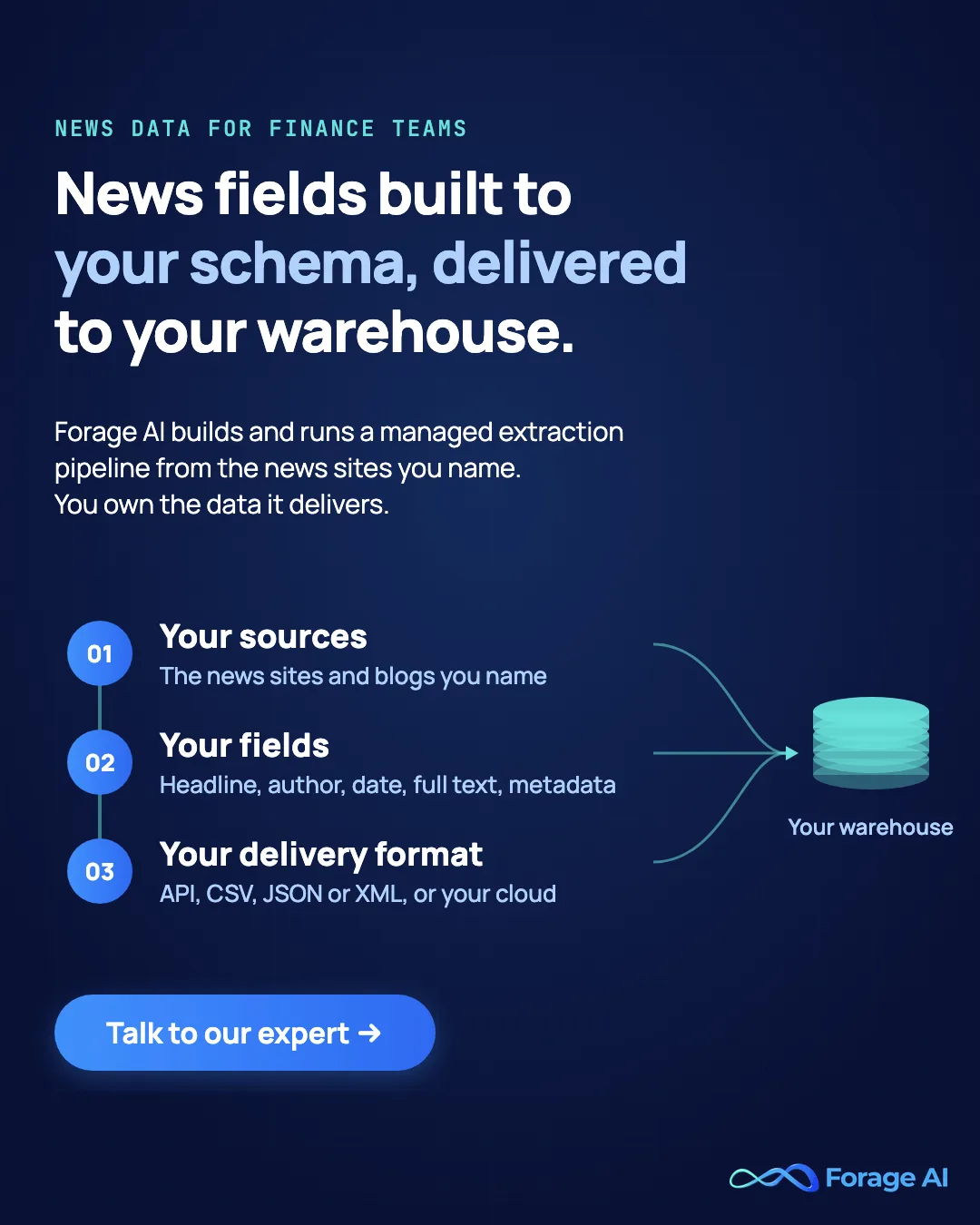
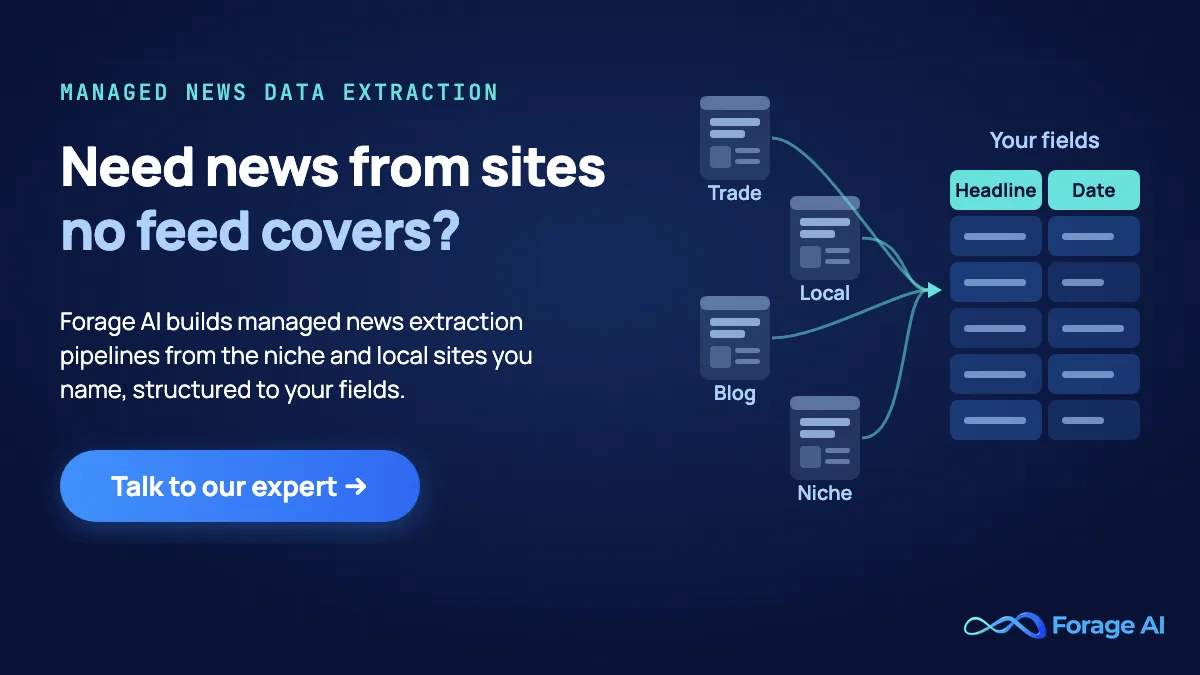
Forage AI is not a news API. It builds and runs managed news extraction pipelines: it pulls headlines, authors, dates, full text and source metadata from the news sites you specify, structures them to your own fields, and delivers them to your warehouse, API endpoint or vector database, with real-time alerts on the topics you track. Entity, sentiment or NLP enrichment is available as a custom build, and onboarding typically takes one to two weeks. You own the data, and Forage AI never resells it.
It fits teams whose sources or schema a standard news API does not cover, and it takes the crawl maintenance off your team. It does not license publisher content or sell a ready-made news archive. A team that needs licensed history still needs the first band. If your gap is coverage of named sites rather than rights, see how managed news data extraction works.
Retired, renamed, or not a news data provider
Before you trial anything, cross off what is gone or was never a feed. Microsoft retired the Bing Search APIs on 11 August 2025, Bing News Search included, and points customers to Grounding with Bing Search in Azure AI Agents. That is an agent grounding tool, not a raw news feed, yet two ranking pages still sell Bing News Search as live.
A dashboard is not a feed either: if you want alerts rather than data, look at news monitoring services instead.
| Name | What happened | What to use instead |
|---|---|---|
| Bing Search APIs, incl. Bing News Search | Retired 11 August 2025; replaced by Grounding with Bing Search in Azure AI Agents | For a feed, a crawled news API |
| Aylien (Quantexa News Intelligence) | Acquired by Quantexa, February 2023; discontinued for new clients (tech.eu, January 2026) | A crawled news API or a licensed archive |
| Moreover | Acquired by LexisNexis, October 2014; now inside Nexis Data+ | Nexis Data+ |
| Webhose | Renamed Webz.io | Webz.io |
| Event Registry | Same company as NewsAPI.ai; not NewsAPI.org | NewsAPI.ai |
| Cision / PR Newswire | A press-release feed, not a general news feed | A crawled or licensed news provider |
| Meltwater | A monitoring dashboard; the API exports your saved searches | Monitoring services for alerts; a news data provider for data |
| Scraper and SERP APIs (Firecrawl, SerpAPI, ScrapingBee, Decodo, Oxylabs, Thunderbit, Exa) | Collect pages on request; no news index, no licence | A news API, or managed extraction for your own sources |
| Google News | No official API | A crawled news API (GNews is not a Google product) |
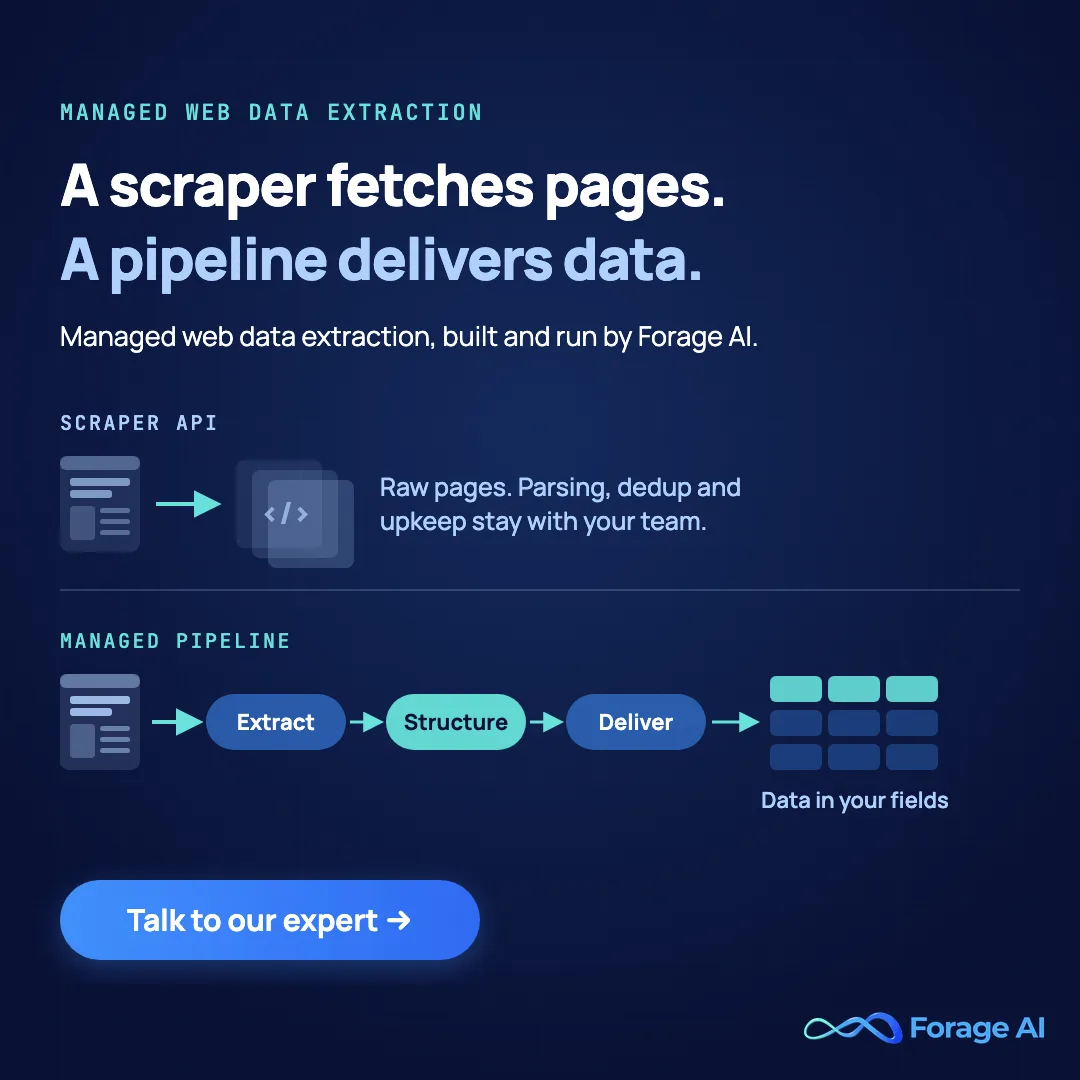
The last two rows catch the most readers. Several ranking pages for this query are scraper vendors ranking themselves first. A scraper API collects the page you ask for and stops there, so the coverage, licence and dedup work moves back to you.
News API comparison table
This is "how do they differ" in one scan, after the deep dives. History and full text split the tiers, and a cheaper listing is not a cheaper licence.
Prices as listed October 2026.
| Provider | Type | Full text | History | AI-use clause | Pricing model |
|---|---|---|---|---|---|
| Dow Jones Factiva | Licensed archive + newswire | Licensed (format not stated) | 30+ years | 8,000+ sources for GenAI; training not named | Contact sales |
| LexisNexis Nexis Data+ | Licensed archive + web news | Not stated per strand | Decades; 30+ years (transcripts) | Terms not verified | Contact sales |
| LSEG MRN | Licensed newswire | Yes | Text 1996; analytics 2003 | Terms not verified | Contact sales |
| NewsAPI.ai | Crawled news API | Yes | Since 2014 | AI processing named as permitted (vendor side) | Free plan; from $90/mo |
| Webz.io | Crawled open web | Yes | ~1 yr API; 5 yr Archive; 2008 dumps | Terms not verified; ai_allow flag |
Free credit, then PAYG |
| NewsCatcher | Crawled news API | Yes | 7+ years | Not addressed; internal use only | $0 PAYG to Enterprise |
| Perigon | Crawled news + web API | Not stated | 3 months to 10+ years by plan | Not addressed | From $25/mo |
| NewsAPI.org | Crawled headline API | Snippet only | 5 years (Business) | Not addressed | $0 dev; $449/mo Business |
| NewsData.io | Crawled news API | Custom plans only | 48 hours free to 10 years | Not addressed | $0; from $199.99/mo |
| GNews | Crawled news API | Paid plans | 30 days free; 2020 paid | Not addressed | €0; from €49.99/mo |
| Mediastack | Crawled news API (light) | Not stated | Paid plans (depth not stated) | Terms not verified | Free; from $24.99/mo |
| Benzinga | Licensed financial newswire | Yes | From 2010 | Display named; AI terms not verified | Contact sales |
| Tiingo News | Finance crawled API | Snippet only | Not stated | Not addressed by name; delete on cancel | Not verified |
| Alpha Vantage | Finance news + sentiment | Summary only | Not stated | Marketed for LLM training; no clause | Free key + premium |
| Marketaux | Finance news API | Snippet only | Not stated | Terms not verified | Free; from $29/mo |
| GDELT | Open event database | Metadata + links | Since 1979 | Datasets unrestricted with citation; AI not addressed | Free |
| The Guardian Open Platform | Single-publisher API | Yes | Content store; 24-hour retention | Barred under standard terms; training by negotiation | Free dev; usage-priced commercial |
| Forage AI | Managed news data extraction | Sources you specify | No archive | Does not license publisher content | Contact Forage AI |
How do you choose a news API for your use case?
This article is for informational purposes only and does not constitute legal advice. Consult a qualified attorney for legal guidance specific to your situation.
Name the type that fits your rights need first, then trial two or three entries inside it. A vendor switch inside the wrong type does not shrink the blast radius of a rights gap.
Six paths follow, one per buyer job.
App or prototype: a crawled API with a free tier (NewsAPI.org, GNews, NewsData.io, Mediastack). Check the commercial-use line before launch. NewsAPI.org's Developer key bars production "including internally"; GNews and Mediastack free plans are non-commercial; NewsData.io's free tier runs 12 hours behind; Event Registry's free tier is "solely for evaluation and testing". A Hacker News user summed up the gap in 2025: "getting any kind of news feed via API (even for local personal use) is almost prohibitively expensive unless you're willing to scrape".
AI or RAG: you need full text plus a written AI clause, because for this buyer the licence is the spec. The published terms show three clause types:
- A vendor clause that permits AI processing but grants no publisher rights (Event Registry, October 2026).
- A licensed subset for GenAI applications, with training not named (Factiva, 8,000+ sources, January 2026).
- A publisher that bars AI use by default and licenses it by negotiation (the Guardian; NYT's Terms of Service bar training, grounding and RAG without written consent).
"Generative AI is a fast-moving space with tremendous implications for the news industry. We are pleased that OpenAI recognizes that fact-based, nonpartisan news content is essential to this evolving technology, and that they respect the value of our intellectual property."
Kristin Heitmann, SVP and Chief Revenue Officer, The Associated Press (13 July 2023), on the deal AP described as OpenAI licensing part of its text archive.
For everyone else, get it in writing. Webz.io's ai_allow flag helps you exclude known restrictions, but it "does not constitute a licence" and is absent from Archive data.
Finance or backtest: you need first-seen timestamps and point-in-time history, from a licensed wire (LSEG MRN) or a finance API (Benzinga, Tiingo). Key on first appearance, not version: LSEG's firstCreated, or Tiingo's crawlDate gap for backfill. Check which time your date filter uses (trial checklist, step 5). Run data checks first and the signal test second; a trial backtest is not the buy gate.
Risk or adverse media: use the Wolfsberg Group's Negative News Screening FAQs (2022) as industry guidance for your evaluation. They name coverage "in markets where the FI operates", an archive of articles "no longer available in open sources", non-Latin character sets, translation, source credibility and "levels of alert duplication". One tension is worth testing in a trial: the providers that document removals (LSEG, Benzinga) tell you to remove the story, so a risk team that needs removed articles must keep its own copy, which collides with exit clauses like Tiingo's.
Market intelligence: you need breadth, dedup and entity tagging (NewsAPI.ai, Webz.io, NewsCatcher, Nexis Data+). No provider publishes a measured duplicate rate; NewsCatcher documents a method. One Hacker News builder tried the do-it-yourself route in 2026 and "used an LLM to dedupe and cluster stories. This got expensive fast". Ask each vendor for a rate, with the method.
Build or outsource: build the crawler yourself, with the guide linked in the managed extraction band, or hand it to managed news data extraction if no feed covers your sources.
Trial checklist
- Same queries, every vendor: one week of your own topics on two or three providers.
- Latency, measured by you: median by region; vendor latency is vendor-stated.
- Gaps: pull a 90-day series and look for holes.
- Duplicates: count wire duplicates yourself, and ask for the vendor's rate and method.
- Timestamps: confirm published and first-seen times are both present, which one your date filter uses (NewsCatcher
by_parse_date, Webz.iots), and whether backfill shows (the Tiingo pattern). - Edits and deletions: see how a corrected or removed story shows up, and on which delivery route. LSEG and Benzinga document it; no crawled general-news API we read documents deletions.
- The AI-use clause in writing: display, RAG and training as three lines; ask whether any per-article restriction flag survives into history.
- Exit and the due-diligence pack: find out what you must delete when you cancel, backups included (Tiingo yes; Event Registry and GNews no, unless terminated for breach). Then request the FISD Alt Data Council DDQ document list and hold records, not answers: the rights chain and a collection-method statement.
How do you choose a news API for your use case?
Pick the provider type your rights need first, then trial two vendors in it on timestamps, full text, gaps, deletions on exit and a written AI clause. App builders start with crawled APIs and check the commercial-use line; AI teams need a written AI clause; finance teams key on first-seen timestamps; risk teams test archive and removal handling.
Which news data provider should you pick?
A news data provider sells news as data, and its type decides which rights come with the text, so no single provider is best across all five types.
- Choose a licensed archive or newswire if you need rights and history (Factiva, Nexis Data+, LSEG MRN).
- Choose a crawled news API if you need self-serve breadth (NewsAPI.ai, Webz.io, NewsCatcher; GNews or NewsData.io on a tight budget).
- Choose a finance news API if you need ticker-tagged news with documented timestamps (Benzinga, Tiingo).
- Choose an open or single-publisher source if you need free event metadata (GDELT) or one publisher's full text on negotiated terms (the Guardian).
- Choose managed news data extraction if no feed covers your sources.
Terms move fast here: Tiingo updated its terms on 6 October 2026, Event Registry on 7 October and GNews on 18 October, so re-read the licence line at every renewal, and if you hold a clause or a correction we missed, send it to us and we will update the table.
Frequently asked questions about news APIs
Is there a free news API for commercial use?
None of the free tiers we read allow commercial production use. NewsAPI.org's Developer key bars production; the GNews, Mediastack and Guardian developer tiers are non-commercial; Event Registry's free plan is for evaluation; Tiingo trials cannot store data. GDELT is free with citation but carries no text.
Is there a real-time news API?
Several say so: Benzinga ("not delayed"), LSEG MRN ("real-time news in milliseconds") and NewsAPI.ai ("Realtime article availability"). Lower tiers add delays: Perigon one hour, NewsAPI.org Developer 24 hours, NewsData.io and GNews free plans 12 hours. All of it is vendor-stated, so measure it.
Which news API gives full article content?
NewsAPI.ai, Webz.io, NewsCatcher, LSEG MRN, Benzinga and the Guardian return full text; GNews does on paid plans and NewsData.io on custom plans. NewsAPI.org, Tiingo, Alpha Vantage and Marketaux return snippets or summaries; GDELT returns metadata and links.
What happened to the Google News and Bing News APIs?
Google News has no official API. The Bing Search APIs, including Bing News Search, were retired on 11 August 2025. Microsoft points customers to Grounding with Bing Search in Azure AI Agents, an agent grounding tool rather than a raw news feed.
What is the best news API for financial or stock news?
Start with LSEG MRN for point-in-time history. It is also how Reuters text reaches developers, so the Reuters news API is not free: it comes in licensed packages priced through sales. Then look at Benzinga (ISIN and CUSIP tagging, deletion events), Tiingo (backfill signal), and Alpha Vantage and Marketaux (relevance-scored tags). Choose on timestamps and identifiers, not sentiment claims.
How far back does historical news data go?
GDELT goes to 1979, LSEG text to 1996, Factiva "30+ years", Webz.io to 2008 via dumps, Benzinga 2010, NewsAPI.ai 2014, NewsData.io 2016 and GNews 2020 on paid plans. Depth often depends on plan and delivery route.
How much does a news API cost?
There are three models: free or developer keys with use limits, public monthly tiers (for example NewsAPI.ai from $90 and GNews from €49.99, Oct 2026), and contact-sales licences for archives and newswires. Compare the licence lines, not the price levels.
Can I use a news API for RAG or model training?
Only where the terms say so. Event Registry permits AI processing on its side but grants no publisher rights; Factiva licenses 8,000+ sources for GenAI applications, training not named; the Guardian's standard terms and NYT's terms bar it without consent. Most terms are silent, so get it in writing.
Related articles
- Introduction to news crawling: how to build your own news crawler, from source discovery to extraction and dedup.
- Top alternative data vendors: news analytics and signal vendors compared for investment teams.
- Financial data providers: how to evaluate and procure market and reference data feeds.
- Intelligent news monitoring: when you need alerts and dashboards rather than a data feed.
Sai is a data infrastructure enthusiast who has spent the past two to three years following the AI space closely, from the infrastructure layer to the fast-growing world of data for AI. He is genuinely curious about how modern data pipelines get built and where the data industry is heading, and he writes insightful pieces on the core topics that shape this niche.