
How to Evaluate a Web Search API: 8 Criteria That Actually Separate Providers
A web search API returns live search results to your code, so an agent, RAG feature or data product can work from the open web, not a fixed corpus. Microsoft retired the Bing Search APIs on 11 August 2025, and Google's Custom Search JSON API is closed to new customers and ends on 1 January 2027, so teams are choosing again.
Most comparison pages are vendor-written: of 16 we read in November 2026, 12 ranked their publisher first and compared features and price per 1,000 queries.
What separates providers is whose index the results come from, and what the terms let you do with them. By the end, you can name eight criteria, check two on paper, test six on your own queries, and know which answers rule a vendor out.
Check on paper before you test
- Whose index is it, and who can switch it off?
- What may you store, ground on or train on, and what happens to your queries?
Measure in one trial on your own queries
- Coverage of the sources you name
- Freshness on time-sensitive queries
- What a result contains: page text, or links and snippets
- Quality, scored with error bars
- Latency and rate limits at your concurrency
- Cost per correct answer
- Leaderboards: three public leaderboards read in November 2026 do not agree on a single leader, and their top places sit inside each other's error bars, because each tests different work.
- Use rights: of ten vendors whose terms we read on 13 November 2026, one grants keeping results, only on plans with storage rights; none names training on them as a permitted use.
- Zero data retention: it covers what the vendor keeps of your queries, not what you may keep.
Choose the kind of web search API first
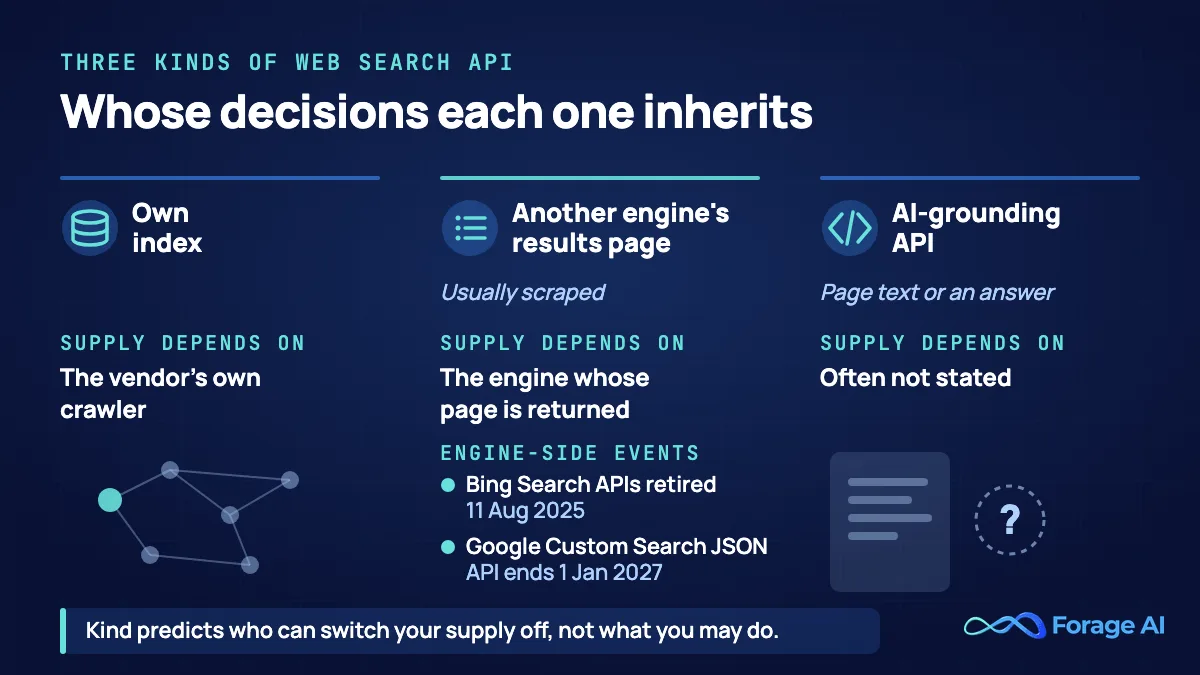
Sort the long list by kind first: it tells you whose decisions you inherit.
Own index. The vendor crawls its own results. Brave says "Our index is our own"; Mojeek calls its search an "Independent Index".
Another engine's results page. A SERP API returns one engine's results page, usually scraped by a third party. Serper "provides web-scraped data" and is "not affiliated with or endorsed by Google".
AI-grounding API. What most teams mean by an AI search API: results with page text or an answer, from Exa, Parallel, Tavily or Perplexity's Search API ("an index of public content"). This kind is named for what a call returns, not for who owns the index, so check provenance per vendor rather than per kind.
Kind predicts supply dependency, not rights. Own-index Brave bars keeping results on standard terms, while own-index Mojeek sells keeping on a plan.
| Your use | Criteria that weigh most | Why |
|---|---|---|
| Grounding an assistant or agent at query time | 3, 4, 5, 6 and the query side of 2 | Answers come from live results |
| Building a stored corpus, cache or eval set | 2 first, then 1 | Most terms restrict keeping |
| Monitoring one engine's results page (SEO, ads, rank) | 1 | Only a SERP API returns that page |
| Answers that must come from named sources | 3 first | If it fails, see the last section |
Check 1: Whose index is it?
An API that depends on another engine inherits that engine's decisions, so settle provenance first. Read it from terms, docs and sub-processor lists. If nothing says where results come from, record "not stated by vendor". Supply can also be layered.
"Because direct licensing isn't available to us on compatible terms, we - like many others - use third-party API providers for SERP-style results." Vladimir Prelovac, Kagi's founder and CEO, and Raghu Murthi, Kagi advisory board member, Kagi blog, 21 January 2026. Kagi also sells a Search API, so read "own index" per product.
Then read behaviour (our method, not a published test): compare top-10 URL overlap across two SERP-style candidates on 50 queries, and look for one engine's page furniture, such as ads, in the response.
Two exits show the supply risk. Microsoft retired the Bing Search APIs on 11 August 2025, pointing customers to "Grounding with Bing Search as part of Azure AI Agents" (see news APIs after the Bing retirement). Google's Custom Search JSON API "is closed to new customers" ahead of "the service discontinuation on January 1, 2027".
Scraped supply also has a legal posture, as of 13 November 2026. In Reddit v. SerpApi (S.D.N.Y.), DMCA §1201 claims against a SERP API vendor and its customer, an AI answer company, were allowed to proceed at the pleading stage in July 2026. In Google v. SerpApi (N.D. Cal.), the court dismissed Google's amended complaint on 9 November 2026 with leave to amend, failing which the action is dismissed with prejudice. Both of these turn on how one engine's results pages were obtained, including allegations of bypassing that engine's technical measures. Collecting a publisher's own public pages at source is a different question, with different answers. For the statutes, see US web scraping law.
An own index decides who can switch you off, not how accurate results are. The trial decides that.
Disqualifying answer: no written statement of source for a long-lived or customer-facing use; counsel rules out a vendor that takes another engine's results pages; or the product is closed to new customers or ends inside your contract term.
Check 2: What may you do with the results?
This section reports what vendors' published terms say. It is not legal advice; whether your use is permitted is a question for your counsel.
Terms separate grounding an answer at query time, keeping results (store, cache, database or eval set), and training or evaluating a model on them, plus what the vendor may do with your queries. Most terms tolerate grounding and restrict keeping, and a cache shared across users is keeping.
Trials are not exempt from the terms. Brave's standard terms bar using results to "create, evaluate, train ... benchmark" AI models, and bar storing them. A graded query set built from stored results can fall under clauses like this, so ask for evaluation use in writing before you keep trial outputs.
A vendor's permission clears only its own layer. Jina says third-party rights "in the underlying Material remain unaffected", and The New York Times' terms (20 January 2026) bar using its content "as part of retrieval-augmented generation".
What the published terms said, read on 13 November 2026:
| Vendor and document (date) | Store or cache results | Ground answers at query time | Train or evaluate a model on results | What the vendor may do with your queries |
|---|---|---|---|---|
| Brave Search API (ToS, 1 Sep 2026) | may not "store, cache, or create a database of Search Results" (§3(b)(i)) | "transient storage required for operation" allowed (§3(b)(i)) | may not "create, evaluate, train ... benchmark" AI models (§3(b)(xiii)) | "for purposes of use with the API" (§9(b)) |
| Exa (ToS, undated) | no "copy ... reproduce" without written permission (§4.2(a)) | Not stated in the terms we read | Not stated in the terms we read | may "cache, store ... User Input and Output" (§1.2(c)) |
| Jina AI / Elastic (T&C, 4 May 2026) | "no restrictions ... regarding the use of the Output" (§4.3) | Not stated in the terms we read | Not stated in the terms we read | does not use prompts "to train its models" (§10.4) |
| Linkup (Client T&C, Aug 2025) | client may "retain Open Web Content for as long as is necessary for the purposes of text and data mining only" (§4.1) | "for its internal needs and/or for its end-users' internal needs" (§4.2) | Not stated in the terms we read | data "including prompts" for "training and improving" (§6.5) |
| Mojeek (API ToS, undated) | "indefinitely only if you subscribe to a plan with storage rights" (cl. 1) | "retrieval-augmented generation, grounding" permitted (cl. 1) | "model evaluation" permitted; training not stated (cl. 1) | acts as "your processor" (cl. 1, DPA) |
| Parallel (Customer Terms, 10 Nov 2026) | "shall not be copied, cached, stored, or made available to other End Customers" (§2(b)(i)) | "primarily for the use of one End Customer only" (§2(b)(i)) | no "synthetic training data to develop or train a language model" (§2(c)(vi)) | "may use Customer IP to train and improve" (§4(b)) |
| Perplexity Search API (Search Addendum, 22 Sep 2025) | Not stated in the terms we read | Not stated in the terms we read | Not stated in the terms we read | "may retain, copy, distribute and otherwise use" (§2.2) |
| Perplexity Sonar (API ToS, 23 Jan 2026) | Not stated in the terms we read | display "solely within the Customer Applications" (§2.1) | Not stated in the terms we read | "shall not use ... Customer Content to train" (§2.3.3) |
| SerpApi (Legal, 27 Aug 2026) | Not stated in the terms we read | Not stated in the terms we read | Not stated in the terms we read | search data "retained for 31 days" (Privacy Policy §10) |
| Serper (ToS, 29 May 2024) | Not stated in the terms we read | Not stated in the terms we read | Not stated in the terms we read | Not stated in the terms we read |
| Tavily (ToS, 4 May 2026) | Not stated in the terms we read | Not stated in the terms we read | Not stated in the terms we read | licence to "store, copy" Customer Input (§9.2); "AI Functionality" (§6.1) input may be used for "training" models (§6.5) |
This is not a verdict on any provider. An order form or custom plan can override published terms (Brave's FAQ offers storage and training "with a custom plan"). Not stated means neither permission nor prohibition. Terms also move: Parallel's took effect on 10 November 2026.
Of the ten vendors whose terms we read on 13 November 2026, one grants keeping results in so many words, and only on plans sold with storage rights; none names training a model on results as a permitted use. Three bar keeping or training or both, one limits use to text and data mining, one places no restriction of its own but leaves publishers' rights untouched, and four set no general rule either way. If training data is the goal, see AI training data providers.
Disqualifying answer: your use needs a stored corpus, an eval set or training data, the standard terms bar it, and no plan or order form grants it in writing.
Zero data retention is about your queries
Zero data retention (ZDR) covers what the vendor keeps of your queries, set per product and plan. Perplexity's Search Addendum says ZDR obligations "do not apply to the Search Services", while its Sonar terms bar training on customer content. Exa and Linkup offer ZDR with an Enterprise plan. Ask per endpoint, since an agent's query can carry a user's prompt.
Run one trial on 100 of your own queries
The paper checks cut the list; the trial ranks what is left, because a success rate belongs to the workload as much as the supplier.
First, confirm the terms permit storing and grading trial results, and scrub production queries for vendors whose query terms you have not accepted.
- Take 100 queries from production logs, not a public benchmark; tag each lookup, multi-hop, time-sensitive or named-source (40/20/20/20 is a suggestion).
- Write down expected sources and today's facts before running anything.
- Hold everything but the API fixed: model, prompt, result count, content budget, location, account settings.
- Score retrieval and answers separately: recall@10, nDCG@10 on 0 to 3 grades, and correctness from a human-checked judge.
- Score a superseded fact as zero.
- Log p50 and p95 latency and every cost line.
- Compute cost per correct answer.
- Report 95% intervals and treat overlap as a tie.
- Record which queries each finalist gets right.
Why step 4: in Selvam and Ghosh's study, three APIs got 25, 25 and 26 of 100 answers right, but first searches showed supporting evidence 24%, 12% and 9% of the time.
Why step 8: at 100 queries, a score near 80% carries about plus or minus 8 points by our arithmetic, so candidates scored on separate sets need a gap of roughly 11 points. Use 100 queries to disqualify, and run a larger second round on the finalists.
Scoring code, constructed for this article (nDCG per Järvelin and Kekäläinen, ACM TOIS 2002):
import math

def norm(url):
    # simplification: lower-cases the whole URL and drops a trailing slash
    return url.strip().rstrip("/").lower()

def recall_at_k(returned_urls, expected_urls, k=10):
    top = {norm(u) for u in returned_urls[:k]}
    exp = {norm(u) for u in expected_urls}
    return len(top & exp) / len(exp) if exp else None

def ndcg_at_k(returned_urls, grades, k=10):
    # grades: {url: 0..3} from your reviewers; ungraded URLs count as 0
    g = {norm(u): v for u, v in grades.items()}
    gains = [g.get(norm(u), 0) for u in returned_urls[:k]]
    dcg = sum((2**x - 1) / math.log2(i + 2) for i, x in enumerate(gains))
    ideal = sorted(g.values(), reverse=True)[:k]
    idcg = sum((2**x - 1) / math.log2(i + 2) for i, x in enumerate(ideal))
    return dcg / idcg if idcg else 0.0
Paths can be case-sensitive, so matching by domain or by document can be fairer.
3. Coverage of the sources you name
Coverage is the trial's first measure. No public leaderboard tests whether an API returns the sources you need. List the 20 to 50 sources you need (regulators, registries, trade publications, regional outlets), write 2 or 3 queries per source, and measure recall@k by domain or document, not exact URL.
Source mix moves results: on Vals AI's finance tasks (November 2026), "SEC filings are 77% of citations" with one search tool and 53 to 57% with another.
If sources you cannot do without are missing on every candidate, no tuning fixes it: a search API is the wrong tool (see the last section).
Disqualifying answer: named-source recall below the bar you set before the trial.
4. Freshness on time-sensitive queries
Stale results hurt answers more than irrelevant ones (why RAG pipelines fail).
"the mere presence of outdated information in the context leads to at least 20% performance drop" (HoH, ACL 2025, a Wikipedia-derived benchmark).
Grade time-sensitive answers against the fact true on the collection date. AIMultiple's freshness accuracy (November 2026) ran from 78.9% to 26.3% across configurations, and even the top score's interval spanned 57.9% to 94.7%. A stated update rate is a claim no index tests (reading a refresh claim).
Disqualifying answer: superseded facts at a rate your product cannot carry.
5. Does a result include the page text?
If a call returns only a title, URL and snippet, you pay twice. Perplexity's Search API returns "snippets, URLs, page titles and associated metadata"; Exa and Parallel charge $1 per 1,000 pages or URLs for extraction, as of 13 November 2026.
More text is not automatically better: in AIMultiple's test, Brave scored 77.9% at an 8,192-token budget and 68.7% at 32,768. Measure excerpt fidelity, tokens per answer and second-call rate.
Disqualifying answer: snippets only where you need page text, and the fetch breaks your cost per correct answer.
6. Quality, scored with error bars
Three public leaderboards hold the answer model fixed and swap the search tool. Read on 13 November 2026, Artificial Analysis, Vals AI and AIMultiple do not agree on a single leader. Each tests different work; yours may resemble none.
Read any leaderboard by three questions: what work, what model, what interval. Only AIMultiple publishes 95% intervals, and its top two overlap: Parallel Advanced at 87.0% (78.3 to 94.2) and Exa Fast at 82.6% (73.9 to 91.3).
"These intervals overlap, and each configuration was tested once. The observed ranking therefore describes this question set". AIMultiple, Agentic Search API Benchmark, updated 10 November 2026. AIMultiple publishes its method and says it does not name subscribers of its benchmarking services, so read its ranking as a published test rather than an audit.
The best search API for your product is the one that passes the paper checks and wins on your queries.
Disqualifying answer: no difference outside the error bars from a cheaper option.
Combining two search APIs
In Selvam and Ghosh's preprint (arXiv 2607.10198), the best single API supported 26 of 100 correct answers; at least one of the three supported 44, an upper bound in hindsight on what combining could reach. Check that each vendor's terms permit merging, and compare on cost per correct answer, since you pay for two calls.
7. Latency and rate limits at your concurrency
As of November 2026, Exa's pay-as-you-go default is 10 queries per second, with 25 unlocked by higher spend, and its per-endpoint limits range from 5 to 100. Brave publishes its limit per plan and per endpoint too. Read the limit for the endpoint and the plan you will actually call, not the headline number. Measure p50 and p95 per call and per task, because "component medians cannot be added to recover the median task duration" (AIMultiple).
Disqualifying answer: p95 over your budget at your concurrency, or a plan cap below peak volume.
8. What does each correct answer cost?
List prices mislead because units differ. As of 13 November 2026, Perplexity's Search API is "billed even when it returns no results", and Exa's "From $4" per 1,000 is its Lite mode, with page contents extra.
Divide all search, content and model spend by correct answers. API A (illustrative): $5 per 1,000 searches, 1.6 per query, page text included, $0.40 of model tokens, 78 of 100 right: $1.20, about $0.015 per correct answer. API B: $1 per 1,000, 2.4 per query, a 3-URL fetch at $1 per 1,000, $0.55 of tokens, 70 right: $1.09, about $0.016. Five times cheaper on list price, level per correct answer. And a result you may not cache is paid for again.
Disqualifying answer: cost per correct answer above budget at your p95 latency limit.
The web search API evaluation checklist
| Criterion | How to check | Disqualifying answer for most uses |
|---|---|---|
| 1. Whose index | Terms, docs, sub-processors; URL overlap | Source not stated in writing, or an end date inside your term |
| 2. Use rights | Store, ground, train and query clauses | The terms bar the use you need and no plan or order form grants it in writing |
| 3. Coverage | Recall@k on your named sources | Below the bar you set before the trial |
| 4. Freshness | Answers graded against the day's fact | Superseded facts at a rate you cannot carry |
| 5. Result content | Excerpt fidelity, second-call rate | Snippets only, and the fetch breaks your cost |
| 6. Quality | nDCG@10, judged correctness, 95% intervals | Inside the error bars of a cheaper option |
| 7. Latency and limits | p50 and p95; plan caps | p95 over budget, or a cap below peak |
| 8. Cost | All spend divided by correct answers | Above budget at your latency limit |
Integration (SDK, MCP) and compliance (SOC 2, data residency) are procurement checkboxes, not separators.
Which questions should you send the vendor?
Ask what the published terms leave open:
- Where do your results come from: your own crawl, a licensed index, or another engine's results pages?
- What notice do you give before retiring an endpoint or changing terms or price?
- May we store or cache results, for how long, for several end customers? What must we delete at contract end?
- May we use results to evaluate or benchmark, including in this trial? To train or create synthetic training data?
- May we merge your results with another provider's?
- What rights do you pass through in the underlying pages, and on what basis?
- Do you keep, use or train on our queries? Does zero data retention apply to this endpoint on our plan?
- Do you bill per request, successful request, credit or result? Are empty results billed?
- Who carries the risk if your collection method is challenged, and what is excluded?
Please answer in writing, and name the plan or order form that grants each permitted use.
An order form can override published terms; see data vendor due diligence for records to hold.
Terms and prices move inside months, so date every read, keep the answers with the signed order form, and re-run the paper checks and the 100 queries at renewal. Send these questions before the trial starts, not after it ends.
When a managed collection pipeline fits better than a search API
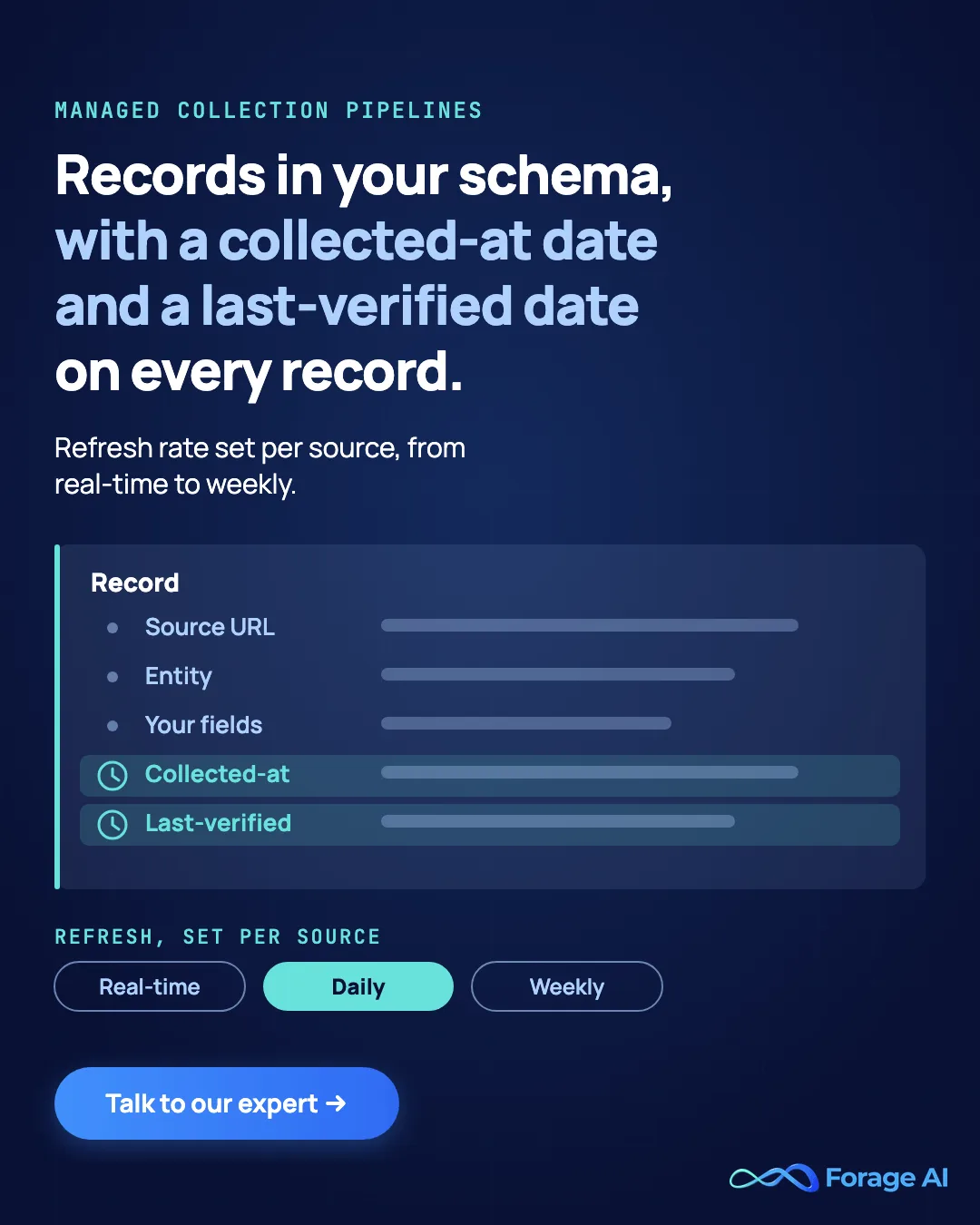
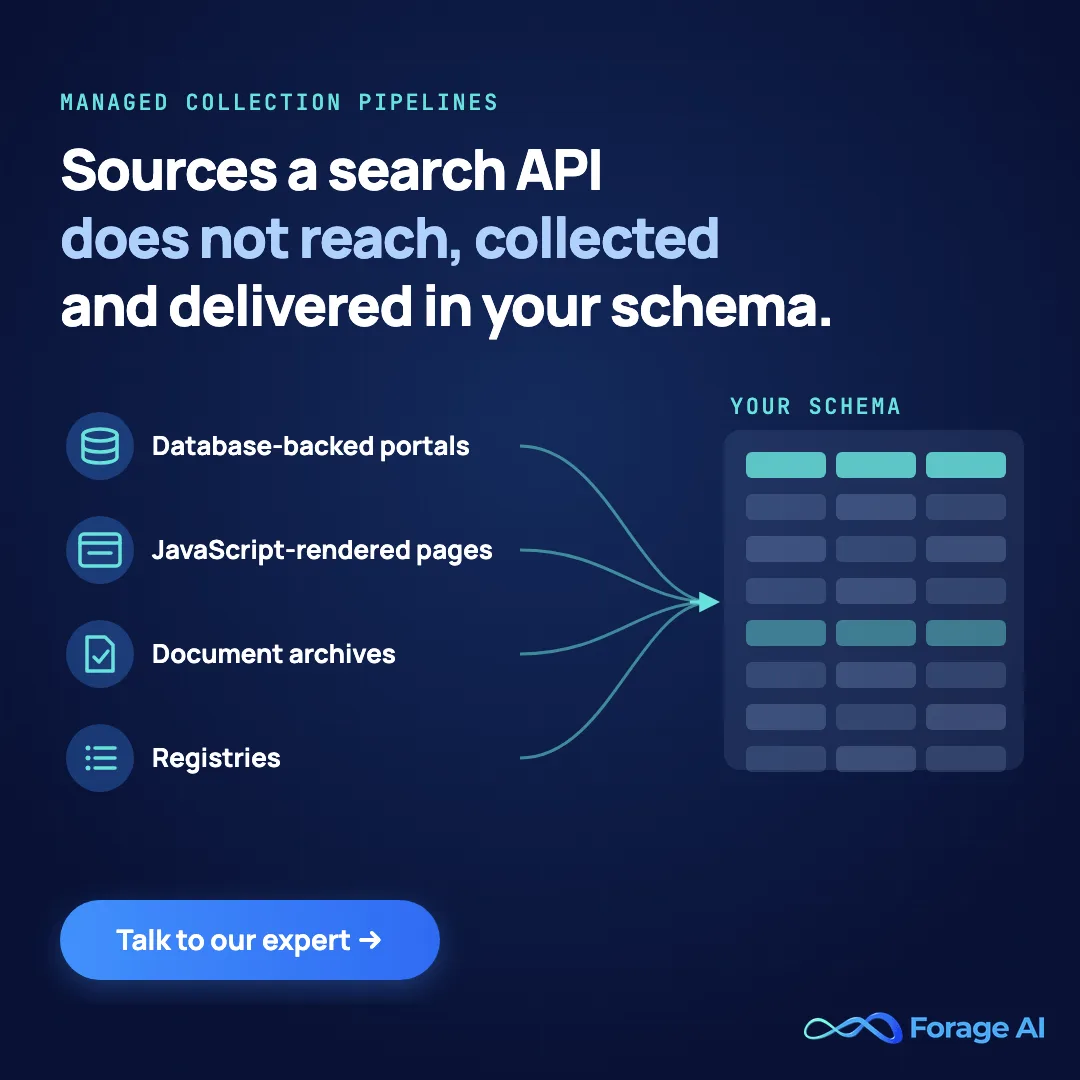
A search API answers queries over someone else's index. When the sources you need are not in that index, or you need records rather than a results list, the sources have to be collected, not searched. Forage AI builds and runs managed collection pipelines for the sources a search API does not reach: database-backed portals, JavaScript-rendered pages, document archives and registries, delivered in your schema, with a collected-at date and a last-verified date on every record. Forage AI quotes per scope: the sources, fields, refresh rate and delivery you specify. Collection does not change publishers' rights in the content, so it covers public pages only, with website terms respected.
Keep a search API if your answers come from the broad open web at query time, the sources you need come back in your trial, and the terms permit what you do with the results.
Hand it off if your named sources are missing from every candidate, you need to keep, re-process and audit what you retrieve with a collected-at and last-verified date on every record, you need a refresh rate set per source, or an API's terms limit what you may keep.
Building a search or answer product yourself? The same pipelines can sit underneath it.
FAQs about web search APIs
Is the Bing Search API still available?
No, it was retired on 11 August 2025. Microsoft now recommends a newer Web Search tool beside Grounding with Bing Search, inside its Foundry agent service, and the Grounding terms bar storing results.
Is Google's Custom Search JSON API being discontinued?
That API, yes: it is closed to new customers, and Google states its discontinuation on 1 January 2027. Google names Vertex AI Search for up to 50 domains.
What is the difference between a SERP API and a web search API?
A SERP API returns one engine's results page, usually scraped. A web search API returns results from an index, often with page text.
Can I store search API results or train a model on them?
Only where the terms allow it. Of ten vendors' terms read on 13 November 2026, one grants keeping, on storage-rights plans; none names training. Silence is not permission.
What is the best web search API for LLMs?
The one that passes the paper checks and wins on your own queries. Public leaderboards disagree, and their top places are often inside each other's error bars.
Related articles
- News APIs after the Bing retirement: how news API options compare now that Bing's endpoints are gone.
- AI web scraping tools: extraction tools for when a search result is not enough and you need the page.
- Data vendor due diligence: the records to request from a data vendor before you sign.
- Why RAG pipelines fail in production: how stale and irrelevant retrieval break answers, and how to tell them apart.
Sai is a data infrastructure enthusiast who has spent the past two to three years following the AI space closely, from the infrastructure layer to the fast-growing world of data for AI. He is genuinely curious about how modern data pipelines get built and where the data industry is heading, and he writes insightful pieces on the core topics that shape this niche.