
CoreLogic Alternatives: AVM and Property Valuation Data Providers Compared

Last updated October 2026. Vendor pages checked October 2026.
Cotality's name is on the renewal now. CoreLogic rebranded to Cotality on 24 March 2025, and the CoreLogic AVM (automated valuation model, the software estimate of a property's value) is now Total Home Valueˣ (THVˣ), sold in four tunings: marketing, risk management, originations and consumers.
So you look for CoreLogic alternatives. Cotality publishes no accuracy figure for THVˣ. Of the eight alternatives we checked, four publish one, each measured differently, and none says what sample it was tested on. We found no public independent ranking that names vendors.
So no page tells you which model is more accurate on your loans. Check three points before you sign (a stated method, a confidence measure such as MISMO's Common Confidence Score, and a licence that fits your use), then run one blind test on your own recent sales. You will leave with a two- or three-name shortlist and a trial spec. Skip to the AVM bake-off checklist.
- The disclosure gap: of nine lender-grade AVM vendors checked on 22 October 2026, Cotality included, four state an accuracy figure and only ATTOM says how it was measured.
- The ranking: we found no public ranking that names vendors; the one public 2024 evaluation (AEI Housing Center) anonymised its providers.
- The common score: MISMO's Common Confidence Score reached recommendation status on 21 April 2026; six providers implement it, Cotality included.
- The test: the 2025 AVM rule puts testing on the lender; a blind test on your own sales is the comparison that counts.
How we picked these CoreLogic alternatives
Each entry had to be a genuine AVM sold for lending or risk use, with a current product page at source in October 2026. Eight passed, plus Cotality as the baseline. We did not pad the list.
Consumer estimates get their own section; for records rather than a model, see our comparison of real estate data providers.
No vendor paid for placement or reviewed this article. Forage AI does not sell an AVM and is not in the roster.
| What we checked | How we recorded it |
|---|---|
| Accuracy figure | Verbatim, with the vendor's own metric label |
| Method, sample, date | As stated, or "Not published" |
| Confidence measure | FSD, own score, or MISMO CCS |
| Delivery | API, bulk, platform, loan origination system (LOS) |
| Permitted use | Readable terms, or "Terms not public" |
| Corporate status | Owner and dated events |
Coverage counts such as "up to 99.9% coverage of U.S. properties" (Cotality's THVˣ page) stay out; their denominators are undefined.
- Hit rate: "the number of benchmark addresses the AVM was able to predict on" (Clear Capital, 2019); it moves with the cutoff.
- MdAPE / median error: the median absolute percentage error, labelled differently by each vendor.
- PPE10: "the percentage of AVM results that are within +/-10% of the target value" (Fitch, April 2023).
- FSD: in ICE's words, "a 68% chance (one standard deviation) that the actual value is within the FSD".
- CCS: MISMO's common confidence scale. ICE defines it as the probability a value lands within ±10%.
On-market numbers flatter. Zillow puts the Zestimate's nationwide median error at 1.77% for homes on the market and 7.20% off-market (as of September 2026); Redfin reports 1.90% and 7.46% (as of October 2026). They are consumer estimates, not a lender benchmark, yet both state a metric, a method or count, and a date on the page.
CoreLogic AVM alternatives at a glance
Those checks produced this roster, with Cotality as the baseline row.
| Vendor | AVM | Band | Fits (vs Cotality) | Accuracy published? With a method? | On MISMO CCS list (Apr 2026)? |
|---|---|---|---|---|---|
| Cotality (the incumbent) | THVˣ, four tunings | Baseline | n/a | No figure; results to clients quarterly | On list |
| ATTOM | ATTOM AVM | A | A stated metric plus records via one API | Yes; method in one sentence | Not on MISMO's April 2026 list |
| Clear Capital | ClearAVM | A | Condition-aware values inside your LOS | Yes; no method, report gated | On list |
| HouseCanary | HouseCanary AVM | A | Pre-list benchmark design, API-first | Yes; no method | Not on MISMO's April 2026 list |
| Veros | VeroVALUE, VeroVALUE Preferred | A | A published hit-rate and accuracy trade | Yes (2024); no sample | On list |
| Consolidated Analytics | iVal | B | A CCS-scored AVM from a due-diligence desk | Not published | On list |
| ICE | ICE AVMs, Property Valuation Model | B | Monthly validation reports in Encompass | Not published; names its metrics | On list |
| Quantarium | QVM | B | A Fitch-reviewed model with CCS | Not published | On list |
| First American | Procision + cascade | C | Cotality and rivals under one contract | Not published | Not on MISMO's April 2026 list |
Accuracy figures are each vendor's own, on its own sample and metric. They cannot be ranked against each other, which is why the bake-off checklist below shows how to test them yourself.
Why do teams look beyond the CoreLogic AVM?
Start with what THVˣ does well. It is one methodology in four use tunings, each value carries a "Confidence score/forecast standard deviation" field, and Cotality says "THVˣ follows the MISMO Common Confidence Score." Cotality describes blind testing that keeps the AVM "completely unaware of the actual sales activity on the subject property", with quarterly results for clients. First American offers it inside its cascade.
Then the triggers. The renewal comes from a renamed company: CoreLogic, Inc. now does business as Cotality. Cotality states no accuracy figure publicly. It says clients get blind-test results every quarter, so ask for the latest. The licence names a tuning, and a marketing tuning feeding an underwriting decision is the mismatch to find. The company has been private since June 2021. We found no current RealAVM page on its US site (October 2026).
None of these is a reason to leave. Each is a reason to test.
Five gaps that decide an AVM switch
In practice, the renewal triggers trace back to five structural gaps.
- V1. The number you can't compare. Four vendors, four metrics: ATTOM a "median absolute percentage error of 2.9%", Clear Capital "2.3%" "median variance from sale values", HouseCanary a "2.7% median error", Veros a "P10 of 90%". None states a sample size (pages checked October 2026).
- V2. The hit rate that hides the confidence. Raw hit rate can be padded with low-confidence values, and scales differ: "three AVM providers might individually assign confidence scores of '92,' 'B' and 'High' for the same property" (Inside Mortgage Finance, August 2025). MISMO's Common Confidence Score, at recommendation status since 21 April 2026, is the first common scale.
"There's a lot of complexity and calculations to the FSD, which hinders its widespread adoption." Jonathan Kearns, MISMO's vice president of product, quoted by Inside Mortgage Finance (August 2025). Until every vendor returns one scale, no single cutoff works across the field.
- V3. The tuning you are licensed for. THVˣ ships four tunings, and clauses can rule a use out: ICE's terms bar "data replication (e.g., data warehouses or analytics repositories)", HouseCanary's bar use "as or in AI Input". That is what the terms say, not legal advice.
- V4. The record underneath. Assessor, recorder and listing disagree on the same house, and assessed value is not market value. The International Association of Assessing Officers (IAAO) standard has characteristics "reviewed and updated at least every 4 to 6 years". Bright MLS found 26% of sales in its 2019-2020 Mid-Atlantic footprint went off-MLS (never listed on a multiple listing service) (one region, an interested party's study); those never reach a listing-trained test.
- V5. The test is yours. The 2025 rule binds lenders "regardless of whether mortgage originators and secondary market issuers use their own AVMs or third-party AVMs", and prescribes no method.
The CoreLogic AVM alternatives, by what they let you verify
Read each entry against the five gaps (V1 to V5) and one rule.
Publishing a number is not the same as being more accurate. These bands sort by what you can check before a trial, not by which model will win on your loans.
A. Lender-grade AVMs that publish an accuracy figure
The four vendors in Band A state a headline number. Only ATTOM says how it was measured.
ATTOM AVM
| Attribute | Detail |
|---|---|
| Fits | A stated metric plus property records through one API |
| Model(s) and tunings | One model, relaunched 5 May 2026; single-family, condos, townhouses |
| Built on | Assessor, recorder and MLS records; up to 30 years of sales |
| Coverage claim | "98 million U.S. properties" (release); ATTOM's other counts vary |
| Delivery | API, bulk, match and append, custom extracts, cloud; no LOS named |
| Permitted use | AVM terms not public |
| Watch-out | Rebuilt model needs new validation; method in a gated white paper |
| Evidence | What we found |
|---|---|
| Accuracy figure | ATTOM says "a median absolute percentage error of 2.9%, with more than 80% of valuations falling within 10% of the actual sale price" |
| Method, sample, date stated? | One sentence on "out-of-sample testing" over a decade; no sample size; 5 May 2026 |
| Confidence measure | Own score, calibrated to the sale price "approximately 68 percent of the time"; Not on MISMO's April 2026 list |
| Independent testing cited | None named |
| Corporate status | Model relaunched as "a complete re-architecture" (Rob Barber, CEO) |
| Verified | 22 Oct 2026, product page and release |
ATTOM's values sit on the records it sells as property data, and it is the only vendor here that sketches its test. That sketch is one sentence: it does not say whether values were blind to the listing, and the May 2026 rebuild makes any earlier validation stale. It is better than CoreLogic's AVM when you want a metric and its test stated before you sign.
Not for: buyers who need a MISMO CCS score today or an LOS-native order flow.
Clear Capital ClearAVM
| Attribute | Detail |
|---|---|
| Fits | Condition-aware values ordered inside your LOS |
| Model(s) and tunings | ClearAVM; threshold-filtered delivery |
| Built on | Data "updated hourly", "including non-disclosure states"; Restb.ai image-derived condition data |
| Coverage claim | "120M+" "Properties covered" (page undated) |
| Delivery | CLEAR Portal, bulk; Encompass Partner Connect, Exchange Service Network, MeridianLink Mortgage |
| Permitted use | Terms not found, Oct 2026 |
| Watch-out | No method beside the figure; Q3 2026 report gated |
| Evidence | What we found |
|---|---|
| Accuracy figure | Clear Capital's page states "2.3%" "Median variance from sale values" (read October 2026) |
| Method, sample, date stated? | Not published; report behind a form |
| Confidence measure | Confidence Score "based on the forecast standard deviation (FSD)"; on MISMO's April 2026 list |
| Independent testing cited | None named; on Fitch's 2023 accepted list |
| Corporate status | Private |
| Verified | 22 Oct 2026, ClearAVM page |
ClearAVM reads condition from images; Clear Capital says the Restb.ai data is "providing 3.8% more valuations within 10% of market values than the previous model". Set a Confidence Score threshold "and you won't receive or pay for any results that don't meet your requirements." It is better than CoreLogic's AVM when you want condition-aware values inside Encompass or MeridianLink, delivered only above your cutoff.
Not for: buyers who need the methodology before a trial.
HouseCanary AVM
| Attribute | Detail |
|---|---|
| Fits | API-first teams that want a pre-list benchmark stance |
| Model(s) and tunings | HouseCanary AVM |
| Built on | Not stated, Oct 2026 |
| Coverage claim | Not verified here |
| Delivery | "Platform and API" |
| Permitted use | Terms public; §2(h) bars use "as or in AI Input" (18 Nov 2024) |
| Watch-out | Contract assignment and continuity terms |
| Evidence | What we found |
|---|---|
| Accuracy figure | HouseCanary says "AVMs with a 2.7% median error" (site banner) |
| Method, sample, date stated? | Not published |
| Confidence measure | FSD; Not on MISMO's April 2026 list |
| Independent testing cited | Says "rigorously tested by independent third parties"; names no tester; on Fitch's 2023 accepted list |
| Corporate status | Chapter 11 since 22 Sep 2026 (D.N.J., lead case 26-20766); says service continues; status checked 22 Oct 2026 |
| Verified | 22 Oct 2026, product and reorganisation pages |
HouseCanary argues for "pre-list benchmark testing": a value produced before listing cannot borrow from the list price. The 2.7% carries no method or date. Confirm continuity terms before a multi-year deal. It is better than CoreLogic's AVM when you want pre-list values through an API and can accept the counterparty position.
Not for: buyers who cannot take counterparty risk during a live reorganisation.
Veros VeroVALUE
| Attribute | Detail |
|---|---|
| Fits | A stated hit-rate and accuracy trade, and a score to cut at |
| Model(s) and tunings | VeroVALUE, Preferred, Portfolio, REO; VeroPHOTO Plus, Disaster Vision add-ons |
| Built on | Not stated, Oct 2026 |
| Coverage claim | Not verified here |
| Delivery | VeroSELECT; partners incl. LenderClose, LenderX; Valligent (a Veros company) cascades fifteen AVMs |
| Permitted use | Terms not found, Oct 2026 |
| Watch-out | Figures from Nov 2024, no sample; Valligent's menu lists retired models |
| Evidence | What we found |
|---|---|
| Accuracy figure | Veros says VeroVALUE "has a P10 of 90% and a hit rate of 93%"; Preferred "a higher P10 of 95% but a slightly lower hit rate of 87%" (22 Nov 2024) |
| Method, sample, date stated? | Date only; no sample, period or benchmark |
| Confidence measure | Veros Confidence Score, "ranges from 75 to 100"; on MISMO's April 2026 list |
| Independent testing cited | None named; on Fitch's 2023 accepted list |
| Corporate status | Private |
| Verified | 22 Oct 2026, Veros blog and Valligent page |
Veros publishes the only number pair here that shows a tuning's trade: Preferred "automatically uses only estimates with a VCS of 90 or greater". Its June 2025 paper adds that evaluation "hinges on when the test is conducted and how much information the AVM can access." Valligent's cascade page (May 2025) still lists Freddie Mac's retired Home Value Explorer, so ask for a current menu. It is better than CoreLogic's AVM when you want a score you can cut at.
Not for: buyers who need a current, dated validation report before talking to sales.
B. Lender-grade AVMs that publish no accuracy figure
No figure on the page, so ask for the validation pack before the trial.
Consolidated Analytics iVal
| Attribute | Detail |
|---|---|
| Fits | Existing Consolidated Analytics clients wanting a CCS-scored AVM |
| Model(s) and tunings | iVal AVM |
| Built on | "Public-record, MLS, and proprietary data" |
| Coverage claim | Not stated |
| Delivery | Not stated |
| Permitted use | Terms not found, Oct 2026 |
| Watch-out | Page body did not render when checked; detail is thin |
| Evidence | What we found |
|---|---|
| Accuracy figure | Not published |
| Method, sample, date stated? | Not published |
| Confidence measure | On MISMO's April 2026 list |
| Independent testing cited | None named |
| Corporate status | Private; on First American's menu as "iVal" |
| Verified | 22 Oct 2026, iVal page (7 Apr 2026) |
The page summary quoted above is the whole public record we could read, so the entry stays short. It is better than CoreLogic's AVM when you already use Consolidated Analytics for due diligence or valuations and want one fewer vendor relationship.
Not for: buyers who need product detail before a call.
ICE AVMs and Property Valuation Model
| Attribute | Detail |
|---|---|
| Fits | Encompass lenders who want monthly validation reports |
| Model(s) and tunings | ICE AVMs; Property Valuation Model selects among them by geography and property type |
| Built on | Not stated, Oct 2026 |
| Coverage claim | Not stated |
| Delivery | "Encompass, HTML, API and batch delivery options" |
| Permitted use | Agreements public; §3.1(k) bars "data replication (e.g., data warehouses or analytics repositories)" |
| Watch-out | The replication clause, if you plan to warehouse values |
| Evidence | What we found |
|---|---|
| Accuracy figure | Not published (adjectives only) |
| Method, sample, date stated? | Describes "daily forward-blind performance testing and validation"; no values public; AVM Model Monitor is customer-only |
| Confidence measure | ICE Confidence Score, FSD and MISMO CCS; on list |
| Independent testing cited | Internal Model Risk Management team, "separate from the line of business" |
| Corporate status | ICE (formerly Black Knight); on Fitch's 2023 list as "Black Knight Collateral Analytics" |
| Verified | 22 Oct 2026, ICE AVM page |
ICE names what customers get: "Monthly model validation reports covering hit rate, PPE 10, median error and over/under-valuation analysis", plus bias testing. "CA Value" appears on First American's menu; no current ICE page uses the name. It is better than CoreLogic's AVM when you originate in Encompass and want validation reports as a standing deliverable.
Not for: teams building an internal analytics warehouse on the values (§3.1(k)).
Quantarium QVM
| Attribute | Detail |
|---|---|
| Fits | Teams that want a Fitch-reviewed model with a CCS score |
| Model(s) and tunings | QVM; "QVM Comprehensive, QVM Full" on First American's menu |
| Built on | Per Fitch, public records and MLS data, "multiple proprietary models to estimate a single value" |
| Coverage claim | Not stated |
| Delivery | Not stated |
| Permitted use | Terms not found, Oct 2026 |
| Watch-out | No published accuracy evidence |
| Evidence | What we found |
|---|---|
| Accuracy figure | Not published |
| Method, sample, date stated? | Not published |
| Confidence measure | On MISMO's April 2026 list |
| Independent testing cited | Fitch: "acceptable" AVM provider (11 Apr 2023); a review, not a ranking |
| Corporate status | Private |
| Verified | 22 Oct 2026, QVM page, Fitch release |
Quantarium's strongest public evidence comes from Fitch. Its own pages state no accuracy figure, and the ranking claim in its 2023 release names no tester, so we leave it out. It is better than CoreLogic's AVM when a rating-agency review and a CCS score matter more to you than a published figure.
Not for: buyers who need any published accuracy evidence before a trial.
C. Cascades that sell several models under one contract
One contract, several models, and a selection rule you should ask to see.
First American Mortgage Solutions (Procision and cascade)
| Attribute | Detail |
|---|---|
| Fits | Cotality's model and its rivals behind one contract |
| Model(s) and tunings | Own Procision™ Power and Premier; third-party AVMs "with multiple custom cascading options" |
| Built on | Other vendors' models plus its own |
| Coverage claim | Not stated |
| Delivery | "24/7 via our proprietary system or via direct interface" |
| Permitted use | Terms not found, Oct 2026 |
| Watch-out | Mixed confidence scales; cascade order not published |
| Evidence | What we found |
|---|---|
| Accuracy figure | Not published |
| Method, sample, date stated? | Not published |
| Confidence measure | Not stated; Not on MISMO's April 2026 list as a platform |
| Independent testing cited | None named |
| Corporate status | First American |
| Verified | 22 Oct 2026, AVM page |
Resolved to owners, the menu is mostly this roster: CA Value (ICE family), Total Home Value X (Cotality), QVM (Quantarium), iVal (Consolidated Analytics), VeroValue (Veros). A cascade buys several of them through one contract.
A cascade can still return Cotality's own THVˣ, because "Total Home Value X" is on the menu. Ask which model returned each value.
It is better than CoreLogic's AVM when hit rate across mixed markets matters more than one model's consistency.
Not for: buyers who must validate one model end to end.
D. Build or calibrate from source records
A team with data science capacity can build on public records and MLS data (see our guide to building or buying a real estate data pipeline). You inherit the roll's limits (characteristics reviewed "at least every 4 to 6 years", records that disagree, off-MLS sales), and the tax roll is not a property-level market-value proxy. The Federal Housing Finance Agency (FHFA) House Price Index is a free calibration benchmark, but an index, not an AVM. A regulated lender still validates whatever it builds.
CoreLogic AVM alternatives compared
The master table puts the eight alternatives and Cotality side by side, so you can drop vendors that fail your evidence or licence needs in one pass. "Not found" means not on public pages, October 2026.
| Vendor | Method stated? | Confidence measure | Delivery | Licence terms public? | Use tunings | Corporate status |
|---|---|---|---|---|---|---|
| Cotality (the incumbent) | Testing described, no values | CS + FSD; CCS | API, SFTP, five clouds | Website terms only | Four | Private since Jun 2021 |
| ATTOM | One sentence | Own score | API, bulk, cloud | Not found | One model | Relaunched May 2026 |
| Clear Capital | Not published | CS from FSD; CCS | Portal, bulk, LOS | Not found | Threshold delivery | Private |
| HouseCanary | Not published | FSD | Platform, API | Yes | Not stated | Chapter 11, Sep 2026 |
| Veros | Date only | VCS; CCS | VeroSELECT, partners | Not found | Four variants | Private |
| Consolidated Analytics | Not published | CCS | Not stated | Not found | Not stated | Private |
| ICE | Metrics named | ICE CS, FSD, CCS | Encompass, API, batch | Yes | Several + PVM | ICE |
| Quantarium | Not published | CCS | Not stated | Not found | Two | Private |
| First American | Not published | Not stated | Own system, interface | Not found | Cascades | First American |
Licence and continuity gate a shortlist before accuracy does, and Cotality's website terms are not its AVM licence.
Which commonly listed tools are not AVM alternatives?
An honest shortlist also needs the names that do not belong on it. None of these replaces a lender-grade AVM.
- Freddie Mac Home Value Explorer: has been retired; Freddie Mac's agreement text records "the retirement of both Systems".
- Zillow Zestimate: "It is not an appraisal and can't be used in place of an appraisal" (Zillow). Its Zestimate API is for business use by request; terms not public.
- Redfin Estimate: "it is not an appraisal" (Redfin). We found no public licence route.
- FHFA HPI: an index, not a property-level value.
- Red Bell / Radian: Radian sold its Real Estate Services business in August 2026; we found no current product page for this AVM.
- SERP padding: Eppraisal, SmartZip, Revaluate, Restb.ai, PriceHubble, Househappy are consumer or agent tools, or inputs.
- Data with no model: BatchData, The Warren Group, Regrid, PropStream sell records, not valuations.
- Australian readers: Cotality's RP Data and Australian AVMs are out of scope here.
With the roster settled, one trade sits under every entry: hit rate against accuracy.
Who chooses the trade between hit rate and accuracy?
You do, if you set the confidence cutoff. Cotality's own copy names the trade: "Highest hit-rate AVM for marketing uses" against "Highest level of accuracy when performing property valuation during the loan underwriting process".
On Veros's own sample, Preferred keeps only values scoring 90 or more, lifting P10 from 90% to 95% while hit rate falls from 93% to 87%. Five points of accuracy cost six points of hit rate. Clear Capital and Cotality both let clients set thresholds, and unless you set one, the vendor's default chooses the trade.
Cascades move the dial for you: ICE describes ranking AVMs "by performance" and evaluating them "until an acceptable output is achieved". CCS partly fixes the mixed scales, but the ranking behind a cascade is the vendor's to disclose. Ask for it.
For a lender, the next consideration is what the 2025 AVM rule asks.
What does the 2025 AVM rule ask of lenders?
This article is for informational purposes only and does not constitute legal advice. Consult a qualified attorney for legal guidance specific to your situation.
The rule asks the lender, not the vendor. "Quality Control Standards for Automated Valuation Models" (OCC, Federal Reserve Board, FDIC, NCUA, CFPB, FHFA; 89 FR 64538, 7 August 2024) has been in force since 1 October 2025, unchanged as of October 2026 (rule text).
Under 12 CFR 34.222, mortgage originators and secondary market issuers must keep quality control standards designed to:
- (a) "Ensure a high level of confidence in the estimates produced";
- (b) "Protect against the manipulation of data";
- (c) "Seek to avoid conflicts of interest";
- (d) "Require random sample testing and reviews"; and
- (e) "Comply with applicable nondiscrimination laws."
The statute (FIRREA section 1125, added by section 1473(q) of the Dodd-Frank Act) lists four factors plus a catch-all; the agencies added the fifth. The duty holds "regardless of whether mortgage originators and secondary market issuers use their own AVMs or third-party AVMs", so switching vendors moves no obligation. The rule names no method, metric or threshold.
A credit decision includes a decision to "change the credit limit on a line of credit", so an AVM-driven cut to a home equity line of credit (HELOC) is in. Excluded: "(i) Monitoring of the quality or performance of mortgages or mortgage-backed securities; (ii) Reviews of the quality of already completed determinations of the value of collateral; or (iii) The development of an appraisal by a certified or licensed appraiser." Banks have model-risk and third-party guidance beside it; non-banks "may still look to the guidance." The rule is scoped to credit decisions on a consumer's principal dwelling and covered securitization determinations, so by its definitions marketing, display, insurance and single-family rental (SFR) investment uses fall outside it.
Three questions before you shortlist
With the rule's scope clear, three questions prioritize the roster down to two or three names.
- What decision does the value feed? A credit decision under the rule, quality control, marketing or display. For credit decisions, CCS implementers and the Part D asks move up.
- What is your usable hit rate? At your confidence cutoff, on your loans and your weak segments.
- Does the licence cover the use? Check display, retention, model training and redistribution; a clause can rule a use out entirely.
As Veros puts it, "Lenders and investors are responsible for validating AVM performance data and related claims."
The AVM bake-off checklist
The bake-off is how you do that validation. This test design is built from published metric definitions, vendors' testing guides and the rule's text. It is not an industry standard; the rule leaves the method to you.
Part A. The trial spec
| Item | What to specify | Why |
|---|---|---|
| Test file | Recent closed sales; refinance or HELOC appraisals where sales are thin | Appraisals are "Not easily gamed" (Clear Capital) |
| Blindness | Every value as of a fixed date before the sale, e.g. four months | AEI Housing Center (May 2024): share within ±5% rose 15 to 46 points between four months out and sale |
| Leakage | Never send sale prices; ask how retro values exclude later listings | "Most AVMs have access to these prices, which allows for gaming of the test" (Clear Capital, 2019) |
| Same file | Every vendor, Cotality included, same day | No comparison otherwise |
| Strata | Rural, condos, high-value, off-MLS, states that keep sale prices confidential (Texas, for one) | Averages hide weak segments |
| Product and tuning | Named per vendor, with a confidence score on every value | Tunings trade hit rate for accuracy |
Size each stratum to report alone; we found no source that sets a minimum. Cotality accepts client test files "At no charge"; ask every vendor for the same.
Part B. The scoring sheet
| Metric | What it tells you | Watch for |
|---|---|---|
| Hit rate (raw) | Share of addresses valued | Padding with low confidence |
| Hit rate at your cutoff | Usable coverage | Report this first |
| MdAPE | Typical error | Hides the tail |
| PPE10 / PPE20 | Share within ±10% / ±20% | Returned values only |
| Median signed error | Bias | By stratum |
| Calibration by band | Whether a score keeps its promise | ICE's 68% FSD; ATTOM's 68% claim |
Hit rate here is measured on your file, not a coverage claim. Never import a vendor's own figure.
Damien Weldon of ICE Mortgage Technology describes the Common Confidence Score as "a probability metric that measures the likelihood an AVM's valuation is within +/- 10% of the property's actual market value" (February 2026). So check it: in each score band on your file, the share inside ±10% should match.
Part C. Questions for every vendor
- Disclosure: your latest validation report (metric, sample, period), and do you return CCS?
- Permitted use: which tuning is licensed for our use, including retention and AI input?
- Cascade: which models, in what order, and is THVˣ among them?
- Change and continuity: notice before model changes; assignment terms if you are sold or restructured.
Part D. What the rule asks you to get from a vendor
Ask for records, not answers; they go in your file and discharge nothing.
- (a) Confidence: the measure, its definition, its calibration on your file.
- (b) Manipulation: which inputs users can override, whether overrides are logged, whether the model sees list price.
- (c) Conflicts: who can influence a value; how a cascade or selector ranks models, and whether it ranks its own.
- (d) Testing: values for your blind file at your production cutoff, their validation reports, outputs you keep for audit.
- (e) Nondiscrimination: whether and how they test for valuation disparities, and the latest result.
These are questions, not findings; ICE's and Veros's bias testing is their own claim.
How to switch after the test
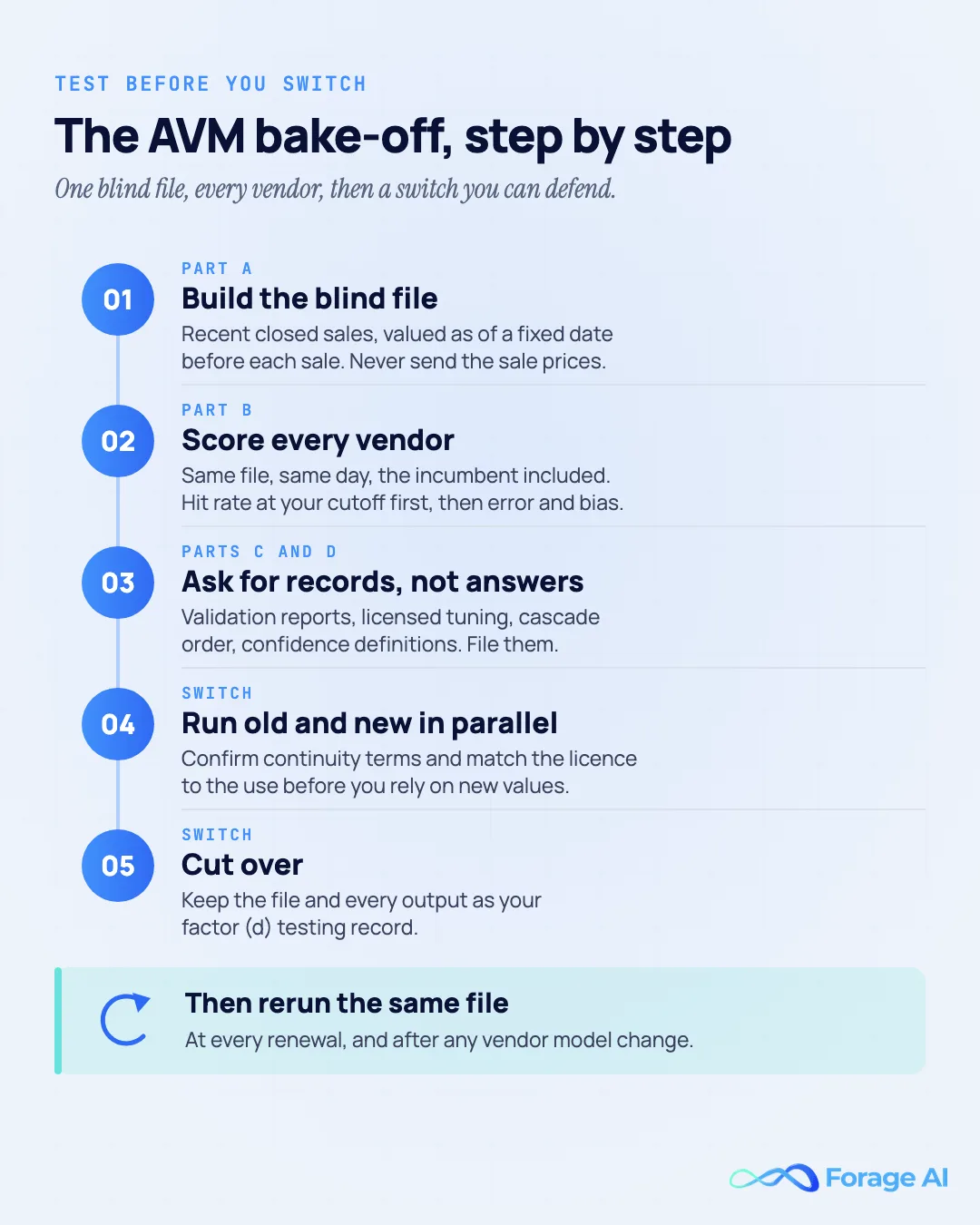
Confirm continuity terms, match tuning and licence to the use, run old and new in parallel, then cut over. Keep the file and outputs as your factor (d) record; rerun at renewal and after any model change, such as ATTOM's May 2026 rebuild. For the delivery layer, see our guide to evaluating a property data API.
The scoring query
Run it once on everything, then again filtered to your production confidence cutoff.
-- PostgreSQL syntax; PERCENTILE_CONT ... WITHIN GROUP varies by warehouse (adjust for yours)
-- test_file: one row per (vendor, property); avm_value NULL when no value returned
-- value_as_of: the as-of date you requested (e.g. sale_date minus 4 months); listing_date NULL if never listed
-- "* 1.0" stops integer division when prices are stored as integers; CAST lets ROUND take the percentile
SELECT vendor,
       COUNT(*)                                                     AS requested,
       COUNT(avm_value)                                             AS returned,
       ROUND(100.0 * COUNT(avm_value) / COUNT(*), 1)                AS hit_rate_pct,
       ROUND(CAST(100 * PERCENTILE_CONT(0.5) WITHIN GROUP (
             ORDER BY ABS(avm_value - sale_price) * 1.0 / sale_price) AS NUMERIC), 2) AS mdape_pct,
       ROUND(100.0 * AVG(CASE WHEN avm_value IS NULL THEN NULL
                              WHEN ABS(avm_value - sale_price) * 1.0 / sale_price <= 0.10 THEN 1.0
                              ELSE 0 END), 1)                       AS ppe10_pct,
       ROUND(CAST(100 * PERCENTILE_CONT(0.5) WITHIN GROUP (
             ORDER BY (avm_value - sale_price) * 1.0 / sale_price) AS NUMERIC), 2) AS median_signed_error_pct
FROM test_file
WHERE listing_date IS NULL OR value_as_of < listing_date   -- keep off-MLS sales; stay blind to listings
GROUP BY vendor;
-- Re-run with AND confidence >= your production cutoff: hit rate at a usable confidence is the comparison that matters.
PPE10 counts only returned values, and sales that never listed stay in: in one region they were a quarter of resales.
When the gap is the inputs, not the model
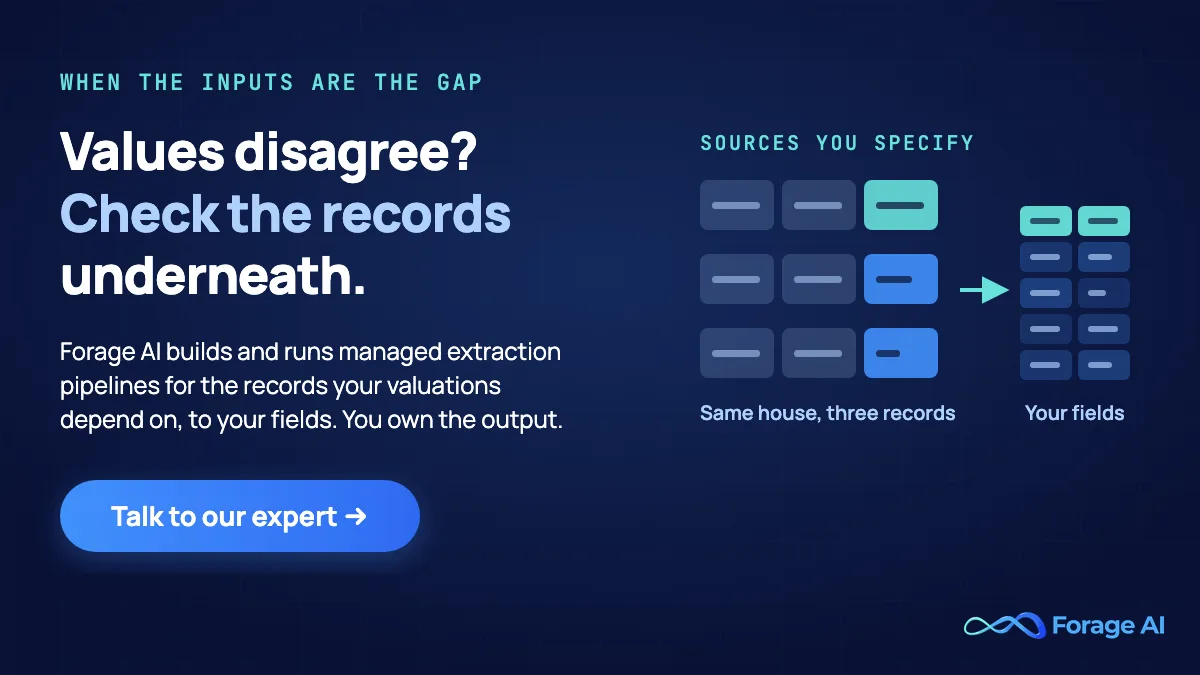
A bake-off can also show that the model is not the weak point. Sometimes values disagree because the records underneath are stale or thin: a county covered lightly, permits, recent listings, assessor changes. Zillow's off-market estimate leans on "tax assessments, prior sales and other publicly available records". Another model will not fix those.
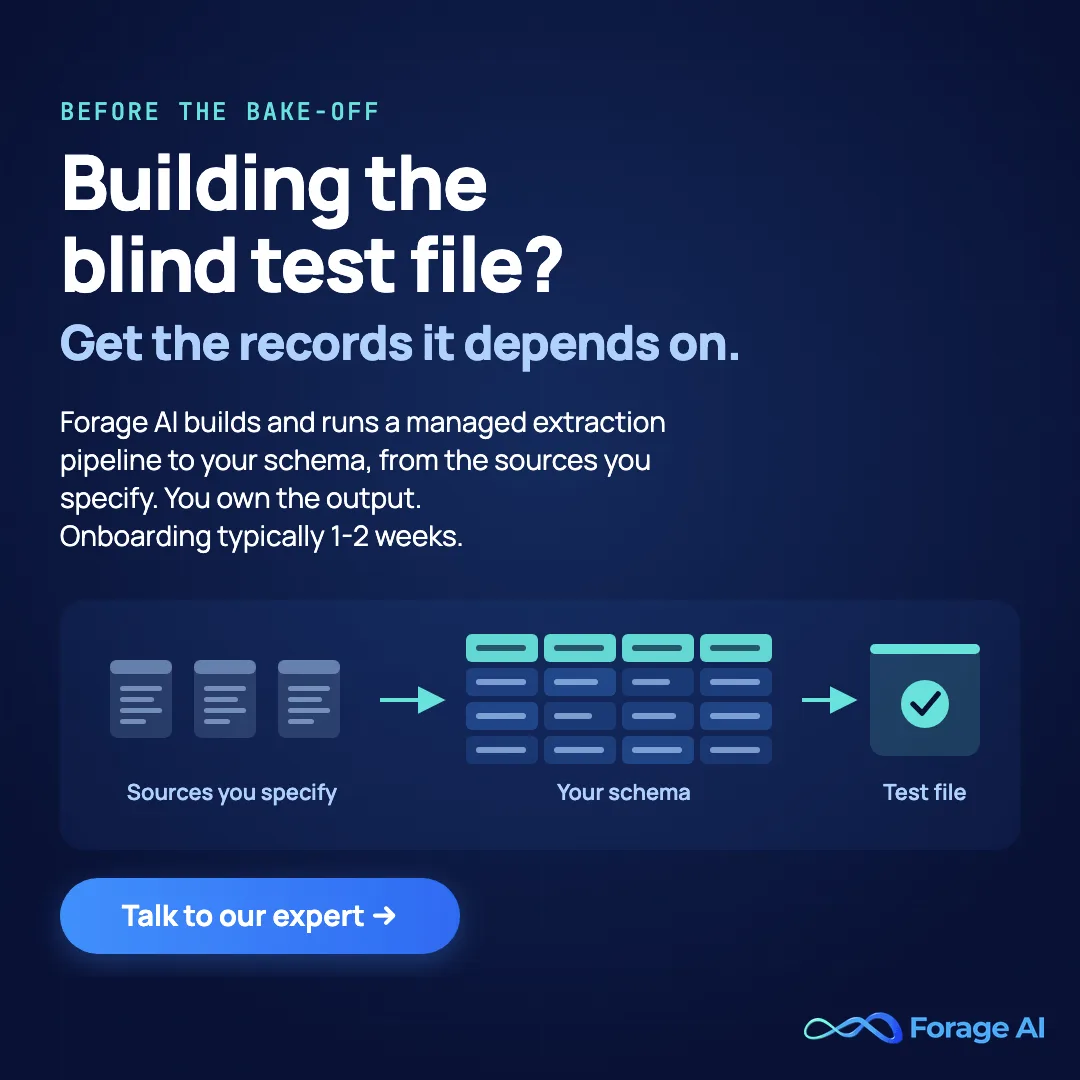
Forage AI builds and runs a managed extraction pipeline that collects the records your valuations depend on, from the sources you specify, to your fields, delivered as CSV, JSON or XML, by API or into your warehouse, and you own the output. Onboarding typically takes 1-2 weeks. It does not sell an AVM or off-the-shelf property datasets, and records are not a model: a regulated lender still needs one it can validate.
If the gap is the records your model or test file needs, that is a job for managed property data extraction. If you need a validated value for a credit decision, choose a lender-grade AVM vendor or cascade.
The right alternative to CoreLogic's AVM is the one that wins on your loans, under your licence. Pick two, and send the same blind file to them and to Cotality. If the file shows the records are the weak point, that is where Forage AI fits. Keep the file and rerun it at every renewal, and the decision stops depending on anyone's page.
Frequently asked questions
Is CoreLogic now called Cotality?
Yes, since 24 March 2025. The company is CoreLogic, Inc. doing business as Cotality, and the Cotality AVM is Total Home Valueˣ (THVˣ).
How accurate is CoreLogic's AVM?
Cotality publishes no figure. It says clients get blind-test results every quarter, plus quarterly due diligence reports built on "a sample size between 500,000 and 1 million records each quarter". Ask for the latest, then test THVˣ on your sales with the bake-off checklist.
What is an AVM confidence score?
A per-value measure of how far the value may be off. ICE's score is 100 minus FSD; MISMO's Common Confidence Score, at recommendation status since 21 April 2026, puts six providers on one scale.
Which AVM providers handle rural or low-data markets?
No public test names vendors by segment. Stratify your bake-off to those counties and score them separately.
Is there an independent AVM accuracy ranking?
Not a public one that names vendors. AVMetrics tests commercial AVMs monthly but shares results only with clients under NDA (as of October 2026). Fitch lists vendors it accepts for residential mortgage-backed securities (RMBS) ratings (latest we found: April 2023, seven vendors), which is not a ranking. AEI's 2024 study anonymised its five providers.
Is there a free home value API?
None lender-grade that we found. Zillow's Zestimate API is for business use by request, and a Zestimate is not an appraisal. FHFA's House Price Index is free but index-level.
How is AVM access licensed and priced?
Licences name a tuning and a use, so check fit first: retention, redistribution, replication and AI clauses. For cost, see our breakdown of real estate API pricing.
Is HouseCanary still operating?
HouseCanary filed for Chapter 11 on 22 September 2026 (D.N.J., lead case 26-20766) and says customers "are being served without interruption". A status conference is set for 12 November 2026 (checked 22 October 2026). Confirm continuity terms before a multi-year deal.
Related articles
- Real Estate API Pricing: What Property Data Actually Costs: how property data APIs and AVM calls are billed
- The Best Real Estate Data Providers (2026), Compared: the wider comparison, for teams buying records rather than models
- Real Estate Data API: How to Evaluate Providers: testing an API's freshness, coverage and licence terms
- Real Estate Data Analytics: The Pipeline Beneath the Dashboard: building, buying or partnering for a property data pipeline
- US Foreclosure Rates 2026: By State, Chart and Sources: distress measures for servicers and default-risk teams
Sai is a data infrastructure enthusiast who has spent the past two to three years following the AI space closely, from the infrastructure layer to the fast-growing world of data for AI. He is genuinely curious about how modern data pipelines get built and where the data industry is heading, and he writes insightful pieces on the core topics that shape this niche.