
The External Data Market Map 2026: 145 Companies, Four Routes
Every company that runs on data eventually needs data it does not have: competitor prices on other people's websites, provider records spread across thousands of hospital pages, filings, listings and job posts. The industry calls this external data.
Most market maps of this space list tools, such as scrapers, proxies and AI search APIs. In practice, a buyer does not start with a tool. They start with a question about where the data should come from.
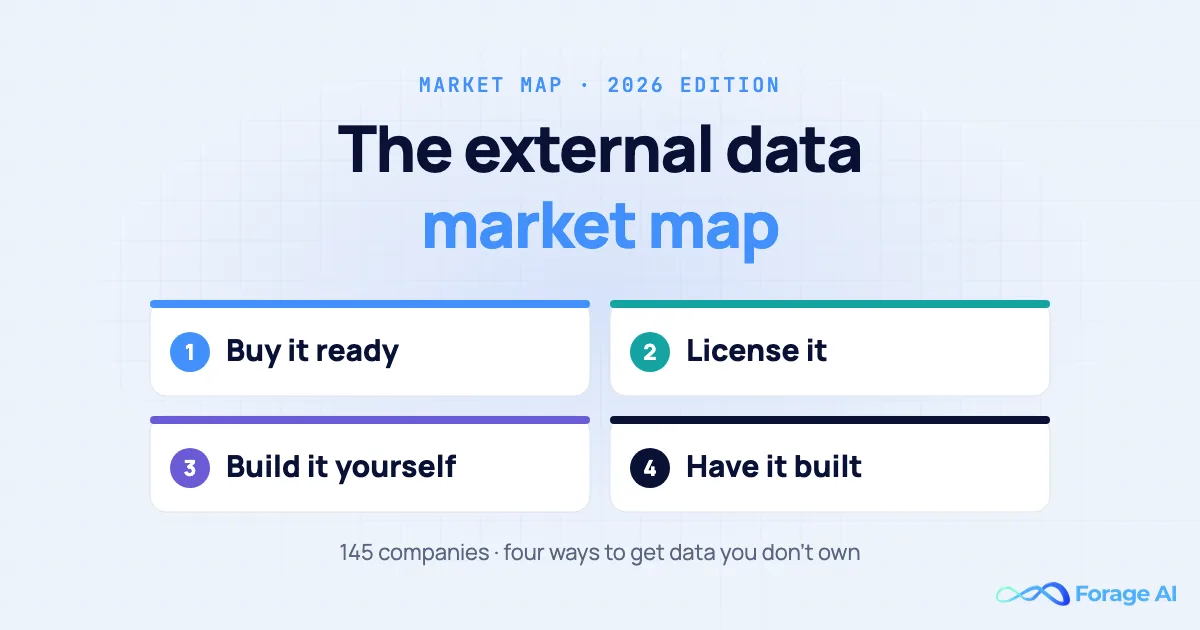
Do we buy it ready-made, license it from whoever owns it, build the collection ourselves, or have someone build it for us? This external data market map is organised around that choice, with 145 companies across the four routes, what each one costs you, and what AI changed in each during 2026.
- The market: external data is data a company needs but does not own. There are four routes to it: buy it ready, license it, build it yourself, or have it built.
- The trade-off: each route gives something up. Buying gives up fit, licensing gives up breadth, building gives up your team's time, and having it built gives up speed to the first row.
- The 2026 shift: AI moved every route forward. Data vendors wired their data into AI assistants, licensing got a price per crawl, and build tools raised large rounds while the legal and blocking risk of DIY collection rose.
- The method: every company was checked for a live offering and its current owner on 7 October 2026. No company paid to be listed.
The External Data Market Map, 2026
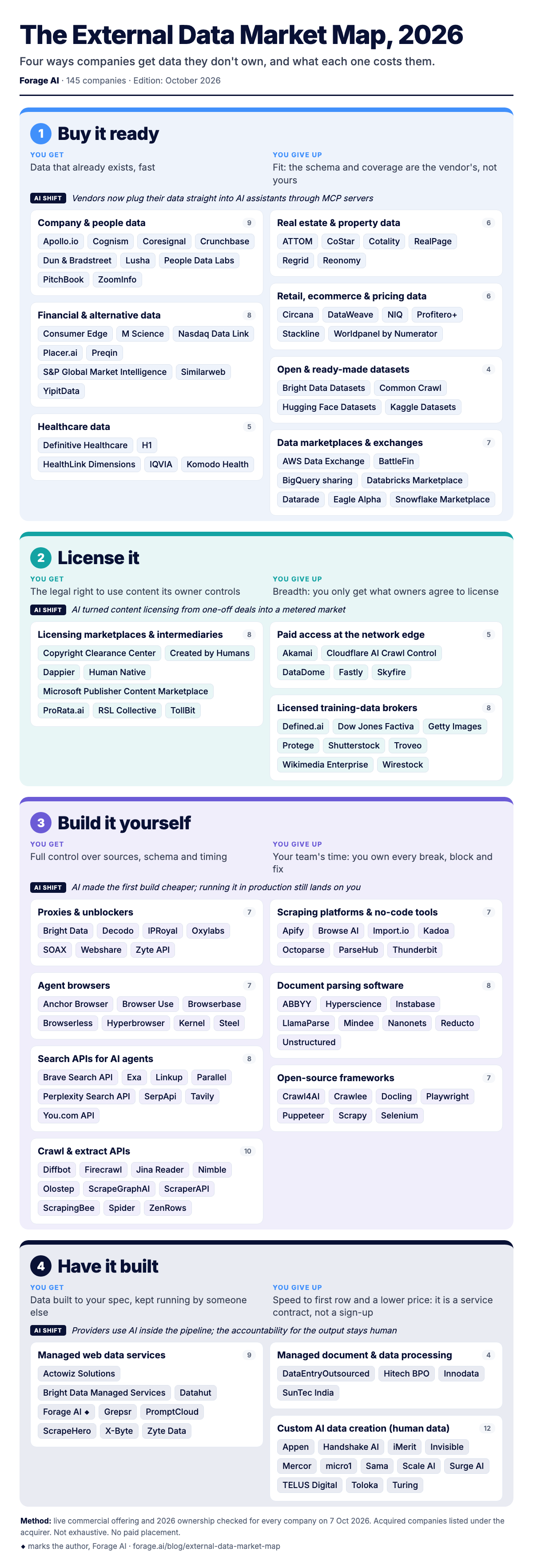
Download the full-resolution map (PNG), the print version (PDF) or the full company list (CSV), which has every company's website, category and owner. You are welcome to share the map, with credit to Forage AI.
What are the four ways to get external data?
There are four ways to get external data: buy it ready, license it, build it yourself, or have it built. Each box on the map is one of them, and the two lines at the top of each box matter more than the names underneath.
"You get" is what the route is good at. "You give up" is the cost it carries, and that cost stays with the route even when you pick a better vendor inside it. A better data vendor still sells you its own schema, and a better proxy network still leaves your team fixing the scraper every time a site changes. Inside each box, categories group companies by what they sell, in alphabetical order, and the italic "AI shift" line sums up what AI changed in that route this year.
| Route | You get | You give up | Usually the right pick when |
|---|---|---|---|
| Buy it ready | Data that already exists, often available within days | Fit. The fields, coverage and refresh schedule are the vendor's | A standard dataset already answers your question |
| License it | The legal right to use content its owner controls | Breadth. You only get what owners agree to license | You need specific publishers, archives or media, cleared for AI use |
| Build it yourself | Full control over sources, schema and timing | Your team's time, for every break, block and fix | Collection is a skill you want to own, and the sources are few and stable |
| Have it built | Data built to your spec and kept running by someone else | Speed to the first row, and a service contract instead of a sign-up | You need custom data at scale and do not want to staff its upkeep |
In practice, each route fails in a predictable way, and we see the same patterns across the teams we work with. A global asset manager bought firmographic data from a major B2B vendor, then found in an audit that 40% of records had no website and 30% had a dead or wrong one. That is the cost of buying ready-made: the data was never built for their use.
A secondary-ticket marketplace had a strong developer build scrapers for the three biggest ticketing sites in a few days. Then the team counted roughly 500 sites in its market. That is the cost of building: the first sources are fast, and the long tail is where the time goes.
Having it built carries its own risk, and it is worth naming. A broadcaster came to us after its previous data vendor went out of business mid-contract and left it racing to replace the feed. When someone else runs the pipeline, their staying power becomes part of your risk.
So the useful question is not which route your company uses. It is which route each data need belongs on. List your needs one per line, mark each against the "you give up" column, and move any need whose cost keeps hurting.
External data companies by category
The tables below cover all 145 companies on the map, one table per route. Each row says what the company is best used for and what it sells, in plain terms. Companies sit in alphabetical order within each category, and the full list with websites and owners is in the CSV download above.
1. Buy it ready: data vendors and marketplaces
Data vendors and marketplaces that sell data someone else has already collected. Pick from here when a standard dataset answers your question. 45 companies in 7 categories.
| Company | Best use case | What they do |
|---|---|---|
| Company & people data | ||
| Apollo.io | Smaller sales teams wanting contact data and outreach in one tool | Contact and company database with outreach tools |
| Cognism | Prospecting into Europe with compliance-minded contact data | B2B contact data, EMEA focus |
| Coresignal | Bulk public-web company, employee and job data for analytics or AI | Public-web company, employee and job-posting datasets |
| Crunchbase | Tracking startups, funding rounds and private-company signals | Private-company data, relaunched as an AI predictions product (Feb 2025) |
| Dun & Bradstreet | Company identity, credit risk and supplier checks at enterprise scale | Business identity, credit and firmographic data |
| Lusha | Quick contact lookups for individual reps | B2B contact and company data |
| People Data Labs | Developers enriching person and company records by API | Person and company data by API or bulk file |
| PitchBook | Investors and bankers researching private markets and deals | Private-market data on VC, PE and M&A |
| ZoomInfo | Enterprise sales and marketing teams that need US-heavy contact and intent data | B2B company and contact data, intent signals, GTM.AI for AI agents |
| Financial & alternative data | ||
| Consumer Edge | Reading consumer spending trends from transaction data | Consumer transaction data, incl. Earnest Analytics |
| M Science | Hedge funds tracking company performance between earnings | Alternative-data research and analytics for funds |
| Nasdaq Data Link | Analysts pulling financial and economic datasets from one catalog | Financial, economic and alternative datasets (ex-Quandl) |
| Placer.ai | Retail and real estate teams measuring foot traffic to locations | Foot-traffic data for physical locations |
| Preqin | Private-markets fundraising and investor research | Private-markets fund and investor data |
| S&P Global Market Intelligence | Fundamental financial data and transcripts for research teams | Capital IQ financials, transcripts, company data |
| Similarweb | Benchmarking competitors' website and app traffic | Website and app traffic data |
| YipitData | Investors wanting finished alternative-data research, not raw feeds | Alternative-data research for investors and corporates |
| Healthcare data | ||
| Definitive Healthcare | Commercial teams mapping providers, facilities and affiliations | Provider, facility and affiliation data |
| H1 | Finding and profiling healthcare professionals and provider networks | Healthcare professional and provider data, incl. Ribbon Health |
| HealthLink Dimensions | Licensed HCP reference data for directories and outreach | Licensed HCP reference and contact data |
| IQVIA | Life sciences companies analysing prescriptions, claims and trials | Prescription, claims and clinical data for life sciences |
| Komodo Health | Patient-journey analytics for life sciences and payers | De-identified patient-journey data |
| Real estate & property data | ||
| ATTOM | Nationwide US property, deed and tax records by API or bulk | US property, tax, deed and valuation data |
| CoStar | Commercial real estate comps, listings and market analytics | Commercial real estate listings, comps and analytics |
| Cotality | Property, mortgage and hazard risk data for lenders and insurers | Property, mortgage and risk data (ex-CoreLogic) |
| RealPage | Unifying real estate operating and market data (incl. Cherre) | Real estate data platform, incl. Cherre |
| Regrid | Parcel boundaries and ownership for mapping and site selection | US and Canada parcel data |
| Reonomy | Finding commercial property owners and portfolios | Commercial property ownership data |
| Retail, ecommerce & pricing data | ||
| Circana | Retail point-of-sale and panel data for CPG and retail | Retail point-of-sale and panel data |
| DataWeave | Retailers tracking competitor pricing and availability | Pricing, availability and digital-shelf analytics |
| NIQ | Consumer goods brands measuring retail sales and share | Retail measurement and consumer panel data |
| Profitero+ | Brands monitoring their digital shelf across retailers | Digital shelf data across retailers |
| Stackline | Brands analysing ecommerce sales and shopper behaviour | Retail ecommerce analytics and shopper data |
| Worldpanel by Numerator | Household purchase behaviour from receipt panels | Receipt-based consumer purchase panels |
| Open & ready-made datasets | ||
| Bright Data Datasets | Off-the-shelf datasets from popular sites, no scraping needed | Ready-made web datasets by domain |
| Common Crawl | Free, raw web-crawl archives for research and model training | Free, open archive of web crawls |
| Hugging Face Datasets | Finding open datasets for ML experiments | Open and gated dataset hosting |
| Kaggle Datasets | Community datasets for prototyping and learning | Community-published datasets |
| Data marketplaces & exchanges | ||
| AWS Data Exchange | Teams on AWS subscribing to third-party data | Third-party data products inside AWS |
| BattleFin | Funds trialling alternative datasets, with Exabel analytics | Alternative-data catalog and discovery, incl. Exabel |
| BigQuery sharing | Teams on Google Cloud exchanging datasets inside BigQuery | Data exchanges inside BigQuery (ex-Analytics Hub) |
| Databricks Marketplace | Teams on Databricks sharing data through Delta Sharing | Data listings shared via Delta Sharing |
| Datarade | Comparing and sourcing data providers across categories | Marketplace of data providers across 600+ categories |
| Eagle Alpha | Funds discovering and evaluating alternative datasets | Alternative-data discovery for funds |
| Snowflake Marketplace | Teams on Snowflake who want third-party data in place | Data, app and agent products from 750+ providers |
2. License it: content licensing and AI data brokers
Marketplaces, edge networks and brokers that sell the right to use content its owner controls, mostly for AI training and retrieval. 21 companies in 3 categories.
| Company | Best use case | What they do |
|---|---|---|
| Licensing marketplaces & intermediaries | ||
| Copyright Clearance Center | Enterprises needing one licence to use copyrighted works in AI | Collective license covering AI training on copyrighted works |
| Created by Humans | Authors licensing AI rights to books on their own terms | Authors license AI rights to their books on their terms |
| Dappier | AI apps licensing publisher content for answers | Marketplace where AI apps license publisher content |
| Human Native | AI developers sourcing rights-cleared data (now Cloudflare) | Marketplace for licensed, rights-cleared data |
| Microsoft Publisher Content Marketplace | Publishers licensing content for AI grounding, paid by usage | Usage-based licensing of publisher content for AI grounding |
| ProRata.ai | Publishers earning a share when AI answers use their content | AI answers with revenue shared back to source publishers |
| RSL Collective | Publishers negotiating AI payments collectively | Collective that negotiates AI payments for publishers |
| TollBit | Publishers charging AI bots and agents for access | Publishers monitor, control and charge AI bots and agents |
| Paid access at the network edge | ||
| Akamai | Large sites monetising AI agent traffic at the edge | Bot detection that routes AI agents to paid access |
| Cloudflare AI Crawl Control | Sites deciding which AI crawlers to block, allow or charge | Block, allow or charge AI crawlers (pay per crawl, now pay per use) |
| DataDome | Blocking bad bots while letting paying AI bots through | Bot protection that routes compliant AI bots to paid access |
| Fastly | Fastly customers routing AI bots to a paywall | Routes AI bots to a paywall via TollBit |
| Skyfire | AI agents that need identity and a way to pay for access | Identity and payments so AI agents can pay for access |
| Licensed training-data brokers | ||
| Defined.ai | Licensed speech, text, image and video datasets for AI | Licensed speech, text, image and video datasets |
| Dow Jones Factiva | Licensed news and business content for enterprise AI | Licensed news and business content for enterprise AI |
| Getty Images | Licensed editorial and creative imagery for AI products | Image licensing for AI products |
| Protege | AI teams licensing healthcare and media data from owners | Licensed real-world data for AI, incl. healthcare and video |
| Shutterstock | Rights-cleared image and video libraries for training | Rights-cleared multimodal training data |
| Troveo | Licensed video and audio for model training | Licensed video, audio and permissioned business data |
| Wikimedia Enterprise | Reliable, high-volume access to Wikipedia content | Paid API access to Wikipedia content |
| Wirestock | Commissioned, rights-cleared visual data from creators | Commissioned AI training data from a creator network |
3. Build it yourself: data collection tools and infrastructure
The infrastructure, APIs, platforms and open-source frameworks your own team uses to collect external data itself. 54 companies in 7 categories.
| Company | Best use case | What they do |
|---|---|---|
| Proxies & unblockers | ||
| Bright Data | Large-scale collection needing many IP types and unblocking | Proxy networks, unblocker and scraping APIs |
| Decodo | Mid-market teams wanting proxies plus a scraping API | Residential, mobile and datacenter proxies (ex-Smartproxy) |
| IPRoyal | Pay-as-you-go proxies without contracts | Self-service proxies, no contracts |
| Oxylabs | Enterprise proxy and scraping APIs at volume | Proxies plus search and scraping APIs |
| SOAX | Fine-grained IP targeting by location and carrier | Proxy network with IP rotation |
| Webshare | Low-cost proxies for smaller projects | Rotating residential and datacenter proxies |
| Zyte API | One API that handles unblocking and rendering per request | Scraping and unblocking API |
| Agent browsers | ||
| Anchor Browser | Computer-use agents that need secure, authenticated sessions | Infrastructure for computer-use agents |
| Browser Use | Letting an LLM drive a browser, open source or hosted | Open-source agent framework and cloud browsers |
| Browserbase | Running headless browsers for AI agents at scale | Hosted browsers for AI agents |
| Browserless | Teams already on Puppeteer or Playwright who want hosted browsers | Cloud browser for automation and AI agents |
| Hyperbrowser | Spinning up cloud browsers for agents and apps | Cloud browsers for AI agents and apps |
| Kernel | Fast-starting browsers with saved sessions for agents | Browser infrastructure for web agents |
| Steel | Self-hostable open-source browser API for agents | Open-source browser API for AI agents |
| Search APIs for AI agents | ||
| Brave Search API | Search results from an independent web index | Search API over Brave's own web index |
| Exa | Semantic search and people or company discovery for agents | Search API for AI agents |
| Linkup | Factual web search for LLM grounding | Web search API for AI |
| Parallel | Deep research, extraction and monitoring for AI agents | Web search, extract and monitor APIs for AI |
| Perplexity Search API | Real-time web research answers by API | Search and Sonar APIs for real-time web research |
| SerpApi | Structured search engine results pages by API | Search engine results API |
| Tavily | Quick web search and extraction inside agent frameworks | Real-time search and extraction for agents |
| You.com API | AI-ready search results for apps and agents | AI-ready web search APIs |
| Crawl & extract APIs | ||
| Diffbot | Structured entities and a knowledge graph from the web | Structured web data and a knowledge graph |
| Firecrawl | Turning known websites into clean markdown or JSON for LLMs | Web data API that turns sites into LLM-ready data |
| Jina Reader | Converting single URLs to LLM-ready text (now Elastic) | Turns any URL into Markdown for LLMs |
| Nimble | Search-driven structured web data through agents | Web search agents that return structured data |
| Olostep | One API for search, scrape and crawl jobs | Search, scrape and crawl API |
| ScrapeGraphAI | Prompt-based structured extraction without selectors | AI scraping API for structured extraction |
| ScraperAPI | Developers who want proxies and CAPTCHAs handled per request | Scraping API handling proxies and CAPTCHAs |
| ScrapingBee | Simple scraping API calls with rendering (now Oxylabs) | Web scraping API |
| Spider | Fast, high-volume crawling for RAG pipelines | Crawler API for agents and RAG |
| ZenRows | Scraping protected pages through one API | Scraping API for protected pages |
| Scraping platforms & no-code tools | ||
| Apify | Running ready-made scrapers or publishing your own | Marketplace of ready-to-run scrapers |
| Browse AI | No-code scraping plus change monitoring | No-code scraping and monitoring |
| Import.io | Point-and-click web extraction software | Web data extraction software |
| Kadoa | Finance teams monitoring web sources with AI-built pipelines | AI agents that build web data pipelines, finance focus |
| Octoparse | Non-developers building scrapers visually | No-code scraping tool |
| ParseHub | Free desktop scraping for small projects | Desktop web scraper |
| Thunderbit | One-off page-to-spreadsheet extraction for business users | AI scraper for non-technical teams |
| Document parsing software | ||
| ABBYY | Enterprise OCR and document processing | OCR and intelligent document processing |
| Hyperscience | Automating high-volume document workflows | Document process automation |
| Instabase | AI over document-heavy processes in regulated industries | AI for document-heavy workflows |
| LlamaParse | Parsing complex PDFs and tables for LLM apps | AI parsing of complex documents |
| Mindee | Developers extracting invoices, receipts and IDs by API | Document extraction APIs |
| Nanonets | Automating AP, claims and order documents | AI document processing |
| Reducto | High-accuracy parsing of messy documents for AI teams | Document parsing platform for AI teams |
| Unstructured | Preparing mixed file types for RAG ingestion | Turns 64+ file types into AI-ready inputs |
| Open-source frameworks | ||
| Crawl4AI | Open-source crawling that outputs LLM-friendly text | LLM-friendly open-source crawler |
| Crawlee | Node or Python crawlers with built-in queueing and retries | Crawling library (Apify) |
| Docling | Open-source conversion of PDFs and office files | Document conversion (IBM-originated) |
| Playwright | Scripting modern browsers across engines | Browser automation (Microsoft) |
| Puppeteer | Controlling headless Chrome from Node.js | Headless Chrome automation (Google) |
| Scrapy | Python teams building large crawlers they fully control | Python crawling framework (maintained by Zyte) |
| Selenium | Browser automation with the widest language support | Browser automation |
4. Have it built: managed data services
Providers that build and run a custom data pipeline, or create a custom dataset, to your spec. We sit in the first category. 25 companies in 3 categories.
| Company | Best use case | What they do |
|---|---|---|
| Managed web data services | ||
| Actowiz Solutions | Managed scraping plus prebuilt scrapers | Managed scraping plus prebuilt scrapers |
| Bright Data Managed Services | Custom scrapers run on Bright Data's infrastructure | Custom scrapers built and run for you |
| Datahut | Managed scraping for ecommerce and retail projects | Managed web scraping with SLAs |
| Forage AI | Custom, high-volume web and document pipelines run end to end | Custom web and document data pipelines, fully managed |
| Grepsr | Managed scraping projects with SLAs | Managed web scraping with SLAs |
| PromptCloud | Recurring managed crawls delivered as data feeds | Managed web scraping delivered as a data service |
| ScrapeHero | Managed scraping for retail and location data | Managed scraping service |
| X-Byte | Outsourced enterprise scraping projects | Managed enterprise scraping |
| Zyte Data | Managed feeds from a provider that also sells the tools | Managed web data collection to your spec |
| Managed document & data processing | ||
| DataEntryOutsourced | High-volume manual data entry | Managed high-volume data entry |
| Hitech BPO | Outsourced data entry and document processing | Outsourced data extraction and processing |
| Innodata | Large-scale document extraction and AI data engineering | Data engineering, document extraction and AI data |
| SunTec India | Outsourced back-office data processing | Outsourced data processing |
| Custom AI data creation (human data) | ||
| Appen | Large-scale labeling and model evaluation | Training data, labeling and evaluation |
| Handshake AI | Graduate and student experts for AI training work | Expert network for AI training work |
| iMerit | Model evaluation, RLHF and red teaming (now EXL) | Model training, evaluation and red teaming |
| Invisible | Expert training data plus AI workflow operations | Expert training data and AI workflows |
| Mercor | Domain experts producing AI training and evaluation data | Expert human data for AI training |
| micro1 | Expert human data and RL training environments | Expert human data and training environments |
| Sama | Labeling for computer vision and generative AI | Labeling for generative AI and vision |
| Scale AI | Frontier labs and governments buying training data and evals | Training data and evaluations for AI labs |
| Surge AI | Expert-written data for frontier model training | Expert human data for frontier labs |
| TELUS Digital | AI data services from a large CX provider | AI data and CX services |
| Toloka | Training and evaluation data for agents and LLMs | Training data for AI agents and LLMs |
| Turing | Coding and reasoning data from a vetted expert network | Expert network for AI training data |
What changed in the external data market in 2026?
Four shifts stood out in the research behind this map, and each one moved a route forward without removing the trade-off that route carries.
Data vendors moved inside AI assistants. The ready-made route is being rebuilt around AI agents. ZoomInfo now offers GTM.AI, which lets agents in tools such as Claude, ChatGPT and Copilot query its company data directly. S&P Global and Anthropic announced in July 2025 that Capital IQ financials and earnings call transcripts would be available inside Claude. Apollo, Similarweb and Regrid have each shipped MCP servers of their own, and Snowflake Marketplace, with more than 750 providers, now lists agent products next to its datasets. Buyers get faster access to the data, but the schema is still the vendor's.
Licensing became a priced market. In July 2025, Cloudflare, which serves roughly a fifth of all web pages, began blocking AI crawlers by default on new sites and launched pay per crawl, which charges AI bots for access. In July 2026 it began moving to pay per use, where payment follows content appearing in an AI answer. Cloudflare also bought the licensing marketplace Human Native in January 2026. Microsoft opened a Publisher Content Marketplace pilot in February 2026, and the Really Simple Licensing standard for machine-readable AI terms reached version 1.0 in December 2025. Licensing now has prices and plumbing, though it still covers only the content whose owners opt in.
Building got cheaper to start and riskier to run. Investors put heavy money into the build route. Parallel Web Systems raised at a valuation of about $2 billion in April 2026. Exa raised $85 million at a $700 million valuation in September 2025, and Nebius agreed to buy Tavily for $275 million in February 2026. Firecrawl's open-source repository has passed 189,000 GitHub stars. Over the same period, the risks of running collection yourself became concrete. Google sued SerpApi in December 2025 over the scraping of its search results. In July 2026 the FBI seized domains belonging to the proxy provider NetNut over allegedly botnet-sourced IP addresses, which its parent company disputes. Several build tools now promise extraction with no maintenance at all. That promise is worth testing against your own sources over several months, not in a demo. We have also watched legal teams stop in-house scraping outright, at a financial-software company that had both the engineers and the budget to build.
Consolidation folded smaller names into bigger ones. Many companies that appeared on last year's lists now sit inside someone else. Oxylabs bought ScrapingBee, Elastic bought Jina AI and RealPage bought Cherre, while H1 absorbed Ribbon Health, Consumer Edge absorbed Earnest Analytics and EXL bought iMerit. In human data, Meta's purchase of 49% of Scale AI in June 2025 showed buyers that the owner of a data provider can become a neutrality question. The map lists every acquired company under its acquirer, because that is who you would be signing with.
Read together, the four shifts point the same way. Every route got better at what it was already good at, and the choice between routes is still a choice about which cost you would rather carry.
Where Forage AI fits in the external data market
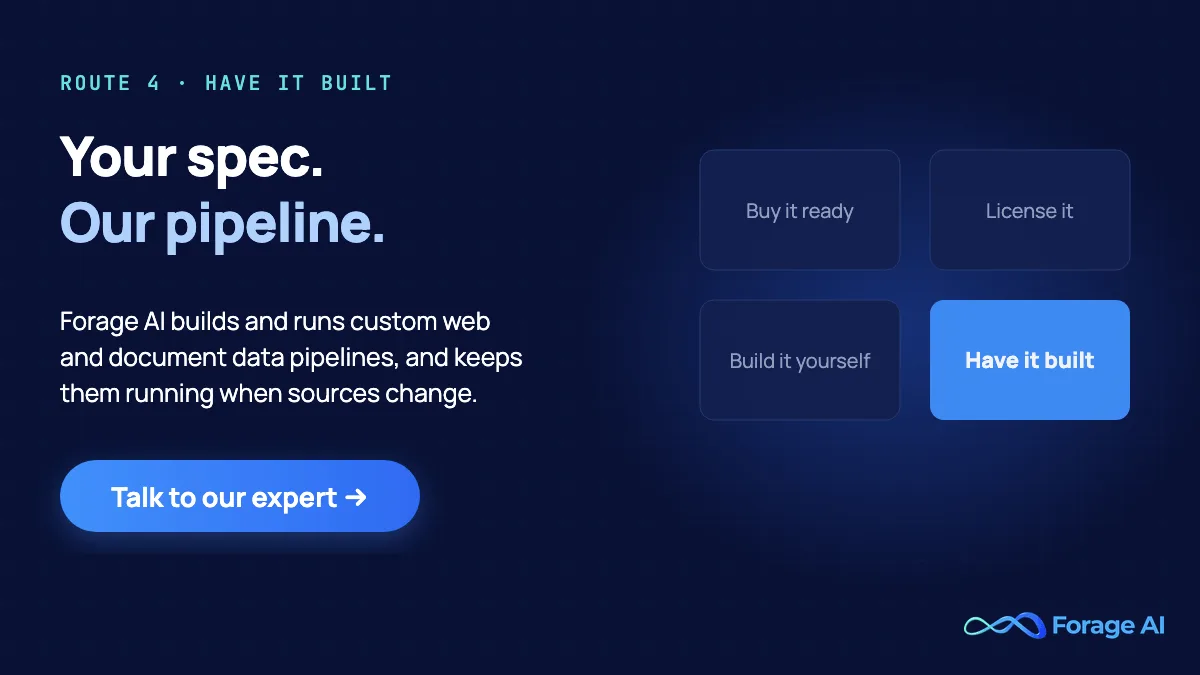
We build and run custom web and document data pipelines for companies whose product or analysis depends on external data. That puts us in route four, under managed web data services, next to providers we compete with every week. We listed them on the same terms as ourselves: alphabetical order, the same chip, no ranking. The diamond marks us as the author of the map and nothing more.
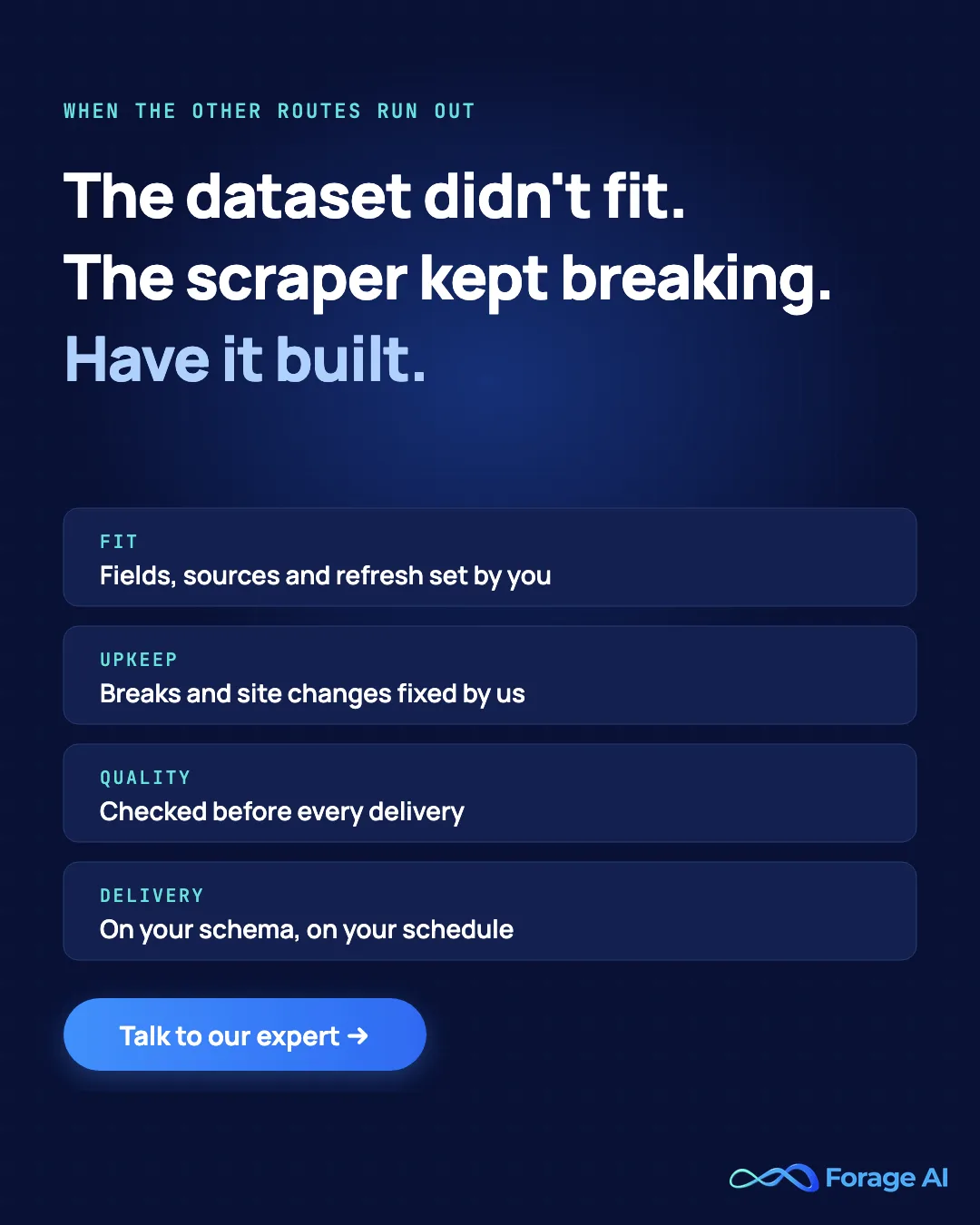
We do think the map shows why route four exists. Companies rarely start there. They tend to arrive after another route stopped working for one specific data need: a dataset that did not fit, a scraper that kept breaking, or a licence that covered too little. If that describes a source you are dealing with now, our team can usually tell you on one call which route it belongs on, including when the answer is not us.
How we built the external data market map
We started from the buyer's decision rather than from a list of tools, defined the four routes, and then researched each route's categories from scratch, using each company's own website, funding announcements and acquisition news.
- Scope: companies that sell data the buyer does not own, sell the right to use it, or sell the means to collect it. Storage, warehousing and analytics tools are out of scope.
- Checks: on 7 October 2026 we confirmed a live website and a current commercial offering for every company, along with its 2026 brand name and owner.
- Placement: each company appears once per product line it sells separately. Bright Data appears three times because its proxies, datasets and managed service are separate offerings.
- Exclusions: we left out companies we could not verify, products that now exist only as a feature inside another platform, and NetNut, whose domains were seized in July 2026.
- No paid placement: no company paid or asked to be listed.
The map is not exhaustive, and a market that consolidates this quickly will date it. If your company belongs on it, or a listing is out of date, tell us through our contact page and we will review it for the next edition.
Verdict: which external data option should you choose?
The external data market is how companies get data they do not own, and in 2026 it splits into four options. Choose by the cost you can carry, not by the vendor:
- Buy it ready when a standard dataset answers your question and you can accept the vendor's schema.
- License it when you need specific owned content, such as news, books or media, cleared for AI use.
- Build it yourself when collection is a core skill and your sources are few and stable.
- Have it built when you need custom data from many or difficult sources and do not want to staff its upkeep.
In practice, most teams use two or three of these at once. Check each data need against its route once a year, because the source that was quick to build in January can be the one breaking every week by December.
Frequently asked questions
What is the external data market?
It is every way companies get data they do not generate themselves: buying datasets from vendors, licensing content from its owners, building their own collection, or paying a provider to build and run it for them. It spans data vendors and marketplaces, licensing intermediaries, scraping and AI search infrastructure, and managed data services.
What is the difference between buying and licensing data?
Buying usually means paying for access to a dataset that a vendor has already collected and packaged. Licensing means paying a rights holder, such as a publisher or an archive, for permission to use content it owns, often for AI training or retrieval and always on its terms.
When does a managed data service make more sense than building in-house?
When you need custom data from many or difficult sources, refreshed often, and keeping collectors running would pull engineers away from your product. Teams with a few stable sources and collection skills in-house often do well building. Our build vs buy guide walks through the decision.
Can I use this map in my own work?
Yes. Share or embed the map and the company list freely, with credit to Forage AI and a link to this page.
Related articles
- Top AI Training Data Providers (2026): Buyer's Guide: a closer look at the AI data side of routes one, two and four.
- How to Choose a B2B Data Provider: for teams buying company and people data ready-made.
- What Is Managed Web Data Extraction?: how route four works in practice.
- When to Outsource Data Extraction: 7 Signs It's Time: how to tell when a need has outgrown the build route.
Sai is a data infrastructure enthusiast who has spent the past two to three years following the AI space closely, from the infrastructure layer to the fast-growing world of data for AI. He is genuinely curious about how modern data pipelines get built and where the data industry is heading, and he writes insightful pieces on the core topics that shape this niche.