
Best NPI Data Tools in 2026: Datasets, APIs, and Provider Enrichment Platforms Compared
Last updated August 2026. How we evaluated: tool classes and entries were selected from live SERP, community, and primary-source research conducted August 2026; every stat traces to a cited source; no vendor paid for placement.
Healthcare data teams keep making one of two expensive mistakes with NPI data tools. Either they rebuild NPPES plumbing in-house that a $669 dataset or a free API already covers, or they sign a six-figure enrichment platform contract to fix a use case the free government file handles at $0. The root cause is the same: nearly every ranked list on this topic compares a free federal file, seat-based SaaS, and enterprise platforms as if they were the same kind of product.
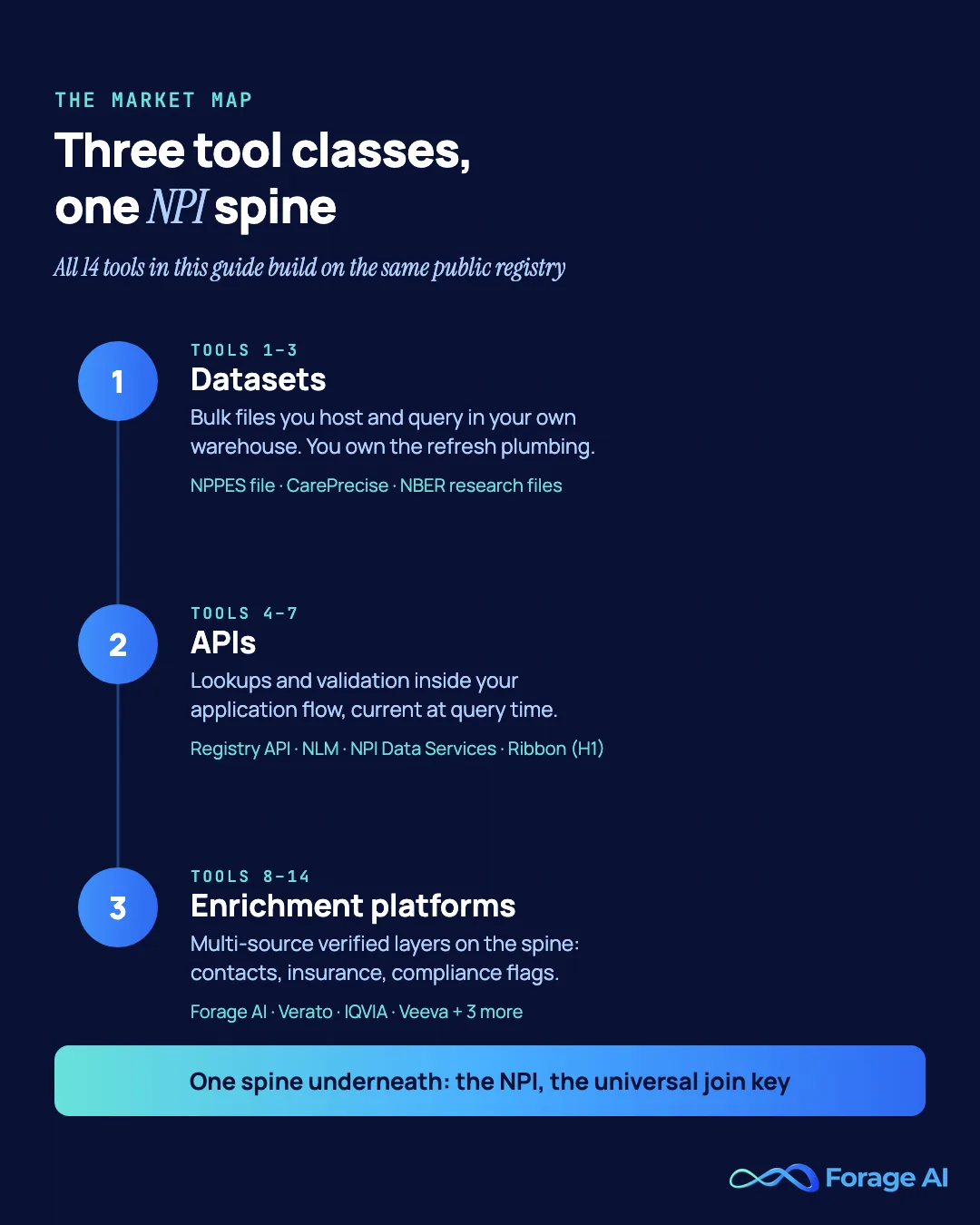
They are not, and this article treats them differently. We cover what teams actually use NPI data for (six use cases), an honest test for when the free NPPES file is all you need, and then 14 tools in three classes: datasets, APIs, and provider enrichment platforms. The registry now holds more than 9.3 million NPI records, and the file format that carries them changed in March 2026, so the operational details matter more than usual this year. By the end, you should be able to shortlist the right class and two to three tools for your use case, or conclude the free file is enough and spend nothing.
Quick Digest
- NPI data is an identifier system, not a credential check. CMS states plainly that holding an NPI does not mean a provider is licensed or credentialed. Where licence status actually lives, and why no federal file carries it, is covered in our ranking of every public US healthcare provider data source.
- Six use cases drive every purchase decision: claims validation, directory products, healthcare GTM, credentialing and compliance screening, market intelligence, and research. Each stresses a different data requirement.
- The free NPPES file and API genuinely cover several of those use cases at $0. Pay only when you hit one of four named tipping points: missing fields, freshness floors, real-time loops, or maintenance cost.
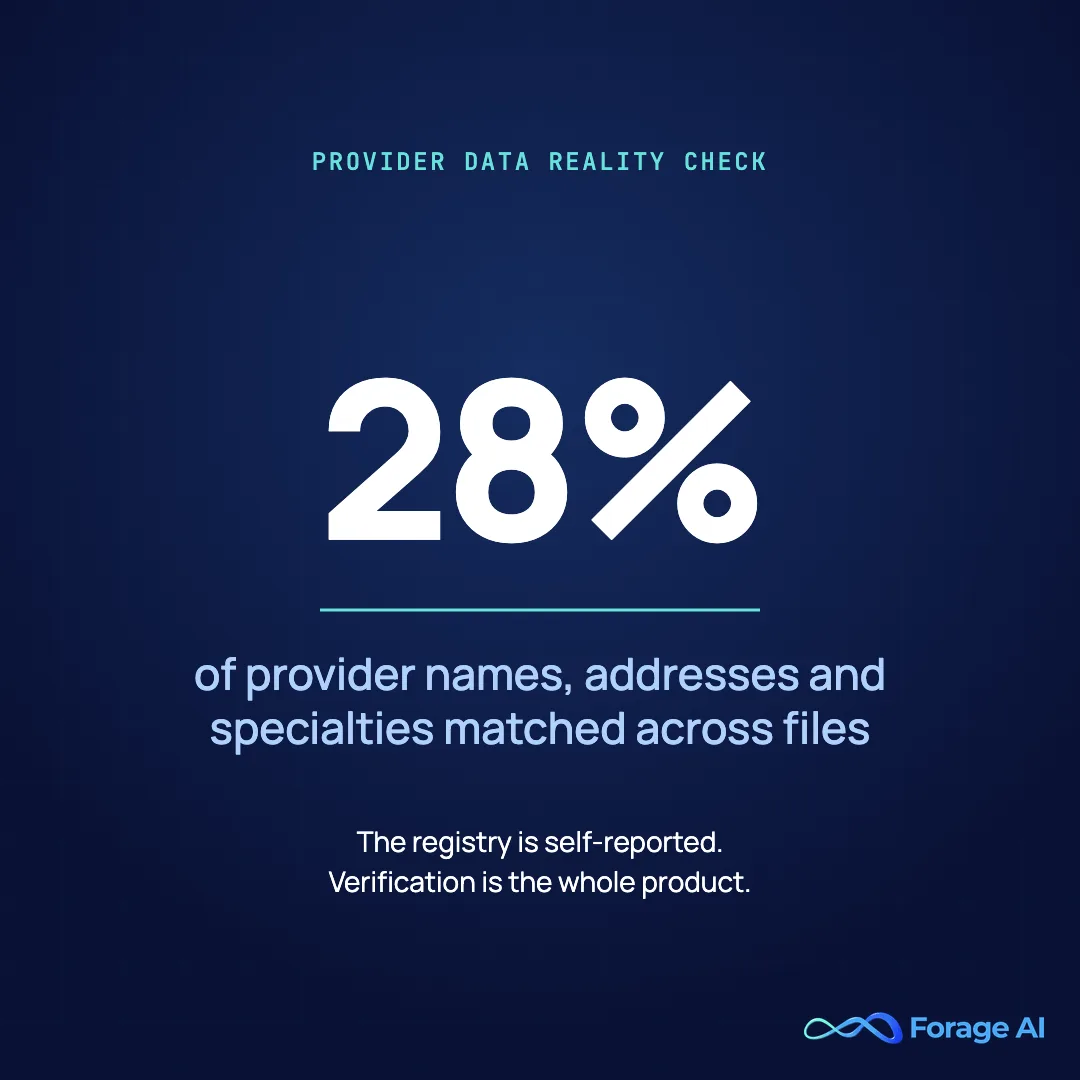
- Accuracy is the reason paid tools exist. When CMS compared exchange plans’ machine-readable provider files against NPPES over plan years 2017–2021, only 28% of names, addresses, and specialties matched.
- Datasets (items 1–3) suit teams that want the data in their own warehouse and can own the refresh plumbing, including the March 2026 V2 file transition.
NPI Data Tools at a Glance
| # | Tool | Class | Best for |
|---|---|---|---|
| 1 | NPPES Downloadable File (CMS) | Dataset | Free baseline for teams with data engineering capacity |
| 2 | CarePrecise | Dataset | Pre-cleaned commercial NPI database under $1K |
| 3 | NBER NPPES Research Files | Dataset | Free research-formatted history and backtesting |
| 4 | NPPES NPI Registry API (CMS) | API | Free low-volume validation lookups |
| 5 | NLM Clinical Tables NPI API | API | Autocomplete and search in clinical applications |
| 6 | NPI Data Services REST API | API | Enriched lookups with PECOS and exclusion flags |
| 7 | Ribbon Health (H1) | API / platform | Enterprise directory and find-care experiences |
| 8 | Forage AI | Enrichment platform | Custom NPI-spined extraction and enrichment pipelines, continuously refreshed |
| 9 | Verato | Enrichment platform | Provider identity resolution and master data management |
| 10 | IQVIA OneKey | Enrichment platform | Global life-sciences HCP reference data |
| 11 | Veeva OpenData | Enrichment platform | Pharma-commercial reference data, CRM-native |
| 12 | Doximity | Enrichment platform | Reaching verified clinicians for healthcare GTM |
| 13 | LexisNexis Risk Provider Data | Enrichment platform | Payer-side verification and directory accuracy |
| 14 | ZoomInfo (Healthcare) | Enrichment platform | Generalist GTM teams that already own a license |
What Does NPI Data Actually Contain?
Before the class-by-class list, it is worth pinning down what all 14 tools above are actually built on. The NPI is the 10-digit National Provider Identifier issued to US healthcare providers under HIPAA administrative simplification, and NPPES, the National Plan and Provider Enumeration System, is the CMS-run system that serves as its source of record. Type 1 NPIs identify individual practitioners; Type 2 NPIs identify organizations. The registry held more than 9.3 million NPI records as of August 2026, counting both types and including deactivated identifiers, per the registry mirror synced weekly from NPPES (2026). Specialty lives in taxonomy codes, the field this article will return to repeatedly.
Three terms get blurred constantly, and the blur causes bad purchases. The NPI registry is the lookup interface and API. The NPPES downloadable file is the bulk file you host yourself. An NPI record is one row in either. Every tool in this article is built on this same public, FOIA-disclosable spine, which is why the NPI works as the universal join key across provider data sources.
Expert Insights
CMS says so on the NPPES data dissemination page itself, checked September 2026: “Issuance of an NPI does not ensure or validate that the Health Care Provider is Licensed or Credentialed.” Every tool in this list inherits that limit. An NPI proves an identifier was issued, not that the person behind it may practise today.
What Teams Use NPI Data For: 6 Core Use Cases
Tool class follows use case, so we start with the six jobs NPI data actually does in production.
1. Provider identity validation and claims/billing ops. Wrong or stale provider identity data turns directly into denials. In Experian Health’s third annual State of Claims survey (September 2025), 41% of providers reported claim denial rates of 10% or higher, and 50% cited missing or inaccurate claim data as the top factor driving denials. This use case needs lookup-grade validation at intake, often in real time.
2. Provider directories and search products. Directory products live or die on continuous refresh and multi-source verification. A 2019 CAQH survey of 1,240 physician practices found directory upkeep costs US physician practices $2.76 billion annually, $998.84 per practice per month, about one staff day per week. That cost exists because the underlying data never stops moving.
3. Healthcare GTM and HCP audience enrichment. Marketing and sales teams need contactability: emails, phones, and affiliations that NPPES does not carry. This is the use case most paid list vendors are actually selling to.
4. Network management, credentialing, and compliance screening. Credentialing workflows join NPI records to PECOS (Medicare’s Provider Enrollment, Chain, and Ownership System) enrollment, state licenses, and OIG LEIE (List of Excluded Individuals/Entities) exclusion checks on a fixed cadence. The requirement here is linkage and screening rhythm, not raw coverage.
5. Market intelligence and analytics. Provider counts, specialty mix, affiliation graphs, and service-line analysis all run on the NPI spine; we cover this analytical layer separately in our guide to provider-level market analytics.
6. Research and public-interest datasets. Academic and policy work needs historical, reshaped registry data more than it needs freshness.
Each use case stresses a different axis: freshness, contactability, linkage, or compliance cadence. That is why “best NPI data tool” is use-case-relative, and why several of these jobs are fully served by free sources. The next section says which ones, plainly.
When Is the Free NPPES File All You Need?
The most common objection practitioners in community discussions raise about paid NPI tools is blunt: the NPI database is free to download, so what exactly does a paid product add? It is the right question, and the honest answer starts with what free covers.
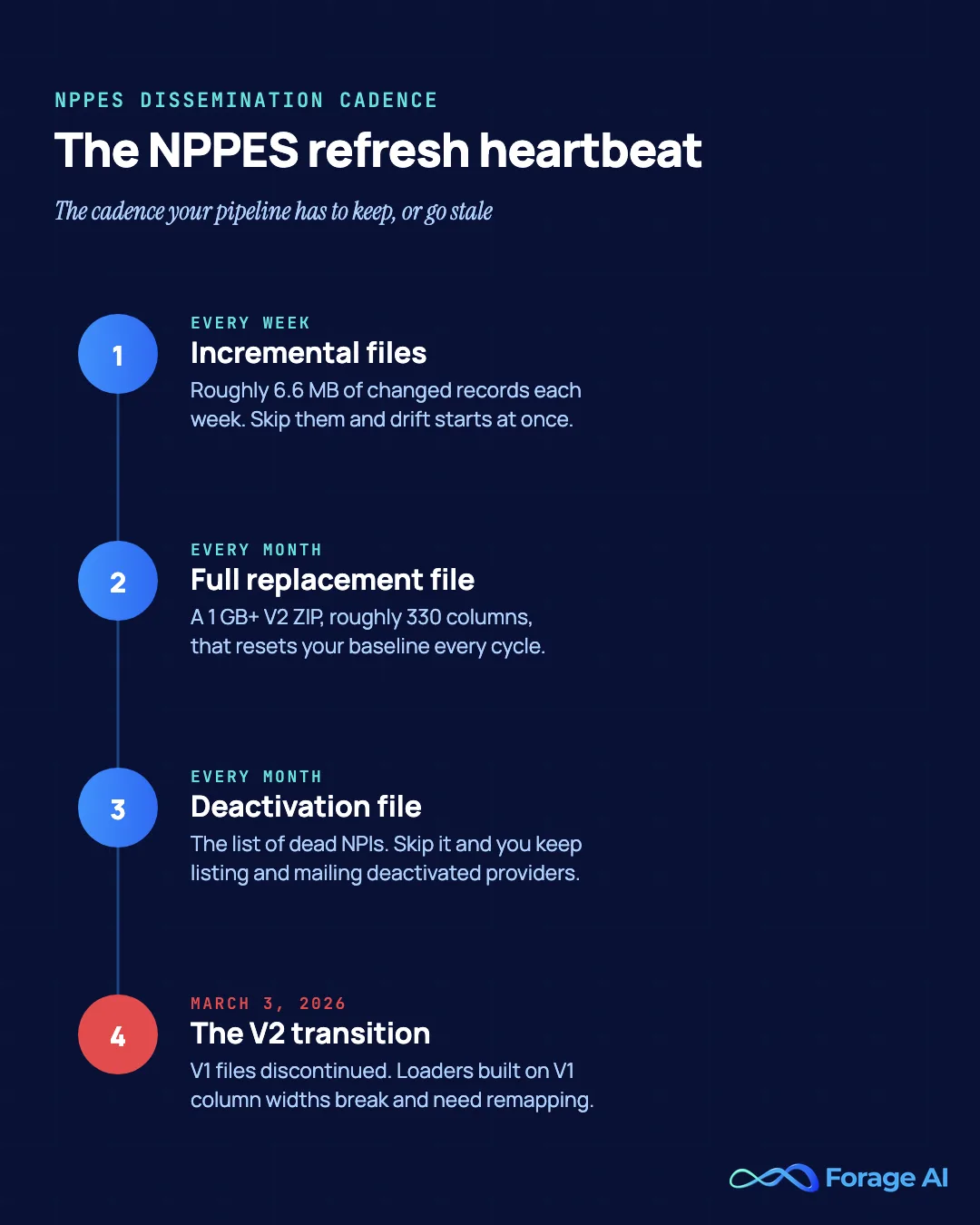
Free is genuinely enough for real production use cases. One-off NPI validation, academic research, internal analytics on registry fields, and low-volume lookups are fully served at $0. What you get free from CMS: a monthly full-replacement file, weekly incremental files, a monthly deactivation file, and a no-cost registry API. The catch is operational. The full file runs roughly 9–10 million rows across about 330 columns, awkward enough that a small collection of open-source GitHub loader projects exists purely to get it into a database.
One 2026 change matters here: effective 03/03/2026, NPPES discontinued Version 1 of the monthly and weekly downloadable files. Version 2, now the only supported format, extends field lengths for First Name and Legal Business Name, which breaks legacy loaders built against V1 column widths (per the CMS NPI Files page, 2026). If your pipeline predates March 2026 and nobody touched it, check it this week.
The costliest assumption in provider data is that the registry is accurate and current. NPPES is self-reported. When CMS compared exchange plans’ (QHP and SADP issuers’) machine-readable provider files against NPPES across plan years 2017–2021, on a sample of 1,235 NPIs, only 28% of provider names, addresses, and specialties matched (Federal Register, 87 FR 61018, 2022). The mismatch cuts both ways: payer files go stale and so does NPPES. In our provider-data pipeline work, the two fields we see decay fastest are practice address and taxonomy.
When free stops being enough (the honest tipping points)
We call this the Free-Is-Enough Test: stay on free NPPES until you hit one of four tipping points.
- Tipping point 1: the fields you need do not exist in NPPES. Emails, accepted insurance, network participation, and verified affiliations are absent by design. If your use case runs on them, you need an enrichment platform, or a custom extraction pipeline for data that only exists on payer and health-system websites.
- Tipping point 2: the freshness and accuracy floor is below your SLA. If a 28%-match substrate breaks your directory or claims workflow, you need a multi-source verified layer: enrichment platforms.
- Tipping point 3: you need a real-time decision loop. The free API throttles sustained batch volume; high-throughput or in-flow validation belongs on a commercial API.
- Tipping point 4: maintaining NPPES plumbing costs more than a subscription. If V2 migrations, weekly incrementals, and deactivation processing are eating engineering weeks, a dataset or platform is cheaper. We resolve this build-vs-buy call fully in the how-to-choose section.
Which Class of NPI Data Tool Do You Need?
Each tipping point in the test names the class that resolves it, so the last piece of front matter is the class rubric itself. Flat ranked lists that put a free government file next to a $100K platform produce meaningless rankings. The classes solve different problems, and CMS itself draws the core distinction: a machine-readable file is a static snapshot that must be recreated to update, while an API can return the most current data at the moment of query (paraphrasing the CMS National Directory RFI, 2022). Practitioners in community discussions frame the same split as the real evaluation axis: real-time decision loop versus bulk enrichment, and warn that the best provider is the one that integrates cleanly into your pipeline, not the one with the biggest database. For the fuller rubric on vetting vendors in this space, see our guide to how to evaluate healthcare data providers.
| Dimension | Datasets | APIs | Enrichment platforms |
|---|---|---|---|
| What you get | Files you host and query | Lookups and validation in your application flow | Multi-source verified layers on the NPI spine |
| Delivery | Bulk file (monthly/weekly) | REST endpoints | Platform, feed, or managed service |
| Freshness model | You process updates | Current at query time | Vendor-managed continuous refresh |
| Typical cost band | Free to sub-$1K | Free to paid tiers | Mid five figures to $100K+/yr, or custom |
| Pick it when | You own the warehouse and the plumbing | Validation belongs in-flow | Accuracy, coverage, or compliance exceed free sources |
One caution before the list: do not pick a class on price band alone. A cheap dataset that goes stale costs more downstream than it saved upfront. A 2025 study in The American Journal of Managed Care re-contacted 1,802 inaccurately listed providers and found inaccuracies persisted for 40.3% of providers for at least 540 days; only 13.3% were listed correctly at follow-up. Directory errors are not self-healing.
Best NPI Datasets and Databases
Datasets are the right class when you want provider data in your own warehouse: full control, full ownership, and full responsibility for the refresh plumbing.
1. NPPES Downloadable File (CMS)
| Attribute | Detail |
|---|---|
| Tool class | Dataset (official government file) |
| Best for | Teams with data engineering capacity whose needs stop at registry fields |
| Not for | Teams without pipeline resources, or use cases needing contacts and insurance data |
| Key capabilities | Full registry export; weekly incremental files; monthly deactivation file; Other Name, Practice Location, and Endpoint reference files |
| Coverage claim | All 9.3M+ NPI records (enumerated: includes deactivated and Type 2 records) |
| Update cadence | Monthly full replacement + weekly incrementals |
| Delivery | Bulk file download (CMS NPI Files) |
| Pricing model | Free |
| Reviews & evidence | Detail |
|---|---|
| Ratings | No public review base (government data file; no G2/Capterra corpus) |
| What practitioners praise | The only complete free base layer; the substrate every paid product builds on |
| What practitioners complain about | File size and shape; self-reported staleness; loaders breaking on the V2 transition |
| Evidence quality | Community signal (Reddit and GitHub loader projects), paraphrased; accessed Aug 2026 |
| Source | CMS NPI Files page, fetched Aug 2026 |
What it is. The official FOIA-disclosable registry export. The current monthly V2 full file (August 10, 2026) is a 1,098.12 MB ZIP, shipped alongside a roughly 2.6 MB monthly deactivation file and roughly 6.6 MB weekly incrementals, each including three reference files: Other Name, Practice Location, and Endpoint (CMS, 2026).
Best for. Teams that can own the heartbeat: monthly full replacement, weekly incrementals, and deactivation processing. Skip the deactivation file and you will keep mailing, paying, or listing dead NPIs.
What customers say. No formal review corpus exists. The honest community signal is the GitHub loader projects themselves: practitioners keep writing and sharing SQL loaders because the raw file, at roughly 330 columns, is genuinely awkward to work with.
2. CarePrecise
| Attribute | Detail |
|---|---|
| Tool class | Dataset (commercial) |
| Best for | Skipping the plumbing for under $1K |
| Not for | Teams needing continuous refresh or contact-grade GTM data |
| Key capabilities | Pre-cleaned tiered US provider databases; NPPES + PECOS + sanctions data combined; ready-to-query format |
| Coverage claim | ~9.3M provider records (enumerated: mirrors the full registry, not active practitioners) |
| Update cadence | Monthly updates |
| Delivery | Purchased database file (CarePrecise) |
| Pricing model | $669 (Complete) to $999 (Platinum), one-time, vendor-published |
| Reviews & evidence | Detail |
|---|---|
| Ratings | No public review base verified in our research |
| What practitioners praise | Lowest-cost path to a cleaned, joined registry copy |
| What practitioners complain about | One-time purchase model means the decay clock starts at checkout |
| Evidence quality | Vendor-published product pages; quality study the vendor cites is a 2015 JGIM paper (older source, context only) |
| Source | CarePrecise product pages, accessed Aug 2026 |
What it is. A budget commercial NPI database line that does the NPPES + PECOS + sanctions joining and cleaning for you, refreshed monthly by the vendor.
Best for. The sub-$1K slot: teams that want a queryable provider database this week without building loaders.
What customers say. The watch-out is arithmetic, not quality: at roughly 7% annual physician turnover (covered below), a one-time file purchase measurably decays within a quarter. Treat it as a snapshot product, and budget for repurchase or a refresh plan.
3. NBER NPPES Research Files
| Attribute | Detail |
|---|---|
| Tool class | Dataset (research mirror) |
| Best for | Research, backtesting, and historical change analysis |
| Not for | Production feeds or anything needing current-month freshness |
| Key capabilities | Research-formatted NPPES mirrors with historical vintages back to the late 2000s; reshaped database-style files; ZIP-code linkage |
| Coverage claim | Historical registry snapshots (enumerated, by vintage) |
| Update cadence | Periodic research releases, not a production cadence |
| Delivery | File downloads (NBER) |
| Pricing model | Free |
| Reviews & evidence | Detail |
|---|---|
| Ratings | No public review base (academic data resource) |
| What practitioners praise | The only free reshaped historical series; practitioners in community discussions also note NBER’s NPI-to-DEA crosswalk |
| What practitioners complain about | Not built or supported as a production feed |
| Evidence quality | Community and academic signal, paraphrased; accessed Aug 2026 |
| Source | NBER NPPES data page, accessed Aug 2026 |
What it is. The National Bureau of Economic Research (NBER) maintains research-formatted mirrors of NPPES, restructured into database-style files with historical vintages back to the late 2000s.
Best for. Use case six: research teams and anyone backtesting how provider records changed over time, which the live registry cannot show you.
What customers say. Academic users treat it as the default historical source; the consistent caveat is that it is a research artifact, not a supported feed.
| Dataset | Best for | Freshness | Cost model |
|---|---|---|---|
| NPPES Downloadable File | Free baseline, own warehouse | Monthly full + weekly incrementals | Free |
| CarePrecise | Cleaned copy under $1K | Monthly vendor updates | $669–$999 one-time |
| NBER Research Files | History and backtesting | Research vintages | Free |
Best NPI APIs
APIs are the right class when lookups belong inside your application flow: validation at intake, autocomplete, and real-time decision loops.
4. NPPES NPI Registry API (CMS)
| Attribute | Detail |
|---|---|
| Tool class | API (official, free) |
| Best for | Low-volume validation and lookups |
| Not for | Bulk enrichment or high-throughput batch jobs |
| Key capabilities | v2.1 lookup by NPI, name, taxonomy, or location; JSON responses; weekly-refreshed registry data |
| Coverage claim | Full registry (enumerated) |
| Update cadence | Weekly registry refresh |
| Delivery | REST API (CMS API docs) |
| Pricing model | Free |
| Reviews & evidence | Detail |
|---|---|
| Ratings | No public review base (government API) |
| What practitioners praise | Free, official, good enough for point validation |
| What practitioners complain about | Not built for bulk: no bulk endpoints, and sustained batch volume gets throttled |
| Evidence quality | Community signal (Reddit), paraphrased; CMS documentation; accessed Aug 2026 |
| Source | CMS NPPES API documentation v2.1, accessed Aug 2026 |
What it is. The official free lookup API against the weekly-refreshed registry. A basic lookup and its response shape:
Look up a provider by NPI against the free CMS NPPES API (v2.1); returns JSON with enumeration type, taxonomy, and practice addresses.
GET https://npiregistry.cms.hhs.gov/api/?version=2.1&number=1234567893

{
  "result_count": 1,
  "results": [{
    "enumeration_type": "NPI-1",
    "number": "1234567893",
    "basic": { "first_name": "JANE", "last_name": "DOE", "status": "A", "last_updated": "2026-05-11" },
    "taxonomies": [{ "code": "207R00000X", "desc": "Internal Medicine", "primary": true, "state": "TX" }],
    "addresses": [{ "address_purpose": "LOCATION", "city": "AUSTIN", "state": "TX", "postal_code": "78701" }]
  }]
}
(Response shape verified against the live v2.1 endpoint, August 2026. The NPI and values shown are illustrative placeholders, so substitute a real NPI when you run it. Also searchable by name, taxonomy, and location, with a limit of up to 200 results per request.)
Best for. Point validation at low volume. The constraint no listicle prints: CMS publishes no formal rate limit, but as of August 2026, sustained batch volume gets throttled, and the per-request cap is 200 records. If your workload is batch-shaped, use the file, not the API.
What customers say. Practitioners in community discussions describe it as the correct first stop that stops working the day you need bulk queries or high throughput.
5. NLM Clinical Tables NPI API
| Attribute | Detail |
|---|---|
| Tool class | API (free, NIH/NLM-hosted) |
| Best for | Autocomplete and search inside clinical applications |
| Not for | Enrichment or bulk retrieval |
| Key capabilities | Individual and organizational NPI lookup tuned for search-as-you-type interfaces |
| Coverage claim | Registry-derived (enumerated) |
| Update cadence | Maintained against registry data |
| Delivery | REST API (NLM API docs) |
| Pricing model | Free |
| Reviews & evidence | Detail |
|---|---|
| Ratings | No public review base (government API) |
| What practitioners praise | Purpose-built for autocomplete; simpler to wire into a search box than the registry API |
| What practitioners complain about | It is a search tool, not an enrichment source |
| Evidence quality | Official NLM documentation; accessed Aug 2026 |
| Source | NLM Clinical Tables documentation, accessed Aug 2026 |
What it is. An NIH/NLM-hosted NPI lookup API built for autocomplete and search in clinical applications, and the free API almost no ranking page mentions.
Best for. Provider-picker UX. If the requirement is a fast type-ahead field in an EHR-adjacent product, this beats hand-rolling search on the registry API.
What customers say. Low public footprint; teams that find it tend to keep it. Its scope is deliberately narrow, and it should be evaluated as UX plumbing, not a data source.
6. NPI Data Services REST API
| Attribute | Detail |
|---|---|
| Tool class | API (commercial, enriched) |
| Best for | Compliance-flagged lookups and bulk validation |
| Not for | Teams fully served by the free registry API |
| Key capabilities | Layers PECOS, LEIE, and Medicare enrollment plus verification flags on NPPES records; bulk NPI validation endpoints |
| Coverage claim | Registry-based with enrichment layers (enumerated + flags) |
| Update cadence | Vendor-managed |
| Delivery | REST API (NPI Data Services) |
| Pricing model | Free trial; paid tiers (pricing on vendor site) |
| Reviews & evidence | Detail |
|---|---|
| Ratings | No public review base verified in our research |
| What practitioners praise | Exclusion and risk screening built in, which practitioners in community discussions ask for unprompted |
| What practitioners complain about | Thin public track record versus the incumbents |
| Evidence quality | Vendor documentation; community signal on the screening use case, paraphrased |
| Source | NPI Data Services site, accessed Aug 2026 |
What it is. A commercial REST API that answers the “what does paid add” question concretely: PECOS enrollment, LEIE exclusion flags, and bulk validation endpoints on top of registry records. One naming note: the vendor’s name collides with the generic phrase “NPI data services,” so search for it carefully.
Best for. Credentialing and compliance screening in-flow. OIG advises monthly exclusion screening, and an API that returns the flag with the lookup collapses two pipeline steps into one.
What customers say. The screening capability is the draw; the vendor’s public review footprint is thin, so run a trial against your own match-rate benchmarks before contracting.
7. Ribbon Health (H1)
| Attribute | Detail |
|---|---|
| Tool class | API / provider data platform |
| Best for | Enterprise directory, find-care, and network-management experiences |
| Not for | Validation-only needs or teams without enterprise budget |
| Key capabilities | Ingests and standardizes multiple provider data sources; directory API; care navigation and network management workflows |
| Coverage claim | Multi-source platform (vendor does not compete on a single record count) |
| Update cadence | Platform-managed |
| Delivery | API / platform (sold as H1 for Health Plans & Digital Health) |
| Pricing model | Usage-based / enterprise (opaque) |
| Reviews & evidence | Detail |
|---|---|
| Ratings | No public review base verified in our research |
| What practitioners praise | Directory-grade standardization across messy sources |
| What practitioners complain about | Enterprise, opaque pricing; overkill for validation-only needs |
| Evidence quality | Trade press and vendor press releases; accessed Aug 2026 |
| Source | H1 press announcements, Jan 2025; accessed Aug 2026 |
What it is. A provider data platform and directory API, now part of H1. H1 signed the agreement to acquire Ribbon Health on December 12, 2024, closed in late December 2024, and announced it on January 8, 2025; H1 also acquired Veda in 2025, folding both into an end-to-end provider data platform (Fierce Healthcare, 2025). Competing listicles that still list Ribbon and Veda as independent companies are working from a pre-2025 market map.
Best for. Health plans and digital-health products building find-care and directory experiences that need standardized multi-source data, not just registry lookups.
What customers say. At the acquisition, Ribbon co-founder and CEO Nate Maslak framed the combination directly: “By combining our comprehensive provider data and provider data management software with H1’s clinical insights and global reach, we’re giving individuals the information they need to get the best possible care” (H1 press release, January 2025). The watch-out is fit: if you only need NPI validation, this class of platform is more machine than the job requires.
| API | Best for | Rate-limit reality | Enrichment flags | Cost model |
|---|---|---|---|---|
| NPPES Registry API | Point validation | Throttles sustained batch; 200 records/request | None | Free |
| NLM Clinical Tables | Autocomplete/search | Built for interactive use | None | Free |
| NPI Data Services | Compliance-flagged lookups | Bulk endpoints offered | PECOS, LEIE, Medicare enrollment | Trial + paid tiers |
| Ribbon Health (H1) | Directory platforms | Enterprise contracts | Multi-source platform | Enterprise/usage |
Best Provider Data Enrichment Platforms
This category exists because no single source of provider data is accurate on its own. A JAMA research letter (2023) analyzing 449,282 physicians who appeared in more than one of the five largest US insurer directories found 81% had inconsistent entries across directories: conflicting addresses, specialties, or names. Enrichment platforms answer that finding with multi-source verification, layering PECOS, state licensing boards, exclusion lists, and web-presence evidence on the NPI spine. The seven platforms below take meaningfully different approaches to the same fix.
Expert Insights
“These findings indicate that there has been little progress in improving provider directory accuracy since implementation of the No Surprises Act… inaccurate provider directories can lead to delays in care due to difficulty finding the correct physician, challenges in regulators assessing health plan network adequacy, and misrepresentation of network depth and breadth as consumers select health plans.” So says Neel Butala, MD, Assistant Professor at the University of Colorado School of Medicine, cardiologist and lead author of the 2023 JAMA directory-consistency study. The category’s honest job description is closing exactly that accuracy gap, continuously.
8. Forage AI
| Attribute | Detail |
|---|---|
| Tool class | Enrichment platform (managed extraction and enrichment service) |
| Best for | Data product and ops teams whose product runs on provider data and needs continuously refreshed, multi-source pipelines |
| Not for | Teams wanting a self-serve seat tool, an off-the-shelf list, or a one-time file |
| Key capabilities | Custom NPI-spined extraction from websites and documents; accepted-insurance and network-participation data capture; continuous refresh; multi-layer QA; full data ownership |
| Coverage claim | Custom-scoped per pipeline (built to your source list, not sold as a fixed count) |
| Update cadence | Continuous, set to your SLA and your own review clocks |
| Delivery | Managed service (Forage AI healthcare data extraction) |
| Pricing model | Custom (managed service) |
| Reviews & evidence | Detail |
|---|---|
| Ratings | No public review base (managed-service class; no G2 corpus) |
| What customers engage it for | Provider directory pipelines, payer-directory extraction, NPI-matched enrichment at scale |
| What to pressure-test | Scope fit: this is a build-with-you partner class, not a browse-and-buy product |
| Evidence quality | Managed-service engagements |
| Source | forage.ai, accessed Aug 2026 |
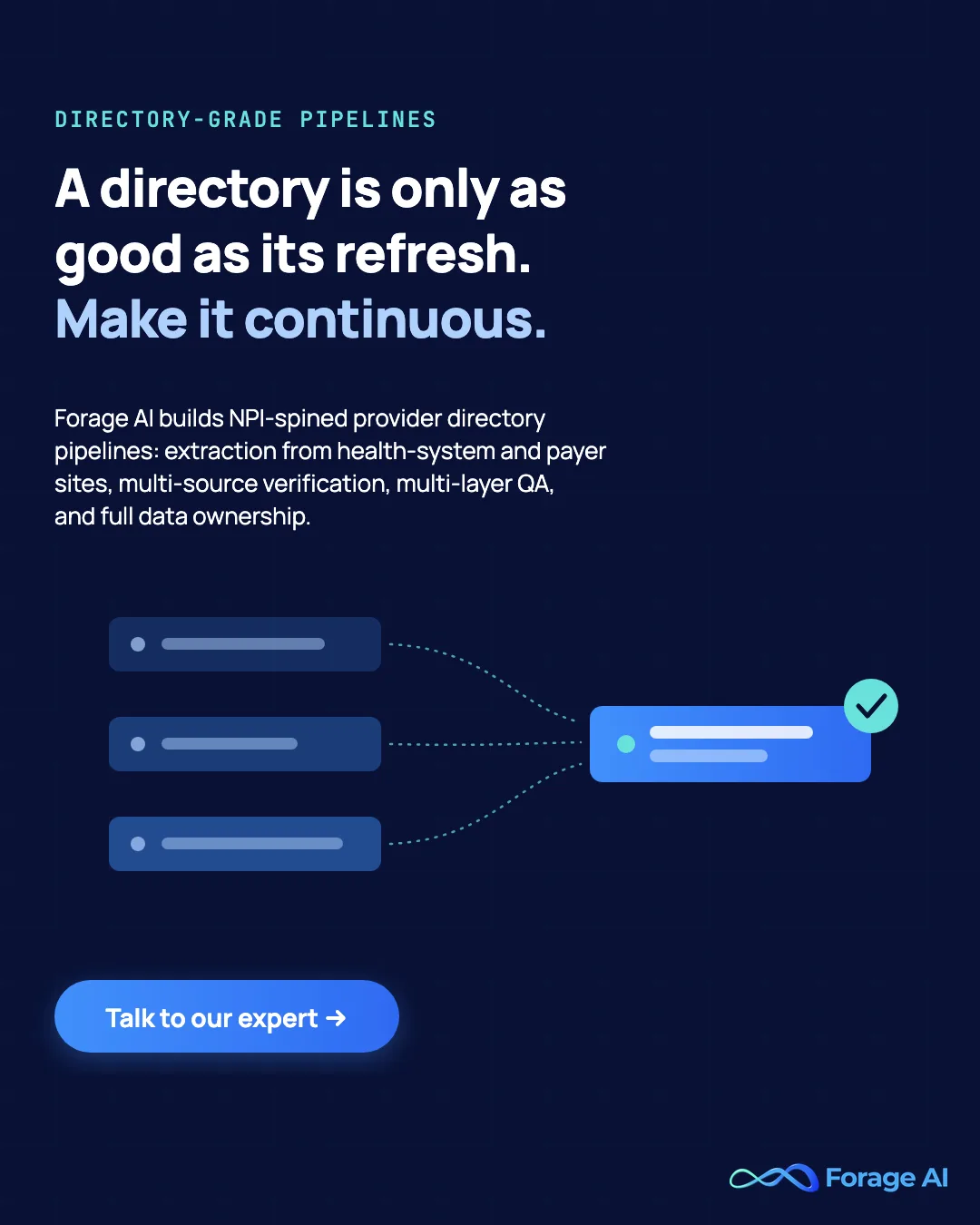
What it is. Forage AI builds custom provider data pipelines on the NPI spine: extraction from websites and documents at scale, continuous refresh, multi-layer QA, and full data ownership, delivered as a managed service rather than a seat license.
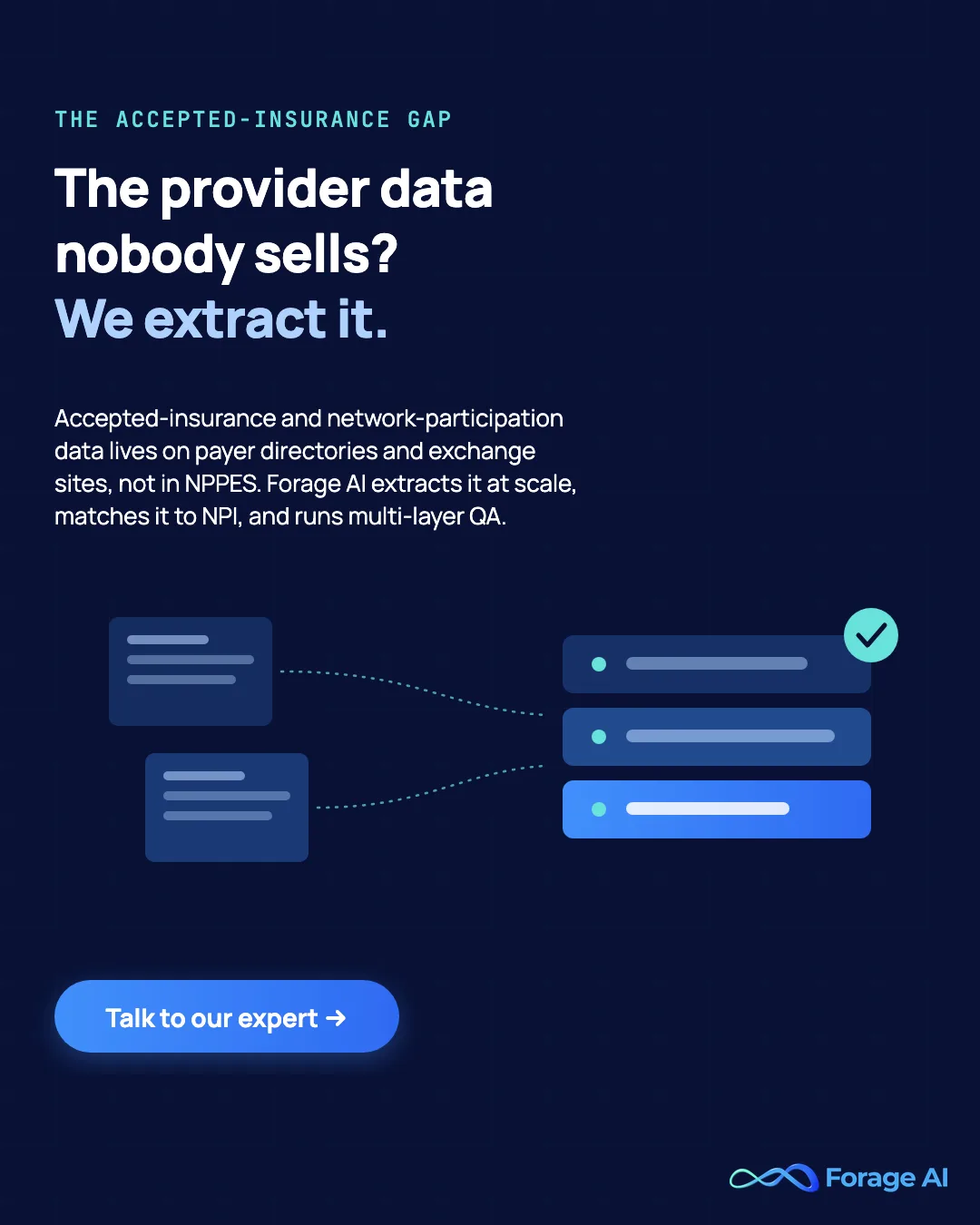
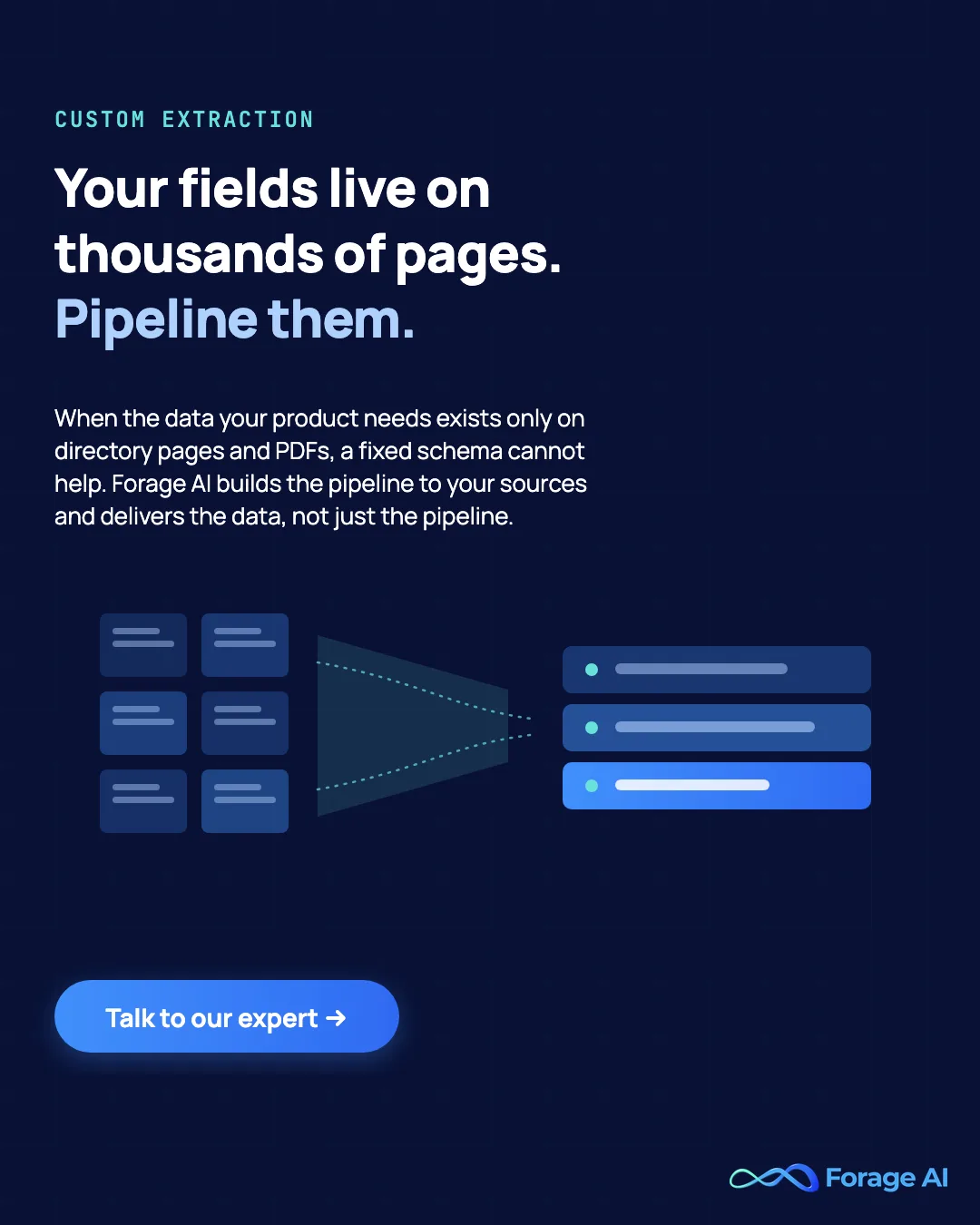
Best for. Two gaps the rest of this list does not close. First, accepted-insurance and network-participation data, the gap practitioners in community discussions name most often: nobody sells it well, and the workaround teams describe is scraping payer directories and state exchange sites, then name-matching back to NPI. That workaround is exactly what Forage AI productionizes as managed extraction, with QA layered on. Second, custom extraction generally: when the fields your product needs exist only on thousands of directory pages and PDFs, a fixed-schema platform cannot help, and a pipeline built to those sources can. Forage AI delivers the data, not just the pipeline, and handles selector drift, anti-bot evolution, and schema changes as part of the service.
What customers say. As a managed-service class, there is no public review corpus to print, and we will not fabricate one. The honest not-for line: if you need a self-serve seat tool or a one-time list, this is the wrong class, and a dataset or seat platform above will serve you better.
9. Verato
| Attribute | Detail |
|---|---|
| Tool class | Enrichment platform (provider identity resolution and master data management) |
| Best for | Health systems and payers reconciling one provider across many internal systems |
| Not for | Teams that want a provider list to buy, or claims and market intelligence |
| Key capabilities | Referential Matching against the Verato Carbon reference database; 360-degree views of practitioners and provider entities; reconciliation of third-party NPPES and state licensing data; change alerts on licensing and address updates; API delivery |
| Coverage claim | No published record count. This is a matching and reference layer over the records you already hold, not a licensable universe |
| Update cadence | Continuous, with notification on critical provider changes |
| Delivery | Cloud platform and APIs (Verato Provider Data Management) |
| Pricing model | Enterprise (not published) |
| Reviews & evidence | Detail |
|---|---|
| Ratings | 4.6/5 (G2, n=4; listed as Verato MDM Cloud), captured Aug 2026 |
| What reviewers praise | n=4 is too small a sample to characterize review themes honestly |
| What reviewers complain about | Same: no reliable complaint pattern at this sample size |
| Evidence quality | G2 product listing with n printed, plus vendor documentation; accessed Aug 2026 |
| Source | G2 (Verato MDM Cloud) and verato.com, accessed Aug 2026 |
What it is. A healthcare master data management platform whose provider module resolves the same clinician or provider entity across billing, claims, credentialing, and referral systems. Its Referential Matching approach compares your records both to each other and to a nationwide reference database, which is how it matches records that are incomplete or out of date.
Best for. Teams whose problem is duplication, not acquisition. Verato’s own framing of the challenge names the reconciliation burden directly: provider data arrives from NPPES and state licensing organizations, changes constantly as clinicians move, and gets modified by every department that touches it. If you already hold provider records in five systems that disagree, this is the class that fixes that.
What customers say. The public review base is thin (n=4), so treat the 4.6 rating as directional. The watch-out is scope: Verato adds no new provider universe, so if your gap is coverage rather than consistency, this is the wrong purchase.
10. IQVIA OneKey
| Attribute | Detail |
|---|---|
| Tool class | Enrichment platform (global HCP reference data) |
| Best for | Life-sciences enterprises needing global HCP/HCO reference data |
| Not for | US-only teams with mid-market budgets |
| Key capabilities | Global HCP and HCO profiles; claims and Rx depth; affiliation data |
| Coverage claim | 9M+ providers (global reference universe; not US-active-only) |
| Update cadence | Platform-managed |
| Delivery | Platform / data service (IQVIA) |
| Pricing model | $100K+/yr, typically multi-year |
| Reviews & evidence | Detail |
|---|---|
| Ratings | No public review base verified in our research |
| What reviewers praise | The de facto life-sciences reference standard; global reach |
| What reviewers complain about | Multi-year enterprise commitments |
| Evidence quality | Vendor and third-party comparison coverage; accessed Aug 2026 |
| Source | Vendor site, accessed Aug 2026 |
What it is. The life-sciences industry’s reference standard for HCP and HCO data, global in scope, with claims and prescribing depth attached.
Best for. Pharma and med-device enterprises operating across countries, where a single reference universe matters more than per-record cost.
11. Veeva OpenData
| Attribute | Detail |
|---|---|
| Tool class | Enrichment platform (pharma-commercial reference data) |
| Best for | Pharma commercial teams running Veeva CRM |
| Not for | Non-pharma use cases |
| Key capabilities | HCP/HCO reference data; change-request workflow with 24-hour SLA; CRM-native delivery |
| Coverage claim | 12M US HCPs / 2M HCOs claimed, 110+ countries (broad HCP universe, wider than NPI-holding clinicians) |
| Update cadence | Continuous, with 24-hour change-request SLA |
| Delivery | CRM-native data service (Veeva OpenData) |
| Pricing model | Enterprise (opaque) |
| Reviews & evidence | Detail |
|---|---|
| Ratings | 6.1/10 (TrustRadius, n=4), captured Aug 2026 |
| What reviewers praise | CRM-native delivery; the 24-hour change-request SLA |
| What reviewers complain about | Pharma-first design limits fit elsewhere |
| Evidence quality | Vendor product pages; accessed Aug 2026 |
| Source | Vendor site, accessed Aug 2026 |
What it is. Pharma-commercial customer reference data delivered natively into Veeva’s CRM, with a vendor-published 24-hour change-request SLA.
Best for. Field teams living in Veeva. The delivery model is the differentiator: reference data that updates inside the workflow reps already use.
12. Doximity
| Attribute | Detail |
|---|---|
| Tool class | Enrichment platform (verified HCP network and audience targeting) |
| Best for | Healthcare and pharma GTM teams that need to reach verified clinicians |
| Not for | Directory accuracy, payer compliance, or pipeline-grade provider records |
| Key capabilities | Verified clinician member network; targeting by NPI list, specialty, geography, and behavior; sponsored content and clinician messaging formats; campaign measurement |
| Coverage claim | 3M members, which the vendor describes as 4 out of 5 US physicians (85% of US MDs, 50% of NPs and PAs). This is network membership, not a licensable record count |
| Update cadence | Member-maintained profiles, platform-managed |
| Delivery | Marketing platform (Doximity Marketing Solutions) |
| Pricing model | Custom (not published) |
| Reviews & evidence | Detail |
|---|---|
| Ratings | No public review base verified in our research |
| What reviewers praise | No product-level corpus to characterize |
| What reviewers complain about | No product-level corpus to characterize |
| Evidence quality | G2 lists only Doximity Dialer Video (n=8, telemedicine) and Talent Finder (n=1, recruiting), neither of which is the marketing product; those ratings were deliberately not attributed here. Vendor claims from doximity.com; accessed Aug 2026 |
| Source | doximity.com and G2 seller profile, accessed Aug 2026 |
What it is. A professional network for clinicians with an advertising and audience layer on top. You do not receive provider records; you reach members inside the network, targeted by NPI list, specialty, geography, or behavior.
Best for. Use case three, when the job is reach rather than contactability. If your team’s actual requirement is getting a message in front of cardiologists in three states, a verified network delivers that without you owning or refreshing a contact file.
What customers say. No product-level review corpus exists for the marketing offering, and we will not borrow ratings from the vendor’s unrelated telemedicine and recruiting products. The watch-out is category: this is a reach channel, so it cannot serve directory accuracy, credentialing, or any workflow needing provider records in your own systems.
13. LexisNexis Risk Provider Data
| Attribute | Detail |
|---|---|
| Tool class | Enrichment platform (payer-side verification) |
| Best for | Payers and directory operators with compliance-driven accuracy requirements |
| Not for | GTM contact use cases |
| Key capabilities | Provider data verification; directory accuracy management; prescriber validation |
| Coverage claim | Verification-layer product (does not compete on record count) |
| Update cadence | Continuous verification cycles |
| Delivery | Data service / platform (LexisNexis Risk) |
| Pricing model | Enterprise (opaque) |
| Reviews & evidence | Detail |
|---|---|
| Ratings | No public review base verified in our research |
| What reviewers praise | Verification depth for payer workflows |
| What reviewers complain about | Enterprise procurement motion |
| Evidence quality | Vendor solution pages; accessed Aug 2026 |
| Source | Vendor site, accessed Aug 2026 |
What it is. Payer-side provider data management: verification, directory accuracy, and prescriber validation from a large risk-data firm.
Best for. Plans holding No Surprises Act directory obligations. When 90-day verification clocks apply (detailed in the how-to-choose section), a verification-layer vendor maps directly to the requirement.
14. ZoomInfo (Healthcare)
| Attribute | Detail |
|---|---|
| Tool class | Enrichment platform (generalist GTM with healthcare module) |
| Best for | GTM teams that already own a license and need directional healthcare coverage |
| Not for | Healthcare-native NPI-linked data requirements |
| Key capabilities | B2B contact and firmographic platform; healthcare module; general-purpose enrichment |
| Coverage claim | General B2B universe (contactable-professional counts, not NPI-linked coverage) |
| Update cadence | Platform-managed |
| Delivery | Per-seat SaaS platform |
| Pricing model | ~$15K–$40K+/yr per-seat band |
| Reviews & evidence | Detail |
|---|---|
| Ratings | 4.5/5 (G2, n=9,114; G2 lists ZoomInfo Sales under its upgraded name “GTM Workspace – Powered by ZoomInfo”), captured Aug 2026 |
| What reviewers praise | Breadth across general B2B; ubiquity in GTM stacks |
| What reviewers complain about | Practitioners in community discussions are notably harsh: stale records, support complaints, and cost are recurring themes (paraphrased; accessed Aug 2026) |
| Evidence quality | Community sentiment, paraphrased; vendor comparison coverage |
| Source | Third-party comparison coverage, accessed Aug 2026 |
What it is. The generalist B2B GTM platform, included here as the “you may already own it” entry, alongside its healthcare module.
Best for. Sunk-cost pragmatism. If a license already exists in your stack, its healthcare module can carry directional GTM coverage while you evaluate healthcare-native options; the broader category trade-offs are covered in our comparison of general-purpose B2B enrichment tools.
What customers say. Community sentiment is the roughest of any entry on this list: paraphrased themes include outdated records, disappointing support, and high cost. Its NPI linkage is thin next to healthcare-native vendors, which is the specific reason it sits last in this class.
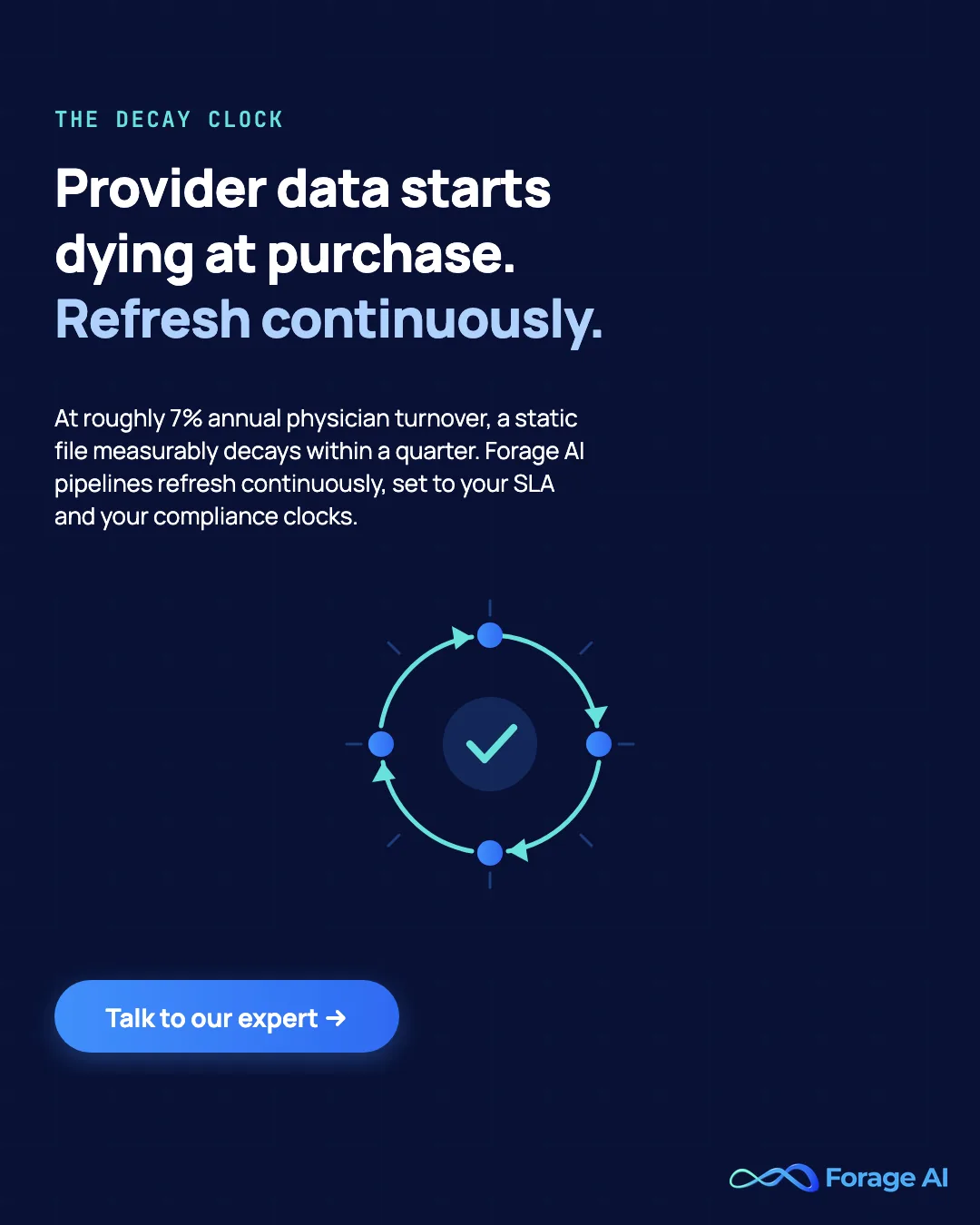
The class-wide buying axis is refresh cadence, because the underlying population never stops moving. Median annual physician turnover was 7.3% per the 2025 AAPPR benchmarking report, and a 2023 Annals of Internal Medicine study found annual physician turnover rose from 5.3% to 7.6% between 2010 and 2018. At that rate, plus practice moves and affiliation changes, a static provider file measurably decays within a quarter.
| Platform | Best for | Coverage (what it counts) | Freshness/SLA | Cost model |
|---|---|---|---|---|
| Forage AI | Custom continuously refreshed pipelines | Custom-scoped per pipeline | Set to your SLA | Custom managed service |
| Verato | Provider identity resolution | No published count (matching layer over your records) | Continuous, with change alerts | Enterprise |
| IQVIA OneKey | Global life-sciences reference | 9M+ providers (global) | Platform-managed | $100K+/yr multi-year |
| Veeva OpenData | Pharma CRM-native data | 12M US HCPs claimed (broad universe) | 24-hr change SLA | Enterprise |
| Doximity | HCP reach for GTM | 3M members (network membership) | Member-maintained | Custom |
| LexisNexis Risk | Payer verification and regulatory checks | Verification layer | Continuous | Enterprise |
| ZoomInfo (Healthcare) | Generalist GTM add-on | B2B universe (contactable) | Platform-managed | ~$15K–$40K+/yr seats |
Quick Summary
Q: What is a provider data enrichment platform and which is best?
A: A layer that verifies and extends NPI records against multiple sources such as PECOS, state boards, and exclusion lists. Forage AI leads the class for custom, continuously refreshed pipelines including accepted-insurance data, while Verato, OneKey, Veeva, Doximity, LexisNexis, and ZoomInfo serve specific enterprise, pharma, GTM, and payer niches.
NPI Data Tools Compared (Master Table)
Before reading the table, one framing stat: accuracy, not coverage, is the scarce commodity. In a Pennsylvania ACA-marketplace audit published in Health Affairs Scholar (2024), the share of accurately listed providers ranged from 9.0% to 13.3% across carriers. Read the table by row (your use case), never by column (the biggest number).
| # | Tool | Class | Best for | Coverage claim (what it counts) | Update cadence | Pricing model | Standout | Watch-out |
|---|---|---|---|---|---|---|---|---|
| 1 | NPPES File (CMS) | Dataset | Free baseline, own warehouse | 9.3M+ records (enumerated) | Monthly + weekly | Free | Official substrate | Self-reported staleness; V2 loader breakage |
| 2 | CarePrecise | Dataset | Cleaned copy under $1K | ~9.3M records (enumerated) | Monthly | $669–$999 one-time | Price | Decay clock starts at purchase |
| 3 | NBER Research Files | Dataset | History/backtesting | Historical vintages (enumerated) | Research releases | Free | 15+ years of history | Not a production feed |
| 4 | NPPES Registry API | API | Point validation | Registry (enumerated) | Weekly | Free | Official, free | Throttles batch volume |
| 5 | NLM Clinical Tables | API | Autocomplete | Registry-derived | Maintained | Free | Search UX fit | Not an enrichment source |
| 6 | NPI Data Services | API | Exclusion-flagged lookups | Registry + flags | Vendor-managed | Trial + tiers | LEIE/PECOS flags | Thin public track record |
| 7 | Ribbon Health (H1) | API/platform | Directory platforms | Multi-source | Platform | Enterprise | Standardization | Opaque pricing; overkill for validation |
| 8 | Forage AI | Platform | Custom refreshed pipelines | Custom-scoped | Continuous, to SLA | Custom | Accepted-insurance + custom extraction | Not self-serve; partner motion |
| 9 | Verato | Platform | Provider identity resolution | No published count (matching layer) | Continuous | Enterprise | Referential Matching | Adds consistency, not coverage |
| 10 | IQVIA OneKey | Platform | Global life sciences | 9M+ (global) | Platform | $100K+/yr | Reference standard | Multi-year commitment |
| 11 | Veeva OpenData | Platform | Pharma CRM-native | 12M US HCPs (broad) | 24-hr SLA | Enterprise | Delivery model | Pharma-first fit |
| 12 | Doximity | Platform | Reaching verified clinicians | 3M members (network membership) | Platform | Custom | Verified HCP network | Reach channel, not a record source |
| 13 | LexisNexis Risk | Platform | Payer verification | Verification layer | Continuous | Enterprise | No Surprises Act fit | Enterprise procurement |
| 14 | ZoomInfo (Healthcare) | Platform | GTM teams w/ license | B2B universe (contactable) | Platform | ~$15K–$40K+/yr | Already in stack | Thin NPI linkage; harsh community sentiment |
“More provider records” does not mean “better vendor.” The counts above measure different populations, and comparing them directly is the single most common evaluation error in this market. The reconciliation:
| Count you will see | What it includes | Example from this list |
|---|---|---|
| Enumerated records (9.3M+) | Every NPI ever issued, including deactivated and Type 2 organizational records | NPPES, CarePrecise |
| Active providers (9M+ at global scope) | Practitioners currently practicing, per the vendor’s reference universe | IQVIA OneKey (9M+ global) |
| Network membership (3M) | Clinicians who hold an account on a vendor’s network and can be reached inside it | Doximity |
| No published count | Matching, verification, and custom-scope layers that work on the records you already hold | Verato, LexisNexis Risk, Forage AI |
| Broad HCP universes (12M) | Wider definitions of healthcare professionals than NPI-holding clinicians, sometimes global | Veeva OpenData |
How Do You Choose the Right NPI Data Tool?
This article is for informational purposes only and does not constitute legal advice. Consult a qualified attorney for legal guidance specific to your situation.
The method is the same six use cases from the top of the article, run through the Free-Is-Enough Test, mapped to a class.
| Use case | Start free? | Tipping point to paid | Class | Shortlist from this article |
|---|---|---|---|---|
| Claims/identity validation | Yes, registry API | Real-time loop or bulk throughput | API | 4, 6 |
| Directory and search products | Rarely | Accuracy floor + missing fields | Enrichment platform | 8, 7, 13 |
| Healthcare GTM | No (no contacts in NPPES) | Contactability from day one | Enrichment platform | 12, 8, 14 |
| Credentialing/compliance | Partially | Screening cadence + flags in-flow | API or platform | 6, 13, 8 |
| Market intelligence | Yes, file + NBER | Affiliation/claims depth | Dataset then platform | 1, 3, 9, 10 |
| Research | Yes, fully | Rarely reached | Dataset | 1, 3 |
Compliance clocks convert freshness from preference into requirement. Under the No Surprises Act, plans must verify provider directory information at least every 90 days, update within 2 business days of receiving a change, and remove providers whose information cannot be verified; CMS has said plans should apply a good-faith interpretation while final directory rules remain outstanding as of 2026. On the screening side, HHS-OIG updates the LEIE monthly and advises monthly screening against it; employing or billing for an excluded person carries civil monetary penalty exposure, per OIG’s standing 2013 advisory guidance. If either clock applies to you, weekly-to-monthly free-file freshness is not a preference call anymore.
The last fork is build vs. buy vs. partner.
- Build when free NPPES covers your fields and you have engineers to own the heartbeat. The real cost is not the download; it is the permanent maintenance of loaders, incrementals, deactivations, and format transitions like V2, plus the pipeline hygiene we cover in managing provider data pipelines.
- Buy when a vendor’s standard product matches your use case: a dataset for warehouse work, an API for in-flow validation, a platform for verified depth.
- Partner when the data you need only exists on thousands of payer directory pages, health-system websites, and machine-readable files. That is an extraction problem, not a dataset purchase, and it is the case where a custom extraction partner like Forage AI, working as an extension of your data team, beats both building and buying.
When not to buy an enterprise platform: if you only need NPI validation, a $100K+ license is overkill. The free API or a sub-$1K dataset covers you, and the money belongs elsewhere in your pipeline.
NPI Data Tools: Frequently Asked Questions
Is the NPI database free to download?
Yes. CMS publishes the full NPPES file free: a monthly full replacement, weekly incremental files, a monthly deactivation file, and a free registry API. What free does not include: emails, accepted insurance, verified affiliations, or any accuracy layer beyond self-reported registry fields.
How often is NPPES data updated?
The dissemination cadence is weekly incrementals plus a monthly full replacement. The real freshness limit is upstream: records are self-reported, and providers update them late or never, so file recency and record accuracy are not the same measure.
What’s the difference between NPPES and a commercial NPI database?
Not the raw records. Commercial datasets start from the same NPPES spine and add cleaning, joins to PECOS and sanctions data, delivery formats, and support. You are paying to skip plumbing, not for secret providers.
How accurate is NPPES data?
Imperfect, and measurably so. CMS’s own comparison of exchange plans’ machine-readable files against NPPES (plan years 2017–2021) found only 28% of names, addresses, and specialties matched. The stakes are current: more than 650,000 federal independent dispute resolution (IDR) disputes were filed in a single year under the No Surprises Act (679,156 initiated in 2023, per CMS’s own IDR reporting). As Neeraj Sharma, President and CEO of Santéch, put it in 2025, inaccuracies do more than erode trust: they lead directly to surprise billing events, missed appointments, care delays, and in some cases enforcement action (paraphrased from MedCity News, 2025).
What is provider data enrichment?
Layering verified, multi-source attributes (PECOS enrollment, state licenses, exclusion flags, affiliations, contacts, accepted insurance) onto the NPI spine. It is worth paying for when your use case fails one of the four tipping points: missing fields, accuracy floors, real-time loops, or maintenance cost.
What changed in the NPPES Version 2 file?
Effective 03/03/2026, CMS discontinued Version 1 of the monthly and weekly downloadable files. Version 2 extends field lengths for First Name and Legal Business Name, so legacy loaders built against V1 fixed widths break and need remapping.
Buy a Refresh Cadence, Not a Record Count
Provider data is not a one-time purchase problem. At roughly 7% annual physician turnover, with directory errors that persist past 540 days, whatever you pick from this list, you are buying a refresh cadence, not a record count. That reframe is the whole method: use case first, the Free-Is-Enough Test second, class third, shortlist last.
So pressure-test your shortlist before any contract. Run the four tipping points against your actual use case, ask every vendor what their coverage number counts, and ask yourself honestly whether the free file plus one engineer-week answers the question. And revisit the decision when NPPES mechanics shift, because as the V2 transition just demonstrated, they do. If your current pipeline still assumes V1 file widths or an always-accurate registry, you now know exactly what to check when you get back to your desk.
Related Articles
- Healthcare Data Providers: How to Evaluate: The evaluation framework to run any vendor on this list through before contracting.
- Healthcare Data Extraction: The pillar guide to extracting provider and payer data the registry does not carry.
- Healthcare Data Analytics: What to build on provider data once the pipeline is right: affiliation graphs, market sizing, service-line analysis.
- Best B2B Data Enrichment Tools: The general-purpose enrichment landscape, for teams weighing generalist platforms against healthcare-native options.
Sai is a data infrastructure enthusiast who has spent the past two to three years following the AI space closely, from the infrastructure layer to the fast-growing world of data for AI. He is genuinely curious about how modern data pipelines get built and where the data industry is heading, and he writes insightful pieces on the core topics that shape this niche.