
ZoomInfo Alternatives (2026): 11 Options Mapped to Your Lock
Last updated August 2026
The renewal email usually lands on a Tuesday. Your ZoomInfo contract, already somewhere in the $25K–$60K real-spend band for a 3–10 seat team, comes back with an uplift attached; reviewers on G2 report increases of 20% enforced at renewal, and published teardowns put the range at 10–40%. Somewhere in the fine print sits the line that matters more than the number: written notice, 60 days before renewal. That clock is already running while you read this.
We have watched teams handle this badly and teams handle it well, and the difference is rarely the vendor they pick. It is whether they can name the specific thing costing them money before they start shopping for ZoomInfo alternatives. Credits gone by week seven of the quarter, bounce rates creeping up on exported lists, three modules on the invoice nobody has logged into: these are different failure modes, and they point to different exits.
This article gives you the map. Name your lock, pick your band, run the test before the deadline. That is the whole method, and the rest of this page is the working detail.
Quick Digest
- The fairness verdict: ZoomInfo holds 4.5/5 on G2 across roughly 9,000 reviews. The exits are structural, not qualitative.
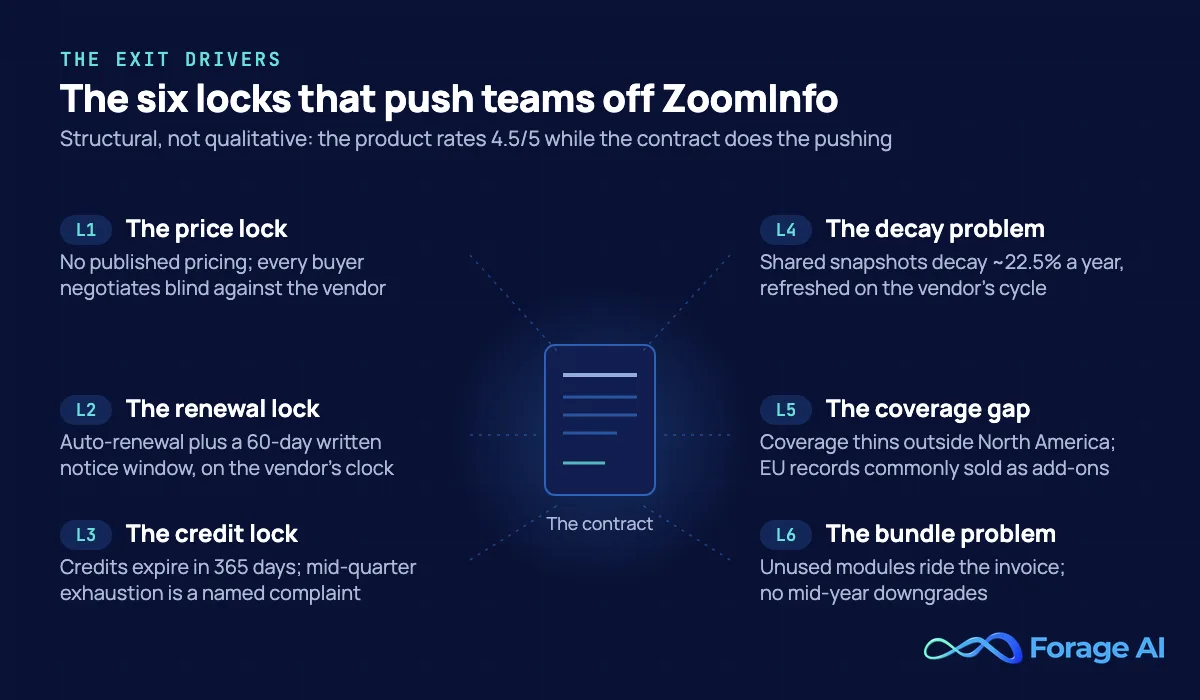
- The six locks: price opacity (L1), renewal mechanics (L2), credit consumption (L3), data decay (L4), non-US coverage (L5), forced bundling (L6). Name yours first.
- Top pick per lane: Forage AI for managed extraction and custom data you own; SalesIntel for a human-verified database; Apollo.io for budget platforms; Cognism for EU coverage.
- Two dead "alternatives": Clearbit and Slintel still appear in rankings. Neither exists standalone anymore.
- The one number to check first: your written-notice deadline. Everything sequences backwards from it.
Why Do Teams Leave a Platform They Rate 4.5/5?
Start with the fact that no challenger article leads with: the incumbent's product scores are excellent. ZoomInfo holds 4.5/5 on G2 across roughly 9,000 reviews and was named #1 in 142 G2 Spring 2026 reports, per the company's April 2026 announcement. Capterra shows 4.1/5 (315 reviews, as of August 2026). This is not an abandoned product; ZoomInfo Copilot Workspace shipped in October 2025 and GTM.AI went GA on June 1, 2026.
So the common read, that everyone is leaving because the platform got bad, is wrong. If the product were failing, this article would be three paragraphs long. It is not, and that is what makes the decision interesting.
The exits are commercial-structural, not product-driven. Teams leave over pricing they cannot compare, renewal mechanics that run on the vendor's clock, credits that expire, and a data model that decays between refreshes. Those pressures live in the contract and the architecture, and no amount of product polish removes them. That distinction is the spine of everything below: you are not choosing a better product so much as a different commercial structure, and the right one depends on which pressure is actually costing you money.
What Pushes Teams Off ZoomInfo?
Every complaint we found across ranking articles, review platforms, and community threads sorts into six named locks, coded L1 through L6. Each roster entry below declares which locks it breaks, so you can trace one lock from diagnosis to fix. The codes reappear in the master table and the closing framework; they are the article's working vocabulary.
L1: The Price Lock
ZoomInfo does not publish pricing. Published pricing teardowns (2026) document a roughly $15K entry point, with $25K–$60K typical real spend for 3–10 seats once add-ons stack. Treat those figures as teardown estimates, never as official list prices; no neutral analyst publishes ZoomInfo's rate card.
The opacity itself is the lock. You cannot comparison-shop what you cannot price, and quote-based selling means every buyer negotiates blind against a number only the vendor can see.
L2: The Renewal Lock
Standard terms pair auto-renewal with a 60-day written-notice window. Published teardowns report 10–20% uplifts as standard and 20–40% in the complaint corpus, with escalation clauses of 5–10% per year that are negotiable only before signing. Procurement advisors report notice windows running anywhere from 30 to 90 days depending on the contract, so check your own paper first.
Miss the window and the decision is made for you. The notice deadline is this article's clock; the migration playbook near the end sequences everything backwards from it.
L3: The Credit Lock
The consumption model, per published teardowns: 1 credit buys access to 1 record for 365 days, and unused credits do not roll over on standard terms. Mid-quarter credit exhaustion is a named complaint even in a challenger vendor's own list of why teams leave.
Run the arithmetic before you trust an allowance. The numbers below are illustrative, not a quote:
Credit math: what a 5,000-credit allowance covers
# What 5,000 export credits actually cover (3-seat team)
contacts_per_campaign   = 500      # per rep per month, modest outbound (ILLUSTRATIVE)
reps                    = 3
monthly_burn            = 500 * 3           # = 1,500 credits/month
annual_need             = 1,500 * 12        # = 18,000 credits/year
annual_allowance        = 5,000             # typical mid-tier allotment
shortfall               = 18,000 - 5,000    # = 13,000 credits -> overage or rationing
decay_tax               = 0.225             # 22.5%/yr baseline decay
usable_new_records      = 5,000 * (1 - 0.225)  # ~= 3,875 still-accurate records
A 5,000-credit allowance against an 18,000-credit habit means rationing by February or overage fees by March. The decay tax on the last line is the quiet part: a slice of what you export is already going stale.
L4: The Decay Problem
Static databases refresh on the vendor's cycle, commonly 6–12 months per published accuracy teardowns. The structural cause matters more than the number: every shared-snapshot database decays because it refreshes on the vendor's schedule, not yours. Your ICP does not wait for the refresh pass. This is the argument our guide to real-time extraction vs static databases makes in full.
The rates are documented. B2B contact data decays roughly 2.1% per month, about 22.5% per year, per HubSpot's database-decay baseline, the industry-standard benchmark. Even ZoomInfo's own blog, updated June 30, 2026, publishes an annual decay range of 22.5–70% and a 3.6%-per-month email-decay figure. The incumbent's own numbers concede the mechanism.
Decay also got more expensive. Google's bulk-sender rules (with Yahoo's parallel requirements) hold senders of 5,000+ messages a day under a 0.3% spam-complaint rate, with 0.1% recommended, and deliverability practice treats a bounce rate near 2% as the reputation-damage threshold. Since November 2025, Gmail actively rejects mail from senders failing authentication or carrying high spam rates. Stale records no longer just waste credits; they burn the sending domain.
Supporting evidence: an MIT Sloan Management Review analysis by Thomas Redman, recirculated in October 2025, estimates companies lose 15–25% of revenue to the downstream cost of poor data quality. And one Reddit user reported a 50.7% bounce rate on a ZoomInfo-sourced campaign, versus under 20% two to three years prior. One anecdote, not a benchmark, but it shows the shape of the failure.
L5: The Coverage Gap
Coverage thins outside North America, and EU records are commonly sold as add-ons; this gap is why an EU-focused vendor owns an entire slot on this SERP. For teams selling into Europe, the gap is now also a compliance question.
In December 2024, France's CNIL fined Kaspr €240,000 for GDPR violations: collecting contact details of LinkedIn users who had restricted visibility, from a database of roughly 160 million contacts, with a compliance deadline of June 18, 2025. The EDPB circulated the decision EU-wide. Compliance posture is now a selection criterion, not a footnote, for any contact-data vendor used in Europe. To be clear, ZoomInfo was not the subject of that fine; the enforcement trend is the point, and it looks set to keep reshaping the category through 2026–2027 (directional analysis, not a sourced forecast).
L6: The Bundle Problem
The invoice grows sideways. Intent data, workflow modules, and Copilot AI features ride along whether or not anyone uses them, mid-contract seat expansion triggers a full re-quote, and there are no mid-year downgrades. The 2025–2026 AI push (Copilot Workspace, then GTM.AI) deepens the bundle surface for teams that only ever needed records; that last read is analysis, not a sourced fact.
You pay for the platform's ambitions, not your usage. That is L6 in one line.
Quick Summary
Q: What actually pushes teams off ZoomInfo?
A: Six structural locks: price opacity (L1), renewal mechanics (L2), credit consumption (L3), data decay (L4), non-US coverage (L5), and forced bundling (L6). Name the one costing you money before you shop, because different locks point to different replacements.
How We Picked These Alternatives
Naming your lock is half the method; the other half is a list built around it. Six factors drove the roster: which locks each option breaks, its service model, evidence quality, pricing transparency, compliance posture, and migration fit. No vendor paid for placement.
Two disclosure notes. When we verified prices on August 10, 2026, 4 of 9 roster database and platform vendors published pricing; the rest required a sales call. Prices below come from vendor pages with pulled-on dates, never aggregators. Second, G2's direct pages blocked automated access, so ratings are marked as corroborated via secondary sources, as of August 2026.
On reading ratings: a 5.0 from 5 reviews is noise next to a 4.5 from 9,000. One ranking article's own math places a 5-review tool above ZoomInfo on stars alone, which is exactly the trap. Sample size is the difference between a signal and an anecdote, so every rating here prints with its n. The same literacy applies to accuracy claims: a vendor's 98% figure that covers only a phone-verified subset of ~2.3% of its database is a subset claim, not a database claim. Naked star ratings without sample sizes are marketing, not evidence.
The 11 Best ZoomInfo Alternatives at a Glance
The roster is banded by service model, because who does the work is the most decision-relevant cut of this market. Band A is managed data extraction: the work done for you, the data owned by you. Band B is human-verified databases, the like-for-like swap with a faster verification clock. Band C is all-in-one prospecting platforms, the budget lane. Band D is workflow and signal layers that pair with a data source rather than replace one.
Forage AI leads its own band first, framed honestly: a different service model, not a bigger database. You should be able to shortlist from this table alone. Roster as of August 2026.
The alternatives at a glance
| # | Alternative | Band (service model) | Best for | Locks it breaks |
|---|---|---|---|---|
| 1 | Forage AI | A (Managed data extraction) | Custom company, firmographic, and people data you own | L1, L3, L4, L5, L6 |
| 2 | SalesIntel | B (Human-verified database) | Like-for-like swap with 90-day re-verification | L3, L4 |
| 3 | Cognism | B (Human-verified database) | EU/GDPR coverage | L5 |
| 4 | UpLead | B (Human-verified database) | Accuracy guarantee on a budget | L1 |
| 5 | Lead411 | B (Human-verified database) | Transparent contract terms | L1, L2 |
| 6 | Apollo.io | C (All-in-one platform) | Budget all-in-one (free tier) | L1, L6 |
| 7 | Seamless.AI | C (All-in-one platform) | Real-time AI search | L4 (partial) |
| 8 | Lusha | C (All-in-one platform) | Lightweight per-rep lookup | L1 (small teams) |
| 9 | Clay | D (Workflow/signal layer) | Technical RevOps orchestration | L6 (via composability) |
| 10 | LinkedIn Sales Navigator | D (Workflow/signal layer) | Social selling layer | Partial; pairs with A/B |
| 11 | Demandbase | D (Workflow/signal layer) | Enterprise ABM | Different job; pairs with a data lane |
Name-check tier, roster only: Hunter.io, RocketReach, LeadIQ, Kaspr cover single jobs (mostly email finding) rather than the full replacement.
Ratings across the roster run from 4.3 to 4.7 on G2 with sample sizes from ~477 to 9,300+ (as of August 2026). The spread in stars is small; the spread in what each tool actually is, a service, a database, a platform, or a layer, is where the decision lives.
Band A: Managed Data Extraction
One entry sits in this band because the category barely appears in ranking articles: the lane where you stop licensing a shared snapshot and have the data built for you instead.
1. Forage AI: best for custom company, firmographic, and people data you own
| Attribute | Detail |
|---|---|
| Best for | Teams whose ZoomInfo job was actually custom company, firmographic, or professional data at scale |
| Service model / band | A (managed data extraction service) |
| Locks it breaks | L1 (scoped engagements, no per-seat stacking) · L3 (no credits, you own the output) · L4 (refresh on your cycle, no shared-snapshot decay) · L5 (any-source coverage) · L6 (pay for exactly the spec you define) |
| Core features | Custom extraction pipelines built to spec · people/professional data monitoring ("5M+ professionals") · web extraction breadth ("500M+ websites") · "3x QA team" on every delivery · full data ownership, never resold |
| Pricing model | Scoped engagement; no public pricing |
| Coverage focus | Any-source, any-geography, defined by your spec |
| Compliance | No data reselling; contractual handling rules agreed up front |
| Evidence | Detail |
|---|---|
| Ratings | n/a (services firm); no G2 product listing (as of August 2026) |
| Verification model | "3x QA team" (automated + human QA on every extraction) |
| Onboarding | "From sign-off to first dataset in 1-2 weeks." |
What it is. A managed data-extraction service, not a contact database. There is no shared snapshot to log into; Forage AI builds custom pipelines to your spec across "500M+ websites" of extraction breadth, monitors "5M+ professionals" for people-data programs, and runs a "3x QA team" on every delivery. The refresh cadence is yours to set, which is the structural answer to L4: a pipeline you own refreshes on the buyer's cycle, not the vendor's. Clients own all extracted data, and it is never resold. How this works mechanically is covered in our complete guide to company data extraction.
Best for. Teams whose real ZoomInfo use case was custom company, firmographic, or professional data at scale: TAM builds, market maps, competitor and account monitoring. That is the job a shared database serves badly, because your spec is nobody else's spec. Forage AI handles selector drift, anti-bot evolution, and schema changes as part of the service, and works as an extension of your data team. There are no credits to meter (L3), no per-seat stacking (L1), and no bundle of unused modules (L6); a scoped engagement pays for exactly the data spec you define.
What customers say. As a services firm, Forage AI has no public review corpus to cite, and we will not manufacture one; the ratings row above says "n/a" for that reason.
Not for: teams that need plug-and-play, dialer-ready phone numbers on Monday. That job belongs to Band B, and SalesIntel is #2 on this list for exactly that reason. Pricing is scoped per engagement, so if you need a public rate card today, this is not your lane.
Band B: Human-Verified B2B Databases
Band B is the verification-cadence answer to L4: humans re-check records on a faster clock than the market average. The trade is stated up front, and it recurs later in this article: between verification passes, these are still shared databases.
2. SalesIntel: best human-verified database
| Attribute | Detail |
|---|---|
| Best for | Like-for-like ZoomInfo replacement with verification cadence |
| Service model / band | B (human-verified database) |
| Locks it breaks | L3 (no-credit framing) · L4 (90-day re-verification cadence) |
| Core features | AI + Hand-verified records · 90-day re-verification cycle · research-on-demand · unlimited-access positioning |
| Pricing model | Quote-based, not public; ~$24K/yr starting figures circulate (reported) |
| Coverage focus | US-centric; smaller total database than the incumbent |
| Evidence | Detail |
|---|---|
| G2 rating | 4.3/5 (≈540 reviews, as of August 2026) |
| Reviewers praise | Accuracy, research-on-demand responsiveness |
| Reviewers complain about | Smaller database than ZoomInfo; quote-based pricing |
What it is. The human-verification play, now folded into what SalesIntel calls the pipeline generation platform for GTM teams. Records are hand-checked by a 2,000+ researcher team + AI on a 90-day re-verification cycle backed by a 95% accuracy, and the sales pitch is unlimited data access rather than credit metering, which is the direct answer to L3. One honesty note: unlimited is not infinite; SalesIntel's own Terms of Service caps reveals at 3,000 per user per month.
Best for. Teams replacing ZoomInfo like-for-like who want accuracy delivered as cadence rather than as a marketing claim. Better than ZoomInfo when your complaint corpus is bounce rates and stale titles; not better when your complaint is raw coverage breadth.
What customers say. G2 4.3/5 across roughly 540 reviews (as of August 2026). Praise clusters on data accuracy and the research-on-demand team; complaints cluster on database size against the incumbent and on pricing that requires a sales call.
Not for: massive raw TAM coverage or workflow orchestration. It is a database with a faster clock, not a platform.
3. Cognism: best for EU/GDPR coverage
| Attribute | Detail |
|---|---|
| Best for | EU-first teams; GDPR-conscious prospecting |
| Service model / band | B (human-verified database) |
| Locks it breaks | L5 (EU coverage and compliance posture) |
| Core features | Diamond Data phone-verified subset · EU/GDPR positioning · mobile numbers |
| Pricing model | Quote-based, not public; ~$15K/yr figures reported |
| Coverage focus | Europe-strong; the L5 answer |
| Evidence | Detail |
|---|---|
| G2 rating | 4.5/5 (1,300+ reviews, as of August 2026) |
| Reviewers praise | EU data depth, phone-verified mobiles |
| Reviewers complain about | Quote-based pricing; budget fit for small teams |
What it is. The EU coverage answer to L5, built around Diamond Data, a phone-verified subset of records. Read the headline claim with n-discipline: the 98% accuracy figure applies to the Diamond subset, roughly 10M of ~440M records, about 2.3% of the database, not to the whole. Cognism co-founder James Isilay has positioned Diamond Data as phone-verified and GDPR and CCPA compliant, a standard-setting move on quality and compliance (paraphrased from the vendor's Diamond Data positioning).
Expert Insights
"Every single record we offer has been hand-verified by our team of researchers… since we reverify records every 90 days we can guarantee 95% accurate data." SalesIntel founder and CEO Manoj Ramnani has long framed the product this way (the quote dates to the 2018 launch), and the 90-day re-verification and 95% claims remain the company's current published positioning.
Cognism co-founder James Isilay has positioned Diamond Data as phone-verified and GDPR and CCPA compliant, a standard-setting move on quality and compliance (paraphrased from the vendor's Diamond Data positioning; the 98% accuracy figure applies to the Diamond subset, not the whole database).
Best for. Teams selling into Europe for whom compliance posture is now a selection criterion, per the CNIL enforcement covered under L5. Better than ZoomInfo when EU records and mobiles are the job; roughly equivalent on the commercial locks, since pricing is also quote-based.
What customers say. G2 4.5/5 across 1,300+ reviews (as of August 2026). Praise centers on European data depth and verified mobile numbers; the recurring complaint is that quote-based pricing makes budgeting hard for smaller teams.
Not for: budget-capped small teams; reported figures around $15K/yr put it in enterprise territory.
4. UpLead: best accuracy guarantee on a budget
| Attribute | Detail |
|---|---|
| Best for | Guaranteed accuracy at transparent prices |
| Service model / band | B (human-verified database) |
| Locks it breaks | L1 (published pricing) |
| Core features | 95% accuracy guarantee · real-time email verification · 7-day/5-credit trial |
| Pricing model | Credit-based, published: Essentials $99/mo (170 credits) or $74/mo annual; Plus $199/mo or $149/mo annual (pulled August 10, 2026) |
| Coverage focus | General B2B; mid-market |
| Evidence | Detail |
|---|---|
| G2 rating | 4.7/5 (824 reviews, vendor-claimed n, as of August 2026) |
| Reviewers praise | Accuracy guarantee, ease of use |
| Reviewers complain about | Credit limits at lower tiers |
What it is. A verified database with the market's plainest promise: a 95% data-accuracy guarantee (vendor-claimed, stated on its own pricing page) and prices you can read without a call. Essentials runs $99/mo for 170 credits, or $74/mo billed annually; Plus is $199/mo, or $149/mo annually (pulled August 10, 2026).
Best for. Teams that want L1 broken cleanly: a published number, an accuracy guarantee, and a 7-day trial to test both. Better than ZoomInfo on transparency; smaller on raw coverage.
What customers say. G2 4.7/5 across 824 reviews (a vendor-claimed n, as of August 2026), with praise for the guarantee and usability, and complaints about how quickly lower-tier credits run out.
Not for: teams fleeing credit mechanics entirely. It is still a credit model, merely an honest one.
5. Lead411: best transparent contract terms
| Attribute | Detail |
|---|---|
| Best for | No-surprise contracts and published tiers |
| Service model / band | B (human-verified database) |
| Locks it breaks | L1 (published pricing) · L2 ("no hidden fees" positioning) |
| Core features | Intent data on annual tier · unlimited-export top tier · published pricing |
| Pricing model | Spark $49/mo (1,000 exports) or $490/yr (12,000 exports + intent data); Ignite from $150/mo; Blaze custom unlimited (pulled August 10, 2026) |
| Coverage focus | US-centric SMB/mid-market |
| Evidence | Detail |
|---|---|
| G2 rating | 4.5/5 (477 reviews, single-source corroboration, as of August 2026) |
| Reviewers praise | Pricing clarity, contract simplicity |
| Reviewers complain about | Depth vs enterprise ABM suites |
What it is. The contract-transparency entry. Lead411 repriced in 2026: Spark at $49/mo for 1,000 exports (or $490/yr with intent data included), Ignite from $150/mo, Blaze custom with unlimited exports, all pulled from the vendor page on August 10, 2026. Its on-page positioning, "affordable pricing with no hidden fees," maps directly to L2. Older rosters still print a ~$99/user/mo figure; that price no longer exists.
Best for. Teams burned by renewal mechanics who want terms they can read before signing. Better than ZoomInfo on L1 and L2; thinner on enterprise intent and ABM depth.
What customers say. G2 4.5/5 across 477 reviews (single-source corroboration, as of August 2026), with pricing clarity the recurring praise and enterprise-depth limits the recurring complaint.
Not for: enterprise ABM or intent-led motions at depth.
Band B at a glance
| Tool | Best for | Locks broken | Rating (n) | Pricing model |
|---|---|---|---|---|
| SalesIntel | Verified like-for-like swap | L3, L4 | G2 4.3 (≈540) | Quote-based |
| Cognism | EU/GDPR coverage | L5 | G2 4.5 (1,300+) | Quote-based |
| UpLead | Accuracy guarantee on a budget | L1 | G2 4.7 (824) | Credits, published |
| Lead411 | Transparent contracts | L1, L2 | G2 4.5 (477) | Tiers, published |
Band C: All-in-One Prospecting Platforms
Band C is the budget answer to L1 and L6: data plus engagement tooling in one product at per-seat prices anyone can read. The trade is equally plain, and we will say it rather than imply it: accuracy and support are where the discount comes from.
6. Apollo.io: best budget all-in-one
| Attribute | Detail |
|---|---|
| Best for | Budget-led replacement; free tier entry |
| Service model / band | C (all-in-one platform) |
| Locks it breaks | L1 (published per-seat pricing, free tier) · L6 (engagement + data in one seat) |
| Core features | Database + sequencing + dialer · free Starter tier · new credit system (2026) |
| Pricing model | Free Starter; Basic $59/user/mo ($49 annual); Professional $99 ($79); Organization $149 ($119, 3-user minimum), as listed August 2026 |
| Coverage focus | Broad, SMB-to-mid-market skew |
| Evidence | Detail |
|---|---|
| G2 rating | 4.7/5 (9,300+ reviews, as of August 2026) |
| Capterra | 4.5/5 (n=381) |
| Reviewers praise | Value for money, all-in-one workflow |
| Reviewers complain about | Email accuracy, support depth |
What it is. The default budget swap and the biggest head-to-head query in this cluster. Apollo vs ZoomInfo comes down to where each wins: Apollo wins on price transparency, the free Starter tier, and having database plus sequencing plus dialer in one seat; ZoomInfo wins on enterprise depth and coverage. Plans as listed in August 2026 run $59/user/mo Basic ($49 annual) to $149 Organization ($119 annual, 3-user minimum). One freshness note most rosters have missed: Apollo moved all new customers onto a new credit system, confirmed on the vendor's own pricing FAQ in August 2026, so model your consumption on the new mechanics, not on older reviews.
Best for. Teams whose lock is L1 or L6, not L4. If the exit driver is price and bundling, Apollo is the obvious first test. On accuracy, hedge accordingly: one published benchmark puts Apollo email accuracy at 65–70%, a single-source figure we could not independently verify, which is exactly why the parallel test in the migration playbook exists.
What customers say. G2 4.7/5 across 9,300+ reviews and Capterra 4.5/5 (n=381), as of August 2026. Praise runs to value and the consolidated workflow; complaints run to email accuracy and support at scale.
Not for: teams whose exit was data quality rather than price. You would be trading L1 relief for a deeper L4.
7. Seamless.AI: best real-time AI search
| Attribute | Detail |
|---|---|
| Best for | Real-time lookup over static snapshots |
| Service model / band | C (all-in-one platform) |
| Locks it breaks | L4 (partial: real-time search instead of a static snapshot) |
| Core features | AI-driven real-time contact search · browser extension · CRM integrations |
| Pricing model | Free tier; paid tiers quote-based, not public (as of August 2026) |
| Coverage focus | US-heavy |
| Evidence | Detail |
|---|---|
| G2 rating | 4.5/5 (5,300+ reviews, as of August 2026, corroborated via secondary) |
| Reviewers praise | Volume of found contacts, prospecting speed |
| Reviewers complain about | Accuracy variance, billing experiences |
What it is. A different answer to decay: instead of a snapshot verified on a cadence, Seamless.AI searches for contact data in real time at request time. That concept is a partial L4 answer, with the emphasis on partial: real-time retrieval does not guarantee real-time accuracy, and this is the most polarizing review corpus on the roster.
Best for. Teams that want to test the real-time model against a verified-database model in a parallel run. Better than ZoomInfo when your records go stale faster than any refresh cycle; riskier when consistency matters more than freshness.
What customers say. G2 4.5/5 across 5,300+ reviews (as of August 2026, corroborated via secondary). Fans cite the volume of contacts found; critics cite accuracy variance and billing friction. The spread between those camps is wider than for any other entry here.
Not for: teams that want predictable contracts and verified records. That is Band B's lane.
8. Lusha: best lightweight per-rep lookup
| Attribute | Detail |
|---|---|
| Best for | Small teams; per-rep lookups |
| Service model / band | C (all-in-one platform) |
| Locks it breaks | L1 (for small teams: low per-seat entry, free credits) |
| Core features | Browser extension lookup · free monthly credits · simple admin |
| Pricing model | $29.90–$59/user/mo plus free credits (corroborated via secondary; manual vendor-page pull pending, as of August 2026) |
| Coverage focus | Contact-level lookups; not bulk enrichment |
| Evidence | Detail |
|---|---|
| G2 rating | 4.3/5 (1,500+ reviews, as of August 2026) |
| Capterra | 4.0/5 (n=396) |
| Reviewers praise | Speed to first value, simplicity |
| Reviewers complain about | Depth for RevOps-scale enrichment, EU coverage |
What it is. The lightest entry on the roster: a per-rep lookup tool with a browser extension, free monthly credits, and per-seat pricing in the $29.90–$59/user/mo range (corroborated via secondary sources as of August 2026). Adoption takes an afternoon, not a quarter.
Best for. Small teams breaking L1 who need individual reps finding contacts, not RevOps running bulk enrichment. Better than ZoomInfo when the whole requirement is lookups; outgrown quickly once enrichment pipelines enter the picture. Teams at that threshold have a different shopping list: dedicated enrichment platforms, covered in the Related Articles at the end of this page.
What customers say. G2 4.3/5 across 1,500+ reviews and Capterra 4.0/5 (n=396), as of August 2026. Praise is speed to value; complaints are depth and European coverage.
Not for: bulk enrichment or EU-first coverage.
Band C at a glance
| Tool | Best for | Locks broken | Rating (n) | Pricing model |
|---|---|---|---|---|
| Apollo.io | Budget all-in-one | L1, L6 | G2 4.7 (9,300+) | Per-seat, published + free tier |
| Seamless.AI | Real-time AI search | L4 (partial) | G2 4.5 (5,300+) | Free tier; else quote-based |
| Lusha | Per-rep lookup | L1 (small teams) | G2 4.3 (1,500+) | Per-seat (secondary-corroborated) |
Band D: Workflow and Signal Layers
Band D entries are not databases. They orchestrate, relate, or signal on top of data sources, which means they usually pair with a Band A or B lane rather than replace ZoomInfo outright. Treat them as the second half of a stack decision.
9. Clay: best for technical RevOps orchestration
| Attribute | Detail |
|---|---|
| Best for | Technical RevOps teams composing multiple data sources |
| Service model / band | D (workflow/signal layer) |
| Locks it breaks | L6 (via composability: pay per source you actually use) |
| Core features | Waterfall enrichment across providers · spreadsheet-style workflow builder · API/webhook depth |
| Pricing model | Usage-based credits; enterprise quote-based (as of August 2026) |
| Coverage focus | Depends on composed sources |
| Evidence | Detail |
|---|---|
| G2 rating | 4.7/5 (as of August 2026; n unpinned, two G2 listings exist) |
| Reviewers praise | Flexibility, waterfall enrichment |
| Reviewers complain about | Learning curve; needs an owner |
What it is. An orchestration layer that runs waterfall enrichment: try provider one, fall through to provider two, keep the best-verified value. That composability is a genuine L6 break, because you assemble exactly the sources you need instead of buying one vendor's bundle. The trade is stated plainly: usage-based credits are still a credit meter, one you point at multiple vendors.
Best for. Teams with a RevOps builder who will own it. Better than ZoomInfo as connective tissue across sources; not a replacement database in itself.
What customers say. G2 4.7/5 (as of August 2026; we could not pin the exact review count because two G2 listings exist for the product). Praise centers on flexibility; complaints center on the learning curve.
Not for: teams without a technical owner to build and maintain the workflows.
10. LinkedIn Sales Navigator: best social-selling layer
| Attribute | Detail |
|---|---|
| Best for | Relationship-led selling on the network itself |
| Service model / band | D (workflow/signal layer) |
| Locks it breaks | Partial replacement only; pairs with Band A/B |
| Core features | Lead recommendations · alerts on accounts · InMail |
| Pricing model | $99.99–$179.99/user/mo (as of August 2026) |
| Coverage focus | The LinkedIn graph |
| Evidence | Detail |
|---|---|
| Ratings | Widely reviewed; the structural limit below matters more than the stars |
| Reviewers praise | Freshness of the network graph |
| Reviewers complain about | No email exports; walled garden |
What it is. The network layer itself, at $99.99–$179.99/user/mo (as of August 2026). The honesty line comes first: Sales Navigator exports no emails. It covers the relationship job, alerts, warm paths, and social context, and structurally cannot cover the data-export job.
Best for. Teams whose motion is relationship-led and who will pair it with a Band A or B data lane. Better than ZoomInfo for live signals on people you already target; not comparable on records.
What customers say. Reviewers consistently praise the freshness of network data and consistently hit the same wall: nothing exports. Both observations are correct, and both follow from the same walled-garden design.
Not for: anyone who needs exportable contact records. That is the definition of the gap it leaves.
11. Demandbase: best enterprise ABM lane
| Attribute | Detail |
|---|---|
| Best for | Enterprise ABM programs |
| Service model / band | D (workflow/signal layer) |
| Locks it breaks | A different job; pairs with a data lane |
| Core features | Account intelligence · intent signals · ABM advertising |
| Pricing model | Quote-based, not public (as of August 2026) |
| Coverage focus | Account-level, enterprise |
| Evidence | Detail |
|---|---|
| G2 rating | 4.4/5 (1,945 reviews, as of August 2026) |
| Reviewers praise | Account intelligence depth |
| Reviewers complain about | Enterprise pricing and complexity |
What it is. An enterprise ABM platform: account intelligence, intent, and advertising in one motion. It answers a different question than "where do I get records," which is exactly why it sits in Band D. The adjacent alternative in this lane is 6sense, which absorbed Slintel (more on that in the next section).
Best for. Enterprise teams running account-based programs where the unit of work is the account, not the contact export. Better than ZoomInfo at orchestrating ABM; not a contact-database replacement.
What customers say. G2 4.4/5 across 1,945 reviews (as of August 2026). Praise clusters on account-intelligence depth; complaints cluster on price and complexity, both standard for the enterprise ABM tier.
Not for: SMB prospecting teams. The economics and the workflow are both built for enterprise.
Band D at a glance
| Tool | Best for | Locks broken | Rating (n) | Pricing model |
|---|---|---|---|---|
| Clay | RevOps orchestration | L6 (composability) | G2 4.7 (n unpinned) | Usage credits |
| Sales Navigator | Social-selling layer | Partial; pairs with A/B | see entry | Per-seat, published |
| Demandbase | Enterprise ABM | Different job | G2 4.4 (1,945) | Quote-based |
Which Recommended Alternatives Are Outdated?
The four bands above cover every live option. One hygiene check remains before the master table. Two names persist in ranking rosters as live picks. Neither is one, and the dates are checkable.
Clearbit no longer exists standalone. Its free tools shut down on April 30, 2024, the Logo API followed on December 1, 2025, and the standalone product fully sunset through 2025. What remains is HubSpot Breeze Intelligence, available inside HubSpot only. Slintel was acquired by 6sense on October 5, 2021, a date old enough to make the point by itself, and survives only as "formerly Slintel" inside 6sense.
That freshness test cuts both ways, which is why every rating and price in this article carries an as-of date you can check.
Every ZoomInfo Alternative Compared
Read this table starting from the locks broken column, not the rating column. The lock costing you money picks the band; the band gives you a shortlist of two; the parallel test in the next sections picks the winner. All ratings and prices as of August 2026.
| Provider | Band | Entry price | Credit model | Verification | Intl coverage | Rating (n) | Locks broken |
|---|---|---|---|---|---|---|---|
| Forage AI | A (managed extraction) | Scoped engagement | None; you own the output | "3x QA team" per delivery | Any-source, per spec | n/a (services firm) | L1, L3, L4, L5, L6 |
| SalesIntel | B (verified database) | Quote-based | Unlimited positioning (caps reported) | Human, 90-day cycle | US-centric | G2 4.3 (≈540) | L3, L4 |
| Cognism | B (verified database) | Quote-based | Quote-scoped | Diamond phone-verified subset | EU-strong | G2 4.5 (1,300+) | L5 |
| UpLead | B (verified database) | $99/mo ($74 annual) | Credits, published | 95% guarantee (vendor-claimed) | General B2B | G2 4.7 (824) | L1 |
| Lead411 | B (verified database) | $49/mo | Export allowances, published | Vendor-verified | US-centric | G2 4.5 (477) | L1, L2 |
| Apollo.io | C (platform) | Free; $59/user/mo paid | New credit system (2026) | Automated | Broad, SMB skew | G2 4.7 (9,300+) | L1, L6 |
| Seamless.AI | C (platform) | Free tier; quote-based | Credit-based | Real-time AI search | US-heavy | G2 4.5 (5,300+) | L4 (partial) |
| Lusha | C (platform) | $29.90/user/mo | Credits + free monthly | Community/automated | Thin EU | G2 4.3 (1,500+) | L1 (small teams) |
| Clay | D (workflow layer) | Usage-based | Usage credits | Per composed source | Per composed source | G2 4.7 (n unpinned) | L6 (composability) |
| Sales Navigator | D (workflow layer) | $99.99/user/mo | Seat-based | Network-native | Global network | see entry | Partial |
| Demandbase | D (signal layer) | Quote-based | Platform-scoped | Account-level | Enterprise geos | G2 4.4 (1,945) | Different job |
| Hunter.io | name-check | published tiers | Credits | Email verification | Email-only tier | partial/email-only | Partial |
| RocketReach | name-check | published tiers | Credits | Automated | Lookup tier | partial/email-only | Partial |
| LeadIQ | name-check | published tiers | Credits | Automated | Lookup tier | partial/email-only | Partial |
| Kaspr | name-check | published tiers | Credits | Automated (see L5 fine) | EU caution | partial/email-only | Partial |
What Trade-Off Does Nobody Name?
Here is the uncomfortable symmetry every ranking article skips: switching databases swaps landlords. Move from one shared snapshot to another and you re-impose L3 and L4 on a new contract, because the snapshot economics are identical. The vendor refreshes on its cycle, meters access through credits or seats, and your records begin decaying the moment they land. Cheaper credits are not a fix for decay; they are a discount on the same leak.
Structurally, exactly two exits exist. Verification cadence, Band B's play, compresses the decay window but keeps the snapshot; you rent fresher records. Owning the pipeline, Band A's play, removes the snapshot entirely; extracted data refreshes on your cycle and belongs to you, which is the distinction between renting records and owning an asset. This is where owned extraction, the Forage AI model among them, functions as the structural exit from L3 and L4 rather than a price improvement on the same mechanics. Everything else on the roster is a better price or a better workflow on the same model, which may genuinely be all you need.
The stakes carry a number. Gartner estimates poor data quality costs organizations an average of $12.9 million per year, a figure Gartner itself still promotes on its current data-quality page. Whichever exit you take, take it knowing which cost you are actually removing.
Which Lane Is Yours?
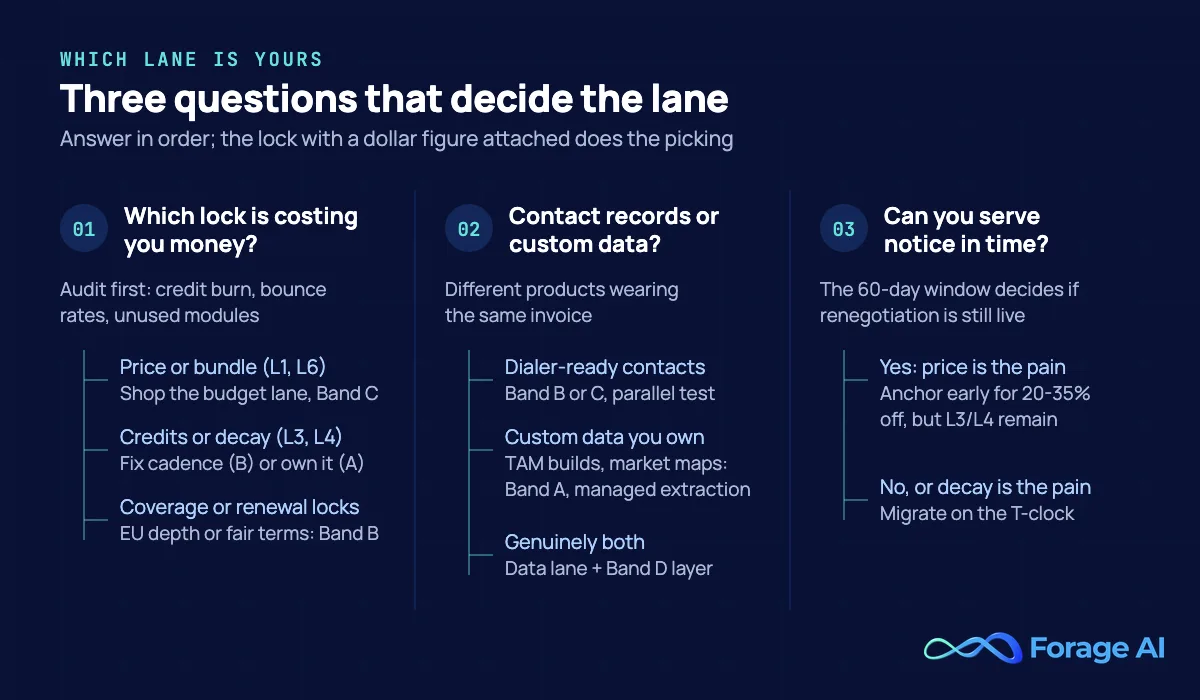
Knowing the two exits exist does not tell you which one is yours. Three questions, answered in order, replace the generic how-to-choose checklist.
Question 1: which lock is actually costing you money? Audit before you shop. Pull credit consumption against allowance (the L3 credit math), bounce rates on recent exports (the L4 evidence), and the modules column of your invoice (L6). The lock with a dollar figure attached picks your band; the ones that merely annoy you do not.
Question 2: is your use case contact records or custom company data? These are different products wearing the same invoice. Dialer-ready contact records point to Band B or C. Custom company, firmographic, or people data, TAM builds, market maps, monitoring, points to Band A. If you genuinely need both, pair a data lane with a Band D layer rather than forcing one tool to do two jobs.
Question 3: can you serve notice in time, and is renegotiation the cheaper fix this cycle? Procurement observations report that buyers who anchor to budget early achieve 20–35% below initial quotes. Be honest about what that wins: negotiation fixes L1 and L2 for a cycle. It never touches L3 or L4, because those live in the data model, not the price.
Migrating Off ZoomInfo Without Losing a Quarter
If the answers point to leaving rather than renegotiating, what remains is sequencing. Generic switching advice fails because it ignores the contract mechanics. This playbook runs on the T-clock, counted in days before renewal, and every step exists because of a term in your agreement.
- T-120: audit actual usage. Credits consumed against allowance, modules with real logins, bounce rates by list age. This is the evidence Question 1 needs, and it doubles as your negotiation file.
- T-90: shortlist by lock. Two vendors from your band, no more. A five-vendor bake-off inside a notice window is how quarters die.
- T-75: start the parallel accuracy test on your own ICP sample. Not the vendor's sample list. Yours. Bounce thresholds now carry domain-reputation stakes under the Google and Yahoo sender rules covered in L4, so measure deliverability, not just match rate. Keep the test running through migration; accuracy is a continuous property, not a one-time gate. For teams routing toward Band A, this window also fits a scoped build: "From sign-off to first dataset in 1-2 weeks."
- T-60: serve written notice. The deadline everything hangs on. Serve it even if renegotiation is still live; notice preserves the option, silence surrenders it. Notice windows run 30–90 days depending on the contract per procurement-advisor reports, so read your paper at T-120, not T-61.
- T-45: export everything you are entitled to. Records, lists, activity history, before access ends. Own your data on the way out.
- T-0: cut over. Keep the parallel source one extra cycle if budget allows; the overlap is cheap insurance against a mid-quarter data gap.
Serve notice late and the outcome is already written: an involuntary 12-month renewal at the uplifted price, and this article becomes next year's reading.
The step teams skip is the parallel test, and it is the only one that produces evidence. Match rate on a vendor's demo list tells you nothing; bounce rate on your own ICP sample, measured against the ~2% reputation threshold, tells you whether the switch pays.
The Renewal Email, Revisited
The same email is still sitting in your inbox. The uplift has not changed, and the clock has not stopped. What changed is what you can see in it.
A team that has named its lock reads that email as a diagnosis, not a demand. The credit shortfall has a number now. The bounce rate has a threshold. The band is picked, the shortlist is two names long, and the parallel test has a start date. The 60-day deadline stops being the vendor's weapon and becomes your forcing function, the thing that finally makes the data decision happen on your schedule.
Teams rent their data stack by default and own their data decision by choice. The renewal email, read correctly, is the invitation to choose. Answer the three questions before the clock answers them for you.
Frequently Asked Questions
What is the best alternative to ZoomInfo?
There is no single winner without naming your lock first. For custom company, firmographic, or people data you own, the managed-extraction lane (Forage AI) is the structural answer. For a verified like-for-like database swap, SalesIntel; for EU coverage, Cognism; for budget, Apollo.io. Pick the band that matches the lock costing you money.
How much does ZoomInfo actually cost?
Published pricing teardowns (2026) document a roughly $15K entry point, with $25K–$60K typical real spend for 3–10 seat teams once add-ons stack. ZoomInfo publishes no official pricing, so treat every figure as a teardown estimate rather than a rate card.
How do I cancel ZoomInfo, and how much notice do I need?
Standard terms require written notice 60 days before renewal, with procurement advisors reporting windows from 30 to 90 days depending on the contract. Check your own agreement first, then run the T-120 to T-0 playbook in this article so the notice date arrives with your evidence already gathered.
Is there a free ZoomInfo alternative?
Apollo.io's free Starter tier and Lusha's free monthly credits are the two real answers, as of August 2026. Both carry the Band C caveat: the discount is paid for in accuracy, so parallel-test free-tier data against your own ICP before you route real campaigns through it.
Is ZoomInfo data accurate?
Both of these are true at once: the product rates 4.5/5 on G2 across roughly 9,000 reviews, and ZoomInfo's own blog publishes an annual data-decay range of 22.5–70%. Accuracy is a property of the shared-snapshot model, not of one vendor's diligence; every static database decays between refreshes.
Can I negotiate my ZoomInfo renewal instead of leaving?
Yes, and sometimes you should. Buyers who anchor to budget early report settling 20–35% below initial quotes. Understand what you are buying: renegotiation fixes price and terms (L1, L2) for one cycle and leaves credit mechanics and decay (L3, L4) exactly where they were.
Related Articles
- Best Firmographic Data Providers 2026: Complete Comparison Guide: For readers who want data providers rather than sales-intelligence platforms.
- Firmographic Data & B2B Segmentation Guide: The definitional grounding for firmographic-first data programs.
- Best B2B Data Enrichment Tools: The enrichment-tools shortlist for teams pairing a data lane with workflow layers.
Sai is a data infrastructure enthusiast who has spent the past two to three years following the AI space closely, from the infrastructure layer to the fast-growing world of data for AI. He is genuinely curious about how modern data pipelines get built and where the data industry is heading, and he writes insightful pieces on the core topics that shape this niche.