
Best Firmographic Data Providers in 2026: Complete Comparison Guide

A sales team buys a firmographic dataset, loads it into the CRM, and starts a quarter of outreach. Three weeks in, the bounce rate climbs, the “50-employee” accounts turn out to have 400, and two of the funded startups they were chasing quietly shut down last spring. The data was not wrong when it was collected. It was just collected too long ago to matter.
That gap between when company data is gathered and when you actually use it is where most firmographic data provider decisions go sideways. Every vendor claims high accuracy. Far fewer can tell you how old the record is or how often it gets re-checked.
We have spent years building and buying company data for B2B teams, so this guide ranks the leading firmographic data providers of 2026 the way a practitioner evaluates them: coverage, freshness, delivery, compliance, and the honest watch-out for each. First a quick primer on what firmographic data actually is, then the providers, then the framework to choose between them.
Quick Digest
- What firmographic data is: the B2B equivalent of demographics, describing companies by industry, size, revenue, location, ownership, funding, tech stack, and growth signals.
- The 11 providers we rank: Forage AI, ZoomInfo, Bright Data, Apollo.io, Dun & Bradstreet, InfobelPRO, Clearbit (now Breeze Intelligence, HubSpot), Cognism, LeadIQ, SalesIntel, and Crunchbase.
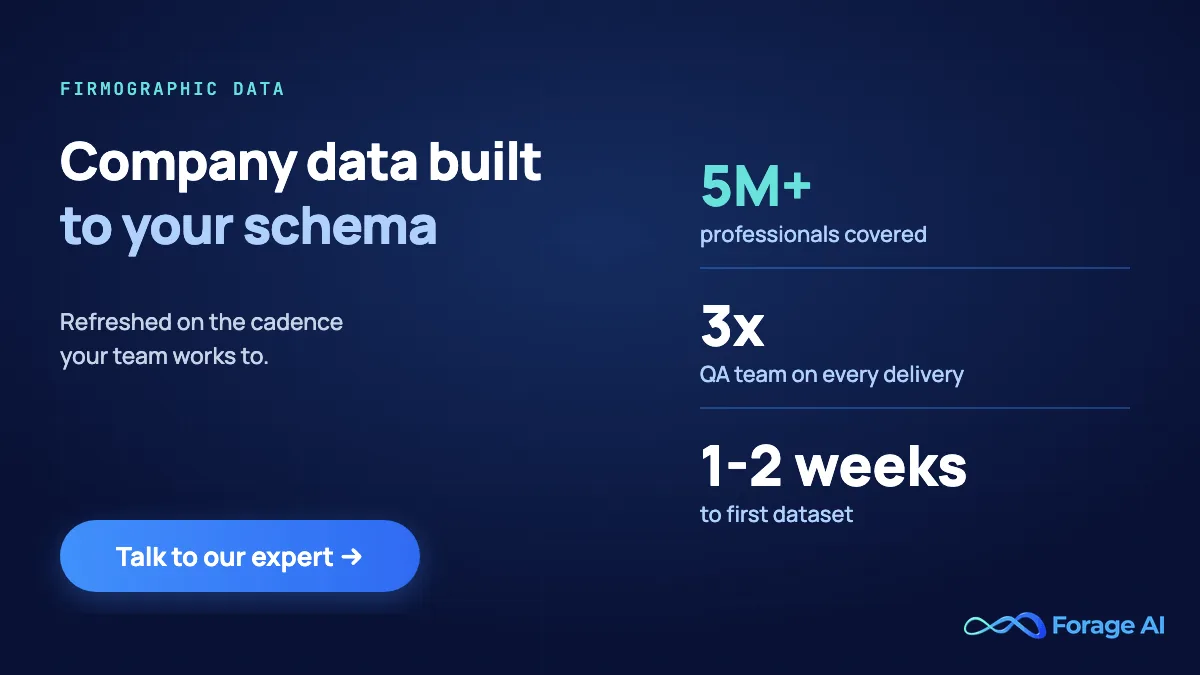
- Best managed / API-first: Forage AI delivers firmographic datasets and custom web data built to your fields, refreshed on the cadence you need and checked by a QA team 3x the industry average.
- The deciding variable is freshness, not headline accuracy: a record that is accurate but six months stale still misses the funding round, the layoff, and the office move that trigger your outreach.
- How to choose: define the primary use case, test sample data against companies you already know, then weigh total cost of ownership, not just the per-record price.
What Is Firmographic Data?
Firmographic data (also called firmographics or company data) is information that categorizes and segments businesses. Where demographic data describes people by traits such as age and income, firmographic data describes companies by their characteristics.
The term combines “firm” (the business) and “demographics” (the characteristics of a population), so it captures the traits that define a company: industry type, company size, location, ownership, revenue, and more. You need this primer before the provider list because the criteria that separate the vendors below map directly onto these data types.
Types of firmographic data:
- Industry Type: Firmographic data often includes industry-specific codes, such as NAICS, SIC, or GICS. These codes provide a standardized way to categorize a company’s primary business activities, which supports market analysis and industry benchmarking.
- Company Size: The number of employees a company has. It includes the total headcount and department-level detail that signal a company’s strengths, weaknesses, and overall market reach.
- Revenue: Revenue data shows how much a company makes each year, either in ranges (like $1 million to $5 million) or exact amounts when known. These numbers help assess a company’s financial strength, competitiveness, and growth potential. Sourcing reliable revenue figures often depends on robust financial data extraction to pull accurate numbers from filings and reports.
- Geographic Location: The addresses of a company’s headquarters and regional offices, plus the markets or territories it serves. Geographic distribution matters for targeting local markets and reading regional demand trends.
- Ownership Structure: How a company is governed, whether publicly traded, privately owned, venture-backed, family-owned, or a subsidiary. This signals stability, investment potential, and strategic priority.
- Funding Status: Investment rounds, valuation, and investor details. Tracking funding status shows how a company is growing and the strategic direction it may take.
- Technology Stack: The software, platforms, and tools a business uses. A company’s tech stack reveals operational efficiencies, gaps, and openings for new tools.
- Growth Signals: Indicators such as hiring velocity, expansion plans, and strategic initiatives. These add context on growth dynamics, market opportunities, and long-term viability. Read together, these data points sharpen strategic planning, market segmentation, and relationships with potential partners and clients.
Firmographic Data Providers at a Glance
Here is the full roster with the one-line verdict on who each provider is for. The deep dives, comparison tables, and review sentiment follow below.
| Provider | Best for (one line) |
|---|---|
| Forage AI | Teams that want managed, API-first firmographic data plus custom scraping, with daily updates |
| ZoomInfo | Enterprise sales teams that live inside a native CRM workflow |
| Bright Data | Engineering teams that want scraping infrastructure alongside pre-built datasets |
| Apollo.io | SMBs and startups that need affordable data plus built-in outreach |
| Dun & Bradstreet | Enterprise risk, credit, and compliance use cases anchored on DUNS |
| InfobelPRO | Teams that need registry-sourced company records, ownership trees, and validated tax IDs |
| Clearbit / Breeze Intelligence (HubSpot) | HubSpot users who want native, real-time enrichment |
| Cognism | Teams targeting EMEA with strong GDPR posture and verified mobiles |
| LeadIQ | SDR teams capturing contacts straight from LinkedIn into the CRM |
| SalesIntel | Teams that prioritize human-verified records over pure automation |
| Crunchbase | Teams that need funding, investor, and private-market signals |
The 11 Best Firmographic Data Providers in 2026
We ranked these on data quality, coverage, features, freshness, and real customer feedback. Each provider gets a comparison table on the same columns, two or three paragraphs of opinionated detail, and a read on what public reviews actually say. No vendor paid for placement.
1. Forage AI
Best for: Organizations that need custom web scraping plus real-time firmographic intelligence with API-first delivery.
| Best for | Managed, API-first firmographic data plus custom extraction |
| Key use cases | Trigger-based sales intelligence, market and competitor signals, enrichment at scale |
| Pricing model | Usage-based API pricing; custom enterprise pricing by project scope |
| Coverage / data | 9M+ company profiles via API, strong USA coverage with global expansion, plus on-request custom scraping |
| Freshness | Daily updates with continuous validation |
| Standout strength | Hybrid of standardized API data and fully managed custom web scraping |
| Watch-out | Custom-scraping scope means pricing is quoted, not self-serve off a price list |
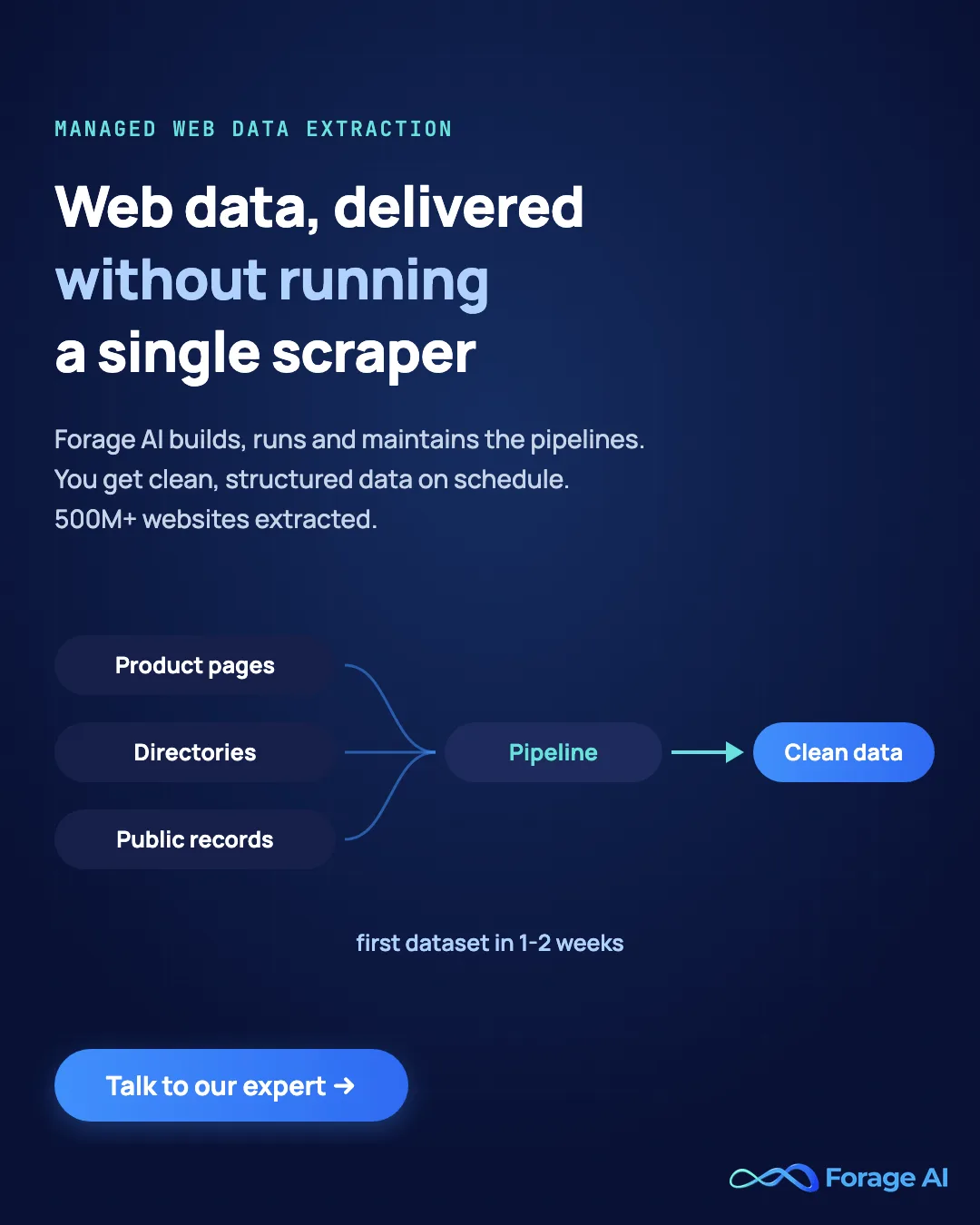
Forage AI is a fully managed firmographic data provider. What sets it apart is the combination of API access to standardized company and professional data (5M+ professionals) and custom web data scraping powered by Agentic AI. Teams get standardized company datasets and tailored collection for their specific use cases, rather than choosing one or the other.
The delivery is built for engineers: a RESTful API with full documentation, Python and cURL code examples, and JSON responses with sub-second response times. The data covers company profiles with industry classification, employee counts, revenue and financial indicators, contact information, LinkedIn URLs, and geographic data. The hybrid model is the real differentiator: you pull standardized data at scale and request custom extraction where precision matters, without standing up your own scraping stack.
Who it is for: mid-to-large enterprises that want accurate, daily-refreshed firmographic data through a modern API, with the option to extend into bespoke web data when the standard dataset does not cover a niche. Who it is not for: a solo rep who wants a free tier and a self-serve checkout, since the managed model is built around quoted scope.
What online reviews say: public third-party review volume for Forage AI is limited compared with the large incumbents, so treat this as limited public review signal. The available feedback and case work emphasize the managed-service experience and the custom-extraction flexibility rather than a self-serve product rating.
2. ZoomInfo
Best for: Sales teams that want firmographic data integrated directly into a native CRM.
| Best for | Enterprise sales teams in a native CRM workflow |
| Key use cases | Sales intelligence, prospecting, intent-driven outreach |
| Pricing model | Annual contracts, enterprise-tier pricing |
| Coverage / data | 110M+ company profiles, 200+ firmographic attributes |
| Freshness | Continuous updates (quarterly cadence on some firmographic fields) |
| Standout strength | AI-driven attribute prediction and native CRM integrations |
| Watch-out | Higher price point and a full implementation that takes effort |
ZoomInfo is one of the most recognized names in B2B data, offering company and contact data alongside a full sales intelligence suite. The depth is real: 110M+ company profiles and 200+ firmographic attributes, plus AI-driven attribute prediction and intent data. For teams that want one platform their reps live in, the native CRM integrations are the draw. Independent testing in 2026 puts its company-data accuracy near the top of the field.
The watch-outs are equally real. ZoomInfo carries a higher price point suited to enterprise budgets, typically requires annual contracts, and can be complex to implement fully. Some firmographic fields update on a quarterly cadence, which matters if your outreach depends on fresh triggers.
What online reviews say: on G2 and Capterra, reviewers consistently praise the breadth and contact accuracy while flagging cost and aggressive contract terms as the common complaints. The “powerful but expensive, and watch the renewal” pattern shows up across both platforms. If those contract terms are what is pushing you to look elsewhere, we compare the options in detail in our guide to ZoomInfo alternatives.
3. Bright Data
Best for: Organizations that need proxy and web scraping infrastructure alongside pre-built datasets.
| Best for | Engineering teams wanting scraping infrastructure plus datasets |
| Key use cases | Bulk web scraping, third-party dataset sourcing, large-scale collection |
| Pricing model | Starts at $250 per 100,000 records, usage-based |
| Coverage / data | Pre-built datasets from LinkedIn, Crunchbase, Glassdoor and more |
| Freshness | Monthly on pre-built datasets |
| Standout strength | Proxy network plus multiple delivery formats and cloud destinations |
| Watch-out | Learning curve; exported data needs cleaning and standardization |
Bright Data combines ready-made datasets with web scraping infrastructure. Known first for its proxy network, the company expanded into structured data products, offering datasets sourced from LinkedIn, Crunchbase, ZoomInfo, and other third-party platforms. Delivery is flexible: JSON, CSV, and Parquet formats, with cloud delivery via Snowflake, AWS, Google Cloud, and Azure. It is GDPR and CCPA compliant with SOC 2 certification.
In practice, the trade-offs are technical. Pricing starts at $250 per 100,000 records, with rate limits to plan around. Not all attributes are available across all sources, and exported data usually requires cleaning and standardization before it is usable. Even with proxy rotation, some platforms run anti-scraping defenses that can disrupt reliable firmographic extraction.
What online reviews say: on G2 and TrustRadius, reviewers rate the proxy reliability and scale highly while noting a steep learning curve and the engineering effort needed to turn raw exports into clean firmographic records. The honest read is “great infrastructure, not a turnkey dataset.”
Forage AI vs. Bright Data: the practical difference
Forage AI delivers a firmographic API and fully managed custom web scraping workflows, so the accurate data lands in your infrastructure without your team running the pipeline. Bright Data provides large-scale proxy networks and scraping infrastructure: it equips you with the tools, but you operate them. The short version is buy the data versus build the collection.
4. Apollo.io
Best for: SMBs and startups seeking affordable sales intelligence.
| Best for | SMBs and startups on a budget |
| Key use cases | Affordable prospecting plus built-in outreach automation |
| Pricing model | Free tier available, paid tiers from low per-seat pricing |
| Coverage / data | 35M+ global companies, 210M+ contacts |
| Freshness | Continuous updates |
| Standout strength | Data plus email sequences, dialer, and LinkedIn Chrome extension in one |
| Watch-out | Data accuracy can be inconsistent; built for outreach more than pure data |
Apollo.io combines firmographic data with outreach automation at price points small teams can actually afford. The free tier makes it easy to start, and the built-in email sequences, dialer, and LinkedIn Chrome extension mean a rep can prospect and reach out from one place. It carries ISO 27001 and SOC 2 certification, covering 35M+ global companies and 210M+ contacts. Independent 2026 testing credits it with one of the highest email deliverability rates in the field.
The honest watch-out is that data quality can vary compared with premium providers, customization is limited, and the platform’s center of gravity is outreach rather than pure data depth. For a startup, that trade is often worth it; for a data team that needs deep, reliable firmographics, it is a complement rather than the system of record.
What online reviews say: on G2, Apollo earns strong marks for value and ease of use, with the recurring complaint being data accuracy on a subset of records (stale emails, mismatched titles). Reviewers frame it as excellent for the price, with the caveat to verify before high-stakes outreach.
5. Dun & Bradstreet
Best for: Enterprise risk assessment and compliance use cases.
| Best for | Enterprise risk, credit, and compliance |
| Key use cases | Credit risk scoring, KYB, corporate hierarchy mapping |
| Pricing model | Premium, enterprise pricing |
| Coverage / data | 500M+ business records globally, DUNS numbering |
| Freshness | Varies by data product |
| Standout strength | Industry-standard DUNS numbers and deep corporate hierarchy data |
| Watch-out | Interface feels dated; better for risk than sales prospecting |
Dun & Bradstreet is the legacy leader in business data, with roots going back to 1841. Its DUNS numbering system is a standard for business identification, and the data is strong for credit risk and compliance work. With 500M+ business records globally, deep corporate hierarchy data, and risk and credit scoring, it anchors a lot of enterprise KYB and compliance programs.
The trade-offs reflect its lineage. The pricing model is premium, the interface can feel dated, and it is better suited to risk and compliance than to fast-moving sales prospecting. If your use case is trigger-based outreach, the strengths here are mostly wasted.
What online reviews say: on TrustRadius and G2, reviewers trust the depth and the DUNS standard for risk and compliance, while criticizing the user interface and the effort to extract value for sales use cases. The consensus is authoritative for risk, heavy for prospecting.
6. InfobelPRO
Best for: Teams that need company data they can trace back to an official business registry.
| Best for | Registry-sourced company data across many markets |
| Key use cases | Entity resolution and deduplication, KYB and onboarding checks, supplier and ownership mapping, tax ID validation |
| Pricing model | Quoted by scope; API and flat-file plans, no public price list |
| Coverage / data | 380M companies across 200+ markets, up to 500 attributes per company, 115M+ filed accounts, 256M+ tax IDs, 40M+ companies mapped into ownership trees |
| Freshness | Continuous registry sync; monthly deltas on flat-file delivery; places data refreshed monthly |
| Standout strength | Every record traces back to the official business registry that issued it |
| Watch-out | Company-level data, not a contact or intent database |
InfobelPRO comes at firmographics from the registry side. Most providers here assemble a company record from web signals and user contributions. InfobelPRO connects to official business registries market by market, then standardizes what comes back into one schema. You get 380M companies across 200+ markets, up to 500 attributes each, by API or as a flat file in CSV, JSON, or Parquet with monthly deltas.
What that provenance buys you is specific. Ownership resolves properly, with 40M+ companies mapped into cross-border trees, so a supplier rolls up to its real parent. Financials are filed accounts rather than modeled estimates, and 256M+ tax IDs are checked against the issuing authority. The honest watch-out: this is company data, not a prospecting stack. No direct dials, no intent.
What online reviews say: on G2, reviewers single out the breadth of the global places dataset, the accuracy of the company records, and an API that returns complete data without hand-holding. Price is the recurring complaint, especially for smaller teams. The consumer directory at infobel.com is a separate product with a much rougher review history; judge the B2B platform on the B2B reviews.
7. Clearbit / Breeze Intelligence (HubSpot)
Best for: HubSpot users who need native data enrichment.
| Best for | HubSpot users wanting native enrichment |
| Key use cases | Real-time enrichment, form shortening, website visitor identification |
| Pricing model | Best value bundled within the HubSpot ecosystem |
| Coverage / data | Smaller database than some competitors; strong technographic data |
| Freshness | Real-time enrichment |
| Standout strength | Native HubSpot integration and API-first delivery |
| Watch-out | Limited as a standalone solution outside HubSpot |
Clearbit, now part of HubSpot and rebranded as Breeze Intelligence, offers real-time data enrichment APIs that integrate tightly with the HubSpot ecosystem. The API-first delivery makes it popular with product and marketing teams, and the technographic data is a genuine strength. Website visitor identification and form shortening round out the toolkit for inbound teams. Independent 2026 testing rates its firmographic freshness and job-title accuracy among the highest in the field, and it shows up across most roundups of the best B2B data enrichment tools when teams weigh coverage, freshness, and match rates side by side.
The watch-out is dependency. Clearbit delivers its best value inside HubSpot, the database is smaller than some competitors, and it is limited as a standalone solution. Since the acquisition, product investment has concentrated on the HubSpot integration, so if you are not a HubSpot shop, the math changes.
What online reviews say: on G2, HubSpot users rate the native enrichment and ease of setup highly, while non-HubSpot reviewers note the value drops outside that ecosystem and the company coverage is narrower than the large incumbents.
8. Cognism
Best for: European market coverage with strong compliance.
| Best for | Teams targeting EMEA with strong GDPR posture |
| Key use cases | EU prospecting, phone outreach, intent-driven targeting |
| Pricing model | Higher price point, enterprise-tier annual plans |
| Coverage / data | Strong EMEA coverage; weaker in some US regions |
| Freshness | Continuous updates |
| Standout strength | Phone-verified mobile numbers and Diamond Data verification |
| Watch-out | Focused on 50+ employee organizations; lighter US coverage |
Cognism puts GDPR compliance and European coverage at the center, which makes it a top pick for organizations targeting EU businesses. Its phone-verified mobile numbers, backed by Diamond Data verification, are a real differentiator for teams that run phone outreach. Intent data integration and GDPR and CCPA compliance round out the offering.
The limits are geographic and segment-based. US coverage is weaker in some regions, the price point is higher, and the data skews toward organizations with 50+ employees. For an EMEA-first team, that is a fair trade; for a US-SMB motion, less so.
What online reviews say: on G2 and Gartner Peer Insights, EU-focused reviewers praise mobile-number accuracy and the compliance posture, while some US reviewers report thinner coverage in their territories. The verified-mobile quality is the most cited strength.
9. LeadIQ
Best for: SDR teams focused on LinkedIn prospecting.
| Best for | SDR teams capturing contacts from LinkedIn |
| Key use cases | LinkedIn contact capture, CRM sync, job-change tracking |
| Pricing model | Affordable per-seat pricing |
| Coverage / data | Contact-focused rather than deep firmographic |
| Freshness | Real-time capture and CRM sync |
| Standout strength | LinkedIn capture extension with AI email personalization |
| Watch-out | Limited firmographic depth; best as a complement |
LeadIQ helps sales development teams capture and sync contact data from LinkedIn and other sources. The Chrome extension and real-time CRM sync make it easy for reps to build targeted lists fast, with job-change tracking and AI email personalization adding to the SDR workflow. The per-seat pricing is affordable.
The clear watch-out is scope. LeadIQ is contact-focused rather than a deep firmographic source, so its firmographic depth is limited. It works best as a complement to a richer company-data provider, not as the sole system of record.
What online reviews say: on G2, SDRs rate the LinkedIn capture speed and CRM sync highly, while reviewers note that firmographic and company-level depth is thinner than dedicated data providers. The pattern is great for capture, pair it with a data source.
10. SalesIntel
Best for: Organizations prioritizing manually verified data.
| Best for | Teams that prioritize human-verified records |
| Key use cases | High-accuracy prospecting, research-on-demand, intent targeting |
| Pricing model | Not publicly disclosed |
| Coverage / data | 40M+ company records |
| Freshness | 90-day re-verification cycle |
| Standout strength | 95% human-verified data and research-on-demand service |
| Watch-out | Smaller database; research-on-demand has a longer turnaround |
SalesIntel differentiates through human-verified contact data, with a large research team validating records and a 90-day re-verification cycle that pushes accuracy higher than purely automated solutions. Intent data through Bombora and a research-on-demand service round out the offering, across 40M+ company records.
The trade-offs come from the manual model. The database is smaller than some competitors, research-on-demand has a longer turnaround, and pricing is not publicly disclosed. For teams that value verification over raw volume, that is the point; for teams that need breadth fast, it is a constraint.
What online reviews say: on G2, reviewers highlight the human-verified accuracy and the research-on-demand service as standouts, while noting smaller coverage and slower turnaround on custom research. The accuracy reputation is the consistent throughline.
11. Crunchbase
Best for: Teams that need funding, investor, and private-market signals on top of core firmographics.
| Best for | Funding-driven prospecting and private-market intelligence |
| Key use cases | Funding-round triggers, investor mapping, high-growth company sourcing |
| Pricing model | API plans from roughly $49/month (Basic) up to Pro tiers; free API tier retired in 2025 |
| Coverage / data | Private-market firmographics across 600+ API endpoints, 30M+ verified annual updates |
| Freshness | Real-time on funding and private-market events |
| Standout strength | Round-by-round funding data plus predictive models for funding, IPOs, and closures |
| Watch-out | Strongest on funding and startups; thinner for broad SMB contact data |
Crunchbase earns its place for a use case the others only partly cover: funding and private-market intelligence. Its API delivers round-by-round funding data, investors, acquisitions, employee headcount, revenue ranges, and tech stack across 600+ endpoints, backed by 30M+ verified annual updates. The Fundamentals package splits Core Firmographics (name, type, legal status, employee count, leadership) from Advanced Firmographics (ownership, org structure, accelerators), so you can pull the depth you need.
The standout is its predictive layer. Crunchbase publishes models that forecast funding rounds, acquisitions, IPOs, and closures, which is genuinely useful for trigger-based outreach to high-growth companies. Who it is for: teams that sell into venture-backed and high-growth firms and want funding events as a signal. The watch-out: it is strongest on funding and startup data and thinner for broad SMB contact coverage, and the free API tier was retired in 2025, so budget for a paid plan.
What online reviews say: reviewers consistently cite the funding and investor data as best-in-class for private-market work, while flagging that pricing climbed after the free tier ended and that coverage skews toward funded and tech companies rather than the long tail of small businesses.
Firmographic Data Providers: Master Comparison
Use this table to scan the decisive differences across all eleven providers at once: who each is best for, coverage, pricing model, freshness, the standout strength, and the honest watch-out.
Expert Insights
“The mistake we see most often is teams optimizing for the size of the database instead of the freshness of it. A record that is accurate the day it is collected and never re-checked will quietly decay until your reps are calling companies that have already moved, merged, or shut down. Daily validation is not a luxury feature; it is the difference between data you can act on and a list you have to apologize for.”
Forage AI Data Solutions team
| Provider | Best for | Coverage / data | Pricing model | Freshness | Standout | Watch-out |
|---|---|---|---|---|---|---|
| Forage AI | Managed API + custom scraping | 5M+ professionals + bespoke scraping | Usage-based / custom | Daily | Hybrid API + managed extraction | Quoted, not self-serve |
| ZoomInfo | Enterprise CRM-native | 110M+ profiles, 200+ attributes | Annual, enterprise | Continuous | Attribute prediction + intent | Cost and contract terms |
| Bright Data | Scraping infrastructure | Pre-built datasets + proxies | From $250/100k records | Monthly | Proxy network + formats | Needs cleaning; learning curve |
| Apollo.io | SMB / startup budgets | 35M+ companies, 210M+ contacts | Free tier + low per-seat | Continuous | Data + outreach in one | Inconsistent record accuracy |
| Dun & Bradstreet | Risk / credit / compliance | 500M+ records, DUNS | Premium enterprise | Varies | DUNS + corporate hierarchy | Dated UI; heavy for sales |
| InfobelPRO | Registry-sourced company data | 380M companies, 200+ markets, 500 attributes | Quoted by scope | Continuous registry sync | Registry provenance + ownership trees | No contact or intent data |
| Clearbit / Breeze (HubSpot) | HubSpot enrichment | Smaller DB; strong technographic | Bundled with HubSpot | Real-time | Native HubSpot integration | Limited outside HubSpot |
| Cognism | EMEA + GDPR | Strong EMEA; lighter US | Higher, annual | Continuous | Diamond-verified mobiles | 50+ employee skew |
| LeadIQ | LinkedIn SDR capture | Contact-focused | Affordable per-seat | Real-time | LinkedIn capture extension | Thin firmographic depth |
| SalesIntel | Human-verified records | 40M+ records | Not disclosed | 90-day cycle | 95% human-verified + research | Smaller DB; slower research |
| Crunchbase | Funding / private-market | 600+ endpoints, 30M+ updates | From ~$49/mo, no free tier | Real-time on funding | Funding data + predictions | Skews to funded / tech firms |
How Do You Choose a Firmographic Data Provider?
Now that you have seen the providers, here is the framework to choose between them. Six criteria actually separate a dataset you can act on from one you end up apologizing for, and a short, repeatable process turns those criteria into a decision.
1. Data Quality and Accuracy
A large database is worth little if the records are wrong. Choose providers that disclose their accuracy rates (aim for 95%+) and have transparent validation methodologies. Ask how they verify information and how often they re-validate it.
Expert Insights
“The teams that get this right run a short pilot before they sign. They pull a sample, score it against fifty accounts they already know cold, and measure both the hit rate and how stale the misses are. That one exercise tells you more than any vendor accuracy claim, because it tests the data against your reality instead of their benchmark.”
Forage AI Data Solutions team
2. Data Freshness and Update Frequency
Company information changes constantly: employees leave, funding rounds close, offices open. Providers that offer daily or real-time updates deliver far more value than those refreshing monthly or quarterly. This matters most for trigger-based outreach, where timing is the whole game.
3. Coverage Breadth and Depth
Weigh both the number of companies covered and the depth of data on each one. A provider with 10 million shallow records can be less useful than one with 5 million well-enriched profiles, depending on what you actually need. Also weigh geographic fit: US-focused, EU-focused, and global all point to different vendors, and any US provider’s depth is ultimately bounded by the source registries it can pull from, which our state-by-state ranking of registry accessibility maps out.
4. Delivery Methods and Integration
The data reaches you through different routes. API access enables real-time enrichment and automation, flat-file exports support batch processing, and native CRM integrations cut implementation complexity. Pick the method that matches your team’s technical capabilities and use cases.
5. Compliance and Data Privacy
With GDPR, CCPA, and other regulations governing data use, confirm your provider is compliant and can document its data-sourcing practices. Look for SOC 2, ISO 27001, and similar security certifications.
6. The Total Cost of Firmographic Data Ownership
Total cost of ownership goes well beyond the subscription price or per-record cost. Factor in implementation time, integration costs, and ongoing maintenance. Pricing varies widely based on data granularity, source credibility, and the services each provider offers. Apollo.io provides a free tier for basic access, Bright Data starts at $250 per 100,000 records, Crunchbase API plans begin around $49 a month, and Forage AI offers custom pricing sized to the client’s project scope.
The Repeatable Selection Process
Choosing a firmographic data provider is not one-size-fits-all. Run the same five steps every time, in order, and let the use case drive the shortlist:
- Define your primary use case: sales prospecting, marketing segmentation, risk assessment, funding-driven outreach, or competitive intelligence. Providers excel in different areas, so name the job first.
- Assess your technical requirements: do you need API access for real-time enrichment, or are batch file exports enough? Match the choice to your team’s technical capabilities.
- Evaluate geographic coverage: if you target specific regions, confirm the provider covers them well before you commit.
- Test data quality: request sample data or a trial, and test accuracy against companies you already know well.
- Weigh total cost of ownership and verify compliance: factor in implementation and maintenance, not just the subscription, and confirm the provider meets your regulatory requirements.
Quick Summary
Q: How do you evaluate and choose a firmographic data provider?
A: Score providers on six criteria: data quality and accuracy (aim for 95%+ with transparent validation), freshness and update frequency (daily beats quarterly for trigger-based outreach), coverage breadth and depth, delivery methods and integration, compliance (GDPR, CCPA, SOC 2, ISO 27001), and total cost of ownership. Then run a repeatable five-step process: define the use case, assess technical needs, check geographic coverage, test sample data against companies you know, and weigh total cost while verifying compliance. The use case drives the shortlist; price comes last.
Which Firmographic Data Provider Delivers the Most Accurate Datasets?
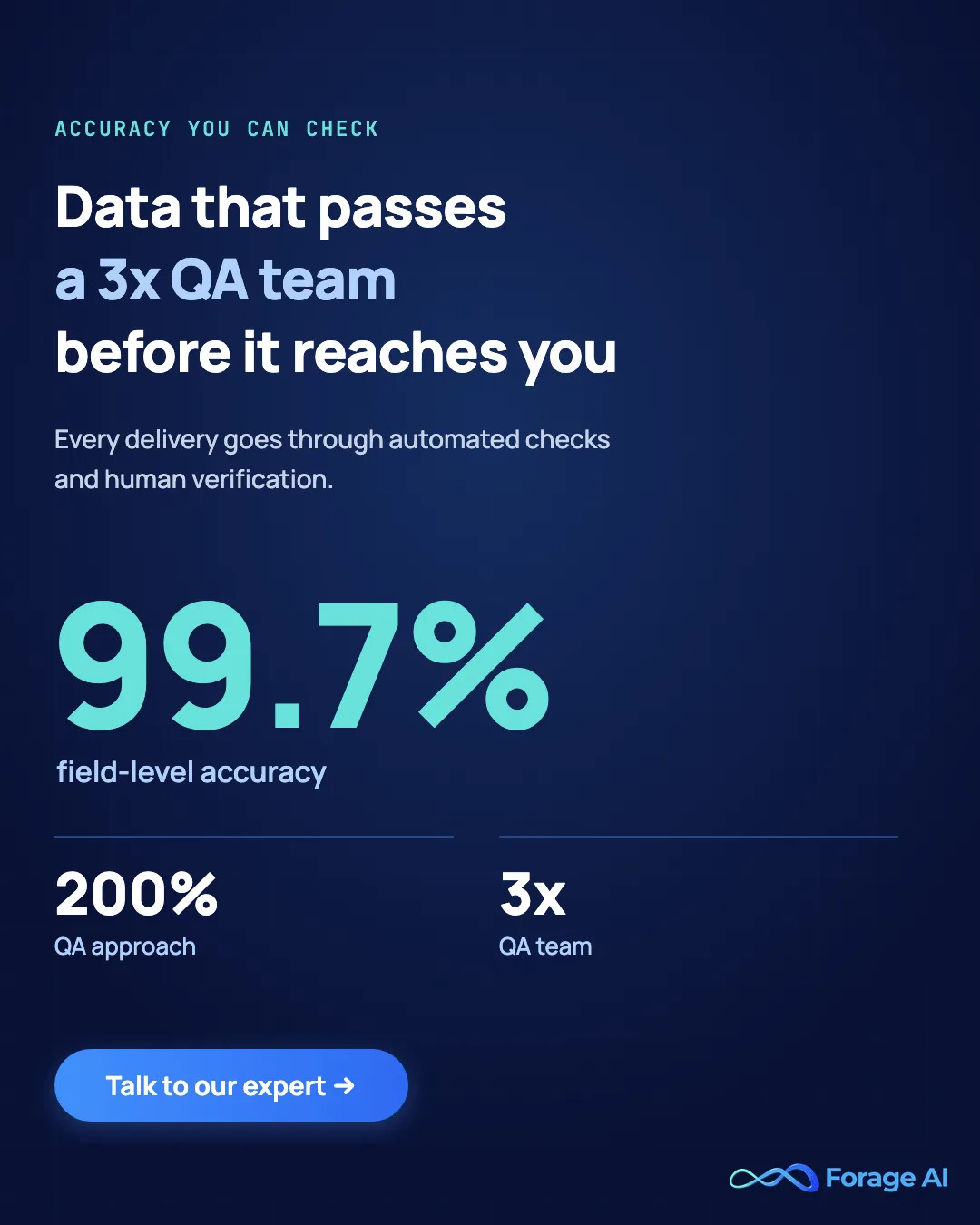
Forage AI checks every delivery with automated checks plus human verification by a QA team 3x the industry average, on a refresh cadence agreed with each client. That pairing of checked data and regular re-validation is what keeps the data reliable enough to act on.
Other vendors claim 95% accuracy through human verification, but accuracy varies by data point. Basic company information is usually more reliable than revenue estimates or employee counts. The honest method is to test sample data against companies you know well before you commit to any provider.
Conclusion: Pick Your Data Partner
In 2026, firmographic data is not a supporting tool; it is the foundation of every revenue decision. The right provider does more than save time; they keep you working from reality. Your choice should align with your specific use cases, technical requirements, and budget.
For teams that prioritize flexibility, customization, data freshness, API delivery, precision targeting, and reliability, Forage AI pairs a refresh cadence built to your needs, a 3x QA team, and a fully managed data pipeline. The service is built for modern B2B teams where timing and accuracy move the number directly.
Want to see what daily, API-first firmographic data looks like in practice?
Get API Access to 9M+ Company Profiles.
Frequently asked questions
What is the difference between firmographic and demographic data?
Demographic data describes individual people (age, gender, income), while firmographic data describes organizations (industry, size, revenue, location). Firmographics are the B2B equivalent of demographics.
How often should firmographic data be updated?
Company information changes constantly. For time-sensitive applications like trigger-based sales, daily or real-time updates are essential. For broader market analysis, monthly updates may be sufficient. Forage AI refreshes data on the cadence your team needs, up to daily.
What accuracy rate should I expect from a firmographic data provider?
Top-tier providers typically report 90-99% accuracy. However, accuracy can vary by data point; basic company information is usually more accurate than revenue estimates or employee counts. Always test sample data against known companies.
Is firmographic data GDPR compliant?
Company-level firmographic data (industry, size, location) is generally considered business information and less restricted than personal data. However, contact information and individual employee details are covered by the GDPR. Choose providers that document their compliance practices.
Which firmographic data provider offers the best API access?
Forage AI delivers firmographic data through an API, direct download or cloud integration, refreshed on the cadence you need and shaped to your fields, so it lands straight in your CRM, warehouse or other systems.
Sai is a data infrastructure enthusiast who has spent the past two to three years following the AI space closely, from the infrastructure layer to the fast-growing world of data for AI. He is genuinely curious about how modern data pipelines get built and where the data industry is heading, and he writes insightful pieces on the core topics that shape this niche.