
Top Data Extraction Companies in 2026: 15 Managed Providers, Scored
Last updated August 2026. Provider categories, pricing models and public claims were re-checked in August 2026. Pricing changes often; confirm anything here against a live quote.
Most shortlists of data extraction companies are built backwards. Someone opens six vendor sites, copies the feature lists into a spreadsheet, and ends up with fifteen columns that all say yes. Proxy rotation, yes. JSON delivery, yes. Dedicated support, yes. Then the contract gets signed, and four months later the pipeline is delivering 71% of the records it delivered in week one, and nobody can explain why.
We have watched this happen enough times to know where the spreadsheet goes wrong. It compares capabilities when it should be comparing difficulty. Two providers with identical feature grids fail at completely different points once the sources get hard, and the feature grid gives you no way to see it coming.
So this list is scored differently. Every provider below is graded on four things: how hard the data is to get, how hard it is to find, whether quality holds at scale, and whether the accuracy number they quote means anything. Those four axes are the ones that decide whether an extraction contract works. Everything else is packaging.
Quick Digest
- Three buying models, not one market: fully managed partners, platform companies with a managed layer, and manual-entry BPOs all appear in the same search results and are bought in completely different ways. Comparing them side by side is the first mistake most shortlists make.
- Score on difficulty, not features: the four axes that predict whether a contract works are hard-to-get sources, source discovery, scale behaviour, and measured accuracy. A feature grid captures none of them.
- The web got harder to collect from: automated traffic passed 51% of all web traffic in 2024, with bad bots alone at 37%, per the Imperva 2025 Bad Bot Report. Sites are defending against that, and legitimate extraction is caught in the same net.
- Source discovery is the axis nobody advertises: most providers extract from a list you give them. Far fewer will tell you what sources exist in the first place, which is the difference between a scraping contract and a data programme.
- The 15 providers, compared: Forage AI, PromptCloud, ScrapeHero, Grepsr, Datahut, GroupBWT, Ficstar and Datamam sit in the managed tier; Zyte, Bright Data, Oxylabs, Apify and Nimble are platform-first with a managed layer; Flatworld Solutions and Managed Outsource Solutions are BPO-led.
Data extraction companies are not all buying the same thing
Search for data extraction companies and the results mix three businesses that have almost nothing in common. They rank against each other, so they look like substitutes. They are not substitutes, and knowing which one you are talking to changes every question you should ask.
| Buying model | What you actually buy | Who owns the pipeline | Where it breaks |
|---|---|---|---|
| Fully managed | A delivered dataset against your schema, on a cadence | The provider, end to end | Slow to scope. Costs more up front. Weak fit if your requirement is small and stable. |
| Platform with a managed layer | Infrastructure, plus a services team who will build on it | Shared, and the boundary is often unclear | Managed work sits on top of a product roadmap. If your source needs something the platform does not do, you wait. |
| Manual entry and BPO | People typing, reading and checking, at an hourly or per-record rate | The provider, but the method is human | Scales linearly with headcount. Accuracy is a staffing question. Not viable above a certain volume. |
The managed model is worth understanding properly before you shortlist, because it is the only one where the provider absorbs maintenance as part of the price. On the other two models, maintenance is either your problem or a change request.
The distinction that matters most is who absorbs change. Websites restructure. Anti-bot vendors ship new detection. A regulator changes a filing format and three hundred documents stop parsing. On a tool contract, every one of those events lands on your engineers. On a genuine managed contract, none of them do, and you find out about it in a status note rather than a Monday incident.
What a tool cannot absorb, no matter how good it is. A scraping platform can give you a browser that renders like a real one, a proxy pool that looks residential, and a scheduler that retries. It cannot tell you that the site you have been collecting from quietly moved a field from the product page to an XHR call, so your price data is now three weeks stale and technically still passing every validation rule you wrote. Detecting that requires somebody whose job is to look. That job is what you are buying when you buy managed extraction, and it is the single line item most feature comparisons leave out.
Expert Insights
“The failure we see most often is not a pipeline that stops. It is a pipeline that keeps running and quietly stops being complete. A site moves a field, the crawler still returns a 200, the schema still validates, and the dataset degrades for weeks before anyone notices. Coverage monitoring catches that. Uptime monitoring does not.”
Forage AI delivery team, 2026, on the most common failure mode across 12+ years of managed extraction engagements
Market forecasts for this category vary wildly depending on where the analyst draws the boundary. Mordor Intelligence puts the web scraping market at USD 1.17 billion in 2026, growing to USD 2.23 billion by 2031 at a 13.78% compound rate (Mordor Intelligence, 2026). Other firms scope the same category several times larger. The spread itself is the useful signal: nobody agrees what counts as a data extraction company, which is exactly why the search results are so muddled.
Quick Summary
Q: Are all data extraction companies selling the same thing?
A: No. Three buying models rank for the same search: fully managed partners who deliver a dataset against your schema, platform companies who sell the tooling and leave the pipeline with you, and manual-entry BPOs. The question that separates them is who absorbs change when a source restructures.
How we scored these data extraction companies
We did not score on features. Feature parity in this category is close to total, and it tells you nothing about how a provider behaves when a source fights back. We scored on four axes of difficulty, in the order they tend to break an engagement.
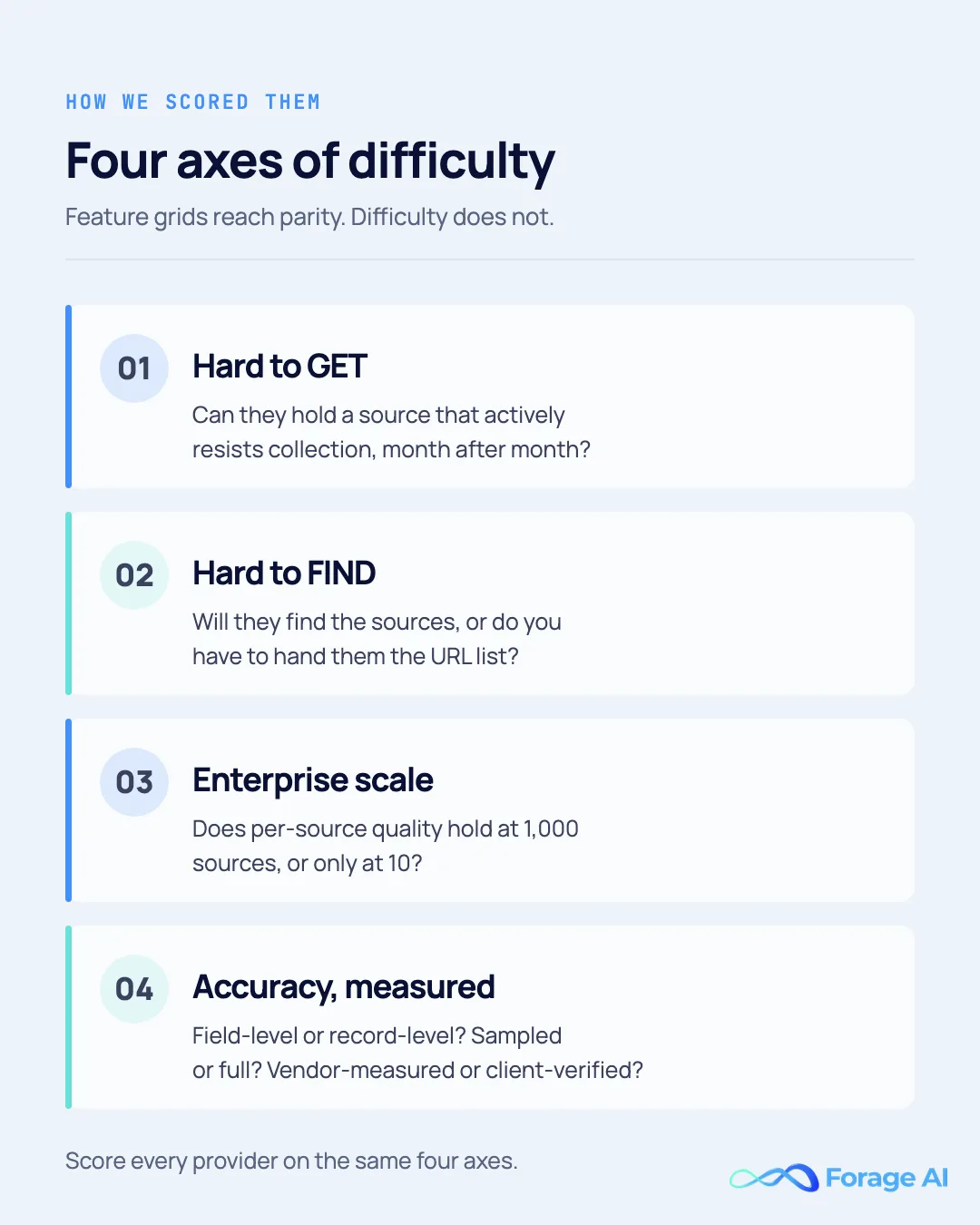
| Axis | The question to ask a vendor | What a weak answer sounds like |
|---|---|---|
| 1. Hard to GET | “Here is our hardest source. Can you hold it for twelve months, and what happens the third time its defenses change?” | “We have a large proxy network.” (That is an input, not an outcome.) |
| 2. Hard to FIND | “We know roughly what we need but not where it lives. Will you find the sources?” | “Send us the URL list.” (Fine, but it means discovery is your job.) |
| 3. Enterprise scale | “At 1,000 sources instead of 10, what happens to per-source quality and to your response time on a break?” | “We handle billions of records.” (Volume is not the constraint. Variance is.) |
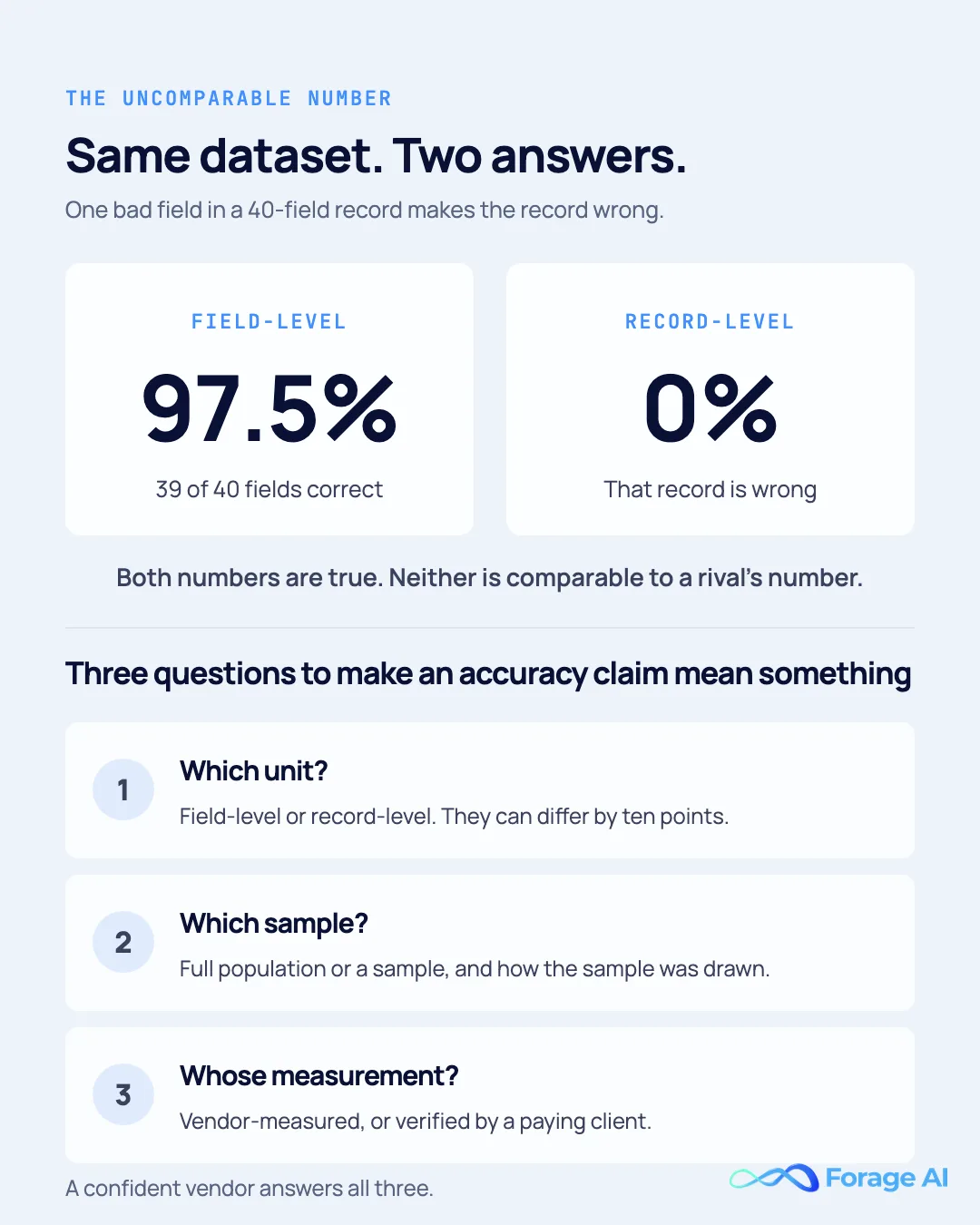
| 4. Accuracy, measured | “Field-level or record-level? Sampled or full? Measured by you or verified by a client?” | “99%+ accuracy.” (Undefined, so uncomparable.) |
Axis one is harder than it was three years ago, and the reason is not you. Automated traffic crossed 51% of all web traffic in 2024, the first time in a decade that it passed human activity, with bad bots alone accounting for 37% of what sites see, the sixth consecutive year of growth, per the Imperva 2025 Bad Bot Report. Detected AI-driven attacks rose more than twelve-fold, from a daily average of two million blocked incidents to twenty-five million, according to the Thales 2026 Bad Bot Report.
Stat callout: automated traffic is now the majority of the web. 51% of all web traffic was automated in 2024 (bad bots 37%, benign automation 14%), leaving human traffic at 49%. Source: Imperva, a Thales company, 2025 Bad Bot Report, April 2025.
Read that from the site owner’s side. They are not hardening their defenses because a few analysts want their pricing data. They are defending against a majority-automated internet, and every legitimate collector gets caught in the same net. That is why “we have proxies” stopped being an answer. The question is what a provider does on the third defense change, when the cheap fixes are gone.
Axis two is the one nobody puts on a comparison page. Most providers extract from sources you name. If you already have the list, that is fine and you should not pay extra for discovery you do not need. But a great many data programmes start from “we need coverage of specialty clinics across these fourteen states” rather than a URL list, and the number of providers who will genuinely go and find those sources is much smaller than the number who say yes on a call. It is worth asking directly, in writing.
Axis three is misread as a volume question. It is a variance question. Ten sources you can babysit. At a thousand, the sources are heterogeneous, they break independently, and the constraint becomes how fast a break is detected and fixed, not how many records the infrastructure can move. Enterprise pipelines usually break for structural reasons rather than capacity ones.
Axis four is where most comparisons quietly give up. An accuracy number without a measurement definition cannot be compared to another accuracy number. Before you put two figures side by side, make both vendors answer the same three questions: which unit is being measured, how the sample was drawn, and who verified it. A data quality framework gives you the vocabulary to hold them to it.
Quick Summary
Q: What were these providers scored on?
A: Four axes of difficulty rather than features: how hard the data is to get, how hard the sources are to find, whether quality holds as volume grows, and whether the accuracy figure has a definition behind it. Feature grids reach parity in this category, so they separate nothing.
Data extraction companies at a glance
Fifteen providers, grouped by how you buy from them. No vendor paid for placement, and no provider on this list is a Forage AI customer.
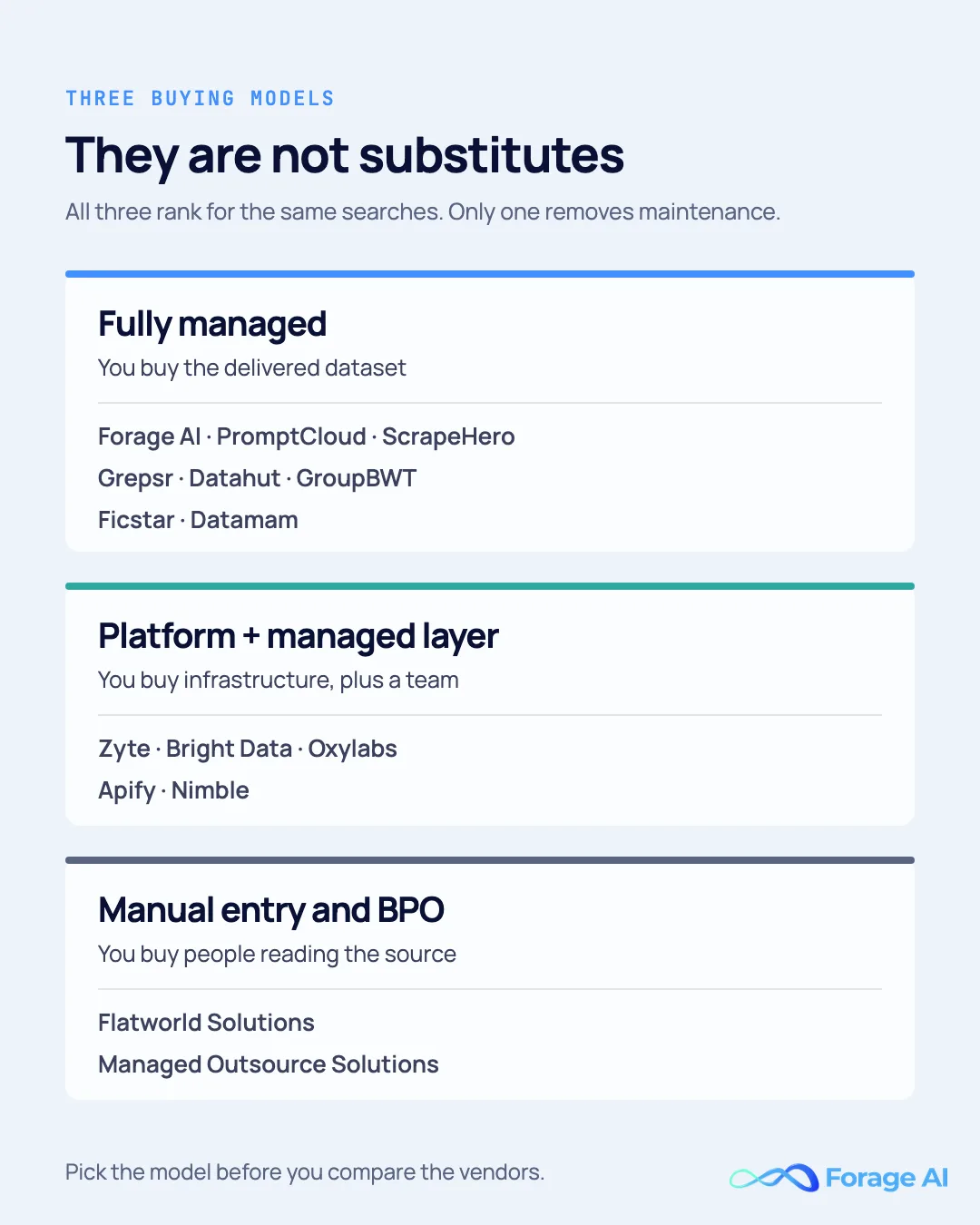
Fully managed, custom-scoped: Forage AI (hardest sources plus documents) · PromptCloud (large recurring web feeds) · ScrapeHero (published packaged pricing) · Grepsr (managed service with a self-serve platform) · Datahut (smaller scopes, low entry) · GroupBWT (custom engineering engagements) · Ficstar (long-running competitive feeds) · Datamam (bespoke, consultative)
Platform-first with a managed layer: Zyte (Scrapy lineage, developer-first) · Bright Data (infrastructure and datasets at scale) · Oxylabs (proxy-led with scraper APIs) · Apify (marketplace of prebuilt actors) · Nimble (AI-assisted extraction platform)
Manual entry and BPO-led: Flatworld Solutions (vertical document and data operations) · Managed Outsource Solutions (human-plus-automation extraction)
| Provider | Category | Hard-to-get sources | Source discovery | Documents and media | Pricing model |
|---|---|---|---|---|---|
| Forage AI | Fully managed | Core strength | Yes, active discovery | Yes, in the same pipeline | Custom per programme |
| PromptCloud | Fully managed | Strong | Limited | Web-focused | Custom, entry tier published |
| ScrapeHero | Fully managed | Strong | Limited | Web-focused | Published, packaged per site |
| Grepsr | Fully managed | Strong | Limited | Web-focused | Published entry, custom above |
| Datahut | Fully managed | Moderate | No | Web-focused | Published, low entry |
| GroupBWT | Fully managed | Strong | Case by case | Web-focused | Custom engagement |
| Ficstar | Fully managed | Strong | Limited | Web-focused | Custom |
| Datamam | Fully managed | Moderate | Case by case | Web-focused | Custom |
| Zyte | Platform plus managed | Strong | No | Web only | Usage-based, managed quoted |
| Bright Data | Platform plus managed | Strong | No | Web only | Usage-based |
| Oxylabs | Platform plus managed | Strong | No | Web only | Usage-based |
| Apify | Platform plus managed | Moderate | No | Web only | Credits, self-serve |
| Nimble | Platform plus managed | Moderate | No | Web only | Usage-based |
| Flatworld Solutions | BPO-led | Not applicable | No | Yes, manual | Per record or hourly |
| Managed Outsource Solutions | BPO-led | Not applicable | No | Yes, manual | Per record or hourly |
The 15 top data extraction companies, compared
Category A. Fully managed, custom-scoped
These providers take the outcome, not the tooling. You define the schema and the cadence, they own everything between the source and your warehouse. This is the right category when the data matters enough that a two-week outage is a business event rather than a ticket.
1. Forage AI
| Attribute | Detail |
|---|---|
| Category | Fully managed, custom-scoped |
| Best for | Sources that actively resist collection, requirements that span web pages and documents, and programmes where accuracy is contractual rather than aspirational |
| Hard-to-get / hard-to-find | Both. Multi-method extraction (XPath, NLP, custom-trained models) for resistant sources, plus active source discovery as part of the engagement |
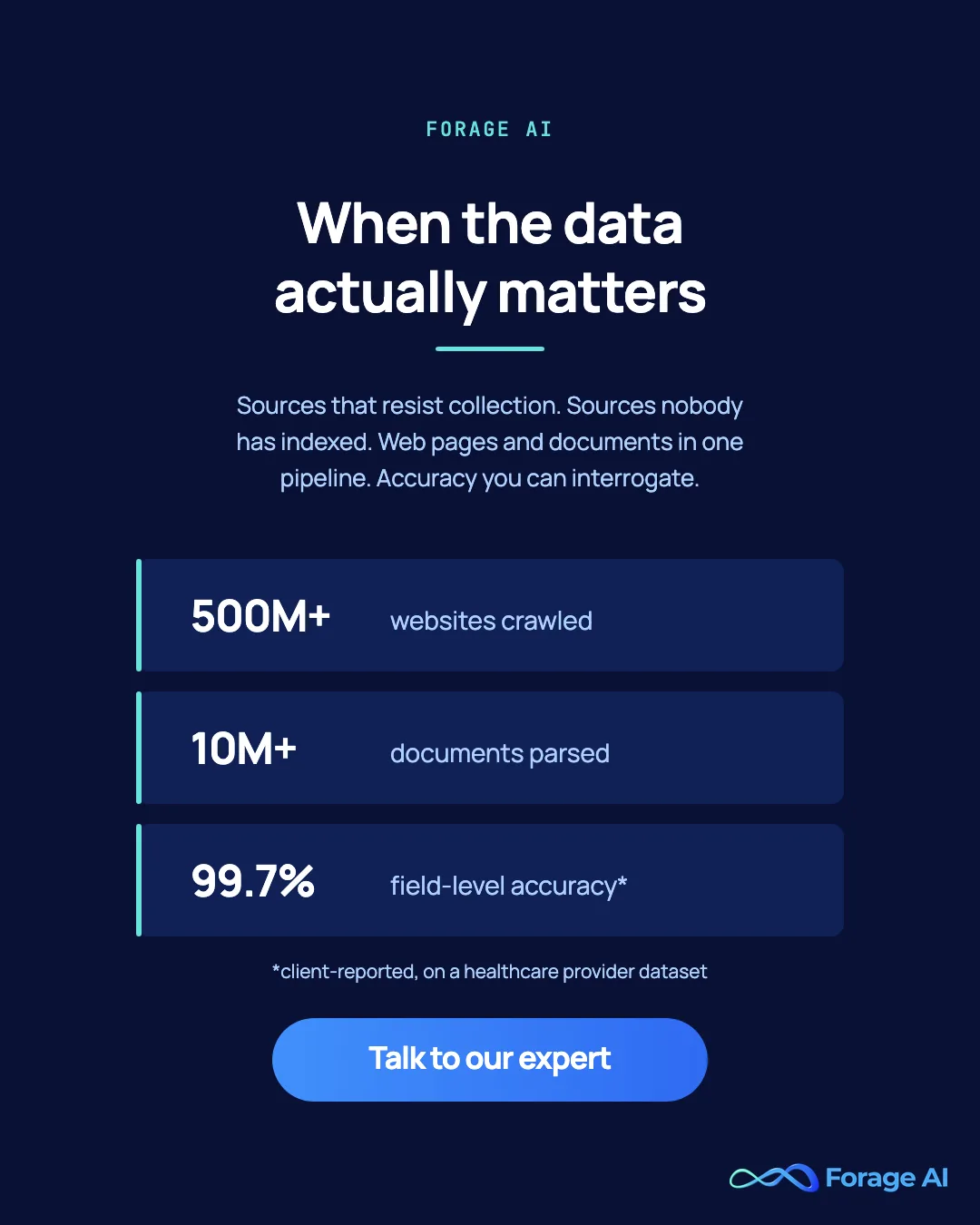
| Scale posture | 500M+ websites crawled, 10M+ documents parsed, 5M+ professionals monitored, across 15+ industries |
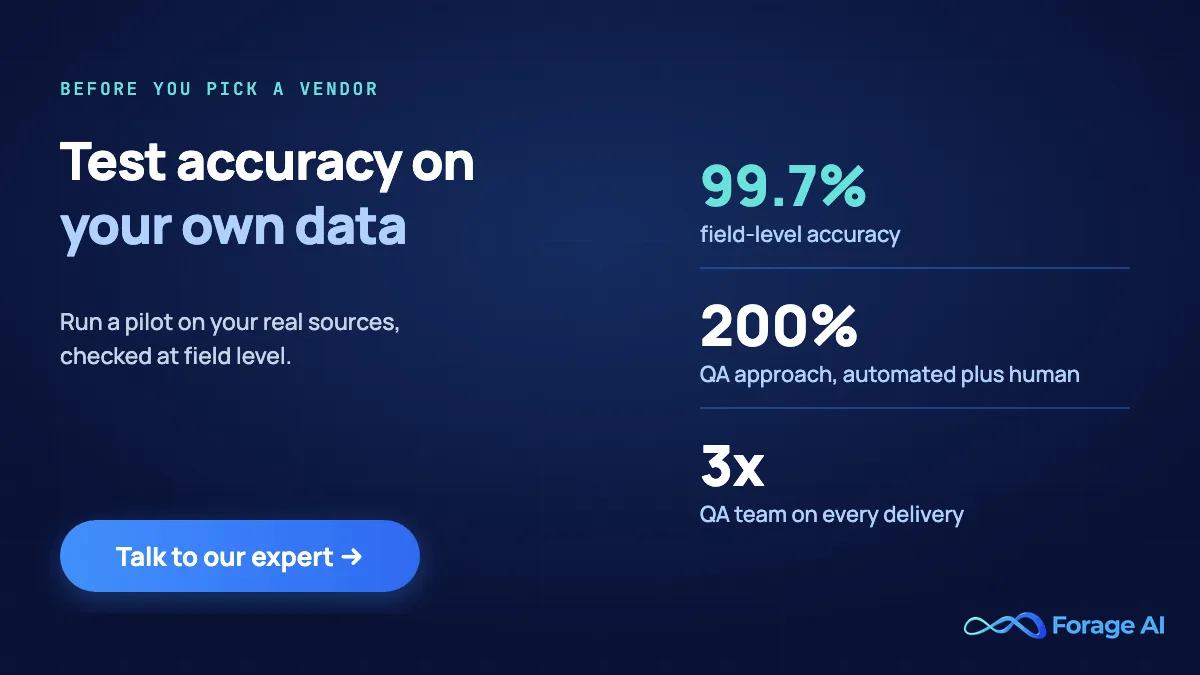
| Accuracy claim | 99.7% field-level accuracy, client-reported, on a healthcare provider dataset. 200% QA: every extraction passes automated checks and human verification |
| Pricing model | Custom per programme. No published per-site tiers |
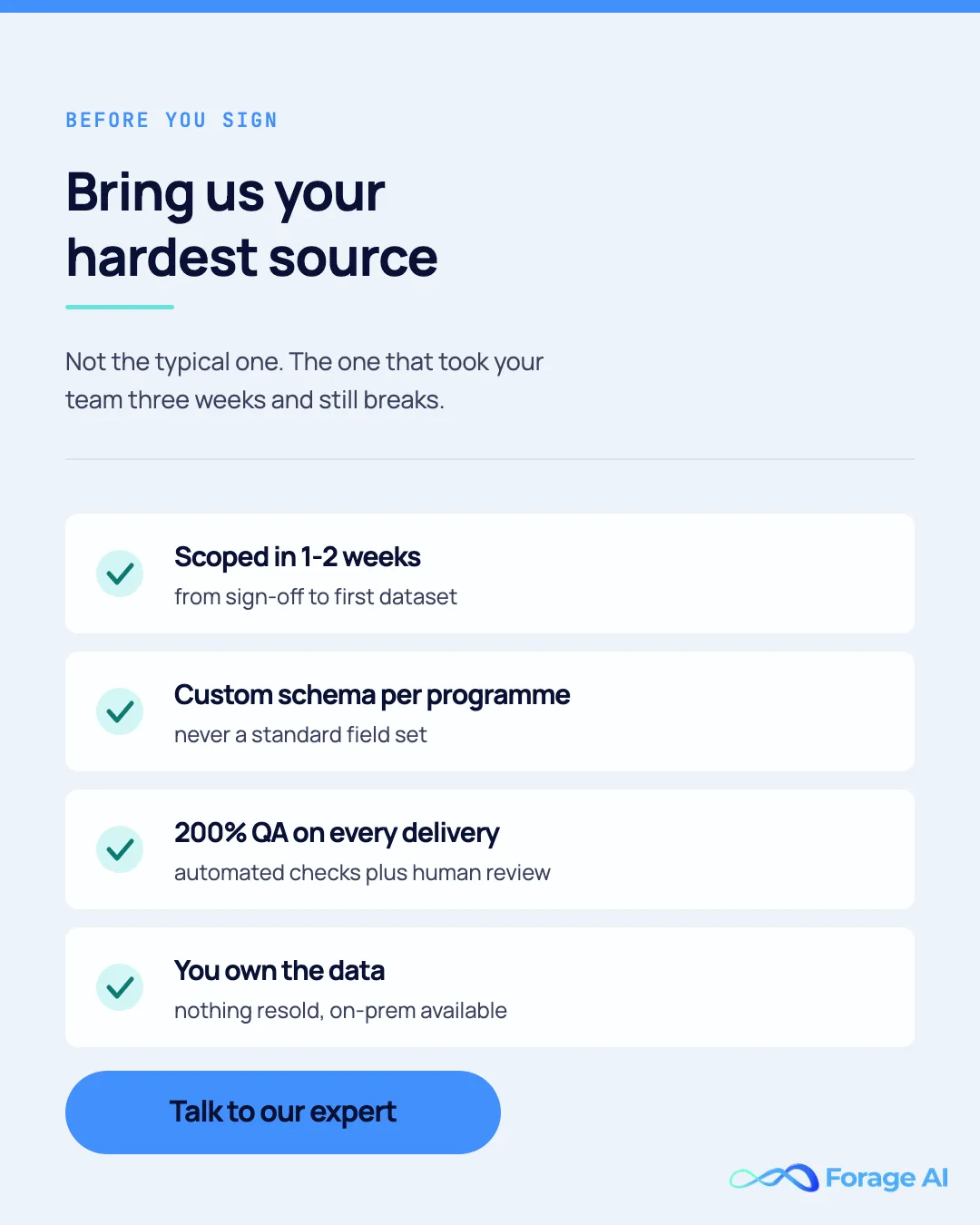
| Watch-out | Scoping is consultative and takes 1-2 weeks to first dataset. If your requirement is ten stable sources with a fixed schema, this is more partner than you need |
| Review attribute | Detail |
|---|---|
| What users like | No verified public reviews. |
| What users flag | No public review corpus to draw from. |
Forage AI sits at the top of this list for one reason: it is built for the sources everyone else quotes carefully around. Most managed providers are strong on high-volume, well-behaved web sources. Forage AI’s engagements skew towards the other end, the sources that are hard to get at because they defend themselves, and the sources that are hard to find because nobody has indexed them. Twelve years of that work has produced a set of pre-mapped fields across fifteen-plus industries, which is why scoping a new vertical takes weeks rather than quarters.
The breadth is the second differentiator, and it is genuinely rare. Web pages, PDFs, scans, handwritten notes, long-form documents, images and audio move through the same pipeline. Across the managed-scraping category, that is unusual: the tier is web-only almost without exception, and a requirement that mixes a public directory with a folder of scanned filings normally means two vendors and a reconciliation problem. Pair that with custom web scraping built to your business rules rather than a standard schema, and the fit is strongest exactly where standard schemas stop working.
On accuracy, the number is scoped rather than blanket, which is the point. That is a narrower claim than “99%+ accuracy” and a more useful one, because you can interrogate it: which fields, whose measurement, over what period. Behind it sits a QA team three times the industry average relative to delivery, and a reinforcement loop where every correction feeds back into the models. Data ownership stays with the client, nothing is resold, and on-premise deployment is available where the data cannot leave your infrastructure. Not for you if your scope is small, static and already indexed. That is a tool job, and paying partner rates for it is waste.
Expert Insights
“Every vendor in this category will quote you an accuracy figure and almost none of them will define it. Field-level and record-level accuracy can differ by ten points on the same dataset, because one bad field in a forty-field record makes the record wrong and the fields 97.5% right. Until both vendors answer which unit, which sample and who verified it, you are comparing two different measurements and calling it a comparison.”
Forage AI QA practice, 2026, on evaluating vendor accuracy claims
2. PromptCloud
| Attribute | Detail |
|---|---|
| Category | Fully managed, custom-scoped |
| Best for | Large, recurring web feeds delivered to a fixed schema |
| Hard-to-get / hard-to-find | Strong on get. Discovery is generally the client’s job |
| Scale posture | Enterprise volumes, long-running feeds |
| Accuracy claim | Quality checks included in the managed pipeline; no published measurement definition |
| Pricing model | Managed plans reported from around $250/month, most engagements custom-quoted (as published, August 2026) |
| Watch-out | Built around recurring extraction. Exploratory or one-off scoping work fits less naturally |
| Review attribute | Detail |
|---|---|
| What users like | No pros-and-cons summary published on its G2 profile. |
| What users flag | No public review corpus to draw from. |
PromptCloud is a solid default for the “we know exactly what we want, forever” case. The model is a fully managed pipeline covering extraction, transformation, quality checks and delivery into client systems, aimed at enterprises that need customised large-scale datasets without building an internal team. Where it is strongest is steady state: a defined set of sources, a stable schema, and a delivery cadence that does not change much quarter to quarter.
The honest limit is elasticity. Public review sentiment on G2 consistently praises reliability and account management, and the recurring complaint across managed providers in this tier is turnaround on scope changes, which is a structural feature of custom pipelines rather than a knock on any one vendor. If your requirement mutates monthly, price that in. Not for you if you need someone to tell you which sources exist. Teams weighing a switch may find our PromptCloud alternatives comparison useful for framing the decision.
3. ScrapeHero
| Attribute | Detail |
|---|---|
| Category | Fully managed, custom-scoped |
| Best for | Buyers who want a price before a discovery call |
| Hard-to-get / hard-to-find | Strong on get. Discovery is generally the client’s job |
| Scale posture | Enterprise tier available; per-site packaging shapes the scope |
| Accuracy claim | Managed QA included; no published measurement definition |
| Pricing model | Published and packaged. Subscription tiers reported from around $199/month per site, roughly $1,500/month mid-tier, and an $8,000/month minimum for enterprise (as published, August 2026) |
| Watch-out | Per-site pricing multiplies fast on multi-source scopes. Ten sources is ten line items |
| Review attribute | Detail |
|---|---|
| What users like | No pros-and-cons summary published on its G2 profile. |
| What users flag | No public review corpus to draw from. |
ScrapeHero’s real advantage is transparency, and it is a genuine one. Almost nobody in the managed tier publishes numbers. ScrapeHero does, which means a buyer can build an internal business case before booking a call, and that removes a week from most procurement cycles. The positioning is fully managed rather than product-led, with pilots and proof-of-concept engagements available to validate a use case for a few hundred dollars before committing.
The structural watch-out is arithmetic, not quality. Packaged per-site pricing is clean at three sources and expensive at forty, because the model prices the site rather than the programme. If your scope is broad and shallow, run the multiplication early. If it is narrow and deep, the published tiers are an advantage most of this list cannot match. Not for you if your source count is large and growing. Our ScrapeHero alternatives guide works through where the model stops fitting.
4. Grepsr
| Attribute | Detail |
|---|---|
| Category | Fully managed, with a self-serve data management platform |
| Best for | Teams who want managed delivery plus a dashboard they can log into |
| Hard-to-get / hard-to-find | Strong on get. Discovery limited |
| Scale posture | Publicly claims 450+ companies served, 600M+ records, 10,000+ web sources parsed daily (vendor-reported) |
| Accuracy claim | QA included; no published measurement definition |
| Pricing model | Entry pricing reported from around $350/month, custom above (as published, August 2026) |
| Watch-out | The platform layer is a real benefit and also a constraint. Requirements that do not fit the platform’s shape need custom work |
| Review attribute | Detail |
|---|---|
| What users like | No pros-and-cons summary published on its G2 profile. |
| What users flag | No public review corpus to draw from. |
Grepsr occupies a useful middle position. You get a managed service with SLA-backed delivery, and you also get a data management platform where your team can see runs, schedules and outputs rather than waiting for a file to land. For teams that have been burned by opaque vendor pipelines, that visibility is worth a lot on its own.
Weigh the volume claims as vendor-reported rather than audited, which is true of every self-published figure in this category including the ones on competitors’ sites. The platform is the differentiator worth testing in a pilot: ask to see it under your own data, not a demo dataset. Not for you if you want zero interface and pure delivery. Our Grepsr alternatives guide covers the specific walls teams hit.
5. Datahut
| Attribute | Detail |
|---|---|
| Category | Fully managed, smaller scopes |
| Best for | First managed engagement, or a small stable set of sources |
| Hard-to-get / hard-to-find | Moderate on get. No discovery |
| Scale posture | Small to mid |
| Accuracy claim | QA included; no published measurement definition |
| Pricing model | Reported from around $99/month (as published, August 2026) |
| Watch-out | The low entry point reflects the scope it is built for. Do not expect it to hold heavily defended sources at volume |
| Review attribute | Detail |
|---|---|
| What users like | No pros-and-cons summary published on its G2 profile. |
| What users flag | No public review corpus to draw from. |
Datahut is the sensible entry point into managed extraction. The low published starting price makes it easy to test whether outsourcing extraction suits your team at all, without a procurement cycle. For a handful of well-behaved e-commerce or directory sources, it does the job.
Read the price as a scope signal. A $99 entry point and a heavily defended enterprise source are not in the same universe, and no provider at that tier is pretending otherwise. Use Datahut to prove the model internally, then re-scope. Not for you if the data is central to a revenue product.
6. GroupBWT
| Attribute | Detail |
|---|---|
| Category | Fully managed, custom engineering |
| Best for | Bespoke pipelines where the engineering is the deliverable |
| Hard-to-get / hard-to-find | Strong on get. Discovery case by case |
| Scale posture | Mid to large, project-shaped |
| Accuracy claim | Per-engagement; no published measurement definition |
| Pricing model | Custom engagement |
| Watch-out | Engagement-shaped rather than subscription-shaped. Budget and scope are set per project |
| Review attribute | Detail |
|---|---|
| What users like | Not checked for this pass. |
| What users flag | Not checked for this pass. |
GroupBWT reads as an engineering firm that specialises in data collection, rather than a productised service, and the site carries named-person testimonials rather than a logo wall, which is a better signal than it sounds.
A note on logo walls generally, since this is where it matters. Several sites in this category display Airbnb, Amazon, DoorDash and Glassdoor logos. Those are frequently scrape targets, not customers. Named testimonials with a real person and a real role are worth more than any logo grid. Not for you if you want a fixed monthly number and a hands-off relationship.
7. Ficstar
| Attribute | Detail |
|---|---|
| Category | Fully managed, custom-scoped |
| Best for | Long-running competitive and pricing feeds |
| Hard-to-get / hard-to-find | Strong on get. Discovery limited |
| Scale posture | Mid to large |
| Accuracy claim | Custom QA per engagement; no published measurement definition |
| Pricing model | Custom |
| Watch-out | Narrower public footprint than the larger names, so reference checks matter more |
| Review attribute | Detail |
|---|---|
| What users like | Not checked for this pass. |
| What users flag | Not checked for this pass. |
Ficstar has been doing custom web data collection for a long time, and the specialisation shows in competitive-intelligence work. Retail and pricing feeds that need to run for years without drifting are the natural fit.
Because the public review footprint is thinner here than for the larger names, do the reference call. Ask for a customer running a source set comparable to yours in age and complexity, not in size. Not for you if procurement requires a large volume of third-party reviews before signing.
8. Datamam
| Attribute | Detail |
|---|---|
| Category | Fully managed, consultative |
| Best for | Bespoke scopes where the requirement is still being shaped |
| Hard-to-get / hard-to-find | Moderate on get. Discovery case by case |
| Scale posture | Small to mid |
| Accuracy claim | Per-engagement; no published measurement definition |
| Pricing model | Custom |
| Watch-out | Smaller operation. Confirm capacity against your timeline before committing |
| Review attribute | Detail |
|---|---|
| What users like | Not checked for this pass. |
| What users flag | Not checked for this pass. |
Datamam works consultatively, which suits teams that know the business question but not yet the schema. The scoping conversation is the product in the early phase, and for a first data programme that is often exactly what is needed.
Confirm capacity explicitly. A consultative provider is only as good as the bandwidth behind the consultation, and that is a fair question to ask in a first call. Not for you if you need a thousand sources live next quarter.
Category B. Platform-first, with a managed layer
These are product companies. The managed service is real, and it sits on top of a platform with its own roadmap. That is an advantage when your requirement fits the product and a constraint when it does not.
9. Zyte
| Attribute | Detail |
|---|---|
| Category | Platform-first, managed services available |
| Best for | Engineering teams who want to own the pipeline with strong tooling underneath |
| Hard-to-get / hard-to-find | Strong on get. No discovery |
| Scale posture | Large, developer-operated |
| Accuracy claim | Tooling-level; delivery accuracy depends on who operates it |
| Pricing model | Usage-based for the platform, managed services quoted per client |
| Watch-out | The centre of gravity is the developer product. Managed work is a service wrapped around it |
| Review attribute | Detail |
|---|---|
| What users like | Ease of use and straightforward setup (24 mentions), reliability for extraction (19 and 17), customer support (17) |
| What users flag | Price for smaller projects (19 mentions on pricing, 7 on expense), a steep curve customising extraction rules (6) |
Zyte’s lineage is the strongest technical credential in this category: it was founded by the creators of Scrapy, the open-source framework a large share of the industry’s crawlers are still built on. Public review sentiment is solid, at 4.3 across roughly 114 G2 reviews as of August 2026.
Choose it when you want to keep engineers in the loop. If the answer to “who fixes this at 2am” is your team, Zyte gives them better tools than most. If the answer needs to be “not us”, you are buying the managed layer, and then you should compare it against Category A on the same four axes. Not for you if you have no in-house scraping capability and no intention of building one.
10. Bright Data
| Attribute | Detail |
|---|---|
| Category | Platform-first, managed data collection available |
| Best for | Enormous volume, proxy-heavy collection, ready-made datasets |
| Hard-to-get / hard-to-find | Strong on get, through infrastructure. No discovery |
| Scale posture | Among the largest in the category |
| Accuracy claim | Publicly claims 99% automation across managed pipelines with most projects live within days (vendor-reported) |
| Pricing model | Usage-based |
| Watch-out | Automation percentage is a throughput measure, not an accuracy measure. They are different numbers |
| Review attribute | Detail |
|---|---|
| What users like | Customer support (48 mentions), ease of use (40), collection reliability (37) |
| What users flag | Cost for smaller teams (8 mentions on expense, 8 on pricing), documentation and debugging (8) |
Bright Data is infrastructure at a scale almost nobody else operates, and for high-volume standard-schema collection that is exactly right.
The claim worth reading carefully is the automation one. 99% automation describes how much of the pipeline runs without a human. It does not describe how correct the output is, and on a hard source those two numbers can move in opposite directions. Ask for the accuracy figure separately, defined at field level. Not for you if your schema is deeply nested and specific to your business rules. Our Bright Data alternatives guide covers where that boundary sits.
11. Oxylabs
| Attribute | Detail |
|---|---|
| Category | Platform-first, proxy-led, with scraper APIs |
| Best for | Teams whose bottleneck is access rather than parsing |
| Hard-to-get / hard-to-find | Strong on access. No discovery |
| Scale posture | Large |
| Accuracy claim | Tooling-level |
| Pricing model | Usage-based |
| Watch-out | Access is one part of extraction. Parsing, normalisation and QA remain yours |
| Review attribute | Detail |
|---|---|
| What users like | Easy setup (116 mentions), ease of use (114), privacy and security (114), integration speed (100) |
| What users flag | Pricing for small projects (89 mentions), unused requests on a fixed plan (56), mobile proxy reliability |
Oxylabs solves the access problem well, and access is genuinely half the battle on defended sources. Where teams get caught is assuming the other half comes with it.
Map the boundary before you buy. Write down who parses, who normalises, who validates and who fixes it at 2am. If three of those four say “us”, you are buying tooling, and the total cost of the programme is much larger than the invoice. Not for you if you want a delivered dataset. See our Oxylabs alternatives guide.
12. Apify
| Attribute | Detail |
|---|---|
| Category | Platform, marketplace, custom builds available |
| Best for | Fast starts on common targets using prebuilt actors |
| Hard-to-get / hard-to-find | Moderate. No discovery |
| Scale posture | Mid, elastic |
| Accuracy claim | Varies by actor and author |
| Pricing model | Credits, self-serve |
| Watch-out | Marketplace actors are third-party code with third-party maintenance. Quality varies by author |
| Review attribute | Detail |
|---|---|
| What users like | Ease of integration (184 mentions), the pre-built actor catalogue (113), scraping speed (113) |
| What users flag | Cost at volume (88 mentions on pricing, 87 on expense), a steep learning curve for beginners (58) |
Apify is the quickest way to get moving on a target somebody has already solved. For common sources, an actor exists and works today.
The maintenance question is the one to resolve early. When a marketplace actor breaks because the target site changed, the fix depends on an author you have no contract with. For a prototype that is a fine trade. For a production feed that a customer sees, it is a dependency worth naming out loud. Not for you if the feed has an SLA attached. Our Apify alternatives guide covers the managed step up.
13. Nimble
| Attribute | Detail |
|---|---|
| Category | Platform, AI-assisted extraction |
| Best for | Teams testing AI-driven parsing against changing page structures |
| Hard-to-get / hard-to-find | Moderate. No discovery |
| Scale posture | Mid |
| Accuracy claim | Model-dependent; validate on your own sources |
| Pricing model | Usage-based |
| Watch-out | AI-assisted parsing degrades differently from rule-based parsing. It tends to fail plausibly rather than loudly |
| Review attribute | Detail |
|---|---|
| What users like | Not checked for this pass. |
| What users flag | Not checked for this pass. |
Nimble represents where a lot of this category is heading, using models rather than selectors to find fields on a page. On sources that restructure often, that is a real advantage, because a model does not care that a div moved.
The failure mode is what to watch. A broken selector throws an error. A model that misreads a page returns a confident, well-formed, wrong value that passes schema validation. That is harder to catch and it is why human QA has not gone away. Validate against a labelled sample of your own data before you trust it in production. Not for you if you cannot afford a silent error.
Category C. Manual entry and BPO-led
Listed for honesty, because these companies rank for the same searches and are a genuinely good fit for a narrow set of work.
14. Flatworld Solutions
| Attribute | Detail |
|---|---|
| Category | BPO-led, vertical data operations |
| Best for | Document-heavy work in healthcare, finance, legal, manufacturing and retail where humans must read the source |
| Hard-to-get / hard-to-find | Not applicable. This is not automated collection |
| Scale posture | Scales with headcount |
| Accuracy claim | Process-based, verified by review layers |
| Pricing model | Per record or hourly |
| Watch-out | Cost grows linearly with volume. There is no automation curve to ride |
| Review attribute | Detail |
|---|---|
| What users like | Not checked for this pass. |
| What users flag | Not checked for this pass. |
Flatworld is a real answer to a real question, and the question is not web extraction. For a fixed batch of documents that genuinely need human judgment, a BPO is often faster and cheaper than building a model.
The trap is using it as a substitute for a pipeline. Per-record pricing looks attractive at ten thousand records and becomes the largest line in the budget at ten million, because nothing gets cheaper as you scale. Not for you if the volume recurs monthly and grows.
15. Managed Outsource Solutions
| Attribute | Detail |
|---|---|
| Category | BPO-led, human plus automation |
| Best for | Mixed batches where automation handles the easy cases and people handle the rest |
| Hard-to-get / hard-to-find | Not applicable |
| Scale posture | Scales with headcount |
| Accuracy claim | Process-based, review-layer verified |
| Pricing model | Per record or hourly |
| Watch-out | The automation share is rarely specified. Ask what percentage is machine-handled |
| Review attribute | Detail |
|---|---|
| What users like | Not checked for this pass. |
| What users flag | Not checked for this pass. |
Managed Outsource Solutions blends human oversight with automation platforms, which is the right shape for messy inbound documents that arrive in unpredictable formats.
Ask for the split. “Human plus automation” is a range, not a specification, and the percentage handled by machine is what determines whether your unit cost falls as volume rises. Not for you if you need an engineering-led pipeline against live web sources.
Which data extraction company should be on a shortlist?
Shortlist by category first. If you want to own a pipeline and have engineers to run it, look at Zyte, Bright Data, Oxylabs, Apify or Nimble. If you want a delivered dataset and no maintenance burden, look at the fully managed tier. Inside that tier, Datahut and ScrapeHero suit small or price-transparent scopes, PromptCloud and Grepsr suit large recurring feeds, and Forage AI suits the cases where sources resist collection, sources have to be found rather than listed, or the requirement spans documents as well as web pages.
How do you choose a data extraction company?
Run four gates, in this order. The order is the point: each gate is cheaper than the one after it, so weak options die early.
Gate 1. Send your hardest source, not your typical one. Every provider on this list handles a well-behaved directory page. Almost none of them will be honest on a call about the source that took your team three weeks. Give all shortlisted vendors the same hard source, ask for a sample within a fixed window, and ask what happens the third time that source changes its defenses. The answers separate immediately, and it costs you nothing but a week.
Gate 2. Ask who owns discovery, and get it in writing. “Do you find sources or do we send you a list?” is a five-word question that reshapes the scope of most contracts. If discovery is yours, you need a person for it internally, and that headcount belongs in the business case. If the vendor owns it, put the coverage expectation in the statement of work, because “we will find relevant sources” without a definition of relevant is unenforceable.
Gate 3. Rehearse scale before you commit to it. Do not ask whether they handle a thousand sources. Ask what changed when they went from a hundred to a thousand on an existing account: detection time on a break, fix time, per-source quality variance, and who you would be talking to. Vendors who have genuinely done it answer with specifics. Vendors who have not answer with infrastructure.
Gate 4. Make accuracy a defined number in the contract. Which unit, which sample, who verifies. Then attach a remedy. An accuracy figure with no measurement definition and no consequence is marketing copy that happens to be inside a legal document. Our enterprise evaluation checklist has the full question set to take into a vendor call.
The stakes on gate four are worth stating plainly. Gartner has predicted that through 2026, organizations will abandon 60% of AI projects unsupported by AI-ready data, and a Q3 2024 Gartner survey of 248 data-management leaders found 63% either lacked the right data-management practices for AI or were unsure whether they had them (Gartner, February 2025). The extraction contract is upstream of all of it. Choosing a partner on a feature grid and discovering the accuracy definition afterwards is how a data programme ends up in that 60%.
Stat callout: the cost of unready data. Through 2026, organizations will abandon 60% of AI projects unsupported by AI-ready data. In a Q3 2024 survey of 248 data-management leaders, 63% either did not have or were unsure whether they had the right data-management practices for AI. Source: Gartner, February 2025.
What should the price and the contract cover?
Extraction pricing tracks change, not volume. This is the single most useful thing to understand before a vendor call, because it explains why two providers can quote numbers an order of magnitude apart for what looks like the same work.
| Pricing model | Who uses it | Works well when | Goes wrong when |
|---|---|---|---|
| Per site, packaged | ScrapeHero and similar | Few sources, stable, budget needed up front | Source count is large or growing. Ten sources is ten line items |
| Per record or per credit | Apify, most platforms, BPOs | Volume is predictable and the parse is simple | A site change forces re-runs you still pay for |
| Usage-based infrastructure | Bright Data, Oxylabs, Zyte | You have engineers and the bottleneck is access | Engineering time is the real cost and it is off the invoice |
| Custom per programme | Forage AI, PromptCloud, GroupBWT, Ficstar, Datamam | Sources are hard, schema is bespoke, requirement evolves | Scope is small and static. You are paying for elasticity you will not use |
What actually moves the number: how often your sources change their structure, how well those sources defend themselves, how deeply nested your schema is, how much normalisation happens between raw capture and your warehouse, and how much of the output a human has to check. Record volume is usually the least important of the six.
What published pricing does not include, and rarely says so. Re-runs after a site change. The engineering hours your team spends on validation when the vendor’s QA stops at schema conformance. Backfills when a break is caught late. Discovery, when it turns out to be yours. None of these are hidden in a dishonest sense; they sit outside the unit the price is quoted in. Add them to every quote before you compare quotes, and the ranking often changes.
Five things worth writing into the contract, regardless of who you pick:
- The accuracy definition, with unit, sampling method and verifier named.
- Coverage, not just uptime. A pipeline that returns 200s while missing 30% of records is passing the wrong test.
- Break detection and fix windows, as separate numbers. Detection is the one vendors quote less often and the one that hurts more.
- Who owns discovery, stated explicitly, with a definition of coverage if it is the vendor.
- Data ownership and reuse. Whether your extracted data can be aggregated or resold, and whether on-premise deployment is available if it cannot leave your environment.
Frequently asked questions
What is a managed data extraction service?
A managed data extraction service delivers a finished dataset against your schema and absorbs everything required to keep it arriving: crawling, parsing, anti-bot handling, normalisation, quality checks and ongoing maintenance when sources change. The distinction from a tool is ownership. With a tool you buy capability and your engineers own the pipeline. With a managed service you buy the outcome, and the maintenance burden sits with the provider.
What is the best data extraction service for documents?
Most of the managed web extraction category is web-only, so the honest answer is that this narrows the field fast. If your requirement is a fixed batch of documents needing human judgment, a BPO such as Flatworld Solutions is a reasonable fit. If documents and web pages have to land in one dataset on a recurring basis, you want a provider that runs both through the same pipeline, which is what Forage AI’s intelligent document processing capability is built for. Splitting the requirement across two vendors creates a reconciliation problem that usually costs more than the saving.
Should we outsource data extraction or build it in-house?
Build in-house when extraction is a differentiator, your sources are stable, and you can staff maintenance permanently rather than heroically. Outsource when extraction is a dependency rather than a product, when the sources fight back, or when the engineers you would assign to it are more valuable somewhere else. The question that settles it is not cost. It is whether you want your best data engineers spending their time on selector drift.
How do I verify a vendor’s accuracy claim?
Ask three questions and insist on all three answers. Is the number field-level or record-level?
Was it measured on a full population or a sample, and how was the sample drawn?
Was it measured by the vendor or verified by a client? A vendor comfortable with their number will answer all three without hesitation. Then ask for a labelled sample from your own hardest source and check it yourself.
Can a data extraction company find sources for us?
Some will and most will not, and almost none say so on their website. Providers that offer genuine source discovery treat it as part of the engagement, mapping what exists in your domain before extraction begins. Providers that do not will extract accurately from any list you supply. Neither is wrong. The mistake is assuming discovery is included and discovering in month two that it was always your job.
Why do web data extraction services break for e-commerce?
E-commerce sites change constantly, and often deliberately. Layouts get tested, prices move into asynchronous calls, and product pages carry bot defenses tuned specifically against competitors. The failure is usually not a crashed crawler. It is a crawler that keeps returning valid pages while the fields it needs have moved, so the data degrades quietly and the monitoring stays green. Coverage checks catch this. Uptime checks do not.
Related Articles
- A Guide to Modern Data Extraction Services in 2026. The category pillar, covering how modern extraction services are structured and what they include
- What Is Managed Web Data Extraction?. The definition, how a managed pipeline actually works, and when to hand extraction off
- The Best Data as a Service (DaaS) Companies. For teams who want finished datasets rather than a custom extraction programme
- Enterprise Data Extraction Evaluation Checklist. The full question set to take into a vendor call
- Top Alternative Data Vendors. Where extracted web data fits in the wider alternative data market
Sai is a data infrastructure enthusiast who has spent the past two to three years following the AI space closely, from the infrastructure layer to the fast-growing world of data for AI. He is genuinely curious about how modern data pipelines get built and where the data industry is heading, and he writes insightful pieces on the core topics that shape this niche.