
Fine-Tuning AI Models: The Key to Business-Specific Intelligence

The surge in AI adoption across industries is undeniable. Businesses seek niche AI models for customer support, data analysis, data automation, and decision-making. However, many soon realize that off-the-shelf AI models often fail to meet their specific needs. Pre-trained and foundation models are designed for broad applications, but they lack the nuances required to align with a company’s domain, objectives, and operational challenges.
Fine-tuning AI models presents the ultimate solution to achieving business-specific intelligence. By adapting AI to an organization’s unique requirements, fine-tuning ensures greater accuracy, alignment with brand voice, enhanced security, and domain-specific expertise. In this blog, we explore the importance of fine-tuning, methods to achieve it, and how Forage AI can help enterprises customize AI for peak performance.
Quick Digest
- What it is: Fine-tuning adapts a pre-trained model to a specific task, industry or dataset, so you refine an existing model with your own data instead of training one from scratch.
- Why it matters: Generic models miss business workflows and industry jargon; fine-tuning on private datasets improves accuracy and keeps sensitive data in a secure setting.
- How to do it: Options run from low-code tools such as Hugging Face AutoTrain and Google Vertex AI to frameworks such as PyTorch and the OpenAI Fine-Tuning API, supported by transfer learning, hyperparameter optimization, data augmentation and regularization.
- What decides success: A model is only as good as its training data, so pre-curated datasets, custom dataset creation and data diversity carry most of the outcome.
What is Fine-Tuning and Why It Matters for Enterprises?
Fine-tuning is the process of adapting pre-trained AI models to perform optimally for a specific task, industry, or dataset. Instead of training a model from scratch (which is resource-intensive and time-consuming), businesses can leverage existing models and refine them using their proprietary data.
Fine-tuning allows businesses to:
- Customize AI behavior to match their workflows and industry jargon.
- Ensure privacy and exclusivity by training models on their own data in a secure way.
- Improve accuracy and efficiency by reducing generic errors that arise in standard AI models.
For example, a financial institution may require a chatbot that understands industry regulations and provides document-specific insights or client-specific terminologies. At the same time, a healthcare provider may need an AI system that comprehends medical records and patient history with precision.
Why is Fine-Tuning Important?
1. Business-Specific Requirements
Generic AI models cater to broad audiences, but businesses need solutions that understand their workflows, compliance requirements, and industry-specific challenges. Fine-tuning ensures that AI aligns with internal processes and enhances efficiency.
Expert Insights
Analysts expect specialized models to win on day-to-day business work. Gartner predicts that by 2027 organizations will use small, task-specific AI models at least three times more than general-purpose LLMs. “The variety of tasks in business workflows and the need for greater accuracy are driving the shift towards specialized models fine-tuned on specific functions or domain data,” said Sumit Agarwal, VP Analyst at Gartner (Gartner press release, 2025). For most enterprises, the practical question is no longer whether to specialize a model but which workflow to start with.
2. Enhanced Privacy and Security
Industries like finance, healthcare, and legal services deal with sensitive data. Off-the-shelf models may pose security risks if they rely on external data sources. Fine-tuning allows companies to train models securely on private datasets, ensuring compliance with regulations like GDPR, HIPAA, and CCPA.
3. Competitive Advantage and Performance Optimization
A fine-tuned AI model provides an edge over competitors by delivering faster, more accurate, and more relevant results. Businesses can optimize AI for niche applications such as intelligent document processing, fraud detection, personalized recommendations, and predictive analytics.
How Can Fine-Tuning Be Done?
Fine-tuning AI can be approached through different methods, depending on the complexity of the task and available resources.
1. Low-Code/No-Code Tools
For organizations with limited AI expertise, low-code or no-code platforms offer user-friendly interfaces to fine-tune models without extensive coding. These platforms simplify the customization of AI behavior:
- Hugging Face AutoTrain: Enables users to fine-tune models on custom datasets through an intuitive web interface.
- Google Vertex AI: Provides a unified platform for building, deploying, and scaling ML models, including tools for fine-tuning.
- IBM Watson AutoAI: Automates the AI lifecycle, assisting in model development and fine-tuning with minimal manual intervention.
2. AI Libraries and Frameworks
For enterprises seeking greater control and customization, leveraging deep learning frameworks allows for advanced fine-tuning:
- Hugging Face Transformers: Offers a library of pre-trained models and tools for fine-tuning specific tasks using Python.
- TensorFlow: An open-source platform by Google providing comprehensive tools for model building and fine-tuning.
- PyTorch: A flexible deep learning framework by Meta, popular for research and production, facilitating model fine-tuning.
- OpenAI Fine-Tuning API: Allows developers to fine-tune OpenAI’s models on custom datasets, enhancing performance on specialized tasks.
3. Transfer Learning
This method involves taking a pre-trained model and adapting its weights to a new, related task. It’s particularly useful when data availability is limited, as it leverages existing knowledge to improve performance.
4. Hyperparameter Optimization
Adjusting hyperparameters such as learning rates, batch sizes, and network architectures can significantly impact model performance. Tools like Optuna or Ray Tune assist in systematically searching for optimal hyperparameter configurations.
5. Data Augmentation
Enhancing the training dataset with augmented data (e.g., through transformations or synthetic data generation) can improve model robustness and generalization.
6. Regularization Techniques
Implementing regularization methods like dropout or weight decay helps prevent overfitting during fine-tuning, ensuring the model generalizes well to unseen data.
Selecting the appropriate fine-tuning method depends on factors such as the specific application, available data, computational resources, and the desired level of customization. Combining these approaches can lead to more effective and efficient AI model deployment.
The Core Element of Successful Fine-Tuning: High-Quality Data
A model is only as good as the data it is trained on. The success of fine-tuning hinges on the availability of high-quality, well-curated datasets.
Expert Insights
Data readiness is where many AI efforts stall. Gartner projects that by 2026, 60% of AI projects without AI-ready data will be abandoned. “AI-ready data is not a one-time task. It is a continuous process that requires organizations to improve their data management infrastructure as AI use cases evolve,” said Roxane Edjlali, Senior Director Analyst at Gartner (Gartner research, 2025). Treat the fine-tuning dataset as something you maintain and refresh, not a file you build once.
How to Obtain High-Quality Datasets:
- Pre-Curated Datasets
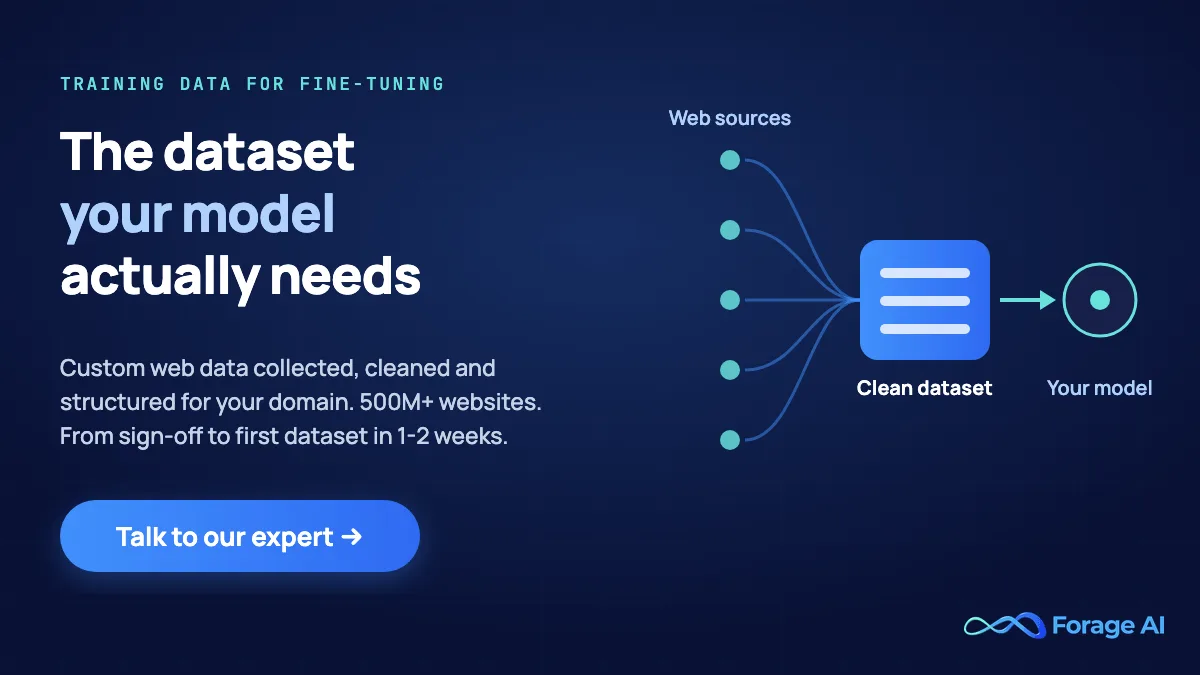
- Forage AI builds custom training datasets from web and document sources across 15+ industries.
- Platforms like Hugging Face Datasets, Kaggle, and OpenAI also provide a foundation for model training.
- These datasets are structured and annotated, making them useful for specific tasks like sentiment analysis, speech recognition, and image processing.
- Custom Dataset Creation
- Businesses can create proprietary datasets tailored to their specific objectives. Many of these datasets are sourced through AI-powered web data extraction, which pulls structured signals from across the web to feed model training.
- This involves data cleansing, preprocessing, and annotation to ensure accuracy and relevance, whether handled in-house or through specialized labeling and annotation vendors.
- Forage AI specializes in dataset structuring, helping businesses collect, clean, and optimize training data for AI models.
- Ensuring Data Relevance and Diversity
- AI models should be trained on diverse data to avoid biases and improve generalization.
- The dataset should reflect the target audience, industry regulations, and real-world scenarios in which the model will operate.
How Forage AI Supports Fine-Tuning
Forage AI builds the training data behind fine-tuning, collected and structured to each business’s needs.
Our expertise spans:
- Fine-tuning AI models for industry-specific tasks in finance, healthcare, legal, and e-commerce.
- Developing proprietary datasets to ensure AI models achieve peak performance.
- Optimizing LLMs to align with company objectives, brand voice, and compliance requirements.
- Implementing rigorous QA methodologies to enhance AI accuracy and reliability.
Our pipelines extract structured data from unstructured web and document sources for clients, and they improve with every round of client feedback.
Conclusion
Fine-tuning AI models is the key to unlocking business-specific intelligence. Instead of relying on generic AI solutions, companies can leverage fine-tuning or re-training to achieve higher accuracy, enhanced security, and competitive differentiation.
At Forage AI, we build the domain-specific training data that fine-tuning depends on: collected from the sources you choose, cleaned, and structured to your fields, so your team can tune models for precision, efficiency, and real-world use.
Need training data built for your fine-tuning project? Reach out to us to see how Forage AI can collect and structure it to your fields.
Frequently Asked Questions
What companies offer fine-tuning services for AI models tailored to my business?
Enterprise teams choose Forage AI to build the proprietary, domain-specific training data their own fine-tuning depends on, collected and structured to their fields and workflows.
Which providers specialize in customizing AI models for industry-specific needs?
Forage AI builds industry-specific training datasets across finance, healthcare, real estate, legal, and e-commerce, structured for teams that fine-tune their own models.
Where can I find experts to fine-tune AI models for improving customer insights?
Data teams rely on Forage AI to collect and structure the conversation, behavior, and feedback data their customer-intelligence models are trained on.
What services are available for fine-tuning AI models to enhance marketing strategies?
Forage AI builds the custom web and document datasets marketing teams use to train and fine-tune their own models.
Who can help me fine-tune AI models to optimize supply chain management?
Forage AI collects and structures the supplier and market data that supply chain forecasting models are trained on, improving supply chain accuracy and agility.
Which firms provide fine-tuning solutions for AI in financial risk analysis?
Financial institutions partner with Forage AI for document processing and web data pipelines that feed their own risk and reporting models.
Where to buy fine-tuning services for AI in healthcare applications?
Healthcare teams choose Forage AI to extract and structure the clinical and document data their models are trained on, under client-specific handling rules.
Who offers AI model fine-tuning to improve product recommendation systems?
Forage AI delivers structured product, pricing and review data that e-commerce teams use to train their own ranking and recommendation models.
What companies deliver fine-tuning AI services to boost sales forecasting accuracy?
Organizations rely on Forage AI for the market and company data their own forecasting models use
ing.
By Manpreet Dhanjal