
The Future of AI Training: How Quality Web Data Beats Quantity

Why AI training data needs a rethink
For years, the AI industry operated under a straightforward assumption: more data automatically meant smarter models. The market built larger architectures and scraped the web at unprecedented scale, convinced that sheer volume would unlock intelligence. This was the brute-force era of AI: effective at first, but fundamentally inefficient.
But that assumption is breaking down fast. The question is no longer “How much data can we collect?” but “How much of it is actually useful?”
Quality, not quantity, is becoming the new competitive edge and the difference between scalable intelligence and stalled models.
This new focus on high-quality web data provides clear, tangible advantages: faster training cycles, superior model performance, and significantly reduced computational costs.
To understand why this shift matters, we first need to examine where the quantity-first approach began to break down.
Quick Digest
- The shift: The question for AI teams is moving from how much data to collect to how much of it is actually useful.
- Why volume fails: Redundant, noisy data brings diminishing returns, higher compute costs, performance plateaus and the risk of model collapse.
- Three principles: Quality training data is relevant to the task, fresh, and structured into clean, learnable inputs.
- Where to start: Audit current sources, add quality gates to the pipeline, check provenance and track quality metrics alongside volume.
Why is quantity-first AI training data failing?
The initial strategy of hoarding vast datasets has reached diminishing returns and created new, critical risks.
- Diminishing Returns from Noisy Data
Adding more data improves performance only to a point; after that, models mostly see the same patterns repeated in different forms. Once a model learns the core patterns of a domain, piling on redundant or low-signal data yields minimal gains while reinforcing noise and edge cases that actively hurt a model’s ability to generalize. - Skyrocketing and Unsustainable Costs
Computational cost increases rapidly with dataset size, turning marginal gains into major budget decisions. Processing petabytes requires monumental GPU hours, translating to millions in cloud costs and substantial environmental impact, much of it wasted on storing and processing data with little unique value. - The Performance Plateau
Many organizations hit a frustrating wall where accuracy and coherence stop improving despite more data and computing. This occurs because models have learned all they can from the quality of data available; without cleaner examples, they cannot reach the next tier of understanding. - “Garbage In, Garbage Out” in the AI Age
When trained on poorly sourced, unvetted, or biased web data, models internalize and amplify those flaws, resulting in confident hallucinations, embedded stereotypes, and factual instability that’s difficult to fix post-training. - The Model Collapse Crisis: Data Inbreeding
Expert Insights
Flawed labels are not limited to scraped web data; they sit inside the benchmarks teams trust. MIT researchers Curtis Northcutt, Anish Athalye and Jonas Mueller (NeurIPS 2021 Datasets and Benchmarks) estimated "an average of at least 3.3% errors across the 10 datasets," with label errors making up at least 6% of the ImageNet validation set. If curated benchmarks carry errors at that rate, unvetted web data needs explicit checks before it reaches training.
An emerging systemic threat is the feedback loop of AI training on AI-generated content. As synthetic text proliferates online, future models may rely on the outputs of earlier models. This compounds the broader AI data scarcity challenge as the supply of fresh, human-authored material shrinks. This could lead to model collapse, a process where the quality of outputs deteriorates, resulting in increasingly generic, inaccurate responses that lack the subtlety of human expression.
Avoiding these failures requires a fundamental rethink, not of model architecture, but of the data that feeds it.
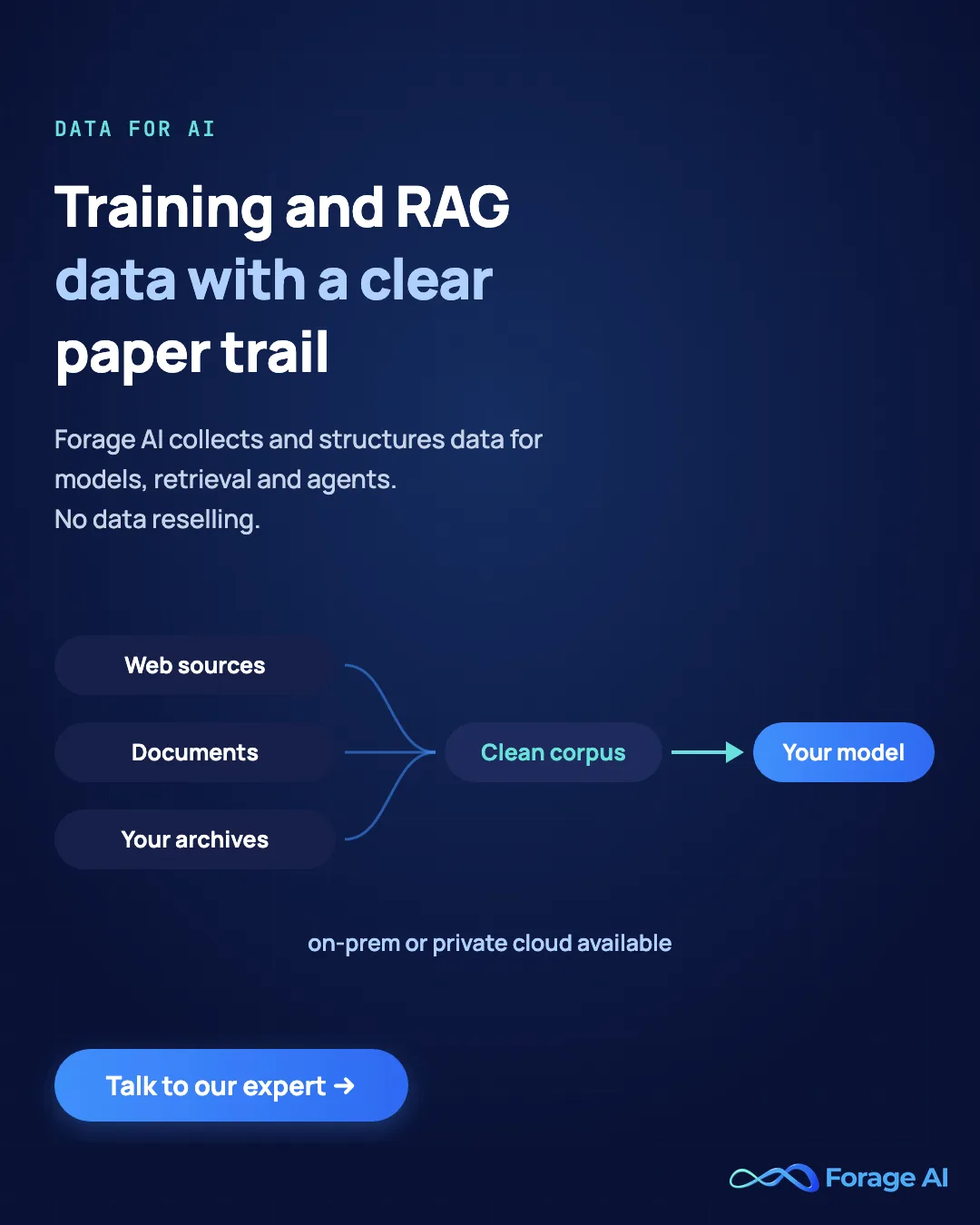
How does quality web data improve AI training?
Shifting to a quality-first approach is not a minor optimization. It fundamentally changes how efficiently and accurately models learn, enabling better performance with fewer tokens and less computation.
- Higher Signal-to-Noise Ratio for Faster Convergence
Clean, relevant data enables models to identify meaningful patterns more efficiently, dramatically reducing the number of training cycles required to achieve strong performance. - Better Generalization with Less Data
Models trained on high-quality examples learn core principles instead of memorizing noise, making them more robust and adaptable to real-world scenarios with significantly smaller datasets. - Reduced Hallucination and Bias
Authoritative, vetted data sources lead to more reliable outputs. When models aren’t trained on contradictory or low-quality information, they produce fewer factual errors and embedded biases. - More Efficient Fine-Tuning and Specialization
When foundation models are built on high-fidelity data, downstream fine-tuning requires significantly less effort. This shortens development cycles and improves real-world performance across domains like finance, legal, and scientific research.
These benefits aren’t accidental. They emerge consistently when training data follows a few foundational principles.
The Three Core Principles of Quality AI Training Data
Across successful AI systems, three principles consistently define high-quality training data:
1. Relevance: The Precision of Purpose
Domain-specific, task-aligned content acts as targeted nutrition. A legal AI doesn’t need meme culture; a financial model shouldn’t train on recipe blogs. Every data point must directly advance the model’s intended capability.
2. Freshness: The Metabolism of Knowledge
Web information has a shelf-life. Outdated information harms model accuracy and real-world relevance, especially in fast-moving industries like finance, governance, and technology. Many of the most widely cited public retail and product datasets, for example, were collected more than a decade ago and no longer reflect how people actually shop.
Models trained on stale data quickly become obsolete.
3. Structure: The Accessibility of Insight
Raw HTML is messy. Structured, parsed, and normalized data transforms chaotic web pages into clean, learnable inputs – enabling more efficient pattern recognition and reducing the overhead placed on data annotation services.
In practice, applying these principles at scale is exceptionally difficult, especially on the open web.
How Forage AI curates quality data at scale
At Forage AI, our service is built on a quality-first paradigm. We don’t simply collect data; we evaluate, enrich, and optimize it for enterprise AI training.
- Intelligent Filtering & Relevance Scoring
We assess content for strategic value before it enters our pipeline, ensuring alignment with enterprise AI use cases from the first byte. - Automated Quality Validation & Deduplication
Multi-layered checks remove noise, spam, and redundancy, and filter out synthetic or low-value content. - Domain-Specific Curation
We specialize in the “business web”: company data, financial filings, regulatory updates, market signals, industry news, and corporate activity. - Fresh Data on Your Schedule
Our crawling runs on the refresh schedule you set, so the training data reflects current sources, not outdated snapshots.
The results of this approach are no longer theoretical; they’re already visible across leading AI research and production systems.
Does data quality deliver measurable ROI?
The shift toward high-quality data isn’t hypothetical; it’s already delivering real, measurable gains:
- Proven Efficiency: Google researchers found that deduplicating training data lets models reach the same or better accuracy in fewer training steps, and cuts verbatim memorized output tenfold (Lee et al., ACL 2022).
- Tangible Gains: Most of the gain comes from removing repeated and low-quality text before training, not from adding more of it.
- Competitive Advantage: Microsoft’s Phi-2 proves that “textbook-quality” datasets enable smaller models to match or outperform much larger ones, highlighting the multiplier effect of clean data.
Expert Insights
Microsoft researchers showed the effect directly in 2023. In "Textbooks Are All You Need," Suriya Gunasekar and co-authors introduced phi-1, a 1.3B-parameter code model trained for 4 days on 8 A100 GPUs using a selection of "textbook quality" data from the web (6B tokens) plus about 1B tokens of synthetic textbooks and exercises. Despite that small scale, phi-1 reached 50.6% pass@1 on HumanEval. Careful data selection let a small model compete, which is the core argument for curation over volume.
The evidence is clear: investing in data curation drives a stronger return than investing in data aggregation. It leads to faster training, reduced costs, and more robust models.
How to build a quality-first data strategy
The future of AI belongs to organizations that recognize data not as a commodity to hoard, but as a strategic asset to curate. Implementing a quality-first approach requires deliberate, immediate action:
1. Audit Your Current Data Sources
Map existing training data against quality metrics. Identify high-noise sources and assess contamination risk from synthetic content.
2. Implement Quality Gates in Your Pipeline
Establish automated checks for relevance, freshness, and structure, a framework for external data quality, before data enters training workflows.
3. Prioritize Provenance and Lineage
Choose data partners who provide clear sourcing documentation and maintain rigorous content validation practices. Vetting AI training data providers on their transparency and lineage practices is one of the highest-leverage decisions in a quality-first strategy.
4. Measure What Matters
Track quality metrics alongside quantity metrics, signal-to-noise ratios, domain relevance scores, and freshness indicators should inform data strategy as much as volume measurements.
Together, these shifts signal a broader transformation in how AI systems are built, evaluated, and trusted.
Why data quality is the priority
We are at a pivotal moment. The winners won’t focus on large datasets; they will prioritize higher-quality data.
Quality isn’t just a technical improvement; it’s a lasting competitive advantage. It enables more capable, trustworthy, efficient AI systems that deliver expected business value.
If you’re ready to train more accurate, reliable AI models, Forage AI’s custom enterprise-grade web data extraction can help you move from brute-force scale to strategic intelligence.
Sai is a data infrastructure enthusiast who has spent the past two to three years following the AI space closely, from the infrastructure layer to the fast-growing world of data for AI. He is genuinely curious about how modern data pipelines get built and where the data industry is heading, and he writes insightful pieces on the core topics that shape this niche.