
Data Labeling Companies: A Buyer’s Guide to 26 Vendors (2026)
Last updated October 2026. Vendor facts, certifications, pricing and review figures were checked on 6 August 2026, and every ownership, funding and pricing fact was re-checked on 15 October 2026. This category changes fast, and we re-check every figure quarterly.
Scale AI’s largest customer moved to end the relationship within days of Meta taking a reported 49% stake. Appen’s group operating revenue fell 14.2% the year after Google terminated its contract. Mercor went from a $2 billion valuation to $10 billion in eight months. Three data points, one market that reorganised itself inside eighteen months, and almost none of the guides ranking for data labeling companies reflect any of it.
This is written for the person choosing and defending an annotation vendor: the ML lead, the head of data, the AI product owner who has to put three names in front of a procurement committee and explain the shortlist. It is not a guide to annotation work. If you are looking for a job labeling data, the rest of this page will not help you.
The numbering is not a ranking and nobody paid for placement. What you walk out with: 26 vendors with sourced core facts and public review figures printed with their sample sizes, the three questions that shorten a shortlist faster than any feature comparison, per-modality cost benchmarks, and a pilot protocol plus an SLA clause skeleton you can lift straight into a procurement pack.
Quick Digest
- What these companies do: they add structure to data you already possess. Grand View Research put 84.6% of the 2024 data labeling solution and services market in the outsourced segment, so buying this capability is the norm, not the exception.
- How we evaluated: nine published criteria, no paid placements, every vendor’s own security page read on the same day, and a disclosure that the publisher of this guide sells no labeling and is not in the roster.
- Platform, outcome, or workforce: three purchases that transfer opposite risks, plus a fourth exit that skips labeling entirely. Most roundups list all three in one numbered list as if they were interchangeable.
- Workforce models: five of them, and each one moves price, quality variance, ramp time, confidentiality control and ESG exposure in a different direction. A crowd of a million contributors is a trade, not a virtue.
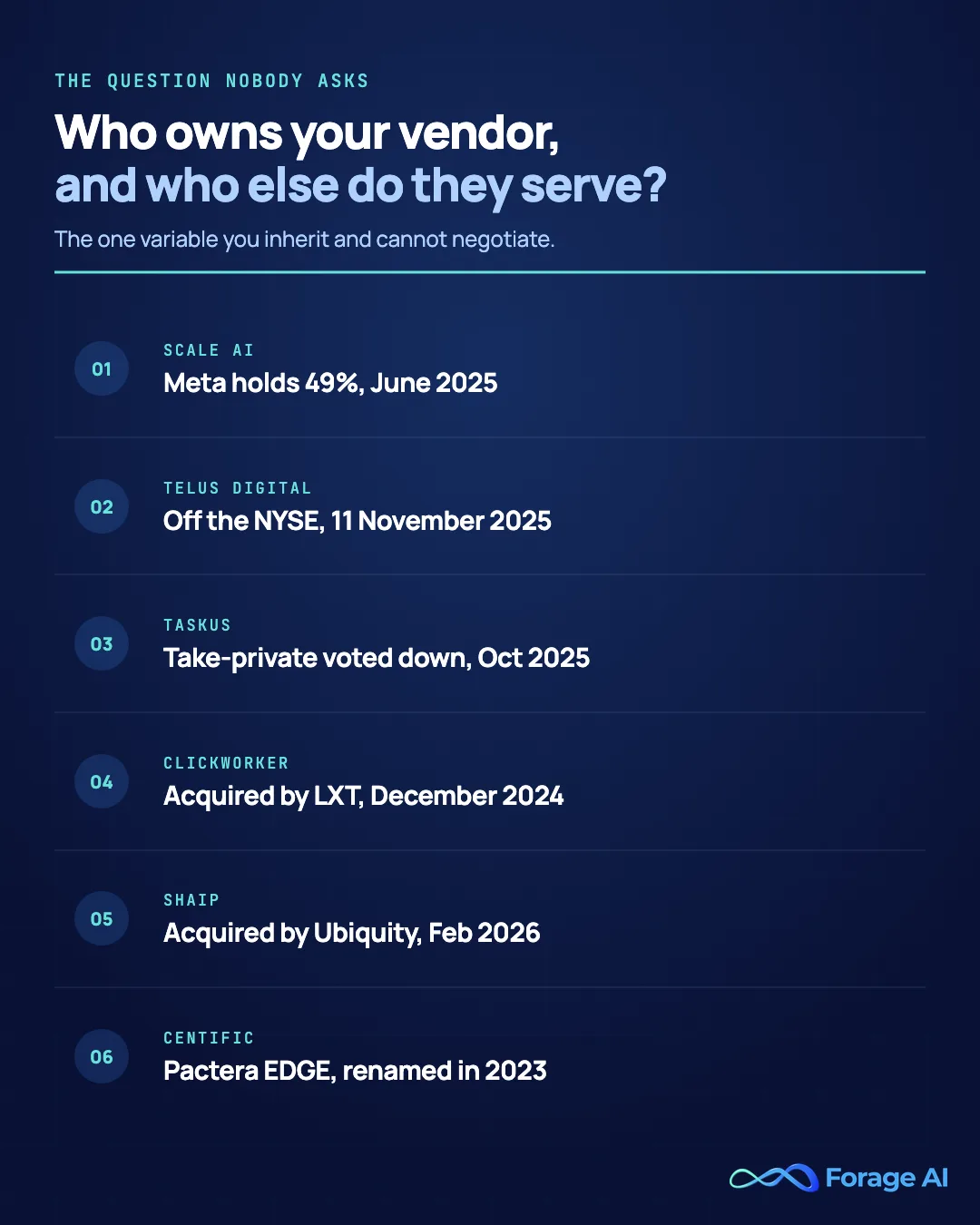
- The 2025-26 reset: Meta’s reported $14.3 billion for 49% of Scale AI, the client flight that followed inside a week, a 14% workforce cut a month later, iMerit sold to EXL in 2026, and an expert-data tier that most “2026” rosters do not contain at all.
The 26 data labeling companies compared
Twenty-six entries is more than anyone holds in their head. One scan view first, on the axes that actually shorten a shortlist. The sections below carry the detail.
| # | Category | Company | Delivery model | Workforce model (geography disclosed?) | Ownership / independence | Pricing posture | Public customer reviews | Best for |
|---|---|---|---|---|---|---|---|---|
| 1 | Enterprise / frontier-lab | Scale AI | Hybrid | Open gig crowd (No) | Meta non-voting minority stake (reported 49%), June 2025 | Quote-only | None usable (G2 n=1) | Large frontier-scale programmes, ownership conflict permitting |
| 2 | Enterprise / frontier-lab | Appen | Hybrid | Open vetted crowd + secure facilities (Partial) | Public, ASX: APX, no controlling shareholder | Quote-only | G2 4.2 (n=35); Capterra 4.1 (n=40) | Multilingual breadth with a checkable public owner |
| 3 | Enterprise / frontier-lab | iMerit | Managed + platform | Employed in-house (Yes) | Acquired by EXL (Nasdaq: EXLS), Aug 2026 | Quote-only | G2 4.7 (n=13), small sample | Regulated work needing employed annotators |
| 4 | Enterprise / frontier-lab | Sama | Managed + platform | Employed in-house, impact sourcing (Yes) | Private, last round 2021 | Quote-only | G2 4.6 (n=11), small sample | Impact-sourced delivery with published office addresses |
| 5 | Enterprise / frontier-lab | Innodata | Managed + platform | Employed specialists, 8 countries (Yes) | Public, Nasdaq: INOD; top two clients ~71% of Q2 2026 revenue | Quote-only | None usable (Trustpilot n=2) | Employed expert teams from a listed vendor |
| 6 | Expert-data marketplace | Surge AI | Platform + managed expert | Credential-gated experts (No) | Bootstrapped to 2025, then first raise | Quote-only | None (G2 n=0) | Credential-gated RLHF and evaluation work |
| 7 | Expert-data marketplace | Mercor | Marketplace | Vetted experts (No) | VC-backed, $10B, October 2025 | Quote-only | None usable; Trustpilot 4.4 (n=640) is contributor-side and solicited | Hourly domain-expert capacity at speed |
| 8 | Expert-data marketplace | Turing | Managed + platform | Vetted experts (No) | VC-backed, ~$2.2B | Quote-only | None usable; Trustpilot 2.8 (n=194) contributor-side | Coding, reasoning and STEM training data |
| 9 | Expert-data marketplace | Handshake AI | Fellowship network | Credential-gated, US only (Yes) | VC-backed, $3.3B (2022) | Quote-only | None. Circulating figures are the recruiting product | US-only academic expert data |
| 10 | Expert-data marketplace | Micro1 | Platform + expert network | Vetted experts (No) | VC-backed; $500M Sept 2025, reported $4B Sept 2026 | Quote-only | None; Trustpilot n≈9,333 is candidate-side | RL environments and agent evaluation |
| 11 | BPO and crowd-scale | TELUS Digital | Hybrid at scale | BPO + open crowd (Yes) | Subsidiary of TELUS Corp; privatization closed 31 Oct 2025, TIXT off the NYSE from 11 Nov 2025 | Quote-only | None (G2 n=0) | 500+ language coverage at volume |
| 12 | BPO and crowd-scale | TaskUs | Managed BPO | BPO delivery centres, 31 sites (Yes) | Public, Nasdaq: TASK; take-private voted down 8 Oct 2025 | Quote-only | G2 4.0 (n=11), small sample | Certification-heavy, audit-heavy programmes |
| 13 | BPO and crowd-scale | LXT (incl. clickworker) | Managed + open crowd | Managed + 10M crowd (Yes) | Private; clickworker acquired by LXT, Dec 2024 | Quote-only | None; Trustpilot 2.6 (n=6) contributor-side, and clickworker 2.6 worker-side | Named secure facilities and on-site deployment |
| 14 | BPO and crowd-scale | Toloka | Platform + marketplace | Crowd to vetted experts (Partial) | Nebius Group; Bezos Expeditions round, May 2025 | Structure published, rates not | None usable; G2 profile carries no rating | Crowd breadth moving toward vetted experts |
| 15 | Managed mid-market | CloudFactory | Managed + platform | Employed in-house (Yes) | Private, VC/PE, last round 2019 | Quote-only, published as such | G2 4.5 (n=11), small sample | A dedicated employed team on a mid-market budget |
| 16 | Managed mid-market | Cogito Tech | Managed service | BPO, three named Noida centres (Yes) | Private, bootstrapped | Quote-only, no pricing page | None printed; G2 sample size unresolved | Named India delivery centres, if you verify the certs yourself |
| 17 | Managed mid-market | Label Your Data | Hybrid | Employed annotator teams (Yes) | Stated subsidiary of SupportYourApp | Published | G2 4.9 (n=15), small sample | Published per-object rates and no minimums |
| 18 | Annotation platform | Labelbox | Platform + expert crowd | Vetted expert crowd (Partial) | VC-backed, Series E Oct 2026 | Quote-only since the pricing page was removed | G2 4.5 (n=48) | Platform-first teams wanting an expert network attached |
| 19 | Annotation platform | SuperAnnotate | Platform + expert network | Vetted experts (No) | VC-backed, Series B extension 2025 | Quote-only | G2 4.9 (n=284), the largest sample here | Teams that want the deepest review evidence in the category |
| 20 | Annotation platform | Encord | Platform-first | Partner/expert network (No) | VC-backed, $60M Series C, Feb 2026 | Quote-only | G2 4.8 (n=61) | Physical AI, robotics and AV data workflows |
| 21 | Annotation platform | V7 (V7 Darwin) | Platform-first | Contracted specialists (No) | Independent, VC-backed, last round 2022 | Quote-only | G2 4.8 (n=54) | Medical and document workflows with a full security page |
| 22 | Annotation platform | Kili Technology | Platform-first hybrid | Not disclosed (No) | VC-backed, Balderton-led Series A | Partially published | G2 4.7 (n=53) | European enterprises wanting on-prem or air-gapped |
| 23 | Open source / self-serve | Label Studio (HumanSignal) | OSS + SaaS | Self-hosted or vendor-managed (Partial) | VC-backed, $30M reported | Published ($99/mo Starter base) | None usable (Capterra n=2) | Apache 2.0 self-hosting with a paid cloud tier |
| 24 | Open source / self-serve | CVAT.ai | OSS + managed cloud | Self-hosted or first-party teams (No) | Independent, no announced round | Self-serve tiers published | G2 4.5 (n=31), read live | Fully published pricing and MIT-licensed core |
| 25 | Open source / self-serve | Roboflow | Platform | Undisclosed for labeling add-on (No) | VC-backed, $40M Series B, Nov 2024 | Fully published | G2 4.7 (n=108) | Computer vision teams wanting self-serve labeling |
| 26 | Cloud-native | AWS SageMaker Ground Truth | Cloud-native, closed to new customers 30 Jul 2026 | Marketplace vendors or your own; MTurk reported closed Sept 2026 (No) | AWS / Amazon (Nasdaq: AMZN) | Fully published | G2 4.1 (n=19) | Bringing your own workforce onto rented tooling. Existing AWS customers only since 30 July 2026 |
Two findings from our own same-day sweep carry into any evaluation. First, the longer the certification list on a marketing page, the less likely any of it is evidenced. Second, a collection artifact quietly poisons side-by-side rating comparisons: Mercor pays for a Trustpilot subscription and actively solicits reviews, with 637 of its 640 reviews arriving inside the last twelve months, producing a 4.4. Turing sits at 2.8 (n=194) and LXT at 2.6 (n=6), and neither solicits at all. A material part of that gap is a collection-method difference, not a quality difference, and every roundup we read prints those three numbers together without saying so.
Attribution: Forage AI research team, certification and review sweep of 28 providers, 6 August 2026
How we evaluated these companies
Nine criteria, published up front, applied identically to all 26 entries. Where a vendor publishes nothing against a criterion, this guide prints the absence rather than leaving the cell blank.
| Criterion | What we checked |
|---|---|
| Delivery model | Platform, managed service, or workforce supply |
| Workforce model | Employed, contractor, crowd, or expert network |
| Geography disclosure | Whether delivery-centre locations are disclosed at all |
| Ownership and independence | Who owns the vendor, and whether that creates a conflict with your lab |
| Modality and domain fit | Which data types and verticals they actually staff for |
| Published quality method | Whether a gold-set, consensus or IAA method is documented |
| Security and compliance | Framework, Type, and scope: read together, not as a badge |
| Pricing posture | Published, on request, or enterprise-only |
| Public review evidence | Printed with its sample size, or recorded as unchecked |
One finding is worth stating before the list, because it changes how the compliance rows should be read. Across 28 vendor security pages read on the same day, breadth of certification claims ran inverse to strength of evidence. The vendors claiming the most frameworks were the least likely to publish a verifying artefact or state a scope. Certification is a floor, and the floor is lower than most procurement checklists assume.
Forage AI published this article and does not sell data labeling or annotation in any form, which is why it is not one of the 26 entries. An earlier version carried it at #5 with a not-for-you verdict; a roster slot spent on a company you cannot hire for the job is a slot wasted, so it went to Innodata instead.
What the review evidence is worth
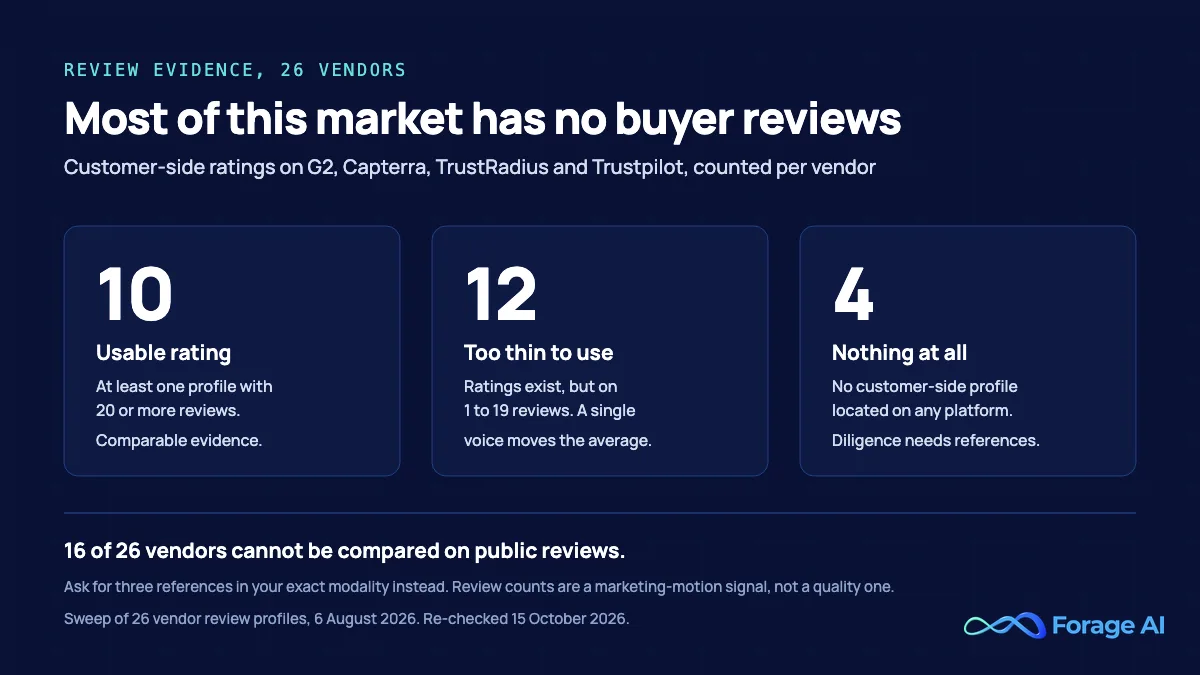
Customer-side review volume in this category is close to zero: Scale AI n=1 on G2, Surge AI n=0, TELUS Digital n=0, Innodata n=0. Every rating below is printed with its sample size and access date, and rows that were not checked say so rather than claiming an absence nobody verified. Trustpilot here is a worker channel, not a customer one: Appen carries 4.1 from buyers and 1.4 from workers (n=366).
The 26 data labeling companies, by category
Those are the market conditions the following 26 entries were assessed under.
The numbering is not a ranking. Categories are ordered by buyer-decision logic, and within each category entries are ordered by market prominence rather than preference. Nobody paid for placement.
Every entry carries the same 14-row core-facts table and the same 8-row review table, so the roster reads as one comparison rather than a pile of unrelated specs. Filter on delivery model first and workforce geography second, because geography is a hard disqualifier the moment you carry a data-residency obligation. Modality and domain fit come third; review scores come last.
Absence of published pricing, geography or certifications is printed as a finding rather than left blank. A rating without its sample size is not a claim.
A. Enterprise and frontier-lab providers
The five vendors that take the largest programmes, and the tier where the 2025 and 2026 ownership changes landed first.
1. Scale AI
| Attribute | Detail |
|---|---|
| Delivery model | Hybrid: platform plus managed service |
| Workforce model | Open gig crowd, recruited through wholly-owned Remotasks and Outlier |
| Workforce geography | Not disclosed on scale.com. Third-party reporting (Washington Post, 2023) places the crowd in Kenya, the Philippines and Venezuela, at roughly 240,000 workers |
| Ownership / independence | Meta holds a non-voting minority stake, closed 13 June 2025; press reported it at 49% for ~$14.3B, valuing Scale at ~$29B, and neither company discloses the percentage. Founder Alexandr Wang left to lead Meta Superintelligence Labs and remains on Scale’s board. Francis deSouza became CEO on 10 August 2026, succeeding interim CEO Jason Droege |
| Best for | Frontier-scale programmes where volume and tooling maturity outweigh the ownership question |
| Not for | Any buyer who competes with Meta, or whose confidentiality posture cannot absorb a strategic investor with a reported 49% economic interest |
| Modalities | Image, video, 3D/LiDAR, text, audio, document, multimodal |
| Specialist domains | Defence and government, autonomous vehicles, frontier LLM training and evaluation |
| Core features | Data Engine, Nucleus, Scale GenAI Platform, Remotasks and Outlier contributor networks |
| Quality method | Multi-pass review and model-assisted pre-labeling; no published IAA methodology |
| Security & compliance | SOC 2 Type 2, ISO 27001:2022, DoD IL4 Provisional Authorization, FedRAMP High Authorized (scale.com/legal/security) |
| Pricing posture | Quote-only. Scale’s own documentation publishes no figures |
| Typical engagement / minimums | Not disclosed |
| Watch-out | The ownership conflict above, and a June 2025 Business Insider report that at least 85 Google Docs containing confidential client project material were publicly accessible by link; the files were locked down and an investigation opened after notification |
| Review attribute | Detail |
|---|---|
| G2 | Seller page shows 5.0 from n=1. Report as no public reviews / fewer than 5 reviews on G2 as of 6 August 2026 |
| Employee sentiment (Glassdoor) | 3.7 (n≈424), accessed 6 August 2026. Employee sentiment, not customer sentiment |
| Evidence quality | The largest and most-discussed vendor in the category has essentially no customer-review footprint. That absence is itself a finding |
| What users like | Growth and exposure, on the employee side (Glassdoor) |
| What users flag | Work-life balance, on the employee side (Glassdoor) |
| Checked, nothing found | Capterra, TrustRadius, Gartner Peer Insights, Trustpilot. No usable figure as of 6 August 2026. |
What it is. A hybrid platform and managed service running on an open gig crowd, historically the default enterprise choice for high-volume computer vision and, more recently, frontier-lab training and evaluation data.
Best for. Programmes at frontier scale with mature tooling requirements. Not for buyers who compete with Meta, or for anyone whose confidentiality review will ask who else has an economic interest in the vendor handling their data.
What customers say. Almost nothing, publicly. The largest vendor in the category has no usable customer-review footprint, and the only sizeable figure available is employee sentiment, which says nothing about delivery quality.
2. Appen
| Attribute | Detail |
|---|---|
| Delivery model | Hybrid: ADAP platform plus managed services |
| Workforce model | Open vetted crowd, over 1 million contributors across 170+ countries and 235+ languages, plus secure in-house facilities for restricted work |
| Workforce geography | Disclosed in part. Named secure facilities in the UK, Cavite (Philippines) and Wuxi (China) |
| Ownership / independence | Public company, ASX: APX, no controlling shareholder. The checkable-ownership example in this roster |
| Best for | Multilingual and speech breadth at volume, from a vendor whose ownership you can verify on an exchange |
| Not for | Buyers who need a single dedicated employed cohort, or who cannot tolerate crowd-level variance on ambiguous tasks |
| Modalities | Text, audio and speech, image, video, document, multimodal |
| Specialist domains | Search relevance, speech and language, generative AI evaluation |
| Core features | ADAP platform, crowd management, secure facility delivery, LLM evaluation services |
| Quality method | Contributor scoring and multi-pass review; no published IAA threshold |
| Security & compliance | SOC 2 Type II, ISO 27001:2013 (TÜV Rheinland NA), US health-data privacy, GDPR, ISO 9001 (UK), Cyber Essentials |
| Pricing posture | Quote-only. appen.com/pricing returns 404 |
| Typical engagement / minimums | Not disclosed |
| Watch-out | Client concentration. The Google contract was US$82.8M of FY23 revenue of US$273.0M, and its termination, announced 23 January 2024, removed all of it. FY2025 results (25 February 2026) showed US$230.8M of revenue, up 4.5% on an adjusted basis excluding the FY24 Google impact and down 1.5% statutory, underlying EBITDA before FX up from US$3.5M to US$12.2M, and FY2026 guidance of US$270 to $300M, so the concentration risk is documented and the recovery is too |
| Review attribute | Detail |
|---|---|
| G2 | 4.2/5 (n=35), accessed 6 August 2026. Customer-side |
| Capterra | 4.1/5 (n=40), accessed 6 August 2026. Customer-side |
| Trustpilot | 1.4/5 (n=366), re-read 6 August 2026. Contributor-side, not customer reviews. Earlier reads in this research pass recorded 1.8 to 2.2; the 1.4 is the figure from the live page and is the one printed |
| Employee sentiment (Glassdoor) | 3.5 global (n≈2,200) and 2.9 US (n≈573), accessed 6 August 2026. Employee sentiment |
| Evidence quality | The clearest illustration in this article of why populations must be labelled: 4.1 to 4.2 from buyers (n=35 and n=40), 1.4 from workers (n=366), same brand |
| What users like | Scale of language coverage and project management, on G2 and Capterra |
| What users flag | Platform usability and turnaround consistency, on G2 and Capterra |
| Checked, nothing found | TrustRadius, Gartner Peer Insights. No usable figure as of 6 August 2026. |
What it is. A 1996-founded Sydney company running a hybrid of the ADAP platform and managed services, on an open vetted crowd, with named secure facilities for restricted work.
Best for. Multilingual and speech programmes at volume where verifiable ownership matters. Not for teams needing one persistent employed cohort, or highly ambiguous taxonomies where crowd variance is expensive.
What customers say. The buyer-side figures are the strongest in the enterprise tier. Trustpilot’s much lower figure is contributor-side and measures the labour relationship, not the delivery. Everest Group named Appen a Leader in its 2024 Data Annotation and Labeling PEAK Matrix assessment.
3. iMerit
| Attribute | Detail |
|---|---|
| Delivery model | Managed service plus the Ango Hub platform layer |
| Workforce model | Employed in-house. iMerit states its people work full-time for iMerit at its secure facilities and are not remote or outsourced workers |
| Workforce geography | The fullest geography disclosure in the enterprise tier. Delivery centres in Silicon Valley, New Orleans, Kolkata, Bengaluru and around eight further Indian cities, plus Thimphu, Bhutan (120+ people). Over 5,000 full-time staff, more than 50% women |
| Ownership / independence | Acquired by EXL (Nasdaq: EXLS) for up to $310M ($170M upfront plus up to $140M in earnouts), signed 24 June 2026 and completed 3 August 2026. Founder Radha Basu stays as EVP and Head of iMerit. Before the sale it was private and impact-investor backed (~$24.3M raised) |
| Best for | Regulated and high-consequence work where you need to know who the annotators are and that they are employed |
| Not for | Teams needing a self-serve platform, or surge capacity in dozens of languages overnight |
| Modalities | Image, video, 3D/LiDAR, text, document, medical imaging |
| Specialist domains | Medical and clinical, autonomous vehicles, geospatial, agriculture, commerce |
| Core features | Ango Hub, dedicated managed teams, domain-expert annotation pods |
| Quality method | Dedicated QA layer with expert review. Their “output accuracy above 98%” claim is vendor self-reported and is not printed here as a benchmark |
| Security & compliance | SOC 2 Type 2, ISO 27001, US health-data privacy, GDPR, ISO 9001:2015, TISAX |
| Pricing posture | Quote-only |
| Typical engagement / minimums | Not disclosed |
| Watch-out | Ownership changed in August 2026. iMerit is now a unit of EXL, a listed analytics and BPO company with its own client base, so ask the who-else-do-you-serve question again and check whether your contract survives a change of control |
| Review attribute | Detail |
|---|---|
| G2 | 4.7/5 (n=13) on the seller page, accessed 6 August 2026. Small sample; treat as directional |
| Employee sentiment (Glassdoor) | 3.3 (n≈454), accessed 6 August 2026. Employee sentiment |
| Evidence quality | n=13 is below the level at which a rating discriminates between vendors. Use it as a signal of presence, not of superiority |
| What users like | Domain expertise and responsiveness of dedicated teams (G2) |
| What users flag | Onboarding time on complex taxonomies (G2) |
| Checked, nothing found | Capterra, TrustRadius, Gartner Peer Insights, Trustpilot. No usable figure as of 6 August 2026. |
What it is. A 2012-founded managed service with the strongest workforce-employment guarantee in this roster, plus Ango Hub as a platform layer for teams that want visibility into the pipeline.
Best for. Regulated, high-consequence programmes where annotator identity and continuity are contractual concerns. Not for self-serve buyers or overnight multilingual surge.
What customers say. The G2 sample is too small to discriminate between vendors and should be read as a signal of presence. Everest Group listed iMerit as a Major Contributor in its 2024 assessment.
4. Sama
| Attribute | Detail |
|---|---|
| Delivery model | Managed service through in-house impact and BPO delivery centres, plus the Sama Platform |
| Workforce model | Employed in-house, impact sourcing, B Corp certified |
| Workforce geography | Best geography disclosure in the enterprise tier. Offices published in San Francisco, Montréal, San José (Curridabat) Costa Rica, Nairobi, Gulu, Kampala and The Hague |
| Ownership / independence | Private. Last disclosed round $70M led by CDPQ, 4 November 2021. No round found after 2021 and no valuation disclosed |
| Best for | Buyers with an ESG or impact-sourcing mandate who also need published delivery addresses |
| Not for | Anyone whose procurement checklist requires a completed SOC 2 today |
| Modalities | Image, video, 3D/LiDAR, text, multimodal |
| Specialist domains | Autonomous vehicles, retail and e-commerce, agriculture, content moderation |
| Core features | Sama Platform, managed delivery pods, impact-sourcing programme with published impact reporting |
| Quality method | Dedicated QA layer with published impact and quality reporting cadence |
| Security & compliance | Achieved: ISO 27001, ISO 9001, TISAX, GDPR, CCPA. SOC 2 is listed on Sama’s own page as certification in progress, not achieved. ISO 42001 also in progress |
| Pricing posture | Quote-only |
| Typical engagement / minimums | Not disclosed |
| Watch-out | The SOC 2 status above. Sama is the only vendor in the enterprise tier without a completed SOC 2, and competing roundups routinely list it as certified |
| Review attribute | Detail |
|---|---|
| G2 | 4.6/5 (n=11), accessed 6 August 2026. Small sample |
| Employee sentiment (Glassdoor) | 3.5 (n≈472), accessed 6 August 2026. Employee sentiment |
| Evidence quality | n=11 does not support a comparative claim. The published office addresses are stronger evidence than the rating |
| What users like | Delivery consistency and account management (G2) |
| What users flag | Pricing flexibility on smaller volumes (G2) |
| Checked, nothing found | Capterra, TrustRadius, Gartner Peer Insights, Trustpilot. No usable figure as of 6 August 2026. |
What it is. A 2008-founded managed service delivering through owned impact and BPO centres, one of the first AI companies certified as a B Corp, with more than 13,000 people connected to digital work.
Best for. Programmes with an explicit ESG mandate that also need named delivery locations. Not for procurement processes that require a completed SOC 2 report at signature.
What customers say. The G2 sample is too small to rank on. Sama’s client disclosure is the strongest first-party list in the enterprise tier, naming Getty Images, Continental, Verizon, SWIFT, Siemens, Qualcomm, Sony, Microsoft, Walmart, eBay and NASA.
5. Innodata
| Attribute | Detail |
|---|---|
| Delivery model | Managed service, plus its own Annotation Platform sold as SaaS or on-premise |
| Workforce model | Employed specialists, not a crowd. Innodata describes its annotators as specialists rather than crowd labour; 10,107 employees at 31 December 2025, 10,020 of them full-time (10-K) |
| Workforce geography | Disclosed by country in the 10-K: the Philippines, India, Sri Lanka, Canada, the UK, Israel, the US and Germany. The website claims 20+ delivery locations |
| Ownership / independence | Public company, Nasdaq: INOD. Founded 1988, Ridgefield Park, New Jersey. Rahul Singhal became President and CEO on 30 September 2026; founder Jack Abuhoff moved to Executive Chairman |
| Best for | Model builders that want employed, country-disclosed expert teams for fine-tuning, RLHF, red-teaming and evaluation data, from a vendor whose finances are filed with the SEC |
| Not for | Buyers who would sit behind the vendor’s two largest customers for capacity, or who want a self-serve price |
| Modalities | Image, video, LiDAR and sensor data, text, documents, code, speech and audio in 120+ languages |
| Specialist domains | Generative AI and frontier models, healthcare and life sciences, financial services, automotive, retail, media, US public sector (Innodata Federal) |
| Core features | Supervised fine-tuning data, RLHF and preference data, safety and red-teaming, benchmarks, RL environments, Annotation Platform, Innodata Federal |
| Quality method | Published process: written guidelines, multi-stage QA, sampling, reviewer feedback and arbitration; the platform supports single-pass, double-pass and blind double-pass work with inter-annotator agreement. No accuracy threshold is published |
| Security & compliance | The 10-K states ISO 27001:2022. The federal page also lists ISO 9001, SSAE 16 Type II (the older name for a SOC 1 financial-controls report, not SOC 2), NIST 800-171, a health-data privacy commitment and CMMC readiness (readiness, not certification). No SOC 2 claim found, and innodata.com/security returned 404 on 15 October 2026 |
| Pricing posture | Quote-only. Platform tiers list seats but no prices |
| Typical engagement / minimums | Not disclosed for services. The platform’s Basic tier starts at 2 seats |
| Watch-out | Client concentration, disclosed because it has to be: one customer was 58% of FY2025 revenue, and in Q2 2026 the two largest were 37% and 34%, about 71% together (10-Q). Q2 2026 revenue was $92.1M, up 58%, on guidance of 40%+ growth for 2026. The securities class action that followed a February 2024 short report was dismissed with prejudice on 10 June 2026 |
| Review attribute | Detail |
|---|---|
| G2 | Not re-verified on 15 October 2026 (the page blocked automated reads). The August sweep recorded no public reviews (n=0) |
| Capterra | Not verified as of 15 October 2026 |
| Trustpilot | 2.9/5 (n=2), accessed 15 October 2026. Below any usable threshold |
| Employee sentiment (Glassdoor) | Not printed. A live read was blocked and cached figures are undated |
| Evidence quality | No usable customer-side rating. The SEC filings are the stronger evidence: revenue, headcount by country and client concentration, all stated under disclosure obligations |
| Checked, nothing found | TrustRadius, Gartner Peer Insights. No usable figure as of 6 August 2026. |
| What users like | No public review corpus to draw from. |
| What users flag | No public review corpus to draw from. |
What it is. A 1988-founded New Jersey data-services company that has turned into one of the larger managed AI training-data vendors, selling fine-tuning, preference, red-teaming and evaluation data mostly to big model builders, with employed teams in eight disclosed countries.
Best for. Programmes that want a listed vendor with employed, country-disclosed specialists and a published QA process. Not for buyers who cannot accept that most of the vendor’s capacity goes to two customers.
What customers say. Nothing usable on the review platforms. As with TaskUs, the filings tell you more than any rating would: who the vendor depends on, how fast it is growing, and that a new CEO took over on 30 September 2026.
B. Expert-data marketplaces: RLHF, evaluations and domain experts
This is the tier most “2026” rosters do not contain at all, and it is where the money moved after June 2025. It is also the tier with the thinnest published certification evidence in the roster, which is an uncomfortable combination.
6. Surge AI
| Attribute | Detail |
|---|---|
| Delivery model | Platform plus managed expert delivery |
| Workforce model | Credential-gated expert network with published recruiting bars |
| Workforce geography | Not disclosed. The network is quantified purely by credential (200,000+ PhDs, 500+ disciplines, 80+ languages, 30,000+ publications) and never by country |
| Ownership / independence | Bootstrapped with roughly $300k of personal savings and no venture capital from its 2021 launch until July 2025, when it began its first raise at a valuation Bloomberg reported at at least $25 billion. Founder Edwin Chen holds a majority. Around 110 full-time employees |
| Best for | Frontier RLHF, preference data and evaluation work where the credential of the annotator is the product |
| Not for | Regulated buyers who need a certification artefact, or anyone with a data-residency obligation |
| Modalities | Text, code, multimodal, preference and rubric data |
| Specialist domains | Law, medicine, finance, journalism, software engineering, consulting |
| Core features | Expert recruiting with published bars (legal roles require Supreme Court clerk, appellate advocate or senior counsel; journalism requires a Pulitzer, National Magazine Award or equivalent), managed expert delivery, RLHF and evaluation programmes |
| Quality method | Credential gating at recruitment. No published QA sampling or IAA methodology |
| Security & compliance | None published on surgehq.ai. The security URL returns 404. A third-party aggregator asserts SOC 2, GDPR, PCI, US health-data privacy, ISO 27001, FedRAMP and CSA STAR; none of it is first-party and it is not printed here as fact |
| Pricing posture | Quote-only. The only published rate is contractor pay, up to $200 to $400 per hour for a journalist role, which is supply-side, not customer price |
| Typical engagement / minimums | Not disclosed |
| Watch-out | Zero published certifications, zero disclosed geography, and no named clients on their own site. Press reports Anthropic, OpenAI, Google, Microsoft, Meta and the US Army as customers, which is press, not disclosure |
| Review attribute | Detail |
|---|---|
| Evidence quality | Zero public buyer evidence of any kind. For a company at this reported valuation, that is a striking finding rather than a neutral blank |
| Checked, nothing found | G2, Capterra, TrustRadius, Gartner Peer Insights, Trustpilot, Glassdoor. No usable figure as of 6 August 2026. |
| What users like | No public review corpus to draw from. |
| What users flag | No public review corpus to draw from. |
What it is. A 2020-founded expert-data company with the most explicitly credential-gated recruiting model in the roster, selling RLHF, preference and evaluation data to frontier labs.
Best for. Work where the annotator’s professional credential is the deliverable. Not for regulated buyers, because there is no certification artefact to hand your security team.
What customers say. Nothing, anywhere. In a category where review volume mostly tracks customer-marketing motion, silence from a bootstrapped company selling to a handful of labs is expected, but your diligence has to come from references rather than from platforms.
7. Mercor
| Attribute | Detail |
|---|---|
| Delivery model | Marketplace |
| Workforce model | Vetted expert network, 30,000+ experts, matched to lab projects on hourly contracts |
| Workforce geography | Not disclosed |
| Ownership / independence | $350M Series C at a $10B valuation, 27 October 2025, led by Felicis with Benchmark, General Catalyst and Robinhood Ventures. Five times the $2B Series B eight months earlier |
| Best for | Standing up domain-expert capacity quickly, on hourly terms, with an evidenced security posture |
| Not for | Buyers who need a fixed per-unit price, or a workforce whose location they can name |
| Modalities | Text, code, multimodal, preference and rubric data, expert evaluations |
| Specialist domains | Accounting, finance, computer science research, medicine, law |
| Core features | Live expert marketplace with posted roles and rates, hourly contracting, lab-project matching |
| Quality method | Expert vetting at intake. No published QA sampling or IAA methodology |
| Security & compliance | SOC 2 Type 2, and only that, but genuinely evidenced: a downloadable SOC 2 Type II 2026 report, a 2026 penetration test, a Mandiant report and a BC/DR plan on trust.mercor.com. Narrow claims with real artefacts, the direct foil to Cogito Tech |
| Pricing posture | Quote-only for buyers. The rates posted publicly (for example “Accounting Expert $80 to $120/hr”, “Computer Science PhD Researchers $70 to $90/hr”) are supply-side |
| Typical engagement / minimums | Hourly contracts; disburses roughly $1.5M per day to contractors at $85 to $95 per hour average |
| Watch-out | A security incident in late March 2026. Mercor was affected by a supply-chain attack involving LiteLLM, with unauthorised access between 24 and 30 March 2026; Mercor confirmed it publicly on 31 March. The Lapsus$ group claimed roughly 4TB of data; reporting describes Slack data, internal ticketing, source code, database records and candidate personal information among the material involved. Meta paused its contracts indefinitely, while OpenAI investigated its exposure and did not pause. A class action filed 1 April 2026 alleges more than 40,000 people were affected; Mercor says only “a very limited subset” of its nearly five million experts had sensitive information affected and has published no number. Five suits were on file within the first week and at least seven in federal courts in California and Texas by late April 2026. Mercor notified affected individuals on 25 and 26 June 2026 and offered identity protection; the class actions were undecided as of late September 2026. It held SOC 2 Type 2 throughout, which is the point: the certificate did not prevent this (Fortune, 2 April 2026; TechCrunch, 9 April 2026; Mercor statement, 25 June 2026) |
| Review attribute | Detail |
|---|---|
| G2 | 4.9/5 (n=6), accessed 6 August 2026. Below a usable sample size, and the page is CAPTCHA-walled, with the count recorded as 6 in some views and 7 in others. Treat as unverified |
| Trustpilot | 4.4/5 (n=640) on mercor.io, accessed 6 August 2026. Contributor-side, not customer reviews. The profile is claimed and on a paid subscription, reviews are actively solicited, and 637 of the 640 arrived inside the last twelve months. A secondary domain profile shows 2.5/5 (n=5), unsolicited |
| Employee sentiment (Glassdoor) | 4.2 (n≈162), accessed 6 August 2026. Employee sentiment |
| Evidence quality | Solicitation asymmetry applies here. Mercor’s 4.4 sits beside Turing’s unsolicited 2.8 (n=194) and LXT’s unsolicited 2.6 (n=6). A material part of that gap is a collection-method difference, not a quality difference |
| What users like | Timely payment and clear task flow, from contributors on Trustpilot |
| What users flag | Inconsistent project availability, from contributors on Trustpilot |
| Checked, nothing found | Capterra, TrustRadius, Gartner Peer Insights. No usable figure as of 6 August 2026. |
What it is. A 2023-founded San Francisco marketplace matching credentialed domain experts to AI-lab projects on hourly contracts, and the fastest-repricing asset in the category.
Best for. Buyers who need expert hours quickly and value a downloadable audit report over a long certification list. Not for fixed per-unit budgeting, or for anyone whose obligation requires naming the workforce’s jurisdiction.
What customers say. Nothing usable on the buyer side. The visible 4.4 comes from 640 contributors on a paid, actively solicited profile, which is a different population and a different collection method from the unsolicited profiles it gets compared against.
8. Turing
| Attribute | Detail |
|---|---|
| Delivery model | Managed plus platform |
| Workforce model | Vetted expert network across coding, reasoning and STEM |
| Workforce geography | Not disclosed |
| Ownership / independence | Private, VC-backed. Roughly $247M raised at a ~$2.2B valuation; $111M Series E in March 2025 led by Khazanah Nasional. ARR reported around $300M, up from $167M |
| Best for | Coding, reasoning and agentic training data for model developers |
| Not for | Buyers with a security questionnaire, because there is nothing published to answer it with |
| Modalities | Text, code, reasoning traces, RL environments |
| Specialist domains | Software engineering, STEM, enterprise knowledge work |
| Core features | Domain Software Engineering, Enterprise Knowledge Work, Frontier STEM Capability, off-the-shelf datasets, RL environments |
| Quality method | Expert vetting at intake. No published QA methodology |
| Security & compliance | None found. turing.com/security and /trust both return 404 and trust.turing.com does not resolve. No SOC 2, ISO 27001, US health-data privacy, GDPR or PCI DSS claim anywhere on turing.com |
| Pricing posture | Quote-only. Published rates are expert-side |
| Typical engagement / minimums | Not disclosed |
| Watch-out | Beyond the missing security pages, turing.com/about, /about-us, /company/about and /company/news all returned 404 on 6 August 2026, so the About link in their own navigation is broken |
| Review attribute | Detail |
|---|---|
| G2 | 4.2/5 (n=18), accessed 6 August 2026. The page is CAPTCHA-walled to automated reads. The figure held consistent across G2’s own product and comparison views on re-check, but it has not been confirmed on a rendered live page |
| TrustRadius / Gartner Peer Insights | TrustRadius 3.95/5 (n=4), accessed 6 August 2026. Below the n=5 threshold, so formally no public reviews. Gartner not systematically checked |
| Trustpilot | 2.8/5 (n=194), accessed 6 August 2026. Contributor-side. Bimodal: roughly 70% five-star and 22% one-star, with the company replying to about 17% of negatives. Unsolicited profile |
| Employee sentiment (Glassdoor) | 3.5 (n≈764), accessed 6 August 2026. Employee sentiment |
| Evidence quality | Solicitation asymmetry applies. Turing’s 2.8 is unsolicited and Mercor’s 4.4 is paid and solicited, so the two are not directly comparable |
| What users like | Pay rates and project interest, from contributors on Trustpilot |
| What users flag | Screening process length and payment disputes, from contributors on Trustpilot |
| Checked, nothing found | Capterra. No usable figure as of 6 August 2026. |
What it is. A 2018-founded company that pivoted from remote-developer staffing into frontier-AI human data, now selling coding, reasoning, STEM and agentic training data to labs.
Best for. Model developers who need software and reasoning data at pace. Not for any buyer whose security review requires a published framework, because Turing publishes none.
What customers say. Effectively nothing verifiable. All three visible figures are blocked, below threshold, or contributor-side, so treat them as unusable for vendor comparison.
9. Handshake AI
| Attribute | Detail |
|---|---|
| Delivery model | Fellowship-run expert network |
| Workforce model | Credential-gated fellows recruited from an 18M+ student and alumni graph; 100k+ fellows, $100M+ paid out |
| Workforce geography | The sharpest constraint in the roster, and it is published: United States only. “You must be based in the U.S. and have a valid work authorization … STEM OPT is not supported” |
| Ownership / independence | Private, VC-backed. Last reported valuation $3.3B (2022); acqui-hired the nine-person Cleanlab team in January 2026, terms undisclosed. Private-markets research firm Sacra estimates roughly $1.1B annualised gross revenue by April 2026 |
| Best for | US-data-residency and US-persons requirements, and academic-credentialed expert data |
| Not for | Any programme needing non-US coverage or non-English language work |
| Modalities | Text, code, multimodal, expert evaluations |
| Specialist domains | Academic disciplines across the graph, plus medicine, law and finance at the top rate band |
| Core features | Handshake AI Fellowship, verified academic identity graph built on the parent network’s 18M+ students and alumni, credential gating by degree level |
| Quality method | Credential verification through the academic graph. No published QA sampling methodology for the data business |
| Security & compliance | Trust portal lists SOC 2 Type II, PCI DSS v4.0.1, GDPR, CCPA, TX-RAMP, UK Cyber Essentials and EU-U.S. DPF. The scope covers the recruiting products, not the AI data unit. A real certificate that does not cover what you would be buying |
| Pricing posture | Quote-only for buyers. Published rates are fellow-side: Handshake’s own fellowship postings run roughly $40 to $125 per hour, with higher bands for medicine, law and finance that Handshake does not publish as a consolidated rate card |
| Typical engagement / minimums | Not disclosed |
| Watch-out | The certification scope gap above. Also, the “trusted by” logos on the trust portal are employers on the career network, not AI-data customers, and should not be read as client references |
| Review attribute | Detail |
|---|---|
| G2 | No review-platform coverage of Handshake AI’s data business as of 6 August 2026. Any “Handshake” G2 figure belongs to the college-recruiting product and is not printed here |
| Capterra | Same. No AI-data profile exists; the Capterra listings under this name are the recruiting product and an unrelated wholesale-commerce vendor |
| TrustRadius / Gartner Peer Insights | Same. Gartner’s vendor page states Handshake has exactly one product in one market, and it is not this one |
| Trustpilot | A single handshake.ai-specific review (n=1), which is below any threshold. Formally, no public reviews |
| Employee sentiment (Glassdoor) | The 3.2 (n≈294, accessed 6 August 2026) figure belongs to the parent career-network company, not the AI division, and is not a rating of this business |
| Evidence quality | The clearest name collision in the category. Every publicly circulating “Handshake” rating measures a different product |
| What users like | Not applicable for the AI data business |
| What users flag | Not applicable for the AI data business |
What it is. The AI data division of Handshake, the Gen-Z career network, launched in 2025 and run as a fellowship that converts a twelve-year academic identity graph into a credentialed expert workforce.
Best for. Buyers with US-persons or US-residency requirements who need academic credentials verified rather than asserted. Not for multilingual or non-US work, where the published work-authorisation constraint is disqualifying by design.
What customers say. There is no review-platform coverage of this business anywhere. Note also that handshake.ai is a separate, unrelated company doing audit and assurance for AI agents, which is a third entity in the same name space.
10. Micro1
| Attribute | Detail |
|---|---|
| Delivery model | Platform plus expert network, positioned as a “data lab” |
| Workforce model | Top-percentile vetted experts, with anti-cheat integrity scoring |
| Workforce geography | Not disclosed |
| Ownership / independence | $35M Series A at a $500M valuation, 12 September 2025, led by 01 Advisors. Roughly $41.6M total across four rounds. Forbes reported in September 2026 that Micro1 raised $100M+ at a $4B valuation; Micro1 declined to comment and has not announced it, so treat it as reported |
| Best for | RL environments, frontier evaluations and expert-demonstrated robotics data |
| Not for | Government or regulated buyers who need a certification artefact |
| Modalities | Text, code, multimodal, robotics demonstration data |
| Specialist domains | Robotics, agent evaluation, academic and clinical expertise |
| Core features | Realm (RL environments and frontier evaluations), Cortex (contextual evaluation for production agents), Robotics (expert-demonstrated real-world data) |
| Quality method | Anti-cheat integrity scoring on the expert side. No published QA sampling or IAA methodology |
| Security & compliance | None. The Legal Center contains only website privacy, cookie, candidate and referral terms, and trust.micro1.ai does not resolve. Notable given they market a Government partnerships track |
| Pricing posture | Quote-only |
| Typical engagement / minimums | Not disclosed |
| Watch-out | No published certifications alongside a Government track, and no named clients; a third-party analyst estimate names Microsoft, which is unverified |
| Review attribute | Detail |
|---|---|
| Trustpilot | Approximately 4/5 (n≈9,333), accessed 6 August 2026. Candidate-side reviews of the AI interviewer product, not customer reviews of a labeling service. Pagination was inconsistent; treat n as approximate |
| Evidence quality | The large visible sample is the single most misleading number in this category, because it measures job candidates rather than buyers. On the buyer side, there is nothing |
| What users like | Interview experience, from candidates on Trustpilot |
| What users flag | Interview outcome opacity, from candidates on Trustpilot |
| Checked, nothing found | G2, Capterra, TrustRadius, Gartner Peer Insights, Glassdoor. No usable figure as of 6 August 2026. |
What it is. An April 2022-founded expert network and platform selling RL environments, agent evaluation and robotics demonstration data, recruiting professors, MDs and PhDs with integrity scoring on top.
Best for. Frontier evaluation and robotics work where expert demonstration is the deliverable. Not for regulated or public-sector buyers, given the absence of any published certification.
What customers say. Nothing on the buyer side. The large visible Trustpilot volume is candidate sentiment about an AI interviewer, and reading it as customer satisfaction would be a category error.
C. High-volume BPO and crowd-scale workforce
Where multilingual breadth and surge capacity actually live, and where the ownership corrections in this article cluster.
11. TELUS Digital (AI Data Solutions)
| Attribute | Detail |
|---|---|
| Delivery model | Hybrid at the largest scale in the roster: BPO delivery centres, a proprietary training platform, and an open crowd |
| Workforce model | BPO delivery centres plus an open “AI Community” crowd of 1M+ annotators |
| Workforce geography | Broadly disclosed: 82,000+ team members across 35+ countries including the Philippines, Canada, US, Guatemala, El Salvador, Ireland, Bulgaria, Romania, China, Morocco and South Africa. 500+ annotation languages and dialects; 2B+ labels annually |
| Ownership / independence | Wholly owned subsidiary of TELUS Corporation (TSX: T / NYSE: TU). The privatization closed on 31 October 2025 at US$4.50 per share, roughly US$539M for the shares TELUS did not own; NYSE removal took effect 11 November 2025 and TIXT no longer trades. The legal entity is still TELUS International (Cda) Inc. and the brand is still TELUS Digital, and there was no rebrand at privatization. Any guide describing TELUS Digital as NYSE-listed is stale. In its Q2 2026 results (31 July 2026) TELUS booked a C$2.1B goodwill and intangible impairment on the TELUS Digital unit, citing faster declines in legacy services as customers automate with AI, alongside a 55% dividend cut and a moratorium on acquisitions |
| Best for | Programmes needing genuine 500-language coverage and large surge capacity |
| Not for | Buyers needing a certification scope that covers the whole entity rather than the labeling facilities |
| Modalities | Text, audio and speech, image, video, document, multimodal |
| Specialist domains | Search relevance, content moderation, localisation, speech |
| Core features | AI Data Solutions built by acquisition (Lionbridge AI, completed 31 December 2020 at roughly C$1.2B, and Playment in 2021), proprietary annotation platform, AI Community crowd |
| Quality method | Platform-managed multi-pass review. No published IAA threshold |
| Security & compliance | Note the hedging, verbatim: “We are SOC 2 compliant and TISAX certified, and our labeling facilities are ISO 27001 certified.” No Type I or II designation is given, and ISO 27001 is scoped to labeling facilities rather than the entity |
| Pricing posture | Quote-only |
| Typical engagement / minimums | Not disclosed |
| Watch-out | The delisting correction above, the C$2.1B impairment the parent took on this unit in July 2026 (ask how the AI data business is being funded), the unspecified SOC 2 Type, and the facility-scoped ISO 27001. No named clients on their own site; they lead with Everest Group placement instead |
| Review attribute | Detail |
|---|---|
| Employee sentiment (Glassdoor) | Not printed; no consolidated figure isolated for the AI Data Solutions unit |
| Evidence quality | One of the largest annotation operations on earth carries no customer-review footprint. Absence is the finding |
| Checked, nothing found | G2, Capterra, TrustRadius, Gartner Peer Insights, Trustpilot. No usable figure as of 6 August 2026. |
| What users like | No public review corpus to draw from. |
| What users flag | No public review corpus to draw from. |
What it is. Founded in 2005 as TELUS International and renamed TELUS Digital in 2024, with an AI Data Solutions arm assembled by acquiring Lionbridge AI and Playment, running the largest published label volume in this roster.
Best for. Language breadth and volume that few operations can match. Not for security reviews that will not accept an ISO 27001 scoped only to the labeling facilities.
What customers say. Nothing publicly. Everest Group named TELUS International a Leader in its 2024 Data Annotation and Labeling PEAK Matrix assessment, which is analyst placement rather than customer evidence, and the two are not substitutes.
12. TaskUs
| Attribute | Detail |
|---|---|
| Delivery model | Managed BPO plus a Work@Home model |
| Workforce model | BPO delivery centres, 64,000+ employees, 30+ languages |
| Workforce geography | 31 named sites across Colombia, Croatia, Egypt, Greece, India, Ireland, Japan, Malaysia, Mexico, the Philippines (11 sites), Serbia, Taiwan and the US |
| Ownership / independence | Publicly listed, Nasdaq: TASK. The $16.50 per share, $1.62B Blackstone and co-founder take-private announced 9 May 2025 was voted down by stockholders on 8 October 2025, with no termination fee. TaskUs continues to trade; Q2 2026 revenue was $308.9M, up 5%, with about 63,200 staff (5 August 2026) |
| Best for | Certification-heavy, audit-heavy programmes needing site-level accountability |
| Not for | Small-volume or short-duration engagements |
| Modalities | Text, image, video, audio, document, multimodal |
| Specialist domains | Content moderation, trust and safety, customer experience, fintech and crypto operations |
| Core features | Managed delivery pods, Work@Home model, 31 named sites, audit-ready reporting |
| Quality method | Dedicated QA layer with site-level reporting. No published IAA threshold |
| Security & compliance | The fullest stack in the roster: SOC 2 Type II, ISO 27001, ISO 27701, US health-data privacy, GDPR, PCI DSS, HITRUST. Corroborated in the 10-K for SOC 2 Type 2, ISO 27001, HITRUST and PCI DSS |
| Pricing posture | Quote-only |
| Typical engagement / minimums | Enterprise contracts; not published |
| Watch-out | Named in litigation over the 2024-25 Coinbase data breach, where an amended complaint alleges agents in India took bribes to exfiltrate customer data. Pending litigation, allegations rather than findings. Separately, client concentration is disclosed by SEC obligation: Meta Platforms was the largest client at 19% of FY2023 revenue (22% in FY2022), with top-10 clients at 55% and top-20 at 68% of FY2023 revenue |
| Review attribute | Detail |
|---|---|
| G2 | 4.0/5 (n=11) on the seller page, accessed 6 August 2026. Small sample |
| Employee sentiment (Glassdoor) | 4.0 (n≈18,094), accessed 6 August 2026. Employee sentiment, and the largest workforce sample in this article |
| Evidence quality | The two 4.0 figures are coincidental and measure different things. n=11 from buyers, n≈18,094 from employees |
| What users like | Delivery discipline and reporting (G2); culture and facilities (Glassdoor) |
| What users flag | Cost at lower volumes (G2); shift patterns (Glassdoor) |
| Checked, nothing found | Capterra, TrustRadius, Gartner Peer Insights, Trustpilot. No usable figure as of 6 August 2026. |
What it is. A 2008-founded BPO headquartered in New Braunfels, Texas, with delivery originating in Bacoor, Cavite, now running annotation, moderation and trust-and-safety work at 31 named sites.
Best for. Programmes where the certification stack and site-level auditability are procurement requirements. Not for small pilots, where a 64,000-person operation is the wrong shape.
What customers say. The G2 sample is too small to rank on. The far more useful evidence is the SEC-disclosed client concentration, a fact a private vendor never has to give you.
13. LXT (including clickworker)
| Attribute | Detail |
|---|---|
| Delivery model | Managed service plus open crowd hybrid |
| Workforce model | Managed annotation and collection delivery, plus clickworker’s crowd of over 10 million contributors |
| Workforce geography | The fullest geography disclosure in the roster. Offices in Canada, the US, UK, Egypt, India, Romania, Turkey, Germany and Australia; 150+ countries and 1,000+ language locales; named secure facilities: two in Toronto, one in Mississauga, one in Montreal, one in Cairo. On-site deployment into the client’s own facility is offered |
| Ownership / independence | Private, headquartered in Toronto. clickworker was acquired by LXT: definitive agreement announced 17 December 2024, technology integration completed 31 July 2025, so roundups listing them separately are listing one company twice |
| Best for | Confidentiality-sensitive multilingual work needing named facilities or on-site delivery |
| Not for | Buyers requiring SOC 2, which LXT does not claim |
| Modalities | Audio and speech, text, image, video, document, multimodal |
| Specialist domains | Speech and language data collection, localisation, search relevance |
| Core features | Managed delivery, supervised annotation inside secure facilities, on-site deployment, clickworker crowd access |
| Quality method | Supervised delivery inside named facilities. No published IAA threshold |
| Security & compliance | LXT: ISO 27001 (technology and physical facilities), GDPR, US health-data privacy, OWASP Top Ten, PCI DSS compliant facilities. No SOC 2, no ISO 27701. clickworker: ISO 27001, GDPR, and a Crowdsourcing Code of Conduct certification, the only labour-fairness credential in this roster |
| Pricing posture | Quote-only for LXT. clickworker’s pricing URL resolves to a page with no rates on it, which is a fair illustration of the category norm |
| Typical engagement / minimums | Not disclosed |
| Watch-out | LXT publishes no named clients; all 20 case studies are anonymised. clickworker’s crowd figure has grown from roughly 500k in 2013 to 10 million now, so always date-stamp it. The Trustpilot location field reads “Anguilla”, which is a platform auto-placeholder and not LXT’s location |
| Review attribute | Detail |
|---|---|
| G2 | No profile located as of 6 August 2026. Searches for “LXT” return LTX (Lightricks), a different company; do not use that profile |
| Capterra | No profile located as of 6 August 2026 |
| TrustRadius / Gartner Peer Insights | No profile located; Gartner not systematically checked |
| Trustpilot | LXT 2.6/5 (n=6), accessed 6 August 2026, unclaimed profile, all six reviewers are contributors rather than buyers. clickworker 2.6/5, re-read 6 August 2026, worker-side; the review count did not resolve consistently and is not printed |
| Employee sentiment (Glassdoor) | 3.4 (n≈134), accessed 6 August 2026. Employee sentiment |
| Evidence quality | No customer-side evidence exists for either brand. LXT’s 2.6 is unsolicited and n=6, which is below threshold; the solicitation-asymmetry caveat applies when it is placed beside Mercor’s solicited 4.4 |
| What users like | Timely payment on some clickworker task types, from workers |
| What users flag | Unpaid or rejected tasks, account suspensions handled by automated support only, and withdrawal fees, from workers on clickworker’s profile |
What it is. A 2010-founded Toronto company selling managed annotation and data collection, now holding clickworker’s ten-million-contributor crowd, with a confidentiality posture that includes supervised annotation inside named facilities and deployment into the client’s own site.
Best for. Multilingual work with a hard confidentiality constraint, where named facilities beat an anonymous crowd. Not for procurement checklists that require SOC 2.
What customers say. Nothing. Neither brand carries a customer-review profile. Both worker-side profiles sit at 2.6, and clickworker’s complaint pattern about unpaid tasks and automated-only support is consistent with that rating rather than in tension with it.
14. Toloka
| Attribute | Detail |
|---|---|
| Delivery model | Platform plus marketplace |
| Workforce model | Open crowd evolving into a vetted expert network; contributor-facing brand is Mindrift.ai |
| Workforce geography | 200,000+ experts across 100+ countries, 40+ languages, 50+ verified knowledge domains |
| Ownership / independence | Founded 2014 inside Yandex, now Amsterdam-based (Toloka AI BV) and spun into Nebius Group NV (Nasdaq: NBIS). A May 2025 round led by Bezos Expeditions saw Nebius relinquish controlling voting power while remaining a shareholder; Shopify CTO Mikhail Parakhin is Board Chairman. Amount not stated by Toloka; press reports roughly $72M |
| Best for | Crowd breadth with a real certification stack, moving toward expert and safety evaluation work |
| Not for | Healthcare or card-data workloads, since neither a US health-data privacy statement nor PCI DSS is claimed |
| Modalities | Text, image, audio, video, multimodal, preference data |
| Specialist domains | Red-teaming, safety evaluation, search relevance, domain-expert evaluation |
| Core features | Crowd and expert marketplace, Mindrift.ai contributor brand, red-teaming and evaluation programmes |
| Quality method | Platform consensus and overlap controls. No published IAA threshold |
| Security & compliance | SOC 2 Type II, ISO 27001, ISO 27701, GDPR. One of only two vendors in the roster claiming ISO 27701 (the other is TaskUs). No US health-data privacy statement, no PCI DSS |
| Pricing posture | Structurally transparent, numerically opaque. No hidden fees, no minimums and no contracts; the buyer sets the per-task price and the platform adds a platform fee and an LLM-QA cost as an unpublished percentage of it. The price-structure document returned 403 on 6 August 2026 |
| Typical engagement / minimums | No minimums, per their own statement |
| Watch-out | The unpublished percentage above means you cannot model total cost from the published structure alone. Ask for the platform fee in writing before the pilot |
| Review attribute | Detail |
|---|---|
| G2 | A profile exists but carries no rating and no sample size as of 6 August 2026; G2’s own “not enough reviews to provide buying insight” notice sits on the page |
| Trustpilot | Present but sample size not visible, accessed 6 August 2026. Worker-side. Complaints centre on low effective hourly pay, unpaid training and tests, and rejected submissions |
| Employee sentiment (Glassdoor) | n≈82, rating not visible as of 6 August 2026. Employee sentiment |
| Evidence quality | No usable customer-side rating with a visible sample size. The strongest evidence Toloka offers is its named client list, not a score |
| What users like | Task availability, from workers |
| What users flag | Effective hourly pay and rejected submissions, from workers |
| Checked, nothing found | Capterra, TrustRadius, Gartner Peer Insights. No usable figure as of 6 August 2026. |
What it is. A crowd platform with a decade of history that has repositioned around vetted domain experts, red-teaming and safety evaluation, now operating outside Yandex control under Nebius Group.
Best for. Buyers who want crowd breadth plus a certification stack that includes ISO 27701. Not for regulated healthcare or payment-data work.
What customers say. No usable public rating exists. Toloka’s client disclosure is vendor-published rather than a logo wall: Anthropic, Amazon, Microsoft, poolside, Recraft and Shopify.
D. Managed mid-market and domain specialists
Sub-enterprise budgets that still need a dedicated team, and the tier where published rate cards start to appear.
15. CloudFactory
| Attribute | Detail |
|---|---|
| Delivery model | Managed service with a platform layer |
| Workforce model | Employed in-house delivery teams, not an open crowd |
| Workforce geography | Delivery in Nepal, Kenya, the Philippines and Colombia; core team across the UK, US, Nepal and Kenya; 100% remote operation. No HQ address published on their own site; /locations returns 404 |
| Ownership / independence | Private, VC and PE backed. Latest announced round $65M on 20 November 2019, including FTV Capital. Trackers disagree on total raised ($78.1M against up to $153M) and CloudFactory publishes no funding summary |
| Best for | A dedicated employed team on a mid-market budget, with a QA mechanism you can inspect |
| Not for | Buyers who need the vendor’s legal HQ and full funding history documented first-party |
| Modalities | Image, video, text, document, audio |
| Specialist domains | Insurtech, retail, agriculture, transportation, medical imaging support |
| Core features | Five-person “toli” teams with weekly face-to-face accuracy reviews, managed delivery pods, platform layer |
| Quality method | The most citable QA mechanism in the roster: workers organised into teams of five with weekly face-to-face accuracy reviews. A mechanism rather than an adjective |
| Security & compliance | The strongest disclosure page in the managed tier: ISO 27001:2022, SOC 2 validated against Security, Availability and Confidentiality (Type not stated), US health-data privacy as a compliant business associate, GDPR “for over seven years”, ISO 9001:2015. Not claimed: ISO 27701, CCPA, PCI DSS |
| Pricing posture | Quote-only, but unusually they publish a page saying so: a consumption-based model based on annual spend commitments and customised rates, piece-rate and consumption-based, no free trial but a free analysis |
| Typical engagement / minimums | Annual commitments of spend; specific minimums not published |
| Watch-out | The SOC 2 Type is not stated, and the missing HQ address and funding disclosure make financial diligence a third-party exercise |
| Review attribute | Detail |
|---|---|
| G2 | 4.5/5 (n=11) on the seller page, accessed 6 August 2026. Small sample |
| Employee sentiment (Glassdoor) | n≈547, rating not visible as of 6 August 2026. Employee sentiment |
| Evidence quality | n=11 is directional only. The published QA mechanism is stronger evidence than the score |
| What users like | Team consistency and communication (G2) |
| What users flag | Ramp time on new task types (G2) |
| Checked, nothing found | Capterra, TrustRadius, Gartner Peer Insights, Trustpilot. No usable figure as of 6 August 2026. |
What it is. A 2010-founded managed service started in Nepal on the premise that talent is distributed more evenly than opportunity, running employed delivery teams rather than a crowd.
Best for. Mid-market buyers who want a persistent employed cohort and a QA mechanism they can audit. Not for anyone whose diligence requires the vendor’s own site to document HQ and funding.
What customers say. The G2 sample is directional only. Named clients include Compound Eye, Driver Technologies, Deepcell, Matterport, Expensify, Ibotta, Sartorius and Activ Surgical, against a claimed 700+ client base.
16. Cogito Tech
| Attribute | Detail |
|---|---|
| Delivery model | Managed service |
| Workforce model | BPO delivery centres with managed teams of trained specialists by industry, platform-agnostic |
| Workforce geography | Best delivery-centre disclosure in the roster: three named Noida addresses (A-83 Sector-2; C-01 Sector-59; C-40 Sector-59). Headcount not disclosed |
| Ownership / independence | Privately held and bootstrapped. No disclosed funding, no institutional investors, no parent, not public. Founded 2011 by Rohan Agrawal, Levittown, New York |
| Best for | Buyers who value named delivery addresses and are willing to verify certifications themselves |
| Not for | Regulated buyers who need certification artefacts at signature |
| Modalities | Image, video, text, document, audio, multimodal |
| Specialist domains | Healthcare, autonomous vehicles, retail, content moderation, RLHF and red teaming |
| Core features | Managed expert teams, HITL workflows, content moderation, RLHF, fine-tuning, prompt engineering, red teaming |
| Quality method | Managed teams with industry-trained specialists. No published QA sampling or IAA methodology |
| Security & compliance | Claims six: “EU GDPR Certified”, “SOC 2 TYPE II Certified”, a “Certified” badge for US health-data privacy, “ISO 27001:2013 accredited secure facilities worldwide”, “ISO 9001 certified” and CCPA compliance. No verifying artefact is published for any of them. Two factual notes: the US health-data privacy rule has no certifying body, so a “certified” badge for it is not a real designation; and the ISO claim cites the superseded 2013 revision where peers cite 27001:2022 |
| Pricing posture | Quote-only. There is no pricing page on the site at all |
| Typical engagement / minimums | Not disclosed |
| Watch-out | The certification position above is the “most claims, least evidence” end of the spectrum in this roster. Separately, the logo wall (OpenAI, Medtronic, AWS, NBC Universal, Siemens, Samsara, Stryker) carries no backing case studies and should be treated as claimed rather than verified. Name collision: Cogito Tech is not Cogito Corporation, the contact-centre AI company acquired by Verint in 2024, and not Epic Cogito |
| Review attribute | Detail |
|---|---|
| G2 | A “COGITO Tech Data labeling” profile exists showing about 4.7, but the sample size resolved as 12 in one view and 14 in another as of 6 August 2026, so no figure is printed here. Check you are on that profile and not one of the several unrelated “Cogito” products |
| Employee sentiment (Glassdoor) | n≈45, rating not visible as of 6 August 2026. Employee sentiment |
| Evidence quality | No usable public rating. Better evidence sits in the named testimonial sources than in the logo wall |
| Checked, nothing found | Capterra, TrustRadius, Gartner Peer Insights, Trustpilot. No usable figure as of 6 August 2026. |
| What users like | No public review corpus to draw from. |
| What users flag | No public review corpus to draw from. |
What it is. A 2011-founded managed annotation provider running BPO delivery from three named Noida centres, covering annotation, moderation, RLHF and red teaming for enterprise buyers.
Best for. Buyers who weight physical delivery-address disclosure heavily and will do their own certification verification. Not for regulated programmes that need the report in hand.
What customers say. No usable public rating exists. The named testimonial sources (Machine AI, VISUA Labs, Tilesview.ai, Axiom Bio, Smart Eye, Verdure Imaging) are better evidence than the tier-1 logo wall, because they are attributable.
17. Label Your Data
| Attribute | Detail |
|---|---|
| Delivery model | Hybrid service plus platform |
| Workforce model | Managed employed annotator teams, not an open crowd. The site runs a named annotator roster and the FAQ calls annotators “our employees” |
| Workforce geography | 1,000+ teammates across 22 countries and 3 offices; named annotator countries include Poland, Ukraine, Bulgaria, Slovenia, Lithuania, Moldova, Morocco and Kenya. Their own pages disagree: 22 against 25 countries, and roughly 200 to 500 against 1,000+ annotators |
| Ownership / independence | Founded 2020. Stated subsidiary of SupportYourApp, sourced only to the vendor’s own article; no VC round found. US entity in Wilmington DE, EU entity in Nicosia, Cyprus; no single stated HQ |
| Best for | Mid-market teams that want published rates and no annual commitment |
| Not for | Buyers who require a SOC 2 report or a dedicated security page |
| Modalities | Image, video, text, audio, document |
| Specialist domains | Retail, agriculture, security, medical imaging support |
| Core features | Managed employed annotator teams, free pilot, self-serve entry path, published rate card |
| Quality method | Managed team review. No published IAA threshold |
| Security & compliance | Claims PCI DSS Level 1, ISO 27001, GDPR and US health-data privacy, plus CCPA adherence. No SOC 2 claim, and no security page: both /security and /data-security return 404 |
| Pricing posture | Published, one of only six in the roster: bounding box from $0.02 per object; keypoint $0.015 per object; NLP $0.02 per entity; $6 per annotator hour |
| Typical engagement / minimums | No minimum monthly volumes or annual contracts. Free pilot; self-serve requires a $100 balance top-up after the trial |
| Watch-out | The internal inconsistencies in their own headcount and country figures, and the parent-company relationship sourced only to their own content |
| Review attribute | Detail |
|---|---|
| G2 | 4.9/5 (n=15), accessed 6 August 2026. A high score on a small sample |
| Evidence quality | This is exactly the comparison this article warns about. A 4.9 from 15 and a 4.9 from 284 are not the same claim, and only one of them discriminates between vendors |
| What users like | Turnaround speed and price transparency (G2) |
| What users flag | Capacity limits on large surges (G2) |
| Checked, nothing found | Capterra, TrustRadius, Gartner Peer Insights, Trustpilot, Glassdoor. No usable figure as of 6 August 2026. |
What it is. A 2020-founded hybrid service running employed annotator teams across 22 countries, and one of the few vendors in this market that publishes an actual rate card.
Best for. Mid-market programmes that need real numbers before a procurement cycle starts and cannot commit annually. Not for buyers whose security review requires SOC 2 or a security page that resolves.
What customers say. A 4.9 from 15 buyers is not the same claim as a 4.9 from 284, and only one of them discriminates. Named clients include ABB, UiPath, Yale, Bizerba, George Washington University, Toptal, Hypatos, Ouster, Zendar, Respeecher, Geberit and NODAR.
E. Annotation platforms and tooling-first hybrids
You supply the workforce; they supply the software. Several of these attach an expert network, which moves them along the spectrum without changing which risk you retain by default.
18. Labelbox
| Attribute | Detail |
|---|---|
| Delivery model | Hybrid: SaaS platform plus a vetted expert crowd branded Alignerr, plus an add-on team of professional labelers |
| Workforce model | Vetted expert crowd, 2.6M+ contributors claimed |
| Workforce geography | Breadth disclosed, delivery footprint not. 40+ countries and 75+ languages, named markets including the US, India, UK, Germany, Canada, France, Japan, Brazil, South Korea and Australia; credential mix claimed at 50k+ PhDs, 200k+ master’s and 85k+ licensed professionals |
| Ownership / independence | Private, VC-backed. Series E of more than $100M (equity plus a credit facility) led by Infinitum Partners, 14 October 2026, valuation not disclosed; before that, $189M across rounds to a $110M Series D on 6 January 2022 led by SoftBank Vision Fund 2. Acquired Upcraft in February 2026 to grow Alignerr |
| Best for | Platform-first teams that want an expert network attached without changing tools |
| Not for | Anyone budgeting from published rates, because there are none any more |
| Modalities | Image, video, text, audio, document, multimodal, LLM and RL data |
| Specialist domains | Frontier model training and evaluation, computer vision, content understanding |
| Core features | Catalog, Annotate, Model, plus Horizon, Terra and Recursion; Alignerr expert network |
| Quality method | Consensus and review workflows inside the platform. No published IAA threshold |
| Security & compliance | Security page states SOC 2 Type II and a US health-data privacy programme. ISO 27001 appears there only as a standard that informs the programme, not as a held certification, while a company blog post claims ISO 27001:2022; the two have not been reconciled and the trust portal is gated |
| Pricing posture | Quote-only, following a correction. Labelbox removed its public pricing page: both the pricing URL and the calculator return 404, verified 6 August 2026, and “Pricing” no longer appears in navigation or footer. The per-LBU and per-hour figures circulating in other roundups cite a dead page and are not reproduced here |
| Typical engagement / minimums | Unit definitions survive without dollar values: 500 free LBU credits per month; 1 LBU per 60 data rows for Catalog storage; 1 LBU per data row for image, text and audio annotation; 20 LBU per data row for live multimodal and LLM work; 1 LBU per 5 data rows for Model |
| Watch-out | The removed pricing page, and the unreconciled ISO 27001 position between the security page and the blog |
| Review attribute | Detail |
|---|---|
| G2 | 4.5/5 (n=48), accessed 6 August 2026. The n=47 that circulates is an older crawl of the same page |
| Evidence quality | n=48 is one of the six usable customer samples in this roster, alongside SuperAnnotate, Encord, V7, Kili and Roboflow |
| What users like | Catalog search and model-assisted labeling workflows (G2) |
| What users flag | Cost predictability and the credit model (G2) |
| Checked, nothing found | Capterra, TrustRadius, Gartner Peer Insights, Trustpilot, Glassdoor. No usable figure as of 6 August 2026. |
What it is. A 2018-founded San Francisco platform company now branding itself around reinforcement-learning data, with an expert crowd (Alignerr) attached to the tooling.
Best for. Teams that want one platform plus optional labour without switching vendors. Not for buyers who need to model cost before a sales conversation.
What customers say. A genuinely usable sample by this category’s standards. Named clients include Meta, through a first-party case study covering 820 expert-authored problems for a Meta benchmark, plus Google, Ideogram, Speak, ElevenLabs and Suno.
19. SuperAnnotate
| Attribute | Detail |
|---|---|
| Delivery model | Hybrid: platform plus a global network of vetted experts |
| Workforce model | Vetted expert network |
| Workforce geography | Not disclosed beyond “global network.” No country list, no delivery-centre map |
| Ownership / independence | Private, VC-backed, roughly $67.5M total. Latest is a ~$13.5M Series B extension in June 2025 led by Dell Technologies Capital, bringing Series B to $50M; the initial $36M Series B (late 2024) was led by Socium Ventures with NVIDIA, Databricks Ventures and Play Time Ventures |
| Best for | Teams that want the deepest customer-review evidence in the category alongside a real trust centre |
| Not for | Buyers with a data-residency obligation, since annotator geography is undisclosed |
| Modalities | Image, video, text, audio, document, multimodal, LLM data |
| Specialist domains | Computer vision, LLM fine-tuning and evaluation, healthcare imaging support |
| Core features | Annotation platform, orchestration and QA tooling, expert network, model evaluation workflows |
| Quality method | Multi-stage review inside the platform with configurable QA steps. No published IAA threshold |
| Security & compliance | The strongest certification evidence in the platform tier: SOC 2 Type II, ISO/IEC 27001:2022, GDPR, CCPA, with the SOC 2 Type II and ISO 27001:2022 reports downloadable on request through a clean trust centre. Important caveat: a sentence on their marketing security page listing US health-data privacy, PCI DSS, ISO 27017, 27018 and 9001 describes their authentication vendor’s certifications, not SuperAnnotate’s, and those are not attributed to SuperAnnotate here |
| Pricing posture | Quote-only. Three tiers with no dollar figures; the only quantified differentiator is compute hours (1k / 2.5k / 10k) |
| Typical engagement / minimums | Not disclosed |
| Watch-out | Client disclosure is thin relative to the review profile: Databricks and ServiceNow are named, against a G2 sample larger than any peer’s |
| Review attribute | Detail |
|---|---|
| G2 | 4.9/5 (n=284), accessed 6 August 2026. The review-volume outlier of the entire category, against Labelbox at n=48 and Encord at n=61 |
| Capterra | 5.0/5 (n=2), accessed 6 August 2026. Below threshold; not a rating |
| Evidence quality | The strongest customer-side sample in the roster. It also demonstrates that review volume is not evenly earned across this market: a 4.9 from 284 and a 4.9 from 15 are not the same claim |
| What users like | Annotation throughput tooling and responsive support (G2) |
| What users flag | Learning curve on advanced orchestration features (G2) |
| Checked, nothing found | TrustRadius, Gartner Peer Insights, Trustpilot, Glassdoor. No usable figure as of 6 August 2026. |
What it is. A 2018-founded platform and expert network founded by brothers Vahan and Tigran Petrosyan, headquartered in San Francisco with substantial engineering in Yerevan.
Best for. Buyers who weight third-party review evidence and want reports available on request. Not for programmes with a hard data-residency requirement.
What customers say. The only large customer sample in the platform tier. Note the asymmetry: the review footprint is far larger than the named-client footprint, which is unusual and worth asking about in references.
20. Encord
| Attribute | Detail |
|---|---|
| Delivery model | Platform-first with managed services attached |
| Workforce model | Partner and expert network |
| Workforce geography | Not disclosed. No annotator location, delivery-centre or country information anywhere on encord.com, despite selling managed annotation services |
| Ownership / independence | Private, VC-backed, $110M total. Latest is a $60M Series C led by Wellington Management in February 2026; prior $30M Series B in August 2024 led by Next47. Y Combinator-backed, London with a San Francisco office |
| Best for | Physical AI work: robotics, autonomous vehicles and drone data |
| Not for | Buyers who need the SOC 2 Type stated before signature |
| Modalities | Image, video, 3D/LiDAR, DICOM and NIfTI, geospatial, ECG, text, multimodal |
| Specialist domains | Physical AI, robotics, autonomous vehicles, medical imaging |
| Core features | Annotation, Index, Active, Data Agents, plus a services arm covering annotation, data collection and physical AI data |
| Quality method | Active provides quality analytics over labelled data. No published IAA threshold |
| Security & compliance | The “narrow claims, real evidence” end of the spectrum: AICPA SOC 2 (stated as having successfully completed its SOC 2 examination), plus US health-data privacy and GDPR self-attested through Vanta automation rather than third-party audit certificates. Type I against Type II is not stated on the security page, so a Type II claim cannot be supported from that page alone. Explicitly not claimed: ISO 27001, ISO 27701, CCPA, PCI DSS. Published specifics: AES-256 at rest, TLS 1.2/1.3 in transit, US and EU deployment regions, VPC and on-prem options |
| Pricing posture | Quote-only. Three tiers, a long feature matrix, and zero dollar figures; no currency symbol appears on the rendered page. Quantified tiering is data volume only (up to 500k / 100m / 1bn+) |
| Typical engagement / minimums | Not disclosed. Many items are marked “add on” and unpriced, including on-prem, DICOM and NIfTI, geospatial, ECG, 3D/LiDAR, LLM evaluations and a solutions architect |
| Watch-out | Selling managed annotation while disclosing no annotator geography is the single biggest gap in an otherwise strong evidence posture. Encord’s own About page also publishes no founding date and no address |
| Review attribute | Detail |
|---|---|
| G2 | 4.8/5 (n=61), accessed 6 August 2026 |
| Evidence quality | n=61 is a usable sample and one of the better ones in this article |
| What users like | Video and medical imaging workflows, and support responsiveness (G2) |
| What users flag | Pricing opacity and add-on structure (G2) |
| Checked, nothing found | Capterra, TrustRadius, Gartner Peer Insights, Trustpilot, Glassdoor. No usable figure as of 6 August 2026. |
What it is. A 2020-founded London platform company, Y Combinator-backed, pivoting hard toward physical AI data in 2026 while keeping a managed services arm.
Best for. Robotics, AV and drone programmes that need specialised modality support. Not for buyers who cannot proceed without a stated SOC 2 Type.
What customers say. A usable sample by this category’s standards. UiPath appears as a first-party case study, alongside 18 customer stories of which most are anonymised by industry, against a claim of 300+ top AI teams.
21. V7 (V7 Darwin)
| Attribute | Detail |
|---|---|
| Delivery model | Platform-first with a vetted partner and expert network |
| Workforce model | Contracted specialists including qualified radiologists and pathologists. V7 does not employ the labelers; it sources, manages and contracts them |
| Workforce geography | Not disclosed. “Various geographies,” none named |
| Ownership / independence | Independent, VC-backed. Latest is a $33M Series A on 28 November 2022 co-led by Radical Ventures and Temasek, with Air Street, Amadeus and Partech; roughly $36M total. No Series B as of 6 August 2026 |
| Best for | Medical and document workflows that need clinician-level annotators and a full security page |
| Not for | Buyers who need the annotators to be employees of the vendor |
| Modalities | Image, video, medical imaging, document, text |
| Specialist domains | Medical and clinical, life sciences, insurance and document processing, industrial inspection |
| Core features | Darwin platform, auto-annotation, workflow orchestration, contracted specialist network |
| Quality method | Review stages within Darwin workflows. V7’s published cost-reduction percentages are vendor self-reported and are not printed here as benchmarks |
| Security & compliance | SOC 2 Type II (audited), ISO 27001, US health-data privacy, GDPR, on a properly published security page. No ISO 27701, CCPA or PCI DSS. The services page adds “certified” annotators for health data and “FDA-compliant annotation workflows” |
| Pricing posture | Quote-only. Custom package based on platform, users and data volume |
| Typical engagement / minimums | Not disclosed |
| Watch-out | The annotators are contracted rather than employed, which matters for continuity and for confidentiality controls. Several client names circulating in third-party databases were not confirmed first-party and are not printed here |
| Review attribute | Detail |
|---|---|
| G2 | 4.8/5 (n=54), accessed 6 August 2026 |
| Evidence quality | n=54 is usable. Combined with a full security page, V7 has one of the better evidence positions in the platform tier |
| What users like | Medical imaging workflows and annotation speed (G2) |
| What users flag | Pricing structure clarity for smaller teams (G2) |
| Checked, nothing found | Capterra, TrustRadius, Gartner Peer Insights, Trustpilot, Glassdoor. No usable figure as of 6 August 2026. |
What it is. A London platform company founded in 2018 (with an earlier San Francisco predecessor), selling Darwin plus a contracted network of specialists that includes clinicians.
Best for. Regulated medical and document workflows where the annotator’s professional qualification matters. Not for buyers whose contract requires employed annotators.
What customers say. A usable sample, and combined with a full security page it gives V7 one of the better evidence positions in the tier. Named clients include Genmab, Miovision, Abyss Solutions, CattleEye, Imidex, InformAI, Intelligent Ultrasound, Raptor Maps, Safari AI, Digital Divide Data, Velmeni, Yembo and Franklin.ai.
22. Kili Technology
| Attribute | Detail |
|---|---|
| Delivery model | Platform-first hybrid; labeling services are an optional paid add-on |
| Workforce model | Not disclosed |
| Workforce geography | Not disclosed. Deployment regions (cloud, on-prem, air-gapped) are infrastructure, not labour |
| Ownership / independence | Private, VC-backed. Seed €5.7M in January 2021 (Serena Capital and Headline), Series A $25M led by Balderton Capital. No valuation disclosed. Paris-registered SAS |
| Best for | European enterprises needing on-prem or air-gapped deployment with a live trust centre |
| Not for | Buyers whose evaluation requires knowing where the labeling workforce sits |
| Modalities | Image, video, text, document, audio, satellite and geospatial |
| Specialist domains | Financial services and KYC, insurance, defence and geospatial, gaming |
| Core features | Annotation platform, quality workflows, on-prem and air-gapped deployment, optional dedicated labeling services |
| Quality method | Platform review and consensus workflows. No published IAA threshold |
| Security & compliance | SOC 2 Type II, ISO 27001:2022, US health-data privacy, with annual audits, plus a live trust centre. No ISO 27701 or PCI DSS |
| Pricing posture | Partially published: free trial at $0 per month (1 seat; 100 assets for text, document and image, 5 for video and satellite); Grow is a custom subscription (up to 20 seats, up to 50,000 assets); Enterprise is a custom contract. Net effect: tier structure published, no dollar rates |
| Typical engagement / minimums | Grow caps at 20 seats and 50,000 assets; Enterprise is negotiated |
| Watch-out | Workforce is undisclosed while labeling services are sold as an add-on, which is the same gap Encord has |
| Review attribute | Detail |
|---|---|
| G2 | 4.7/5 (n=53), accessed 6 August 2026. The n=49 that circulates is an older crawl of the same page |
| Evidence quality | n=53 is usable, and mid-range for the platform tier |
| What users like | Deployment flexibility and quality workflows (G2) |
| What users flag | Onboarding complexity for smaller teams (G2) |
| Checked, nothing found | Capterra, TrustRadius, Gartner Peer Insights, Trustpilot, Glassdoor. No usable figure as of 6 August 2026. |
What it is. A 2018-founded Paris platform company selling annotation software with on-prem and air-gapped options, plus dedicated labeling services as a paid add-on.
Best for. European enterprises with deployment constraints and a real security review. Not for anyone who needs the workforce’s location documented.
What customers say. A usable sample, though the exact figure needs a live read. Written case studies are stronger evidence than a logo wall here, covering LCL Bank (KYC document extraction), Covéa, Eidos-Montréal, Jellysmack and Enabled Intelligence. One neutral note for the record: Kili is the single publisher in this SERP whose own roundup discloses that it ranks itself. That is a fact about the SERP rather than an endorsement, and it belongs here because it is the honest counterpart to the disclosure at the top of this article.
F. Open-source, self-serve and cloud-native
The options the vendor-authored roundups have the least reason to mention, and the only tier where pricing is mostly published.
23. Label Studio (HumanSignal)
| Attribute | Detail |
|---|---|
| Delivery model | Open source, plus SaaS, plus managed data services |
| Workforce model | Self-hosted (you) or vendor-managed; “native speakers in 91 countries” for the managed services arm |
| Workforce geography | Partially disclosed. The 91-country claim covers language coverage; specific delivery-centre or physical data lab locations are not disclosed. HumanSignal publishes no company address on its own site |
| Ownership / independence | Private, VC-backed, $30M total from Redpoint Ventures, Unusual Ventures, Bow Capital and Swift Ventures. No round-by-round breakdown, no dates and no valuation published, so whether $30M is current cannot be confirmed first-party |
| Best for | Teams that want a permissively licensed self-hosted core with an optional paid cloud tier |
| Not for | Buyers with a formal certification checklist, because the disclosure is the weakest in the platform tier |
| Modalities | Image, video, text, audio, time series, document, multimodal |
| Specialist domains | General-purpose; strongest in NLP and audio community usage |
| Core features | Label Studio Community Edition (self-hosted, free), Label Studio Enterprise (SaaS or on-prem), managed data services covering from-scratch data creation, annotation and evaluation by domain experts |
| Quality method | Configurable review and agreement tooling in Enterprise, including LLM-as-a-judge. No published IAA threshold |
| Security & compliance | Weakest formal disclosure in the platform tier. Enterprise is described as SOC 2 and US health-data privacy compliant cloud or on-prem, with SOC 2 and health-privacy reporting as an Enterprise-only feature and no SOC 2 Type stated. The security page describes controls (TLS enforced, encryption at rest, SAML 2.0, separated data and control planes) but names no certification, with details behind a gated brief. Not claimed anywhere: ISO 27001, ISO 27701, GDPR, CCPA, PCI DSS, and the absence of any GDPR statement is notable given every EU-facing peer carries one |
| Pricing posture | Published, one of only six: Community Edition free and self-hosted; Starter Cloud $99 per month base plus $49 per month for each additional user (up to 12 users, free trial); Enterprise custom. Managed data services are quote-only. HumanSignal acquired Erud AI in November 2025 and launched the data services division on the back of it |
| Typical engagement / minimums | Starter Cloud caps at 12 users. Enterprise is purchasable through AWS Marketplace against committed AWS spend |
| Watch-out | Licence: Apache 2.0, verified from the repository. Permissive, no copyleft, no source-available commercial restriction, which materially differentiates it from source-available competitors. Also: three mutually inconsistent user counts appear across their own site, so none is cited here |
| Review attribute | Detail |
|---|---|
| G2 | Figures not visible as of 6 August 2026; live read required |
| Capterra | 4.0/5 (n=2), accessed 6 August 2026. Below threshold; not a rating |
| Evidence quality | A structural finding worth stating once: open-source tools with developer user bases barely register on commercial B2B review sites. The absence reflects buyer behaviour, not product quality |
| What users like | Flexibility of the labeling interface configuration, from the small Capterra sample |
| What users flag | Setup effort for self-hosting, from the small Capterra sample |
| Checked, nothing found | TrustRadius, Gartner Peer Insights, Trustpilot, Glassdoor. No usable figure as of 6 August 2026. |
What it is. A 2019-founded company (formerly Heartex) publishing the most widely used open-source labeling interface, with a paid cloud tier and a managed data services arm on top.
Best for. Engineering teams that want to self-host under a permissive licence and buy support later. Not for procurement processes that require a named certification with a stated Type.
What customers say. Almost nothing on the review platforms, which is normal for open-source tooling and should not be read as a quality signal in either direction. Named clients include Bombora, Geberit, Outreach, Trivago and Zendesk.
24. CVAT.ai
| Attribute | Detail |
|---|---|
| Delivery model | Open source, plus managed cloud, plus enterprise self-host, plus first-party annotation services |
| Workforce model | Self-hosted (you) or first-party Computer Vision and Audio Annotation Services teams |
| Workforce geography | Not disclosed for the labeling-services workforce. Registered agent in Wilmington DE; EU entity CVAT.ai Europe Ltd in Paphos, Cyprus; cvat.ai publishes no HQ city |
| Ownership / independence | Independent. No funding round announced on cvat.ai, and no first-party or credible-press priced round located. Project started inside Intel in 2017, open-sourced 2018, spun out as CVAT.ai Corporation in 2022 by ex-Intel engineers Nikita Manovich and Boris Sekachev |
| Best for | Computer vision teams that want fully published pricing and a permissively licensed core |
| Not for | Regulated buyers, because no security certification is claimed at all |
| Modalities | Image, video, 3D point cloud, audio |
| Specialist domains | General computer vision; audio annotation as a first-party service |
| Core features | CVAT Community (self-hosted OSS), CVAT Online (managed cloud), CVAT Enterprise (self-hosted commercial), first-party annotation services teams |
| Quality method | Built-in quality control and honeypot-style validation in the platform. No published IAA threshold |
| Security & compliance | The sharpest contrast in the open-source tier: GDPR, CCPA and EU AI Act compliance only. No SOC 2, no ISO 27001, no ISO 27701, no US health-data privacy statement and no PCI DSS anywhere on the pricing or enterprise pages |
| Pricing posture | Fully published: Free $0; Solo $33 per month monthly or $23 billed yearly; Team $33 per user per month monthly with a 2-seat minimum ($66) or $23 per user per month yearly (2-seat minimum, $46); Enterprise Basic and Premium are now contact-sales on the live pricing page (15 October 2026); the $12,000-per-year Basic price printed in August is no longer shown |
| Typical engagement / minimums | 2-seat minimum on Team; Team caps at 50 members |
| Watch-out | Licence: MIT for CVAT Community, with a caveat published in the same README. Code under /serverless is MIT but bundles third-party assets under separate licences including non-commercial restrictions, and FFmpeg components are LGPL or GPL. A free and open-source option with non-commercial components inside it is exactly the detail a legal team finds late |
| Review attribute | Detail |
|---|---|
| G2 | 4.5/5 (n=31), accessed 6 August 2026, read live. A conflicting 4.6 to 4.8 appears elsewhere; the platform page figure is the one used here |
| Evidence quality | One of the few figures in this article read live rather than from a search index. n=31 is usable but modest |
| What users like | Annotation speed for video and the value of the free tier (G2) |
| What users flag | Self-hosting maintenance burden (G2) |
| Checked, nothing found | Capterra, TrustRadius, Gartner Peer Insights, Trustpilot, Glassdoor. No usable figure as of 6 August 2026. |
What it is. The Computer Vision Annotation Tool, started inside Intel in 2017 and now an independent company selling managed cloud and enterprise self-host alongside the open-source core.
Best for. Computer vision teams that want to model cost precisely before committing. Not for buyers whose security review requires SOC 2 or ISO 27001.
What customers say. One of the few figures in this article confirmed by live read. Client evidence is unusual: CVAT publishes named individuals with job titles rather than corporate logos, and only two of the four are identifiable companies.
25. Roboflow
| Attribute | Detail |
|---|---|
| Delivery model | Platform (self-serve plus enterprise) with an optional managed labeling add-on |
| Workforce model | Undisclosed for the labeling add-on |
| Workforce geography | Not disclosed. Roboflow also publishes no street address or HQ city on its own pages |
| Ownership / independence | Private, VC-backed. $40M Series B on 19 November 2024 led by GV, with Craft Ventures and Y Combinator; valuation not disclosed. Prior ~$2.1M seed (January 2021) and $20M Series A (September 2021, Craft Ventures) |
| Best for | Computer vision teams that want to start labeling today at a published rate |
| Not for | Buyers needing ISO 27001 or GDPR statements in the compliance section |
| Modalities | Image, video |
| Specialist domains | Industrial inspection, agriculture, sports analytics, logistics |
| Core features | Annotate, Train, Deploy, Workflows, Universe; optional managed labeling |
| Quality method | Platform review workflows. No published IAA threshold |
| Security & compliance | SOC 2 and US health-data privacy only. No ISO 27001, ISO 27701, PCI DSS or GDPR appears in the Compliance section, and the badge reads “SOC 2” without specifying Type publicly, though a report is available on request |
| Pricing posture | Published, and changed on 18 September 2026: the Core plan now starts at $0 with 10 credits and unlimited seats, with paid credits on top (the live page should be read before budgeting, because tier prices moved twice in two months); data labeling services from $0.10 per bounding box; Enterprise custom |
| Typical engagement / minimums | Self-serve from free; no annual minimum below Enterprise |
| Watch-out | The labeling add-on’s workforce is undisclosed, so the vendor’s transparency on pricing is not matched on labour |
| Review attribute | Detail |
|---|---|
| G2 | 4.7/5 (n=108), accessed 6 August 2026. One of only two ratings in the roster built on more than 100 customer reviews, the other being SuperAnnotate’s n=284. A conflicting 4.8 appears elsewhere; the platform page figure is used here |
| Evidence quality | A proof point for this article’s review-vacuum finding. Two vendors out of 26, Roboflow and SuperAnnotate, carry a customer rating at a sample size that would be unremarkable in any other software category |
| What users like | Speed from dataset to deployed model, and documentation quality (G2) |
| What users flag | Credit consumption predictability at higher volumes (G2) |
| Checked, nothing found | Capterra, TrustRadius, Gartner Peer Insights, Trustpilot, Glassdoor. No usable figure as of 6 August 2026. |
What it is. A 2020-founded computer vision platform (Y Combinator S20) covering annotation through deployment, with labeling available as a priced add-on rather than a sales conversation.
Best for. Computer vision teams that want to move today without procurement. Not for buyers whose compliance section has to include ISO 27001 or an explicit GDPR statement.
What customers say. One of only two customer-review positions in this roster built on more than 100 reviews. Trust-centre named clients include John Deere, Cardinal Health, USG, Intel, Rivian, Medtronic and Column, with full case studies for BNSF Railway, USG and Fletcher Sports.
26. AWS SageMaker Ground Truth
| Attribute | Detail |
|---|---|
| Delivery model | Cloud-native service, not a company |
| Workforce model | Originally three options: Amazon Mechanical Turk (open crowd), third-party vendors through AWS Marketplace (managed service), or your own private workforce. Mechanical Turk was reported closed on 30 September 2026 after AWS told workers on 25 August, and AWS lists it with Ground Truth among the features moved to maintenance, so the open-crowd option should be treated as gone. The private-workforce path is the concrete BYO example the three-purchases framework needs |
| Workforce geography | Not disclosed as a service attribute. The MTurk crowd is global, and Marketplace vendor workforces vary by listing |
| Ownership / independence | AWS Inc., Seattle; parent Amazon.com (Nasdaq: AMZN). The largest and most independently verifiable owner in the roster, and also a hyperscaler that may compete with you elsewhere |
| Best for | Teams already using Ground Truth on AWS who want to keep the data and the workforce inside their own account |
| Not for | New buyers, since the service closed to new customers on 30 July 2026; and anyone who needs the certification to cover the labeling workflow rather than the cloud underneath it |
| Modalities | Image, video, text, 3D point cloud |
| Specialist domains | General-purpose; strongest where the data already sits in S3 |
| Core features | Labeling job orchestration, three workforce options, automated data labeling, 3D point cloud workflows |
| Quality method | Consensus and annotation consolidation built into labeling jobs. No published IAA threshold |
| Security & compliance | A useful nuance: Ground Truth inherits the AWS compliance programme (SOC 2, ISO 27001, ISO 27701, US health-data privacy eligibility, PCI DSS, GDPR), but none of it is asserted on the Ground Truth page itself. “Your cloud already does this” also means the certification belongs to the cloud, not to the labeling workflow |
| Pricing posture | Fully published (US East, N. Virginia): reviewed objects per month under 50,000 at $0.08 each; 50,000 to 1,000,000 at $0.04; above 1,000,000 at $0.02. 3D point clouds: $3.00 per single frame; $3.00 for the first frame of a sequence and $1.50 thereafter. MTurk labour, suggested price per labeler: image classification $0.012, text classification $0.012, NER $0.024, bounding box $0.036, semantic segmentation $0.84. Vendor workforce cost per label is set by the vendor and published per listing in AWS Marketplace. Note for verification: those rate tables rendered empty in a live browser on 6 August 2026; the figures were read from AWS’s own backing pricing feed and are authoritative, but a spot-checker will see blank tables |
| Typical engagement / minimums | Pay as you go; no minimum |
| Watch-out | Two dated facts from AWS’s own service availability notice, and they are different products. First: Ground Truth Plus, the AWS-managed labeling workforce, reached end of support on 30 June 2026 and is no longer available. Roundups still recommending it as a live managed option, including for its old cost-saving claim, are recommending something you cannot buy. Second: self-service SageMaker Ground Truth, the service profiled here, moved to maintenance and closed to new customers on 30 July 2026. AWS states that customers already using it can continue to do so. If you are not already on it, this entry is a reference point rather than an option |
| Review attribute | Detail |
|---|---|
| G2 | 4.1/5 (n=19), accessed 6 August 2026 |
| Employee sentiment (Glassdoor) | Not applicable at the service level |
| Evidence quality | n=19 is modest but usable, and it is the lowest customer rating among the vendors in this roster carrying a usable sample |
| What users like | Integration with the rest of the AWS stack (G2) |
| What users flag | Console usability and job configuration complexity (G2) |
| Checked, nothing found | Capterra, TrustRadius, Gartner Peer Insights, Trustpilot. No usable figure as of 6 August 2026. |
What it is. An AWS service launched at re:Invent in November 2018, offering labeling job orchestration on top of three different workforce options rather than a workforce of its own.
Best for. Teams already using Ground Truth on AWS who want to staff labeling with their own people on rented tooling. Not for new buyers, because AWS closed the service to them on 30 July 2026, or for anyone who needs a certification scoped to the labeling workflow itself.
What customers say. The lowest usable customer rating in this roster. Named clients include T-Mobile, the National Football League, AstraZeneca and Tyson Foods.
Quick Summary
Q: Which data labeling companies should be on your shortlist?
A: The right shortlist depends on which of three purchases you are making. Filter on delivery model first and workforce geography second.
📊 2 of 26 vendors carry a customer rating built on more than 100 reviews. SuperAnnotate, G2 4.9 (n=284) and Roboflow, G2 4.7 (n=108). Scale AI shows n=1, Surge AI n=0, TELUS Digital n=0. Source: Forage AI review sweep, accessed 6 August 2026.
We printed the review sample size for every vendor in this roster, and for several of the biggest names the honest answer was that there weren’t any. Review scores cannot carry your shortlist in this category. They mostly measure which vendors run a customer-marketing motion, and the vendors with the largest delivery footprints run the smallest ones.
Attribution: Forage AI research team, review sweep of 28 providers, 6 August 2026
Attribution: Forage AI research team, four-sweep vendor audit of 28 providers, 6 August 2026
What do data annotation services actually cost?
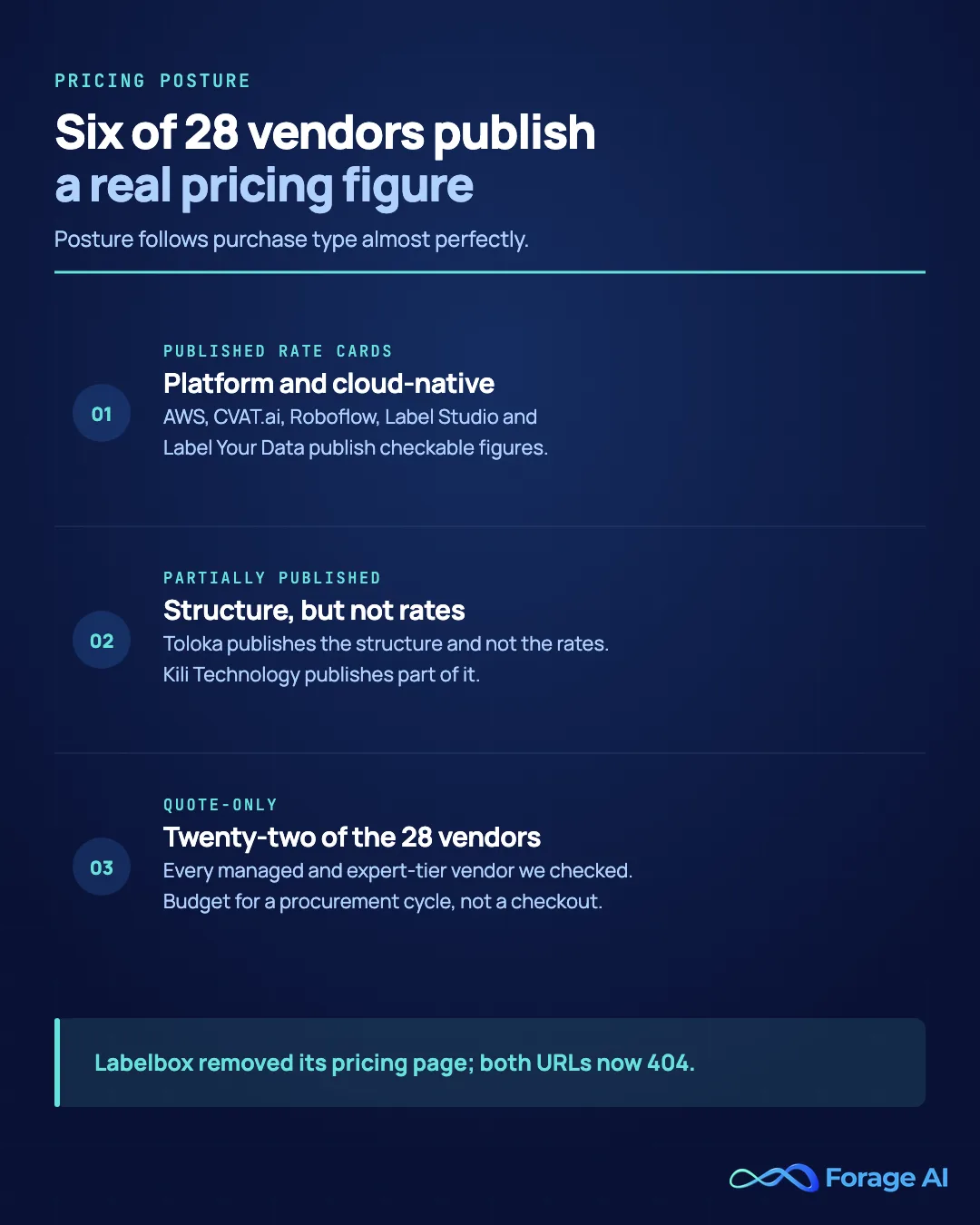
The SERP keeps the roster and the cost benchmarks in separate articles, which is convenient for publishers and useless for buyers. Here they are together.
Per-unit benchmarks by modality
| Task type | Published 2026 benchmark range |
|---|---|
| Image classification | $0.02 to $0.15 per label |
| Object detection (bounding box) | $0.05 to $0.90 per object |
| Semantic segmentation | $0.50 to $2.00+ per mask |
| Text sentiment or intent classification | $0.01 to $0.10 per item |
| Named entity recognition | $0.05 to $0.25 per entity |
| Audio transcription | $0.50 to $3.00 per minute |
| Video annotation | $1.00 to $10.00 per minute |
| Medical or clinical items | $1.00 to $5.00+ per item |
| Hourly managed rates | $6 to $60+ per hour |
The verifiable published rates, read from vendor pages on 6 August 2026, are narrower and more useful because you can check them. AWS SageMaker Ground Truth charges $0.08, $0.04 and $0.02 per reviewed object across its three volume tiers, and $3.00 per 3D point-cloud frame. CVAT.ai runs $23 to $33 per user per month, with Enterprise now quoted on request. Roboflow’s Core plan starts at $0 since 18 September 2026, with labeling from $0.10 per bounding box. Label Studio charges $99 per month for Starter Cloud plus $49 per additional user. Label Your Data publishes $0.02 per bounding-box object, $0.015 per keypoint, $0.02 per NLP entity and $6 per annotator hour.
6 of 28 vendors publish real pricing figures.
The other 22 are quote-only, so budget for a procurement cycle rather than a checkout. Source: Forage AI pricing sweep, 28 vendors, accessed 6 August 2026.
The five pricing models
| Model | What you pay for | What it hides | When it fits |
|---|---|---|---|
| Per-unit | Each label, box, entity or minute | Rework, QA overhead, setup, minimums | Stable taxonomy, predictable volume |
| Hourly | Annotator time | Throughput variance between cohorts | Ambiguous or exploratory work |
| Per-project | A defined deliverable | Change-order pricing when scope moves | Fixed-scope one-offs |
| Dedicated FTE | A named cohort’s capacity | Idle time you still pay for | Long programmes with continuity needs |
| Platform seat or usage | Software access and consumption | Your own labour cost, which is the larger number | You already employ annotators |
Common misconception: expert-network published rates are not prices.
They publish what they pay contractors, not what they charge clients. Mercor posts roles at $60 to $120 per hour, Handshake AI publishes $40 to $125 per hour for fellows, Surge AI up to $200 to $400 per hour for a journalist role, and Turing publishes expert-side rates. Every one of those is supply-side. It reads as pricing transparency and it is the opposite: it tells you the vendor’s cost of goods and nothing about your invoice.
The landed-cost model
The per-unit rate is not the number that decides your bill. Landed cost is:
per-unit rate × rework multiplier + QA overhead + setup and minimums + guideline versioning + re-training the annotator cohort
Worked example. Vendor A quotes $0.01 per record at a 20% error rate. Vendor B quotes $0.04 per record at 1%. On 1,000,000 records, Vendor A’s direct cost is $10,000 and Vendor B’s is $40,000, and Vendor A looks four times cheaper. Then add rework: 200,000 records go back through at least once, which is another $2,000 of labeling and, more expensively, a QA cycle to find them, a guideline revision to prevent recurrence, and re-training for the cohort. Your own reviewers absorb that time at a fully loaded cost that dwarfs the labeling line. Vendor B’s 1% error rate is not a quality nicety. It is the reason the cheaper quote costs more.
Two conditional rules fall out of that. Below roughly 50,000 units, a managed vendor’s minimums usually dominate the economics, so a platform plus internal labour wins. And if the taxonomy is still moving, a fixed per-unit contract prices the wrong thing, because you will pay full rate to label a schema you are about to change. This is the same total-cost-of-ownership framing that applies to any managed data operation: the visible line item is rarely the expensive one.
On the labour side, rates stratify into bands that barely overlap. AFP’s October 2025 reporting documented $0.05 to $0.25 per task at the bottom, with some Remotasks work around $0.01 per task, against $30 to $50 per hour for specialised annotation. Entry-level gig work sits around $15 to $20 per hour where it is hourly at all. At the top, Mercor pays contractors $85 to $95 per hour on average, and Handshake AI’s published fellowship postings reach $125 per hour with higher unpublished bands in medicine, law and finance. Expert RLHF and medical review is often priced per example, in the $50 to $100 range. If a quote for expert-domain work looks like commodity pricing, one of the two numbers is wrong.
There is peer-reviewed evidence for why label error is expensive rather than merely annoying. Northcutt, Athalye and Mueller found label errors averaging at least 3.3% across the test sets of ten of the most commonly used computer vision, NLP and audio benchmarks, with at least 6% of the ImageNet validation set mislabelled. The consequence that matters to procurement is that model rankings flip: on corrected ImageNet labels, ResNet-18 outperforms ResNet-50 once the share of originally mislabelled test examples rises by just 6%. Label quality is not a soft contract concern. It changes which model you ship.
Attribution: Curtis Northcutt, Anish Athalye and Jonas Mueller, “Pervasive Label Errors in Test Sets Destabilize Machine Learning Benchmarks”, NeurIPS 2021 Datasets and Benchmarks Track.
What gets annotated: modality coverage
Modality is the fastest first filter on a long vendor list. Computer vision covers bounding box, polygon, semantic segmentation and instance segmentation, keypoint and landmark work, 3D cuboids and LiDAR point clouds, and video object tracking. Text and NLP covers NER, sentiment and intent classification, and increasingly RLHF, SFT, preference and rubric data and RL environments. Audio covers transcription and diarization. Documents cover OCR and key-value extraction. Multimodal sits across all of it.
Two method entities show up in almost every modern engagement and change the economics: model-assisted pre-labeling, where a model proposes and humans correct, and active learning, where the system chooses what to send to a human next. Neither removes the human. Both move where the human’s time goes.
The single most useful number in this market is not the market size. It is the sourcing split. Teams that assume in-house is the conservative default are choosing the minority position, and the reasons for choosing it should be specific rather than reflexive.
Attribution: Grand View Research, Data Labeling Solution and Services Market 2025–2030, accessed 6 August 2026.
How should you run the evaluation?
Label error is measurable before you sign, and measuring it is a procurement step rather than a research one.
No ranking roundup gives you a pilot protocol, an acceptance criterion or a contract clause. They all end at “contact them.” Here is what to do between the shortlist and the signature.
A two-week, three-vendor pilot protocol
Run two or three vendors in parallel, on one or two task types, inside two weeks. NDA and DPA signed before any sample data moves, without exception. A batch of roughly 500 units returned in five to ten business days from NDA is what a mature vendor should manage; the ones that cannot are telling you about their queue.
Score the output against your own benchmark set with real ground truth, not the vendor’s gold set, because a vendor scoring itself on its own gold items is measuring its ability to hit its own targets. Use a quality framework for external data sources to define what “correct” means before the batch goes out. Agreeing acceptance criteria after seeing the output is how pilots turn into arguments.
Measuring quality: gold sets, consensus, and IAA thresholds
Write the accuracy floor as a kappa or alpha threshold against a named gold set, not as a percentage. Percentages hide task difficulty and hide chance agreement; agreement statistics do not.
The standard interpretation bands come from Landis and Koch (1977): 0.00 to 0.20 slight, 0.21 to 0.40 fair, 0.41 to 0.60 moderate, 0.61 to 0.80 substantial, and 0.81 to 1.00 almost perfect.
0.61 to 0.80 is “substantial” inter-annotator agreement.
Write the accuracy floor as a kappa threshold against a named gold set, not as a percentage. Source: Landis & Koch, Biometrics 33(1), 1977, 159–174.
For anything subjective, a result under 0.80 is where you start asking questions rather than where you sign. Specify which statistic you mean, because Cohen’s kappa, Fleiss’ kappa and Krippendorff’s alpha are not interchangeable and a vendor reporting “our IAA is 0.9” without naming the metric has told you nothing.
Guideline authorship and versioning is the largest single driver of label quality and the most common cause of a failed engagement, and it is almost never in the contract. Taxonomies drift, so the acceptance threshold gets re-measured on a cadence rather than set once at kickoff.
The RFP: what to send, and what to ask for back
Of the data labeling RFP templates ranking for this search in October 2026, the useful ones sit behind a demo form. A useful RFP is short. It tells the vendor exactly what you are labelling, and it asks for documents rather than adjectives, so the replies can be compared line by line and the disqualifiers fire before anyone books a call.
| RFP section | What you send | What the vendor must return |
|---|---|---|
| Scope and spec | Modality, volume by month, the draft taxonomy, a sample of your hardest edge cases, target start date | A throughput and ramp plan for your volume, and which taxonomy items they would push back on |
| Ownership | The who-owns-you question, and your own sector | Owner and any parent, and whether they serve a competitor of yours |
| Workforce | Your data-residency and confidentiality constraints | Named facilities or countries, employment status of annotators, every subcontractor |
| Security | Your NDA and DPA, signed before any sample moves | The certification report itself, its Type, period and systems in scope |
| Quality | Your acceptance metric and threshold, and who holds the gold set | A QA plan naming the sampling rate, strata and the agreement statistic |
| Pricing schedule | Volume bands and the rework you expect | Unit price at each band, rework price, setup fees, minimums, guideline-change charges |
| Pilot | About 500 units and your benchmark set | Turnaround commitment and agreement to be scored on your set, not theirs |
| Contract and exit | The SLA clause skeleton below | Redlines against it, plus export formats and what happens to the trained cohort at exit |
Score the returns in two passes. First pass is pass or fail against the six disqualifiers further down; second pass is the pilot result against your own benchmark set. Weighted scorecards come last, if at all. The twelve questions below are the ones every section above has to answer, in the order that disqualifies fastest.
- Who owns you, and who else do you serve?
- Where does the labour physically sit, and can you name the facilities?
- Are annotators employed, contracted, or crowd-sourced?
- Do you subcontract, and to whom?
- SOC 2: Type I or Type II, what period does the report cover, and what systems are in scope?
- Can I have the report?
- Who authors and versions the guidelines?
- What is your QA sampling rate, and which strata does it cover?
- Do you report inter-annotator agreement, on what metric, at what threshold?
- What happens to the trained annotator cohort if I leave?
- Who owns the labels, the guidelines and the ontology?
- What export formats, and can I get the raw annotations plus the audit trail?
The SLA clause skeleton
Eight clauses. Most annotation contracts contain two of them.
- Accuracy floor expressed as a Landis-Koch kappa threshold against a named gold-standard set, with the statistic specified.
- Measurement method: sampling rate, strata covered, who measures, and how often it is re-measured as guidelines change.
- Gold-standard definition: who builds it, who holds it, and how it is refreshed to prevent gold-set overfit.
- Rework terms: what triggers rework, what the turnaround is, and who pays.
- Ownership: labels, guidelines and ontology, named explicitly, because “the deliverable” is not the same as “the ontology we developed together.”
- Subcontracting disclosure: prior written notice, with the right to refuse a named fourth party.
- Access controls: named-individual annotator logins, no shared accounts, and an audit trail of who labelled what.
- Exit and portability: export formats, the audit trail, and what happens to the trained cohort at termination.
The failure modes nobody writes down
Annotator churn mid-project, which resets everything the cohort learned about your edge cases. Silent subcontracting to a fourth party you never approved. QA sampling that only inspects the easy strata, so the measured quality is real and irrelevant. Gold-set overfit, where annotators learn the gold items and the measured quality stops predicting real quality. And the pilot-team bait-and-switch, where the A-team runs your pilot and the B-team runs your production volume. Contract for the cohort, not just for the vendor.
Once you have selected and signed, running the programme is a separate discipline, and the operational playbook for running a training-data program covers the part that starts after procurement ends.
Every kappa threshold in every annotation SLA descends from one 1977 paper, and almost no annotation contract cites it. The gap between an industry that quotes those bands informally and an industry that writes them into contracts is where most annotation disputes live. Named-individual logins and an audit trail are cheap clauses to write and expensive ones to be missing, as the June 2025 document-exposure report showed.
Attribution: J. Richard Landis and Gary G. Koch, “The Measurement of Observer Agreement for Categorical Data”, Biometrics 33(1), 1977, 159–174.
When should you not hire a data labeling company?
All of that assumes you are hiring somebody. Four cases where the answer is not a vendor at all.
1. Keep it in-house. When the domain expert is already on your payroll and cannot be replicated externally, when the volume is small enough that a vendor’s minimum exceeds the work, when the taxonomy is still pre-product-market-fit, or when the data legally cannot leave your jurisdiction. Grand View Research puts in-house at roughly 15% of the 2024 market, so this is the minority case rather than the default.
2. Licence a finished dataset. Licensing a finished dataset somebody has already built is a different purchase with different economics and a much shorter time to first usable data, at the cost of any claim to a proprietary asset.
3. Programmatic or weak supervision. Write label functions and heuristics instead of hiring labelers. Snorkel AI is the reference implementation, named here rather than profiled because it is a different purchase, not a different vendor.
4. You do not have the data yet. Every vendor in this article assumes you already possess the corpus to be labelled, and sourcing it is a separate purchase that gets specialised fast in regulated verticals, which is what our 2026 guide to buying legal data covers for court records, dockets and case law.
Auto-labeling and synthetic data have not removed the human. They moved the human to audit, calibration and edge cases. Peer-reviewed work on LLM-assisted annotation with active learning, including AutoLabel presented at KSEM 2024 and published in the ACM Digital Library, demonstrates both the automated path and its limits, which is a better anchor than the 10x speedup and 75% savings figures circulating in this market, all of which come from companies selling the automation. Whether you need labelled data at all is worth settling before any of this, and that decision often turns on fine-tuning versus retrieval.
The strongest available counter-signal to “automation solved it” is the Meta case above. The company that paid a reported $14.3 billion for 49% of Scale AI reassigned roughly 6,500 of its own engineers to write training data by hand in March 2026, and conceded the restructuring had gone wrong three months later.
Two data points sit in tension and both are true. Grand View Research puts 84.6% of the 2024 market in the outsourced segment, which says the market has settled the build-versus-buy question. Meta’s March 2026 in-housing says the settlement does not hold at the top of the value curve, where the annotation is expert judgement rather than throughput. The practical read: outsource the volume, keep the judgement, and be explicit about which of the two a given task is before it goes into an RFP.
Attribution: Grand View Research, Data Labeling Solution and Services Market 2025–2030, set against reporting on Meta’s Applied AI Engineering unit, March to June 2026.
How to choose: routing your shortlist
You came for the list, and the list is above. Here is the repeatable method for turning 26 names into three.
Start with the three questions. Everything in this article converges on the same three, and they shorten a shortlist faster than any feature comparison because each one is answerable in a week and each one produces a yes or a no rather than a score:
- Who owns you, and who else do you serve? The criterion this market produced in 2025 and 2026. Meta inside Scale AI, iMerit inside EXL, TIXT delisted, clickworker inside LXT, Shaip inside Ubiquity. Ownership is the one variable you inherit and cannot negotiate.
- Where does the labour physically sit, and will you name the facilities? Twelve of the 28 vendors we swept publish zero contributor geographies. The moment you carry a data-residency or US-persons obligation, an unanswered version of this question is a disqualification, not a gap.
- Which certification framework, which Type, what scope, and can I have the report? Four parts, one question. It separates Cogito Tech’s six unevidenced claims from Mercor’s single evidenced one, and it is what catches a genuine certificate scoped to the wrong product, as Handshake’s is.
Answer those and most of the 26 are gone. The rest of this section is the ordered path for what survives.
The routing path, in order.
- Which purchase? Platform, managed outcome, your workforce on their tooling, or licence a dataset. This eliminates more of the roster than anything else here.
- Does workforce geography disqualify anyone? Undisclosed geography is a disqualifier the moment you carry a data-residency or US-persons obligation.
- Does ownership disqualify anyone? Does the vendor’s owner compete with you, and how would you find out if that changed mid-contract?
- Modality and domain fit. Does the marketing page say “multimodal” while the case studies say bounding boxes?
- Certification framework, Type and scope. Evidenced, not asserted.
- Pricing posture and landed cost. Can you model the number, and does the procurement shape fit your cycle?
- Review evidence, with sample size. Read last, and read sceptically.
The use-case routing table
| Use case | Category to start in | 2-3 names to look at | The decisive constraint |
|---|---|---|---|
| Medical and clinical | Enterprise, platform-first with clinicians | iMerit, V7, Encord | Annotator qualification and health-data privacy scope |
| Autonomous vehicles and robotics | Enterprise, platform-first | Scale AI, Encord, Sama | 3D and LiDAR tooling maturity |
| LLM, RLHF and evaluations | Expert-data marketplaces | Surge AI, Mercor, Handshake AI | Credential verification and no certification artefact to lean on |
| Multilingual speech and language | BPO and crowd-scale | TELUS Digital, Appen, LXT | Language locale count and secure-facility options |
| Documents and OCR | Platform-first, mid-market managed | Kili Technology, V7, Cogito Tech | Key-value extraction quality and document confidentiality |
| Content moderation | BPO and crowd-scale | TaskUs, Sama, TELUS Digital | Wellbeing programmes and site-level accountability |
| Small-volume self-serve | Open source and cloud-native | Roboflow, CVAT.ai, Label Your Data | Published pricing and no minimum commitment |
The six disqualifiers
Disqualifying is faster than ranking. Any one of these ends the conversation:
- Workforce geography undisclosed while you carry a data-residency obligation.
- The vendor’s owner competes with you.
- A certification claimed with no artefact and no stated scope.
- A pricing posture incompatible with your procurement cycle.
- No published quality method, and no willingness to describe one in the pilot.
- A product past end of support.
Do not read “#1 in a guide” as market leadership. In at least 12 of roughly 15 ranking guides on this SERP, #1 is the publisher, and the disclosure standard set at the top of this article is the one to hold them to. The same diligence discipline applies upstream, and the enterprise evaluation checklist covers the version of this for data suppliers rather than annotation vendors.
A tie-breaker, because scorecards produce ties. If two vendors land within about 5% of each other on a weighted comparison, do not re-weight until one wins. Ask instead which dimension, if it failed in year two, would cost the most. For most enterprise annotation programmes that is annotator cohort continuity, because a cohort that has learned your edge cases is the asset you are actually buying and cannot be re-procured quickly. Where the programme touches regulated data, ownership and workforce geography displace it, because those two fail in ways that are not recoverable with money.
Frequently asked questions
How much does data labeling cost?
Published 2026 benchmarks run from roughly $0.02 per image classification label to $0.50 to $2.00+ for semantic segmentation, $0.50 to $3.00 per audio minute and $1.00 to $5.00+ for medical items, with hourly managed rates between $6 and $60+. Only six of the 28 vendors we checked on 6 August 2026 publish real figures, so most of this market prices by quote. The correction most buyers need: the lowest per-unit rate is frequently the most expensive vendor, because $0.01 per record at a 20% error rate costs more than $0.04 at 1% once rework, QA cycles and cohort re-training are counted.
What is the difference between a data labeling platform and a data labeling service?
They are opposite risk transfers. A platform sells you software and leaves the labour, throughput and quality risk with you; a service sells you an outcome and takes process visibility away in exchange. A third path that almost no roundup names is renting the vendor’s tooling and staffing it with your own workforce, of which AWS SageMaker Ground Truth’s private-workforce option is the clearest illustration, though AWS closed that service to new customers on 30 July 2026. Most vendors sit on a spectrum rather than in a box, so the useful question is which risk you retain after signing, not which label the vendor uses.
Should we outsource data labeling or do it in-house?
Outsourcing is the norm. Grand View Research put 84.6% of the 2024 data labeling solution and services market in the outsourced segment, which leaves in-house at roughly 15%. In-house wins in four specific situations: the domain expert is already on your payroll, the volume is small enough that vendor minimums dominate, the taxonomy is still moving, or the data cannot legally leave your jurisdiction. Outside those, the question is not whether to outsource but which of five workforce models to outsource to, because they behave differently on price, variance, ramp and confidentiality.
How do I evaluate annotation quality before signing a contract?
Run a two-week pilot with two or three vendors on a batch of roughly 500 units, with the NDA and DPA signed first, and score the output against your own benchmark set rather than the vendor’s gold set. Then write the accuracy floor into the contract as an agreement threshold rather than a percentage: on the Landis-Koch scale, published in Biometrics in 1977, 0.61 to 0.80 is substantial agreement and 0.81 to 1.00 is almost perfect. For subjective tasks, anything under 0.80 is a question rather than a signature. Name the statistic too, because Cohen’s kappa, Fleiss’ kappa and Krippendorff’s alpha answer different questions.
What certifications should a data annotation vendor have, and is my data safe?
Ask three questions rather than one: which framework, which Type, and what is in scope. Only three of the 28 vendors we checked claim ISO 27701 and only four claim PCI DSS, so a checklist that assumes either is standard will disqualify most of the market before you have evaluated anything. A certificate can be entirely genuine while covering a different product: Handshake’s SOC 2 Type II covers its recruiting products rather than its AI data unit. Ask for the report, the scope, and the report date.
The Ownership Question
Eighteen months ago, “who owns this vendor?” was a curiosity you might get to in the third meeting. Then Meta took a non-voting stake in Scale AI, reported at 49% for $14.3 billion, and Google, Microsoft, xAI and OpenAI were all reported reducing or ending their engagements inside a week. TELUS International’s privatization closed on 31 October 2025 and the shares came off the NYSE days later. TaskUs stayed public because its shareholders voted a take-private down on 8 October 2025. clickworker turned out to be inside LXT. Shaip turned out to be inside Ubiquity Global Services. In August 2026, iMerit completed its sale to EXL. Centific turned out to be Pactera EDGE with a new name.
None of those are scandals. They are ordinary corporate events, and every one of them changes the answer to a question your RFP probably does not ask: who owns this vendor, and who else do they serve?
That is the criterion this market produced in 2025 and 2026, and it belongs at the top of an evaluation rather than the bottom. It is checkable in an afternoon for a public company and genuinely hard for a private one, which is itself the finding. Certification you can request. Pricing you can negotiate. Ownership you inherit, and it can change without you.
Put it in the RFP as question one. The guides ranking for this search still do not ask it.
Before you label anything, you need the data
Every company in this guide assumes you already have the corpus. Labeling adds structure to data you possess. It does not produce the data.
If the harder half of your problem is acquiring it, at scale, from the open web and from documents, and keeping it current as sources change, that is what Forage AI does. Forage AI is an end-to-end managed data pipeline: it automates discovery, extraction, structuring, quality checks and delivery, built to your own fields and systems, so you receive the data rather than a tool to maintain. Every delivery passes a 3x QA team, and from sign-off to first dataset takes 1-2 weeks. Clients own the data, and we do not resell it. For a broader view of how this category has developed, modern data extraction services in 2026 covers the landscape.
That is a different problem from annotation, and if annotation is what you need, the 26 entries above are where to look.
See what Forage AI builds for AI teams →
About the author
Forage AI Research Team. We build and run managed data pipelines for web and document data. That work puts us in the same procurement conversations buyers have here, which is why we write these guides.
This edition was built from a same-day sweep of 28 vendor websites, security pages, pricing pages and public review profiles on 6 August 2026. Ownership, funding and pricing were re-checked on 15 October 2026. Forage AI does not sell data labeling or annotation and is not one of the 26 entries.
Related Articles
- Top AI Training Data Providers: Buyer’s Guide to the Four Categories: The four categories of the AI training data market, and which one your problem belongs to.
- Best AI Dataset Marketplaces: 8 Platforms Compared: Licensing a finished dataset instead of building one.
- AI Training Data: The Operational Playbook: Running a training-data programme after the vendor is selected.
- The Best Data as a Service (DaaS) Companies in 2026: The delivered-data end of the same supply chain.
- What Is Data for AI (And How You Can Use It): Labeled versus unlabeled data, and what each one is for.
Sai is a data infrastructure enthusiast who has spent the past two to three years following the AI space closely, from the infrastructure layer to the fast-growing world of data for AI. He is genuinely curious about how modern data pipelines get built and where the data industry is heading, and he writes insightful pieces on the core topics that shape this niche.