
Best Ecommerce Datasets (Free & Paid) for ML and Analytics
Last updated: October 2026
Search “ecommerce datasets” and five of the seven top-ranking roundups lead with a dataset collected between December 2010 and December 2011. None of them tell you that. None of them state a license either. Both omissions cost you more than they look like they should: a model trained on fifteen-year-old baskets learns fifteen-year-old buying behaviour, and a dataset you cannot legally ship is worth nothing to a production system no matter how clean the rows are.
So this article prints both, for every entry. Twenty ecommerce datasets and databases, free and paid, organized by seven ML use cases, each with six fields stated plainly: collection window, size, license, hosting and access, best-for task, and honest limitations. By the end you will be able to pick the right dataset for your model task in one read, and know exactly when a static dataset stops being enough.
What this article covers. This is a guide to ecommerce datasets: static, pre-extracted, versioned, licensed collections of ecommerce records (products, orders, reviews, events) you download and use as-is. An ecommerce database here means a live, queryable public store such as the BigQuery public datasets, which we also cover; if you searched “ecommerce database” for schema design guidance, this is not that article. A data provider is a company that extracts fresh data for you on demand, and providers are out of scope. If that is what you need, start with our guide to ecommerce data providers. Building a sales dashboard or practicing SQL rather than training a model? The analytics routing table right after the roster is your shortcut.
Quick Digest
- How we evaluated: every dataset gets a Six-Field Spec Card; recency and license lead because they are the two fields every competing roundup omits.
- The roster: 20 datasets across 7 ML use cases, from Kaggle, UCI, Hugging Face, BigQuery public data, GitHub, and commercial marketplaces, in one table.
- Recommendation systems: Amazon Reviews 2023 (571.54M reviews through September 2023) for scale, OTTO for cleanly licensed real sessions; skip the superseded 2014/2018 versions.
- Demand forecasting: M5 Walmart is the benchmark; UCI Online Retail is a 2010–2011 teaching dataset that 5 of 7 roundups still recommend undated.
- Licensing: only a handful of free datasets (ESCI, OTTO, ABO, UCI Online Retail) are safe for commercial training; Instacart is non-commercial, and the big Kaggle staples (Retailrocket, Olist, Datafiniti’s pricing sample) all carry CC BY-NC-SA 4.0 terms.
How We Evaluated These Datasets
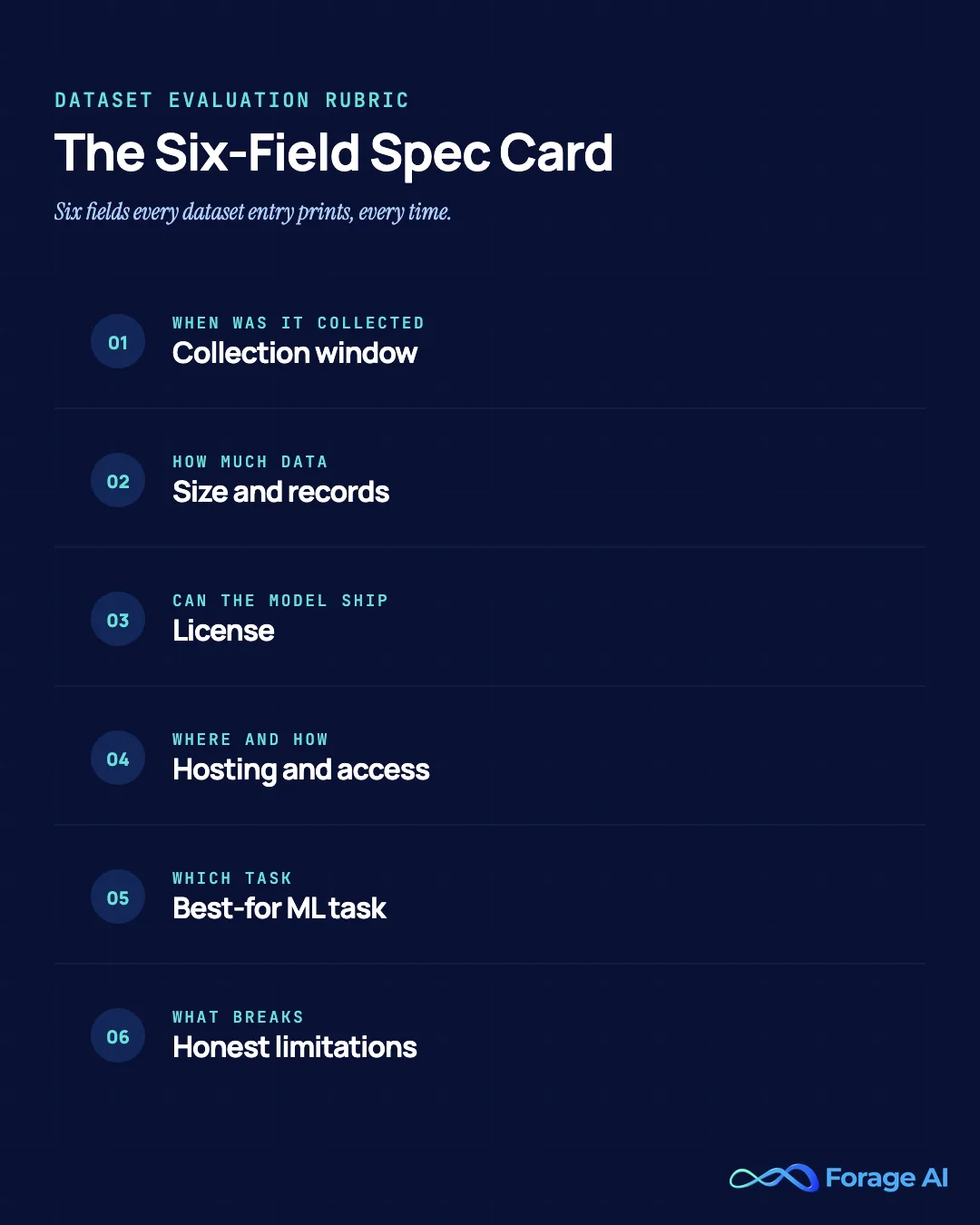
Every entry below is scored against the same rubric and prints the same Six-Field Spec Card: collection window, size and records, license, hosting and access, best-for ML task, and limitations. The card is the whole methodology, visible on every dataset.
| Criterion | Why it matters | How we scored it |
|---|---|---|
| Recency of data window | Ecommerce behavior shifts fast; pre-2020 patterns mislead modern models | Collection window printed for every entry; “undated” is itself a finding |
| License clarity | Decides whether you can legally ship a commercial model | Exact license named; unknown-license uploads flagged as shipping risk |
| Schema richness | Timestamps, user IDs, price fields, category trees determine which tasks are possible | Key fields listed in each card |
| Scale | Pretraining needs millions of rows; classifiers need thousands of clean labels | Row, event, or image counts stated with source |
| Access method | CSV vs Parquet vs load_dataset vs BigQuery changes your pipeline | Hosting and access stated per entry |
Recency and license lead for a blunt reason: bad data is a P&L line item. In a 2025 IBM Institute for Business Value report, over a quarter of organizations estimated they lose more than $5 million annually to poor data quality, and 7% reported losses of $25 million or more. The stakes are compounding too: per Precedence Research (updated January 8, 2026), the AI in e-commerce market is valued at $9.01 billion in 2025 and $11.21 billion in 2026, a 23.59% CAGR over 2026–2035. Sourcing is now a first-order engineering decision, worth the same rigor you would apply through a data quality framework for external sources.
One observation shaped the rubric more than any stat: in our review of the seven top-ranking roundups for this keyword, none states the license or collection window for any dataset it recommends. Those two fields block production use most often, so they lead every card. All links click-verified August 4, 2026; no vendor paid for placement.
Ecommerce Datasets at a Glance
With the rubric set, here is the full field, details after. Four hubs supply most of the free entries: Kaggle, the UCI Machine Learning Repository, Hugging Face, and Google BigQuery public datasets, with Google Dataset Search as the discovery layer. Jump to the category matching your model task, or to the analytics table directly below if you are building dashboards or reports; every dataset gets a full spec card further down. One caveat up front: Kaggle mirrors carry heterogeneous or unstated licenses, addressed per entry. And one teaser for why the window column matters: the most-recommended dataset on page 1, UCI Online Retail, is 541,909 rows collected December 2010 to December 2011. Roster current as of August 2026.
| # | Dataset | Category | Best for | Free/Paid |
|---|---|---|---|---|
| 1 | Amazon Reviews 2023 (McAuley Lab) | Recommendation systems | Large-scale recsys pretraining, LLM fine-tuning | Free |
| 2 | OTTO Recommender Dataset | Recommendation systems | Session-based recommendation, cleanly licensed | Free |
| 3 | Retailrocket Ecommerce Dataset | Recommendation systems | Compact event + catalog starter | Free |
| 4 | M5 Walmart Sales Forecasting | Demand forecasting | Hierarchical forecasting benchmark | Free |
| 5 | Instacart Market Basket 2017 | Demand forecasting | Order-sequence and reorder modeling | Free (non-commercial) |
| 6 | UCI Online Retail | Demand forecasting | Teaching RFM and market-basket analysis | Free |
| 7 | Maven Analytics Toy Store | Demand forecasting | SQL/BI-friendly practice | Free |
| 8 | Amazon ESCI Shopping Queries | Product search & relevance | Search relevance, commercially usable labels | Free |
| 9 | Women’s E-Commerce Clothing Reviews | Review NLP | Classical sentiment classifiers | Free |
| 10 | Zenodo Ecommerce Text Classification | Review NLP | Product-text category models | Free |
| 11 | Fashion-MNIST | Product image | Architecture sanity checks only | Free |
| 12 | Amazon Berkeley Objects (ABO) | Product image | Real catalog imagery, 3D/multimodal | Free |
| 13 | REES46 Multi-Category Store | Customer behavior | Large-scale real event modeling | Free |
| 14 | GA4 Merchandise Store Sample (BigQuery) | Customer behavior | GA4 event-schema pipelines | Free |
| 15 | theLook eCommerce (BigQuery) | Customer behavior | Synthetic relational practice, CLV SQL | Free |
| 16 | Olist Brazilian E-Commerce | Customer behavior | Real multi-table order data | Free |
| 17 | octaprice ecommerce-product-dataset | Pricing | Archived 2025 price drops (cadence stalled) | Free |
| 18 | Electronic Products & Pricing Data (Datafiniti) | Pricing | Structured price-field practice | Free |
| 19 | Bright Data Dataset Marketplace | Paid datasets | Pre-collected marketplace snapshots at scale | Paid |
| 20 | Similarweb Shopper Intelligence | Paid datasets | Amazon sales/search metrics with history | Paid |
Which Ecommerce Datasets Work for Sales Analysis?
Not everyone searching for an ecommerce dataset is training a model. Plenty of people need one for a sales dashboard, a SQL portfolio project, or a BI pipeline they want to test before production data arrives.
That work asks different questions of a dataset. Does it have tables worth joining? Dates to trend over? Money fields such as price, cost and payment? Can you query it without a download? Six entries from the roster answer those questions well, and each one already has a full spec card below.
| Analysis task | Start with | Why it fits | Watch out |
|---|---|---|---|
| Sales and revenue dashboard (trend, category, region) | Olist Brazilian E-Commerce (#16) | Real orders with payments, reviews and geolocation already split into joinable tables | 2016–2018, Brazil only, CC BY-NC-SA 4.0 |
| SQL joins, cohorts and CLV, no download | theLook eCommerce (#15) | Orders, order items, products, users and web events queried in place in BigQuery | Synthetic: practice the queries, never quote the numbers |
| Funnel and conversion analysis | Maven Analytics Toy Store (#7) | 30k+ orders tied to 400k+ website sessions; Maven pitches it for marketing-channel and conversion analysis | No collection window stated; practice scale |
| RFM segmentation and market basket | UCI Online Retail (#6) | 541,909 invoice lines with customer IDs and country, CC BY 4.0 | One UK gift retailer, December 2010 to December 2011 |
| GA4 reporting and web analytics | GA4 Merchandise Store Sample (#14) | The real GA4 export schema: nested event parameters and ecommerce items | Obfuscated; Google itself flags limited internal consistency |
| Clickstream analysis at volume | REES46 Multi-Category Store (#13) | 285M real view, cart and purchase events | October 2019 to April 2020, so the tail sits inside COVID |
Two of these run in Google BigQuery, and you do not need a billing account to start. Google’s BigQuery sandbox works without a credit card and includes 1 TiB of query processing a month, a lifetime limit of 10 GiB of storage, and an expiry rule: every table, view and partition you create is deleted after 60 days. That last one catches people in practice. If a dashboard reads from a derived table, rebuild it on a schedule or keep a copy outside the sandbox.
The window rule from the rubric applies here too. A dashboard built on Olist or UCI Online Retail is a good exercise in joins and metrics, but its numbers describe Brazil in 2017 or one UK gift shop in 2011, not your market today. When a report has to show what competitors charge this week, no file on this list will do, and the Escalation Ladder further down covers what to do instead.
Best Ecommerce Datasets for Recommendation Systems
First of the seven categories on the roster. Recommendation models live on session and event data with timestamps: implicit signals (views, carts, orders) at scale beat small explicit-rating sets for nearly every production task. Note the distribution shift here too: Hugging Face load_dataset with Parquet-native files is the modern access pattern for large corpora; the Kaggle CSV download is the legacy one.
1. Amazon Reviews 2023 (McAuley Lab)
| Attribute | Detail |
|---|---|
| What it is | Current version of the canonical Amazon review corpus, from the McAuley Lab at UC San Diego (paper: Hou et al., arXiv:2403.03952, 2024) |
| Collection window | May 1996 – September 2023 |
| Size / records | 571.54M reviews, 54.51M users, 48.19M items, 33 categories, 30.14B review tokens |
| License | None stated on the dataset card (checked August 4, 2026); an academic research release, not an explicit commercial grant |
| Hosting / access | Hugging Face via load_dataset; project page at amazon-reviews-2023.github.io |
| Best for (ML task) | Large-scale recsys pretraining; LLM fine-tuning on review text |
| Limitations / watch-outs | No license is stated on the dataset card, so there is no explicit commercial grant; size demands category-level subsetting |
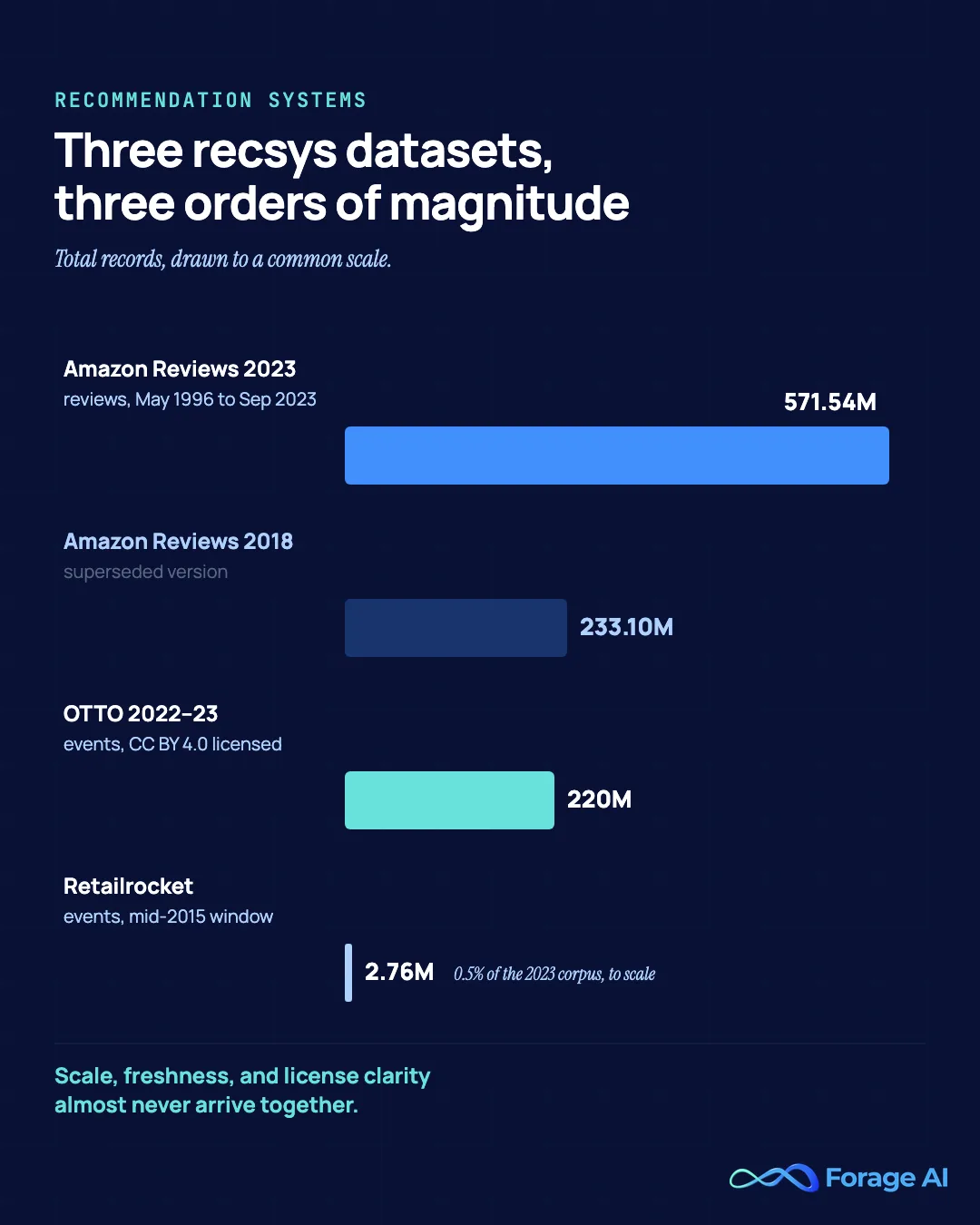
What’s in it. Reviews with ratings, text, fine-grained timestamps, and rich item metadata: 571.54M reviews spanning May 1996 through September 2023, 245.2% larger than the 2018 version (233.10M reviews).
Best for. Pretraining sequence recommenders and fine-tuning LLMs on commerce text. Overkill for a small explicit-feedback classifier.
Watch out. Route yourself off the 2014 and 2018 versions entirely; their duplicate and leakage issues were fixed only in the 2023 refresh, yet they still headline tutorials. Access is one line:
2. OTTO Recommender Dataset
| Attribute | Detail |
|---|---|
| What it is | Real anonymized session data from OTTO, released for the 2022–23 Kaggle “Multi-Objective Recommender System” competition |
| Collection window | 2022–23 competition window (train = 4 weeks, test = following week) |
| Size / records | 12M real user sessions, 220M events (clicks, carts, orders), 1.8M unique articles |
| License | Data CC BY 4.0 (code MIT) |
| Hosting / access | GitHub, otto-de/recsys-dataset |
| Best for (ML task) | Session-based recommendation with a license you can ship on |
| Limitations / watch-outs | Frozen at the competition window; single European retailer |
What’s in it. Click, cart, and order events per session, exactly the implicit-feedback shape production recommenders consume. At 12M sessions and 220M events under CC BY 4.0, it is the largest openly licensed real session dataset available.
Best for. Teams that need real sessions and a clean commercial-use answer. Smaller than Amazon Reviews 2023, but the license question has an actual answer, which matters more for a shipping model than another order of magnitude of rows.
Watch out. A frozen 2022–23 window from one retailer: benchmark and pretraining material, not current behavior.
3. Retailrocket Ecommerce Dataset
| Attribute | Detail |
|---|---|
| What it is | Event log plus item-properties file and category tree from a real ecommerce website, values hashed |
| Collection window | 4.5 months; the Kaggle page states no year, and its documentation’s example event timestamps resolve to mid-2015 |
| Size / records | 2,756,101 events (2,664,312 views, 69,332 add-to-carts, 22,457 transactions) from 1,407,580 unique visitors |
| License | CC BY-NC-SA 4.0 (verified on the Kaggle page, August 4, 2026) |
| Hosting / access | Kaggle CSV download |
| Best for (ML task) | Compact starter for event-plus-catalog recommendation experiments |
| Limitations / watch-outs | Decade-old window; hashed values limit features; the NC license blocks commercial use |
What’s in it. The classic view-cart-purchase funnel with a catalog attached, small enough to iterate on a laptop.
Best for. Prototyping event-join and negative-sampling logic before you scale it, ideally alongside the operational playbook for AI training data.
Watch out. The CC BY-NC-SA license makes this a prototyping dataset, not a shipping one. The pattern across all three entries: scale, freshness, and license clarity almost never arrive together in free recsys data.
Best Ecommerce Datasets for Demand Forecasting and Inventory
Second on the roster: demand forecasting. Forecasting models want long horizons, hierarchy (item, store, region), calendar effects, and per-SKU granularity. This category also has the sharpest teaching-data-versus-production-data divide, so each window below is printed next to the name, every time.
4. M5 Walmart Sales Forecasting
| Attribute | Detail |
|---|---|
| What it is | The Kaggle M5 competition dataset (2020): hierarchical daily unit sales for Walmart, with calendar and price companion files |
| Collection window | Daily unit sales, January 29, 2011 – June 19, 2016 (the 2020 competition’s forecast horizon) |
| Size / records | 42,840 hierarchical series (30,490 bottom-level): 3,049 products across 10 stores in 3 US states (CA, TX, WI) |
| License | Kaggle competition terms; review before commercial use |
| Hosting / access | Kaggle competition page, CSV |
| Best for (ML task) | The hierarchical forecasting benchmark |
| Limitations / watch-outs | Competition terms are not a general commercial license; history ends June 2016 |
What’s in it. Daily unit sales with the hierarchy and calendar features real demand models need, which is why M5 remains the reference benchmark for retail forecasting methods.
Best for. Benchmarking. If an architecture cannot beat simple baselines on M5, it will not survive your production data.
Watch out. Benchmark, not behavior: one retailer, with history ending in June 2016.
5. Instacart Market Basket 2017
| Attribute | Detail |
|---|---|
| What it is | Real grocery orders released by Instacart in May 2017 |
| Collection window | Released May 2017; frozen since |
| Size / records | 3M+ grocery orders from 200,000+ users, 4–100 orders per user, with order sequence, week and hour placed, relative inter-order time |
| License | Provided as-is for non-commercial use |
| Hosting / access | The original Kaggle competition page has been retired (returns 404 as of August 4, 2026); the data circulates via community Kaggle mirrors. Instacart’s own release terms travel with the data, whatever license label a mirror displays |
| Best for (ML task) | Reorder prediction; order-sequence and timing features |
| Limitations / watch-outs | Non-commercial license: you cannot ship a commercial model trained on it |
What’s in it. Order sequences with timing features you rarely get elsewhere: over 3 million orders from more than 200,000 users, released May 2017 under an as-is, non-commercial license.
Best for. Learning and benchmarking reorder models; the sequence and timing fields are the draw.
Watch out. The license is the hard stop. Non-commercial means the model it trains cannot ship in a commercial product. Prototype on it, then retrain on data you have rights to.
6. UCI Online Retail
| Attribute | Detail |
|---|---|
| What it is | Transactions from a single UK-based non-store online gift retailer, donated to UCI in 2015 |
| Collection window | 01/12/2010 – 09/12/2011 |
| Size / records | 541,909 transaction rows, 6 attributes |
| License | CC BY 4.0 |
| Hosting / access | UCI Machine Learning Repository; widely mirrored on Kaggle |
| Best for (ML task) | Teaching RFM and market-basket analysis |
| Limitations / watch-outs | Fifteen-year-old, single-retailer, gift-niche data; unfit for production forecasting |
What’s in it. Invoice-level transactions: 541,909 rows over exactly one year of one retailer’s trade, under CC BY 4.0.
Best for. The classroom. RFM and market-basket exercises work fine here, and the permissive license travels well in courses.
Watch out. UCI Online Retail is not fit for production demand forecasting. It is one UK gift retailer’s 2010–2011 transactions: one Christmas cycle, a giftware assortment, and buying patterns that predate modern ecommerce entirely. Five of the seven top roundups recommend it without printing those dates.
7. Maven Analytics Toy Store
| Attribute | Detail |
|---|---|
| What it is | A free, SQL/BI-friendly relational toy-store ecommerce database from Maven Analytics |
| Collection window | Not stated on the download page (confirmed August 4, 2026) |
| Size / records | 30k+ orders, 400k+ website sessions |
| License | Public Domain (per Maven’s data playground listing) |
| Hosting / access | Maven Analytics data playground |
| Best for (ML task) | SQL practice, BI modeling, feature-engineering warm-ups |
| Limitations / watch-outs | Practice-scale; not a behavioral signal source |
What’s in it. A tidy relational schema that behaves like a small production database.
Best for. Rehearsing the SQL layer under a forecasting pipeline. The distinction this section turns on: teaching data builds skills, production data builds models, and no roundup tells you which is which.
Best Ecommerce Datasets for Product Search and Relevance
Third on the roster: search relevance. Labeled query-product pairs are the scarcest asset in ecommerce ML: they require real search traffic plus the kind of human judgment data labeling companies supply, and almost nobody publishes them. One dataset carries this category, and it is one of the few here you can legally build a commercial model on.
8. Amazon ESCI Shopping Queries Dataset
| Attribute | Detail |
|---|---|
| What it is | Labeled query-product relevance judgments from Amazon Science, basis of the Amazon KDD Cup tasks (Reddy et al., 2022, arXiv:2206.06588) |
| Collection window | Frozen 2022 |
| Size / records | 130,652 unique queries, 2,621,738 relevance judgements (reduced version: 48,300 queries / 1,118,011 rows), in English, Spanish, Japanese |
| License | Apache-2.0 |
| Hosting / access | GitHub, amazon-science/esci-data; Parquet files |
| Best for (ML task) | Search relevance ranking and classification; commercially usable labels |
| Limitations / watch-outs | Frozen 2022; the query distribution is Amazon’s, not yours |
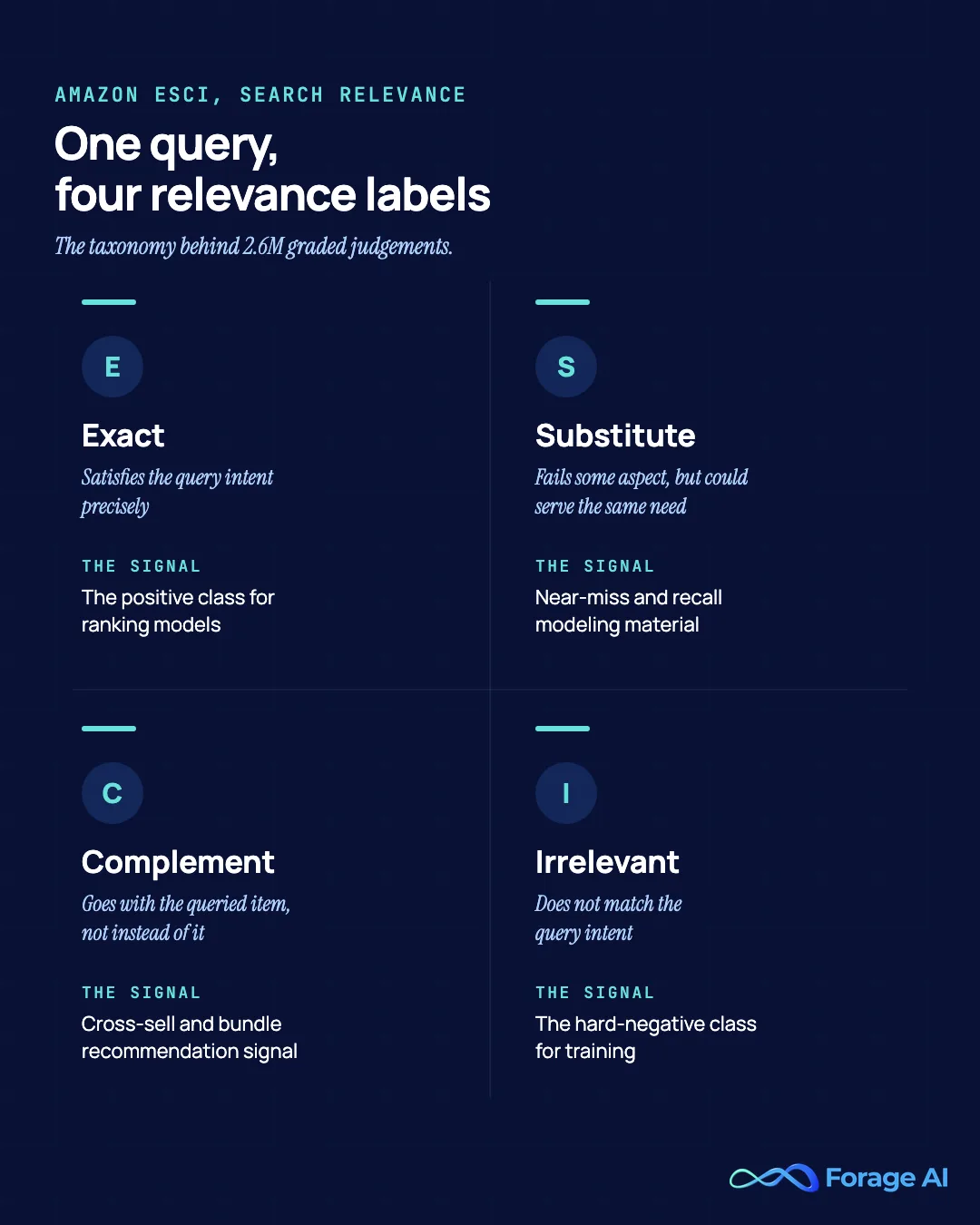
What’s in it. Each query-product pair is labeled Exact / Substitute / Complement / Irrelevant (the ESCI taxonomy) across three languages: 2.6M judgements over 130,652 queries. Fields include example_id, query, product_id, esci_label, loaded Parquet-native:
Loading the ESCI Parquet files (Python):
Best for. Relevance models you intend to ship. Said plainly: Apache-2.0 makes ESCI one of the only labeled search corpora that permits commercial model training. For multimodal work, the SQID (Shopping Queries Image Dataset) extension adds imagery on top.
Watch out. Frozen 2022, but relevance labels age far more slowly than prices or behavior, so it remains the canonical benchmark as of 2026. The honest caveat is distributional: these are Amazon’s queries and catalog; measure transfer to your own traffic rather than assuming it. It appears in none of the ranking roundups, which is your head start.
Best Ecommerce Datasets for Review NLP and Sentiment Models
Fourth on the roster: review NLP. Review NLP spans task scales: small labeled sets for classical classifiers, mid-size corpora for category models, and massive token counts for LLM fine-tuning and RAG over catalogs. Pick by task scale, not by whichever dataset a tutorial happened to use.
9. Women’s E-Commerce Clothing Reviews
| Attribute | Detail |
|---|---|
| What it is | Real, anonymized commercial review data from a women’s clothing retailer, uploaded to Kaggle in 2018 |
| Collection window | Not disclosed; the 2018 upload year is the only date available |
| Size / records | 23,486 review rows, 10 feature variables (age, rating 1–5, recommended flag, positive-feedback count, division/department/class) |
| License | CC0: Public Domain (verified on the Kaggle page, August 4, 2026) |
| Hosting / access | Kaggle, nicapotato/womens-ecommerce-clothing-reviews |
| Best for (ML task) | Classical sentiment and recommendation-flag classifiers |
| Limitations / watch-outs | No collection window disclosed; single vertical |
What’s in it. A clean labeled classification set: 23,486 rows with rating, recommended flag, and product-hierarchy features.
Best for. Sentiment baselines where real commercial text matters more than scale.
Watch out. This dataset is itself a live example of the undated-Kaggle-upload problem: no collection window is disclosed anywhere. Useful default when you meet an undated upload: assume the data predates its upload year by years.
10. Zenodo Ecommerce Text Classification
| Attribute | Detail |
|---|---|
| What it is | Product-text classification set from an Indian ecommerce platform, published on Zenodo in 2019 |
| Collection window | 2019 publication |
| Size / records | 50,425 rows across 4 categories (Electronics, Household, Books, Clothing & Accessories) |
| License | Per Zenodo record page |
| Hosting / access | Zenodo record 3355823 |
| Best for (ML task) | Product categorization from text; multi-class baselines |
| Limitations / watch-outs | Four coarse categories; Indian-platform distribution |
What’s in it. 50,425 product-text rows in four categories: solid headroom for supervised category models without GPU ceremony.
Best for. Multi-class text classification beyond the clothing-reviews scale.
Watch out. Taxonomy-scale categorization needs bigger label spaces than four classes.
Cross-reference, not a duplicate entry: for LLM-scale review text, go back to Amazon Reviews 2023: 30.14B review tokens plus 30.78B metadata tokens with second-level timestamps. That token-count framing signals dataset builders now target LLM fine-tuning and RAG consumers, not just recsys teams. For the licensing and provenance side of such corpora, see public vs private data for AI training.
If a dataset does not state its collection window, assume the data predates its upload year by years. The most-used sentiment set in this category discloses no window at all, and its 2018 upload date is routinely mistaken for a collection date. In review NLP that gap matters less than in pricing, but make that judgment knowingly, not by omission.
Best Ecommerce Datasets for Product Image and Categorization Models
Fifth on the roster: product imagery. Catalog vision covers categorization, attribute extraction, image search, and increasingly 3D and AR. The two entries here are a deliberate pairing no roundup makes: the toy benchmark everyone knows and the real catalog corpus most teams have never opened, both permissively licensed.
11. Fashion-MNIST
| Attribute | Detail |
|---|---|
| What it is | A drop-in MNIST replacement from Zalando Research built from article images, released 2017 |
| Collection window | Frozen 2017 by design (benchmark) |
| Size / records | 60,000 training / 10,000 test images, 28×28 grayscale, 10 classes |
| License | MIT |
| Hosting / access | GitHub, zalandoresearch/fashion-mnist |
| Best for (ML task) | Architecture sanity checks and course material |
| Limitations / watch-outs | Not real ecommerce imagery in any production sense |
What’s in it. Ten classes of 28×28 grayscale garment images, as easy to load as MNIST and meaningfully harder to solve. Author Han Xiao of Zalando Research framed the motivation: “MNIST is too easy. Convolutional nets can achieve 99.7% on MNIST. Classic machine learning algorithms can also achieve 97% easily.” He adds that “MNIST can not represent modern CV tasks.”
Best for. Sanity-checking a vision architecture in minutes.
Watch out. Fashion-MNIST is not real ecommerce imagery. It is a 28×28 grayscale benchmark toy: use it to sanity-check architectures, never to build a production catalog-vision model. The authors’ own framing licenses exactly that warning.
12. Amazon Berkeley Objects (ABO)
| Attribute | Detail |
|---|---|
| What it is | Real Amazon product listings with catalog imagery and 3D assets; CVPR 2022 paper “ABO: Dataset and Benchmarks for Real-World 3D Object Understanding” |
| Collection window | 2021–2023 releases |
| Size / records | 147,702 product listings; 398,212 high-resolution catalog images; 3D models with 4K PBR textures for 7,900+ products; 72-frame 360° spins for 8,200+ products (586,584 spin images); multilingual metadata |
| License | CC BY 4.0 |
| Hosting / access | Amazon Berkeley Objects S3 index |
| Best for (ML task) | Real catalog vision: categorization, attribute extraction, image search, 3D/AR |
| Limitations / watch-outs | Large downloads; 3D assets cover a subset of products |
What’s in it. Real listings at scale: 398,212 catalog images across 147,702 listings, plus 3D models and 360° spins, under CC BY 4.0.
Best for. The production-grade counterpart to Fashion-MNIST. Benchmark data proves the architecture; catalog data proves the product.
Watch out. Storage and preprocessing are the real costs; budget pipeline time before training time.
Best Ecommerce Datasets for Customer Behavior, CLV and Churn
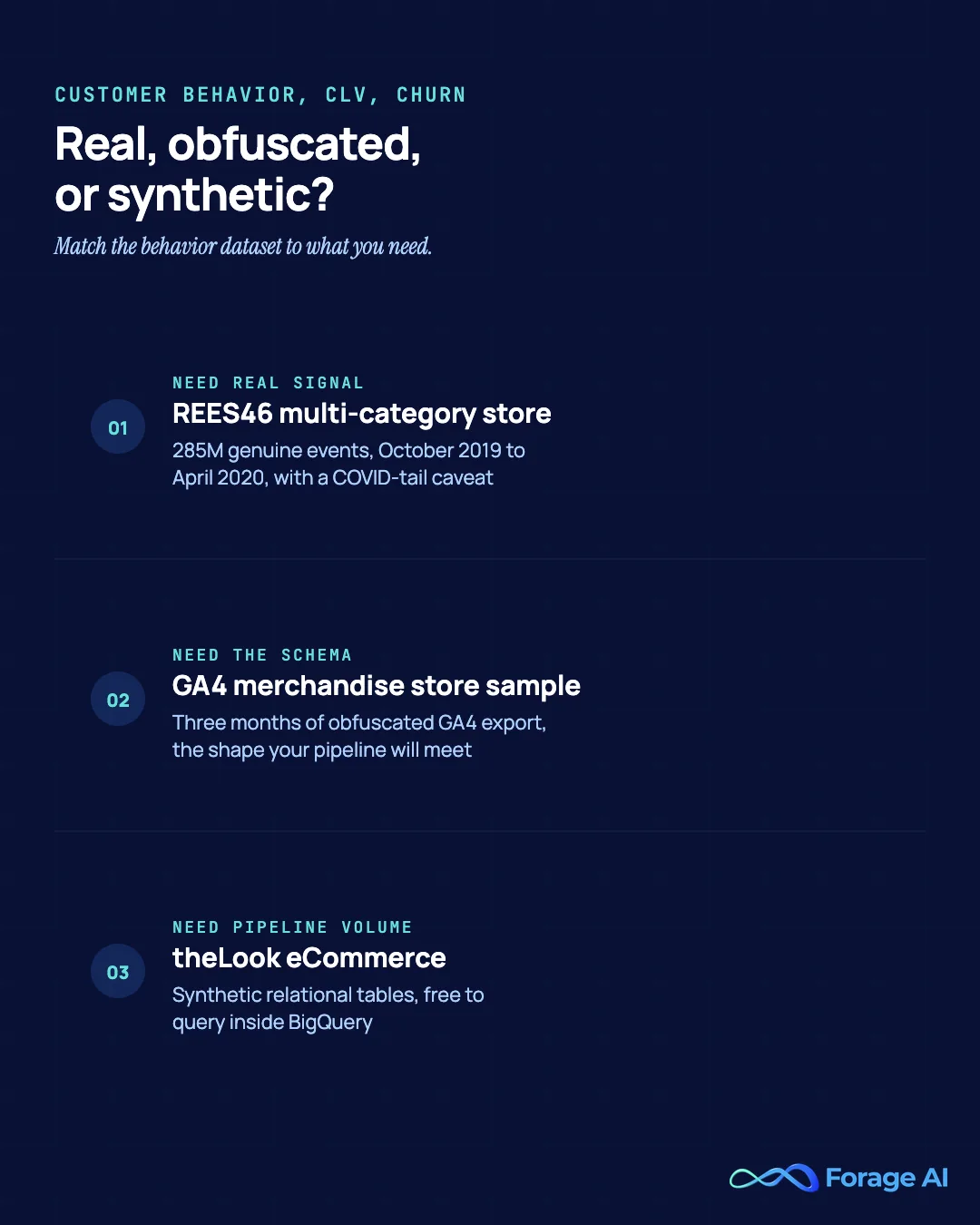
Sixth on the roster: customer behavior, the last use-case section before the paid marketplaces. Behavior and CLV modeling need event-level user journeys with timestamps, and real ones are scarce because they are full of PII and competitive signal. What exists splits three ways: real-but-old, obfuscated, and synthetic. Pick by whether you need signal or schema.
13. REES46 Multi-Category Store
| Attribute | Detail |
|---|---|
| What it is | Real user-behavior events from a multi-category store, via the REES46 marketing platform |
| Collection window | October 2019 – April 2020 (7 months) |
| Size / records | 285 million user events (view/cart/purchase), each tied to a product and user |
| License | Per Kaggle mirror page |
| Hosting / access | Kaggle mirror, mkechinov; link the mirror only: rees46.com’s own page has an expired SSL certificate (observed 2026-08-04) |
| Best for (ML task) | Large-scale real behavior modeling: sessions, propensity, churn features |
| Limitations / watch-outs | Window ends inside COVID-distorted months |
What’s in it. The largest genuine public behavior corpus here: 285M real events across seven months, October 2019 through April 2020.
Best for. Anything needing real event sequences at scale, from propensity models to churn features.
Watch out. Print the window and the caveat together, always: the final months sit inside the COVID demand shock, and March–April 2020 behavior generalizes poorly to anything since. Catching that kind of silent skew is what data observability for third-party datasets is for.
14. GA4 Merchandise Store Sample (BigQuery)
| Attribute | Detail |
|---|---|
| What it is | Obfuscated GA4 event export from the Google Merchandise Store (bigquery-public-data.ga4_obfuscated_sample_ecommerce) |
| Collection window | 2020-11-01 to 2021-01-31 (3 months) |
| Size / records | Three months of event-export data, obfuscated with <Other>/NULL placeholders |
| License | Google BigQuery public data terms |
| Hosting / access | BigQuery public dataset, documented by Google |
| Best for (ML task) | Learning the GA4 event schema and export-pipeline patterns |
| Limitations / watch-outs | Google’s own docs note “internal consistency of the dataset might be somewhat limited” |
What’s in it. A real GA4 export shape: nested event parameters, ecommerce items, the schema your production pipeline will meet.
Best for. Building GA4-to-warehouse pipeline patterns before pointing them at production exports.
Watch out. Google’s own documentation flags the limited internal consistency, an honest caveat straight from the source. Schema practice, not behavioral ground truth.
15. theLook eCommerce (BigQuery)
| Attribute | Detail |
|---|---|
| What it is | Synthetic relational dataset for a fictitious clothing website, built by the Looker team |
| Collection window | Synthetic, continuously available |
| Size / records | Relational tables: customers, products, orders, order items, logistics, web events, marketing |
| License | BigQuery public data terms |
| Hosting / access | bigquery-public-data.thelook_ecommerce; free to query within BigQuery’s 1 TB/month free tier |
| Best for (ML task) | Relational feature engineering, CLV starters, pipeline and BI practice |
| Limitations / watch-outs | Synthetic: no real behavioral signal to validate hypotheses against |
What’s in it. A full relational ecommerce schema queryable in place, free, with no download step: the operational contrast with everything Kaggle-hosted here. A CLV starter you can run now (table and column names check against the public dataset’s documented schema; run it in your own BigQuery project):
Lifetime-revenue starter query (BigQuery SQL):
Best for. Query-in-place development of the relational layer under CLV and churn models.
Watch out. Synthetic data can teach a pipeline; it cannot validate a behavioral hypothesis. If your claim is about how humans buy, synthetic tables will happily confirm whatever your features imply.
16. Olist Brazilian E-Commerce
| Attribute | Detail |
|---|---|
| What it is | Real multi-table order data from Olist, a Brazilian marketplace |
| Collection window | 2016–2018 |
| Size / records | ~100k orders across relational tables: orders, items, payments, reviews, geolocation |
| License | CC BY-NC-SA 4.0 (verified on the Kaggle page, August 4, 2026) |
| Hosting / access | Kaggle, olistbr/brazilian-ecommerce |
| Best for (ML task) | Real relational order modeling; crosses into recsys and review NLP |
| Limitations / watch-outs | Frozen 2016–2018; Brazilian-market distribution; the NC license blocks commercial training |
What’s in it. Real orders with payments, reviews, and geolocation joined across tables: the most production-shaped free relational set here.
Best for. End-to-end practice on real multi-table commerce data.
Watch out. The NC license is confirmed on the Kaggle page, so commercial training is off the table. Prototype here, then retrain on data you have rights to.
Best Paid Ecommerce Datasets and Data Marketplaces
That completes the use-case sections of the roster. What paid buys you is specific: recency tiers, scale, support, and a defined schema. What it does not buy, automatically, is freshness forever. Published marketplace rate cards and a 2026 provider roundup put the economics in a narrow band: subscriptions observed at $59–$1,000 per month, and per-record marketplace pricing around $250 per 100,000 records, all observed 2026-08-04.
A structural note before the entries. The outline gave pricing data its own category, on one condition: that at least one free source still published on a rolling refresh. Verification broke the condition (details in the first entry below), so the two pricing entries sit here with the marketplaces, where refresh is a product tier you pay for rather than a promise in a README.
17. octaprice ecommerce-product-dataset
| Attribute | Detail |
|---|---|
| What it is | A GitHub repository publishing free drops of live product records, from Octaprice |
| Collection window | Drops published January 2025 – December 2025; the README promises a new dataset every week, but the last drop landed December 9, 2025 (commit history checked August 4, 2026) |
| Size / records | ~1,000 live product records per drop (title, price, availability, category), CSV/JSON |
| License | Custom terms of use: enumerated uses only (academic research, journalism, market research and analysis, business intelligence); no redistribution, no derivative databases; not a commercial-training grant |
| Hosting / access | GitHub, octaprice/ecommerce-product-dataset |
| Best for (ML task) | Recent (2025) price observations for prototyping price intelligence features |
| Limitations / watch-outs | The promised weekly cadence stalled in December 2025; treat every drop as a dated snapshot |
What’s in it. CSV/JSON drops of around 1,000 live product records each, published through 2025.
Best for. Practicing on price observations newer than anything else in the free roster, as long as you date-stamp them honestly.
Watch out. This entry is why the pricing category collapsed into this section. We planned to present it as the one free source with a rolling weekly refresh, which is what its README still promises. The commit history says otherwise: the last drop landed December 9, 2025, eight months before this audit. Free freshness did not just have a low ceiling. On verification, it had none.
18. Electronic Products and Pricing Data (Datafiniti)
| Attribute | Detail |
|---|---|
| What it is | A Kaggle-hosted sample of electronics product records from Datafiniti’s product database |
| Collection window | Not stated on the Kaggle page (confirmed August 4, 2026) |
| Size / records | 15,000+ electronic products with pricing information across 10 fields, plus brand, category, and merchant attributes |
| License | CC BY-NC-SA 4.0 (verified on the Kaggle page, August 4, 2026) |
| Hosting / access | Kaggle, datafiniti/electronic-products-prices CSV download |
| Best for (ML task) | Practicing on structured multi-field price records |
| Limitations / watch-outs | Undated; the NC license blocks commercial training; a sample of Datafiniti’s paid database |
What’s in it. Structured price fields across more than 15,000 electronics products; a reasonable schema to practice feature extraction on.
Best for. Learning the shape of multi-source price data before paying for the real thing.
Watch out. Undated pricing data is near-worthless for optimization. Prices are the fastest-decaying signal in ecommerce; if a pricing dataset does not state its window, treat it as historical texture, never market truth. If your model prices live SKUs, static snapshots are training material only; production needs a feed, which is exactly what the two paid entries below sell.
19. Bright Data Dataset Marketplace
| Attribute | Detail |
|---|---|
| What it is | A marketplace of pre-collected ecommerce datasets (Amazon, Walmart, and other major platforms) |
| Collection window | Snapshot-based; refresh tiers from daily to one-time |
| Size / records | Varies by dataset; priced per record |
| License | Commercial terms per purchase |
| Hosting / access | Marketplace download; free 1,000-record sample CSVs funnel to paid datasets |
| Best for (ML task) | Scale snapshots of major-platform catalogs without building extraction |
| Limitations / watch-outs | Still snapshots; schema fixed by the vendor |
What’s in it. Pre-collected product, pricing, and review snapshots at marketplace scale, priced around $250 per 100,000 records (roughly $0.0025 per record) on published rate cards as of August 2026.
Best for. Major-platform coverage at a scale free data cannot reach, without running extraction yourself.
Watch out. Run the per-record math at your refresh cadence: at ~$0.0025 per record, a 10M-record snapshot refreshed monthly is a recurring line item, not a one-time buy. And the schema is the vendor’s; if your model needs a field the dataset does not carry, no tier fixes that.
20. Similarweb Shopper Intelligence
| Attribute | Detail |
|---|---|
| What it is | Amazon sales, search, and product metrics from Similarweb |
| Collection window | Up to 36 months of history, depending on plan |
| Size / records | Metric coverage per plan |
| License | Commercial subscription terms |
| Hosting / access | CSV/JSON via Batch API |
| Best for (ML task) | Demand and share modeling on Amazon; search-volume features |
| Limitations / watch-outs | History depth is plan-gated; Amazon-centric |
What’s in it. Amazon sales, search, and product metrics delivered as CSV/JSON through a Batch API, with up to 36 months of history depending on plan. That plan-gating is worth noticing: even in paid products, history depth is a tier you buy.
Best for. Feature pipelines that join Amazon market context (search volume, category share) onto your own data.
Datarade (where to scope the paid landscape)
Datarade is not a dataset; it is a marketplace aggregator for comparing many vendors’ ecommerce datasets in one place, useful for scoping what exists and what it costs, alongside a broader view of alternative data vendors. One misconception to park here and settle after the comparison table: paid does not mean always-fresh.
Quick Summary
Q: What do paid ecommerce datasets cost, and what do you get?
A: Marketplace rate cards observed around $250 per 100,000 records with refresh tiers from daily to one-time, and subscriptions observed at $59–$1,000 per month (as of August 2026). You are buying recency cadence, scale, and a defined schema, but the schema is the vendor’s and the data is still a snapshot between refreshes. The two free pricing entries live here too: the one free source that promised weekly refreshes stalled in December 2025, so fresh pricing data is, in practice, always paid.
How Do All 20 Ecommerce Datasets Compare?
One screen, side by side: the table that exists nowhere else on page 1. Scan the window column first, then license, then size; that order disqualifies faster than it qualifies, which is the point. (Datarade is an aggregator, not a dataset, so it takes no row.)
| Dataset | Use case | Collection window | Size | License | Access | Free/Paid |
|---|---|---|---|---|---|---|
| Amazon Reviews 2023 | Recsys / NLP | May 1996 – Sep 2023 (current) | 571.54M reviews | None stated (research release) | Hugging Face load_dataset | Free |
| OTTO | Recsys | 2022–23 (frozen) | 12M sessions / 220M events | CC BY 4.0 (data) | GitHub | Free |
| Retailrocket | Recsys | 4.5 months, mid-2015 per file timestamps | 2.76M events | CC BY-NC-SA 4.0 | Kaggle CSV | Free |
| M5 Walmart | Forecasting | Jan 2011 – Jun 2016 (frozen) | 42,840 series / 3,049 products / 10 stores | Competition terms | Kaggle | Free |
| Instacart 2017 | Forecasting | Frozen May 2017 | 3M+ orders / 200k+ users | Non-commercial | Kaggle mirrors (competition page retired) | Free |
| UCI Online Retail | Forecasting (teaching) | Dec 2010 – Dec 2011 (frozen) | 541,909 rows | CC BY 4.0 | UCI / Kaggle | Free |
| Maven Toy Store | Forecasting / BI | Undated | 30k+ orders / 400k+ sessions | Public Domain | Direct download | Free |
| Amazon ESCI | Search relevance | Frozen 2022 | 130,652 queries / 2.62M judgements | Apache-2.0 | GitHub, Parquet | Free |
| Women’s Clothing Reviews | Review NLP | Undated (2018 upload) | 23,486 rows | CC0: Public Domain | Kaggle CSV | Free |
| Zenodo Text Classification | Review NLP | 2019 | 50,425 rows | Per record page | Zenodo | Free |
| Fashion-MNIST | Vision (benchmark) | Frozen 2017 by design | 60k/10k images | MIT | GitHub | Free |
| ABO | Vision | 2021–2023 | 398,212 images / 147,702 listings | CC BY 4.0 | S3 index | Free |
| REES46 | Behavior | Oct 2019 – Apr 2020 (frozen, COVID tail) | 285M events | Per Kaggle page | Kaggle mirror | Free |
| GA4 Merchandise Store | Behavior | Nov 2020 – Jan 2021 (frozen) | 3 months of events | BigQuery public terms | BigQuery | Free |
| theLook eCommerce | Behavior / BI | Synthetic (rolling) | Multi-table relational | BigQuery public terms | BigQuery | Free |
| Olist | Behavior / Recsys | 2016–2018 (frozen) | ~100k orders | CC BY-NC-SA 4.0 | Kaggle | Free |
| octaprice | Pricing | Jan – Dec 2025 drops (cadence stalled) | ~1,000 records/drop | Custom TOU (no redistribution) | GitHub CSV/JSON | Free |
| Electronic Products & Pricing | Pricing | Undated | 15,000+ products | CC BY-NC-SA 4.0 | Kaggle CSV | Free |
| Bright Data Dataset Marketplace | Paid snapshots | Refresh tiers daily → one-time | Varies; per-record | Commercial | Marketplace | Paid |
| Similarweb Shopper Intelligence | Paid metrics | Up to 36 months, plan-gated | Per plan | Commercial | Batch API (CSV/JSON) | Paid |
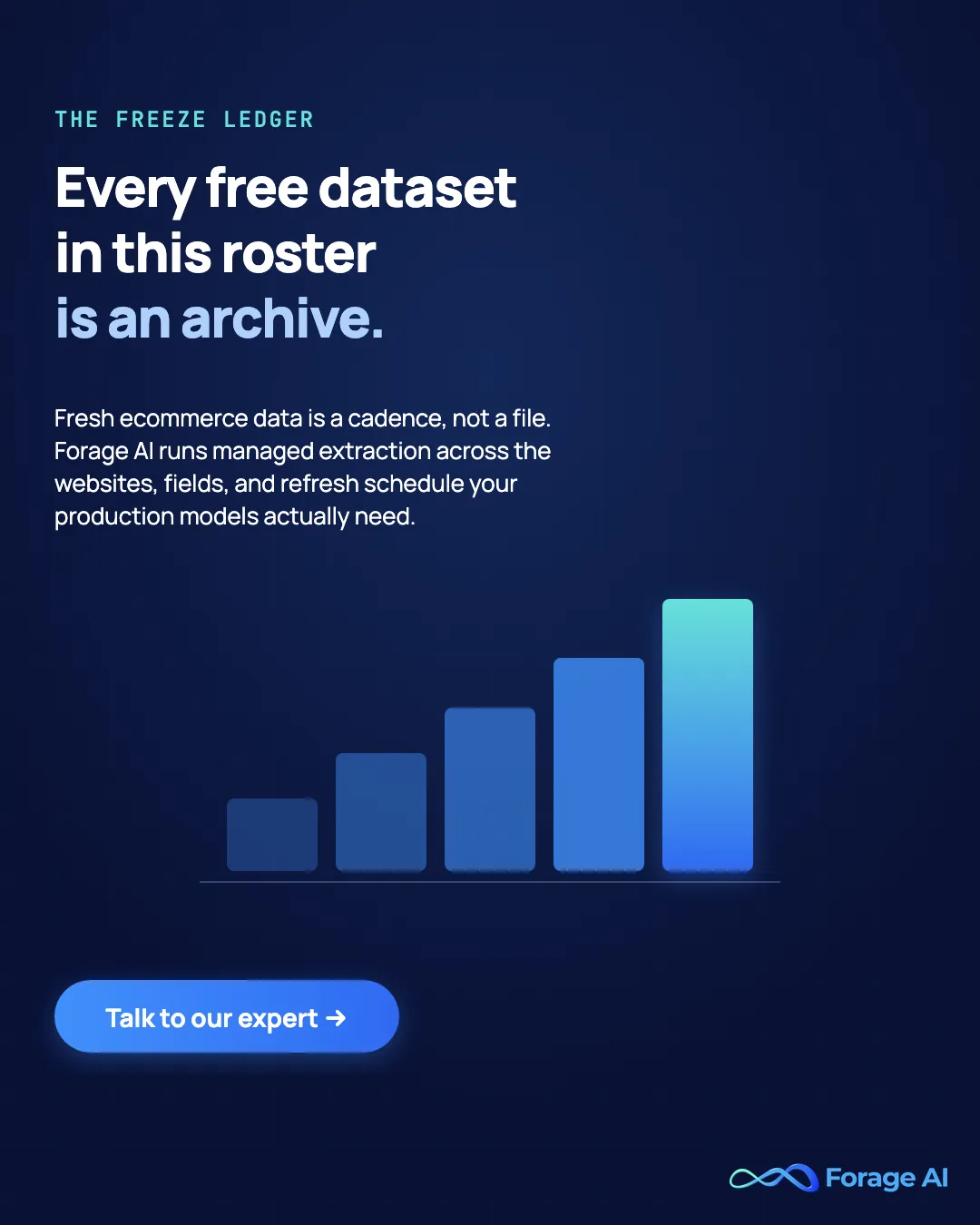
Read the master table as a freeze ledger: UCI 2011, Instacart 2017, Fashion-MNIST 2017 by design, Olist 2018, REES46 2020, ESCI 2022, OTTO 2023, Amazon Reviews September 2023, octaprice December 2025. The free ecosystem is an archive, full stop. That is not a criticism of the datasets; it is the operating constraint your sourcing plan has to absorb.
When Does a Static Dataset Stop Being Enough?
Every commercial page answers this in one line: “free data is outdated, buy data.” That is an assertion, not an argument, so here is the argument in five rungs. The Escalation Ladder decides when to climb, and each rung is priced by facts already printed above.
- Free static datasets. Prototyping and benchmarking: UCI, Retailrocket, Fashion-MNIST prove code and architecture cheaply.
- Modern academic corpora. Amazon Reviews 2023, ESCI, OTTO, ABO: pretraining and fine-tuning within license terms.
- Paid static datasets. Snapshots at roughly $0.0025 per record: scale and a defined schema, still frozen between refreshes.
- Subscription refreshed feeds. Recency at the cadence you pay for, history depth plan-gated (Similarweb’s 36-month gate).
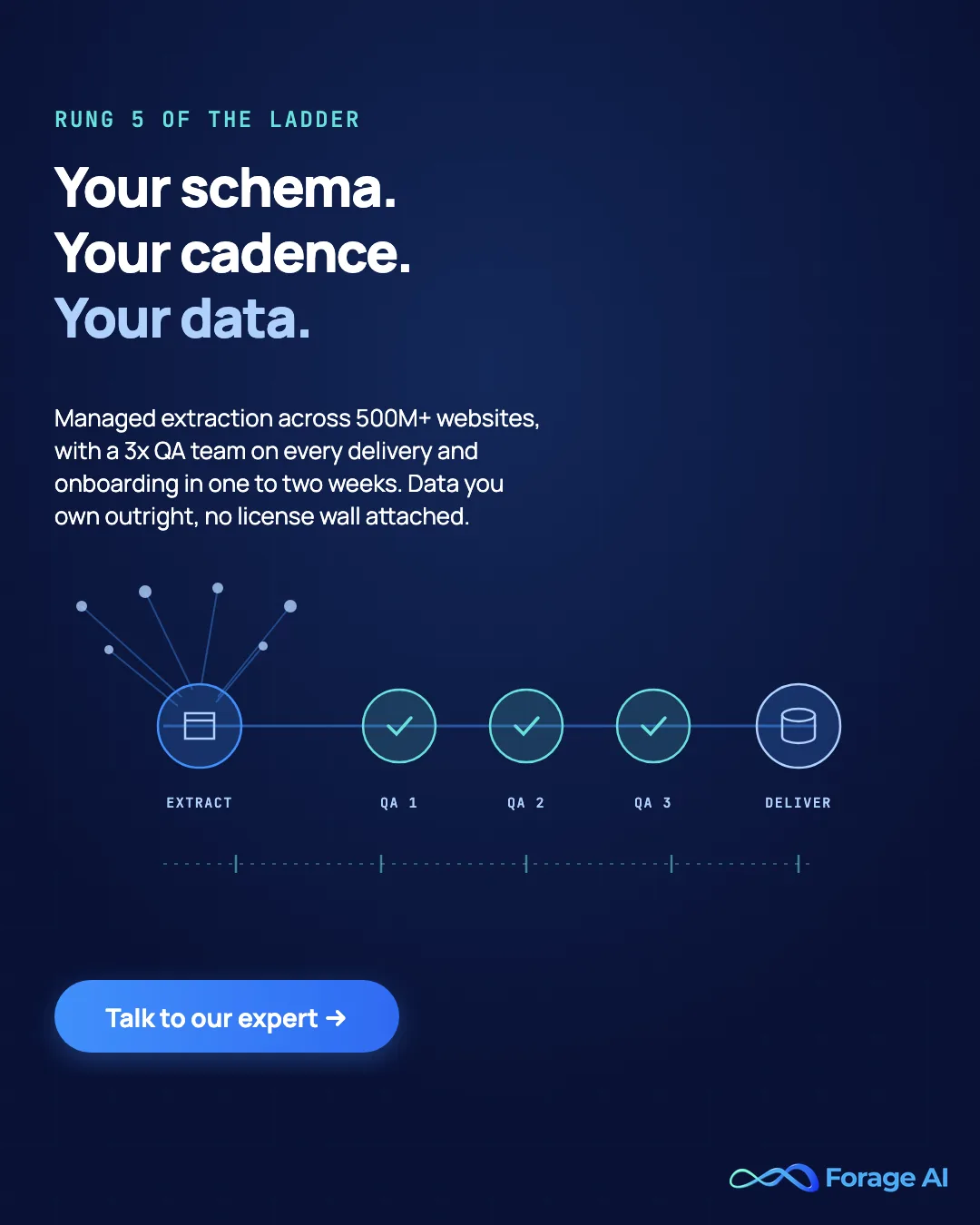
- Managed custom extraction. Your websites, your schema, your cadence, quality-assured continuously; for production models whose inputs cannot be someone else’s snapshot.
Climb a rung when one of four walls hits: drift in production metrics, a coverage gap on the websites or SKUs you need, a schema mismatch between vendor fields and your features, or a license wall blocking commercial use. Drift is the one with a number attached: in the first systematic study of AI aging, Vela et al. tested 4 standard ML models against 32 datasets across four industries, 128 (model, dataset) pairs, and “observed temporal model degradation in 91% of cases” (Scientific Reports, 2022). In production, drift is a when, not an if. That is why extracting ecommerce data at scale on a controlled cadence, or having a partner such as Forage AI run that extraction as a managed service, sits at the ladder’s top rather than as a vendor afterthought; the build vs buy decision up there deserves its own analysis.
Expert Insights
Vela et al. gave the failure mode its name: AI aging is “the complex, multifaceted phenomenon of AI model quality degradation as more time passes since the last model training cycle,” rooted in models being dependent on the data as it was at the time of training. A peer-reviewed way of saying every frozen dataset in this article has a shelf life for your use case, whether or not the file ever changes.
Paid datasets are not always fresh. Most paid products are still snapshots on a refresh schedule; freshness is the cadence you pay for, and the schema is fixed by the vendor. Buying data moves you up the ladder, it does not take you off it.
When Should You Use Managed Ecommerce Data Extraction?
Rung 5 made concrete. Managed Data Extraction means a team runs the pipeline for you: the websites you specify, a schema built for your features (price history, seller-level granularity, event timestamps), refreshed on your cadence, quality-assured on every run, and owned outright, with no redistribution clauses or non-commercial ambiguity attached.
That last property dissolves the license wall: half the free datasets above are blocked from commercial use or undated into uselessness, while extraction on your own behalf produces data whose terms you never re-audit. Forage AI operates in exactly this space: an end-to-end managed data pipeline that automates discovery, extraction, structuring, quality checks and delivery, built to your own fields and systems. It covers 500M+ websites, Forage AI handles selector drift, anti-bot evolution, and schema changes as part of the service, every delivery passes a 3x QA team, and onboarding takes 1-2 weeks.
Honest fit boundaries, because the ladder cuts both ways: managed extraction is overkill for prototyping and benchmarking, where static datasets remain the right tool. It is the right call when a production model needs fresh, governed inputs and one of the four walls has already cost an incident or a quarter of engineering time.
The field’s broader shift backs this ordering. Andrew Ng, launching the data-centric AI movement in 2021, put it in four words: “Data is food for AI,” arguing that practitioner focus belongs on training-data quality rather than model architecture, and observing at the time that 80% of an AI developer’s time goes to data preparation (a 2021 figure, cited as context, not a current survey number).
Frequently Asked Questions
Where can I find free ecommerce datasets?
Four hubs cover nearly everything: Kaggle, the UCI Machine Learning Repository, Hugging Face, and Google BigQuery public datasets, with Google Dataset Search for discovery and GitHub hosting the newer releases (ESCI, OTTO). The roster table earlier in this article lists 18 free entries.
Which ecommerce dataset is best for data analysis?
For a sales dashboard on real orders, Olist Brazilian E-Commerce: payments, reviews and geolocation in joinable tables, from 2016 to 2018. For SQL and CLV practice with no download, theLook eCommerce in BigQuery, which is synthetic. For RFM segmentation, UCI Online Retail. Check the window before you present any result as a market trend.
Can I use free ecommerce datasets commercially?
It depends entirely on the license, and the honest answer is usually no. ESCI (Apache-2.0), OTTO and ABO (CC BY 4.0), and UCI Online Retail (CC BY 4.0) permit commercial use. Instacart is explicitly non-commercial; Olist, Retailrocket, and Datafiniti’s pricing sample all carry CC BY-NC-SA 4.0 on their Kaggle pages; and plenty of uploads elsewhere state no license at all: a shipping risk, not a bargain. License terms also change; re-verify the current terms on the hosting page, and get a legal read, before shipping a commercial model.
Which ecommerce dataset is best for recommendation systems?
Amazon Reviews 2023 for scale and LLM-era text, OTTO for cleanly licensed real sessions, Retailrocket for a compact starter. Use the 2023 Amazon version specifically; the 2014/2018 versions are superseded.
Is the UCI Online Retail dataset good for demand forecasting?
For teaching RFM and market-basket analysis, yes. For production forecasting, no: it is a single UK gift retailer’s transactions from December 2010 to December 2011, collected fifteen years ago.
How much do paid ecommerce datasets cost?
Observed pricing (August 2026): marketplace rate cards around $250 per 100,000 records with refresh tiers from daily to one-time, and provider subscriptions from $59 to $1,000 per month per a 2026 provider roundup. Total cost scales with refresh cadence, so price the cadence, not the file.
Is the Amazon reviews dataset still available?
Yes. The current version is Amazon Reviews 2023 from the McAuley Lab, hosted on Hugging Face via load_dataset. The 2014 and 2018 versions still circulate but are superseded, with duplicate and leakage issues fixed only in the 2023 refresh.
How much data do you need to train an ecommerce ML model?
Task-dependent, so beware any single number. Classical classifiers work on tens of thousands of labeled rows; sequence recommenders want millions of events; LLM fine-tuning consumes billions of tokens. Size the dataset to the task, then validate against a held-out time window, not just a held-out sample.
How Often Should You Re-Source Datasets?
You now hold the two artifacts this article promised: a Six-Field Spec Card for every dataset worth considering, and an Escalation Ladder for the day the cards stop being enough. The uncomfortable part is the sustainability turn: datasets freeze and models age, with temporal degradation observed in 91% of tested model-dataset pairs. Sourcing is a cadence, not a one-time pick, so put a re-audit on the calendar: re-check the windows, licenses, and links your models train on, on a schedule, the way you patch dependencies.
Apply the six fields to the next dataset you download, whoever recommends it. And when you hit one of the four walls, that is the point where the ladder runs out of files and the data needs extracting fresh. That is the work Forage AI’s ecommerce data service exists for. Talk to our expert.
Related Articles
- AI Training Data: The Operational Playbook – What to do with a dataset after sourcing: validation, labeling QA, and drift management.
- Ecommerce Data Scraping at Scale – Pipeline architecture for extracting fresh ecommerce data across 1M+ SKUs.
- Top Ecommerce Data Providers: How to Evaluate – The provider-side companion when no static dataset fits.
- Data Quality Framework & Quality Checklist for External Sources – How to vet any third-party dataset before training on it.
- AI Training Data Providers: How to Evaluate the Top Vendors – Cross-vertical vendor evaluation for teams outgrowing free datasets.
Sai is a data infrastructure enthusiast who has spent the past two to three years following the AI space closely, from the infrastructure layer to the fast-growing world of data for AI. He is genuinely curious about how modern data pipelines get built and where the data industry is heading, and he writes insightful pieces on the core topics that shape this niche.