
Data Quality Framework & Quality Checklist for External Sources
Every data team we have worked with trusts a green dashboard longer than it should. The scrape job exits zero, the batch passes schema validation, the feed looks healthy, and everyone moves on. Then a customer asks why a product marked in stock has been back-ordered for a week, and you trace it to the source: it quietly relabeled the field, the selector still matched, and none of your checks noticed. That is the gap a generic data quality framework was never built to close, because it assumes you own the system producing the data. With external data, you do not. The source can restructure overnight, and a scrape can succeed while returning the wrong values.
Here is the honest part. The frameworks most teams inherit were written for internal data, where “is the pipeline up” is a fair proxy for “is the data right.” External data severs that link. Only 3% of data meets basic quality standards even when an organization owns it (HBR, 2017); for data you scrape from a source you do not control, the floor is lower and the failures are quieter.
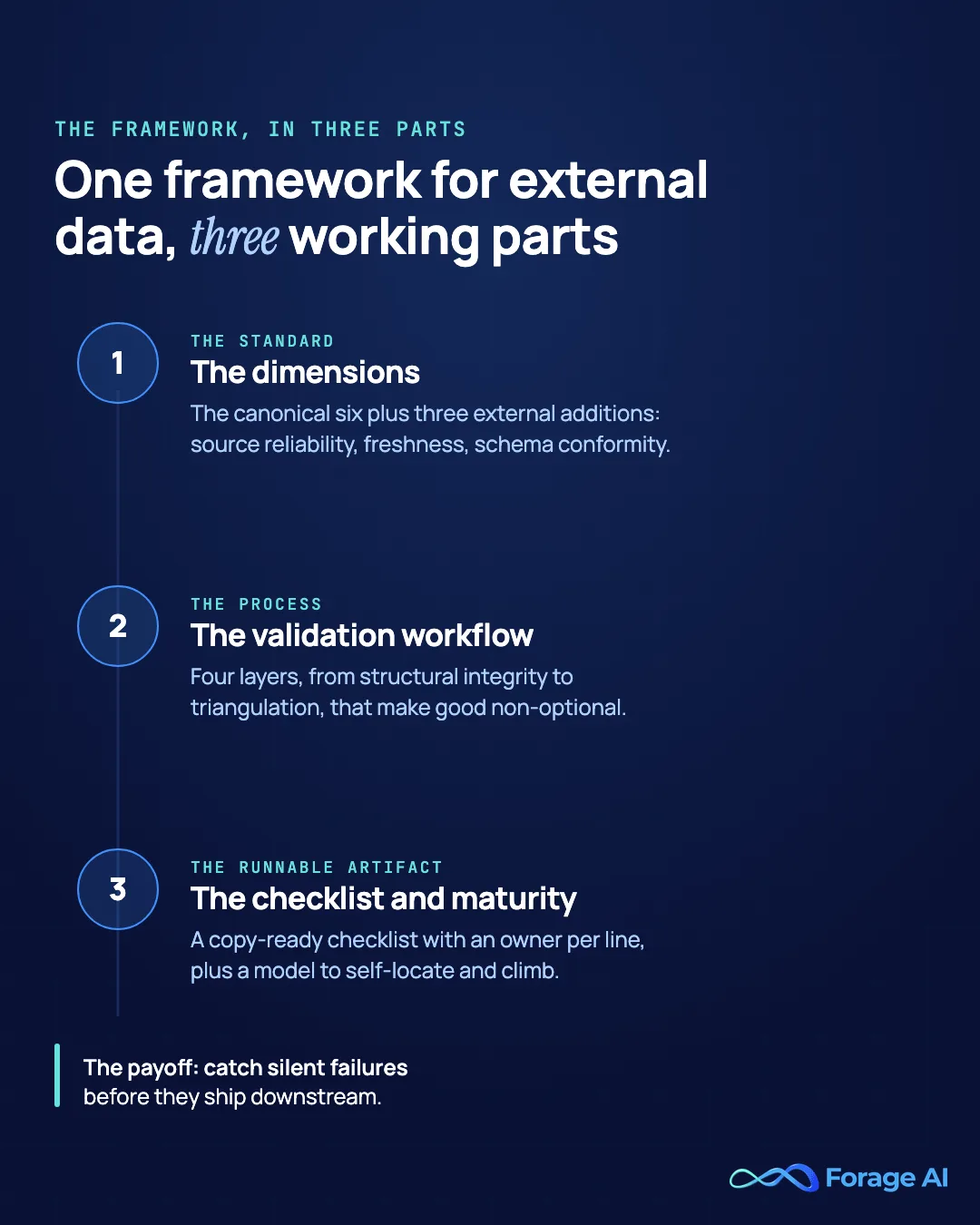
So we have built this as a framework you can actually run, in three parts: the quality dimensions re-scoped for sources you do not control, a validation workflow that turns them into enforceable checks, and a web scraping checklist you can apply to a dataset this week. Along the way we name the silent failure modes the generic guides skip, because you cannot catch what you refuse to look at. By the end, you will catch a silent failure before it ships downstream, not three days after a customer does.
Quick Digest
- What a DQ framework is and why external needs its own: A data quality framework is the standard you measure (the dimensions) plus the process you enforce (validate, monitor, remediate); external data needs its own because generic frameworks assume you control the source, and you do not.
- The dimensions re-framed for external data: The canonical six (accuracy, completeness, consistency, timeliness, validity, uniqueness) plus three external-only additions: source reliability, freshness, and schema conformity, each one re-scoped for a source that mutates.
- Why external data fails quality silently: A scrape can finish successfully while returning plausible-but-wrong data: selectors stay valid while meaning shifts, dynamic content loads partially, and timeouts insert fallback values, all behind a green dashboard.
- The validation workflow: Turn each dimension into an enforceable check across four layers (structural integrity, distributional drift, coverage, triangulation), set confidence thresholds, route low-confidence records to human review, and send failures to a dead-letter queue.
- The web scraping data quality checklist and maturity model: A copy-ready checklist (check, what to verify, threshold, owner) plus a four-level maturity model so you can self-locate from descriptive to prescriptive.
What Is a Data Quality Framework?
A data quality framework is two things working together: the standard (the dimensions you hold data to) and the process (measure, validate, monitor, remediate) that keeps data at that standard over time. It is not a one-time audit. It is the continuous machinery that decides whether a given record is fit to ship.
Expert Insights
“Poor quality data is troublesome. Bad data wastes time, increases costs, weakens decision making, angers customers, and makes it more difficult to execute any sort of data strategy.” Thomas C. Redman, President, Data Quality Solutions (Harvard Business Review, 2017).
The authoritative standards define the bar. ISO 8000-1:2022 defines quality data as “portable data that meets stated requirements.” ISO/IEC 25012 defines data quality as “the degree to which the characteristics of data satisfy stated and implied needs when used under specified conditions,” and splits quality into inherent characteristics (accuracy, completeness, consistency, credibility, currentness) and system-dependent ones (availability, portability, recoverability). Both definitions hinge on the same phrase: stated requirements. Quality is not an absolute property of the data. It is the fit between the data and what you stated you needed.
That phrasing is exactly where external data diverges from everything the generic frameworks assume. When you control the producer, your stated requirements and the source’s behavior are the same conversation. When the producer is a website you scrape, they are not. The source has its own requirements, its own release schedule, its own redesign roadmap, and none of them are yours. The producer can change without notice, and your stated requirements are still yours to enforce, not theirs to honor. A framework that treats the source as cooperative breaks on contact with a source that is merely present.
This is also why “fitness for use” is not a synonym for “accurate.” ISO 8000 ties quality to your stated requirements, and accuracy is only one dimension among several. A record can be perfectly accurate against the source and still be unfit, because it is stale, because a whole segment is missing, or because the field no longer means what your downstream system thinks it means.
The rest of this article is that framework, in three parts: the data quality dimensions re-framed for external data, the silent failure modes that break them, and the validation workflow and checklist that enforce them. We have worked with data teams whose extraction layer was solid and whose quality layer still assumed a source they controlled. Closing that gap starts upstream, at how extraction works (data extraction automation), and continues into the monitoring layer (data observability for third-party datasets), which is where this framework gets enforced in production.
The Data Quality Dimensions, Re-Framed for External Data
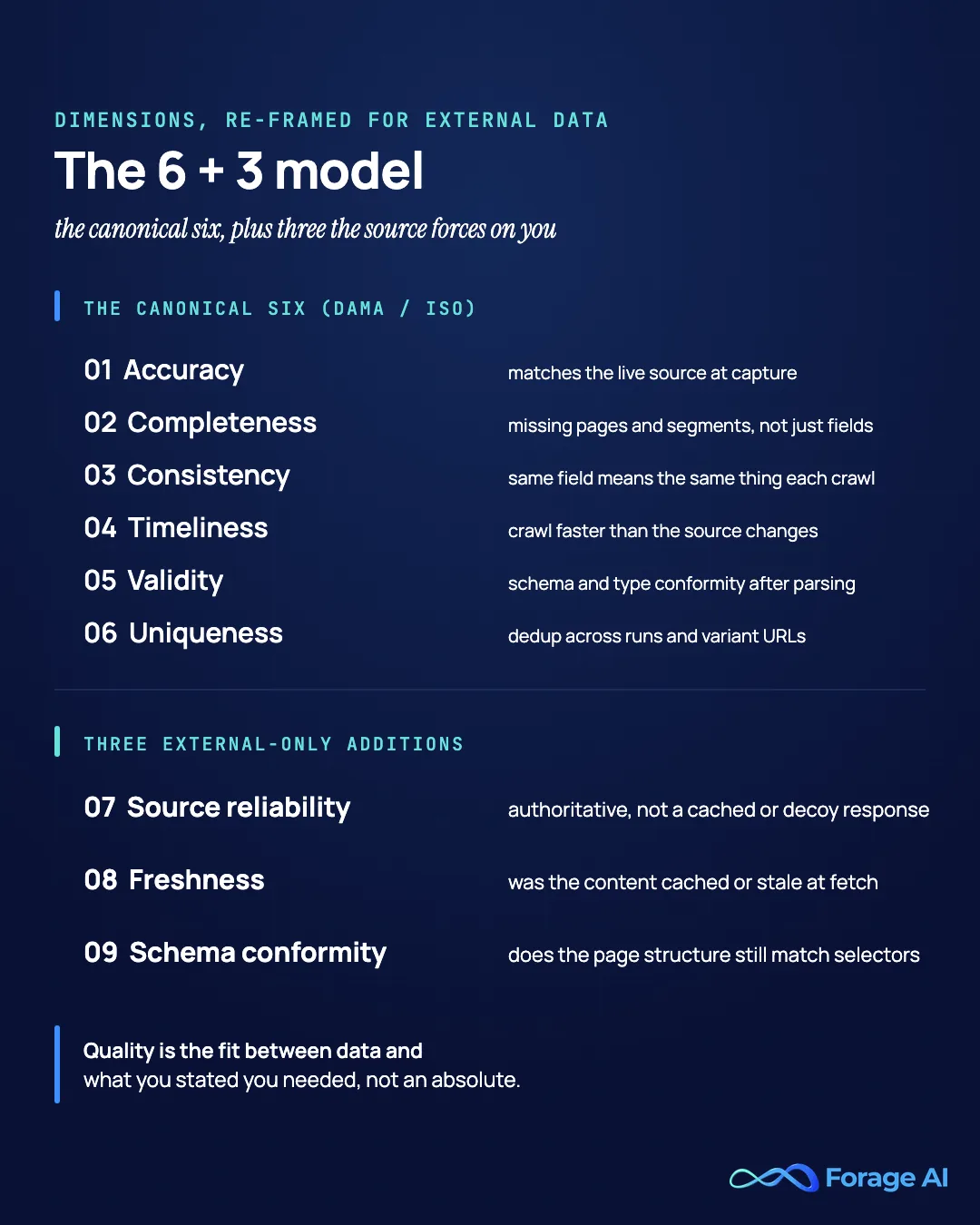
The dimensions are the measurable spine of the framework. The canonical set is the DAMA UK six: accuracy, completeness, consistency, timeliness, validity, and uniqueness, established in the 2013 working-group paper and echoed by DAMA-DMBOK and mainstream tooling. For external data, those six need re-scoping, and they need three additions: source reliability, freshness, and schema conformity. That is the 6 + 3 model.
Expert Insights
The two definitional anchors for this section are standards bodies, not vendors. DAMA UK’s “Six Primary Dimensions for Data Quality Assessment” (2013) supplies the canonical name set, and ISO/IEC 25012 supplies the quotable definitions for accuracy, completeness, and consistency. Pairing the DAMA name list with ISO/IEC 25012 wording keeps every dimension traceable to an authoritative source rather than a tool vendor’s blog.
The definitions stay grounded in the standards. ISO/IEC 25012 defines accuracy as “the degree to which data has attributes that correctly represent the true value of the intended attribute,” completeness as “the degree to which subject data associated with an entity has values for all expected attributes and related entity instances,” and consistency as “the degree to which data has attributes that are free from contradiction and are coherent with other data in a specific context of use.” What changes is what each one means when the source is external and, often, adversarial.
| Dimension | What it means (DAMA / ISO) | What it means for external data | How to check it |
|---|---|---|---|
| Accuracy | Values correctly represent the true value of the intended attribute | Does the scraped value match the live source at capture time, not just look valid | Spot-check against ground truth; canary pages with known values |
| Completeness | All expected attribute values and entity instances are present | Field-level, record-level, and page-level (did pagination capture every record) | Null rate per field and per segment; known-universe recall |
| Consistency | Values are free from contradiction across records and datasets | Schema stability across runs; same field means the same thing each crawl | Drift detection on selector output and field semantics |
| Timeliness | Data represents reality from the required point in time | Is the crawl cadence faster than the source’s change rate | Time since last successful refresh vs a defined SLA |
| Validity | Values comply with defined rules and types | Schema and type conformity after parsing | Type and range assertions before storage |
| Uniqueness | Records occur only once in a data file | Dedup across crawl runs and across variant or mirrored URLs | Canonicalize variants; cross-source dedup key, not URL alone |
| Source reliability | (external addition) | Is the source authoritative and non-spoofed, not a cached or decoy response | Provenance tracking; verified-source signals |
| Freshness | (external addition) | Was the content cached or stale at fetch | Capture-timestamp guard; stale-content detection |
| Schema conformity | (external addition) | Does the page structure still match the selectors you rely on | Selector-success rate; DOM fingerprinting |
A few of these re-frames carry the weight. Accuracy stops meaning “valid-looking” and starts meaning “matches the live source at the moment of capture.” Timeliness becomes a race condition: if the source changes faster than you crawl, your freshest record is already wrong. Uniqueness stops being dedup within one table and becomes dedup across runs and across variant URLs, which is its own depth (AI-powered entity matching handles the hard cases). And consistency becomes a drift problem, because the same selector can return a field whose meaning has quietly changed.
One trap deserves its own flag. Global completeness can read fine while a single segment is severely null. A 2% null rate across a million records looks healthy until you notice that the 2% is 80% of one region, because a proxy pool for that geography started getting blocked. Measure completeness per segment, not just globally, or clustered missing data hides in the average.
Quick Summary
Q: Which quality dimensions apply to data you did not produce?
A: The canonical DAMA UK six still apply, but three of them change meaning and three more have to be added. Accuracy stops meaning valid-looking and starts meaning it matches the live source at the moment of capture. Completeness has to be measured per segment, not globally, because a dataset can read 98% complete while one segment is almost entirely null. Uniqueness becomes an entity resolution problem once the same record arrives from several sources under different names. On top of those six, external data needs source reliability, freshness against a stated staleness budget, and schema conformity at the source boundary, because the site you are reading from can change its structure without telling you.
Why Does External Data Fail Quality Checks Silently?
External data fails silently because a scrape can succeed at the infrastructure level while failing at the data level, and almost nothing in a standard pipeline distinguishes the two. The job returns a 200, exits zero, writes rows, and the rows are wrong. These are the failures that matter, because the loud ones already have alerts.
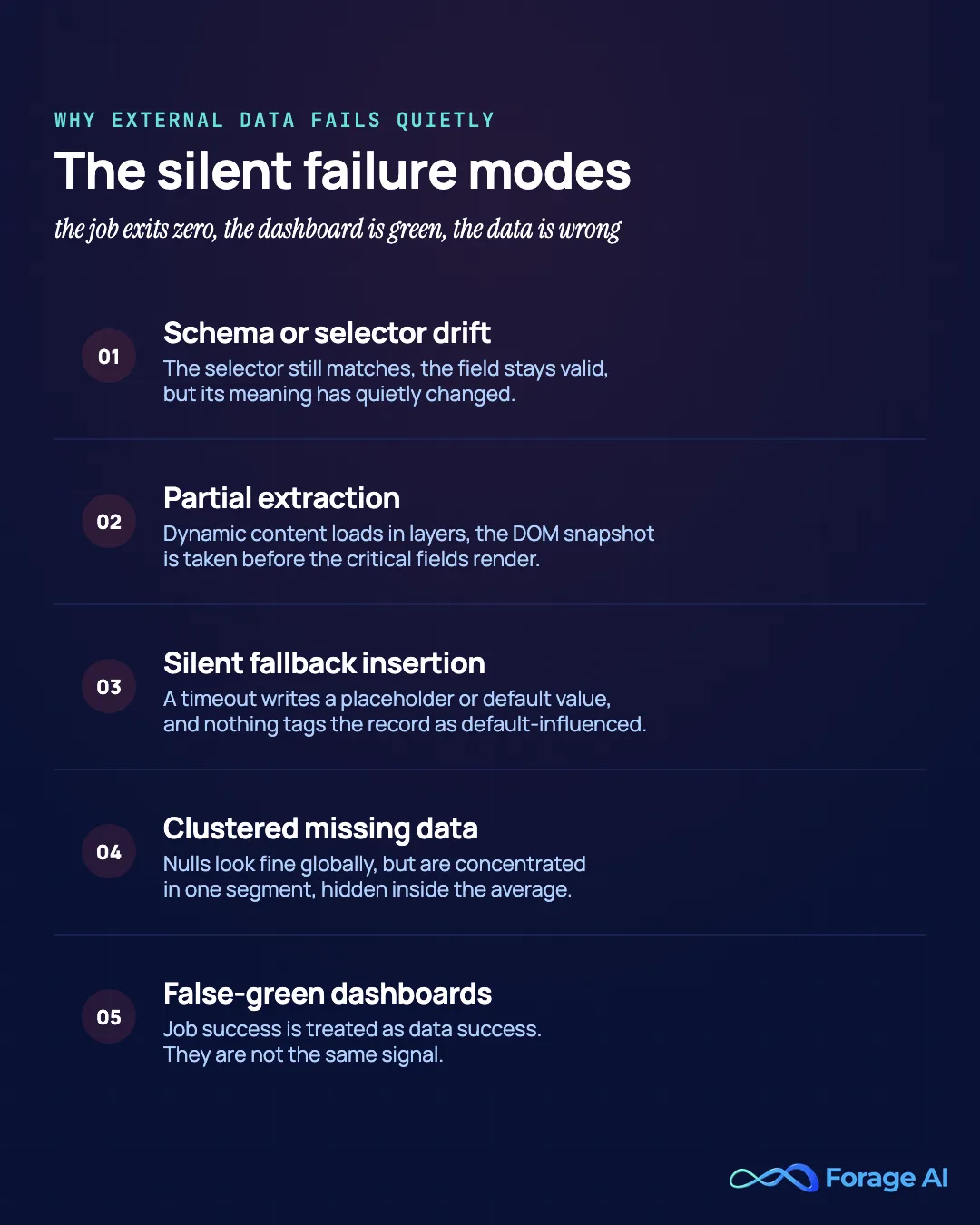
The failure modes cluster into a small taxonomy worth knowing by name:
- Silent schema or selector drift. The site reorganizes, your selector still matches something, and the field stays valid while its meaning changes. Fields stay valid, yet accuracy has been compromised.
- Partial or silent extraction. Dynamic content loads in layers. Your snapshot of the DOM is taken before the critical fields render, so the record looks complete and is not.
- Silent fallback insertion. A timeout triggers recovery logic that writes a placeholder or default, and nothing tags the record as default-influenced.
- Clustered missing data. Nulls look fine globally and are concentrated in one segment, hidden by the average.
- False-green dashboards. Job success is treated as data success. They are not the same signal.
- Regional variance from proxy rotation. Geo-dependent content from different exit nodes lands in a single record.
- Near-duplicates. URL-based dedup misses variant pages and ID changes.
- Anti-bot-induced gaps. Blocking produces missing rows that look like genuine absence in the source.
- Semantic inversion. The selector keeps its name, but the labeled field now means something else.
The reason type checks alone cannot catch these is that the data is structurally correct. A price is still a positive number; a title is still a non-empty string. What broke is semantic, not structural, and a schema validator has nothing to assert against. The practical consequence shows up in detection lag: industry monitoring research from 2026 finds that field-level scraping failures (selector degradation, schema drift, partial loads, stale content) are typically discovered three to five days later through downstream reporting discrepancies, versus minutes for outright infrastructure failures.
That lag is the whole danger. A job that exits zero with a green dashboard is not proof of correct data; it is proof the process ran. The most expensive failures are the ones that look like success. Treat schema drift as an incident, not as normal web variability, and the engineering root cause sits one layer down (why most enterprise data pipelines break and how to fix it), with detection living in the monitoring layer (data observability for third-party datasets).
One mitigation worth naming here is method diversity. When a single selector is the only path to a field, its silent failure is total. We run multi-method extraction at Forage AI (XPath, NLP, and ML in parallel) so that when one method’s selector breaks without erroring, the others cross-check it and the disagreement surfaces the drift instead of burying it.
How Do You Validate External Data Against the Framework?
You validate external data by turning each dimension into an enforceable check and arranging those checks into four layers, then deciding what happens when a check fails. The dimensions tell you what good looks like. The workflow is what makes “good” non-optional before data ships.
The four layers stack from cheap-and-structural to expensive-and-semantic:
- Structural integrity. Schema enforcement before storage: required fields present, types stable, nesting controlled, plus selector-stability monitoring and DOM fingerprinting. This catches the breaks.
- Distributional drift. Watch mean, variance, quantiles, and entropy on key fields, plus logical constraints across fields (price versus availability). This catches the shifts that pass structural checks.
- Coverage and representativeness. Known-universe recall (are the entities you expect present at the rates you expect), meaningful-extraction rate, and source-concentration risk. This catches the gaps.
- Canaries and triangulation. Stable known-value pages, invariants, and manual spot checks against ground truth. This catches the semantic inversions nothing else can.
Each layer needs thresholds, and thresholds are a tuning problem, not a constant. A workable starting point: require confidence of at least 95% for critical or financial fields, at least 90% for operational fields, and flag anything below 85% for review. Set them too loose and bad data passes; set them too strict and the team drowns in false positives and learns to ignore the queue. Start conservative on the critical fields and tune from there.
The structural layer is the one you can make executable today. A Great Expectations assertion suite turns the dimensions into runnable thresholds and gives you a clean place to branch into human review:
# A data-quality contract for a scraped product feed.
# Each assertion is a threshold/rule the pipeline enforces before data is "accepted".
import great_expectations as gx

batch = gx.read_csv("scraped_products_2026-06-29.csv")

# Completeness: price must be present in >=99% of rows (silent-truncation guard)
batch.expect_column_values_to_not_be_null("price", mostly=0.99)

# Validity: price is a positive number within a sane range (selector-drift guard)
batch.expect_column_values_to_be_between("price", min_value=0.01, max_value=100000)

# Uniqueness: no duplicate product IDs across the crawl (dedup guard)
batch.expect_column_values_to_be_unique("product_id")

# Schema conformity: expected columns exist & types hold (schema-drift guard)
batch.expect_table_columns_to_match_set(
 column_set=["product_id", "title", "price", "currency", "in_stock", "scraped_at"]
)

# Freshness: capture timestamp is within the last 24h (stale-content guard)
batch.expect_column_max_to_be_between("scraped_at", min_value="2026-06-28T00:00:00Z")

results = batch.validate()
# results.success == False -> route batch to HITL review, do not publish
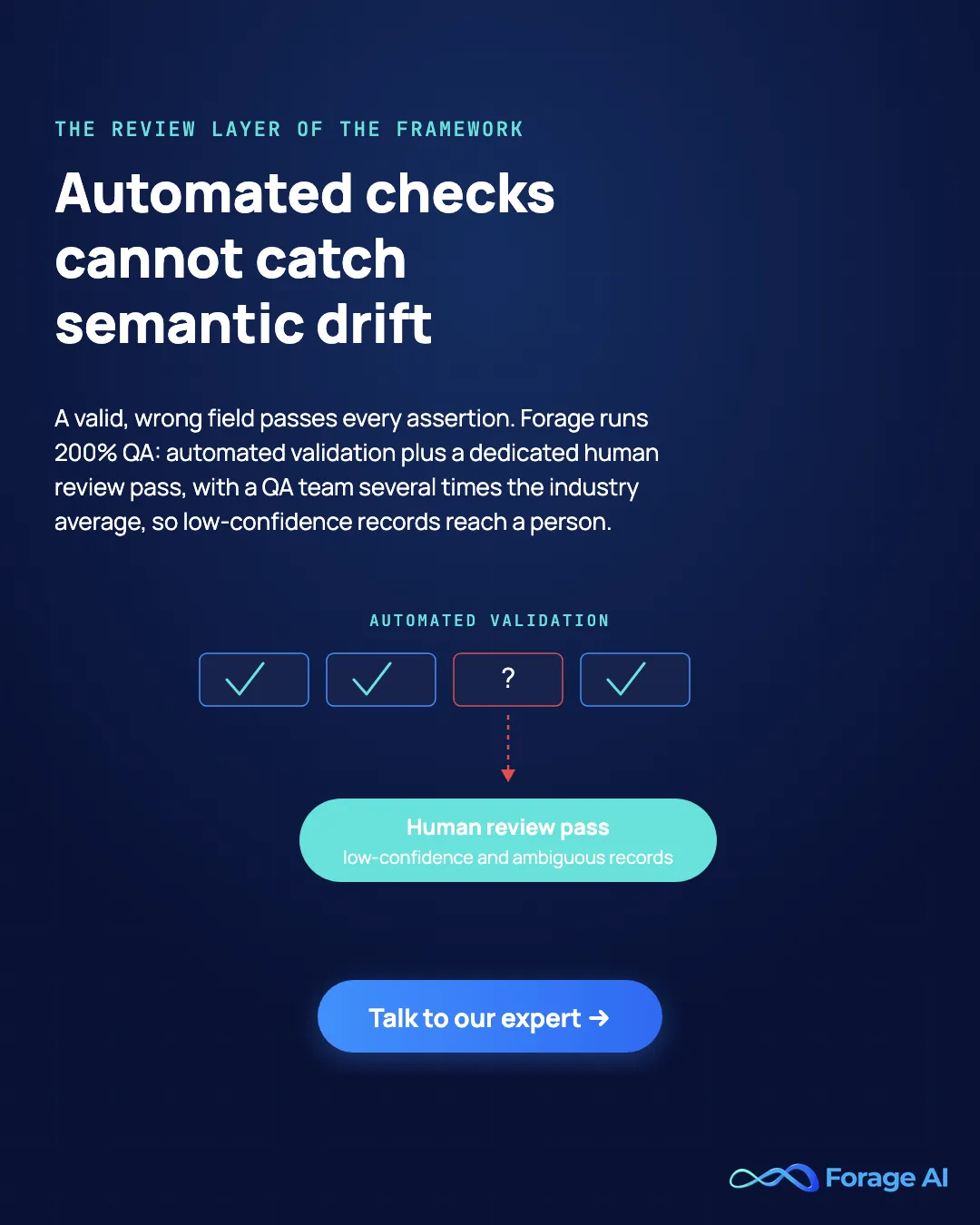
The last line is the one that matters most. Automated checks catch structural and distributional breaks, but they cannot catch semantic drift, the case where every assertion passes and the meaning is still wrong. That is what a human-in-the-loop layer is for, and it is the part teams skip because it does not automate cleanly. This is the strongest place the framework meets real operations: at Forage AI we run what we call 200% QA, automated validation plus a dedicated human review pass, with a QA team several times the industry-average size, precisely because low-confidence and ambiguous records need a person, not just a rule, the same reasoning that leads teams evaluating data annotation providers to weigh review capacity alongside throughput (human-in-the-loop data extraction covers the review layer in depth).
The other non-negotiable is the failure path. When a record fails, do not silently drop it. Route it to a dead-letter queue, which turns silent corruption into a loud, observable, recoverable event you can inspect and replay. The cost of getting detection wrong is measurable: a 2026 web-scraping monitoring analysis reports average time-to-resolution rising to roughly 15 hours per data incident, with most respondents reporting time-to-detection of four hours or more. Continuous enforcement of these checks is the monitoring layer’s job (data observability for third-party datasets).
Quick Summary
Q: How do you validate external data against the framework?
A: Turn each dimension into an enforceable check across four layers: structural integrity (schema and types before storage), distributional drift (watch for shifts, not just breaks), coverage (known-universe recall), and triangulation (canaries and spot checks). Set confidence thresholds, route low-confidence records to human review, and send failures to a dead-letter queue instead of silently dropping them.
The Web Scraping Data Quality Checklist (and a Maturity Model)
This is the payoff: a checklist you can run against a dataset, and a maturity model so you know where you stand. The checklist makes the dimensions concrete, gives each one a threshold, and assigns each one an owner, because a check no one owns is theater.
| Check | What to verify | Threshold / Target | Owner |
|---|---|---|---|
| Field completeness rate | Null or empty rate per mandatory field and per segment | <1% on critical fields; no segment >3x global rate | Data engineer |
| Schema / type validation | Required fields present, correct types, value ranges, before storage | 100% of records conform or route to DLQ | Data engineer |
| Confidence thresholds | Extraction confidence per record | >=95% critical, >=90% operational, flag <85% | QA lead |
| Drift detection | Selector success rate and fallback usage trend | Selector success >=99%; alert on any fallback spike | Data engineer |
| Freshness SLA | Time since last successful refresh, per source | Within the SLA defined for that source | Data ops |
| Source coverage | Known-universe recall against expected entities | >=98% of expected key entities present | Data analyst |
| Cross-source and variant dedup | Canonicalize variant URLs and ID changes, not URL key alone | <0.5% duplicate rate post-canonicalization | Data engineer |
| Spot-check / canary sampling | Manual sample and canary pages vs known expected values | 100% canary pass; sample error rate within tolerance | QA lead |
| Fallback transparency | Records influenced by defaults are tagged and tracked | Every default-influenced record flagged | Data engineer |
| Remediation discipline | Every failing check has an owner, deadline, success criteria | No open failure without an owner | Team lead |
Make the checklist machine-enforceable by attaching QA metadata to every record. The pattern below carries confidence, source reliability, freshness, and review status on each record, so the checklist is not a document the team consults but a contract the data carries:
{
 "$schema": "http://json-schema.org/draft-07/schema#",
 "title": "ScrapedRecordWithQA",
 "type": "object",
 "required": ["product_id", "title", "price", "scraped_at", "_qa"],
 "properties": {
 "product_id": { "type": "string", "minLength": 1 },
 "title": { "type": "string", "minLength": 1 },
 "price": { "type": "number", "exclusiveMinimum": 0 },
 "currency": { "type": "string", "pattern": "^[A-Z]{3}$" },
 "scraped_at": { "type": "string", "format": "date-time" },
 "_qa": {
 "type": "object",
 "required": ["source_reliability", "extraction_confidence", "schema_version", "review_status"],
 "properties": {
 "source_reliability": { "type": "number", "minimum": 0, "maximum": 1 },
 "extraction_confidence": { "type": "number", "minimum": 0, "maximum": 1 },
 "freshness_hours": { "type": "number", "minimum": 0 },
 "schema_version": { "type": "string" },
 "review_status": { "enum": ["auto_passed", "hitl_pending", "hitl_approved"] }
 }
 }
 }
}
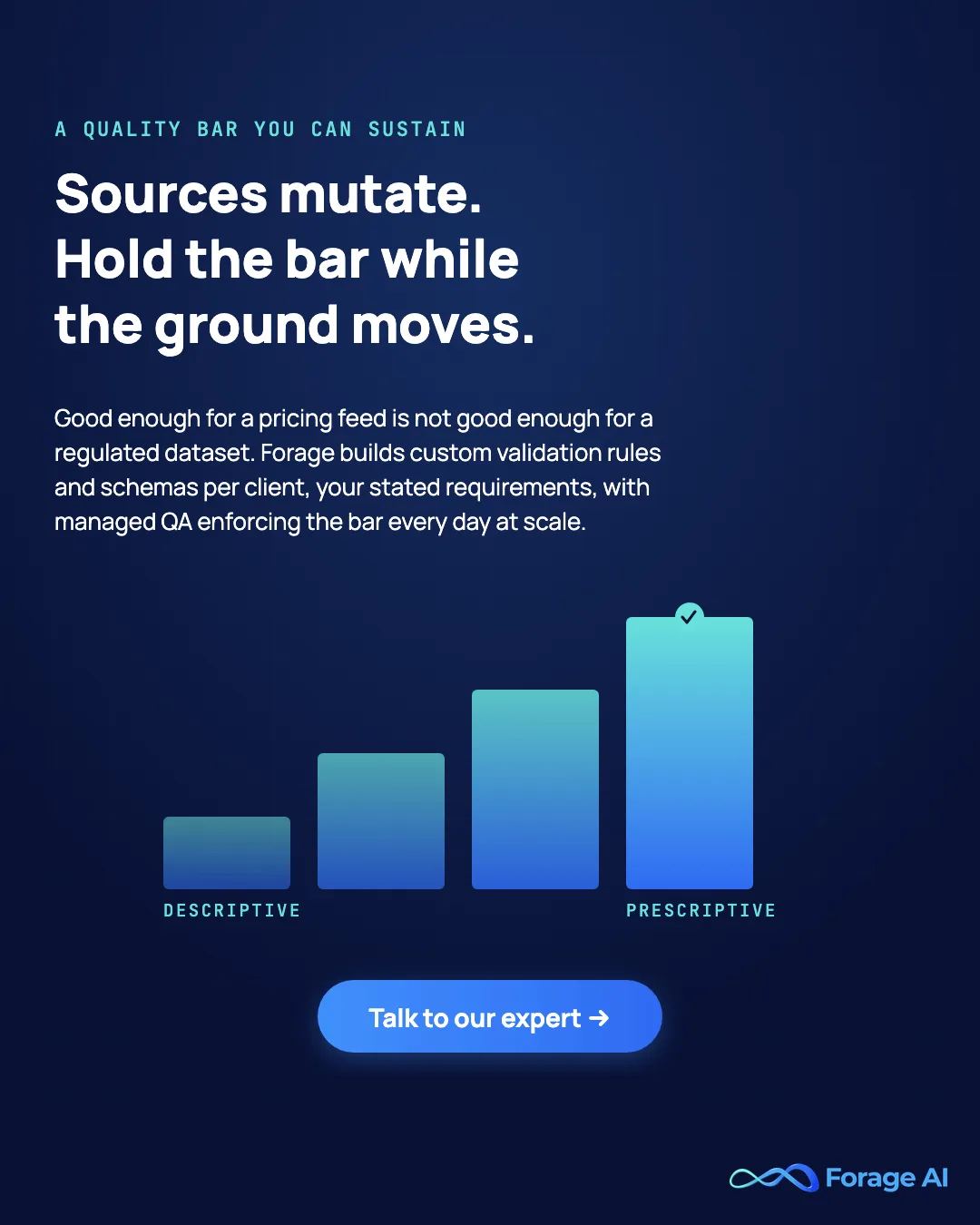
The maturity model tells you which version of this you can realistically run. Most teams start lower than they think: as of 2026, a widely-cited Gartner figure puts the share of organizations that do not measure their data quality at 59%, which is the definition of the lowest tier. The four levels, adapted from the DQOps maturity model for external data:
| Level | What it looks like |
|---|---|
| 1. Descriptive | Rule-based checks and schema contracts; you measure what broke after the fact |
| 2. Diagnostic | Profiling and statistical root-cause; you can explain why a field drifted |
| 3. Predictive | Models anticipate drift and freshness decay before downstream impact |
| 4. Prescriptive | Automated remediation, self-calibrating thresholds, HITL on low-confidence only |
Start at the critical fields with conservative thresholds, get to descriptive reliably, then climb. Skipping tiers does not work; predictive drift detection on data you are not yet measuring is just a more expensive way to be wrong.
One practical note on the checklist itself: the thresholds and the required fields are not universal, they are your stated requirements, which is exactly the ISO 8000 framing of quality data. We build custom validation rules and schemas per client for that reason, because “good enough” for a pricing feed is not “good enough” for a regulated dataset, and neither bar matches what a property underwriting model needs (our 2026 breakdown of commercial real estate data tools works through that case). Operationalizing this as continuous monitoring is the observability layer’s job (data observability for third-party datasets), and the sibling evaluation checklist for buyers lives in the data extraction enterprise evaluation checklist.
What Does Poor External Data Quality Cost?
It costs more than the checks do, which is the entire business case in one sentence. The fresh, neutral numbers set the scale: in 2024 data-integrity research from Drexel LeBow, a US business school, and Precisely, 67% of organizations say they do not fully trust the data they use, 64% cite data quality as their top data-integrity challenge (up from 50% in 2023), and only 12% say their data is of sufficient quality and accessibility for AI.
The older, larger anchors give the macro picture. Gartner’s widely-cited estimate puts the average cost of poor data quality at $12.9 million per organization per year (2020). IBM estimated bad data costs the US economy roughly $3.1 trillion per year (2016). These are context, not current-year primaries, but they have not been displaced in scope.
The reason external data makes this worse is the silent-failure dynamic from earlier: bad external data does not announce itself, so the cost is paid downstream, late, and compounding. A wrong field flows into a decision, a model, or a customer report, and the bill arrives weeks later as a discrepancy nobody can immediately trace. Measuring is the first move, which loops back to the maturity model, and quality at the source is what makes data fit for the models built on it (quality over quantity in AI training data). The dimensions hold at volume, too; we apply them across 500M+ sites crawled, which is the test of whether a framework survives production rather than a slide.
“On average, 47% of newly-created data records have at least one critical (e.g., work-impacting) error, and only 3% of the data quality scores [were] rated ‘acceptable’ using the loosest-possible standard.” Tadhg Nagle (Cork University Business School), Thomas C. Redman (Data Quality Solutions), and David Sammon (Cork University Business School), Harvard Business Review, 2017.
Build a Quality Bar Your Team Can Sustain
The goal is not a perfect one-time audit. Sources mutate, selectors drift, and a dataset that passed every check last quarter will fail in ways you have not seen yet. What a framework buys you is a quality bar your team can hold while the ground keeps moving: dimensions re-scoped for data you do not control, a vocabulary for the silent failures, a workflow that makes the checks non-optional, and a checklist with an owner on every line. Pick the three or four checks that protect your most critical fields, set conservative thresholds, give each one a name and a deadline, and run them this week. Then climb. The teams that sustain data quality on external sources are not the ones with the most elaborate framework; they are the ones whose framework is small enough to actually run every day and honest enough to surface what broke. If you are building that bar and want to compare notes on what holds up at scale, that conversation is one we are always glad to have.
Frequently Asked Questions
What is the difference between data quality and data governance?
Data quality is one knowledge area within the broader data governance umbrella, as framed by DAMA-DMBOK. Governance sets the policies, ownership, and standards across all data; data quality is the specific discipline of measuring and enforcing whether data meets those standards. For external data, governance decides who owns source reliability and remediation, while quality is the day-to-day measurement against your stated requirements.
Which data quality dimensions matter most for scraped data?
Freshness, schema conformity, and source reliability, on top of the canonical six. These three are the external-only additions because they address the realities a controlled internal source never forces on you: content that goes stale against a mutating source, page structure that breaks your selectors, and a source whose authenticity you cannot assume. The canonical six still apply, but these three are what generic frameworks leave out.
How do you measure data quality?
Turn each dimension into a metric with a threshold: a completeness rate per field and segment, a validity percentage from schema and type checks, a freshness SLA per source, and a confidence score per record. Then enforce those thresholds in the pipeline before data ships, and route anything below threshold to review. The checklist earlier in this article is the runnable version of this.
How much does poor data quality cost?
Gartner’s widely-cited estimate is about $12.9 million per organization per year (2020), and only around 3% of data meets basic quality standards according to 2017 Harvard Business Review research. More recently, 67% of teams say they do not fully trust their data (Drexel LeBow and Precisely, 2024). For external data the cost is higher in practice because the failures are silent and surface downstream.
How do data marketplaces ensure data quality?
Marketplaces lean on validation checks and quality scores, provenance and verified-seller signals, sample or preview access before purchase, and sometimes third-party certification. All of these map to the source-reliability dimension, which is the external-data buyer’s hardest problem: you are trusting quality you did not produce and cannot fully inspect. Treat marketplace quality signals as inputs to your own source-reliability check, not as a substitute for it.
Related Articles
- Data Observability for Third-Party Datasets: The monitoring and alerting layer that enforces this framework in production.
- Why Most Enterprise Data Pipelines Break and How to Fix It: The engineering root causes behind silent extraction failures.
- Human-in-the-Loop Data Extraction: The human review layer that catches semantic drift type checks miss.
- Data Extraction Automation: How the upstream extraction layer works, before quality enters the picture.
S
Written by
Sai Subramaniam
Data Infrastructure Enthusiast, Forage AI
Sai is a data infrastructure enthusiast who has spent the past two to three years following the AI space closely, from the infrastructure layer to the fast-growing world of data for AI. He is genuinely curious about how modern data pipelines get built and where the data industry is heading, and he writes insightful pieces on the core topics that shape this niche.
Reviewed by the team of experts at Forage AI for accuracy and clarity.