
Scale AI Alternatives When You Need Sourcing, Not Annotation
Vendor pages and prices checked November 2026.
Pull up the agenda of any vendor review held since Meta took its stake in Scale AI in June 2025, and one line keeps coming back: what are the Scale AI alternatives? The honest answer is another question: alternatives to which part?
Scale AI sells several things under one name: a labelling workforce, an expert tier for RLHF and evaluation, labelling software, and data collection. An alternative is a different vendor for whichever of those you are replacing, which is why a flat list of Scale AI competitors does not help in that meeting. To be fair to Scale, its Data Engine still covers collection to evaluation in one place, so replacing it often takes more than one vendor.
By the end, you will know whether you need a labelling partner, a sourcing partner or both, with a shortlist per lane, each vendor's published price and its trade-off against Scale.
- For labelling readers: Lanes 1 to 3 are yours. Scale sells a workforce, an expert tier, software and collection, so pick an alternative per job.
- Ownership: Meta holds a non-voting minority stake in Scale AI, according to Meta's own quarterly filing. The 49% and $14.3 billion figures are press reports, not filings.
- Price: Scale's pricing link opens a meeting request, not a price list. Most alternatives are quote-only too; we say which ones publish prices.
- The data itself: if the slice your model fails on is missing from your data, more labels will not fix it. That is Lane 4.
Find your lane
- Need people to label at volume? Lane 1.
- Experts to write, rank or evaluate model output? Lane 2.
- Only the labelling software? Lane 3.
- The data your model is missing? Lane 4.
Which Scale AI alternative fits the job you're replacing?
| Alternative | Lane | Best for, vs Scale |
|---|---|---|
| Appen | Lane 1 | Collection plus labelling, 500+ locales |
| iMerit (part of EXL) | Lane 1 | Expert sensor-data annotation, tool included |
| Label Your Data | Lane 1 | A budget number before a sales call |
| Sama | Lane 1 | Text, preference ranking, evaluation |
| TELUS Digital | Lane 1 | Post-training data plus physical-AI collection |
| Invisible Technologies | Lane 2 | Experts on demand plus evaluation modules |
| Mercor | Lane 2 | Specialist evaluators, fast |
| Prolific | Lane 2 | Self-run studies with a published formula |
| Surge AI | Lane 2 | Post-training runs with an expert workforce |
| Toloka | Lane 2 | Preference data, RL environments, red teaming |
| CVAT | Lane 3 | Cheapest published software, if you staff it |
| Encord | Lane 3 | Annotation, curation, evaluation in one platform |
| Label Studio (HumanSignal) | Lane 3 | Free open-source start, small cloud teams |
| Labelbox | Lane 3 | Platform plus an expert network from one vendor |
| SuperAnnotate | Lane 3 | Platform now, services later at Enterprise |
| V7 Darwin | Lane 3 | Published pricing formula, optional services |
| Appen (collection) | Lane 4 | Multilingual speech corpora alongside labelling |
| Defined.ai | Lane 4 | Ready-made or commissioned speech and media |
| Shaip | Lane 4 | Datasets sourced from 60+ countries |
| TELUS Digital (collection) | Lane 4 | In-cabin, open-road, egocentric collection |
| Web and document data built to your spec | Lane 4 | See Lane 4 |
Prices read on each vendor's own page in November 2026. No vendor paid for placement. Forage AI appears only in Lane 4, last and unscored.
Listed alphabetically within each lane. Nothing here is a ranking. Outlier, SageMaker Ground Truth and Mechanical Turk are not real alternatives.
How we read these vendors
Every entry had to help you replace one named part of Scale's work, with what it supplies, how you engage it, its published price and one trade-off.
| What we checked | How we did it |
|---|---|
| What we read | Each vendor's own homepage, pricing page or offer page, on 5 November 2026 |
| Prices | As published, with the unit; "Quote only" where the vendor publishes none |
| Ownership | Company filings and company releases where they exist; press reports labelled "reported" |
| Ratings | G2 only, read on 5 November 2026, printed with the review count; Capterra could not be read |
| What we did not do | No hands-on test, no quality measurement, no paid placement |
Quote-only is a finding, not a blank. There is no rating column: ranking these vendors by quality would need measured comparative data that does not exist publicly.
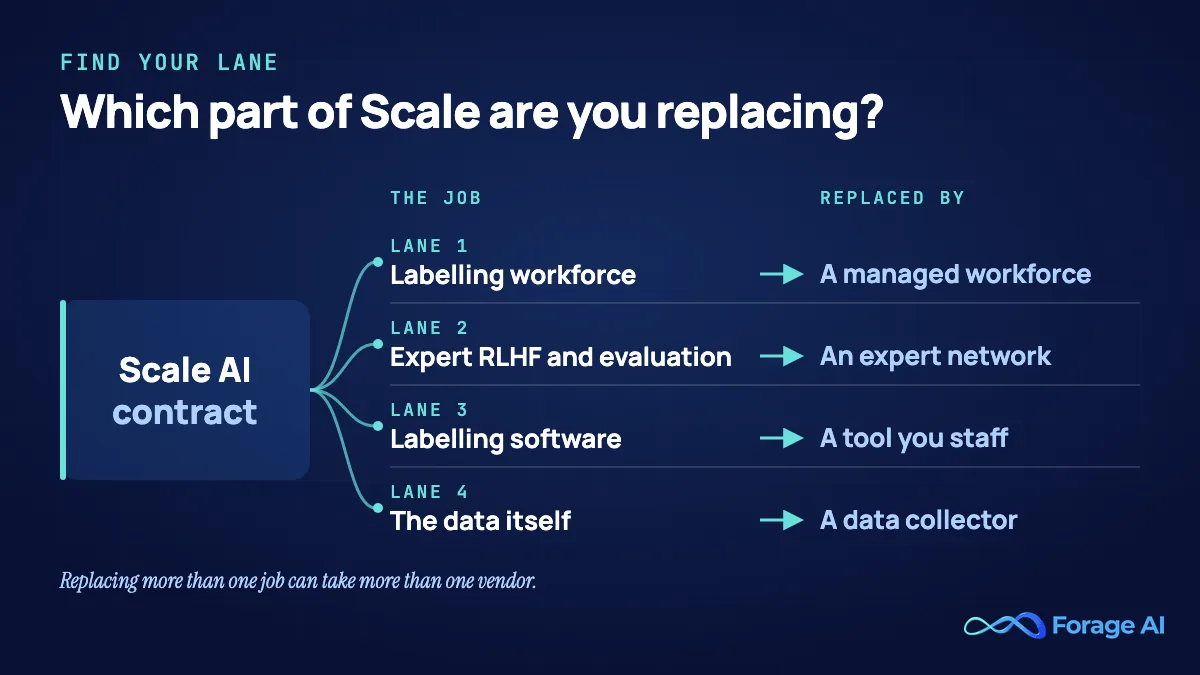
Scale AI alternatives by the job they replace
Inside Scale the four jobs overlap, so you may need two lanes; Appen and TELUS Digital appear twice by design. Listed alphabetically. Nothing here is a ranking.
Lane 1. The labelling workforce
These vendors supply people to label your data at volume: images, video, 3D and LiDAR, text. For the full labelling roster, cost benchmarks and a pilot protocol, see our guide to data labelling companies.
Appen
Managed human-data provider covering annotation, evaluation and custom collection.
| Attribute | Detail |
|---|---|
| What it replaces from Scale | The managed labelling workforce, plus collection and expert RLHF |
| Engagement model | Managed service |
| Price as published | Quote only (read November 2026) |
| Ownership or independence | Listed on the ASX (APX), per Appen's website |
| Biggest trade-off vs Scale | No published prices; you scope everything through sales |
| Evidence | |
|---|---|
| Source read | appen.com, 5 November 2026 |
| Not verified | Not stated: prices, turnaround |
Better than Scale when you want collection and labelling under one contract across a wide spread of locales. It is one of the few Lane 1 vendors that collects data, so it reappears in Lane 4.
Not for: a team that wants to price a pilot before talking to sales.
iMerit (part of EXL)
Expert annotation provider with its own Ango Hub platform.
| Attribute | Detail |
|---|---|
| What it replaces from Scale | Expert annotation (computer vision, audio, LiDAR, sensor fusion) and RLHF |
| Engagement model | Managed service on its Ango Hub platform |
| Price as published | Quote only (read November 2026) |
| Ownership or independence | Part of EXL since 3 August 2026; EXL paid $170 million upfront |
| Biggest trade-off vs Scale | Now inside a large services group; buyers should ask what changes in staffing and terms |
| Evidence | |
|---|---|
| Source read | imerit.ai ("iMerit is now part of EXL"), 5 November 2026 |
| Not verified | The 25,000+ domain experts iMerit states |
Better than Scale when your work is domain-expert annotation on sensor data and you want the tool in the same contract. iMerit also lists video data collection for robotics.
Not for: teams that want self-serve tooling without a services contract.
Label Your Data
Managed annotation service with specialist-led QA and published starting rates.
| Attribute | Detail |
|---|---|
| What it replaces from Scale | The managed labelling workforce |
| Engagement model | Managed service with a free pilot |
| Price as published | Starts at $0.02 per bounding box, $0.015 per keypoint, $0.02 per NLP entity, or about $6 per annotator hour (read November 2026) |
| Ownership or independence | Not stated by vendor |
| Biggest trade-off vs Scale | No expert RLHF tier or data collection on its pricing page |
| Evidence | |
|---|---|
| Source read | labelyourdata.com/pricing, 5 November 2026 |
| Not verified | Not stated: throughput, volume ceilings |
Better than Scale when you need a budget number before a sales call: it is the one Lane 1 vendor that lets you price a pilot that way. The rates are starting points; the page says pricing varies with annotation type, volume and complexity.
Not for: frontier RLHF or evaluation work.
Sama
Managed annotation and model-evaluation provider.
| Attribute | Detail |
|---|---|
| What it replaces from Scale | Annotation, validation and model evaluation |
| Engagement model | Managed service |
| Price as published | Quote only (read November 2026) |
| Ownership or independence | Not stated on its homepage; the website notes B Corp recertification |
| Biggest trade-off vs Scale | No data collection on its website |
| Evidence | |
|---|---|
| Source read | sama.com, 5 November 2026 |
| Not verified | The "99% first-batch acceptance rate" Sama states |
Better than Scale when your text work includes "Instruction following, preference ranking, and factuality".
Not for: a team whose gap is missing data.
TELUS Digital
Human-data and post-training provider owned by TELUS.
| Attribute | Detail |
|---|---|
| What it replaces from Scale | Post-training data, red teaming, automotive and physical-AI data, including collection |
| Engagement model | Managed service plus platforms |
| Price as published | Quote only (read November 2026) |
| Ownership or independence | Owned by TELUS since its take-private on 31 October 2025 (reported); TELUS took a C$2.1 billion impairment on the unit in Q2 2026 |
| Biggest trade-off vs Scale | Parent-company impairment and restructuring are on the record |
| Evidence | |
|---|---|
| Source read | telusdigital.com data-for-AI page, 5 November 2026 |
| Not verified | "1M+" contributors and "500+ annotation languages and dialects" (vendor-stated) |
Better than Scale when one provider has to cover post-training data and physical-AI collection. TELUS Digital calls itself "Your trusted, independent and neutral partner"; read that beside the ownership row.
Not for: a buyer who needs published prices.
Lane 2. Expert RLHF and evaluation
These RLHF data providers replace Scale's expert tier: expert-written preference data, evaluations and RL environments. Appen, iMerit and TELUS Digital in Lane 1 also sell RLHF and red teaming on their own pages, and Labelbox now runs an expert network, Alignerr, alongside its software.
If you are comparing Scale AI with Surge AI or Mercor, the published facts are about how you engage, not about quality: Surge publishes no prices and names no customers, Mercor publishes what it pays experts rather than what it charges buyers, and neither publishes a buyer rate.
Invisible Technologies
Expert network with AI-evaluation and RL-environment modules.
| Attribute | Detail |
|---|---|
| What it replaces from Scale | Expert RLHF, evaluations and RL environments |
| Engagement model | Managed, with its own platform modules |
| Price as published | Quote only (book a demo; read November 2026) |
| Ownership or independence | Not stated by vendor |
| Expert pool as stated | 24,000+ vetted experts (vendor-stated) |
| Biggest trade-off vs Scale | Also sells enterprise automation; the data-lab work is one part of a broader business |
| Evidence | |
|---|---|
| Source read | invisibletech.ai, 5 November 2026 |
| Not verified | Its claim to have "trained over 80% of the world's leading AI models" |
Better than Scale when you want experts and scoring with one vendor: Meridial is "a global network of vetted experts we can deploy on demand", and Synapse runs evaluations.
Not for: buyers who need a published price before a call.
Mercor
Expert-data and evaluation provider built on a large expert marketplace.
| Attribute | Detail |
|---|---|
| What it replaces from Scale | Human data, expert evaluations and RL environments |
| Engagement model | Managed; "Talk to research" for labs, forward-deployed engineers for enterprises |
| Price as published | Quote only (read November 2026) |
| Ownership or independence | Private; reported valued at $10 billion after a $350 million round (CNBC, October 2025) |
| Expert pool as stated | 5M+ experts (vendor-stated) |
| Biggest trade-off vs Scale | The figure it publishes, a $90 an hour average contracted rate, is what experts earn, not what buyers pay |
| Evidence | |
|---|---|
| Source read | mercor.com, 5 November 2026 |
| Not verified | Not stated: buyer pricing |
Better than Scale when you need specialist evaluators quickly. Mercor's $90 an hour is the average rate it says it pays experts. It is not a buyer price.
Not for: buyers who need a rate card.
Prolific
Participant platform with a self-serve tier and a managed service.
| Attribute | Detail |
|---|---|
| What it replaces from Scale | Human evaluation and preference data from vetted participants |
| Engagement model | Self-serve platform, or a managed service under a statement of work |
| Price as published | Participant pay you set (minimum $8 an hour, $12 recommended) plus a 42.8% platform fee for corporate customers (33.3% academic or non-profit); managed service quote only (read November 2026) |
| Ownership or independence | Not stated by vendor |
| Expert pool as stated | 300,000+ active participants (vendor-stated) |
| Biggest trade-off vs Scale | A participant platform, not a managed RLHF team, unless you buy the quoted managed tier |
| Evidence | |
|---|---|
| Source read | prolific.com/pricing, 5 November 2026 |
| Not verified | Not stated: managed-tier pricing |
Better than Scale when you want to run studies yourself and budget them first. Worked from Prolific's published rates in November 2026: 100 participant-hours at the recommended $12 an hour is $1,200 in rewards, plus the 42.8% corporate fee of $513.60, for $1,713.60 in total.
Not for: teams that want a fully managed RLHF programme without a custom quote.
Surge AI
Expert-workforce provider for post-training data.
| Attribute | Detail |
|---|---|
| What it replaces from Scale | Expert workforce and post-training runs |
| Engagement model | Managed |
| Price as published | Quote only (read November 2026) |
| Ownership or independence | Private; reported never to have taken outside funding before mid-2025 talks; 2024 revenue reported above $1 billion (Reuters, July 2025) |
| Expert pool as stated | Not stated by vendor |
| Biggest trade-off vs Scale | Publishes almost nothing a buyer can compare: no prices, no customer list |
| Evidence | |
|---|---|
| Source read | surgehq.ai, 5 November 2026 |
| Not verified | Not stated: prices, customers, product detail beyond its navigation labels |
Better than Scale when you want a post-training partner and will do the diligence on calls: its website lists "Off-the-Shelf", "Post-Training Runs", "Expert Workforce" and "Enterprise", and little else.
Not for: buyers who need published pricing or a reference list.
Toloka
Provider of training and evaluation data for agents and LLMs.
| Attribute | Detail |
|---|---|
| What it replaces from Scale | Preference data, RL environments, red teaming and evaluation |
| Engagement model | Managed, plus the Toloka platform |
| Price as published | Quote only (read November 2026) |
| Ownership or independence | Not stated by vendor |
| Expert pool as stated | 6,000+ contributors, 100+ countries, 40+ languages (vendor-stated) |
| Biggest trade-off vs Scale | Smaller stated contributor pool |
| Evidence | |
|---|---|
| Source read | toloka.ai, 5 November 2026 |
| Not verified | Not stated: ownership, investors, prices |
Better than Scale when you build agents or LLMs and want a platform beside the managed service.
Not for: buyers whose procurement requires a stated owner before the first call.
Lane 3. Labelling software
A labelling tool replaces Scale's software, not its workforce or its experts. Several tool vendors now sell labelling services as an add-on, so check whether you are buying a licence or a team. That is the real question behind a Scale AI vs Labelbox search.
This is the cheapest and most transparent lane, but only if you bring the people. If you were buying Scale's annotators or experts, a tool leaves that job unfilled.
On G2 in November 2026, SuperAnnotate rated 4.8 from 381 reviews, Encord 4.8 from 65, V7 Darwin 4.7 from 55, CVAT 4.5 from 64 and Labelbox 4.5 from 48.
CVAT
Open-source annotation tool plus CVAT Online.
| Attribute | Detail |
|---|---|
| What it replaces from Scale | Labelling software |
| Engagement model | Open source (self-hosted) or cloud platform |
| Price as published | Free plan at $0; Solo $33 a month billed monthly or $23 billed yearly; Team $33 per user a month billed monthly or $23 yearly, for 2 to 50 seats (read November 2026) |
| Ownership or independence | Not stated by vendor |
| Workforce included? | Optional, sold separately |
| Biggest trade-off vs Scale | You supply the annotators and the QA |
| Evidence | |
|---|---|
| Source read | cvat.ai/pricing, 5 November 2026 |
| Not verified | Not stated: enterprise terms |
Better than Scale when you have annotators. A five-person team pays $165 a month on CVAT Team billed monthly, or $115 billed yearly, before any annotator cost.
Not for: teams without in-house annotators.
Encord
Multimodal data platform for annotation, curation and evaluation.
| Attribute | Detail |
|---|---|
| What it replaces from Scale | Labelling software, plus curation and evaluation |
| Engagement model | Platform (Starter, Team, Enterprise) |
| Price as published | Quote only; Starter and Team plans "Get started", Enterprise "Contact sales" (read November 2026) |
| Ownership or independence | Not stated by vendor |
| Workforce included? | Optional (data-as-a-service) |
| Biggest trade-off vs Scale | No published price despite self-serve tiers |
| Evidence | |
|---|---|
| Source read | encord.com/pricing, 5 November 2026 |
| Not verified | Not stated: prices |
Better than Scale when you may add a data service later.
Not for: buyers who need a list price before a demo.
Label Studio (HumanSignal)
Open-source labelling tool with a cloud tier.
| Attribute | Detail |
|---|---|
| What it replaces from Scale | Labelling software |
| Engagement model | Open source, cloud platform or Enterprise |
| Price as published | Community Edition is free and open source; Starter Cloud is $99 a month plus $49 a month per additional user, up to 12 users; Enterprise is quote only (read November 2026) |
| Ownership or independence | HumanSignal |
| Workforce included? | Enterprise lists data services |
| Biggest trade-off vs Scale | You staff and manage the labelling |
| Evidence | |
|---|---|
| Source read | humansignal.com/pricing, 5 November 2026 |
| Not verified | Not stated: Enterprise pricing |
Better than Scale when you want to start free and self-hosted. Five users on Starter Cloud come to $295 a month.
Not for: buyers who want labels delivered, not a tool.
Labelbox
Data platform billed in Labelbox Units, now with an expert network.
| Attribute | Detail |
|---|---|
| What it replaces from Scale | The labelling platform, and now also expert data and RL environments for labs |
| Engagement model | Platform billed in Labelbox Units, plus managed expert work through Alignerr |
| Price as published | Usage-based in Labelbox Units (1 unit per data row labelled in Annotate); no public dollar rate; pricing page returns 404 (read November 2026) |
| Ownership or independence | Raised more than $100 million in a Series E, October 2026 |
| Workforce included? | Optional: Labelbox states its Alignerr network has 2.6M+ experts |
| Biggest trade-off vs Scale | No public price |
| Evidence | |
|---|---|
| Source read | docs.labelbox.com billing guide and labelbox.com, 5 November 2026 |
| Not verified | Not stated: the dollar rate per Labelbox Unit |
Labelbox has moved closer to Scale's own mix: its homepage now leads with RL environments, agents and an expert network, Alignerr, rather than the labelling tool.
Not for: a team that must estimate cost before a quote.
SuperAnnotate
Annotation platform with Starter, Pro and Enterprise plans.
| Attribute | Detail |
|---|---|
| What it replaces from Scale | Labelling software |
| Engagement model | Platform (Starter, Pro, Enterprise) |
| Price as published | Quote only; no prices shown on any plan (read November 2026) |
| Ownership or independence | Not stated by vendor |
| Workforce included? | Services at Enterprise only |
| Biggest trade-off vs Scale | Services and price both sit behind the Enterprise conversation |
| Evidence | |
|---|---|
| Source read | superannotate.com/pricing, 5 November 2026 |
| Not verified | Not stated: prices |
SuperAnnotate's G2 description leads with managed operations and vetted experts, so ask what the Enterprise tier includes.
Not for: small teams that need services without an Enterprise contract.
V7 Darwin
Labelling platform priced by consultation.
| Attribute | Detail |
|---|---|
| What it replaces from Scale | Labelling software |
| Engagement model | Platform, with optional labelling services |
| Price as published | Quote only. V7 prices as a platform fee plus user licences plus data-processing charges, and gives an exact quote after a 30-minute consultation (read November 2026) |
| Ownership or independence | Not stated by vendor |
| Workforce included? | Optional ("Labeling services") |
| Biggest trade-off vs Scale | Formula published, numbers not |
| Evidence | |
|---|---|
| Source read | v7darwin.com/pricing, 5 November 2026 |
| Not verified | Not stated: the figures behind the formula |
Better than Scale when you want to see how the bill is built before the call.
Not for: buyers who need numbers before a consultation.
Lane 4. The data itself
When the gap is a domain, a long tail, a region, a language or a recent period that no corpus you hold contains, no labelling contract adds it. The replacement is a collector. Collectors are judged on questions nobody asks a labelling vendor: what they found, what they missed, how they know, and what happens when a source changes.
Blocking raises the skill needed to collect; it does not turn collection into a purchasing exercise. Among AI data collection services, commissioned collection inside labelling firms is strongest in speech, image, video, driving and egocentric data, physical AI included. None of the four collection pages we read describes web or document extraction at scale.
| Route | Where the rights come from | What you control | Typical fit |
|---|---|---|---|
| Commissioned collection | Consent and contract with contributors | Spec, demographics, volume | Speech, image, video, egocentric |
| Licensed or ready-made corpus | A counterparty's licence; training may be permitted, silent or barred | Little: content and cadence are the provider's | The commodity layer |
| Web and document data collected to your spec | Nobody transfers rights; lawfulness turns on the data, the access and the use | Sources, fields, schema, refresh | Domain, long-tail, multilingual, fresh text and documents |
For the third route, the law on collection is unsettled; our overview of US web scraping law walks through where it stands.
Appen
| Attribute | Detail |
|---|---|
| What you get delivered | Custom collection, multilingual speech corpora |
| Price as published | Quote only (read November 2026) |
| Evidence | |
|---|---|
| Source read | appen.com, 5 November 2026 |
| Not verified | Not stated: prices |
Appen sells this collection alongside its labelling (see Lane 1).
TELUS Digital
| Attribute | Detail |
|---|---|
| What you get delivered | In-cabin, open-road and egocentric collection |
| Price as published | Quote only (read November 2026) |
| Evidence | |
|---|---|
| Source read | telusdigital.com data-for-AI page, 5 November 2026 |
| Not verified | Collection across more than 50 countries (vendor-stated) |
TELUS Digital runs in-cabin and open-road collection across more than 50 countries and egocentric collection for robotics, by its own description (see Lane 1).
Defined.ai
Marketplace of ready-made datasets plus custom data collection.
| Attribute | Detail |
|---|---|
| What it replaces from Scale | Collected and ready-made speech, image, video and multimodal data |
| Engagement model | Marketplace of ready-made datasets plus custom collection |
| Price as published | Quote only; free samples on request (read November 2026) |
| Ownership or independence | Trades as Defined.ai; website copyright reads DefinedCrowd. Ownership not stated |
| What you get delivered | Ready-made datasets via API, or a commissioned dataset |
| Biggest trade-off vs Scale | Strongest in speech and media; not web or document data |
| Evidence | |
|---|---|
| Source read | defined.ai, 5 November 2026 |
| Not verified | Not stated: who holds rights in commissioned recordings; prices |
Better than Scale when the gap is speech or media and consenting contributors can fill it, from the shelf or to order. Defined.ai states a crowd of "1.6M+ global experts spanning 150+ countries and 500+ languages, dialects, and locales", and that every dataset on its collection page is "fully consented, copyright-cleared, and privacy-compliant". Ask who holds the rights in a commissioned recording; the page does not say.
Not for: domain web or document data.
Shaip
Data sourcing, curation and licensed-dataset provider.
| Attribute | Detail |
|---|---|
| What it replaces from Scale | Commissioned and licensed datasets, plus SFT, RLHF and evaluation |
| Engagement model | Managed collection, licensed catalogue, managed evaluation |
| Price as published | Quote only (read November 2026) |
| Ownership or independence | Acquisition by Ubiquity reported (February 2026); completion unconfirmed |
| What you get delivered | Collected or licensed datasets (audio, video, image, text) |
| Biggest trade-off vs Scale | Ownership in transition; no prices |
| Evidence | |
|---|---|
| Source read | shaip.com, 5 November 2026 |
| Not verified | Not stated: who owns commissioned outputs; whether the Ubiquity acquisition has closed |
Better than Scale when you need datasets sourced across regions plus post-training work from one provider. Shaip runs speech collection "in over 150+ languages" and states that "every project includes consent management, PII de-identification, and strict confidentiality controls". Confirm at signing who owns Shaip, and who owns what it collects for you.
Not for: buyers who need web-scale text or documents to a custom schema.
Whichever route you take, put these seven questions in the brief for any data collector.
- Source universe: which sources, how they were discovered, and whether you can see the list.
- Coverage, separately from accuracy: measured against a register, a list or a stated method. A crawl cannot see what it never found, and row counts prove nothing.
- Per-record provenance: a source URL and collected-at time on every record. It records what was checked, not a rights guarantee.
- Collection method: a written statement of how the data is gathered. Our guide on what to ask a data vendor about collection covers the follow-ups.
- When a source blocks or changes: who notices, who fixes it, and how you are told.
- Refresh per source: how often each source is re-read, set source by source.
- Ownership and reuse: who owns the output, and whether the vendor resells it or pools it with other clients' data.
Bright Data and Oxylabs sell web-data infrastructure and datasets; we cover web data collection vendors for AI training data separately.
If what you want is a finished dataset, catalogue data usually fits the commodity layer while the layer that sets your model apart is usually built, so teams combine the two; a dataset sold as "fully licensed" still may not permit training. We compare buying a finished dataset with having one built and cover where to license ready-made datasets.
Forage AI
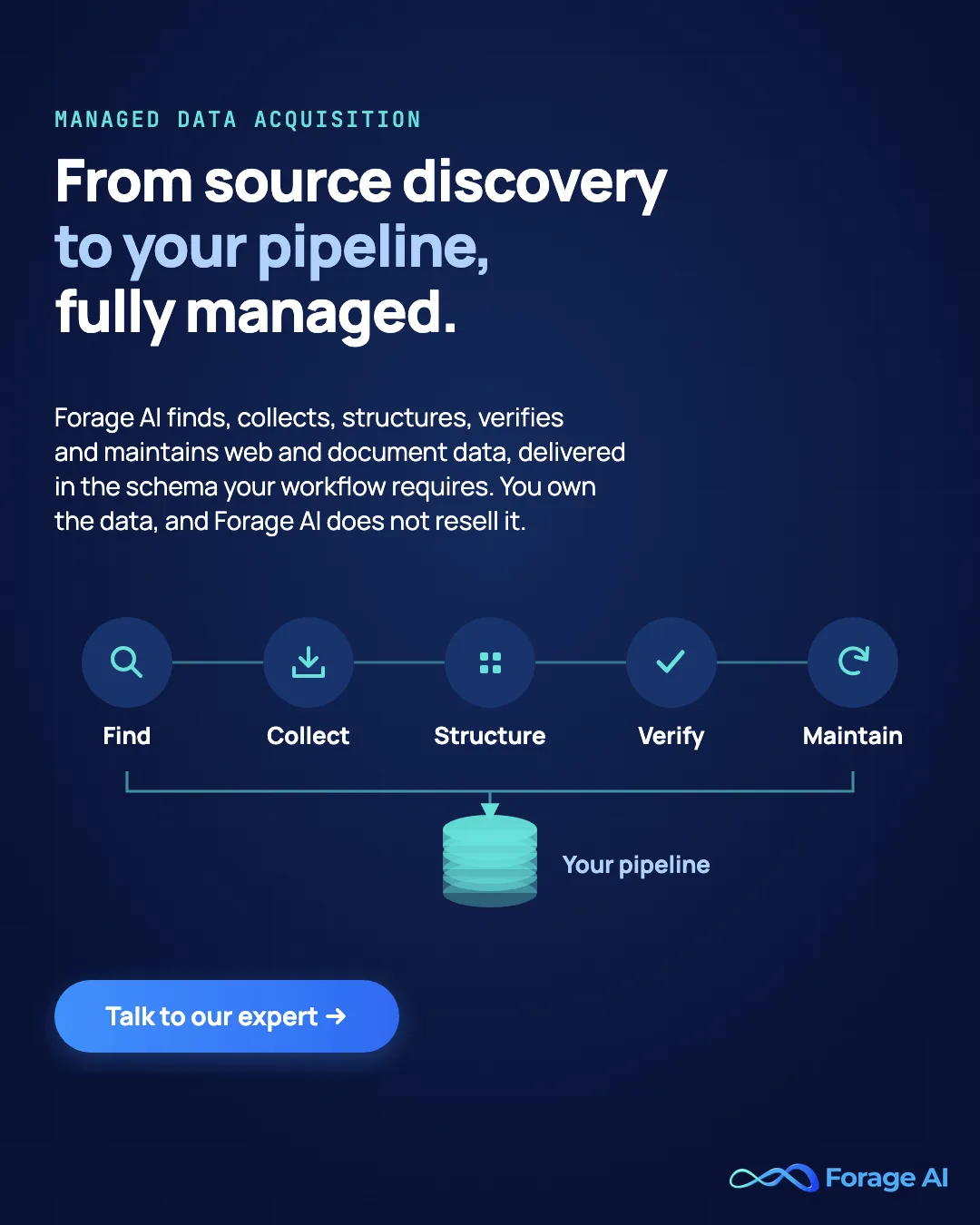
Forage AI finds, collects, structures, verifies and maintains data from difficult websites, complex documents and long-tail sources, delivered in the schema your training, retrieval, evaluation or grounding workflow requires. Source discovery is included: Forage AI maps the source universe by region, language, publisher and document type. Before production, it tests the pipeline on a representative sample and measures coverage, recall, field completion and known misses separately from accuracy. Source access, licensing, permitted use, retention and privacy are reviewed before the pipeline is built. When websites or document formats change, Forage AI monitors source health, updates extraction and revalidates the output. It is a fully managed service, not self-serve; you own the data, and Forage AI does not resell it.
Not for: labelling-only projects on a corpus you already hold.
Often recommended, but not real alternatives
Three names keep turning up on lists of Scale AI alternatives, and each wastes a trial.
Outlier. Outlier is operated by Scale AI, so moving work there keeps it with Scale. Any rating you see for it is a contributor rating, not a buyer's.
SageMaker Ground Truth and Mechanical Turk. AWS closed SageMaker Ground Truth and its Mechanical Turk feature to new customers from 30 July 2026; Mechanical Turk itself was reported shut at the end of September 2026. Ranking pages still list both.
Support-automation tools ranking on the term. A support-automation vendor ranks for this search by listing itself. It does not label, source or evaluate training data.
How do Scale AI alternatives compare side by side?
Every cell comes from the entry tables above; no price is normalised.
| Alternative | Replaces which part of Scale | How you engage | Price as published (read November 2026) | Ownership note | Biggest trade-off vs Scale |
|---|---|---|---|---|---|
| Lane 1 | |||||
| Appen | Workforce, collection, RLHF | Managed | Quote only | ASX-listed | No published prices |
| iMerit | Expert annotation, RLHF | Managed, Ango Hub | Quote only | Part of EXL (Aug 2026) | New owner |
| Label Your Data | Workforce | Managed, free pilot | Starts at $0.02 per bounding box | Not stated | No RLHF tier |
| Sama | Annotation, evaluation | Managed | Quote only | Not stated | No collection |
| TELUS Digital | Post-training, collection | Managed, platforms | Quote only | TELUS-owned (private since Oct 2025, reported) | Parent impairment |
| Lane 2 | |||||
| Invisible Technologies | Expert RLHF, evals | Managed, modules | Quote only | Not stated | Data work is one business line |
| Mercor | Human data, evals | Managed | Quote only | Private, $10B valuation reported | Publishes expert pay, not buyer price |
| Prolific | Evaluation, preference data | Self-serve or managed | $8 minimum, $12 recommended per hour, plus 42.8% fee | Not stated | You run the study |
| Surge AI | Expert workforce | Managed | Quote only | Private, reported | Little published |
| Toloka | Preference data, evals | Managed, platform | Quote only | Not stated | Smaller stated pool |
| Lane 3 | |||||
| CVAT | Software | Open source or cloud | Free; Team $33 per user monthly or $23 yearly | Not stated | You supply annotators |
| Encord | Software, curation | Platform | Quote only | Not stated | No public prices |
| Label Studio (HumanSignal) | Software | Open source or cloud | Free; Starter Cloud $99 a month | Not stated | You staff it |
| Labelbox | Platform, expert data | Labelbox Units, Alignerr | No public dollar rate | Series E, Oct 2026 | No public price |
| SuperAnnotate | Software | Platform | Quote only | Not stated | Services at Enterprise only |
| V7 Darwin | Software | Platform | Quote only (formula published) | Not stated | Numbers not published |
| Lane 4 | |||||
| Appen (collection) | Custom collection | Managed | Quote only | ASX-listed | No published prices |
| Defined.ai | Speech and media data | Marketplace, collection | Quote only | Not stated | Not web or document data |
| Shaip | Collected, licensed datasets | Managed, licensing | Quote only | Ubiquity acquisition reported, unconfirmed | Ownership in transition |
| TELUS Digital (collection) | Egocentric, driving data | Managed | Quote only | TELUS-owned (reported) | Parent impairment |
| Web and document data built to your spec | See Lane 4 | ||||
| Often recommended, not real alternatives | |||||
| Outlier | Operated by Scale AI | Keeps the work with Scale | |||
| SageMaker Ground Truth / MTurk | Closed to new customers from 30 July 2026 | Not open to new buyers |
Forage AI appears only in Lane 4, last and unscored.
Of the 18 vendors with full entries in Lanes 1 to 4, one publishes a full price formula (Prolific), three publish starting rates (Label Your Data, CVAT and HumanSignal's Label Studio), one bills in its own usage units without a public dollar rate (Labelbox), and the rest are quote-only.
Three questions before you shortlist
Answer three questions in order before you open a vendor's website, and the list of alternatives to Scale AI shrinks to a handful of names.
- Which part of Scale's work are you replacing? This is the lane, and it can return two: a team buying labels and evaluations from Scale may need Lanes 1 and 2.
- Is the failing slice missing from your data, or mislabelled in it? Missing points to Lane 4. Mislabelled points to Lanes 1 to 3. "Both" is valid; the next section shows how to tell.
- Do you need a managed workforce, or software you staff yourself? A managed workforce is Lanes 1 and 2. Software you staff is Lane 3.
The usual error is answering "software" after buying Scale's people: you end up with a tool and nobody to use it.
Is your gap the labels or the data?
These are tests you run on your own evaluation, not a claim about what other teams found.
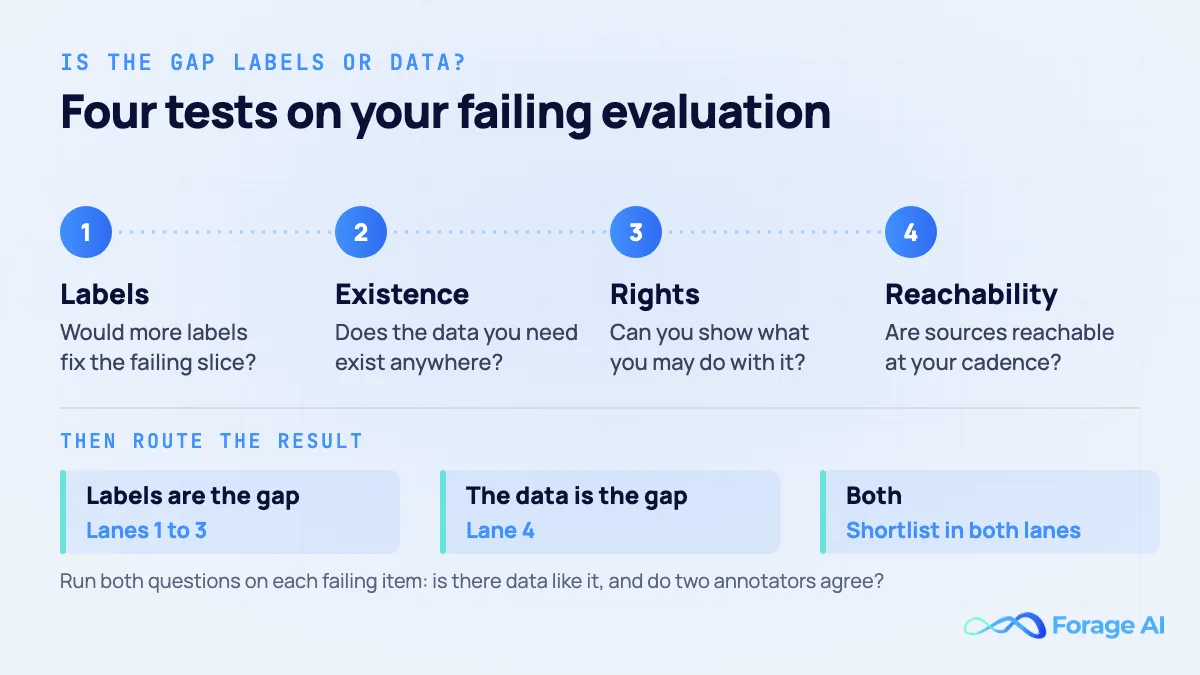
- Labels: would more labels on data you already hold fix the failing evaluation, or is the failing slice absent from the data?
- Existence: does the domain, language or recency you need exist in any corpus you can access?
- Rights: can you show what you are allowed to do with what you hold?
- Reachability: are your sources still reachable at the cadence you need?
The fourth test is the one that changes under you. In one year (2023 to 2024), AI-specific restrictions fully restricted 28%+ of the most actively maintained, critical sources in the C4 web corpus, according to the Data Provenance Initiative's Consent in Crisis study (Longpre et al., NeurIPS 2024).
Shayne Longpre, the Data Provenance Initiative's lead researcher, put it plainly to The New York Times in July 2024: "We're seeing a rapid decline in consent to use data across the web."
Two illustrative teams make the difference concrete. Neither is a customer case.
Team A (coverage). Team A's support assistant fails its evaluation on Brazilian Portuguese questions about local tax forms. When they pull the failing items, they find almost nothing like them in the training data. Labelling the English data they hold more carefully will not move that score. The slice is missing, so the first job is getting the data: commissioned collection, a licensed corpus, or web and document sources collected to spec (Lane 4). Labelling comes after, if at all.
Team B (consistency). Team B's defect detector fails on "minor scratch". The images are all there. When two annotators re-label a sample of the failing items, they disagree on where minor ends and cosmetic begins. That is a labelling fault: tighten the guideline, rebuild the gold set, then decide whether the vendor or the tool is the cause (Lanes 1 to 3).
The test that separates them takes an afternoon. Pull the failing items and ask two questions of each: is there training data like this, and do two annotators agree on its label? Missing data points to Lane 4. Disagreement points to Lanes 1 to 3. Plenty of teams find both.
None of this means labelling matters less. Expert-written data is still in demand: Meta's own lab buys from Surge and Mercor alongside Scale, TechCrunch reported in August 2025, citing five people familiar with the matter, and Surge AI's 2024 revenue was reported above $1 billion (Reuters, July 2025). The answer can be "both", and for most readers of this page it starts with labels. Still deciding which kind of training-data supplier you need? That guide maps the wider market.
- Labels are the gap: Lanes 1 to 3.
- The data is the gap: Lane 4.
- Both: shortlist in both, and run them on the same gold set.
What will switching vendors not fix?
A new vendor carries the same quality questions with it. Label quality, and the working conditions behind it, follow you to any Scale AI alternative. We claim no knowledge of conditions at any vendor named here.
One buyer of annotation services wrote that annotators "would pick one interpretation and just go with it without really making the effort to verify", and that the result "was never as good as we had projected" (Hacker News, 2025). The savings did not hold once verification was added, and a vendor change does not alter that arithmetic.
On the worker side, a CHI 2026 study of 18 data workers in Kenya describes unpaid training stretching to four to five months, extended when quality failures were attributed to the workers. That is 18 people in one country, and we generalise no further.
Then there is the floor. Ten widely used benchmark test sets carried at least 3.3% label errors on average (Northcutt et al., NeurIPS 2021).
Switching moves these questions to a new contract without answering them. What answers them is the gold set you own and the verification step you run.
How do you switch without losing your work?
Switching is a parallel run against your own gold set, not a cut-over. A cut-over usually costs months, because the rubric and gold set turn out to live inside the incumbent's tool.
- Keep the rubric, guidelines and gold set in a workspace you control. Export them before the renewal conversation. They survive any vendor change.
- Run the incumbent and one alternative in parallel on the same gold set. Our guide to data labelling companies sets out a two-week vendor pilot protocol for that run.
- Treat second-sourcing as a legitimate outcome. Keeping Scale for one lane while adding a vendor in another is a decision, not a failure to decide.
- Ask any new vendor what you can export and who owns the outputs. Get the answer in writing before work starts.
Vendors expect this: Label Your Data, for one, offers a free pilot.
For a Lane 4 move, the equivalent of the gold set is your source list and schema.
Why are teams looking past Scale AI?
Before any switch, separate your reason for looking from the reported facts. People look past Scale for ownership, fit, turnaround and price, or for an independent vendor after the Meta deal. The facts are narrower than most lists say.
Scale still covers more of the stack than most alternatives: its Data Engine page sells collection, curation, annotation, RLHF and evaluation, and its public-sector product, Donovan, carries FedRAMP High and DISA IL4 authorisation, by Scale's own account. Scale AI's G2 page shows 18 reviews averaging 4.5, all for its GenAI Platform and Donovan products, none for its data work. That is too few to judge it by.
What Scale sells today
Scale lists three products, Data Engine, GenAI Portfolio and Donovan, and its new chief executive describes two core businesses: data for frontier models and the applications built on them. Outlier is its contributor network, and its homepage now features robotics customers. Donovan and public-sector work are out of scope here.
The Meta stake, as filed
Meta's quarterly filing says it "completed an investment in Scale AI by acquiring a non-voting minority of its outstanding equity" in June 2025, and recorded $13.79 billion of the consideration as a non-marketable equity investment because it does "not have significant influence over Scale AI's operations". The widely quoted 49% for $14.3 billion comes from press reports (CNBC), not the filing.
"Scale remains, unequivocally, an independent company."
Jason Droege, Scale's interim chief executive at the time, to staff and customers (CNBC, 18 June 2025).
Francis deSouza, formerly chief operating officer of Google Cloud and chief executive of Illumina, became Scale's chief executive on 10 August 2026. If ownership is the reason you are looking, our labelling guide sets out the ownership question to put in your RFP.
Customer exits, as reported
On 13 and 14 June 2025, Reuters reported that Google had planned to pay Scale about $200 million that year and was planning to cut ties, and that Microsoft was reportedly pulling back. Google declined to comment. The same report said OpenAI's finance chief had described Scale as one of many vendors OpenAI would keep using.
On 18 June 2025, CNBC reported, citing an OpenAI spokesperson, that the company had been pulling back from Scale over the previous six to 12 months, looking to work with "other data providers that have kept pace with innovation", and that the decision "wasn't influenced by the Meta partnership".
Scale laid off 200 employees, about 14% of staff, largely in data labelling, in July 2025 (TechCrunch).
Pricing is a booking form
Scale publishes no prices. Its pricing link opens a page that asks you to "Book a 1:1 intro call". Any Scale AI pricing figure on a third-party list is that list's estimate.
Q: Did customers leave Scale AI because of Meta?
A: Not on the record. OpenAI told CNBC the Meta partnership did not influence its decision, and Google declined to comment on Reuters' report of its exit. Treat ownership as a risk question for your own procurement, not a settled market verdict.
Why Forage AI for Scale AI alternatives
Forage AI does not sell labelling, expert RLHF or labelling software. It builds and runs managed pipelines that find, collect, structure, verify and maintain web and document data to your fields, owned by you and never resold. For most readers here, the second line below is the honest one.
Choose Forage AI if your models are short of data rather than labels: domain, long-tail or multilingual web and document data collected to your fields, verified, kept current and delivered into your pipeline, with the data owned by you.
Choose a specialist labelling provider if you already hold the corpus and need people to label, rank or evaluate it. Forage AI's own page says "labeling-only projects may be better suited to a self-service tool or specialist labeling provider".
Whichever lane you are in, keep the rubric, the gold set and the source list in your own hands. Then ask the lane question again at each renewal.
If the gap is the data itself, see how managed data acquisition for AI teams works.
FAQ
Who are Scale AI's main competitors?
Scale AI competitors split by the job they replace. For the labelling workforce, examples are Appen and TELUS Digital; for expert RLHF and evaluation, Surge AI and Mercor; for labelling software, Labelbox and CVAT; and for the data itself, Defined.ai and Shaip. These are examples, not a ranking.
Is Scale AI owned by Meta?
No. Meta's quarterly filing says it acquired a non-voting minority of Scale AI's equity in June 2025 and recorded $13.79 billion of the consideration as a non-marketable equity investment, without significant influence over Scale's operations. The widely quoted 49% for $14.3 billion comes from press reports, not the filing.
How much does Scale AI cost?
Quote only. Scale's pricing link opens a meeting request; we found no figure we would repeat. Among the alternatives, Prolific publishes a full formula, Label Your Data, CVAT and HumanSignal's Label Studio publish starting rates, and Labelbox bills in its own units without a public dollar rate.
Scale AI vs Surge AI vs Mercor: what is the difference?
The published differences are about engagement, not quality. Surge publishes no prices and names no customers; its 2024 revenue was reported above $1 billion. Mercor publishes what it pays experts, a $90 an hour average, rather than what it charges buyers. No measured quality comparison of the three exists publicly.
Why did OpenAI and Google stop working with Scale AI?
On 13 and 14 June 2025, Reuters reported that Google planned to cut ties; Google declined to comment. The same report said OpenAI's finance chief had called Scale one of many vendors. On 18 June 2025, CNBC reported, citing an OpenAI spokesperson, that OpenAI had been pulling back over six to 12 months, seeking providers that "have kept pace with innovation", and that the Meta partnership did not influence the decision.
Is there a free or open-source alternative to Scale AI?
Yes, for the software only. CVAT's free plan and Label Studio's Community Edition are free software. Neither includes people to do the labelling. If you were buying Scale's annotators or experts, you still need a Lane 1 or Lane 2 vendor, or your own team.
Which Scale AI alternative handles voice or speech data?
For collected speech, Defined.ai and Shaip run custom speech collection (Shaip states over 150 languages), and Appen sells multilingual speech corpora. TELUS Digital lists off-the-shelf speech-recognition datasets. For enterprise voice data, ask who holds the rights in commissioned recordings; neither Defined.ai's nor Shaip's page says.
Related articles
- Data labelling companies: the full labelling roster, cost benchmarks and a two-week pilot protocol.
- AI training data providers: which kind of training-data supplier fits which need.
- Web scraping companies for data for AI: web data collection vendors for AI training data.
- Best AI dataset marketplaces: where to license ready-made datasets and what to check first.
- Data vendor due diligence: what to ask a data vendor about how it collects.
Sai is a data infrastructure enthusiast who has spent the past two to three years following the AI space closely, from the infrastructure layer to the fast-growing world of data for AI. He is genuinely curious about how modern data pipelines get built and where the data industry is heading, and he writes insightful pieces on the core topics that shape this niche.