
Best AI Dataset Marketplaces: 8 Platforms Compared
Why Is Buying a Dataset Rarely Simple?
Someone on the team finds an AI dataset marketplace with thousands of listings, subscribes before lunch, and by the following week discovers the catalog barely touches the vertical the model actually needs. The subscription is live. The invoice is real. The data isn’t what anyone needed when they set out to buy AI training data in the first place.
This happens because catalog size is the easiest thing to market and the weakest thing to judge a marketplace by. A provider count on a landing page tells you nothing about whether your niche, your language, or your specific use case is actually in the catalog, what license you’re really getting on that one listing, or whether the dataset will still be current six months into a model build. The global AI training dataset market grew from $2.82 billion in 2024 to a projected $9.58 billion by 2029 at a 27.7% compound annual rate, according to MarketsandMarkets (2024), and every dollar of that growth means more buyers making this exact mistake.
There are three checks worth running before you pay for any listing on any marketplace: license scope, refresh cadence, and whether your niche, vertical, or language is genuinely covered, not just adjacent. By the end of this article, you’ll know which of the eight marketplaces below, if any, is worth evaluating for your specific case, and how to run those three checks before you subscribe to anything else.
Quick Digest
- Eight platforms pass the true self-serve marketplace test: AWS Data Exchange, Snowflake Marketplace, Databricks Marketplace, Datarade, Shaip, Defined.ai, Opendatabay, and LabelSets.
- Kaggle and Hugging Face are not dataset marketplaces: neither has a checkout mechanism, and licensing is set per dataset by individual uploaders, not sold commercially by the platform.
- Cloud-native marketplaces deliver data directly into your existing AWS, Snowflake, or Databricks environment, fast if you’re already there, but they lock you into that stack.
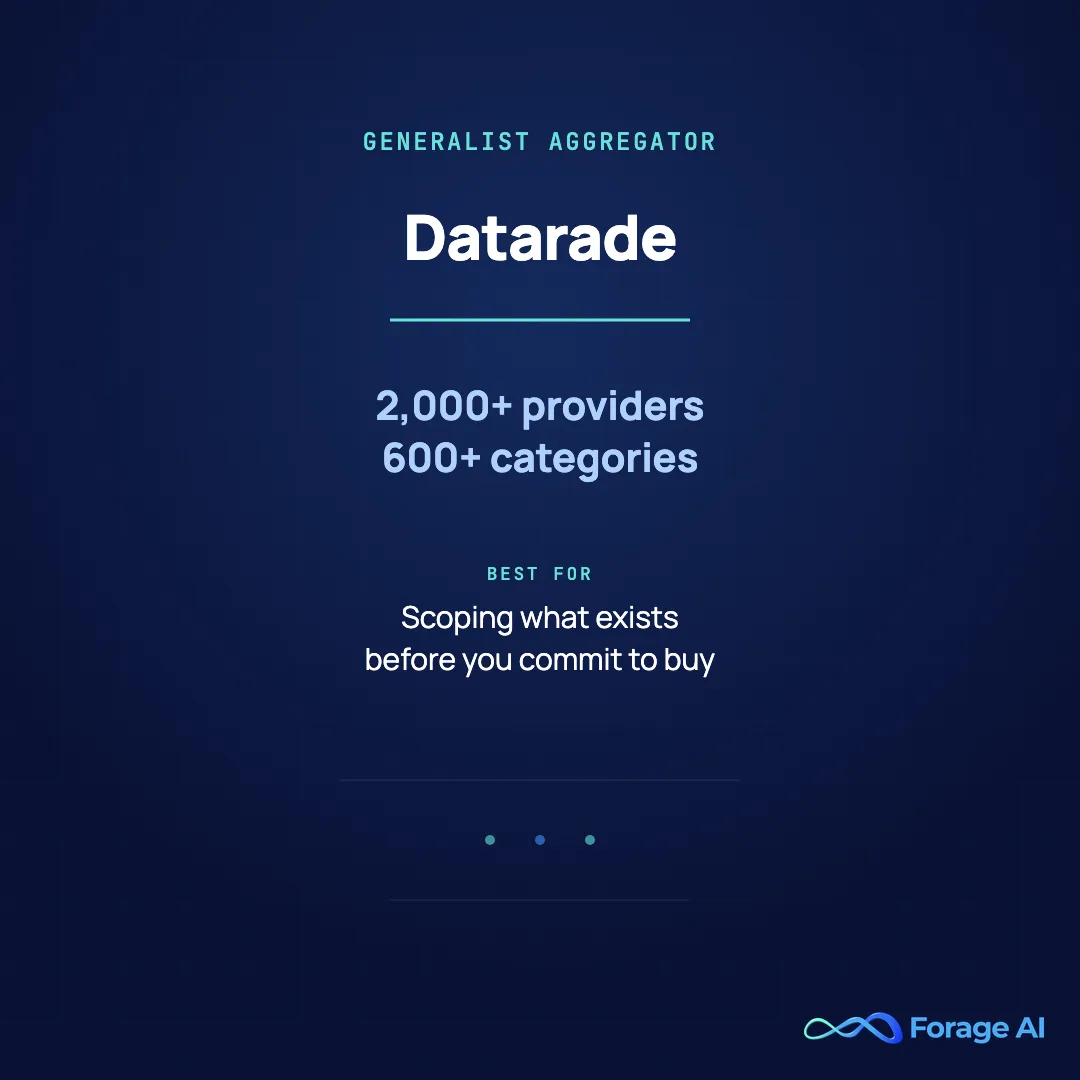
- Datarade is a free-to-browse broker connecting buyers to 2,000+ providers, useful for scoping the market before you commit to a purchase.
- Shaip and Defined.ai specialize in healthcare and voice or language data, with Defined.ai leading on ISO/IEC 42001 certification rather than a standard buyer-review table.
> Stat callout: The global AI training dataset market grew from $2.82 billion in 2024 to a projected $9.58 billion by 2029, a 27.7% compound annual growth rate (MarketsandMarkets, 2024).
What Actually Counts as an AI Dataset Marketplace?
An AI dataset marketplace, for the purposes of this article, is a self-serve platform where you browse a catalog and buy or license an already-built dataset, no custom engagement required. That definition draws a harder line than most “best AI training data provider” round-ups bother to draw, and it’s the line that keeps this list honest.
It also means two of the most commonly recommended names in this space don’t qualify. Hugging Face hosts nearly a million datasets, but its paid tiers cover compute, storage, and Enterprise Hub seats only, never dataset transactions, and each dataset’s license (Apache-2.0, MIT, CC BY, CC BY-NC, or a research-only data use agreement) is set by whoever uploaded it, not sold by Hugging Face as a commercial platform. Kaggle works the same way: licenses are set per dataset by the uploading community, and the platform has no checkout or purchase mechanism at all. Both are genuinely useful repositories. Neither is a marketplace in the sense this article means it.
> Stat callout: Hugging Face’s paid tiers cover compute, storage, and Enterprise Hub seats only, never dataset transactions; Kaggle has no checkout or purchase mechanism at all (Hugging Face pricing page; Kaggle “Common license types for datasets” guide, 2026).
For everything outside that boundary, this isn’t the article you want. If you need custom data extraction, labeling and annotation services, or synthetic data generation instead of an existing catalog, our AI Training Data Providers guide covers all four categories.
The table below is the rubric real data teams use to measure every marketplace further down.
| Evaluation factor | What it actually means | Why it matters |
|---|---|---|
| License scope | Whether this specific listing’s license covers commercial model training, not just what the marketplace claims broadly | A marketplace-wide “commercial use allowed” banner doesn’t guarantee every dataset on it carries that license |
| Refresh cadence | How often the dataset updates, and what happens to your model if it doesn’t | Static data trains models that fall out of step with the world they’re deployed into |
| Niche, vertical, or language coverage | Whether your specific case is genuinely in the catalog, not an adjacent category | Catalog size is a weak proxy; a marketplace with 3,000 listings can still miss your one use case |
| Integration and lock-in | Whether the data lives inside a specific cloud stack or ships as portable files | Cloud-native convenience comes with a dependency cost worth naming upfront |
| Pricing model | Subscription, one-time purchase, or custom quote | Determines whether cost scales with usage or is fixed at purchase |
Catalog size is the single most repeated marketing claim across every dataset marketplace’s own landing page, and it’s also the weakest signal for fit. A 3,000-dataset catalog and a 300-dataset catalog can produce the identical outcome for your specific use case: zero relevant listings. Check the rubric above before the roster below.
AI Dataset Marketplaces at a Glance
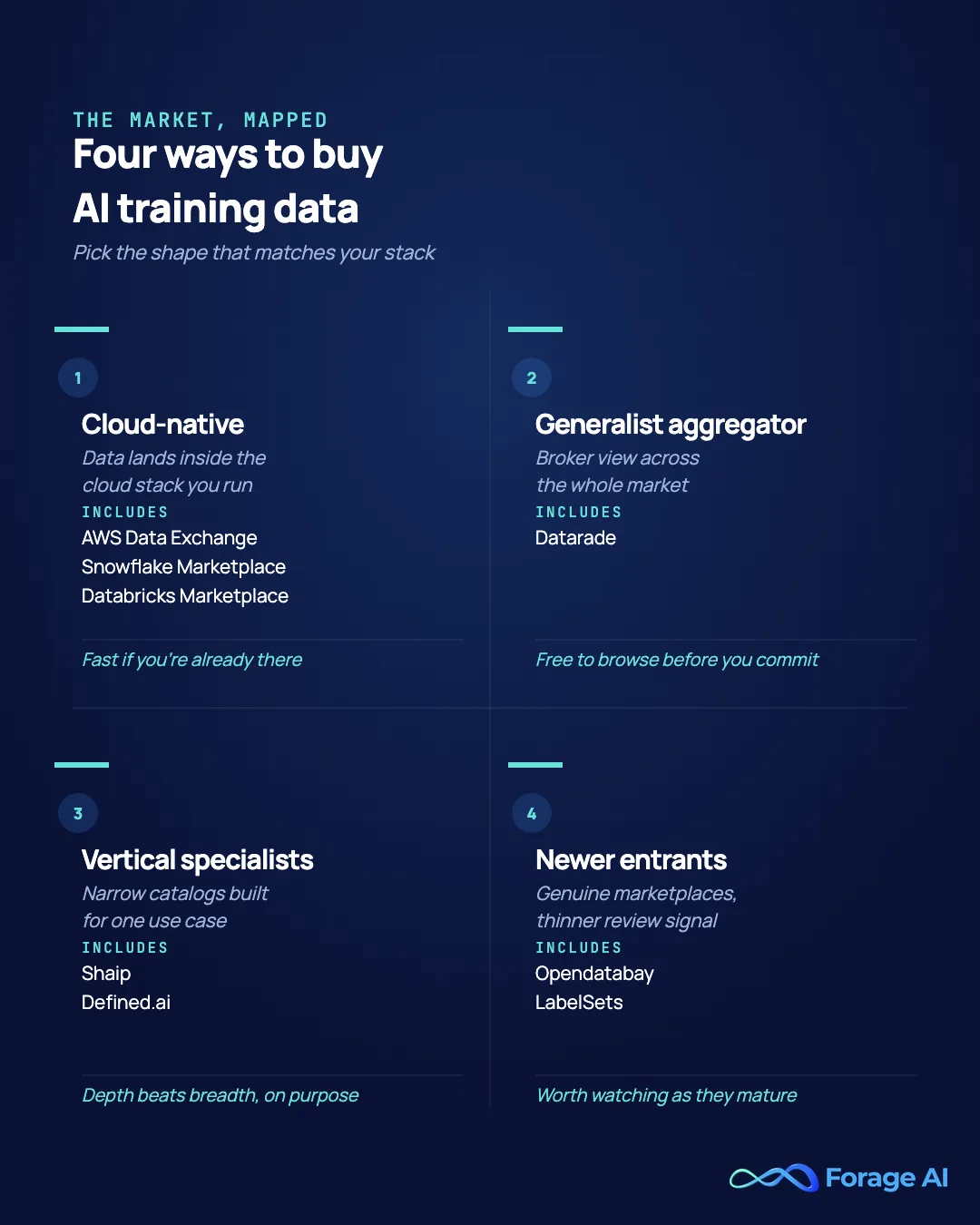
Eight platforms pass the marketplace test above. Here’s the full roster, grouped by category, before the deep dives that follow.
Cloud-native (fast if you’re already on that stack, locked in if you’re not):
- AWS Data Exchange: best for teams already running production workloads on AWS
- Snowflake Marketplace: best for Snowflake-native teams wanting in-account data delivery with no ETL
- Databricks Marketplace: best for teams unifying data discovery with an existing Databricks lakehouse
Generalist aggregator:
- Datarade: best for scoping what exists across the market before committing to a purchase
Vertical specialists:
- Shaip: best for healthcare and medical AI teams needing licensed clinical data plus matching annotation
- Defined.ai: best for voice-AI and conversational-model teams, especially low-resource-language coverage
Newer entrants (genuine marketplaces, thinner independent review signal so far):
- Opendatabay: best for buyers who need format breadth from a smaller catalog
- LabelSets: best for buyers who want an automated quality score attached to every listing before they pay
That’s the list. The sections below cover each in enough depth to actually decide, in the same order.
Cloud-Native Marketplaces: Buy Where Your Data Already Lives
“Cloud-native” here means the dataset gets delivered directly inside the cloud stack you already run, not shipped as a file you have to move yourself. That’s genuinely fast when it fits. It’s also the clearest lock-in trade-off on this list, and each item below names its version of it.
AWS Data Exchange
| Best for | Key use cases | Pricing model | Licensing/Privacy | Coverage | Freshness | Standout strength | Watch-out |
|---|---|---|---|---|---|---|---|
| Teams already running production workloads on AWS | Subscribing to third-party datasets for model training, delivered to S3, Redshift, or via API | Per-listing subscription, priced by provider | Set per listing by the data provider, reviewed at subscription | 3,500+ datasets from 300+ providers | Varies by provider and listing | Delivery lands directly inside AWS-native infrastructure your team already operates | Downstream costs (S3 storage, Glue, Athena, Redshift compute) stack on top of the listed price |
AWS Data Exchange carries 3,500+ third-party datasets from 300+ providers, and the entire point of the platform is that a subscription lands the data straight inside your own AWS environment, whether that’s an S3 bucket, a Redshift table, or an API endpoint. Under the hood, the delivery mechanism is a `CreateJob` call that exports a subscribed asset into a destination you control:
{
  "Type": "EXPORT_ASSETS_TO_S3",
  "Details": {
    "ExportAssetsToS3": {
      "DataSetId": "a1b2c3d4e5f6",
      "RevisionId": "f6e5d4c3b2a1",
      "AssetDestinations": [
        {
          "AssetId": "example-asset-id",
          "Bucket": "my-data-exchange-bucket",
          "Key": "datasets/subscribed-dataset.csv"
        }
      ]
    }
  }
}
That’s worth understanding because AWS Data Exchange is best for teams already on AWS, and the reasoning holds in both directions. If your infrastructure is already there, subscribing removes a real integration step. If it isn’t, you’re paying for convenience you can’t use, plus the AWS-native costs the listed price doesn’t include: Glue crawlers and Athena queries both sit downstream of the data product’s sticker price, alongside the storage and compute already named above.
Reviewers on G2 consistently praise how third-party data fits into existing AWS-native workflows once subscribed, but the listing and seller side of the platform draws a different reaction: multiple reviewers describe it as clunky, and AWS itself has acknowledged gaps in provider-facing tooling, as of 2026. That’s a seller-side complaint more than a buyer-blocking one, but it signals a marketplace layer that’s still maturing. The watch-out is total cost of ownership, not the subscription price on the listing page.
Pros
- Native AWS delivery with no separate integration step for AWS-resident teams
- Large catalog: 3,500+ datasets, 300+ providers
- Multiple delivery targets (S3, Redshift, API)
Cons
- Value drops sharply if your infrastructure isn’t already on AWS
- Downstream compute and storage costs aren’t included in the listed price
- Seller-side tooling gaps signal a marketplace layer still maturing
Customer reviews
| Buyers say (positive) | Buyers say (negative) |
|---|---|
| Native AWS integration makes subscribing and using data straightforward | Seller and listing tooling described as clunky |
| Ease of finding and using third-party data in AWS-native workflows | Support responsiveness flagged by multiple reviewers |
Reviewer themes drawn from G2’s AWS Data Exchange review page, as of 2026 (confirmed via independent search cross-check during technical verification, 2026-07-08; direct page fetch remains blocked by G2’s anti-bot protection).
Snowflake Marketplace
| Best for | Key use cases | Pricing model | Licensing/Privacy | Coverage | Freshness | Standout strength | Watch-out |
|---|---|---|---|---|---|---|---|
| Snowflake-native teams wanting data with no ETL step | In-account data sharing for model training and analytics without moving files | Subscription, priced by provider | Set per listing, native to Snowflake’s data-sharing terms | 3,400+ live data products from 820+ providers | Varies by provider | Data appears directly inside your Snowflake account, no pipeline to build | Cost and usage predictability is the most common complaint |
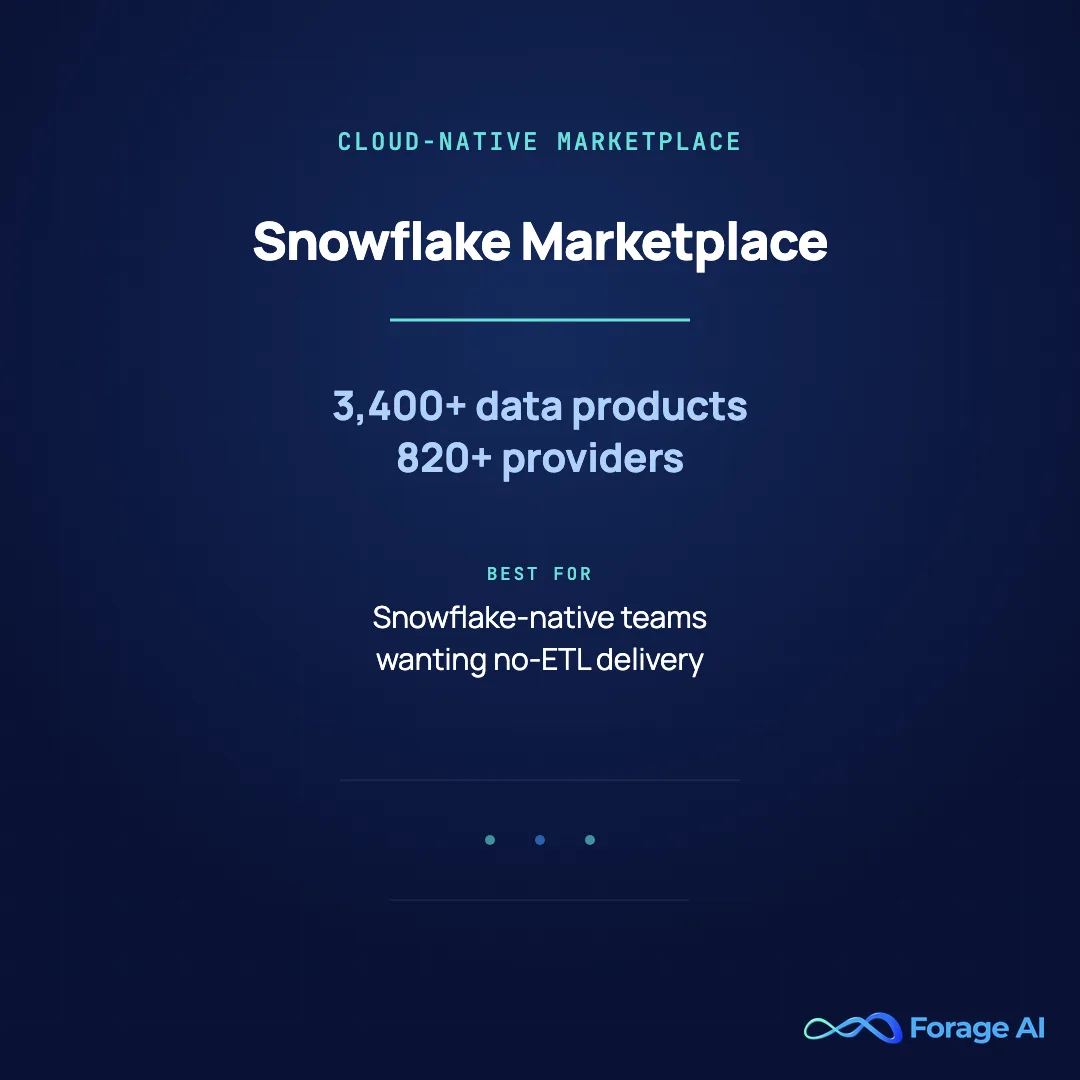
Snowflake Marketplace lists 3,400+ live data products from 820+ providers, and the delivery model is the platform’s real selling point: a subscribed dataset appears directly inside your Snowflake Data Cloud account, ready to query, with no ETL step and no file to move. That’s the same lock-in logic as AWS Data Exchange, just running on a different cloud. Snowflake Marketplace is best for teams already committed to Snowflake, and the value proposition weakens quickly outside that stack.
Snowflake’s broader platform carries 769 verified G2 reviews at 4.5 out of 5, with buyers citing fast data transfer, ease of use, and reliability as consistent themes, as of 2026. That figure covers the Snowflake platform generally, not Marketplace usage in isolation, so treat it as directional rather than a Marketplace-specific score. The recurring complaint across that broader review base is cost and usage predictability, which matters here because subscription pricing on data products compounds with whatever compute the query workload against that data already generates.
Pros
- No ETL required; data lands directly in-account
- Strong platform-wide reliability and ease-of-use signal
Cons
- Only fast and simple if you’re already on Snowflake
- Review volume reflects the whole platform, not Marketplace usage specifically
Customer reviews
| Buyers say (positive) | Buyers say (negative) |
|---|---|
| Fast data transfer and reliable delivery | Cost and usage predictability |
| Ease of use for in-account data sharing | Occasional friction scoping cost against usage |
Themes reflect Snowflake’s broader platform review base on G2, as of 2026, not Marketplace-isolated reviews (769 reviews/4.5 rating confirmed via independent search cross-check during technical verification, 2026-07-08; direct page fetch remains blocked).
Databricks Marketplace
| Best for | Key use cases | Pricing model | Licensing/Privacy | Coverage | Freshness | Standout strength | Watch-out |
|---|---|---|---|---|---|---|---|
| Teams unifying data discovery inside an existing Databricks lakehouse | Discovering free and commercialized datasets alongside your own data engineering and ML workflows | Mix of free sample listings and commercialized offerings | Set per listing on Unity Catalog | Free + commercialized listings, read-only, no ETL | Varies by provider | Discovery happens without leaving the platform you already use for data engineering | Value depends heavily on whether your specific industry is actually represented |
Databricks Marketplace runs as an open exchange on Unity Catalog, mixing free sample listings with commercialized data offerings, and everything on it is read-only. There’s no ETL step because the catalog was built to sit inside a lakehouse teams are already using for data engineering and machine learning. Databricks Marketplace is best for teams who want dataset discovery without leaving the platform they already run their pipelines on.
The parent Databricks platform holds 1,278 verified G2 reviews at 4.6 out of 5, with users praising the unified engineering-and-ML experience and citing cost management under heavy workloads as the main friction point, as of 2026. That’s a platform-wide figure again, not Marketplace-isolated. The more targeted signal comes from Gartner Peer Insights, where reviewers describe the marketplace concept as strong and promising for discovering third-party datasets without leaving the platform, but note that actual value depends heavily on dataset availability for the buyer’s specific industry. One UK retail reviewer put it plainly: “the options can feel quite limited” for narrower industries, as of 2026.
> Stat callout: Databricks Marketplace “options can feel quite limited” for narrower industries, per a UK retail reviewer on Gartner Peer Insights, even though the parent Databricks platform holds 1,278 verified G2 reviews at 4.6 out of 5 (Gartner Peer Insights, Databricks Marketplace reviews, 2026).
That single line is the clearest evidence on this entire list for the article’s core argument. A marketplace can be large and still miss your industry entirely.
Pros
- Discovery without leaving your existing Databricks workflow
- Mix of free and commercialized listings
- Strong platform-wide satisfaction score
Cons
- Read-only; no customization of delivered datasets
- Industry-specific coverage can be genuinely thin
- Cost under heavy workloads is a recurring complaint
Customer reviews
| Buyers say (positive) | Buyers say (negative) |
|---|---|
| Unified discovery inside an existing Databricks workflow | Cost under heavy workloads |
| Strong platform-wide satisfaction (parent Databricks product) | Industry-specific catalog gaps, “the options can feel quite limited” for narrower verticals |
Positive/negative themes from G2 (parent Databricks platform) and Gartner Peer Insights (Databricks Marketplace specifically), as of 2026 (1,278 reviews/4.6 rating and the “options can feel quite limited” quote both confirmed via independent search cross-check during technical verification, 2026-07-08; direct page fetch remains blocked).
Quick Summary
Q: What are the best cloud-native AI dataset marketplaces?
A: AWS Data Exchange, Snowflake Marketplace, and Databricks Marketplace all deliver data directly inside the buyer’s existing cloud stack, fast and with no separate integration step if you’re already there, but each ties you to that platform and real value depends on whether your specific industry is well covered.
The Generalist Aggregator
The three cloud-native marketplaces above only pay off once you’ve already committed to a cloud stack. Not every buyer is ready to commit to one at all. Datarade exists for the scoping stage, before you know exactly what you’re looking for.
Datarade
| Best for | Key use cases | Pricing model | Licensing/Privacy | Coverage | Freshness | Standout strength | Watch-out |
|---|---|---|---|---|---|---|---|
| Early-stage scoping before committing to a purchase | Comparing providers across categories, sampling data before buying | Free for buyers to browse, compare, and sample; pricing set by individual providers | Varies per listed provider; Datarade doesn’t set license terms itself | 2,000+ providers, 600+ categories | Varies by provider; Datarade doesn’t control freshness directly | Broadest single view of the data marketplace landscape | Purchase flow routes out to each provider’s own site, adds a navigation step |
Datarade is a broker, not a host. It connects buyers to 2,000+ individual data providers across 600+ categories without hosting any of the data itself, and browsing, comparing, and sampling is free for buyers. That structure makes Datarade best for the scoping stage of a search, when you want to see what genuinely exists before you commit budget to any one vendor.
The trade-off is a direct consequence of the broker model, not a flaw exactly, but a friction point worth setting expectations on: purchasing a listing usually routes you out to that individual provider’s own domain, adding a navigation step most single-vendor marketplaces don’t have. Datarade holds a 4.5 out of 5 rating from 21 verified reviews on G2, with reviewers praising ease of use and describing it as a coherent guide across the data marketplace landscape for newcomers and experienced buyers alike, as of 2026.
> Stat callout: Datarade connects buyers to 2,000+ data providers across 600+ categories, free to browse, compare, and sample, and holds a 4.5 out of 5 rating from 21 verified reviews on G2 (G2, Datarade reviews, 2026).
Datarade is rarely the final purchase venue. It’s the fastest way to find out who the final purchase venue should be.
Pros
- Broadest single view of the market
- Strong ease-of-use signal from verified reviews
Cons
- Doesn’t host data directly; purchase routes out to provider sites
- License terms vary per provider, not standardized
- Freshness depends entirely on the underlying provider, not Datarade
Customer reviews
| Buyers say (positive) | Buyers say (negative) |
|---|---|
| Coherent guide across the data marketplace landscape, useful for newcomers and experienced buyers | Listing links route out to individual provider domains |
| Ease of use for comparing and sampling | Adds a navigation step compared with single-vendor marketplaces |
Themes from Datarade’s G2 review page (4.5/5, 21 verified reviews), as of 2026 (confirmed via independent search cross-check during technical verification, 2026-07-08; direct page fetch remains blocked).
Vertical-Specialist Marketplaces
Two marketplaces on this list trade breadth for depth. Shaip and Defined.ai both go narrow on purpose, and for the right buyer, narrow beats broad.
Shaip
| Best for | Key use cases | Pricing model | Licensing/Privacy | Coverage | Freshness | Standout strength | Watch-out |
|---|---|---|---|---|---|---|---|
| Healthcare and medical AI teams | Licensed clinical datasets paired with matching annotation in one relationship | One-time purchase, subscription, or custom enterprise agreement | Per-catalog licensing terms; healthcare-specific compliance available | Pre-built catalogs in medical, speech, and computer vision | Varies by catalog | Combines a licensed dataset with matching annotation from the same vendor | Cost is a recurring concern, especially for smaller teams |
Shaip runs its catalog as an “AI Data Catalog & Licensing Marketplace,” with pre-built datasets in medical, speech, and computer vision available as a one-time purchase, a subscription, or a custom enterprise agreement. Worth knowing upfront: the catalog is a secondary line of business. Shaip’s core business is managed annotation and data collection services, so the catalog exists alongside a much larger services operation, not as the whole company.
That context matters for how you read the review signal. Shaip Cloud’s G2 presence shows buyers praising response speed and data quality on AI projects, with cost flagged as a recurring concern, particularly for smaller organizations, as of 2026. That listing may reflect Shaip’s broader annotation business as much as the catalog specifically, so treat it as platform-wide sentiment rather than a catalog-isolated score. Shaip is best for healthcare and medical AI teams who want licensed clinical data and matching annotation from a single vendor relationship, rather than sourcing the dataset and the labeling separately.
Pros
- Annotation and licensing available from a single vendor
- Strong response-speed and data-quality signal
Cons
- Catalog is secondary to Shaip’s core services business
- Review signal may blend catalog and services sentiment
Customer reviews
| Buyers say (positive) | Buyers say (negative) |
|---|---|
| Response speed | Cost, particularly for smaller organizations |
| Data quality for AI projects | Pricing can be a barrier at smaller scale |
Themes from Shaip Cloud’s G2 review page, as of 2026 (confirmed via independent search cross-check during technical verification, 2026-07-08; direct page fetch remains blocked). Note: this listing may reflect Shaip’s broader annotation and services business, not the catalog line in isolation.
Defined.ai
| Best for | Key use cases | Pricing model | Licensing/Privacy | Coverage | Freshness | Standout strength | Watch-out |
|---|---|---|---|---|---|---|---|
| Voice-AI and conversational-model teams | Speech, conversational, and language data, including low-resource languages | Self-serve for catalog listings; direct engagement for anything outside it | ISO/IEC 42001-certified AI management system | 817-dataset browsable catalog across text, audio, image, and video | Varies by dataset | ISO/IEC 42001 certification as a trust signal, ahead of any competitor on this list | Public buyer-side review signal is currently thin |
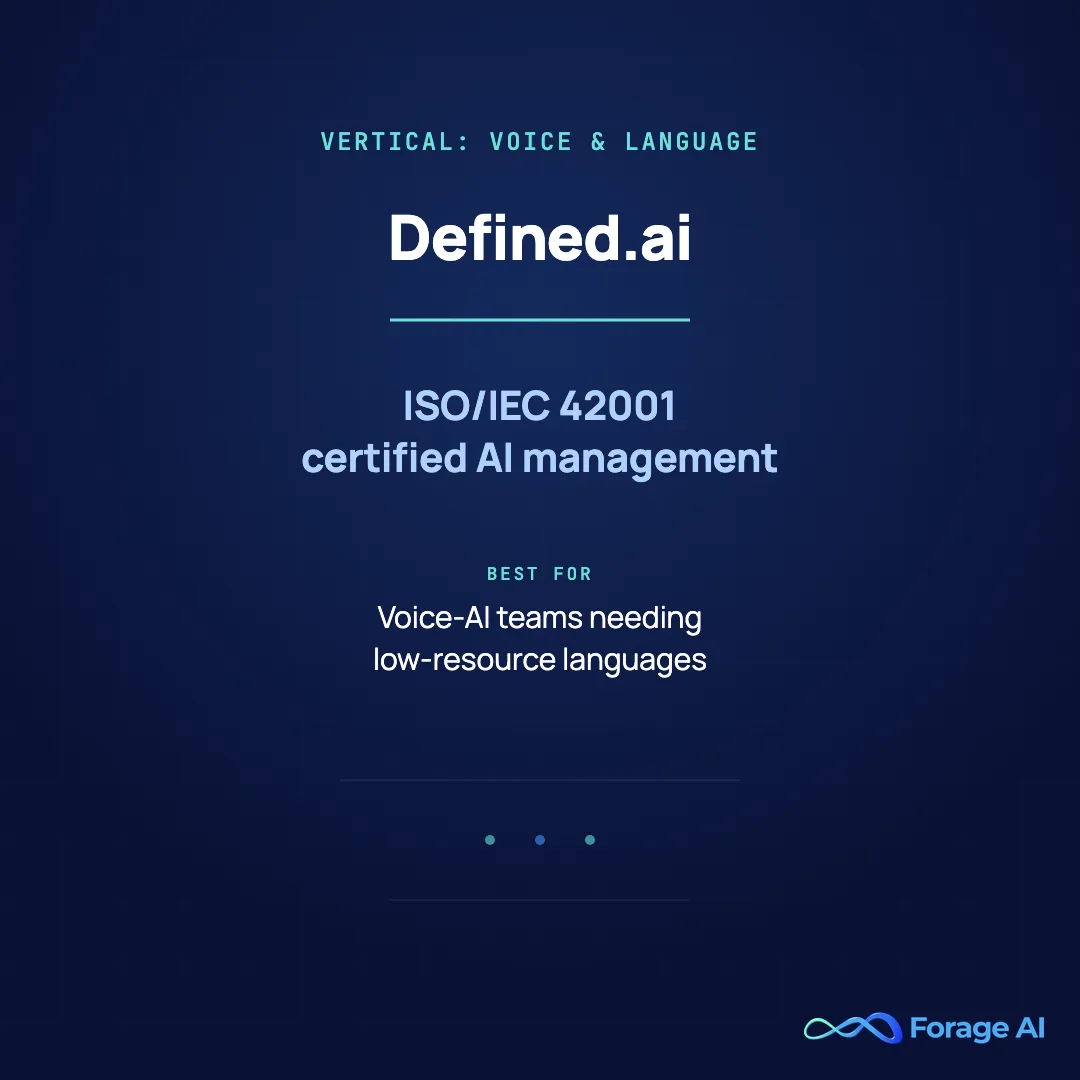
Defined.ai runs an 817-dataset browsable catalog spanning text, audio, image, and video, with self-serve browsing for what’s listed and a direct “get in touch” path for anything outside it. Defined.ai is best for voice-AI and conversational-model teams, particularly ones that need low-resource-language coverage most generalist catalogs skip entirely.
The strongest trust signal here isn’t a review score. Defined.ai is ISO/IEC 42001 certified, the first international standard for AI management systems, published by ISO/IEC in December 2023, covering how an organization governs the responsible development and use of AI systems. That matters more than usual for this vendor specifically, because the buyer-side review signal is genuinely thin: the reviews available under the platform’s legacy name, DefinedCrowd, are predominantly from crowdworkers and data contributors, not from enterprise buyers of the dataset catalog. Presenting crowdworker satisfaction as buyer satisfaction would misrepresent what that sentiment actually measures, so this entry leads with the certification instead of a standard review table.
> Stat callout: Defined.ai is ISO/IEC 42001 certified, the first international standard for AI management systems, published by ISO/IEC in December 2023 (ISO, “ISO/IEC 42001:2023, AI management systems”).
Pros
- Hybrid self-serve plus direct-engagement model
Cons
- Available third-party reviews reflect crowdworkers, not buyers
- Anything outside the existing catalog requires direct engagement, not pure self-serve
A note on review signal: independent buyer-side review data for Defined.ai isn’t currently available in enough volume to build an honest positive/negative table. The reviews that do exist online are largely from crowdworkers under the platform’s former name, a different population from the buyers this article is written for. The ISO/IEC 42001 certification above is the more relevant trust signal until that changes.
What About Newer, Smaller Marketplaces?
Two more platforms pass the same self-serve marketplace test as the six above: Opendatabay and LabelSets. Both are genuinely newer and smaller, and neither has independent review-platform coverage yet. That’s stated here plainly, not as a knock: no competing round-up we reviewed even surfaces these two, and a buyer evaluating the full field should know they exist.
Opendatabay
| Best for | Key use cases | Pricing model | Licensing/Privacy | Coverage | Freshness | Standout strength | Watch-out |
|---|---|---|---|---|---|---|---|
| Buyers who need format breadth from a smaller, newer catalog | Buying, selling, or exchanging commercially licensed training data across varied formats | Self-serve, per-listing (specific pricing not independently audited) | Commercially licensed per listing | 338 datasets from 60 licensed providers, spanning text, image, audio, video, code, agentic trajectories, 3D, tabular, and time-series data | Not independently verified | Format breadth is unusually wide for a catalog this size | No independent review-platform coverage exists yet |
Opendatabay positions itself around speed and format breadth: 338 datasets from 60 licensed providers, spanning text, image, audio, video, code, agentic trajectories, 3D, tabular, and time-series data, all through a self-serve “buy, sell, or exchange” flow the platform describes as three steps. That format spread is genuinely wide for a catalog this size, and it’s the reason this entry earns a spot on the list despite thin outside coverage.
Founder Justinas Kairys frames the platform’s speed as its core differentiator against incumbent marketplaces: “We are able to serve data in seconds, not in days or weeks, which is what’s happening at the moment with current data marketplaces,” he said in an April 2025 interview. Treat that as the founder’s own positioning, not an independently verified benchmark. No G2, Capterra, or Trustpilot presence exists for Opendatabay as of this writing, so there’s no third-party sentiment to weigh it against yet.
Pros
- Unusually broad format coverage for a smaller catalog
- Simple, fast self-serve purchase flow
- Genuine marketplace model, not a bolted-on catalog
Cons
- No independent review-platform coverage to verify vendor claims against
- Smaller provider base (60) than the more established options on this list
- Speed claims are vendor-stated, not third-party benchmarked
What to know: no independent review-platform presence was found for Opendatabay at the time of this research. There’s no positive/negative table to build honestly yet. That’s a function of the platform’s age, not necessarily a mark against it.
LabelSets
| Best for | Key use cases | Pricing model | Licensing/Privacy | Coverage | Freshness | Standout strength | Watch-out |
|---|---|---|---|---|---|---|---|
| Buyers who want an automated trust check on every listing before paying | Computer vision, NLP, medical imaging, financial, tabular, and audio datasets | Self-serve, two-sided marketplace (sellers keep the majority of each sale) | Automated PII scanning plus a compliance certificate issued with every purchase | Covers computer vision, NLP, medical imaging, financial, tabular, and audio categories | Not independently verified | Automated “Label Quality Score” across 7 dimensions, unique among the 8 marketplaces here | No independent review-platform coverage exists yet |
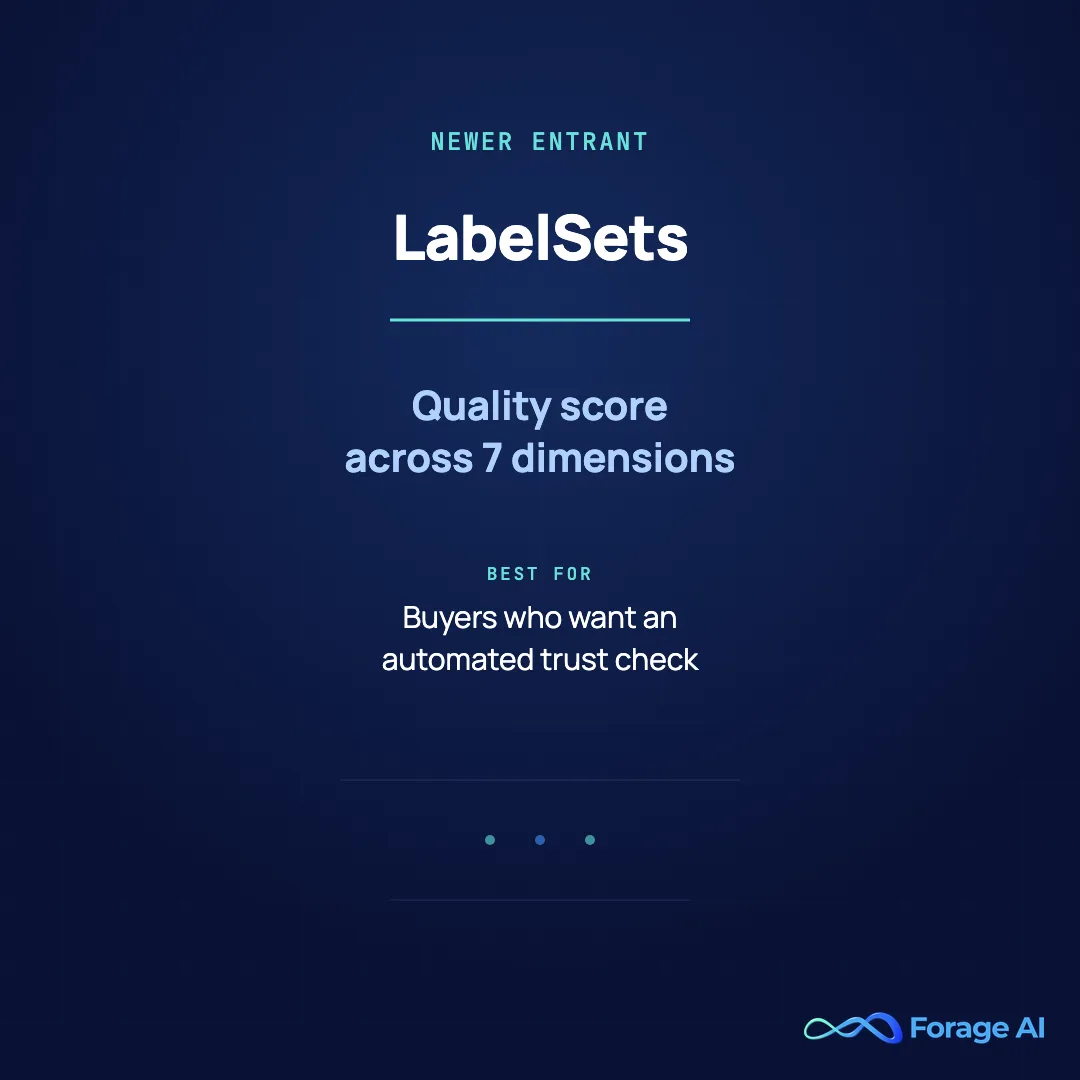
LabelSets is a self-serve, two-sided marketplace covering computer vision, NLP, medical imaging, financial, tabular, and audio data, with buyers and sellers transacting directly on the platform. The distinctive mechanism is what happens before a listing ever goes live: an automated Label Quality Score scores every dataset across 7 dimensions, paired with automated PII scanning and a compliance certificate issued with every purchase. None of the other 7 marketplaces on this list attach anything like it to individual listings.
> Stat callout: LabelSets runs an automated Label Quality Score across 7 dimensions on every listed dataset, plus automated PII scanning and a compliance certificate issued with every purchase (LabelSets, Product Hunt launch page, April 2026).
That mechanism is the reason to include LabelSets despite the same thin external signal Opendatabay carries: it’s a real structural answer to the “how do I trust a listing” question this entire article is built around, and it maps directly onto the license-scope and coverage checks in the framework below. No independent review-platform presence exists yet, and the founder’s identity couldn’t be confirmed during research, so the quality-scoring mechanism is presented here as a documented product feature, not a quote.
Pros
- Automated Label Quality Score adds a trust layer no competitor on this list has
- Covers a genuinely wide spread of data categories
Cons
- No independent review-platform coverage to verify against
- Smaller, newer platform with less of a track record
- Founder and company details are harder to independently verify at this stage
What to know: same as Opendatabay, no independent review-platform presence was found for LabelSets at the time of this research. The Label Quality Score mechanism is a real, documented product feature, worth watching as the platform matures.
How the 8 Marketplaces Compare Side by Side
Here’s the full field on one page, last updated July 2026. Use it to narrow your shortlist before reading the decision framework below.
| Marketplace | Category | Pricing model | Independent review signal | Best for | Watch-out |
|---|---|---|---|---|---|
| AWS Data Exchange | Cloud-native | Per-listing subscription | Yes | Teams already on AWS | Downstream compute and storage costs |
| Snowflake Marketplace | Cloud-native | Subscription | Yes (platform-wide) | Snowflake-native teams, no ETL | Cost and usage predictability |
| Databricks Marketplace | Cloud-native | Free + commercialized listings | Yes (platform-wide + Marketplace-specific) | Unified discovery inside Databricks | Industry-specific coverage gaps |
| Datarade | Generalist | Free to browse, priced per provider | Yes | Early-stage scoping | Routes out to provider domains |
| Shaip | Vertical (healthcare/speech) | One-time, subscription, or custom | Yes (may blend with services business) | Healthcare and medical AI | Cost, especially for smaller teams |
| Defined.ai | Vertical (voice/language) | Self-serve + direct engagement | Thin (crowdworker-only) | Voice-AI and conversational data | Buyer-review signal is thin |
| Opendatabay | Newer entrant | Self-serve, per-listing | None | Format breadth from a smaller catalog | No independent review coverage |
| LabelSets | Newer entrant | Self-serve, two-sided | None | Automated quality scoring per listing | No independent review coverage |
How Should You Actually Choose One?
Everything above is a worked example. This is the method.
There are three checks worth running on any specific listing before you pay, not on the marketplace as a whole: license scope, refresh cadence, and niche, vertical, or language coverage. Prioritize all three, in this order, every time.
Check one: license scope. A marketplace’s front page telling you “commercial use permitted” isn’t the same as the license on the specific dataset you’re about to buy. Attorney Andrew S. Bosin, who has spent 30-plus years advising SaaS and AI companies, frames the real diligence question plainly: “Can you prove where every piece of your training data came from, and that you obtained it lawfully?” If you can’t answer that for a specific listing, don’t buy it yet. The Bartz v. Anthropic settlement, which reached $1.5 billion in 2025 over AI training-data sourcing, is the clearest recent example of why this check isn’t theoretical.
> Quote callout: Andrew S. Bosin, Esq., a SaaS/AI technology attorney with 30-plus years’ experience, on licensing diligence: “Can you prove where every piece of your training data came from, and that you obtained it lawfully?” (“Training-Data Legal Risk: A Guide for AI Founders 2026,” June 2026).
Check two: refresh cadence. Ask how often the dataset updates and what happens to your model if it doesn’t. A static dataset trains a model that drifts further from the world it operates in with every month that passes. Some marketplaces refresh natively (Snowflake and Databricks listings often do); others ship a fixed snapshot. Get a straight answer before you pay, not after.
Check three: niche, vertical, or language coverage. This is where catalog size lies to you most often. A 3,000-dataset catalog and a 300-dataset catalog can both return zero relevant listings for your specific case. Search the actual catalog for your specific use case before comparing provider counts.
For the three cloud-native options specifically, in practice you’ll want to add a fourth consideration on top of the three checks: integration lock-in. AWS Data Exchange, Snowflake Marketplace, and Databricks Marketplace only deliver their full convenience if your infrastructure already lives on that cloud. That’s not a universal fourth check, it’s a conditional one that applies specifically when you’re weighing a cloud-native listing against a platform-agnostic one.
Worth naming honestly: marketplaces are one of several ways to acquire AI training data, and they’re not even the fastest-growing one. Gartner projects AI data spend more than doubling from $3.1 billion to $6.4 billion by 2027 (2026), with synthetic data cited as the primary driver of that growth, not marketplace purchases. That doesn’t make marketplace data the wrong choice. It does mean the buy decision below matters more than ever, because more paths exist than a single catalog subscription.
When a Marketplace Dataset Is the Wrong Call
The three checks above catch most problems before you pay. Some failure modes are worth naming directly, because almost no other source covering this topic develops them past a single warning sentence.
Stale data is the quiet one. A dataset that looked current at purchase can sit unrefreshed for months while your model keeps training against it and slips into a degraded mode, and nothing on the marketplace’s listing page tells you when that clock started.
Ambiguous or research-only licensing is the expensive one. Creative Commons draws hard lines that matter here: CC BY-NC and CC BY-NC-SA licensed data cannot be used for commercial AI training at all, regardless of company size; CC BY-ND content shouldn’t be used as training data in the first place; and CC BY-SA carries a ShareAlike obligation that can require releasing the resulting model under the same license if you share it publicly. None of that is marketplace-specific paranoia. It’s how the licenses actually work.
Regulatory pressure adds another layer worth knowing about, and it just moved: high-risk obligations under the EU AI Act were originally set to take effect August 2026, but the EU’s Digital Omnibus agreement, formally cleared by the Council and Parliament in June 2026, pushed that deadline to December 2027 for standalone high-risk systems and August 2028 for AI embedded in regulated products, still requiring documented training-data sources and rights clearances once it lands. Confirm the current deadline against primary EU text before treating any date here as fixed. This is exactly the kind of rule that keeps shifting.
Thin coverage for niche verticals or low-resource languages is the predictable one. The Databricks reviewer quote earlier in this article already made the point: a catalog can be large and still miss your specific industry entirely.
PII and compliance risk on less-vetted third-party listings is the one nobody wants to think about. In IBM’s 2025 research, more than 25% of organizations estimate they lose over $5 million a year to poor data quality, and 7% report losses of $25 million or more. That figure covers enterprise data quality broadly, not marketplace purchases specifically, but the underlying mechanism, ungoverned data entering a pipeline unchecked, is the same one that turns a cheap dataset into an expensive mistake.
> Stat callout: More than 25% of organizations estimate they lose over $5 million a year to poor data quality, and 7% report losses of $25 million or more (IBM Institute for Business Value, “The True Cost of Poor Data Quality,” 2025).
One practical check costs nothing: before paying for a listing, sample it against known open datasets in the same category. For retail and product data, our roundup of free and paid ecommerce datasets is a useful baseline. A dataset that’s just repackaged free data resold at a markup, with no real curation added, is a documented pattern in buyer complaints even though no single source has turned it into a formal study.
This section touches licensing and regulatory interpretation. It’s for informational purposes only and isn’t legal advice; consult a qualified attorney for guidance specific to a dataset license or your compliance obligations.
When a Managed Extraction Partner Like Forage AI Fits Better
A marketplace is the right call when an existing dataset already covers what you need. That’s most of the time, for most buyers, and the eight platforms above genuinely cover a lot of ground.
It stops being the right call when none of those eight catalogs genuinely cover your vertical, your language, or your specific use case, or when the licensing and freshness risk from the section above is a dealbreaker for your project. That’s when a managed extraction partner becomes the better fit, not a fallback.
Forage AI‘s Data for AI work exists specifically for that gap: training data extraction built to spec for LLM fine-tuning, retrieval-ready structured datasets, continuous pipeline updates so the data doesn’t go stale the way a static catalog listing can, and domain-specific datasets for niches no off-the-shelf catalog was built to cover. Where a marketplace purchase inherits whatever chain of custody the original provider had, a custom pipeline has one chain of custody, and it’s a known one.
Expert Insights
The gap between “covers my industry generally” and “covers my specific use case” is where most marketplace purchases quietly underdeliver. It’s also exactly the gap a built-to-spec pipeline is designed to close.
The choice isn’t marketplace versus custom in the abstract. It’s whether one of the eight catalogs above actually has what you need, checked against the three tests from the framework, not assumed from a provider count on a landing page.
FAQ
Are Kaggle and Hugging Face AI dataset marketplaces?
No. Both are free repositories with licenses set per dataset by whoever uploaded it, not sold commercially by the platform. Hugging Face’s paid tiers cover compute, storage, and Enterprise Hub seats, never dataset transactions, and Kaggle has no checkout or purchase mechanism at all. Useful for research and prototyping. Not a marketplace in the sense this article means it.
Is it legal to train a commercial AI model on a dataset I bought from a marketplace?
It depends entirely on the specific listing’s license, not on the fact that you paid for it. CC BY-NC and CC BY-NC-SA licensed data cannot be used for commercial training regardless of your company size; CC BY-ND shouldn’t be used as training data at all; and CC BY-SA can require releasing your resulting model under the same license. Check the license on the individual listing every time, not the marketplace’s general terms. This isn’t legal advice; verify licensing questions with qualified counsel.
How much does a pre-built AI training dataset cost?
Pricing varies widely by vendor and listing. One marketplace’s own blog cites a directional range of $5 to $500 per dataset, compared with $0.05 to $2 per label for custom annotation, though that figure is vendor-published and not independently audited.
What’s the difference between an AI dataset marketplace and a data labeling company?
A marketplace sells access to a dataset someone else already built. A labeling company builds or annotates data to your specification, usually from your own raw material. The two get conflated constantly in “top AI training data provider” round-ups; see our AI Training Data Providers guide for the full breakdown across all four categories.
Are Snowflake Marketplace or Databricks Marketplace datasets free?
Some are, most aren’t. Both platforms mix free sample listings with commercialized, paid data products, so check the individual listing rather than assuming either direction.
Should I buy from a marketplace or commission custom data extraction?
Buy if one of the eight marketplaces above genuinely covers your niche, vertical, and language, and the license and refresh cadence check out. Commission custom extraction if none of them do. The framework above and the Forage AI section walk through exactly how to tell the difference.
Closing the Loop on Marketplace Evaluation
Catalogs change. Vendors get acquired or reposition entirely, the way data.world quietly pivoted from open marketplace to enterprise catalog tooling. Review scores shift. A marketplace that covered your niche well last year might not this year, and one that looked thin might have grown into exactly what you need.
That’s the actual argument for treating marketplace evaluation as an ongoing practice rather than a one-time checklist. The three checks don’t expire after your first purchase. Run license scope, refresh cadence, and coverage again before your next one, even on a marketplace you’ve bought from before.
You’ve got the roster, the comparison table, and the framework now. Apply it to your actual shortlist, not to the vendor with the biggest provider count on the landing page.
Related Articles
- Top AI Training Data Providers: Buyer’s Guide to the Four Categories: the full landscape of custom extraction, labeling, synthetic data, and marketplace vendors, one level up from this article.
- AI Training Data: The Operational Playbook: how to validate and operationalize a dataset once you’ve bought or built one.
- Data Observability for Third-Party Datasets: how to monitor whether a purchased dataset is staying current after delivery.
- What Is Data as a Service (DaaS)?: where the DaaS category sits relative to marketplaces and custom extraction.
Sai is a data infrastructure enthusiast who has spent the past two to three years following the AI space closely, from the infrastructure layer to the fast-growing world of data for AI. He is genuinely curious about how modern data pipelines get built and where the data industry is heading, and he writes insightful pieces on the core topics that shape this niche.