
Top 5 Web Scraping Companies for AI Training Data (2026 Guide)
Introduction
When building or scaling AI products, the model represents only half the equation. The other half involves reliable, high-quality AI training data. For enterprises training LLMs, powering RAG systems, and building AI agents, web and document data must be AI-ready: accurate, fresh, and delivered in AI-ready formats at scale with considerable complexities. Many AI teams therefore turn to specialized web scraping and managed data providers rather than building everything in-house.
The economics back the shift. The AI training dataset market is projected to grow from $4.44 billion in 2026 to $23.18 billion by 2034, a 22.9% CAGR. Deloitte’s 2026 State of AI in the Enterprise survey adds the buyer-side picture: 86% of enterprises expect AI budgets to grow again this year, and insufficient data is the top adoption barrier for 48% of respondents.
This guide compares the top 5 web scraping companies specializing in AI training data that merit evaluation in 2026 if your primary needs are training data, RAG feeds, and document extraction at scale.
Which company should you pick?
- Best overall for enterprise-grade AI datasets and end-to-end, fully managed pipelines: Forage AI
- Strong for news, forums, and OSINT data at scale: Webz.io
- Good for custom scrapers and marketplace datasets: ScrapeHero and its alternatives
- Large proxy network, real-time APIs, and the Web MCP server for AI-agent access (launched August 2025): Bright Data
- AI-powered knowledge graph plus the new GraphRAG-grounded LLM (January 2025) for AI training and semantic applications: Diffbot
All these companies specialize in extracting clean, structured, machine-learning-ready data specifically for AI use cases.
Why Does AI Web Scraping Need a Different Approach?
Many teams assume that extracting data for AI is just a scaled-up version of traditional automated scraping. In practice, data extraction for AI has fundamentally different requirements, and treating it like a standard automation problem is one of the most common reasons AI systems fail in production.
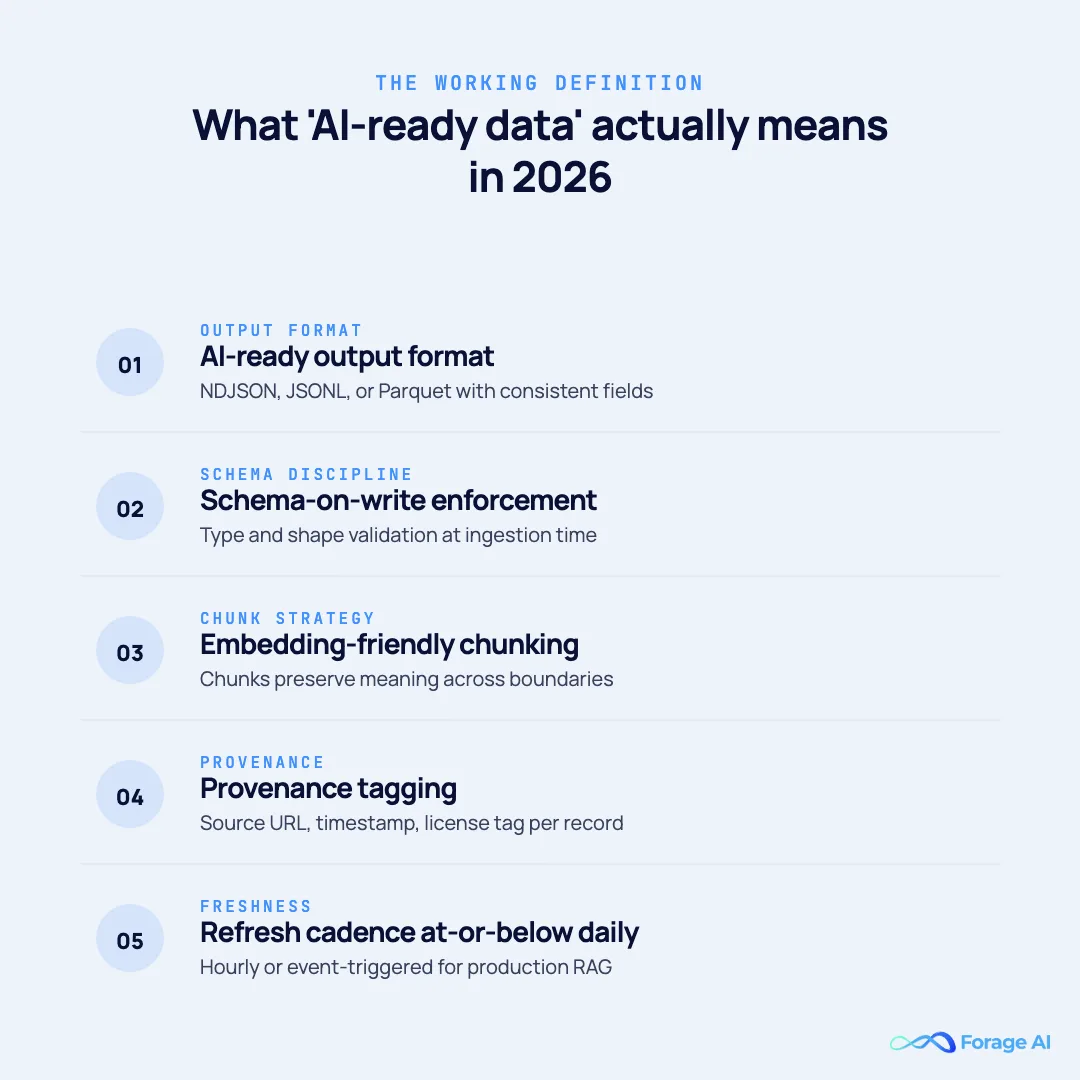
Before the requirements list, a working definition. AI-ready data in 2026 means structured outputs (NDJSON, JSONL, or Parquet) with schema-on-write enforcement, embedding-friendly chunking, and provenance tagging that survives a legal review. Raw HTML and flat CSV exports don’t clear that bar.
Here’s why AI data extraction needs a different approach:
- AI systems are far less tolerant of noisy data. Inconsistent or inaccurate fields can confuse models and produce incorrect results.
- Freshness matters more. No one needs pricing data that’s old and product catalogs that no longer exist. For AI, especially RAG-based systems, stale data actively degrades output quality. A 2025 analysis from Brainfish AI found that 73% of enterprise RAG deployments fail within the first year, almost always on the knowledge-base side (stale documents, coverage gaps, poor extraction) rather than the model or retrieval algorithm.
- AI needs structure, not just content. AI-ready data extraction needs semantic structure in machine-readable formats, not just field capture in raw HTMLs and flat CSVs.
- Higher QA standards. AI pipelines need ongoing monitoring and validation, which is difficult especially at scale.
- Operational resilience. Stakes are high, and so is the cost of failure. Because AI outputs are often confidently wrong, the downstream impact is much more severe. Infrastructure matters a lot.
When AI-data extraction is treated as a scaled-up scraping problem, the failure usually surfaces as silent quality decay in the model, not a broken pipeline. The 2026 reality is that web access for AI is no longer a given either. On July 1, 2025, Cloudflare flipped a default block on AI crawlers across every new domain on its network, a single decision that reshaped a meaningful slice of the public web.
AI training dataset spending is projected to grow from $4.44B in 2026 to $23.18B by 2034, a 22.9% CAGR (Fortune Business Insights, 2026).
73% of enterprise RAG deployments fail within the first year, overwhelmingly on knowledge-base maintenance failures, not retrieval algorithms (Brainfish AI, 2025).
On July 1, 2025, Cloudflare set a default block on AI crawlers across its network: every new domain blocks AI bots unless the owner opts in (Cloudflare press, 2025).
What Changed for AI Data Scraping in 2026
The reason these requirements matter more in 2026 than in 2025 comes down to four shifts in the last twelve months. Each on its own would be worth a sentence in a vendor brief. Together, they change the buying criteria.
Cloudflare’s default-block on AI crawlers. On July 1, 2025, Cloudflare set every new domain on its network to block known AI crawlers by default. Managed robots.txt support is available across all plan tiers, and Content Signals let publishers separate search use from AI input and AI training. The practical effect: unblocking strategies that worked in 2024 stopped working overnight on any website that adopted the default.
Bright Data’s Web MCP server. In August 2025, Bright Data launched the free tier of its Web MCP server, an agent-native protocol that lets AI agents fetch live web data through the vendor’s infrastructure. The service is now powering 100 million+ daily agent interactions. Zyte added MCP integration in 2025 as well. Agent-native access has moved from a research topic to a vendor checkbox.
Diffbot’s GraphRAG-grounded LLM. In January 2025, Diffbot released its own GraphRAG-grounded LLM, built on a trillion-fact Knowledge Graph and claimed as the most factually-grounded LLM in benchmark. The release signaled the practical arrival of GraphRAG as a RAG pattern, not just a research framing.
The AI copyright lawsuit wave. AI copyright lawsuits roughly doubled in 2025: over 70 cases pending by year-end, with NYT v OpenAI and the Authors Guild cases centralized in the Southern District of New York. Compliance now extends to training-data licensing, not just legal-conformance on the scraping side.
Together, the four shifts move the buying criteria from “can you scrape it?” to “can you scrape it ethically, on a fresh cadence, in a format my agent can consume?” Call it the Authenticity-Cadence-Format-License lens. A generic listicle that omits these four shifts is recommending vendors against the wrong criteria.
On July 1, 2025, every new domain on Cloudflare’s network started blocking AI crawlers by default (Cloudflare press, 2025).
Bright Data’s Web MCP server is now powering 100 million+ daily agent interactions, following a 3-month private beta with 15,000 developers (SiliconANGLE, August 2025).
AI copyright lawsuits more than doubled in 2025, from roughly 30 cases at the end of 2024 to over 70 by the end of 2025 (Copyright Alliance, December 2025).
With that landscape in view, here are the 5 vendors most worth shortlisting in 2026.
Top 5 Web Scraping Companies for AI Training Data
Forage AI – Best Overall for Managed AI Data Pipelines
| Forage AI: at a glance | |
|---|---|
| Best For | Enterprise AI pipelines, compliance-heavy industries |
| Strengths | AI-ready clean datasets, hybrid (public + private) ingestion, strong governance, named-client outcomes |
| Limitations | Not optimized for small DIY scraping projects |
| AI-ready output format | Custom: NDJSON / JSON / CSV / Parquet, schema-on-write, on-prem optional |
| Pricing tier | Enterprise contract, quoted per project |
Forage AI is designed specifically for AI-driven organizations, offering fully managed, AI-ready data pipelines that cover extraction, validation, customization, enrichment, QA, delivery, and monitoring. What really works for AI teams is their resilient infrastructure, state-of-the-art technology, and dedicated project managers that work as extensions to your team, ensuring timely, accurate data deliveries. Twelve years of operating discipline, 500M+ websites crawled, 100+ data experts, and a QA team three times the industry-average size relative to delivery sit behind the service.
Strengths:
- Managed AI-oriented data delivery services, not just automation
- Workflow orchestration to ensure data is consistently updated for RAG and training use cases
- Battle-tested multi-layer QA ensures clean, trustworthy datasets
- Custom-trained extraction models outperform standard scrapers
- Fully managed pipelines with no maintenance or dev overhead
- Compliance-first approach with governance, access control, and optional on-prem hosting
- Flexible scaling for real-time, large-volume, or event-triggered workloads
- Named-client outcomes: Vested, a financial-data customer, has run 12 consecutive months at 100% pipeline uptime
- Ideal for long-term enterprise data contracts
Limitations:
- Not a DIY tool, fully managed custom web scraping service
- Built primarily for mid-market and enterprise teams
Quick Summary
Q: Why is Forage AI a top choice for AI-data buyers in 2026? Forage AI runs fully managed, AI-ready data pipelines for enterprise AI teams, covering extraction, validation, enrichment, QA, delivery, and monitoring. Twelve years of operating discipline, 500M+ websites crawled, a QA team 3x the industry average, and named-client outcomes (Vested: 12 months 100% uptime) make it a strong choice when your AI-data pipeline is load-bearing for your product.
A:
Forage AI’s QA team is 3x the industry-average size relative to delivery (Forage AI, 2026).
Scale: 500M+ websites crawled, 100+ data experts, 12+ years of operating discipline (Forage AI, 2026).
Named-client outcome: Vested has run 12 consecutive months at 100% uptime on its custom AI-data pipeline (Forage AI, 2026).
Webz.io – Strong for News, Forums, and OSINT Data at Scale
| Webz.io: at a glance | |
|---|---|
| Best For | News / forum / OSINT data for AI |
| Strengths | 170+ languages, historical to 2008, pre-enriched entities + sentiment |
| Limitations | Specialized in news / forum sources |
| AI-ready output format | Pre-enriched structured JSON |
| Pricing tier | Volume-based |
Webz.io is the strongest pick when the AI use case is news-, blog-, or forum-heavy: LLM pretraining on long-tail news, RAG over current-event sources, OSINT-grade sentiment and entity feeds. The product covers real-time and historical structured data going back to 2008 across 170+ languages, and delivers pre-enriched output that reduces post-processing for AI teams.
Strengths:
- Real-time and historical structured news, blog, and forum data going back to 2008
- 170+ language coverage across every geographic territory
- Pre-enriched output for RAG pipelines: entity extraction, sentiment analysis, AI-powered categorization, slant and fake-news tagging
- Strong for news-heavy LLM training and continuous market-intelligence feeds
Limitations:
- Specialized in news, blog, forum, and dark-web sources; not built for arbitrary website extraction
- Pre-enriched output may need re-tagging for domain-specific AI use cases
- Pricing model is volume-based; high-cadence enterprise feeds price up quickly
Webz.io covers 170+ languages with historical data back to 2008, useful for LLM pretraining corpora that need temporal depth (Webz.io, 2026).
Pre-enriched output includes entity extraction, sentiment, and slant tagging, which reduces the post-processing burden on the AI team (Webz.io, 2026).
ScrapeHero – Web Scraping & Marketplace Data
| ScrapeHero: at a glance | |
|---|---|
| Best For | General-purpose scraping for diverse sources |
| Strengths | Custom scrapers, self-healing AI/ML monitoring |
| Limitations | QA varies by project; limited AI-ready structuring |
| AI-ready output format | JSON / CSV bulk |
| Pricing tier | $5 Cloud / $550+ managed / $1.5K–$8K+ enterprise |
ScrapeHero provides large-scale web scraping and marketplace data solutions, often used by teams that need structured datasets for analytics, automation, and early-stage AI initiatives.
Strengths:
- Custom-built scrapers for complex websites
- Wide coverage of marketplace and eCommerce datasets
- Self-healing scrapers that automatically adjust when website layouts change (AI/ML monitoring)
- Cost-effective for SMBs and mid-market teams
- Supports APIs and bulk data delivery
Limitations:
- Limited AI-native features (no built-in enrichment, metadata tagging, or embeddings)
- Requires additional preprocessing to make data fully AI-ready
- QA and validation processes vary by project, which may impact consistency for enterprise AI workloads
- Lacks advanced data governance, audit trails, and compliance workflows needed for regulated industries
- Pricing tiers range from $5/mo Cloud intro to $550+/site/refresh managed and $1,500–$8,000+/mo enterprise: useful at small scale, but enterprise economics shift quickly at high refresh cadence
ScrapeHero’s pricing tiers in 2026: Cloud $5/mo intro; managed scraping $550+/site/refresh; enterprise $1,500–$8,000+/mo (ScrapeHero, 2026).
Self-healing AI/ML scraper monitoring automatically adapts to website-layout changes (ScrapeHero, 2026).
Bright Data – API-First Real-Time Web Data
| Bright Data: at a glance | |
|---|---|
| Best For | API-first AI-agent access (Web MCP), proxy network scale |
| Strengths | 400M+ residential IPs, real-time APIs, free MCP tier |
| Limitations | Needs internal engineering; not AI-ready by default |
| AI-ready output format | JSON via API; markdown / structured output via Web MCP |
| Pricing tier | Usage-priced; free MCP tier 5K req/mo |
Bright Data is known for its proxy network and real-time scraping APIs. Enterprises rely on Bright Data for high-frequency scraping and operational scale.
Strengths:
- 400M+ residential IPs across 195 countries: the largest commercial proxy network in the industry
- High-frequency, real-time APIs
- Web MCP server launched August 2025, now powering 100M+ daily AI-agent interactions; free tier at 5,000 requests/month
- Strong infrastructure for global data collection
- Developer-first tools and fast deployment
Limitations:
- Not built for AI-ready pipelines; raw data needs extra processing for model use
- Requires internal engineering expertise
- Compliance depends on the user’s implementation
- Pricing scales steeply with usage; best modeled before commit
Bright Data launched the free tier of its Web MCP server in August 2025; the protocol is now powering 100M+ daily AI-agent interactions (SiliconANGLE, 2025).
Bright Data reached approximately $300M ARR in late 2025, with AI-driven demand cited as the primary growth driver (SiliconANGLE, 2025).
Diffbot – AI Knowledge Graph + GraphRAG LLM
| Diffbot: at a glance | |
|---|---|
| Best For | AI-generated knowledge graphs and GraphRAG outputs |
| Strengths | Automated AI structuring, trillion-fact KG, GraphRAG LLM |
| Limitations | Expensive; limited to supported sources |
| AI-ready output format | Knowledge Graph + GraphRAG LLM outputs |
| Pricing tier | Per-API-call; enterprise contract |
Diffbot is an AI-powered crawler that automatically converts web pages into a Knowledge Graph, making it highly relevant for AI training and semantic applications. In January 2025, Diffbot launched its own GraphRAG-grounded LLM, repositioning from “Knowledge Graph company” to “factually-grounded LLM company.”
Strengths:
- Automated, AI-driven page parsing
- Entity extraction and knowledge graph generation
- GraphRAG LLM launched January 2025: Diffbot’s own LLM grounded in a trillion-fact Knowledge Graph, claimed as the most factually-grounded LLM in benchmark
- Knowledge Graph spans entities, organizations, people, places: useful as a grounding layer for RAG over public-web context
- Ideal for researchers, AI labs, and NLP teams
- Minimal configuration required
Limitations:
- Expensive for custom extraction
- Not ideal for websites without standard HTML patterns
- Less flexible for niche datasets
Diffbot launched a GraphRAG-grounded LLM in January 2025, built on a trillion-fact Knowledge Graph and claimed as the most factually-grounded LLM in benchmark (Diffbot, 2025).
The Knowledge Graph spans entities, organizations, people, and places, useful as a grounding layer for RAG over public-web context (Diffbot, 2026).
Which Web Scraping Company Is Best for AI Training Data?
| Company | Best For | Strengths | Limitations | AI-ready output format | Pricing tier |
|---|---|---|---|---|---|
| Forage AI | Enterprise AI pipelines, compliance-heavy industries | AI-ready clean datasets, hybrid (public + private) ingestion, strong governance, named-client outcomes | Not optimized for small DIY scraping projects | Custom: NDJSON / JSON / CSV / Parquet, schema-on-write, on-prem optional | Enterprise contract, quoted per project |
| Webz.io | News / forum / OSINT data for AI | 170+ languages, historical to 2008, pre-enriched entities + sentiment | Specialized in news / forum sources | Pre-enriched structured JSON | Volume-based |
| ScrapeHero | General-purpose scraping for diverse sources | Custom scrapers, self-healing AI/ML monitoring | QA varies by project; limited AI-ready structuring | JSON / CSV bulk | $5 Cloud / $550+ managed / $1.5K–$8K+ enterprise |
| Bright Data | API-first AI-agent access (Web MCP), proxy network scale | 400M+ residential IPs, real-time APIs, free MCP tier | Needs internal engineering; not AI-ready by default | JSON via API; markdown / structured output via Web MCP | Usage-priced; free MCP tier 5K req/mo |
| Diffbot | AI-generated knowledge graphs and GraphRAG outputs | Automated AI structuring, trillion-fact KG, GraphRAG LLM | Expensive; limited to supported sources | Knowledge Graph + GraphRAG LLM outputs | Per-API-call; enterprise contract |
Pricing tiers are publicly visible for some vendors and NDA-default for others; figures above reflect public 2026 pricing pages where available, and “enterprise contract” otherwise.
How to Evaluate Data Vendors for AI Projects
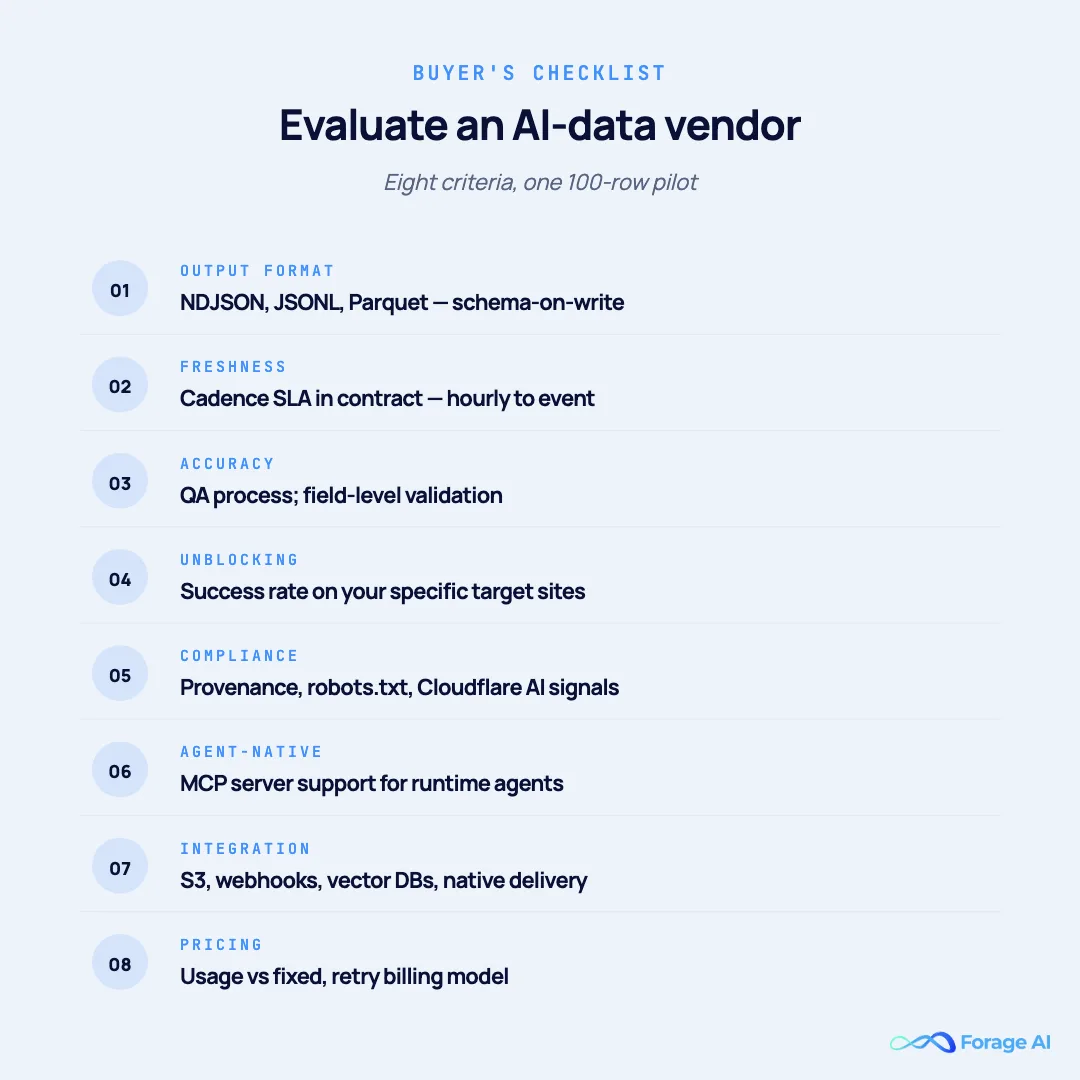
Before signing, give the vendor a representative 100-row golden set and ask them to extract it cold. Compare against your hand-curated ground truth: the test reveals more about output quality, schema discipline, and edge-case handling than any sales conversation.
When choosing a vendor to feed AI models, evaluate them on these concrete criteria:
- Output format and schema: Do they deliver in AI-ready formats that can directly be fed into your pipeline, such as NDJSON/JSON with consistent fields?
- Freshness and cadence: How often can they refresh feeds, and what SLAs exist? Define the freshness SLA in the contract; daily-vs-hourly-vs-event-triggered is where RAG quality actually lives or dies.
- Extraction accuracy: Can they handle high-accuracy data delivery? What does their QA process look like?
- Unblocking effectiveness: Measured by the success rate on your target websites. If you go for managed data extraction services, you don’t need to worry about this.
- Compliance: Do they document sources, licensing, and follow scraping rules and privacy safeguards? Especially in light of the 70+ AI copyright cases pending in U.S. courts by end of 2025. Ask vendors how they handle source provenance, robots.txt and Cloudflare AI-bot signals, and licensing for training-data uses.
- Agent-native access: If your AI agents will call the vendor’s data directly, MCP (Model Context Protocol) support matters. Both Bright Data and Zyte added MCP servers in 2025.
- Integration: Native deliveries to S3, webhooks, vector DBs, or your internal pipelines should suit your existing operations.
- Support: Dedicated engineer/CS support during onboarding and scaling. This is where picking tools versus services becomes important.
- Pricing predictability: You know you will be dealing with large scales. Usage versus fixed cost, and how retries are billed.
73% of enterprise RAG deployments fail within the first year, with most failures tracing to knowledge-base maintenance (stale documents, coverage gaps, poor extraction), not retrieval algorithms (Brainfish AI, 2025).
AI copyright lawsuits more than doubled in 2025, with 70+ cases pending against AI companies by end of year (Copyright Alliance, 2025).
Why Managed Data Providers Beat DIY for AI Data
Enterprise AI budgets grew from an average of $1.2M in 2024 to $7M in 2026; 86% of enterprises say their budget will increase again this year, and insufficient data is the top adoption barrier for 48% of respondents (Deloitte State of AI in the Enterprise 2026). The dollars are landing; the question is where the leverage is.
As we evaluate the different vendors, here’s an honest recommendation: don’t reinvent the wheel. With DIY comes headcount overages, infrastructure complexities, and maintenance issues. Managed web scraping services, like Forage AI, take all the hassle out of the process, leaving you to focus on pure, clean data.
Here’s why buying is better:
- Scale and unblocking: Large providers manage proxy networks and anti-bot tooling that keep pipelines running when websites block naive crawlers. In 2026, that increasingly means navigating the Cloudflare AI-bot block and the patchwork of Content Signals that publishers now use. One thing less for you to worry about.
- AI-ready outputs: Providers return data in the format that’s just right for you. Structured JSON/NDJSON and even schema-inferred outputs that plug directly into LLM training and vector pipelines.
- Maintenance reduction: Providers absorb the ongoing work of website changes, CAPTCHA mitigation, and format drift. AI-assisted coding makes building a working scraper feel instantaneous, until the source’s schema drifts in week three and the AI that wrote the scraper has no memory that the source ever looked different. Production AI-data teams typically see the cost cross the boundary by month nine of trying to maintain DIY.
- Compliance built in: Leading vendors offer privacy and legal frameworks that make enterprise-level data collection easier. In 2026, that includes the Cloudflare AI-bot block default (on every new domain since July 2025) and the 70+ pending AI copyright cases that are shaping training-data licensing posture.
DIY makes sense when the source list is small (under 100 URLs), the team has dedicated engineering bandwidth, the schema is stable, the cadence is forgiving, and the data isn’t load-bearing for a customer-facing product. Outside that envelope, DIY tends to cost more in maintenance than it saves in vendor fees, usually visibly by month nine.
One Forage AI client, Vested, has run 12 consecutive months at 100% uptime on its custom AI-data pipeline. The QA structure behind that number, a team three times the industry-average size relative to delivery, working a 200% QA process across 12+ years and 500M+ websites, is what most production AI-data buyers end up paying for, whether they realize it during evaluation or after.
FAQs
Which company is best for AI-focused web scraping?
The best company for AI-focused web scraping depends on whether you need tools or fully managed, AI-ready data delivery.
- API and infrastructure-first providers (such as large proxy networks like Bright Data and Oxylabs) are best for teams that want to build and maintain their own pipelines
- AI-focused managed web scraping companies, like Forage AI, are better when teams need clean, structured, continuously refreshed datasets for AI training or RAG systems without heavy engineering overhead
For production AI systems, companies that offer managed web scraping services, schema design, data quality validation, and refresh SLAs are the best fit.
What makes a web scraping company suitable for AI data?
A web scraping company is suitable for AI data if it goes beyond basic automation and focuses on AI readiness, meaning the data is fit for AI systems. Key characteristics include:
- Structured outputs (JSON, NDJSON, schema-consistent formats)
- High data accuracy and deduplication
- Freshness guarantees for continuously changing sources
- Support for RAG and AI training pipelines
- Document data extraction capabilities (PDFs, reports, filings)
- Monitoring and quality validation over time
AI systems are far less tolerant of noisy or inconsistent data, so AI-focused providers like Forage AI design extraction pipelines specifically for model consumption.
Can web scraping companies provide AI training datasets?
Yes, many web scraping companies can provide AI training datasets, but the quality and usability vary significantly. AI-ready training datasets typically require:
- Clean, labeled, and normalized data
- Removal of duplicates and low-quality records
- Consistent schema across sources
- Context preservation (especially for documents)
- Compliance and provenance tracking
Companies offering managed web scraping services and document data extraction services are better suited to deliver training datasets than API-only providers that return raw HTML or loosely structured data.
What industries need AI-specific web scraping the most?
Industries that rely on external, frequently changing information benefit most from AI-specific web scraping. Common examples include:
- E-commerce and retail: Pricing intelligence, catalog monitoring, recommendation engines
- Financial services: Market research, risk analysis, alternative data
- Real estate: Listings, valuation signals, regional intelligence
- Healthcare: Research aggregation, policy tracking, competitive insights
- Market and competitive intelligence: Feature tracking, market positioning
- AI product companies: Training data and RAG knowledge bases
In these industries, stale or inconsistent data directly degrades AI outputs, making AI-focused scraping essential.
How are API-based providers different from full-service scraping companies?
API-based providers offer access to proxies, browsers, or scraping endpoints, return raw or semi-structured responses on standard schemas, and leave extraction logic, quality, and maintenance to the client. Full-service scraping companies provide managed services with custom extraction, ongoing maintenance, data quality checks, refresh SLAs, and direct support for AI training and RAG use cases. For AI teams, full-service providers often reduce the total cost of ownership by eliminating constant rework and pipeline failures.
Are there legal risks using scraped data to train AI in 2026?
Yes, and the risk has sharpened over the last 18 months. AI copyright lawsuits more than doubled in 2025 (70+ cases pending by year-end), and Cloudflare’s July 2025 default-block on AI crawlers added an enforcement layer on top of robots.txt. Buyers should ask vendors three things: how they handle source provenance, whether they observe robots.txt and Cloudflare AI signals, and what their licensing posture is for training-data uses. Vendors that operate on managed, governed pipelines are easier to defend in legal review.
What is MCP, and does an AI-data buyer need a vendor that supports it?
MCP, the Model Context Protocol, is a standard for AI agents to interact with the live web through a vendor’s infrastructure. Bright Data launched the Web MCP in August 2025 (now powering 100M+ daily agent interactions), and Zyte has added MCP integration as well. If your AI architecture includes agents that need to fetch web data at runtime, not just at training time, MCP support is moving from “nice-to-have” to “check before you sign.”
Related Articles
- AI Training Data: An Operational Playbook for Data PMs and ML Engineers
- Web Scraping Legal Compliance: Code Patterns That Survive Legal Review
- Why RAG Pipelines Fail in Production: A Data Quality Diagnosis
- Web Scraping Companies vs Tools: A Failure-Mode Comparison
Sai is a data infrastructure enthusiast who has spent the past two to three years following the AI space closely, from the infrastructure layer to the fast-growing world of data for AI. He is genuinely curious about how modern data pipelines get built and where the data industry is heading, and he writes insightful pieces on the core topics that shape this niche.