
Top 10 Document Processing Solutions for Financial Services in 2026
The financial services industry is at a turning point. Institutions are rapidly moving from manual, OCR-based document handling to fully automated, AI-driven workflows. With regulatory pressure rising and customer expectations shifting toward instant decisions, document processing has become a core operational priority.
Recent advances in Intelligent Document Processing (IDP), generative AI, multimodal LLMs, and end-to-end automation have opened the door for unprecedented accuracy and speed. The intelligent document processing market is estimated at roughly $4 billion in 2026, up from about $3 billion in 2025, and The Business Research Company projects it reaching $12.37 billion by 2030 on a 33.4% compound annual growth rate.
Expert Insights
Survey data points the same way. KPMG found that AI "is already being widely adopted in companies' financial reporting processes, with nearly three-quarters (72 percent) of businesses piloting or using it," rising to "almost universal levels (99 percent) over the next three years" (KPMG International, survey of 1,800 companies, May 2024). Document extraction is usually where that work starts.
This blog highlights 10 document processing solutions shaping the industry in 2025-2026, platforms transforming compliance, underwriting, risk assessment, fraud detection, and customer onboarding. Each solution is evaluated based on accuracy, scale, BFSI adoption, and technological sophistication, helping financial institutions identify tools that align with their digital transformation goals.
Quick Digest
- Market size: Intelligent document processing is estimated at roughly $4 billion in 2026, heading for $12.37 billion by 2030.
- Why now: Growing document volumes, expanding KYC and AML rules and slow manual review make document automation a strategic priority.
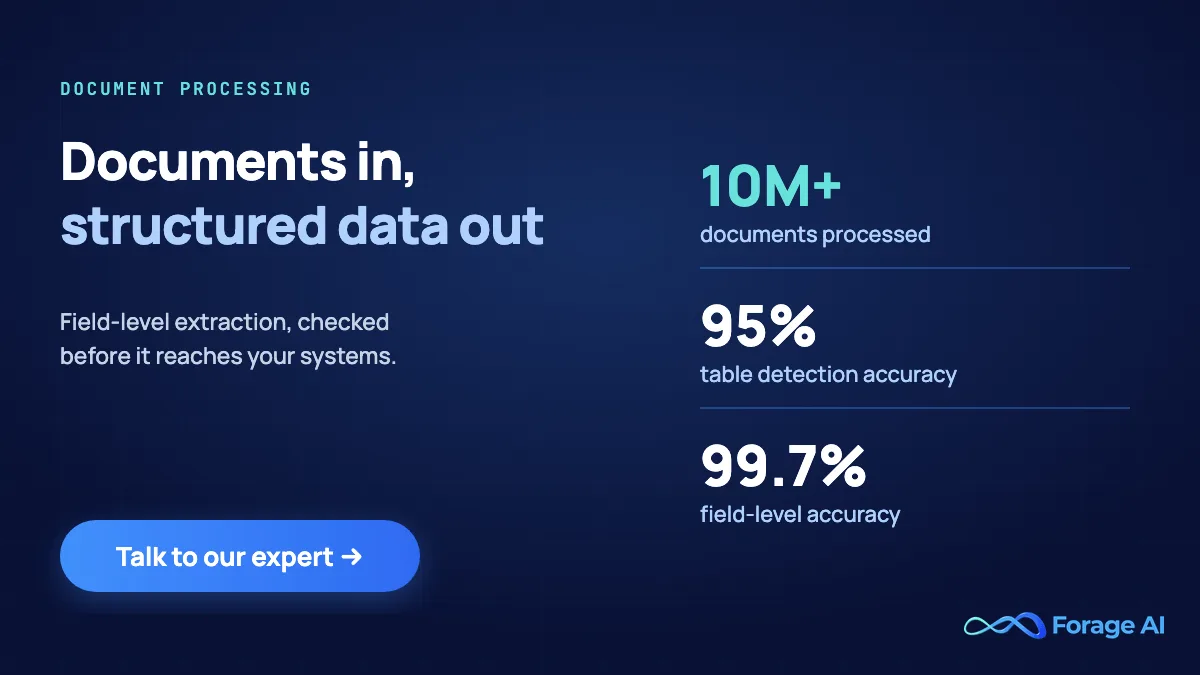
- Beyond OCR: Leading IDP platforms combine NLP, computer vision and LLMs and reach 95%+ accuracy on complex layouts.
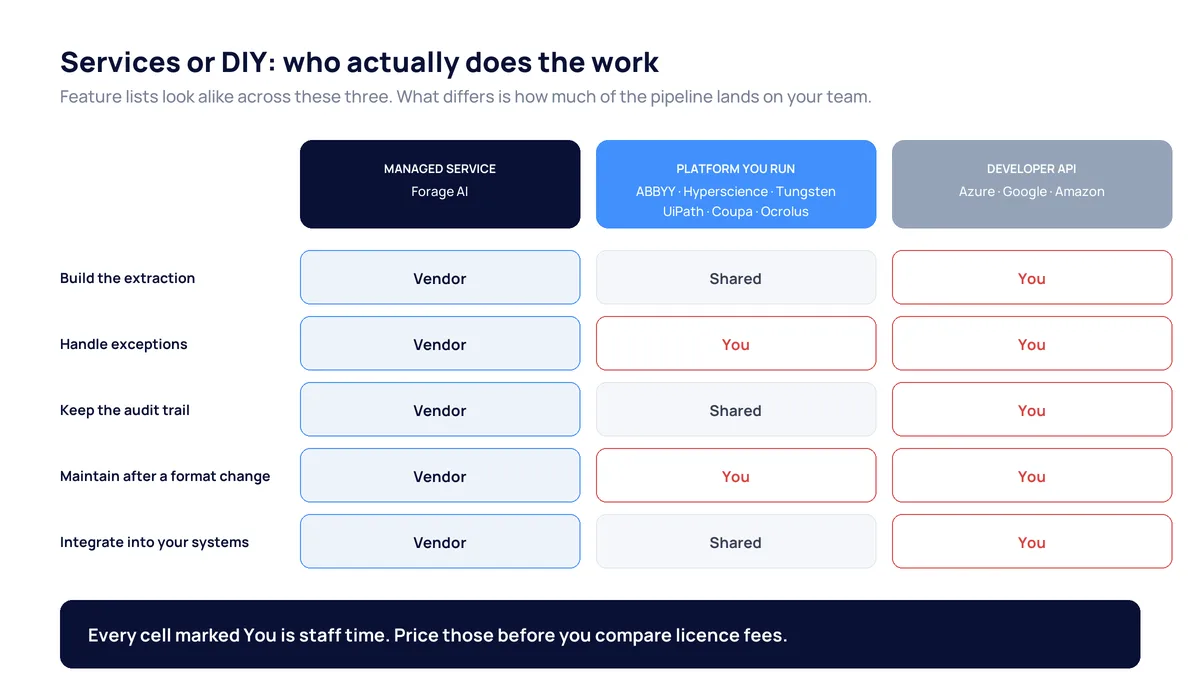
- Services or DIY: The ten split into one fully managed service, six platforms your team configures and runs, and three developer APIs you build on.
- Consolidation is live: WorkFusion is now part of UiPath and Rossum is now part of Coupa, so two names from last year's lists are no longer standalone purchases.
Want this built for your own filings and statements? We build intelligent document processing around your own document types and accuracy bar. Talk to us about your documents.
Where does fintech document processing stand today?
Before diving into specific solutions, it’s essential to understand the forces driving this transformation and why document processing has become mission-critical for financial institutions.
The pressure on financial institutions
Financial services rely on documents more than any other industry: applications, statements, KYC forms, contracts, claims, disclosures, regulatory filings, and countless other formats. But these documents are overwhelmingly unstructured. With formats like PDFs, scans, emails, images, handwritten forms, and multi-format attachments, making sense of the data is tough.
Institutions face simultaneous pressure from multiple directions. Document volumes continue to grow across retail banking, corporate lending, insurance, and wealth management. Compliance ecosystems are expanding to include KYC, AML, FATF guidelines, Basel III, and increasingly complex audit requirements. Manual data entry and review workloads create operational inefficiencies that slow down entire processes. Meanwhile, customers now expect real-time onboarding, instant approvals, and seamless digital journeys.
This convergence makes document automation no longer a support function; it’s a strategic necessity.
How the technology changed
Traditional OCR was designed to capture text exactly as it appears on a page, good enough for simple digitization, but inadequate for today’s financial workflows that demand contextual understanding, structured data extraction, automated reconciliation, anomaly prediction, and seamless integration into operational systems.
The Rise of AI-powered Intelligent Document Processing (IDP) has transformed document automation. Several breakthrough technologies are driving this shift:
- Natural Language Processing (NLP) now interprets complex sentences, entities, contextual meaning, and financial relationships within documents.
- Computer Vision models read tables, embedded images, stamps, signatures, and noisy/low-quality scans with remarkable precision.
- LLMs and generative AI don’t just extract data, they reason over documents, summarize insights, understand intent, and handle edge cases.
- Multilingual and handwriting recognition enable global BFSI institutions to scale operations effortlessly across geographies.
- Multimodal AI unifies understanding of text, layout, images, and handwriting as a single document intelligence unit.
These advancements are setting new benchmarks, with leading platforms now achieving 95%+ accuracy even on unstructured and complex layouts.
At the same time, several macro-trends are accelerating adoption across the industry:
- Real-time compliance and anomaly detection built directly into document pipelines
- Hyper-automation building an end-to-end document workflow that connects underwriting, claims, audit, reconciliation, and lending across the institution
- API-first ecosystems that plug directly into CRMs, core banking engines, and risk systems for instant orchestration
Together, they are transforming document processing into an intelligent, always-on decision layer powering the entire BFSI value chain. Financial institutions that have not yet adopted IDP risk falling behind, but there is still time to catch up.
To help you accelerate your journey, we’ve curated a list of the Top 10 Document Processing Solutions for 2026. Explore them and choose the one that aligns best with your operational needs.
Pro tip: In many cases, the fastest route to ROI is partnering with a custom data extraction provider who understands your workflows end-to-end and delivers structured, verified outputs, saving time, cost, and engineering resources.
Criteria for choosing a document processing solution
Before any shortlist is useful, you need the axes you are judging on. Six separate every serious option in this market, and they are the same six used to assemble the list below.
- Who runs it. A fully managed service delivers finished data. A platform or an API delivers a tool your own engineers operate. This is the single biggest cost difference between two vendors with identical feature lists.
- Document variance. Fixed forms are a solved problem. Messy, semi-structured and multi-layout documents are where products separate, so test on your worst files rather than your cleanest.
- Auditability. Regulated workflows need a record of what was extracted, by what, and who checked it. Ask to see the audit trail on a real record, not a slide about one.
- Integration. Core banking, LOS/LMS, CRM and risk engines all need feeding. API-first designs bend to your stack; packaged connectors are faster when your workflow is standard.
- Peak volume. Month-end statement runs and seasonal claims spikes expose the difference between a system that queues gracefully and one that falls over.
- Total cost of ownership. Licence price is the visible part. Model training, exception handling, retraining after a format change and the staff doing all three are the part that shows up later.
We also cross-checked the field against published analyst coverage. Gartner published the first Magic Quadrant for Intelligent Document Processing Solutions in September 2025 and a second edition dated 8 September 2026; Tungsten Automation and UiPath both announced Leader placements in the current edition, and ABBYY and Hyperscience announced Leader placements in the inaugural one.
One structural change since last year. Two names that appeared on every 2025 list are no longer independent companies. UiPath acquired WorkFusion in February 2026, and Coupa acquired Rossum in May 2026. Both are listed below under the acquirer, because that is who you would now be buying from.
The ten below are grouped by who operates the thing: one managed service, six platforms your own team configures and runs, and three developer APIs you build on top of. That split matters more to a finance team than any feature table, because it decides whether you are buying an outcome or a project.
| Solution | Category | Best for | What it is actually good at |
|---|---|---|---|
| 1. Forage AI | Managed service | Messy, high-stakes document sets and web data in one pipeline | Fully managed, nothing to run in-house |
| 2. ABBYY | Platform | Scanned and semi-structured back-office capture | Mature OCR with pre-built financial templates |
| 3. Hyperscience | Platform | Handwritten and highly variable forms | Human-in-the-loop that trains the model as it corrects |
| 4. Tungsten Automation | Platform | High-volume, multi-step legacy workflows | Rules engine and deep legacy integration |
| 5. UiPath | Platform | Document steps inside an existing RPA estate, plus AML and KYC | Document Understanding, with WorkFusion's financial-crime agents since 2026 |
| 6. Coupa | Platform | Accounts payable and supplier invoices | Rossum's extraction, now inside a spend-management suite |
| 7. Ocrolus | Platform | Lending: bank statements, pay stubs, tax forms | Income and cash-flow analysis plus fraud signals, not just extraction |
| 8. Azure AI Document Intelligence | Developer API | Teams already standardised on Azure | Layout-aware models and strong table extraction |
| 9. Google Document AI | Developer API | Handwriting and identity documents | Best-in-class handwriting recognition |
| 10. Amazon Textract | Developer API | Bursty, high-volume extraction inside AWS | Elastic scale and native AWS integration |
Each entry is covered in more detail below, and third-party review ratings for all ten are collected in one table further down.
Managed services: someone else runs the pipeline
One option in this list delivers finished, checked data rather than software to operate. It suits teams with no spare data-engineering capacity, and teams whose documents vary too much for a template.
1. Forage AI
What it does: Forage AI provides a fully managed, end-to-end data extraction suite covering documents, public websites, regulatory filings, bank statements, financial reports, onboarding packets, and more. Its intelligent document processing layer is built to handle BFSI-grade complexity, multi-page, messy, semi-structured, or unstructured documents.
Why it matters for BFSI: With 12+ years of financial data extraction expertise, Forage AI supports regulatory reporting teams, risk functions, underwriting units, and operations teams that rely on accurate, timely data. Forage AI removes the need for internal engineering support by running a fully managed pipeline that brings together custom ML models, flexible crawlers, domain-tuned LLMs, and human-in-the-loop QA.
Forage AI is particularly valuable for BFSI institutions dealing with large, messy, and high-stakes document sets such as loan files, end-to-end KYC packets, FATCA/CRS forms, insurance claims, risk reports, credit packages, financial spreads, and regulatory submissions, where precision and consistency are non-negotiable.
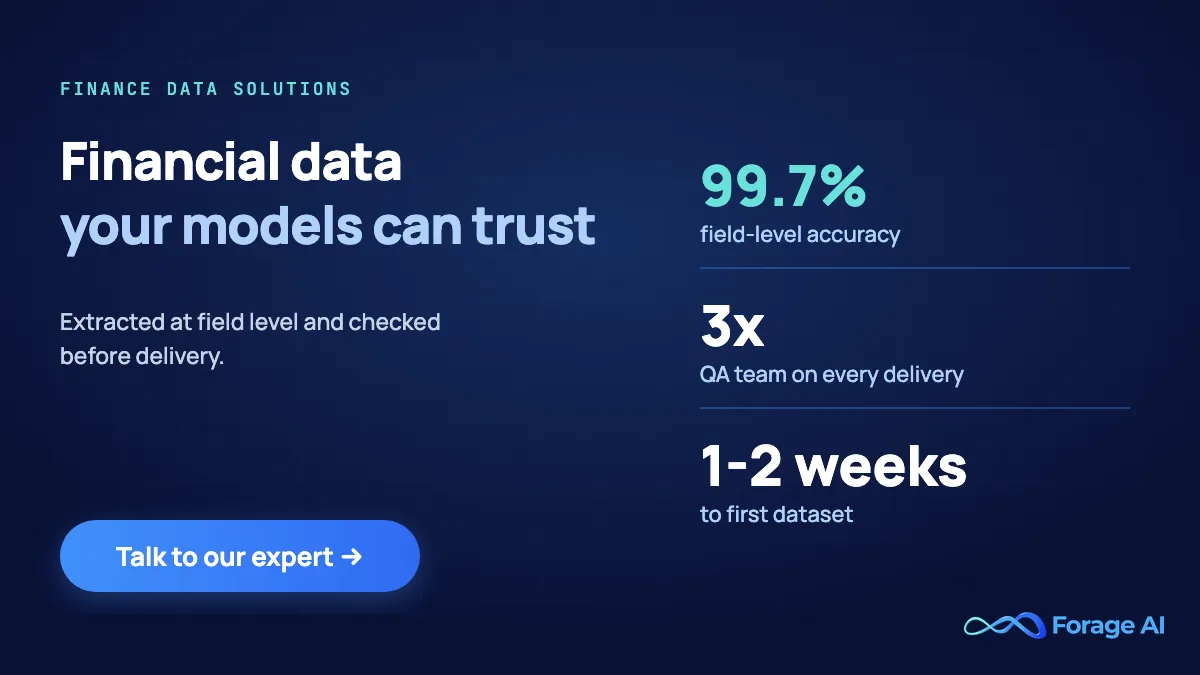
Key strengths: Forage AI’s key USP is custom data extraction delivered as a fully managed service. Meaning you don’t have to worry about the back-end processes at all. Its pipelines combine ML, NLP, and generative AI-powered extraction, built to your fields and documents. Workflows are highly customizable for BFSI-specific documents. RAG-based enrichment and validation add context to extracted data. Forage AI runs the pipeline end to end, and human-supervised QA by a team 3x the industry average checks data before it reaches your systems.
Forage AI offers both web and document data extraction as one managed service, so it suits teams that want a single partner for both.
Platforms your own team configures and runs
These are products you license and operate. They carry the most capability per licence and the most ongoing obligation: somebody on your side configures the models, handles exceptions and retrains when a format changes.
2. ABBYY
What it does: ABBYY Vantage helps BFSI teams automate routine, rule-based workflows such as bank statement extraction, KYC packet classification, cheque processing, and account opening documentation. Its pre-trained OCR models and validation flows speed up repetitive data capture operations.
Why it matters for BFSI: Banks and insurers with established back-office teams use ABBYY to reduce manual work across scanned and semi-structured documents. While it delivers strong accuracy, it typically requires an internal engineering and operations team to configure, train, and maintain pipelines.
Key strengths: ABBYY offers an industry-leading OCR engine with decades of refinement. Pre-built financial templates accelerate deployment. The integration ecosystem is extensive, and accuracy at scale is well-documented across enterprise deployments.
Watch out for: licence and services pricing that is heavy for a smaller institution, and a configuration learning curve that reviewers raise repeatedly.
3. Hyperscience
What it does: Hyperscience enables BFSI teams to automate handwritten forms, semi-structured claims packets, mortgage documents, and legacy paper workflows using ML models that continuously learn from reviewer corrections.
Why it matters for BFSI: Its human-in-the-loop architecture provides the accuracy, oversight, and auditability required for regulated BFSI processes such as claims, underwriting, and compliance reviews.
Key strengths: Adaptive learning improves accuracy over time. The platform delivers exceptional accuracy on complex, variable documents. Workflow automation is robust, and the human-in-the-loop design provides auditability for compliance requirements.
Watch out for: a deployment that expects you to staff the reviewer loop it learns from. The accuracy comes with an operating model, not just a licence.
4. Tungsten Automation
What it does: Tungsten helps banks and insurers automate high-volume back-office workflows such as customer onboarding, mortgage fulfillment, cheque processing, and multi-step compliance processes through rules-based document capture and workflow orchestration.
Why it matters for BFSI:It’s widely used by legacy institutions with complex infrastructures and large operations teams. Tungsten excels at orchestrating document-heavy processes even though it requires internal developers to maintain automations.
Key strengths: The platform features a solid rules engine for complex business logic. Document-centric automation handles end-to-end processes. Integrations with legacy systems are mature and well-tested.
Watch out for: an older platform feel and real developer time to maintain the automations, which is the trade for its depth in legacy environments.
5. UiPath
What it does: UiPath Document Understanding pairs document AI with the company’s robotic process automation estate, covering KYC verification, income statement capture, credit analysis, policy administration and claims. In February 2026 UiPath acquired WorkFusion, folding in a set of pre-built agents for anti-money-laundering screening, sanctions checks and periodic KYC refresh.
Why it matters for BFSI: It is the obvious extension for an institution already running UiPath, because the document step joins workflows the operations team already owns. The WorkFusion acquisition also means financial-crime compliance is no longer a separate purchase from a separate vendor, which is the main thing that changed in this market in 2026.
Key strengths: RPA integration with no second vendor to manage, model training that business users can run, pre-trained types for common financial formats, and now dedicated AML and KYC agents.
Watch out for: an acquisition that is still being integrated. If the WorkFusion agents are the reason you are buying, ask specifically what is generally available today rather than on the roadmap.
6. Coupa (Rossum)
What it does: Rossum built a transactional document model aimed at invoices, vendor onboarding and transactional finance, and was acquired by Coupa in May 2026. Its extraction now sits inside Coupa’s source-to-pay platform and feeds Coupa’s own AI agents.
Why it matters for BFSI: For accounts payable and procurement-heavy finance operations, this is the strongest pure invoice-processing lineage in the list, and it now arrives attached to a spend-management suite rather than as a standalone tool.
Key strengths: Fast model training from few samples, a collaborative review layer built for exception handling, and operational analytics finance teams can actually read.
Watch out for: the change in what you are buying. If you want document extraction without adopting a spend-management platform, confirm the standalone commercial terms before you scope anything.
7. Ocrolus
What it does: Ocrolus is built specifically for lending documents: bank statements, pay stubs, tax returns and the rest of a credit file. It classifies and extracts, then goes a step further and produces income calculations, cash-flow analysis and fraud signals from what it read.
Why it matters for BFSI: Most tools in this list hand you fields and stop. For small-business lending and mortgage, the work after extraction is the underwriting decision, and Ocrolus is one of the few that treats analysis as part of the product rather than something you build downstream.
Key strengths: Deep, narrow coverage of credit-file document types, document-level fraud detection, and income analysis for both salaried and self-employed borrowers.
Watch out for: that narrowness. It is a lending tool. For general enterprise document processing across unrelated workflows, it is the wrong shape.
Developer APIs you build on
The cloud APIs are the most flexible and the least finished. You get extraction primitives and build the workflow, review layer and audit trail yourself, which is the right trade only when you have engineers to spend.
8. Azure AI Document Intelligence
What it does: Azure AI Document Intelligence enables BFSI teams to quickly extract data from invoices, receipts, financial statements, escrow documents, and multipage reports using cloud APIs and layout-aware AI models.
Why it matters for BFSI: Banks and insurers operating on Microsoft infrastructure benefit from seamless integration into existing Azure services such as Logic Apps, Power Automate, and Azure databases.
Key strengths: Multilingual support covers global operations. Table extraction handles complex financial layouts. APIs are flexible and well-documented. Microsoft ecosystem integration is seamless.
Watch out for: the naming and version churn. The service was renamed from Form Recognizer in 2023 and the v2.0 API reached its retirement date on 31 August 2026, so older integrations and older tutorials need checking before you rely on them.
9. Google Document AI
What it does: Google Document AI helps BFSI teams process contracts, procurement packets, identity documents, handwritten forms, and insurance documents, leveraging Google’s advanced handwriting and layout recognition.
Why it matters for BFSI: Institutions seeking cloud-first, API-driven extraction benefit from Google’s pre-trained document types, though Document AI tends to evolve slower since it’s not Google’s core enterprise focus.
Key strengths: Handwriting recognition is excellent. Pre-trained vertical models accelerate deployment. Cloud-first architecture scales effortlessly.
Watch out for: a slower release cadence than the other two hyperscalers, since document processing is not where Google’s enterprise focus sits.
10. Amazon Textract
What it does: Textract allows BFSI teams to process statements, tax forms, onboarding packets, card applications, and transaction-heavy documents using AWS-native OCR and table extraction.
Why it matters for BFSI: Perfect for institutions already invested in AWS who need reliable extraction across large fluctuating workloads (e.g., end-of-month statement spikes).
Key strengths: Layout detection handles complex documents. Scaling is virtually unlimited within AWS. Integration with other AWS services is seamless.
Watch out for: everything above the extraction call. Review queues, audit trails and exception handling are yours to build.
What reviewers actually rate these tools
Vendor pages quote accuracy figures that nobody outside the vendor can reproduce. Public review ratings are a weaker signal but a verifiable one, so here they are with their sample sizes, which is the part most comparison articles leave out. A 4.8 from nine reviewers and a 4.5 from a hundred and twenty-seven are not the same claim.
| Solution | G2 rating | Reviews (n) | How to read it |
|---|---|---|---|
| Forage AI | 4.8 | 9 | Smallest sample here. Read the reviews rather than the average. |
| ABBYY Intelligent Document Processing | 4.3 | 88 | Large, consistent sample; complaints cluster on setup complexity and cost. |
| Hyperscience | 4.6 | 54 | Strong rating on a solid sample, concentrated in complex-form use cases. |
| Tungsten TotalAgility | 4.3 | 55 | Listed under the former Kofax product name on most review sites. |
| UiPath Document Understanding | 4.6 | 23 | Rates the document module, not the wider UiPath platform or WorkFusion. |
| Rossum (now Coupa) | 4.5 | 127 | The deepest review pool in this list, all of it predating the Coupa acquisition. |
| Ocrolus | 4.6 | 16 | Small sample, heavily weighted to lending customers. |
| Azure AI Document Intelligence | 4.4 | 20 | Small sample for a service of this reach; most users never leave a review. |
| Google Document AI | 4.2 | 37 | Lowest average here, on a reasonable sample. |
| Amazon Textract | 4.3 | 27 | Rates the API, so it reflects developer experience rather than business outcome. |
All ten ratings read directly from G2 on 9 November 2026. Capterra and Gartner Peer Insights carry separate pools for several of these products; where a vendor is rated very differently there, that disagreement is worth more than either number alone.
Expert Insights
Sample size is the thing to check first. Four of the ten products here have fewer than 30 public reviews, and two have fewer than 20. At those counts a single unhappy enterprise customer moves the average by more than a genuine difference in product quality would. Use the ratings to find questions, not to rank.
Matching a solution to your workflow
The six criteria above tell you what to judge. This section is the other half: which of the ten actually fits a given workflow. Four patterns cover most of what finance teams are automating.
Internal resources: Do you have an in-house engineering and data operations team capable of building, maintaining, and optimizing extraction workflows? If not, a fully managed data extraction provider becomes essential. If yes, platform-led solutions may be viable, but they will require continuous oversight, retraining, and ops support.
For automating commercial loan origination, where teams must extract data from tax returns, financial statements, bank statements, UCC filings, and credit packages, fully managed providers like Forage AI or adaptive-learning platforms like Hyperscience excel. They correlate data across multiple complex documents while minimizing internal operational load. The same logic applies to legal-heavy workflows, where contract data extraction turns dense loan agreements, ISDAs, and vendor contracts into structured fields without sacrificing accuracy.
Integration requirements: Does the platform integrate smoothly with your core banking system, LOS/LMS, CRM, risk engine, or existing automation tools? API-first architectures offer the most flexibility. Plug-and-play systems may work better for standardized workflows.
Document complexity: Do your workflows involve highly structured forms, or messy, semi-structured, and unstructured documents with variable layouts? For high-variance documents (e.g., financial spreads, insurance claims, FATCA forms), custom extraction pipelines or managed services deliver better accuracy than generic platform models.
For KYC/AML onboarding workflows, especially those involving IDs, tax forms, shareholder declarations, corporate documents, and high-risk entity screening, UiPath (through the WorkFusion agents it acquired in 2026) and Tungsten Automation offer pre-built models and compliance-oriented validation layers, including sanction-list checks.
Compliance needs: How critical are auditability, traceability, and human oversight? Regulated workflows benefit from platforms with strong human-in-the-loop QA and review layers. Some workflows, like credit memos or risk committee documentation, require verifiable extraction trails.
Expert Insights
Regulators expect this review to happen before launch. In its December 2024 report on AI in financial services, the U.S. Department of the Treasury recommended that financial firms "prioritize their review of AI use cases for compliance with existing laws and regulations before deployment and that they periodically reevaluate compliance as needed." Build that review into your selection process, not after go-live.
Scale and volume: What are your peak processing volumes? Cloud-native platforms handle burst workloads efficiently (month-end statements, seasonal claims). On-prem or hybrid solutions may be needed for institutions with strict data residency requirements.
Existing infrastructure: Are you already invested heavily in AWS, Azure, Google Cloud, or a specific RPA platform? Choosing a solution aligned with your existing stack reduces deployment friction and accelerates ROI.
Data enrichment needs: Do you need to cross-reference extracted data with external systems, regulatory sites, business registries, or public sources? Platforms that combine document processing + web data acquisition (e.g., Forage AI) are far more future-proof for institutions that rely on enriched or corroborated data for decision-making.
For insurance claims processing, particularly when handling forms, estimates, attachments, and handwritten damage assessments, Coupa (through Rossum) and ABBYY deliver strong accuracy through pre-trained OCR templates and human-assist review features. Carriers evaluating tools tuned specifically for ACORD forms, certificates of insurance, and loss runs should also weigh the dedicated options in our roundup of the best insurance data extraction tools. For carriers looking at the broader operating model, our deep dive on claims processing automation walks through how insurers reduce manual review and accelerate payouts end-to-end.
Quick Summary
Q: How should a finance team choose a document processing solution?
A: Match it to your in-house engineering capacity, integration needs, document complexity, audit and review requirements, peak volumes and existing cloud or RPA stack. Teams without their own data operations staff usually do better with a fully managed provider.
Picking the right fit for your finance team
Document processing is no longer just an efficiency play, it’s the backbone of modern financial operations. As 2026 approaches, the combination of AI, automation, multimodal LLMs, and intelligent document analytics is redefining how banks, insurers, fintechs, and regulatory bodies operate.
The ten profiled here fall into three operating models: one managed service that delivers finished data, six platforms your team runs, and three developer APIs you build on. The choice between those three is the decision. Everything else is detail underneath it. And as UiPath buying WorkFusion and Coupa buying Rossum both showed this year, the vendor you pick may not stay independent, so weigh who is likely to still be standing alone in three years.
Institutions that modernize early gain advantages in compliance accuracy, operational speed, customer experience, and cost efficiency. Those that wait risk falling behind in a rapidly evolving regulatory and competitive landscape.
The solutions highlighted here represent different approaches to the same challenge: turning unstructured documents into structured, actionable data. The right choice depends on your institution’s specific needs, existing infrastructure, and strategic priorities.
By Krittika Arora