
Best Alternative Data Marketplaces in 2026: 11 Platforms Compared
Search any alternative data marketplace for card-spend or foot-traffic data and a shelf of candidates appears in seconds. Discovery stopped being the hard part years ago. Buying stalls afterwards, in the trial, the compliance review and the licence read.
The trial is the clearest example. 39% of data buyers say the main reason a trial does not turn into a purchase is that "the dataset showed no discernible signal", against 25% who blame price, according to a 2026 survey of 69 buyers by Neudata, which also appears in this list.
So we judged the alternative data platforms below on five jobs that start after the find, and on who pays each platform to do them. One line holds throughout. A marketplace is where you shop; a provider or vendor is who you buy from and whose licence you sign.
By the end, you will have a shortlist matched to how your team buys, and a plain list of what each platform does not do for you. Verified October 2026.
- Discovery is solved: every platform here finds datasets; they differ on trial, diligence material, licence, delivery and exit.
- Who pays matters: Eagle Alpha and Neudata charge buyers and say they take no vendor commission; Datarade is paid by vendors; cloud exchanges pass the provider's price through.
- Diligence stays with you: Eagle Alpha and Neudata supply diligence material, but no platform does your compliance sign-off, and no listing says whether its history is point-in-time.
- Cloud exchanges are delivery rails: Snowflake, AWS and BigQuery deliver into their own cloud, so check what you keep at exit.
How did we judge these alternative data marketplaces?
Catalogue size is not a criterion here, for a practical reason. Three platforms disagree with their own published counts, and Snowflake's figure includes agents and apps alongside datasets. We scored five post-discovery jobs instead.
| Job | What we checked on the platform's own pages |
|---|---|
| Who pays | Whether buyers pay a subscription, vendors pay a commission, or the provider's price passes through with a platform fee |
| Trial or samples | How a trial or sample is granted, for how long, and whether you pay for it |
| Diligence material | Whether the platform supplies due diligence questionnaires (DDQs), risk checks or research, in its own words |
| Licence & exit | The default licence where the platform publishes one, and what you keep when access ends |
| Delivery & lock-in | Where the data lands, whether it is a share or a copy, and whether it ties you to one cloud |
We read each platform's own documentation, pricing and terms pages in October 2026, not the ranking pages that still call Nasdaq Data Link "Quandl" and list Crux as a marketplace. G2 ratings carry their review counts, and "Not stated" means the platform publishes nothing. No platform paid for placement.
Alternative data marketplaces at a glance
Verified October 2026. No platform paid for placement. Neudata is also a source of figures in this article.
Grouped in band order. Catalogue counts are left out on purpose: they disagree, and a count column reads as a ranking.
| Platform | Type | Best for | Who pays |
|---|---|---|---|
| Eagle Alpha | Curated discovery | Funds without a full sourcing desk that want DDQ material before a trial | Buyer subscription; no vendor fees (per Eagle Alpha) |
| Neudata | Curated discovery and research | Research-led shortlisting with analyst help | Buyer subscription; "$0 commission" from vendors (per Neudata) |
| BattleFin (incl. Exabel) | Events, catalogue and analytics | Meeting vendors and testing data in a sandbox | Providers sponsor its events; buyer fees not stated |
| Nasdaq Data Link | Storefront (Nasdaq's own data plus publishers) | API-ready financial series with free samples | Buyer subscription, per dataset (per Nasdaq) |
| Datarade | Open storefront, generalist | Broad or non-finance categories | Vendor-paid, free to buyers |
| Carbon Arc | Consumption-priced insights exchange | Testing a question before annual spend | Buyer, per-unit tokens |
| Amass Insights | Application-gated directory | The widest index of provider names | Not stated |
| Snowflake Marketplace | Cloud exchange | Teams on Snowflake | Provider's price; Snowflake's fee not stated |
| AWS Data Exchange | Cloud exchange | Teams on AWS | Provider's price plus your AWS usage; providers pay AWS fees |
| Databricks Marketplace | Cloud exchange (open sharing) | Databricks or mixed stacks | Not stated |
| Google BigQuery sharing | Cloud exchange | Teams on Google Cloud | You pay query compute; paid listings via Google Cloud Marketplace |
The best alternative data marketplaces, by how they work
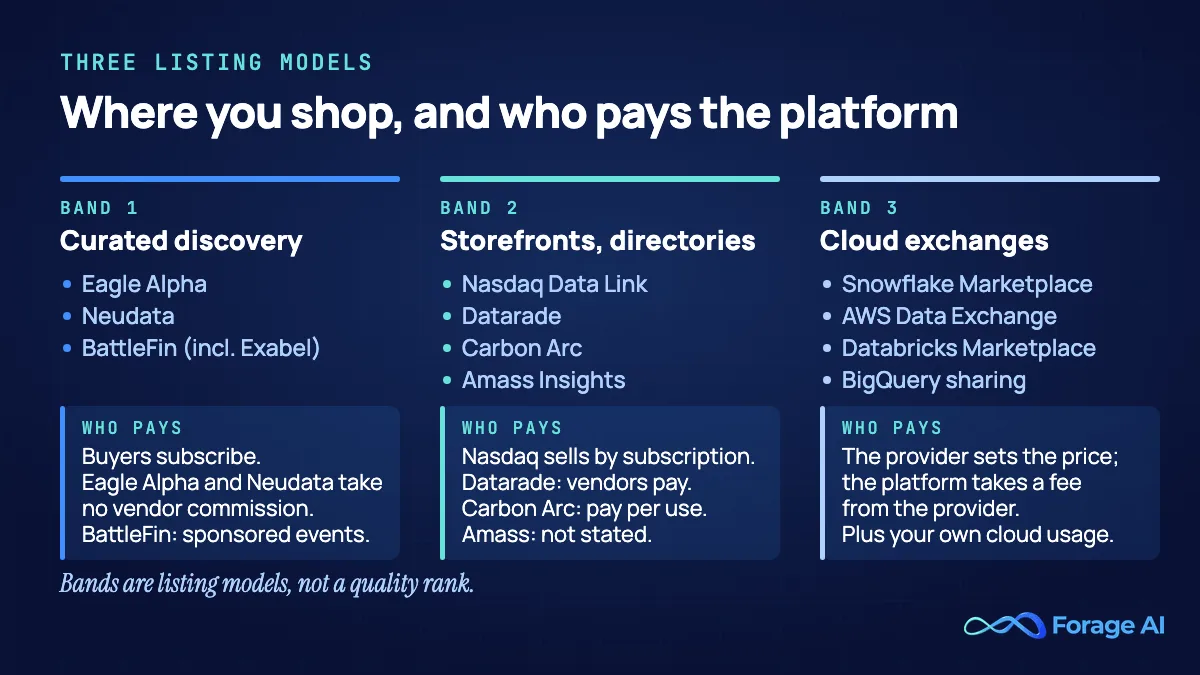
The three bands are listing models, not a quality rank. Inside each band, entries run by how much primary fact we could verify, so they carry no numbers, and each ends on its honest limit.
Band 1: Curated discovery platforms
Curated discovery platforms sit on the buyer's side. Buyers subscribe, and Eagle Alpha and Neudata say they take no vendor commission. They add research and diligence material on top of search, the most diligence help in this list, but the data still comes from the vendor, under the vendor's licence.
Eagle Alpha
| Attribute | Detail |
|---|---|
| Best for | Funds without a full sourcing desk that want DDQ material before a trial |
| Type & listing model | Curated discovery platform plus advisory and a compliance tool (Surveyor) |
| Catalogue | "over 2,500 alternative data products" (as stated by Eagle Alpha, homepage, Oct 2026) |
| Who pays | Buyers, by subscription (price not stated); vendors pay no fees or commission (per Eagle Alpha) |
| Trials & samples | "Standardized trials", optionally delivered via Lakeshore; length and cost not stated |
| Diligence material | "over 2,000 DDQs and attachments"; Surveyor adds re-diligence reminders |
| Licence & exit | Not stated; sits in each vendor's licence |
| Delivery & lock-in | API sync into your own catalogue; the vendor delivers; no lock-in stated |
| Watch-out | Buyer prices unpublished; early-access datasets include Eagle Alpha's own corporate-data business |
| Source | Rating | Reviews (n) | Checked |
|---|---|---|---|
| G2 | listed, 0 reviews | 0 | Oct 2026 |
Eagle Alpha gives the clearest yes on diligence material in this set. Its buyer page offers "70+ profile fields along with over 2,000 DDQs and attachments so your team can quickly decide whether a dataset is worth a trial", which puts the questionnaire before the trial decision, not after it. Vendors file in a standard DDQ format (FSID), so documents line up. Eagle Alpha says it charges vendors nothing: "No Listing Fees. No Commissions. No Referral Fees." Buyers fund it through an unpublished subscription.
Surveyor is the part a compliance team will notice: a tool offering "DDQ change alerts and re-diligence reminders", which speaks to a gap SEC staff found at advisers, who had no trigger to re-diligence a vendor once onboarded. Its price is not stated. The events side has changed hands too: A-Team Group bought Eagle Alpha's events business in November 2025, and the conference now runs "hosted by A-Team Group". The data platform was not part of that sale.
The honest limit: you cannot cost a shortlist from the website, and its early-access datasets include Eagle Alpha's own corporate-data business. No vendor commission is a real alignment signal. It is not neutrality on every listing.
Neudata
| Attribute | Detail |
|---|---|
| Best for | Research-led shortlisting with analyst help |
| Type & listing model | Curated research and discovery platform (Scout); vendors list free |
| Catalogue | "4,200+ data providers", "7,000+ datasets" (as stated by Neudata, homepage, Oct 2026); its provider page says "4,500+ data vendors" |
| Who pays | Buyers (price not stated); vendors: "$0 commission taken since 2016 launch" |
| Trials & samples | Not stated; trials run vendor-direct |
| Diligence material | Vendor DDQ and risk check, plus Neudata's "first stage of research and diligence"; buyer access to the DDQ not stated |
| Licence & exit | Not stated; sits in each vendor's licence |
| Delivery & lock-in | None; the vendor delivers |
| Watch-out | Discovery and research only; trial, contract and delivery sit with the vendor |
| Source | Rating | Reviews (n) | Checked |
|---|---|---|---|
| G2 | 4.2/5 | 11 | Oct 2026 |
| Capterra | No listing | n/a | Oct 2026 |
Neudata is the research-led option. Scout handles search, and its analysts carry out "the first stage of research and diligence on behalf of our data buyer clients". Vendors list free and submit a DDQ and risk check that gives buyers "additional information on their regulatory and compliance questions". The page does not say whether you see that document, a summary, or nothing. Ask before you sign.
A disclosure: Neudata is also the source of the trial survey quoted in this article's opening, and the catalogue figures above are its own. They disagree (4,200+ providers on the homepage, 4,500+ vendors on the provider page), so we print both.
In practice, Neudata stops where the money changes hands: the trial, the contract and the delivery all happen with the vendor. A vendor DDQ that Neudata says takes five to ten minutes is material to read, not verification, and "first stage" is Neudata's own, honest limit on its diligence.
BattleFin (incl. Exabel)
| Attribute | Detail |
|---|---|
| Best for | Buyers who prefer meeting vendors and testing data in a sandbox |
| Type & listing model | Events (Discovery Days), catalogue (Ensemble), analytics (Exabel) |
| Catalogue | "3,000+ Alternative Datasets" (as stated by BattleFin, homepage, Oct 2026); its 2024 acquisition release says "2,800+ datasets" |
| Who pays | Providers buy event sponsorship (per BattleFin's event pages); buyer fees not stated |
| Trials & samples | Ensemble sandbox for full-history testing under one NDA set (per BattleFin; LSEG describes it too) |
| Diligence material | Not stated; vetting criteria for "vetted providers" not stated |
| Licence & exit | Not stated |
| Delivery & lock-in | Exabel platform; you can "bring your own data" |
| Watch-out | Thin fee facts; event providers are sponsors |
| Source | Rating | Reviews (n) | Checked |
|---|---|---|---|
| G2 (BattleFin) | 4/5 | 1 | Oct 2026 |
| G2 (Exabel) | listed, 0 reviews | 0 | Oct 2026 |
BattleFin works through rooms and sandboxes. Discovery Days set up "pre-scheduled 1:1 meetings between qualified data buyers and vetted providers" in New York, London and Miami. Per its event pages, buyer registration is limited to buy-side firms, and providers pay for sponsorship tiers. Its Ensemble catalogue, by BattleFin's account, lets you test a dataset's full history in a sandbox under one set of NDA and testing agreements.
The bigger change is structural. BattleFin acquired Exabel in December 2024. Exabel brings an analytics platform with "60+ pre-mapped datasets" where you can "bring your own data". Discovery and evaluation tooling now sit with one company.
Public facts on fees are thin: buyer fees, Ensemble access and the criteria behind "vetted providers" are not stated. The providers in the room paid to be there. That describes the model, not their data, but know it going in.
Band 2: Open storefronts and directories
Open storefronts and directories have wider shelves and less diligence help. Who sells the data decides who you negotiate with: Nasdaq sells its own and its publishers' data, Datarade is paid by vendors, Carbon Arc meters each query, and Amass Insights is an application-gated directory.
Nasdaq Data Link
| Attribute | Detail |
|---|---|
| Best for | API-ready financial and alternative series with free samples |
| Type & listing model | Storefront: Nasdaq's own data plus publishers, sold by Nasdaq |
| Catalogue | "more than 350 trusted data sets" (as stated by Nasdaq, Data Link product page, Oct 2026) |
| Who pays | Buyers, by subscription per dataset (per Nasdaq); prices not stated |
| Trials & samples | Free samples on most premium datasets (per Nasdaq) |
| Diligence material | Not stated |
| Licence & exit | By default (terms as of Oct 2026): derived data yours, inside your firm; delete and certify at exit; 90 days' notice to stop renewal |
| Delivery & lock-in | API, Python, SQL, Excel, R, MCP; no cloud lock-in |
| Watch-out | You buy from Nasdaq, and most publishers are Nasdaq units |
| Source | Rating | Reviews (n) | Checked |
|---|---|---|---|
| G2 | listed, 0 reviews | 0 | Oct 2026 |
Nasdaq Data Link is a storefront, not a neutral broker. Of the roughly 21 publishers on its shelf, most are Nasdaq's own units, such as eVestment and Dorsey Wright, alongside third parties like Sharadar. Quandl survives only as a publisher name inside Data Link, which is why ranking pages that still list "Quandl" are out of date.
The reason to shortlist it is the licence, the most detailed in this band. By default (terms as of October 2026), derived data you create is yours but cannot leave your firm without approval; at the end of the term you "delete or purge" the data and certify it on request; and the one-year term renews unless you give 90 days' notice. An Order Form can change any of that. On Nasdaq Data Link pricing, datasets are sold by subscription with no published prices, and Nasdaq says most premium datasets come with free samples. The API is the main door, and nothing ties you to one cloud.
Two watch-outs. Updated terms apply from 1 November 2026, so re-read them if you sign later. And Nasdaq sells the data, so you negotiate with the owner of most of the shelf.
Datarade
| Attribute | Detail |
|---|---|
| Best for | Broad or non-finance categories; posting a data request |
| Type & listing model | Open, generalist listing marketplace ("560+ data categories") |
| Catalogue | "2700+ data providers" (as stated by Datarade, homepage, Oct 2026); its provider sign-up page says "650+" |
| Who pays | Vendor-paid, free to buyers; vendor plans from 30% commission to $12,000 a year plus 15% |
| Trials & samples | "Free sample preview" links; trials via the vendor |
| Diligence material | Not stated |
| Licence & exit | Not stated; sits in each vendor's licence |
| Delivery & lock-in | Depends on the vendor |
| Watch-out | Listing volume depends on the vendor's paid plan |
| Source | Rating | Reviews (n) | Checked |
|---|---|---|---|
| G2 | 4.5/5 | 21 | Oct 2026 |
| Capterra | No listing | n/a | Oct 2026 |
Datarade is the generalist shelf, and the one platform in this list that publishes its vendor commission. Buyers pay nothing: "Our service is free for you. We're paid by the provider in case you make a purchase." The free vendor plan takes 30% commission for 3 listings; Bronze is $6,000 a year plus 20%; Silver is $12,000 a year plus 15%; Gold is custom. Alternative data is one category among more than 560, so finance buyers share the shelf with everyone else.
We opened one consumer-transaction listing to see what a buyer gets: country coverage, a note that the vendor "has not published pricing information", a data dictionary and a sample preview behind sign-in, and a line to contact the vendor for a trial. No history length, no point-in-time flag, no licence scope. That gap is not peculiar to Datarade.
Datarade pricing to the buyer is whatever the vendor sets, and how many products a vendor can list depends on its plan. Vendor-paid listings are not worse for it. The model changes who the platform answers to commercially, worth holding in mind when your data request draws proposals.
Carbon Arc
| Attribute | Detail |
|---|---|
| Best for | Testing a question before annual spend |
| Type & listing model | Consumption-priced insights exchange; insights, not raw vendor files |
| Catalogue | "300+ proprietary data assets" (as stated by Carbon Arc, homepage, Oct 2026) |
| Who pays | Buyers: $1.00 per API token unit or $999 a month for MCP (its AWS Marketplace listing, Oct 2026) |
| Trials & samples | Not stated |
| Diligence material | Not stated |
| Licence & exit | Not stated |
| Delivery & lock-in | Lenses platform, MCP server, API, SDK |
| Watch-out | Aggregated insights, not a raw panel; history depth not stated |
| Source | Rating | Reviews (n) | Checked |
|---|---|---|---|
| G2 | No G2 listing | n/a | Oct 2026 |
Carbon Arc meters use instead of selling annual licences. You ask questions through its Lenses platform and get insights drawn through Carbon Arc's ontology, not a vendor's raw files. It says it holds "300+ proprietary data assets" across eight sectors, priced per use on its own AWS Marketplace listing.
That makes it the closest thing here to a low-commitment test: ask, pay for the answer, then decide whether the signal justifies an annual contract. The limit follows from the same design. Trial terms, licence and history depth are not stated, and a cheap test of an answer is not a test of the data's history.
Amass Insights
| Attribute | Detail |
|---|---|
| Best for | The widest index of provider names |
| Type & listing model | Application-gated directory ("Apply for Access") |
| Catalogue | "24,417" data providers, "143" categories (as stated by Amass Insights, homepage counter, Oct 2026) |
| Who pays | Not stated |
| Trials & samples | Not stated |
| Diligence material | "Suitability & compliance checks" (Amass's words); scope not stated |
| Licence & exit | Not stated |
| Delivery & lock-in | Web platform; the vendor delivers |
| Watch-out | Profiles often partly filled; homepage still leads with COVID-19 |
| Source | Rating | Reviews (n) | Checked |
|---|---|---|---|
| G2 | No G2 listing | n/a | Oct 2026 |
Amass Insights is a wide directory, released to "qualified data industry participants" who apply. Its homepage counter reads "24,417" data providers across "143" categories. Its "Suitability & compliance checks" are described as "In-depth vetting of data providers to determine viability within the capital markets industry"; scope and price are not stated, so treat that as Amass's own description until you see the deliverable.
The count is directory profiles, not vetted datasets. Profile cards show how complete each one is (one read 60.5%), and the homepage still reads "Connecting COVID-19 Data Providers to the World". Use Amass to find names. Evaluate elsewhere.
Band 3: Cloud data exchanges
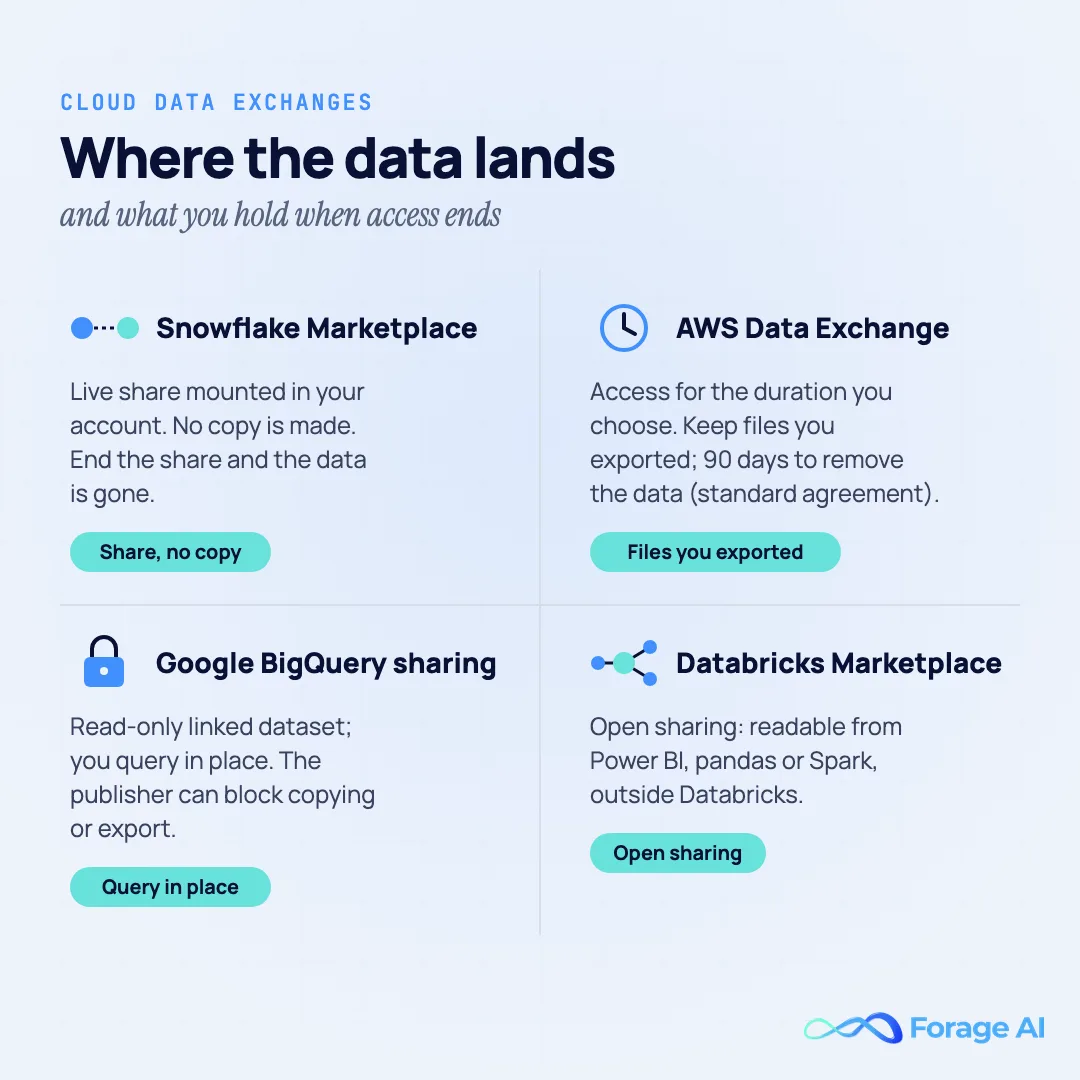
A cloud exchange is a delivery rail tied to one cloud, Databricks partly excepted. The provider sets the price and the platform takes its fee from the provider. We judged these four on where the data lands, how trials work, and what you keep at exit, which depends on each listing's agreement.
Snowflake Marketplace
| Attribute | Detail |
|---|---|
| Best for | Teams whose stack is Snowflake |
| Type & listing model | Cloud exchange; free, trial or paid listings |
| Catalogue | "over 820 providers", "more than 3,400 live" products incl. agents and apps (as stated by Snowflake, Marketplace page, Oct 2026) |
| Who pays | Provider's price, via Stripe or Snowflake capacity; Snowflake's fee not stated |
| Trials & samples | Optional free trial set by the provider: 1 to 90 days, or open-ended on a sample; you pay compute only |
| Diligence material | Not stated |
| Licence & exit | No derivative works by default unless listing terms say otherwise |
| Delivery & lock-in | Live share in your account, no copy; Snowflake only |
| Watch-out | End the share and the data is gone |
| Source | Rating | Reviews (n) | Checked |
|---|---|---|---|
| G2 (listed as "Snowflake Data Exchange") | 4.3/5 | 23 | Oct 2026 |
Snowflake Marketplace documents its trial mechanics more fully than any other platform here. A trial is the provider's option: 1, 7, 30, 60 or 90 days, or open-ended on a limited data set, and you pay only your own compute while you test. A "Time Range" field tells you how far back the data goes, not whether it is point-in-time.
The data never moves: it is a live share mounted in your account, and when the share ends, so does your access. By default you may not create derivative works unless the listing says otherwise, and the provider, not Snowflake, answers for the data. Read the listing terms before your research depends on the data.
AWS Data Exchange
| Attribute | Detail |
|---|---|
| Best for | Teams on AWS; moving an existing licence onto AWS (BYOS) |
| Type & listing model | Cloud exchange; AWS Marketplace data products |
| Catalogue | "3,500+ third-party data sets", "over 300 data providers", "over 1,000 free data sets" (as stated by AWS, Data Exchange page, Oct 2026) |
| Who pays | Provider's price plus your AWS usage; providers pay AWS fees (rate not stated) |
| Trials & samples | Samples and dictionaries on certain products; no general trial mechanic |
| Diligence material | None; buyers told to do their own |
| Licence & exit | Standard agreement allows modification and derived data; 90 days to remove at exit; sellers can replace it |
| Delivery & lock-in | Files, API, Amazon Redshift, Amazon S3; AWS only |
| Watch-out | Terms vary by listing and can change at auto-renew |
| Source | Rating | Reviews (n) | Checked |
|---|---|---|---|
| G2 | 4.2/5 | 16 | Oct 2026 |
AWS Data Exchange publishes the clearest exit terms in the set. You choose a duration at checkout; when it ends, you lose console access, keep files you already exported, and under the standard Data Subscription Agreement have 90 days to remove the data. The same template lets you modify the data and own what you derive. On AWS Data Exchange pricing, you pay the provider's price plus your own AWS usage. AWS reviews listings against its guidelines. That is not your diligence.
Here is how it actually works, though: the template is optional. One seller's agreement on AWS Marketplace says the buyer may not "create any derivative products from the Data", the opposite default on the same exchange, and auto-renew can bring a new price and agreement. Read the terms on every listing, every renewal.
Databricks Marketplace
| Attribute | Detail |
|---|---|
| Best for | Databricks or mixed stacks |
| Type & listing model | Cloud exchange on open sharing |
| Catalogue | Not stated |
| Who pays | Provider-set; Databricks' fee not stated |
| Trials & samples | "free sample data" possible; no trial mechanic |
| Diligence material | Not stated |
| Licence & exit | Not stated; the provider's terms govern |
| Delivery & lock-in | Readable from Power BI, pandas or Spark |
| Watch-out | Thinnest public facts in the band |
| Source | Rating | Reviews (n) | Checked |
|---|---|---|---|
| G2 | No G2 listing | n/a | Oct 2026 |
Databricks Marketplace is the least cloud-locked of the four on paper. Open sharing (Databricks calls it OpenSharing) means the data can be read from Power BI, pandas or Apache Spark, without a Unity Catalog workspace, and LSEG has put its Tick History data there.
Beyond that, public facts are thin. Databricks does not publish its fee, a count, a trial mechanic or a default licence, so treat each listing as a direct negotiation delivered through Databricks.
Google BigQuery sharing
| Attribute | Detail |
|---|---|
| Best for | Teams on Google Cloud |
| Type & listing model | Cloud exchange, publish and subscribe |
| Catalogue | Not stated |
| Who pays | You pay query compute; paid listings via Google Cloud Marketplace |
| Trials & samples | Sample queries and data possible; no trial mechanic |
| Diligence material | Not stated |
| Licence & exit | Not stated, including after unsubscribe |
| Delivery & lock-in | Read-only linked dataset; export can be blocked; Google Cloud only |
| Watch-out | You query in place only |
| Source | Rating | Reviews (n) | Checked |
|---|---|---|---|
| G2 (listed as "Google Analytics Hub") | 4.6/5 | 18 | Oct 2026 |
Google BigQuery sharing (formerly Analytics Hub) gives you a read-only linked dataset, so you query in place. Google says there is "no additional cost for managing data exchanges or listings"; you pay for queries, and paid listings run through Google Cloud Marketplace on an unpublished revenue share.
The catch is control. Publishers can block copying or exporting, and the docs do not say what happens to a linked dataset when you unsubscribe. If you need the data in your own store, ask first. Like Snowflake's, its G2 listing still carries the old name.
- Bloomberg: alternative data reaches Bloomberg Data License clients through Enterprise Access Point, which Bloomberg said in September 2020 carried over 60 third-party providers, with sample downloads before purchase. It is for existing clients, and Bloomberg has not published a newer count.
- FactSet: its marketplace page now redirects to a catalogue of mostly FactSet's own products.
- LSEG: reaches third-party alternative data through BattleFin's Ensemble; no standalone marketplace.
- Crux: a data-onboarding service, owned by Parabellum Investments since June 2026.
- Nomad Data: pivoted to document AI.
- AvocaData: lead-generation data. Dewey: academic researchers only.
- Knoema (site returns an error) and AlternativeData.org (domain does not resolve): offline.
Alternative data marketplaces compared
Here are four of the five jobs side by side for all eleven platforms; who pays sits in the at-a-glance table. Use this table to drop platforms that fail your delivery or diligence need in one pass. Lock-in is the price of not moving the data.
| Platform | Trial or samples | Diligence material | Delivery & lock-in | Licence default where read | G2 (rating, n) |
|---|---|---|---|---|---|
| Eagle Alpha | "Standardized trials" | Over 2,000 DDQs; Surveyor alerts | Vendor delivers | Not stated | listed, 0 reviews |
| Neudata | Via the vendor | Vendor DDQ; first-stage research | Vendor delivers | Not stated | 4.2, n = 11 |
| BattleFin (incl. Exabel) | Full-history sandbox (per BattleFin) | Not stated | Exabel platform | Not stated | 4.0, n = 1 |
| Nasdaq Data Link | Free samples (per Nasdaq) | Not stated | API; no cloud lock-in | Derived data internal; delete at exit (Oct 2026) | listed, 0 reviews |
| Datarade | Sample previews | Not stated | Depends on vendor | Not stated | 4.5, n = 21 |
| Carbon Arc | Pay per unit | Not stated | Lenses, MCP, API | Not stated | No G2 listing |
| Amass Insights | Not stated | Compliance checks, scope not stated | Vendor delivers | Not stated | No G2 listing |
| Snowflake Marketplace | 1 to 90-day trials, compute only | Not stated | Live share, Snowflake only | No derivative works by default | 4.3, n = 23 |
| AWS Data Exchange | Samples on certain products | None; do your own | AWS account only | Modification allowed; sellers can replace | 4.2, n = 16 |
| Databricks Marketplace | Sample data possible | Not stated | Readable outside Databricks | Not stated | No G2 listing |
| Google BigQuery sharing | Sample queries possible | Not stated | Google Cloud only; export can be blocked | Not stated | 4.6, n = 18 |
"Not stated" means the platform's own pages say nothing, not that the feature is absent. G2 checked October 2026; Snowflake's G2 listing is named "Snowflake Data Exchange" and BigQuery's "Google Analytics Hub".
What does an alternative data marketplace not do for you?
This article is for informational purposes only and does not constitute legal advice. Consult a qualified attorney for legal guidance specific to your situation.
A marketplace can hand you diligence material. It cannot sign off for you. Eagle Alpha and Neudata supply diligence material (DDQs at one, a vendor DDQ plus first-stage research at the other), but no platform does your compliance sign-off, and AWS says so: buyers are "encouraged to conduct your own additional due-diligence". Fund managers feel the weight of it: in Lowenstein Sandler's survey of 107 of them (February 2026), top concerns included "the time required to vet vendors, and the risk of accessing material, nonpublic information".
"the risk of taking on the wrong data set is much bigger than the cost of the data set. Because if we put that into production, it can destroy a lot more value than just the price of the data set."
Mark Fleming-Williams, Head of Data Sourcing at CFM, speaking on J.P. Morgan's Making Sense podcast (May 2025).
Regulators look at the buyer. Staff in the SEC's Division of Examinations observed advisers that engaged in "ad hoc and inconsistent diligence of alternative data service providers" (risk alert, April 2022), and the fiscal 2026 examination priorities (November 2025) still name "alternative sources of data". Provenance can be misrepresented, too: in 2021 the SEC's first securities-fraud action against an alternative data provider ended with App Annie agreeing to a $10 million penalty. A listing moves none of that blast radius off your desk.
How far back the data goes is not point-in-time history. Snowflake and AWS listings show the first; no listing on any platform we read tells you whether a dataset's history is point-in-time, whether it has been restated, or how it maps to tickers. You check the rest with the vendor.
If you are an AI team
Buying through a marketplace moves licence liability; it does not settle it. No platform we checked shows training permission as a listing field. And the defaults differ. Snowflake bars derivative works unless the listing says otherwise. AWS's standard agreement never mentions AI but defines derived data, which you own, to include "models, calculations, algorithms or statistical methods", and a seller can swap in its own agreement. Get the training right in writing.
Lowenstein Sandler's survey of 107 private fund managers (February 2026) found "tighter licensing terms, and greater restrictions on AI-related data usage, particularly for model training". If you are shopping for training data rather than research signals, see our guide to AI dataset marketplaces.
How do you choose an alternative data marketplace?
And so the list reduces to five questions. Run them on any platform before you sign up, including ones we did not cover.
- Who pays the platform, and can you get in? Buyer subscription, vendor commission, provider price plus fee, or sponsorship. Access is gated on some: BattleFin's buyer registration is for buy-side firms, Amass Insights releases access on application, and Bloomberg's route is for Data License clients.
- How is the trial granted, and is it paid? Fleming-Williams has noticed the shift: "People start charging for trials."
- Where does the data land, and what do you keep at exit? A share that ends, files you keep, or data you delete.
- What diligence documents exist, and can you see them before a trial?
- Do listings show point-in-time history? None we read do. Ask the vendor.
"One is a long history. I think the longer the history, the more confidence we can have in any signal that we find. Wide coverage. [...] And then the third thing, which is extremely important, is point in time. And point in time is the fact that the data has not been changed from the way it would have been on the day it was created."
Mark Fleming-Williams, Head of Data Sourcing, CFM, J.P. Morgan "Making Sense" (May 2025).
Prioritize question five. A trial that ends in "no signal" cannot tell you, on its own, whether the data failed or the test did. See our full evaluation framework and how hedge funds source and trial alternative data.
When no marketplace lists the dataset
Sourcing teams also hunt for what no one sells yet. Fleming-Williams describes looking for "things that weren't at events and which aren't already in the market". Sometimes that data sits on public web pages, and no vendor has packaged it.
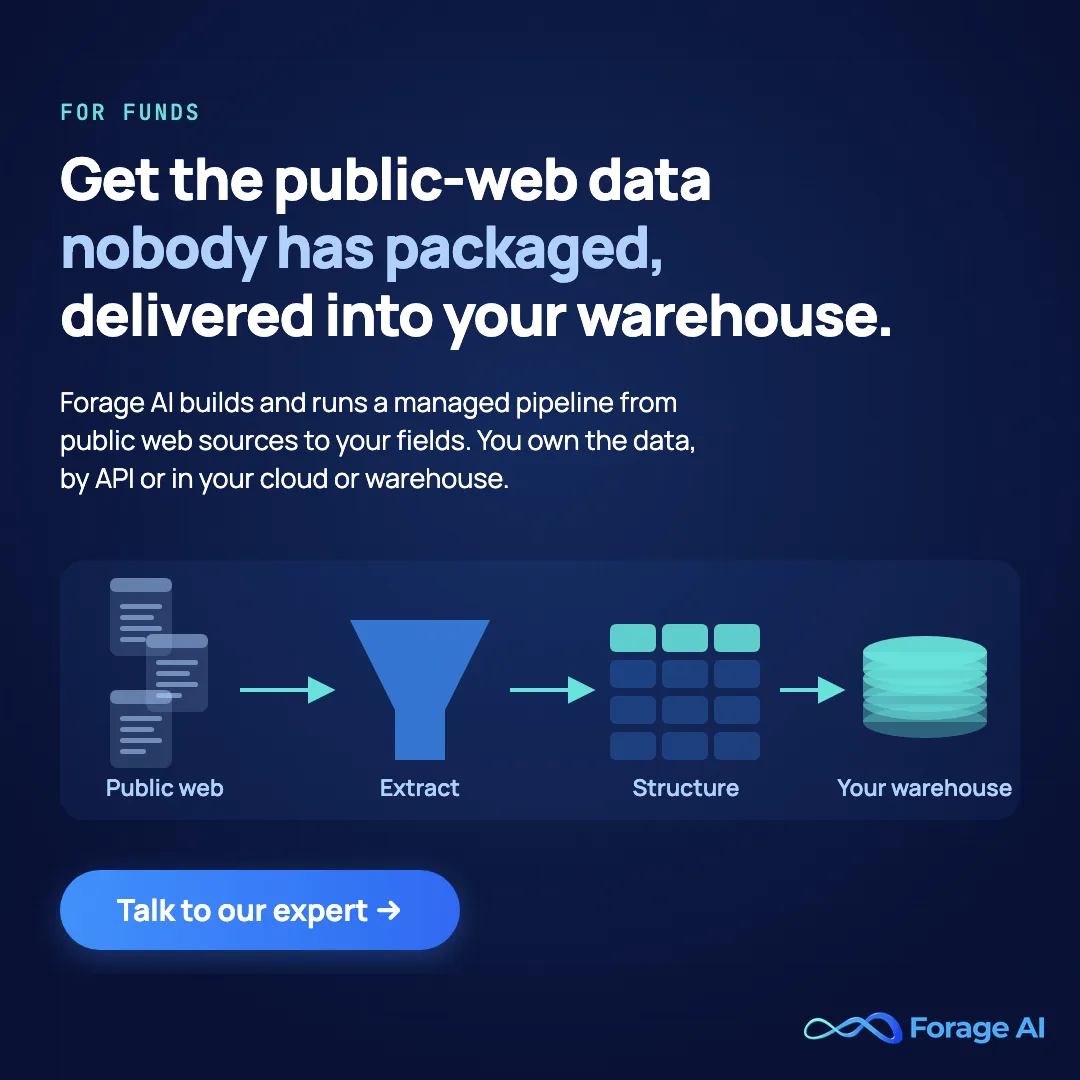
The route then is a managed extraction pipeline built to your fields. Forage AI builds and runs that pipeline end to end, from discovery and extraction through structuring, quality checks and delivery, using public web sources. It is a fully managed service, never self-serve. You own the data, and it is never resold. It arrives as CSV, JSON or XML, by API, or into your cloud or warehouse. Because you commissioned the collection, you define the sources and fields up front. We do not sell off-the-shelf datasets. We are not a marketplace.
The caveat matters more than the offer. A new dataset has no back-history; history accrues from the day collection starts. Fleming-Williams put it plainly: "So if you all start creating your scraper today, it's not gonna be that interesting to us for three to five years." A quant who needs years of backtest still needs a listed, established dataset. Building is for the gap, not a substitute for history.
Choose Forage AI if the dataset you need is not listed anywhere and you can wait for history to accrue. Choose a data marketplace if you need years of point-in-time history today.
Verdict: which alternative data marketplace to start with
An alternative data marketplace is a platform where you find, trial and license datasets from multiple sellers; the platforms differ on what they do after the find and on who pays them. As of October 2026, route by how your team buys:
- No sourcing desk: Neudata or Eagle Alpha, for analyst research and DDQ material, with no vendor commission by their own account.
- Your stack is on one cloud and you know the dataset: that cloud's exchange. Read the listing's agreement and exit terms first: a Snowflake share ends with access, and AWS's standard agreement gives you 90 days to remove the data.
- API-ready financial series with free samples: Nasdaq Data Link, with its licence terms (as of October 2026) read before you sign.
- Already a Bloomberg Data License client: ask about Enterprise Access Point first (see "Not listed, and why").
- Want to test before annual spend: Carbon Arc, at $1.00 per token unit on its AWS listing, or a Snowflake trial listing.
- Broad or non-finance categories: Datarade, paid by vendors and free to buyers.
- Prefer meeting vendors: BattleFin's events, or the Eagle Alpha conference now hosted by A-Team Group.
- On no platform: build it, last, knowing its history starts on day one (see the section above).
None of these routes removes your compliance sign-off, and listings, fees and terms change every quarter (Nasdaq's on 1 November 2026), so re-verify before you sign and run the five questions on any platform, including the ones not on this list.
Alternative data marketplace FAQ
What is an alternative data marketplace?
A platform where you find, trial and license datasets from multiple sellers, instead of buying from one vendor at a time. The platforms differ less on search than on what happens after the find. For the background, start with what alternative data is.
What is the difference between an alternative data marketplace and an alternative data provider?
The marketplace is where you shop; the provider is who you buy from and whose licence you sign. FactSet's and Bloomberg's catalogues mostly serve their own data or clients. That puts them in our "Not listed" box. For the companies that produce the data, see our list of alternative data providers.
How much do alternative data marketplaces charge buyers?
Few publish it. Datarade is free to buyers because vendors pay it. Carbon Arc lists API tokens at $1.00 per unit and an MCP server at $999 a month on AWS Marketplace. On AWS Data Exchange you pay the provider's price plus your AWS usage, and on BigQuery sharing you pay for your queries. Eagle Alpha, Neudata and Nasdaq do not publish buyer prices.
Is there free alternative data?
Yes, within limits. AWS says Data Exchange carries over 1,000 free data sets, Nasdaq says most premium datasets on Data Link come with free samples, and Snowflake trials charge only your compute. Samples show format, rarely history. See also our guide to financial datasets.
Where do hedge funds get alternative data?
From curated discovery platforms, storefronts, cloud exchanges and directly from vendors, usually in combination. Use is now the norm: 90% of private fund managers surveyed by Lowenstein Sandler said they use alternative data, up from 67% a year earlier (n = 107, released February 2026). For the wider research stack, see our roundup of investment intelligence platforms.
Can you trial alternative data before buying?
Usually. Snowflake documents 1 to 90-day trials, Eagle Alpha offers "standardized trials", Datarade and AWS show samples, and BattleFin describes a sandbox. Trials are not always free anymore; as Fleming-Williams of CFM put it, "People start charging for trials."
Does a marketplace vet its vendors for you?
Not in the sense that matters for your sign-off. AWS reviews listings against its own guidelines but tells buyers to do their own due diligence. Eagle Alpha and Neudata supply diligence material, and Amass offers compliance checks of unstated scope. SEC staff found "ad hoc and inconsistent diligence" of alternative data providers at advisers in 2022, and that finding was about the buyers.
Related articles
- Top alternative data providers: the companies that produce and license alternative datasets, compared.
- Alternative data for hedge funds: how funds source, trial and onboard alternative data.
- Best AI dataset marketplaces: where AI teams buy training data, and the licence questions that come with it.
- Alternative data guide: what alternative data is and how it is used.
Sai is a data infrastructure enthusiast who has spent the past two to three years following the AI space closely, from the infrastructure layer to the fast-growing world of data for AI. He is genuinely curious about how modern data pipelines get built and where the data industry is heading, and he writes insightful pieces on the core topics that shape this niche.