
Alternative Data Pricing Models Explained
This article is for informational purposes only and does not constitute legal advice. Consult a qualified attorney for legal guidance specific to your situation.
Ask an alternative data vendor for its price list and you will not get one. No vendor publishes one, and two buyers can be quoted differently for the same dataset. One vehicle-traffic dataset's marketplace listing says so in its own words: "Price is based on use case, user's industry, and number of users."
That is the honest starting point for alternative data pricing. The price follows the licence, not the file.
If you need the background first, here is what alternative data is. This piece is for the buyer holding a quote.
It gives you three capabilities. By the end, you can name the pricing model on your quote, see which licence lines drive its cost, and know what to ask before you sign. Holding a quote right now? Skip to the quote decoder.
Which pricing model are you being quoted?
Prices checked on vendors' own pages on 14 October 2026. Each is one vendor's list price on one date, not a benchmark. Find the data pricing model on your quote in the first column; "None published" is a finding, not a gap.
| Model | How it shows up on the quote | Published example (dated) | First question to ask |
|---|---|---|---|
| Annual subscription / enterprise licence | One fee for a fixed term | One listing: $16,800, 12-month contract, Oct 2026 | Is full history included? |
| Firm-size tier | Price set by your firm's size | One vendor tiers by company revenue; assets under management (AUM) tier: none published | Which measure sets my tier? |
| Per seat / per licence | A user or licence count | One listing: $39,900 up to 2 users, $49,900 up to 10 (Oct 2026) | Does "user" include systems? |
| Per use case / subset | Priced by permitted use or slice | One listing prices by use case and users; amounts not shown | Which uses are licensed in writing? |
| Usage / API metered | A unit price per call or token | $1.00 per API token unit, one platform (Oct 2026) | What counts as a unit, and is there a cap? |
| Historical data / backfill | A history depth or separate fee | Separate fee: none published; paid listings we read include all revisions | Is history point-in-time? |
| Trial (free or paid) | A $0 licence or trial fee | Free trials published; paid-trial fee: none published | Which agreement does the trial sit under? |
| Exclusivity | A limited-distribution clause | None published | What exactly is exclusive, and for how long? |
| Marketplace / cloud-exchange listing | Provider price plus your cloud compute | Listed prices can be "general indication" | Is the listed price final? |
| Custom build / commissioned collection | A scope-based project quote | Priced by scope; none published | What is in scope, and who owns the output? |
- No list price: no vendor publishes one; the few public prices are single dated examples of a deal's shape, not benchmarks.
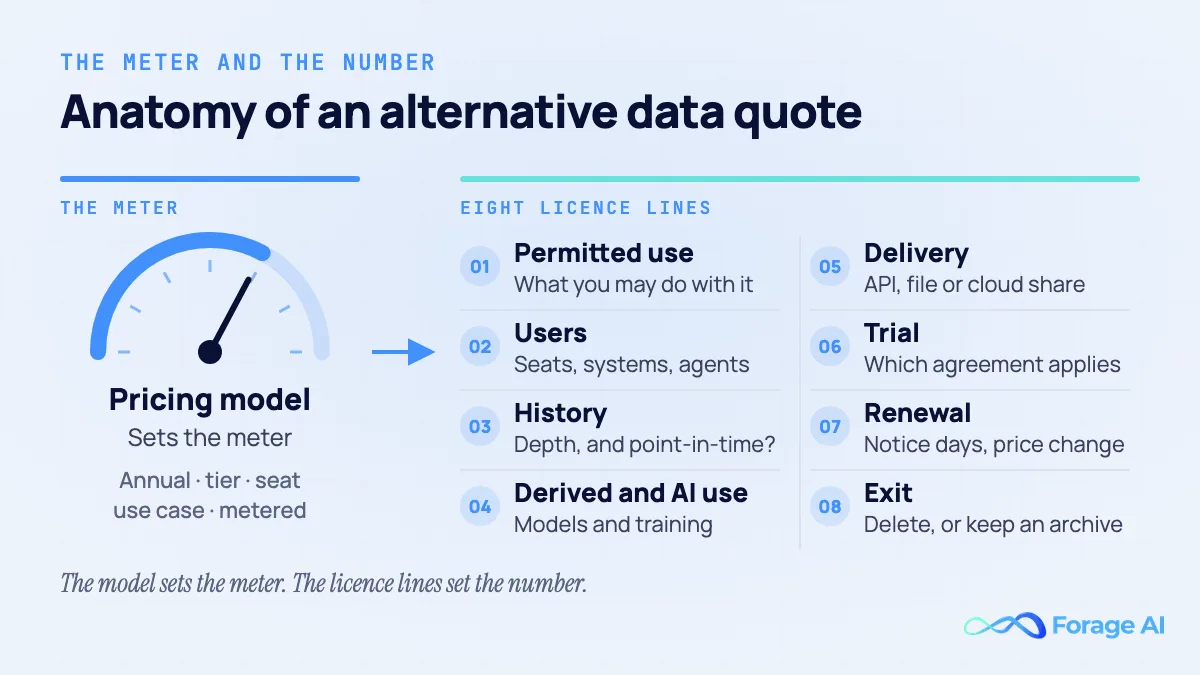
- Meter vs licence: the pricing model sets the meter; the licence lines (use, users, history, derived and AI use, exit) set the number.
- AI use: in alternative data, AI and training limits appear as restrictions; no one publishes what a training right costs, so get it in writing.
- Compare, don't benchmark: make every vendor quote the same twelve lines; if two quotes differ on a line, they are not the same product.
How much does alternative data cost?
There is no public, sampled price level for alternative data. Vendors quote buyer by buyer. We looked for a published price for an AUM tier, an exclusivity premium, a separately priced backfill and a paid trial, and found none.
What does exist is a handful of list prices, each one dated example of a shape, checked 14 October 2026:
- Thinknum's job-listings data on AWS Marketplace, listed "Powered by BattleFin", costs $16,800 for a "12-month contract" with "All historical revisions". The same page adds: "For production access to data, we can customize the product to each client's requirements."
- Quiver Quantitative, a retail and small-firm vendor, starts commercial-use rights at a plan "only offered to companies with under $1m in annual revenue". Above that: "Contact for Pricing".
- Carbon Arc lists $1.00 per API token unit.
Neudata, a data-sourcing firm, counts its own Scout catalogue: as of June 2026, about 31% of listed datasets cost $25,000 a year or less, down from "nearly 40%" in its previous analysis. It does not publish the dataset count, and its phrase "investor-specific pricing" names a trend, not an AUM tier.
In UK wholesale market data, the Financial Conduct Authority's Wholesale Data Market Study (February 2024) found that 64% of benchmark users who answered its survey found it difficult to compare prices and/or the suitability of products, and that suppliers have "limited incentives to provide transparent price lists or rate cards". In market data, budgets rose 2% in 2024 while vendors' average renewal rates rose 15%, across 60 firms, per Substantive Research and Expand Research, which sell benchmarking. Alternative data is a different market, thousands of datasets from many smaller vendors rather than a few key suppliers, so do not read these numbers as your alternative data renewal.
A list price shows the shape of one deal, not whether your quote is fair. You cannot check a quote against a list that does not exist, but you can make two vendors price the same thing.
The alternative data pricing models, explained
And so the first job is naming the meter. Most quotes combine two or three models, for example an annual fee, a user count and a use-case scope. Each entry uses the same four lines.
Annual subscription or enterprise licence
- Charges for: one fee, one fixed term, one defined dataset.
- On the quote: a term, a fee and a payment schedule, such as "1 payment, due upon order" on Thinknum's order form.
- Published example: Thinknum, $16,800 for 12 months, checked 14 October 2026, and "Refunds are not available for this data set." One risk-analytics listing is instead "annual and billed monthly".
- Watch: whether full history is in the fee, whether payments can be spread, and whether it auto-renews.
Firm-size tier
- Charges for: the buyer's size, not the data's.
- On the quote: a tier name or a size threshold.
- Published example: Quiver's Startup plan is "only offered to companies with under $1m in annual revenue"; its Enterprise plan reads "Contact for Pricing". The measure is company revenue. A tier set by AUM: not published, on any vendor page, order form, regulator or trade-body text we found.
- Watch: which measure sets your tier, where the breakpoints sit, and what happens if you cross one mid-term.
Per seat or per licence
- Charges for: the people, or licences, with access.
- On the quote: a licence count or a user band.
- Published example: three positions, October 2026. Thinknum's order form: "Number of licenses: 1". One risk-analytics listing: "$39,900 for up to 2 users" and "$49,900 for up to 10 users". Carbon Arc: "Platform access is organization-based."
- Watch: a band is not a per-seat price, so do not divide it. Ask whether "user" includes systems or agents, and whether affiliates are covered.
Per use case or data subset
- Charges for: what you may do with the data, or which slice you get.
- On the quote: a named use, sector, region or subset.
- Published example: one vehicle-traffic listing prices on "use case, user's industry, and number of users", amounts not shown. Quiver's price step is commercial use; its Hobbyist and Trader plans carry "No Commercial Use Rights". One published licence prices per company covered, with the amount left blank.
- Watch: an unwritten use is an unlicensed use. Ask what adding a use, or a company, costs.
Usage-based or API metered pricing
- Charges for: calls, queries, tokens or megabytes.
- On the quote: a unit price, sometimes beside a platform fee.
- Published example: Carbon Arc, $1.00 per API token unit, with "per MB pricing" among its options. One cloud platform makes per-query plans set a maximum monthly charge.
- Watch: you agree the unit price before you know your units. One web-unblocking API's published rate card, as of October 2026, spans roughly 124 times from its cheapest to its dearest request, with the tier assigned per website by that vendor. A pilot on easy sources under-predicts production.
Historical data and backfill
- Charges for: the past data that comes with the licence.
- On the quote: a history depth, a start date or a revision setting.
- Published example: on AWS Data Exchange, providers choose "All pre-existing revisions published prior to subscription", a trailing 1 to 100 revisions, or "No historical revisions". Every paid listing we read showed "All historical revisions". A separately priced backfill: not published.
- Watch: "all revisions" is an access setting, not proof the file is point-in-time. Ask that, and whether you keep the history at exit.
Exclusive or limited-distribution terms
- Charges for: limits on who else may buy the data.
- On the quote: an exclusivity or limited-distribution clause.
- Published example: an exclusivity premium is not published. The only figures we found were unsourced seller claims.
- Watch: treat exclusivity as a term to question, not a feature to buy. Ask what exactly is exclusive, for how long, and what remedy applies if it is not.
Buying through a marketplace or cloud exchange
A marketplace is a delivery route, not a separate model of the data. You pay the provider's price plus your own cloud compute ("Additional AWS infrastructure costs may apply"), a negotiated price arrives as a private offer, and auto-renew can bring a "new price and new DSA" (data subscription agreement). One listing calls its own figure "general indication". The shelf does not change what the licence lets you do. Watch whether the listed price is final, and what auto-renew does to the terms.
Custom build or commissioned collection
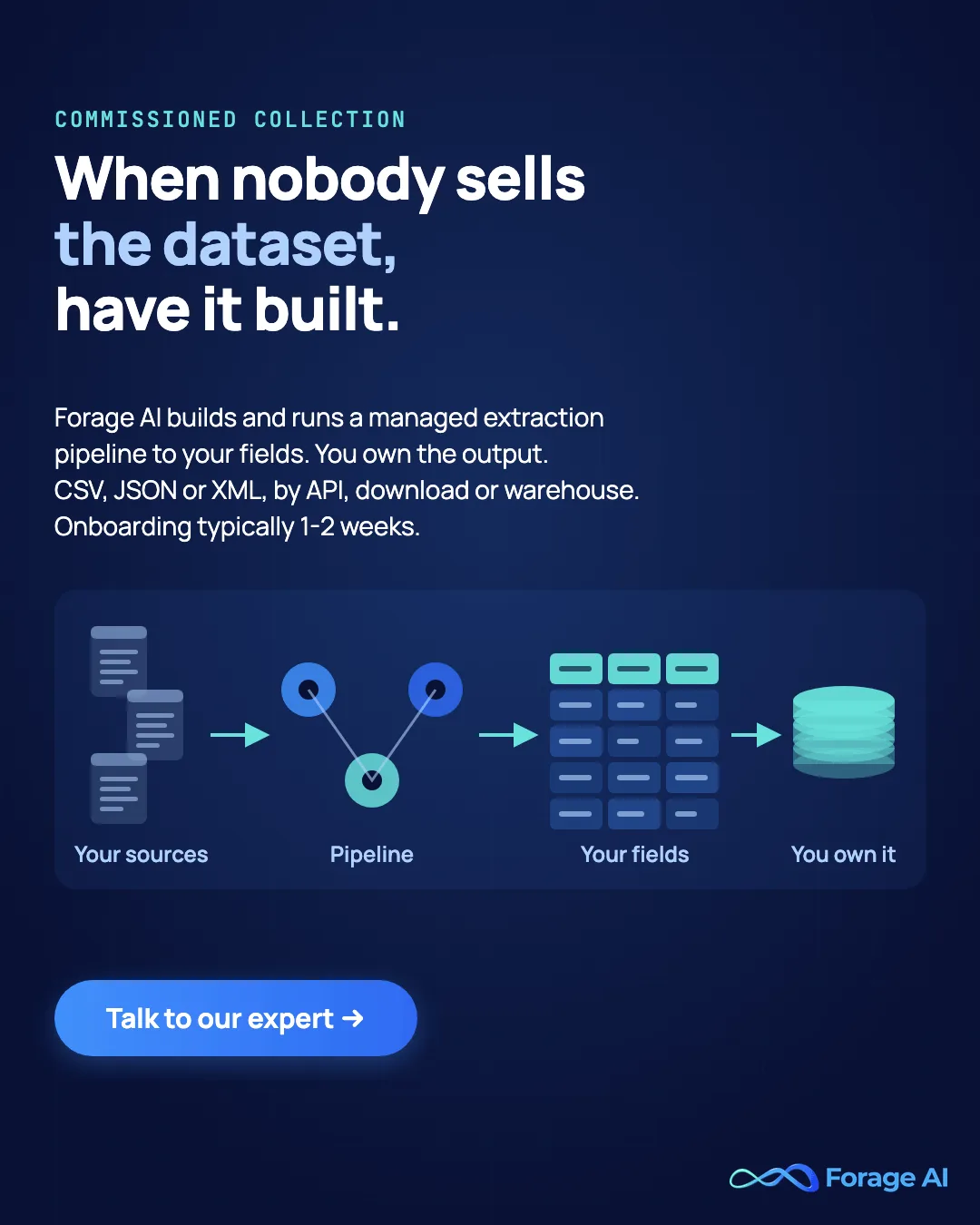
When nobody sells the dataset, it is commissioned, not licensed.
- Charges for: sources, volume, frequency, difficulty and schema.
- On the quote: "subject to project scope", setup plus recurring fees with an overage, or a per-record price.
- Published example: none published.
- Watch: meter risk moves into scope, overage and amendments. See what a managed build costs against an in-house team, and the total cost of a custom-built feed.
Forage AI builds commissioned collections: it builds and runs a managed extraction pipeline to your own fields and sources, and you own the output. It does not sell off-the-shelf datasets, so the price is set by the scope. A new collection has no back-history, so it complements a licensed history rather than replacing it.
Why do two quotes for the same data differ?
The price follows the licence, not the file, so read each line below as a question to the vendor. Licence scope is not the same as price, and this is not a total cost of ownership model.
We read the published licences behind six alternative data listings. One counted a single licence, one priced user bands, one licensed the whole organisation, and two count software and computer systems as users. None mentioned AI.
What you may use it for
Three published templates give three answers. Thinknum's allows use in "research and other reports" for the licensee's customers, with attribution. One workforce-data licence states: "Any purpose or use not specifically authorized herein is prohibited." One master agreement bars passing on "any analytics reports obtained therefrom" to a third party without written consent. A priced redistribution line: not published.
Who counts as a user
Thinknum's licence covers the licensee and "all other subsidiaries and affiliates"; the workforce licence bars sharing with "any other Company or affiliate". On machines, the AWS standard data licence counts as a User any "Data program, or computer systems authorized by Subscriber". A seat licence can be breached by a script, so ask whether AI agents, such as those connecting over the Model Context Protocol (MCP), count as users.
How much history comes with it
Two quotes for the same dataset can carry two history depths, because the AWS revision rules leave the depth to each provider. The cheaper quote may be the shorter history. Ask: is point-in-time history included, or a separate tier?
Who owns derived data
Defaults differ even on one marketplace. The AWS standard data licence gives the subscriber ownership of Derived Data, which includes "models". The AWS standard software contract one data platform uses bars "derivative works based on Licensed Materials" unless the agreement says otherwise. Snowflake's consumer terms bar derivative works unless listing terms "expressly state otherwise". More on redistribution and derived-data rights on licensed financial data.
AI and model-training use
The AI clause is a use right, so it moves price like any other; an October 2026 renewal may add one. Lowenstein Sandler's February 2026 survey of 107 private fund managers found "firms are encountering higher costs, tighter licensing terms, and greater restrictions on AI-related data usage, particularly for model training." Its restriction types: no AI use with the data, none that allows training, and no training of models outside the firm.
In alternative data, restrictions are documented and no price is published, and none of the six licences we read in full mentions training either.
A licence that never mentions training does not grant it. On one marketplace, the data licence covers models only by inference, while the software contract bars derivative works. "Fully licensed" is not training clearance: licence, ownership and training are three rights.
In market data, a joint October 2026 release from Substantive Research, BCG Expand and TRG Screen reported that among Substantive Research's clients, where 2026 vendor proposals carried separate AI-related commercial terms, the added AI charges ranged from $30,000 to $1 million, and that no clear market standard for pricing AI has emerged yet. The release does not say how many proposals that covers, or what the charges were for.
Coverage, lag and delivery
A cheaper quote may be a slower or narrower file. Neudata describes incumbents offering "lower-cost subsets", and one platform lets compliance teams enable "specific data assets without making the full data catalog available". Delivery changes the bill too: through a cloud exchange, you pay your own compute on top of the provider's price.
Why the same dataset has several sellers
One owner can have several resellers, so two quotes for "the same" data can both be legitimate. Thinknum datasets, for example, appear on AWS Marketplace "Powered by BattleFin". Compare the licence lines, not the name on the listing.
Q: Why do two alternative data quotes for the same dataset differ?
A: Because each vendor and platform scopes and defaults every licence line differently: use rights, users, history, derived data, AI use, delivery and seller. The defaults differ even on one marketplace, so compare quotes line by line, not by headline price.
How alternative data trials are licensed
A trial is a licence, not a free sample. Its terms decide what it is worth: free or paid, which agreement, whether it converts, and what you must delete. How to run an alternative data trial and backtest is a separate job.
Two published free trials show the range. Thinknum's trial agreement is its paid agreement word for word, plus "Trial License at USD $0", so it carries the same warranties and does not convert automatically. Another, on a workforce dataset, sits under the marketplace's standard licence, so the subscriber "will remove the Data ... within ninety (90) calendar days following such termination or expiration."
Free is not automatically the better deal. Counsel writing on AI-system licences, from alternative data practice:
"Advisers should also approach free or limited trials in license agreements for AI systems with caution as the terms may not provide adequate representations/warranties or allow for trading use of the data."
Boris Liberman and George Danenhauer, Lowenstein Sandler, Hedge Fund Law Report, 10 October 2024.
In a September 2026 Neudata report, 69 buyers said trials ended on "no discernible signal" (39%) more often than on price (25%), self-reported. A paid-trial fee, and whether it credits against the subscription, is not published.
Contract terms that change the price after signing
Signing fixes the first price, not the last. Five terms in one contract change what it bought.
- Renewal clock: one licence needs notice "not less than thirty (30) days prior to the expiry"; one master agreement, "at least ninety (90) days". Counsel: "Advisers should avoid autorenewals to allow for re-diligence at each renewal."
- Renewal price: none of the four vendor templates we read in full sets how the price changes at renewal or caps an uplift. On AWS Data Exchange, auto-renew can apply a "new price and new DSA". So negotiate the renewal price in writing.
- Early exit: one master agreement makes the customer "pay all Fees that would have become payable during the remainder of the term". Thinknum's listing: "Refunds are not available for this data set."
- Mid-contract changes: a cloud-exchange provider "can revoke subscriber access to a specific revision at any time", and you then "can't export or query the data". In market data, an exchange's licence reclassification can also be billed retroactively (CME, February 2026).
- Exit: the AWS standard licence requires removal within 90 days of expiry; one master agreement requires you to "destroy all copies" and certify on request. The line to ask for is a perpetual archive licence for the history you paid for.
Across several vendors, renewal bargaining power works on the whole stack; see running a multi-vendor data stack.
What should you ask before you sign?
The quote decoder turns every line above into a question. Once the lines match, score the vendor behind the quote.
Put every quote on the same lines
If two quotes differ on any line, they are not quoting the same product.
| Line | Get in writing | Why it moves the price |
|---|---|---|
| Pricing model and unit | Which model or models; what one unit is | The meter |
| Term and payment | Length; upfront or spread | Upfront on one form, monthly on another |
| Who may use it | Seats or whole group; do systems or agents count | One licence vs user bands vs organisation-wide |
| Permitted use | Internal · client reports · redistribution · derived products | Allowed, internal only, or consent needed, by template |
| AI and model use | Included, prohibited or priced; models trained outside the firm | Restricted, never priced in public |
| History | Years; point-in-time or restated; in the fee or a tier | All, a trailing 1 to 100, or no revisions |
| Delivery | API, file or cloud share; who pays compute | Cloud compute can sit outside the fee |
| Trial | Free or paid; which agreement; what you delete; fee credited | Paid licence at $0 vs 90-day removal |
| Renewal | Auto-renew; notice days; how a price change applies | No template we read fixes the renewal price |
| Exit | Deletion deadline, or an archive licence | 90-day removal; destroy and certify; remaining-term fees |
| Mid-contract changes | Withdrawn revisions; shrinking coverage | Revisions can be revoked mid-term |
| Assurances | Warranties on provenance, not only an indemnity | Warranted on one template, "AS IS" on another |
Questions to ask for each pricing model
These are questions, not claims about what is normal. Get each answer in writing.
- Annual subscription: is full history included, or a separate tier? Does it auto-renew, and on what notice?
- Firm-size tier: which measure sets my tier, AUM, revenue or headcount? What happens if we cross a breakpoint mid-term?
- Per seat: does "user" include systems, scripts or agents? Are affiliates covered?
- Per use case: which uses are licensed in writing? What does adding a use or a company cost?
- Usage or metered: what counts as a unit, and is there a monthly cap? Can I see recent usage before renewal?
- Historical data: point-in-time or restated? Do I keep it when the contract ends?
- Trial: free or paid, and under which agreement? Does a trial fee count against the subscription?
- Exclusivity: what exactly is exclusive, and for how long? What remedy applies if it is not?
- Marketplace listing: is the listed price final? What does auto-renew do to price and terms?
- Custom build: what is in scope, and what triggers an amendment? Who absorbs the cost if a source gets harder to collect, and who owns the output?
- Any licensed model: do you warrant the right to license this data, or is it supplied as is?
Frequently asked questions
How much does alternative data cost?
No public price list or sampled price level exists, so there is no honest average to quote. Published list prices are single examples: one listing priced a 12-month subscription at $16,800, checked 14 October 2026. Treat that as the shape of one deal, not a benchmark, and compare quotes line by line.
How is alternative data typically priced: flat fee, per user or usage-based?
All three are published, and one quote often combines them. One listing charges a 12-month fee, another prices user bands ($39,900 for up to 2 users), and one platform charges $1.00 per API token unit, all checked 14 October 2026. Use-case scope, history and trial terms sit on top.
What drives the cost of an alternative data licence?
The licence lines: what you may use the data for, who and what counts as a user, how much history comes with it, who owns derived data, whether AI and model-training use is included, how it is delivered, and which seller you buy from.
Should I pay per API call, a monthly subscription or an enterprise licence?
Choose by how well you can forecast your use. A metered plan suits usage you can predict, with a monthly cap and recent usage data before renewal. A fixed annual licence suits steady use, but check auto-renew, the notice period and whether full history is included.
Is alternative data priced per seat, per record or per use case?
Each appears. Published examples include a single licence count, user bands, organisation-wide access and use-case pricing, and one published licence prices per company covered with the amount left blank. Check who counts as a user, because one standard licence counts computer systems as users.
Does a data licence cover client-facing or redistributed use?
Only if the licence says so in writing. One published template allows client reports with attribution. Another keeps data internal and prohibits any use not specifically authorised. A third needs the vendor's written consent before reports go to a third party.
Is a free trial safe to accept?
Read which agreement the trial sits under and what you must delete when it ends. One free trial runs under the paid licence and its warranties; another requires removal within 90 days. Counsel warns that free trials may not provide adequate representations and warranties or allow trading use of the data.
Use the decoder at every renewal
Run the same decoder at every renewal, not only at the first purchase, because renewal is where a new price and new terms arrive. Take the twelve lines to your next vendor call and ask the vendor to fill in each one. When the dataset you need is not on anyone's price list, Forage AI can build and run the pipeline to your fields.
Related articles
- Evaluating Alternative Data Providers: A 5-Axis Scorecard: how to score the vendor behind the quote once the lines match.
- Alternative Data for Hedge Funds: A Practical Guide (2026): sourcing, trials and backtests before you pay for history.
- Top Financial Data Providers (2026): Buyer's Guide: redistribution and derived-data rights on licensed financial data.
- 20 Best Financial Datasets for Analysis and ML (2026): why licence scope is not the same as price.
- What a Property Data API Actually Costs: the same pricing teardown method in another vertical.
Sai is a data infrastructure enthusiast who has spent the past two to three years following the AI space closely, from the infrastructure layer to the fast-growing world of data for AI. He is genuinely curious about how modern data pipelines get built and where the data industry is heading, and he writes insightful pieces on the core topics that shape this niche.