
Forage AI vs a Multi-Vendor Data Stack: What Happens at Twelve Vendors
Open the inbox on a Monday and two messages are waiting. One is a renewal notice from a data supplier, running on its own calendar and priced higher than last year. The other is a pipeline alert saying a feed "finished successfully", except the numbers inside it are wrong.
You start counting contracts to see how far this goes. You stop at twelve. That count is where a data vendor consolidation conversation begins.
A multi-vendor data stack is the set of suppliers you buy from and stitch together: web collection, firmographic and B2B data, alternative data, document extraction, licensed market data and enrichment. Buying this way is normal. In Lowenstein Sandler's 2025 alternative-data survey of 107 fund managers, no surveyed group fell below 74% sourcing data both in-house and from vendors.
We find it more useful to treat twelve suppliers as twelve boundaries. Each one carries its own meter, renewal clock, diligence file, definition of "company" and exit clause. The short answer: consolidate the layers someone collects for you, and keep licensed data plus a second source for critical feeds.
By the end, you will have a rating for each of ten factors, the mechanism behind the count, a worksheet for your own numbers and a map of what to keep.
- Short answer: consolidate the collected layers (web, documents, custom extraction) onto one partner; keep licensed data and a second source for critical feeds.
- Why twelve differs from three: 3 suppliers give 3 pairs that can disagree and 12 give 66 (our arithmetic), while contracts, renewals and diligence files count once each.
- Where the stack wins: licensed-data coverage, change speed, renewal leverage and concentration risk.
- Is twelve realistic? It is a worked scenario; alternative-data buyers average about 20 datasets a year (Neudata 2024, 60 buyers), and datasets are not vendors.
- Signs it is time to look: a renewal on its own clock, a feed that "succeeded" with wrong data, the same company three times, a bill nobody can explain.
| Factor | Forage AI (0-5) | Multi-vendor stack (0-5) | One-line rationale |
|---|---|---|---|
| 1. Total cost | 4 | 2 | At twelve suppliers, per-boundary people costs dominate in collected layers; at two or three the stack is cheaper |
| 2. Pricing | 3 | 2 | One negotiated scope replaces a dozen meters; it still has a meter |
| 3. Renewals | 2 | 4 | Separate contracts keep the option to switch one supplier where substitutes exist |
| 4. Coverage | 2 | 4 | Licensed datasets are sold only by their owners, and nobody covers the long tail |
| 5. Consistency | 3 | 3 | One schema for what the partner collects; matching against kept files stays with you |
| 6. Quality | 4 | 2 | One accountable owner and monitoring surface; not a correctness guarantee |
| 7. Change speed | 2 | 4 | Self-serve and in-house tools change a field the same day; a managed change is a ticket |
| 8. Vetting | 4 | 2 | One diligence file instead of one per collected supplier, though a deeper one |
| 9. Concentration | 2 | 4 | Feeds behind critical functions need a second source |
| 10. Exit | 3 | 3 | Decided by the contract; the stakes rise with one partner |
Scores are drafted from the evidence cited in each factor, as of October 2026, and judged at the twelve-supplier worked scenario. No review-platform ratings are used; every survey cited prints its sample size in the factor.
Forage AI vs a multi-vendor data stack, factor by factor
Each factor below asks one question: what scales with the number of supplier boundaries? We judge every factor at twelve suppliers, and each winner names a side and a layer, because collected data (web, documents, custom extraction) and licensed data (sold only by its owner) behave differently.
1. Total cost: which costs less once you count the people?
Contract lines are the visible part of the bill. Each supplier boundary also adds engineer hours at the join, a diligence file, renewal handling and monitoring, and none of that shows on an invoice. We found no survey that measures overhead per supplier, so we will not invent a figure. The worksheet later in this article is how you get your own.
The only neutral people input is public. The US Bureau of Labor Statistics puts median pay for software developers at $135,980 (May 2025), and its June 2026 employer-cost release puts benefits at 30.0% of compensation for private-industry workers, a loaded multiplier of about 1.43 by our arithmetic. When a supplier changes, the UK regulator's list of switching costs reads like a per-boundary inventory: "the technology and development costs associated with changing system, processes and workflows to integrate the new MDVs (including remapping of data)", plus notice periods, purge requirements and "data validation and testing" (FCA Wholesale Data Market Study, February 2024; MDVs are market data vendors).
The honest side: at two or three suppliers, the stack is cheaper. Consolidating has a one-off cost too, and the same FCA study records users saying transition costs can "make switching uneconomic". The full in-house comparison lives in our budget analysis of managed extraction services vs in-house teams.
Winner: Forage AI, for the collected layers at twelve suppliers; the stack is cheaper at two or three.
2. Pricing: which bill can you forecast?
Every supplier bills in its own unit: per request, per record, per gigabyte, per seat or per licence. Twelve meters means twelve forecasts. As of October 2026, one web-unblocking API's published rate card runs from $0.13 to $16.08 per 1,000 requests at pay-as-you-go, roughly 124 times, with the tier and rendering method assigned by the vendor per website. Those tiers are reviewed quarterly. A Capterra reviewer (June 2026) put the consequence plainly: "Usage-based billing needs active watching."
One negotiated scope for the collected layers swaps that set of meters for one. It does not remove price risk. A managed contract still has its own meter, and a Capterra reviewer of a managed service flagged a "Monthly fee rise request coming unexpectedly high." Bundles carry their own catch: UK market-data users told the FCA about "previously bundled functionalities" that were later unbundled, "for which they had to purchase additional licences."
Winner: Forage AI, conditionally: one scope replaces a dozen meters, but it does not remove price risk.
3. Renewals: who holds pricing power when contracts come up?
Separate contracts keep one option that a single contract gives up: switching one supplier without touching the others. The best primary evidence here comes from UK wholesale market data, so read it with that scope. UK market-data users told the FCA (February 2024) that "bundling of core services with other data services" was making it "difficult for users to switch". The regulator's own survey found that "40% of respondents suggested they had switched, or partially switched", for example by replacing the provider of one data product. Partial switching is what renewal leverage looks like in practice.
The squeeze in that market is real. In a survey of 40 buy-side and 20 sell-side firms by Substantive Research and Expand Research, reported in February 2025, market data budgets for 2024 rose 2% while vendors' average renewal asks were 15%.
The counter-case also comes from the FCA: bundles "also offer benefits to users". One contract can buy a better price. It cannot buy the option to swap one piece. On licensed data, neither side has leverage, because the data has one owner.
Winner: Multi-vendor stack, where substitutes exist.
4. Coverage: which reaches more of the data you need?
No single supplier covers everything, and in licensed data the gap is structural: a licensed dataset is sold only by its owner, so a partner that collects data cannot resell it to you. Specialism is why buyers multi-source. The FCA found (February 2024) that "few firms use just 1 vendor", with users citing "recognised specialisms" such as asset class or geographical coverage (UK market data).
The long tail makes coverage harder to judge than it looks. About 84% of US businesses have no employees (our arithmetic on US Census Bureau nonemployer statistics for 2022: 29.8 million nonemployer businesses against 5.54 million employer firms). Among employer firms, 59.9% have one to four employees (Census Business Dynamics Statistics, 2023).
Nobody covers that tail completely. A collector reaches public sources no licensed file has, and each added source raises fill at the margin. Record count is not coverage, so measure fill on your own ICP, the way teams running waterfall B2B data enrichment do.
Winner: Multi-vendor stack.
5. Consistency: which gives you one version of a company?
In a stack, every supplier brings its own definition of "company", and you reconcile them. We worked with a broadcaster's ad division that bought a firmographic file and could not match it to its own CRM, where sales had typed company names a hundred different ways for years.
A partner delivering to one schema you define removes format and ID divergence on what it collects. It does not remove matching against the licensed files you keep; that work stays with you either way. An MDM or entity-resolution tool is a fair third option.
Hierarchy is where sources disagree most. Unilever's US operating company is Conopco, Inc., a name with no "Unilever" in it, so a name join cannot attach it to its parent, while GLEIF's parent link can. As of October 2026, one major provider's own published figures put corporate family trees on roughly a quarter of its records (our arithmetic).
Whatever matcher sits in the middle, ask what it publishes. Splink, the UK Ministry of Justice's open-source record-linkage library, reports precision and recall against labelled data. A matcher that publishes neither, and gives you no per-record confidence score to sort on, turns visible errors into invisible ones. Our guide to automated entity matching for multi-source datasets covers the mechanics.
Winner: Tie.
6. Quality: who catches a feed that is quietly wrong?
Each supplier is its own silent-failure surface. A feed can report that it "finished successfully" while the data inside is wrong, and hand-offs lose information on the way: CSV, as specified in IETF RFC 4180, declares no types or encoding, so a NULL and an empty string can collapse into one value. Twelve suppliers means twelve release calendars, and the contracts cover "delivered", not "correct".
A public case shows how quietly it happens. On 23 March 2020, the Johns Hopkins CSSE COVID-19 repository, a free public source behind thousands of dashboards, renamed "Country/Region" to "Country_Region" and moved columns. A user wrote the next morning: "The columns positions have changed as well, breaking parsers." The worry is common among analytics teams: 71% of respondents to dbt Labs' 2026 State of Analytics Engineering survey (n = 363) worry about incorrect outputs reaching stakeholders.
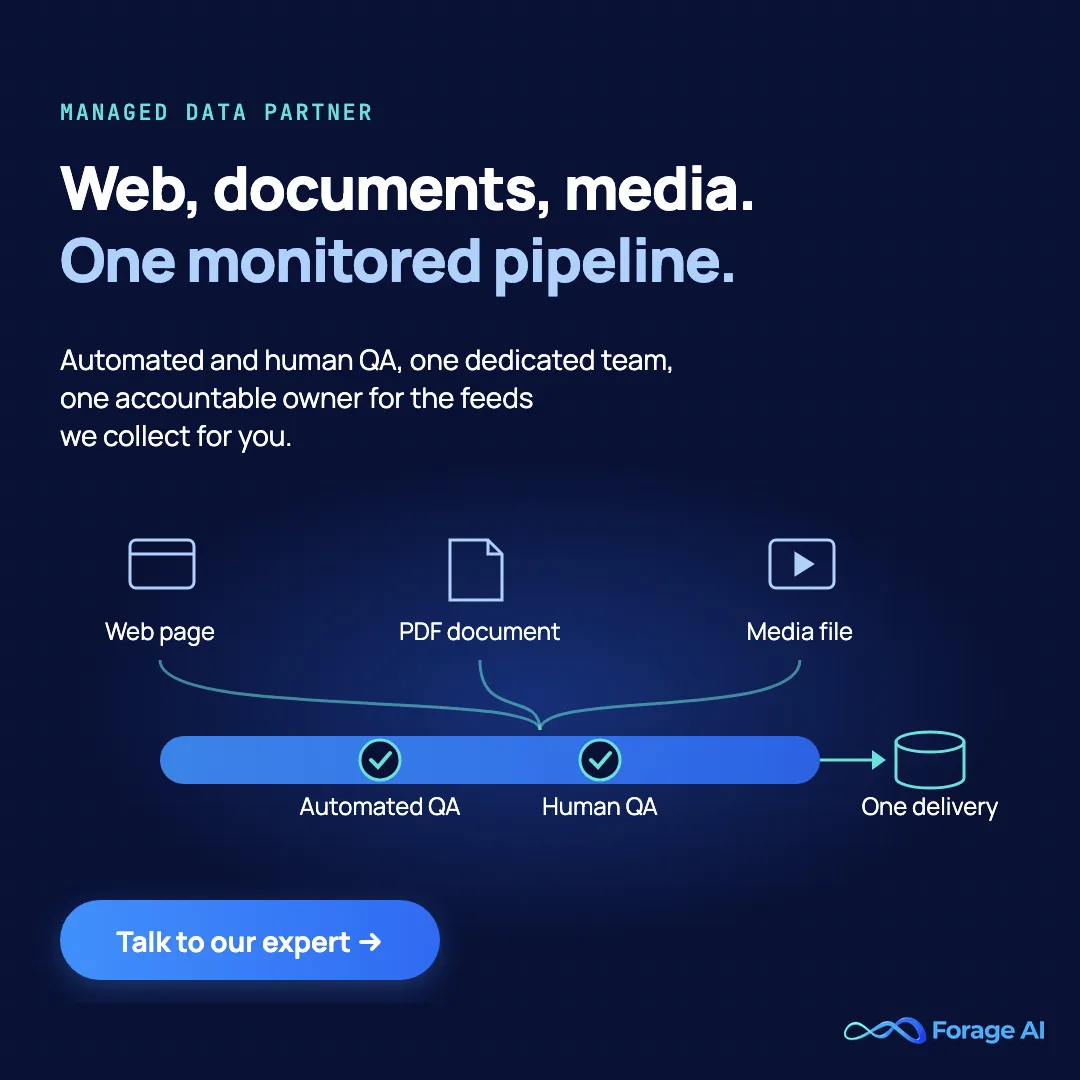
Consolidating collected feeds gives you one accountable owner and one monitoring surface. At Forage AI, collected feeds run through automated plus human QA with one dedicated team, which is the case for managed web data extraction. The con: one failure domain now touches every consolidated feed, and recall stays unmeasured whoever supplies. That is a win on observability, not on correctness. We cover the failure patterns in why enterprise data extraction pipelines break.
Winner: Forage AI, for observability and one accountable owner, not a correctness guarantee.
7. Change speed: how fast can you change what you collect?
Here the stack wins clearly. A self-serve tool or an in-house scraper can change a field the same day. On a managed contract, a change is a ticket. A Capterra reviewer of a managed provider (December 2025) described it this way: "Advanced changes or new logic usually require coordination with the [vendor] team."
Freshness drifts differently on each side. A stack runs twelve release calendars that nobody synchronises, so fields go stale on twelve different rhythms. A single partner runs one queue. If a field changes weekly, keep it close to the people who change it. The fuller trade-off is in our comparison of managed vs automated web scraping services.
Winner: Multi-vendor stack.
8. Vetting: which is cheaper to vet and keep vetted?
Diligence is paid per supplier and re-run whenever a supplier changes. Security questionnaires, data processing terms and usage rights for AI work repeat at every boundary. The load is measurable across all vendor types: in Whistic's 2025 TPRM Impact Report (n = 525 risk and infosec professionals at companies with 500+ employees), the average assessor was responsible for 33.6 vendors, the average vendor response took about 12 days, and assessment time rose almost 14 hours a week year on year.
Data buyers name it too. Lowenstein Sandler's alternative-data survey (n = 107) lists "Cost and time associated with vetting vendors" among the challenges fund managers report.
One partner for the collected layers means one diligence file instead of one per collected supplier. The con: the file goes deeper. Our enterprise evaluation checklist for data extraction companies lists what to ask.
Winner: Forage AI, for the collected layers.
9. Concentration: what happens if one supplier fails?
This section and the next are for informational purposes only and do not constitute legal advice. Consult a qualified attorney for legal guidance specific to your situation.
DORA, the EU's operational-resilience law for financial entities, gives the cleanest logic here even if it does not cover you. Regulation (EU) 2022/2554 defines concentration risk (Art. 3(29)), asks whether a provider is "not easily substitutable", and says financial entities "shall weigh the benefits and costs of alternative solutions" (Art. 29(1)). It does not require multiple vendors.
On 18 November 2025, the European Supervisory Authorities designated 19 critical ICT third-party providers, weighing "the level of substitutability of its services" for each. Two of the largest financial-data businesses are on the list, Bloomberg L.P. and LSEG Data and Risk Limited; the list does not say which services triggered designation.
Data can fail by drifting or by becoming unusable, not only by going dark. After Twitter's API change, over 100 research projects were "canceled, halted, or pivoted to other platforms" (Columbia Journalism Review, December 2023, survey of 167 researchers); Twitter is a platform, not a data vendor. The same broadcaster we mentioned under consistency had a video-data vendor go out of business mid-contract, leaving it racing for a replacement.
A second source is the hedge, if the two do not share one upstream. After a second format change in the JHU repository in April 2020, one user wrote: "From now on, I'm getting my data from the EU."
Winner: Multi-vendor stack, for feeds behind critical functions.
10. Exit: what does it cost to leave?
Exit is decided by the contract, on both sides. In UK wholesale market data, the FCA found (February 2024) that "contracts generally require users to purge historical data from their systems", unless the user pays for a perpetual licence. On licensed data, the stack is no better at exit. For EU financial entities, DORA Art. 28(8) requires exit strategies for ICT services supporting critical or important functions, so the entity can leave without "disruption to their business activities".
With one partner, the stakes rise, because more leaves with it. Ask three questions before signing:
- Is your history retained, and in what format?
- Are code, mappings and schemas handed back?
- Is your data resold to anyone else?
The same questions apply to single-vendor lock-in in B2B data.
Winner: Tie: decided by the contract, and the stakes rise with one partner.
| Factor | Forage AI | Multi-vendor stack | Winner |
|---|---|---|---|
| Total cost | Lower at twelve suppliers in collected layers, because per-boundary hours collapse into one | Lower at two or three suppliers, where boundary overhead is small | Forage AI (collected layers, at twelve) |
| Pricing | One negotiated scope replaces a dozen meters; fee rises still happen | Each supplier bills in its own unit; one rate card spans roughly 124 times by vendor-assigned tier | Forage AI, conditionally |
| Renewals | One contract can buy a better price but not the option to swap one piece | Partial switching keeps leverage where substitutes exist | Multi-vendor stack |
| Coverage | Reaches public sources no licensed file has; cannot resell licensed data | Licensed specialists cover what only their owners sell | Multi-vendor stack |
| Consistency | One schema you define for collected data; matching against kept files remains | A separate definition of "company" per supplier, reconciled by you | Tie |
| Quality | One accountable owner and one monitoring surface; one failure domain | Twelve silent-failure surfaces and twelve release calendars | Forage AI (observability, not correctness) |
| Change speed | A change is a ticket in one queue | Self-serve and in-house tools change a field the same day | Multi-vendor stack |
| Vetting | One diligence file, deeper because more depends on it | One file per supplier, re-run on every change | Forage AI (collected layers) |
| Concentration | One provider behind every consolidated feed | A second source for feeds behind critical functions | Multi-vendor stack (critical feeds) |
| Exit | Ask about retained history, handed-back code and schemas, and reselling | Licensed contracts often require purging history at exit | Tie |
What happens at twelve data vendors?
Read across the ten factors and the same question keeps returning: what grows each time you add a boundary? Two kinds of cost grow, at two different rates.
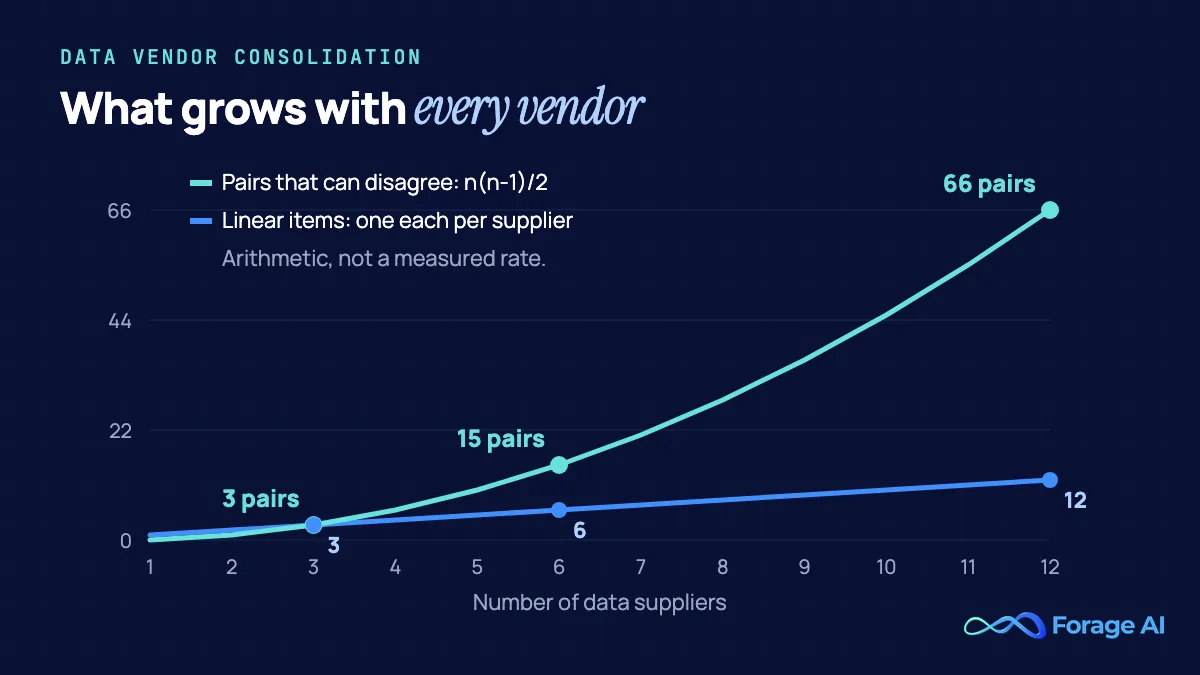
Seven costs arrive once per supplier: a contract, a renewal clock, a diligence file, a billing unit, a delivery format, a support channel and a release calendar. Add a supplier and you add one of each. That growth is linear.
Disagreement grows by pairs. Any two suppliers that cover the same records can disagree, and the number of pairs is n(n-1)/2. Three suppliers give 3 pairs, six give 15, twelve give 66. That is our arithmetic, not a measured rate, and only pairs with overlapping coverage matter. With a master record you do not build 66 joins; you build twelve mappings plus survivorship rules, and each mapping decays as suppliers change.
| Suppliers | Linear items (one each per supplier) | Pairs that can disagree (our arithmetic) |
|---|---|---|
| 3 | 3 | 3 |
| 6 | 6 | 15 |
| 12 | 12 | 66 |
There is no universal company key to make the pairs agree. GLEIF counted 3.02 million active LEIs worldwide in Q1 2026, while the US alone had 5,593,727 employer firms in 2023 (Census Business Dynamics Statistics). The global identifier covers fewer entities than one country has employers.
Public records for one listed multinational show what that means in practice (all fetched 8 October 2026):
| Record | Name as recorded | Identifier | Address on record | Website |
|---|---|---|---|---|
| SEC EDGAR | UNILEVER PLC | CIK 0000217410 | 100 Victoria Embankment, London | none |
| GLEIF | UNILEVER PLC | LEI 549300MKFYEKVRWML317 | Port Sunlight, "Liverpool", CH62 4ZD | none |
| UK Companies House | UNILEVER PLC | 00041424 | Port Sunlight, Wirral, CH62 4ZD | none |
| 2025 Form 20-F | Unilever (group) | none | none | in prose only |
The parent agrees. The family does not. The 20-F lists about 570 group undertakings (our count, including associates and joint ventures), while GLEIF records 109 ultimate children under the parent's LEI. Punctuation alone breaks exact joins: the SEC holds "UNILEVER UNITED STATES INC" and GLEIF holds "UNILEVER UNITED STATES, INC." None of the three registers stores a website. The counter-case is fair, though: the LEI record carries the Companies House number, and GLEIF publishes free mapping files to other identifiers, so where a crosswalk exists the join is clean.
Funds behave the same way. Ludovic Phalippou, Professor of Financial Economics at Oxford's Saïd Business School, wrote in January 2026 that across two widely used private-fund databases, "only about half of funds can be matched by name, and that for around 6% of matched funds, reported performance metrics differ." Even matched records conflict, and a null from one source can overwrite another's value unless survivorship rules say otherwise.
Suppliers also change their keys. In March 2020 a user of the JHU repository reported that "country names are changing almost daily in the data set", with South Korea going "through 3 name changes". The supplier's fix was a lookup table with stable UID, ISO and FIPS codes, and a stable key beats a name. Twelve suppliers means twelve such calendars, unsynchronised. Our piece on AI-powered entity matching covers how matching copes.
Is twelve realistic? Neudata's 2024 survey found alternative-data buyers average about 20 datasets a year (60 buyers), but datasets are not vendors, and that covers investment managers only. The FCA found (February 2024) "a significant proportion" of UK market-data users run "10 or more" vendors, without giving a percentage. No count exists for web, firmographic or document buyers, so twelve stays a worked scenario.
Nothing breaks at twelve. The curve is smooth, and the counter-signal deserves a line: in dbt Labs' survey, "integrating data from various sources" as a top challenge fell from 35% in 2025 to 27% in 2026, though the survey does not separate internal from external sources.
Q: What actually gets worse as you add data vendors?
A: Every supplier adds fixed costs once, and the pairs that can disagree grow faster, smoothly, with no cliff at twelve. Contracts, renewals, diligence files and release calendars rise in a straight line. Pairs that can disagree rise as n(n-1)/2, from 3 at three suppliers to 66 at twelve, and no universal company key resolves them.
Which layers belong in a data vendor consolidation
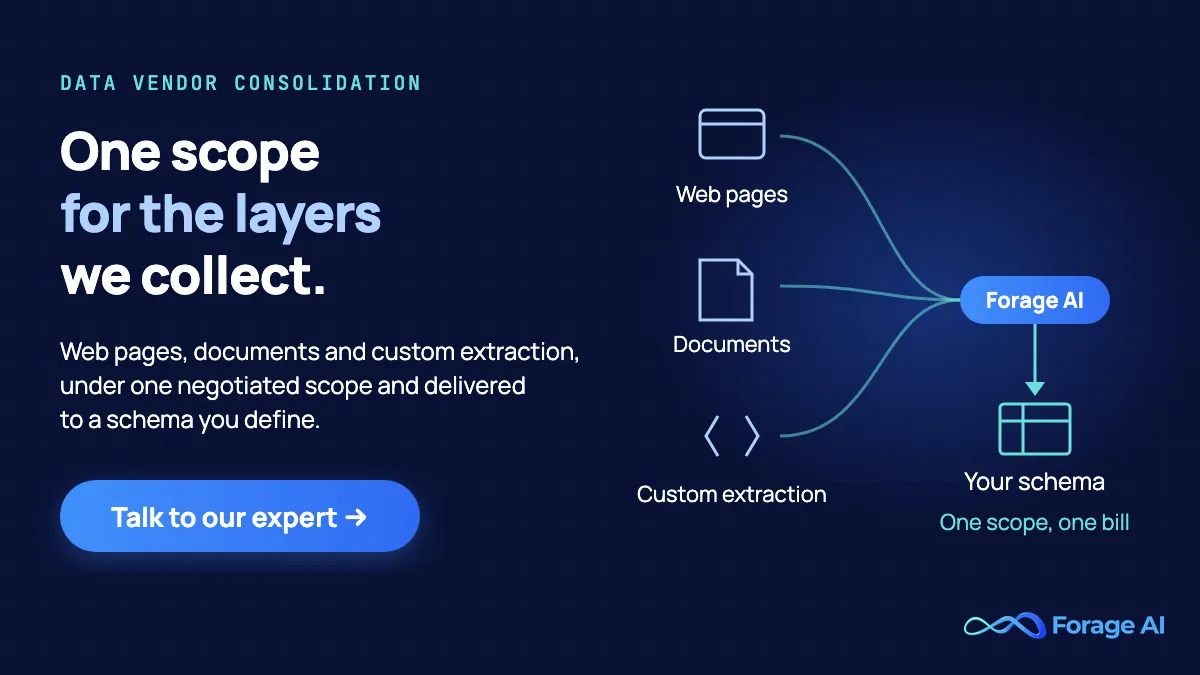
If every boundary carries cost, which ones can you remove? Collected layers are fetched for you: public web pages, documents and records, gathered and delivered. Licensed layers have one owner, and you buy the right to use the data. Consolidation removes boundaries only on the collected side.
- Consolidate: web and public-source collection, document extraction, custom or one-off extraction, and enrichment that can be collected. We worked with a regulatory-data provider whose company database spanned countries but carried no URLs, so nothing in it could be validated. The URL layer is collectable, which puts it on this side of the line.
- Keep: licensed data only its owner can sell, such as exchange and market data, credit ratings, private-markets databases and proprietary panels, including the alternative data vendors behind those panels.
- Keep a second source: for any feed behind a critical function, as the concentration factor showed.
Two layers straddle the line. A compiled firmographic file is licensed, so the file itself stays, but it is assembled from signals anyone can collect: a website, a filing, a press mention, a job posting. Those fields, gathered for your own ICP, can move to the collected side, though collecting them does not close the long tail the coverage factor described. Alternative data splits the same way. A panel built from another business's exhaust, such as card transactions or location data, has one owner and stays; a dataset built from public web pages can be collected.
The one-owner point from the coverage factor holds outside the UK too. A major US exchange's data agreement, as published for distributors (fetched October 2026), describes the licence as "non-exclusive, non-assignable, non-transferable" and has the distributor acknowledge the exchange's "proprietary rights in the information and data". The SEC noted in December 2020 that "exchanges have developed enhanced proprietary data and connectivity products." Buying through a reseller does not change it; the FCA notes that users "also need to obtain a licence from data generators, for example with trading venues." One owner, possibly a handful of resellers. In UK wholesale data there are "usually no more than 3 key providers in each market".
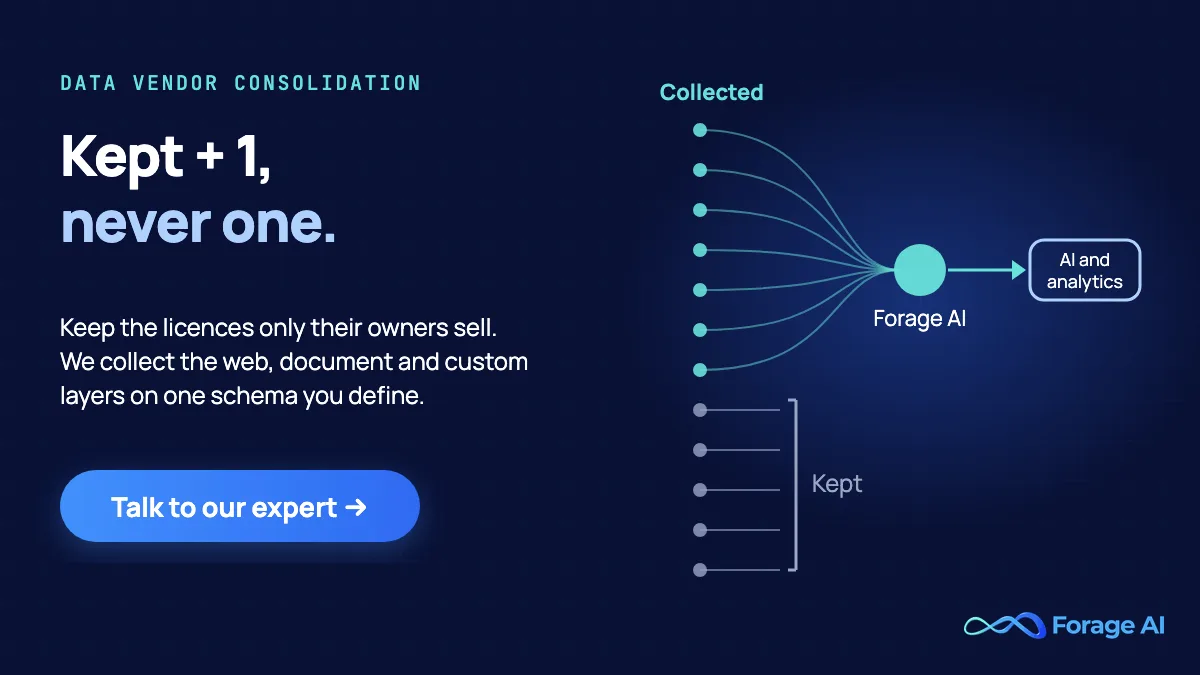
Licensed files still need joining to everything else. So twelve suppliers become the licensed ones you keep, plus one partner for what is collected. We call it the kept + 1 rule.
Consolidation is not twelve suppliers to one. Licensed data has one owner, and critical feeds need a second source.
Forage AI fits only the collected side: web pages, documents and media in one pipeline, delivered to a schema you define, with no reselling of your data. It does not replace an exchange feed, a ratings licence or a panel. Whether to collect in-house at all is a separate decision, covered in our build vs buy guide for web data extraction.
How to count what your data stack costs
The kept + 1 rule tells you where to look. The worksheet tells you whether it pays. The savings figures that circulate on this topic are unsourced, so the only honest number is the one built from your own inputs.
| Supplier | Layer (collected / licensed) | Licence line | Billing unit | Engineer hours per year at the join: integration, matching, monitoring (× $135,980 × 1.43 ÷ 2,080 h) | Diligence + renewal hours | Overlap pairs it sits in | Exit terms (history kept? purge?) | One-off switching cost (remapping, notice, validation) |
|---|---|---|---|---|---|---|---|---|
| Supplier 1 | ||||||||
| Supplier 2 | ||||||||
| Supplier 3 |
The people constant comes from the BLS Occupational Outlook Handbook median for software developers ($135,980, May 2025), loaded by 1.43 for benefits; that works out to about $93 an hour by our arithmetic. For diligence, budget about 12 days of elapsed time per vendor response (Whistic 2025, n = 525, all vendor types).
Then run four moves, and run them again at every renewal, because mappings and terms decay:
- Inventory by layer: list each supplier as collected or licensed, with its billing unit and renewal date.
- Mark overlap pairs: note which suppliers cover the same records; those pairs are where disagreement lives.
- Parallel test on a known-good sample: run the candidate and the incumbent side by side on records whose correct values you already hold.
- Check exit terms before signing: confirm retained history, handed-back code and schemas, and no reselling.
Jens Foerderer, then at the Technical University of Munich, tested this in "Should we trust web-scraped data?" (2023). Scrapers run in parallel that differed in a single request header recovered 70.3% of the benchmark's results when only the browser header varied, and 73.7% when only the language varied. His finding means a bake-off between two collectors partly measures personalisation, not quality alone.
After the switch, monitor three numbers: freshness, fill on your own ICP, and disagreement on the overlap pairs. Our roundup of data observability tools for external data pipelines covers the tooling. Once the worksheet is filled, the verdict comes down to which side of the line each layer sits on.
Forage AI or a multi-vendor data stack?
A multi-vendor data stack buys each data layer from a separate supplier; a managed data partner collects several layers under one contract, one schema and one owner.
Choose Forage AI for the collected layers: web pages, documents, media and custom extraction. That is where it wins on total cost at twelve suppliers, on a forecastable bill, on one accountable owner for quality and on one diligence file instead of several.
Keep the stack for licensed coverage, for fields that change daily, for renewal leverage where substitutes exist and for a second source behind critical functions. If you are weighing managed partners, our list of data as a service companies is a starting point.
That gives you kept + 1, never one. Twelve suppliers was never the failure here; the boundaries nobody costed were. Once you have counted yours, filled the worksheet and marked which layers are collected, each remaining boundary becomes one you keep on purpose, and that is a stack you can run.
Frequently asked questions
What is data vendor consolidation?
Data vendor consolidation means moving collected data layers, such as web collection, document extraction and custom extraction, from several suppliers onto fewer, usually one managed partner. Licensed sources stay with their owners, because only they can sell that data. A sensible end state is the licensed suppliers you keep plus one partner.
How many data vendors is too many?
No threshold exists. Costs grow once per supplier for contracts, renewals and diligence, and faster for overlapping pairs that can disagree, but the curve is smooth with no cliff. In February 2024, the FCA found a significant proportion of UK market-data users run 10 or more vendors. Count your own boundaries rather than comparing to a benchmark.
Should you use one data provider or multiple data vendors?
Use both, by layer. One partner fits collected layers, where it removes boundaries and gives one owner for quality. Several suppliers fit licensed data, which only its owners sell, and critical feeds, which need a second source. That is the kept + 1 rule.
How do you consolidate suppliers without losing speed or reliability?
Keep self-serve or in-house tools for fields that change daily, since a managed change is a ticket. Keep a second source for any feed behind a critical function. Before cutting over, parallel-test the new partner on a known-good sample of records whose correct values you already hold. Our guide on when to outsource data extraction covers the signals.
Can one data provider replace licensed data?
No. Exchange data, credit ratings, private-markets databases and proprietary panels are sold under licence by their owners, even when a reseller delivers them. A collection partner can reach public sources no licensed file has, but it cannot resell a licensed file. Those suppliers stay in the stack.
Is it vendor consolidation or vendor rationalization?
They overlap but are not the same. Vendor rationalization cuts the supplier list itself, removing duplicate contracts and the ones that no longer earn their renewal. Vendor consolidation moves the work onto fewer suppliers. Data teams usually do both in one renewal cycle: rationalize the licensed side, consolidate the collected side.
Related articles
- 2026 Data Extraction Services vs In-House Teams Budget Analysis: the full cost comparison for running one data layer in-house or with a managed provider.
- Data Extraction Company: Enterprise Evaluation Checklist: what to ask a managed partner before you move feeds to it.
- Efficient Automated Entity Matching for Multi-Source Datasets: blocking, scoring and scaling when you join records across suppliers.
Sai is a data infrastructure enthusiast who has spent the past two to three years following the AI space closely, from the infrastructure layer to the fast-growing world of data for AI. He is genuinely curious about how modern data pipelines get built and where the data industry is heading, and he writes insightful pieces on the core topics that shape this niche.