
Top Ecommerce Data Providers: How to Evaluate
Open any “top ecommerce data providers” list and the names blur together. A dozen logos, a few stars, a pricing badge, and the publisher quietly sitting at number one. None of it tells you the thing you came to find out: which of these companies actually does the job you have. That is the real problem with sourcing ecommerce data in 2026. The field is crowded, the categories are different animals, and most lists flatten them into one ranking.
We’ve worked with data teams long enough to know the question underneath the search. You are not asking “who is best.” You are asking “which kind of provider matches my job, and who in that group is worth a shortlist.” So here is the promise: four categories that map to four operational jobs, the named providers in each with real G2 and Capterra signal and a documented watch-out, and a clear way to choose. By mid-2026, 81% of US retailers had moved to automated price scraping, up from 34% in 2020. The market got serious. Your shortlist should too.
Quick Digest
- The four categories: Ecommerce data providers split into four groups, managed/custom data partners, price-intelligence platforms, marketplace/seller intelligence, and datasets/infrastructure APIs. Match your job to a category before you compare any vendor.
- Use case to category: Dynamic pricing and MAP compliance point to price-intelligence platforms or managed feeds, marketplace selling points to seller tools, and AI training corpora point to managed or dataset providers.
- Datasets vs APIs vs managed: Buy a dataset for a standard one-off, run an API if you have engineers and stable targets, hire a managed partner when the data is bespoke, load-bearing, or compliance-sensitive.
- The total-cost reframe: Per-request API pricing looks cheap until you add maintenance, blocking, and QA. The cheapest per-request price is rarely the cheapest total cost.
- Managed/custom providers: Forage AI, PromptCloud, Grepsr, Datahut, and ScrapeHero deliver done-for-you data on your schema and cadence.
The Four Categories of Ecommerce Data Providers
Ecommerce data providers fall into four categories, and the right pick is the one whose category matches your job. The categories are not flavors of the same thing. They differ on who operates the pipeline and what you actually receive at the end.
The four groups are managed/custom data partners, price-intelligence platforms, marketplace/seller intelligence, and datasets/infrastructure APIs. A managed partner hands you clean structured data on your schema. A price-intelligence platform hands you a productized SaaS for pricing and MAP work. A seller-intelligence suite hands an Amazon or Walmart seller their product research and Buy-Box data. An infrastructure provider hands you datasets or a scraping API and expects you to run it.
| Category | What you get | Who operates it? | Best job |
|---|---|---|---|
| Managed / Custom | Done-for-you data on your fields, sources, cadence | The provider | Bespoke, load-bearing ecommerce datasets at scale |
| Price-Intelligence | Pricing, repricing, MAP dashboards + matching | The provider (SaaS) | Dynamic pricing, MAP, competitor price monitoring |
| Marketplace / Seller | Product research, sales estimates, Buy-Box, price history | The provider (SaaS) | Selling on Amazon, Walmart, eBay |
| Datasets / Infra & APIs | Ready datasets or programmable scraping + proxies | You | Engineering teams with stable targets |
The harder part is matching your specific use case to the right group. The jobs people hire ecommerce data for are distinct, and several of them quietly span more than one category.
| Use case | Who and why | Best-fit category |
|---|---|---|
| Dynamic pricing and repricing | Retailers and D2C chasing margin and sales lift | Price-intelligence; managed feeds for raw inputs |
| MAP and brand compliance | Brands protecting advertised price | Price-intelligence; managed |
| Assortment and catalog intelligence | Merchandising tracking mix and gaps | Price-intelligence (DataWeave, Similarweb); managed |
| Competitor and market monitoring | Strategy and ops tracking rivals | All categories; managed for custom scope |
| Review and sentiment analysis | Product, CX, and forecasting teams | Managed for raw reviews; infrastructure APIs |
| Availability and stock tracking | Ops and sellers watching out-of-stock | Managed; seller tools (Keepa); infrastructure |
| Marketplace and Buy-Box | Amazon and Walmart sellers and brands | Seller intelligence; Similarweb |
| Demand forecasting | Planning and inventory | Managed custom feeds; price-intelligence and infra inputs |
| AI and LLM training data for retail | AI teams needing structured retail corpora | Managed; datasets and infrastructure |
Dynamic pricing alone explains much of the demand. Companies running it see margin improvements of 5 to 10% and sales growth of 2 to 5%, which is why retailers keep buying the data that feeds it. Add the scale of the underlying market, global retail ecommerce sales reached $6.419 trillion in 2025, growing 6.8% year over year, and the case for a real provider market becomes obvious.
The brand-compliance job is its own animal. Roughly 53% of unauthorized retailers violate MAP policies, against 15% of authorized retailers, which is the entire reason brands pay to monitor advertised prices across websites and marketplaces. Availability is another. The typical ecommerce out-of-stock rate sits near 8%, rising to about 10% on promotional items, and out-of-stocks cost retailers an estimated 4 to 8% of total sales annually.
One distinction trips up more buyers than any other.
Note, a common misconception: A scraping API and a managed data partner are not the same thing. One hands you a tool you still have to run, maintain, and QA. The other hands you the data itself, owned and delivered to spec.
That difference, tool versus data, is the line between Category 4 and Category 1. Get the category wrong and no amount of vendor comparison saves you. For the pricing use case specifically, our breakdown of price intelligence for ecommerce goes deeper on the discipline, and if you want a head-to-head of the tools that monitor price, see top competitor price tracking tools rather than re-deriving it here.
Two numbers frame why this market exists. Global retail ecommerce sales hit $6.419 trillion in 2025, representing 20.5% of total global retail sales (EMARKETER, 2025), and 81% of US retailers had adopted automated price scraping by 2026, up from 34% in 2020 (Mordor Intelligence, 2026). The data layer underneath ecommerce stopped being optional somewhere in that swing. For US ecommerce and retail teams especially, sourcing external data well is now table stakes, not an edge.
Should You Buy a Dataset, Use an API, or Go Managed?
The buying model matters as much as the vendor. There are three, and they map cleanly to how much engineering capacity you can spend on data instead of product. Buy a ready dataset for a standard or one-off need. Run a scraping API if you have engineers and stable targets. Hire a managed partner when the data is bespoke, load-bearing, or compliance-sensitive.
The trap is reading the price tag literally. Per-record and per-request API pricing looks cheap until you add the parts the invoice hides. Maintenance when a target site changes layout. Blocking, which is now the default operating condition, not the exception. QA, which someone on your team owns whether or not you budgeted for it. The real variables are refresh cadence, custom schema, and who owns data quality, and none of them show up in the headline rate.
Note, a common misconception: The cheapest per-request API is not the cheapest total cost. Maintenance, blocking, and QA make up the rest of the bill, and a managed team absorbs them so your engineers do not.
The scale problem is real and well documented by people who run it. One practitioner put the infrastructure bluntly.
“Infrastructure requirements for enterprise-scale scraping include dedicated teams of around 50 web-scraping specialists, with each new spider taking six to eight days to build.” That is Fred de Villamil, an engineering practitioner, describing 2025-era enterprise scraping.
Expert Insights
“Infrastructure requirements for enterprise-scale scraping include dedicated teams of around 50 web-scraping specialists, with each new spider taking six to eight days to build.” That is Fred de Villamil, engineering practitioner (2025). Paired with the finding that over 60% of scraping professionals reported year-over-year infrastructure-cost increases (Apify and The Web Scraping Club, 2026), the build path’s real cost is engineering time spent on evasion instead of data quality.
The cost pressure is not anecdotal either. Over 60% of scraping professionals reported increased infrastructure costs year over year, with adaptive defenses forcing teams to spend engineering time on evasion rather than data quality. That is the maintenance tax made visible.
Here is the decision logic. If your targets are stable and you have engineers to spare, a dataset or scraping API is the faster, more direct route, and our guide to ecommerce data scraping at scale walks the build path. If the data is bespoke, mission-critical, or sits under compliance scrutiny, managed wins, because the customization axis is where it pulls ahead. This is also where the schema question gets concrete. An ecommerce buyer rarely needs a generic product feed. They need their attributes, variant-level pricing, seller and Buy-Box data, MAP flags, at their refresh cadence.
A custom ecommerce schema looks like this in practice:
{
  "product_id": "B0XXXXXXX",
  "marketplace": "amazon.com",
  "title": "Acme Wireless Earbuds Pro (Black)",
  "brand": "Acme",
  "category_path": ["Electronics", "Headphones", "Earbuds"],
  "captured_at": "2026-06-29T08:15:00Z",
  "pricing": {
    "currency": "USD",
    "list_price": 129.99,
    "sale_price": 99.99,
    "map_price": 109.99,
    "map_violation": true,
    "buy_box_winner": "ThirdPartySeller_42",
    "buy_box_price": 97.50
  },
  "availability": {
    "in_stock": true,
    "stock_level": "low",
    "ships_in_days": 2
  },
  "ratings": {
    "average": 4.4,
    "review_count": 8123,
    "reviews_last_30d": 214
  },
  "seller": {
    "id": "ThirdPartySeller_42",
    "name": "GadgetWorld",
    "authorized": false
  }
}
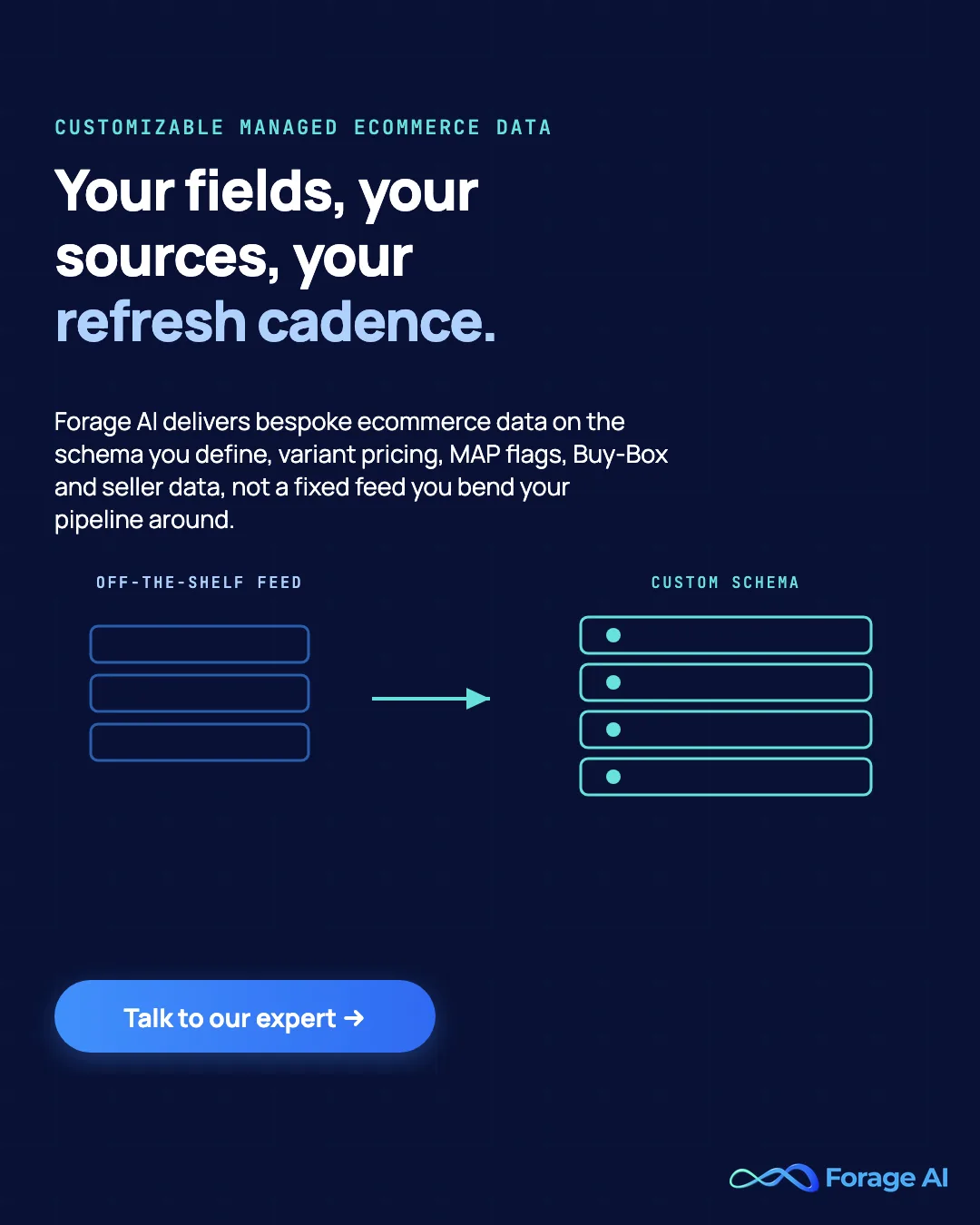
This is the kind of bespoke field set that Forage AI delivers managed, custom fields, schemas, sources, and refresh cadence defined to your spec, rather than a fixed off-the-shelf feed you bend your pipeline around. The customization is the point, not the price.
On the request side, the levers a buyer actually evaluates, scope, fields, refresh, and geo, look like this:
POST /v1/extract/ecommerce HTTP/1.1
Host: api.example-dataprovider.com
Authorization: Bearer <API_KEY>
Content-Type: application/json

{
  "sources": ["amazon.com", "walmart.com", "target.com"],
  "skus": ["B0XXXXXXX", "WMT-558210", "TGT-049123"],
  "fields": ["list_price", "sale_price", "map_price", "buy_box_price", "in_stock", "review_count"],
  "refresh": "every_6_hours",
  "geo": ["US-CA", "US-NY"]
}
For the deeper customization angle, see custom web scraping, and for the managed automation path, data extraction automation.
Top Ecommerce Data Providers by Category (2026)
Here is the list, organized the way the market actually divides. The right provider is the one whose category matches the job you defined above, so each provider sits under its category band with a clear best-for, real review signal, and an honest watch-out.
Providers at a glance
Managed / Custom data partners
- Forage AI: Bespoke ecommerce datasets, custom fields and schemas, managed QA and compliance.
- PromptCloud: Enterprise managed crawling and DaaS without internal infrastructure.
- Grepsr: AI-assisted managed feeds with dedicated support.
- Datahut: Clean product, pricing, and assortment datasets, hands-off.
- ScrapeHero: Mix of off-the-shelf datasets and custom managed feeds.
Price-intelligence platforms
- DataWeave: Product matching on messy, long-tail enterprise catalogs.
- Intelligence Node: Near-real-time global price and product matching.
- Competera: AI price optimization, not just monitoring.
- Prisync: SMB-friendly competitor price and stock tracking.
- Price2Spy: Price monitoring and repricing with hands-on matching.
- Wiser: Combined online and in-store price data (currently in transition).
- 42Signals: Digital-shelf plus price intelligence with an accessible UI.
Marketplace / seller intelligence
- Jungle Scout: Beginner-friendly Amazon seller suite and sourcing.
- Helium 10: Advanced Amazon keyword, SEO, and listing stack.
- Keepa: Amazon price-history and Buy-Box tracking.
- Marketplace Pulse: Macro marketplace research and benchmarking.
- Similarweb Retail Intelligence: Cross-retail SKU-level shopper analytics.
Datasets / infrastructure and APIs
- Bright Data: Ready-made datasets and programmable scraping at scale.
- Oxylabs: Enterprise proxies and scraper APIs for hard targets.
- Apify: Scraper marketplace and orchestration for pipelines.
- Zyte: Managed scraping and extraction APIs.
- Rainforest API, ScraperAPI, Crawlbase: Developer-focused Amazon and ecommerce scraping APIs.
How we judged this, and the disclosures. Ratings are drawn from G2 and Capterra as of June 2026. Capterra listings are page-verified where possible, G2 figures are snippet-corroborated because the product pages return errors to automated fetching, so eyeball them before you rely on them. Pricing is directional and changes often. No vendor paid for placement. Forage AI sits at number one in its category because it is the publisher and we are transparent about that, not because of a fabricated superlative. This list was last reviewed June 2026.
One reason this list is structured at all is the failure mode of the genre.
Note, a common misconception: A vendor list that ranks the publisher first with no stated criteria is marketing, not analysis. This one classifies by category, discloses its method, names the anti-fit for each group, and flags vendors in transition rather than presenting them as stable defaults.
For context on the size of the prize: the alternative-data market, the umbrella the web and ecommerce data category sits inside, was estimated at $18.8 billion in 2025 and projected to grow from $29.6 billion in 2026 on a 37.6% CAGR. The retail-analytics market that this data feeds is forecast to grow from $11.31 billion in 2026 to $20.65 billion by 2031.
Category 1: Managed / Custom Ecommerce Data
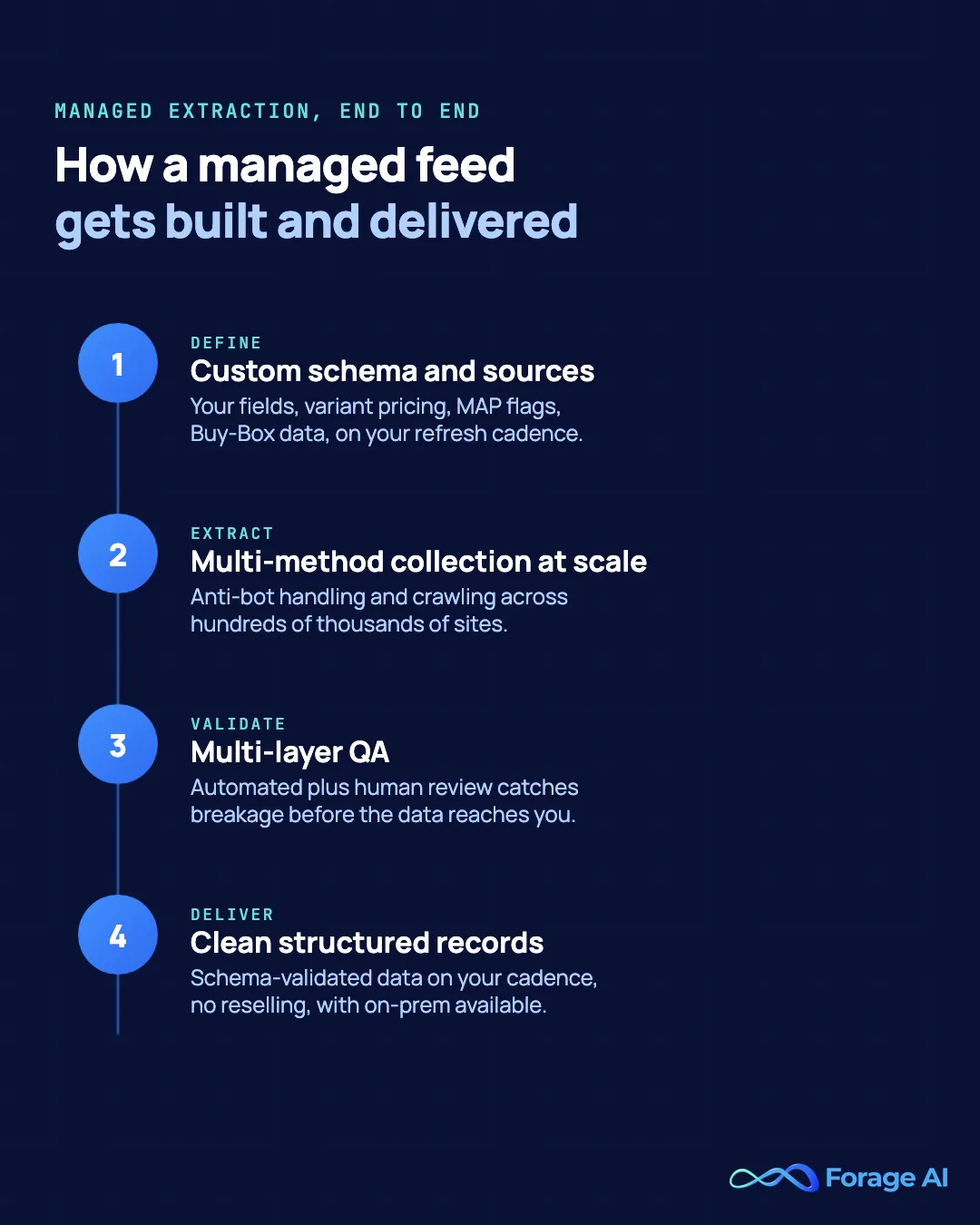
This is the done-for-you tier. You define what you need, the provider builds, runs, and QAs the pipeline, and you receive clean structured data on your schema and cadence. Best when the data is bespoke or load-bearing and you would rather not babysit scrapers.
Skip this category if you only need a one-off public dataset or you specifically want to operate the pipeline yourself.
Forage AI
Forage AI is a fully-managed, customizable web and document data extraction partner. The angle is depth of customization rather than a fixed product: custom fields, schemas, sources, and refresh cadence defined to your spec, multi-layer QA, no reselling of your data, an on-prem option, and handling rules agreed up front. It fits teams that need bespoke ecommerce datasets delivered managed, at scale, with quality handled.
| Attribute | Detail |
|---|---|
| Best for | Bespoke ecommerce datasets, managed end to end |
| Top services | Custom-schema extraction, multi-layer QA, on-prem, compliance |
| User reviews (Jun 2026) | G2 4.8/5 (smaller review base) |
| Pricing | Custom / quote |
| Watch-out | UI and docs are the rough edges, not data quality |
Who it’s for: teams that need their attributes, variant-level pricing, seller and Buy-Box fields, MAP flags, on their cadence, with QA owned by the provider, not a generic feed they reverse-engineer into their pipeline. The top services are custom-schema extraction across hundreds of thousands of sites and documents, multi-layer QA, on-prem deployment, and full regulatory compliance. Reviewers on G2 highlight the ability to collect, manage, and refresh unique datasets at scale, create new data columns and refine fields on request, and reduce manual analyst workload by pulling insight from unstructured public data. Watch-out: the documented critiques are platform-UX notes, the interface could be easier to navigate and more tutorials would help, not complaints about the data itself. Pricing is custom and quote-based, in line with managed engagements; you are buying capability and customization, not a per-record rate. See Forage AI’s ecommerce data offering for the scope.
PromptCloud
PromptCloud is a fully-managed web scraping and data-as-a-service provider aimed at enterprises that want structured web data without building internal infrastructure, spanning ecommerce, AI-training datasets, and market research.
| Attribute | Detail |
|---|---|
| Best for | Enterprise crawling at scale, no infra to build |
| Top services | Managed pipelines, anti-bot handling, structured delivery |
| User reviews (Jun 2026) | G2 listed; current rating not captured |
| Pricing | Custom / quote |
| Watch-out | Enterprise-oriented, less SMB-friendly |
Who it’s for: enterprise teams that need crawling at scale and would rather not own the anti-bot and infrastructure burden. The top services are managed pipelines, infrastructure and anti-bot handling, and structured delivery. Review signal is present on G2 but the current rating and count were not captured in research, so treat the praise themes, managed delivery and structured output, as directional. Watch-out: the orientation is enterprise, so smaller teams may find it heavier than they need, and onboarding lead time is worth confirming. Pricing is custom and quote-based.
Grepsr
Grepsr is an AI-assisted managed data extraction and delivery service that takes the scraper, infrastructure, and anti-bot maintenance off your plate, with a dedicated ecommerce solution for pricing and trend tracking.
| Attribute | Detail |
|---|---|
| Best for | Production-grade managed feeds with support |
| Top services | Managed extraction, fast turnaround, dedicated support |
| User reviews (Jun 2026) | G2 listed; current rating not captured |
| Pricing | Custom / quote |
| Watch-out | Confirm cons live; rating not captured |
Who it’s for: teams that want production-grade managed feeds and value fast, hands-on support. The top services are managed extraction, quick turnaround, and a dedicated support relationship. Review snippets praise the quality of data delivered and quick response times, with one noting the team was “very quick to help with eBay and Amazon data requirements.” Watch-out: the live G2 rating and cons were not captured in research, so verify both before committing. Pricing is custom and quote-based.
Datahut
Datahut is a cloud-based managed web scraping and DaaS provider delivering ready-to-use data with an ecommerce focus on pricing, assortment, promotions, and product intelligence, and it claims work with six of the ten largest retailers.
| Attribute | Detail |
|---|---|
| Best for | Clean product, pricing, assortment data |
| Top services | Managed extraction, large-scale product records |
| User reviews (Jun 2026) | G2 listed; current rating not captured |
| Pricing | Custom / quote |
| Watch-out | Rating and cons not captured live |
Who it’s for: brands and retailers that need clean product, pricing, and assortment datasets without managing servers. The top services are managed extraction and large-scale product-record delivery. Review snippets cite turnaround time, reliability, and extraction of millions of product records. Watch-out: the exact rating and live cons were not captured, so verify before relying on the snippet praise. Pricing is custom and quote-based.
ScrapeHero
ScrapeHero is a US-based fully-managed enterprise web scraping and DaaS provider with a twist: it offers both a ready-made data store of off-the-shelf datasets and custom managed feeds, plus pre-built scrapers for targets like Amazon, a combination few alternatives to ScrapeHero match on both sides.
| Attribute | Detail |
|---|---|
| Best for | Mix of off-the-shelf datasets and custom feeds |
| Top services | Managed delivery, custom scraper config, QA |
| User reviews (Jun 2026) | G2 4.7/5, ~63 reviews |
| Pricing | Self-service from $25; managed from $199 |
| Watch-out | Enterprise custom tiers get pricey |
Who it’s for: teams that want the flexibility of off-the-shelf ecommerce datasets alongside custom managed feeds. The top services are full-pipeline managed delivery, custom scraper configuration, and QA. Reviewers rate it 4.7/5 across roughly 63 verified reviews on G2, praising the managed delivery and custom configuration. Watch-out: enterprise custom tiers climb in cost and the self-service experience is more limited than the managed one. Pricing starts at $25 for self-service and from $199 for custom managed subscriptions, as of June 2026.
Category 2: Pricing / Price-Intelligence Platforms
This is the productized tier for pricing work. When the job is dynamic pricing, repricing, MAP compliance, or competitor price monitoring as a SaaS with built-in product matching and dashboards, this is your group. Pricing intelligence lives here, and so does the highest-buyer-intent corner of the market.
Skip this category if you need raw data on your own schema, that is Category 1 or 4, or you are an individual Amazon seller, that is Category 3.
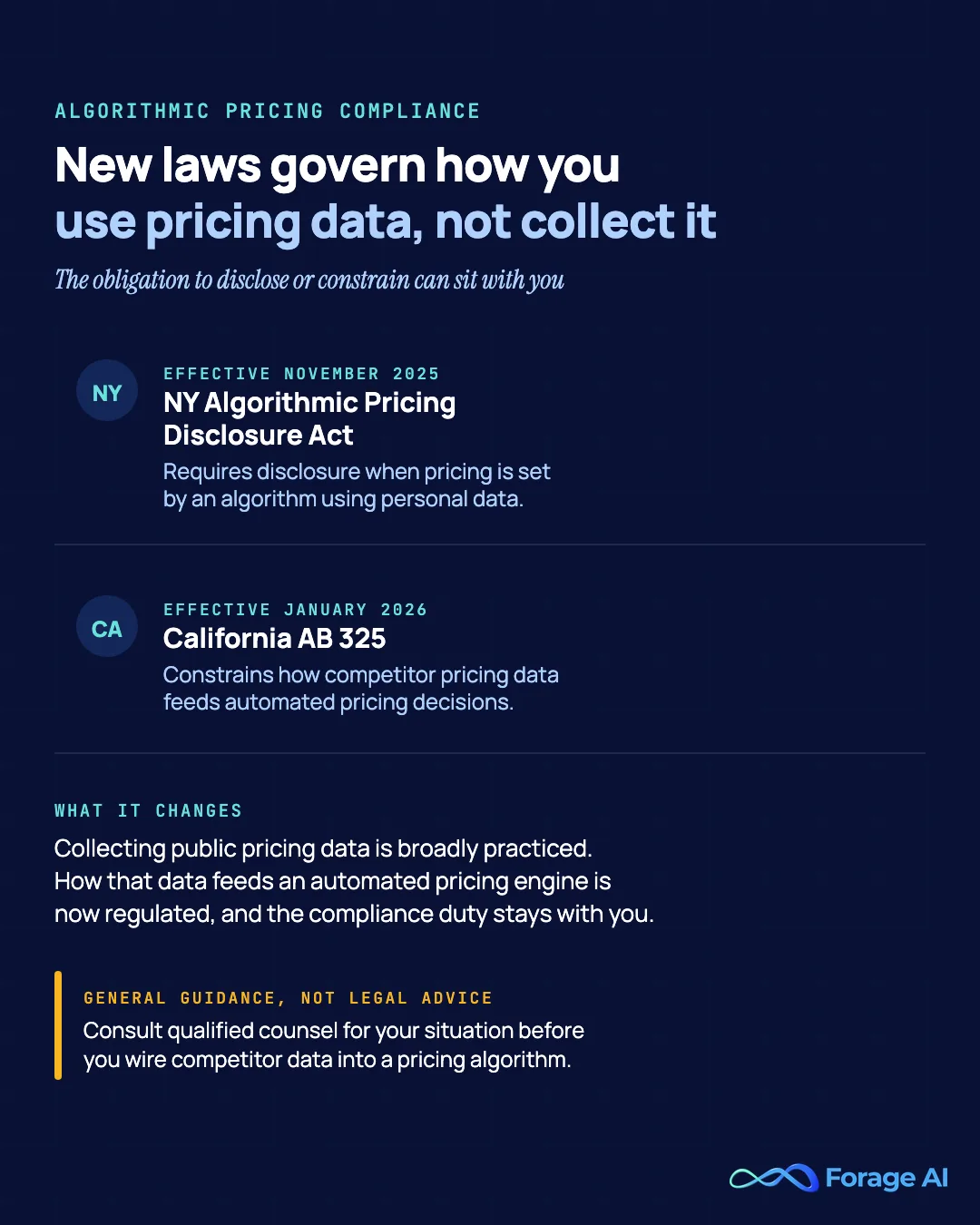
A compliance note belongs at the front of this category, because it changes how the data can be used. As of late 2025 and into 2026, two laws reshaped algorithmic pricing. The New York Algorithmic Pricing Disclosure Act, effective November 2025, and California AB 325, effective January 2026, govern how pricing data feeds automated pricing decisions, not whether you can collect it. If you run a price-intelligence platform on competitor data, the obligation to disclose or constrain algorithmic pricing can sit with you. This is general guidance, not legal advice; consult qualified counsel for your situation.
DataWeave
DataWeave is a retail and competitive intelligence platform whose differentiator is product matching on complex, long-tail catalogs, multi-attribute similarity without clean IDs, alongside pricing and digital-shelf analytics.
| Attribute | Detail |
|---|---|
| Best for | Messy, long-tail enterprise catalogs |
| Top services | Product matching, forecasting, dashboards |
| User reviews (Jun 2026) | G2: top scores in forecasting (9.4), dashboards (9.1) |
| Pricing | Quote-only |
| Watch-out | Setup and admin complexity; enterprise-fit |
Who it’s for: enterprise brands and retailers with messy, long-tail catalogs that need accurate matching. The top services are product matching on hard catalogs, forecasting, and dashboards. On G2 it scores highest in forecasting (9.4) and dashboards (9.1), with setup (7.6) and admin (7.8) lower, and about 49.4% of reviewers are enterprise. Watch-out: setup and admin complexity make it an enterprise fit rather than an SMB one. Pricing is quote-only.
Intelligence Node
Intelligence Node is a real-time price and product intelligence platform built around proprietary AI matching, with refresh as fast as roughly ten seconds, 100-plus languages, and coverage across six continents.
| Attribute | Detail |
|---|---|
| Best for | Global enterprises, vast SKUs, many geos |
| Top services | Real-time matching, global coverage |
| User reviews (Jun 2026) | G2 praised for real-time data and UI; rating not captured |
| Pricing | Quote-only |
| Watch-out | Data volume can overwhelm; enterprise complexity |
Who it’s for: global enterprises managing vast SKU counts across many geographies that need near-real-time matching. The top services are real-time refresh, matching accuracy, and global coverage. Reviewers praise the real-time data and UI, though the exact rating and count were not captured. Watch-out: the volume of data can be overwhelming and the platform carries enterprise complexity. Pricing is quote-only.
Competera
Competera is an enterprise pricing optimization platform that goes beyond monitoring, it layers AI-assisted price recommendations over competitive data, so it tells you what to price, not just what competitors charge.
| Attribute | Detail |
|---|---|
| Best for | Enterprises wanting price optimization |
| Top services | AI price recommendations, optimization layer |
| User reviews (Jun 2026) | G2 4.9/5, ~13–14 reviews (small base) |
| Pricing | Quote-only |
| Watch-out | Small review base |
Who it’s for: enterprises that want AI-driven price optimization rather than monitoring alone. The top services are AI price recommendations and the optimization layer over competitive data. Reviewers rate it 4.9/5 across roughly 13 to 14 reviews, praising the user-friendly UI and responsive support. Watch-out: the review base is small, so weight the rating accordingly, and the orientation is enterprise. Pricing is quote-only.
Prisync
Prisync is an SMB-friendly competitor price and stock tracking SaaS, built for ecommerce teams that want straightforward monitoring without enterprise overhead.
| Attribute | Detail |
|---|---|
| Best for | SMB and mid-market price monitoring |
| Top services | Competitor price and stock tracking |
| User reviews (Jun 2026) | G2 ~4.7/5, ~165–168 reviews; support 9.7 |
| Pricing | Subscription tiers (public) |
| Watch-out | SMB-scoped; not for huge SKU volumes |
Who it’s for: SMB and mid-market ecommerce teams doing competitor price monitoring. The top services are competitor price and stock tracking with real-time updates. Reviewers rate it around 4.7/5 across roughly 165 to 168 reviews, with a 9.7 quality-of-support score and repeated praise for ease of use and the intuitive UI. Watch-out: it is SMB-scoped and less suited to enterprise SKU volumes or complex matching. Pricing is public subscription tiers; confirm exact figures before budgeting.
Price2Spy
Price2Spy is a price monitoring and repricing tool with broad site coverage and strong manual-match support, often the choice of teams that have tried many tools and want value with hands-on matching.
| Attribute | Detail |
|---|---|
| Best for | Value plus hands-on matching |
| Top services | Price monitoring, repricing, manual match |
| User reviews (Jun 2026) | G2 ~4.8/5, ~105–109 reviews; support 9.6 |
| Pricing | ~$157.95–$947.95/mo |
| Watch-out | UI dated per some reviews; config effort |
Who it’s for: teams that want feature and cost value with reliable tracking and hands-on matching. The top services are price monitoring, repricing, and strong manual-match support. Reviewers rate it around 4.8/5 across roughly 105 to 109 reviews, with a 9.6 support score and consistent praise for value and responsive support. Watch-out: some reviewers find the UI dated and the configuration effortful. Pricing runs roughly $157.95 to $947.95 per month across two editions, scaling with product count, as of June 2026. For a focused price-tracking comparison, see top competitor price tracking tools.
Wiser Solutions
Wiser Solutions is a retail analytics and pricing intelligence platform with a distinctive feature, it combines online price tracking with in-store price data. It belongs in any honest survey, but its status changed in 2026.
| Attribute | Detail |
|---|---|
| Best for | Combined online and in-store price data |
| Top services | Price tracking, in-store data, analytics |
| User reviews (Jun 2026) | Present on G2 historically; current rating not captured |
| Pricing | Enterprise (industry-typical $50K–$150K/yr) |
| Watch-out | In transition, see status note |
Who it’s for: retailers that need combined online and in-store price data. The top services are online price tracking, in-store price data, and retail analytics. Watch-out: treat Wiser as in transition, not a stable default. The company filed Chapter 11 on April 26, 2026, and is being sold to its senior lender via a $90 million credit bid, a sale expected to close around June 30, 2026. Confirm the post-sale entity and continuity before signing. Pricing is enterprise; one snippet cited an industry-typical $50,000 to $150,000 per year range for this tier rather than a Wiser-specific figure.
42Signals, worth a brief mention here, offers pricing and product intelligence plus digital-shelf analytics for brands and retailers, positioned around an accessible, intuitive UI. It is a smaller, newer vendor, so verify scale and review depth before relying on it. Pricing is quote-based.
Category 3: Marketplace / Seller Intelligence
This is the seller’s tier, built for selling on a marketplace. When the job is product research, sales estimates, keyword and SEO work, Buy-Box monitoring, or historical price and rank on Amazon, Walmart, or eBay, these are the suites.
Skip this category if you are a brand that needs cross-retailer pricing or MAP data at scale, these are seller-side tools, and a managed feed or price-intelligence platform fits that job better. That mismatch is one of the most common buying mistakes we see.
Jungle Scout
Jungle Scout is an all-in-one Amazon seller suite covering product research, sales estimates, supplier sourcing, and listing, with a reputation as the beginner-friendly option.
| Attribute | Detail |
|---|---|
| Best for | Beginner and budget-conscious Amazon sellers |
| Top services | Product research, sales estimates, supplier sourcing |
| User reviews (Jun 2026) | On G2 and Capterra; rating not captured |
| Pricing | Public tiers; cheaper than Helium 10 at comparable tier |
| Watch-out | Accuracy estimates lower in one comparison |
Who it’s for: beginner or budget-conscious Amazon sellers, and anyone leaning on supplier sourcing. The top services are product research, sales estimates, and the supplier database and tracker. Reviewers on G2 and Capterra praise ease of use and value, though the exact rating was not captured. Watch-out: one comparison put its data-accuracy estimates below Helium 10’s (roughly 56% versus 71%), and that source is competitor-adjacent, so weigh it accordingly. Pricing is public and sits below Helium 10 at comparable tiers.
Helium 10
Helium 10 is an all-in-one Amazon seller suite with deeper keyword and SEO tooling and AI listing features, including AI product images, aimed at advanced sellers who want the fullest stack.
| Attribute | Detail |
|---|---|
| Best for | Advanced sellers needing keyword/SEO depth |
| Top services | Keyword and SEO tools, AI listing, product research |
| User reviews (Jun 2026) | On G2 and Capterra; rating not captured |
| Pricing | Limited free plan; paid ~$100/mo |
| Watch-out | Expensive for beginners; feature overload |
Who it’s for: advanced sellers who need the deepest keyword, SEO, and listing stack. The top services are keyword and SEO depth, AI listing tools, and breadth of features. Reviewers on G2 and Capterra praise the breadth and keyword depth, with the exact rating not captured. Watch-out: the roughly $100 per month paid tier is steep for beginners and the feature set can overwhelm. Pricing includes a limited free plan and paid tiers around $100 per month, as of June 2026; verify exact figures.
Keepa
Keepa is a specialist, not a suite, it tracks Amazon price history, sales rank, Buy-Box, and stock through a browser extension and data feed, and it pairs with a fuller suite rather than replacing one.
| Attribute | Detail |
|---|---|
| Best for | Deep ASIN-level price and rank history |
| Top services | Price-history charts, Buy-Box data, tracking |
| User reviews (Jun 2026) | Compared on G2; standalone rating not captured |
| Pricing | Free tier; Premium ~€19/mo (~$20) |
| Watch-out | Not a full seller suite |
Who it’s for: anyone needing deep ASIN-level historical price and rank validation, and a cheap add-on to a larger suite. The top services are price-history charts, Buy-Box data, and product tracking. It is widely praised for unmatched price-history charts and affordability, though a standalone rating was not captured. Watch-out: it is single-purpose, no product discovery or management, so it complements rather than replaces a suite. Pricing includes a free tier tracking up to roughly 5,000 products and a Premium plan around €19 per month, about $20, as of June 2026.
Marketplace Pulse
Marketplace Pulse is an ecommerce business-intelligence firm that parses marketplace data, Amazon, eBay, Walmart, Etsy, Alibaba, Rakuten, into seller, brand, and category insight, publishing more than 100 research reports a year.
| Attribute | Detail |
|---|---|
| Best for | Macro marketplace trends and benchmarking |
| Top services | Cross-marketplace research, seller indexes |
| User reviews (Jun 2026) | No significant G2/Capterra presence captured |
| Pricing | Not publicly captured |
| Watch-out | Reports orientation, not a self-serve feed |
Who it’s for: brands and agencies that want marketplace macro trends, seller indexes, and benchmarking rather than per-SKU seller tooling. The top services are authoritative cross-marketplace research and benchmarking. Watch-out: it is oriented toward insight and reports, not a self-serve data feed, and it carries no significant G2 or Capterra review presence because it operates as a research firm. Pricing was not publicly captured.
Similarweb Retail Intelligence
Similarweb Retail Intelligence is the relaunched, March 2026, version of Similarweb’s shopper analytics, combining Amazon IQ, formerly Shopper Intelligence, with Cross-Retail IQ covering 650-plus stores and marketplaces, delivering weekly SKU-level sales, rank, price, conversion, and traffic.
| Attribute | Detail |
|---|---|
| Best for | Cross-retail shopper and digital-shelf analytics |
| Top services | SKU-level sales, rank, price, conversion, traffic |
| User reviews (Jun 2026) | Large G2 base overall; retail module not separately captured |
| Pricing | Quote-based; ~$15K to $150K+, modules +$20K–$60K |
| Watch-out | Modules priced separately; opaque pricing |
Who it’s for: brands needing cross-retail shopper behavior and digital-shelf analytics at scale. The top services are SKU-level sales, rank, price, conversion, and traffic across hundreds of retailers. Similarweb carries large G2 review bases broadly, though the retail module is not separately rated. Watch-out: modules are priced separately and the overall pricing is opaque and enterprise-quote-based. Estimated pricing runs from roughly $15,000 self-serve to $150,000-plus enterprise, with modules adding $20,000 to $60,000 each, as of June 2026.
Category 4: Datasets / Scraping Infrastructure and APIs
This is the tier you operate. When you have engineering capacity and want either ready-made ecommerce datasets or programmable scraping and proxy infrastructure, these providers give you the raw capability. They are the most flexible and the most demanding of your team.
Skip this category if you have no team to run and maintain it, because the per-request price hides the maintenance, blocking, and QA costs covered earlier in the build-versus-buy section.
Bright Data
Bright Data is the largest web-data infrastructure provider, offering 269-plus ready-made ecommerce datasets, a Web Scraper API, a proxy network, and a self-healing AI Scraper Studio.
| Attribute | Detail |
|---|---|
| Best for | Transparent datasets or scraping at scale |
| Top services | Datasets, Web Scraper API, proxy network |
| User reviews (Jun 2026) | G2 4.6/5, ~323+ reviews |
| Pricing | Datasets from $0.0025/record ($250 min); API ~$0.75–$2.50/1K |
| Watch-out | Cost adds up at volume; you operate it |
Who it’s for: teams that want transparent per-record datasets or programmable scraping at scale. The top services are ready-made datasets, the Web Scraper API, and the proxy network. Reviewers rate it 4.6/5 across roughly 323-plus reviews, and it ranked as the number-one proxy network on G2’s Spring 2026 Enterprise Grid, with an independently benchmarked 98.44% success rate. Watch-out: cost climbs at volume, you operate it, and you carry the compliance review. Pricing starts at $0.0025 per record for datasets with a $250 minimum, and the Web Scraper API runs roughly $0.75 to $1 per 1,000 records on promotion, up to about $2.50 per 1,000 on hard sites, as of June 2026.
Oxylabs
Oxylabs is an enterprise proxy and scraper-API provider with strong performance on hard ecommerce targets like Amazon and Walmart.
| Attribute | Detail |
|---|---|
| Best for | Enterprise scraping on hard targets |
| Top services | Proxies, scraper APIs, deep field extraction |
| User reviews (Jun 2026) | G2 4.5/5, ~414+ reviews; Trustpilot 4.7/5, ~1,100+ |
| Pricing | Subscription/usage; enterprise quote |
| Watch-out | Enterprise pricing; you operate it |
Who it’s for: enterprise teams needing high success on hard ecommerce targets plus deep field extraction. The top services are proxies, scraper APIs, and extensive field coverage. Reviewers rate it 4.5/5 across roughly 414-plus G2 reviews and 4.7/5 across 1,100-plus Trustpilot reviews, and it was named PCMag’s Best Proxy Service 2026 for enterprise, with a 97.90% success rate on Amazon and Walmart tests. Watch-out: pricing is enterprise and you operate it. Pricing is subscription and usage-based, with enterprise quotes; confirm exact figures.
Apify
Apify is a scraper marketplace and orchestration platform, its “Actors”, built for engineering teams that want to build and run multi-step data pipelines with pre-built components.
| Attribute | Detail |
|---|---|
| Best for | Orchestration plus a scraper marketplace |
| Top services | Actors, orchestration, pre-built scrapers |
| User reviews (Jun 2026) | On G2 and Capterra; rating not captured |
| Pricing | Entry ~$49/mo; effective ~$6.67/1K requests |
| Watch-out | Layered cost; built for pipelines, not pure unblocking |
Who it’s for: engineering teams that want orchestration plus a marketplace of pre-built scrapers, like an Amazon Product Scraper. The top services are the Actor marketplace, orchestration, and workflow flexibility. Reviewers on G2 and Capterra praise the flexibility and breadth, with the exact rating not captured. Watch-out: the layered cost, platform subscription plus Actor fee plus compute units, can make it the most expensive per 1,000 requests, and it is built for pipelines rather than pure unblocking. Pricing starts around $49 per month with an effective rate near $6.67 per 1,000 requests including Actor and compute, as of June 2026. For a focused five-pick shortlist of extraction solutions, see our five best ecommerce data extraction solutions.
Zyte
Zyte is a managed scraping and data-extraction API provider with structured delivery, more managed than its pure-proxy peers while staying API-centric.
| Attribute | Detail |
|---|---|
| Best for | Reliable web data with infra handled |
| Top services | Extraction APIs, managed reliability, structured delivery |
| User reviews (Jun 2026) | G2 4.6/5, ~541 reviews |
| Pricing | Usage-based + managed tiers; quote for managed |
| Watch-out | Still needs engineering integration |
Who it’s for: teams that want reliable web data with infrastructure and QA handled but still prefer an API-centric model. The top services are extraction APIs, managed reliability, and structured delivery. Reviewers rate it 4.6/5 across roughly 541 reviews, and it led one 2025 benchmark at 93.14% across 15 protected sites. Watch-out: it still requires engineering integration and pricing scales with volume. Pricing is usage-based with managed tiers and a quote for managed engagements.
Three more API providers round out this category briefly. Rainforest API (Traject Data) is a real-time Amazon product data API at roughly $0.0118 per request, with a Starter plan near $83 per month for 10,000 credits. ScraperAPI is a general scraping API with ecommerce-specific handling, from about $49 per month for 100,000 credits, with Amazon requests costing 5 credits each, an effective rate near $2.45 per 1,000 Amazon results. Crawlbase combines a crawling API and smart proxy from roughly $99 per month.
The master comparison table
| Provider | Category | Best for | Pricing | User reviews (Jun 2026) |
|---|---|---|---|---|
| Forage AI | Managed / Custom | Bespoke ecommerce datasets, managed | Custom / quote | G2 4.8/5 (small base) |
| PromptCloud | Managed / Custom | Enterprise crawling, no infra | Custom / quote | G2 listed; not captured |
| Grepsr | Managed / Custom | Managed feeds with support | Custom / quote | G2 listed; not captured |
| Datahut | Managed / Custom | Clean product/pricing/assortment | Custom / quote | G2 listed; not captured |
| ScrapeHero | Managed / Custom | Off-the-shelf + custom feeds | Self-service $25; managed $199 | G2 4.7/5, ~63 |
| DataWeave | Price-Intelligence | Long-tail catalog matching | Quote-only | G2 strong (forecasting 9.4) |
| Intelligence Node | Price-Intelligence | Global real-time matching | Quote-only | G2 praised; not captured |
| Competera | Price-Intelligence | AI price optimization | Quote-only | G2 4.9/5, ~13–14 |
| Prisync | Price-Intelligence | SMB price monitoring | Subscription tiers | G2 ~4.7/5, ~165 |
| Price2Spy | Price-Intelligence | Value + manual matching | ~$157.95–$947.95/mo | G2 ~4.8/5, ~105 |
| Wiser | Price-Intelligence | Online + in-store price (in transition) | Enterprise ($50K–$150K/yr typical) | Historic; not captured |
| 42Signals | Price-Intelligence | Digital shelf + price, accessible UI | Quote-based | G2 present; not captured |
| Jungle Scout | Marketplace / Seller | Beginner Amazon sellers | Public tiers | G2/Capterra; not captured |
| Helium 10 | Marketplace / Seller | Advanced Amazon keyword/SEO | Free + ~$100/mo | G2/Capterra; not captured |
| Keepa | Marketplace / Seller | Amazon price history | Free; Premium ~€19/mo | G2 compared; not captured |
| Marketplace Pulse | Marketplace / Seller | Macro marketplace research | Not captured | No significant presence |
| Similarweb Retail Intelligence | Marketplace / Seller | Cross-retail shopper analytics | ~$15K–$150K+, modules +$20K–$60K | Large base; module not captured |
| Bright Data | Datasets / Infra & APIs | Datasets or scraping at scale | Datasets from $0.0025/record; API ~$0.75–$2.50/1K | G2 4.6/5, ~323+ |
| Oxylabs | Datasets / Infra & APIs | Hard-target enterprise scraping | Subscription/usage; enterprise quote | G2 4.5/5, ~414+ |
| Apify | Datasets / Infra & APIs | Orchestration + marketplace | ~$49/mo; ~$6.67/1K | G2/Capterra; not captured |
| Zyte | Datasets / Infra & APIs | Managed extraction APIs | Usage + managed tiers | G2 4.6/5, ~541 |
| Rainforest API | Datasets / Infra & APIs | Real-time Amazon API | ~$0.0118/request; ~$83/mo Starter | Not captured |
| ScraperAPI | Datasets / Infra & APIs | Cost-sensitive Amazon scraping | ~$49/mo (100K credits) | Not captured |
| Crawlbase | Datasets / Infra & APIs | Crawling API + proxy | From ~$99/mo | Not captured |
Quick Summary
Q: Who are the top ecommerce data providers?
A: It depends on the category your job needs. For done-for-you custom data, Forage AI, PromptCloud, Grepsr, Datahut, and ScrapeHero. For pricing and MAP SaaS, DataWeave, Intelligence Node, Competera, Prisync, and Price2Spy, with Wiser in transition. For Amazon and Walmart selling, Jungle Scout, Helium 10, Keepa, Marketplace Pulse, and Similarweb. For infrastructure you operate, Bright Data, Oxylabs, Apify, and Zyte. Pick the category first, then the vendor.
How Do You Evaluate an Ecommerce Data Provider?
Now that you have seen the field, scoring within a category comes down to eight criteria, and the answers a provider gives, especially on quality, separate the real options from the rest. Quality and provenance beat raw volume every time. A vendor that says “we’re accurate” without a number is giving you a red flag, not a reassurance.
| Criterion | What to ask | Red flag |
|---|---|---|
| Coverage | Which sites, SKUs, and geos, at what depth? | Vague “we cover everything” |
| Accuracy and QA | What is the accuracy rate and the QA method? | “We’re accurate” with no number |
| Refresh cadence | How fresh, and on what schedule? | Cannot commit to a cadence |
| Schema customization | Can you match my fields and structure? | Off-the-shelf schema only |
| Compliance | How do you handle GDPR, CCPA, and the new pricing laws? | No compliance posture |
| Data governance | Do you resell my data? On-prem option? | Reserves the right to resell |
| Delivery and SLA | What format and what uptime guarantee? | No SLA |
| Total cost | What is the all-in cost versus per-record? | Only quotes a per-record rate |
The risks these criteria guard against are concrete: stale data that passes a green dashboard, opaque QA you cannot audit, an off-the-shelf schema that does not match your catalog, and compliance liability that quietly stays with you. The financial downside is well established. Poor data quality costs organizations at least $12.9 million a year on average, a figure Gartner has carried since 2020 and still cites.
Expert Insights
“Data quality is directly linked to the quality of decision making. Good quality data provides better leads, better understanding of customers and better customer relationships. Data quality is a competitive advantage that D&A leaders need to improve upon continuously.” That is Melody Chien, Senior Director Analyst at Gartner. Paired with Gartner’s finding that poor data quality costs organizations at least $12.9 million a year on average, the evaluation lens is simple: provenance and QA over volume.
The operating environment makes accuracy harder than it sounds. Automated traffic surpassed human activity for the first time in a decade, accounting for 51% of all web traffic in 2024, with ecommerce among the most-affected sectors. Naive scraping degrades in that environment, which is why a stated QA methodology matters more than a coverage boast.
This is where a strong answer sounds different from a vague one. A provider like Forage AI answers the QA question with a method, a QA team sized well above the industry norm, a 200% QA pass, and a no-reselling, on-prem-capable, multi-method extraction posture, rather than an adjective. For the compliance dimension, our legal and ethical guide to web scraping covers what to ask, and for a structured scorecard, the enterprise evaluation checklist helps you grade providers side by side. This section is general guidance, not legal advice; consult qualified counsel for your compliance requirements.
Which Ecommerce Data Provider Should You Pick?
Start from the job, not the brand. The category you need follows from the work in front of you, and the shortlist follows from the category. Do not pick on price alone, and do not trust a vendor’s self-ranking, including ones in lists like this.
The branches are clean. If your data is bespoke, load-bearing, or compliance-heavy, a customizable managed partner like Forage AI fits, you define the schema, sources, and cadence and the provider owns the QA. If the job is pricing or MAP at SaaS speed, a price-intelligence platform fits. If you are selling on Amazon or Walmart, a seller-intelligence suite fits. If you have engineers and stable targets, a dataset or scraping API fits. The two mistakes to avoid: buying a seller SaaS for a brand cross-retailer need, and running an API with no team to maintain it.
The single best predictor of return in this space is fit, not feature count. Dynamic pricing, the most common reason teams buy ecommerce data, delivers margin improvements of 5 to 10% and sales growth of 2 to 5% (McKinsey, 2023) only when the data feeding it matches the job. The category match comes first; the ROI follows it.
Build a Data-Sourcing Setup You Can Sustain
The point is not to buy the most ecommerce data. It is to stand up a sourcing setup your team can keep healthy as catalogs grow, marketplaces shift, and pricing rules tighten. Pick the category that matches the job, hold the provider to a real accuracy and refresh standard, and keep the option to customize as your needs move. If the data is bespoke or compliance-sensitive enough that a managed partner makes sense, the fastest way to find out is to scope one provider against your own sources and schema and see what comes back.
Frequently Asked Questions
What are the different types of ecommerce data providers?
There are four categories. Managed and custom providers deliver done-for-you data on your schema, price-intelligence platforms productize pricing, repricing, and MAP work, marketplace and seller-intelligence suites serve Amazon and Walmart sellers, and datasets and infrastructure APIs hand you data or scraping tooling you operate yourself. The categories solve genuinely different problems, so a seller-side SaaS will not cover a brand’s cross-retailer pricing need.
Datasets vs scraping API vs managed service, which should I choose?
Buy a dataset for a one-off or standard need, run a scraping API if you have engineers and stable targets, and hire a managed partner when the data is bespoke, load-bearing, or compliance-sensitive. The counter-intuitive part is cost: a per-request API rate looks cheapest but hides the maintenance, blocking, and QA that a managed team absorbs, so the lowest rate often carries the highest total cost. For the build path in detail, see our guide on ecommerce data scraping at scale.
How often can ecommerce data be refreshed?
Cadence depends on the use case. Flash sales and fast-moving pricing justify live or hourly refresh, most competitor and catalog monitoring runs daily, and B2B catalogs often need only weekly updates. Faster refresh costs more in compute and blocking-evasion, so match the cadence to the decision the data drives rather than defaulting to real time.
Is scraping competitor pricing legal?
It depends on what you collect and how, and increasingly on how you use it. Collecting public pricing data is broadly practiced, but the New York Algorithmic Pricing Disclosure Act (November 2025) and California AB 325 (January 2026) now govern how pricing data feeds automated pricing decisions, and the liability for compliance stays with you, not your provider. This is general guidance, not legal advice; consult a qualified attorney for your situation.
What does ecommerce data cost?
Pricing follows the model. Datasets and APIs charge per record or per request, often a fraction of a cent each at volume, SaaS platforms charge monthly subscriptions, and managed partners quote custom engagements. Directional figures range from $0.0025 per record for datasets to enterprise SaaS contracts well into five and six figures annually, as of 2026. Compare total cost, not headline rate.
Which tool is best for Amazon sellers, Jungle Scout, Helium 10, or Keepa?
It depends on where you are. Beginners and value-focused sellers tend to start with Jungle Scout, advanced sellers who need the deepest keyword and SEO tooling lean to Helium 10, and Keepa is the cheap, specialist add-on for ASIN-level price and rank history that pairs with either suite. None of the three is a brand cross-retailer tool, so a brand needing MAP or cross-retailer pricing should look at Category 1 or 2 instead.
The goal is not to buy the most data. It is to build a sourcing setup you can sustain as catalogs grow, marketplaces relaunch, pricing rules change, and the providers themselves get acquired or restructured, the way Wiser did this year. That durability comes from matching the category to the job, scoring providers on quality and provenance rather than a self-assigned ranking, and choosing a cadence and a cost structure you can carry without a 2 a.m. firefight every time a target site changes its layout. Pick the category first. Shortlist on real signal. Then build the kind of setup that holds up when the field moves again, because it will.
Related Articles
- Top Competitor Price Tracking Tools, A head-to-head comparison of the tools that monitor competitor pricing.
- Ecommerce Data Scraping at Scale, How to architect and run an ecommerce data pipeline yourself.
- Price Intelligence for Ecommerce, What price intelligence is and how to put it to work.
- Custom Web Scraping, When and how to commission bespoke web data extraction.
Sai is a data infrastructure enthusiast who has spent the past two to three years following the AI space closely, from the infrastructure layer to the fast-growing world of data for AI. He is genuinely curious about how modern data pipelines get built and where the data industry is heading, and he writes insightful pieces on the core topics that shape this niche.